They Locked The Lake Gate Before He Could Repair The Ramp His Mother Needed
Chapter 1: The Crew Was Already Pulling The Ramp Apart
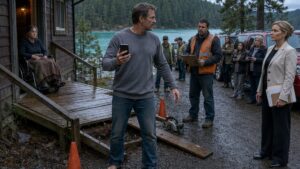
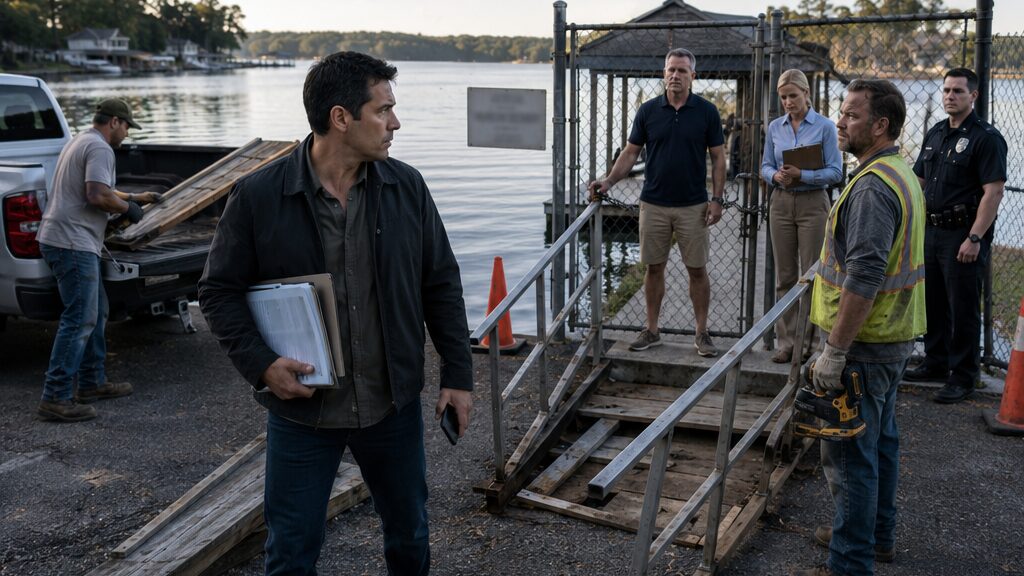
The first screw hit the gravel before David Garcia reached the gate.
It bounced once near an orange cone, bright and small against the wet gray stones, and then disappeared under the boot of a worker kneeling beside the half-built ramp. The worker had a drill in one hand and David’s new handrail in the other. Behind him, another man slid one of the ramp boards into the back of a white truck as if it were scrap lumber.
David stopped with his hand still around the folder tucked under his arm.
“Hey,” he called.
The drill kept whining.
“Stop,” David said, louder this time. “Stop the work.”
The worker looked up, then past David, not at him. That was when David saw Christopher Hill standing on the other side of the locked chain-link gate, one hand resting on the latch as if he owned the morning.
The lake was quiet behind him. Smooth water. A row of private docks. The posted HOA sign near the path, its white letters clean and severe: Lake Access By Authorization Only. Beyond it, the old boathouse sat in the sun with its green roof and fresh paint, looking like nothing bad could happen in a place that expensive.
Christopher wore a dark polo and shorts, the same clothes he wore to Saturday board walks, as if this were a routine inspection and not a crew dismantling something from David’s property.
“You need to move back,” Christopher said.
David looked at the truck. One ramp board was already inside. A second leaned against the tailgate. The handrail, the one Maria Lopez had measured twice because Linda’s right hand dragged when she got tired, hung crooked against the worker’s knee.
“That’s mine,” David said.
“It’s an unauthorized structure.”
“It’s a safety repair.”
“It’s a lakefront exterior alteration without approval.” Christopher’s voice was controlled in that practiced way he used at meetings, the kind that made disagreement sound like disorder. “The removal order is active.”
David crossed the last few feet to the gate. The chain was looped through the frame and locked with a heavy brass padlock. On any other morning he would have unlocked the small side gate with the key the association had issued when his house was built. Today there was a second chain wrapped around it.
“You changed the lock.”
“The board restricted access until compliance is restored.”
A drill started again.
David turned sharply. “I said stop.”
The worker paused with the bit against another screw. The crew supervisor, a broad man in a reflective vest, stepped out from behind the truck and lifted both palms, not quite apologizing.
“We were told to remove the non-compliant materials.”
“By who?”
The supervisor glanced toward Christopher.
David slipped his phone from his pocket and began recording. His thumb shook once before he steadied it against the folder. “I want the order in writing. I want the date. I want the appeal record. And I want to know why your crew is removing materials from my property before the hearing.”
Christopher’s mouth tightened. “You were noticed.”
“When?”
“A notice was placed on your front door.”
“When?”
Christopher looked toward the clipboard under the arm of the woman standing near him. Melissa Carter, the HOA compliance manager, adjusted her grip but did not speak.
David looked at her. “Melissa?”
She checked the clipboard. “The notice was posted this morning.”
“This morning,” David repeated. “The crew was already here when I came outside.”
The worker with the drill lowered it completely now. The supervisor looked uncomfortable.
Christopher stepped closer to the locked gate, his fingers curling through the chain-link. “Mr. Garcia, this has been discussed. The board has not approved the ramp. You were told not to proceed.”
“I was told the application was pending.”
“You proceeded anyway.”
“I repaired a rotting path and installed a handrail.”
“You created a structure.”
“I prevented a fall.”
Christopher’s eyes flicked toward the phone. “You should be careful about recording workers without consent.”
“They’re on my property taking my materials.”
“They are acting under association enforcement authority.”
“That’s not a court order.” David opened the folder with one hand, awkwardly but carefully, and pulled out the top sheet. “Here’s the county permit. Here’s Maria Lopez’s repair plan. Here’s the request I submitted to the HOA three weeks ago. Here’s the email confirmation from your office.”
Melissa looked up at that.
Christopher did not move.
David pressed the papers against the gate so the top page faced outward. “Received. Stamped. Dated. Before today.”
Christopher glanced at the sheet but did not reach for it. “Submission is not approval.”
The words landed harder than David expected. Not because they surprised him, but because of how cleanly they erased everything he had done right. He had filled every box he thought mattered. He had drawn the path measurements. He had paid the county fee. He had waited until Maria told him the old boards were too soft to leave through another week of rain.
And he had still known, somewhere under his careful voice and neat folder, that one box was missing the truth.
He kept the paper against the gate.
“Then you pause removal until the appeal.”
“The board has determined the structure presents an insurance and aesthetic issue along the lake path.”
“Aesthetic,” David said.
Christopher’s jaw shifted. “Lakefront modifications affect property values for every owner.”
Behind Christopher, the lake stayed bright and harmless.
David looked past him to the stretch of path behind the gate, the place where the ramp curved from his back door toward the level walkway by the water. For years, Linda had used that route to reach the old garden bench after dinner. After the stroke, the little slope became a hill. The back step became a ledge. The uneven stones became something David watched even when she was nowhere near them.
The supervisor cleared his throat. “Sir, do you want us to keep going or wait?”
David answered before Christopher could. “Wait.”
Christopher pointed at the ramp. “Continue.”
The supervisor did not move.
That was the first small shift in the morning. Not a victory. Just hesitation.
A uniformed officer walked up from the road side of the property, his hand resting near his belt but not on anything. David had seen the patrol car parked by the clubhouse when he came outside. At first, he thought one of the neighbors had called about the noise. Now he understood: Christopher had wanted the scene to look official before David even reached it.
“What’s the dispute?” the officer asked.
Christopher answered quickly. “Association removal of an unauthorized lakefront structure.”
David held up the folder. “Removal of a medically necessary access repair before my appeal has been heard.”
The officer looked from David to Christopher, then to the locked chain. “Who owns the gate?”
“The association,” Christopher said.
“The gate controls a service easement behind my house,” David said. “I have access for maintenance and repairs.”
“Not for unapproved construction,” Christopher said.
David forced himself not to raise his voice. “I am asking for the work to stop until the order is produced in writing.”
Melissa finally stepped forward. The clipboard was pressed flat against her blouse. “There is an enforcement notice.”
“Show it to him,” David said.
She turned a page. “The notice cites section 7.4, exterior alterations, and section 9.2, lakefront common-area protections.”
“Does it mention my appeal?”
Melissa’s eyes stayed on the paper for a second too long. “It mentions failure to obtain approval.”
“That’s not what I asked.”
Christopher cut in. “Mr. Garcia, this is not a debate. You can present your objections at the emergency review.”
“When?”
“Tomorrow.”
David looked at the ramp boards already stacked in the truck. “After half of it is gone?”
The officer stepped closer to the gate. “Do you have anything showing this gate needs to be opened today?”
David looked down at the folder.
He had the county permit. He had the contractor plan. He had the HOA timestamp. He had the emails.
He did not have the one letter still sealed in Linda’s dresser, the one he had not wanted strangers to read.
The drill was silent now. So was the lake. Even Christopher waited.
David slid the papers back into the folder slowly, feeling the empty weight of what was missing.
“I have proof,” he said, but the officer’s face told him that proof was not yet the same thing as authority.
The officer nodded toward the locked gate. “Then I need to see the document that says they have to open it today.”
Chapter 2: The Doorway That Turned Into A Wall
“Are they taking it back out?”
Linda Garcia stood in the kitchen doorway with both hands on her walker, her weight shifted carefully toward her left side. The question came before David had even closed the back door. She had heard the saw. Or the drill. Or maybe she had heard the kind of silence that came after men stopped working because someone had told them to.
David set the folder on the kitchen table.
“No,” he said too quickly. “Not all of it.”
Linda looked past him toward the rear glass door. From where she stood, she could see the bare strip where the handrail had been fastened that morning. Four screws lay on the table beside David’s keys. He had picked them up from the gravel without knowing why, then carried them inside like evidence.
Linda saw them.
Her fingers tightened around the walker handles. “David.”
“They removed two boards and part of the rail. I stopped them.”
“You stopped them?”
“For now.”
That was the truth, but not enough of it. The truck was still parked beyond the gate. Christopher was still out there with Melissa and the crew, waiting on the emergency review as if the house and its doorway could pause with them.
Linda began moving toward the kitchen table. Step. Pause. Walker. Step. Her right foot dragged just enough that David’s body reacted before his mind did. He moved to help.
She gave him the look that stopped him halfway.
“I can get to the chair.”
“I know.”
“You always say that like you don’t believe it.”
He stepped back.
Linda reached the chair nearest the window and lowered herself slowly. She wore a pale sweater over her therapy clothes, the cuffs bunched slightly at her wrists. On the counter behind her sat the morning pill organizer, the blue cup she used because the larger glasses slipped too easily, and the discharge folder from outpatient therapy.
David hated that their kitchen had become a place of objects chosen around what could fall.
He pulled out a chair but did not sit. “The HOA says the ramp is unauthorized.”
Linda gave a small, dry laugh. “The path was rotten before your father died.”
“I know.”
“They didn’t notice when it was dangerous.”
“I know.”
“But they noticed when it became useful.”
David looked toward the back door.
Without the handrail, the doorway seemed wider, emptier. The old step down to the sloped path looked harmless from a distance. It was only when someone moved slowly, when a foot failed to lift or a hand needed a rail exactly where none existed, that the house revealed its traps.
The phone on the table buzzed.
David picked it up and saw Maria Lopez’s name. He answered on speaker because Linda was watching his face.
“David,” Maria said, her voice tight. “I just got a call from the crew supervisor. They’re saying I can’t continue unless the HOA gives written access.”
“You have the county permit.”
“I do. And I’m telling you the design is good. But if the gate is locked and the association says I’m trespassing on common access, I can’t put my license in the middle of that without written clearance.”
Linda looked away.
David gripped the phone. “Maria, you saw the old boards.”
“I saw them. I put in my notes that the slope and missing rail are a fall risk.”
“Then tell them that.”
“I did. They said the issue is exterior approval, not safety.”
David closed his eyes for one second.
Maria’s voice softened. “I’m not walking away. But I need you to get them to put something in writing. Either they allow access or they deny it. Right now they’re using the gate to make everyone afraid to touch the job.”
After the call ended, Linda reached for one of the screws on the table. David almost told her not to, then stopped himself. She rolled it carefully between thumb and forefinger.
“You didn’t give them the letter,” she said.
David looked at her.
She did not look back. “From my doctor.”
“I gave them the accommodation request.”
“That’s not what I asked.”
He hated how close her words sounded to his at the gate.
“I gave them the therapy summary,” he said. “The part about limited mobility. The walker. The recommendation for level access.”
Linda’s face remained still. “But not the fall report.”
David sat then, because standing felt too much like hiding. “I didn’t think they needed that.”
“You didn’t think, or you didn’t want?”
Outside, a truck door slammed somewhere near the gate. The sound cut through the kitchen. Linda flinched, barely, but David saw it.
He spoke lower. “I didn’t want them passing around details about you in a board packet.”
“Details about me.”
“Mom.”
“No, say it.” Her voice stayed steady, which made it worse. “My bad right hand. My foot. The fall by the step. The part where I couldn’t get up before you came home.”
David stared at the screw between her fingers.
The afternoon of the fall came back in pieces he had never let arrange themselves fully: Linda on the path, one slipper twisted under her heel, her walker tipped sideways in the damp leaves, the lake just beyond her shoulder, shining as if it had nothing to do with what had happened. She had not cried when he found her. She had apologized for scaring him.
That apology had been worse than blood.
“I promised you this house wouldn’t turn into a place you couldn’t use,” David said.
“And then you tried to keep the reason private.”
“I tried to keep you private.”
Linda put the screw down. “There is a difference.”
His email chimed.
He grabbed the phone too hard. The subject line showed the HOA seal and Melissa Carter’s name.
Emergency Compliance Review Notice.
David opened it.
Linda watched his eyes move.
“What does it say?”
He swallowed. “They consider the ramp unsafe and non-compliant pending board review.”
“Unsafe,” Linda repeated.
“It says all work must stop. It says continued obstruction of enforcement may result in additional fines.”
“Obstruction?”
David read further, the words flattening the kitchen as he went. Emergency review. Tomorrow morning. Ten o’clock. Clubhouse conference room. Owner may present documentation. Failure to comply may result in association removal at owner expense.
At the bottom, in Melissa’s clean professional language, was one more line:
Please be advised that the current structure does not have approved medical accommodation status in the association file.
David lowered the phone.
Linda’s face changed just enough for him to see she understood before he explained. Not the legal part. The part he had caused.
“You didn’t give them enough,” she said.
“I gave them enough to know.”
“Not enough to make them admit they knew.”
He wanted to argue. He wanted to say Christopher would have blocked it anyway, that the board did not need the fall report to understand a woman with a walker needed a handrail. He wanted to tell her the shame was theirs.
But the empty place by the back door stood behind him like an answer.
Linda pushed herself upright. “Where is the full letter?”
“In your dresser.”
“Bring it.”
“Mom—”
“Bring it here.”
He did not move.
Linda looked at him then, not angry, not soft. “If they are going to talk about whether I can get through my own door, I need to know exactly what you let them know.”
David went down the hall to her bedroom and opened the top drawer. The sealed envelope lay under a stack of folded scarves, untouched, as if privacy could protect anyone from a locked gate.
When he returned, Linda did not reach for it at first.
The phone buzzed again.
Another email from Melissa appeared, shorter than the first.
Emergency review confirmed for 10:00 a.m. tomorrow. Bring all documents you wish the board to consider.
David looked from the message to the envelope, and the kitchen seemed to shrink around the rear doorway, the missing rail, the four screws, and his mother waiting to see what he had chosen not to say.
Chapter 3: The Locked Lake Gate And The Missing Line
“You are not bringing another board through here.”
Christopher Hill stood behind the locked gate with both feet planted on the lake path and one hand wrapped around the chain like he had been waiting there long enough to become part of it. The morning sun was behind him, throwing the diamond pattern of the fence across his shirt. Beside him, the posted HOA sign gleamed white and official.
David stopped three feet from the gate.
Maria stood behind him with a rolled plan tube under one arm and a tool belt she had not put on. A county inspector had come in a white vehicle with the county seal on the door. The uniformed officer was there too, speaking quietly into his radio near the road. Melissa Carter held her clipboard against her chest, her eyes moving between David’s folder and the second chain still looped through the gate.
David lifted the folder. “I’m not bringing a board through. I’m bringing documents.”
Christopher looked at Maria’s plan tube. “This area remains closed to unapproved work.”
“The county inspection is scheduled for nine.”
“The county does not control HOA exterior standards.”
“The county controls whether the repair is safe.”
Christopher’s expression did not change. “Safe does not mean approved.”
Maria exhaled through her nose but said nothing.
David opened the folder and pulled out the county permit first. He had placed the papers in order before leaving the kitchen. Permit. Contractor plan. HOA application. Email confirmation. Medical accommodation request. He had not added the sealed letter. Not yet. It was in the folder, still unopened, because Linda had said she wanted to read it with him before he gave it to anyone.
That small delay now felt like a hand around his throat.
The county inspector stepped forward. “Mr. Hill, I’m here to inspect existing conditions and confirm whether the repair plan meets safety requirements. I don’t need to authorize HOA approval.”
Christopher nodded once. “Then you can inspect from this side.”
“The remaining structure is beyond the gate.”
“Then the owner should have waited for association approval before building it.”
David held the permit against the fence, the way he had held the papers the day before. “The path was already failing. Maria replaced unstable boards and started the handrail because my mother was coming home from therapy.”
Christopher’s eyes flicked toward the folder. “That was your choice.”
There it was. The cleanest version of Christopher’s case. David had acted before the HOA gave him permission. In a community like Lakeview Shore, that sentence alone could make people stop listening.
Melissa flipped through her clipboard. “The issue before the emergency review is whether the installed elements constitute an unauthorized alteration to the common lakefront access corridor.”
“It’s behind my house,” David said.
“It connects to association-maintained shoreline.”
“It connects my mother’s doorway to level ground.”
Melissa’s face tightened, but Christopher answered first.
“Then you should have applied correctly.”
David felt heat rise in his neck. He forced his voice down. “I did.”
“No,” Christopher said. “You submitted an exterior alteration form. Incomplete. No approved accommodation status. No final board vote. No variance.”
David pulled the stamped copy from the folder and held it up. “Received three weeks ago.”
“Received is not approved.”
Maria stepped forward then. “The old boards were soft at the edge. The slope doesn’t meet modern accessibility standards. My plan reduces risk.”
Christopher turned to her. “Are you willing to certify that this structure meets every HOA aesthetic and insurance requirement?”
“I’m willing to certify the repair is safer than what was there.”
“That is not the question.”
“It should be,” Maria said.
For the first time that morning, Christopher’s calm slipped. “This association has had one lakefront injury claim in five years. One. It took eighteen months and increased premiums for every owner. We are not allowing homeowners to improvise structures along shared access because they believe their situation is special.”
The words hung there.
David looked at him more closely. Beneath the polished enforcement language was something sharper than annoyance. Fear, maybe. Or memory turned into policy.
The county inspector crouched near the outside edge of the fence, studying the visible portion of the ramp. “From what I can see, the joist spacing is standard. Handrail height appears within range. I would need access for a full inspection, but this is not obviously unsafe.”
David let out a breath.
Christopher immediately said, “Not obviously unsafe is not approval.”
The breath stopped.
Melissa wrote something on the clipboard.
David turned to her. “You have my application in the file.”
“Yes.”
“And the request for accommodation.”
She paused. “There is an exterior alteration application with a note referencing mobility concerns.”
“A note?”
“That is how it appears in the file.”
David opened the folder again, faster now, and pulled out his copy. “No. The accommodation request was attached. Two pages. Therapist recommendation. Contractor note. Timeline. Here.”
He pressed the pages to the fence. Melissa stepped closer despite Christopher’s glance.
Her eyes moved over the top sheet. David saw the moment she found the stamp. It was faint blue, half over the corner, but clear: RECEIVED. Three weeks ago. Melissa Carter’s initials sat beside the date.
She looked back at her clipboard.
David watched her.
“What?” he asked.
Melissa did not answer.
Christopher said, “This can be reviewed at ten.”
“The inspector is here now.”
“The gate remains locked until the board determines access.”
David looked at the officer. “Can he do that if I have a county permit?”
The officer’s answer came carefully. “I can’t adjudicate HOA authority. If the association controls the gate and there’s no immediate emergency, I’m not forcing them to open it.”
“No immediate emergency,” David repeated.
The phrase felt obscene beside the path where his mother had fallen.
Maria touched David’s sleeve, not to restrain him exactly, but to remind him there were witnesses.
David looked through the fence at Christopher. “You’re using a lock because you know the permit doesn’t say what you want it to say.”
Christopher stepped closer until only the chain-link separated them. “I’m using a lock because owners agreed to rules when they bought here.”
“I bought a house, not permission to keep my mother safe.”
“You bought into a community.”
The lake moved behind him in small ripples. A pontoon boat knocked softly against a dock. Somewhere a neighbor’s dog barked once, then stopped.
Melissa turned another page on her clipboard, slower this time.
David noticed her thumb stop near the bottom of a form. She glanced at his copy again.
“What is it?” he asked.
She lowered her voice. “Your copy has a received-date stamp.”
“So does yours.”
Her eyes moved toward Christopher before returning to the page. “The file copy has a later intake date.”
David stared at her.
Christopher’s head snapped toward Melissa. “This is not the review.”
She closed the clipboard.
But David had heard enough. The gate, the chain, the permit, the stamped page in his hand—all of it shifted. The question was no longer only whether he had started too early.
It was whether someone had made his request look later than it was.
David held the stamped copy against the fence again, this time for the officer, for the inspector, for Maria, and for Melissa, whose face had gone still.
“Then somebody needs to explain,” he said, “why my paperwork and your file don’t say the same thing.”
Chapter 4: The Video Made Him Look Guilty
The video had already been posted before David got back inside.
He saw it because his phone would not stop vibrating on the kitchen table. One message from a neighbor he barely knew. Then another. Then a notification from the Lakeview Shore community board, where people usually argued about dock lights and trash pickup.
The caption sat above the video like a verdict.
Owner thinks rules don’t apply. Builds illegal lake ramp, then calls county when HOA says no.
David stood frozen with the phone in his hand while the clip played without sound.
There he was at the gate, holding papers against the chain-link fence. Christopher stood on the other side, calm and square-shouldered. Melissa’s clipboard appeared for half a second. The officer appeared too. But the video was cropped tightly enough that no one could see the back doorway of David’s house, no one could see the missing handrail, no one could see the place where Linda’s walker caught on the old threshold when she was tired.
The shot made David look like a man trying to force his way into common lakefront property with a contractor and a county official.
Someone had added text across the bottom.
HOA finally enforcing rules.
David replayed it once, then once more, hoping the second viewing would reveal some clue that made it less deliberate. It did not. The camera had been positioned from the side yard of a lakefront neighbor, angled past the shrubs, catching the documents and the officer and the locked gate but not the reason any of them were there.
Linda rolled her walker into the kitchen doorway. “What is it?”
David locked the screen without thinking.
Her eyes dropped to his hand. “David.”
“It’s nothing you need to look at.”
“That means it’s about me.”
“It’s about the gate.”
“That means it’s about me.”
He turned the phone face down on the table. The four screws were still there beside his keys. He had not been able to throw them away.
Linda came closer slowly. “Let me see.”
“No.”
The word came out too fast.
Her face closed.
David softened his voice. “Mom, they’re using the video to make it look like I built some private lake deck.”
“Then tell them why it’s there.”
“I can answer without putting your medical history on a neighborhood message board.”
“You mean without putting me there.”
He leaned both hands on the table. The folder lay open, the stamped copy on top. Beside it sat the sealed doctor’s letter, still unopened, as if the envelope itself had begun judging him.
“I’m not going to let strangers debate your body in the comments.”
Linda turned her walker slightly so she could look out the rear door. The empty strip where the handrail had been removed caught the late sun. The holes in the post looked dark and precise.
“I appreciate that,” she said. “I do.”
“But?”
“But you keep acting like needing help is the same as being exposed.”
David had no answer ready.
His phone buzzed again. A new comment preview appeared despite the locked screen.
If he needed special access he should have applied the right way like everyone else.
David picked up the phone, and anger moved through him so quickly it almost felt useful. He opened the thread. More comments had appeared.
Rules are rules.
That path is common property.
This is how property values get ruined.
One person gets a ramp, next person builds a deck.
Then a comment from Christopher’s account, carefully written, already gathering likes.
The board cannot discuss individual enforcement files publicly, but all owners are expected to follow established approval procedures before modifying lakefront access areas.
David stared at the words. They were not wild. They were worse. They sounded responsible.
He typed three different replies and deleted each one.
My mother had a stroke.
She fell on that path.
You locked a gate to stop a safety repair.
Each sentence felt like handing Linda to strangers one piece at a time.
Linda watched his thumbs stop and start. “Don’t do it.”
“I’m not letting him control the story.”
“You already are if you think the only way to answer is to show them my letter.”
“It would explain everything.”
“To them.” She nodded toward the phone. “And tomorrow they would still have opinions. Some would be kind. Some would be awful. All of them would know something I didn’t choose to give them.”
David put the phone down.
The front doorbell rang.
He and Linda looked at each other. David crossed the house and opened the door to find Maria Lopez on the porch with her work tablet under one arm and sawdust still on her boots.
“I’m sorry to show up,” she said, glancing past him. “But I got an email from my supplier.”
David stepped aside. “Come in.”
Maria stopped in the entry rather than bringing her boots onto the clean floor. She looked tired in a way that made David immediately understand this was not good news.
“They’re asking whether the materials are still being installed this week,” she said. “The composite boards were a rush order. If the job is stopped, they want to reclaim the remaining shipment or charge storage.”
“How long do we have?”
“Forty-eight hours before extra charges start. Maybe less if another job claims the boards.”
Linda had made it halfway into the hall. “Those are the boards for the ramp?”
Maria looked at David before answering. “Yes, ma’am. The ones with the textured surface.”
Linda nodded as if hearing about someone else’s life. “The ones that don’t get slick.”
David felt that land harder than any comment online.
“I’ll cover the storage,” he said.
Maria shook her head. “That’s not the whole issue. If the HOA forces removal and the materials get damaged, the supplier won’t take responsibility. I need written access or written denial. I can’t keep my crew half-scheduled with a locked gate and an enforcement order.”
“So everyone gets to wait except my mother.”
Maria’s eyes softened. “I’m not against you, David.”
“I know.”
“But I have to protect my license. Christopher already left me a voicemail saying any further work would be treated as unauthorized construction on association-controlled shoreline.”
David rubbed a hand across his face. “He called you directly?”
“Yes.”
Linda’s walker clicked once against the floor. “He called the contractor before the meeting?”
Maria nodded.
David picked up his phone again and opened the community board. The video had been shared twice. A neighbor had written, Why is there an officer if Garcia is right?
That was the whole trick. Official objects made people choose sides before the truth arrived. A gate. A clipboard. A uniform. A caption.
His inbox chimed.
This email was not from Melissa. It came from Kevin Miller, the HOA treasurer, whose messages usually contained budget spreadsheets and cautious phrases like for everyone’s awareness. The subject line was blank.
David opened it.
The message had only one sentence.
You did not get this from me, but you should know this was discussed before the review.
Below it was a forwarded image of what looked like a board note or internal agenda comment. No letterhead. No signature. Just a typed line, highlighted in yellow.
Removal should proceed before accommodation claim matures into precedent.
David read it again.
Then again.
Maria moved closer. “What is that?”
David turned the screen so she could see.
Her mouth tightened.
Linda did not ask to see. She looked at David’s face and seemed to understand enough.
“What does that mean?” she asked.
David’s voice came out flat. “It means somebody knew exactly what kind of request this was.”
The phone felt suddenly heavier than the folder had at the gate. The video online made him look guilty because the world could only see the part Christopher wanted seen. But this line, this small private sentence, showed something else: they had not just misunderstood the ramp.
They had been racing it.
David looked toward the rear door, where the missing handrail left four dark holes in the wood.
For the first time all day, Linda did not tell him to put the phone down.
Chapter 5: The Board Called Safety An Exterior Change
Christopher began the meeting with a photograph of the half-removed ramp.
Not David’s application. Not the county permit. Not Maria’s plan. Not the stamped received copy. Not the doctor’s sealed letter, which still sat inside David’s folder like a weight he had not earned the right to use.
Just the photograph.
It filled the screen at the front of the HOA clubhouse conference room, bright and enlarged until every unfinished edge looked careless. A ramp board leaned at an angle. The removed handrail lay beside orange cones. The lake glittered behind it, cropped into the kind of view that made any structure look like an intrusion.
David sat at the long table with the folder in front of him. Linda had stayed home. That had been her choice, but he could still see the disappointment in the way she had handed him the envelope that morning and then taken it back.
“Not yet,” she had said. “Not until you can say why you didn’t use it.”
Now Christopher stood beside the screen with a remote in his hand.
“This is what the board is being asked to retroactively bless,” he said. “An exterior alteration begun without final approval in a protected lakefront corridor.”
Kevin Miller sat two chairs down from Melissa, his fingers folded over a yellow legal pad. He did not look at David at first.
Melissa had the official file in front of her. The folder was thinner than David’s.
That bothered him more than it should have.
Christopher clicked the remote. The next slide showed a section of the HOA rules, enlarged and underlined.
Section 7.4: No owner may alter exterior structures, common-facing access paths, lakefront approaches, railings, ramps, stairs, docks, or visual corridors without prior written approval.
“There is a process,” Christopher said. “Every owner here relies on that process. We cannot have individual owners making unilateral changes because their reasons feel urgent to them.”
David leaned forward. “My reasons don’t feel urgent. They are urgent.”
Christopher turned. “You will have time to speak.”
“I had time to apply, too. You still sent a crew.”
A few unnamed neighbors seated along the wall shifted. David recognized one of them from the community board comments. Another had probably filmed the video.
Melissa cleared her throat. “Mr. Garcia, the emergency review will allow owner statement, compliance summary, contractor input if applicable, and board questions.”
“Is my contractor allowed in?”
Christopher said, “This is an owner hearing.”
“Because you already called her and scared her off the job.”
Kevin looked up then.
Christopher’s expression remained almost polite. “I reminded the contractor of association access restrictions.”
David opened the folder and slid Maria’s written statement across the table. “She provided this instead.”
Melissa reached for it. Christopher’s hand moved first, but Kevin said, “Let Melissa log it.”
Christopher stopped.
It was a small thing. David noticed it.
Melissa took the statement and wrote something on her clipboard. “Received.”
David watched her pen mark the time.
“Say the date too,” he said.
Her eyes flicked up.
“Please,” David added.
Melissa’s throat moved. “Received today.”
Christopher’s face hardened. “We are not here to litigate clerical practice.”
“No,” David said. “Apparently we are here because clerical practice is the difference between my mother having a safe doorway and your crew taking the rest of it out.”
Kevin finally spoke. “Mr. Garcia, before we go further, can you explain why work began before written approval?”
The room quieted.
David had expected Christopher’s accusation. He had not expected Kevin’s question to sound so reasonable, or for that reasonableness to make him feel more exposed.
He looked at the folder. “My mother’s discharge schedule changed.”
“From where?” Kevin asked.
“Outpatient therapy. She had a stroke last year.”
There was a small movement along the wall. Someone looking down. Someone else crossing their arms.
David kept his voice even. “The back path was already deteriorating. Maria inspected it and said the boards at the slope were soft, the step was unsafe, and the handrail didn’t support her grip. We submitted the repair plan. We had the county permit. I believed the HOA request was being reviewed as an accommodation.”
Christopher said, “Believed.”
David turned to him. “Because I submitted it that way.”
Melissa opened the HOA file.
David noticed then that her hands were not steady. Not dramatically shaking. Just careful, too careful.
“The association file,” she said, “contains an exterior alteration application dated—”
David interrupted. “Which date?”
Christopher’s voice cut in. “Let her finish.”
Melissa looked at the first page. “Intake date is listed as last Friday.”
David opened his folder and pulled out his copy. “My received stamp is from three weeks ago.”
He slid the page across the table.
Kevin reached for it before Christopher could stop him.
The room seemed to tighten around the paper. Kevin compared David’s copy to the HOA file page Melissa placed beside it. He did not say anything for a long moment.
Christopher leaned over. “The intake date reflects when the file was deemed complete.”
“Then why is it labeled received?” David asked.
Melissa turned a page. “There is a note in the system marking the accommodation packet incomplete.”
“Who marked it incomplete?”
She looked at Christopher.
He stared at the screen.
“Melissa,” Kevin said quietly.
She drew a breath. “The note was entered after board review.”
“After Christopher reviewed it?” David asked.
Melissa’s silence answered before her mouth did. “After Mr. Hill requested clarification.”
Christopher set the remote down. “Because it was incomplete. The documentation did not establish a formal medical accommodation.”
David felt the sealed absence of the letter from his folder. He had known this part would come. Still, when it arrived, it did not feel like a fact. It felt like a door closing.
“What documentation was missing?” Kevin asked.
Christopher answered. “Specific medical necessity. Duration. Explanation of why no alternative access could be used. Confirmation that the structure requested was required, not merely preferred.”
David looked at the photograph on the screen. The ramp looked ugly there. Half-built. Cropped away from the back door. Cropped away from Linda.
“I included the therapist recommendation,” David said.
“It referenced mobility limitations,” Christopher said. “It did not justify altering the lakefront corridor before approval.”
“And that gave you the right to remove it before the review?”
“It gave the association the responsibility to prevent an unapproved structure from remaining.”
Kevin’s pen tapped once against his pad. “Christopher, the phrase in the internal note—”
Christopher turned sharply. “This is not an executive session discussion.”
“It became relevant when removal happened before the review.”
David looked at Kevin. “You saw it.”
Kevin met his eyes briefly, then looked down. “I saw enough to be concerned about timing.”
Christopher’s voice cooled. “Concern does not change the rules.”
“No,” David said. “But maybe it changes why you used them so fast.”
A board member at the far end murmured something about liability. Christopher seized the word.
“Yes. Liability. That is what everyone keeps forgetting. Five years ago this association dealt with an injury claim because a lakefront owner modified a dock step without approval. We all paid for that. We all lived through the insurance review, the premium increase, the threats from attorneys. So when an owner begins unapproved work in a lakefront access area, the board does not have the luxury of sentiment.”
For the first time, David saw the room listen to Christopher not because he was powerful, but because he was offering them fear that sounded familiar. Property values. Insurance. Precedent. One person’s exception becoming everyone’s bill.
David almost hated him less in that moment.
Almost.
Then Christopher clicked back to the photo of the ramp.
“This is not a question of whether Mr. Garcia loves his mother,” he said. “I’m sure he does. This is a question of whether private urgency overrides community rules.”
There it was again, neat and cruel without raising its voice.
David stood before he had planned to.
“No,” he said. “It’s a question of what happens when a rule sees a person and calls her a problem.”
The room went still.
He opened the folder but did not remove the sealed letter. His fingers rested on it.
“My mother fell on that path,” he said.
Melissa looked up.
David swallowed. He had not said it aloud outside the kitchen. “Before the repair. Before the application. Before any of this. I found her on the slope because the old step and rail weren’t safe for how she moves now.”
Christopher’s face shifted, just slightly.
“I didn’t include the full fall report,” David continued. “That was my mistake. I thought I was protecting her privacy. I thought if I gave you the contractor plan, the therapist recommendation, the permit, the timeline, you would understand enough without needing every humiliating detail.”
The word humiliating hit him as soon as he said it.
He heard Linda’s voice from the kitchen: You keep acting like needing help is the same as being exposed.
David’s hand came off the envelope.
“I should not have hidden the strongest part of the truth,” he said. “But you should not have used that gap to send a crew before the appeal.”
Christopher folded his arms. “The board can only consider what is submitted.”
“Then consider the dates. Consider Maria’s statement. Consider the county inspector. Consider that your own file says one date and my stamped copy says another.”
Kevin was now looking at the two documents side by side. Melissa had not closed the file.
Christopher picked up a printed sheet and slid it toward David.
“This is the fine schedule,” he said. “If you continue to obstruct removal, the association may assess daily penalties, removal costs, and legal fees. If unpaid, those assessments may become a lien under the governing documents.”
The word lien moved through the room like a cold draft.
David looked at the sheet. Numbers in columns. Administrative fee. Contractor recovery. Daily violation. Legal processing.
It was amazing how clean a threat could look when printed in a table.
“You’re threatening my house because I won’t remove a ramp my mother needs to get out of it.”
Christopher did not blink. “I am advising you of enforcement consequences.”
Kevin set down his pen. “We may need to pause—”
Christopher turned toward the board. “The motion is simple. Owner has twenty-four hours to voluntarily remove remaining unapproved materials, pending submission of complete accommodation documentation. Failure triggers association removal at owner expense.”
“Pending submission?” David said. “You’re giving me one day to remove the thing before you review the document you say is missing?”
“That is the consequence of starting early.”
David looked at Melissa.
She looked down at the file.
Kevin did not vote right away. But when the motion carried, it carried anyway.
The meeting ended without anyone shouting. Chairs scraped. Neighbors whispered. Christopher gathered the fine schedule and slid it neatly into the record. Melissa stamped the top page of Maria’s statement with the date and time as if doing one small thing correctly could balance the rest.
David put his folder under his arm and walked out past the clubhouse windows facing the lake.
At the door, Kevin stopped him.
“I can’t undo the vote tonight,” Kevin said quietly.
David looked at him. “Then why send the note?”
Kevin glanced back toward the meeting room. “Because if that line means what I think it means, the timing wasn’t just strict. It was strategic.”
Before David could answer, his phone chimed with the official decision from Melissa.
Twenty-four hours.
Remove remaining materials voluntarily or the association will proceed with forced removal and assess costs to the owner.
David stood outside the clubhouse with the lake beyond the glass and the sealed letter still in his folder, knowing the choice he had avoided had just been put on a clock.
Chapter 6: The Letter He Was Afraid To Use
Linda placed the sealed medical letter on top of David’s folder before he finished explaining the vote.
She did it with her left hand. Carefully. Deliberately. The envelope slid across the kitchen table until it covered the fine schedule Christopher had handed him the night before.
David stopped mid-sentence.
Linda was already dressed for the day, though it was barely seven. Her cardigan was buttoned unevenly, one side slightly higher than the other. She noticed him notice and fixed it without comment.
“Use it,” she said.
He looked at the envelope. “You should read what they’ll see first.”
“I know what happened to me.”
“That’s not the same thing as seeing it written in a board packet.”
Linda pulled out the chair and lowered herself into it. Her walker stood beside her, angled toward the rear doorway. Since the handrail had been removed, she had not tried to go outside. Not once. The doorway had turned into something they both pretended was temporary.
“I read it last night,” she said.
David looked up.
“You took it out of the dresser and left it on my nightstand before the meeting. I opened it after you left.”
“You didn’t say.”
“You didn’t ask.”
The words were not sharp. That made them harder to avoid.
David sat across from her. The envelope showed a neat tear along the top edge. He had not noticed. Inside was the letter from the physician, the therapy addendum, and the fall report he had refused to copy. It described Linda’s right-side weakness, balance risk, need for stable hand support, difficulty with uneven surfaces, and the recommendation for safe level access from the rear entrance due to the layout of the home.
It also described the fall by the lake path in plain language.
No drama. No shame. Just fact.
David put his fingertips on the envelope but did not open it.
Linda watched him. “Do you know what bothered me most?”
“The fall being in there.”
“No.” She looked toward the rear door. “That you decided the truth about me was something to manage.”
He flinched.
“I know you meant well,” she said. “You always mean well so hard it becomes another wall.”
He gave a small, tired laugh despite himself. It disappeared quickly.
“I didn’t want them to reduce you to symptoms.”
“And instead they reduced me to nothing.”
The kitchen went quiet.
Outside, the lake path was empty. The remaining ramp section sat unfinished behind the locked gate, a wounded thing waiting for another truck.
Linda pushed the envelope closer to him. “I don’t want my neighbors reading about me. I don’t want Christopher Hill deciding what my body means. I don’t want comments, pity, whispers, or people pretending they never noticed me using a walker before.”
“Then we don’t use it.”
“Yes,” she said. “We do.”
David looked at her.
“Because I want to stay in this house more than I want Christopher to be comfortable with a cleaner version of me.”
He opened the envelope then.
The first page was clinical. The second page was worse because it was specific. Date of fall. Location: rear lake path. Contributing hazards: uneven threshold transition, sloped walkway, insufficient gripping rail. Recommended modification: stable ramp surface and continuous handrail from rear doorway to level path.
David read until the words blurred.
Linda reached across the table and tapped the page. “That line. The one about the threshold. That’s why I need it. Not because I want to sit by the lake like a lady in a brochure.”
He nodded.
“And David?”
He looked at her.
“Don’t apologize for me when you submit it.”
“I won’t.”
“I mean it. Don’t write that I’m sorry for the inconvenience. Don’t write that we understand community concerns. Don’t make me sound like I’m asking to borrow dignity.”
His mouth tightened. “Okay.”
The county office opened at eight-thirty. David drove there with the folder on the passenger seat and Linda’s letter clipped inside the front flap, no longer hidden beneath other documents. The county inspector met him near the public counter with a paper cup of coffee and the expression of someone who had already heard enough to be careful.
“I can confirm what I observed,” the inspector said. “But I can’t force the HOA to approve an exterior alteration.”
“I know.”
The inspector pulled Maria’s plan from the folder and laid it beside a county checklist. “From a safety standpoint, the proposed surface and rail are better than the existing condition. The old step and slope present a higher fall risk for someone using mobility assistance.”
“Can you put that in writing?”
“I can issue an inspection note based on visible conditions and submitted plans. It won’t settle the HOA issue.”
“Nothing settles the HOA issue.”
The inspector looked at him over the papers. “Sometimes the point is to remove excuses one at a time.”
That was the first useful sentence David had heard from an official in two days.
By late morning, he had the inspection note. By noon, Maria had emailed a revised drawing with a narrower rail profile and a darker finish that matched the lake path posts. She added one sentence at the bottom: Design maintains required hand support while minimizing visual impact.
David did not love the compromise. He loved even less that compromise had become necessary after someone had already taken boards from his property. But when he imagined Linda’s hand finding the rail, the color of the rail mattered less.
At the HOA office, Melissa was alone behind the front counter. Her hair was pulled back, and the clipboard from the gate sat beside her keyboard. Through the open door behind her, David could see stacked boxes of meeting records and a wall calendar marked with inspection dates.
She looked up when he entered, and for a second neither of them spoke.
“I need to submit a corrected medical accommodation packet,” David said. “And a formal demand to pause removal until review.”
Melissa stood. “I can receive it.”
“I need you to stamp every page.”
Her face tightened, but she nodded. “I understand.”
He slid the folder across the counter and began laying out the documents one by one. Linda’s medical letter. Fall report. Therapy recommendation. County inspection note. Maria’s revised plan. Copy of the original received stamp. Copy of the email confirmation. Copy of the internal note Kevin had forwarded, with the source removed.
Melissa’s eyes stopped on that page.
David watched her read the highlighted line.
Removal should proceed before accommodation claim matures into precedent.
She did not ask where he got it.
“You saw this before?” he asked.
Melissa took too long to answer. “I saw discussion about timing.”
“That isn’t what I asked.”
“I saw enough to know Mr. Hill was concerned the board would lose enforcement options if the ramp remained in place.”
“The ramp. Not the need.”
Her hands rested beside the stamp. “The file was treated as an alteration first.”
“And accommodation second.”
She looked at him then. “Yes.”
The stamp came down on the first page. The sound was small but solid.
Received.
Second page.
Received.
Third.
Received.
David waited until every page had ink. Then he slid forward a letter he had written at Linda’s kitchen table, using none of the apologetic language he had almost typed out of habit.
“Please include this in the record.”
Melissa read the first lines.
My mother is not asking the association to ignore safety. She is asking the association to stop calling safety a violation.
Melissa’s face changed, not enough to become an apology, but enough to become human.
“I need to tell you something,” she said.
David stayed still.
“Christopher has the crew scheduled for tomorrow morning.”
He had expected it, and still his stomach dropped.
“What time?”
“Dawn. He said if the materials are gone before legal review, the board can consider a new application from zero.”
“From zero.”
“I objected to the timing.”
“Did you put that in writing?”
She looked away.
David gathered his copies, each page stamped now. “Then do it.”
“David—”
“No. Put it in writing. Not because it helps me feel better. Because tomorrow morning, if that truck comes back, everyone there will pretend the paper says whatever they need it to say.”
Melissa’s eyes moved to the stamp, then the clipboard, then the folder.
“I’ll send an email confirming receipt and noting the pending accommodation review.”
“When?”
“Now.”
He waited at the counter while she typed. He heard the keys. He watched the message form on the screen in fragments he could not fully read. Pending corrected packet. Medical accommodation. Removal scheduled. Recommend pause pending board review.
She hesitated before sending.
Then she clicked.
David’s phone chimed a moment later.
He looked at the email, then at Melissa.
“Thank you,” he said.
She did not accept it as absolution. “That may not stop him.”
“No,” David said, putting the folder under his arm. “But it means he can’t say he didn’t know.”
Before sunrise the next morning, headlights swept across David’s kitchen wall.
He was already awake, standing by the rear door with his shoes on and Linda’s stamped medical letter inside the folder. The engine outside idled low and heavy. A truck turned off the road and rolled toward the lake gate, orange lights blinking against the dark windows.
Linda appeared behind him with both hands on her walker.
David turned. “Mom, stay inside.”
She looked past him to the lights.
“No,” she said. “Not hidden.”
Outside, the crew truck stopped at the locked gate again.
Chapter 7: The Gate Opened Before Anyone Apologized
The crew supervisor had one hand on the remaining handrail when David stepped between him and the ramp.
“Not until the board puts that order in writing.”
The supervisor froze with his fingers still around the rail. Behind him, the truck idled with its orange lights blinking against the lake gate. The two workers stood by the tailgate, waiting for someone else to decide whether the morning would become work or trouble.
Christopher Hill stood inside the gate with the chain already unlocked but still looped through the fence. He had come prepared this time. Dark polo, folded papers, phone in hand, expression set as if dawn made him more official.
“Mr. Garcia,” he said, “you were notified.”
David held up his folder. “And you were notified that a corrected medical accommodation packet was received yesterday. Stamped. Logged. Sent to the board.”
Christopher’s eyes moved briefly to the folder. “The enforcement order remains valid.”
“Then show it.”
The uniformed officer had returned, standing near the road side of the gate. David had called before the truck arrived, not to ask anyone to save him, but to make sure the morning had witnesses. Maria Lopez stood beside him with her arms folded over her jacket, her tool bag still in her truck. Linda waited just inside the rear doorway, both hands on her walker, visible through the glass.
Not hidden.
The sight of her changed the air around the gate. One of the workers looked away first.
Christopher noticed her and tightened his mouth. “This is not necessary.”
David did not turn around. “It is exactly necessary.”
The supervisor released the handrail and stepped back. “I need clarity before my crew touches anything.”
“You have clarity,” Christopher said. “Proceed with removal.”
“No,” David said. He took one page from the folder and held it out through the fence. “Melissa Carter sent this to the board yesterday. It says removal is scheduled while a corrected accommodation review is pending. It recommends pause.”
Christopher did not take the page.
A car door closed behind David. Melissa came up the path from the clubhouse parking area, carrying her clipboard and a thin file. She looked as if she had dressed in a hurry. Her hair was pulled back, but loose strands had escaped around her face.
Christopher turned toward her. “Why are you here?”
“To complete the record,” she said.
“You are not authorized to override enforcement.”
“I’m not overriding anything.” Melissa opened the file. “I’m confirming receipt.”
David watched Christopher’s face as she spoke. He saw, for the first time, something like alarm beneath the anger.
Melissa faced the officer, then the crew supervisor. “Yesterday at 12:43 p.m., the association received a corrected medical accommodation packet from David Garcia regarding the rear lake path ramp and handrail. The packet included medical documentation, a fall report, contractor revision, county inspection note, and a formal request to pause removal pending review.”
Christopher said, “The packet was incomplete when enforcement began.”
“It is not incomplete now,” Melissa said.
“That doesn’t erase the violation.”
“No,” Kevin Miller said from behind her. “But it changes the risk of continuing removal.”
David turned. Kevin was walking quickly from the parking area, one hand holding a leather notebook, the other carrying a set of printed emails. He did not look comfortable. He looked like a man who had spent the night deciding whether discomfort was still an excuse.
Christopher’s voice sharpened. “Kevin, this is not a board meeting.”
“It became a board matter when you scheduled removal after the corrected packet was received.”
“The vote was already taken.”
“The vote was taken before the corrected packet and before Melissa’s notice.” Kevin stopped beside the gate, breathing hard from the walk. “I’m not approving additional demolition without legal review.”
“You don’t have authority to stop enforcement alone.”
“Neither do you, not when the record changed.”
The workers looked at the supervisor. The supervisor looked at the officer. The officer looked at the papers, then at Christopher.
David stayed still. He could feel Linda behind him without looking. That was harder than facing Christopher. If he lost his temper, if he turned this into shouting, he would make it easier for them to call him the problem.
Christopher pointed toward the ramp. “This structure was begun early. That fact has not changed.”
“No,” David said. “It hasn’t. I started before final approval because my mother’s discharge date moved and the old path was unsafe. I should have given you the full medical letter from the start.”
Christopher’s expression flickered, as if he had expected denial and received something less useful.
David continued, “That mistake is mine. But you knew there was an accommodation issue before you sent a crew. You knew there was an appeal before the first board came off. And you scheduled this second removal after Melissa told you the corrected packet was received.”
Kevin looked down at the printed emails in his hand. “Christopher, why not wait forty-eight hours?”
“Because every day that ramp remains, it becomes harder to enforce removal.”
The sentence came out fast.
No one moved.
Even the idling truck seemed to grow quieter beneath it.
David let the words sit there.
Christopher’s face changed as he realized what he had said aloud. He looked toward the lake, toward the docks and clean lawns and houses with wide windows facing the water.
“I meant,” he said, more carefully, “that precedent matters.”
Kevin’s voice was low. “More than immediate safety?”
Christopher turned on him. “You remember the dock claim. You remember what happened to premiums. You remember owners threatening lawsuits because one person made an exception and everyone paid for it.”
“I remember,” Kevin said. “I also remember that we created an accommodation policy so we wouldn’t treat every exception like misconduct.”
Melissa’s fingers tightened around the clipboard.
David turned then and looked back toward the rear doorway.
Linda stood framed in the glass, one shoulder slightly lower than the other, her walker steady beneath her hands. She was not crying. She was not performing injury for anyone. She was simply there, in the doorway she could not safely cross without the thing they had come to remove.
Christopher saw her too.
For one second, the procedural lines on his face had nowhere to go.
The officer cleared his throat. “As it stands, I’m not going to assist with removal while there’s a documented pending accommodation and board disagreement. This looks civil, and unresolved.”
The crew supervisor nodded as if relieved. “We’ll stand down unless the association provides updated written authorization.”
Christopher stared at him. “You were hired by the association.”
“And I’m not getting dragged into a medical accommodation dispute without clean paperwork.”
Maria gave the smallest breath of laughter, not amused, just exhausted.
Kevin opened his notebook. “I’m making a motion by email to suspend removal pending emergency legal review and accommodation vote.”
“You can’t conduct business at a gate,” Christopher said.
“You tried to conduct demolition at one,” Melissa said.
The words surprised everyone, including Melissa.
Christopher looked at her as if she had stepped out of the role he had assigned her.
She held his stare. “The original accommodation materials were received before removal began. The file date did not reflect that clearly. I should have corrected it sooner.”
David heard the cost in that sentence. Not enough to undo anything. Enough to matter.
Kevin’s phone buzzed. Then Melissa’s. Then Christopher’s.
The board email had gone out.
The workers waited by the truck. The lake brightened slowly behind the boathouse. A neighbor stood halfway down the path with a phone lowered at his side, not recording now.
Christopher read his screen. His jaw worked once.
Kevin looked at David. “Removal is suspended.”
David did not move.
“Suspended is not approved,” Christopher said, but the force had gone out of it.
“No,” David said. “But it means the handrail stays while you decide whether my mother gets to leave her own kitchen.”
The next hours did not feel like victory. They felt like paperwork with consequences.
At the HOA office, David sat across from Kevin, Melissa, Christopher, and a county official on speakerphone while Maria’s revised drawing lay in the center of the table. The darker rail finish would match the lake path posts. The ramp edge would be narrowed by four inches where it met the common access corridor. Maria agreed to add a low curb lip and textured surface label to the plan. The county official confirmed the changes did not weaken the safety purpose.
Christopher objected twice. Once about sight lines. Once about precedent.
Kevin answered the second objection before David could.
“Then the precedent is that medical accommodations are reviewed before demolition.”
No one applauded. No one apologized.
Melissa stamped the revised decision at 3:18 p.m.
Violation withdrawn pending completion of approved medical accommodation modifications.
Conditional access granted for repair.
Gate access authorized for contractor and owner.
David looked at the stamp for a long moment. It was the same kind of ink that had failed him before. Now it opened the gate.
When they returned to the lake path, Christopher unlocked the chain himself. He did not offer the key to David. He unlooped it, pulled it through the fence, and held the gate open without looking at Linda, who waited by the rear door.
David could have said something. He had thought of sentences all night, sharp ones, clean ones, sentences that would make Christopher look as small as David had felt at the clubhouse table.
Instead he walked through the gate with Maria.
The removed boards were still in the truck. The supervisor helped unload them without being asked. Maria inspected each one, rejected two, and marked the rest with pencil. By late afternoon, the path looked less wounded. Not finished, but possible.
Three days later, the new handrail ran from the rear doorway down the gentle ramp to the level lake path. It was darker than David had wanted and narrower than Maria’s first plan, but it held steady under his hand. The screw holes from the removed rail were filled. The gate stood unlocked while Maria completed her final check.
Linda came to the doorway with her walker.
David stood beside the ramp but did not reach for her.
She noticed.
One careful step. Then another. Her right hand found the rail. Her fingers curled around it, testing not whether it was beautiful, not whether it satisfied a rule, but whether it would stay.
It stayed.
At the bottom, Linda turned toward the lake. The water moved quietly beyond the path, the same water that had watched everything without taking sides.
David held the folder under one arm. It was thicker now, stamped and worn at the corners, no longer proof that he had done everything right. Proof that he had learned what he had done wrong, and what still had to be fought for anyway.
Linda looked back at the house, then at him.
“You didn’t hide me,” she said.
David swallowed. “No.”
She touched the rail once more, lightly this time, as if greeting something that had finally become part of the home.
The gate clicked in the breeze behind them, open.
The story has ended.