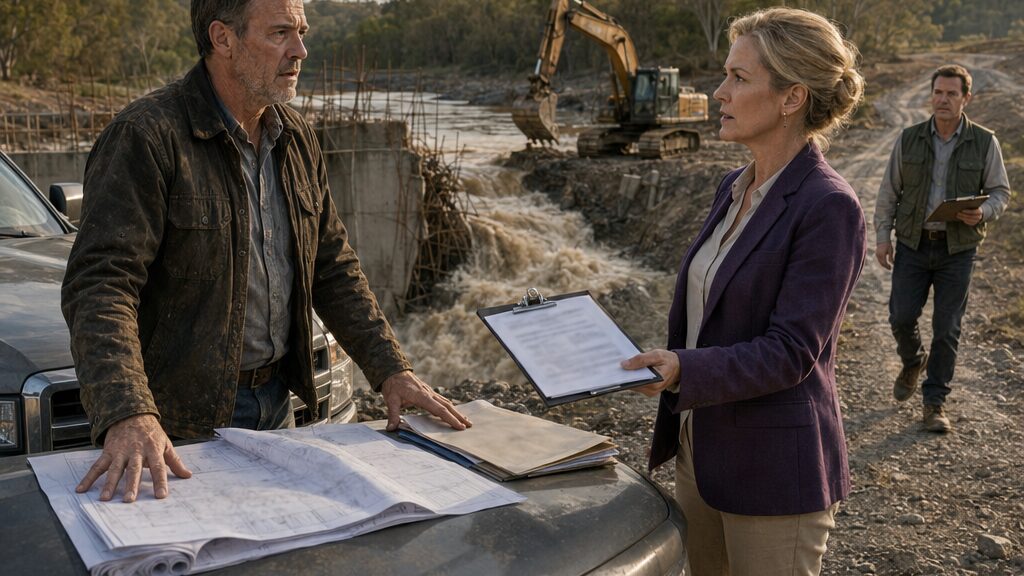
He Paid To Reinforce The Dam. The Contractor Demolished It And Asked For More.
Chapter 1: The Water Was Running Through Concrete
The water was running through the concrete.
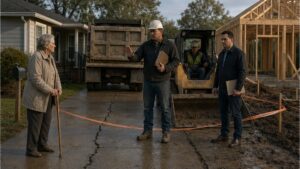
Frank Carter stopped halfway down the gravel slope with the rolled blueprints crushed under one arm, staring at the place where the old spillway should have been. Yesterday, there had been a curved lip of weathered concrete, cracked but whole, with his father’s handprints still faintly visible near the edge. Now muddy water tore through a raw gap, foaming around broken slabs and exposed rebar.
An excavator sat idle on the bank, its bucket dripping brown water.
Frank heard the rush before he understood it. Then he saw the cut.
Not repaired. Not reinforced. Cut.
He walked faster, boots slipping on loose gravel. The blueprints knocked against his ribs. Down below, tire tracks carved black grooves through the damp soil, and chunks of concrete lay piled beside the access road like something torn out and abandoned halfway through.
Cynthia Wright stood near the contractor’s truck in a purple blazer that looked wrong against the mud. Her hair was pinned back, her sunglasses hooked in one hand. She did not look surprised to see him.
“Frank,” she said, as if they had scheduled this.
He stopped ten feet from her. “What happened to my dam?”
Cynthia glanced toward the breach, then back at him. “We ran into field conditions.”
“That’s not an answer.”
“It’s the only responsible one right now.” She lifted a folder from the hood of her truck. “The existing spillway was compromised beyond safe reinforcement. My crew had to open it before pressure built behind it.”
Frank looked past her at the broken concrete. The pond level had already dropped. Water pushed through the breach with a steady, ugly force, dragging silt into the channel below.
“I paid you to reinforce it,” he said. “You said you were adding support.”
“We started that process.”
“You demolished it.”
Cynthia’s expression tightened, not with guilt, but impatience. “You’re using the wrong word.”
Frank pulled the blueprints from under his arm and unrolled them against the truck hood. Wind tugged the corners. His hands shook once, then steadied as he flattened the paper.
“This is the plan you signed,” he said. “Reinforce existing spillway. Patch cracks. Install support forms. Add stone at the outflow. Where does it say remove the spillway?”
Cynthia set her folder beside the plans. “Frank, you’re not an engineer.”
“No. That’s why I hired one.”
“You hired a contractor to handle conditions as they appeared. That’s what we did.”
He looked at the excavator, the torn bank, the concrete pieces. His throat felt scraped dry. “Without calling me?”
“We tried to reach you.”
“You left one message that said you were moving equipment.”
“And then we had to act.”
She opened the folder and slid a sheet toward him. The paper was clean, new, clipped to a revised invoice.
Frank read the number twice.
$38,000.
His eyes moved from the amount to Cynthia’s signature block, then down to the words “emergency stabilization phase.”
“You’re asking me for more money.”
“I’m telling you what it takes to stabilize what’s left.”
“What’s left?” Frank repeated.
Cynthia’s mouth hardened. “That breach is on your property. If it widens, the liability is yours. I’m trying to keep this from becoming worse.”
The sentence landed colder than the water noise. For three weeks, Frank had told himself Cynthia knew more than he did. He had told himself construction sounded rough before it looked finished. He had signed the deposit check, then the second installment, because she had spoken in terms that made his questions feel small.
He looked again at the gap in the dam.
His father had built the original spillway with two neighbors and rented forms, back when the cottage was still only weekends and the nursery was a row of saplings behind the shed. Frank had repaired small cracks himself for years. He had finally hired Cynthia because he knew the next repair was bigger than him.
She had seen that. She had sold him confidence.
Now she was standing beside the wound, charging him to stop the bleeding.
“I’m not signing that,” Frank said.
Cynthia’s eyebrows rose. “Then you’re delaying stabilization.”
“You made the cut.”
“We made a necessary decision.”
“Show me the signed change order.”
Her eyes flicked away from him for less than a second.
Frank caught it.
The sound of tires came up the access road before Cynthia answered. A county vehicle pulled beside the contractor’s truck, white dust rising around it. A man in a field vest stepped out holding a clipboard and a phone.
Cynthia straightened at once.
“Raymond,” she called. “Good. Maybe you can help Mr. Carter understand the urgency.”
The man looked past both of them to the breach. His face changed, not dramatically, but enough. He walked to the edge, scanned the water, the exposed rebar, the pile of broken concrete, then turned back.
“Mr. Carter?” he asked.
Frank lifted one hand. “Frank Carter.”
“Raymond Green. County water office.” His attention stayed on the running water. “We received notice of dam work and possible discharge downstream.”
“I didn’t authorize this,” Frank said.
Cynthia let out a short breath. “He authorized reinforcement work. During field operations, the existing structure proved unstable.”
Raymond looked at her. “Was a demolition change order filed?”
Cynthia’s chin lifted. “The condition required immediate mitigation.”
“That’s not what I asked.”
Frank looked down at the blueprints pinned under his hands. Cynthia’s revised invoice touched the edge of the original plan like it belonged there.
Raymond stepped closer. “Mr. Carter, right now the county has to treat this as an active water release from your property. If that channel cuts wider or sends sediment downstream, you may receive a notice. Contractor dispute or not, the owner of record is you.”
Frank felt Cynthia watching him.
There it was. The shift. The damage behind him, the bill in front of him, the county beside him, and all of it trying to settle on his name.
He folded the revised invoice once and placed it back on Cynthia’s folder.
“I paid for reinforcement,” he said. “I did not pay for demolition. I did not approve demolition. I’m not paying another dollar until someone shows me where I signed for this.”
Cynthia’s face flushed. “Be careful, Frank. Refusing necessary stabilization doesn’t make the problem disappear.”
“No,” he said, looking at the broken dam. “But signing your paper might make it mine.”
Raymond lowered his clipboard slightly. “Then I need copies of the original contract, any change orders, and the permit language.”
Frank reached for the contract packet inside his folder. He knew the contract was there. The receipts were there. The blueprints were there.
Then Raymond asked the question that made the whole hillside seem to quiet around the water.
“Where is the signed change order authorizing removal of the spillway?”
Frank looked at Cynthia.
Cynthia looked at the breach.
And Frank realized he had never seen one.
Chapter 2: The Contract Said Reinforce, Not Remove
The second receipt did not list a supplier.
Frank found it under the coffee tin at 11:43 that night, folded once, with his own handwriting across the corner: second payment, materials secured. The amount made his stomach tighten. He had written the check after a three-minute phone call with Cynthia, standing in the nursery yard with mud on his knees and customers waiting by the maple saplings.
Materials are secured, she had said. We can keep your project on schedule if you release the next installment.
He had not asked what materials. He had not asked where they were stored. He had not asked for a delivery slip.
Now the receipt lay beside photographs of a broken dam.
Frank sat at the kitchen table with the blueprints spread over placemats and the contract held open by a saltshaker. Outside, the sound of water traveled farther in the dark than it did by day. He could not see the breach from the house, but he could hear it. A low, constant rushing where there should have been only the soft movement of the pond.
His phone buzzed.
Cynthia Wright: No stabilization can proceed until revised scope is signed. Weather delay costs may apply after tomorrow.
Frank read the message once. Then again. His thumb hovered over the screen.
A month ago, he would have typed back something careful. Let me look at it. Can we talk in the morning? He could feel that old reflex in his hand, the urge to keep the peace long enough for the other person to become reasonable.
Instead, he set the phone face down.
Headlights crossed the kitchen wall. A car door shut outside, and a moment later Anna Carter came in without knocking, carrying a grocery bag and wearing the expression she used when she had already heard enough to be angry.
“I saw the water from the road,” she said.
Frank did not answer fast enough.
Anna put the bag on the counter. “Dad.”
“It looks worse in daylight.”
“That isn’t what I asked.”
“You didn’t ask anything.”
She stepped to the table and looked at the papers. The blueprints, the contract, the receipt, the revised invoice Cynthia had left, the photos Frank had printed on cheap office paper because he did not trust his phone not to fail him.
Anna picked up the revised invoice. Her jaw tightened. “Thirty-eight thousand more?”
“She says emergency stabilization.”
“She demolished it and wants you to pay her to stop demolishing it?”
Frank rubbed both hands over his face. “It’s not that simple.”
“It looks pretty simple from the road.”
He almost snapped at her. The words rose and stopped behind his teeth. She was not wrong, but she had not been standing there when Cynthia spoke in permit phrases and liability warnings. She had not felt Raymond Green’s clipboard turn the whole thing official.
“I already paid her twice,” Frank said.
Anna lowered the invoice. “Twice?”
He pointed to the receipt, then looked away.
“How much?”
He named the amounts.
The kitchen felt smaller after that. Anna sat down slowly, as if the chair had moved beneath her.
“Why didn’t you tell me?”
“Because it was handled.”
“It wasn’t handled.”
“I thought it was.”
She looked at him then, not with anger alone. There was something worse under it: fear. He had seen that look when her mother was sick, when money became numbers whispered after midnight. Frank hated being the reason for it.
“She knew what she was doing,” Anna said.
Frank leaned back. “Maybe. Or maybe I didn’t know what to ask.”
“That’s not the same as consent.”
“No. But she’ll make it sound close.”
Anna went quiet. Then she reached for his phone. “Do you have photos from before?”
“In the folders.”
“Which folders?”
Frank opened the laptop with a hesitation that embarrassed him. He had photographs everywhere: on the phone, on the old desktop, in emailed attachments to Cynthia, in a cloud account Anna had set up and he barely used. Anna sat beside him and began sorting.
“Before work started,” she said. “During first week. After second payment. Today.”
“That sounds like a lot.”
“It is. That’s why we’re doing it before she changes the story again.”
They worked until the table looked less like a mess and more like a timeline. In the first photos, the spillway showed cracks but stood intact. In the next set, forms had been delivered and stakes marked the bank. After the second payment, the equipment appeared, but no reinforcement material showed in frame. Then came the day’s images: concrete broken, water cutting through, no forms, no stone, no support structure.
Anna held one photo beside another. “Three weeks apart. Tell me what changed.”
Frank looked at the two images. The answer was visible enough to make his chest ache.
Nothing had been reinforced. Only removed.
His phone buzzed again.
Cynthia Wright: I strongly advise you not to create delays that increase your exposure.
Anna read it over his shoulder. “She’s trying to scare you.”
“It’s working.”
“Good. Then write scared, not quiet.”
Frank gave a humorless laugh. “What does that mean?”
“It means you answer in writing. You say what you authorized and what you didn’t. You ask for documents. You don’t argue about feelings.”
She slid a blank notepad toward him.
Frank picked up a pen. His hand hovered above the paper. He had spent years writing invoices for nursery customers, repair notes, planting dates, lists of things that had to be done before frost. But this felt different. This felt like admitting, line by line, that someone had walked him into a corner.
He wrote: I authorized reinforcement of existing spillway under signed contract dated—
He stopped.
Anna did not push.
The water kept running outside.
By morning, Frank had sent Cynthia one email and left one voicemail at the county office. The email was short: he requested the signed demolition change order, material delivery receipts, permit language supporting removal, and written explanation of the alleged emergency condition. He attached four dated photos.
He read the message six times before sending it. His finger pressed the button before he could talk himself into softening the last line.
I do not authorize additional work or payment under the revised invoice.
At 9:12, the county clerk called back.
Frank stood at the kitchen counter with the contract open and Anna listening from the table.
“I’m looking at the permit note attached to the property file,” the clerk said. Papers rustled on her end. “It references maintenance access, controlled drawdown, and reinforcement work along the spillway.”
Frank gripped the counter. “Does it say demolition?”
“Not in the summary I have.”
“Removal?”
“I don’t see that word either.”
Anna looked up sharply.
Frank closed his eyes once. “Can I get a copy?”
“You can request one through records. Mr. Green may also have field notes after yesterday.”
“I’ll request everything.”
“There is one more thing,” the clerk said. “The permit language says drawdown access. That doesn’t necessarily approve structural removal. If removal occurred, someone should be able to show why.”
Frank opened his eyes and looked at the blueprints on the table.
For the first time since he had seen water running through concrete, he had one sentence that did not belong to Cynthia.
“That doesn’t necessarily approve structural removal.”
He wrote it down carefully.
Then he underlined it.
Chapter 3: The Invoice Arrived Before The Rain
Cynthia’s truck came back before the storm, but there were no boards in the bed, no gravel, no forms, no crew.
Just Cynthia.
Frank saw her from the porch, turning off the county road and stopping at his gate as if she still had permission to enter. The sky behind her was the color of wet tin. Far beyond the house, the broken dam gave off its steady, unwanted sound.
Anna stood inside the screen door. “Don’t go out alone.”
“I’m not planning to fight her.”
“That’s not what I’m worried about.”
Frank took the folder from the hall table. The original contract was clipped on top now, not buried under receipts. He had placed the blueprints beneath it, folded flat enough to carry. His phone was in his shirt pocket with the recorder app open, though he hated the feel of that more than he wanted to admit.
Cynthia got out carrying a clipboard and a legal-size envelope. Her boots were clean.
“Frank,” she called. “We need to resolve this today.”
He walked down the porch steps and stopped where the gravel met the yard. He did not open the gate.
Cynthia noticed. Her expression cooled.
“You’re blocking access to an active site,” she said.
“I revoked access until you provide documents.”
“You can’t revoke access and then blame me for delay.”
“I’m not blaming you for delay. I’m asking why you removed a spillway I paid you to reinforce.”
She lifted the envelope. “That’s what this addresses.”
Frank did not reach for it.
Cynthia slid the papers through the gate bars anyway. They landed against his boot. He picked them up, keeping the folder tucked under one arm.
The top page was another invoice. The same $38,000. Beneath it was a document titled Revised Emergency Stabilization Agreement.
Anna came down onto the porch but stayed back.
Cynthia glanced at her. “This is between the contracting parties.”
“My daughter can stand on my porch.”
“This kind of interference is exactly how projects become more expensive.”
Frank read down the first page. Cynthia kept talking.
“The storm coming tonight changes the risk. If that breach widens, you may be looking at downstream claims, county fines, additional equipment mobilization, maybe even emergency work at premium rates. I’m trying to prevent that.”
He turned the page.
There it was, buried halfway down.
Owner acknowledges prior emergency removal of compromised spillway was necessary and releases contractor from claims arising from preexisting conditions, demolition access, water release, and related site instability.
Frank read it once, then again.
His pulse slowed in a way that felt almost dangerous.
“You want me to sign away damages.”
Cynthia’s face did not change. “That is standard language.”
“It says I release you for demolition.”
“It says you acknowledge site conditions.”
“It says demolition.”
“It says emergency removal.”
Frank looked past her to the road beyond the gate. No equipment. No crew. No attempt to stop the water before rain. Only paper.
“You came here to get a signature,” he said.
“I came here to keep you from making a bad situation worse.”
Anna took one step forward. Frank lifted a hand slightly, not to silence her, but to tell her he still had himself in hand.
Cynthia tapped the gate with one polished nail. “Frank, I understand this is emotional. It’s your property. I respect that. But water does not care about paperwork.”
“No,” Frank said. “But you do.”
Her eyes narrowed.
He placed her revised agreement on top of his folder and opened his original contract beneath it. The two documents made a hard little sound in the wind.
“Original fixed price,” he said. “Scope: reinforce existing spillway. Install support forms. Patch cracks. Add stone at outflow. No demolition line. No emergency removal line. No signed change order.”
Cynthia’s mouth tightened. “Construction changes.”
“Then paperwork changes before the work.”
“Not when safety is involved.”
“Then show me the engineer’s note.”
For the first time, she did not answer immediately.
Rain began with a few hard drops on the porch roof.
Cynthia looked toward the dam path, then back to him. “If you refuse to cooperate, I can file a lien for unpaid work and delay costs.”
Anna said, “Unpaid work? The dam is broken.”
Cynthia turned toward her. “You don’t understand construction billing.”
Frank felt Anna bristle. He kept his eyes on Cynthia.
“How much work am I unpaid on?” he asked.
Cynthia looked back at him. “Mobilization, demolition response, site management, emergency assessment—”
“Assessment by whom?”
“My company.”
“Not an engineer?”
“My company made a field decision.”
“There it is,” Frank said softly.
Cynthia blinked. “Excuse me?”
“You made a field decision. Not me.”
“That doesn’t release you from financial responsibility.”
Frank folded the revised agreement once and held it out through the gate. Cynthia did not take it.
He let it rest against the metal bar.
“I’m not signing this.”
The rain picked up, dotting the paper.
Cynthia’s voice lowered. “Think carefully. By tomorrow, the county will only see one responsible owner.”
Frank felt the words strike exactly where she aimed them. The property was his. The dam was his. The muddy water, the exposed concrete, the downstream risk — all of it would wear his name first because his name was on the deed.
A week ago, that would have been enough. He would have signed to make the official pressure stop.
Now he looked at the waiver bleeding ink in the rain and saw what she needed from him.
Not payment first.
Permission after the fact.
“You can leave it,” he said.
Cynthia opened her mouth, then closed it. She pushed the wet agreement through the bars. It fell inside the gate at Frank’s feet.
“You’re choosing a very expensive path,” she said.
“No,” Frank said. “You chose it when you cut the dam.”
Her face flushed, but she did not yell. She walked back to her truck, opened the door, and paused.
“When the notice comes,” she said, “remember that I tried to help.”
She drove away without looking toward the breach.
Frank stood in the rain until Anna came down with a plastic folder. Together they lifted the wet papers from the gravel and slid them inside before the ink could run completely.
The title at the top was still readable. So was the release clause.
That night, rain hammered the roof and the sound from the dam grew heavier. Frank did not sleep. Near dawn, he checked his phone and found an email from Cynthia sent at 5:18 a.m., copied to the county water office.
Mr. Carter has refused emergency stabilization access and declined the revised agreement necessary to proceed.
Frank read it twice in the gray kitchen light.
Then he saw the last line.
All further water release consequences remain the responsibility of the owner of record.
Chapter 4: The License Number Did Not Match
The license number on Cynthia’s business card did not belong to dam repair.
Frank stared at the state licensing page on the county library computer because his own internet at home had decided to stall exactly when he needed it most. The card lay beside the keyboard, its corners softened from being carried in his shirt pocket: Wright Site & Water Solutions, Licensed Structural Waterwork, Emergency Stabilization, Rural Property Specialist.
The search result on the screen said something else.
General excavation and grading.
Frank clicked the record again, as if the words might rearrange themselves into the version Cynthia had sold him. They did not. The license was active, but the classification listed roadbeds, drainage ditches, grading, and non-structural earthwork. Nothing about structural dam repair. Nothing about reinforced spillway work. Nothing about emergency demolition.
A librarian passed behind him with a cart. Frank moved the business card closer to the monitor and wrote the classification number on the notepad Anna had forced into his truck before he left.
“You don’t have to know everything,” she had said. “You just have to write down what you find.”
He had not liked how much he needed that sentence.
By ten-thirty, Frank was standing at the county office counter with a folder under one arm and mud still dried along the hem of his jeans. The clerk printed the permit summary on pale yellow paper and slid it across the counter.
“Maintenance access,” she said, tapping the first paragraph. “Controlled drawdown. Reinforcement work along the existing spillway.”
Frank read the lines slowly. He could hear Cynthia’s voice from the gate: water does not care about paperwork.
But the paper cared about the difference between reinforcement and removal.
“Is there a demolition permit attached?” he asked.
The clerk searched again. The printer behind her hummed and stopped. “Not that I see.”
“An emergency notice?”
“Not in this file.”
“What about a field condition report?”
“That would usually come from the contractor or an engineer if they were claiming unexpected structural danger.”
Frank looked at the yellow paper. “Can I request everything?”
“You can request the full file. It may take a few days.”
A few days. The dam was running now.
The clerk’s expression softened in the practiced way of someone who could see trouble but not step into it. “Mr. Green is in today. He can’t give legal advice, but he may tell you what the county needs from you.”
Raymond Green met him in a small side office with maps pinned to one wall. He had the manner of a man who measured every sentence before allowing it into the room.
“I saw Cynthia Wright’s email,” Raymond said.
“So did I.”
“She is framing the issue as owner refusal of emergency stabilization.”
“She cut the spillway without a signed change order.”
“I understand that is your position.”
Frank felt heat move up his neck. “It’s not a position. It’s the contract.”
Raymond did not react. He opened a folder and placed a copy of Cynthia’s email beside a blank county form. “Mr. Carter, I’m telling you what the file will show if you do nothing. Right now, we have a damaged private dam releasing muddy water from your property. We have a contractor saying she attempted to perform emergency stabilization but was denied access. We have you saying the work exceeded scope.”
“So she can just say it and that’s enough?”
“No. But if you want the record to show more, you have to put more into the record.”
Frank looked down at his own hands. He had spent years fixing things before anyone could complain. Broken fence wire, washed-out nursery paths, leaks under the cottage sink. Handle it quietly, and no one gets involved. That had always felt like responsibility.
Now quietness looked like an empty file.
“What do I need?” he asked.
Raymond slid the blank form closer. “Written timeline. Original contract. Any messages. Any photos before and after. Written request for change orders. Written denial if there are none. Permit copy. License records, if relevant. Material receipts, if she billed you for materials. And if you can get an independent assessment of the current condition, that helps.”
Frank wrote each item down.
Raymond added, “The county can still issue you a notice to stabilize or control discharge. The contractor dispute doesn’t remove your responsibility as owner.”
“There it is again,” Frank said.
“I’m not saying it to threaten you.”
“But she is.”
Raymond leaned back. “That may be. I can’t write that in a county file without evidence.”
Frank folded the yellow permit summary and slid it into his folder. “She says I verbally approved emergency demolition.”
Raymond’s eyes moved to the folder. “Did you?”
“No.”
“Did you approve anything verbally that she could confuse with that?”
Frank hated the question because the honest answer had edges. “I approved moving equipment after she said materials were secured. I approved staying on schedule. I didn’t approve cutting the dam.”
Raymond nodded once. “Then write that exactly.”
Frank left the office with the feeling of having been handed tools too late but still sharp enough to use.
At home, he parked by the access road before going to the house. The storm had carved more mud from the bank. The water was lower in the pond, louder through the breach. He took photos from the same three angles Anna had labeled the night before. Wide view from the gravel rise. Close view of exposed rebar. Downstream channel.
The broken concrete looked different through the phone camera. Less like disaster. More like evidence.
He was kneeling to photograph a piece of exposed steel when a truck door slammed behind him.
Cynthia had returned, not in her work truck this time, but in a dark SUV. She did not come down the slope. She stood near the gate with her arms crossed.
“You’ve been to the county,” she said.
Frank straightened slowly. “Yes.”
“You’re creating a record without understanding what you’re putting in it.”
“I’m putting the contract in it.”
“You’re putting your refusal in it too.”
He slipped the phone into his pocket. “I refused to sign a release after the fact.”
“You refused access before a storm.”
“You came with paperwork, not equipment.”
Her expression tightened. For a moment, the confident contractor mask slipped, and Frank saw something tired under it. Not remorse. Pressure. A person calculating costs faster than she could cover them.
“You think I wanted this?” she asked.
“I don’t know what you wanted.”
“I wanted the job finished. I wanted your dam stabilized. I wanted one project this month not to turn into another fight over conditions nobody wants to pay for.”
“You took money for materials that never arrived.”
Her eyes sharpened again. “Be careful with accusations.”
“Then show me the receipts.”
She looked toward the water, jaw set. “You’re going to regret treating me like the problem when I’m the one who showed up.”
Frank almost answered that showing up with an invoice was not the same thing as showing up with repair materials. But the more he talked, the more chances he gave her to twist his words.
So he said nothing.
Cynthia seemed to dislike that more than anger.
She opened her SUV door. “My written statement will be clear.”
“It already is.”
“No,” she said. “The next one.”
She drove off, spraying gravel.
Frank stood there until the SUV disappeared past the pines. Then he went to the mailbox. Inside was an envelope from the county, already damp at one corner from the wet metal box.
He opened it on the porch.
Notice of Potential Unsafe Discharge Condition.
He read the first page, then the second. The county was requesting a stabilization plan within ten days. It did not accuse him of wrongdoing, but it named him as owner of record. Cynthia had been right about one thing: the county knew whose property it was.
Frank was still reading when an older pickup rolled into the driveway too fast and stopped crooked near the nursery sign. A woman got out in rubber boots, mud streaked up one leg of her jeans. Her face was tight with anger.
“Are you Frank Carter?” she called.
“Yes.”
She pointed down toward the road, where brown water had cut through the ditch. “Your dam is washing mud under my driveway.”
Frank folded the county notice once.
“I’m trying to fix it.”
“Well,” the woman said, coming closer, “you’re doing a poor job of trying.”
Chapter 5: The Neighbor Knew The Same Name
Sarah Mitchell pointed at the mud under her driveway as if Frank had carried it there in buckets.
“Do you see that?” she said. “That culvert was clear last month. Now I’ve got water backing up every time your pond spits more dirt downstream.”
Frank stood beside the ditch with his boots sinking into the soft shoulder. The storm had left a dirty ribbon along the road, and Sarah’s gravel drive sagged where water had eaten around the pipe beneath it. He could have defended himself. He wanted to. The words were ready: I didn’t cut the dam. I didn’t authorize the breach. I’m the one losing property too.
But Sarah’s mailbox leaned at an angle, and a line of mud had dried halfway across her drive. Anger was easier to carry when damage had nowhere else to go.
“You’re right about the water,” Frank said.
That stopped her for half a breath.
“I know it came from my property,” he continued. “I’m not denying that.”
Her eyes narrowed. “Then fix it.”
“I’m trying.”
“People always say that after the damage comes downhill.”
Frank looked past her at the culvert. The pipe mouth was partly buried, but the shape of the washout was odd. The gravel had not simply been coated by runoff; part of the edge looked sunken, as if the ground below had been disturbed before the storm.
“Did someone work on this recently?” he asked.
Sarah’s expression changed from anger to caution. “Why?”
“The gravel looks fresh on that side.”
“That’s none of your business.”
“It might be if the same contractor—”
“The same contractor as what?”
Frank hesitated. He had not intended to bring Cynthia’s name into a roadside argument with a neighbor he barely knew. He had seen Sarah only a handful of times, usually lifting feed bags from her truck or waving without smiling. People downstream had their own business. He had respected that.
Now the water had made their business meet.
He opened his folder on the hood of his truck and pulled out the top copy of the contract. “I hired a contractor to reinforce my dam. The spillway was cut instead. I’m trying to prove what happened.”
Sarah looked impatient until her eyes dropped to the signature line.
Then she stopped.
Not slowed. Stopped.
Frank watched her face close around a private recognition.
“What?” he asked.
Sarah reached for the paper. “Who is that?”
“Cynthia Wright.”
Sarah did not take the contract. She just stared at the signature.
Frank felt the air shift between them. “You know her.”
Sarah gave a small laugh without humor. “She did my culvert.”
The road seemed to quiet around them, though the water still ran under the ditch grass.
“When?” Frank asked.
“Four months ago.”
“What happened?”
Sarah folded her arms. “What always happens. First price was manageable. Then she said the old pipe was worse than expected. Then she needed more for fill. Then she said the crew had already opened the drive, so if I stopped work, the access would be unsafe and that would be on me.”
Frank said nothing.
Sarah glanced toward the sagging gravel. “She put it back together enough to drive over. For a while.”
“Did you complain?”
“I complained plenty.”
“In writing?”
Her mouth tightened. “Some.”
“Do you still have it?”
She looked at him then, hard. “Why? So you can use my mess to fix yours?”
Frank took the hit because part of it was fair.
“No,” he said. “So I can find out whether she used the same story twice.”
Sarah looked back at the culvert. The anger had not left her, but it had changed direction. “I signed something.”
Frank’s stomach dropped. “A revised agreement?”
“A release.” The word came out flat. “She gave me back two thousand dollars and said if I wanted that money before winter, I had to sign that I accepted the work as complete. I needed the drive. My mother was still living with me then, and the ambulance needed access if she got worse.”
Frank understood then why shame could sound like anger.
Sarah kicked a stone into the ditch. “So no, I can’t be your perfect witness.”
“I’m not looking for perfect.”
“You should be. Perfect is what paperwork people want.”
He almost smiled, but the water noise took it out of him. “I’m learning that.”
She looked at the folder again. “Bring your truck up to the house. I’ll show you what I have. But I’m not promising anything.”
Sarah’s kitchen smelled of coffee left too long on a warmer. She cleared half a table by moving seed catalogs and a stack of pharmacy mail. Frank stood awkwardly near the door until she pointed at a chair.
“Sit. You’re dripping mud on the mat either way.”
She brought out a folder thinner than his, but with the same kind of stress in the bent corners. Inside were a proposal, two invoices, a receipt, three printed photos, and the release she had mentioned. Frank saw Cynthia’s signature before he read anything else.
Wright Site & Water Solutions.
Sarah watched him see it.
“She told me the old culvert collapsed during excavation,” Sarah said. “Said it had been failing for years and I was lucky she found it before the driveway gave way.”
“Was that true?”
“Partly.” Sarah poured coffee into a mug and did not offer him one. “The pipe was old. I knew that. But it wasn’t collapsed. I drove over it every day.”
Frank laid Sarah’s proposal beside his own contract. Cynthia’s language had the same rhythm. Existing condition. Field adjustment. Owner acknowledgment. Emergency access. Stabilization phase.
“Did she bill you for materials?” he asked.
“Pipe, stone, fabric, fill. Why?”
Frank pulled out his second receipt. “Mine says materials secured. No supplier.”
Sarah flipped through her folder and found a stapled receipt. “I asked for proof because my brother kept telling me I was being stupid.”
“You weren’t.”
She looked at him sharply, and he realized she had been waiting for him to think it.
The receipt listed delivered riprap stone and drainage fabric. The date was four days after Frank’s second payment. The supplier name was smudged, but the delivery address was readable.
Or almost readable.
Frank leaned closer. “That’s not your address.”
Sarah frowned and snatched the receipt back. “It’s not?”
He turned his phone toward her with a photo of Cynthia’s revised invoice. The material line used the same description: riprap stone, drainage fabric, emergency stabilization.
Sarah read it, then looked at her own receipt again.
“That’s a yard address,” she said. “Not mine.”
“Could be where they staged materials.”
“Then why charge me delivery?”
Frank did not answer because the question was already moving somewhere worse.
Sarah sat down slowly across from him. The defensive anger drained, leaving embarrassment she clearly hated showing.
“I thought she gave me money back because I pushed hard,” she said. “Maybe she gave it back because she needed me quiet.”
Frank looked at the release. Cynthia had written the same kind of sentence she wanted him to sign: owner acknowledges site conditions and accepts work performed.
“How many people signed these?” he asked.
Sarah rubbed at the edge of the table with her thumb. “I don’t know.”
The back door rattled in the wind. From here, Frank could not hear the dam, but he could imagine the water moving under Sarah’s drive and down from his property, tying the damage together whether either of them wanted it or not.
Sarah stood abruptly and went to a drawer near the stove. “There’s one thing I didn’t put in the folder.”
She returned with a folded paper, softer than the others, as if it had been opened too many times.
“I kept this because it bothered me,” she said. “It came with the receipt copy. Cynthia told me it was just a supplier confirmation.”
Frank unfolded it carefully.
It was a delivery receipt with two job reference numbers handwritten near the bottom. One was Sarah’s culvert job. The other began with FC-DAM.
Frank’s initials.
His property.
The delivery date was the same week Cynthia told him his materials were secured.
Sarah leaned over his shoulder and saw it at the same time he did.
“Frank,” she said quietly, “why are my culvert materials and your dam materials on the same slip?”
Chapter 6: The Inspection Made The Damage Official
Thomas Jones stepped over the exposed rebar, looked once at the broken spillway, and said, “This wasn’t emergency stabilization.”
Frank had expected technical language first. Measurements, maybe. A cautious opening. Something like possible or appears to be. Instead, Thomas stood at the edge of the breach in scuffed work boots, clipboard under one arm, and gave the sentence no decoration at all.
Cynthia would have hated him immediately.
Frank felt a dangerous little lift in his chest and forced it down. One blunt contractor was not justice. One sentence was not a repair.
Thomas crouched beside the broken concrete. He was broad-shouldered, gray at the temples, with hands that looked more comfortable holding tools than paper. He tapped the exposed steel with the end of his pencil.
“You see this?” he asked.
Frank stepped closer. “Rebar?”
“Old rebar. Cut rough. No temporary formwork. No bypass channel. No staged reinforcement. If someone opened this because they had to relieve pressure, they’d document the hazard first and control the release. This is a removal start that stopped before stabilization.”
Frank wrote that down so quickly his pencil tore the page.
Thomas glanced at him. “You don’t have to catch every word. I’ll put it in the report.”
“I need to catch enough.”
“That bad?”
Frank looked at the water moving through the gap. “Bad enough.”
They spent two hours on the site. Thomas measured the breach, photographed the spillway from both banks, checked the downstream erosion, and examined the pile of broken concrete Cynthia’s crew had left near the access road. He asked for the original blueprints, then spread them over the hood of Frank’s truck, weighing the corners with stones.
The plans looked tired now. Creased, dirt-smudged, marked with Frank’s notes and Anna’s sticky tabs. But under Thomas’s hand, they became something steadier.
“This was a reasonable reinforcement plan,” Thomas said. “Not cheap, but reasonable.”
“Could it have been reinforced before?”
“From what I can see, yes. I’d want prior photos, but the cracks alone don’t justify tearing out the spillway.”
Frank opened the photo folder on his phone. Thomas scrolled through images Anna had organized by date. In the earliest shots, the spillway was stained and cracked, but whole. In the middle shots, Cynthia’s equipment sat near the bank. In the latest, the concrete was gone.
Thomas stopped on a photo from after the second payment. “Where are the materials?”
Frank looked at the image. Stakes. Equipment. Mud. No forms. No stone pallets. No fabric rolls.
“That’s what I keep asking.”
Thomas zoomed in, then moved to the next image. “If reinforcement material had been delivered, you’d see something. Stone, mesh, form lumber, bags, pallets, geotextile rolls. Nothing here.”
Frank wrote: no evidence paid-for reinforcement materials ever installed.
Thomas walked the site again. At the breach, he pointed to the channel cut by the storm. “Every day this runs, repair gets more expensive.”
“I know.”
“No, I mean substantially. You don’t just put back what was removed. You stabilize the banks, control the flow, rebuild the spillway, armor the outflow, maybe repair downstream erosion. Whoever opened it increased the cost.”
Frank felt the numbers forming before Thomas said them.
When Thomas finally gave a rough estimate, Frank looked toward the nursery fields instead of at him. Rows of young trees stood beyond the shed, leaves moving in the wind. Inventory. Income. Future bills. All of it suddenly looked like something that could be sold too early.
“That’s more than the original contract,” Frank said.
“It usually is after someone makes the wrong cut.”
Frank folded his arms because he did not trust his hands. “Can you put that in writing?”
“I can put what I observe in writing. I won’t say fraud. I won’t say intent. I’ll say the work performed does not match the reinforcement scope you showed me, and I don’t see evidence of installed stabilization materials.”
“That’s enough?”
Thomas looked at him with an expression that was not unkind, just plain. “Enough for what?”
Frank almost answered: enough to make her stop. Enough to get my money back. Enough to make the county see I didn’t do this.
But Thomas was not there to make him feel better.
“For the complaint,” Frank said.
“It helps. It doesn’t finish it.”
By late afternoon, Thomas sat in his truck writing a preliminary field note while Frank photographed the blueprints laid beside the clipboard. The image looked almost staged: original plan, broken dam, independent notes. But the smell of wet concrete and silt made it too real to feel like proof of victory.
Anna arrived as Thomas was packing up. She parked near the gate and walked down with two coffees in a cardboard tray.
“One of those for me?” Frank asked.
“One is for the man telling us how bad it is.”
Thomas accepted the coffee with a nod. “It’s bad. It’s fixable.”
Anna closed her eyes briefly at the second sentence.
“Not fast,” Thomas added. “Not cheap.”
Frank gave a short laugh. “You could’ve let us enjoy fixable for one minute.”
“False comfort costs money.”
Anna looked at Frank. “I like him.”
Thomas handed Frank the preliminary note. “Full report in two days. Don’t let the first contractor touch anything unless the county orders emergency work and you have every instruction in writing.”
Frank slid the note into a plastic sleeve. “She says I’m refusing stabilization.”
“Then ask her for her engineering basis. Ask her for material delivery tickets. Ask her for the signed change order. Same questions, every time.”
“That makes people mad.”
Thomas shut his truck door. “People who did the work can answer them.”
After he drove off, Frank and Anna stood above the breached dam. The water had dropped enough to expose a line of mud along the pond bank like a bathtub ring. Anna held her coffee untouched.
“How much?” she asked.
Frank told her.
She looked away.
“I can sell some nursery stock early,” he said.
“Dad.”
“I said some.”
“You always start with what you can give up.”
He did not answer because she was right and because being right did not produce money.
At the house, Frank scanned Thomas’s preliminary note, the county notice, Sarah’s delivery receipt, Cynthia’s revised invoice, and the original contract. He attached them to a draft complaint but did not send it yet. His finger hovered over the trackpad.
Anna stood behind him. “What are you waiting for?”
“For it to be cleaner.”
“It won’t be.”
Before he could answer, an email notification appeared from Cynthia.
Subject: Proposed Resolution.
Frank opened it.
The message was brief, almost courteous. Cynthia offered to refund $12,000 as a “good faith adjustment” if Frank would withdraw county and licensing complaints, sign a confidentiality agreement, release Wright Site & Water Solutions from all claims related to the dam, and allow her company to close the file without admission of fault.
Anna read over his shoulder.
“That’s not a refund,” she said.
Frank looked at the attached agreement and saw the shape of the gate again, Cynthia pushing wet paper through the bars before the rain.
“No,” he said. “It’s a price for silence.”
The cursor blinked over his unsent complaint.
Outside, through the closed kitchen window, the water kept running.
Chapter 7: The Hearing Turned On One Refusal
Cynthia slid the settlement across the table before anyone mentioned the dam.
The paper stopped halfway between her and Frank, its first page held flat beneath her manicured fingertips. She had arrived in a gray suit this time, not the bright blazer from the job site, and there was no mud on her boots. Her folder was new. Her pen was already uncapped.
Frank looked at the amount printed in the second paragraph.
Twelve thousand dollars.
Enough to start Thomas Jones on temporary stabilization. Not enough to rebuild the spillway. Not enough to replace what Frank had already paid. Not enough to undo the county notice, Sarah’s washed-out culvert, the nights of running water in his ears.
But enough to tempt a tired man.
The mediation officer sat at the end of the table with a tablet and a stack of forms. Raymond Green stood near the wall, not as an advocate, he had reminded Frank twice, but as a county official available to confirm field notes. Anna sat beside Frank with her hands folded so tightly her knuckles had gone pale.
Cynthia pushed the document another inch.
“This is a practical resolution,” she said. “No one here benefits from dragging this out.”
Frank did not touch the paper. The same blueprints from the dam site lay rolled beneath his chair. He had carried them in even though they were too large for the table and awkward in the narrow hallway. He wanted the weight of them there.
The mediation officer looked at Frank. “Mr. Carter, you understand this is voluntary.”
“I understand.”
Cynthia’s pen tapped once. “The offer is made without admission of fault. It allows Mr. Carter to address his immediate property concern while avoiding extended costs for everyone.”
“Costs for everyone,” Anna said quietly.
Frank gave her a small look, and she stopped.
Cynthia noticed. “I appreciate that emotions are high. But we are dealing with a rural structure that had preexisting deterioration. My company encountered unsafe conditions and acted to prevent greater failure.”
Frank reached down, lifted the blueprints, and unrolled them onto the table. They knocked against Cynthia’s settlement, pushing it aside. Raymond stepped forward to help weigh one corner with a stapler.
Cynthia’s mouth tightened. “We’ve seen the plan.”
“No,” Frank said. “You’ve talked around it.”
He placed the original contract beside the blueprints. Then the before photo. Then the photo after his second payment. Then the photo of the breach. Then the unsigned waiver Cynthia had left in the rain, now dried with a wrinkle through the release clause. Then Sarah’s delivery receipt. Then Thomas’s inspection summary.
He did not stack them. He laid them in a line.
“My contract says reinforce existing spillway,” Frank said. “These photos show the spillway whole before work. This photo shows no reinforcement materials after the second payment. This one shows the spillway removed. This document asks me to release Wright Site from claims after the removal already happened.”
Cynthia leaned back. “That is an oversimplified presentation.”
“It’s the order things happened.”
“You verbally authorized field decisions.”
Frank looked at her then. For days he had dreaded that sentence because it held the one part of the truth that could be bent against him. He had approved moving equipment. He had approved staying on schedule. He had paid when Cynthia said materials were secured.
He had been embarrassed by that.
Now he said it clearly.
“I authorized moving equipment after you told me materials were secured. I did not authorize removing the spillway. I did not sign a demolition change order. I did not sign an emergency removal acknowledgment. I asked for those documents. You have not provided them.”
Cynthia opened her folder. “Field conditions required immediate action.”
“Where is the engineer’s note?”
“The conditions were visible.”
“To whom?”
“My crew.”
Frank let the silence sit.
The mediation officer typed something. Raymond looked down at his own folder.
Cynthia turned toward him. “Raymond, you saw the site. You know the structure was compromised.”
Raymond lifted his eyes. “My field note says I observed an open breach, exposed rebar, and active discharge. I also noted that no signed demolition change order was presented at the site.”
Cynthia’s jaw flexed. “That does not mean one was required before emergency mitigation.”
“It means I didn’t see one.”
The difference was small. It mattered.
Frank felt Anna’s shoulder shift beside him, like she had breathed for the first time since sitting down.
Cynthia recovered quickly. “Even if we debate paperwork, Mr. Carter refused access before weather. That increased exposure.”
Frank placed her gate agreement on top of the blueprint, open to the release clause. “I refused to sign this.”
The mediation officer leaned forward to read.
Frank continued, “It says I acknowledge emergency removal was necessary and release you from claims tied to demolition and water release. That was after the dam had already been cut.”
Cynthia’s pen stopped tapping.
“It was standard protective language,” she said.
“It was permission after the fact.”
The room went still.
For the first time, Cynthia looked tired instead of merely controlled. Her eyes moved across the documents, not as if she had not seen them before, but as if she had not expected Frank to place them in a row and stay quiet long enough for everyone else to look.
Then she said, lower, “You think you’re the only client whose project changed after the first estimate?”
Frank heard something in it. Not confession. Not remorse. Weariness sharpened into accusation. As if every homeowner who had questioned her was part of the same enemy.
“No,” he said. “I think that’s the problem.”
Cynthia’s gaze flicked toward the door.
The mediation officer cleared his throat. “Ms. Wright, the settlement includes confidentiality and withdrawal of complaints. Mr. Carter, is that your primary concern?”
Frank looked at the dollar amount again.
Twelve thousand dollars would make the first repair payment easier. It would quiet Cynthia. It would remove one fight from his life. He could tell himself he had done enough. He could let Sarah handle her own regret. He could let the county file close around the safest version of events.
Anna did not speak. That helped more than if she had begged him.
Frank touched the edge of his father’s blueprint. There was a faint brown thumbprint near the old spillway line. Maybe his father’s. Maybe his own from years of handling it. It did not matter. The paper was not proof that the dam had been perfect. It was proof that somebody had once taken care to build something meant to last.
“I need the money,” Frank said.
Cynthia’s shoulders eased slightly.
“But I’m not withdrawing the complaint. I’m not signing confidentiality. And I’m not signing anything that says your company’s demolition was authorized.”
The ease vanished.
Cynthia closed her folder halfway. “Then the offer changes.”
“I figured.”
“You may recover less.”
“I figured that too.”
The mediation officer looked from one to the other. “Mr. Carter, are you rejecting the proposed settlement?”
Frank pulled the settlement back toward Cynthia and placed it on her side of the table.
“I’m rejecting the silence.”
Cynthia stared at him. “You’re making this personal.”
Frank shook his head. “No. I made it personal when I was too embarrassed to ask for receipts. This is the first time I’m making it plain.”
Raymond looked away, but not before Frank saw the corner of his mouth tighten in something close to approval.
The mediation officer called for a break.
Out in the hallway, Anna hugged her folder to her chest and did not try to hug Frank. She knew better in public. Instead, she stood beside him at the vending machines while he bought a bottle of water he did not want.
“You okay?” she asked.
“No.”
“Good answer.”
He almost smiled.
At the far end of the hallway, Cynthia stood on her phone, speaking low and fast. Frank caught only pieces: equipment rental, exposure, multiple files. Her face had lost its courtroom smoothness. For one second, she looked like a person balancing too many collapsing boards.
Then the elevator opened.
Sarah Mitchell stepped out holding a folder against her chest.
Frank straightened. “Sarah?”
She walked toward him with her mouth set, eyes fixed past him on the mediation room door.
“I know I said I couldn’t help,” she said.
Frank looked at the folder. “What changed?”
Sarah pulled out a document Frank had never seen before. It looked like her release agreement, but the signature line at the bottom was blank.
“I found the copy she sent before I signed the other one,” Sarah said. “This one still has the attachment list.”
Frank looked down.
Two job numbers. One material batch. Her culvert. His dam.
Sarah nodded toward the door where Cynthia had disappeared.
“She didn’t just do it to me after you,” she said. “She was already billing both jobs before your dam was ever cut.”
Chapter 8: The Pond Filled Slower Than Trust
Water ran through the repaired channel for the first time without tearing the bank.
Frank stood on the gravel rise with both hands in the pockets of his work jacket, watching the new spillway take the flow in a clean silver sheet. It was not beautiful. Not yet. Fresh concrete never looked as if it belonged beside old stone and muddy grass. The banks were armored with new rock, the scar line still visible where the breach had widened after the storm.
But the water stayed where Thomas Jones had told it to stay.
That was enough for the morning.
Thomas stood below with one boot on a stone, watching the flow with the same blunt patience he had brought to the inspection. “It’ll settle,” he called up. “Grass takes time. Concrete takes time. People usually don’t like that.”
Frank nodded. “People usually want to stop paying before that.”
Thomas looked up, and for the first time Frank saw him almost smile. “That too.”
The settlement had changed after Sarah stepped into the hallway. It had not become generous. Nothing about it felt like victory the way people imagined victory. Cynthia did not apologize. She did not admit fraud. She did not hand back every dollar. Her company’s bonding representative agreed to a partial repayment tied to documented scope mismatch and unresolved material billing questions. The county kept Frank’s file open until Thomas submitted a stabilization plan and completed the first phase.
Frank still paid more than he could comfortably spare.
He sold two rows of young maples early to a landscaping company that wanted bulk pricing and knew he needed the sale. He hated that part. He hated the stumps of empty space in the nursery almost as much as he hated the patched line across the dam. But the channel held, and the county notice was lifted after Thomas’s final inspection.
Some losses left paperwork. Some left gaps in the ground.
Anna came down from the house with a white envelope in her hand.
“You got something from the licensing board,” she said.
Frank took it but did not open it right away. For a few seconds he just watched the water move through the new spillway. The sound was different now. Lower. Controlled. Still water, still motion, but no longer the frantic cutting noise that had kept him awake.
Anna touched the envelope against his sleeve. “Dad.”
“I know.”
“You’re doing that thing where you wait because bad news might be polite enough to leave.”
He looked at her. “Has that ever worked?”
“No.”
Frank opened the envelope.
The letter was formal and careful. It did not promise punishment. It did not say Cynthia was guilty. It said the licensing board had opened a review of Wright Site & Water Solutions based on multiple complaints involving scope changes, material billing, and work outside classification. It requested Frank preserve original documents and remain available for follow-up.
Multiple complaints.
Frank read that phrase twice.
Anna leaned closer. “Sarah?”
“Sarah. Maybe others.”
“Is that good?”
Frank folded the letter along its original crease. “It’s not closed.”
Anna understood. She nodded once, slowly.
That afternoon, Sarah drove down and parked by the nursery sign, this time straight instead of crooked. She brought no anger with her, or maybe she had packed it away for use somewhere else. She stood beside Frank at the repaired channel and watched water slide through the new concrete.
“Looks expensive,” she said.
“It is.”
“Looks better.”
“It does.”
She handed him a copy of her own licensing board letter. “They asked me for the unsigned attachment list.”
“You sent it?”
“Yesterday.”
Frank looked at her. “Thank you.”
Sarah stared at the spillway. “Don’t thank me too much. I’m still mad about the mud.”
“You should be.”
That earned him a sideways glance. “You always agree with people when they’re mad?”
“No. I’m learning to sort which part is true.”
Sarah looked back at the water, and the tightness in her face eased by a small measure. “That’s annoying and fair.”
They stood there until Thomas called for Frank to check a seam near the outflow. Sarah left without ceremony, but before she got into her truck, she turned back.
“She counted on me being embarrassed,” she said.
Frank did not ask who. “I know.”
Sarah nodded toward the repaired dam. “Don’t let that part get buried under concrete.”
After she left, Frank went to the house and found Anna at the kitchen table with the original blueprint unrolled. She had placed Thomas’s repair notes beside it, aligning old lines with new marks. The paper looked different now. Not saved, exactly. Used.
“You kept this one?” she asked.
“Couldn’t throw it away.”
“It’s not the same plan anymore.”
“No.”
She ran one finger along the old spillway line. “Grandpa’s handprint is still there.”
Frank looked. The faint print near the corner had survived damp folders, truck hoods, county counters, mediation tables, and his own handling. He had been afraid to touch it too often, as if paper could remember blame.
Anna’s voice softened. “You didn’t fail him.”
The words found the place he had been avoiding since the day he saw water running through concrete.
Frank looked through the kitchen window toward the pond. “I signed too easily.”
“You trusted someone.”
“I stayed quiet too long.”
“Yes,” Anna said.
He turned back to her.
She did not soften it. That was why he believed what came after.
“And then you stopped.”
The next week, Frank put the contracts into a storage box. Not hidden, not burned, not displayed. Cynthia’s business card went into a plastic sleeve with the license lookup. The revised invoice went behind the original contract. The wet waiver went behind that, release clause facing up. Sarah’s copied receipt went in the complaint folder. Thomas’s final report went on top.
The blueprint he stored separately.
Before closing the drawer, he unfolded it one last time. The old lines were still there beneath the new notes, the intended reinforcement beneath the repair that had come too late. Frank pressed the paper flat with both hands, then rolled it carefully and tied it with string.
Outside, water moved through the spillway without tearing at the bank. The sound reached the kitchen faintly now, not as alarm, not as accusation, but as something that would need watching.
Frank placed the contract folder in the drawer, not to remember Cynthia Wright, and not even to remember the money.
He kept it to remember the moment he learned that shame can sign away more than property if a man lets it hold the pen.
The story has ended.