After They Tried To Tear Out His Mother’s Ramp, The HOA Survey Marked Their President’s Mansion
Chapter 1: The Crew Was Already Taking The Ramp Apart
The first sound Daniel Carter heard that morning was not the coffee maker, not his mother calling from the back bedroom, not the medical transport van turning into the street.
It was a drill biting into the ramp outside his front door.
The sound came in hard metallic bursts—whirr, stop, whirr, stop—followed by the scrape of wood dragged across concrete. Daniel froze at the kitchen counter with one hand on the pill organizer and the other around Mary’s water glass. For one second, his mind tried to make the noise into something harmless: a neighbor’s repair, a delivery cart, a lawn crew.
Then a man outside said, “That one’s loose. Pull it.”
Daniel set the glass down so fast water slapped over the rim.
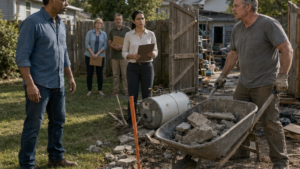
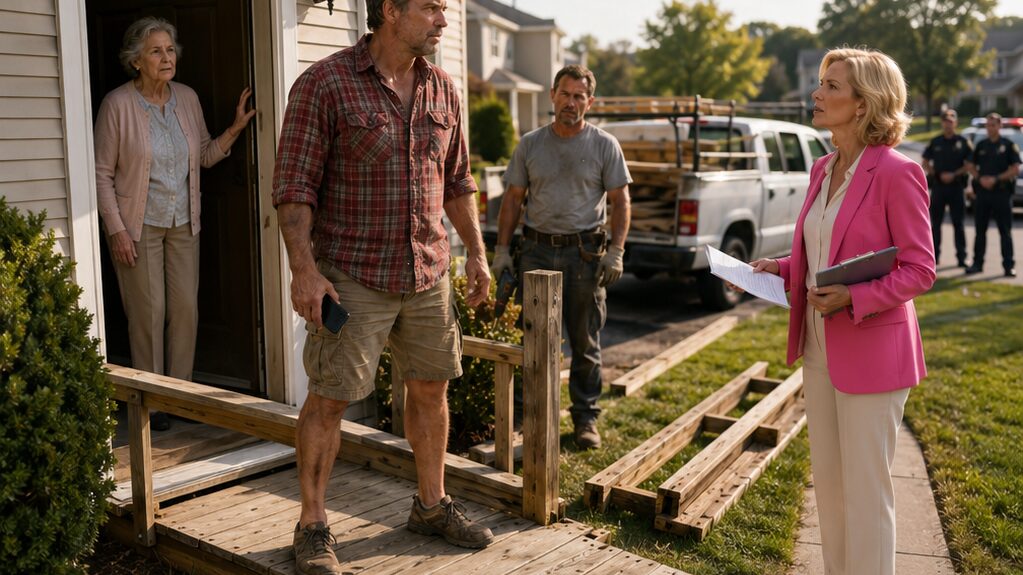
He reached the front hall in three strides. Through the narrow window beside the door, he saw boots on the ramp. Not one pair. Three. A white truck sat at the curb with its hazard lights blinking. The side of the truck had no company name, only magnetic numbers and a rack of tools. Two men in work gloves were crouched over the ramp Daniel had built and paid to have reinforced after Mary’s last fall. One of them had already removed the top handrail. The rail lay on the grass like something broken off a body.
Daniel opened the door.
“Stop.”
The worker nearest the threshold looked up, startled. A screw spun out from under his drill and rolled toward Daniel’s shoe.
“Sir, you need to stay inside,” the man said.
Daniel stepped onto the landing. Without the handrail, the top edge felt naked under his palm. “This is my house. Get off the ramp.”
A second worker stood from where he had been stacking boards by the truck. “We’re contracted for removal.”
“By who?”
The first worker glanced toward the street.
Daniel followed his eyes and saw a woman standing beside a black car with the driver’s door still open. Kathleen Hill wore a bright pink blazer over cream slacks, the kind of outfit that looked prepared for a photo, a complaint, and a meeting all at once. Her blond hair was smooth against the morning breeze. In one hand, she held a clipboard. In the other, a folded notice.
The house behind her rose above the curve of the street—white columns, wide windows, manicured hedges, a driveway that bent like a showroom entrance. Kathleen’s mansion always looked as though it had been placed in the neighborhood to remind the other homes they were being judged.
She came up Daniel’s walkway without hurrying.
“Mr. Carter,” she said. “You were notified.”
“No,” Daniel said. He pulled his phone from his pocket and started recording. “I was not notified that a crew would be on my property taking apart a medical access ramp.”
Kathleen’s eyes flicked toward the phone. Not fear. Calculation.
“You were notified that the structure is non-compliant.”
“It’s a ramp.”
“It is an unapproved exterior alteration that extends beyond the permitted improvement envelope.”
Daniel stared at her. Behind him, from the hallway, Mary called, “Daniel?”
He turned his head but did not step back. “Stay where you are, Mom.”
Kathleen lowered her voice, which made it colder. “There is no need to make this dramatic.”
“My mother has a medical pickup in forty minutes. She cannot use the front steps.”
Kathleen’s expression tightened, but not with concern. “That should have been addressed through the proper accommodation process.”
“I submitted the request four weeks ago.”
“You submitted a porch modification request.”
“For a ramp.”
“With incomplete documentation, no board approval, and no updated site plan.” She opened the folded notice and held it toward him. “The association has authority to remove unauthorized structures affecting common-area setbacks and community appearance.”
Daniel did not take the paper. He kept the phone steady.
“Do you have a court order?”
Kathleen blinked once. “This is an HOA enforcement action.”
“That’s not what I asked.” He turned the phone slightly toward the men. “Do any of you have a court order to dismantle a structure attached to my home?”
The crew supervisor, a stocky man with a sunburned neck, shifted his weight. “We were told it was cleared.”
“By her?”
Kathleen’s mouth tightened. “By the board.”
“Show me the board vote. Show me the final accommodation denial. Show me the removal authorization with today’s date.”
The supervisor lowered his drill.
That small silence changed the whole yard.
A neighbor walking a dog slowed across the street. One of the workers looked at the ramp boards already stacked near the truck as if they had become evidence. Daniel heard the medical alarm chime faintly from inside, the reminder he had set for Mary’s morning medication.
Kathleen noticed the pause too.
“The crew has been instructed to proceed,” she said.
“Not until I see the order.”
“You are obstructing an authorized contractor.”
“I’m standing on my own front landing, between my mother and a fall.”
Kathleen’s eyes moved over the ramp, the temporary braces, the pressure-treated boards Daniel had sanded by hand because Mary hated splinters. “Mr. Carter, everyone in this neighborhood has personal circumstances. We cannot allow residents to install structures wherever they please simply because they feel strongly about them.”
Daniel felt heat rise under his collar. He wanted to say everything at once: that Mary had cried the first time he had to lift her up the steps; that the old porch corner had sunk after every heavy rain; that he had sent emails, photos, receipts, diagrams; that nobody on the board had returned his calls until the violation notice arrived.
Instead he said, “Put the rail back.”
The supervisor looked from him to Kathleen.
“No,” Kathleen said. “The remaining structure is unsafe and unauthorized.”
“You made it unsafe when you started taking it apart.”
Kathleen held up the clipboard. “The ramp crosses into association-maintained frontage. It changes the exterior appearance from the street. It was not approved.”
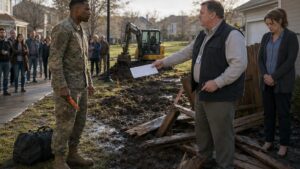
Daniel glanced past her toward the strip of grass between his walkway and Kathleen’s sweeping side lawn. The property line had always been a rumor in that part of the neighborhood, marked by old shrubs, a drainage dip, and an iron pin no one had seen in years. Kathleen had argued about it before, usually with landscapers, once with a delivery driver who parked near her curved drive.
“You don’t know where the line is,” Daniel said.
Kathleen’s face sharpened. “Excuse me?”
“You keep saying common frontage. Show me the survey.”
“The association map is clear.”
“That map is older than my roof.”
“Then we will have it surveyed.” She said it as if she were granting punishment. “And if this ramp is where our records show it is, the cost of removal and survey certification will be added to your account.”
Daniel heard a soft thump behind him. He turned. Mary stood inside the hallway with one hand pressed against the wall, dressed but not ready, her gray hair pinned unevenly because she had tried to do it herself. Her walker waited too far behind her.
“Mom,” he said, his voice dropping despite himself. “Please sit down.”
Mary’s eyes were not on him. They were on the missing rail.
“I can wait,” she said.
That hurt more than if she had asked for help.
Daniel turned back to the crew. “Nobody touches another board.”
Kathleen lifted her phone. “Then I’m contacting law enforcement to keep the peace.”
“To keep the peace?” Daniel gave one short laugh that had no humor in it. “Your crew is on my property before breakfast with drills.”
“This could have been avoided if you had complied with procedure.”
“This could have been avoided if one person on that board had answered a medical accommodation request like a human being.”
For the first time, something in Kathleen’s face moved—not guilt, exactly, but discomfort at the word medical being said loud enough for the neighbor to hear. She looked toward Mary in the doorway and then quickly away, as if acknowledging her would weaken the paper in her hand.
The supervisor cleared his throat. “Ma’am, we should probably pause until this is sorted.”
Kathleen turned on him. “The contract is for complete removal.”
“And I’m not catching a trespass charge over a handrail,” he said.
Daniel kept recording. The ramp boards lay in a rough pile by the curb. Screw holes dotted the exposed side supports. The space where the rail had been looked like a missing tooth.
From inside the house, Mary whispered, “Daniel, the van.”
He looked down the street. The medical transport vehicle had turned into the neighborhood and was slowing, its roof light flashing softly in the morning sun. It stopped two houses away, blocked by the crew truck.
Kathleen saw it too. Her lips pressed together.
A siren chirped once at the corner.
Two police vehicles rolled into the street and stopped near the curb, one behind the white crew truck, one near Kathleen’s black car. Doors opened. Officers stepped out, scanning the workers, the ramp, Daniel, Kathleen, Mary in the doorway.
Kathleen raised her clipboard and pointed—not at the missing rail, not at Mary, not at the scattered boards.
She pointed at the narrow strip of grass beside Daniel’s walkway.
“That structure,” she told the nearest officer, “is on association property.”
Daniel looked at the officer, then at the ramp, then at his mother standing behind him with no safe way down.
And for the first time that morning, he wondered whether the people with the paperwork were going to make him the trespasser at his own front door.
Chapter 2: The Application Nobody Wanted To Read
The first thing Daniel saw when he walked into the HOA meeting room was a photograph of his mother’s ramp projected eight feet wide under the word VIOLATION.
The picture had been taken from the street, at an angle that made the ramp look larger than it was. Someone had circled the handrail in red. Someone had drawn an arrow toward the front lawn. The top of Mary’s walker was barely visible through the sidelight window beside the door, but whoever made the slide had cropped most of it out.
Daniel stopped just inside the doorway.
Around the long table, board members sat with folders open and water bottles lined in front of them. A few neighbors had taken chairs along the wall. Kathleen Hill sat at the center, still in the pink blazer from that morning, though now the collar looked sharper beneath the fluorescent lights. Susan Mitchell, the treasurer, sat two seats away with a laptop open and a stack of insurance documents beside her.
Kathleen looked up. “Mr. Carter. You’re late.”
Daniel held up his phone. “Medical transport was delayed because your crew truck blocked the curb.”
A few people shifted in their chairs. Kathleen did not.
“You were invited to attend for the violation review,” she said. “Please take a seat.”
He remained standing. “Before I sit down, I want it entered into the minutes that workers removed part of the ramp before I was handed any notice of physical removal.”
Kathleen folded her hands. “The meeting has not begun.”
“Then it can begin with that.”
Susan looked at Kathleen. “We should note his objection.”
Kathleen’s jaw moved once. “Noted.”
Daniel took the chair nearest the door. He had brought a folder, thin but organized: copies of emails, the original application, photos of the cracked steps, a receipt from the contractor, Mary’s appointment schedule, the morning’s video saved in three places. He had not brought the letter from Mary’s doctor. Not yet. He had told himself the board did not need to know every detail of her condition. They needed to know the ramp was necessary. There was a difference.
Kathleen clicked a remote. Another photo appeared. This one showed the ramp from the side, the temporary braces visible beneath it.
“As you can see,” she said, “the structure changes the exterior presentation of the home, extends into the frontage area, and was installed without architectural approval.”
Daniel opened his folder. “I submitted an application on May second.”
“You submitted a request for porch stabilization and front-entry modification.”
“That’s the ramp.”
Kathleen’s smile was small and procedural. “The word ramp appears once, in a note field. There is no formal accommodation request attached.”
“There are pictures of the broken steps. There is a contractor estimate. There is a note saying my mother cannot safely use the stairs.”
Susan leaned forward. “Mr. Carter, did you submit medical documentation with the application?”
Daniel felt every eye in the room move to him. He looked down at the folder. The copy of the application was on top. His own words stared back: temporary access modification while front steps are repaired. Resident mobility issue. Urgent.
Not Mary’s diagnosis. Not the doctor’s letter. Not the phrase reasonable accommodation.
“No,” he said.
Kathleen’s fingers rested on the remote. “Then the board had no way to evaluate it as an accommodation request.”
Daniel looked at her. “You had my phone number. My email. My address. You had the photographs. You had enough to send a removal crew.”
Susan’s pen stopped.
Kathleen clicked again. The next slide showed the HOA design guidelines, section numbers highlighted in yellow. “We are not discussing sympathy. We are discussing process. Residents cannot bypass the architectural committee, install visible structures, and later claim urgency.”
A man at the end of the table murmured agreement.
Daniel placed the dated email receipt on the table and slid it forward. “May second. Automatic confirmation. May sixth, I sent follow-up photos. May ninth, I asked if temporary installation was permitted while the review was pending. May thirteenth, no response. May twentieth, the contractor reinforced the ramp because the porch edge shifted again after rain. May twenty-seventh, violation notice.”
Susan reached for the papers before Kathleen could stop her.
“These receipts are real,” Susan said.
Kathleen turned slightly. “No one is disputing receipt.”
“I am,” Daniel said. “I’m disputing that receiving it and ignoring it gives you the right to pretend I never asked.”
The room went still enough that the projector fan sounded loud.
Kathleen’s expression cooled. “Mr. Carter, the association receives many requests. We are volunteers. Emergency work must still comply with community standards.”
“Then tell me what standard lets my mother leave the house.”
“Again,” Kathleen said, “you did not provide sufficient documentation that anyone required—”
Daniel’s hand closed over the folder before he could stop himself. The doctor’s letter was inside the inner flap, sealed in an envelope because Mary had asked him not to hand her life around to strangers. He had promised. After his father died, after Mary sold the old place, after she said she would move in only if Daniel did not let people treat her like a burden, he had promised.
He heard her voice in his head: I need help, not an announcement.
So he did not pull out the envelope.
Instead he said, “I am telling you now.”
Susan looked at him with something like concern, but her voice remained careful. “For the record, Mr. Carter, there is a difference between a design request and a formal accommodation. If you’re asking the board to consider medical necessity, the file has to reflect that.”
“The file reflects enough for a phone call.”
Kathleen tapped the table. “The issue before us is whether enforcement should continue. The structure was not approved. The removal was authorized based on noncompliance and potential encroachment.”
“Potential,” Daniel repeated.
Kathleen clicked to a site map. Daniel recognized it; every homeowner had received the same faded copy at closing. His house sat near the bend where Kathleen’s larger lot widened. The line between the frontage and his walk was a thick black stroke, too broad to prove anything.
“This area,” Kathleen said, pointing with the remote’s red laser, “is association-maintained. The ramp extends into it.”
“Based on that old map?”
“Based on association records.”
“Then survey it.”
The words came out before Daniel had fully decided to say them.
Kathleen paused. “Excuse me?”
“If you’re going to tear out the ramp because you claim it crosses a line, survey the line.”
A faint sound moved through the room. Someone whispered. Susan looked from the map to Daniel’s papers.
Kathleen set the remote down with quiet precision. “The association is within its rights to verify boundaries. If a survey is required because of your unauthorized work, the cost may be charged back to your account.”
“Fine.”
Susan looked sharply at him. “Mr. Carter—”
“Fine,” he said again, though he knew he could not afford fine. Not really. The porch repair had already gone on a card. Mary’s transport bills sat in a stack by the microwave. He had been choosing which invoices could wait by how threatening their envelopes looked.
Kathleen watched him as if she had finally found the place where pressure would work. “The survey will not pause enforcement unless the board votes to pause it.”
“Then vote.”
No one moved.
Susan looked at the ramp photo still glowing on the wall. “I move to pause further removal until the boundary is verified and until Mr. Carter is given forty-eight hours to supplement the accommodation record.”
Kathleen’s head turned toward her.
“That is not on tonight’s agenda,” Kathleen said.
“It is now,” Susan replied, though her voice was not bold. It was cautious, the voice of someone counting risk.
Another board member seconded after a long silence.
The vote did not save the ramp. It saved only what was left of it.
By the end, Kathleen had her survey. Daniel had forty-eight hours. The crew would not return before the boundary check, but the rail remained off, the boards stayed stacked, and Mary still could not safely use the front entrance.
As people stood, Kathleen gathered her papers and came close enough that no one else would hear clearly.
“You may think a survey helps you,” she said. “But if that ramp is on association frontage, the removal cost, legal review, and survey fee will all become your responsibility.”
Daniel looked at the projected photo of his own front door, still marked in red.
“Then let’s find out where the line actually is.”
Kathleen’s smile did not reach her eyes.
“We will,” she said. “Tomorrow morning.”
Chapter 3: The Yellow Tripod Faced The Wrong House
Frank Lopez planted the yellow tripod in the grass between Daniel’s damaged ramp and Kathleen Hill’s curved driveway as if he were setting a small machine in the middle of a family argument and asking it not to take sides.
Daniel stood on his walkway with his phone already recording.
Across the strip of lawn, Kathleen watched from beside her black car. She had not worn pink this time, but a pale jacket that made her look official in a different way. Two board members stood behind her. Susan Mitchell was there too, arms folded, a file pressed against her ribs. The demo crew had not returned, but their absence did not make the morning calmer. The boards they had removed still lay stacked near Daniel’s garage, and the missing rail made Mary’s front door look unfinished, accused.
Frank adjusted the total station and looked through the scope.
“Mr. Lopez,” Kathleen said, “the association map indicates the frontage begins approximately three feet from the walkway.”
Frank did not look up. “I’ll locate the monuments first.”
“The map is in the packet.”
“I saw it.”
Daniel almost smiled. He did not.
He had spent the early morning moving Mary’s chair near the front window so she could see without standing. She had objected at first, then let him adjust the curtain. “Don’t make a show,” she told him.
“I won’t.”
“You already are.”
He had no answer for that.
Now, through the window, he could see her shape behind the glass, still and small and proud. He kept the camera angled away from her.
Frank’s assistant carried a rod toward the curb. A few neighbors had appeared with coffee mugs and pretending-not-to-watch faces. The neighborhood’s perfect lawns made the stakes look sharper: one yellow tripod, a few orange flags, one half-dismantled ramp, one mansion with columns shining beyond Kathleen’s shoulder.
Frank called out numbers to his assistant. The assistant marked a point near the sidewalk.
Kathleen stepped closer. “That seems too far west.”
Frank made a note. “It’s where the pin reads.”
“The pin may have shifted.”
“Possible,” Frank said. “That’s why I’ll check the rear reference and the recorded plat.”
Daniel kept filming. “Please say that again.”
Frank looked at him. “I’m checking the recorded plat against physical monuments.”
Kathleen turned. “Mr. Carter, you are not directing this survey.”
“No,” Daniel said. “Just documenting the one you ordered.”
Her eyes flicked toward his phone. “This is exactly the sort of hostile behavior that makes board enforcement difficult.”
Daniel did not answer. He had learned the previous night that not every accusation deserved oxygen.
Frank moved the tripod twice. Each time, the yellow legs opened over the lawn with calm, deliberate clicks. Each time, Kathleen’s confidence became more rigid. She stood as if posture could hold the old map in place.
After twenty minutes, Frank put a small orange flag near the base of Daniel’s ramp.
Kathleen exhaled as if vindicated. “There.”
Frank placed a second flag. Then a third.
Daniel looked at the line forming in the grass. It did not cut through the ramp. It ran beside it.
Frank checked his tablet. “Preliminary read places the ramp within the Carter parcel.”
The words landed softly.
Too softly, at first.
Daniel lowered the phone an inch. “Within my property?”
“Preliminary,” Frank said. “Not certified until I complete the checks. But yes, based on what I’m seeing, the ramp does not extend into association frontage.”
Susan looked down at her file.
Kathleen stepped forward. “That cannot be correct.”
Frank straightened. “It may be different from the association map. That doesn’t make it incorrect.”
“The board has used that map for years.”
Frank’s face remained neutral. “Then the board may want its records updated.”
Daniel heard movement at the window. Mary had shifted behind the curtain.
For one brief, dangerous second, Daniel felt victory rush into him. He imagined asking Kathleen to repeat every word from the meeting, imagined showing the video to every neighbor, imagined laying the removed handrail at the board’s feet.
Then he looked at the ramp again. The top rail was still gone. Mary still could not come down.
A police cruiser turned onto the street.
Daniel’s grip tightened around the phone.
Kathleen lifted her chin, but he saw something pass over her face—not surprise, because she had called them, but irritation that they had arrived at the wrong moment.
The officers parked behind the survey van. One approached slowly, hands relaxed. “We got a call about obstruction.”
Kathleen answered before anyone else. “Mr. Carter has been interfering with an association-ordered boundary survey connected to an enforcement action.”
Daniel held up the phone but kept his voice level. “I’m standing on my walkway. The surveyor just said the ramp is on my property.”
The officer looked at Frank.
Frank nodded. “He has not interfered with my work.”
Kathleen’s color rose. “The issue is broader than the ramp. The frontage line affects association maintenance and adjacent property boundaries.”
“Adjacent,” Frank repeated, and for the first time he looked toward Kathleen’s mansion.
Daniel followed his gaze.
The orange flags did not stop where Daniel expected. The sightline extended beyond his ramp, across the dip in the lawn, toward the edge of Kathleen’s curved driveway. Her landscaping bed, raised with stone blocks and trimmed shrubs, sat exactly where the line seemed to be heading.
Susan noticed it too. “Frank,” she said carefully, “are you saying that line continues toward the Hill property?”
“Property lines usually do,” Frank said.
Kathleen gave a short laugh. “My property was surveyed when the west addition was approved.”
“Do you have that survey?”
“It’s in the association records.”
Susan did not look convinced. Daniel noticed that. So did Kathleen.
Frank walked a few yards closer to the mansion side. He motioned to his assistant, who moved the rod toward the driveway. The yellow tripod turned, its single dark eye no longer facing Daniel’s ramp. It faced Kathleen’s house.
That was when the street became quiet in a different way.
Not polite quiet. Waiting quiet.
Kathleen stepped into Frank’s path. “Mr. Lopez, your scope today is the Carter ramp.”
“My work order says disputed frontage boundary adjacent to Carter parcel.”
“I authorized verification of his encroachment.”
“I don’t verify conclusions,” Frank said. “I verify boundaries.”
Daniel kept the camera steady, though his pulse had started to beat in his thumb.
The assistant called out from near the driveway. Frank checked the reading, frowned slightly, then checked the tablet again.
Kathleen saw the frown.
“What?” she said.
Frank did not answer immediately. He walked to the curb, looked back toward Daniel’s ramp, then toward Kathleen’s white-columned house. He crouched near an old iron marker half-buried under mulch at the edge of her landscaping bed. One of the officers moved closer, not because anyone had threatened anything, but because everyone could feel the argument changing shape.
Susan spoke first. “Is that a marker?”
Frank brushed soil away with his gloved hand. “Looks like one.”
Kathleen’s voice sharpened. “There is no marker there.”
Frank looked up. “There is now.”
Daniel heard a neighbor whisper from across the street.
Kathleen’s face had gone still, but her eyes moved quickly: marker, driveway, tripod, Daniel’s phone, police, Susan. For the first time since the drill woke him, she looked less like a person enforcing a rule and more like a person watching a rule walk toward her own front door.
Frank stood and wiped his hand on a cloth.
“I can complete the Carter ramp certification today,” he said. “Or, if the association wants the full boundary certified, including the continuation along the Hill west wall and driveway edge, I’ll need written authorization.”
No one spoke.
The yellow tripod stood between the half-torn ramp and the mansion, aimed like it had chosen its own answer.
Frank looked at Kathleen.
“Do you want the full boundary certified?” he asked.
Chapter 4: The Line Under The President’s Driveway
The preliminary survey arrived in Daniel’s email at 6:12 in the morning with one clean black line that should have made him feel safe.
Instead, it made his stomach drop.
The line did not touch the ramp. Frank Lopez had marked the edge of Daniel’s parcel several feet away from the boards Kathleen’s crew had tried to remove. The ramp, the front landing, even the temporary brace near the cracked porch corner all sat inside Daniel’s property. A short note beneath the diagram read: preliminary boundary location inconsistent with association-maintained frontage map.
Daniel read that sentence three times while Mary sat at the kitchen table stirring oatmeal she had not eaten.
“Well?” she asked.
“It says the ramp is ours.”
Mary looked toward the front door. The missing handrail left a pale strip where the wood had been screwed in. “Then why do you look like somebody handed you a bill?”
Daniel turned the laptop so she could see the map. The same black line that cleared the ramp continued past the corner of his lawn, across the narrow drainage dip, and toward the stone landscaping along Kathleen Hill’s curved driveway.
Mary leaned closer. “That’s her side, isn’t it?”
“Looks like it.”
“Does she know?”
Daniel closed the laptop halfway. “She was standing there when he found the marker.”
Mary gave him a look. “That isn’t an answer.”
Before Daniel could reply, his phone buzzed. A message from Susan Mitchell appeared with no greeting.
Can you come by the records office at 10? Bring your porch photos. Do not forward this message.
Daniel stared at it. Susan had not sounded like an ally at the meeting. She had sounded like someone trying to keep the association from being sued. Maybe that was all she was. Maybe that was enough.
The HOA records office occupied a small side room behind the clubhouse kitchen. Daniel had never been inside. Most homeowners knew it only as the place where holiday decorations, old ballots, and boxes of architectural forms went to disappear.
Susan was waiting with three banker’s boxes open on the table.
“You didn’t get this from me,” she said before he sat.
“I got a text from you.”
“You got a text asking you to bring photos. Anything else you saw because I was checking association risk.”
Daniel set his folder down. “That’s what this is?”
“That’s what everything is, eventually.” Susan pushed a brittle sheet across the table. “This is the original drainage easement record from when the subdivision was built.”
The paper smelled old, dusty, and faintly damp. Daniel recognized street names, lot numbers, a curving line labeled stormwater swale, and a narrow utility notation running between his side yard and what was now Kathleen’s expanded driveway bed.
“That drainage dip behind my front walk,” Daniel said.
Susan nodded. “It was supposed to stay open.”
“It is open.”
“On your side.” She tapped the map. “The record suggests it continues under the current Hill landscaping edge. Possibly the driveway expansion too. I’m not saying it does. I’m saying the association should have checked before treating your ramp like the source of the problem.”
Daniel pulled out the porch photos. In the first, the front step had a hairline crack. In the second, taken after spring rain, the crack had widened and the corner had dropped slightly. In the third, Mary’s walker stood at the bottom because she could not climb up without Daniel’s hand under her elbow.
Susan looked at the photos longer than he expected.
“Why didn’t you include the medical letter?” she asked quietly.
Daniel’s fingers tightened on the folder.
“Because my mother asked me not to.”
Susan looked up.
“She moved in after my father died,” Daniel said. “She agreed to it on one condition. No neighbors discussing her in meetings. No committees deciding what she can and can’t do like she’s a project. I thought if I said mobility issue, ramp, temporary, repair, that would be enough.”
Susan’s face softened, but only for a second. Then the treasurer returned. “It wasn’t enough for our process.”
“Your process ignored the words that were there.”
“I know.”
That stopped him.
Susan slid another page from the box. “There’s something else. Kathleen’s west-side landscaping was approved six years ago as ‘decorative border and driveway edge correction.’ No full survey attached. Just the association map.”
Daniel looked at the date. “She was president then?”
“Architectural chair. Not president.”
“But she approved her own project.”
“Technically, the committee did.” Susan’s mouth tightened. “Practically, yes, she drove it.”
Daniel looked down at the old drainage record again. The black line from Frank’s preliminary survey now felt less like a victory and more like a thread pulled from the wall.
His phone rang before he could ask the next question. The caller ID showed the city office.
The city inspector arrived at Daniel’s house just after noon, carrying a tablet and the tired expression of someone who had already been told two versions of the same story. He examined the front ramp, the missing rail, the exposed screw holes, and the stacked boards by the garage.
Daniel stood beside him with the survey printout in one hand.
“The ramp is on my property,” he said. “The HOA crew removed the rail.”
The inspector crouched near the top landing. “I’m not here to decide property lines.”
“They damaged it.”
“I can see that.” The inspector stood and tapped something into the tablet. “But in its current condition, this access ramp is unsafe for use.”
Daniel felt the words hit before he understood them. “Unsafe because they took it apart.”
“Correct.”
“Then write that.”
“I can note observed partial dismantling. But until the rail is restored and the top support is checked, I have to tag it.”
Mary watched from the doorway, one hand flat against the inside wall.
Daniel turned toward her. “Mom, don’t come out.”
“I wasn’t planning to fly,” she said, but her voice was thinner than usual.
The inspector printed a small notice from his portable device and fixed it near the side of the landing with blue tape. UNSAFE ACCESS STRUCTURE — USE RESTRICTED PENDING REPAIR.
Daniel stared at the paper. The survey said the ramp was his. The city said it was unsafe. The HOA had created the danger, and now the danger had become official.
By late afternoon, Kathleen’s email arrived.
Mr. Carter,
In light of the preliminary nature of the survey and the city’s unsafe-structure tag, the Association is prepared to resolve this matter without further escalation. The Board will waive pending fines if you withdraw your accommodation complaint, remove the front ramp, and submit a new application for a rear-entry access solution not visible from the street. The Association will allow expedited review.
Regards,
Kathleen Hill
HOA President
Daniel read it twice.
Then he carried the laptop to Mary’s room.
She was sitting by the window with her knitting in her lap, though she had not made a stitch all day. The blue unsafe notice was visible through the glass, taped beside the ramp like a verdict.
Daniel turned the screen toward her. “She wants the ramp moved to the back.”
Mary read slowly. Her face did not change until she reached the line about withdrawing the complaint.
“The back door has two steps and that narrow turn by the laundry,” she said.
“I know.”
“The transport chair won’t fit.”
“I know.”
She looked at him. “But it would end the fight?”
Daniel did not answer.
Mary folded her hands over the yarn. “Daniel.”
He closed the laptop before she could say what he was afraid she would say.
“No,” he said. “It would end the paperwork. It wouldn’t get you out the door.”
From outside, a car slowed in front of the house. Daniel glanced through the curtain and saw Kathleen’s black car rolling past, slow enough for her to see the unsafe notice, the missing rail, and the ramp she was now pretending had never been necessary in the first place.
Mary’s voice came from behind him, quiet but steady.
“Then you had better decide whether you’re fighting for me, or fighting because she embarrassed you.”
Daniel kept his eyes on the street until Kathleen’s car disappeared around the curve.
Chapter 5: The Video Mary Asked Him Not To Post
Daniel’s thumb hovered over the button that would send the video to every neighborhood page, every local group, every person who had ever complained about the HOA and meant it.
On the screen, the crew supervisor lowered his drill. Kathleen stood in her pink blazer with the folded notice in one hand. Daniel’s own voice came from the phone, calm in a way he barely recognized: Do you have a court order?
Then Mary appeared in the doorway behind him, one hand against the wall, her body half-hidden by the frame.
Daniel paused the video before her face turned fully toward the missing rail.
The caption box was empty. He had already typed and deleted three versions. The first was angry. The second was cleaner. The third had been all dates and no heat, which somehow made it worse. He could imagine the comments before they existed. People would call Kathleen heartless. They would share the clip. They would freeze Mary’s shape in the doorway and turn it into proof.
His thumb drifted closer to Post.
“Don’t,” Mary said from behind him.
Daniel locked the phone so quickly the screen went black.
She stood at the kitchen entrance with her walker, breathing carefully, one slipper slightly crooked. “I know that look.”
“What look?”
“The one you got when you were twelve and wanted to tell the whole block the neighbor’s dog bit you.”
“It did bite me.”
“And you still made it about winning.”
Daniel set the phone face down. “This is different.”
“Yes,” Mary said. “Now you’re old enough to know better.”
He pulled out a chair for her, but she waved him off and took it herself, slow and stubborn. The blue unsafe notice outside colored the window glass.
“They’re lying,” Daniel said.
“Then make them read the paper.”
“That video is paper.”
“No. That video is me in a doorway with my hair wrong.”
He looked away.
Mary lowered herself into the chair. “Don’t make me the reason people hate her.”
“She sent a crew to tear out your ramp.”
“Then prove that. Don’t sell me with it.”
The words stung because he knew she was not accusing him of cruelty. She was accusing him of fear wearing armor.
Daniel sat across from her. “I should have filed the doctor’s letter the first day.”
“Yes.”
He looked up.
Mary’s eyes did not soften. “You were trying to protect me. You were also trying to protect yourself from having neighbors know things you didn’t want to say out loud.”
He wanted to deny it. Instead he picked up the phone and opened the video again, not to post it, but to export a copy. He renamed the file: Removal Attempt — 8:17 AM — Before Notice Delivery.
Mary watched him.
“No caption?” she asked.
“No caption.”
“Good.”
By noon, Daniel had turned the kitchen table into an evidence line. He placed every document in order: application, email receipts, follow-up photos, violation notice, video timestamp, preliminary survey, city unsafe tag, Kathleen’s settlement offer. He added the doctor’s letter in a sealed sleeve with Mary’s consent written on a sticky note in her own careful handwriting: For accommodation review only. Not for publication.
It was the closest thing to trust he could ask from her.
At three, he walked to the crew company’s yard, a fenced lot behind a strip mall where trailers and stacked ladders sat in neat rows. The demo crew supervisor recognized him from the ramp and looked as though he had been waiting to be accused.
“I’m not here to yell,” Daniel said.
“That’s a first this week.”
“I need your work log from the morning you came to my house.”
The supervisor folded his arms. “Can’t hand out company paperwork.”
“Then confirm the time.”
“Talk to the HOA.”
“They’re saying the notice came first.”
The supervisor’s expression changed. Not much, but enough.
Daniel pulled out the video still. The time displayed at the top: 8:17 AM. “You were already taking the rail off here. Kathleen handed me the notice after I opened the door.”
The supervisor rubbed the back of his neck. “We got the go-ahead at seven-thirty. Job start eight.”
“Who gave the go-ahead?”
“The association office sent the work order.”
“Did it say the homeowner had been notified?”
“It said notice posted.”
“When?”
The supervisor looked toward the office trailer. “I don’t know.”
Daniel waited. He had learned from Kathleen that silence could be a tool; he had not expected to use it himself.
Finally the supervisor said, “I can give you a copy of our arrival log if you send a written request. It won’t say what you want it to say.”
“What will it say?”
“That we arrived at 8:02 and began removal at 8:09.”
Daniel felt the first clean piece of the day slide into place.
“And the notice?”
“You’d have to ask the association.”
“I did.”
The supervisor gave him a humorless look. “Then ask better.”
By evening, Daniel had the arrival log by email. He printed it and placed it between the video timestamp and Kathleen’s notice. The sequence was plain enough that even a board could not pretend not to see it.
8:02 crew arrival.
8:09 removal begins.
8:17 video starts.
8:22 notice handed to homeowner.
Mary read the times and said nothing for a while.
Then she took out her pen and wrote on another sticky note: This is why I could not leave for transport.
Daniel looked at her handwriting until the numbers blurred.
The next morning, Kathleen sent her own attachment to the board and copied Daniel. The subject line read: Contractor Safety Statement — Carter Ramp.
He opened it standing at the kitchen counter.
The statement claimed the crew had observed “pre-existing instability,” “improper support,” and “unsafe construction conditions prior to removal activity.” It did not mention the missing rail. It did not mention the time they began. It did not mention Mary.
Mary watched his face. “What now?”
Daniel printed the statement and set it at the end of the table. For a moment, he saw exactly how easy it would be to post everything and let strangers do what strangers did.
Instead, he pulled a clean sheet from the printer.
At the top, he wrote: Response to Contractor Safety Statement.
He added only dates, photos, and the work log. No insults. No guesses. No clip for the neighborhood to chew on.
At the bottom of the pile, beneath the contractor statement, Daniel placed the crew supervisor’s arrival log. The document was only one page, but the timestamp on it was louder than any caption he could have written.
Chapter 6: The Hearing Where The Survey Came Back
Kathleen Hill began the formal hearing by calling the ramp “an unauthorized structure already found unsafe,” and Daniel felt half the room accept the phrase before the first document was opened.
The clubhouse had been arranged like a small courtroom pretending not to be one. Board members sat behind folding tables. Neighbors filled the back row. The city inspector stood near the side wall with a tablet. Frank Lopez waited beside a rolled survey sheet secured with two rubber bands. Daniel sat alone at the front with his evidence folder closed under both hands.
Mary had not come.
That had been her choice, and Daniel was still fighting the urge to apologize for respecting it.
Kathleen’s jacket was pale blue tonight, but the pink folder in front of her was unmistakable. She looked composed, even generous, as she addressed the board.
“The association is not indifferent to resident needs,” she said. “But we cannot allow unsafe, unapproved structures to remain because a homeowner failed to follow the required process.”
Daniel heard Susan’s pen click once.
Kathleen continued. “Mr. Carter was offered a reasonable resolution: waiver of fines, expedited review, and an alternate rear-entry solution. He declined.”
Daniel opened his folder.
“Mr. Carter,” Susan said, “you’ll have time to respond.”
“I’m ready.”
Kathleen’s eyes narrowed. “After I finish.”
He closed the folder again.
She presented the contractor safety statement first. Then the unsafe tag. Then the old association map. The sequence was clean if nobody looked too closely. Unauthorized ramp. Unsafe structure. Association frontage. Refused compromise.
When it was Daniel’s turn, he did not start with Mary.
He started with the rail.
He placed a photo on the table: the ramp the night before removal, intact, level, with both rails secured. Then another: the missing rail beside the crew truck. Then the work log.
“The unsafe condition the city tagged was created after removal began,” he said. “Here are the times. Crew arrival, 8:02. Removal begins, 8:09. Video starts, 8:17. Notice handed to me after that.”
Kathleen leaned toward her microphone. “The crew reported pre-existing instability.”
Daniel placed the contractor’s earlier invoice beside the photos. “The ramp was reinforced five days before the crew came. If the board has an inspection report from before 8:09 that morning, I’d like to see it.”
No one moved.
Susan looked at the work log. “Do we have such a report?”
Kathleen’s answer came too quickly. “The contractor observed the condition.”
“After they started removing it?” Susan asked.
Kathleen’s lips pressed into a line. “The distinction is not material if the structure was unauthorized.”
“It is material to liability,” Susan said.
The room shifted.
Daniel did not look at Kathleen. He kept his eyes on Susan because he could feel how fragile that turn was. Susan was not defending him because she liked him. She was following the risk to where it led.
Next he placed the application receipt on the table. “May second. May sixth. May ninth. I asked for temporary access while the porch repair was pending.”
Kathleen said, “You did not submit the required accommodation form.”
“No,” Daniel said. “I did not.”
That surprised the room more than any denial would have.
He took out Mary’s doctor’s letter, still in its clear sleeve. His hand paused on it.
“My mother asked me not to make her condition public,” he said. “I used words like mobility issue because I thought I could protect her privacy and still make the need clear. That was my mistake.”
Kathleen glanced toward the neighbors.
Daniel kept the letter face down except for the heading and date. “I’m submitting the medical documentation to the board for review, not to the audience. The relevant point is simple: she cannot safely use the front steps. The rear entrance does not accommodate her transport chair. The front ramp is not cosmetic.”
For the first time that night, Kathleen did not answer immediately.
Susan reached for the sleeve, read the top page quietly, and passed it to the board member beside her without exposing it to the room.
Then Frank Lopez stood.
He unrolled the certified survey across the table. The paper made a soft cracking sound as it flattened. Daniel saw the black boundary line, sharper now, official now, running past his front walk, missing the ramp completely, continuing toward Kathleen’s driveway edge.
Frank placed a weighted marker on each corner.
“My certified finding,” he said, “is that the Carter ramp, as installed prior to partial removal, was within the Carter parcel. It did not encroach into association-maintained frontage based on recorded monuments and plat references.”
Kathleen’s face remained controlled, but her hand closed around a pen until her knuckles paled.
Frank continued. “The association map used in the violation packet appears inconsistent with the recorded boundary by approximately several feet in this area.”
Susan looked at the old map, then at the survey. “And the line continuing west?”
Frank moved his finger along the page. “The recorded boundary and associated drainage easement continue along the edge of the Hill property. Based on visible conditions, some landscaping and a portion of the driveway-edge correction may occupy or obstruct the easement area. That would require additional engineering review, but the boundary location is clear.”
The room went silent enough for Daniel to hear someone in the back row whisper, “That’s her driveway.”
Kathleen sat forward. “The Hill property improvements were approved years ago.”
“I’m not commenting on approvals,” Frank said. “I’m commenting on location.”
“The survey scope was the Carter ramp.”
“The certified survey includes the disputed boundary segment referenced in the work order.”
Susan turned to Kathleen. “Who wrote the work order?”
Kathleen did not answer.
Daniel looked at the survey, at the line cutting through the certainty Kathleen had carried into every room. A part of him wanted to push. He could ask for her landscaping to be removed immediately. He could ask why her project had no survey. He could let the neighbors understand exactly whose house now stood under the same rules she had used against his ramp.
He saw Mary in the kitchen that morning, looking at his phone. Don’t sell me with it.
Susan cleared her throat. “Mr. Carter, given this survey, what remedy are you requesting?”
Kathleen looked at him then. Not pleading. Not sorry. Bracing.
Daniel could feel the room waiting for him to choose punishment.
He opened his folder to the last page, the one he had rewritten three times.
“I want the violation withdrawn,” he said. “All fines and removal charges removed from my account. Written approval to restore the front ramp with minor safety trim if required by code. Reimbursement for the rail and boards your crew removed or damaged. A drainage review for the easement affecting my porch. And written confirmation that my mother’s accommodation will not be used as a design precedent against other residents.”
Kathleen blinked. “You’re not requesting enforcement against my property?”
Daniel looked at her. “I’m requesting access to mine.”
The words did not make him feel noble. They made him feel tired. But the tiredness was clean.
Susan’s face changed, not dramatically, but enough. She turned to the other board members. “The board acted before completing accommodation review. We relied on an outdated map. We have a certified survey contradicting the basis for removal. We also have potential easement exposure affecting more than one property.”
Kathleen said, “Susan.”
“No,” Susan said, and the single word carried farther than any argument Daniel had made. “We need emergency liability review before we take another step.”
The board members murmured. One asked whether the ramp could be restored immediately. Another asked whether the city tag prevented use. The inspector answered that restoration could proceed if repaired to code and reinspected.
Kathleen requested a closed session. Susan requested a formal recess with the evidence preserved in the record.
Daniel sat back as the board voted.
The recess passed by a narrow margin.
Kathleen gathered her pink folder and stood without looking at him. Susan remained seated, reading the survey line again as if it had become a sentence she could no longer avoid.
The chair announced the hearing would reconvene after emergency review.
Daniel looked down at the photo of the removed boards, then at Mary’s sealed medical letter, then at the certified survey stretching from his ramp toward the president’s mansion.
The fight had finally entered the record, but the ramp was still broken, and Mary still could not come safely through her own front door.
Chapter 7: The Ramp Went Back Where The Line Belonged
The same white crew truck returned one week later, and Daniel stood at the front window long enough to watch the first worker unload boards instead of carry them away.
For a moment, his body did not understand the difference. The sound of the tailgate dropping still made his shoulders tighten. The scrape of lumber still found the place in him where the drill had started everything. Even when the crew supervisor lifted a new handrail from the truck bed and set it carefully on padded sawhorses, Daniel kept his phone in his pocket and his hand on the doorframe, ready.
Mary sat behind him in her chair, dressed in a blue cardigan, her walker within reach.
“Are they here to fix it,” she asked, “or are you still deciding whether to fight them?”
Daniel looked back at her.
“They’re here to fix it.”
“Then open the door like a civilized person.”
He almost smiled.
Outside, the supervisor removed his cap when Daniel came onto the landing. The unsafe notice still clung to the side post, curled at one corner from a week of sun. The old screw holes in the ramp looked darker than the new boards stacked beside them.
“Mr. Carter,” the supervisor said. “We’ve got the approved plan. Front ramp restoration, rail replacement, top support check, and trim pieces to match the exterior requirements.”
“Trim pieces,” Daniel repeated.
“Association wants the visible edge painted to match the porch.” The man looked embarrassed by how small it sounded. “City inspector wants the rail height verified before use.”
Daniel stepped aside. “Do it right.”
“We will.”
The crew began without drills at first. They measured. Marked. Checked level. The supervisor photographed the existing damage before touching anything. Daniel noticed that. He also noticed the way the workers stayed off the grass strip now marked by small survey stakes.
Across the street, Kathleen Hill stood at the end of her curved driveway.
The survey stakes cut through the clean edge of her landscaping bed, bright orange against dark mulch. One stood near the stone border. Another stood close enough to the driveway flare that any person walking past could see the line did not respect the story the HOA map had told for years.
Kathleen wore a neutral jacket and held no clipboard.
That, more than anything, made her look smaller.
A black landscaping tarp covered part of the bed where a contractor had begun removing stones for the drainage review. The work was not dramatic. No machine tore into the mansion. No crowd gathered to watch her lose face. A city engineer’s small white marking flags did the job with less noise and more permanence.
Susan Mitchell arrived at midmorning with a folder and no audience.
She handed Daniel three signed letters.
“The violation is withdrawn,” she said. “All fines and removal charges are removed from your account. The board approved the ramp restoration with the trim condition. The drainage review is officially open, and the association records will be corrected after final survey filing.”
Daniel read each page before answering. He had learned that relief was not the same as trust.
“And future accommodation requests?”
“In writing,” Susan said. “Separate from design review. That policy change passed last night.”
He looked up.
Susan met his eyes, but not easily. “We should have had it already.”
Daniel folded the letters. “Yes.”
She took that without defending herself.
For a few seconds, they stood beside the ramp while the crew fitted the new rail into place. The supervisor tightened a bolt, then checked it twice.
Susan glanced toward Mary’s window. “How is she?”
“Waiting.”
“For what?”
Daniel looked at the rail, then at the front door. “For me to stop standing in the way.”
By noon, the city inspector had returned. He tested the rail with both hands, checked the top landing, measured the slope, and walked down once with the flat expression of a man determined not to become part of anyone’s emotional ending.
“Approved for use,” he said, and peeled the blue unsafe notice from the post.
The paper came away in one piece.
Daniel had not expected that to matter. It did. The square of clean wood beneath it looked like the house had been holding its breath.
The crew packed slowly. The supervisor left the old damaged rail by the garage only after asking whether Daniel wanted it discarded.
“No,” Daniel said. “Leave it.”
Mary appeared at the doorway before he went in to get her.
She had put on lipstick. Not much, just enough to announce that this was not a medical event. Her hand rested on the walker, but her eyes were on the ramp.
“You ready?” Daniel asked.
“I was ready a week ago.”
He did not reach for her elbow until she nodded.
Together they crossed the threshold. Her first step onto the rebuilt landing was careful. Her second found the rail. Daniel watched her fingers close around the smooth new wood, the same place the old rail had been torn away. The boards did not shift. The rail did not give. The ramp held.
At the bottom, Mary stopped.
The street had gone quiet, though Daniel knew people were watching from windows. Kathleen still stood near her driveway, half-hidden by the open door of her car. For one brief second, Daniel saw not the president, not the pink blazer, not the woman with the notice, but a homeowner looking at stakes in her own lawn and understanding that rules did not always stop at someone else’s porch.
Mary followed his gaze.
“Don’t,” she said.
“I didn’t say anything.”
“You were thinking loudly.”
Daniel let out a breath.
Kathleen did not come over. She did not apologize. She did not wave. After a moment, she turned toward the workers near her landscaping bed and spoke to them with the stiff posture of someone trying to keep authority while losing certainty.
Mary adjusted her grip on the rail. “Is that enough for you?”
Daniel looked at the restored ramp, the signed letters in his hand, the orange stakes that would remain in Kathleen’s lawn until the corrected survey was filed. He thought of the video still saved on his phone, the version he had never posted. He thought of the doctor’s letter, no longer hidden but not displayed. He thought of how close he had come to making the whole thing about proving Kathleen wrong instead of getting Mary safely down the steps.
“No,” he said honestly. “But it’s what we needed.”
Mary nodded, as if that was the only answer she had been willing to accept.
The medical transport van turned into the street a few minutes later. This time, there was no crew truck blocking the curb. No officer asking who owned the grass. No clipboard held between a person and a doorway.
Daniel walked beside Mary as she moved down the ramp under her own balance, one hand on the new rail, one hand steadying the walker. At the bottom, she paused and looked back at the house.
“It looks better with the trim,” she said.
Daniel laughed before he could stop himself.
Across the lawn, the yellow survey stakes remained where Frank Lopez had placed them, bright and blunt against Kathleen Hill’s perfect grass. They pointed toward the mansion, toward the corrected record, toward whatever the association would have to fix next.
Mary kept her hand on the rail a moment longer.
Then she let go.
The story has ended.