The HOA Chair Called His Vegetable Garden an Eyesore, Until the Rulebook Turned Against Her
Chapter 1: The Violation Notice on the Tomato Stake
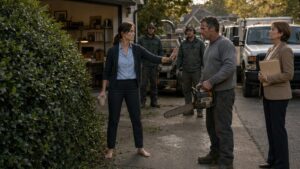
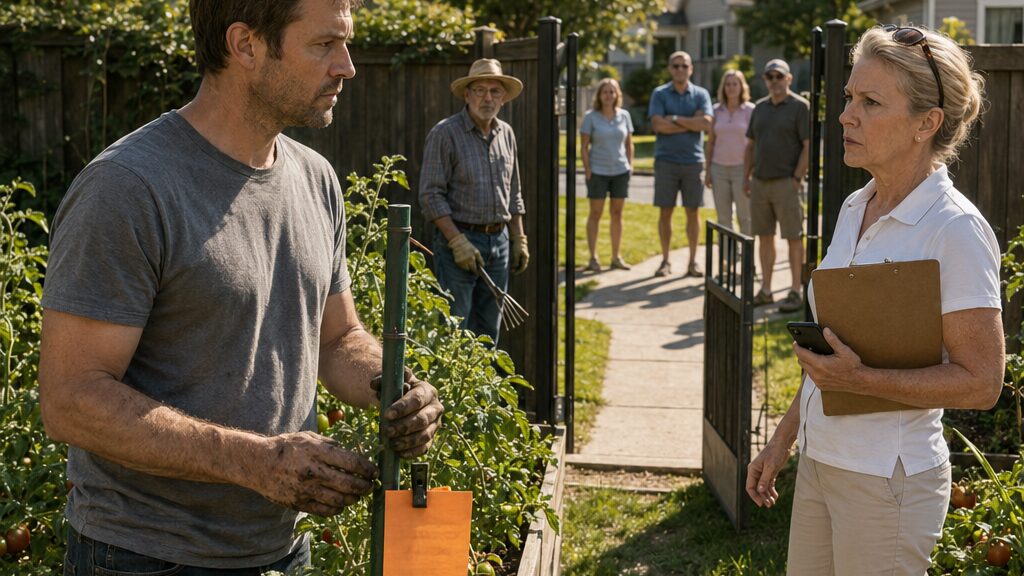
Nancy Martin clipped the orange violation notice directly to the tomato stake, not the fence, not the gate, not the mailbox where normal people left paper.
The stake bent under the pressure of her hand.
Matthew Hall stepped forward before he could stop himself, one palm lifting, not to touch her, not even close, but to steady the green wooden support before it snapped. The tomato plant was heavy with fruit, some still pale at the shoulders, some already blushing red beneath the leaves.
“Careful,” he said.
Nancy looked at his hand as if he had reached for her purse.
“That,” she said, tapping the notice with two fingers, “is exactly the problem.”
Matthew let go of the stake slowly. He could feel dirt under his fingernails from where he had tied the lower stems that morning. Behind Nancy, beyond the open side gate, two neighbors had slowed on the sidewalk. One kept walking after a quick glance. The other pretended to check a phone.
It was a Saturday morning. He had been watering in an old gray T-shirt, the hose coiled at his feet, a basket sitting upside down beside the raised beds because he had not expected company. The four beds stood along the sunny edge of the backyard, neat cedar frames, dark soil, peppers in one corner, basil in another, tomato stakes in straight rows. To Matthew they looked practical. To Nancy, judging from the tight set of her mouth, they looked like a collapse in civilization.
“This is not an approved landscape feature,” she said.
“It’s a vegetable garden.”
“It’s a visible structure.”
“It’s tomatoes.”
“It is an eyesore.”
The word landed louder than it should have. Matthew glanced again at the sidewalk. The neighbor with the phone had gone still.
Nancy wore white pants and a pale blue visor, though the sun was not yet high enough to require one. A clipboard rested against her forearm. Her sunglasses were pushed into her hair. She had the clean, prepared look of someone who had expected resistance and dressed for being right.
Matthew took a breath through his nose.
“Can you tell me which section?” he asked.
Nancy’s eyebrows rose. “Excuse me?”
“Which rule. I’d like to read it before I respond.”
“You know the landscaping standards.”
“I know lawns need to be maintained. I know fencing has restrictions. I don’t remember anything that bans raised beds.”
“That is because residents are expected to understand the spirit of the guidelines, not look for loopholes.”
He looked at the orange notice moving slightly in the breeze. It was clipped near a cluster of tomatoes he had meant to pick for Anna Smith later, if he saw her car in the driveway. Her kids liked the small ones. They ate them like candy, she had said once, embarrassed by how grateful she sounded over a paper lunch bag of extra produce.
Nancy followed his eyes.
“Do not remove that notice,” she said.
“I wasn’t going to.”
“I have already photographed the violation from multiple angles.”
Matthew looked at her phone, now visible in the hand not holding the clipboard. There was something almost triumphant about the way she held it.
“You came into my side yard to take pictures?”
“The gate was open.”
“I was right here.”
“And I identified myself.”
“You walked in while I was watering.”
Nancy clicked her pen. “This conversation would be more productive if you stopped trying to make it personal.”
Matthew felt heat move up his neck. He wanted to say that the entire thing was personal. The tomatoes were personal. The Saturdays were personal. The way people turned their heads and kept walking when someone with a clipboard stood in your yard was personal.
Instead, he looked at the notice again.
“What exactly are you requiring me to do?”
“All nonconforming garden structures must be removed and the area restored to approved turf or ornamental planting.”
“By when?”
“The board will determine the compliance window.”
“The board already knows about this?”
Nancy smiled without softening. “I sent the photos this morning. You are not the first owner to think food crops give them special permission to ignore the rules.”
Matthew folded the end of the hose over itself until the water stopped leaking from the nozzle.
“I’m not trying to ignore anything.”
“Then remove it.”
He heard the back door of a nearby house slide shut. Somewhere farther down the street, a lawn mower started, then coughed out. The whole neighborhood seemed to be listening badly.
“I’ll check the guidelines tonight,” Matthew said. “Then I’ll answer in writing.”
Nancy leaned slightly toward him. “Mr. Hall, this is not a negotiation.”
“It should at least be accurate.”
Her face changed then. Not much. Just enough for him to see that he had stepped beyond the kind of compliance she preferred.
“The association has the right to correct ongoing violations,” she said. “If you refuse to remove the beds, the HOA may hire a contractor to remove them and assess the cost to your account.”
Matthew’s hand tightened around the hose. “You’re saying you’ll come onto my property and tear out vegetable plants?”
“I am saying the association will enforce its rules.”
“They’re plants.”
“They are unapproved exterior modifications.”
The tomato stake creaked again under the pull of the clipped paper. Matthew reached toward it, stopped, and curled his fingers back into his palm.
Nancy noticed. “Good. At least we understand each other.”
A laugh almost came out of him, not because anything was funny, but because she had managed to turn his refusal to break his own tomato stake into proof that she had authority over it.
“I’d still like the section number,” he said.
“It will be in the written notice.”
“This is the written notice.”
“The formal packet will follow.”
“So this orange tag isn’t formal?”
“It is a courtesy warning.”
“You just said you sent the photos to the board.”
Nancy’s pen tapped once against the clipboard. “Mr. Hall, the board does not appreciate semantic games.”
Matthew looked past her shoulder. The neighbor with the phone had finally moved on. The side gate stood wide open, framing the yard like a stage. He hated that. He hated that his first instinct was still to lower his voice and make this smaller.
He stepped around Nancy, not close enough to threaten, and gently pushed the gate inward until it rested half closed. Not shut. Not slammed. Just enough that the sidewalk no longer had a clean view of the orange notice.
Nancy watched him do it.
“That will not hide the violation.”
“I’m not hiding it.”
“Then you won’t mind the board seeing the rest.”
She lifted her phone and took another picture.
The shutter sound was small and artificial. Still, Matthew felt it in his chest.
For a second, he imagined grabbing the orange notice, ripping it off the stake, and handing it back to her in pieces. He imagined telling her exactly where she could put her guideline packet. The picture came so easily that it frightened him.
Instead, he picked up the fallen twist tie near his shoe and wound it around a drooping branch.
Nancy gave a short breath, almost a laugh. “You are making this worse for yourself.”
“No,” Matthew said, quieter than he intended. “I’m keeping the plant upright.”
She closed her folder. “You have been warned.”
She walked out through the half-closed gate, pulling it open wider than necessary with a sharp metallic scrape. Matthew stood among the beds until her footsteps faded down the side path.
Only then did he turn back to the notice.
It had the HOA letterhead across the top, a blank line filled with his address, and the words LANDSCAPING NONCOMPLIANCE printed in heavy black letters. Beneath that, someone had checked a box beside Unauthorized Exterior Addition. The clip had pinched a tomato leaf against the paper.
Matthew lifted the leaf free with two fingers.
“Don’t pull that notice off yet,” a voice said from the other side of the fence.
Matthew turned.
Frank Rivera stood just beyond the open gate, wearing old gardening gloves and holding a small hand rake like he had forgotten it was there. He was in his late sixties, maybe older, with silver hair flattened by a straw hat and glasses that had slipped down his nose. He had lived three houses over for as long as Matthew had been in the neighborhood. They had traded nods for years and tomatoes twice.
Matthew looked from Frank to the orange notice.
“Why?”
Frank’s eyes stayed on the paper clipped to the stake.
“Because she just made it evidence.”
Chapter 2: The Neighbor Who Knew the Law
Frank Rivera read the orange notice with his hands behind his back, leaning close enough to see every line but never touching the paper.
Matthew noticed that first. Not the way Frank frowned, not the way he adjusted his glasses, not even the quiet little sound he made when he saw the checked box. What Matthew noticed was discipline. Frank treated the notice like something fragile and dangerous.
“You said evidence,” Matthew said.
Frank straightened slowly. “I said don’t disturb it.”
“That’s not the same thing.”
“No,” Frank said. “But it is where you start.”
Matthew looked toward the side gate. Nancy was gone, but the yard still felt occupied by her. The air around the tomato beds seemed altered, as if the orange notice had made the plants less his.
Frank removed one glove and pointed to the bottom of the page. “See that? Date, time, address, violation category. Her initials. She gave you a record before she gave you a formal packet.”
“Is that good?”
“It depends on whether she is right.”
“And if she’s wrong?”
Frank looked at the tomato plants. “Then she documented herself being wrong.”
Matthew let out a breath. “You sound like you’ve done this before.”
“I was an agricultural attorney before I retired.”
Matthew blinked. “You were a what?”
Frank smiled faintly. “Most people have that reaction. Crop insurance, land use, small farms, state compliance. Not glamorous. Useful, sometimes.”
Matthew almost laughed from relief, but it stopped before it became sound. Relief felt dangerous. Too easy.
“So can they make me remove it?”
Frank glanced at the notice again. “Maybe. Maybe not. I’d need to see your governing documents, the current state statute, and what exactly they’re claiming this is.”
“It’s a garden.”
“To you. To Nancy, it is an exterior modification. To the board, it may be a maintenance issue. To the state, it may be food production protected from unreasonable restrictions.”
Matthew stared at him. “Protected?”
“Possibly.”
“That seems like something the HOA would know.”
Frank’s expression did not change, but the silence that followed said plenty.
Inside the house, Matthew cleared half the kitchen table. He moved a stack of mail, a coffee mug, and a bowl of tomatoes he had picked the day before. Frank came in through the back door after wiping his shoes twice on the mat, then once more when he thought Matthew was not looking.
Matthew opened the HOA portal on his laptop. His hands felt clumsy on the keyboard. He hated that Nancy had done that to him, turned his own kitchen into a place where he had to defend vegetables like contraband.
“Community Standards,” Frank said, reading over his shoulder. “Architectural Control. Landscaping. Try that one.”
Matthew downloaded the PDF. It opened with the subdivision logo and a photograph of the entrance sign, all brick columns and trimmed hedges. The document was dated nine years earlier.
Frank put on his reading glasses properly.
“There,” Matthew said, scrolling. “Vegetable gardens.”
The section was short.
Vegetable gardens shall not be visible from any street, common area, neighboring lot, or approved community pathway. All visible landscaping shall consist of turf grass, approved ornamental shrubs, approved trees, and seasonal flowers unless otherwise authorized by the Board.
Matthew read it twice. The words tightened around him.
“My backyard is visible from the side gate if the gate is open,” he said.
Frank did not answer immediately. He took a folded piece of paper from his shirt pocket and smoothed it on the table. Matthew saw printed text, highlighted lines, and a web address from the county site.
“I had a feeling this might come up one day,” Frank said.
“You carry that around?”
Frank gave him a look over his glasses. “I garden too.”
The paper was a summary of a state statute passed three years earlier. Matthew read the highlighted line slowly. Homeowners associations could not prohibit homeowners from growing food crops on their own property, though they could impose reasonable restrictions related to safety, drainage, and access.
Matthew leaned back.
“So they can’t ban it.”
“Not simply because it is visible or because it is vegetables.”
“But they can regulate it.”
“Yes. Reasonably.”
“Who decides reasonable?”
Frank tapped the page. “That is where people spend money.”
The relief Matthew had been holding finally arrived, but it was smaller than he expected. It did not feel like victory. It felt like finding a door and realizing it was locked from the other side.
“So I send this to Nancy,” Matthew said. “She drops it.”
Frank looked out the kitchen window toward the orange notice still clipped among the leaves.
“You can try.”
“You don’t think she will?”
“I think Nancy wrote half those guidelines and remembers every argument she won to get them approved.”
Matthew looked at the HOA document again. “She wrote them?”
“She chaired the standards committee years before she chaired compliance. She believes the place looks orderly because of her.”
“That doesn’t mean she gets to ignore state law.”
“No. But people don’t always experience correction as information. Sometimes they experience it as an attack.”
Matthew pushed back from the table. “I don’t want to attack anybody. I want them to leave the garden alone.”
Frank nodded, but his face had grown distant.
“What?” Matthew asked.
“There was a woman on my street,” Frank said. “Years ago. Before the statute. She had raised beds behind a low fence. Grew squash, peppers. Her husband had medical bills, and she stretched groceries that way. The HOA sent letters. She pulled it all up before the hearing.”
“Because of the same rule?”
“Because nobody told her she had a chance.”
Matthew looked at the tomatoes in the bowl on the table. He had planned to make sauce that evening. He had planned to keep his life quiet.
Frank folded the statute summary and slid it toward him.
“Answer in writing,” Frank said. “Take photographs. Do not insult Nancy. Do not threaten the board. Ask for the rule citation, ask for the enforcement authority, and ask them to confirm whether they have reviewed the statute.”
Matthew touched the edge of the paper.
“You sound like you’re giving me homework.”
“I am.”
“Can you come to the meeting if there is one?”
Frank’s mouth tightened. “If there is one, yes. But don’t make me your shield.”
Matthew looked up.
Frank’s voice stayed gentle. “It is your garden.”
That sentence should have been comforting. Instead, it settled on Matthew like a weight.
By late afternoon, he had drafted the email three times and deleted the first two. The final version was plain, almost stiff. He cited the section. He attached photos. He attached the statute summary from the county website. He asked for confirmation that enforcement would pause while the board reviewed the current law.
He hovered over Send for nearly a minute.
Then he clicked.
For a while, nothing happened. The house was quiet except for the refrigerator hum and the faint tick of the kitchen clock. Matthew went outside and watered the basil. He checked the twist ties on the tomato stakes. He left the orange notice exactly where it was.
At 6:42 p.m., his phone buzzed.
The email subject line was in all caps.
FINAL COMPLIANCE WINDOW — SEVEN DAYS TO REMOVE UNAUTHORIZED LANDSCAPING STRUCTURES.
Matthew opened it standing beside the tomato bed.
The message was short. The board had reviewed the matter. The violation remained open. Removal of the raised beds and associated plantings was required within seven days. Failure to comply would result in contractor removal and assessment of costs to his homeowner account.
At the bottom, beneath Nancy Martin’s name, was a copied line to the board president, Patricia Lopez.
Matthew read the message again, then looked down the row of tomato stakes holding the plants upright in the fading light.
Frank had said maybe.
Nancy had answered as if maybe did not exist.
Chapter 3: Seven Days Before the Contractor Comes
The contractor’s card was waiting in Matthew’s mailbox on Monday morning, wedged between a grocery flyer and the electric bill.
It was not in an envelope. Just a white business card with a landscaping company logo and a handwritten note on the back.
HOA removal estimate scheduled. Exterior access needed Thursday.
Matthew stood at the curb with the mailbox door hanging open.
Thursday was not seven days. Thursday was four.
A pickup slowed at the corner, the driver’s face turned briefly toward him, then away. Matthew closed the mailbox too hard. The metal door clanged, and he hated the sound because it made him look angry in public.
He carried the card inside and set it beside the orange notice he had photographed but still had not removed. The notice remained outside on the tomato stake, fluttering in the morning heat like some small flag of occupation.
His first instinct was to forward the contractor card to Frank.
His second was to do nothing until he had better words.
The second instinct was the old one. The one that had helped him survive office politics, bad neighbors, family arguments, and every moment when someone mistook quiet for agreement. Wait. Let the loud person spend themselves. Give things time to soften.
But Nancy had not softened. She had scheduled a contractor.
Matthew opened his laptop and wrote to Patricia Lopez directly.
He kept the message short. He attached the contractor card, Nancy’s seven-day email, the statute summary, and his original request for review. He asked whether contractor removal had been authorized by a board vote. He asked whether the board intended to enter his property before resolving the legal question.
He read the email twice and removed the sentence that began, “This is absurd.”
Then he sent it.
By noon, Patricia replied.
Mr. Hall, thank you for your message. The Board is aware of the compliance matter. Enforcement actions are handled pursuant to the governing documents. If you wish to dispute the violation, you may attend the next open Board meeting and request to be added to the agenda. Until then, no individual Board member can unilaterally cancel an enforcement action.
Matthew stared at the screen.
The next open meeting was Thursday evening.
The contractor card said Thursday.
He called the management company and reached a voicemail menu that offered five options and no person. He left a message. He sent another email. He printed everything because Frank had told him paper still mattered when people wanted to pretend they had not seen something.
In the afternoon, Matthew went outside with a hammer and a bundle of twine. A storm had passed through the previous week, and one of the tomato rows leaned slightly toward the fence. If someone was going to accuse the stakes of being ugly, he would at least make them straight.
He was tying the third stake when Anna Smith stopped at the open gate with a laundry basket balanced on one hip.
“You okay?” she asked.
Matthew looked up. Anna lived across the street and two houses down. She always looked like she was between obligations: work badge still clipped to her pocket, hair pulled back quickly, keys around her wrist. Two children waited on the sidewalk behind her, one dragging a scooter, the other looking hopefully at the tomato plants.
“Depends who you ask,” Matthew said.
Anna’s eyes moved to the orange notice. Her face changed before she could hide it.
“I saw Nancy here Saturday.”
“Most of the neighborhood did.”
“I didn’t mean—”
“It’s fine.”
But it was not fine, and they both knew it.
Anna shifted the basket. “Is she making you pull them out?”
“She’s trying.”
Anna glanced toward her children. “That happened to me with herbs.”
Matthew stopped tying the twine.
“What?”
“It was small. Just a little raised box by the kitchen window. Basil, mint, parsley. Nothing like this.” She nodded toward his beds, then seemed to regret the comparison. “I got a warning last year. Same language about approved landscaping.”
“You removed it?”
“I couldn’t risk the fines.” She said it quickly, like an apology. “I rent out a room to my cousin some months. I’m always one fee away from rearranging the whole budget. Nancy said if they had to correct it, it would go on the account.”
Matthew looked at the child by the scooter. The child was staring at a cluster of cherry tomatoes with open longing.
“You should have said something,” Matthew said.
Anna’s expression closed a little. Not angry. Tired.
“To who?”
The question had no edge, which made it worse.
Matthew looked down at the twine in his hands. “I don’t know.”
“Exactly.”
A car turned into the street. Both of them looked automatically, though it was only a delivery driver.
Anna lowered her voice. “I’m not getting involved, Matthew. I’m sorry. I hope you win. I really do. But I can’t have Nancy checking my trash bins and my window screens for the next six months.”
“I didn’t ask you to.”
“I know.” She adjusted the basket again. “That’s why I’m saying it before you do.”
Her younger child took one step toward the garden. Anna touched his shoulder.
Matthew picked a handful of cherry tomatoes and held them out.
Anna hesitated.
“No rules against accepting produce, I hope,” Matthew said.
She gave a small, reluctant smile and took them. “Don’t joke too loud.”
After she left, Matthew stood by the gate with the twine still looped around his fingers. Until that afternoon, the garden had been his problem. Embarrassing, irritating, unfair, but still his. Now he could see the empty rectangle beneath Anna’s kitchen window in his mind, the place where herbs had been.
He took photographs of every raised bed. He photographed the gate, the sightline from the sidewalk, the drainage gravel, the distance from the fence, the tomato stake with the notice still attached. Then he drove to the county office and asked for a printed copy of the statute because Frank had said official paper had a different smell in a meeting room.
The clerk behind the counter did not care about his HOA, but she stamped the copy when he asked. The blue ink looked almost ceremonial.
At home, a new message waited from Patricia.
Mr. Hall, you have been added to the agenda for Thursday’s open meeting. Please note that owner comments are limited to three minutes. The compliance record currently identifies your account as noncompliant pending corrective action.
Matthew read the line again.
Noncompliant.
Not concerned homeowner. Not disputed violation. Not pending legal review.
Noncompliant.
A little after five, the HOA portal updated. The meeting agenda appeared under Community Notices.
Item 6: Landscaping Enforcement Matter — Noncompliant Owner: Matthew Hall.
His full name sat there for every neighbor with a login to see.
Matthew printed the agenda and laid it on the kitchen table beside the statute, the contractor card, Nancy’s email, and the photographs of the orange notice clipped to the tomato stake.
For the first time all week, he did not reach for Frank’s number.
He pulled out a blank legal pad instead and wrote at the top, in block letters firm enough to dent the page:
QUESTION FOR THE BOARD: CAN YOU ENFORCE A RULE THE STATE HAS ALREADY OVERRIDDEN?
Chapter 4: The Rulebook Nancy Wrote Herself
Matthew found Nancy Martin’s signature on page thirty-two of the old rulebook, beneath a paragraph that made vegetable gardens sound like broken appliances.
The PDF had been scanned crookedly, gray at the edges, with faint staple marks in the corner. He had opened it because Frank told him older versions sometimes admitted what newer summaries tried to hide. At first, it looked like a dead end: minutes, landscaping definitions, diagrams of approved shrubs, a color chart for mulch. Then he saw the committee approval page.
Standards Revision Committee.
Chair: Nancy Martin.
Her name sat there in blue ink, firm and careful, dated nine years earlier.
Matthew leaned closer to the laptop screen in his garage, surrounded by stacked boxes, a half-empty bag of potting soil, and old tomato stakes from past seasons. He had stored them against the wall every winter, too cheap to throw out wood that still held. Their pointed ends were stained dark from seasons in the ground.
He printed the page.
The printer clattered too loudly in the quiet garage. When the paper slid out, he picked it up and stared at the signature as if it might explain her voice in his yard, her certainty, the way she had said not a negotiation.
Frank stood beside the workbench, arms folded.
“That is why she is taking it personally,” Matthew said.
“That is part of why.”
Matthew looked at him. “Part?”
Frank nodded toward the page. “Rules become personal when people spend years being thanked for enforcing them.”
Matthew set the printed signature beside the contractor card. “So she wrote a bad rule and now can’t admit it.”
Frank’s mouth tightened. “That is the easy version.”
“I like the easy version.”
“I know.”
The words irritated Matthew because they were true. It would have been easier if Nancy were only small and mean. Easier if she woke up looking for tomato plants to insult. Easier if he could go into the meeting and make her look foolish without feeling anything else.
Frank turned the old rulebook toward himself. “Back then, the neighborhood was newer. A lot of owners were worried. People had moved in expecting trimmed lawns and matching fences. There had been two rental disputes, one abandoned property, one front yard full of junk for a winter.”
“So the answer was banning basil?”
“The answer was control.” Frank removed his glasses and rubbed the bridge of his nose. “People often ask for control when they are afraid of decline.”
Matthew looked toward the open garage door. Across the street, lawns cut into neat green squares led up to painted shutters and flower beds arranged like catalog photos. It was not a bad neighborhood. That was part of the trap. Everything looked too orderly for the damage to be obvious.
His phone buzzed.
A message from the HOA portal.
Reminder: Open Board Meeting Thursday, 6:30 p.m. Agenda Item 6: Landscaping Enforcement Matter — Noncompliant Owner: Matthew Hall.
He turned the screen toward Frank.
“I hate that word.”
“Noncompliant?”
“Yes.”
“Then make them define what compliance means under current law.”
Matthew almost smiled. “You always talk like that?”
“When I’m trying not to say something less useful.”
Matthew gathered the papers into piles: governing documents, statute, emails, photos, contractor card, agenda. The pile was beginning to look less like panic and more like preparation. That should have calmed him. Instead it made his stomach feel hollow.
“What if I just get them to cancel mine?” he asked.
Frank did not answer.
“I’m serious,” Matthew said. “If they back off my garden, that’s what I wanted. I don’t know Anna’s situation. I don’t know every old notice. I’m not a lawyer. I have a job. I have enough going on.”
Frank put his glasses back on. “All true.”
“But?”
“But you heard her.”
“Anna?”
Frank nodded. “She pulled up her herb bed because she thought she had no choice.”
Matthew picked up one of the old tomato stakes leaning against the wall and turned it in his hands. The wood had a split near the top where he had hammered too hard one spring. He remembered doing it after a long week at work, impatient with the ground, impatient with everything. The plant tied to that stake had still grown.
“I didn’t make Anna stay quiet,” he said.
“No.”
“I didn’t write the rule.”
“No.”
“I didn’t threaten anyone.”
“No.”
The agreement should have helped. It did not.
Frank took the stake gently from him and set it back against the wall. “Sometimes the question is not whether you caused the problem. Sometimes the question is whether you are standing where the problem finally became visible.”
Before Matthew could answer, voices carried from the driveway.
Nancy’s voice first.
Then Patricia Lopez’s, lower and more controlled.
Matthew froze. Frank stepped toward the garage opening, not enough to be seen fully. Across the narrow side lawn, near Nancy’s car parked by the curb, the two women stood beside the sidewalk. Patricia held a folder against her chest. Nancy’s hands moved sharply as she spoke.
Matthew knew he should step back. He did not.
“We cannot let one owner turn this into a referendum,” Nancy said.
Patricia’s reply was hard to catch. “I’m not saying we let him. I’m saying we need to be careful.”
“Careful is exactly how these things get out of hand.”
“Nancy, if there is a state statute—”
“There is always some statute someone thinks applies. That does not mean we abandon our standards.”
Matthew felt Frank glance at him, but he kept his eyes on the driveway.
Patricia lowered her voice, though not enough. “The contractor should wait until after the meeting.”
Nancy’s face tightened. “If we pause enforcement every time someone prints something off the internet, we have no enforcement. One exception becomes ten. Then nobody trims hedges, nobody submits paint colors, nobody asks before building whatever they want. You know how quickly that spreads.”
“It’s a vegetable garden.”
“It is a visible structure in violation of standards I spent months getting approved because this community was tired of looking like nobody cared.”
There it was. Not just authority. Fear.
Matthew saw it on her face for half a second: not triumph, not smugness, but panic dressed as certainty.
Patricia looked toward Matthew’s house. He stepped back, too late to be sure she had not seen him.
Nancy continued. “If the board undermines compliance, people will blame me when property values slip. They always do. They complain privately, then disappear when it is time to enforce anything.”
Patricia did not answer right away.
Finally she said, “Then bring your documents Thursday.”
“I will.”
“And I’m asking you, as board president, do not contact the contractor again until after the meeting.”
Nancy’s jaw worked once. “Fine.”
But the word did not sound like surrender. It sounded like a temporary position.
When the two women separated, Matthew stayed still until Nancy’s car door shut and Patricia walked back toward the clubhouse road.
Frank exhaled quietly.
Matthew turned to him. “You heard that.”
“I did.”
“She knows there might be a problem.”
“She knows enough to fear one.”
Matthew looked down at the rulebook page with Nancy’s signature. The anger was still there, but it had changed shape. Nancy was wrong. She was responsible. She was also terrified that if one stake stayed upright, everything she had built to feel useful might loosen.
That did not make the contractor card less real.
It did not make Anna’s empty herb bed reappear.
Matthew sat at the workbench and pulled the legal pad closer. Under his first question for the board, he wrote another.
HOW MANY OWNERS HAVE BEEN TOLD TO COMPLY WITH THIS RULE SINCE THE STATUTE PASSED?
Frank read it over his shoulder.
“That,” Frank said, “is not a question they will enjoy.”
Matthew capped the pen.
“No,” he said. “But it’s the one they earned.”
Frank started toward the garage door, then stopped near the old tomato stakes.
“Matthew.”
He looked up.
Frank’s face had gone quieter than before. Older, somehow.
“Thursday night, you can probably save your garden with what you already have.”
“Probably?”
“Probably.” Frank’s eyes held his. “But before you decide how hard to push, ask yourself something plainly. Do you want to save one garden, or do you want to fix the rule?”
Chapter 5: The Meeting Room Smelled Like Fresh Mulch
Nancy placed printed photos of Matthew’s garden in front of every board member before the meeting had officially started.
Not one photo. Six.
Matthew saw them from the back row as he walked into the clubhouse meeting room carrying his folder and a stamped copy of the statute. In the largest photo, the orange violation notice was clipped to the tomato stake, exactly where Nancy had put it. The angle made the beds look crowded, almost invasive, as if the plants had crept forward to threaten the fence.
The room smelled like fresh mulch and burnt coffee. Someone had arranged folding chairs in three stiff rows. A pitcher of water sat on a side table beside paper cups. Neighbors spoke in low voices, but when Matthew entered, the sound thinned.
He took a seat near the aisle.
Frank sat two chairs away, not beside him. Matthew understood the choice. Support, not shield.
Anna Smith sat in the back row with her work badge still clipped to her shirt. She looked at him once, then down at her hands.
At the front table, Patricia Lopez reviewed the agenda with a pen. Nancy sat to her right, posture straight, lips pressed in a line of professional concern. Two other board members murmured over the photographs.
At 6:30, Patricia tapped the table.
“We’ll call the open meeting to order.”
The routine business went first. Pool repairs. A late dues report. A reminder about trash bins. Matthew heard almost none of it. His folder rested on his knees. The stamped statute inside felt heavier than paper.
When Patricia finally reached Item 6, Nancy slid one photograph to the center of the table.
“Landscaping enforcement matter,” Patricia said. “Owner Matthew Hall. Mr. Hall, you requested time to address the board. You’ll have three minutes initially. The board may ask follow-up questions.”
Initially.
Matthew stood before he could think too much about the word. His chair legs scraped the floor. A few heads turned.
Nancy began before he reached the front. “For context, the compliance committee documented an unapproved visible vegetable garden consisting of raised beds, support stakes, and associated plantings. The governing documents clearly require visible landscaping to consist of approved turf, ornamental shrubs, approved trees, and seasonal flowers unless otherwise authorized.”
Matthew stopped at the small lectern. “May I respond to that?”
Patricia looked at Nancy, then at him. “Go ahead.”
He opened his folder. His fingers did not shake until he noticed they were not shaking, and then they almost did.
“I’m not disputing that I have raised beds,” he said. “I’m disputing whether the association can enforce that rule against food crops under current state law.”
Nancy gave a small sigh, not loud enough to be rude, but loud enough for the front table.
Matthew placed the stamped statute on the lectern.
“Three years ago, the state passed a law limiting HOA restrictions on food gardens on owner property. It says associations may impose reasonable restrictions for safety, drainage, and access, but they cannot prohibit food crops simply because they are visible or because the association prefers ornamental landscaping.”
One board member leaned forward. Patricia’s pen stopped moving.
Nancy said, “That is your interpretation.”
Matthew nodded once. “That’s why I asked for legal review before enforcement. Instead, after I sent this statute to the compliance chair and the board, I received a seven-day removal deadline and then a contractor card scheduling an estimate before this meeting.”
He placed the contractor card beside the statute.
A murmur passed through the room.
Nancy’s hand moved to her folder. “The contractor was preliminary.”
“The card says exterior access needed Thursday.”
“Preliminary estimate,” Nancy repeated.
Matthew lifted the garden photo. “This picture was taken by Ms. Martin on Saturday morning after she entered my side yard through an open gate. This notice was clipped to a tomato stake. She told me not to remove it. She also told me the HOA could remove the beds at my expense.”
Nancy’s face flushed. “Because that is the enforcement process for uncorrected violations.”
“But the question is whether it is a valid violation.”
The room went still in the way rooms did when politeness began to fail.
Matthew looked at Patricia, not Nancy. “I’m asking the board to pause enforcement, cancel the removal order, and review the landscaping rule against current state law.”
Patricia reached for the statute. “Do you have copies?”
“Yes.”
He passed them forward. Not dramatically. Not like a man exposing corruption. Like someone handing over a bill that had been ignored too long.
Nancy picked up one copy and scanned it quickly.
“This does not eliminate reasonable restrictions,” she said.
“I agree.”
“Our rule concerns visibility and exterior appearance.”
“That is exactly the part I’m asking you to review.”
“Our community standards were approved properly.”
“Nine years ago.”
Nancy looked up.
Matthew took out the page with her signature. He had not wanted to use it. Even as he slid it forward, part of him felt mean. But the page mattered. It showed why the rule had weight and why it had gone unquestioned.
“This is from the version adopted nine years ago,” he said. “Ms. Martin chaired the committee. I’m not saying that was improper. I’m saying the law changed three years ago, and the rule does not appear to have changed with it.”
Patricia’s eyes flicked to Nancy.
Nancy sat very still. “I helped write standards this community requested.”
“I believe that,” Matthew said.
The answer seemed to surprise her.
He continued before he lost courage. “I also believe the board has kept enforcing at least one standard that may no longer be enforceable.”
One of the board members whispered to Patricia. Patricia nodded once, then addressed Nancy.
“Was the statute reviewed when the violation was issued?”
Nancy’s mouth opened, then closed.
Matthew did not look away, though part of him wanted to.
“I was aware of the owner’s claim,” Nancy said. “I did not consider it sufficient to override our documents without board discussion.”
“But enforcement continued,” Patricia said.
“Because the violation existed.”
“If the rule is unenforceable, the violation may not exist.”
Nancy’s eyes hardened. “That is impossible. I wrote that section with counsel at the time.”
“At the time,” Matthew said quietly.
The words hung there.
For the first time since she entered his yard, Nancy looked less angry than exposed.
Patricia turned a page of the statute. “We need legal review before any contractor action.”
Matthew felt something loosen in his chest, but Frank shifted in his chair, just slightly. Not over.
Patricia looked at him. “Mr. Hall, for tonight, I’m prepared to recommend a temporary pause on enforcement pending review.”
That should have been enough. It was what he had wanted on Monday. Maybe even that morning. His garden would survive the week. The contractor would not come. He could go home, remove the orange notice, and retie the leaning stake.
Instead, he heard Anna’s voice in his memory.
To who?
Matthew looked down at his papers.
“There’s one more issue,” he said.
Nancy’s chair creaked. “Of course there is.”
He kept his voice level. “I’d like the board to identify how many owners received warnings or fines under this same visible-garden rule after the state statute passed.”
Patricia’s expression changed.
“That may require management records,” she said.
“I understand.”
Nancy leaned forward. “That is beyond the scope of your violation.”
“No,” Matthew said. “That is the scope of the rule.”
The room stirred again. Someone in the second row whispered, “Good question.”
Nancy turned toward the chairs. “This is not a town hall.”
Patricia tapped her pen once. “Nancy.”
Nancy faced forward, breathing shallowly. “If we start reopening every closed compliance matter, we expose the association to unnecessary confusion and potential cost.”
Frank stood.
Matthew’s pulse jumped. He had not expected it.
Patricia looked wary. “Please state your name.”
“Frank Rivera. Owner. Retired attorney.” He paused. “Not representing Mr. Hall.”
Nancy’s jaw tightened.
Frank held up one hand. “I’ll be brief. If the rule conflicts with state law, the cost already exists. Refusing to look at it does not make it smaller.”
He sat before anyone could argue.
Patricia rubbed her forehead with two fingers. “The board will consult counsel regarding the food-garden statute and related enforcement history. Contractor action is paused pending that review.”
For a moment, Matthew could hear the air conditioner pushing cold air through the ceiling vent.
Then Anna stood in the back row.
She did not raise her hand. She did not look ready. Her laundry-day tiredness seemed to follow her into the room, but her voice was clear enough when she spoke.
“Mine was already removed.”
Everyone turned.
Anna swallowed, one hand gripping the back of the folding chair in front of her.
“My herb bed,” she said. “Last year. Same rule. Same warning.”
Nancy looked down at the table.
Matthew’s folder slipped slightly in his hand.
The room had stopped being about his tomatoes.
Chapter 6: The People Who Had Already Pulled Up Their Gardens
Residents lined up in the clubhouse hallway after the meeting, not to congratulate Matthew, but to show him old notices folded into purses, phone photos, and envelopes worn soft at the corners.
Anna was first, though she looked as if she regretted standing the moment people gathered around her. She held her phone out to Patricia, showing a picture of a small wooden herb box beneath a kitchen window. In the image, the basil was bright and full. Behind it, the siding of her house looked ordinary, clean, harmless.
“I took this before I pulled it out,” she said. “I don’t know why. I guess I was mad.”
Patricia looked at the phone with a face trained not to react too much. “Please forward that to the management email.”
Anna gave a short laugh. “I did last year. When I asked if there was an appeal.”
Patricia’s expression faltered.
Behind Anna, another resident held a violation letter about a trellis. Someone else had a notice about a clothesline. One man mentioned a wheelchair ramp color requirement in a voice so low Matthew almost missed it. Not all of them were vegetable gardens. Not all would be protected by the same law. But the pattern was there: warnings written with certainty, people complying because fighting felt too expensive, too public, too risky.
Matthew stood near the bulletin board with his folder under one arm. He had won the pause. The contractor was not coming Thursday. His tomato stakes would still be standing in the morning.
The victory felt thin.
Nancy came out of the meeting room carrying her clipboard against her chest like armor. When she saw the cluster in the hallway, her steps slowed.
“This is exactly what I was concerned about,” she said.
No one answered at first.
Patricia turned. “Nancy, not now.”
“Yes, now.” Nancy’s voice stayed controlled, but her face was pale. “The association cannot function if every past compliance matter is relitigated in the hallway.”
Anna lowered her phone.
Nancy looked at the residents, one by one. “Do you understand what reopening closed files could do? Legal fees. Special assessments. Insurance questions. Management costs. Everyone wants the rules enforced until enforcement touches them personally.”
Matthew saw several people look away. Nancy knew where to press. Money. Fees. The fear of the whole neighborhood paying for one person’s complaint.
“That doesn’t mean the rules were legal,” Matthew said.
Nancy turned to him. “And it does not mean every inconvenience is harm.”
Anna flinched.
Matthew noticed and felt anger rise hard and fast. “She pulled out plants she was using.”
“She complied with the documents she agreed to when she purchased in the community.”
“I rent,” Anna said quietly.
Nancy’s mouth tightened, but she did not apologize.
Patricia stepped between them slightly. “Enough. The board will review the applicable records.”
“With counsel,” Nancy said.
“Yes. With counsel.”
“And when counsel tells us this is not simple, I hope everyone remembers tonight.”
It should have sounded like a warning to the crowd. It sounded, to Matthew, like fear trying to become policy.
Frank came up beside him after Nancy walked away.
“You heard the clothesline?” Matthew asked.
“I heard.”
“That’s not the garden statute.”
“No.”
“So this could get messy.”
“It already was messy. It was just quiet.”
Matthew looked at the hallway. Neighbors who had avoided his eyes all week now wanted someone to hand their papers to. He did not want to be that person. The desire to retreat was so strong he could almost taste it.
“I’m not qualified for this,” he said.
Frank nodded. “Good. Remember that.”
Matthew frowned. “That’s your advice?”
“People who think they are qualified to fix everyone usually become another problem.”
The next morning, Matthew walked the neighborhood before work with no real purpose except that he could not sit in his kitchen staring at emails. He passed Anna’s house first. Beneath her kitchen window was a pale rectangle in the mulch where the herb box had been. The soil there had settled lower than the rest, a small absence shaped like compliance.
Two streets over, he noticed a bare patch near a patio where something with posts had once stood. Farther on, a side yard had new sod in a suspiciously square area. Maybe he was imagining patterns. Maybe not.
When he returned home, the orange notice still hung from the tomato stake. He had left it overnight because removing it felt premature. The paper had curled slightly at one corner from sprinkler mist. He unclipped it at last, not with triumph, but carefully, preserving the mark where the clip had pressed the page.
Inside, an email from Patricia waited.
Mr. Hall, the board is willing to suspend the current violation and waive any pending fine related to your garden while counsel reviews the governing documents. Attached is a proposed owner resolution. If signed, the current matter will be considered resolved as to your property.
The attachment was two pages.
Matthew read it once standing up.
Then again sitting down.
The language was polite. No admission of error. No broader review commitment. No resident notification. The HOA would pause his violation. He would agree that the resolution addressed all claims related to the matter. Future concerns would be handled through normal procedures.
A private settlement, dressed like reason.
His phone buzzed before he could call Frank. It was Patricia.
He answered.
“Mr. Hall,” she said. “I wanted to make sure you received the proposed resolution.”
“I did.”
“I think it’s a practical path. It protects your garden while giving the board time to review the legal question properly.”
“What about the other residents?”
A pause. “That is more complicated.”
“Because it costs money?”
“Because the board has duties to the association as a whole.”
“And I’m not part of the association as a whole?”
“That’s not what I mean.”
Matthew looked through the kitchen window at the tomato stakes. One had loosened slightly in the soil. The plant still stood because three other ties held it, but the lean was visible now that he knew to look.
Patricia’s voice softened. “Mr. Hall, I’m not your enemy here. But if this becomes broad and adversarial, counsel will control the process. It may take months. It may become expensive for everyone. This agreement gives you what you asked for.”
It was almost true.
That was what made it tempting.
He saw himself signing it. Removing the notice. Picking tomatoes that evening. Waving politely to Anna without asking for anything more. Letting the machinery of the neighborhood close quietly around everyone else because his little square of soil had been spared.
His hand moved to the old orange notice on the table.
“I need time to review it,” he said.
“Of course. But contractor action is paused only under the proposed resolution.”
Matthew closed his eyes briefly. There it was. The pressure, wrapped in courtesy.
“How long do I have?”
“End of day.”
After the call, he drove to Frank’s house. Frank was in the driveway rinsing soil from a trowel. He read the agreement under the shade of the garage, lips pressed together.
“You can sign it,” Frank said.
Matthew stared at him. “That’s it?”
“It saves your garden.”
“And the rule?”
“It saves your garden,” Frank repeated.
Matthew took the pages back. “You asked me what I wanted to fix.”
“I did. I didn’t say the answer would be painless.”
At home, Matthew placed the proposed resolution beside Anna’s forwarded photo of the herb box, beside the contractor card, beside Nancy’s signed rulebook page.
For nearly an hour, he did nothing.
Then he opened his email and wrote to Patricia with both hands flat on the table between sentences, as if keeping himself there.
Thank you for the proposed resolution. I cannot sign an agreement that resolves only my property while leaving the underlying rule and past enforcement unaddressed. I am requesting that the board formally suspend enforcement of the visible food-garden restriction for all owners pending legal review, identify affected enforcement actions since the statute took effect, and provide notice to residents regarding corrected rights after review.
He read it three times.
He removed one sentence that sounded like anger.
He left the rest.
When he clicked Send, the house stayed quiet. No music swelled. No neighbor knocked. No one told him he had done the right thing.
Only the tomato stake outside leaned another fraction in the soft soil, waiting to see whether he would let it fall or brace it again.
Chapter 7: What the Tomatoes Were Really For
Anna Smith returned the basket on Tuesday morning with both hands wrapped around the handle, as if it contained something breakable.
Matthew opened the door still holding a coffee mug. He had not slept well since refusing Patricia’s agreement. Every time his phone buzzed, he expected a new fine, a legal threat, or a message telling him the contractor pause had expired. Instead, Anna stood on his porch in her work shirt, the old wicker basket he had left on her steps weeks before resting against her hip.
“I think this is yours,” she said.
For a second, he did not recognize it. Then he saw the blue twist tie looped around one side, the one he used to mark baskets he wanted back if people remembered.
“You didn’t have to bring it over.”
“I know.” Anna glanced toward the street before lowering her voice. “But I didn’t want to leave it by your door with everything going on. People are watching.”
Matthew almost said, Let them. But he was not that brave before coffee, and maybe not after.
He stepped onto the porch. “Did something happen?”
“Not exactly.” She held out the basket. Inside was a folded paper towel and, beneath it, three cherry tomatoes rolling softly against the wicker. “My youngest saved those from the last bag you gave us. Said we should give some back.”
Matthew looked at the tomatoes, then at Anna.
“They were from my garden.”
“I told him that.”
“And he still—”
“He’s six.” Her smile was small but real. “Fair is very important when you’re six.”
Matthew took the basket. The wicker pressed into his palm. He remembered leaving it on her steps after the first big harvest, before the violation, before Nancy’s orange notice, before he understood that his habit of leaving produce quietly had become part of the story whether he wanted it to or not.
Anna shifted her bag higher on her shoulder. “I didn’t tell people about the tomatoes at the meeting.”
“You didn’t have to.”
“I wanted to. Then I thought it would sound like I was asking for sympathy.”
“You lost your herb bed.”
She looked away. “People lose worse things.”
“That doesn’t make it nothing.”
The words came out sharper than he meant, and Anna’s eyes returned to him. Not offended. Just surprised that he had said it so plainly.
Matthew set the basket on the porch rail. “Sorry.”
“No,” she said. “You’re right.”
A car slowed near the curb. Both of them turned. Nancy Martin’s silver sedan rolled past at a careful residential speed. She did not stop, but her face angled toward Matthew’s porch long enough for all three of them to know she had seen Anna standing there.
Anna’s shoulders tightened.
Matthew felt the old instinct again: lower the stakes, let the moment pass, do not make someone else visible because of your fight.
“You should go,” he said quietly.
Anna nodded, relieved and ashamed at once. “The review meeting is Friday?”
“Final vote, if counsel gives them language in time.”
“Are you speaking?”
“I don’t know.”
She looked at him for a beat. “You should.”
Then she went down the porch steps and crossed the street quickly, like a person leaving rain before it starts.
Friday came with too many emails and not enough answers. The board circulated a proposed temporary suspension of food-garden enforcement pending full legal review. It did not mention past violations. It did not mention resident notice. It did not mention Nancy’s contractor order. Patricia’s message called it “a balanced interim measure.”
Frank read the document at Matthew’s kitchen table and made the same small sound he had made over the first notice.
“That bad?” Matthew asked.
“That careful.”
“Careful bad or careful good?”
“Careful protective.”
“Of who?”
Frank slid the paper back. “The association.”
Matthew looked through the window. The garden had reached that late-summer point where it seemed to grow while he watched it. The tomato stakes stood in rows, some straight, some slightly scarred, all carrying more than they looked strong enough to hold.
“I don’t want to stand up there and talk about myself,” he said.
“Then don’t.”
“What does that mean?”
“Talk about the rule. Talk about what happened. Talk about what repair looks like.”
Matthew looked at the basket Anna had returned. He had washed it, but the wicker still held the faint green smell of stems.
Frank followed his gaze.
“You never said why you grow so much.”
Matthew did not answer right away.
For most of the neighborhood, the garden had appeared all at once in spring: cedar beds, soil delivery, seedlings hardened off on trays, stakes lined like a small fence. It had looked like a hobby that got out of hand. Maybe that was easier for people to understand.
“It started after the food drive,” Matthew said.
Frank waited.
“Two winters ago. The clubhouse did that holiday collection. I volunteered to sort cans for maybe an hour.” He rubbed a thumb over the rim of his mug. “A lot of it was expired. Not by a month. By years. People cleaned out pantries and called it charity.”
Frank’s face stayed still.
“There was a woman there with two kids,” Matthew continued. “Not from the neighborhood. She asked if there were vegetables. Fresh ones. The volunteer told her no, mostly canned soup and pasta. She said thank you anyway. Very polite.” He swallowed. “I went home and threw away a drawer of lettuce that had gone bad because I forgot it was there.”
The kitchen seemed too quiet after that.
“So you planted vegetables,” Frank said.
“I planted too many vegetables.”
“No,” Frank said. “You planted enough to have extra.”
Matthew looked at him, but Frank’s eyes were on the garden.
“I didn’t want to make it a thing,” Matthew said. “People get weird when they think you’re helping them. So I just left bags. Anna, the older couple near the corner, sometimes the break room at work.”
“And now it is a thing.”
“Now it is evidence.”
Frank smiled faintly. “Most useful things become evidence eventually.”
That evening, the clubhouse was not full, but it was fuller than before. People who had stood in the hallway after the first meeting now sat in chairs with folders and folded notices. Anna came in late and stood by the wall.
Nancy arrived with no clipboard this time. She carried a slim folder and wore a gray sweater instead of the crisp compliance-chair uniform Matthew had come to expect. She looked tired. Not defeated. Tired.
Before the meeting started, Matthew went to the side table where someone had set coffee and water. Nancy stood there, trying to separate two paper cups.
For a moment, neither of them moved.
Then she said, “Mr. Hall.”
“Ms. Martin.”
“I did not know you were distributing produce.”
He looked at her. “I wasn’t distributing. I was sharing extra.”
Her mouth tightened at the correction, but she accepted it.
“People should ask for help through appropriate channels,” she said.
The old Nancy was still there. But her voice did not have the same steel.
“Some people don’t want to be turned into a channel,” Matthew said.
She looked toward Anna, then away. “You think I don’t understand that people struggle.”
“I think you didn’t think it mattered to the rule.”
Nancy gripped the rim of the paper cup. “The rule cannot account for every private circumstance.”
“Then maybe it shouldn’t be used like it can.”
Her eyes flashed. For a second, he thought she would return to the familiar ground: standards, property values, documents, procedure. Instead, she looked down at the cup in her hand.
“My husband and I bought here when the front entrance still had weeds taller than the sign,” she said. “People forget that. They see the lawns now and think it happened naturally. It did not.”
Matthew said nothing.
“I spent years getting people to care enough to show up, to vote, to maintain things. Every time standards loosen, someone takes advantage. Then everyone blames the board.”
“That may be true,” Matthew said. “It doesn’t make this rule enforceable.”
“No,” she said.
The single word surprised him more than an argument would have.
Nancy looked toward the front table, where Patricia was arranging packets. “I can admit one rule needs review.”
“One rule?”
Her face closed again. “Do not ask me to stand in front of that room and say every person who ever complained about compliance was right.”
“That’s not what I’m asking.”
“What are you asking?”
Matthew looked at the chairs filling slowly, at Anna near the wall, at Frank seated alone with his hands folded over his cane.
“I’m asking them to tell people the truth.”
Nancy’s expression shifted, but before she could answer, Patricia called the meeting to order.
Matthew returned to his seat with his pulse steady and his throat dry.
The proposed suspension passed through procedural language first. Counsel had advised review. Enforcement would pause. Food-garden restrictions would be examined. Past matters would be considered after record identification. Patricia’s voice was careful enough to make every sentence feel padded.
When she asked for owner comments before the final vote, no one stood at first.
Matthew felt the basket in his memory, the three tomatoes Anna’s child had returned because fairness mattered when you were six. He felt the old instinct one last time, urging him to let the process move without him.
Then he pushed himself up.
“I’d like to speak first,” he said.
Chapter 8: The Rule They Could No Longer Enforce
Patricia Lopez read the old rule aloud before the vote, and every word sounded smaller than it had on paper.
“Vegetable gardens shall not be visible from any street, common area, neighboring lot, or approved community pathway,” she said, her voice carrying through the clubhouse meeting room. “All visible landscaping shall consist of turf grass, approved ornamental shrubs, approved trees, and seasonal flowers unless otherwise authorized by the Board.”
She lowered the page.
No one spoke immediately.
Matthew stood near the front row, not at the lectern yet. He had asked to speak first, and Patricia had nodded, but she had also insisted the rule be read into the minutes before discussion. Procedure first. Always procedure.
Nancy sat at the board table with her folder closed. She did not look at Matthew. She looked at the printed rule as if it were a photograph of someone she used to know.
Patricia turned to him. “Mr. Hall.”
Matthew walked to the lectern carrying only one sheet of notes. Not the whole folder. Not the stack of proof. Those were on the table if he needed them, but he did not want to hide behind paper now.
He placed his hands on either side of the lectern.
“I planted my garden because I wanted fresh food and because I was tired of seeing good food wasted,” he said.
His voice sounded too plain in the room. That helped.
“I didn’t ask permission because I didn’t think tomatoes in my backyard were the kind of thing a neighbor needed to fear. When Ms. Martin cited me, my first thought was to make it go away quietly. I wanted my garden left alone. That was all.”
Nancy’s eyes lifted.
Matthew kept his focus on Patricia, then on the room.
“But after the first meeting, people showed me notices. Herb beds. Trellises. Other things that may or may not be covered by the same law, but all handled the same way: comply quickly, pay if you don’t, don’t make trouble.”
A board member shifted in his chair.
“I’m not asking the HOA to pretend rules don’t matter,” Matthew said. “I live here too. I want the neighborhood maintained. I’m asking the board to admit that a rule can be old, well-intended, and still wrong under current law. And when that happens, fixing it privately for one person is not enough.”
Anna stood near the back wall, arms folded tight across herself. Frank watched without expression, but Matthew knew him well enough now to see approval in the stillness.
Matthew looked down at the one sheet, then decided not to read from it.
“I don’t need anyone punished for my garden. I need the contractor order canceled. I need the violation removed from my account. I need enforcement suspended for everyone while you review the rule. And if residents were told to remove food gardens after the law changed, I think they deserve notice that the rule may have been wrong.”
The word deserve made Nancy close her eyes briefly.
Matthew softened his voice, not to weaken the request, but to keep it from becoming a performance.
“The tomato stake Ms. Martin clipped the notice to is still standing. That picture is in your packet. She meant it to show noncompliance. I’m asking you to look at it another way. It shows the exact moment the board had a chance to stop and check the law before doing harm.”
He stepped back before he could add more.
The room stayed quiet. Not the empty quiet of boredom. The uncomfortable quiet of people who had heard something they could not easily turn into a side.
Patricia thanked him and opened discussion.
One board member asked about counsel’s recommendation. Patricia read from a memo: the visible food-garden prohibition was likely unenforceable as written; reasonable restrictions could be drafted around safety, drainage, pests, and access; continued enforcement carried risk. The association should suspend enforcement immediately and begin revision.
The words were dry. They changed everything.
Nancy’s turn came last.
Patricia looked at her. “As compliance chair, do you have any comment before the motion?”
Nancy’s fingers rested on her closed folder. For a second, Matthew saw her in his yard again, sunglasses pushed up, phone raised, certain the neighborhood needed her certainty. Then he saw the woman by the coffee table, speaking of weeds taller than the entrance sign and people blaming the board when standards failed.
She opened the folder but did not take anything out.
“I still believe standards matter,” she said.
A few people shifted, bracing.
Nancy’s voice remained even. “I believe this community asked for order because disorder has costs too. I also understand counsel’s advice. If the rule is unenforceable as written, we should not continue enforcing it.”
Patricia watched her carefully.
Nancy swallowed. “And the review should not be limited to food gardens.”
Matthew felt the room change.
Patricia’s pen paused over the minutes. “Can you clarify?”
Nancy looked down the table, not at the audience. “If we are reviewing one section for changes in state law, we should review the related exterior standards as well. Accessibility modifications. Solar devices. Clotheslines, if applicable. Anything where the law may have moved faster than our documents.”
Anna’s hand went to her mouth.
Frank looked at Matthew then, just once.
Nancy continued, quieter. “I do not want residents relying on rules that the board cannot defend. And I do not want volunteers enforcing rules without knowing they have changed.”
It was not an apology. Not fully. It did not restore Anna’s herb bed or erase the way Matthew’s name had appeared on the agenda as noncompliant owner. But it was not denial either.
Patricia wrote something in the margin of her packet.
“Then the motion before the board,” she said, “is to suspend enforcement of the visible food-garden restriction immediately, cancel the pending violation and contractor action related to Matthew Hall’s property, direct counsel and management to review the exterior standards for conflict with current law, identify potentially affected food-garden enforcement actions since the statute took effect, and provide notice to residents after review.”
A board member asked whether that exposed the HOA to more claims.
Patricia took off her glasses. “Continuing to enforce after notice would expose us to more.”
That ended the question.
The vote was not dramatic. No one cheered. No one slammed a fist on the table. Patricia called names, and each board member answered. When Nancy said “yes,” she did it clearly, with both hands folded on top of the folder.
Motion carried.
Matthew sat down because his knees had become less certain than his voice.
Afterward, people did not line up around him the way they had the week before. This time they went to Patricia with questions about records and notice. That was better. Less heroic. More useful.
Anna approached him near the back wall.
“My youngest is going to ask if this means we can grow mint again,” she said.
Matthew smiled. “Mint is dangerous. Not legally. Just everywhere.”
She laughed once, surprised by it. Then her face grew serious. “Thank you for not signing.”
He shook his head. “I almost did.”
“I know.”
The honesty of that made him look at her.
Anna shrugged. “That’s why it matters.”
Outside, the evening had softened. Cars started one by one in the clubhouse lot. Nancy came out last, or nearly last, carrying her folder at her side now instead of against her chest.
Matthew was standing near his truck when she approached.
“Mr. Hall.”
He turned.
For a moment, she seemed unsure what to do without a clipboard between them.
“The contractor has been canceled,” she said.
“Thank you.”
“I should have waited for review.”
He accepted that sentence for what it was. Not everything, but something.
“I should have answered sooner, before it got that far,” he said.
Nancy looked at him sharply, as if she had not expected him to give anything back.
Then her gaze moved past him toward the road leading into the subdivision. “I still think people take advantage when rules get loose.”
“Some do.”
“And I still think the neighborhood needs standards.”
“It does.”
She nodded, but her face remained unsettled. “Then I suppose we will have to write better ones.”
Matthew thought of the old tomato stake leaning in soft soil, of rules that had held too long after the ground changed beneath them.
“Probably,” he said.
The next morning, he went outside before work with a roll of fresh twine in his pocket.
The garden was wet from the sprinklers. Sunlight caught on the tomato leaves. Without the orange notice, the stake looked ordinary again, just green-painted wood with a scar near the clip mark. The plant tied to it had grown heavy on one side, pulling the stake forward.
Matthew crouched, pressed the wood deeper into the soil, and tied the main stem with a loose loop. Not too tight. Tight ties cut into growth. He had learned that the first year.
A car slowed near the curb. He looked up and saw Anna’s youngest child in the back seat, waving with both hands. Anna gave a quick embarrassed honk and kept driving.
By noon, Matthew had picked more tomatoes than he needed. He filled the old wicker basket, then another paper bag, then a cardboard box from the garage. He kept a few for himself and loaded the rest into his truck.
At the clubhouse, a new notice had been taped inside the glass case by the door.
TEMPORARY ENFORCEMENT SUSPENSION — FOOD-GARDEN LANDSCAPING STANDARD.
The language beneath was cautious, reviewed, official. It did not say anyone had been wrong in the way a person might say it. It said enough for now.
Matthew set the basket of tomatoes on the table below the notice.
He did not leave a note.
When he got home, one of the older stakes had loosened again. He carried the hammer out, then stopped. The soil was soft enough for his hands.
He knelt beside the bed, pressed the stake upright, and packed earth around it with his fingers until it stood on its own.
The story has ended.