The Carpenter Who Drew One Final Line Before the HOA Destroyed His Father’s Tree
Chapter 1: The Chainsaw Started Before Anthony Saw the Notice
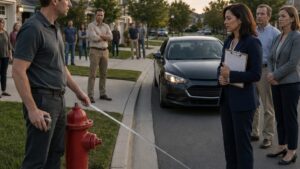
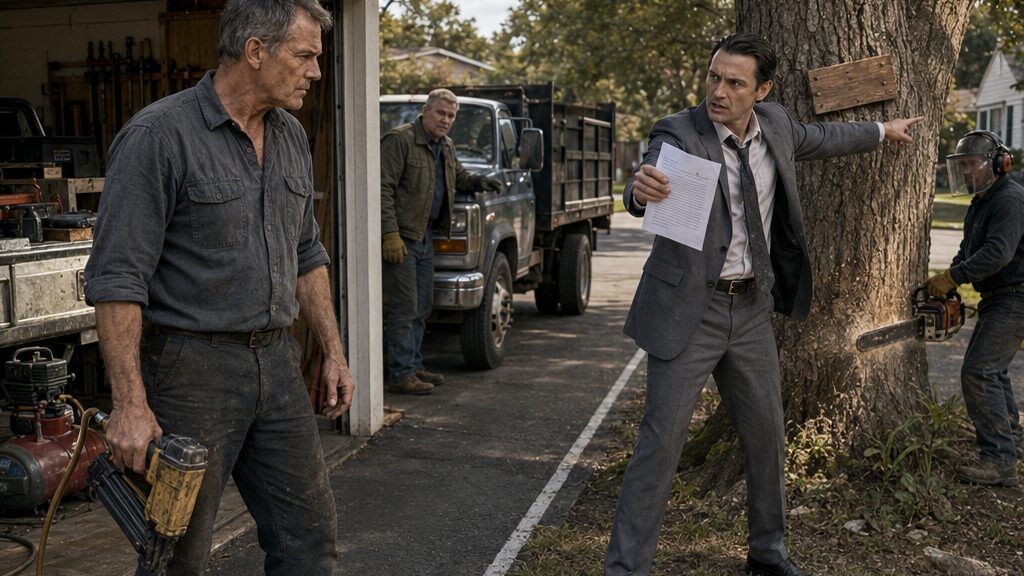
The chainsaw erupted before Gregory Moore finished taping the notice to Anthony Lewis’s plaque.
Its engine coughed once, caught, then rose into a hard metallic scream that filled the open garage and rattled the thin panes above the workbench. Anthony froze with one hand on the tailgate of his pickup and the other around a canvas tool bag.
Across the driveway, a worker in hearing protection held the saw at his thigh. Blue exhaust drifted around his boots.
Gregory pressed the last strip of tape flat with his thumb.
“There,” he said, stepping back as though he had hung a court order. “You’ve been served.”
Anthony set the tool bag down.
The paper covered half the plaque. Four walnut boards, joined edge to edge, with the house numbers carved deep enough to catch shadow in the afternoon. His father had drawn the first numerals in pencil nearly twenty years earlier, then stood beside Anthony at the bench while he cut them by hand.
Anthony crossed the driveway and wiped a streak of sawdust from the exposed corner.
“What are you doing here?”
Gregory adjusted the cuffs of a gray suit that was too shiny at the elbows. “Enforcing community standards.”
Behind him, a white work truck sat at the curb with its hazard lights blinking. A second worker lowered a crowbar from the bed. The chainsaw continued to idle, pulsing through the pavement.
Anthony read the first line of the notice.
EMERGENCY AESTHETIC CORRECTION.
He looked at Gregory. “Emergency.”
“The board has received complaints.”
“About what?”
Gregory tapped the paper. “The font.”
Anthony waited.
Gregory seemed disappointed that he had not reacted.
“The lettering is inconsistent with the approved neighborhood character,” he continued. “It presents as improvised, visually distressed, and economically suggestive.”
“Economically suggestive.”
“It looks impoverished.”
The worker with the crowbar glanced toward the street.
Anthony peeled one strip of tape loose without tearing the paper. “Take your notice off my plaque.”
Gregory’s smile thinned. “That plaque is the subject of removal.”
The chainsaw revved sharply. Anthony turned toward it.
The mature oak stood twelve feet from the driveway, its lowest branch reaching over the yard in a wide, level arm. The bark near the base still held a shallow crescent where Anthony’s father had once struck it with the corner of a wheelbarrow. Anthony had planted the sapling the week after the funeral, when the yard had felt too open and the house too quiet.
The operator lifted the saw and tested its weight.
Anthony’s voice lowered. “Why is that running?”
Gregory followed his gaze. “The tree is included.”
“Included in what?”
“Associated visual obstruction.”
Anthony looked again at the notice. The paper shook slightly in the exhaust wash.
“You came to remove a number plaque,” he said, “with a chainsaw.”
“We came prepared to complete all authorized corrections.”
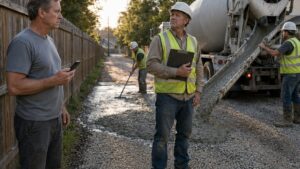
A man in a faded work jacket stepped from the passenger side of the truck. He was broad through the shoulders, with gray beginning at his temples and a clipboard tucked under one arm.
“Jacob Green,” he said. “Crew foreman.”
Anthony nodded once. “Did you see a permit?”
Jacob’s eyes moved toward Gregory.
Gregory answered for him. “The HOA’s emergency powers supersede routine delay.”
“That wasn’t my question.”
“This is private community property.”
“This is my driveway.”
Gregory turned toward the garage. Shelves of clamps lined one wall. Stacked hardwood rested on spacers near the floor. A compressor hose looped over a hook beside the workbench. Anthony’s pickup held two levels, a miter-saw stand, extension cords, and the cabinets he was due to install before noon.
Gregory made a slow show of surveying it.
“This garage is also under review.”
Anthony said nothing.
“Commercial equipment. Visible storage. Repeated loading activity.” Gregory pointed to the pickup. “Effective today, vehicle access through this driveway may be restricted pending a use determination.”
Anthony looked at the truck, then at the cabinets strapped beneath a moving blanket.
“You’re blocking me from leaving for work?”
“I’m preventing continued noncompliance.”
For the first time, the absurdity fell away.
The plaque was not the whole target. Neither was the tree. Gregory had arrived early, with equipment already fueled and a crew already paid, because he did not expect discussion. He expected Anthony to choose between obedience and losing a day’s income.
Anthony removed the notice carefully and read past the bold heading.
The parcel number sat near the bottom.
He read it twice.
“This isn’t my property.”
Gregory’s expression held, but his right hand closed around the edge of his folder.
Anthony pointed to the number. “Last four digits are wrong.”
“A clerical error.”
“It identifies the property behind mine.”
“The physical address is clear.”
“The physical address is handwritten.”
Gregory stepped closer and lowered his voice. “You are not going to bury this process in technicalities.”
Anthony looked at the suit, the folder, the crew, the bright hazard lights blinking for an audience that had not yet gathered.
“Technicalities are what you’re standing on.”
A curtain shifted in the house across the street.
Jacob cleared his throat. “We could pause until the office confirms the parcel.”
Gregory turned on him. “The work order has been confirmed.”
“I mean the permit packet.”
“You have an authorization.”
“I have your authorization.”
“And you will be paid upon completion.”
Jacob glanced toward the chainsaw operator, then toward Anthony. “I’d still rather have the right parcel.”
Gregory opened his folder, pulled out another sheet, and held it where Jacob could see the signature block but not long enough to read it.
“The board has retained me to resolve this,” he said. “You were hired to execute the correction, not reinterpret it.”
Anthony noticed the word retained.
Gregory liked words that implied doors opening for him.
He also noticed that Gregory had not called himself counsel.
Not yet.
Anthony folded the notice once and held it out. “Leave.”
Gregory did not take it.
“Your opportunity to comply voluntarily has expired.”
“It arrived thirty seconds ago.”
“You have received prior warnings.”
“For a plaque.”
“For a pattern.”
Anthony looked toward the oak again. The chainsaw operator shifted his grip but had not moved closer.
“What pattern makes that tree your business?”
Gregory’s face changed—not much, but enough. The careful contempt sharpened into impatience.
“The tree interferes with the corrected sightline.”
“To what?”
“The residence identification area.”
Anthony looked from the plaque to the tree. They did not overlap from the street. The tree stood well to the side, and its canopy began above the roofline of a parked car.
“You need the tree gone to see four numbers?”
“I don’t need anything. The community requires conformity.”
Anthony stepped between the crew and the yard.
“Shut the saw off.”
Gregory gave Jacob a look.
Jacob hesitated, then gestured to the operator. The engine dropped into silence. The sudden quiet made the neighborhood feel larger. A dog barked two houses down.
Anthony could hear his compressor cycling inside the garage.
He could also hear the faint metallic click as the worker with the crowbar adjusted his grip.
Gregory pointed at the plaque. “Remove it.”
The worker looked at Jacob.
Jacob rubbed his jaw. “Maybe start with the sign and hold on the tree.”
“No,” Gregory said. “The obstruction is part of the correction.”
Anthony watched Jacob absorb that. He was not eager. But he was still standing there with a crew and a truck, waiting for someone else to decide what counted as enough doubt.
Gregory turned back to Anthony.
“People mistake patience for permission,” he said. “The board has been patient with you.”
Anthony almost laughed. Instead, he looked at the empty street, at the windows beginning to fill, at the cabinets in his truck and the plaque his father had helped him mark.
Then he looked at the oak.
The threat was no longer printed on paper. It had a blade, fuel, and a man waiting to pull the trigger.
Gregory raised one finger toward the trunk.
“Make the first cut,” he told Jacob, “before he manufactures another excuse.”
Chapter 2: The Font Violation Was Never About the Font
The crowbar slipped behind the plaque’s upper corner and tore the first screw halfway out of the post.
The sound was small compared with the chainsaw, but it struck Anthony harder—a dry wooden crack, followed by the scrape of metal against walnut.
“Stop.”
The worker froze.
The plaque hung crooked by a quarter inch. Fresh wood showed around the screw head.
Gregory stepped between Anthony and the post. “Do not interfere with authorized personnel.”
Anthony looked past him. “Take the bar out.”
The worker glanced at Jacob.
“Easy,” Jacob said. “Don’t split it.”
Gregory snapped his head around. “It is being discarded.”
“It’s still attached to his property.”
“Not for long.”
Anthony moved closer until Gregory had to either step back or stand chest to chest with him. Gregory chose to stay, though his shoulders tightened.
“You’re damaging it before you’ve shown a valid order,” Anthony said.
“I have shown you more courtesy than the governing documents require.”
“No. You showed me the wrong parcel number.”
“A harmless typo.”
“You called it an emergency.”
“It is.”
“Then show me the complaint.”
Gregory opened his folder, shuffled papers, and removed none.
Anthony nodded toward the plaque. “Show me the approved font list.”
“The design standards are interpretive.”
“So there isn’t one.”
“There are accepted forms.”
“Written where?”
Gregory’s voice rose enough for the watching houses. “This is exactly why enforcement becomes expensive. Every resident believes his personal preference outweighs the collective interest.”
A front door opened across the street.
Carolyn Davis stepped onto her porch with her phone held low against her hip. She wore gardening gloves and had dirt on one knee of her jeans, as if she had come out in the middle of pulling weeds. She did not cross the road.
Gregory noticed her immediately.
“Residents are advised not to obstruct a lawful correction,” he called.
Carolyn lifted the phone higher.
“I’m not obstructing,” she said. “I’m recording.”
The chainsaw operator looked away.
Gregory adjusted his tie. “Then record accurately.”
Anthony saw something in Gregory settle. The audience gave him shape. He stood straighter, widened his gestures, and began speaking toward the houses rather than to Anthony.
“This property has accumulated multiple unresolved violations,” he announced. “Today’s action concerns unapproved signage, visual obstruction, and commercial misuse.”
Anthony pointed to the paper in Gregory’s folder. “Read the rule.”
Gregory smiled. “You had months to educate yourself.”
“Read it.”
“I am not here to conduct a seminar.”
“Then I will.”
Anthony held out his hand.
Gregory did not move.
Carolyn crossed the street.
Every step looked reluctant, as though she expected someone to write down the distance from her porch to Anthony’s curb and attach a fee to it.
“I have the section,” she said.
Gregory’s smile disappeared.
Carolyn took a folded notice from her back pocket. It had been opened and closed so many times the creases had gone soft.
“You quoted it to me in April,” she said. “Section eight-point-fourteen.”
“That matter is unrelated.”
“You said my porch light was an unauthorized commercial display.”
“It was excessively bright.”
“It was a forty-watt bulb.”
Gregory turned to Jacob. “Continue.”
Anthony raised one hand, and Jacob did not signal the worker.
Carolyn unfolded her notice and held it beside Anthony’s. “Same paragraph.”
Anthony read the citation.
Then he walked into the garage.
Gregory called after him, “Leaving the enforcement area does not suspend the action.”
Anthony returned with a thick binder dusty along the top edge. The HOA rules had arrived when he bought the house. Most of the pages had not been touched in years, but his father had taught him never to throw away anything that told another person what they were allowed to do.
He opened to section eight.
Gregory watched him too closely.
Anthony found the number.
“Eight-point-fourteen,” he read. “Illuminated commercial identifiers.”
Carolyn looked over his shoulder.
Anthony continued. “No internally lit, neon, flashing, rotating, or externally powered commercial sign may be displayed on a residential structure.”
He looked at the walnut plaque.
No wires. No bulbs. No business name. Four carved numbers darkened with oil.
Carolyn took her own notice from his hand. “My porch light wasn’t a commercial sign either.”
Gregory shut his folder.
“The provision is applied in conjunction with supplementary design authority.”
“Which section?” Anthony asked.
“The board is not limited to one paragraph when addressing cumulative decline.”
Jacob’s mouth moved as though he had tasted something bitter.
Anthony closed the binder. “You cited a rule that doesn’t apply.”
“The board determined otherwise.”
“You determined otherwise.”
Gregory took the crowbar from the worker and tapped its curved end against the plaque.
Once.
Twice.
The walnut gave a dull, solid knock.
“This,” he said, “is not craftsmanship. It is exactly the kind of improvised visual marker that lowers expectations. Rough lettering. Uneven depth. A finish that looks homemade.”
“It is homemade,” Anthony said.
“That is not a defense.”
“It wasn’t meant to be.”
Gregory looked toward the houses. “Standards exist because not every owner recognizes when personal sentiment becomes public deterioration.”
The insult landed where Gregory intended. Not on the plaque, but on the hands that had made it.
Anthony saw his father’s pencil resting across the walnut. Heard him say, Not so fast. Let the grain tell you where it wants the cut.
His father’s numbers had not been perfect. The three leaned slightly. The seven was wider at the base because his hand had trembled that morning.
Anthony had left both exactly as drawn.
Carolyn looked at the plaque, then at Anthony. Something in her expression shifted, but not toward sympathy.
Toward anger.
“You charged me two hundred dollars for that same citation,” she said to Gregory.
“Your account is not being discussed.”
“You threatened a lien.”
“Because you refused correction.”
“You told me your legal office had reviewed it.”
Gregory’s face hardened. “It had.”
“Which office?”
Before he could answer, a dark sedan turned onto the street and stopped behind the crew truck.
Brenda Allen emerged carrying a leather portfolio. Her clothes were neat, her hair fixed, her expression already strained by the sight of residents outside their homes.
“Why hasn’t work started?” she asked.
Gregory moved toward her. “Mr. Lewis is obstructing.”
Anthony held up the notice. “Wrong parcel. Wrong rule. No hearing.”
Brenda did not examine the paper.
“The board approved an emergency aesthetic correction last night.”
“Based on what emergency?”
“Property values do not collapse all at once,” she said. “They erode through tolerated exceptions.”
Carolyn laughed once, without humor. “My porch bulb almost destroyed the neighborhood.”
Brenda’s eyes narrowed. “This is not the time.”
“When is?”
“The resident meeting tonight.”
Carolyn lifted her notice. “Good. I’ll bring this.”
A second door opened down the block. Then another.
Brenda saw them.
Anthony saw her see them.
The work crew, the roaring saw, the ridiculous plaque dispute—none of it had been brought here only to change his property. It had been staged where everyone could watch.
A correction, Gregory had called it.
A demonstration was closer.
Brenda stepped beside Gregory and lowered her voice, but the street had gone quiet enough for Anthony to catch every word.
“The meeting starts at six,” she said. “This has to be finished before they compare papers.”
Chapter 3: The Easement Anthony Refused to Explain
Anthony opened the locked drawer beneath his workbench for the first time in six years.
The brass key resisted, then turned with a scrape.
Inside lay a sealed packet wrapped in a clear protective sleeve. A red band crossed the top page.
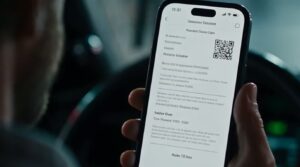
RESTRICTED UTILITY EASEMENT. DO NOT EXCAVATE. EMERGENCY CONTACT REQUIRED.
Carolyn stood at the garage entrance, watching.
Behind her, Gregory argued with Brenda near the crew truck. Jacob had ordered the chainsaw shut down again, but the machine still ticked as it cooled. The damaged plaque remained on its post, one corner pulled loose.
Anthony lifted the packet and felt the old reluctance return.
“Where did that come from?” Carolyn asked.
“It came with the property documents.”
“That isn’t an answer.”
“It’s the answer I have.”
She stepped inside.
Anthony disliked people entering his garage without invitation. Today, Gregory’s crew had already crossed the driveway, touched the plaque, measured the yard with their eyes. Carolyn’s presence should have felt different.
It did.
That did not make it comfortable.
She looked at the warning band. “You knew there was an easement?”
“Yes.”
“For what?”
Anthony slid the packet from its sleeve but kept the cover folded over the details.
“A protected communications line crosses the edge of the lot.”
Carolyn stared at him.
“Under the tree?”
“Near it.”
“How near?”
“Near enough that nobody cuts, drills, grinds, or excavates without clearance.”
“And you didn’t think that mattered before a crew arrived with a chainsaw?”
“It mattered.”
“Then why didn’t you tell anyone?”
Anthony looked toward the street. Gregory had begun speaking to two residents at the curb, gesturing with his folder as if explaining Anthony’s instability.
“I’m telling you now.”
“No. You’re telling me because they’re already here.”
He did not answer.
Carolyn stepped closer to the bench. “You recognized that citation, didn’t you?”
Anthony folded the packet shut.
“Anthony.”
“Yes.”
“When?”
“Months ago.”
Her face changed.
Not surprise. Confirmation.
“You knew he used the same language on me.”
“I suspected.”
“You read my notice?”
“You showed it to me at the mailbox.”
“And you said it was probably easier to change the bulb.”
He remembered.
Carolyn had stood in the road with the notice shaking in one hand. He had been carrying a sheet of plywood from his pickup. She had asked whether the rule looked right.
He had glanced at it, recognized the vague language, and felt the sealed easement packet in his mind like a door he did not want opened.
Change the bulb, he had said. It may cost less than fighting.
At the time, he had called that practical.
Now the crew truck blocked half the street.
Carolyn pulled off one gardening glove finger by finger.
“You let me think I was wrong.”
“I didn’t know what Gregory was doing.”
“You knew enough to stay quiet.”
Anthony rested both hands on the workbench.
“I was trying to keep this from becoming bigger.”
“For whom?”
He looked at the packet.
The line had been installed long before he bought the house. A government contractor had replaced part of it after a storm damaged a relay station outside the county. The easement officer had told Anthony the exact route, the restrictions, and the penalties for careless disclosure.
Do not advertise it. Do not mark it beyond the approved utility plate. If anyone digs, call the number before they touch soil.
Anthony had followed those instructions so completely that secrecy had become habit.
After his father died, the habit deepened. Problems entered the garage and stayed there. Broken tools, unpaid invoices, grief, paperwork. He fixed what he could and stored what he could not.
“I thought attention would bring more trouble,” he said.
Carolyn waited.
“I thought if people started arguing about property records, inspections would follow. Roads closed. yards opened. Questions nobody here asked for.”
“So you decided for everyone.”
“Yes.”
The word came out before he could soften it.
Carolyn looked toward the plaque.
“You decided for me when I paid that fine.”
Anthony nodded.
“You decided for the family on the corner when they cut down their hedge.”
He nodded again.
“You decided Gregory was safer if nobody challenged him.”
“I decided silence was safer.”
“For you.”
Anthony looked at her then.
There was no use defending it. The evidence stood outside in a gray suit.
“For me,” he said. “And I was wrong.”
Carolyn’s anger did not disappear. He was grateful for that. Forgiveness offered too quickly would have let him mistake admission for repair.
A sharp metallic scrape came from the yard.
Anthony turned.
One of the workers had moved a rake near the base of the oak. Beneath a mat of dry leaves, a narrow utility marker protruded from the soil at an angle. Its yellow coating had been scraped nearly bare. Fresh gouges ran across one side.
Anthony left the packet on the bench and crossed the driveway.
“Don’t touch that.”
The worker stepped back.
Anthony crouched beside the marker.
Two inches of dark conduit showed where the soil had been disturbed. It should not have been visible at all.
He brushed loose dirt aside with his fingertips. The scraped section looked older than today’s work. A shallow trench ran along the flower bed, half hidden under mulch.
Carolyn knelt several feet away. “Was it like that before?”
“No.”
“When did you last check?”
Anthony thought of the landscaping crew the HOA had sent three weeks earlier to reshape the common verge. They had worked beyond the curb, shaving soil from the edge of his yard despite his objections. He had watched from the garage, angry but unwilling to reveal why the boundary mattered.
He had told them to stop.
They had moved six inches.
He had let that count as victory.
Gregory approached, Brenda beside him.
“What are you doing?” Gregory demanded.
“Who worked this bed?” Anthony asked.
Brenda glanced at the exposed conduit. “The maintenance contractor refreshed several frontage areas.”
“They crossed my line.”
“The verge presentation falls under community authority.”
“This isn’t the verge.”
Gregory leaned forward. “That appears to be an unapproved pipe.”
Anthony stood.
“Stay away from it.”
Gregory smiled. “Another violation?”
Anthony held his gaze. “A warning.”
“About what?”
Anthony heard Carolyn behind him, waiting.
He could disclose enough to stop the work. But once spoken in the street, the information could not be gathered back. Gregory would turn it into another performance. Brenda would argue jurisdiction. Neighbors would record. The line’s location would become common knowledge before the right office was notified.
Anthony looked toward his garage, where the emergency packet lay open on the bench.
Jacob came around the truck with his clipboard.
“Mr. Lewis,” he said quietly, “I asked them to hold position.”
Anthony nodded.
Jacob lowered his voice. “But Moore just told the driver to reposition.”
“Where?”
Jacob pointed.
The truck’s front wheels had begun to turn toward the driveway apron. The intended path ran directly across the painted survey line Anthony had renewed every spring—and over the disturbed strip beside the conduit.
“I told him I wanted clearance first,” Jacob said. “He said the board’s indemnity covers it.”
Anthony rose.
The folding rule hung from a nail inside the garage. His father’s rule: yellowed wood, brass joints, one edge worn smooth from decades of use.
Anthony retrieved it and returned to the plaque post.
He opened the sections one by one, the joints clicking into place.
From the post to the survey mark.
From the survey mark to the oak.
From the oak to the scraped marker.
The old measurements matched the property plan within less than an inch.
Carolyn watched him finish.
“What does that prove?” she asked.
“That they’re not close to the line.”
She frowned.
Anthony folded the rule halfway.
“They’re on top of it.”
The truck engine started.
Jacob turned toward the sound, his face tightening.
Gregory stood beside the passenger door, directing the driver with one hand. He pointed toward the narrow space between Anthony’s pickup and the tree.
The exact path above the protected corridor.
Anthony closed the folding rule.
For years, he had believed the danger lay in telling people what ran beneath his yard.
Now he understood the greater danger had been letting the wrong people believe nothing important was there.
Chapter 4: Gregory Moore Could Not Survive One Verified Question
“Which state admitted you to practice law?”
Anthony asked it loudly enough for Jacob, Brenda, Carolyn, and every neighbor along the curb to hear.
Gregory stood beside the work truck with one hand raised toward the driver. The question stopped that hand in the air.
“Lake County,” he answered.
For one second, nobody moved.
Then Carolyn said, “That isn’t a state.”
Gregory lowered his hand.
Anthony held the sealed easement packet against his side. “Try again.”
“I am not submitting to an interrogation on a public street.”
“You called yourself the board’s lawyer.”
“I said I was retained to handle enforcement.”
“Your notices say legal office.”
“They were prepared under my direction.”
“Which state licensed you?”
Gregory’s face reddened above the collar. “My professional credentials have no bearing on your violations.”
“They have bearing on every legal threat you signed.”
Brenda stepped between them, though not far enough to hide Gregory.
“This is becoming intentionally disruptive,” she said. “The board relied on qualified guidance.”
Anthony looked at her. “Did you verify it?”
Her eyes flicked toward Gregory.
That was answer enough.
The damaged plaque still hung from one loosened corner. Gregory crossed to it, pulled the crowbar free, and drove the tip behind the upper edge again.
Anthony moved forward.
Jacob caught Gregory’s wrist before he could pry.
“Hold up,” Jacob said.
Gregory stared at the hand around his sleeve. “Release me.”
“I need the utility-clearance sheet.”
“You have the work order.”
“I asked for the clearance sheet.”
Brenda opened her portfolio. “The board indemnifies your company for all authorized actions.”
“That doesn’t tell me what’s underground.”
“It tells you who accepts liability.”
Jacob let go of Gregory but did not step away. “If I hit a gas line, your signature doesn’t put my men back together.”
“This is a residential tree removal.”
“There’s exposed conduit beside the roots.”
Gregory jerked the crowbar from his hand. “An unapproved conduit Mr. Lewis is using to create delay.”
Anthony watched Jacob’s eyes move to the scraped marker, then to the truck’s proposed path.
“Did you request a utility locate?” Jacob asked.
“I confirmed no public utility conflict.”
“With whom?”
“The appropriate office.”
“Name it.”
Gregory shut his mouth.
The silence traveled down the street more efficiently than any accusation.
Anthony walked to the plaque and touched the split around the loosened screw. The walnut remained solid. The mounting plate behind it had bent outward.
Gregory saw where Anthony was looking and yanked the plaque free.
The second screw tore through the wood.
Carolyn inhaled sharply.
Gregory held the plaque up by one edge as though he had seized contraband.
“There,” he said. “The immediate violation has been corrected.”
Anthony looked at the two empty holes in the post.
He expected anger to arrive like heat. Instead, everything became exact.
The ragged fibers around the holes.
The curl of walnut caught beneath Gregory’s thumb.
The faint pencil mark on the back where his father had written TOP and drawn an arrow, though the numbers made the direction obvious.
“Put it down,” Anthony said.
“You may retrieve it after the enforcement action.”
“It is my property.”
“It is evidence of noncompliance.”
Carolyn lifted her phone. “You just tore it off after the rule was shown not to apply.”
Gregory pointed the plaque at her. “Interference can be fined.”
“Under the porch-light rule?”
A few neighbors laughed. It was brief, nervous, but Gregory heard it.
His grip tightened.
Anthony understood then that humiliation frightened Gregory more than liability. The man could tolerate questions while he still controlled the performance. He could not tolerate laughter.
Jacob walked back to the chainsaw operator.
“Lower it,” he said.
The operator placed the saw on the grass.
Gregory turned. “What are you doing?”
“Pausing until I see a permit and clearance.”
“You signed a contract.”
“I signed to perform authorized work.”
“It is authorized.”
“Then show me.”
Brenda removed a document from her portfolio and held it toward Jacob. “Board indemnification. Signed last night.”
Jacob read it.
Anthony watched the foreman’s jaw work. Money was written all over his hesitation—not greed, but payroll. Fuel. Insurance. Men expecting checks on Friday. Gregory had built his entire method around costs already incurred.
“This says the association assumes financial responsibility,” Jacob said.
“Yes.”
“It doesn’t authorize cutting on disputed private property.”
Brenda lowered her voice. “Your invoice is substantial. If the work is abandoned, payment will be reviewed.”
Jacob looked at his crew.
One worker stared at the pavement. The driver kept both hands on the wheel.
Gregory stepped close enough to Jacob that their shoulders nearly touched.
“You were hired because you said you could handle difficult removals,” he said. “If one homeowner with a binder can stop you, perhaps the board chose the wrong contractor.”
Jacob looked toward Anthony.
“I’ve got three men here and half a day lost.”
“I know,” Anthony said.
“You paying that?”
“No.”
Gregory spread his hands. “There is your answer.”
Anthony did not blame Jacob for asking. That was the trap: every person on the street had been assigned a cost for resisting. Anthony would lose his workday. Jacob would lose the contract. Carolyn would risk another fine. Brenda would risk admitting she had signed what she did not understand.
Only Gregory seemed to gain from movement.
Anthony crossed to the oak while the machinery remained still. He crouched near the exposed conduit and examined the disturbed soil. No fresh cut marked the casing, but one root had been scraped down to pale wood.
The tree had not yet been harmed beyond the outer bark.
Jacob came near him without the chainsaw.
“You have five minutes,” he said quietly.
Anthony looked up.
“I’m not agreeing with him,” Jacob continued. “But that indemnity gives my company coverage. If I walk now, I eat the whole job.”
“Coverage won’t matter if you strike what’s under this line.”
“What is it?”
Anthony looked toward Carolyn. She was still recording.
“Something that requires clearance.”
“That’s not enough.”
“It has to be.”
Jacob rubbed the back of his neck. “You’re asking me to trust your word while telling me I was a fool for trusting his.”
The fairness of it struck cleanly.
Anthony opened his mouth, then stopped. He had wanted Jacob to act responsibly without giving him the information responsibility required.
“I can show you the restriction,” he said.
Before he could retrieve the packet, Brenda held out the indemnification form.
“Your company is protected,” she told Jacob. “The board has voted. The work is scheduled. We cannot allow one resident to nullify collective governance by producing mysterious papers from a drawer.”
Her voice trembled slightly at the end.
Anthony saw that she was not certain. She was choosing certainty as a posture.
Jacob took the form again.
Gregory crossed toward the truck and slapped the hood twice.
“Restart,” he called.
The chainsaw operator looked at Jacob.
Jacob did not answer immediately.
Gregory faced the watching residents.
“This community has spent years maintaining standards because inconsistency is contagious. One exception becomes ten. Ten become decline. Property values fall, responsible owners leave, and everyone who followed the rules pays for those who did not.”
For the first time, Anthony heard the argument Gregory told himself.
Not the whole truth. But enough of one to make obedience feel virtuous.
Then Gregory looked at the empty post and the plaque in his hand.
“We finish this now.”
Anthony stood.
“Court authorization,” he said. “Contractor permit. Emergency provision. Utility clearance. State license.”
Gregory’s eyes shifted at each item.
Anthony took one step closer.
“You have none of them.”
Gregory’s confidence did not vanish. It cracked.
And through the crack came fear.
He glanced toward Brenda, toward Carolyn’s phone, toward the neighbors, and finally toward the plaque he had torn loose. Retreat would no longer look procedural. It would look like confession.
He threw the plaque face-down onto the grass.
Then he climbed onto the work truck’s running board and pointed across the painted boundary.
“Advance,” he ordered.
Jacob stared at him.
Gregory slapped the roof.
“Move the truck across the line.”
The engine rose.
Behind it, the chainsaw restarted.
Chapter 5: Six Steel Nails Across the Painted Line
The truck’s front tire rolled one inch over Anthony’s property line as the chainsaw teeth touched the oak’s outer bark.
A burst of pale dust jumped from the trunk.
Anthony raised his hand.
“Stop!”
The driver braked, but Gregory struck the side mirror with his palm.
“Keep moving.”
Jacob stood between the truck and the tree, his face pulled tight. He shouted toward the operator, but the chainsaw swallowed the words.
The blade had not entered the wood. Its teeth skated against the bark, leaving a bright horizontal scratch.
Anthony turned and ran into the garage.
Behind him, Gregory called, “He’s retreating. Proceed.”
Anthony crossed the concrete floor in six strides.
His industrial nail gun hung beside the compressor hose. It was heavier than the finish guns he used for cabinets, built for fastening steel track and dense framing material. That morning, he had loaded it for a commercial stair repair scheduled after the cabinet installation.
He checked the magazine.
Six thick fasteners remained.
The compressor gauge showed full pressure.
He connected the hose and lifted the gun.
For a moment, his father’s folding rule lay in his path on the bench.
Measure twice.
Anthony nearly heard the voice.
He took the rule with his free hand.
When he returned outside, Carolyn lowered her phone for the first time.
“Anthony.”
He did not look at her. “Stay behind the curb.”
Gregory pointed at the nail gun.
“There. You see that?” he shouted to the neighbors. “He is threatening an authorized crew with a weapon.”
Anthony stopped inside his garage threshold.
The hose stretched behind him, not yet tight.
“It’s a fastening tool,” he said.
“It fires steel projectiles.”
“At material.”
Gregory turned to Carolyn’s camera. “Record his admission.”
Anthony ignored him and opened the folding rule across the asphalt.
From the garage threshold to the painted line.
From the line to the truck’s front tire.
From the tire to the edge of the exposed conduit corridor.
The truck had less than nine feet before its weight reached the disturbed strip. At its current crawl, the driver needed barely two feet to stop. If panic took over, four.
Anthony closed the rule.
Jacob stepped toward him.
“Put that down.”
“Move your truck back.”
“I’m trying to hold this together.”
“You’ve crossed the line.”
“An inch.”
“That inch is the last safe one.”
Jacob looked toward the tree. The operator had pulled the saw back and was holding it at idle, waiting.
Gregory jumped down from the running board. “Advance.”
The driver’s foot remained on the brake.
Gregory strode to the window. “You are under contract.”
Jacob called, “Hold position.”
“I gave an order,” Gregory said.
“You don’t give my driver orders.”
“I direct enforcement.”
“You’re not standing in front of the tire.”
Gregory swung toward him. “If this job is not completed, the board will refuse payment and seek damages.”
Jacob’s face hardened. “You said the property was cleared.”
“It is.”
“You said permits were confirmed.”
“They were.”
“By who?”
Gregory pointed toward Anthony instead of answering. “By the same authority he has defied for months.”
Anthony placed a scrap block of laminated beam stock on the driveway. He had used it beneath a cabinet to protect the tailgate.
He set it upright.
Carolyn said his name again, sharper now.
Anthony looked toward Jacob.
“This is your warning.”
He aimed the nail gun downward and fired once.
The gun cracked.
The thick fastener drove through the laminated block and buried itself into the asphalt beneath it. The block jumped, then held upright, pinned in place.
The chainsaw operator released the throttle.
Silence fell in uneven layers: first the saw, then the truck engine settling to idle, then the startled voices along the curb.
Anthony lowered the tool.
“I will not fire at a person,” he said. “I will not fire at a tire. I will not touch your crew.”
Gregory’s expression sharpened with opportunity.
“You all heard him threaten the vehicle.”
“I said the opposite.”
“You have discharged a weapon during lawful enforcement.”
Anthony looked at the driver through the windshield. “You have room to reverse.”
The driver looked toward Jacob.
Jacob walked to the tree, took the chainsaw by its top handle, and pulled it away from the trunk.
It was a small act, but it changed the street.
Gregory saw it too.
“What are you doing?”
“Removing the saw from the conflict.”
“You’re abandoning the contracted work.”
“I’m preventing someone from getting hurt.”
“No one is in danger unless he uses that gun.”
Jacob set the saw on the grass behind him. “You brought us here without clearance.”
Brenda moved closer, indemnity form still in hand.
“The board will cover documented losses,” she said. “Please finish the authorized portion.”
Jacob looked at her. “You watched him tear the sign down with the wrong parcel number.”
“The address was clear.”
“You heard the rule didn’t apply.”
“The board’s broader authority applies.”
“You heard about the line.”
Brenda’s fingers tightened on the paper. “Mr. Lewis has not identified any verified utility.”
Anthony felt the packet beneath his arm.
He could show them now.
He could unfold the map, point to the route, reveal the emergency identifier, and trust that Gregory would finally retreat.
But Gregory had already ignored the exposed marker.
Words had not stopped the crowbar.
Documents had not stopped the truck.
Anthony looked at Carolyn. Months earlier, he had advised her to change a bulb because resistance cost too much. Now the price of delay sat between the tire and the conduit.
He placed the folding rule beside the painted line.
Its yellow wooden sections made the boundary visible in a way faded paint no longer did.
Then he moved the pinned scrap block several feet ahead of the truck, still outside the tire’s path, and pointed to it.
“That was the last demonstration.”
Gregory laughed, but the sound was thin.
“You don’t dictate terms.”
Anthony met the driver’s eyes. “Reverse now.”
Gregory slapped the hood again.
“Forward.”
The driver looked at Jacob.
Jacob stood motionless.
The truck moved.
Not fast. Barely a crawl.
But it moved.
The hose behind Anthony dragged across the concrete. He felt its weight in his wrist. He stepped onto the driveway apron and lowered to one knee.
Carolyn backed toward the curb, still recording.
Gregory raised both hands.
“Look at him. Armed. Unstable. Obstructing lawful work.”
Anthony placed the muzzle against the asphalt well ahead of the tire and just inside his own property.
His pulse slowed.
The tool was designed to join material. Steel to concrete. Track to slab. Measured force, contained direction.
He marked six points by eye across the truck’s path, each spaced narrower than the tire width, each far enough from the wheel to avoid contact while the vehicle was moving.
“Final warning,” he said.
The truck advanced another six inches.
Gregory pointed at him. “Keep going.”
Anthony fired.
The first nail drove into the asphalt with a flat, explosive crack.
Then the second.
Third.
Fourth.
Fifth.
Sixth.
Each fastener stood angled slightly toward the truck, thick steel shafts forming a row across the lane. None touched rubber. None came within inches of a person.
The driver hit the brake.
The truck stopped so violently Gregory lost his footing beside the hood. He fell backward onto one hand, his folder opening as he struck the pavement. Papers scattered beneath the chassis and across the painted boundary.
The chainsaw operator stepped away from the tree.
For three seconds, nobody spoke.
Compressor air hissed through Anthony’s hose.
The six nails gleamed in a perfect line.
Gregory pushed himself upright. His palm was scraped, his tie crooked, his face stripped of performance.
“You could have killed someone.”
Anthony stood and lowered the nail gun.
“No.”
“You fired at us.”
“I fired into my driveway.”
“You trapped the vehicle.”
“I stopped it before it crossed a protected corridor.”
The word protected reached Gregory.
His eyes moved past Anthony to the disturbed soil.
One of the scattered papers had slid against the exposed conduit marker. Its corner rested beneath the scraped yellow coating, revealing a small metal plate on the side Anthony had not wanted visible.
Gregory saw it.
He walked toward the tree.
Anthony stepped between them.
“Don’t.”
Gregory’s gaze stayed fixed on the plate.
“What is that?”
Anthony did not answer.
Gregory looked down and saw the crowbar lying where the worker had dropped it beside the plaque.
The fear in his face changed shape.
He had lost the truck, the crew, and the audience.
Only the evidence remained.
Gregory bent and seized the crowbar.
Chapter 6: The Crowbar Struck the Wrong Kind of Truth
“I’ll remove the illegal pipe myself.”
Gregory raised the crowbar over his shoulder and charged toward the exposed conduit.
Anthony dropped the nail gun.
It struck the grass beside the face-down plaque.
He reached the garage wall in two steps, tore his father’s framing hammer from its hook, and turned as Gregory swung.
The crowbar came down toward the metal plate.
Anthony caught it against the hammer head.
Steel rang across the street.
The force drove Anthony’s wrist downward, but the hammer held. Gregory’s crowbar glanced aside and struck soil instead of conduit.
Anthony shoved him back.
Gregory stumbled, then raised the bar again.
Jacob moved between them.
“Drop it.”
“This pipe is unapproved evidence,” Gregory snapped.
“That sentence doesn’t mean anything.”
“He buried it to obstruct enforcement.”
Anthony crouched beside the marker, keeping the hammer in one hand. The impact had loosened more soil, exposing the identifier plate.
Red lettering appeared beneath the scrape.
PROTECTED COMMUNICATIONS CORRIDOR.
Gregory saw it and lunged.
Jacob caught his arm.
“Enough.”
“Get off me.”
Anthony brushed dirt from the plate.
A coded number ran below the warning.
He looked toward Carolyn.
“Record this.”
Her phone was already raised.
Anthony read the identifier aloud, slowly, every letter and digit.
Brenda stepped closer, her face drained of color. “Do not announce restricted information.”
Anthony looked at her. “You knew there was no clearance.”
“I knew the contractor had not produced a separate sheet.”
“You signed anyway.”
“I relied on Gregory.”
Gregory twisted free of Jacob. “This is theater. Anyone can bolt a plate to a pipe.”
Anthony held up the hammer.
“This belonged to my father,” he said. “That doesn’t make it a judge’s gavel. A metal plate doesn’t matter because of how it looks. It matters because someone can verify it.”
Gregory’s mouth closed.
The word verify struck him harder than the shove.
Anthony walked backward toward the garage, never turning his back on the crowbar. The emergency packet lay on the workbench where he had left it. He pulled the contact card from its sleeve and dialed the first number.
Gregory took out his own phone.
“Police,” he said loudly when the call connected. “We have an armed homeowner firing a projectile weapon at a lawful work crew.”
Anthony heard Carolyn swear under her breath.
Gregory paced toward the street, shaping each phrase with care.
“He has blocked a vehicle with steel spikes. He assaulted me with a hammer. He is making claims about government infrastructure and threatening anyone who approaches.”
Anthony’s call answered.
He gave his name, address, easement number, and the emergency identifier from the plate.
“Possible attempted impact,” he said. “Excavation equipment and a heavy vehicle inside the restricted distance. Marker exposed. No confirmed breach.”
The voice asked whether machinery was still running.
Anthony looked toward Jacob.
“Shut everything down,” he said.
Jacob did not hesitate.
He crossed to the truck and reached through the open window. The engine died. Then he disconnected the chainsaw’s ignition lead and ordered his workers behind the curb.
Gregory stopped speaking into his phone long enough to stare.
“You don’t have authority to abandon this site.”
Jacob faced him. “My men are done.”
“You will not be paid.”
“Then I won’t be paid.”
The answer sounded as though it cost him.
That gave it weight.
Anthony relayed the shutdown to the emergency operator.
The voice instructed him not to touch the conduit, not to allow vehicles to move, and to keep everyone outside the marked corridor.
“Response team is being dispatched,” the operator said.
“How long?”
“Remain on scene.”
The call ended.
Gregory smiled as if the lack of a specific time proved fraud.
“You see? No one is coming.”
Anthony put the phone in his pocket.
“Carolyn, stay at the curb. Keep recording.”
She nodded.
“Jacob, have your crew photograph where the truck stopped and where the saw touched the bark.”
Jacob turned to his workers.
Anthony pointed toward two neighbors. “Write down what you saw before anyone tells you what you saw.”
The neighbors exchanged glances, then one took out a phone.
This was the part Anthony had avoided for years: asking other people to enter the problem.
The street did not collapse under the request.
It organized.
Carolyn moved closer to Brenda. “Show the authorization.”
Brenda held the portfolio against her chest. “This is an active enforcement matter.”
“It stopped being that when he swung at the line.”
“He did not understand what it was.”
Anthony looked at her. “Neither did you. That was why clearance mattered.”
Brenda’s face tightened. “You withheld information.”
“Yes.”
The admission quieted her.
Anthony continued. “And you used the absence of information as permission.”
Gregory ended his police call.
“They’re on the way,” he announced. “You’ll be arrested before your imaginary agents arrive.”
Carolyn lowered her phone just enough to look directly at him. “What is your license number?”
Gregory turned on her.
“You people keep repeating irrelevant questions.”
“Because you never answer.”
“I am a compliance consultant.”
The title came out too quickly.
Anthony heard the shift.
So did Brenda.
She stared at him. “You told the board you provided legal enforcement services.”
“I do.”
“As an attorney.”
“I said legally structured services.”
“You signed correspondence as counsel.”
“Advisory counsel.”
Carolyn’s camera moved between them.
Gregory saw it and pointed the crowbar toward her. “Stop recording private board communications.”
Jacob stepped in front of Carolyn.
“Put the bar down.”
Gregory looked around.
His crew had left him.
Brenda had begun examining the documents in her portfolio as if the words might have changed.
Residents stood along both sides of the street, phones out, no longer watching from windows.
Anthony understood the surprise in Gregory’s face.
For years, he had confronted people one at a time. A porch light. A hedge. A plaque. Each resident had assumed the threat was uniquely theirs, the paperwork too embarrassing or too expensive to share.
Now Gregory faced the one thing his authority could not survive.
Comparison.
A siren sounded in the distance.
Gregory recovered instantly.
“Everyone remain back,” he called. “Police are responding to an armed assault.”
Anthony looked at the nail gun lying in the grass.
From a distance, stripped of context, it would look bad.
Six steel nails across the asphalt.
A hammer in his hand.
Gregory’s scraped palm.
The truck stopped inside the property line.
Anthony placed the hammer on the ground.
“Carolyn, keep the video running.”
“It has been running.”
“Jacob?”
“I’ll tell them exactly what happened.”
Brenda spoke without looking up from her papers. “The indemnity was prepared by Gregory.”
Gregory turned toward her. “On board instruction.”
“You said the utility language was standard.”
“It is.”
“You said no separate clearance was necessary.”
Gregory’s voice dropped. “Think carefully before you misstate privileged discussion.”
Brenda looked up. “Was it privileged?”
He had no answer.
The siren grew louder.
At the far end of the street, a patrol vehicle turned the corner, lights flashing blue and red.
Gregory straightened his tie.
“Finally.”
Then black vehicles appeared from the opposite direction.
Three of them.
They entered fast but controlled, blocking the other end of the street before the patrol car reached Anthony’s driveway. Dark-clothed agents stepped out, one carrying a hard equipment case, another already directing residents away from the tree.
The local patrol stopped near the crew truck.
For one breathless moment, both responses faced the same scene from opposite sides.
Gregory raised his hand and pointed at Anthony.
“That’s him,” he shouted. “He fired at us.”
The lead federal agent looked at the row of nails, the stopped tire, the discarded crowbar, the exposed identifier plate, and the chainsaw scratch on the oak.
Then the agent’s gaze settled on the nail gun lying beside the face-down plaque.
“Everyone keep your hands visible,” he ordered.
Anthony lifted his empty hands.
Gregory smiled.
The agent pointed directly at Anthony.
“You,” he said. “Step away from the tool.”
Chapter 7: When Every Neighbor Brought the Same Piece of Paper
“Step away from the tool.”
Anthony took two slow steps back from the nail gun.
Gregory moved at once.
“He discharged it at the vehicle,” he said. “Then he came at me with a hammer.”
The lead federal agent did not look at him. “Keep your hands where I can see them.”
Gregory raised both palms, performing cooperation.
A local officer approached from the opposite side of the truck. His gaze moved from the six steel nails to Gregory’s scraped hand, then to Anthony.
“Who called in the armed disturbance?”
“I did,” Gregory said. “I represent the association.”
The federal agent pointed toward the exposed conduit. “No one crosses that marker.”
Another agent opened the hard case and began examining the plate and disturbed soil. A third photographed the tire, the painted property line, and the chainsaw mark on the oak.
Anthony stood with his hands lifted and watched strangers take control of his driveway.
The old instinct returned immediately: say as little as possible, let the facts speak, keep the private pieces private.
Then Gregory said, “He invented this line after we began a lawful correction.”
Anthony looked toward Carolyn.
Her phone was still recording.
“Show them the video,” he said.
Gregory’s face tightened. “That recording lacks context.”
Carolyn walked toward the local officer. “It starts before the plaque was removed.”
“Stay outside the marked area,” the agent warned.
She stopped and held the phone out.
Jacob stepped forward next.
“I’m the contractor,” he said. “We were told permits and utility clearances had been confirmed.”
Gregory turned on him. “Be careful.”
Jacob did not look away. “I asked for the clearance sheet. He never showed one.”
Brenda stood beside the sedan with her portfolio clutched against her ribs. “The board relied on his representations.”
“You signed the indemnity,” Jacob said.
“That does not mean I authorized unsafe work.”
“You told me payment would be reviewed if I stopped.”
Brenda’s mouth opened, then closed.
The local officer took Anthony’s name and asked him to explain the nails.
Anthony pointed to the folding rule lying beside the line.
“The truck crossed onto my property. I warned them. I fired one fastener into a scrap block to demonstrate the tool. Then I placed six fasteners into my own driveway ahead of the tires after the driver continued.”
“Why not move the vehicle?”
“It wasn’t mine.”
“Why not call police first?”
Anthony looked toward the conduit.
“Because the truck was moving toward that.”
The officer glanced at the federal agent.
“How close?”
The agent examining the soil stood. “Close enough that nobody moves anything until the corridor is checked.”
Gregory laughed softly. “A row of nails is not lawful self-defense.”
“No one said it was,” the officer replied. “We’re establishing what happened.”
The answer stripped Gregory of the argument he wanted.
The lead agent walked to the face-down plaque and lifted it by the edge. Fresh tears marked the screw holes.
“This was attached where?”
Anthony pointed to the post.
“Reason for removal?”
Gregory stepped forward. “Noncompliant typography and associated visual degradation.”
The agent looked at the carved house numbers, then at Gregory.
“Typography.”
“It violated neighborhood standards.”
Carolyn crossed her arms. “The cited rule is for illuminated commercial signs.”
Gregory spoke over her. “The board has supplementary authority.”
“Show me,” the agent said.
Gregory opened his folder.
Papers spilled from it in no useful order: invoices, notices, photocopied rule pages, a contractor work order, and a letterhead bearing the words Moore Legal Compliance Services.
The agent picked up the letterhead.
“Are you an attorney?”
Gregory hesitated.
Brenda looked at him.
“I provide legal compliance consulting.”
“That wasn’t the question.”
Gregory adjusted his tie. “I do not appear in court.”
“Are you licensed to practice law?”
“My work does not require courtroom admission.”
Carolyn made a sound that was almost a laugh.
The agent folded the letterhead once and handed it to a colleague.
“Verify him.”
Gregory’s confidence contracted. “On what basis?”
“On the basis that you invoked legal authority while directing work beside protected infrastructure.”
Brenda opened her portfolio with trembling hands. “The board was told he was qualified.”
A federal agent took the documents from her.
The first page was the indemnity form. Beneath it sat an invoice for emergency enforcement services, marked at nearly three times Jacob’s quoted labor cost.
Jacob saw it upside down.
“That isn’t my invoice.”
Brenda pulled back. “Administrative expenses were included.”
“Paid to who?”
No one answered.
Carolyn stepped toward the hood of the nearest black vehicle and placed her folded notice on it.
“This is mine,” she said. “Same legal language. Same citation. Different violation.”
The lead agent glanced at it.
Anthony reached into the garage and retrieved his notice from the workbench. He placed it beside Carolyn’s.
The paragraphs matched nearly word for word.
A neighbor from two houses down approached carrying a plastic folder.
“I have one too.”
Gregory pointed at him. “Outstanding accounts are not relevant.”
The neighbor set his papers beside the others.
Then a woman from the corner brought a notice about a hedge.
Another resident produced a fine for a mailbox color.
A man who had remained behind his screen door all morning came across the street holding three envelopes and a canceled check.
Within minutes, the hood held a row of paper extending from one headlight to the other.
Different names.
Different supposed violations.
The same citation.
The same urgent deadline.
The same threat of legal escalation.
The lead agent read one, then another.
“What happens if they don’t pay?”
Carolyn answered. “They threaten liens.”
Gregory said, “Lawful collection remedies.”
“Through what legal office?” the agent asked.
Gregory stared at the papers.
Anthony understood why one notice had never been enough. Alone, each resident looked careless, difficult, ashamed. Together, the wording revealed its machinery.
A repeated error was not an error anymore.
It was a method.
Brenda tried to step away from the vehicle.
An agent stopped her.
“I need to leave for the resident meeting.”
“The meeting is postponed.”
“I am the treasurer. I need to notify people.”
“They appear notified.”
The agent held up an authorization bearing her signature.
“Did you approve this removal?”
“I approved enforcement based on counsel.”
Gregory turned. “The board directed the timeline.”
“You said the line was inactive.”
“I said no conflict had been reported.”
“You said you checked.”
“I said the contractor was responsible for checking.”
Jacob shook his head. “You told me it was clear.”
Brenda looked between them.
For the first time, Anthony saw the full structure collapse. Not because one person confessed, but because everyone had relied on someone else’s silence.
The lead agent approached Anthony.
“Did you know the corridor was here?”
“Yes.”
“For how long?”
“Since I bought the property.”
“And you disclosed that to the contractor?”
“Not until today.”
Carolyn looked at him.
Anthony could have explained the restrictions. The sealed packet. The fear of drawing attention to the line. The years of believing quiet caution protected everyone.
Instead, he looked at the row of notices.
“I should have told the neighbors sooner that the language was wrong,” he said. “I should have compared papers when Carolyn asked me.”
Gregory seized on it. “He admits withholding material information.”
Anthony kept speaking.
“I thought keeping it private prevented trouble. It made everyone easier to isolate.”
Carolyn’s expression remained hard, but she placed one hand flat beside his notice.
The neighbor with the canceled check added, “He’s not the one who took our money.”
Another resident stepped forward.
Then another.
No cheering. No speeches.
Only paper.
One page at a time.
An agent came from the conduit with a handheld monitor.
“No breach detected,” he said. “Outer marker disturbed. Corridor intact.”
Anthony’s knees weakened so slightly he hoped no one noticed.
The lead agent looked toward the scratch on the tree, then at the stopped truck.
“How close?”
The technician pointed to the tire.
“Based on the route, another few feet would have placed the front axle over the shallow section. Cutting or anchoring near the root zone could have damaged the casing.”
Minutes.
That was all Anthony had stopped.
Not an abstract danger. Not a threat for later.
A few more feet.
The local officer photographed the nail line and took possession of the tool. He did not cuff Anthony.
Gregory noticed.
“This is selective enforcement,” he said.
The lead agent handed him a card. “You and Ms. Allen are coming with us for formal questioning. The documents and electronic communications connected to this work order will be preserved.”
Brenda’s face went pale. “Am I under arrest?”
“At this moment, you are being detained while we determine the scope of the incident.”
Gregory pointed toward Anthony. “And him?”
“The investigation includes everyone.”
That was not the victory Gregory wanted, but it was the truth.
Agents escorted Gregory toward one vehicle and Brenda toward another.
Gregory passed the plaque on the grass without looking at it.
Brenda did.
For one moment, she seemed about to say something to Anthony.
She lowered her eyes instead.
As the doors closed, the lead agent turned to Anthony.
“You protected the corridor today,” he said. “But you were minutes from a very different outcome.”
Anthony looked at the bent plaque, the six nails, and the neighbors gathered around matching pages.
He had saved the tree.
He had stopped the truck.
But the damage caused by his silence had no boundary line he could repaint.
Chapter 8: The Plaque Stayed Crooked Until Anthony Asked for Help
The next morning, Anthony found the plaque standing against his workbench.
Every loosened screw had been collected in a shallow metal tray beside it.
The bent mounting plate lay on a folded shop towel. Someone had wiped the dirt from the carved numbers but left the torn walnut untouched.
Anthony stood at the garage entrance with his coffee cooling in his hand.
The street beyond the driveway looked stripped down after the previous day. The crew truck was gone. The chainsaw was gone. Federal marking flags remained around the protected corridor, bright and temporary against the grass.
The oak still stood.
Its bark carried one pale scratch where the teeth had touched.
Carolyn sat on a folding chair near the workbench, reading through a stack of copied notices.
“You broke into my garage?” Anthony asked.
“The door was open.”
“It was not.”
“You gave Jacob the code yesterday.”
Anthony looked at her.
“He gave it to me,” she said. “You can be angry after you fix your lock.”
On the bench beside her sat a handwritten list of residents willing to attend an independent records review. Nearly every house on the street appeared.
Anthony set down the coffee.
“I was going to come over.”
“No, you were going to repair the plaque first, then come over when you had arranged the apology in your head.”
He picked up the bent plate.
“I’m sorry I told you to change the bulb.”
“That isn’t the whole apology.”
“I know.”
“Then don’t make it sound like one.”
Anthony ran his thumb over the bend. The metal could be flattened. The walnut could be patched. He could cut a new plaque before lunch, cleaner than the old one, with letters Gregory could never call rough.
His eyes settled on the pencil arrow on the back.
TOP.
His father’s handwriting had faded but remained legible.
“I knew his notices were wrong,” Anthony said. “I did not know the whole scheme. But I knew enough to ask questions, and I kept quiet because I thought questions would bring attention to the line.”
Carolyn folded one page.
“You also thought you could handle your part alone.”
“Yes.”
“And that the rest of us should handle ours.”
“Yes.”
She waited.
Anthony set the plate down.
“I was wrong.”
Carolyn nodded once. No absolution. No punishment.
A useful answer.
“The enforcement authority is suspended,” she said. “The remaining board members agreed to an outside review.”
“Agreed voluntarily?”
“They agreed after three agents carried boxes out of the office.”
Anthony almost smiled.
“The records meeting is at six,” she continued. “We need someone who can compare the property descriptions and contractor invoices.”
“You need a lawyer.”
“We’ll hire one.”
“Then why me?”
“Because you notice when four numbers are wrong on a parcel.”
Anthony looked at the list.
His first instinct was to say he had work.
That was true. The cabinet installation had been postponed. He needed to retrieve the nail gun after the local department finished documenting it. The bent asphalt fasteners still had to be removed by an approved crew because the street remained part of an active investigation.
There would always be work.
He looked at Carolyn.
“I’ll come.”
“Good.”
She rose and lifted one end of the plaque.
“What are you doing?”
“Helping.”
“I can carry it.”
“I know.”
Anthony took the other end.
They walked to the post beneath the oak.
Two neighbors were already waiting near the curb with a level, a drill, and fresh screws. Jacob had left the tools before dawn, along with a short note accepting responsibility for the bark damage and offering to repair it under the direction of a certified arborist.
Anthony examined the original mounting plate again.
“We should replace this,” one neighbor said. “It’ll never sit straight.”
Anthony held it against the post.
The upper corner bowed outward. Even flattened, it would carry a slight twist. The plaque would lean enough for a careful eye to notice.
Carolyn looked at him. “You could make a new one.”
“Yes.”
“Will you?”
Anthony studied the torn screw hole.
The damage did not erase his father’s pencil line. It did not change the grain or the tool marks or the uneven seven. It had become part of what the plaque had survived.
“No.”
He clamped the plate to the post and worked the bend down with the framing hammer. Each strike was light. Controlled. The same hammer that had stopped Gregory’s crowbar now settled the metal into place.
When the plate was as straight as it would go, Anthony positioned the plaque.
The top edge leaned.
He adjusted the lower screw.
It leaned the other way.
Carolyn held one side while Anthony stepped back.
“Left corner up,” he said.
She raised it.
“Too far.”
“Then say when.”
Anthony moved closer, set the level across the top, and watched the bubble drift just beyond center.
He could correct it by cutting into the damaged wood.
He could force the old plaque to pretend nothing had happened.
Instead, he removed the level.
“There,” he said.
Carolyn looked along the edge. “It’s crooked.”
“A little.”
“You hate crooked.”
“I hate false straight more.”
She held the plaque while he drove the first screw.
Then the second.
The new fasteners caught solid wood beyond the torn holes. Anthony tightened them until the heads sat flush, no deeper.
When Carolyn released her side, the plaque remained in place.
Scarred at one corner.
Slightly uneven.
Still carrying the same four numbers his father had drawn.
Across the street, more residents emerged with folders under their arms. They did not crowd Anthony’s yard or applaud. They gathered in small groups, comparing pages before the evening meeting.
Anthony looked toward the protected corridor.
The federal flags would eventually be removed. The asphalt would be repaired. The oak’s pale scratch would darken with time.
But the painted property line would no longer be the only boundary that mattered.
Carolyn picked up the tray of old screws.
“Keep these?”
Anthony considered them.
“Yes.”
“For evidence?”
He looked at the plaque.
“For memory.”
She handed him the tray.
Anthony carried it back toward the open garage, then stopped and turned to the neighbors.
“The meeting is at six,” he said. “Bring every notice you have.”
They nodded.
This time, Anthony did not return to the garage alone.
The story has ended.