The Neighbor Who Called His Solar Batteries Bombs Livestreamed Her Own Federal Sabotage Case
Chapter 1: The Woman Filming Beyond the Garage Door
Raymond Carter heard Sharon Wright tell the internet that his garage could take out three houses before he saw her standing at the edge of his driveway.
He was halfway beneath the open hood of the wall-mounted charging unit, one hand holding a meter probe against a terminal, when her voice carried over the quiet hum of the cooling fans.
“Look at those batteries,” she said. “One spark, and this whole end of the street is gone.”
Raymond withdrew the probe and turned.
Sharon stood inches from the property seam with her phone held vertically at eye level. She had positioned herself so Raymond’s open garage filled the screen behind her: the custom PHEV charger on the left wall, the dark battery cabinets along the rear, the organized workbench, and the small green sensor pulsing above the garage door.
The light blinked once.
Sharon flinched theatrically.
“There,” she whispered to her viewers. “It just fired again.”
“It’s a status sensor,” Raymond said.
She angled the phone toward him. “He admits it’s active.”
Raymond looked at the red dot near the top of her screen. More than two hundred people were watching. Comments slid upward too quickly to read.
He set the meter down and wiped his fingers on a cloth. “You’re filming into my home.”
“It’s an open garage.”
“You’re filming from my property.”
Sharon glanced at her shoes, then moved one inch backward without lowering the phone. “There. Happy?”
“No.”
The green light pulsed again.
Sharon zoomed in. “That’s the laser array I told you about. It points straight across the street.”
“It detects motion at the garage entrance.”
“So you say.”
Raymond had learned months ago that explanations made Sharon quieter only long enough to find a new accusation. The charger had become an industrial transformer in one video, the battery bank a military power cell in another. A sealed conduit beneath the workbench was supposedly carrying illegal current through the ground. Each claim grew after he refused to stand on camera and argue.
He crossed to a clear plastic sleeve mounted beside the charger and removed the city inspection certificate.
“This is the electrical permit,” he said. “The charging system and batteries passed final inspection.”
Sharon moved closer. Her phone camera swept across the paper.
“Hold it still.”
He did.
She read the top line aloud, then the inspection number. For the first time that morning, her voice lost some of its certainty.
Raymond let the silence sit.
The battery installation had three layers of isolation, automatic temperature monitoring, independent fire containment, and a manual disconnect Sharon could not have identified if he placed her hand on it. None of that mattered as much as the blue city stamp visible on her stream.
One of the comments stopped her.
She frowned at the screen, then smiled.
“What about the cabinet?”
Raymond’s eyes shifted before he could stop them.
At the rear of the garage, partly concealed behind the charging assembly, stood a narrow gray cabinet with no manufacturer label. Its door was open three inches. Inside, a vertical strip of diagnostic indicators glowed beneath a shielded panel.
He had left it open while checking a signal fault.
Sharon followed his gaze and swung the camera.
Raymond reached the cabinet in three strides and shut the door.
The lock clicked.
Sharon’s smile widened. “Why isn’t that on the permit?”
“It isn’t part of the charging system.”
“What is it?”
“Not your concern.”
Her viewers reacted instantly. The comments accelerated.
NOT HIS CONCERN?
ASK HIM WHY IT’S HIDDEN.
CALL THE FIRE DEPARTMENT.
Raymond felt irritation harden into something less comfortable. He had chosen the wrong words, but the right ones were not available to him.
Sharon stepped to the driveway again. “You heard him. There’s equipment in there that isn’t on the permit, and he refuses to say what it does.”
“The permitted installation is safe.”
“That isn’t what I asked.”
“It’s the answer you’re entitled to.”
Her face tightened. It was not fear Raymond saw then, but the sting of being dismissed in front of an audience.
She turned the phone toward herself. “This is exactly what I’ve been dealing with. He thinks because he understands wires and computers, nobody else gets to ask questions.”
Raymond returned the certificate to its sleeve.
A delivery truck passed at the end of the street. Sharon waited until the engine noise faded, then tapped her screen.
“People have asked about the vehicles that come here at night,” she said.
Raymond stopped.
She brought up a photograph on her livestream. The image had been taken through rain or a dirty window. Two men in dark jackets stood in his garage beside an unmarked utility vehicle. One carried a hard equipment case. The other was Eric Thomas, though the crop removed his face.
The time stamp showed 1:14 a.m.
“That was three weeks ago,” Sharon said. “Why were unidentified men unloading equipment into a residential garage after midnight?”
Raymond remembered the failed relay module, the emergency replacement, and the instruction to complete the work before morning traffic exposed the service vehicle. He also remembered Sharon’s kitchen light turning on across the side yard.
“Maintenance,” he said.
“On what?”
He looked at her phone rather than her face.
“Private equipment.”
“Unpermitted equipment.”
“I didn’t say that.”
“You didn’t have to.”
A comment appeared with his street number.
Raymond saw it before Sharon did.
Then another viewer posted a map pin.
His irritation vanished.
“End the stream.”
Sharon blinked. “Why?”
“They’re posting my address.”
“This is a public street.”
“Your viewers are identifying my house.”
“They’re concerned.”
“They don’t live here.”
Sharon looked at the comments. For a moment, uncertainty crossed her expression. Then someone posted a row of explosion symbols, and her mouth settled into a line.
“Maybe people need to know where the danger is.”
Raymond took one step toward her.
She raised the phone higher. “Do not threaten me.”
He stopped immediately.
“I’m asking you to remove my address.”
“You’re trying to silence a safety warning.”
“No. I’m trying to keep strangers from coming to my house.”
The green sensor pulsed above them.
Sharon tilted the phone upward as if the light had answered for him.
“You see how bright that is?” she said. “Imagine that hitting a child’s eyes every night.”
“It is less powerful than the indicator on your router.”
“You don’t know what’s in my house.”
The irony almost made him laugh. He did not. Laughter would become another clip.
He picked up his meter and shut the charging unit’s service panel. The garage had always been a place of controlled systems: labeled drawers, aligned tools, measured voltage, known tolerances. Sharon’s camera changed the geometry of it. Every cable became suspicious. Every closed box became evidence.
She began backing toward her lawn, speaking to the stream.
“We have official proof that only part of the installation is permitted. We have nighttime deliveries. We have a hidden cabinet he refuses to identify.”
“You have none of those things,” Raymond said.
She ignored him.
“And now he wants the public kept away.”
Raymond looked at the comments again. The viewer count had passed six hundred.
A new message stayed pinned at the bottom of the screen.
FORTY-EIGHT HOURS. NEIGHBORHOOD HAZARD INTERVENTION. MAKE HIM OPEN THE CABINET.
Sharon read it silently.
Raymond saw the change in her face—not surprise, but calculation.
He pointed toward her property. “Do not come into this garage.”
“I’m standing on my own side.”
“I’m not talking about now.”
She lowered the phone just enough for him to see her directly.
“Then maybe you should tell us what you’re hiding before somebody has to find out.”
She ended the stream.
The green light blinked above the open door, calm and regular.
On Sharon’s dark screen, Raymond could still see the last comment reflected between them.
Chapter 2: The Inspection That Proved Too Little
Sharon arrived at the neighborhood meeting carrying two enlarged photographs mounted on red poster board.
One was labeled LASER ARRAY.
The other read BOMB BANK.
She propped them against the folding table before anyone had taken a seat.
Raymond stood near the back wall of the association room, regretting that he had come and knowing his absence would have been worse. Twenty metal chairs faced a table where Emily Perez arranged copies of the city permit, the battery specifications, and a printed agenda she kept straightening whenever voices rose.
“Those labels need to come down,” Emily said.
“They describe what people are looking at,” Sharon replied.
“They describe what you think you’re looking at.”
Sharon turned to the neighbors filing in. “Does anyone here want to wait until after an explosion to decide whether the word bomb was accurate?”
Several people avoided her gaze. Two nodded.
Raymond watched the room divide itself without anyone announcing sides. Those closest to Sharon looked angry. Those nearest Emily looked tired. No one stood near Raymond.
The electrical inspector arrived carrying a tablet and a hard plastic case. He introduced himself by role, not name, then asked that questions wait until after he reviewed the documents and installation.
Sharon raised her hand immediately.
“We want every cabinet opened.”
The inspector looked at Emily.
Emily said, “The purpose is to verify the safety of the charging station and battery system.”
“The hidden cabinet is connected to them,” Sharon said.
Raymond spoke from the wall. “It is not.”
“Then prove it.”
The inspector studied Raymond. “Will I be able to inspect all components covered by the city permit?”
“Yes.”
“And anything outside the permit?”
“You’ll inspect what falls under your authority.”
That answer changed the room.
Emily’s shoulders tightened. Sharon folded her arms as if Raymond had confirmed the central argument before the inspection began.
They walked together to Raymond’s house in a loose procession that made the short distance feel ceremonial. Sharon filmed without livestreaming, narrating under her breath. Raymond opened the garage fully and stood aside.
The inspector began at the service feed. He checked conductor size, breaker ratings, grounding, heat clearance, battery spacing, ventilation, cable protection, emergency shutoff, and the charger’s fault history. He removed panels Raymond had already loosened and used a thermal camera against connections that had never run above ordinary operating temperature.
Sharon hovered behind the marked line Raymond had placed on the floor.
“Why are those batteries indoors?” she asked.
“They are rated for protected indoor installation,” the inspector said.
“Can they catch fire?”
“Anything storing energy can fail. These units have containment, isolation, temperature monitoring, and automatic disconnects.”
“So yes.”
The inspector lowered the thermal camera. “Your kitchen wiring can fail. That does not make your oven a bomb.”
A few neighbors smiled.
Sharon did not.
The inspector moved to the sensor above the garage door. Its indicator pulsed green.
“What does the light do?” Emily asked.
“It displays system status,” Raymond said.
Sharon lifted one of her posters. “He previously said it detected motion.”
“It does both.”
The inspector opened the sensor housing, checked the model number, and read its output rating from his tablet.
“No laser emitter,” he said. “No directed light system. The visible indicator is low intensity.”
Sharon looked around the group. “Low according to whom?”
“According to the manufacturer, the certification standard, and the meter I’m holding.”
For several minutes, the meeting became what Raymond had wanted from the beginning: facts placed beside accusations until the accusations shrank.
The inspector sealed the sensor housing and moved to the battery bank.
“These units are code-compliant,” he said. “They’re fire-isolated from the living space, mounted correctly, and protected by automatic cutoffs. Based on this inspection, they present no abnormal hazard to neighboring property.”
Emily exhaled.
Someone behind Raymond said, “There. That should settle it.”
Sharon pointed toward the gray cabinet.
“Open that.”
The inspector followed her finger.
Raymond did not move.
The cabinet stood behind the charger with its door locked, its plain surface reflecting the inspection light. A narrow conduit ran from its lower edge into the wall.
The inspector approached it and examined the tamper seal beside the lock. His expression changed, not dramatically, but enough.
“Is this listed on the city plan?” Emily asked.
“No,” Sharon answered before anyone else could.
The inspector looked at Raymond. “This equipment is outside the scope of the permit I was assigned to inspect.”
“Because it’s illegal?” Sharon asked.
“No.”
“Then open it.”
“I can’t.”
The room went quiet.
Sharon stepped forward. “You can’t, or you won’t?”
“I do not have jurisdiction over that cabinet.”
The sentence landed harder than Raymond expected.
Emily turned to him. “Whose jurisdiction is it?”
Raymond kept his eyes on the inspector.
“I can’t discuss that.”
Sharon gave a short laugh. “You brought us here to prove everything was safe, and now the city inspector says he isn’t even allowed to look inside the thing you hid.”
“The systems you complained about have been inspected,” Raymond said.
“I complained about all of it.”
“You called a status light a weapon.”
“And you said there was nothing unusual here.”
“I never said that.”
Emily looked from Raymond to the cabinet. “Is there any danger to the neighborhood from whatever is inside?”
“No.”
“Can you document that?”
“Not for this meeting.”
Her face changed. Until then, Raymond had seen frustration in her. Now he saw doubt.
“What does that mean?” she asked.
“It means the cabinet is not under city inspection.”
“That isn’t an answer.”
“It’s the answer I can give.”
Above them, the sensor light shifted from green to amber.
Sharon swung her camera toward it.
“There,” she said. “It changed.”
Raymond checked the diagnostic display on his handheld meter. A scheduled relay handshake had begun behind the sealed cabinet.
“It’s running a test.”
“Of what?”
He said nothing.
Sharon turned to the neighbors. “The inspector can’t open the cabinet. Raymond won’t identify it. Now the light has gone from green to warning orange.”
“Amber does not mean danger,” Raymond said.
“What does it mean?”
“Diagnostic activity.”
“Inside the cabinet?”
The silence answered for him again.
The inspector completed his report at the workbench. He formally cleared the charger, battery bank, sensors, and all public-facing electrical work. Emily collected the signed document and thanked him.
It should have been a victory.
Instead, neighbors left in pairs, speaking quietly about federal jurisdiction, sealed cabinets, and the amber light. Sharon stood beside her posters, no longer needing to convince anyone that something had been withheld. Raymond had done that for her.
Emily remained after the others crossed the street.
“You could have told me this meeting would have limits,” she said.
“I told you the charging installation would pass.”
“You knew that wasn’t the only question.”
“It was the only legitimate safety complaint.”
“You don’t get to decide what people are afraid of.”
“No. But I do get to decide what they’re entitled to know.”
Emily folded the inspection report. “You keep saying that like it should make them trust you.”
Raymond looked at the amber sensor.
The diagnostic completed. The light returned to green.
“You have the report,” he said.
Emily gave a tired shake of her head. “You keep handing people proof and acting surprised when they notice the part you won’t show them.”
She walked away.
Raymond lowered the garage door halfway, then stopped when his phone vibrated.
Eric Thomas had sent a message with no greeting.
Call me from a secure line. Now.
Raymond went inside, closed the interior door, and used the encrypted handset locked in a kitchen drawer.
Eric answered on the first tone.
“Someone uploaded close-range images of your installation,” he said.
“Sharon filmed the inspection.”
“These are closer than today’s footage. The cabinet seal is visible. So is part of the lower vent assembly.”
Raymond looked through the kitchen window toward the garage.
“How identifiable?”
“Enough that the images have already been copied outside the neighborhood group.”
“Where?”
“A public forum. Then two mirrors. We’re tracing distribution.”
Raymond thought of Sharon’s enlarged posters leaning against the folding table, ridiculous until they were not.
“Do I need to shut it down?”
“No. You need to tell me exactly who has been inside your garage.”
Across the side yard, Sharon stood at her window holding her phone.
This time, she was not filming the batteries.
She was filming him.
Chapter 3: The Secret Cabinet Behind the Charger
The fault alert sounded at 7:18 that evening, three sharp tones from the encrypted handset and a red symbol Raymond had not seen in eleven months.
RELAY PATH DEGRADED.
He was in the garage before the third tone ended.
The sky beyond the open door had turned the flat gray that came before severe weather, though the air was still. He unlocked the cabinet, broke the temporary service seal, and pulled the door open.
Inside, shielded communication modules sat in narrow vertical racks. Status lines moved across a protected display. One signal path had dropped below minimum strength. A secondary route was compensating, but only just.
The green sensor above the garage door shifted to amber.
Not a laser. Not a weapon. A simple indicator tied to the relay’s operational health.
Raymond connected his meter to the diagnostic port.
Behind him, tires rolled onto the driveway.
Eric stepped out of an unmarked dark vehicle and shut the door with more force than necessary. He entered the garage without looking toward Sharon’s house.
“Close it,” he said.
“I need airflow while the panel is open.”
“Then use the internal ventilation.”
“The storm window starts in less than two hours.”
“And your neighbor has photographed identifiable hardware.”
“She photographed the exterior.”
“She photographed enough.”
Eric stood beside the cabinet, his gaze moving over the fault display. He had worked with Raymond long enough not to ask unnecessary questions. He saw the degraded route, the compensating link, and the weather alert icon.
“How bad?”
“If the primary path drops another six percent, emergency traffic reroutes through the lower-band channel.”
“Capacity?”
“Sixty-two percent.”
Eric glanced toward the open street. “Close the garage.”
Raymond fitted an insulated tool against the signal coupling. “When this stabilizes.”
“That isn’t a suggestion.”
“Neither is the weather.”
Eric lowered his voice. “Your footage is circulating in groups that specialize in guessing what government equipment does. Most of them are wrong. One of them won’t be.”
Raymond adjusted the coupling by a fraction. The signal rose one percent.
“This relay exists for nights like this.”
“It exists because it’s supposed to remain undisclosed.”
“It remains useless if I shut it down during a fault.”
“I said close the door, not shut down the relay.”
“And trap heat around an open panel.”
Eric looked at him. “You always do this.”
“Do what?”
“Turn every disagreement into a technical equation where you’re the only person allowed to calculate the answer.”
Raymond kept his eyes on the meter. “The hardware doesn’t care who wins the argument.”
“No. People do.”
The signal climbed another two percent, then fell three.
Raymond swore under his breath.
Eric stepped closer. “What do you need?”
“Hold that cable clear of the lower terminal.”
Eric obeyed.
Together they worked in the practiced silence of men who had once spent years inside equipment rooms where every sound meant something. Eric held the shielded cable while Raymond reseated a connector and ran a path test. The display flickered.
A tone sounded from the cabinet.
One long note.
Raymond froze.
For an instant, the garage disappeared.
He was back in a temporary communications trailer years earlier, rain hammering the roof, his headset dead against one ear. A field team had called twice from a flooded service road. The third call never reached him. By the time the backup channel came alive, responders had already lost the minutes that mattered.
His coworker had been found beside an overturned utility vehicle, one hand still around a radio.
The investigation called it cascading infrastructure failure.
Raymond had called it a promise.
Never again because a signal path had been neglected. Never again because someone assumed the backup would hold.
“Raymond.”
Eric’s voice brought the garage back.
The meter probe had slipped in his hand.
“I’m fine,” Raymond said.
“You’re not.”
“The path is recovering.”
“I wasn’t talking about the path.”
Raymond reseated the probe. “Then talk about something useful.”
Eric released the cable and stepped away. “Useful would be reporting threats before your neighbor turns your garage into a public attraction.”
“She’s loud, not dangerous.”
“She posted protected hardware.”
“She doesn’t know what it is.”
“That does not make it safer.”
Raymond initiated the diagnostic cycle. The modules responded in sequence. Signal strength rose through the threshold and held.
The amber sensor pulsed twice, then returned to green.
A small success. Enough to keep the relay ready if the cellular grid failed during the storm.
Eric watched the stable reading. “What did she ask at the inspection?”
“To open the cabinet.”
“And?”
“I refused.”
“What explanation did you give?”
“That it was outside city jurisdiction.”
Eric closed his eyes briefly. “You told a frightened neighborhood that a sealed cabinet in your garage was beyond local authority.”
“It was accurate.”
“It was gasoline.”
“What would you have preferred?”
“That you request a controlled safety statement through me.”
Raymond looked at him. “Would you have approved it?”
Eric did not answer immediately.
That was answer enough.
“You would have delayed,” Raymond said.
“I would have reviewed the exposure.”
“While Sharon kept filming.”
“Yes. Because exposure matters.”
“So does letting people imagine whatever they want.”
“You’re the one who let that happen.”
The words stayed between them.
Raymond closed the cabinet but did not lock it yet. He knew Eric was right in the narrow way that hurt most. There had been opportunities to explain the nonclassified parts: emergency support equipment, independently reviewed infrastructure, no hazard to adjacent homes. Raymond had rejected them because each explanation invited another question. Silence had been cleaner.
Technically cleaner.
Humanly disastrous.
Eric took out his phone and showed him a video page. Sharon’s original clip had been reposted beneath a title claiming a covert energy weapon had been installed in a suburban garage. The address was missing, but the image of the cabinet seal was clear.
Comments below it speculated about surveillance, experimental batteries, hidden transmitters, and government testing.
None was correct.
Several were close enough.
“You suspend visible maintenance,” Eric said. “You keep the garage closed. You say nothing beyond the permit language. I’ll request a site risk review.”
“How long?”
“Tomorrow, if I can move it.”
“The storm is tonight.”
“The relay is stable.”
“For now.”
Eric moved toward his vehicle.
Raymond locked the cabinet. “I want exterior monitoring increased.”
“File the request.”
“You’re standing here.”
“And you’re the custodian. File it.”
That, too, was part of their problem. Eric trusted procedure because procedure spread responsibility. Raymond trusted his hands because hands could tighten a connector before a form reached the right desk.
Neither man said it.
Eric paused at the driveway.
“Your neighbor isn’t just embarrassing you anymore,” he said. “Treat her like a credible threat.”
Raymond looked toward Sharon’s darkened windows.
“She wants attention.”
“Attention is a motive. It isn’t a limit.”
Eric drove away.
Raymond lowered the garage door until only a foot of evening light remained beneath it. He checked the relay once more, then carried the encrypted handset inside.
At 9:42, the exterior camera sent a motion alert.
He opened the feed.
Sharon stood beside the narrow gate between their properties. She wore a rain jacket and carried an empty canvas tool bag over one shoulder.
She looked toward Raymond’s dark windows, waited, then placed one hand on the gate latch.
The camera caught her testing it twice.
On the third try, the latch shifted.
Sharon smiled and stepped back, as if she had learned exactly what she needed to know.
Edit
Chapter 4: When Silence Started Looking Like Guilt
The notice had been stapled to Raymond’s garage trim hard enough to split the corner of the paper.
EMERGENCY ASSOCIATION HEARING.
He pulled the staple free and read the page while standing beneath the sensor Sharon had called a laser. The light pulsed green above him, indifferent to the red warning-beam sticker someone had pressed across its plastic housing.
Three similar stickers marked the battery cabinets.
Another had been stuck to his mailbox.
The hearing was scheduled for the following morning. Residents would consider petitioning for an emergency injunction against operation of the “unidentified high-energy installation” until an independent review could determine whether it threatened adjacent properties.
The public equipment had already been independently reviewed.
Raymond folded the notice once and walked across the street.
Emily Perez opened her door before he knocked. She was still dressed for work, one shoe on and one in her hand.
“I was coming over,” she said.
“You attached this to my garage?”
“The association did.”
“You’re the secretary.”
“And the board voted while you refused to answer calls.”
“I was maintaining the equipment.”
“That sentence is the problem.”
She set the shoe down and motioned him inside. Raymond remained on the porch.
Emily noticed the folded notice in his hand. “Nobody has ordered you to shut anything down.”
“Yet.”
“The petition asks a court to decide whether temporary limits are reasonable.”
“Based on what evidence?”
“Based on the part nobody can inspect.”
“The city inspected everything under city authority.”
“I know.”
“The batteries passed. The charger passed. The sensors passed.”
“I know that too.”
“Then tell them the petition has no basis.”
Emily crossed her arms. “Tell me what the cabinet does.”
Raymond looked past her into the quiet front room. Copies of the inspection report covered the dining table. Beside them lay Sharon’s enlarged photographs, now reduced to ordinary printed pages. Someone had drawn circles around the cabinet seal, the lower vent, and a section of conduit.
“I can’t,” he said.
Emily’s expression hardened. “Then stop acting shocked that people think you’re hiding something.”
“I am hiding something.”
The admission silenced her.
Raymond continued before she could ask. “That does not make it dangerous to them.”
“How am I supposed to separate those two things?”
“By using the evidence you have.”
“The evidence says the batteries are safe. It says nothing about the cabinet.”
“Because the cabinet is not a neighborhood matter.”
“It became one when you installed it in a neighborhood.”
He almost answered that the location had been selected precisely because the neighborhood sat between two vulnerable communications zones. The words rose and stopped against the restrictions Eric had repeated.
Emily stepped aside. “Come in. There’s something you should hear.”
On her phone, she opened a saved voicemail and placed it on the entry table.
Sharon’s voice filled the hall.
“I don’t want another specialist talking down to me off camera. If this battery expert is legitimate, let him say everything while I record. And Raymond needs to be there. I need him to admit something on camera before the meeting, or there’s no point.”
The recording ended.
Raymond looked at Emily. “When was that?”
“Yesterday morning.”
“You offered her a private briefing?”
“With a certified battery safety specialist. No livestreaming, no access to your property, just questions and technical documents.”
“And she refused.”
“She said secrecy was how people manipulate the public.”
“No. She refused because an expert might tell her she was wrong.”
Emily picked up the phone. “That’s what I’m beginning to think.”
“Beginning?”
Her mouth tightened. “I’m trying not to decide that every concern is invalid because Sharon has handled hers badly.”
“She put my address online.”
“I told her to remove it.”
“She photographed protected hardware.”
“You never told me it was protected.”
“I told you it was outside your authority.”
“That sounded like contempt, Raymond. Not protection.”
The distinction struck with irritating accuracy.
He unfolded the hearing notice and smoothed it against the porch rail. “Cancel the vote.”
“I can’t cancel it alone.”
“You can distribute the voicemail.”
“I will, if she claims she has been seeking neutral answers.”
“That is exactly what she claims.”
Emily nodded, but not with the certainty he wanted. “Her motives don’t answer the question about your cabinet.”
The morning had warmed, yet Raymond felt the storm pressure gathering in the stillness. Across the street, red warning stickers appeared on two more mailboxes. They were shaped like narrow beams spreading from a single point.
Sharon had turned the green light into a neighborhood symbol.
Emily followed his gaze. “She printed hundreds.”
“You let her hand them out?”
“I don’t control the sidewalk.”
“You keep saying what you don’t control.”
“And you keep saying what nobody is entitled to know.”
They faced each other across a difference neither could close.
A van stopped beside Raymond’s driveway.
Kathleen Brown stepped out with a camera operator. Raymond recognized her from the local evening news. Sharon emerged from her house moments later, already wearing the grave expression she used for livestreams.
“You called the news,” Raymond said.
Emily stared at the van. “I didn’t.”
Kathleen approached with a microphone.
“Raymond Carter?”
“No comment.”
“We’re reporting on residents’ concerns about an unreviewed electrical installation.”
“The electrical installation was reviewed yesterday.”
“Not all of it.”
Raymond looked toward Sharon.
She stood behind the camera operator, not smiling. She did not need to.
Kathleen continued. “Can you explain why the city inspector was unable to examine a secured cabinet connected to your system?”
“It is not connected to the charging system.”
“Then what is it connected to?”
“No comment.”
“Can you confirm it presents no hazard?”
“Yes.”
“Based on whose assessment?”
He could have said federal oversight. He could have said protected emergency infrastructure. Either phrase would reveal more than Eric had authorized and invite questions the neighborhood could not safely answer.
Instead he said, “The equipment is lawful.”
Kathleen waited.
Raymond realized how the sentence sounded only after it had left him.
The camera shifted, placing him against the open garage. Behind his shoulder, the secured cabinet stood in partial shadow. The green sensor blinked once above it.
Sharon murmured, loud enough for the microphone, “Ask him why the warning light keeps changing.”
Raymond stepped back and lowered the garage door.
The camera recorded that too.
That evening, Kathleen’s segment opened with the shattered logic of editing: Sharon pointing at the battery bank, the inspector saying he lacked jurisdiction over one cabinet, Raymond refusing to identify it, then the garage door descending between him and the camera.
The report also stated that the charger and batteries had passed inspection. The sentence lasted six seconds.
His refusal filled the rest.
Raymond watched from his kitchen while the relay status display glowed on the encrypted handset. Outside, the first wind moved through the trees.
Kathleen’s voice said, “Residents will vote tomorrow on whether to seek an emergency court order.”
A clip showed Sharon beside the red beam stickers.
“We are not against technology,” she said. “We are against secret technology being forced on families without consent.”
Raymond turned off the television.
The handset showed the relay in normal condition. He opened the secure contact for Eric, then stopped with his thumb above the call command.
He could disclose enough to end this. One sentence to Kathleen. One phrase at the hearing.
Emergency communications support.
He imagined the follow-up questions, the maps assembled by strangers, the hardware images already spreading online. Duty required silence.
But beneath that duty sat something less defensible: resentment. He wanted the neighbors to trust the inspection because it was correct. He wanted Emily to understand without being told. He wanted Sharon’s ignorance to collapse under its own weight.
People were not circuits. They did not correct themselves when given proper input.
The handset chirped.
EMERGENCY STANDBY INITIATED.
A severe-weather alert followed. Wind-driven rain was approaching from the west. Cellular congestion was already increasing.
Raymond went to the garage and raised the door for ventilation while he checked the charger wall and relay temperature. The sensor shifted from green to amber as the standby link engaged.
Across the driveway, a phone screen lit in the gathering dark.
Sharon stood just beyond the property seam with her livestream running.
“Tonight,” she told the camera, “we’re finally going to show everyone what he has been hiding.”
Then she stepped toward the open garage.
Chapter 5: The Axe Beneath the Livestream Light
The bat struck the sensor mount before Raymond could cross the garage.
Plastic cracked against metal. The housing twisted sideways, scattering clear fragments across the concrete, but the amber light inside continued to pulse.
Sharon drew the bat back.
“Stop.”
Raymond’s voice cut through the alarm chirp from the damaged sensor.
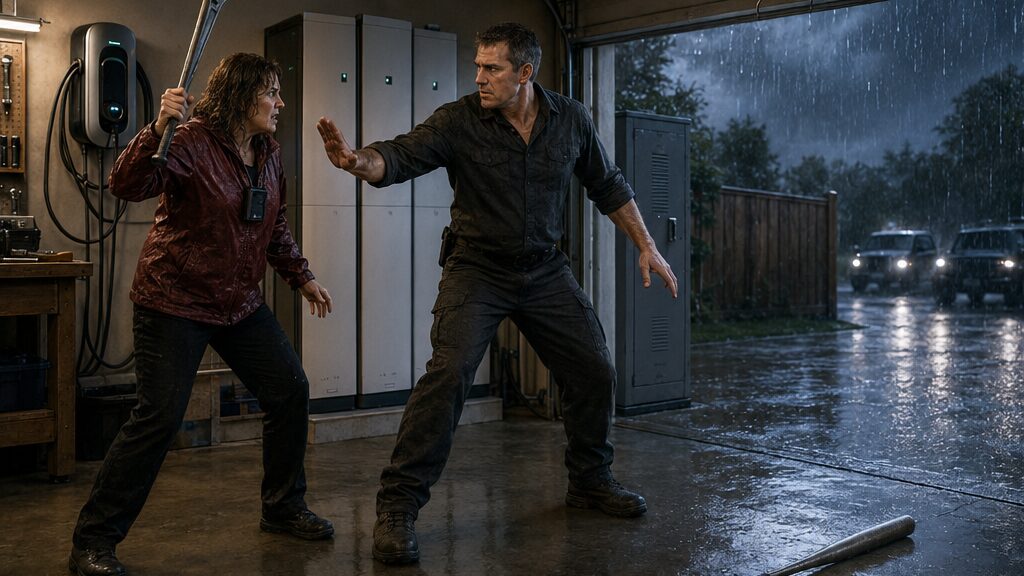
She stood inside the garage by nearly six feet. Rain darkened the shoulders of her jacket. A phone clipped to a chest harness faced outward, broadcasting the battery cabinets, the charger, and Raymond advancing from the workbench.
In her other hand hung a steel felling axe.
“You saw that,” she told the stream. “It’s still firing even after I disabled it.”
“It’s an indicator light.”
“That beam points directly at my property.”
“It does not emit a beam. Put the bat down and leave.”
The viewer count on her phone climbed past two thousand. Comments rolled across the screen.
OPEN THE CABINET.
SHOW THE BOMBS.
DON’T LET HIM SCARE YOU.
Sharon angled her body so Raymond appeared behind the raised axe. The camera framing was deliberate. She had left distance between them, placed the damaged sensor above his shoulder, and kept herself nearest the exit.
“I asked for answers,” she said. “I offered him every opportunity.”
“You refused the specialist Emily arranged.”
A flicker crossed her face.
“That meeting had conditions designed to silence me.”
“It prohibited filming.”
“Exactly.”
She pointed the bat at the solar battery bank. “Those units store enough power to burn this block.”
“They are isolated and monitored.”
“By the laser you just admitted was active.”
“I admitted no such thing.”
“You keep changing your story.”
Raymond heard the relay cooling fan rise behind the secured cabinet. Emergency standby was drawing more power. The sensor’s amber pulse accelerated in time with the diagnostic cycle.
Sharon saw it.
“Look at that,” she whispered to the stream. “It knows I’m here.”
“It detects motion.”
“So it is targeting me.”
Raymond stopped three paces away. “Put both tools on the floor.”
Her grip tightened around the axe handle.
“I brought these because you’ve made everyone afraid to approach you.”
“You brought an axe into my garage.”
“To remove a hazard.”
“You are the hazard now.”
The words landed harder than he intended.
Sharon’s expression changed. For a second she looked not angry but wounded, as if he had delivered the sentence she had spent months expecting from everyone around her.
Then the comments surged again.
HE THREATENED HER.
CALL POLICE.
SMASH THE POWER FIRST.
She lifted the axe.
Raymond moved between her and the battery cabinets.
“Last warning.”
“You don’t get to warn me while those bombs sit beside my home.”
“The batteries passed inspection.”
“The inspector was not allowed to inspect everything.”
“The cabinet is not a battery.”
“Then prove it.”
“No.”
Her mouth opened in triumph, as though the refusal had been the answer she wanted.
She stepped toward the charging cables.
Raymond matched her movement.
“Do not touch that system.”
“Why?” she asked the camera. “What happens if I do?”
“You could injure yourself.”
“There it is. He admits it’s dangerous.”
“Any high-voltage equipment is dangerous when attacked with steel.”
She raised the axe higher.
The relay emitted a brief signal tone behind him.
Sharon’s eyes shifted toward the cabinet.
“That sound came from the hidden unit.”
Raymond saw her decide.
She swung toward the cable channel.
He caught the axe handle below the head with both hands.
The impact drove him half a step backward. Steel passed within inches of the wall conduit. Sharon pulled hard, trying to wrench the tool free.
“Let go of me!” she shouted.
“I’m not touching you.”
“You’re attacking me!”
“You swung an axe at live equipment.”
The phone captured the struggle from Sharon’s chest: Raymond’s hands on the handle, her body jerking, the battery cabinets behind him. Cropped later, it could become anything.
He twisted the handle downward and away from the cables. Sharon resisted until the axe head struck the concrete with a sharp ring. Her fingers loosened.
Raymond pulled the tool free, carried it behind him, and slid it beneath the workbench.
The small victory lasted less than a breath.
Sharon still had the bat.
“Leave,” he said.
Her eyes went to the exit. Rain sheeted across the driveway. Beyond the garage, several neighbors had appeared beneath umbrellas and porch roofs. Emily stood at the property edge, phone in hand, her face pale.
Sharon could leave now.
Raymond saw her understand that.
He also saw her glance at the livestream count.
More than four thousand people were watching.
Retreat would not look like caution. It would look like defeat.
A comment appeared in large text:
THE CABINET. EXPOSE IT NOW.
Sharon pointed the bat toward the sealed door. “What are you protecting?”
“Emergency equipment.”
The phrase escaped before Raymond could stop it.
Sharon went still.
“What kind of emergency equipment?”
“That is all I can say.”
Her fear sharpened into vindication. “So you lied.”
“No.”
“You said it was private.”
“I said it was not part of the charging system.”
“Who gave you permission to put emergency equipment beside our homes?”
“Leave the garage.”
“Who authorized it?”
“Sharon.”
“Say it on camera.”
Raymond heard Eric’s warning: Attention is a motive. It isn’t a limit.
Sharon had never needed the equipment to be dangerous. She needed Raymond to admit that something had been kept from her. Now she had it.
She raised the bat again, but this time Raymond stepped into the swing before it gained speed. He trapped the barrel beneath his forearm and drove it downward.
Sharon released it with a cry.
The bat clattered across the floor.
Emily called from the driveway, “Sharon, stop. Come out now.”
For a moment, silence returned except for rain, the cooling fans, and the damaged sensor’s alarm.
Raymond kicked the bat beyond reach.
“Walk out,” he said. “Nobody is blocking you.”
Sharon looked toward Emily.
“You heard him admit it.”
“I heard him tell you to leave,” Emily said.
“He has illegal federal equipment.”
“He did not say federal.”
Sharon’s face tightened. Emily had been the neutral one, the careful one, the person Sharon could still claim to represent. Now even she had stepped across the line.
“This is why nobody trusts associations anymore,” Sharon said. “You protect whoever has money and technical words.”
Emily lowered her phone. “I tried to protect your right to ask questions. I am not protecting this.”
Sharon turned back into the garage.
Raymond followed her gaze.
On the workbench lay his heavy steel wrench, the one he had used during the relay diagnostic. It was within two steps of her.
He moved first.
Not fast enough.
Sharon snatched the wrench and backed toward the cabinet. The tool looked heavier in her hand than the bat, shorter and more controllable. Her knuckles whitened around the handle.
“Put it down,” Raymond said.
“You have been intimidating me for months.”
“I have barely spoken to you.”
“That is intimidation. You stand there acting like nobody deserves an answer.”
The truth inside the accusation struck him even as she distorted it.
He had treated silence as discipline. He had watched fear grow and dismissed it because the facts were on his side. He had never lied about the batteries, but he had let every unanswered question harden into suspicion.
None of that placed the wrench in Sharon’s hand.
“Set it down,” he said again. “You still have a choice.”
She looked at the livestream.
Then she shifted her footing.
Raymond recognized the movement. The camera had to see the front of her body when she swung. She had practiced where to stand, how to frame his approach, how to make herself appear cornered with the open driveway directly behind her.
“You’re all watching,” she told the phone. “If he touches me, you know why.”
She lifted the wrench over one shoulder.
The relay cabinet was less than three feet away.
“Sharon,” Emily said from outside.
Sharon swung.
Raymond saw the arc, the cabinet seam, and the metal tool descending toward the modules carrying emergency traffic through the storm.
He stepped inside the blow.
The wrench struck his open palm with a metallic crack.
Pain shot through his wrist.
The tool stopped inches from the cabinet door.
Sharon stared at his hand around the steel.
The viewer count on her screen surged higher.
Chapter 6: The Wrench Buried in the Fence
The wrench vibrated in Raymond’s grip while Sharon continued shouting to the people watching through her phone.
“He grabbed me! He’s attacking me!”
Raymond had not touched her.
Not yet.
His right palm burned where the steel had landed. Sharon still held the far end of the wrench with both hands, pulling it toward herself, trying to reset for another strike.
Behind Raymond, the relay emitted a descending warning tone.
The damaged sensor flashed amber above the garage door.
“Release it,” he said.
“You release it.”
“You swung at the cabinet.”
“I was defending the neighborhood.”
“You were destroying equipment you do not understand.”
“Because you refused to explain it.”
She twisted the handle. Pain tightened across Raymond’s wrist, but he held on. If he pulled straight back, Sharon would come with it. If he shoved, she could fall beneath the battery disconnect panel. If he simply let go, the cabinet was within reach.
The phone on her chest captured every breath between them.
Outside, Emily told someone to stay back. Another neighbor shouted that police were coming.
Sharon planted one foot and jerked harder.
Raymond let the wrench move two inches toward her.
Her balance shifted.
He stepped to the side, caught her shoulder with his free hand, and turned her away from the cabinet in one controlled pivot.
Sharon stumbled into the open space near the driveway.
Raymond stripped the wrench from her grip.
For one instant, he held the heavy tool between them.
Sharon saw it above his shoulder and recoiled.
The camera saw it too.
All the anger he had contained for months compressed into that instant: his address posted to strangers, protected hardware exposed, red stickers on his home, an axe swung toward live cables, the relay almost struck while emergency traffic depended on it.
He could have brought the wrench down onto the concrete at her feet.
He could have bent it across the workbench vise.
He could have used the fear on her face to make certain she never entered his garage again.
Instead Raymond turned toward the wooden fence separating their properties.
He hurled the wrench.
It crossed the narrow side yard and struck a fence post with a deafening crack. The steel head buried deep in the wood. The handle shuddered once and remained jutting outward.
Everyone stopped moving.
Even the livestream comments seemed to pause.
Raymond lowered his empty hand.
“Leave my property.”
Sharon stared at the wrench embedded in the fence. Rain blew through the open garage and darkened the concrete around her shoes.
“You could have killed me.”
“I threw it away from you.”
“You spun me.”
“To keep you from striking the cabinet.”
“You assaulted me.”
Raymond turned his back on her.
It was a calculated risk. He heard her inhale sharply, perhaps expecting another argument, perhaps considering the axe beneath the workbench. But the relay tone had changed.
The warning repeated.
Raymond reached the cabinet and checked the status display. The attempted strike had not breached the casing, but the impact caught in his palm had transmitted enough vibration through the floor to interrupt a sensitive connection. One emergency route was dropping.
He unlocked the cabinet.
Sharon lifted her phone.
“There,” she said breathlessly. “He is opening it. Everyone record this.”
The protected modules became visible behind Raymond’s shoulder.
That was the exposure Eric had feared.
Raymond could not close the cabinet. Not with the link degrading.
He reseated the loose coupling and watched the signal graph rise, falter, then rise again.
Behind him, Sharon told the stream, “This proves everything. Secret transmitters. Hidden government equipment in a residential neighborhood.”
Her screen chimed.
A warning banner appeared across the broadcast.
CONTENT UNDER REVIEW.
Sharon frowned and tapped it away.
The banner returned.
Raymond saw it reflected in the cabinet’s inner panel.
He knew what had happened. The stream had captured identifiable relay hardware, its protected asset markings, and a direct attempt to strike the enclosure. Automated monitoring had likely matched the visual identifiers before a human analyst ever saw the video.
The exposure was now documented at its source.
Sharon mistook the warning for censorship.
“They’re trying to shut me down,” she said. “Share this now. Download everything.”
The comments multiplied with links, screen-recording notices, and accusations.
She had turned her own broadcast into distributed evidence.
The relay signal crossed the minimum threshold.
Raymond held the connector steady and tightened the locking collar with a smaller insulated tool.
The amber sensor pulsed faster.
“Raymond,” Emily called, “are you hurt?”
“No.”
His palm said otherwise. Blood had begun to bead along a split beneath his thumb, but his grip remained steady.
Sharon backed into the driveway and called emergency services on a second phone.
“My neighbor attacked me,” she said loudly. “He took a weapon and threw it at my head.”
Emily stepped closer. “That is not what happened.”
“Stay out of this.”
“I recorded it.”
“You’re part of it.”
Sharon’s voice broke on the last word. Beneath the fury, Raymond heard panic. The moment had gone beyond the triumphant intervention she had imagined. The neighbors were not cheering. Emily had contradicted her. The tools lay scattered across Raymond’s floor, and the fence held a physical record of the direction he had thrown.
Still, Sharon continued.
“He has an illegal communications system,” she told the dispatcher. “I tried to shut it down before it harmed anyone.”
Emily covered her mouth.
Raymond finished tightening the coupling.
The signal stabilized.
One module after another returned to normal. The sensor above the door changed from amber to green, shining through its cracked housing.
A dispatcher’s voice, faint through Sharon’s second phone, asked whether she had entered Raymond’s property.
“I entered because there was an immediate hazard.”
“Were you carrying weapons?”
“They were tools.”
“Did the resident ask you to leave?”
Sharon looked toward the neighbors.
No one spoke for her.
Raymond closed the cabinet door but left it unlocked for the arriving response team. The green sensor continued its regular pulse. Emergency traffic moved across the display—routing codes, channel loads, priority bursts. Somewhere beyond the storm, responders were using the link while Sharon described it as a threat.
He had spent the morning wanting to protect his reputation.
Now he no longer cared what the livestream audience thought.
He cared about the signal holding.
Sharon’s first phone chimed again.
The livestream vanished beneath a black screen.
EVIDENCE PRESERVED.
ACCOUNT ACCESS TEMPORARILY RESTRICTED.
“What does that mean?” she whispered.
Raymond looked at the street.
Two dark vehicles turned the corner without lights or markings. A third followed behind them. They moved too quickly for utility crews and stopped in a precise line beyond the driveway.
Doors opened before the engines went silent.
Eric stepped from the first vehicle beside two agents in rain jackets. More personnel moved toward the garage perimeter while one raised a credential toward the neighbors.
“Nobody touch anything,” the agent ordered.
Sharon still held both phones.
“I called you,” she said, relief returning to her face. “He has hidden equipment, and he attacked me when I tried to protect the street.”
Eric’s gaze passed over the broken sensor, the bat on the floor, the axe beneath the workbench, the open relay cabinet, and the wrench embedded in the fence.
Then he looked at Raymond’s bleeding hand.
“No,” Eric said. “Your livestream called us.”
Sharon’s phone remained frozen on the words EVIDENCE PRESERVED as the agents crossed into the garage.
Edit
Chapter 7: The Broadcast That Reversed Every Accusation
“Everyone away from the garage.”
The lead agent’s voice carried across the driveway as another emergency burst sounded inside the relay cabinet.
Raymond remained beside the open panel.
“The primary route is holding,” he said. “The backup is still carrying priority traffic.”
The agent looked to Eric.
“He stays,” Eric said. “Nobody else crosses the threshold.”
Sharon stood in the rain between two investigators, clutching the phone that still displayed EVIDENCE PRESERVED. Her expression moved between outrage and disbelief.
“I am the one who called for help.”
One investigator took the phone from her carefully and sealed it inside an evidence sleeve.
“You also broadcast restricted equipment,” he said.
“I exposed it.”
“You broadcast yourself entering private property with an axe.”
“It was a safety intervention.”
The investigator glanced toward the tool beneath Raymond’s workbench, then toward the damaged sensor and the bat lying near the battery bank.
“Do not explain anything else until you have been advised of your rights.”
That finally silenced her.
Raymond watched the relay graph instead of Sharon. Traffic loads had climbed sharply as the storm disrupted cellular service west of the neighborhood. Dispatch data, responder coordination, and priority channels crossed the screen in coded streams.
If the wrench had struck six inches farther left, it might have fractured the protected module housing.
If the axe had severed the charging conduit, the system could have dropped into emergency isolation.
The street beyond his garage would never know how close Sharon had come to creating the failure she claimed to prevent.
An investigator photographed Raymond’s injured hand.
“Medical attention?”
“After the link settles.”
“That is not your decision.”
“It is while I’m the only authorized custodian on site.”
Eric gave him a tired look. “Let them wrap it.”
A medic cleaned the split beneath Raymond’s thumb without pulling him from the cabinet. The bandage made fine adjustments harder, but the signal remained stable.
Outside, investigators marked the axe, bat, broken sensor pieces, and every place Sharon had crossed the property line. One photographed the wrench embedded in the fence from three angles. The green light above the garage continued blinking through the cracked plastic.
Emily stood beneath a neighbor’s umbrella, speaking to an agent.
“I recorded from before the axe swing,” she said. “She was told to leave several times.”
Sharon heard her.
“You brought everyone against me.”
Emily looked at her across the driveway. “No. You brought tools.”
The sentence was quiet. It seemed to affect Sharon more than anything the agents had said.
By midnight, the storm weakened and the relay load began to fall. Raymond was escorted to an interview room in an unmarked office building while technicians secured the cabinet.
Eric sat across from him with a file closed beneath one hand.
“You stopped the strike,” he said.
“Yes.”
“You preserved the equipment.”
“Yes.”
“You also failed to report repeated threats, unauthorized photography, doxxing, an announced intervention, and footage of Sharon testing your gate.”
Raymond’s jaw tightened. “I reported the hardware images.”
“After they were distributed.”
“I requested increased exterior monitoring.”
“After she tested the gate.”
“She had not entered.”
Eric opened the file. “You decided she was an attention problem rather than a security problem.”
“I was wrong.”
The admission came faster than Raymond expected.
Eric studied him. “That will be part of the review.”
“So will the fact that you refused a public safety statement.”
Eric’s hand went still.
“You never formally requested one.”
“You told me disclosure would be delayed.”
“That was not a refusal.”
“It was enough for you to avoid responsibility.”
For several seconds, neither spoke.
Then Eric closed the file again.
“You’re right,” he said. “I treated this as a containment issue because that was easier than treating it as a human one.”
Raymond looked at the bandage around his palm.
The old communications failure had taught him to mistrust delay. Yet he had delayed every conversation that did not involve a cable, signal path, or measurable fault.
The irony sat heavily between them.
The review did not clear him completely.
Investigators concluded that his physical response had been controlled and proportionate. Security footage showed Sharon striking the sensor, raising the axe toward live equipment, refusing multiple orders to leave, then swinging the wrench at the relay cabinet. Raymond’s throw had traveled away from her and toward an empty fence line.
But the report also stated that he had underestimated a documented threat and failed to activate available protection protocols.
Raymond signed the acknowledgment without argument.
Sharon’s consequences arrived less quietly.
Her livestream archive, cloud backups, comments, rehearsal clips, and earlier messages were preserved. Investigators found a private recording in which she practiced standing near the garage exit so Raymond would appear to be blocking her. Another clip showed her testing how the bat swing would fit inside a vertical frame.
The discovery did not erase her fear of the batteries.
It proved she had arranged that fear for an audience.
Three days later, Kathleen Brown called Raymond.
“I owe you a correction,” she said.
“You owe viewers one.”
“I’m preparing a full timeline.”
“Use the security footage.”
“I need your permission.”
“Only the exterior and garage footage from the incident.”
“I also want to interview you about the relay.”
“No.”
“About why you stayed silent, then.”
Raymond considered hanging up.
Instead he said, “Include that I was not permitted to identify the equipment. Include that I also failed to use the explanation I was permitted to give.”
Kathleen was quiet.
“That makes the story less simple,” she said.
“It was never simple.”
The corrected report aired that evening.
It began with Sharon’s claim that the batteries could destroy three houses. Then the screen divided.
On one side, her edited livestream showed Raymond stepping toward her.
On the other, the full security angle showed the open driveway behind her, the axe in her hand, and Raymond keeping himself between her and the equipment.
Kathleen’s narration was restrained.
“The charging station, batteries, and sensors had passed inspection. The secured cabinet was later confirmed, in limited terms, as protected emergency communications infrastructure. Officials say the system carried priority traffic during last week’s storm.”
The broadcast showed Raymond catching the wrench.
It showed him turning Sharon away.
It showed the tool crossing the side yard and burying itself in the fence.
Then it froze on Sharon’s face as she shouted, “Those bomb batteries are putting everyone in danger.”
The words appeared beneath her in quotation marks.
By morning, the image had spread everywhere.
People placed Sharon’s expression beside photographs of flashlights, phone chargers, kitchen appliances, and children’s toys with batteries. The phrase bomb batteries became a joke she could not retrieve from the public once released.
Raymond did not laugh.
He stood inside the repaired garage, watching the green sensor pulse above the charger while crews removed the last evidence marker.
The scar in the fence remained.
On the television inside his house, the corrected report froze again on Sharon’s face beside the buried wrench.
This time, the full frame showed what her livestream had tried to hide.
Chapter 8: What the Green Light Actually Protected
The replacement garage door had no windows.
Eric placed the installation order on Raymond’s workbench and tapped the specification sheet.
“Solid core. Reinforced track. Remote closure tied to the security system.”
Raymond read the final line.
FULL VISUAL CONCEALMENT REQUIRED.
“You want the entire garage hidden.”
“I want the relay hidden.”
“The charger and batteries are lawful public-facing equipment.”
“They have become visual markers for the relay.”
“So we erase everything.”
“We reduce exposure.”
Three weeks had passed since the attack. The broken sensor had been replaced, the cabinet resealed, and the charging cables tested twice. The wrench had been removed from the fence after investigators completed their measurements, leaving a deep crescent-shaped scar in the post.
Across the street, Sharon’s curtains remained closed.
She had been released pending further proceedings under restrictions that prohibited contact with Raymond and access to his property. Her home still appeared in news footage when reporters discussed the case, though the crowds had finally stopped driving past.
Raymond set the order down.
“No.”
Eric frowned. “This is not optional.”
“The reinforced door is reasonable. Full concealment is not the only solution.”
“What are you proposing?”
“A controlled neighborhood briefing.”
Eric stared at him as though Raymond had suggested placing the relay cabinet on the sidewalk.
“No classified details,” Raymond said. “An independent specialist explains the charger, batteries, sensors, isolation systems, and emergency shutoffs. You provide the approved statement about protected emergency-support infrastructure.”
“We do not confirm relay locations.”
“You already confirmed its purpose to the press in limited terms.”
“After the location was compromised.”
“And now everyone on this street knows something was concealed. Closing a solid door without explanation will preserve the same fear.”
Eric looked toward the green sensor.
Its pulse reflected faintly on the new charger housing.
“You could have requested this before,” he said.
“I should have.”
The answer removed some of his resistance.
Eric picked up the order and folded it once. “There was a nonclassified statement available.”
Raymond said nothing.
“I could have authorized it after the first complaint,” Eric continued. “Emergency continuity support. Independent safety oversight. No operational details.”
“But you didn’t.”
“No.”
“Why?”
“Because every explanation creates a record. Every record creates questions.”
“That sounds familiar.”
Eric gave a brief, humorless smile. “Apparently we both prefer equipment to people.”
The safety briefing took place inside the neighborhood meeting room rather than Raymond’s garage.
An independent battery specialist explained thermal containment, automatic disconnects, and the difference between stored electrical energy and an explosive device. A security representative described the sensor as a low-power motion and status unit. Eric read the approved statement confirming that additional equipment supported emergency communications continuity and had been subject to oversight beyond city jurisdiction.
No one was permitted to photograph technical documents.
No one objected.
Emily stood at the front when questions ended.
“I treated neutrality as fairness,” she said. “It was not fair to ignore evidence because one side was louder, and it was not fair to dismiss legitimate uncertainty because the equipment was legal.”
Raymond watched her fingers tighten around the edge of the lectern.
“Asking questions was never the problem,” she continued. “Threats, trespass, and weapons were not questions.”
The room remained quiet.
Several neighbors looked toward Raymond. He resisted the impulse to look away.
When Emily invited him to speak, he stood without notes.
“The equipment in my garage helps maintain communications when ordinary systems fail,” he said. “That is all I can say about its function.”
No one interrupted.
“The public electrical systems were inspected and safe. I knew that. I assumed the documents should have been enough.”
He glanced at Eric.
“They were enough to prove compliance. They were not enough to build trust.”
A neighbor near the back raised a hand. “Were we ever in danger from the batteries?”
“No.”
“Were we in danger from the hidden equipment?”
“No.”
Raymond paused.
“But attacking either system created danger.”
The room accepted the distinction without applause.
That was better.
Afterward, Kathleen waited outside beside her news van.
“I’d still like the personal interview,” she said. “The man behind the emergency relay.”
“There is no story there.”
“There is always a story.”
“Not one I’m giving you.”
She studied him, then nodded. “Can I at least ask whether you regret throwing the wrench?”
Raymond looked across the street toward his fence.
“I regret that it reached the point where I had to catch it.”
Kathleen wrote the sentence down.
He did not ask whether she would use it.
The internet continued making jokes about bomb batteries. Sharon’s frozen expression appeared on shirts, coffee cups, and edited clips. Raymond could not control that consequence any more than Sharon could.
He also refused to feed it.
When strangers requested interviews, he declined. When a video channel offered money for the damaged bat, he did not answer. The axe remained in evidence. The wrench returned to his workbench after investigators released it, though he no longer placed it near the relay cabinet.
The reinforced garage door was installed, but Raymond selected a model with narrow upper windows rather than full concealment.
Through them, neighbors could see the ordinary parts of the system: the parked PHEV, the coiled charging cable, the battery status panel, and the clean rows of tools.
The protected cabinet remained out of sight.
One evening, Raymond plugged in the vehicle and heard the charger engage with a soft mechanical click.
The replacement sensor above him pulsed green.
Years earlier, another signal light had gone dark while a coworker waited for help that arrived too late. Raymond had spent years trying to defeat that memory with perfect maintenance, tighter procedures, and fewer people allowed close enough to interfere.
The relay had never required him to carry the promise alone.
He closed the cabinet, checked the lock, and stepped outside.
The fence post still bore the wrench’s scar. He had considered replacing the board, but left it in place. It was not a trophy. It marked the distance between stopping a weapon and using one, between justified secrecy and avoidable silence.
Behind him, the charger hummed steadily.
The green light flashed once above the vehicle, visible through the narrow garage windows.
This time, Raymond did not close the door to hide it.