The Birdhouse Next Door Looked Harmless Until One Night Changed the Whole Neighborhood
Chapter 1: The Birdhouse Angela Said Was Too Attractive
“The problem is, it’s too attractive.”
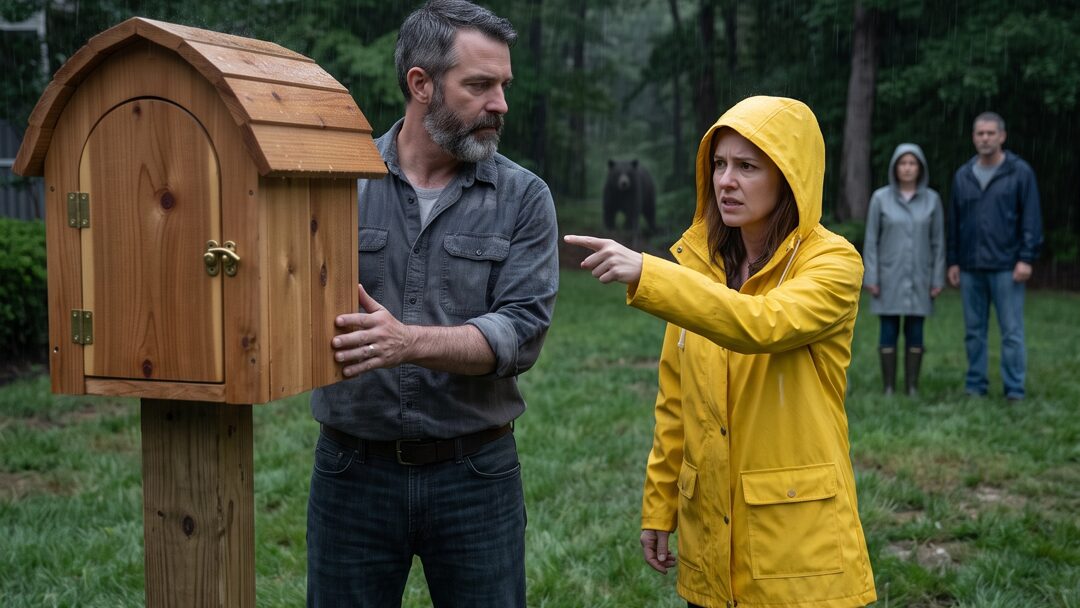
Thomas Mitchell looked from Angela Robinson’s pointing finger to the birdhouse, then back to Angela.
Rain ticked softly against the hood of her bright yellow jacket. Behind her, at the edge of the shared property line, two nearby homeowners had slowed their Saturday errands just enough to pretend they were not listening.
Thomas rested one hand on the cedar post.
“Too attractive to what?”
Angela stared at him as if the question itself were part of the problem.
“To birds, Thomas.”
He waited.
“That’s a birdhouse.”
“I know what it is.”
“Then I’m having trouble finding the disagreement.”
One of the neighbors coughed into a fist. Thomas heard the effort it took not to laugh.
Angela heard it too.
Her mouth tightened.
The birdhouse stood nearly five feet above the wet grass, broad-roofed and carefully proportioned, with three small entry holes beneath a deep overhang. Thomas had painted the trim a muted green and left the cedar walls to weather naturally. The roofline curved slightly at each end—not enough to look whimsical from a distance, but enough that anybody who knew furniture or finish carpentry could tell someone had spent unreasonable hours getting it right.
It was larger than anything sold at a garden center.
That much Angela had right.
She stepped closer.
“It’s almost the size of a cabinet.”
“Small cabinet.”
“And you put it ten feet from the property line.”
“Eleven and a half.”
“That is not helping.”
Thomas kept his expression neutral. Years of working with clients had taught him that silence was often cheaper than honesty.
Angela looked toward the trees beyond the subdivision. Their neighborhood sat where newer cul-de-sacs pressed against old woods, close enough that deer browsed azaleas and raccoons learned trash schedules better than some homeowners did.
“We already have wildlife issues,” she said. “You know that.”
“I don’t put food out.”
“You built a bird condominium.”
“It has three openings.”
“That is not the point.”
“What is the point?”
Her hand came up again, palm open toward the structure.
“The point is that it’s too big, too attractive, and practically an invitation.”
This time the neighbor near the driveway turned away completely.
Thomas felt a laugh rise in his chest and killed it before it reached his face.
Angela saw something anyway.
“There,” she said.
“There what?”
“That look.”
“What look?”
“The one where you decide everybody else is ridiculous and you’re too calm to say it.”
The accusation landed harder than the complaint.
Thomas removed his hand from the post.
“I didn’t say you were ridiculous.”
“You don’t have to.”
For a moment, only rain filled the space between them.
Angela’s anger had always seemed to Thomas like a thing she kept folded neatly until she needed it. She was not a habitual screamer. She chaired architectural review meetings, quoted page numbers from community guidelines, and remembered which homeowners had been granted exceptions three years earlier. Most of the time, she was controlled.
That made the yellow jacket and pointing finger feel more public than shouting would have.
Thomas glanced at the two neighbors.
They suddenly became fascinated by a mailbox.
“If you came over to ask me something,” he said quietly, “ask.”
“I’m asking you to reduce the size before Monday.”
“Monday?”
“The committee is reviewing it.”
“You filed a complaint?”
“I raised a concern.”
“With the committee you sit on.”
“I disclosed that I’m adjacent to the property.”
“How generous.”
Angela’s eyes sharpened.
There it was. The thing she had accused him of.
Thomas regretted the words as soon as they left his mouth, but he did not take them back.
Angela stepped off the grass onto the narrow bed of wet pine straw beside the post.
“The guidelines require review for freestanding decorative structures above four feet.”
“It was approved as a landscape feature.”
“The drawing you submitted did not show this scale.”
“The measurements were on it.”
“The perspective was misleading.”
“The perspective was a rectangle with numbers.”
She looked up at the birdhouse again.
Thomas watched her attention travel from the curved roof to the lower trim, then around the side.
His shoulders tightened before he understood why.
Angela moved toward the back.
“What’s this?”
Her fingers reached for a small brass latch set into a nearly invisible panel.
Thomas caught her wrist.
Not hard.
But fast.
Angela froze.
So did the neighbors.
Thomas released her immediately.
“Don’t.”
The word came out lower than he intended.
Rain gathered at the end of Angela’s hood and fell between them.
She looked at her wrist, then at him.
Thomas stepped back.
“You don’t touch someone else’s property without asking.”
“I was looking at a panel.”
“You were opening it.”
“What’s inside?”
“Nothing that concerns you.”
Her face changed.
The irritation did not disappear. Something colder joined it.
“Is it a feeder?”
“No.”
The answer came too quickly.
Angela noticed.
Thomas knew she noticed.
“You just told me you don’t put food out.”
“I don’t.”
“Then open it.”
“No.”
“Thomas.”
“No.”
A porch door clicked shut somewhere across the yard.
The small audience had understood the argument was no longer funny.
Angela folded her arms.
“If that compartment contains feed, seed, suet, anything scented—”
“It doesn’t.”
“Then why are you protecting it?”
Thomas looked past her toward his workshop windows. Through the rain-dark glass, he could see nothing inside, but he knew exactly which drawer held the spare brass screws. He knew which shelf held the original paper patterns. He knew what handwriting ran at an angle across the old cut list because she had never written straight on unlined paper.
He looked back at Angela.
“I said it doesn’t concern you.”
Her expression hardened into decision.
“Fine.”
She walked away.
“Angela.”
She stopped at the property line but did not turn.
“I haven’t fed birds from that thing in months.”
The words were true.
They were also not the whole truth.
Angela glanced back.
“You should have started with that.”
“You didn’t ask.”
“I did ask.”
“No. You accused.”
She gave him a tired look.
“And you hid.”
Then she crossed into her yard.
Thomas stood beside the birdhouse until the neighbors finally moved on.
The rain strengthened.
He reached behind the post and touched the brass latch with one finger.
It had darkened slightly around the edges. He had meant to polish it in spring. Then spring had become summer, and every time he considered opening the panel, he found something else that needed doing.
A hinge on a kitchen cabinet.
A customer’s dining table.
Gutters.
Anything.
His phone buzzed in his pocket.
He expected a message from Angela.
Instead, it was an email.
The sender line read: Pine Hollow Residential Association.
Thomas opened it beneath the dripping roof of the birdhouse.
NOTICE OF EXPEDITED ARCHITECTURAL REVIEW.
He read the first paragraph once.
Then again.
A complaint had been received regarding an unapproved or materially altered exterior structure with possible wildlife-attraction concerns. An inspection was scheduled within forty-eight hours. Failure to provide reasonable access could result in enforcement action under the community declaration.
At the bottom was Jennifer Clark’s name.
Board President.
Thomas looked toward Angela’s house.
A yellow shape moved behind her kitchen window.
Then disappeared.
He lowered the phone and turned slowly toward the rear of the birdhouse.
The small brass latch waited under his hand.
Chapter 2: The Promise Hidden Behind the Small Brass Latch
Ashley Green was halfway through asking why her father had kept a box of warped plywood scraps when she stopped speaking.
Thomas knew what she had found before he turned around.
She stood at his workbench with a yellowed sheet of graph paper between both hands.
“Dad.”
He set down the tape measure.
Ashley looked at the page again.
The workshop smelled of cedar dust and machine oil. Monday light came through the high windows in pale strips, catching the suspended dust between them.
“Where did you get this?”
Thomas wiped his hands on his jeans.
“It was in the drawer.”
“That isn’t what I asked.”
She held the paper toward him.
A rough roofline crossed the page in pencil. Measurements crowded the margins. One corner contained three tiny circles labeled with arrows. Near the bottom, in handwriting that leaned upward no matter how carefully its owner tried to write, were the words:
Too plain. Give it some nerve.
Ashley looked toward the backyard window.
Then back at the drawing.
“Mom designed it.”
“Part of it.”
“The birdhouse.”
Thomas said nothing.
Her eyes narrowed.
“You told me you just felt like building something.”
“I did.”
“Dad.”
The old impatience in her voice made him feel, for half a second, that she was seventeen again and he had forgotten to tell her about a change in plans.
He reached for the paper.
Ashley pulled it back.
“How much of it was hers?”
“The roof.”
“That curved edge?”
“Her idea.”
“The three openings?”
“Also hers.”
“And the ridiculous size?”
Thomas almost smiled.
“That was shared responsibility.”
Ashley did not.
Behind them, the doorbell sounded inside the house.
Thomas checked his watch.
Ten o’clock.
Right on time.
“You invited somebody?”
“The HOA inspection.”
Ashley stared at him.
“You didn’t mention that.”
“You came by unannounced.”
“You texted me that you needed help moving lumber.”
“I do.”
“You needed me here.”
Thomas picked up the tape measure again.
“Jennifer Clark is coming to inspect the birdhouse. Angela may be with her.”
“And?”
“And nothing.”
Ashley set the drawing flat on the bench.
“You want me to stand there while you refuse to answer questions.”
“I answer questions.”
“You answer the question you wish people asked.”
The bell sounded again.
Thomas walked toward the door connecting the workshop to the house.
Behind him, Ashley said, “That is exactly what Mom used to say.”
His hand stopped on the knob.
He did not turn.
“Jennifer’s waiting.”
Outside, Jennifer Clark stood with a tablet tucked beneath one arm. She wore flat shoes suited to wet grass and the careful expression of someone entering a dispute she intended to describe later as routine.
Angela stood several feet behind her.
No yellow jacket today.
Thomas noticed that before he could stop himself.
Jennifer smiled briefly.
“Mr. Mitchell.”
“Thomas is fine.”
“Thank you for providing access.”
“I provided access to the yard.”
Her smile faded by a degree.
“Yes. We’ll clarify scope as we go.”
Ashley came out behind him.
Thomas introduced her.
Jennifer nodded. Angela did too, with a flicker of recognition that suggested she had seen Ashley visit before but had never known her name.
They crossed the grass.
Jennifer began with measurements. Height. Distance from property line. Footprint. Post depth, as far as Thomas could document it.
Thomas answered each question precisely.
For several minutes, the inspection almost felt ordinary.
Then Jennifer walked around the back.
“The complaint references an internal compartment.”
Thomas looked at Angela.
She kept her face still.
Jennifer touched nothing.
“May I see it?”
“No.”
“Is it accessible?”
“Yes.”
“What is its function?”
“Storage.”
Angela shifted.
Jennifer glanced at her tablet.
“Storage of what?”
“Private material.”
“Does it contain bird feed?”
“No current feed.”
The phrasing made Ashley look sharply at him.
Jennifer caught it too.
“Current?”
Thomas kept his eyes on the tablet.
“The structure was originally designed with a removable feeder insert. I stopped using it.”
“When?”
“Months ago.”
Angela spoke for the first time.
“How many months?”
Thomas turned.
“I don’t remember.”
“You told me there was no feeder.”
“I told you I don’t put food out.”
“You said no when I asked if the compartment was a feeder.”
“The compartment is not a feeder.”
“But there is a feeder inside it.”
“There was a removable insert.”
Jennifer raised one hand.
“Let’s keep this factual.”
“It is factual,” Angela said.
Her voice was controlled, but Thomas heard strain beneath it.
“My trash enclosure was torn apart last fall. We’ve had two neighborhood warnings about bears. I asked whether that structure could attract wildlife, and he treated me like I was inventing a problem.”
Thomas looked at her.
For the first time, he noticed a repaired section of fence behind her house. Three new boards among weathered ones.
He had seen them before.
He had never asked why they were there.
Jennifer turned to him.
“I need to inspect the compartment.”
“No.”
Ashley exhaled behind him.
Jennifer’s tone hardened.
“If the issue is privacy, we can limit observation. You may remove personal items first.”
“No.”
“Thomas,” Ashley said.
He ignored her.
Jennifer shifted the tablet against her hip.
“The association has a duty to investigate a documented safety concern.”
“You have a duty to follow your own procedures.”
“We are.”
“You scheduled an expedited inspection based on a neighbor complaint about attractiveness.”
Angela stared at him.
“That is not what I wrote.”
Thomas looked at her.
She continued, “I wrote that the scale, prior feeder use, proximity to the woods, and unknown internal compartment could create an attractant.”
The small payoff of being technically right dissolved before Thomas could enjoy it.
Angela had not written the absurd version.
She had written the serious one.
Jennifer opened a form on her tablet.
“Mr. Mitchell, I can note that you are denying access to the compartment.”
“You can note that I’m allowing exterior inspection and refusing access to personal materials absent a specific rule requiring it.”
“That may limit our ability to resolve this informally.”
“So be it.”
Ashley stepped forward.
“Can I talk to him for a second?”
Thomas said, “No need.”
“There is definitely a need.”
She took his arm and led him toward the workshop before he could object without making a scene.
The moment the door shut, she turned on him.
“You kept a feeder in there?”
“An insert.”
“Oh, good. That’ll sound excellent at the hearing.”
“It hasn’t been used.”
“Then open the compartment.”
“No.”
“Why?”
“You saw the plans.”
Ashley’s anger faltered.
Thomas hated himself for feeling relieved.
She looked through the window toward the birdhouse.
“The originals are in there?”
“Some.”
“Some?”
“Notes. Measurements.”
“You locked Mom’s papers inside a birdhouse?”
“They were part of the build.”
“And now you won’t touch them.”
Thomas said nothing.
Ashley’s face tightened.
“There it is.”
“What?”
“The thing you do.”
“I don’t know what you’re talking about.”
“Yes, you do. You decide silence makes you noble.”
He looked away.
She stepped closer.
“You did it after the hospital. You did it when I asked what she said at the end. You did it when I wanted to help clean out her closet. Now you’re doing it with a wooden birdhouse while an HOA committee stands in your yard.”
His jaw tightened.
“Lower your voice.”
“Why? So nobody finds out you loved your wife?”
“That is not what this is.”
“Then tell me what it is.”
Thomas looked at the graph paper on the bench.
For years he had believed that refusing to translate grief for other people was a form of loyalty. Her handwriting had been hers. The joke about giving the roof nerve had been theirs. He did not want Jennifer Clark reading it over a tablet or Angela Robinson standing there while he lifted out pages that still carried a faint brown water ring from his wife’s coffee cup.
He picked up a pen.
“What are you doing?” Ashley asked.
“Limiting the inspection.”
He returned outside.
Jennifer had prepared a refusal acknowledgment.
Thomas read every line.
Then he crossed out the phrase full inspection denied and wrote:
Exterior inspection completed. Access refused only to enclosed personal-material compartment pending identification of governing authority.
He initialed the change.
Jennifer watched him sign.
“You understand this may lead to enforcement.”
“Yes.”
Angela looked at him for a long moment.
Not triumphant.
Not satisfied.
Something closer to disbelief.
That night, Thomas ate standing at the kitchen counter.
Ashley had left without saying much after the inspection. The old drawing remained in the workshop, weighted flat beneath a square of maple.
At 11:47 p.m., his phone vibrated against the counter.
He glanced down.
BACKYARD CAMERA: MOTION DETECTED.
Thomas opened the live feed.
At first he saw only grainy darkness, silver grass, and the pale shape of the birdhouse.
Then something moved beneath it.
Something large enough to block the post from view.
Chapter 3: The Night Visitor Caught Beneath the Camera Timestamp
The shape rose on two legs beneath the timestamp.
Thomas stopped breathing.
For one absurd second, his mind tried to make it a person in a coat.
Then the animal dropped to all fours and turned its head.
A bear.
The camera’s infrared image flattened everything into shades of gray, but there was no mistaking the heavy shoulders, the rounded ears, the long snout lifting toward the birdhouse.
Thomas gripped the kitchen counter.
On the screen, the bear circled the post.
11:47:19 PM.
It sniffed the wet grass.
11:47:31 PM.
It stood again and placed one forepaw against the cedar.
“No,” Thomas whispered.
The live feed juddered.
The bear’s weight shook the post.
Thomas moved toward the back door, then stopped with his hand above the lock.
He knew enough not to walk into a dark yard with a bear.
Instead he switched on the floodlights.
The phone image flashed white.
Outside, something struck wood with a hollow crack.
Thomas heard it through the glass.
By the time he reached the window, the bear was already moving toward the trees, a dark mass passing beyond the fence line.
He waited.
One minute.
Five.
Ten.
Then he called the nonemergency number and reported the sighting.
Only after that did he replay the footage.
At first the sequence looked almost comic.
The bear approached.
Sniffed.
Rose.
The oversized birdhouse—Angela’s “invitation”—seemed to present itself like the setup to a joke no reasonable person could have planned.
Thomas nearly laughed.
Then he watched again.
The bear did not paw randomly at the roof.
It moved around the post.
Directly to the back.
Thomas leaned closer to the screen.
11:48:07 PM.
The snout pressed toward the concealed panel.
11:48:11 PM.
One paw scraped beneath the brass latch.
Thomas replayed it.
Again.
The bear targeted the panel.
A cold unease spread through him.
He set the phone down, picked it up again, and opened the older camera archive.
Nothing from the previous night.
Nothing the night before that.
A raccoon six days earlier, passing along the fence.
A deer.
Wind.
Thomas went to the workshop and turned on every light.
The old graph-paper drawing still lay beneath the maple square.
He lifted it.
Too plain. Give it some nerve.
His thumb stopped beside the penciled notes.
Behind the rain-streaked window, the birdhouse stood crooked.
One side of the roof had been pushed upward. The rear panel was no longer flush with the frame.
Thomas looked at the drawer where he kept the brass screws.
Then at the window.
He did not go outside until dawn.
The damage was worse in daylight.
Claw marks scored the cedar. One trim piece lay in the grass. The post leaned several degrees east, and the rear panel had been pulled partly open, though the latch still held at one corner.
Thomas crouched beside it.
A muddy print marked the lower wood.
He could smell wet soil.
Something else too.
Faint.
Sweet? Musty?
He leaned closer.
Then straightened sharply, irritated with himself for imagining scents because Angela had planted the idea in his head.
His phone rang.
Ashley.
“Are you okay?”
Thomas looked toward the street.
“How do you know?”
There was a pause.
“Know what?”
He closed his eyes.
“You don’t.”
“Dad, what happened?”
“Bear in the yard.”
Silence.
Then, “A bear?”
“It left.”
“Did it get near the house?”
“No.”
“The birdhouse?”
Thomas did not answer quickly enough.
Ashley swore under her breath.
“I’m coming over.”
“No.”
“That was not a request.”
The call ended.
Thomas took photographs before touching anything. Damaged roof. Leaning post. Rear panel. Tracks.
He was photographing the broken trim when Angela came through her side gate.
She had thrown the yellow rain jacket over pajamas.
The sight of it almost made the whole thing ridiculous again.
Almost.
She stopped at the property line.
Her eyes went to the birdhouse.
Then to Thomas.
“What happened?”
He held up the phone.
“Bear.”
All color left her face.
“You’re joking.”
“I’m not.”
“Last night?”
“Eleven forty-seven.”
She stepped closer, then caught herself before crossing onto his grass.
“Was anyone outside?”
“No.”
“Did it—”
“It went for the birdhouse.”
Angela stared at the claw marks.
Thomas watched the exact moment her concern collided with vindication.
He expected I told you so.
She did not say it.
Instead she asked, “Did you call wildlife control?”
“Yes.”
“Good.”
The restraint unsettled him more than triumph would have.
He opened the footage.
Angela watched beside him without speaking.
The bear rose beneath the timestamp.
Its paw struck the post.
Then it moved around the back.
Angela leaned toward the screen.
“Play that again.”
Thomas did.
The paw scraped beneath the latch.
Her eyes lifted to his.
“What’s in there?”
“Personal papers.”
“And?”
“Nothing else.”
“Thomas.”
“I stopped feeding months ago.”
“That isn’t an answer.”
He locked the phone.
“It’s the answer you’re getting.”
Angela’s jaw tightened.
“You watched a bear try to tear open that exact compartment.”
“And I said I’m checking it.”
“When?”
He looked at the damaged panel.
“After I document everything.”
“Or after you decide which truth you can live with?”
The phrase hit too close to Ashley’s accusation.
Thomas stepped toward her.
“You do not get to turn this into your victory.”
Angela did not move.
“I don’t want it to be my victory.”
“Could’ve fooled me.”
“You think I wanted a bear in your yard?”
“I think you wanted to be right.”
For the first time since she appeared, anger overtook shock.
“And I think you would rather risk being wrong than let anybody see you change your mind.”
A car slowed in the street.
The driver lifted a phone toward the yard.
Thomas turned.
The car continued.
“What was that?”
Angela looked toward the vehicle.
“I don’t know.”
Thomas’s phone began vibrating.
Then vibrating again.
Three notifications.
Five.
Seven.
The neighborhood group chat.
He opened it.
At the top was a video thumbnail.
His security footage.
The timestamp.
The bear.
The birdhouse.
Someone had added a caption:
REMEMBER THE GIANT BIRDHOUSE ARGUMENT? YOU CANNOT MAKE THIS UP.
Thomas stared.
“How did they get this?”
Angela stepped beside him.
The clip began with a shaky daytime recording from Saturday.
Angela in the yellow jacket, pointing.
Her voice, clear enough to understand:
“It’s too big, too attractive, and practically an invitation.”
Then a cut.
Black-and-white surveillance footage.
The bear appeared.
The clip ended just after it struck the birdhouse.
A laughing emoji filled the caption.
Thomas felt the blood drain from his face.
Someone had combined the confrontation with his private camera footage.
“No,” Angela said.
He looked at her.
She was staring at the screen.
“I didn’t post that.”
“I didn’t ask.”
“You think I did.”
“Did you?”
“No.”
Comments were multiplying beneath the video.
She warned him.
Man built a bear restaurant.
HOA lady finally right about something.
Imagine being this stubborn.
The original post already showed hundreds of shares outside the private neighborhood group.
Thomas tapped the account.
A nearby homeowner’s name.
Someone who had received the security clip after Thomas reported the bear and sent it to the neighborhood safety thread.
He had not even realized the attachment could be downloaded.
Ashley’s car pulled into his driveway.
She got out holding her phone.
“You should watch this,” she said, then saw their faces. “You already have.”
Thomas looked down at the looping video.
Angela’s warning.
His birdhouse.
The bear.
Again.
Again.
Again.
The absurdity had become proof before he had even opened the damaged panel.
By noon, a wildlife-control officer had inspected tracks near the yard and advised every nearby homeowner to secure trash, grills, pet food, and bird feed. Thomas listened carefully, photographing the printed guidance.
“What specifically drew it here?” he asked.
The officer glanced at the damage.
“Can’t tell from tracks alone.”
“So the birdhouse didn’t necessarily attract it.”
“I didn’t say that.”
“What are you saying?”
“I’m saying bears follow scent opportunities. Could be one source. Could be several. You’ve got woods, trash day was yesterday, and I smelled grease near a grill two houses down.”
Thomas looked toward Angela.
She stood near her fence with her arms folded.
The officer continued, “But if that structure ever held seed, I’d inspect it.”
Thomas felt Ashley’s eyes on him.
He nodded once.
“I will.”
The officer left.
For half an hour, Thomas believed the uncertainty might matter.
Then his phone chimed with an email from Jennifer Clark.
Subject: EMERGENCY ENFORCEMENT ACTION — WILDLIFE HAZARD.
He opened it standing beside the damaged post.
The board had reviewed “widely circulated video evidence” showing direct wildlife interaction with the disputed structure. Effective immediately, Thomas was ordered to remove or secure the birdhouse pending emergency review. Daily fines would begin if compliance was not documented within the stated deadline.
The attached notice cited the viral footage twice.
Thomas read the final paragraph.
Then Ashley said quietly behind him, “Dad.”
He turned.
She was looking not at the notice, but at the damaged rear panel.
The brass latch hung crooked from one screw.
“What exactly,” she asked, “is still inside there?”
Chapter 4: When the Viral Clip Became Official Evidence
By Tuesday morning, strangers were repeating Angela’s words back to Thomas.
Too big.
Too attractive.
Practically an invitation.
He saw the phrases under reposts of the bear video while standing at his kitchen counter with untouched coffee cooling beside him. Someone had slowed the footage at the moment the bear rose beneath the birdhouse. Someone else had added dramatic music. One version cut directly from Angela pointing in her yellow jacket to the bear striking the post, as if reality itself had waited for her cue.
The comments were worse because some were funny.
Man accidentally opens woodland restaurant.
HOA woman gets one point.
Imagine being warned and then feeding a bear furniture.
Thomas locked the phone.
Three seconds later, he unlocked it again.
The original neighborhood upload had spread well beyond Pine Hollow. A local community page had shared it overnight. Then another account with hundreds of thousands of followers had reposted the clip without context.
By eight thirty, his email contained an amended enforcement notice.
The daily fine would begin at noon unless the birdhouse was removed, rendered inaccessible, or secured under a method approved by the board.
Thomas read the sentence twice.
Then he called Jennifer Clark.
She answered on the fourth ring.
“Thomas.”
“You amended the notice.”
“Yes.”
“Based on what?”
“The incident.”
“Based on what evidence that the structure caused it?”
There was a small pause.
“Thomas, a bear physically interacted with the structure.”
“That proves interaction.”
“It proves enough for interim action.”
“Not enough for a daily fine.”
“We have a responsibility to protect residents.”
“Then issue a community-wide attractant notice.”
“We did.”
“And fine every unsecured grill and trash can?”
“This is not the same.”
“Why?”
Another pause.
When Jennifer answered, her voice had cooled.
“Because we have visual evidence tied to an already disputed structure.”
Thomas looked toward the backyard.
The birdhouse stood braced with temporary lumber. He had placed a plywood shield over the damaged rear panel without opening it. The board’s instructions required securing the structure, and he had done that much.
“You have a viral clip,” he said.
“We have evidence.”
“You just changed the word.”
“Meeting tonight at six thirty. You can state your position then.”
The call ended.
Thomas kept the phone at his ear a moment longer.
At eleven, he walked the neighborhood with the wildlife-control guidance folded in his pocket.
He did not tell himself he was looking for evidence.
That would have sounded too much like obsession.
He was simply walking.
Two houses down, a grill sat beneath a covered patio with an overflowing grease cup visible under the firebox. Across the street, a trash bin lid stood open because a cardboard box prevented it from closing. At the cul-de-sac, black plastic bags had been stacked beside a garage since pickup day.
Thomas photographed none of it.
At first.
Then he saw torn trash near the wooded edge.
A raccoon could have done it. A dog. The bear.
He took one picture.
Then another.
By the time he returned home, he had twelve.
Ashley was waiting in the driveway.
“You’re collecting trash photos now?”
“I’m documenting conditions.”
“That sentence should worry you.”
Thomas passed her.
She followed him into the backyard.
The plywood shield covered the damaged compartment. Fresh screws shone against old cedar.
Ashley stopped.
“You still haven’t opened it.”
“No.”
“Dad.”
“I secured it.”
“You secured the thing you claim might have nothing to do with the bear without checking what’s inside.”
“I know what’s inside.”
Her expression changed.
Thomas regretted the wording.
“What does that mean?”
“It means I know there are papers.”
“And the insert?”
He looked away.
Ashley folded her arms.
“You don’t know.”
“I know it hasn’t been filled.”
“That’s not the same thing.”
He picked up a cordless drill and carried it toward the workshop.
Ashley said behind him, “You are working very hard to prove everyone else could be wrong.”
Thomas stopped.
“But not that you’re right,” she finished.
At six twenty-five, the Pine Hollow clubhouse parking lot was already full.
Inside, phones glowed above folding tables.
Thomas saw his own backyard on three screens before reaching the sign-in sheet.
The bear clip looped silently.
Rise.
Strike.
Cut.
Again.
Jennifer sat at the front with two architectural committee members and an HOA management representative. Angela stood near the wall, speaking quietly to a neighbor.
She was not wearing yellow.
Thomas disliked noticing.
The meeting began with liability language.
Potential hazard.
Immediate action.
Reasonable precaution.
The management representative referred to “documented attraction activity.”
Thomas raised his hand.
Jennifer saw him and continued speaking.
When public comment opened, he stood.
“What evidence establishes attraction?”
The room shifted.
Jennifer clasped her hands.
“The video is part of the evidence.”
“Part of what else?”
“The prior complaint.”
“A complaint is not causation.”
A few people looked down at their phones.
Thomas continued.
“The wildlife officer who inspected my property said there may be multiple scent sources. Trash. Grills. Feed. He did not identify the birdhouse as the cause.”
Jennifer replied, “He also recommended inspecting any structure that had previously contained seed.”
“Yes.”
“Have you done that?”
Thomas felt every face turn toward him.
“No.”
The word damaged him more efficiently than any accusation could have.
Jennifer did not press.
She did not need to.
A committee member leaned toward the microphone.
“So you are contesting emergency action while refusing to inspect the exact compartment the bear targeted?”
Thomas looked at the looping phone screens.
“I am contesting selective punishment without established cause.”
“That wasn’t the question.”
“No,” Thomas said. “It wasn’t.”
A murmur moved through the room.
He saw Angela close her eyes briefly.
The meeting ended with the fines intact.
Outside, Thomas walked toward his truck.
“Wait.”
Angela followed him into the parking lot.
He kept moving.
“Thomas.”
“What?”
She glanced back toward the clubhouse.
“The board is overstating it.”
He stopped.
The admission caught him harder than an insult would have.
Angela lowered her voice.
“The video does not prove the birdhouse alone caused the bear visit.”
“Interesting time to discover nuance.”
“I’m serious.”
“So am I.”
She ignored that.
“Jennifer is afraid of being accused of doing nothing after a documented bear incident. The management company is pushing liability language. They want a clean action.”
“And I’m the clean action.”
“Yes.”
Thomas laughed once.
Angela flinched.
“You think this is funny?”
“I think you filed the complaint.”
“I did.”
“You pushed expedited review.”
“Yes.”
“You turned a stupid argument into an official record.”
“Because you would not answer a basic question.”
“And now you’re worried the machine you started is moving too fast.”
Her jaw tightened.
“My fence was torn apart last fall.”
“I saw the boards.”
“You saw them today, maybe.”
Thomas said nothing.
Angela stepped closer.
“I spent three nights after that checking the yard every time I heard something. I asked the board for a neighborhood attractant policy. Nothing happened. Then you built that thing.”
“I did not build it to attract bears.”
“I know that.”
The words stopped him.
Angela continued more quietly.
“I know that now.”
Thomas studied her face.
For once, she looked less certain than angry.
“There’s a way out,” she said.
He waited.
“Remove it voluntarily. The board will suspend the fines. I can support closing the complaint once the site is cleared.”
“Permanently?”
“For now.”
“That means permanently.”
“It means no one has to drag this through a hearing.”
“And what do you get?”
Her expression hardened again.
“Not everything is about winning.”
“That’s rich.”
“I’m trying to help you.”
“No. You’re trying to make the mess disappear before anyone asks whether the board skipped steps.”
Angela stared at him.
Then she nodded slowly.
“There. That look again.”
Thomas opened his truck door.
She said, “You would rather be punished publicly than accept a private compromise from someone you dislike.”
He turned.
“And you would rather call control concern than admit you like being the person who saw trouble first.”
The words landed.
Angela’s face went still.
Thomas drove home knowing he had probably refused the easiest path available.
That knowledge did not make him turn around.
At nine fifteen, he was in the workshop organizing photographs for a possible appeal when the door opened.
Ashley stood there holding a screwdriver.
Thomas looked at it.
Then at her.
“What did you do?”
She shut the door behind her.
“I got tired of waiting for you to decide whether grief outranked common sense.”
His stomach tightened.
“Ashley.”
“The rear panel was already damaged.”
“What did you do?”
She met his eyes.
“I opened it.”
Chapter 5: The Compartment Thomas Refused to Open
Ashley placed the feeder insert on the workbench between them.
Thomas knew it immediately.
The shallow cedar tray had once slid into the rear compartment on two narrow runners. He had built it to be removable, washable, simple.
Now a dark stain marked one corner.
A few pale seed husks clung to the seam.
Thomas stared at them.
Ashley said nothing.
She did not need to.
He reached toward the tray.
Then stopped before touching it.
“You had no right.”
“I know.”
The answer disarmed him.
He looked at her.
Ashley’s face was pale but steady.
“I know I had no right to open it.”
“Then why?”
“Because you kept saying you knew what was in there when you didn’t.”
“I did know.”
“No. You remembered.”
Thomas picked up the insert.
It was lighter than he expected.
He turned it over.
Along the underside, where the wood had absorbed years of oil and seed dust, a faint sweet odor remained beneath the dampness.
Not strong.
But present.
His throat tightened.
Ashley reached into the canvas tote at her feet and withdrew a plastic sleeve.
Inside were several folded sheets of graph paper.
Thomas took one step forward.
“You removed those?”
“The panel was wet. Water had gotten in.”
“You should have left them.”
“They were starting to stick together.”
He held out his hand.
Ashley did not give them to him.
“Not until you listen.”
“Ashley.”
“No.”
The same word he had used with Jennifer. With Angela. With everyone.
It sounded different coming back.
Ashley placed the sleeve flat beside the stained insert.
“You knew that tray was still in there.”
Thomas looked at the workbench.
“Dad.”
“Yes.”
The workshop seemed to narrow around the admission.
“Yes, I knew.”
“Did you know it still smelled?”
“No.”
“Did you check?”
He said nothing.
Ashley’s anger cracked.
“That’s what I thought.”
Thomas turned away and gripped the edge of the bench.
He could see the original build as clearly as if the pieces were still laid out around him.
His wife at the end of the table.
Pencil behind one ear.
Arguing that the roof needed more curve.
Laughing when he said birds did not care about architectural confidence.
The feeder insert had been her addition.
Not because she knew anything about birds.
Because she liked watching them arrive.
After she died, Thomas had filled it twice.
Then once.
Then stopped.
He had removed seed from the visible tray and told himself that was enough.
But the old insert had remained behind the panel with her notes.
“Why didn’t you take it out?” Ashley asked.
Thomas stared at the floor.
“I was going to.”
“When?”
He did not answer.
“When, Dad?”
“I don’t know.”
Ashley waited.
Something in him gave way—not dramatically, not all at once. More like a joint finally slipping after years under strain.
“The last time I opened that panel,” he said, “your mother was still alive.”
Ashley went still.
Thomas kept looking at the floor.
“She put the papers in there because she said I’d lose them in the shop.”
A breath caught in Ashley’s throat.
“She was right,” Thomas said.
“Dad…”
“I knew the insert was behind them.”
He rubbed a hand over his beard.
“I knew it.”
The words were worse the second time.
“I kept thinking I’d take it out when I had a reason to open the compartment. Then after she died, opening it felt…”
He stopped.
“Like what?”
“Like moving the last thing she put away herself.”
Ashley’s face folded briefly before she controlled it.
Thomas hated seeing sympathy arrive. He had hidden the truth partly to avoid exactly that.
He picked up the insert again.
“So I left it.”
“For years?”
“Yes.”
“And when Angela asked?”
“I hadn’t used it in months.”
“That is not the same as safe.”
“I know.”
It was the first time he had said those words aloud.
Ashley sat on the edge of the workbench.
Thomas looked at the seed husks in the corner.
All his photographs of open trash bins suddenly felt dishonest.
Not false.
Just incomplete.
His phone rang.
The wildlife-control officer had returned his earlier message.
Thomas answered and put the call on speaker.
He described the insert exactly.
Old cedar tray.
Previously used for seed.
Stored enclosed but not airtight.
Visible residue.
Possible moisture.
The officer did not hesitate.
“Yes, that could retain odor.”
Thomas closed his eyes.
“Enough to attract a bear?”
“Could.”
“Would it?”
“Can’t say.”
The answer gave him no relief.
The officer continued.
“Bears can investigate multiple odor sources in one route. Your neighborhood had unsecured trash reported that night. I noted grill grease nearby. If this tray had residue, that’s another possible attractant.”
“So not sole cause.”
“I did not say sole cause.”
“Could the bear have entered the neighborhood for trash and then investigated the birdhouse?”
“Yes.”
“Could it have come specifically because of the birdhouse?”
“Yes.”
Thomas looked at Ashley.
The officer added, “That’s why we tell people not to think in single-source stories. Secure everything.”
After the call, the workshop fell silent.
Ashley tapped one finger against the plastic sleeve.
“There’s your answer.”
“No. There’s uncertainty.”
“There’s responsibility.”
Thomas looked at her.
She did not soften the word.
The next morning, the insurance adjuster for the HOA walked the common edge of the neighborhood with Jennifer and the management representative. Thomas watched from his yard.
He was not invited.
At noon, Jennifer emailed him.
The board’s position remained unchanged.
At twelve fifteen, Angela knocked on his workshop door.
Thomas almost ignored her.
Then he opened it.
Her eyes went first to the feeder insert on the bench.
She stopped.
For a moment, neither spoke.
“You found something,” she said.
Thomas stepped aside.
Angela entered slowly.
He did not show her the papers.
He did not need to.
“The insert held seed,” he said. “Years ago.”
Her face tightened.
“Years?”
“Last regular use was over a year ago. I added some seed after my wife died. Stopped months back.”
“But the insert stayed.”
“Yes.”
“Residue?”
“Yes.”
Angela looked toward the backyard.
Thomas waited for triumph.
Again, it did not come.
Instead she said, “You should tell the board.”
“I will.”
Her head turned sharply.
“You will?”
“Yes.”
“When?”
“At a formal hearing.”
Angela stared at him.
“That admission could hurt you.”
“I know.”
The phrase came easier now.
She walked to the bench and looked at the stained tray.
“Jennifer will use this to justify everything.”
“She can try.”
“She’ll say the video plus the residue proves the emergency action.”
“It proves there was a possible attractant.”
“That may be enough.”
“Not for selective fines if the rest of the neighborhood had unsecured attractants and the board skipped procedure.”
Angela looked at him.
“You photographed them.”
“Yes.”
A tired sound left her.
“Of course you did.”
Thomas almost smiled.
Almost.
Then Angela noticed the corner of the plastic sleeve beneath a cloth.
A line of handwriting showed through.
She did not touch it.
“What is that?”
Thomas covered it fully.
“My wife’s plans.”
Understanding moved across her face with painful speed.
“The compartment.”
“Yes.”
“That’s why you…”
“Yes.”
Angela stepped back.
Thomas expected a question.
She asked none.
At the door she paused.
“Jennifer thinks I saw you actively feeding birds.”
Thomas looked up.
“What?”
“She asked me yesterday whether I could confirm it.”
“And?”
“I said no.”
“You filed the complaint.”
“I filed what I knew.”
He studied her.
Angela’s expression hardened, but not at him.
“If they turn my concern into evidence I never gave, that’s on them.”
She left.
For several minutes Thomas stood in the doorway.
Then he sat at the workbench and opened his laptop.
Ashley, who had been quiet in the house, came in carrying coffee.
He began typing.
REQUEST FOR FORMAL HEARING AND STAY OF EMERGENCY FINES.
She read over his shoulder.
“You want me there?”
“Yes.”
“To speak?”
“No.”
Ashley’s face tightened.
Thomas turned toward her.
“I need to do it.”
“You don’t have to protect me from this.”
“I’m not.”
“Then what?”
He looked at the feeder insert.
“At some point, if I keep letting other people say the hard part for me, silence is just another way of lying.”
Ashley set the coffee down.
Thomas attached the wildlife guidance, photographs of neighborhood attractants, the damaged structure, and the officer’s written summary.
Then he added a final sentence.
I will also disclose evidence unfavorable to my own position.
His finger hovered over Send.
Ashley said nothing.
Thomas clicked.
Chapter 6: The Hearing Where Nobody Could Stay Completely Right
“I knew there was an old feeder insert inside the birdhouse.”
Thomas said it before Jennifer could call the meeting to order.
The room went still.
He stood at the front of the Pine Hollow clubhouse with one hand resting on a folder of photographs. Behind him, projected on the wall, was a close image of the damaged birdhouse.
The brass latch hung crooked.
No viral music.
No captions.
No bear.
Just wood, mud, claw marks.
Thomas continued.
“I knew the insert had been used for seed in the past. I knew I had not removed it.”
Jennifer’s expression changed almost imperceptibly.
One of the committee members leaned forward.
Thomas heard a chair creak near the back.
Ashley sat in the second row.
Angela stood along the side wall.
Thomas looked at neither of them.
“I did not know it retained residue or odor. I should have checked. I did not.”
A murmur moved through the room.
Thomas let it.
For once, he did not rush to control what people thought.
Jennifer folded her hands.
“Thank you for that clarification.”
“It’s not a clarification.”
Her eyes sharpened.
“It’s an admission.”
Thomas opened the folder.
“And it is not the whole record.”
He placed the wildlife-control officer’s written summary on the document camera.
Possible attractant sources observed within immediate neighborhood area included unsecured refuse, grill grease, and previously used feed structures.
Jennifer glanced at the screen.
“The officer did not exclude your structure.”
“No.”
“He confirmed it could have contributed.”
“Yes.”
The second admission created another murmur.
Thomas nodded.
“That is exactly my point.”
A committee member frowned.
“Your point is that your birdhouse could have attracted the bear?”
“My point is that I was wrong to dismiss the risk, and the board was wrong to declare sole cause without investigation.”
Jennifer sat back.
“We did not declare sole cause.”
Thomas turned a page.
The emergency notice appeared on-screen.
He had highlighted one sentence.
Direct wildlife attraction caused by the disputed structure creates an immediate community hazard.
“You wrote caused by.”
Jennifer looked toward the management representative.
The representative adjusted a pen.
Thomas continued.
“You issued daily fines before the scheduled architectural review was completed. You used a circulating video as evidence. You did not inspect other documented attractants before singling out my property.”
Jennifer said, “We acted under emergency authority.”
“Show me the section.”
The room shifted again.
This time, not toward Thomas.
Toward the board table.
Jennifer opened a binder.
The management representative leaned over.
Pages turned.
Thomas waited.
It was the hardest part.
Waiting without filling silence.
Finally Jennifer cited a nuisance provision allowing immediate action where a condition presented imminent risk to common property or residents.
Thomas nodded.
“Was the birdhouse on common property?”
“No.”
“Was the bear present when the order issued?”
“No.”
“Had a wildlife professional determined the structure was the source?”
“No.”
Jennifer’s mouth tightened.
“The board does not need certainty before taking precaution.”
“I agree.”
The answer surprised her.
Thomas looked toward the residents.
“You should have ordered temporary securing. Community-wide attractant controls. Trash compliance. Grill cleanup. Suspension of all feeding until review.”
He turned back to Jennifer.
“You did some of that later.”
“We issued guidance.”
“After you fined one homeowner.”
A committee member spoke.
“The video showed the bear targeting your structure.”
“Yes.”
“And you refused inspection.”
“Yes.”
Thomas felt Ashley shift behind him.
He kept going.
“That refusal was a mistake.”
The room quieted.
Not because the admission was dramatic.
Because nobody seemed prepared for him to make it.
“I treated questions about the compartment as questions about things that belonged to my wife and me. That was pride. It made the safety issue harder to resolve.”
He placed another photograph under the camera.
The feeder insert.
Then another.
The preserved graph-paper plans inside their plastic sleeve.
A few people leaned forward.
Thomas kept his voice even.
“My wife helped design the birdhouse before she died. Some of her last handwritten measurements were stored behind that panel. I avoided opening it because I did not want to disturb them.”
He stopped.
The old instinct rose immediately.
Enough.
Do not say more.
He looked at Ashley.
She did not rescue him.
Good.
Thomas turned back.
“That does not excuse leaving the insert inside.”
Angela lowered her eyes.
Jennifer said, “Mr. Mitchell, emotional significance does not alter the safety analysis.”
“No.”
Thomas closed the folder.
“But it explains my refusal. Since this process has been full of people turning incomplete facts into complete stories, I thought explanation mattered.”
A few heads turned toward the phones on the tables.
The viral clip had entered the room without playing.
One committee member cleared his throat.
“We also have a statement that the complainant observed ongoing feeding activity.”
Angela moved before Thomas could speak.
“No.”
Everyone turned.
She stepped away from the wall.
Jennifer frowned.
“Angela, we have your written concern.”
“You have my concern. You do not have a statement that I observed active feeding.”
The management representative said, “Our notes indicate—”
“Your notes are wrong.”
Her voice was not loud.
It did not need to be.
Angela looked directly at the board.
“I asked whether the compartment contained feed because Thomas refused access and because the structure had a feeder history. I did not see him filling it. I did not see birds being actively fed from it during the period in question.”
Jennifer’s face hardened.
“This is not the time to relitigate staff notes.”
“It is exactly the time if you are using them as evidence.”
Thomas stared at Angela.
She did not look at him.
The surprise was not that she defended him.
She did not.
She continued.
“I still believe the structure presented a legitimate risk. I still believe Thomas was obstructive. I still believe temporary action was justified.”
Now she looked at him.
“But I did not witness what you are implying I witnessed.”
The room became uncomfortable in a new way.
No villain.
No clean side.
Thomas felt something inside him loosen.
Jennifer called a short recess.
In the hallway, Ashley handed him water.
“You did it,” she said.
“Not finished.”
“You told them.”
Thomas twisted the cap.
“Most of it.”
Ashley’s face sharpened.
“Most?”
“The truth that matters here.”
She studied him, then let it go.
Across the hall, Angela spoke with Jennifer in low voices.
Jennifer’s posture was rigid.
Angela walked away first.
When the hearing resumed, the board withdrew the claim of observed ongoing feeding. It did not withdraw the enforcement action.
Jennifer spoke carefully.
“In light of disputed factual issues, the board is prepared to suspend accrued emergency fines under a settlement condition.”
Thomas already disliked the word condition.
“What condition?”
“Permanent removal of the structure.”
Ashley inhaled behind him.
Jennifer continued.
“No admission of liability by the association. No further fines. The architectural complaint closes.”
The offer hung in the room.
Simple.
Clean.
Exactly what Angela had suggested in the parking lot.
Thomas looked at the projected photograph.
The damaged birdhouse.
Then at the old plans.
For weeks, he had treated preservation as a choice between untouched and destroyed.
He suddenly saw how narrow that had been.
He asked, “May I use the document camera?”
Jennifer hesitated.
Then nodded.
Thomas returned to his folder.
From the bottom, he removed a new drawing.
Fresh paper.
Fresh measurements.
He placed it beneath the camera.
The projected image showed a smaller structure using the same curved roofline and three openings, but with no feeder cavity. The rear compartment had been eliminated. Interior surfaces were accessible for cleaning. Mounting height and distance met the association guidelines.
Thomas heard Ashley whisper something behind him.
He did not turn.
Jennifer studied the drawing.
“What is this?”
“A redesign.”
“You are rejecting permanent removal?”
“Yes.”
“Thomas,” she said, “the board is offering you a complete end to the matter.”
“No. You’re offering to end it by pretending the only safe outcome is erasure.”
The words came out harder than he intended.
He paused.
Then corrected himself.
“That is what I would have said a week ago.”
Jennifer waited.
Thomas tapped the drawing.
“Now I’m saying this: I was wrong to leave a possible attractant uninspected. I will remove the feeder system permanently. I will rebuild the damaged structure to comply with dimensional requirements. I will submit to inspection of all functional cavities.”
He turned one page.
“And I am asking the board to withdraw fines issued before proper review, adopt one wildlife-attractant standard for every property, and stop treating a viral video as a substitute for causation.”
No one spoke.
Thomas looked toward Angela.
She was staring at the redesign.
Not at him.
At the roofline.
The curve remained.
So did the three small openings.
The thing he had believed could survive only untouched had changed on paper before his eyes.
Jennifer said, “The board will need to review this.”
Thomas gathered the drawings.
“Then review it.”
He left the new plan on the table.
Chapter 7: The New Birdhouse Kept the Promise Without Keeping the Danger
Thomas raised the saw toward the section of roof he had once refused to let anyone touch.
Then he stopped.
The damaged birdhouse lay on padded sawhorses in the middle of his workshop, stripped of its post and loosened trim. Morning light caught the claw marks along the cedar. The rear panel had already been removed. The old feeder runners were exposed now, two narrow rails worn smooth by years of sliding a tray in and out.
Ashley stood near the door with a cardboard file box against her hip.
“You’ve been holding that saw for a full minute.”
“I’m measuring.”
“You’re staring.”
Thomas lowered the blade.
“I can do both.”
She set the box on the bench.
Three weeks had passed since the hearing. Long enough for the board to review his redesign, long enough for the neighborhood to discover newer things to argue about, not long enough for the bear video to disappear.
The new approval had arrived the previous afternoon.
Conditional.
Of course.
Thomas could rebuild within the submitted dimensions. No feeding cavity. No concealed storage accessible from the exterior. Annual inspection of any decorative wildlife structure over four feet. Final measurement before installation.
He had read every line twice.
Then he had taken the old birdhouse apart.
Ashley opened the file box.
“I made copies.”
Thomas looked at her.
“Of what?”
She gave him a look.
“The plans.”
His shoulders tightened before he could stop them.
Ashley noticed.
“They’re scans, Dad. High resolution. Front and back.”
“You took them somewhere?”
“I used the machine at work.”
“You carried the originals—”
“In a waterproof sleeve, inside a rigid folder, while behaving like I was transporting the Constitution.”
Thomas looked at the box.
Ashley softened.
“They’re safe.”
He set down the saw.
Inside the box were the original graph-paper sheets, each in a clear archival sleeve. Beneath them lay clean copies.
His wife’s handwriting appeared with unsettling sharpness.
Too plain. Give it some nerve.
Thomas ran his thumb along the edge of the sleeve.
Ashley said, “You don’t have to put them back inside anything.”
“I know.”
It was becoming an important sentence.
He lifted one copy and placed it beside his fresh redesign.
Old line.
New line.
The curved roof remained, though narrower. Three openings remained, though spaced differently. The deep rear cavity was gone. The interior could be opened from beneath for cleaning. No tray. No seed channel. No reason for an animal to smell something hidden and persistent.
Thomas picked up the saw again.
This time he cut.
The blade passed through the old feeder runners.
The sound was brief.
He had expected grief to arrive as pain.
Instead, what he felt first was relief.
Not joy.
Not closure.
Just the strange lightness of discovering that wood could be cut without erasing the hand that had once drawn it.
By noon, the workshop floor held curled shavings and labeled pieces. Thomas saved the best cedar. Discarded the damaged back panel. Sanded away the worst claw marks where the wood could be reused.
He did not preserve everything.
That was new too.
At two, his phone buzzed.
Pine Hollow Residential Association.
Thomas opened the message expecting another condition.
Instead, Jennifer had requested his attendance at the common-area pavilion at four.
Final administrative resolution.
Ashley read over his shoulder.
“That sounds ominous.”
“It sounds like a meeting written by somebody who invoices by the hour.”
“You’re going?”
“Yes.”
“Want me there?”
Thomas considered.
Then nodded.
“Yes.”
At four, a dozen homeowners stood beneath the pavilion roof. Not a crowd. Not a spectacle. Just enough people to make everything public.
Jennifer stood beside the management representative with papers clipped into a black folder. Angela was near the far post.
She wore a gray sweater.
Thomas noticed the absence of yellow this time.
Jennifer began without ceremony.
“The board has completed review of the emergency enforcement action, the architectural complaint, and the submitted redesign.”
Thomas folded his arms.
Jennifer looked at him directly.
“The emergency daily fines are withdrawn.”
No applause followed.
Thomas was grateful for that.
A nearby homeowner shifted weight. Someone coughed.
Jennifer continued.
“The board finds that temporary securing of the damaged structure was appropriate, but the record does not support continued monetary penalties issued before full procedural review.”
Thomas heard Ashley release a breath beside him.
The management representative looked less pleased.
Jennifer turned a page.
“Additionally, the board will adopt a uniform wildlife-attractant policy applicable to all lots. Trash storage, outdoor grease, pet food, bird feed, and similar attractants will be addressed under consistent notice procedures.”
Thomas glanced toward Angela.
She was watching Jennifer.
Not smiling.
Jennifer continued.
“The redesign is approved subject to final dimensional inspection.”
There it was.
The practical victory.
Smaller than vindication.
More useful.
Thomas nodded.
“Thank you.”
Jennifer’s expression suggested she had expected more.
He did not give it.
Then Angela stepped forward.
“I need to correct something.”
The movement under the pavilion stopped.
Thomas felt his body tense.
Angela held a folded sheet of paper but did not look at it.
“When I first raised the complaint, I believed the birdhouse created a wildlife risk.”
She looked toward Thomas.
“I still believe my concern was reasonable.”
A few people shifted.
Thomas waited.
Angela continued.
“But I also said things publicly with more certainty than I had evidence for.”
Jennifer’s eyes moved toward her.
Angela did not stop.
“The bear visited Thomas’s yard. It damaged the birdhouse. The old feeder insert was one possible attractant. Other attractants existed in the neighborhood. I cannot honestly say the birdhouse alone brought the bear here.”
One of the nearby homeowners lowered a phone.
Thomas wondered whether it had been recording.
Angela saw the gesture too.
For a second, embarrassment flashed across her face.
Then she continued anyway.
“I also should not have allowed my original complaint to become a simple story about one irresponsible homeowner after the evidence became more complicated.”
Thomas looked at her.
The apology was incomplete.
That made it easier to trust.
Angela folded the paper.
“I was right that there was a risk. I was wrong about how certain I acted.”
No one applauded.
Again, Thomas was grateful.
Jennifer closed the folder.
The meeting dissolved into smaller conversations.
Ashley touched Thomas’s elbow.
“You okay?”
“Yes.”
“You look angry.”
“I’m thinking.”
“That has caused problems before.”
Thomas almost smiled.
Angela approached after the others began leaving.
She stopped several feet away.
“The redesign looks good.”
“You saw it?”
“At the hearing.”
“That was a drawing.”
“You build like you draw.”
Thomas did not know whether it was a compliment.
He decided not to ask.
Angela glanced at Ashley.
“I’m glad the fines were withdrawn.”
Thomas said, “I’m glad you corrected the record.”
Silence settled.
Not comfortable.
Not hostile.
Angela nodded and left.
Thomas watched her cross the common area.
Ashley said, “That was almost adult.”
“Don’t ruin it.”
Back in the workshop, he worked until evening.
He cut the new internal access panel. Joined the roof supports. Sanded the reused cedar until old and new surfaces met without pretending they were the same age.
His phone buzzed on the bench.
Ashley picked it up before he could.
Her face changed.
“What?”
She turned the screen toward him.
Another repost of the bear video.
This one had millions of views.
The caption read:
MAN IGNORES WOMAN’S WARNING, BUILDS GIANT BEAR FEEDER, IMMEDIATELY REGRETS IT.
Thomas stared.
The claim was wrong in almost every useful way.
He had not built it after her warning.
It was not a bear feeder.
The visit had not been proven to have one cause.
Beneath the clip, strangers argued with absolute confidence.
Ashley said, “You should respond.”
“With what?”
“The board decision. The officer’s report. Angela’s correction.”
“And then?”
“People might understand.”
Thomas looked at the comments.
Someone had already posted his street name.
Another person claimed he had been fined thousands of dollars.
A third insisted Angela had begged him for months to remove the structure.
None of it was true.
Thomas felt the old urge rise.
Correct everything.
Prove.
Control.
He reached for the phone.
Then stopped.
“What?” Ashley asked.
He looked toward the half-rebuilt birdhouse.
Three weeks ago he would have spent the night chasing strangers through comments, feeding them documents they would not read and explanations they had not requested.
Now the unfinished roof waited on his bench.
“I have work to do.”
Ashley stared at him.
“That’s it?”
“No.”
Thomas took the phone and reported the post for sharing location details.
Then he blocked the account.
“That’s it.”
Ashley smiled faintly.
He returned to the roof.
By the end of the week, the rebuilt structure stood in his yard.
Smaller.
Cleaner.
Still unmistakably the same idea.
The curved roofline caught evening light. The three openings faced the trees. There was no rear feeder cavity, only a service panel beneath the floor that could be opened and cleaned.
Inside the roof, where no bird would reach it, Thomas had fitted one narrow strip of protected paper.
A copied measurement in his wife’s handwriting.
Not the original.
He had surprised himself with that decision.
The originals belonged somewhere dry.
Memory, he was beginning to understand, did not become less real because it was stored safely.
On Friday afternoon, Thomas finished tightening the final mounting bolt.
The gate clicked behind him.
He turned.
Angela stood at the edge of the yard in the bright yellow rain jacket.
For a moment, the color brought the entire argument back—the pointing finger, the rain, the words too attractive.
But Angela was not pointing now.
She held something in her palm.
The old brass latch.
Chapter 8: What They Left Inside the Roof Where Nobody Could See
Angela held out the brass latch without asking forgiveness.
Thomas looked at it, then at her.
“I thought that was gone.”
“I found it near the fence after the damaged pieces were moved.”
“You kept it three weeks?”
“I put it somewhere safe and forgot about it.”
Thomas raised an eyebrow.
Angela gave him a flat look.
“Yes, I understand the irony.”
He took the latch.
One screw remained in the lower hole, bent slightly where the bear had pulled the panel loose. The brass surface was scratched and darkened around the edges.
Behind Thomas, the rebuilt birdhouse stood on its new post.
Angela looked up at it.
“It’s smaller.”
“By eleven inches.”
“I noticed.”
“Of course you did.”
A pause.
Then, unexpectedly, she smiled.
Not much.
Enough.
Thomas turned the latch over in his palm.
“You came over just to return this?”
“Yes.”
He waited.
Angela waited too.
Neither helped the other.
Finally she said, “Ashley told me the original plans are safe.”
Thomas looked toward her house.
“When did you talk to Ashley?”
“At the pavilion.”
“What else did she tell you?”
“That you would ask exactly that.”
Thomas exhaled through his nose.
Angela pushed her hands into the pockets of the yellow jacket.
“I didn’t ask for details.”
“Good.”
“I know.”
The old response rose automatically.
You don’t know.
He let it pass.
Instead he said, “Your warning mattered.”
Angela’s eyes shifted toward him.
Thomas looked at the birdhouse.
“I should have checked the compartment. I should have removed the insert years ago.”
She said nothing.
“I treated every question like an intrusion because some of them were.”
Angela accepted the point with a slight nod.
“But not all of them,” Thomas continued.
“No.”
He looked at her.
“You were right about risk.”
Angela’s face tightened, almost defensively, as if she suspected a trap.
Thomas turned the latch once more.
“And you were wrong about certainty.”
The words sat between them.
“You made it public before you knew enough. You let me become the reckless neighbor in everybody’s story because it was useful to your complaint.”
Angela looked toward the shared fence.
“Yes.”
No explanation followed.
Thomas had expected one.
Committee pressure.
Her damaged fence.
The ignored policy request.
All of it was true.
None of it changed the answer.
Angela said, “I was afraid if I sounded uncertain, nobody would act.”
Thomas considered that.
“So you sounded certain.”
“Yes.”
“And then once people believed you, it became hard to correct.”
“Yes.”
The simplicity of her answers removed the pleasure from being right.
Thomas looked down at the latch.
“I hated you for about four days.”
“Only four?”
“Five, maybe.”
“That seems low.”
“I was busy.”
This time the smile came to both of them and disappeared quickly.
No reconciliation bloomed from it.
Thomas was glad.
Anything warmer would have felt false.
Angela stepped toward the rebuilt structure but stopped before crossing close to it.
“May I?”
Thomas understood.
He nodded.
She walked around the birdhouse slowly.
At the back, her hand hovered near the smooth cedar.
“No latch,” she said.
“No rear compartment.”
“How do you clean it?”
Thomas crouched and showed her the underside panel.
“Two screws. Entire floor drops.”
Angela examined it.
“Practical.”
“Careful. People will think you approve.”
“I approved the first one aesthetically.”
Thomas stared at her.
She straightened.
“What?”
“You called it too attractive.”
“It was.”
“That was the complaint.”
“That was part of the complaint.”
“It was the memorable part.”
“I’m aware.”
They both looked toward the trees.
Somewhere beyond the property line, a woodpecker struck a trunk in short, hollow bursts.
Thomas opened his hand again.
The brass latch lay across his palm.
Angela said, “What will you do with it?”
“Don’t know.”
“You could put it on the new one.”
“No compartment.”
“Decorative.”
Thomas shook his head.
“A fake door?”
“People put shutters beside windows that don’t close.”
“I dislike those too.”
“That tracks.”
He almost put the latch in his pocket.
Then he looked up at the roof.
The idea arrived quietly.
Not preservation.
Placement.
He went to the workshop and returned with a screwdriver and a short ladder.
Angela watched.
“What are you doing?”
“Changing my mind.”
“That seems dangerous.”
Thomas set the ladder beside the birdhouse.
He climbed high enough to reach under the roof overhang.
The new structure had a narrow protected beam beneath the top ridge, inaccessible to birds and weather unless the roof was deliberately removed.
Thomas positioned the latch against the inner face of the beam.
Angela understood.
“Inside?”
“Yes.”
“Where nobody can see it.”
Thomas drove the first screw.
“That’s not the same as hiding it.”
He tightened the second screw carefully, leaving the bent old screw unused.
When he climbed down, the latch was invisible from the yard.
Still there.
No false compartment.
No sealed cavity.
No risk.
Angela looked up.
“Why keep it at all?”
Thomas folded the ladder.
“Because it was part of the first one.”
“That’s enough?”
He thought of the original plans in Ashley’s archival sleeves.
The copies.
The cut roof.
The discarded damaged wood.
The old feeder insert, now cleaned and stored openly on a workshop shelf rather than hidden behind papers.
“Yes,” he said. “Turns out it is.”
A car pulled into the driveway.
Ashley got out carrying the file box.
She saw Angela and slowed.
“I’m interrupting something.”
“No,” Thomas and Angela said together.
Ashley looked between them.
“That was unsettling.”
She carried the box into the yard and set it on the patio table.
“I brought the originals back.”
Thomas opened the lid.
Every sheet rested flat and protected.
His wife’s handwriting remained exactly as it had been.
Nothing lost because it was no longer sealed inside the birdhouse.
Ashley touched the top sleeve.
“I also backed up the scans in two places.”
Thomas looked at her.
“Two?”
“You raised me.”
He nodded.
Fair.
Angela stepped toward the gate.
“I should go.”
Thomas did not stop her.
At the property line, she turned.
“For what it’s worth, the new one is still attractive.”
Thomas leaned against the table.
“I’ll alert the committee.”
“Please don’t.”
She crossed into her yard.
The yellow jacket moved behind the fence, bright for a moment, then vanished.
Ashley looked at Thomas.
“So?”
“So what?”
“Are you two friends now?”
“No.”
“Enemies?”
Thomas considered.
“No.”
Ashley smiled.
“That sounds inconvenient.”
“It probably is.”
They carried the plans into the house together.
Later, near dusk, Thomas returned alone to the yard.
The rebuilt birdhouse stood quiet against the trees.
He checked the post by habit.
Solid.
The openings were empty.
For a moment, he wondered whether birds would use it at all.
He had changed the dimensions. Removed the feeder. Reduced the depth. Perhaps the old design had been too much of everything.
Too large.
Too stubborn.
Too attractive.
Thomas heard a soft flutter behind him.
He turned.
A small bird landed on the edge of the new roof.
It stayed.
Thomas did not move.
Across the fence, Angela’s back door had opened. She stood on her patio, also watching.
Neither spoke.
The bird hopped once toward the nearest opening, tilted its head, and disappeared inside.
Thomas felt the old reflex to claim the moment.
To call Ashley.
To take a picture.
To prove something.
Instead he stepped back from the post.
Across the fence, Angela did the same.
The story has ended.