The Lights She Forced Us to Remove Were the Ones Keeping Our Street Visible
Chapter 1: The Woman Pointing at the Lights in March
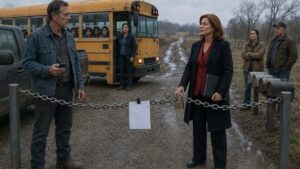
“You need to take those down.”
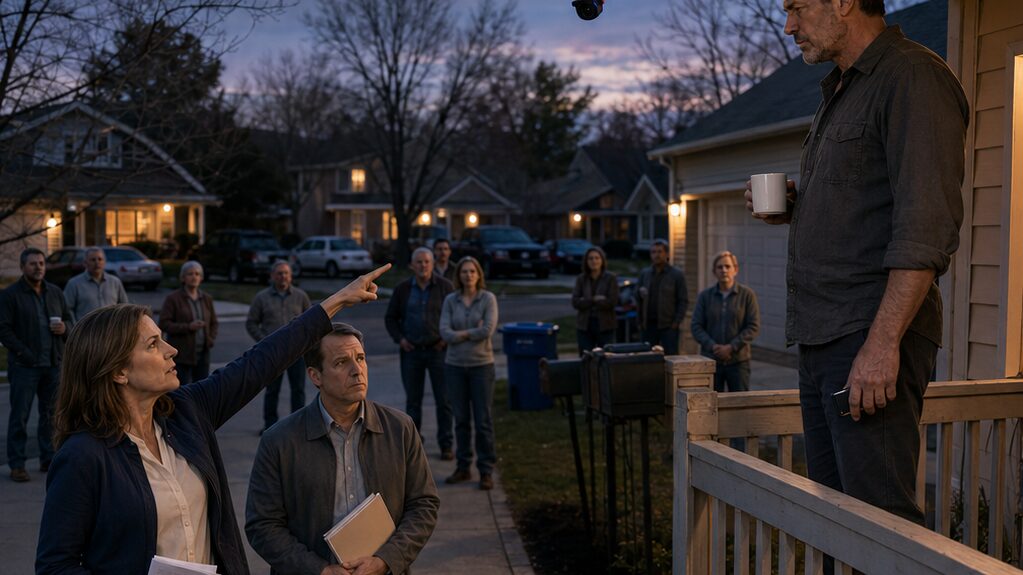
Virginia Davis stood at the edge of Robert Miller’s driveway with one arm raised toward the porch eaves, her index finger fixed on the line of red, blue, amber, and green bulbs above his head.
Robert looked up at them, then down at the white coffee mug in his hand.
“It’s March,” she added.
Across the street, a garage door had stopped halfway open. A man pretending to rearrange recycling bins was no longer pretending very well. Two houses down, someone paused beside a mailbox.
Robert took a sip.
“They’re not holiday lights.”
Virginia’s mouth tightened. She wore the navy jacket she favored for HOA business, though Robert knew there was no scheduled inspection that afternoon. Beside her stood the property manager with a folder tucked under one arm and the uncomfortable expression of a person who had expected an email exchange, not an audience.
Virginia folded her arms.
“Then why are they still up?”
Robert almost smiled.
That was the problem with the lights. In daylight they made his argument look ridiculous.
The bulbs were larger than ordinary patio lights and spaced under the eaves in a pattern only he understood at a glance. Amber near the driveway. Blue toward the side walk. Red above the porch corner. Green at the far end where the curb bent toward the mailbox cluster.
They looked cheerful.
He had never intended them to.
“They’re functional,” he said.
Virginia gave a short breath through her nose. “Colored bulbs are functional.”
“Yes.”
“For what?”
Robert set his mug on the porch rail.
He could have answered plainly. He knew that later, lying awake, he would replay the moment and understand exactly where pride had taken over.
Instead he said, “Visibility.”
The property manager shifted the folder. “Robert, the complaint describes seasonal decorative lighting maintained beyond the permitted period.”
“It’s not seasonal.”
Virginia pointed again. “You can keep saying that.”
Robert looked past her toward the street. The sun was low enough now to throw long shadows from the parked cars, though there was still plenty of daylight.
“Come here.”
Virginia did not move.
“I’m not stepping onto your property for a demonstration.”
“You already came for an inspection.”
“That isn’t what this is.”
The property manager cleared his throat. “Maybe we should just let him explain.”
Virginia’s eyes stayed on Robert.
“Fine.”
Robert took his phone from his pocket and opened the lighting controls. He had named the zones years ago in language nobody else would understand: Curb West. Walk. Drive Edge. Side Gate.
He tapped the first one.
The green bulbs went dark.
Nothing dramatic happened.
Virginia glanced at the property manager as if the demonstration had already failed.
Robert tapped another zone.
The amber lights above the garage clicked off.
Then the blue.
Then the red nearest the porch corner.
In daylight, the effect remained unimpressive.
Virginia shook her head. “This is exactly what I mean.”
Robert picked up his mug. “Come back at seven.”
“I’m not scheduling my evening around your Christmas lights.”
Something in him hardened.
“Then don’t.”
The property manager opened the folder.
Robert saw the paper before either of them spoke.
He knew the HOA logo at the top. He knew the spacing of the paragraphs and the bold heading used for notices. He had received enough minor letters over the years about bins, edging, contractor parking, and once a ladder left against his side wall for two days.
Virginia noticed his expression.
“This isn’t personal,” she said.
Robert laughed once.
She flinched at that, almost imperceptibly.
The property manager held out the notice. “The committee received multiple complaints.”
“How many?”
“I’m not discussing individual complainants.”
“So more than Virginia.”
Virginia’s face changed.
There it was, Robert thought. The small satisfaction of having found a weak spot.
He regretted it almost immediately.
She said, “You think I’m the only person tired of rules applying differently depending on who ignores them?”
“I think you decided what those lights were before asking.”
“I did ask.”
“You demanded.”
A car passed slowly behind her. Robert watched it roll through the bend near the mailboxes. He could see the camera housing under his porch roof, small and black against the trim.
Virginia followed his gaze.
“You keep calling them security lights,” she said. “Show me.”
Robert went still.
The property manager looked between them.
Robert could have shown them diagrams. He had old photographs. Coverage overlays. Time-stamped images from different months. He had saved more than he needed because deleting any of it felt like trusting darkness again.
Instead he picked up his phone.
“Seven o’clock,” he said.
Virginia’s jaw set.
At seven fourteen, she came back.
She did not come alone.
The property manager stood beside her. Joseph Anderson, the HOA treasurer, had walked down from the next block. Three other residents remained near the curb at distances that allowed them to claim coincidence.
Robert was waiting on the porch with the white mug.
The colored bulbs were on.
Now the difference was obvious.
The sidewalk in front of his house was not brightly flooded. It was layered. Soft amber reached the driveway edge. Green filled the shallow dip around the mailbox line. Blue light touched the side walk without shining into the neighboring windows. The porch camera faced outward across overlapping pools.
Virginia looked up.
Robert switched off the green zone.
A section of curb disappeared.
Not completely. There was still moonlight, a distant streetlamp, spill from a kitchen window. But the mailbox corner became a dark pocket.
He switched off the amber.
The driveway edge blurred into the lawn.
Then the blue.
A person walking from the side path toward the street would now pass through a strip of shadow between two camera views.
Joseph stepped closer.
“Turn the green back on.”
Robert did.
The mailbox line returned.
Joseph stared at it.
The property manager lowered his folder.
Virginia said nothing for several seconds.
Robert should have stopped there.
Instead he heard himself say, “Still think they’re decorations?”
Her eyes moved to him.
The question landed harder than he intended.
“I think,” Virginia said carefully, “that you installed exterior fixtures without approval and are now presenting your own system as if that exempts you from the process.”
“They close visibility gaps.”
“That wasn’t my question.”
Robert felt the old resistance rising.
He had spent years explaining lighting to people who cared about cost until something went wrong. He had stood in warehouses, parking structures, office corridors, loading yards, showing managers the exact place danger hid between what a camera could see and what they assumed it could see.
Virginia held out her hand.
The property manager passed her the paper.
“Did you submit an architectural request?”
Robert did not answer.
That was answer enough.
Joseph turned toward him. “Robert?”
“I discussed the first fixtures with the previous manager.”
“That isn’t what she asked.”
Robert looked at the dark camera housing.
Virginia unfolded the notice.
For the first time that day, there was no triumph in her face. Only firmness.
“Pending review,” she said, “the exterior lighting installation is to be shut off.”
Robert reached for the paper.
Then he saw the deadline.
Seventy-two hours.
His fingers tightened around the notice.
The white mug remained on the porch rail behind him, cooling under the colored lights.
Chapter 2: The Rule Virginia Could Not Afford to Bend
“Are you giving him special treatment?”
Virginia had not even removed her coat.
Three residents were waiting outside the HOA office when she arrived the next morning, and the first question struck before she had the key fully in the lock.
She turned.
The woman nearest her held a printed photograph of Robert’s house. The colored bulbs glowed beneath the eaves, exaggerated by the phone camera’s exposure.
“We were told seasonal lights had to come down in January,” the woman said.
“They are under review.”
“That means yes?”
“No. It means under review.”
A man behind her folded his arms. “Funny how review takes longer when someone knows the board.”
Virginia unlocked the door.
The words followed her inside.
Two months earlier, another homeowner had accused the architectural committee of favoritism after a fence application was denied while a similar fence on the opposite side of the development remained standing. The second fence predated the current covenant language. Virginia had explained that three times at a meeting.
Nobody remembered the explanation.
They remembered the accusation.
By ten that morning, six emails about Robert’s lights sat in the committee inbox.
Virginia read each one twice.
She disliked the satisfaction she felt when she found the same phrase repeated in different forms: rules are rules.
At noon, Joseph Anderson came into the office carrying a paper cup and no patience.
“You pushed the shutoff too fast.”
Virginia continued typing. “Good afternoon.”
“I’m serious.”
“So am I.”
Joseph set the cup down. “I saw the demonstration.”
“You also saw an unapproved installation.”
“I saw both.”
“That is the problem.”
“No, the problem is you’re acting as if checking what the system does means surrendering authority.”
Virginia stopped typing.
Joseph was in his late sixties and had spent most of his working life as an electrician. He had the irritating habit of studying an issue long enough to make certainty look immature.
She said, “Three residents were waiting at the door this morning.”
“Then tell them we’re inspecting it.”
“They don’t want another exception.”
“An inspection is not an exception.”
Virginia leaned back.
Through the office window she could see the community entrance, trimmed shrubs, the stone sign, the clean lines residents paid monthly dues to maintain. Nothing looked difficult from a distance.
“You know what happened with the fence,” she said.
Joseph’s expression softened slightly.
“That was different.”
“It did not feel different in the room.”
One resident had stood and asked whether committee members had private lists of friends whose violations did not count. Another had demanded Virginia resign.
She had driven home afterward and found Christine asleep on the sofa, shoes still on after an evening shift. Virginia had stood in the kitchen at midnight, looking at unpaid medical bills Christine had insisted she could handle herself and at HOA emails accusing Virginia of corruption over six feet of cedar fencing.
Order had become something she could still produce.
Maybe that was why she clung to it.
Joseph tapped the desk.
“Get Matthew to inspect the lights.”
Virginia looked at him.
“Before shutoff,” he said. “One hour. He checks fixture output, camera overlap, glare, wiring. Then we know what we’re talking about.”
“You already voted for temporary shutoff.”
“I voted based on the information we had.”
“And now?”
“Now I think we need more information.”
Virginia hated how reasonable he sounded.
That evening she stood at her kitchen window with the lights off behind her.
Across the street, Robert’s eaves glowed in bands of color.
From here, she could see why residents complained. The blue and green looked almost festive. Childish, even. Too noticeable for a neighborhood where people argued over mulch shades.
But she could also see the sidewalk.
A delivery driver walked from a van toward the wrong address, checked a phone, turned, and crossed near the mailboxes. For a moment the driver passed from amber into green and remained clearly visible.
Virginia frowned.
Christine came into the kitchen.
“You’re staring at Robert’s house again.”
“I am not staring.”
Christine opened the refrigerator.
Virginia said, “Do they bother you?”
“What?”
“The lights.”
Christine glanced through the window. “Not really.”
“They’re too bright.”
“Okay.”
“They’re unapproved.”
Christine took out a bottle of water. “Then I guess that’s your answer.”
The indifference irritated Virginia more than disagreement would have.
Her phone rang.
The property manager.
She answered.
Ten minutes later, she was back at the HOA office with Joseph on speaker and Robert standing across the conference table.
Robert had brought a folder.
For one hopeful second, Virginia thought he had found the approval.
He opened it.
Inside were product specifications, hand-drawn coverage notes, printed camera stills, and an architectural request form with only the first page completed.
Virginia touched it.
“This was never submitted.”
“I started it.”
“That is not the same thing.”
“The manager changed.”
“Three years ago.”
Robert’s mouth tightened.
Joseph’s voice came through the speaker. “Why didn’t you finish?”
Robert looked toward the window.
Virginia recognized the movement. It was the same way he had looked at the camera housing when she asked him to prove the system.
“I was adjusting it,” he said.
“For three years?” Virginia asked.
“I changed zones.”
“Brightness?”
“Yes.”
“Fixtures?”
“Some.”
“So the system you demonstrated yesterday isn’t even the system described here.”
Robert closed the folder.
“It works.”
Virginia felt something settle inside her.
Not satisfaction.
Certainty.
She had been afraid that dislike had distorted her judgment. Now his own paperwork gave shape to the concern. He had altered exterior fixtures repeatedly, without approval, then expected everyone else to trust his expertise because he said so.
Joseph asked, “Can we still have Matthew inspect tomorrow?”
Virginia looked at the unfinished form.
She imagined the three residents at the office door. The fence meeting. The accusation that rules bent for people with confidence and technical vocabulary.
“We already issued the notice.”
“That isn’t an answer.”
Robert said quietly, “Let him inspect.”
Virginia looked up.
There was something in Robert’s face she could not identify. Not fear exactly. Something closer to urgency.
It made her suspicious.
“If the system is what you say,” she said, “why didn’t you file it?”
Robert’s silence lasted too long.
Virginia closed the folder.
At the emergency committee call that night, Joseph moved for a technical review before enforcement.
Virginia voted no.
The second member followed her.
The motion failed.
Then Virginia read the temporary shutoff requirement into the record.
Across the street, less than an hour later, the colored lights went dark.
Chapter 3: Three Nights After the Street Went Dark
The sound that woke Robert was metal scraping against pavement.
He opened his eyes in darkness and did not move.
For half a second he was somewhere else.
Six years vanished.
The room changed.
A side gate. A camera feed. A shape leaving the frame.
Then someone shouted outside.
Robert was out of bed before he was fully awake.
He reached the front window and saw almost nothing.
The streetlamp at the corner threw a weak cone over the intersection. Porch lights glowed at scattered houses. But the stretch in front of Robert’s property had become what he had shown them during the demonstration: separate islands of visibility with black seams between them.
Another crash came from the curb.
Robert grabbed his phone and ran downstairs.
He opened the front door.
A figure moved near the mailboxes.
“Hey!”
The figure ran.
Robert stepped off the porch, then stopped.
He could hear shoes striking pavement, fast and irregular, but the runner crossed the dark strip near the driveway edge and seemed to disappear.
A second person might have been farther down the street.
Or a shadow.
Robert could not tell.
He hated that most of all.
By the time neighbors began turning on lights, the street looked different.
One mailbox lay flat in the road.
Another hung twisted from its post.
Letters and advertising flyers had scattered across the asphalt. A small parcel had split open beside the curb. Someone’s metal house-number plaque had been bent nearly in half.
A teen resident stood barefoot on a lawn, staring.
Virginia came out in a robe under a coat.
“What happened?”
Nobody answered immediately.
Robert looked up at his eaves.
The colored bulbs were dead.
He felt the first ugly flash of vindication.
There.
You wanted darkness.
There it was.
The thought lasted perhaps two seconds.
Then a night-shift neighbor crouched beside the broken parcel and said, “My medication was in this.”
Robert’s satisfaction collapsed.
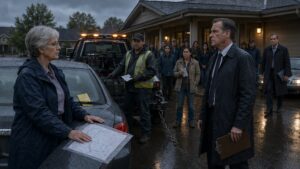
A police officer arrived twenty minutes later.
By then, residents had formed loose clusters. Questions moved faster than facts.
“Did anyone see a car?”
“How many people?”
“Was anything stolen?”
“Check Robert’s cameras.”
That last line came from somewhere behind him.
Several faces turned.
Virginia stood near her driveway, arms folded tightly against the cold.
Robert went inside.
His security monitor was already awake.
He pulled up the front camera.
2:13 a.m.
At first the image looked usable.
Then the motion began.
A blurred shape entered from the right side of the frame. The camera adjusted exposure. The figure crossed the sidewalk, but the green zone that normally filled the mailbox corner was off.
The face vanished into black.
Robert switched to the driveway camera.
The same person—or someone else—appeared for less than a second between two parked vehicles.
No face.
No clear clothing.
Only movement.
He tried the side camera.
Nothing.
Back to front.
Frame by frame.
At 2:14:07, a shoulder.
At 2:14:08, darkness.
At 2:14:10, the mailbox shook.
Robert leaned closer.
His reflection floated over the screen.
The police officer appeared in the doorway behind him.
“Anything?”
Robert did not turn.
“Not yet.”
The officer watched several seconds of footage.
“Can you brighten it?”
Robert almost laughed.
Digital brightness did not create information that had never reached the sensor.
He adjusted the image anyway.
Gray noise replaced black.
Nothing more.
Outside, Virginia was speaking to the property manager on the phone.
Robert could hear only fragments through the open door.
“—multiple boxes—”
“—yes, tonight—”
“—cameras should have—”
Robert shut off the audio feed.
He opened an older recording from four nights earlier, before the shutoff.
Same hour.
Same camera.
A neighbor walked past carrying grocery bags.
The person remained visible from the far curb through the green-lit mailbox area, into amber at the driveway edge, then blue near the side walk.
Robert placed the clips side by side.
Lit.
Unlit.
The difference was brutal.
He exported both.
His hand hovered over the email icon.
He addressed a message to the HOA board.
Subject: THIS IS WHAT I WARNED YOU ABOUT
He stopped.
Deleted the subject.
Typed again.
As demonstrated before the shutdown, removal of the supplemental lighting reduced usable illumination in—
He stopped.
Outside, a woman began crying softly over something taken from a damaged mailbox.
Robert closed his eyes.
The truth was that he had warned them.
The other truth was harder.
He had also let them believe the system was more complete than it was.
If the lighting had remained on, the cameras probably would have captured more.
Probably.
Not certainly.
He knew better than anyone that people used the word security as if it meant guarantee.
A knock sounded at the open door.
Joseph stood there in jeans and a plaid shirt.
“Show me.”
Robert did.
Joseph watched the lit clip once.
Then the dark clip twice.
He pointed at the screen.
“That section there.”
“Mailbox zone.”
“And there?”
“Drive edge.”
Joseph leaned closer. “Gone because the fixtures were off?”
“Yes.”
“All of it?”
“Most of the useful fill.”
Joseph straightened slowly.
Behind him, Virginia had crossed the street.
She did not come inside.
“Did the cameras get them?” she asked.
Robert looked at her.
The answer could have been a weapon.
He felt it sitting in his mouth.
No, because you turned off the lights.
Instead he said, “Not clearly.”
Virginia stared at the monitor through the doorway.
Joseph turned toward her.
“You need to see this.”
She did not move.
The police officer came back with a notepad. “We’ll need copies of whatever footage you have.”
Robert nodded.
He exported the files.
As dawn approached, the neighborhood emptied back into houses. Broken mailboxes remained tilted along the curb like missing teeth.
Robert sat alone at his kitchen table.
His white mug was in the sink from three days earlier. He had not used it since the shutoff.
He opened the email draft again.
The words waited.
I warned you.
He imagined sending them to every board member. Imagined the silence afterward. Imagined Virginia reading them.
His finger rested on the trackpad.
Then another memory rose before he could stop it: a camera feed six years earlier, a dark corner, a person leaving the frame, and Robert telling himself that if he had aimed one fixture differently, someone might not have ended the night bleeding on concrete.
He selected the entire draft.
Deleted it.
The blank email remained open while the first weak daylight reached the dead colored bulbs outside.
Chapter 4: The Meeting Where Nobody Was Completely Right
“Why didn’t your cameras catch them?”
Virginia did not raise her voice.
She did not need to.
The community room was full enough that Robert could hear people breathing between the rows of folding chairs. Printed photographs of the damaged mailboxes lay on the front table beside two still images from his cameras: one taken four nights before the shutoff, the other taken during the vandalism.
Virginia stood near the end of the table with both hands resting on a legal pad.
Her question was aimed at him.
Robert looked at the photographs instead.
The first showed the curb under green and amber light. A person walking past the mailboxes was visible from head to foot.
The second showed almost the same angle.
A dark smear crossed the frame.
“Robert?” the HOA president said.
He lifted his eyes.
Virginia’s face was composed, but he could see the strain around her mouth. She had been answering angry emails for six days. Two residents had threatened insurance claims against the association. Another had demanded reimbursement for a prescription shipment damaged in the street.
Still, the question irritated him.
“You saw the footage,” Robert said.
“I saw shadows.”
“Yes.”
“And we were told you had security cameras.”
A murmur moved through the room.
Robert leaned back in his chair.
There were several answers available to him.
One of them would make Virginia look foolish.
He had rehearsed it without meaning to.
Because the lights were removed.
He could already imagine the silence afterward.
Before he spoke, Joseph Anderson cleared his throat.
“The cameras didn’t lose power,” Joseph said.
Virginia turned toward him.
“No one said they did.”
“No. But that matters.”
Joseph rose slowly from the second row. He carried no notes.
He walked to the front table and tapped the brighter image with one finger.
“Cameras need usable light. Robert’s supplemental fixtures filled the weak areas between the porch, driveway, and curb.”
Then he tapped the dark image.
“When the fixtures were shut off, those areas went back to whatever ambient light happened to be available.”
Virginia said, “So the lights were necessary.”
Joseph looked at her.
“For that camera arrangement? Yes.”
The room became very still.
Robert felt every head turn toward Virginia.
She did not move.
The silence was exactly what he had imagined.
It gave him no satisfaction.
A man near the back said, “Then why did we shut them off?”
Another voice answered, “Ask the committee.”
The HOA president raised a hand. “Let’s keep this orderly.”
Virginia’s fingers tightened on the legal pad.
She looked at Joseph.
“You voted for the shutoff.”
“I did.”
That changed the room.
Joseph nodded once.
“I voted based on incomplete information.”
Virginia stared at him.
“And I regret not insisting on the inspection first.”
For a moment Robert saw something close to relief in her face. Not because Joseph had defended her. He had not. But because he had admitted responsibility before anyone forced him to.
Robert looked away.
The HOA president asked him to explain the lighting zones.
Robert stood and moved to the photographs.
He kept his voice technical.
“The green fixtures covered the mailbox corner. Amber filled the driveway edge. Blue reduced the dark strip along the side walk. None of them made the cameras better in themselves. They gave the sensors enough light to record detail.”
A homeowner lifted a hand.
“So if the lights had stayed on, we’d know who did it?”
Robert paused.
The honest answer was not the answer the room wanted.
“We might have had a better image.”
“Might?”
“Yes.”
Someone sighed sharply.
Robert continued. “Security lighting improves visibility. It doesn’t guarantee identification.”
Virginia looked at him then.
That small word—might—seemed to reach her more than anything else.
The property manager opened a folder.
“There is another issue we need to address.”
Robert knew before the first page was lifted.
Matthew Lewis sat near the side wall. He had arrived late in a work jacket with dust on one sleeve, carrying a tablet.
The HOA president nodded to him.
Matthew stood.
“I inspected the installation yesterday.”
A resident said, “After the damage?”
“Yes.”
Virginia asked, “Without committee approval?”
Joseph answered before Matthew could.
“I requested it.”
The room stirred again.
Matthew connected his tablet to the small monitor at the front.
A diagram appeared.
Robert recognized his house outline immediately.
Red marks showed fixture positions.
Yellow arcs showed camera fields.
Blue shading marked light spill.
Matthew pointed.
“The basic idea is sound.”
Robert felt his shoulders loosen despite himself.
Then Matthew changed slides.
“But the installation has problems.”
The looseness vanished.
“Two fixtures exceed the association’s brightness guidance at the property line. One camera angle relies too heavily on reflected light from the garage surface. The side zone creates a useful overlap, but there is still a blind section here.”
He pointed near the side gate.
Robert’s mouth went dry.
Matthew continued.
“Also, the current fixture arrangement does not match the partial architectural application in the file.”
Virginia looked at Robert.
The HOA president said, “Partial?”
The property manager slid a document onto the table.
Robert stared at his own handwriting.
The unfinished form.
A homeowner in the front row said, “You never got approval?”
Robert kept his eyes on the paper.
“I started the application.”
“That isn’t approval,” Virginia said.
Her voice was quiet.
This time, he had no reason to resent her.
Matthew enlarged another section of the diagram.
“There are also modifications that appear to have been made after the initial notes were prepared.”
“How many?” Joseph asked.
“Several.”
Robert said, “Because the coverage changed.”
Matthew looked at him.
“You adjusted based on observed gaps.”
“Yes.”
“Without documenting the changes.”
Robert did not answer.
A low murmur spread through the chairs.
The atmosphere had shifted again.
Ten minutes earlier, Virginia had stood exposed before the neighborhood.
Now Robert could feel the same attention turning toward him.
A homeowner asked, “So he ignored the rules too?”
Robert’s jaw tightened.
The HOA president said, “That is what we’re trying to establish.”
Virginia sat down.
For the first time all evening, she looked tired rather than defensive.
Robert understood the false shape the story had taken in people’s minds.
Virginia complained.
The lights went off.
The mailboxes were damaged.
Therefore Virginia was wrong, Robert was right, and the world was simple.
Matthew’s diagram had ruined that simplicity.
Good, Robert thought.
Then hated himself for thinking it.
The HOA president gathered the photographs into a stack.
“Robert, why didn’t you complete the application?”
“I was still refining the system.”
“For three years?”
“Yes.”
A few people exchanged looks.
The president said, “Why?”
Robert stared at the side-gate blind spot on the screen.
Matthew had marked it in yellow.
The same color as an old warning overlay from another camera, another night.
His pulse changed.
Virginia noticed.
“What is it?” she asked.
Robert said nothing.
The president leaned forward.
“Matthew mentioned that some of your adjustments appear unusually focused on eliminating dark transitions rather than simply lighting the property.”
Robert looked at him.
“That’s the point.”
“Why that point?”
No one moved.
The president glanced at an older note clipped behind the unfinished application.
Then back at Robert.
“What happened the first time a camera missed someone?”
Chapter 5: The Blind Corner Robert Never Spoke About
The old camera mount was exactly where Robert had left it.
He found it in a cardboard box beneath spare cable, a cracked switch plate, and two coils of wire he had been carrying from house to house for six years without ever using.
The metal bracket was bent.
One screw hole had torn wider than the others.
Robert sat on the garage floor with it in his hand.
He had told the meeting he needed time.
That was all.
The HOA president had not pressed him in front of everyone. Virginia had not asked again. Joseph had walked him to the door and said, “Whatever it is, don’t make us drag it out of you.”
Robert had nearly answered that no one had dragged anything out of him in years.
Now the old mount lay across his palm.
Six years earlier, the side gate had looked harmless on the monitor.
That was what he remembered most.
Not darkness.
Harmlessness.
He had installed a camera under the rear eave after a string of vehicle break-ins two blocks away. The camera covered the driveway and most of the side passage. Robert had checked the view himself.
Good enough, he had thought.
At 11:47 one night, a man crossed the far edge of the frame.
Only part of him appeared.
A sleeve.
A shoulder.
Then nothing.
Robert had been asleep.
Twenty-three minutes later, a neighbor walking home from a late shift encountered someone near the service road behind the houses. There was an argument. A fall. By the time another resident called for help, the person responsible was gone.
The neighbor recovered.
That fact had always made Robert feel worse when people told him not to blame himself.
Because recovery turned guilt into something everyone expected him to release.
He never did.
The police had asked for footage.
Robert had opened the recording.
There was the sleeve.
The shoulder.
The empty strip near the gate.
The camera had not failed.
He had.
At least that was how he remembered it.
Robert closed his hand around the bracket.
The sharp edge pressed into his palm.
The first colored bulb came three weeks later.
Amber.
A commercial surplus fixture he had modified and mounted near the side passage. It looked absurd beside the ordinary porch lights.
He did not care.
Then he added green near the curb.
Blue along the walk.
Red at the porch corner where exposure shifted too quickly between bright and dark.
He told himself each change was technical.
Measured.
Temporary.
He stopped telling himself that after the fifth revision.
At noon, he met Joseph at a diner off the highway.
Joseph arrived with no paperwork.
That made Robert more nervous than a folder would have.
They sat in a booth near the window.
Robert placed the old camera mount on the table.
Joseph stared at it.
“What am I looking at?”
“The first reason.”
Robert told him.
Not all at once.
The words came badly.
He explained the side camera. The partial figure. The later assault. The police request. The useless image.
Joseph listened without interrupting.
When Robert finished, a server refilled their coffee and walked away.
Joseph turned the bent bracket over.
“You think better lighting would have prevented what happened.”
“No.”
“Caught the person.”
“Maybe.”
“That isn’t what I asked.”
Robert looked out the window.
Cars moved along the frontage road.
“I think I should have seen the gap.”
Joseph sat back.
“You weren’t watching live.”
“I designed the coverage.”
“You installed a residential camera.”
“I knew better.”
“Did you?”
Robert looked at him.
Joseph’s expression was not soft.
That helped.
“You knew enough to believe you should have known better,” Joseph said. “Those are not always the same thing.”
Robert felt anger rise.
“You weren’t there.”
“No.”
“You didn’t watch that clip twenty times.”
“No.”
“You didn’t have the officer ask whether there was another angle when you knew there wasn’t.”
Joseph waited.
Robert looked down at the mount.
After a moment Joseph said, “So you made a promise.”
Robert laughed without humor.
“What promise?”
“No dark gaps.”
The words stopped him.
Joseph had said them plainly.
Robert had never said them aloud.
He remembered standing beneath the first amber bulb after installation, looking toward the side gate.
Not again.
That had been the promise.
Not safety.
Not perfection.
No dark gaps.
“I kept adjusting,” Robert said.
“I know.”
“I could see something every time.”
“I know.”
“Reflection. Exposure. A vehicle blocking the wash. Seasonal foliage.”
“And every time you changed it, you told yourself the application wasn’t ready.”
Robert stared at him.
Joseph pushed the bracket back across the table.
“That’s not the same as lying about the purpose.”
“No.”
“But you let people assume the system was professionally complete.”
Robert said nothing.
Joseph’s eyes stayed on him.
“You let us think the only problem was Virginia.”
The anger drained away.
That was the part Robert had avoided.
Not the missing form.
Not the brightness guidance.
He had watched the room turn against Virginia and felt, for one dangerous moment, that consequences had finally chosen the correct address.
He had known better.
That evening Robert returned home and opened the old footage.
He had not watched it in more than a year.
The image was grainier than memory.
The figure entered at 11:47:13.
A sleeve.
A shoulder.
Gone.
Robert paused the frame.
Then he did something he had never done before.
He let it continue.
At 11:48, nothing.
11:51, nothing.
12:03, a cat crossed the driveway.
He had built six years of private ritual around less than one second of incomplete information.
The incident was real.
His failure was real.
But the straight line he had drawn between them had always contained uncertainty.
That did not free him.
It changed the shape of the burden.
Robert opened a blank document.
He began typing.
Original installation date.
Fixture modifications.
Unsubmitted application.
Camera limitations.
Prior incident motivating changes.
He stopped at the last line.
Then continued.
I allowed residents and board members to believe the current system had completed professional review. It had not.
His hands hovered over the keyboard.
A knock came at the door.
Virginia stood outside.
For one second he thought she had come to argue.
She looked past him toward the dark bulbs.
“I heard you left the meeting because of an old incident.”
Robert’s face closed.
Virginia noticed.
“I’m not asking for details.”
“Then why are you here?”
She looked toward the curb.
“I wanted to know whether the lighting can be restored temporarily without restoring all of it.”
Robert stared at her.
“Why?”
Virginia’s expression shifted.
“Forget it.”
She turned.
Robert almost let her leave.
Then he said, “Yes.”
She stopped.
“A reduced pattern could cover the worst gaps.”
“Could?”
“Yes.”
She faced him again.
Neither mentioned the word guarantee.
Virginia nodded once and walked away.
Robert watched her cross the dark section between houses.
Then he returned to the document.
At the bottom, beneath the admission he had resisted for years, he typed one final sentence.
I will present this at the next board session.
Chapter 6: Virginia Heard the Fear Behind Her Own Front Door
Christine’s car had been in the driveway for eleven minutes.
Virginia knew because she had checked the kitchen clock twice.
The headlights were off.
The engine was off.
Christine remained behind the wheel.
Virginia stood at the front window and watched her daughter’s face illuminated by the pale rectangle of a phone.
At first she assumed Christine was finishing a message.
Then another car turned onto the street.
Christine looked up immediately.
Her whole posture changed.
She waited until the vehicle slowed near a neighboring house and a man stepped out carrying a work bag.
Only then did she open her own door.
Virginia was outside before Christine reached the sidewalk.
“What are you doing?”
Christine stopped.
“What?”
“You’ve been sitting there.”
“I was checking something.”
“For eleven minutes?”
Christine looked toward the house.
“I’m tired, Mom.”
Virginia followed her gaze.
Across the street, Robert’s colored bulbs hung dark beneath the eaves.
“Are you afraid to walk from the driveway?”
Christine’s expression hardened.
“No.”
“You waited for that man to get out of his car.”
“I didn’t wait for him.”
“I watched you.”
“Then why ask?”
The answer struck cleanly.
Virginia folded her arms.
Christine walked past her toward the porch.
“Christine.”
Her daughter stopped with one hand on the railing.
Virginia lowered her voice.
“How long?”
Christine looked back.
The irritation left her face first.
That was worse.
“A few nights.”
Virginia said nothing.
Christine sat on the porch step.
“I get home late. It’s darker now.”
“There are streetlights.”
“One at the corner.”
“You have your phone.”
Christine gave her a tired look.
Virginia heard herself and hated the sentence even before it finished existing between them.
Christine rubbed both hands over her face.
“I didn’t tell you because you’d turn it into a project.”
Virginia went still.
“That is unfair.”
“Is it?”
“I’m your mother.”
“Exactly.”
The word was not cruel.
It was exhausted.
Christine looked toward the mailbox line.
“Before, I could see the whole stretch from the curb to the house. I never thought about it. Now there’s that dark section by Robert’s driveway, and after what happened to the mailboxes…”
She stopped.
Virginia sat beside her.
“You thought someone might be there.”
“I knew probably nobody was.”
“Probably.”
Christine nodded.
The word stayed with Virginia.
Probably.
Robert had used the same kind of language when asked whether his lights would have identified the vandals.
Might.
Could.
Not guarantee.
Virginia had resented uncertainty when it came from him because rules felt cleaner.
Now uncertainty sat beside her wearing hospital scrubs under a jacket, too tired to pretend she was not afraid.
Christine said, “Sometimes I wait for another car. Or I call someone while I walk.”
“Why didn’t you tell me?”
“I just did.”
“No. Before.”
Christine looked down.
“Because you’ve already got enough to manage.”
Virginia almost corrected her.
Instead she looked at her own front door.
Enough to manage.
The phrase had followed her for years.
Bills.
Meetings.
Christine’s return home.
Committee complaints.
Residents who believed every exception was corruption and every denial was personal.
Virginia had told herself that order was kindness because disorder always seemed to arrive carrying a cost.
She saw now how easily fear could dress itself in respectable clothes.
A policy.
A deadline.
A vote.
Joseph’s request for inspection returned to her with painful clarity.
One hour, he had said.
Get Matthew to inspect it.
She had refused.
Not because inspection was unreasonable.
Because delay looked like weakness.
Virginia stood.
Christine looked up.
“Where are you going?”
“Inside.”
“That sounded ominous.”
Despite herself, Virginia almost smiled.
At the kitchen table she opened her laptop.
The HOA portal loaded.
She found the emergency committee record.
Joseph Anderson: motion for technical inspection before shutoff.
Vote: failed.
Virginia stared at her own name beside “No.”
Then she opened the email archive.
There it was.
Joseph’s earlier message, sent before the vote.
Recommend temporary hold on enforcement pending contractor review of functional safety claim.
Virginia had read it.
She had not forwarded it to the full board until after the shutoff.
Her throat tightened.
She opened a new message.
To the HOA president. Joseph. Property manager. Committee members.
Subject: Request for Immediate Temporary Lighting Review
She typed:
In light of the recent property damage and confirmed visibility reduction—
Stopped.
Deleted “confirmed.”
Typed again.
In light of the recent property damage, preliminary technical findings, and resident safety concerns, I am requesting an emergency vote to permit a reduced temporary lighting configuration pending full review.
Virginia read it twice.
Then added:
I also believe my decision to proceed without the recommended inspection should be included in the record.
Her finger hovered over Send.
She thought of Robert at his door earlier, asking why she wanted temporary lights restored.
She had almost walked away rather than answer.
Pride, she realized, did not always look like a man refusing to finish an application.
Sometimes it wore a navy jacket and called itself consistency.
Virginia pressed Send.
The message left before Robert had confessed anything to the board.
Chapter 7: Robert Refused the Victory Everyone Offered Him
Virginia asked for the lights back before Robert had even opened his folder.
The community room reacted in fragments.
A chair creaked.
Someone whispered, “What?”
The HOA president looked down at the agenda as if the request might be written there in smaller print.
Virginia sat straight-backed at the end of the table, both hands folded over a yellow legal pad.
“I’m requesting temporary authorization for a reduced lighting configuration,” she said. “Pending full technical review.”
A homeowner near the aisle gave a short laugh.
“So now we need them.”
Virginia looked toward the voice.
“I said temporary authorization.”
“After you had them shut off.”
“Yes.”
The answer landed harder than a defense would have.
Robert stood near the wall with the folder under one arm and a single amber bulb in his coat pocket. He had brought the bulb because he had not known what else to do with his hands.
He had expected anger.
Possibly satisfaction.
He had not expected Virginia to move first.
Joseph glanced at Robert, then back at her.
“When did you decide this?”
“Before tonight.”
“Before Robert’s statement?”
“Yes.”
The room shifted again.
Robert saw it happening: the story trying to simplify itself.
Virginia had reversed course.
Robert had warned everyone.
The mailboxes had been damaged.
Therefore the board should restore the old system and let consequences declare a winner.
The HOA president said, “Given recent events, I think we should hear Robert’s presentation and then consider an emergency motion.”
A resident raised a hand.
“What presentation? We already know the lights worked.”
Robert stepped forward.
“No.”
Heads turned.
He placed the folder on the table.
“We know they helped.”
The resident frowned. “Same difference.”
“It isn’t.”
Virginia watched him closely.
Robert opened the folder.
The first page was the statement he had written after the diner. Behind it were diagrams, modification dates, fixture specifications, screenshots, and the unfinished architectural application.
He could feel the old instinct rising.
Explain only what is necessary.
Keep control.
Give them enough to stop interfering.
He took the amber bulb from his pocket and set it beside the papers.
It rolled half an inch before stopping against Virginia’s legal pad.
“This was the first one,” Robert said.
No one spoke.
“I installed it six years ago after a camera on my property failed to capture a usable image of someone moving through a side passage.”
The HOA president leaned forward.
Robert continued.
“The person later encountered a neighbor near the service road. The neighbor was injured.”
A woman in the second row inhaled quietly.
Robert kept his eyes on the table.
“The camera didn’t fail electronically. It recorded what was in front of it. The problem was the coverage. The person crossed the edge of the frame and disappeared into a dark section.”
Joseph did not move.
Virginia looked at the amber bulb.
Robert said, “I believed better coverage might have produced a usable image.”
“Might?” someone asked.
“Yes.”
The word cost him less this time.
“I don’t know whether it would have changed what happened.”
He turned one page.
“The first amber fixture was installed after that. Then I added other zones. Green near the curb. Blue along the side walk. Red at the porch transition.”
A homeowner said, “Which is what you told us.”
“Part of it.”
Robert looked up.
“I did not complete the architectural process.”
Several people shifted.
“I changed fixtures after the original notes were prepared. I adjusted brightness. I moved coverage. I did not submit each revision.”
The property manager watched him without expression.
Robert went on.
“I also let people believe the system had completed professional review.”
Virginia’s eyes lifted.
“It had not.”
The room was silent now for a different reason.
A man near the back said, “So you misled us.”
Robert felt the accusation enter cleanly.
“Yes.”
Virginia turned toward him.
Robert did not soften it.
“I told the truth when I said the lights served a security purpose. I did not tell the whole truth about how informal the system had become.”
Someone muttered, “Unbelievable.”
Another person said, “Then why are we even here?”
Joseph stood.
“Because two things can be true.”
The HOA president raised a hand, but Joseph continued.
“The shutoff reduced usable visibility. Robert also bypassed procedure.”
Virginia said, “And I pushed the shutoff before the requested inspection.”
The room reacted again.
Robert looked at her.
She did not look away.
A homeowner in the front row said, “Great. So everybody messed up and we’re supposed to pay for it.”
That was the first honest sentence of the night, Robert thought.
The HOA president rubbed his forehead.
“We need a practical path forward.”
A resident pointed toward Robert. “Turn his lights back on.”
Another voice said, “Not if they violate the guidelines.”
“Then change the guidelines.”
“For one house?”
The argument began to spread.
Robert listened for perhaps twenty seconds.
Then he picked up the amber bulb.
“No.”
The room quieted unevenly.
He held the bulb at chest height.
“I don’t want the old system restored as-is.”
Virginia frowned.
A homeowner said, “You’ve been fighting to keep it.”
“I’ve been fighting to keep the dark gaps covered.”
“That is the same thing.”
“It isn’t.”
Robert placed the bulb down again.
“The old system depends too much on one property. Mine. It has undocumented changes. Some fixtures are too bright at the property line. One camera angle relies on reflected light. Matthew found a blind section I kept telling myself I had solved.”
Matthew, seated near the wall, gave a small nod.
Robert opened the final section of his folder.
“I drew an alternative.”
The HOA president stared at him.
“You already redesigned it?”
“Drafted.”
Robert turned the diagram around.
The plan used fewer colored fixtures at his house. Two neutral low-glare lights would be added near shared curb areas, subject to approval. Camera angles would be reassessed. Fixture output would be documented. Temporary lights would cover only the worst gaps while review continued.
Joseph stepped closer.
“Who controls it?”
Robert answered immediately.
“Not me alone.”
That was the sentence he had feared most.
The property manager asked, “What does that mean?”
“It means the final configuration is documented. Approved. Service access is shared through the association’s contractor. Changes require review.”
Matthew leaned over the plan.
“You’re giving up local control of the shared zones.”
“Yes.”
Robert heard the word as if someone else had spoken it.
Virginia studied him.
The HOA president said, “Why?”
Robert looked at the amber bulb.
Because I was wrong.
Because I was right.
Because neither had protected anyone enough.
He chose the simplest answer.
“Because I don’t trust myself to keep calling every change temporary.”
No one laughed.
Virginia’s face altered almost imperceptibly.
The man in the back who had accused Robert of misleading them folded his arms.
“And we’re supposed to trust this now?”
Robert nodded toward the plan.
“No. You’re supposed to inspect it.”
Joseph picked up the first page.
Matthew began tracing the proposed zones with one finger.
The property manager asked for a copy.
For the next forty minutes, no one won.
They argued over cost.
Brightness.
Liability.
Temporary power.
Whether the mailbox area counted as shared infrastructure.
Virginia objected to one fixture location because it would spill into a bedroom window. Robert agreed after checking the angle.
Joseph rejected a cheaper option because its output curve was inconsistent.
Matthew said the installation schedule was unrealistic.
Robert revised it.
At the end, the HOA president looked around the room.
“This requires both a temporary authorization and a full architectural submission.”
Robert said, “I’ll submit it.”
Virginia asked, “Complete this time?”
A few people looked at her, waiting for sharpness.
Robert almost smiled.
“Yes.”
She nodded.
The president gathered the papers.
“Then we have a proposal.”
Robert picked up the amber bulb.
For six years, he had treated every dark gap as a private failure.
Now the plan on the table required signatures other than his own.
He should have felt exposed.
Instead, for the first time in years, the burden had edges.
Chapter 8: The First Light Came Back Without Belonging to One Man
Virginia arrived before dawn carrying a signed approval packet in a clear plastic sleeve.
Robert saw her from the porch.
For one confused moment, he thought something had gone wrong.
Then she held up the packet.
“You’re awake.”
Robert looked at the white mug in his hand.
“So are you.”
“I had the final signature at five forty-two.”
“That sounds healthy.”
Virginia ignored the comment and walked up the driveway.
Six weeks had passed since the board meeting.
The temporary configuration had gone in first: two reduced zones at Robert’s house, one low-glare neutral fixture near the shared curb, and a contractor-adjusted camera angle that no longer depended on the garage reflection.
Nothing about it was dramatic.
That had surprised people.
The street did not glow.
There was no theatrical flood of brightness.
There were simply fewer places where a person vanished between one pool of light and the next.
The vandalism had not repeated.
Robert refused to claim that meant anything.
Virginia handed him the packet.
“Permanent installation approved.”
He opened it.
Every page was there.
Fixture specifications.
Output limits.
Control responsibility.
Maintenance schedule.
Change procedure.
Four signatures.
Robert ran his thumb along the edge.
Virginia said, “You could look happier.”
“I’m checking whether you hid another seventy-two-hour deadline.”
“I considered it.”
He glanced at her.
She almost smiled.
Across the street, Christine’s car turned into the neighborhood.
Both of them looked.
The hour was early enough that most houses remained dark.
Christine parked in Virginia’s driveway.
For a moment she stayed seated.
Robert felt Virginia become still beside him.
Then Christine opened the door.
No waiting.
No phone held up like a shield.
She stepped out, slung a bag over one shoulder, and walked from the driveway toward the house.
At the curb, the neutral shared fixture gave enough light to show the edge of the pavement.
Near Robert’s property, a reduced amber zone filled the old dark transition without spilling into the bedroom windows.
Christine crossed the stretch and climbed the porch steps.
She looked toward them.
“You two are being weird.”
Virginia said, “Good morning to you too.”
Christine disappeared inside.
Robert stared at the empty sidewalk.
The small payoff was almost embarrassingly ordinary.
A woman got out of a car and walked into her house.
Nothing happened.
That was the point.
By eight, Matthew arrived with the final fixtures.
Joseph came ten minutes later carrying coffee and an opinion about every mounting height.
The work took most of the morning.
Robert helped but did not direct everything.
That was harder than he expected.
When Matthew shifted one fixture six inches lower, Robert opened his mouth.
Stopped.
Checked the approved drawing.
The drawing supported Matthew.
Joseph noticed.
“Painful?”
“Deeply.”
“Good.”
The new system used fewer colored bulbs.
The green near the mailbox corner was gone, replaced by a neutral shared fixture with controlled output. The blue side zone remained but at lower intensity. Red disappeared entirely.
One amber bulb stayed near the driveway transition.
Not the original.
A newer approved fixture.
Still amber.
Virginia stood at the curb during the final test with a copy of the switch schedule.
Matthew activated each zone separately.
Robert watched the familiar shadows move.
This time there were measurements.
Recorded values.
Names beside responsibilities.
A maintenance interval.
Nothing depended on his memory.
Nothing depended on someone believing him because he spoke confidently.
The property manager signed the completion sheet.
Joseph checked the curb once more.
Virginia asked, “What happens if that one fails?”
She pointed to the shared neutral fixture.
Matthew answered, “The adjacent zones still provide partial coverage.”
“Partial.”
Robert looked at her.
Virginia caught the word too.
She nodded.
“Fine.”
By late afternoon, the equipment cases were gone.
The street returned to itself.
Robert sat on the porch with the white mug.
He had started using it again during the second week of temporary lighting. At first the habit felt artificial, as if he were trying to recreate the man who had stood there before the complaint.
Eventually it was just a mug.
Virginia crossed the street carrying the switch schedule.
Robert raised an eyebrow.
“You know you’re allowed to email.”
“I wanted to ask something.”
“That sounds dangerous.”
She stood below the porch.
For several seconds, she looked up at the eaves.
The reduced pattern was almost invisible in daylight.
“Could one amber light remain by the mailbox corner?”
Robert followed her gaze.
“That corner is covered by the neutral fixture.”
“I know.”
“Then why?”
Virginia hesitated.
He waited.
“It looked less harsh.”
Robert said nothing.
She added, “And Christine said she liked it.”
There it was.
Not an apology.
Not a confession.
Not a speech about lessons learned.
A request.
Robert looked at the schedule in her hand.
“The approved plan allows one secondary low-output zone if it stays within the measured limit.”
Virginia held out the paper.
“So?”
Robert took it.
Then handed it back.
“You keep this copy.”
She frowned.
“I already have one.”
“That’s the live schedule.”
Virginia looked down.
The page included the control sequence, maintenance contact, override procedure, and test intervals.
She looked up.
“You’re giving me the switch schedule.”
“I’m giving the committee chair the switch schedule.”
“That sounds less generous.”
“It is.”
Virginia laughed once.
The sound surprised both of them.
Robert lifted his mug.
“Amber can stay if Matthew verifies the output.”
“I already asked him.”
Robert stared at her.
Virginia’s expression became almost defensive.
“What?”
“Nothing.”
“You think I’m controlling.”
“I didn’t say that.”
“You were going to.”
Robert took a drink.
Across the street, Christine opened the front door and called for Virginia.
Virginia turned.
Before leaving, she looked once more toward the mailbox corner.
“Robert.”
He waited.
“I should have let Joseph inspect first.”
The sentence was quiet.
Robert could have answered with his own list.
You should have listened.
You should have asked.
You should have believed me.
Instead he said, “I should have filed the application.”
Virginia nodded.
It was not forgiveness.
It was enough truth to stand on.
That evening, the approved lights came on automatically.
Neutral light reached the shared curb.
Blue softened the side walk.
Amber filled the transition near the mailbox corner.
Robert stood behind the porch rail with the white mug warming his hand.
Across the street, Virginia stepped outside and checked the schedule once, then folded it and put it in her pocket.
The amber light did not belong to Robert anymore.
For the first time, that did not feel like losing it.
The story has ended.