The Neighbor Who Reported My Backyard Smoke Never Asked What the Grill Was For
Chapter 1: The Third Saturday Pamela Finally Called It In
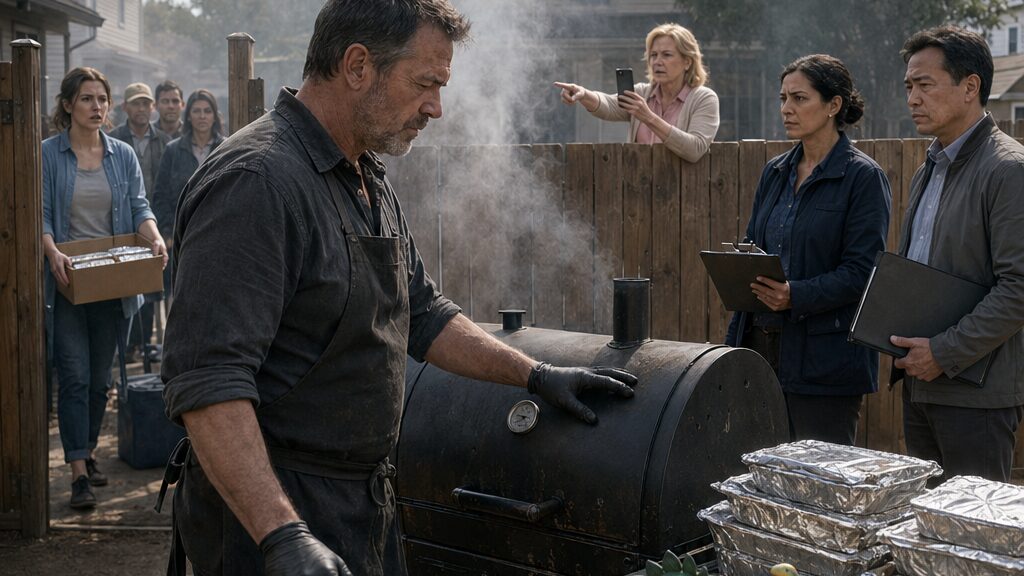
Pamela Hall’s finger appeared above the fence before Richard Carter saw her face.
“You need to put that out.”
Smoke rolled past her hand in a gray sheet, crossed the narrow strip of lawn between their houses, and curled over the edge of her patio umbrella. Richard stood beside the black barrel grill with one gloved hand on the lid.
He lowered it.
The metal came down with a heavy clank.
“There,” he said.
Pamela leaned farther over the cedar fence. Her blonde hair was pulled back, and she wore the same expression she had worn the previous Saturday: not anger exactly, but the exhausted certainty of someone who believed patience had already been wasted.
“That doesn’t make the smoke disappear.”
“No.”
“This is the third weekend.”
“I know what weekend it is.”
Her eyes narrowed. “That’s not what I said.”
Richard turned the vent a quarter inch. The smoke thinned, then thickened again as fat hissed onto the coals beneath the grate. He had been awake since five. Twenty-four pounds of chicken thighs had gone on first, then onions, peppers, and two trays of burgers. The work should have felt familiar. Once, years ago, he had spent twelve-hour shifts in a restaurant kitchen where six burners screamed at once and nobody asked whether smoke was personal.
Now every curl of it seemed to have a witness.
Pamela pointed toward her patio table. “I had to take the cushions inside.”
Richard looked. Two pale cushions remained exactly where they had been.
He said nothing.
That was usually where things went wrong.
“You could at least answer me.”
“I heard you.”
“You always hear me. Then you do whatever you want.”
The grill thermometer was dropping. Richard lifted the lid two inches, checked the meat, and shut it again before Pamela could see more than a flash of foil.
Her head tilted.
“What are you cooking?”
“Lunch.”
“For an army?”
He reached for the long-handled tongs.
“Richard.”
He hated the way she said his name when she wanted an explanation. It sounded like a summons.
“Burgers,” he said.
“That is not just burgers.”
A sedan slowed at the curb beyond his side gate.
Richard saw it through the narrow gap between fence boards.
Too early.
He checked the cheap wall clock mounted beneath the patio roof. Eleven seventeen.
Pamela followed his gaze.
The sedan stopped.
“Who’s that?”
“Someone picking something up.”
She gave a short laugh without humor. “Of course.”
Richard removed the glove from his right hand and walked toward the side table. Eight foil meal trays sat in two neat stacks beneath insulated covers. Each tray had a strip of masking tape across the lid. No names. Only numbers.
A driver came through the side gate carrying two thermal delivery bags.
“Morning,” the driver said.
Richard nodded. “You’re early.”
“Counselor asked if we could move the first route up.”
Pamela went silent.
Richard felt it before he looked at her.
The driver began loading trays.
One.
Two.
Three.
By the fourth, Pamela had moved from the fence to the side of her house where she could see through the open gate.
“Are you selling food?”
Richard’s jaw tightened.
The driver glanced between them.
“No,” Richard said.
Pamela folded her arms. “Then why is someone taking eight prepared meals out of your backyard?”
“They’re spoken for.”
“That is not an answer.”
“It’s the answer I’m giving.”
The driver stopped with one tray halfway into the bag.
Richard regretted the sentence as soon as it left him, but not enough to replace it.
Pamela looked at the driver. “Are you paying him?”
The driver’s face changed.
Richard stepped between them.
“Don’t.”
“I asked a question.”
“Not yours to ask.”
“It becomes my business when smoke from an unapproved operation crosses onto my property.”
“Operation.”
“Yes, Richard. Operation.”
He could have ended it then.
He could have said school hardship fund.
He could have said donated groceries.
He could have said no money changes hands.
He could have said the families were never told who cooked the meals and he wanted it that way.
Instead he looked at the fence, the smoke, Pamela’s phone now visible in her hand, and felt the old resistance rise in him like a locked door.
People heard charity and changed their faces.
They softened their voices.
They asked who had started it.
They asked why.
He had no intention of answering why.
“Call it what you want,” he said.
Pamela stared at him.
Then she unlocked her phone.
“Fine.”
The driver whispered, “Richard, maybe just tell her—”
“No.”
Pamela tapped the screen.
“Who are you calling?” Richard asked, though he already knew.
“The HOA office first.”
“On Saturday?”
“The emergency line exists for ongoing violations.”
He almost laughed. “Smoke is an emergency now?”
Her expression sharpened. “You don’t get to decide what affects other people.”
That landed harder than he wanted it to.
For a second, his hand stopped on the grill lid.
Pamela turned away and began speaking into the phone.
“Yes, this is Pamela Hall. I’m on the architectural-compliance committee. I need to report recurring nuisance smoke and what appears to be unapproved commercial food activity from a residential lot.”
Richard looked at her.
Commercial.
The word moved through him colder than anger.
The driver zipped the bags shut. “I can take these and go.”
“Go.”
“What about the second route?”
Richard looked toward the covered trays still waiting on the table.
“I’ll handle it.”
The sedan pulled away five minutes later with eight meals.
Pamela remained on the phone.
Richard returned to the grill. He lifted the lid just enough to check the next batch.
Smoke pushed out around his wrists.
He shut it again.
By noon, two neighbors had walked slowly past the house. One pretended to check a mailbox. Another paused with a dog that had never before shown interest in Richard’s driveway.
At twelve thirty-eight, a patrol car rolled down the street.
It did not stop.
Richard told himself that mattered.
At one fifteen, Pamela’s patio was empty.
At two, he packed the remaining meals himself and drove them in three separate trips because he refused to give anyone a reason to photograph a line of cars outside his house.
When he returned from the final delivery, the grill was cold.
He stood beside it with the lid closed and noticed a faint black smear on the top handle where his glove had left grease.
His phone buzzed.
He almost ignored it.
The message was from the community association portal.
NOTICE OF EMERGENCY COMPLIANCE INSPECTION.
Richard opened it.
The sender was Jason Lee, community manager.
The notice cited repeated nuisance complaints, possible unauthorized business activity, increased vehicle traffic, and a concern involving “organized food preparation and distribution from a residential property.”
Inspection scheduled: the following Saturday, 10:00 a.m.
Richard read the last line twice.
Failure to provide reasonable access may result in immediate referral to the board for enforcement action.
Behind him, across the fence, Pamela’s back door opened.
He locked his phone, placed one hand on the cold grill lid, and understood that whatever he had been keeping inside his yard was no longer going to stay there.
Chapter 2: The Inspection That Changed the Meaning of the Smoke
Amy Sanchez arrived while Pamela was filming the smoke.
Richard saw the phone first.
Pamela stood on her patio with both hands around it, slowly panning from the gray plume above his fence to the line of foil trays beneath his covered patio.
“Make sure you get the propane tank too,” Jason Lee said from Richard’s side gate.
Richard turned.
Jason stood beside a woman in a navy field jacket carrying a clipboard and a small inspection bag. She was in her forties, dark hair pulled back, expression unreadable.
“Amy Sanchez,” she said. “Municipal fire and community risk.”
Richard wiped his hands on his apron.
“You’re early.”
“Three minutes.”
Behind the fence, Pamela said, “The smoke was heavier ten minutes ago.”
Amy looked at her.
“I’ll inspect what’s present.”
Pamela lowered the phone by an inch.
Jason cleared his throat. “Richard, as the notice explained, we’re here because the association received repeated complaints about nuisance smoke and possible commercial activity.”
“There’s no commercial activity.”
“That’s what we need to establish.”
“You could have asked.”
Jason’s eyebrows lifted slightly. “We did.”
Richard had no answer that did not make him sound exactly like the man Jason thought he was.
Amy stepped toward the grill.
“Before I open anything, what fuel?”
“Propane under the flat top. Charcoal in the barrel.”
“Distance from structure?”
“Eleven feet from the house.”
“Fence?”
Richard glanced toward Pamela.
“Just under eight.”
Amy looked down at the paving stones, then at the cedar fence. “That may matter.”
Pamela spoke immediately. “I told him.”
Richard turned.
“You told me smoke bothered you.”
“I told you it was unsafe.”
“No. You didn’t.”
Jason raised a hand. “We’re not doing that yet.”
Amy set down her bag. “Mr. Carter, open the flat top.”
Richard did.
Burgers sizzled in two rows.
Nothing dramatic.
Nothing hidden.
Pamela’s mouth tightened.
Amy checked the surface, the grease channel, the extinguisher hanging from a patio post, then moved toward the barrel grill.
“Open this one.”
Richard’s hand stopped on the handle.
It was a small hesitation.
Amy noticed.
So did Pamela.
“There,” Pamela said. “That.”
Richard looked at her.
“That is exactly what I mean. Every time anyone asks what he’s doing, he closes it.”
Amy’s voice stayed level. “Mr. Carter.”
Richard lifted the lid.
A burst of smoke rolled upward.
Jason stepped back.
Pamela coughed theatrically from the other side of the fence.
Then the smoke cleared.
Amy leaned closer.
Beside two shallow foil pans of chicken sat a row of brightly colored plastic markers clipped to the edge of separate trays—green, blue, yellow, red. Each one was shaped like a small dinosaur.
Amy stared at them.
Jason frowned. “What are those?”
“Markers.”
“For?”
Richard picked up the green one.
“No dairy.”
The blue.
“No nuts.”
The yellow.
“Low sodium.”
Pamela’s phone dipped.
Amy looked from the dinosaurs to the labels on the waiting trays.
“Why dinosaurs?”
Richard shrugged. “Kids remember them.”
A voice came from the side gate.
“And because plain stickers kept falling off.”
Emily Carter entered carrying a cardboard case of compostable containers. She stopped when she saw Pamela, Jason, and Amy.
Her face changed.
Richard felt his stomach tighten.
Emily set the box down slowly.
Jason looked at her. “You’re part of this?”
“Part of what?”
“The food distribution.”
She glanced at Richard.
That glance lasted half a second too long.
Pamela saw it.
“This is what I’ve been trying to tell everyone,” she said. “There are people coming and going every weekend. Food is being packaged. He won’t say where it goes. He has ignored three warnings.”
“One warning,” Richard said.
“Three conversations.”
“That is not the same thing.”
Amy lifted one of the sealed trays and read the masking-tape number.
“Who receives these?”
Richard’s voice hardened.
“I’m not giving out names.”
“I didn’t ask for names. I asked who receives them.”
“Families.”
“What families?”
He said nothing.
Pamela gave a small, vindicated shake of her head.
Amy set the tray down.
“Mr. Carter, I’m trying to determine whether this is commercial food preparation, a private event, or an organized distribution activity. Those categories have different concerns.”
Emily spoke before Richard could stop her.
“They go through the elementary-school hardship fund.”
Silence settled over the yard.
Even Pamela stopped moving.
Jason turned to Emily. “The school?”
“A counselor coordinates pickup routes. Some families are between housing. Some lost work. Some just need a week where groceries stretch.”
Richard stared at his daughter.
Emily met his eyes.
“I’m not naming anyone.”
Pamela looked at the trays again.
Her expression did not soften, exactly. But certainty left it.
Amy asked, “Are meals sold?”
“No,” Emily said.
“Donations?”
“Groceries, mostly. Sometimes gift cards.”
“Does Mr. Carter profit?”
Emily almost laughed. “No.”
Jason rubbed one hand across his jaw.
Pamela said, “A charitable purpose doesn’t mean he can fill the neighborhood with smoke.”
“No,” Amy said. “It doesn’t.”
Pamela looked surprised by the agreement.
Amy pointed to the barrel grill.
“Turn off the left burner on the flat top.”
Richard frowned. “Why?”
“Heat concentration near the prep table.”
“That table is stainless.”
“The containers under it aren’t.”
Richard looked down.
A cardboard box of lids sat beneath the lower shelf.
He shut off the burner.
Amy continued her inspection.
The mood had shifted, but not into victory.
Richard could feel it.
Two neighboring parents had appeared near the sidewalk. A volunteer stood by the side gate with an empty thermal bag, unsure whether to enter.
Pamela noticed them.
“So this has been going on how long?”
Richard ignored her.
Jason asked, “Richard, do you have temperature records?”
Richard reached beneath the patio counter and handed him a clipboard.
Amy took it first.
Dates. Batch times. Internal temperatures. Cooler readings.
Three months of them.
Her eyebrows rose slightly.
“You kept these?”
“Yes.”
“Why?”
“Because food can hurt people.”
Pamela looked away.
For one brief second, Richard felt the balance change.
Not triumph.
Something quieter.
The assumptions in the yard had cracked open.
Jason flipped through the pages. “This is more organized than I expected.”
Richard heard the danger before anyone else did.
Emily did too.
Her shoulders stiffened.
Amy closed the clipboard. “From what I’m seeing, this is not an obvious illegal commercial operation. I’ll state that in my report.”
Pamela’s lips parted.
Jason exhaled.
The volunteer at the gate smiled.
Then Amy continued.
“But the charitable purpose does not resolve the site issues. You have recurring organized food preparation, multiple pickup vehicles, combustible storage too close to a heat source, and a grill placement that may not meet recommended separation under these conditions.”
The smile disappeared.
Richard crossed his arms.
“So fix the box. Move the grill two feet.”
“Possibly.”
“Then we’re done.”
“No.”
The word came from Jason.
Richard looked at him.
Jason had stopped reading the temperature log. He was staring at the patio, the trays, the volunteers, the labeled coolers.
“This isn’t an occasional backyard cookout.”
“No one said it was.”
Jason’s face remained calm.
“That’s exactly the problem.”
Emily went very still.
Jason looked directly at Richard.
“Where is the association event approval?”
Richard said nothing.
Pamela turned toward him.
Amy watched his face.
Jason tried again.
“For recurring organized activity involving volunteers, distribution traffic, and common liability concerns—where is the approval?”
Richard heard a car door shut at the curb.
Somewhere behind him, fat hissed on hot metal.
He lowered the grill lid.
Emily whispered, “Dad?”
He did not look at her.
Her voice changed.
“I thought you filed that months ago.”
Chapter 3: A Good Cause Could Still Break the Rules
Amy’s report cleared Richard of running an illegal business at 8:12 Monday morning.
By 8:19, Jason had highlighted the paragraphs that could still shut the operation down.
Richard sat across from him in the HOA office, reading the same page for the third time.
No evidence of direct food sales.
No observed exchange of payment.
Documented temperature controls present.
Then:
Recurring organized activity.
Multiple volunteer participants.
Repeated vehicle pickups.
Combustible storage concern.
Recommended review of site-use authorization and insurance implications.
Richard placed the report on Jason’s desk.
“So Pamela was wrong.”
Jason remained seated.
“About commercial sales, yes.”
“Then withdraw the notice.”
“I can’t.”
“Won’t.”
Jason leaned back. Behind him, framed photographs showed the community pool, the clubhouse, and rows of houses beneath mature oaks. Richard had repaired the clubhouse air-conditioning compressor twice in the last six years. Nobody had asked for a special-use review when he did that work after hours.
Jason tapped the report.
“Amy found actual concerns.”
“A cardboard box.”
“And spacing.”
“I can move the grill.”
“And recurring organized use.”
Richard laughed once.
“There it is.”
“What?”
“The part where helping people needs a form.”
Jason’s expression tightened.
“This is not about whether helping people is good.”
“It never is, once somebody brings out a binder.”
“You had volunteers coming onto your property.”
“With permission.”
“Yours.”
“It’s my property.”
“In an association with covenants you agreed to.”
Richard looked toward the closed office door.
He could feel the conversation becoming a shape he recognized: rules on one side, silence on the other, both men pretending anger was precision.
Jason lowered his voice.
“I asked you twice whether this involved an organized event.”
“You asked whether I was running a business.”
“The first email asked about recurring distribution activity.”
Richard remembered it.
He also remembered deleting it after reading the first line.
Possible commercial use.
He had decided the rest was accusation.
“I answered what mattered.”
Jason stared at him.
“No. You answered what you wanted to answer.”
Richard pushed back from the desk.
Jason slid another sheet across.
“What’s that?”
“Association counsel wants confirmation from the carrier that recurring volunteer food distribution from a residential lot doesn’t create a coverage issue.”
Richard did not pick it up.
“You called insurance?”
“I notified the board. The board asked the question.”
“You turned a neighbor complaint into an insurance review.”
“Pamela’s complaint did not create the pickup traffic.”
Richard stood.
Jason stayed seated.
“That’s the problem with you people,” Richard said. “You see eight cars and assume somebody’s making money.”
Jason’s voice cooled.
“I assumed that because the property owner refused to say otherwise.”
The sentence followed Richard out of the office.
At home, he left Amy’s report on the kitchen counter and opened the back blinds.
The grill sat beneath the patio roof.
Closed.
Cold.
For three Saturdays it had been the center of everything. Now it looked like a piece of equipment abandoned after a job.
His phone rang at eleven forty.
The insurance representative introduced herself by role and policy department, then asked whether he had “regularly scheduled organized volunteer activity” at the property.
Richard stood at the sink.
“People pick up food.”
“How many people?”
“Depends.”
“Approximately.”
“Maybe six. Eight.”
“Per month?”
“Per Saturday.”
A pause.
“And food is prepared on site?”
“Yes.”
“Using open-flame or high-heat outdoor cooking appliances?”
“It’s a grill.”
“I understand.”
No, he thought. You understand a category.
The representative continued carefully.
“I’m not making a coverage determination on this call. But repeated organized activity involving third parties can affect how a claim is evaluated, especially if the use differs materially from ordinary residential activity.”
“Has there been a claim?”
“No.”
“An injury?”
“No.”
“Fire?”
“No.”
“Then what exactly are we doing?”
“Trying to clarify risk before there is one.”
Richard closed his eyes.
Pamela had said something similar.
That realization made him angrier than the call.
By noon, the first volunteer canceled.
The message was polite.
Need to pause until insurance situation is clear.
At twelve fifteen, another.
At twelve twenty-eight, the driver from Saturday called.
“My wife says I shouldn’t use our car for routes until somebody confirms we’re covered.”
Richard gripped the phone.
“You’re delivering meals, not hazardous waste.”
“I know.”
“Then come Saturday.”
Silence.
“Richard, Emily said you had approvals.”
His grip loosened.
“What?”
“She told us months ago this was all squared away.”
“I never told her that.”
The driver did not answer.
Richard heard what he had said.
Not: It wasn’t true.
Only: I never told her.
By two, the weekend distribution was suspended.
The elementary-school counselor sent a short message saying the hardship fund would find temporary alternatives. No accusation. No blame.
That made it worse.
Emily arrived after six without knocking.
Richard was at the kitchen table with forms spread around him.
She dropped her keys onto the counter.
“You knew.”
He did not look up.
“Knew what?”
“That there wasn’t approval.”
“There didn’t need to be.”
“Dad.”
“It’s a backyard grill.”
“It’s twenty, sometimes thirty meals a week.”
“Meals. Not explosives.”
“That isn’t the point.”
He looked at her then.
“Whose side are you on?”
Emily recoiled as if he had raised his voice, though he had not.
“There shouldn’t be sides.”
“There are always sides once an HOA gets involved.”
“No. There are forms you ignored and volunteers who thought you hadn’t.”
“I never promised them anything.”
Emily stared at him.
“That is such a technical answer.”
Richard stood.
“You want to know what I did? I cooked. Every week. I bought half the groceries when donations ran short. I logged temperatures. I replaced coolers. I drove meals myself when people canceled.”
“And you let everyone else assume the paperwork was handled.”
“I didn’t discuss paperwork.”
“Exactly.”
He turned toward the window.
The grill was visible through the glass, black lid reflecting the kitchen light.
Closed again.
Emily’s voice softened.
“Why didn’t you just tell Jason what it was?”
Richard said nothing.
“Why didn’t you tell Pamela?”
“Because she wasn’t entitled to know.”
“The families weren’t the only thing you were hiding.”
He looked back sharply.
Emily held his gaze.
“What does that mean?”
She shook her head. “I don’t know. That’s the problem.”
Richard gathered the forms into one stack.
“Saturday’s canceled. Everybody got what they wanted.”
“You think I wanted that?”
“I think you want me to stand in a board meeting and explain myself until strangers decide whether I’m a good enough person to keep cooking.”
“No. I want you to stop acting like every question is an insult.”
The room went still.
Emily took a breath.
Then she walked out.
The garage door opened a moment later.
Richard let her go.
He remained at the table, reading nothing.
Ten minutes passed.
Then twenty.
A scraping sound came from the garage.
He stood.
“Emily?”
No answer.
He crossed the laundry room and found her kneeling beside an old shelving unit. A plastic storage bin sat open on the floor. Dust covered her jeans.
In her hands was a small wooden recipe box.
Richard stopped in the doorway.
Emily looked up.
Her face had lost all anger.
“I was looking for the extension cord,” she said.
Richard could not speak.
She opened the box.
Inside were dozens of yellowed paper tickets, each cut by hand.
On the top one, written in faded blue ink, were five words Richard had not allowed himself to read in years.
No family eats alone.
Emily touched the handwriting with one finger.
Then she looked at her father.
“Dad,” she whispered. “This is Mom’s.”
Chapter 4: The Promise Richard Had Never Told His Daughter
Emily held the ticket as if the paper might tear under the weight of being recognized.
“Dad,” she said again. “This is Mom’s.”
Richard stayed in the laundry-room doorway.
The garage light buzzed overhead. The open storage bin between them held extension cords, old tax folders, a rusted socket set, and the wooden recipe box he had moved from shelf to shelf for seven years without opening.
Emily turned the ticket over.
Nothing on the back.
On the front, in faded blue ink:
No family eats alone.
“She used to write this on my lunch bags,” Emily said.
Richard’s throat tightened.
“Sometimes.”
“No. All the time.”
“You were ten.”
“I remember being ten.”
He stepped into the garage and reached for the box.
Emily pulled it closer to her chest.
“No.”
“Give it here.”
“Why?”
“Because it’s mine.”
Her eyes lifted.
“Is that what this is?”
Richard stopped.
The question sat between them with more force than either of them had used in the kitchen.
Emily looked back into the box. Beneath the tickets were index cards, grocery receipts, clipped coupons, and a spiral notebook swollen from years in damp air.
She took out the notebook.
Richard moved faster than he intended.
“Don’t.”
Emily froze.
There it was again.
The same word he had used with Pamela.
The same tone he had used with Jason.
The same instinct: shut the lid before anyone saw inside.
Emily slowly opened the notebook.
The first pages were recipes. Chili. Rice casserole. Roasted chicken. Quantities written in a cramped hand.
12 adults.
4 kids.
No dairy.
Deliver after 6.
Emily turned another page.
A grocery total had been written in the margin. Under it, a subtraction.
Then another.
Then a note:
Jackson family — no charge.
Richard looked away.
Emily’s voice became quiet.
“When was this?”
“You know when.”
“No, I don’t.”
He walked back into the kitchen.
She followed.
“Dad.”
He put both hands on the counter.
“Your mother helped people.”
“I know she helped people.”
“No. You know she donated coats and brought food to church drives. You know the version people say after somebody dies.”
Emily stopped near the table.
Richard stared at the forms still spread there: insurance questions, HOA notices, Amy’s report. His wife’s handwriting seemed more dangerous than all of them.
“She started with one family,” he said.
Emily did not move.
“A woman she met at the pharmacy. Husband got hurt. Three kids. No short-term disability yet. Your mother made two pans of baked pasta.”
“When?”
“The year before she got sick.”
Emily’s face changed.
Richard continued because stopping now would be another kind of lie.
“Then the woman knew somebody else. Then somebody at the school knew a family living in a motel. Your mother started buying extra groceries.”
Emily looked down at the ticket.
“You knew?”
“Eventually.”
“That means no.”
“It means she didn’t ask permission.”
Despite herself, Emily gave a breath that was almost a laugh.
Richard felt the old ache behind it.
“Yes,” he said. “Exactly.”
He sat.
For a while, neither spoke.
Then Emily asked, “Why didn’t she tell me?”
“Because you would’ve told everybody.”
“I was in college.”
“You still would’ve told everybody.”
“That sounds like her.”
“It was.”
The softness lasted only a moment.
Emily sat across from him and placed the notebook on the table.
“What happened?”
Richard looked at the page where his wife had written a grocery total.
He knew which night Emily meant.
Not the meals.
Not the beginning.
What happened after.
“She got sick,” he said.
“I know that part.”
“We had bills.”
Emily’s jaw tightened.
Richard rubbed his thumb against a nick in the tabletop.
“Your mother kept buying food.”
“For the families.”
“Yes.”
“While she was in treatment?”
“Yes.”
Emily’s eyes filled, but she blinked hard.
Richard wished she would look away.
“She was giving away grocery money?”
“Some weeks.”
“How much?”
“I don’t know.”
“You do.”
He looked at her.
“Enough.”
Emily sat back.
There was no accusation in her face yet.
That made it harder.
Richard said, “One night I found receipts.”
He could see them again. White thermal paper spread across the kitchen counter. Soup. Chicken. Rice. Diapers. Fruit. Things that had not been in their house.
“I asked what they were.”
Emily whispered, “And?”
“I told her to stop.”
The garage refrigerator clicked on.
Emily’s expression did not change.
Richard continued.
“I said we didn’t know what insurance would cover. I said I was taking overtime. I said maybe somebody else could save the neighborhood for a while.”
His voice had gone flat.
He remembered that too.
The flatness.
His wife had been standing in the kitchen wearing a knit cap indoors because she was always cold by then. She had listened to him without interrupting.
Emily asked, “What did Mom say?”
Richard looked at the ticket.
“She said, ‘They still have to eat.’”
Emily pressed her lips together.
Richard stood abruptly and went to the sink.
“I told her we did too.”
Behind him, Emily said nothing.
“That was it,” he said. “No big fight. No plates thrown. I wish there had been. People think the worst things in a marriage happen loud.”
He turned on the faucet though there was nothing to wash.
“She stopped for about two weeks.”
“Then started again?”
“Yes.”
“Did you know?”
“No.”
Richard shut off the water.
“She used gift cards. Coupons. Cash. Had people drop groceries at the school. I found out after she died.”
Emily’s breath caught.
“How?”
“The counselor called.”
Richard could still remember standing in the maintenance office at work, fluorescent lights humming above him, phone pressed against his ear.
“The counselor thought I knew. She wanted to say the families would miss her.”
Emily covered her mouth.
Richard looked toward the back window.
The grill sat outside, lid closed.
“I told the counselor she had the wrong person.”
“Dad.”
“I hung up.”
Emily stared at him.
“That’s why you started cooking?”
“Not right away.”
“How long?”
“Eight months.”
“After Mom died?”
“Yes.”
He returned to the table.
“The first Saturday I made too much chicken. That’s what I told myself. Took it to the school office. Left it there.”
Emily’s eyes moved to the old tickets.
“And then?”
“Then again.”
“You used her phrase.”
“Not at first.”
“But you kept the box.”
“Yes.”
“Why?”
Richard gave a bitter smile.
“You ask a lot of questions for someone who says people don’t need permission.”
Emily did not smile back.
“Because this isn’t about the HOA anymore.”
“It was never about the HOA.”
The words came out before he could stop them.
Emily went still.
Richard felt exposed in a way Amy’s inspection had not achieved.
She leaned forward.
“Then why did you hide it?”
He looked at her.
Because if he told people, they would call him generous.
Because if they knew the promise, they would admire him for keeping it.
Because nobody would hear the part where he had once asked a sick woman to stop feeding hungry families.
He said none of that.
Emily understood anyway.
“You think you don’t deserve to look good.”
Richard’s face hardened.
“Don’t do that.”
“Do what?”
“Turn me into a therapy project.”
“I’m not.”
“Yes, you are.”
“I’m your daughter.”
“That doesn’t make you right.”
“No. But I’m right about this.”
He stood again.
Emily stood too.
“You didn’t hide Mom,” she said. “You hid yourself.”
Richard stared at her.
She picked up the wooden box.
“And now people who trusted you are the ones paying for it.”
His anger returned quickly because anger was easier.
“I fed people.”
“You let volunteers believe the approvals were handled.”
“I never said that.”
“You let me believe it.”
Richard opened his mouth.
Emily shook her head.
“No. Don’t give me another technical answer.”
He closed it.
Her voice cracked for the first time.
“I defended you to everyone.”
“I didn’t ask you to.”
“That’s exactly the problem, Dad. You don’t ask. You don’t explain. You decide what everyone can know, then act betrayed when they make the wrong assumption.”
Richard looked toward the window.
Closed lid.
Black metal.
His own reflection faintly visible in the glass.
Emily set the box on the kitchen table between Amy’s report and the HOA forms.
“The hearing is next week.”
“I know.”
“I can speak.”
“No.”
“I can explain the fundraiser.”
“No.”
“I can explain Mom.”
His hand struck the counter hard enough to rattle a coffee mug.
“No.”
Emily flinched.
Richard hated himself for that more than for the sound.
He lowered his voice.
“She is not evidence.”
“I didn’t say she was.”
“She is not a reason they have to let me break rules.”
“I didn’t say that either.”
“Then leave her out of it.”
Emily looked at him for a long time.
“All right.”
Richard blinked.
She picked up her keys.
“But I’m not defending you at that hearing.”
He felt the words before he understood them.
“What?”
“If you want to tell them Pamela’s wrong and the HOA is unfair, do it yourself.”
“Emily.”
“I’ll defend the families. I’ll defend the volunteers. I’ll defend what Mom did.”
She looked at the box.
“I won’t stand there and help you pretend you didn’t make choices too.”
The front door closed behind her.
Richard remained in the kitchen.
Ten minutes later, his phone chimed.
An association email.
He expected another hearing notice.
Instead the subject line read:
SUPPLEMENTAL SWORN COMPLAINT — HALL PROPERTY / CARTER PROPERTY.
Richard opened the attachment.
Pamela Hall stated that before the official inspection she had directly warned him of a fire hazard and that he had knowingly continued operating despite that warning.
Richard read the sentence twice.
Then a third time.
He remembered every word at the fence.
The cushions.
The smoke.
The third Saturday.
He did not remember any direct fire warning.
At the bottom of the complaint, Pamela had signed her name beneath a certification that the statement was true to the best of her knowledge.
Richard looked at his wife’s old meal-ticket box.
Then back at Pamela’s signature.
By morning, the fight would no longer be about what he had refused to explain.
It would be about what Pamela was now willing to claim.
Chapter 5: Pamela’s Complaint Was Not Entirely a Lie
The inhaler was blue.
Richard noticed it before Pamela opened the patio door.
It sat beside a half-empty glass of water and a deck of cards on her outdoor table, small enough to miss if he had arrived angry.
He had arrived angry.
The printed sworn complaint was folded in his back pocket.
Pamela stepped outside and stopped when she saw him standing beyond the low gate between their side yards.
“What do you want?”
Richard looked at the inhaler.
Then at her.
“Who uses that?”
Her face changed.
Not guilt.
Something quicker and more guarded.
“That is none of your business.”
He almost laughed at the familiarity of the words.
“Funny.”
“Richard.”
“You signed a statement saying you warned me about a fire hazard.”
“I did warn you.”
“You complained about smoke.”
“I told you what you were doing was unsafe.”
“No. You didn’t.”
Pamela crossed her arms.
“My grandson stays here.”
Richard glanced at the inhaler again.
She followed his eyes and moved between him and the table.
“He has asthma.”
The anger in Richard did not disappear.
It lost its clean edges.
Pamela saw that happen and seemed to hate him for seeing her clearly.
“He’s fourteen,” she said. “He stays some weekends when his mother works. The first Saturday, he was inside. He started coughing before I even realized your smoke was crossing over.”
“You never told me.”
“I shouldn’t have to provide medical records to ask my neighbor not to fill my patio with smoke.”
“No. But you could have said a kid couldn’t breathe.”
“And you could have answered one question without acting like I was trespassing into your soul.”
Richard’s jaw tightened.
Pamela looked toward his backyard.
The grill had not been lit since the inspection.
A dark stripe of smoke residue marked two fence boards near the corner where prevailing wind had pushed the worst of it.
Richard saw it as if for the first time.
“You still lied in the complaint.”
Pamela’s eyes returned to him.
“I did not.”
“You said you warned me directly about a fire hazard before the inspection.”
“I said it was unsafe.”
“You said the smoke was ruining your afternoon.”
“I said more than that.”
“Not what you signed.”
Pamela’s mouth tightened.
For a moment he saw not the woman at the fence but a committee member rehearsing wording.
“The board needed the full pattern,” she said.
“That isn’t an answer.”
“No. It’s the answer I’m giving.”
Richard stared at her.
She realized what she had done.
Neither spoke.
He took the folded complaint from his pocket.
“I’m challenging it.”
“Of course you are.”
“I’m going to ask for every email, every timestamp, every message.”
Her face went still.
There.
Not fear exactly.
Calculation.
Richard felt his anger sharpen again.
“You changed the timeline.”
Pamela reached for the patio chair and moved it though it was not in anyone’s way.
“I documented repeated concerns.”
“That isn’t what I asked.”
“You ignored me for weeks.”
“So you improved the story?”
Her cheeks reddened.
“I was trying to get someone to take it seriously.”
Richard stepped closer to the gate.
“And that makes it true?”
“No.”
The answer came so fast he almost missed it.
Pamela looked away.
“No,” she said again. “It doesn’t.”
Richard had prepared for denial.
Not that.
He stood with the paper in his hand, unsure where to put the anger now.
Pamela picked up the inhaler and carried it inside.
At the door, she turned.
“You think because the fundraiser is real, everything you did was fine.”
“I never said that.”
“You don’t have to say things, Richard. That’s your talent.”
Then she went in.
Two hours later, Jason Lee met Richard in the HOA records room.
The space was barely large enough for a copier, three filing cabinets, and a narrow table. Jason closed the door behind them.
“You requested the complaint record.”
“Yes.”
“You’ll receive the formal production electronically.”
“Then why am I here?”
Jason set a yellow folder on the table.
“Because there’s something you need to know before the hearing.”
Richard remained standing.
Jason opened the folder.
“Pamela’s supplemental complaint is a problem.”
“For me?”
“For the process.”
Richard pulled out a chair.
Jason continued.
“Her wording changed between the initial email and the sworn statement.”
“I know.”
“The initial email says recurring smoke, suspected commercial use, and concern about heat near the fence.”
“Not a direct warning.”
“No.”
Richard leaned back.
“So she lied.”
Jason rubbed his forehead.
“She overstated.”
“That’s a polite word.”
“I’m not protecting her.”
“You’re very careful for someone not protecting her.”
Jason’s irritation surfaced.
“I’m careful because this hearing has already turned into two neighbors trying to prove the other one has no legitimate concern.”
Richard looked at the folder.
“What else?”
Jason hesitated.
That caught Richard’s attention.
“What else?”
“During board intake, a member asked whether Pamela had seen flames cross the fence line.”
Richard waited.
Jason said, “She said no.”
“So?”
“The member asked twice.”
Richard frowned.
Jason’s voice lowered.
“There was pressure to classify the complaint as an immediate fire event. Pamela refused.”
Richard stared at him.
“She could have said yes?”
“She could have implied it. No camera covered that corner. There was smoke. She didn’t.”
The records room seemed smaller.
Richard looked at the yellow folder.
“So she’ll stretch one thing but not another.”
“That appears to be the situation.”
“That’s supposed to make me feel better?”
“No.”
Jason sat opposite him.
“It’s supposed to stop you from making the same mistake everyone else is making.”
Richard gave a humorless laugh.
“Which one?”
“Deciding the part of the story that helps you is the only true part.”
Richard looked at him sharply.
Jason did not back away.
“The fundraiser is real,” he said. “Pamela exaggerated the warning timeline. Her grandson’s asthma is also real. Your fire spacing issue is real. Your missing approval is real.”
“You talked to her about the asthma?”
“No. She submitted a confidential accommodation concern after the second Saturday.”
Richard said nothing.
Before she called him an illegal caterer.
Before the inspection.
Before the sworn statement.
Pamela had documented a health concern he had never known existed.
Jason slid a new envelope across the table.
“What’s this?”
“Hearing notice.”
Richard did not touch it.
“The board moved the date?”
“No. They expanded the scope.”
He opened the envelope.
The public violation hearing would address nuisance smoke, recurring organized use, compliance with safety recommendations, inaccurate complaint statements, and possible sanctions.
Richard read the proposed remedies.
Correction plan.
Cost recovery.
Restrictions.
Then he saw the last one.
A temporary prohibition on organized cooking activity from the Carter lot.
Duration: up to twelve months.
His fingers stopped.
“One year.”
Jason nodded.
“They can’t do that.”
“They can consider it.”
“Because Pamela lied?”
“Because you also operated recurring activity without review.”
Richard stood so quickly the chair legs scraped the floor.
Jason remained seated.
“You knew this was possible.”
“I knew restrictions were possible. I didn’t know the board president would put a one-year prohibition on the proposed list.”
Richard folded the notice once.
Then again.
In his mind he saw the meal trays leaving his yard. The driver loading eight at a time. Emily carrying containers through the side gate.
Then he saw the blue inhaler.
Pamela’s changed timeline.
Her refusal to invent flames.
His own deleted email.
His own silence.
He had come to the records room ready to expose her.
Now the hearing notice sat in his hand like a choice with no clean side.
Jason said, “Richard.”
He looked up.
“The board will ask why you didn’t disclose the activity.”
“I know.”
“They’ll ask whether volunteers believed approvals existed.”
Richard’s face hardened.
“I know.”
“And Pamela’s complaint record will be reviewed too.”
Richard put the notice in his pocket.
“What would you do?”
Jason looked surprised.
Richard almost took the question back.
Instead he waited.
Jason glanced at the yellow folder.
“I’d stop trying to win the version where only one person did harm.”
Richard left without answering.
That night, he stood at his kitchen window.
The grill remained closed beyond the glass.
On the fence, smoke residue formed a dark shadow near Pamela’s yard.
His phone buzzed.
Formal hearing packet available.
He opened it.
The proposed one-year ban appeared again, this time in bold among the possible sanctions.
Richard looked at the unopened meal-ticket box on the table.
He could expose Pamela’s exaggeration.
He could admit what he had done.
He could try to do both.
But for the first time, he understood that the board might believe every damaging fact at once.
And if they did, the grill in his backyard could stay closed for a year.
Chapter 6: At the Hearing, Silence Finally Cost Too Much
Jason read Pamela’s strongest accusation into the record before Richard had taken off his jacket.
“Mr. Carter continued organized outdoor cooking activity after being directly warned of a fire hazard and harmful smoke migration.”
Richard stopped beside the second row of folding chairs.
The HOA clubhouse was fuller than he expected.
Board members sat behind two pushed-together tables. Pamela was near the aisle with a folder in her lap. Emily sat behind Richard’s designated chair, holding several pages he had not agreed to read.
On the table in front of his seat, Richard placed the wooden meal-ticket box.
Closed.
The board president looked at him.
“Mr. Carter, are you ready to proceed?”
Richard sat.
“No.”
A few heads turned.
The president paused.
“Do you need additional time?”
Richard looked at Pamela.
She did not smile.
“No,” he said. “Go ahead.”
Jason continued with the record.
The words accumulated.
Recurring smoke.
Pickup traffic.
Organized activity.
Missing review.
Combustible storage.
Complaint inconsistencies.
Richard listened until the conflict no longer sounded like his life. It sounded like a case file assembled from pieces nobody wanted to touch with bare hands.
Amy Sanchez spoke first.
She was brief.
“No evidence of commercial food sales was observed. Temperature logging was present and unusually consistent for an informal residential setup.”
One board member asked, “So there was no safety issue?”
Amy looked at him.
“That is not what I said.”
The room quieted.
“There were correctable site concerns. Combustible storage was too close to a heat source. The arrangement involved recurring activity, volunteers, and pickup patterns beyond an ordinary family cookout. Purpose does not remove risk.”
Richard lowered his eyes.
Pamela shifted in her chair.
Amy continued.
“I also observed immediate cooperation when I ordered a burner shut down.”
Richard looked up.
Amy met his gaze only briefly.
Not rescue.
Accuracy.
The board president thanked her.
Then Pamela was called.
She stood with her folder.
For the first time since the third Saturday, Richard noticed her hands shaking.
Only slightly.
She described the smoke.
The cushions.
Her grandson.
The coughing.
The repeated weekends.
When she mentioned the direct warning, the board president interrupted.
“Ms. Hall, the initial email does not state that you directly warned Mr. Carter of a fire hazard.”
Pamela swallowed.
“I told him it was unsafe.”
“When?”
“The second Saturday.”
Jason looked down at his notes.
Richard felt Emily shift behind him.
The president said, “Your sworn complaint appears to place the warning before the first documented incident.”
Pamela’s face tightened.
“I was trying to describe the pattern.”
“That was not the question.”
A long silence followed.
Richard could have enjoyed it.
A week earlier, he would have.
Instead he thought of the blue inhaler on her patio.
Pamela said, “The timeline in the sworn statement was not precise.”
“Was it inaccurate?”
She looked toward Richard.
“Yes.”
The word barely carried across the room.
The president wrote something.
Pamela sat.
Richard felt no victory.
His turn came next.
He stood.
Emily touched his sleeve.
“Dad.”
He looked down.
She held out the pages.
“I wrote the dates clearly,” she whispered. “The counselor connection. The donations. Mom’s history, only if you want it. You don’t have to improvise.”
Richard took the pages.
At the front of the room, the board waited.
He walked to the speaker table.
He unfolded Emily’s statement.
The first line read:
The Saturday meal program is a volunteer charitable effort supporting families referred through a local elementary-school hardship fund.
Clean.
Accurate.
Defensible.
Richard looked at the second line.
Then at the closed wooden box beside his chair.
He folded the pages.
Emily’s face changed.
“Mr. Carter?” the president said.
Richard placed the statement on the table.
“The fundraiser is real.”
No one moved.
“We don’t sell meals. Families don’t pay. Volunteers pick up sealed trays and deliver them through a school-linked network.”
A board member nodded.
Richard continued.
“I kept temperature logs. I bought equipment. I covered groceries when donations were short.”
Pamela looked down.
Richard gripped the edge of the table.
“I also did not file for review.”
The room shifted.
Emily closed her eyes.
The board president said, “You acknowledge that?”
“Yes.”
“Were you aware recurring organized activity might require approval?”
Richard thought of Jason’s email.
Possible commercial use.
Recurring distribution activity.
The message he had deleted after deciding the first phrase was insult enough.
“Yes.”
A murmur moved through the back row.
Richard heard Emily inhale sharply.
The president leaned forward.
“You were aware?”
“I was aware there were questions. I decided they were based on a false assumption that I was running a business.”
“That does not answer whether you knowingly avoided review.”
Richard looked at Jason.
Then at the board.
“I avoided it.”
The words changed the room.
Not loudly.
But sympathy withdrew by inches.
Richard felt it happen.
A neighboring parent in the back crossed her arms.
One volunteer looked down at the floor.
The president asked, “Why?”
Richard could have spoken about Pamela.
About harassment.
About privacy.
About dignity.
All true.
Not enough.
“Because I didn’t want anyone telling me how to do it.”
Emily stared at him.
Richard continued before he could retreat.
“I told myself I was protecting families’ privacy. Some of that was true. I told myself the HOA would make a simple thing impossible. Maybe some of that was true too.”
He looked at the meal-ticket box.
“But volunteers believed approvals were handled.”
The driver was in the back row.
Richard saw him now.
“I never said the words,” Richard said. “I never told anyone, ‘Yes, it’s approved.’”
He paused.
“That’s what I kept hiding behind.”
No one spoke.
“I let people assume it because the assumption helped me.”
The board president stopped writing.
Richard heard his own breathing.
Behind him, Emily began to cry silently.
He did not turn.
A board member asked, “And the origin of the fundraiser?”
Richard looked at the wooden box.
For seven years he had believed silence protected something sacred.
Now the box looked less like protection than possession.
“My wife started feeding families before she died.”
The sentence was small.
The reaction was smaller.
No gasp.
No sudden softness.
Richard was grateful for that.
“She did it privately. I found out how much only after she was gone.”
His throat tightened.
“I continued.”
The president asked gently, “Is that why you resisted disclosure?”
Richard shook his head.
“Not entirely.”
He could feel Emily watching him.
“My wife was sick. Money was tight. She kept buying groceries for other people.”
The room became very still.
“I told her to stop.”
Richard looked down at his hands.
“I told a sick woman we might need that money ourselves.”
He let the truth remain ugly.
No explanation.
No polished ending.
“When I found out afterward that she had continued, I started cooking because I thought keeping her promise might fix something.”
He touched the closed box.
“It didn’t.”
Pamela was looking at him now.
Richard continued.
“It became easier to keep cooking than to admit why I was doing it. And easier to call every question an insult than to answer one honestly.”
He stepped back from the table.
“That is what I did.”
The board president said nothing for several seconds.
Then a member asked the question Richard had feared.
“Given these admissions, why should the association permit the activity to continue?”
Emily’s prepared statement remained folded beside him.
Richard did not touch it.
“Maybe it shouldn’t continue at my house.”
A murmur moved through the room.
Emily looked up.
The board member said, “Excuse me?”
Richard faced them.
“The grill placement can be changed. Storage can be corrected. But the traffic is real. Volunteers are real. Insurance questions are real.”
Pamela’s expression tightened, as if she did not trust where he was going.
Richard said, “The common green has a covered picnic area.”
Jason looked up sharply.
“The association does not currently authorize food distribution there,” the president said.
“I know.”
“You’re proposing a new use while under enforcement for an unauthorized one?”
“Yes.”
A few people shifted.
Richard continued.
“Not an exemption. A process.”
Jason’s eyes narrowed with concentration.
Richard pointed toward Amy.
“Set the grill spacing. Set the extinguisher requirement. Limit pickup hours. Require one person to hold the safety checklist. No recipient names. No sales. No overnight storage.”
The board president held up a hand.
“Mr. Carter, this hearing is not a planning session.”
“No. It’s a hearing about whether the only solution is closing my grill for a year.”
He looked at Pamela.
“And whether the only way she can be right about smoke is if I’m wrong about everything else.”
Pamela flinched.
Richard turned back to the board.
“She overstated her warning. I avoided review. Both are true.”
The room fell silent again.
The board president leaned toward the other members.
A whispered discussion began.
Richard returned to his chair.
Emily bent close.
“You didn’t use my statement.”
“No.”
“I noticed.”
“I’m sorry.”
She wiped her cheek.
“For what part?”
He almost smiled.
“Still working that out.”
The board called a recess.
People stood.
Richard remained seated with the box in front of him.
Pamela approached after several minutes.
He watched her come.
She stopped at the end of his row.
“I did warn you about the smoke.”
“I know.”
“Not the way I wrote it.”
“I know.”
Her mouth tightened.
“My grandson really does have asthma.”
“I know that too.”
Pamela looked at the box.
“I didn’t know about your wife.”
Richard’s first instinct was immediate.
You weren’t entitled to.
He felt the sentence rise.
Then let it go.
“No,” he said. “You didn’t.”
Pamela nodded once and walked away.
When the board reconvened, the president announced no final ruling.
The possible one-year prohibition remained under consideration.
Unsupported commercial-business allegations would be removed from the record.
Pamela’s inaccurate timeline would be reviewed separately.
Richard’s admitted failure to seek review would remain.
Then the president looked directly at him.
“Your proposal regarding relocation to the common area was not part of the submitted materials.”
Richard waited.
“We are not approving it tonight.”
Emily’s shoulders fell.
The president continued.
“However, the board will direct the community manager to determine whether a temporary, inspectable event-use process is feasible before final sanctions are imposed.”
Jason looked at Richard.
Not a smile.
Something closer to resignation.
The president said, “Mr. Carter, if such a process is developed, it will not belong to you. It will apply neutrally to qualifying community activities.”
Richard looked at the meal-ticket box.
For the first time, that condition frightened him more than punishment.
If the program moved, other people would control parts of it.
Other people would know.
Other people would change things.
His wife’s promise might stop being his.
The president asked, “Do you still wish us to consider your proposal?”
Richard opened his mouth.
Every old instinct told him to pull it back.
Protect it.
Close the lid.
Emily said nothing.
No one rescued him.
Richard looked at the board.
“Yes,” he said.
“Under neutral rules?”
“Yes.”
“With inspection?”
“Yes.”
“With no guarantee that you remain sole organizer?”
The last question struck deeper than the others.
Richard placed one hand on the wooden box.
Then removed it.
“Yes.”
Jason opened a blank page in his notebook.
The board president nodded.
“Then bring us a workable plan.”
For the first time since Pamela pointed across the fence, Richard did not have a defense ready.
He had something harder.
A proposal that could save the meals by taking them out of his yard—and out of his control.
Chapter 7: The Grill Lid Opened Where Everyone Could See
The first permitted cookout began with three people watching the wind.
Richard stood beside the association’s common-area grill with a pair of tongs in his right hand and a laminated safety checklist clipped to the prep table.
Twenty feet away, Jason held a small handheld meter and kept glancing toward the row of houses bordering the green.
Amy Sanchez stood near the extinguisher station, arms folded.
No one said what they were all thinking.
If the smoke crossed the wrong line, the compromise could fail before the first meal left the property.
Richard looked at the grill.
Different grill.
Different ground.
Different rules.
The common green sat behind the clubhouse, bordered by a covered picnic structure and a paved walkway. Yellow tape marked the required buffer from the nearest fence. Two folding signs directed pickup vehicles to a single curb lane. Volunteers wore cheap paper badges with assigned roles.
COOKING.
PACKING.
PICKUP.
The whole operation looked more official than Richard wanted and less stable than anyone admitted.
Emily set a stack of empty trays on the table.
“You’re staring at it again.”
“At what?”
“The grill.”
“I’m monitoring.”
“You’re brooding.”
Richard adjusted the vent.
“Very different.”
She smiled.
Three weeks had passed since the hearing.
In that time, Jason had drafted a temporary event-use process, Amy had reviewed the cooking layout, the board had approved a trial under conditions so specific that Richard had joked privately that even the onions had assigned parking.
No sales.
No overnight storage.
Maximum pickup window of ninety minutes.
Defined fire separation.
Named safety lead.
Complaint log.
Wind contingency.
Richard had objected to half of it.
Then signed all of it.
He reached for the lid.
His hand paused on the handle.
Across the green, two neighbors had stopped to watch.
One was holding a dog leash.
The other carried coffee.
Richard could feel the old instinct returning.
Close it.
Keep them out.
He lifted the lid.
Heat rolled over his face.
Rows of chicken browned beneath the light. Burgers sizzled on the opposite side. At the edge of the prep table, the colored dinosaur markers waited in a stainless tray.
Green.
Blue.
Yellow.
Red.
Emily picked up the green one.
“No dairy?”
Richard nodded.
She clipped it to a foil pan.
A child near the picnic shelter pointed.
“Dinosaurs!”
The child’s parent pulled them back gently.
Richard said, “They can look.”
The words surprised him.
The child came closer, keeping behind the painted safety line.
“What’s the red one?”
“No pork.”
“The blue?”
“No nuts.”
The child considered this.
“Why a dinosaur?”
Richard glanced at Emily.
She was trying not to smile.
“Because plain labels are boring.”
The child accepted that immediately.
For the first forty minutes, nothing went wrong.
Which made everyone nervous.
Volunteers packed trays.
The school counselor checked route numbers.
The delivery driver who had stopped coming after the insurance warning returned with his thermal bags and an embarrassed expression.
Richard handed him the first stack.
“Good to see you.”
The driver nodded.
“Good to be allowed.”
Richard almost said something defensive.
Instead he said, “Fair.”
Jason crossed the green carrying the complaint log.
“Nothing yet.”
“Congratulations.”
“That wasn’t sarcasm.”
“Mine was.”
Jason looked toward the grill.
“You moved the cardboard storage.”
“Yes.”
“Pickup lane’s working.”
“Yes.”
“You could say the plan is working.”
Richard closed the lid for exactly ten seconds, then opened it again to turn the chicken.
“I said yes twice.”
Jason sighed and walked away.
Emily leaned close.
“You’re growing.”
“Careful.”
At eleven thirty-two, Pamela Hall arrived.
Richard saw her before Emily did.
She came from the path beside the clubhouse carrying no folder, no phone raised for recording, no clipboard.
Beside her walked a thin teenage boy in a gray sweatshirt.
Richard’s hand stopped over the grill.
Emily followed his gaze.
“That’s her grandson?”
“Must be.”
Pamela approached the marked edge of the cooking area.
She did not cross it.
The boy looked toward the smoke, then toward the picnic tables.
Richard noticed the blue inhaler in the side pocket of his sweatshirt.
Pamela said, “We’re not staying long.”
Richard nodded.
“All right.”
The boy stared at the dinosaur markers.
Pamela noticed.
“He thinks those are ridiculous.”
The boy said, “I didn’t say that.”
Richard looked down to hide a smile.
Pamela shifted her weight.
“The buffer is farther than I expected.”
Richard glanced at the yellow tape.
“Amy’s number.”
“Not mine.”
“I didn’t say it was.”
Pamela looked toward the grill.
Then toward the row of houses.
“You know I helped with that section.”
Richard turned.
“What section?”
“The wind contingency.”
He thought he had misheard.
Pamela looked irritated already.
“Jason asked for comments.”
“From you?”
“I was the complainant.”
“That didn’t answer the question.”
Her eyes narrowed.
Then, unexpectedly, she gave a tired half-smile.
“No. It didn’t.”
Richard waited.
Pamela said, “I spoke with Amy. She explained that fixed rules don’t solve changing wind.”
Emily stepped closer.
“What did you suggest?”
Pamela pointed toward two portable screens folded beside the shelter.
“Moveable buffer. Stop cooking if smoke persists across the marked line for more than a set period.”
Richard looked at the screens.
He had assumed Jason added them.
Pamela saw that.
“You’re welcome.”
“I didn’t thank you.”
“I know.”
The boy beside her coughed once.
Every adult looked at him.
He rolled his eyes.
“I swallowed wrong.”
Pamela’s shoulders remained tense.
Richard understood then that she had not come to prove anything.
She had come to see whether the plan she helped write actually protected him.
The boy.
Not Richard.
That made more sense.
And somehow mattered more.
A gust came across the green.
Hard.
Sudden.
The smoke lifted from the grill and bent sideways.
Straight toward Pamela.
Her body stiffened.
The boy stepped back.
Richard moved before anyone spoke.
“Lid.”
Emily dropped it.
The metal slammed shut.
Richard turned the burners down.
“Amy?”
“Wind shift,” Amy called. “Watch the line.”
Smoke continued drifting toward the path.
Jason grabbed one portable screen.
Richard took the other.
Together they unfolded them at the edge of the marked buffer.
Pamela guided her grandson farther upwind.
One volunteer whispered, “Do we stop?”
Richard looked at the closed grill.
Meals waited inside.
Pickup drivers were already arriving.
The old version of him would have said the smoke would pass.
Would have said give it a minute.
Would have heard any interruption as an accusation.
Amy checked her watch.
“Richard.”
He knew the rule.
Two minutes persistent migration.
Then shutdown.
The smoke crossed the line again.
Richard raised one hand.
“Pause packing.”
The volunteers stopped.
A parent looked alarmed.
Richard turned off the main burners.
Emily stared at him.
He heard it in the sudden quiet: the risk of losing the batch, delaying routes, proving Pamela right.
Then Pamela spoke from the path.
“Rotate the setup.”
Richard looked at her.
“What?”
“The screen angle.”
Amy turned.
Pamela pointed.
“You’re blocking from where the wind was five minutes ago.”
Jason looked at the ribbon tied to the shelter post.
It had shifted almost ninety degrees.
He moved first.
Richard grabbed the second screen.
Together they repositioned both barriers.
Amy watched the line.
Thirty seconds.
The smoke rose.
Bent.
Caught behind the new angle.
Lifted above the path.
Amy checked her watch again.
“Hold.”
Everyone waited.
The boy put his hands in his sweatshirt pockets.
Pamela stood beside him, eyes fixed on the smoke.
A minute passed.
Then Amy nodded.
“Resume at reduced output.”
Richard restarted one burner.
Only one.
Emily exhaled.
The volunteers moved again.
No applause.
No cheering.
Just trays, gloves, route numbers, and the soft scrape of work restarting.
Richard looked at Pamela.
“You were right.”
She raised an eyebrow.
“About which thing?”
“The screen.”
“Careful. You’ll ruin your reputation.”
He almost laughed.
She almost did too.
The moment passed.
Later, when the final route had left and the grill was cooling, Emily found Richard cleaning the prep table.
She placed one of the old handwritten tickets beside his hand.
No family eats alone.
Richard stopped wiping.
Emily said, “The school wants to print it on the new meal tickets.”
He looked at her.
“What?”
“The fund. They want to use Mom’s phrase.”
“No.”
The answer came instantly.
Emily did not flinch.
Richard saw that she had expected it.
“She wrote that.”
“I know.”
“It was hers.”
“I know.”
“They can’t just turn it into branding.”
“They asked.”
“No.”
Emily picked up the ticket.
“Dad.”
He looked toward the common grill.
Its lid remained open while the metal cooled.
Anyone could see inside.
Empty grates.
No mystery.
Emily said, “You told the board the process couldn’t belong to you.”
“That’s different.”
“How?”
He had no answer ready.
She held the ticket out.
“If this phrase stays in your kitchen drawer, what exactly are you protecting?”
Richard stared at his wife’s handwriting.
Around them, volunteers folded tables that did not belong to him.
Jason collected signs.
Amy packed her inspection bag.
Pamela walked away beside her grandson.
The program had survived its first day because people Richard had once considered obstacles had helped keep it running.
Emily’s voice softened.
“Let the school carry it.”
Richard looked at the ticket.
For years, the phrase had felt like the last piece of something he had not ruined.
Now Emily was asking him to give even that away.
Chapter 8: No Family Eats Alone, Even After the Fighting
The first meal ticket printed without Richard’s name arrived in a plain white envelope.
He opened it at his kitchen table on a Thursday morning and found ten sample cards bound with a paper clip.
No sponsor list.
No photograph.
No story about a grieving husband.
Across the top, in simple dark print, were five words:
No family eats alone.
Richard sat down.
On the back was a route number, allergy code, pickup time, and a small blank for volunteer initials.
That was all.
He ran his thumb over the phrase.
The handwriting was gone.
The words remained.
For several minutes, he told himself that mattered.
Then he noticed a note from Emily tucked beneath the samples.
You can still say no.
He folded the note once.
The old wooden meal-ticket box sat on the far end of the table.
Closed.
Outside, through the kitchen window, his backyard grill had not been used for organized cooking in months. He still made dinner on it. Sometimes burgers. Sometimes vegetables. Once, alone, a single chicken breast that produced almost no smoke.
The board’s final decision had arrived two weeks earlier.
Unsupported commercial-business allegations removed.
Fines tied solely to those allegations withdrawn.
Pamela’s sworn timeline formally corrected.
Neutral nuisance and safety requirements retained.
Richard’s failure to seek review acknowledged in the final record.
No one had won cleanly enough to frame the letter.
He preferred that.
At ten, Emily picked him up for the fundraiser.
“You could drive yourself,” he said as he got into her car.
“You could say thank you.”
“I could.”
She waited.
He buckled his seat belt.
“Drive.”
The common green looked different now.
Not because anything large had changed.
Because the operation no longer seemed temporary.
A lockable storage cabinet had been installed beneath the shelter. The pickup lane markings were permanent but discreet. A laminated event calendar hung near the clubhouse door.
The meal program had one Saturday per month guaranteed and could request additional dates under the same process as any qualifying community activity.
Richard had hated that phrase at first.
Any qualifying community activity.
Then a neighborhood coat drive used the process.
Then a youth club requested the shelter for a school-supply collection.
Jason had been unbearably pleased.
Richard had said nothing.
He carried a box of foil trays toward the tables.
A volunteer stopped him.
“Those go at station two now.”
Richard looked at the sign.
STATION 2 — PACKING.
“I know where trays go.”
The volunteer smiled nervously. “Emily changed the flow.”
Richard turned toward his daughter.
She waved from across the shelter.
He set the box at station two.
Progress, he thought, was often badly organized.
The first route began at eleven.
Richard did not cook.
That was part of the change too.
Two volunteers handled the main grill while he supervised temperatures and corrected things only when asked.
He failed at the second part repeatedly.
“Those onions need more space.”
The volunteer looked at him.
Richard stepped back.
“Sorry.”
Five minutes later:
“Don’t stack the cooked—”
Emily appeared beside him.
“Dad.”
“I’m preventing contamination.”
“You are contaminating morale.”
He muttered something and moved to the checklist table.
That was where Pamela found him.
She approached carrying a manila envelope.
Richard looked at it.
“Please tell me that isn’t another complaint.”
“It isn’t.”
“Then your presentation needs work.”
Pamela placed it on the table.
“The corrected record.”
“I already got the board decision.”
“This is the full complaint file.”
Richard looked at her.
“Why do I need it?”
“You asked for it.”
“Months ago.”
“Yes.”
He did not touch the envelope.
Pamela rested one hand on the back of a folding chair.
Her grandson was across the green helping clip colored dinosaur markers onto trays.
The blue inhaler remained visible in his pocket.
Richard said, “He volunteered?”
“He needed service hours.”
“Of course.”
Pamela’s mouth moved slightly.
Then she looked at the envelope.
“My sworn statement was wrong.”
Richard said nothing.
“I had complained about safety before the inspection,” she continued. “But not in the direct way I wrote it. I told myself the distinction didn’t matter because you had ignored the larger problem.”
Richard watched her.
Pamela’s voice remained steady.
“It mattered.”
He opened the envelope.
Inside were copies of the original email, the supplemental complaint, the correction, and the board notation removing the inaccurate timeline.
Nothing dramatic.
No confession written in red.
Just a record made less false.
Richard said, “Thank you.”
Pamela nodded.
She did not apologize.
He did not ask her to.
After a moment she said, “You were impossible.”
“So were you.”
“Yes.”
She looked toward the grill.
“I still don’t like smoke.”
“I know.”
“And I still think you should have filed the review.”
“I know.”
“And if that buffer gets ignored—”
“Pamela.”
She stopped.
Richard held up the corrected file.
“Don’t ruin it.”
For the first time, she laughed.
Briefly.
Then she walked away.
Richard remained at the table with the envelope in his hand.
Accountability, he discovered, was quieter than vindication.
It did not erase the past.
It corrected a line.
Returned money.
Changed a rule.
Left two neighbors who still did not particularly like each other capable of standing in the same place without pretending nothing had happened.
At noon, the board president approached Richard near the shelter.
“We’re making a few remarks before the final route.”
Richard’s suspicion returned immediately.
“Why?”
“Because the permanent process begins today.”
“I know.”
“We’d like you to say something.”
“No.”
The president blinked.
“You haven’t heard what we’re asking.”
“Yes, I have.”
“Two minutes.”
“No.”
Emily appeared carrying a stack of printed meal tickets.
“What’s happening?”
“He wants me to give a speech.”
The president said, “A few words.”
“That’s how speeches reproduce.”
Emily looked at Richard.
“You don’t have to.”
He studied her face.
Months earlier, she would have pushed.
Now she did not.
That changed his answer more than pressure would have.
“I’m still not doing it.”
The president sighed.
“Fine.”
He walked away.
Richard looked at Emily’s stack of tickets.
The printed phrase was visible on every one.
“You used them.”
“We did.”
“You didn’t wait for my answer.”
“I did.”
Richard frowned.
Emily pulled out her phone and showed him the message he had sent three nights earlier.
Do what you think is right.
Richard stared at it.
“That could mean anything.”
“It means you’re getting old.”
He handed the phone back.
Emily gave him one ticket.
He read it.
No family eats alone.
“I thought seeing it printed would feel wrong,” he said.
“Does it?”
“Yes.”
Emily waited.
Richard looked toward the grill.
“And no.”
The final pickup route was called.
Volunteers began closing coolers.
A parent loaded two thermal bags into a car.
Pamela’s grandson carried a tray to station two, checked the blue dinosaur marker twice, then corrected another volunteer without hesitation.
Richard noticed Pamela watching from the path.
Not the smoke.
The boy.
The old distinction mattered.
Emily stood beside Richard.
“Mom would hate how many forms this took.”
He laughed before he could stop himself.
“Yes.”
“She’d probably ignore half of them.”
“More than half.”
“And then you’d yell at her.”
Richard’s smile faded.
Emily looked at him.
He expected pain.
It came.
But not as a blow.
More like an old ache finally allowed to be old.
“I did yell at her,” he said.
“I know.”
“I told her to stop.”
“I know.”
“I can’t fix that.”
Emily held the stack of tickets against her chest.
“No.”
He looked at her.
She did not offer forgiveness on behalf of the dead.
He was grateful.
The final route pulled away.
The green quieted.
Richard walked toward the community grill.
One volunteer had cleaned the surface and left the lid closed.
He stood before it.
For years, every time someone questioned him, he had lowered a lid.
At Pamela’s fence.
During the inspection.
In his kitchen.
In front of Emily.
He put one hand on the handle.
Behind him, chairs scraped.
People were still packing.
No one was watching closely enough for this to become a performance.
That made it possible.
Richard lifted the lid.
The clean grates caught the afternoon light.
Emily came to stand beside him.
She held one of the printed tickets.
“Read it,” he said.
She looked at him.
“You can read.”
“I know.”
Emily lowered her eyes to the card.
Her mother’s handwriting was gone.
The promise had changed hands.
She read quietly.
“No family eats alone.”
Richard looked across the common green.
At volunteers.
At the marked buffer.
At Pamela and her grandson.
At Jason stacking signs under the shelter.
At the place where something private had become shared without becoming cheap.
Then he reached for the ignition.
The community grill opened beneath his hand.
The story has ended.