My Neighbor Cut Down the Trees Between Our Homes, Then Used the HOA to Make Me Look Guilty
Chapter 1: The Morning the Lake Appeared Through My Trees
The chainsaw stopped the moment Andrew Campbell stepped onto the slope.
For half a second, the silence was worse.
Then a branch rolled through torn leaves below him, struck a stump, and settled with a dry crack.
Andrew stood at the edge of what had been shade.
Yesterday, the lower half of his property had been dense with oak, hickory, and maple. The trees had screened the houses uphill, softened the noise from the road, and turned the lake beyond them into flashes of silver between trunks.
Now the lake was simply there.
Wide. Bright. Exposed.
Andrew could see it through a raw corridor of missing trees.
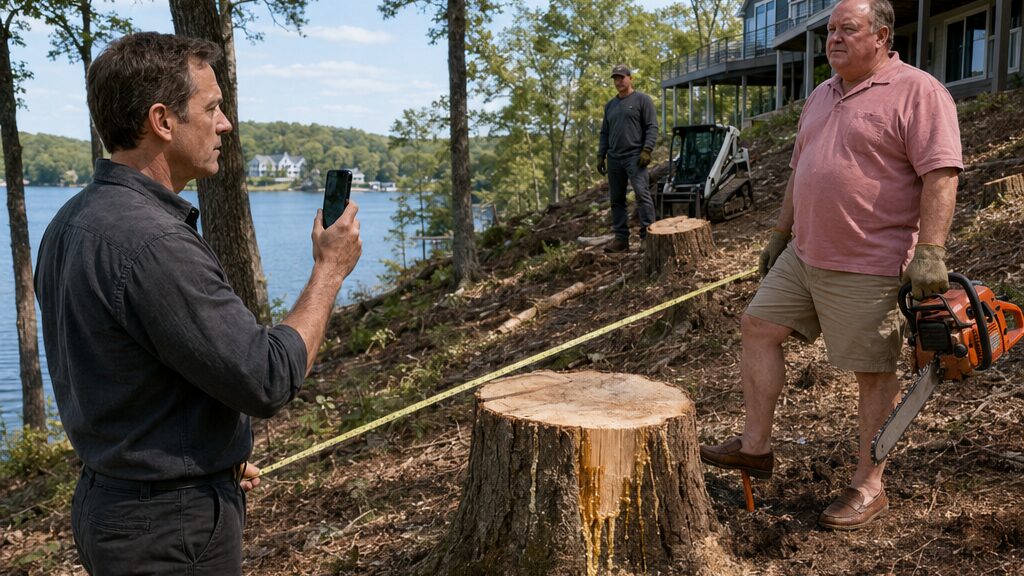
Donald Nelson stood in the middle of that corridor with an orange chainsaw hanging from his right hand.
He wore a pink polo shirt darkened at the chest with sweat, khaki shorts, work gloves, and brown loafers that made no sense on the churned earth. Sawdust clung to his socks.
Behind him, the hillside looked stripped.
Andrew counted five fresh stumps before his mind stopped counting.
“What are you doing?”
Donald glanced toward the chainsaw as if Andrew had asked about the weather.
“Morning.”
“Donald.”
Two workers farther down the slope went still. One held a rope. The other looked toward a white utility trailer parked near the service lane.
Donald smiled.
“Relax.”
Andrew took three more steps.
The smell hit him first: gasoline, hot chain oil, green wood.
Then he saw the sap.
A yellow line ran down the face of the nearest stump, thick enough to catch the morning light. The cut was pale and wet. A scatter of leaves still looked alive.
Andrew stared at it.
“These were cut today.”
Donald gave a short laugh. “That’s generally how tree work happens.”
Andrew looked past him. “Those are my trees.”
“They were blocking the view corridor.”
“My view corridor?”
“The community view corridor.”
Andrew turned slowly.
Donald’s house sat uphill beyond the cleared strip, its rear deck now facing an uninterrupted sweep of water. A white patio umbrella stood open. Two glasses rested on a table.
The view had not been opened for the community.
It had been opened for Donald.
Andrew felt a familiar pressure gather behind his sternum, the first warning that anger was becoming something less manageable. He had spent most of his working life around records, permits, inspection files, dated photographs, revisions, signatures. He knew what happened when people lost control of facts because they had first lost control of themselves.
He made himself breathe once.
“Who authorized this?”
Donald shifted the chainsaw to his other hand.
“The HOA approved selective maintenance.”
“Selective maintenance of my property?”
“You got notice.”
Andrew frowned.
Donald watched the frown and seemed to enjoy it.
“We sent the notice out weeks ago.”
“What notice?”
“That’s between you and your inbox.”
One of the workers lowered his eyes.
Andrew looked again at the slope.
The damage was broader than he had understood from the top. Mature trunks lay in sections. Brush had been dragged aside. Fresh tire impressions crossed the damp ground. The cut line descended toward the lake at an angle that seemed wrong.
He had walked this property hundreds of times.
He knew where the boundary ran.
Not perfectly by instinct, perhaps. But close.
The line between his lot and the Nelson property did not follow the new clearing.
Andrew stepped around Donald.
“Where are you going?”
Andrew did not answer.
Near the remains of a maple, a bright orange plastic survey stake leaned from the soil.
His pulse changed.
The stake had been placed during a boundary verification several years earlier, after a drainage dispute involving a culvert. Andrew remembered the surveyor setting it because the orange cap had looked almost absurdly bright against the leaves.
Now it stood beside a fresh stump.
Donald came up behind him.
“You planning to inspect every twig?”
Andrew crouched.
The stump was nearly twenty inches across. Moist sawdust ringed it. The orange stake stood several feet uphill.
He looked from the stake to the cut.
Then farther down.
Another orange marker showed through debris.
And beyond that, another.
Andrew rose.
“Stop the work.”
Donald’s smile disappeared.
“We’re not stopping anything.”
Andrew looked at the workers. “I’m the owner of this parcel. Until the boundary is confirmed, no more cutting.”
The worker with the rope looked immediately toward Donald.
Donald stepped closer.
“You don’t get to shut down approved work because you woke up irritated.”
Andrew took out his phone.
Donald’s expression hardened.
“What’s that for?”
Andrew photographed the stump.
Then the stake.
Then the wide slope with Donald’s house above it and the lake beyond.
“For the condition of the site.”
Donald gave a humorless laugh. “You always did love paperwork.”
Andrew ignored him.
He moved downhill.
At the next stump, the sap was still running. A severed branch lay across a patch of ferns. He photographed both.
The farther he walked, the less accidental the pattern looked.
The cuts crossed the line of orange markers.
Not once.
Repeatedly.
His disbelief narrowed into something colder.
Behind him, the chainsaw started again.
Andrew turned.
Donald had pulled the cord and was revving the engine.
“I said stop.”
Donald raised his voice over the motor.
“You can make me.”
For one dangerous second, Andrew imagined walking back uphill, taking the saw from him, forcing the whole morning into some simpler kind of conflict.
Instead, he lifted his phone and recorded ten seconds of the running machine, Donald standing beside the stumps, the workers watching.
Then he called out to them.
“I’m documenting notice that the boundary is disputed. Any further cutting may be included in a claim.”
The worker with the rope said something to the other man.
Donald shut off the saw.
“Oh, please.”
Andrew kept moving.
At the lower part of the slope, the ground steepened. Leaves slid beneath his shoes. He found a marker partly hidden under brush and cleared it with his hand.
There.
The boundary line.
He stood and sighted uphill from one orange point to the next.
The clearing was inside it.
His mouth went dry.
He needed an actual measurement.
Andrew returned to the house, ignoring Donald’s voice behind him, and came back with the long tape he kept in the garage.
Donald was still there.
“So now what?”
Andrew hooked the tape at the marked line and walked it toward the largest fresh stump.
The metal strip whispered over leaves.
At the stump, he looked down.
Ten feet.
Ten feet eight.
He adjusted for the center of the cut.
Eleven feet.
Andrew checked again.
The number did not change.
He photographed the tape.
Donald stood uphill, chainsaw resting against his leg.
Andrew straightened.
For the first time that morning, Donald did not smile.
The stump was eleven feet inside Andrew’s recorded boundary.
And Donald had been standing among the markers when Andrew arrived.
Chapter 2: He Put His Shoe Over the Boundary
Donald laughed when Andrew said the number aloud.
“Eleven feet.”
The laugh was not loud. That made it worse.
Donald came downhill with the chainsaw hanging at his side, stepping over branches as though touring work he had commissioned for a magazine spread.
“You measured from a plastic stick.”
“A survey marker.”
“A plastic stick.”
Andrew left the tape stretched across the ground.
“The recorded line is there.”
Donald glanced toward the orange stake.
“No, the line is where the survey says it is.”
“Exactly.”
“And you’re not a surveyor.”
Andrew felt the anger return, hotter now because Donald had managed to wrap contempt in technical language Andrew himself respected.
“That marker was set from the recorded survey.”
Donald stopped beside it.
Behind them, the two workers had moved toward the trailer. Neither seemed eager to restart the saws.
Andrew raised his phone.
“Don’t touch it.”
Donald looked at the phone.
Then at Andrew.
Something shifted in his face.
Not surprise.
Calculation.
“You know what your problem is?”
Andrew said nothing.
“You think every disagreement becomes true if you put it in a folder.”
Donald lifted one loafer and placed it directly over the orange stake.
Andrew’s thumb found the camera control.
“Move your foot.”
Donald pressed down.
The stake bent.
The bright orange top tipped sideways into the dirt.
Andrew took the first photograph.
Donald pressed harder.
The marker disappeared beneath the churned soil until only a sliver remained.
Andrew took the second.
Then he angled the phone lower and took a third photograph that included Donald’s brown loafer, the crushed marker, the sap-wet stump beside it, and the visible line of disturbed earth.
Donald saw what he was doing.
His face reddened.
“Put the phone away.”
Andrew stepped back.
“Work is over for today.”
“You don’t decide that.”
“I just gave notice of a boundary dispute. They can decide whether they want to keep cutting.”
One of the workers called from uphill.
“We’re packing up.”
Donald swung toward him. “No, you’re not.”
The worker shook his head. “Not with a property line dispute.”
Donald stood very still.
Then he looked at Andrew.
“You planned this?”
Andrew almost laughed from disbelief.
“I planned for you to cut down my trees?”
“You’ve been waiting for something.”
“For what?”
“To make a problem.”
Andrew lowered the phone.
The accusation landed strangely because, somewhere beneath the absurdity, it touched a weakness he did not want examined.
He had seen notices from the HOA before. Landscaping notices. Drainage notices. Reminders about dock lighting and seasonal storage. He had developed the habit of scanning subject lines and filing most of them mentally under later.
Donald stepped closer.
“You got the notice.”
“You keep saying that.”
“Because you did.”
“What exactly did it authorize?”
“Selective view maintenance.”
“On whose land?”
“You had a chance to object.”
Andrew looked at him.
Donald smiled again, but this time the smile carried relief.
As if he had finally reached the part of the conversation he trusted.
“You didn’t.”
Andrew felt a small emptiness open in his stomach.
The worker closed the trailer door.
Donald picked up the chainsaw.
“Maybe check your records.”
Then he walked uphill.
Andrew stayed beside the buried stake until the utility truck left.
Only after the sound faded did he crouch.
He used two fingers to brush away loose soil.
The marker was bent nearly flat.
He did not pull it immediately. He photographed it from above, then from both sides. He took a wider image showing the relationship between the marker and stump. He photographed his measuring tape again.
After that, he went inside for gloves, a small garden trowel, and a clear freezer bag.
He felt ridiculous using the freezer bag.
Then he thought of Donald’s shoe.
He excavated carefully.
The orange marker came free with a crease near its middle and wet soil packed along one side. A partial tread impression remained in the dirt above where it had been crushed.
Andrew stopped.
He photographed that too.
He did not touch the impression.
By noon, his dining table had become an evidence surface.
Phone.
Notebook.
Printed photographs.
Measurement sketch.
The bent orange stake inside the clear bag.
Andrew wrote the time of each image from the phone metadata. Then he opened the county property portal and downloaded the recorded plat associated with his lot.
The work calmed him.
Dates behaved.
Measurements behaved.
Files could be compared.
He enlarged the survey on his monitor.
The boundary line ran from the lakeside monument northwest toward the road, exactly as he remembered. The orange markers had been placed along that line during the later verification.
Nothing in the recorded survey showed a shared view corridor.
Nothing showed an HOA easement through the trees.
Andrew printed the plat.
The printer hummed behind him.
His phone vibrated.
A message from Donald.
You should think carefully before accusing people of trespass over approved maintenance.
Andrew read it twice.
He took a screenshot.
Another message arrived.
You were notified. No objection. Don’t rewrite history now.
Andrew did not answer.
He opened the HOA website.
The document archive was badly organized, a mixture of meeting minutes, newsletters, architectural forms, and PDF notices.
He searched “view.”
Three results.
One was about dock visibility.
One concerned brush removal near the community trail.
The third was titled:
SELECTIVE VIEW MAINTENANCE — SOUTH RIDGE PROPERTIES
Andrew opened it.
A one-page notice appeared.
The language was vague.
The HOA had received requests to address “overgrowth affecting established lake sightlines” and intended to coordinate “limited pruning and selective removal where appropriate and approved.”
No map.
No parcel numbers.
No contractor scope.
At the bottom:
Owners with questions or objections should respond within fourteen days.
Andrew stared at the date.
Five weeks earlier.
He checked his email.
Nothing in the main inbox.
He searched the title.
No result.
Then he remembered the archive rule he had created months earlier when HOA messages began multiplying.
Anything from the automated community address containing the word maintenance went directly into a folder.
Andrew clicked it.
There were nineteen unread messages.
The notice sat among them.
He opened it.
The email client showed the exact delivery time.
Tuesday, 8:14 a.m.
He remembered that morning.
He had been on a compliance call. He had seen notifications stack up at the edge of his screen. He had cleared them without reading.
Andrew leaned back.
For several minutes, he heard only the small ticking of the wall clock.
Donald had crossed the boundary.
The survey still existed.
The trees were still gone.
None of that changed.
But another fact now sat beside them.
Andrew had been notified.
And he had said nothing.
Chapter 3: The Notice I Should Have Answered
The timestamp was still on Andrew’s screen Monday morning.
Delivered: 8:14 a.m.
Opened: 8:17 a.m.
He stared at the second line.
He had not merely received the notice.
He had opened it.
The memory returned in pieces. A video call. His coffee going cold. Three windows open across two monitors. The HOA email appearing at the edge of the screen. Andrew clicking it, scanning perhaps the first two sentences, deciding it was another general landscaping announcement.
Then closing it.
The orange stake lay inside the clear bag beside his keyboard.
Bent.
Dirty.
Accusing in a way Donald never could.
Andrew printed the notice.
He read it slowly.
Selective view maintenance.
Limited pruning and removal.
Where appropriate and approved.
Questions or objections within fourteen days.
He searched for attachments.
None.
No map.
No survey reference.
No indication that work would enter his parcel.
Andrew circled the phrase established lake sightlines, then stopped.
The gesture felt too much like preparing an argument before understanding the record.
He turned the page over.
On the blank back, he wrote:
I saw this.
He left the sentence there.
At ten, he drove to the county records office.
The clerk at the counter asked for the parcel number. Andrew gave it without checking his phone.
“You’ve done this before,” the clerk said.
“Used to work municipal records.”
“That explains the handwriting.”
Andrew almost smiled.
He requested the recorded plat, easements, and any boundary adjustments affecting his lot or the Nelson parcel uphill.
The clerk returned with digital copies and one older scanned document whose faint lines made Andrew lean toward the screen.
No boundary amendment.
No maintenance easement.
No shared sightline covenant.
The subdivision declarations gave the HOA authority over common areas and architectural standards but did not grant general access to remove privately owned trees outside emergency conditions or owner consent.
Andrew felt his breathing ease.
Facts.
Actual facts.
The relief lasted until he remembered the unanswered notice.
He asked for a certified copy of the plat.
Outside, he sat in his car and compared the county file with the photograph of his tape measure.
The cut corridor crossed the recorded line.
That much was no longer intuition.
The small payoff should have felt larger.
Instead, Andrew saw two truths refusing to cancel each other.
Donald had crossed the boundary.
Andrew had ignored the warning that something was about to happen.
By afternoon, he was in the HOA common room with Jonathan Rivera.
The room smelled faintly of coffee and furniture polish. A framed photograph of the lake hung behind Jonathan, taken years ago from a viewpoint now obscured by newer construction.
Jonathan closed the door.
“I’m not here officially.”
“You’re the vice president.”
“I know what my title is.”
“Then what does unofficially mean?”
“It means Donald doesn’t know I’m meeting you.”
Andrew set the certified survey on the table.
Jonathan looked at it but did not touch it.
“The clearing crossed my line.”
“I’ve heard.”
“From Donald?”
“From everyone.”
Andrew slid over a photograph.
Jonathan’s eyes moved to the tape measure, then the stump.
“That’s eleven feet.”
“Yes.”
Jonathan rubbed one hand over his jaw.
“The board approved selective work.”
“Where?”
“South ridge.”
“That’s not a boundary.”
“I know.”
“Did the board approve cutting on my parcel?”
“No.”
The answer came quickly.
Andrew waited.
Jonathan looked away.
“But?”
Jonathan exhaled.
“But you didn’t object.”
Andrew felt something tighten.
“So silence transfers ownership now?”
“No. Don’t do that.”
“Do what?”
“Turn this into a clean sentence.”
Andrew sat back.
Jonathan opened a folder.
Inside were printed minutes from an HOA work session.
A line near the bottom had been highlighted.
South ridge owners notified; no objections received.
Andrew read it twice.
“Owners?”
“That’s how it was recorded.”
“I never consented.”
“I didn’t say you did.”
“Donald is saying I did.”
Jonathan’s voice dropped.
“Donald is saying the board relied on the absence of objections.”
Andrew looked at the highlighted line.
“Did you have a map?”
Jonathan hesitated.
That was enough.
“You didn’t.”
“We had a contractor sketch.”
“Show me.”
“It wasn’t attached to the minutes.”
“Where is it?”
“I don’t know.”
Andrew stared at him.
Jonathan straightened.
“Listen to me. I’m trying to keep this from becoming a disaster.”
“For whom?”
“For everybody.”
“Six trees are gone from my land.”
“We don’t know the valuation yet.”
“So the dollar amount decides whether it matters?”
“No.”
Jonathan pushed the minutes toward him.
“I’m telling you Donald is going to argue that you knew view maintenance was planned, you did not object, and now you’re using a technical boundary issue to turn ordinary work into a lawsuit.”
Andrew’s face went hot.
“Ordinary work.”
“I said that’s his argument.”
“And yours?”
Jonathan looked toward the closed door.
“My argument is that nobody should have started cutting without a parcel map.”
There it was.
Not support.
Not confession.
A carefully measured sentence designed to keep Jonathan one step away from responsibility.
Andrew recognized it because he had spent years constructing versions of it himself.
He gathered the survey.
Jonathan said, “There’s something else.”
Andrew stopped.
“Donald requested an emergency meeting.”
“When?”
“Thursday night.”
“About the cutting?”
Jonathan’s expression tightened.
“About your obstruction of approved maintenance and threats of legal action against the association.”
Andrew said nothing.
Jonathan continued.
“He wants the board to issue a formal statement before this spreads.”
“Spreads where?”
“Neighborhood email. Social groups. People talk.”
Andrew looked down at the minutes again.
No objections received.
The phrase was already becoming something larger than what had happened.
Not permission.
Not exactly.
But close enough for someone determined to use it.
Andrew picked up the printed notice and the bag containing the orange stake.
Jonathan’s eyes fixed on the bent plastic.
“What is that?”
“The marker Donald put under his shoe.”
Jonathan looked up.
“You saw him do it?”
“I photographed him doing it.”
For the first time, Jonathan lost his practiced neutrality.
Then Andrew added, “And I opened the notice five weeks ago.”
Jonathan’s expression changed again.
Andrew could almost see the competing versions of the story forming behind his eyes.
Victim.
Participant.
Careless owner.
Aggressive neighbor.
Man with evidence.
Man who had stayed silent.
Thursday night was three days away.
Donald was not waiting for the truth to settle.
He was putting his version into the record first.
Chapter 4: Six Stumps and One Very Expensive Assumption
Rebecca Taylor refused to give Andrew a number before she had crossed the first stump.
“If you hired me for a dramatic figure,” she said, pulling a measuring tape from the pocket of her green field jacket, “you hired the wrong person.”
Andrew stood beside the upper edge of the clearing with the certified survey tucked under one arm.
“I hired you because the trees are gone.”
“That tells me why you called. Not what you expect me to say.”
She wore a yellow hard hat despite the silence of the slope. The contractor’s equipment had been removed days earlier, but hung branches remained above the disturbed corridor, and Rebecca treated damaged trees as if they might still make decisions.
She looked downhill.
The lake shone through the opening.
Donald’s deck sat above them, newly exposed to the water.
Rebecca’s gaze paused there, then returned to Andrew.
“Show me the line.”
He led her to the first surviving orange marker.
She crouched without touching it.
“And the damaged one?”
Andrew pointed toward his house. “Preserved.”
Her eyes flicked to him.
“In what?”
“A clean bag.”
“After photographing it in place?”
“Yes.”
“Before excavation?”
“Yes.”
“Multiple angles?”
“Yes.”
A corner of her mouth moved.
“You really did work records.”
“Long enough.”
“That wasn’t praise.”
She stood and began walking the boundary.
Rebecca did not move with the solemnity Andrew had expected from someone inspecting the remains of mature trees. She moved quickly. Tape around stump. Diameter note. Photograph. Bark fragment. Canopy position. Distance to residence. Slope condition.
At the second stump, she said, “White oak.”
At the third, “Probably hickory. I’ll need the remaining bark and wood structure.”
At the fourth, she stopped.
Andrew waited.
Rebecca put one gloved hand on the cut face.
“This one matters.”
“More than the others?”
“I didn’t say that.”
She measured twice.
“What is it?”
“Mature hardwood. Significant landscape function. Possibly one of your stronger valuation components.”
Andrew heard the professional caution in every phrase.
“You think the total could be substantial.”
Rebecca looked at him.
“There it is.”
“What?”
“The number.”
“I didn’t give you one.”
“You want one.”
“Of course I want one.”
“No. You want a number big enough to make what happened feel as serious to everyone else as it feels to you.”
The comment irritated him because it was close enough to something he had not admitted.
Andrew looked toward the stumps.
“Six trees.”
“At least six relevant removals inside the disputed area, based on what you’ve shown me.”
“Eleven feet inside.”
“I’ve seen your survey. I’m not your surveyor.”
“The county record confirms the line.”
“And I’m still not your surveyor.”
She pulled the tape around another stump.
Andrew folded his arms.
Rebecca wrote on her clipboard.
After a moment, she said, “You want this to survive scrutiny, stop trying to make every expert do every job.”
The words landed harder than he expected.
He thought of Jonathan saying nobody should have cut without a parcel map while refusing to call the act trespass.
Everyone protecting the border of their own responsibility.
Rebecca glanced at him.
“You have a strong record so far.”
“So far.”
“Yes.”
“And the notice?”
Her pen stopped.
Andrew had told her about it on the phone.
“I’m an arborist and appraiser.”
“That means you won’t answer.”
“It means I won’t pretend your unread email changes a tree’s diameter.”
“I read it.”
Rebecca looked up.
Andrew corrected himself.
“I opened it.”
“That’s different?”
He did not answer.
She returned to the measurement.
By late morning, six stumps had numbered flags beside them. Rebecca photographed the open corridor from below, then from the side, documenting how the missing canopy had changed privacy, shade, erosion exposure, and the visual relationship between the two houses.
At one point, she stood near the surviving orange line and looked uphill.
“Your neighbor gets a clean lake view now.”
“Yes.”
“That relevant to your claim?”
“I don’t know.”
“It may be relevant to motive. Different question.”
Andrew watched Donald’s empty deck.
For days, Donald had not approached him directly.
That silence felt strategic.
Rebecca finished shortly after noon.
At her truck, Andrew asked, “When will you have something preliminary?”
“A few days.”
“Can you at least tell me whether we’re talking five thousand or fifty?”
She shut the equipment case.
“No.”
“Rebecca.”
She looked tired now rather than stern.
“I’ve had clients decide what a tree is worth before I arrive. Then they get angry when the biology doesn’t support the story they want. I’ve had other clients accept insurance estimates that treated mature shade trees like stacked lumber.”
“I’m not asking you to inflate anything.”
“Good.”
She opened the truck door.
“Then let me disappoint you accurately.”
Three days later, her preliminary assessment arrived at 6:42 in the morning.
Andrew opened it before making coffee.
He read the first page standing up.
Species classifications remained partly conditional pending documentation, but six mature hardwood removals were included. The report distinguished timber value from landscape contribution, replacement implications, site function, and restoration costs.
Andrew moved to the table.
The preliminary total range centered near sixty-two thousand dollars.
He read the number again.
Then again.
There was no thrill.
Only a strange physical recognition, as though some private scale inside him had finally moved.
Sixty-two thousand dollars did not bring back shade.
It did not restore the years required for a mature canopy.
But it meant the loss could not be dismissed as brush clearing.
Andrew printed the report.
Before the last page finished, his phone began vibrating.
One message.
Then another.
Then six.
The neighborhood email list.
He opened the first forwarded thread.
Subject: CLARIFICATION REGARDING SOUTH RIDGE MAINTENANCE DISPUTE
The message came from Donald in his capacity as HOA president.
Andrew read the first paragraph.
The association had recently become aware that a homeowner who received advance notice of approved maintenance, and raised no objection during the designated period, was now threatening substantial legal action after work had been completed.
Andrew stopped.
His coffee machine clicked off in the kitchen.
The message continued.
The board, Donald wrote, remained committed to protecting all homeowners from “retroactive claims based on technical interpretations inconsistent with prior conduct.”
Attached beneath the message was Andrew’s notice.
The one he had opened.
The one he had not answered.
Andrew scrolled lower.
A second attachment showed an excerpt from the minutes.
South ridge owners notified; no objections received.
His phone rang.
He did not answer.
Another email arrived from one of the unnamed neighboring homeowners.
Andrew, is it true you knew beforehand?
Then another.
This is getting out of hand. Some of us are worried about assessments if the HOA gets sued.
Then Jonathan.
Call me before you respond to anyone.
Andrew stared at the sixty-two-thousand-dollar preliminary assessment lying warm from the printer.
An hour earlier, he had believed the number would force people to understand the scale of the damage.
Donald had moved first.
By breakfast, the neighborhood was no longer asking why six mature trees had been cut across a boundary.
They were asking why Andrew had waited until afterward to complain.
Chapter 5: The Woman on the Deck Changed the Story
Susan Nelson arrived at Andrew’s back door without Donald and asked him to put his phone away.
Andrew had opened the door only six inches.
“What?”
“Your phone.”
She stood on the stone step with both hands visible, as if she had anticipated suspicion. She wore a pale sweater, dark pants, and flat shoes unsuited to the muddy path between the houses.
“I’m not recording you.”
“I didn’t say you were.”
“You asked me to put it away.”
Susan looked toward the slope.
“Because Donald checks location sharing.”
Andrew said nothing.
That was enough to change the shape of the moment.
He stepped back.
Susan entered the kitchen.
She did not sit.
The open lake view was visible beyond the glass doors now. From Andrew’s kitchen, where there had once been trunks and layered leaves, he could see a bright strip of water and part of Donald’s deck above.
Susan saw him looking.
“That’s why I’m here.”
Andrew placed his phone face down on the counter.
“You have five minutes.”
She gave a short, exhausted laugh.
“You sound like him.”
“Then you should be comfortable.”
Her face tightened.
Andrew regretted the line immediately, but did not take it back.
Susan crossed her arms.
“I read the emails.”
“So did everyone else.”
“I told him not to send that.”
“But he did.”
“Yes.”
“And you’re here because?”
“Because you’re about to make this public.”
“It is public.”
“You know what I mean.”
Andrew leaned against the counter.
“No, Susan. I don’t think I do anymore.”
She looked at the printed preliminary report near the kitchen table.
“Is that the appraisal?”
He did not answer.
Her gaze remained on it.
“How much?”
“That’s not why you’re here.”
“No.”
“Then why?”
Susan walked to the glass doors.
For a moment, she looked uphill toward her own house.
From here, the benefit was undeniable. The Nelson deck faced the lake like a viewing platform.
“Donald thought we were going to lose the house.”
Andrew’s anger did not disappear.
But it changed temperature.
“What?”
Susan kept her back to him.
“He refinanced two years ago. Then again against the equity.”
“Why?”
“That’s between us.”
“You came into my kitchen.”
She closed her eyes briefly.
“Repairs. Debt. Bad decisions. Pick whichever answer makes you feel less interested.”
Andrew stayed quiet.
Susan turned.
“The value estimate last fall came in lower than he expected. He became obsessed with the view.”
Andrew looked through the glass.
“Those trees existed when you bought the house.”
“I know.”
“Donald knew.”
“I know.”
“He was HOA president when you bought it.”
“Yes.”
Each answer came smaller.
Susan finally sat at the table.
“He started saying the whole south ridge had become overgrown. That buyers expected lake sightlines. That the board had been too passive.”
“That part sounds familiar.”
“He believed it.”
Andrew studied her.
“You’re defending him.”
“No.”
“You’re explaining him.”
“There’s a difference.”
“Not to the trees.”
Susan flinched.
Andrew saw it and hated that some part of him was glad.
She looked down at her hands.
“The original work was supposed to be limited.”
His attention sharpened.
“Original according to whom?”
“The contractor.”
Andrew moved away from the counter.
“What exactly was he told?”
Susan hesitated.
“This is why I asked about your phone.”
“What was he told?”
She rubbed one thumb over the opposite palm.
“Pruning. Brush. Some selected removals near the upper corridor.”
“On my parcel?”
“I don’t know where the contractor thought the parcel line was.”
“That’s not what I asked.”
“No. Not on your parcel, as far as I understood.”
Andrew felt the room narrow.
“Then how did six trees disappear?”
Susan looked through the glass again.
“The first morning, after they took down some smaller growth, the lake started showing.”
Andrew said nothing.
“Donald went outside.”
“And?”
“He told them to go farther.”
The words were quiet.
Andrew heard the refrigerator motor start behind him.
“Farther where?”
“Down the slope.”
“Past the markers?”
“I don’t know what he said about the markers.”
“You saw them.”
Susan’s silence answered.
Andrew picked up his phone.
She stood immediately.
“You said—”
“I said I wasn’t recording you.”
“Andrew.”
“I need to call my attorney.”
Her face changed.
“Please wait.”
“For what?”
“Until after the HOA meeting.”
“Why?”
“Because if this becomes what I think it becomes—”
“What? Expensive?”
She looked at him.
There it was.
Not greed.
Fear.
Andrew set the phone down again but did not move away from it.
“Donald sent the neighborhood an email making me look like I approved this.”
“I know.”
“Did you know he was going to do that?”
“No.”
“Would you swear to what you just told me?”
Susan’s eyes filled, though no tears fell.
“I don’t know.”
Andrew laughed once, without humor.
“Of course.”
“You think this is simple because the survey line is simple.”
“The line is simple.”
“Our life isn’t.”
“He cut across it anyway.”
“Yes.”
The answer stopped him.
Susan sat again.
“I told him the view wasn’t worth it.”
Andrew watched her.
“He said if we sold without fixing the sightline, we’d take a loss we couldn’t absorb. He said the HOA had authority. He said you never objected.”
“I didn’t know they were cutting my trees.”
“I know that now.”
“Now?”
Susan looked at him carefully.
“You really don’t remember.”
A cold unease moved through him.
“Remember what?”
“Last fall. At our driveway.”
Andrew waited.
“You and Donald were talking about the brush.”
“I talk to Donald as little as possible.”
“You were both by the mailbox. I was getting groceries out.”
Andrew searched his memory.
Nothing firm.
Susan continued.
“He complained about the trees. You said you didn’t care about a few scrub trees.”
Andrew’s mouth went dry.
“I said what?”
“You said, ‘I don’t care about a few scrub trees. Do what you want with the junk near the line.’”
“No.”
“I heard you.”
“That is not consent to cut mature hardwoods eleven feet onto my property.”
“I didn’t say it was.”
“Then why are you telling me?”
“Because Donald will.”
Andrew stared at her.
A memory surfaced.
Late fall.
Donald at the roadside mailbox.
Andrew carrying a package.
A complaint about brush tangling near the drainage swale.
Andrew impatient, trying to end the conversation.
Maybe he had said it.
Not about the oaks.
Not about the slope.
About scrub growth near the line.
But words did not preserve context by themselves.
Susan stood.
“I came because you needed to know before Thursday.”
“You also came because you want me to stay quiet.”
“Yes.”
At least that was honest.
“For Donald?”
“For me.”
She walked toward the back door.
Andrew said, “Why didn’t you stop him?”
Her hand rested on the knob.
“I thought staying quiet would keep one bad decision from destroying everything else.”
Andrew felt the answer enter somewhere deeper than the dispute.
He thought of his father’s last year. Of family calls he had avoided because every decision became an argument. Of believing silence kept him outside the conflict, until choices were made and there was no outside anymore.
Susan opened the door.
Before stepping out, she said, “Donald thinks your silence meant yes.”
Andrew looked at the printed notice on the table.
Then at the report.
Then through the new opening toward the lake.
He had spent days preparing to prove what Donald had done.
Now he understood that Donald would not need to deny the cutting.
He only needed to make Andrew’s own words sound like permission.
Chapter 6: The Meeting Where Silence Became Evidence
Donald opened the emergency HOA meeting by calling Andrew’s claim “a manufactured dispute.”
He did it before Andrew had removed his coat.
The clubhouse was fuller than usual. Folding chairs faced a long table where Donald sat in the center, Jonathan Rivera two seats away, the HOA attorney at the end. Susan occupied a chair against the side wall rather than beside her husband.
Andrew noticed that immediately.
Donald noticed Andrew noticing.
“Since everyone’s here,” Donald continued, “I’d like the record to reflect that this meeting concerns threats against the association arising from maintenance work for which advance notice was provided.”
Andrew carried a slim folder in one hand.
In the other, a clear evidence bag.
Inside it, the bent orange stake looked almost cheap.
He sat in the front row.
One of the neighboring homeowners whispered behind him.
Donald tapped a printed packet.
“The association cannot function if owners ignore notice periods, allow work to proceed, then claim surprise after the fact.”
Andrew took off his coat.
Jonathan avoided his eyes.
The HOA attorney said, “We should be careful about characterizing disputed facts.”
Donald’s jaw tightened.
“Fine. Alleged surprise.”
Andrew felt the old impulse.
Correct the sentence.
Correct every sentence.
He could have done it for hours.
Instead, he waited.
Donald presented the notice first.
Then the minutes.
South ridge owners notified; no objections received.
He projected Andrew’s email record onto the wall.
The message had been opened at 8:17 a.m.
A murmur moved through the room.
Donald turned toward Andrew.
“You received this, correct?”
“Yes.”
The room quieted.
Donald seemed briefly disappointed by the absence of resistance.
“You opened it.”
“Yes.”
“And did not object.”
“No.”
A woman near the back shifted in her chair.
Donald spread his hands.
“There it is.”
Andrew looked at Jonathan.
Jonathan’s face remained still.
Donald continued.
“Now, after the work has improved a long-neglected sightline, Mr. Campbell is circulating claims of trespass and seeking what I understand may be a substantial financial recovery.”
“I haven’t circulated a claim,” Andrew said.
“You hired an appraiser.”
“Yes.”
“You threatened legal action.”
“I gave notice of a boundary dispute while chainsaws were still on my property.”
“Your interpretation of the boundary.”
Andrew opened his folder.
The HOA attorney intervened.
“The recorded survey will be relevant. Let’s keep this orderly.”
Donald nodded as though granting permission.
Andrew placed the certified county survey on the front table.
Then photographs.
The measured stump.
The visible markers.
The cut corridor.
He did not place the orange stake down yet.
Donald leaned back.
“Nobody disputes that work occurred near the line.”
“Eleven feet across it.”
“You measured from a plastic marker.”
Andrew looked at him.
Donald smiled faintly.
That same smile from the slope.
Andrew took the evidence bag and laid it on the table.
The room changed.
Bright orange plastic.
Bent at the middle.
Soil still caught in a crease.
Donald’s smile disappeared.
“What is that supposed to prove?”
Andrew said, “You know what it is.”
“I know you brought a dirty piece of plastic into a meeting.”
Andrew removed three photographs from his folder.
He placed the first down.
Donald’s loafer above the stake.
The second.
The stake bending.
The third.
The marker disappearing beneath the shoe beside the stump.
Someone behind Andrew whispered, “Oh.”
Donald’s face reddened.
“That proves nothing about authorization.”
“No,” Andrew said. “It proves you knew there was a marker.”
Donald pointed toward him.
“You want to talk about what people knew?”
The sentence came too quickly.
Andrew knew what was next.
Susan shifted against the wall.
Donald pulled another page from his packet.
“Last fall, Mr. Campbell told me directly he didn’t care about the scrub trees near our line and that I could do what I wanted with them.”
Several faces turned toward Andrew.
Donald let the silence work.
Andrew could deny the wording.
He could demand proof.
He could say Donald was lying.
His attorney had advised him earlier that afternoon to avoid volunteering ambiguous conversations unless directly necessary.
The clean version of the case was sitting in front of him.
Survey.
Photographs.
Stake.
Appraisal.
Andrew looked at Susan.
She lowered her eyes.
Then he looked at Jonathan.
Then at the projected email timestamp.
8:17 a.m.
Andrew stood.
“I said something like that.”
Donald stopped moving.
The room became completely still.
Andrew heard his own pulse.
“I don’t remember the exact wording. I remember Donald complaining about brush near the roadside drainage area. I was trying to end the conversation. I said I didn’t care about a few scrub trees or junk near the line.”
Donald leaned forward.
“Thank you.”
Andrew turned toward him.
“I was careless.”
Donald’s expression sharpened.
“I also opened the HOA notice.”
A small sound came from Jonathan, almost a breath.
Andrew continued.
“I did not answer it. I skimmed it during work and filed it away. That was careless too.”
One of the homeowners said, “Then why are we here?”
Andrew looked back.
“Because none of those facts move my property line.”
Silence.
He pointed to the projected notice.
“That document says selective view maintenance. It has no parcel map. No tree inventory. No authorization to enter my land.”
He touched the certified survey.
“This is the recorded boundary.”
Then the photographs.
“These are the cuts.”
Then the orange stake.
“And this is what happened when I pointed out the marked line.”
Donald shook his head.
“Convenient performance.”
Andrew felt shame rise in him.
Not the shallow shame of being accused.
Something older.
The shame of recognizing how often he had mistaken delayed honesty for control.
He looked at the room.
“I should have answered the notice.”
Donald opened his mouth.
Andrew kept going.
“I should not have made a careless remark to a neighbor because I wanted to avoid a five-minute conversation. I’m not asking this board to pretend I did everything right.”
That stopped Donald more effectively than denial would have.
Andrew turned toward the table.
“I’m asking whether my failure to speak clearly gave the HOA president the right to choose a different boundary.”
The HOA attorney looked down at his notes.
Jonathan shifted.
Andrew saw it.
“Jonathan.”
The vice president looked up.
“Was there a parcel map attached to the approval?”
Donald said, “This is not cross-examination.”
Andrew did not look at him.
“Jonathan?”
The room waited.
Jonathan rubbed his palms together once.
“No.”
Donald stared at him.
The answer seemed to loosen something in the room.
Andrew asked, “Did the board know the exact cutting corridor?”
Jonathan hesitated.
“The contractor provided a sketch.”
“Was it tied to the recorded survey?”
“No.”
Donald said, “We discussed the corridor.”
Jonathan turned toward him.
“We discussed a corridor.”
Donald’s face hardened.
Jonathan continued.
“We did not have a parcel overlay.”
Andrew felt no triumph.
Only a deeper anger.
“You knew that?”
Jonathan looked at him.
“I knew the map was incomplete.”
“And the work went ahead.”
Jonathan’s voice dropped.
“Yes.”
Donald pushed back from the table.
“This is absurd. We’re turning administrative imperfections into malicious intent.”
The HOA attorney said, “Donald.”
“No. He ignored notice. He gave verbal permission. The board approved maintenance. Now because a few cuts may have crossed some line—”
“Six mature trees,” Andrew said.
“According to an expert you hired.”
“According to six stumps.”
Donald looked toward the audience.
“This is exactly what I mean. He wants everyone here exposed to a lawsuit because he changed his mind after the view improved.”
Susan stood.
Donald stopped.
She had not spoken all evening.
He stared at her.
“Susan.”
She looked at Andrew first.
Then at the board.
“I won’t confirm that.”
Donald’s face emptied.
“What?”
“I won’t tell them Andrew approved what you did.”
“You heard him.”
“I heard what he said about brush near the road.”
Donald’s voice lowered.
“Sit down.”
Susan’s hand tightened on the back of her chair.
“No.”
The word was nearly quiet.
But it carried.
Donald looked around the room as if checking whether everyone had heard.
Susan continued.
“He was careless. That’s true.”
Andrew felt the sentence hit, then settle.
“But he did not tell you to cut mature trees down the slope.”
Donald stood.
“You don’t know what was said between us.”
“I know what you told the contractor.”
The room went still again.
Donald did not blink.
Susan’s face had gone pale.
The HOA attorney closed his pen.
Andrew felt the entire dispute tilt.
Donald said, “Be careful.”
Susan looked at him.
For the first time, Andrew understood that her fear had never been abstract.
She swallowed.
Then spoke toward the board.
“The first clearing was limited. After some smaller growth came down, the lake opened.”
Donald’s chair scraped the floor.
“Susan.”
She kept going.
“He went outside.”
Her voice shook once.
Then steadied.
“And he told the contractor to go farther.”
No one moved.
Andrew looked at the crushed orange stake on the table.
For days, it had seemed like the clearest object in the story.
Now it was not enough.
Susan had changed the question.
The issue was no longer whether Donald crossed the boundary.
It was whether Andrew could prove Donald knowingly expanded the work after seeing what the opened lake view was worth to him—without asking the entire case to rest on the word of Donald’s frightened wife.
Chapter 7: Eleven Feet Was Never the Whole Truth
Donald’s attorney offered Andrew a settlement on the condition that nobody ever learned why.
The proposal arrived four days after the HOA meeting.
Andrew sat across from his attorney in a narrow conference room with a view of a parking lot, the printed offer between them.
The number was substantial.
Not the full amount Rebecca had projected. Not close to what a court might award if intentional conduct were established. But large enough to repair drainage, replant part of the slope, cover legal fees, and leave money behind.
Andrew read the confidentiality clause twice.
Then the paragraph concerning the HOA.
“No correction?”
His attorney shook her head.
“The association minutes stay as they are.”
“And Donald’s email?”
“No retraction.”
Andrew looked down.
The settlement would resolve all property claims. Each side would deny wrongdoing. The HOA would not admit error. Andrew would agree not to discuss the matter publicly beyond saying it had been resolved.
His attorney folded her hands.
“This is not a bad offer.”
“I know.”
“It avoids uncertainty.”
“I know.”
“You have strong evidence. You also have facts they will use against you.”
“The notice.”
“The notice. The email timestamp. The remark about scrub trees.”
Andrew looked toward the window.
A delivery truck reversed across the parking lot. Its warning tone repeated every few seconds.
His attorney continued.
“If the judge believes Donald intentionally crossed the line, that changes things. But intent is the fight.”
“Susan heard him order the contractor farther.”
“Susan is his wife.”
“Not exactly his strongest witness anymore.”
“That cuts both ways. They’ll argue marital conflict.”
Andrew ran one finger along the edge of the offer.
“And the contractor?”
“We finally got a response.”
He looked up.
She opened another folder.
The contractor had produced work notes, invoices, and text messages. Nothing dramatic. No confession. No message saying cut Andrew Campbell’s trees.
But the chronology mattered.
The initial work order described upper-slope brush reduction and selected removals.
A later handwritten note added:
Extend lower opening per owner direction.
Andrew read it.
“Owner.”
“Donald was the contact.”
“Can they prove that?”
“There are texts.”
She slid over printed screenshots.
Donald had asked the contractor for progress photos.
One image showed the lake beginning to appear through the first cleared section.
Three minutes later, Donald replied:
Better. Keep the opening moving down.
Andrew read the sentence again.
His attorney tapped the page.
“That helps.”
“How much?”
“It helps.”
She would not give him the certainty he wanted.
No honest professional ever did.
Andrew leaned back.
“What about the survey?”
“The surveyor confirms the markers were placed along the recorded line during the prior verification. County chronology is clean.”
“And the stake?”
“Useful. Especially with your photographs.”
“The tread impression?”
“Consistent with the shoe in the image. Not magic.”
Andrew almost smiled.
Not magic.
That was the phrase the entire case seemed to require.
No single document.
No single witness.
No orange piece of plastic capable of carrying the truth alone.
His attorney pointed to the settlement offer.
“You have until Friday.”
Andrew looked at the confidentiality clause.
For years, he had believed good records eventually corrected bad stories.
But records did nothing by themselves.
They waited.
People decided whether to use them.
On Thursday evening, the HOA board held a closed session.
Andrew was not invited.
Jonathan called him afterward.
“I voted to amend the minutes.”
Andrew stood in his kitchen.
“What does that mean?”
“It means I moved to remove the language implying owner acquiescence and replace it with a factual statement that notice was distributed but parcel-specific consent was not obtained.”
Andrew said nothing.
Jonathan continued.
“The motion passed.”
“Donald voted?”
“He didn’t.”
“Why?”
“He recused himself after the attorney insisted.”
Andrew looked through the glass doors toward the exposed slope.
“And the public email?”
“We’re issuing a correction.”
The words should have felt like victory.
Instead, Andrew thought of how long Jonathan had known the map was incomplete.
“You could have said this before the trees came down.”
Silence on the line.
“I know.”
Andrew waited for more.
Jonathan gave him none.
For once, Andrew did not rescue the conversation by pretending that was enough.
He said, “The correction needs to name the problem.”
“What problem?”
“That the board had no parcel-specific authorization.”
Jonathan exhaled.
“You always push one sentence farther.”
“No. I usually stop one sentence early.”
The call ended without warmth.
The next morning, Andrew rejected the settlement.
His attorney looked at him for a long moment.
“Because of the amount?”
“No.”
“Then tell me why.”
“Because they want the money to be the whole story.”
She nodded slowly.
“And what do you want?”
Andrew thought of Donald’s shoe.
The unanswered notice.
Susan at his kitchen table.
Jonathan saying everybody.
“I want the public record corrected. I want restoration tied to the actual damage. And I’m not signing something that lets Donald tell everyone I invented this.”
His attorney closed the settlement folder.
“All right.”
The civil hearing took place three weeks later.
There was no cinematic explosion.
No sudden witness entering at the last second.
The judge listened.
That was all.
Andrew testified that he had received and opened the HOA notice.
Donald’s attorney emphasized it.
Andrew agreed.
He testified that he had once made a careless remark about scrub growth near the roadside line.
Donald’s attorney emphasized that too.
Andrew agreed again.
Then the surveyor explained the recorded boundary and prior marker placement.
Rebecca explained the six mature hardwoods, their landscape function, the limits of replacement, and why stump diameter was not equivalent to a pile of firewood.
The contractor’s notes established an initial limited scope and a later extension.
The text messages established timing.
The progress photograph showed the lake beginning to open.
Donald’s reply came three minutes later.
Better. Keep the opening moving down.
Then Andrew’s photographs appeared.
The orange marker.
Donald’s shoe.
The bent stake.
Not proof of everything.
Proof of one choice.
Donald took the stand and said he believed the maintenance authority was broad enough to permit the work. He said Andrew’s silence reasonably suggested no objection. He said the line was unclear in the field.
Andrew watched him.
For the first time, Donald did not look powerful.
He looked tired.
Older.
Still responsible.
But human in a way anger had hidden.
When asked about his finances, Donald’s attorney objected to relevance. The judge allowed limited testimony concerning motive and property-value concerns.
Donald admitted he believed the open view would improve resale potential.
He did not admit fear.
He did not admit Susan had threatened to sell.
He said only, “I was protecting my property.”
Andrew heard the sincerity in it.
That was what made the harm worse.
Donald had convinced himself that protecting his property justified treating Andrew’s as negotiable.
The ruling did not come in eleven minutes.
It came after a recess, additional filings, and a week of waiting.
The court found that Andrew’s earlier silence created ambiguity regarding limited maintenance but did not constitute consent to enter his parcel and remove mature trees. The recorded survey, marker chronology, contractor expansion note, progress photograph, Donald’s text, and stake incident together supported a finding of knowing disregard for the boundary.
Damages were awarded.
Restoration costs were included.
Additional liability followed from the intentional nature of the crossing, though not at every amount Andrew had hoped for.
Donald’s attorney called that afternoon.
There would be no appeal if the final payment structure could be negotiated.
There would be no apology.
Andrew discovered he no longer needed one.
At the next HOA session, Jonathan voted to adopt corrected minutes and a formal statement that no parcel-specific consent had existed.
Donald resigned as president before the vote.
He remained a homeowner.
Rebecca met Andrew on the slope two days after the judgment became final.
She carried a restoration plan and a roll of site drawings.
Andrew expected to feel lighter.
Instead, he found himself staring at the open lake.
Rebecca followed his gaze.
“We can stabilize the slope.”
He nodded.
“We can replant.”
“I know.”
“We can choose species that make sense here.”
“How long?”
She did not pretend to misunderstand.
“For what?”
“For it to look the way it did.”
Rebecca looked at the stumps.
“It won’t.”
Andrew swallowed.
“In ten years?”
“It’ll be different.”
“Twenty?”
“Still different.”
He turned toward her.
“You’re saying the money doesn’t fix it.”
“I’ve been saying that since the first day.”
The lake shone through the empty space Donald had wanted.
Andrew finally understood the full shape of the judgment.
The court could assign value.
The HOA could correct minutes.
Donald could lose authority.
The boundary could be proven to the inch.
But no order could return thirty years of growth to the hillside.
Rebecca unrolled the restoration plan across the hood of her truck.
“We can build something living from what’s left.”
Andrew looked once more at the open corridor.
For months, he had asked what justice would cost Donald.
Now a harder question remained.
What did justice mean when the thing he loved could not be restored in his lifetime?
Chapter 8: I Put the Orange Stake Back Myself
The surveyor asked Andrew whether he wanted the new boundary marker hidden.
They were standing halfway down the restored slope, several months after the judgment, beside a young oak supported by two narrow stakes and a loose protective tie.
The surveyor held a fresh orange marker.
“Some owners prefer them lower,” he said. “Less visible from the house.”
Andrew looked uphill.
Donald’s home was still there.
So was Donald.
The Nelsons had not sold.
The first time Andrew learned that, he had felt an absurd flash of anger. He had imagined the dispute ending with an empty house, a moving truck, some clean physical departure that would let the neighborhood reorganize itself.
Instead, Donald remained two properties uphill.
He no longer attended board meetings.
He no longer sent neighborhood-wide messages.
Sometimes Andrew saw him collecting mail.
Once, they passed each other near the service lane.
Donald had nodded.
Andrew had nodded back.
Nothing had been repaired between them.
Nothing had exploded either.
The surveyor waited.
Andrew looked at the orange marker in his hand.
“Leave it visible.”
“Full height?”
“Yes.”
The surveyor drove it into the confirmed line.
Bright orange against dark soil.
Andrew felt something in his chest loosen.
Not triumph.
Recognition.
For years, he had thought boundaries were strongest when properly recorded.
Now he knew that a recorded boundary could still be ignored, blurred, discussed around, or treated as inconvenient unless someone was willing to stand beside it while it mattered.
The restoration work had changed the slope.
Erosion matting lay beneath new plantings. Young trees stood at careful intervals. Native shrubs filled sections that had been torn open. Nothing resembled the old canopy.
Rebecca had warned him not to force symmetry.
“Forests don’t grow like replacement teeth,” she had said.
He had followed the plan.
At the annual HOA meeting, the room was half as full as the emergency session had been.
Andrew preferred that.
Jonathan sat at the center table now, not as president but as acting chair until the next election.
The revised exterior-work policy passed without argument.
Any maintenance that could cross a private parcel required a mapped scope.
Any owner consent had to be parcel-specific and written.
Any contractor work near a disputed line stopped until verification.
The rules were not dramatic.
That made Andrew trust them more.
One of the neighboring homeowners approached him afterward.
“I was one of the people who thought you waited for a payout.”
Andrew buttoned his coat.
“I know.”
The homeowner looked uncomfortable.
“I shouldn’t have.”
Andrew could have made the moment easy.
He almost did.
The old habit rose automatically: tell the man it was fine, reduce the friction, let everybody leave clean.
Instead, Andrew said, “You could have asked me.”
The homeowner nodded.
“You’re right.”
That was all.
It was enough.
Outside the clubhouse, Susan waited near the parking turnout.
Andrew stopped several feet away.
She held a paper cup in both hands.
“I saw the new trees.”
“They’re small.”
“Yes.”
The lake was visible beyond the roofs.
Susan looked toward it.
“Donald hates the orange marker.”
Andrew nearly smiled.
“I assumed.”
“He says it’s unnecessary.”
“It is.”
She looked at him.
Andrew continued.
“That’s why I left it up.”
Susan gave a quiet laugh.
Then the laughter disappeared.
“I’m sorry.”
Andrew did not ask what part.
The cutting.
The silence.
The meeting.
Her waiting until the cost of telling the truth became smaller than the cost of hiding it.
Perhaps she meant all of it.
He said, “Thank you for speaking.”
“I should have spoken sooner.”
“Yes.”
Susan absorbed the answer.
Andrew felt no pleasure in giving it.
But he did not soften it.
After a moment, she nodded.
“We’re staying.”
“I heard.”
“I thought you should know from me.”
Andrew looked toward the Nelson house.
“Why?”
“Because selling now would mean pretending the view solved something.”
He studied her.
“And did it?”
Susan looked at the lake.
“No.”
They parted without reconciliation.
That, too, felt honest.
Later that afternoon, Andrew walked the slope alone.
The young trees cast almost no shade.
He could see the entire lake between them.
For a long time, the openness had felt like evidence of theft.
Now it was simply a fact he had not chosen.
A red-tailed hawk crossed above the water. Wind moved through the protective sleeves around the saplings with a faint papery sound.
Andrew stopped at the new orange stake.
He crouched.
The surveyor had placed it exactly where the record said it belonged.
Andrew pressed the soil around its base with his own hands.
Months earlier, he would have considered the gesture unnecessary.
The marker’s coordinates were documented.
The survey was certified.
The line existed whether anyone could see orange plastic or not.
He understood the logic.
He no longer mistook it for the whole truth.
Inside the house, he opened the desk drawer where he kept the old marker.
The clear evidence bag was gone now. The case was finished. He had removed the bent stake and cleaned only the loose dirt from it, leaving the crease where Donald’s shoe had folded it.
Andrew laid it beside the copy of the original HOA notice.
For a moment, he considered throwing the notice away.
Instead, he kept both.
Not as trophies.
As two kinds of evidence.
One showed what another man had done after being told where the line was.
The other showed what Andrew had failed to do when he first had the chance to speak.
He closed the drawer.
His phone vibrated.
An HOA message.
For a second, his hand hovered over the screen.
Then he opened it.
The notice concerned proposed drainage work near the community trail. A map was attached. Parcel impacts were listed. Comments were due in ten days.
Andrew read every page.
One detail near his lower access path seemed unclear.
He pressed Reply.
His first sentence was simple.
I have a question about the marked boundary near my property.
He sent it before he could decide the question was too small to matter.
Then he walked back outside.
Evening light lay across the new plantings. Uphill, Donald’s house remained visible. Beyond it, the neighborhood carried on with garage doors opening, a dog barking, someone rolling a trash bin toward the road.
Andrew descended until he reached the boundary.
The old crushed marker remained in his desk.
The new orange stake stood outside where anyone could see it.
Andrew left it there.
The story has ended.