She Tried to Save the Neighborhood Pond Before One Man Buried the Truth Beneath It
Chapter 1: The Red Marker Beside the Koi Pond
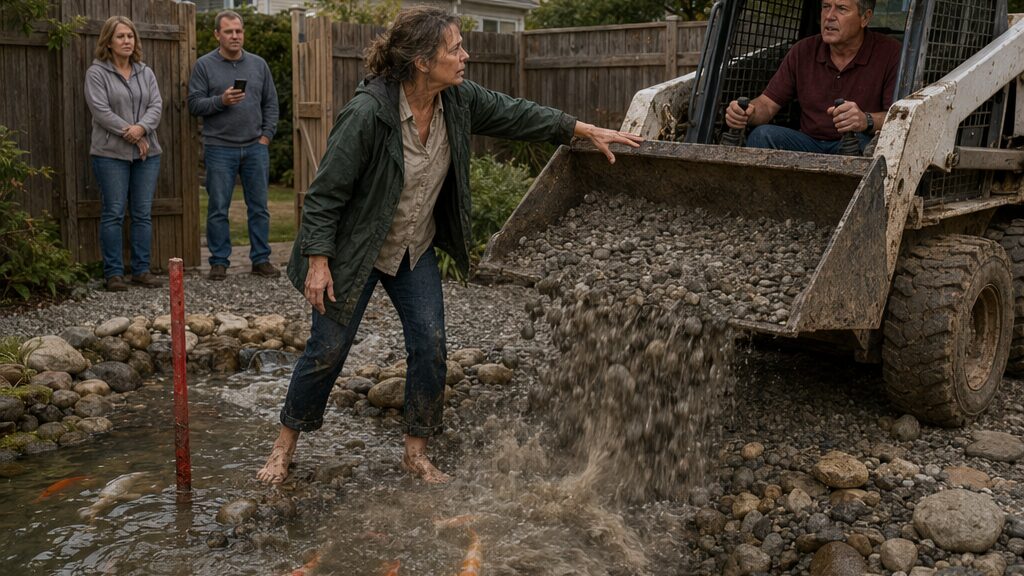
The first load of gravel struck the water while the fish were still beneath it.
Lisa Mitchell heard the splash from her kitchen and ran through the back door without stopping for shoes. By the time she reached the fence line, the skid steer’s bucket was rising again, wet stones sliding from its steel lip. The pond had gone cloudy. Orange backs flashed under the surface, then vanished into the brown churn.
“Brian!”
He looked over from the cab but did not shut off the engine.
The machine’s diesel growl filled the narrow space between their houses. Two neighbors stood near the sidewalk, watching through the gap beside Brian’s garage. One held a phone at chest height. Neither stepped closer.
Brian Roberts lowered the bucket and called over the motor, “Stay on your side, Lisa.”
“This is my side of the drainage corridor.”
“It’s my property.”
“It isn’t only a pond.”
He gave a short laugh, as if she had confirmed something he had already told the neighbors about her. His burgundy polo was dark with sweat between the shoulders. A printed rental agreement lay folded on the skid steer’s dashboard.
The pond occupied the low corner of his yard, bordered by rounded river stone and tall grass that had been flattened by the machine’s tires. A faded red stake stood at the far edge, no taller than Lisa’s knee. Most people assumed it marked a buried cable or an old landscaping line. Brian had complained about it for years.
Lisa pointed to it.
“Elevation seven-twelve point four,” she said. “Photograph that marker before you bury it.”
Brian stared at her through the open side of the cab.
“What?”
“Seven-twelve point four. Take a picture. Make sure the pond and the patio are both visible.”
The neighbor’s phone lifted slightly.
Brian killed the engine. The sudden quiet made the trapped water sound louder. Gravel shifted beneath the surface with soft, grinding clicks.
“You came over here barefoot to recite a number?”
“You need to stop.”
“I asked the HOA for three years who maintained this thing. You told me it was complicated. Amanda told me it was under review. Management sent me a paragraph about owner-maintained landscaping.” He gestured toward the pond. “So I’m maintaining it.”
“There are fish in there.”
“I know there are fish. You put half of them in.”
Lisa looked down. The pale koi was nowhere in sight.
She had brought that fish over in a blue storage tub six years earlier, when Brian’s wife had still lived in the house and the pond pump had worked more often than not. Her husband had steadied the tub while Lisa eased the fish into the water. By then he had been too weak to kneel, but he had insisted on coming outside.
She forced herself to look away from the surface.
“Give me twenty minutes,” she said. “Let me move them.”
Brian rubbed a hand across his mouth. For a moment, his expression loosened. Then he glanced toward the neighbors.
“Twenty,” he said. “Not an HOA meeting. Not another packet. Move the fish.”
Lisa returned with two plastic bins, a net, and the old battery aerator from her garage. Brian stood beside the machine, arms folded, while she waded shin-deep into the pond. The gravel had made the bottom unstable. Each step released a dark bloom of silt.
She caught three koi quickly. A fourth struck the net and escaped beneath a shelf of stone. The pale fish appeared once near the drain pipe, its silver-white back turning in the murk.
“Come on,” Lisa whispered.
Brian checked his watch.
“You said twenty.”
“There’s one more.”
“You’ve already taken four.”
“There were five.”
“There were four last month.”
“There were five.”
His jaw tightened. “This is what you always do. Every question becomes a test only you know the answer to.”
Lisa straightened, water dripping from her gloves. “And every warning becomes personal because you don’t like who gave it.”
The neighbors shifted near the garage.
Brian walked to a patio table and picked up a stapled booklet inside a clear plastic sleeve. He held it out.
“Page thirty-two.”
Lisa did not take it.
“Read it,” he said.
“I know what it says.”
That stopped him.
He opened the booklet himself and read aloud. “‘Decorative ponds, fountains, and similar landscape features located within an owner’s lot are the maintenance responsibility of that owner.’”
“That language is incomplete.”
“It’s the handbook.”
“It isn’t the recorded plan.”
“Then why did the HOA give it to me when I bought the house?”
Lisa had no answer she could offer without opening a door she had kept closed for seven years.
Brian saw the hesitation.
His voice grew quieter. “That’s what I thought.”
The pale koi surfaced beside a clump of reeds. Lisa lunged with the net and missed. The fish disappeared beneath the remaining stone ledge.
Brian climbed back into the skid steer.
“You gave me twenty-five minutes.”
“Brian, the pond receives runoff from the upper lots.”
“So does my driveway.”
“The outlet elevation controls where the water spreads.”
He started the engine.
Lisa carried the four rescued fish to her yard, set the aerator running, and returned before he could lift the next load. She stepped directly into the machine’s path.
Brian’s hands froze on the controls.
“Move.”
“No.”
The bucket hovered above her, packed with gray stone.
The neighbor with the phone took two steps forward.
Lisa kept her eyes on Brian. “I am asking you once, clearly, in front of witnesses. Stop work until the county plan is checked.”
“You don’t get to stand in front of equipment.”
“You don’t get to erase a drainage basin because the handbook used a softer word.”
His face changed at the phrase drainage basin. Not belief. Recognition.
“You’ve had years to call it that,” he said. “You never did.”
The sentence struck more accurately than the accusation around it.
Lisa stepped aside.
Brian drove past her, not quickly, but without looking away. The bucket tipped. Gravel poured over the river stones, flattening reeds and sealing the dark opening where the pale koi had vanished.
The red marker trembled as stones struck around it.
For one second its faded top remained visible above the load.
Then Brian lowered the bucket, pushed forward, and buried it.
Chapter 2: The Map the Homeowners Never Received
Every blue runoff arrow on the county plan ended at Brian’s lot.
Lisa spread the sheet across the HOA office table and held down its curling corners with a stapler, a ceramic mug, and two boxes of old meeting minutes. The paper was larger than the table. Drainage lines crossed lot boundaries in thin blue ink, converging on the basin behind Brian’s house before exiting through a pipe beneath the walking trail.
At the basin edge, a small red triangle carried the number 712.4.
Amanda Hill stood opposite Lisa with her arms folded. She had arrived in workout clothes and a rain jacket, her hair still damp from a shower. It was after eight on Friday evening, and the community management office had been closed for hours.
“This is the approved grading plan?” Amanda asked.
“Stamped by the county.”
“Recorded?”
“Yes.”
“Then why isn’t the easement shown on the plat in Brian’s closing packet?”
“It may be on an attachment.”
“May be?”
Lisa looked through the folder again, though she already knew what was missing.
Amanda pressed two fingers against the bridge of her nose. “I cannot authorize the association to enter his lot based on ‘may be.’”
“He filled the basin.”
“He filled something the current handbook calls a decorative pond.”
“The handbook doesn’t supersede engineering.”
“No, but it changes notice. It changes liability. It changes whether we can claim he knowingly interfered with a common system.”
Lisa tapped the plan. “The water does not care what the handbook calls it.”
Amanda’s eyes lifted. “Neither will the insurer, when they ask why the board distributed two different descriptions.”
The office smelled of copier toner and the citrus cleaner used by the management company. On one wall hung framed photographs of holiday lights, yard contests, and ribbon cuttings. Nothing showed the drainage corridor. Nothing showed the pond after a storm.
Lisa pulled a second document from the records box: the homeowner map printed on glossy paper. It showed streets, lot lines, mail kiosks, the clubhouse, and the walking trail. Brian’s pond appeared as a blue oval with three decorative reeds drawn beside it.
No runoff arrows. No outlet pipe. No elevation marker.
Amanda placed the two maps side by side.
“Who approved this version?”
“The board.”
“You were on the board.”
“I chaired landscape.”
“You voted.”
Lisa said nothing.
Amanda’s expression sharpened. “Did you know the drainage labels had been removed?”
“I knew the map was simplified.”
“That was not my question.”
Lisa moved the ceramic mug from one corner of the county plan and rolled the paper inward before it could spring back. “We need an emergency inspection.”
“We need counsel.”
“We may not have time.”
“The forecast says thunderstorms, not a hurricane.”
“The upper lots shed almost nine acres into that low point.”
Amanda looked toward the dark office window. “You’re certain?”
Lisa pointed to the contour lines. “Here. Street runoff crosses between these two houses. Roof drains enter along the swale. The trail culvert backs up during high intensity rain. The basin stores the peak before the outlet catches up.”
“Why wasn’t this in the reserve study?”
“It was.”
Amanda turned back. “I read the reserve study.”
“You read the summary.”
For the first time that evening, Amanda looked frightened rather than irritated.
Lisa opened another binder and found the maintenance schedule. The pages listed inlet clearing, sediment removal, outlet inspection, and annual marker readings. The last completed entry was seven years old.
The recorded elevation was written in Lisa’s own hand.
712.4.
Amanda noticed the handwriting. “You maintained it?”
“My husband and I checked it. Before he got sick.”
“And after?”
“The board postponed the work.”
“Who recommended postponing it?”
Lisa closed the binder.
Amanda pulled it back open. Beneath the maintenance schedule sat the minutes from a budget meeting. The page carried a motion to reclassify several features as owner-maintained landscaping pending legal review. The motion passed four to one.
Lisa’s name appeared among the votes in favor.
Amanda read it twice.
“You approved this.”
“I approved delaying the assessment.”
“You approved the language.”
“The assessment would have been nearly four thousand dollars per home.”
“That does not answer me.”
“My husband had started treatment. Three families were already behind on dues. The board president said the wording was temporary until counsel reviewed the easements.”
“And did counsel review them?”
“No.”
“Did you follow up?”
Lisa looked at the red triangle on the engineering plan.
At the time, silence had felt like triage. One bill deferred. One fight avoided. One season survived. She had told herself the system remained physically unchanged, that everyone who mattered still knew what the pond was.
Then board members rotated out. Management companies changed. New homeowners received glossy maps. The language hardened through repetition.
Amanda sat down.
“If I call the county now, they will ask when we last inspected it.”
“Yes.”
“They will ask whether Brian received notice.”
“Yes.”
“They will ask why our handbook contradicts our recorded plan.”
“Yes.”
“And you knew.”
Lisa met her eyes. “I knew enough to object. I didn’t object where it would count.”
A truck rumbled outside.
They both went to the window. Through the trees behind the office, headlights moved slowly along the service road. A dump truck was turning toward Brian’s street.
Amanda picked up her phone. “I’ll call management.”
“Call the county emergency line.”
“Lisa—”
“The outlet may already be blocked.”
Amanda hesitated, then dialed.
Lisa rolled the county map carefully and carried it home under her arm. In her kitchen, the four rescued koi moved in slow circles inside the storage bins. The aerator hummed. She searched each pale flicker, still hoping she had miscounted.
At 9:17, her phone sounded with a severe-weather alert.
Flash flooding possible overnight. Repeated storms expected. Avoid low-lying areas.
A second notification arrived from the neighborhood message board.
Brian had posted a photograph of the completed work. The pond was gone beneath a flat rectangle of pale gravel. Patio chairs stood neatly along its edge.
His caption read: Finally fixed the eyesore.
Behind the fence, another truck released its load.
Chapter 3: When the Water Chose Its Old Path
Water began bubbling through the gravel before the rain became heavy.
Lisa saw it from her upstairs window: small dark circles forming across Brian’s newly flattened yard, each one pulsing as trapped water pushed upward between the stones. For a few minutes the surface looked as if it were boiling from below.
Then the circles joined.
She grabbed the rolled county plan, a flashlight, and her phone. By the time she reached the back door, rain was striking the glass hard enough to blur the fence.
The rescued koi thrashed in their bins at the change in pressure.
“Stay,” she told them, though the word sounded foolish even to her.
Outside, water ran ankle-deep along the swale between the houses. It crossed beneath the fence where the ground dipped, carrying mulch, leaves, and one of Brian’s plastic edging strips. The gravel field was already darker at its center.
Brian stood beneath his covered patio in a raincoat, filming.
“You see it?” Lisa shouted.
“I see rain.”
“It’s coming through from the inlet side.”
“The yard’s settling.”
A sheet of water spilled from the upper lots and struck the gravel. Instead of spreading into the old basin, it skated across the compacted surface and turned toward the neighboring property.
Lisa opened the county plan under the shelter of Brian’s patio roof, holding it against the wind.
“The storage volume is gone.”
Brian glanced at the page. “You said the water came here. It came here.”
“It was supposed to stay here.”
“It isn’t at my door.”
A cry came from the house below them on the slope.
The neighbor whose basement sat half a level lower than Brian’s ran into the yard wearing slippers and a hooded sweatshirt. “Water’s coming through the window well.”
Lisa folded the map and pushed it at Brian. “Call 911 if the electrical panel gets wet.”
Then she followed the neighbor downhill.
The basement door opened against moving water. Inside, brown runoff had already covered the vinyl floor. A laundry basket floated sideways near the stairs. The neighbor’s child stood halfway up the steps, clutching a small dog.
“Breaker panel?” Lisa asked.
“Back wall.”
“Is the main above the waterline?”
“I don’t know.”
Lisa stepped inside before she could think better of it.
The water was colder than the pond had been. It reached mid-calf and pressed against her legs with surprising force. She swept her flashlight across the wall. The lower outlets were submerged.
“Do not come down,” she called. “Take the child upstairs and stay away from the metal railing.”
The panel was mounted above a workbench. Water lapped beneath it. Lisa climbed onto the bench, shoes slipping on scattered tools, and pulled the main disconnect.
The basement went black.
From outside came the sound of something large collapsing. A patio storage box had broken free and struck the fence.
Lisa climbed down and found the stairs by flashlight. At the top, the neighbor was crying without sound, one hand over her mouth.
“I’m sorry,” Lisa said.
The woman stared at her. “For what?”
Lisa did not answer.
Back outside, Amanda’s SUV had stopped in the cul-de-sac with its hazard lights on. She wore rubber boots and carried a folder beneath her coat, as though paper could still control what was happening.
“County dispatch logged it,” Amanda said. “They can’t send anyone until the lightning eases.”
“Get people out of the lower rooms.”
Amanda looked past Lisa toward the flooded basement. “Is that from Brian’s yard?”
“It’s from all of us.”
“That is not what I asked.”
Lisa pointed uphill. Water poured between houses in multiple channels now, following routes hidden for years beneath lawns and fences. The pond had not served only Brian’s lot. It had received runoff from rooftops, rear swales, the walking trail, and part of the street.
The glossy homeowner map had reduced the system to a blue oval. The storm was drawing the missing lines back onto the ground.
They moved door to door. At one house, water seeped beneath a sliding door. At another, it pooled against a retaining wall and lifted landscape timbers from the soil. Amanda called residents by name and told them to move cars uphill. Lisa marked water depths on her phone, photographing fence posts, foundations, and the line climbing across Brian’s gravel.
At 11:08, the water reached the elevation where the red marker had stood.
Lisa knew because it touched the second course of stone on Brian’s patio wall, exactly level with the marker’s faded top in an old maintenance photograph.
She took a picture.
The image showed water covering nearly all the gravel, but Brian’s house still stood dry behind the raised patio. Downhill, the neighbor’s basement windows were black rectangles beneath the flood.
Brian came through the gate.
“You’re photographing my property.”
“I’m photographing the high-water line.”
“You’re building a case.”
“I’m recording what the system is doing.”
“The system you didn’t maintain.”
There it was: not denial, but accusation shaped around enough truth to wound.
Lisa lowered the phone.
Brian stepped closer. Rain ran from his hood and down his face. “You knew this could happen.”
“I warned you.”
“Today. You warned me today, after years of calling it a pond.”
“I told the board—”
“You were the board.”
Amanda stood several yards away, listening.
Brian pointed toward the flooded basement. “You want that on me because I rented a machine. Fine. Put the gravel on me. But don’t stand there like the rest of this began Friday afternoon.”
A burst of thunder rolled over the houses.
Lisa looked toward the lower yard. The water had begun to slow near the damaged basement. For one dangerous moment, relief rose in her.
Then she noticed the patio storage box lodged against the fence. It had blocked the opening between the yards, forcing the current sideways.
The water was changing direction.
“Move that box,” she said.
Brian followed her gaze. “It weighs two hundred pounds.”
“Then open the gate.”
“If we open it, the water comes here.”
“It is already coming here.”
He hesitated.
Lisa and Amanda waded to the fence. Together they pulled at the storage box, but the current held it flat against the boards. Brian stood under the patio for another second, then entered the water.
The three of them lifted. The box shifted, spun, and slammed into a tree. Water surged through the reopened gap.
For several seconds it poured harmlessly across the center of Brian’s yard.
Then the current found the compacted track left by the skid steer.
A narrow stream raced along it, curved around the buried pond, and pointed directly toward Brian’s patio doors.
Inside the house, a light came on.
Emily Roberts appeared behind the glass.
She looked down at the water gathering against the threshold, then up at her father.
Brian stopped moving.
The first brown ribbon slipped beneath the door.
Chapter 4: The Decorative Pond Defense
Brian laid the HOA handbook on a wet folding table as if it were evidence in a trial.
The clubhouse had lost power during the night, so the emergency meeting took place beneath the covered entrance, where residents stood in damp clothes and muddy shoes. Water still filled the gutter along the cul-de-sac. A restoration crew had placed yellow fans inside the neighbor’s basement, their cords running through an open window to a generator.
Brian pressed one hand flat against page thirty-two.
“This is what I was given when I bought the house,” he said. “Decorative ponds are the owner’s responsibility. I removed an owner-maintained feature on my own lot.”
Lisa stood across from him with the county grading plan rolled beneath her arm. Her jeans were still stained from the basement. Every time she looked toward Brian’s house, she could see the brown tide mark across the bottom of his patio doors.
Amanda sat between them with two volunteer board members and the HOA management representative. None of them looked rested.
“The question this morning,” Amanda said, “is not whether anyone is angry.”
A man near the curb laughed without humor.
“The question,” Amanda continued, “is what failed, what remains dangerous, and what authority the association has to act.”
“What failed is standing right there,” the neighbor whose basement had flooded said, pointing at Brian.
Brian turned toward her. “I didn’t direct water into your house.”
“You removed the place it was supposed to go.”
“I removed a pond the HOA refused to maintain.”
Lisa unrolled the county plan.
Brian immediately lifted the handbook.
“There,” he said. “That. Every time Lisa wants something, she produces a different map.”
“This one was recorded with the subdivision approval,” Lisa said.
“And this one was handed to every homeowner.”
The argument stopped when Emily Roberts walked from the parking lot carrying a laptop inside a plastic grocery bag.
She did not sit beside her father.
Emily had arrived during the worst of the flooding and spent the night pulling wet rugs from Brian’s lower level. Her hair was tied back, and a pale line of dried mud crossed one cheek.
“I found the email,” she said.
Brian looked at her. “What email?”
“The one you sent management before you rented the machine.”
Silence moved through the group more effectively than Amanda’s attempts at order.
Emily set the laptop on the table and opened a message dated eleven days earlier. Brian had asked whether the pond required HOA approval before removal. The management representative’s response appeared beneath it.
The representative leaned forward. “I didn’t write that.”
“It came from your address,” Emily said.
“I mean I didn’t authorize removal.”
Amanda read the sentence aloud. “‘Based on the governing handbook, decorative water features within an owner lot are generally considered owner-maintained landscaping. Please submit exterior modification photographs after completion.’”
Brian looked around the gathering. “There. I asked.”
Lisa felt her anger shift beneath her, losing the solid footing it had held since Friday.
“You also received my warning before the work was complete,” she said.
“You gave me a number and called it a basin after the first truck arrived.”
“I stood in front of the machine.”
“And then you moved.”
Amanda raised her voice. “Enough.”
The management representative pulled the laptop closer. “This was not approval. It says generally.”
“It also says after completion,” Emily replied. “Not before.”
The representative’s face tightened. “We use standard language when the documents are unclear.”
“They were unclear because you never checked the recorded plan,” Lisa said.
“And you knew the plan existed,” the representative answered. “You chaired the committee.”
The accusation landed in front of everyone.
Lisa could have said the management company had changed twice since the original records were filed. She could have said the board had voted. She could have said Brian had ignored a direct warning, endangered the fish, and buried an elevation marker after she named its purpose.
All of it was true.
None of it erased the handbook in his hand.
A county truck entered the cul-de-sac and stopped beside the clubhouse. Edward Green stepped out wearing rubber boots and carrying a hard plastic document case. He surveyed the water marks, the damaged yards, and the pile of gravel visible beyond Brian’s fence.
“Who is the responsible property owner?” he asked.
Brian lifted one hand.
“Who represents the association?”
Amanda did the same.
Edward set his case on the table. “I need access to the altered lot, the downstream properties, all recorded drainage documents, and any maintenance records.”
Brian nodded toward Lisa. “She has the secret version.”
Edward glanced at her but did not react. “Recorded plans are not secret because homeowners have not read them.”
“This one wasn’t in my closing packet.”
“That is a separate issue.”
Edward spent the next hour measuring the high-water line, photographing the compacted gravel, and tracing the old outlet with a probe. Near the fence, he found the top of the buried pipe packed with stone and soil.
“The outlet wasn’t merely covered,” he said. “The approach grade was raised. Storage volume is effectively gone.”
Brian folded his arms. “The water came from HOA property.”
“Most stormwater systems receive water from somewhere else.”
“Then the HOA should have maintained it.”
Edward looked toward Amanda. “When was the last inspection?”
Amanda glanced at Lisa.
“Seven years ago,” Lisa said.
Edward wrote it down.
The neighbor with the flooded basement stepped closer. “So who pays for my house?”
Edward capped his pen. “I don’t determine private damages. I determine compliance.”
“That’s convenient,” she said.
“No,” he replied. “It’s limited.”
He asked to see the handbook and the management email. He read both without expression, then compared them with the recorded grading plan.
“The owner altered a certified stormwater feature without county approval,” he said. “That is a violation.”
Brian opened his mouth.
Edward held up one hand.
“The association also appears to have distributed maintenance language inconsistent with the recorded design and failed to perform required inspections.”
Amanda’s face went still. “Are you saying the HOA violated county requirements?”
“I’m saying I will issue findings after review.”
“Against whom?” Brian asked.
“Possibly both parties.”
The insurer called before Edward left.
Amanda put the call on speaker, and an insurance adjuster explained that coverage was being reserved pending investigation into unauthorized earthwork, inaccurate community records, deferred maintenance, and prior knowledge.
“What does reserved mean?” one board member asked.
“It means no commitment to coverage has been made.”
The neighbor stared at the phone. “My basement is already ruined.”
The adjuster repeated the phrase about pending investigation.
When the call ended, nobody spoke for several seconds.
Edward packed the handbook copy, the email printout, and the county plan into separate folders.
“I’ll return tomorrow,” he said. “Until then, no one moves gravel, alters the outlet, or changes the grade.”
Brian looked at Lisa. “You wanted enforcement.”
She looked past him at the water line across three homes.
Not like this, she thought, but she did not say it.
Edward closed his case.
“Prepare for two correction notices,” he said. “One for the property owner, and one for the association.”
Chapter 5: What Lisa Signed During the Hardest Year
Lisa found her signature at 1:13 Monday morning.
It sat beneath a paragraph she had spent seven years remembering differently.
The page came from a board packet stored in a cardboard file box at the back of her bedroom closet. She had kept it because the meeting occurred the same week her husband began treatment, though she had never admitted that was why. Hospital parking receipts and pharmacy instructions were tucked between the minutes.
The motion read:
Reclassify ornamental water features located within individual lots as owner-maintained landscaping for budget and maintenance purposes, pending legal confirmation of common drainage obligations.
Four votes in favor.
One opposed.
Lisa’s name appeared beside the second yes.
She sat on the bedroom floor with the paper in her lap.
The phrase pending legal confirmation had once seemed protective. Temporary. A promise that someone would return to the question when money and illness and late fees stopped arriving all at once.
No one had returned.
She opened the next folder. Her husband’s handwriting ran along the margins of old inspection sheets.
Clear leaves at inlet before October storms.
Outlet slow after heavy rain.
Marker holding at 712.4.
His notes were practical, narrow, written in the block letters he used when pain medication made his hand unsteady. On the final sheet, beside the elevation reading, he had drawn a small arrow toward the pond and written, Still doing its job.
Lisa pressed her thumb against the sentence.
At eight the next morning, she carried the file box into the county records office. Edward met her beside a counter stacked with rolled plans.
“You brought originals?” he asked.
“Copies and originals.”
He examined the first page. “You understand these may become part of the enforcement file.”
“Yes.”
“And potentially civil discovery.”
“Yes.”
He looked at her then, not unkindly. “You may want counsel before submitting anything that reflects board knowledge.”
“That is what Amanda told me.”
“She isn’t wrong.”
“No. She’s late.”
Edward did not answer.
Lisa handed him the maintenance sheets. “The basin was inspected informally for years. My husband and I did most of it because the association never assigned a contractor.”
“Why informally?”
“Because calling it formal would have required budgeting for it.”
Edward studied the handwriting. “And when did the inspections stop?”
“When he got sick.”
The words came out evenly, which made them harder to bear.
Edward arranged the records by date. The history emerged without explanation: annual readings, delayed sediment removal, repeated concerns about the outlet, then the board motion, then nothing.
“This does not relieve Mr. Roberts,” he said.
“I know.”
“He performed unpermitted work after a direct warning.”
“I know.”
“But it changes the association’s exposure.”
“I know that too.”
The office door opened behind them.
Emily entered carrying a thick envelope.
She stopped when she saw Lisa. For a moment, both women seemed tempted to leave.
“I asked her to bring the closing documents,” Edward said.
Emily placed the envelope on the counter. “My father doesn’t know I copied all of these.”
Lisa closed the file box. “You should tell him.”
“I will.”
Emily looked at the inspection sheets. “Are those your husband’s?”
Lisa nodded.
“I remember him feeding the fish.”
“He said they were the only residents who never complained about dues.”
Emily almost smiled. It disappeared quickly.
“My father knew you thought the handbook was wrong,” she said.
Edward paused over the documents.
Lisa’s fingers tightened around the box edge. “What did he know?”
“Years ago, when he was treasurer, you sent him an email saying the reclassification should not become permanent.”
“I sent that to the full board.”
“He kept it.”
“Why?”
“Because he was angry.”
Lisa waited.
Emily took a folded printout from her envelope. The message was dated six years earlier. Lisa recognized her own clipped language.
The pond is part of the approved storage system regardless of how we describe maintenance. We are creating a future disclosure problem.
Beneath it, Brian had written a reply to the board president but never sent it.
Then why did we vote to hide the cost from homeowners?
Emily watched Lisa read.
“He found that last month when the appraiser flagged the pond,” she said. “He said you had no right to lecture him now.”
“So he knew it might be drainage.”
“He knew you had objected. He also knew you voted for the change.”
Edward took the page. “Did he show this to the equipment company or management?”
“No.”
“Did he seek county approval?”
“No.”
Emily’s eyes filled, but her voice remained controlled. “The house has to be refinanced. My business loan is tied to it. If the appraisal came in low again, the bank could call part of the debt.”
Lisa had known Emily was under pressure. She had not known the house stood behind it.
“So he filled the pond to raise the appraisal.”
“He said he was correcting something the HOA abandoned.”
“And he believed that?”
Emily looked toward the rolled plans. “Enough to do it. Not enough to ask the county.”
That was the character-based truth Lisa had not wanted. Brian had not acted from ignorance alone. He had acted from resentment sharpened by fear, using the HOA’s dishonesty as permission to commit his own.
Lisa thought of him standing beneath the patio while another basement flooded.
“I am not asking you to excuse him,” Emily said.
“I don’t.”
“I’m asking you not to pretend this started with the skid steer.”
Lisa placed the board motion beside Brian’s unsent reply.
“No,” she said. “It started when we decided accuracy could wait.”
Edward gave her a disclosure form. “Once you sign, these enter the file.”
Lisa read the warning at the top. Submission could affect enforcement, insurance coverage, association liability, and pending claims.
Her instinct was to separate the pages. Give the county the inspection sheets, withhold the motion until she spoke to counsel, preserve the strongest case against Brian.
That instinct had governed too much already.
She signed.
At home that afternoon, Amanda called three times. Lisa let the first two calls go to voicemail. On the third, she answered.
“Tell me you did not submit the old board packet,” Amanda said.
“I submitted all of it.”
“We had a meeting scheduled with counsel.”
“The county asked for maintenance history.”
“You may have destroyed our coverage.”
“We did that before the rain.”
“Lisa, thirty-two families may receive an assessment because you decided to make a confession.”
“Thirty-two families received a false description because I decided not to make one seven years ago.”
Amanda went silent.
Lisa opened her laptop. She attached the county plan, the board motion, the maintenance sheets, Brian’s old email, and a plain chronology without argument.
“What are you doing?” Amanda asked.
“Removing the private advantage.”
“Meaning?”
“If Edward has the file, every homeowner should have it.”
“Do not send anything until counsel reviews it.”
Lisa looked through the kitchen window. The four rescued koi moved beneath the aerator’s small circle of bubbles. The pale fish was still missing.
“I already waited for review,” she said.
She entered the neighborhood distribution list and pressed send.
Chapter 6: The Meeting Where Nobody Stayed Innocent
Three repair estimates faced the homeowners before anyone said hello.
Amanda had taped them to the clubhouse wall beside a county correction notice and a letter from the insurer refusing to commit to coverage. The smallest estimate was large enough to trigger a special assessment. The largest included excavation, outlet replacement, erosion repair, engineering certification, and restoration of the damaged yards.
Someone had written RIDICULOUS across the top page in blue ink.
The room filled beyond its folding chairs. Residents stood against the walls and in the doorway. Brian sat in the front row beside Emily, his arms crossed. Lisa remained at the rear until Amanda called the meeting to order.
“We are not here to retry the storm,” Amanda said.
A homeowner answered, “Then why are we paying for it?”
Voices rose at once.
Amanda struck the table with a wooden gavel rarely used for anything more serious than holiday decoration approvals.
“The county has issued preliminary corrective requirements to Mr. Roberts and to the association. No final allocation has been accepted.”
“Brian filled it,” someone said.
“The HOA lied about it,” another replied.
The neighbor whose basement had flooded stood near the center aisle. “My insurance deductible is due now. Not after you decide whose vocabulary caused the water.”
That quieted the room.
Amanda turned to the estimates. “The immediate proposal is a phased restoration. Mr. Roberts would fund removal of the fill and repair of damage caused directly by the unauthorized work. The association would fund the outlet, shared drainage improvements, engineering, and future inspection.”
Brian leaned forward. “The proposal says I accept primary responsibility.”
“You performed the work,” Amanda said.
“Based on your handbook and your manager’s email.”
“After Lisa warned you.”
“After she helped write the handbook.”
Heads turned toward Lisa.
She walked to the front carrying a long object wrapped in a towel. Mud had dried along one end.
She placed it on the table and unfolded the cloth.
The red water-level marker was bent nearly in half.
The contractor had recovered it that morning from beneath the gravel. Its faded number remained visible along one side.
712.4.
A few residents leaned closer.
Lisa rested both palms on the table. “This marker did not belong to Brian. It did not belong to me. It recorded the elevation the basin was designed to hold before water moved toward the houses.”
“Then why didn’t we know that?” a homeowner asked.
“Because the association stopped telling you.”
Amanda looked down.
Lisa continued before fear could turn her words into qualifications.
“I voted for the language that helped hide it.”
The room shifted.
“I believed the change would be temporary. The board wanted to avoid a special assessment during a bad year. Several owners were behind on dues. My husband had begun treatment, and I could not face another expense or another fight.”
No one interrupted her now.
“I told myself the engineering plan still existed. I told myself the physical system had not changed. I told myself people who needed to know would know.”
She touched the bent marker.
“Then the people changed. The board changed. The management company changed. The language stayed.”
Brian’s arms slowly uncrossed.
A homeowner near the door said, “So this is your fault.”
Lisa met his eyes. “Part of it is.”
Amanda looked at her sharply, perhaps hearing the insurer’s language in every sentence.
Lisa did not stop.
“Brian was warned before he finished. He chose to continue. He buried this marker after I gave him the elevation. That choice belongs to him.”
Brian rose.
“You do not get to confess your way into being noble.”
“I’m not trying to.”
“You release documents after the damage and now everyone thinks honesty is your idea.”
“No. Honesty was my obligation. I missed it.”
The directness unsettled him more than an accusation would have.
Emily placed a hand on his arm, but he pulled away.
“The bank gave us thirty days,” he said to the room. “The pond lowered the appraisal. The HOA refused to claim it. The county wasn’t in my closing documents. I asked management. I got an answer.”
“You also had Lisa’s old email,” Emily said.
Brian turned toward her.
She held his gaze. “You knew she had called it part of the drainage system years ago.”
A murmur traveled across the room.
Brian’s face reddened. “She voted to bury the issue.”
“And you buried the pond,” Emily replied. “Both can be true.”
The room became still.
Lisa watched Brian look from his daughter to the marker, then to the estimates on the wall. For the first time, his anger had nowhere clean to go.
Amanda cleared her throat. “The board needs a workable vote.”
Lisa opened a folder.
“The licensed contractor provided a revised sequence,” she said. “First, remove enough fill to restore emergency storage. Second, reopen the outlet under county supervision. Third, rebuild the basin and repair downstream erosion. The association can finance its portion over three years if we approve a transparent stormwater assessment.”
“How much?” someone asked.
She gave the monthly range.
Several people protested immediately.
A homeowner said, “I’m on the upper side. My house didn’t flood.”
“Your roof drains into the same system,” Lisa replied.
Another said, “Why should new owners pay for an old board’s mistake?”
“Because the water is still coming next year.”
It was not a satisfying answer. That was why it held.
The neighbor with the damaged basement stood. “I don’t want an apology. I want the system fixed before my children sleep downstairs again.”
Her words drew the room back to the practical question.
Amanda called for discussion of the phased plan. Residents argued over percentages, deductibles, legal claims, and whether Brian’s share should include all downstream damage. Nothing resolved neatly.
At last Brian spoke.
“I will not sign anything that says I alone caused this.”
Amanda’s shoulders sank. “No one is asking you to accept sole liability.”
“The proposed agreement says primary.”
“You operated the machine,” Lisa said.
“And you concealed the function.”
“Yes.”
He stared at her, apparently waiting for a defense.
She offered none.
Emily leaned close to him. “The refinancing option requires cooperation with the correction order.”
Brian’s expression changed. “You spoke to the bank?”
“I spoke to everyone because you stopped answering.”
She slid a page toward him. “They will extend the deadline if the property is under an approved restoration contract.”
Brian read without sitting.
Lisa placed another document beside it.
“What is that?” Amanda asked.
“My resignation.”
The room stirred again.
Lisa kept her hand on the page. “Effective after the basin is restored and the maintenance schedule is adopted.”
Amanda frowned. “That is not how resignations work.”
“It is how this one works. I am not leaving the work unfinished again.”
“You think resigning fixes your vote?”
“No.”
“Then why do it?”
“Because accountability without consequence is another temporary phrase.”
Brian looked at the resignation, then at the bent marker between them.
For several seconds, the only sound was the clubhouse ventilation system clicking on.
He did not sign the restoration agreement.
But he did not push it away.
Lisa folded the towel around the marker and left it on the table in front of him.
Chapter 7: The Basin They Rebuilt in Full View
The contractor shut down the excavator because Brian withdrew permission with the bucket already suspended above his yard.
The machine idled beside the half-opened basin, its steel teeth dripping mud. Two dump trucks waited along the curb. A county survey tripod stood where the patio furniture had once been, and orange paint marked the line of the buried outlet.
Brian held the restoration agreement in one hand.
“I did not approve this version,” he said.
The licensed drainage contractor climbed down from the excavator. “The county did.”
“I own the lot.”
“And I need owner authorization to continue.”
Lisa stood near the exposed gravel cut, watching water seep through its lower face. Two weeks had passed since the clubhouse meeting. The weather had stayed dry long enough for arguments, revised estimates, and letters from attorneys. It had not stayed dry long enough to finish the work.
Amanda checked the forecast on her phone. “The warning was upgraded.”
Brian did not look at her. “They upgrade everything now.”
“Two inches possible by midnight,” Lisa said.
“You said that last time.”
“And last time your living room flooded.”
His face tightened.
The contractor removed his hard hat. “I have another crew waiting. If we do not proceed in ten minutes, I pull the equipment.”
Emily came through the side gate carrying a document envelope. She stopped beside her father.
“The lender approved the extension,” she said.
Brian turned. “Without telling me?”
“With conditions.”
She handed him the letter. The bank would delay action on the loan if the property entered an approved restoration contract and Brian contributed the required owner share. Refusal to cooperate would end the extension.
Brian read the first page, then the second.
“You used the house against me.”
“I used the only option you left.”
“This is my house.”
“It secures my debt too.”
Lisa looked away from them. The open basin had begun to resemble a wound rather than a pond: gravel walls, severed roots, a dark pipe mouth exposed near the bottom. The contractor had removed enough fill to reveal the old river stones but not enough to restore storage capacity.
The bent red marker lay on a work table beside the survey equipment.
Brian folded the bank letter. “The agreement still says my work caused the immediate obstruction.”
“It did,” Amanda said.
“And the association’s negligence appears in one paragraph.”
“It appears in the allocation.”
“Not in the admission.”
Lisa opened the folder she had brought.
“Then add mine.”
She placed a signed statement on the table.
Brian did not reach for it. “What is that supposed to be?”
“My acknowledgment that I voted for language that obscured the basin’s function and failed to ensure the correction was made.”
Amanda stared at her. “Counsel told us not to create separate admissions.”
“I am not speaking for the association.”
“You were acting as a board member.”
“I am speaking for myself.”
Brian picked up the statement.
Lisa had kept it brief. No excuses. No mention of her husband’s treatment, the assessment they had feared, or the people who had urged delay. The statement accepted responsibility for her vote and her failure to force the issue back onto the agenda.
It did not reduce Brian’s responsibility.
He read to the end.
“You think this makes us even?”
“No.”
“Then why do it?”
“Because I asked you to sign something accurate while withholding the same from myself.”
Emily watched her father’s face.
The contractor checked his watch.
Beyond the rooftops, thunder sounded—distant but distinct.
Brian looked toward the excavator. “If I sign, the county still fines me.”
“Yes,” Amanda said.
“The HOA still assesses me.”
“As it assesses everyone.”
“And the neighbor can still sue.”
No one answered.
He looked at Lisa. “There is no clean way out.”
“No.”
For several seconds, he held both documents while the machine idled behind him.
Then he took the pen from the table and signed.
The contractor climbed back into the cab before Brian could reconsider.
Work resumed at once. The excavator tore into the compacted gravel, lifting bucket after bucket into the waiting trucks. Brian stood near the surveyor, answering questions about the buried edge stones and the route he had taken with the skid steer.
At the outlet, the contractor found the pale koi.
It lay trapped in a shallow pocket between the original wall and the gravel fill, alive but barely moving. A worker lifted it with both gloved hands and placed it into a tub.
Lisa knelt beside the water.
The fish’s gills opened and closed slowly. Its side was scraped, and one fin hung unevenly.
Emily crouched near her. “Is it going to live?”
“I don’t know.”
Lisa added water from the temporary holding tank and connected a small aerator. The pale fish rolled once, then righted itself.
Brian remained several feet away.
“I thought there were four,” he said.
“There were five.”
He nodded without arguing.
By late afternoon, the contractor had reopened the outlet and excavated the emergency storage shelf. The permanent grading could not be completed before dark, but the basin had depth again.
The surveyor drove a new stake into the exposed soil and handed Brian the recovered red marker.
“It cannot go back bent,” Brian said.
“It can until the permanent post arrives,” Lisa replied. “The elevation matters more than how it looks.”
He examined the mud-streaked number, then carried it to the survey point.
Lisa read from the level rod. “Up one inch.”
Brian adjusted it.
“Half an inch down.”
He pressed the marker into the soil.
“Hold it there.”
The first drops struck the paper plans on the table.
The crew covered the equipment and cleared loose tools. Rain darkened the exposed earth in scattered circles, then spread across the basin floor.
Within twenty minutes, runoff entered from the upper swale.
Brian and Lisa stood beneath the patio awning as water traced the restored path. It reached the basin, slowed, and began to rise around the red marker.
The unfinished sides slumped in two places. Mud washed toward the outlet, and the contractor returned with sandbags to stabilize the cut. Brian carried bags beside the crew without being asked.
The water climbed.
It covered the lowest river stones and reached the faded paint line where the old marker had once stood.
Then it stopped rising.
Across the yard, the stream that had previously followed the skid-steer track disappeared into the basin. No water gathered at Brian’s patio doors.
He stood with rain running from his sleeves and watched the level hold several inches below the threshold.
Lisa did not tell him she had been right.
He did not tell her he knew.
Between them, the red marker remained upright in the moving water.
Chapter 8: What the Water Level Remembered
Three months later, children gathered at the restored basin to watch the koi return.
The pond no longer looked ornamental in the careless way the old handbook had implied. A steel grate protected the inlet. Native grasses stabilized the banks. A permanent water-level post stood near the maintenance path, its markings clean and readable from the fence.
The county required a small sign beside it:
STORMWATER DETENTION AREA
TEMPORARY WATER STORAGE DURING HEAVY RAIN
DO NOT ALTER GRADE OR OUTLET
Below the official language, the HOA had added a simpler line.
This pond protects the homes around it.
Lisa lowered the pale koi into the water last.
Its damaged fin had healed crookedly. For a moment, it remained inside the transport net. Then it slipped free and joined the others beneath the grasses.
Brian stood on the opposite bank wearing work gloves. He had spent the morning clearing leaves from the inlet as part of the new maintenance rotation.
Their conversations since the restoration had remained practical.
Outlet clear?
Yes.
Marker reading?
Unchanged.
Contractor coming Tuesday?
Eight-thirty.
Neither had offered forgiveness. Neither had demanded it.
That evening, the annual HOA meeting filled the clubhouse again. The bent temporary marker lay in a display case near the entrance, beside copies of the county plan and the new inspection schedule. The documents were no longer kept in a box or reduced to a decorative blue oval.
Amanda opened the meeting with the assessment vote.
The monthly amount was not popular. Two homeowners argued that the county should pay. Another wanted the association to continue pursuing Brian for the entire cost. The neighbor whose basement had flooded asked whether the new reserve included emergency pumping and annual outlet inspection.
This time, the answer was written in the budget.
Lisa sat in the second row rather than at the board table.
When the vote was called, the assessment passed by four votes.
No one applauded.
Amanda moved to the next item. “Acceptance of Lisa Mitchell’s resignation from the landscape committee and all remaining board advisory duties.”
A homeowner objected. “She built the new plan.”
“She also submitted the resignation,” Amanda said.
“We can reject it.”
Lisa stood.
“I said I would stay until the basin was restored and the maintenance system was adopted. Both are done.”
Amanda looked at her. “You could remain as a nonvoting technical adviser.”
“That is how informal responsibility begins.”
A few people smiled, though the room stayed quiet.
Lisa continued. “The records should not depend on one person remembering what everyone else forgot. The schedule belongs to the association now.”
Amanda called the vote.
The resignation was accepted.
The decision hurt more than Lisa expected. For years, committee work had given shape to her weeks after her husband died. Leaving it felt less like punishment than surrendering a key to a room she had once believed only she could keep in order.
Outside, the basin reflected the clubhouse lights.
Brian waited near the permanent marker with the inspection clipboard.
“You missed the reading,” he said.
“I resigned five minutes ago.”
“The rotation started yesterday.”
“That is not the same thing.”
He handed her the flashlight anyway.
Water stood well below the emergency line. Brian wrote the date, time, and level in the public log. His handwriting was smaller than she expected.
He paused beside the condition box.
“What do I put for the pale one?”
Lisa looked toward the fish moving beneath the surface.
“Present,” she said.
Brian checked the box.
A low rumble sounded beyond the subdivision. The forecast called for rain before morning, ordinary for the season.
Brian secured the clipboard inside the weatherproof cabinet. Then he crouched beside the post and photographed the water level with the basin and patio both visible in the frame.
Lisa recognized the exact angle she had asked him to record on the afternoon he buried the first marker.
He looked at the photograph, entered the reading, and closed the cabinet.
The water waited below them, holding what the neighborhood had finally learned to name.
The story has ended.