They Arrested Richard Beside His Wife’s Roses, but the HOA’s Own Records Exposed the Truth
Chapter 1: The Officers Stepped Across Virginia’s White Roses
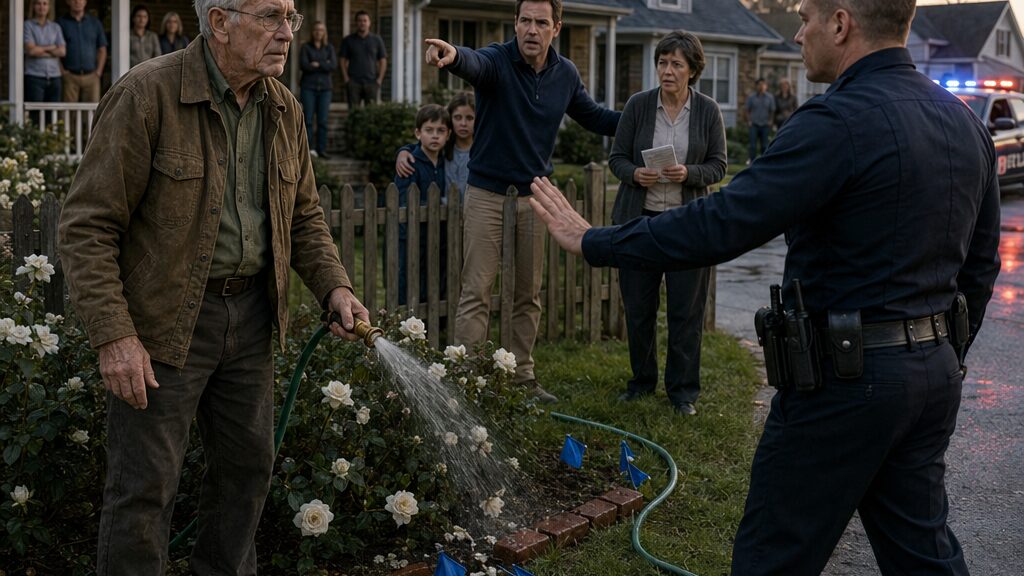
“Drop the weapon!”
Richard Campbell looked down at the object in his right hand.
The brass hose nozzle shone in the late-afternoon sun. Water hissed from its narrow opening and struck the dark soil beneath Virginia’s white roses.
“Sir, drop it now!”
Two police officers stood beyond the driveway with their hands near their holsters. A third moved along the side of a patrol car, watching Richard as though he might suddenly charge.
Richard released the nozzle.
It landed on the brick border with a metallic crack, spun once, and rolled into the rose bed. Water continued spraying across the leaves.
“Hands where we can see them.”
Richard raised both hands. Wet dirt filled the lines of his palms. A thorn had opened the skin beneath his left thumb, and a thin red streak ran toward his wrist.
Across the yard, Jonathan Davis stood beside Donna Hall, the HOA president. Jonathan had one arm around his youngest child and the other extended toward Richard.
“That’s him,” he said. “He threatened my family.”
Richard stared at him.
Jonathan’s face was pale, but his voice carried clearly over the engines of the patrol cars.
“He said he’d kill us. He waved something at the kids.”
“I did not,” Richard said.
An officer stepped through the gap in the hedge.
His boot came down inches from the nearest rose bush.
“Please,” Richard said. “Watch the flowers.”
The officer paused.
Richard lowered himself slowly because his right knee no longer bent without complaint. He kept his palms visible and watched the officer choose another place to step.
The green hose lay across the lawn between them. Beside it, six blue survey flags had been pulled from the ground and stacked against the brick border.
Donna still held the folded notice she had brought to the house. The words EMERGENCY ACCESS INSPECTION showed through the paper where her fingers bent it.
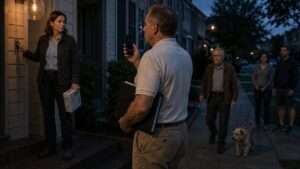
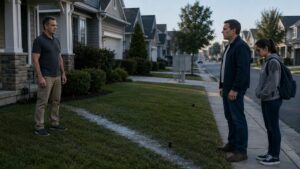
Ten minutes earlier, she had stood at Richard’s gate with an inspector from the HOA management company. Jonathan had been beside them, already angry.
“We need to locate the original drainage channel,” Donna had said.
“You located it last week,” Richard had answered.
“We marked a proposed access line.”
“You marked Virginia’s roses.”
Jonathan had pointed toward the blue flags. “Those bushes are sitting over the drainage bed. My basement flooded again.”
Richard had turned the hose toward the roots and said nothing.
That silence had made Jonathan louder.
“You don’t get to ignore this because you’ve lived here longer than everybody else.”
Richard had removed the first flag while they watched.
Donna had told him not to interfere with a contracted survey. The inspector had tried to explain that no plants would be removed that day.
Jonathan had stepped closer to the fence.
“They’re coming out sooner or later,” he had said. “You can cooperate, or the board can do it without you.”
Richard had pulled the remaining flags one by one.
When Jonathan’s children came into the adjoining yard, Richard had turned away from them. He had picked up the hose nozzle and resumed watering.
Then Jonathan had shouted for his family to get inside.
Now an officer pressed one hand between Richard’s shoulders and guided him onto the lawn.
Richard smelled cut grass and damp earth. His cheek hovered above the cold soil.
“Hands behind your back.”
The cuffs closed tightly around his wrists.
One of the officers retrieved the object from the flower bed. He examined it, then looked toward Jonathan.
“This is a hose nozzle.”
Jonathan did not step back.
“He had something else,” he said. “A gun or a tool. He pointed it at us.”
Richard lifted his head. “I have never owned a handgun.”
“Stay down,” the officer behind him said.
“I never threatened his children.”
“Mr. Campbell, we’ll sort this out.”
Richard heard doors opening along the street. Neighbors gathered on porches and at windows. No one approached. A woman across the road held her phone at chest height.
Donna moved closer to Jonathan and lowered her voice, but Richard caught pieces of it.
“You told dispatch he had a firearm.”
“I saw what I saw.”
“The officer says it’s a nozzle.”
“He put it down before they arrived.”
Richard closed his eyes.
The water continued to run. It had filled the shallow trench around the roses and begun spilling over the bricks.
Virginia had planted the first white bush twenty-six years earlier, after they moved into the house. She claimed the blossoms looked brighter against red brick. Richard had argued that red roses would be easier to keep alive.
She had ignored him and planted white.
The officer helped Richard stand.
“Is there anyone inside the residence?”
“My dog.”
“Any firearms?”
“No.”
“Anyone else?”
“No.”
Jonathan stepped forward before the officer could lead Richard away.
“You need to check the garage,” he said. “He keeps tools in there. He’s been aggressive for months.”
Richard turned toward him. “You know that isn’t true.”
Jonathan’s mouth tightened.
“My children are afraid to play outside.”
“Because you told them to be.”
The officer pulled Richard back.
“That’s enough.”
The words were addressed to Richard, not Jonathan.
He was placed in the rear of a patrol car. Through the window, he watched another officer photograph the blue flags, the pruning shears on the grass, and the brass nozzle lying among white petals.
Donna stood alone near the porch steps now. She looked less certain than she had when she arrived, but she did not stop the officers.
Richard’s dog scratched at the front window. His gray muzzle appeared between the blinds, vanished, then appeared again.
Richard leaned forward as far as the cuffs allowed.
“Someone needs to take care of him.”
The officer in the front seat glanced back. “We’ll contact animal control if necessary.”
“He doesn’t go with strangers.”
“We’ll make sure he’s handled.”
Richard watched the house recede as the car pulled away.
At the corner, he looked back once more. Jonathan had moved beside Donna. He spoke with both hands now, pointing first toward Richard’s property, then toward his own basement window.
Donna opened the emergency notice and read it again.
Jonathan looked toward the departing patrol car.
“He can’t be allowed back there,” he said. “Not with my family next door.”
Chapter 2: Two Nights Away from the House
“Your dog was found alone inside the residence.”
The county clerk said it through the slot in the holding-cell door as though she were reading a utility notice.
Richard gripped the edge of the concrete bench.
“Found by whom?”
“Animal services entered with police authorization.”
“Where is he?”
“I don’t have that information.”
Richard stood too quickly. Pain sharpened through his knee and forced him back against the wall.
“He’s twelve years old. He needs medication with food.”
The clerk’s expression softened, but only slightly. “Your attorney can check.”
“I don’t have an attorney.”
“You have a court appearance this afternoon.”
The slot closed.
Richard sat with his hands between his knees. Dirt remained beneath his fingernails. The jail had taken his belt, wallet, keys, and shoelaces, but no one had given him anything that could clean the dark half-moons from his hands.
For two nights he had slept in short stretches beneath a fluorescent light that never fully dimmed. Each time he woke, he heard the brass nozzle striking the brick again.
At the hearing, a temporary protective order was entered before Richard understood how quickly the proceeding had begun.
Jonathan appeared by video from another room. His attorney described escalating hostility, repeated HOA violations, threatening gestures, and a weapon displayed in front of children.
Richard was assigned counsel only for the criminal allegation. The protective-order matter, he was told, was separate.
The judge read the distance requirement.
Three hundred yards.
Richard leaned toward the microphone. “Your Honor, our houses are less than seventy yards apart.”
The judge looked down at the documents.
“Then you may need alternate accommodation until the full hearing.”
“My medication is in that house.”
“Arrangements can be made through law enforcement.”
“My wife’s things are there.”
The judge’s eyes lifted. “Mr. Campbell, this order is temporary. Do not contact the petitioner or enter the restricted area except through an approved retrieval process.”
By the time Richard was released, darkness had settled over the courthouse parking lot.
Susan Rivera was waiting near the curb with a legal pad beneath one arm.
“I’m the attorney your veterinarian neighbor called,” she said. “Your dog is safe.”
Richard stopped.
“Where?”
“At her clinic. He ate this morning and received his medication.”
The pressure behind Richard’s ribs loosened so suddenly that he had to look away.
Susan opened the passenger door of her car.
“We need to discuss where you can stay.”
“I’m going home.”
“You cannot.”
“It’s my house.”
“And the order is enforceable even if it makes no practical sense.”
Richard did not move.
Susan studied him. “Getting arrested again tonight will not help you keep it.”
He entered the car.
The next morning, in Susan’s office, she spread the police report, temporary order, and HOA records across a conference table.
Jonathan’s statement occupied four pages. It described Richard as increasingly unstable and claimed he had threatened contractors on prior occasions.
Susan tapped a paper clipped behind it.
“He attached complaints from the HOA file.”
Richard looked at the dates.
There were six.
Unauthorized removal of survey markers. Refusal of access. Harassment of a contractor. Interference with drainage assessment. Hostile communication. Threatening conduct.
“Those aren’t findings,” Richard said. “They’re complaints.”
“Most people reading this packet won’t notice the difference.”
“They should.”
Susan sat back. “Courts and police officers make fast decisions from what is placed in front of them. Jonathan placed six written complaints in front of them. You placed nothing.”
Richard’s jaw tightened.
“He lies.”
“Then why didn’t you answer?”
“I don’t conduct conversations through certified mail.”
“That is not an answer.”
“It’s the only one I have.”
Susan turned the first envelope toward him. A postal receipt showed that Richard had signed for it three months earlier.
“You received all six?”
“Yes.”
“And ignored them?”
“Yes.”
“Why?”
“Because the board already knew where the drainage line was.”
Susan pulled out a subdivision map. A dashed line ran between Richard’s rose bed and Jonathan’s property.
“The management company says it needed verification.”
“They could verify it without digging through the roses.”
“They say you prevented an inspection.”
“They arrived with flags.”
“Flags are not excavation equipment.”
Richard pushed the map away.
Susan watched him for a moment, then opened another folder.
“The good news is that the criminal allegation is weak. The object recovered was a hose nozzle. No firearm was found. No witness other than Jonathan claims to have seen one.”
“And the bad news?”
“The HOA complaints create a pattern that makes his story sound plausible.”
“It isn’t plausible.”
“To you.”
She slid a list across the table.
“Jonathan’s attorney has also requested that the temporary order remain in place until trial. If it does, you cannot return home except under escort. The HOA is considering emergency access measures while you are absent.”
Richard looked at the typed words without reading them.
“They want the roses gone.”
“They say they want to inspect the drainage bed.”
“Same thing.”
Susan’s pen stopped above her pad.
“No,” she said. “Those are not automatically the same thing.”
He stood.
The movement sent pain through his knee, but he refused to show it.
“I need to see my dog.”
“I’ll take you after we finish.”
“We’re finished.”
Susan did not raise her voice.
“Mr. Campbell, Jonathan may have lied about the weapon. That does not mean every dispute underneath the lie disappears.”
Richard reached for his coat.
Behind him, papers shifted.
“Why did you ignore six certified notices?” Susan asked. “What were you refusing to let them inspect?”
Chapter 3: The Camera Showed More Than Innocence
Susan froze the video on the object Jonathan had called a gun.
The image filled the monitor in her office: Richard’s right hand wrapped around a brass hose nozzle, white water fanning toward the roses.
Even enlarged, it was unmistakable.
Susan leaned closer. “That is the clearest frame.”
Richard remained standing behind her chair.
A week had passed since his release. He was sleeping in a furnished rental near the county highway, where the refrigerator hummed too loudly and every room smelled faintly of new carpet.
His dog was allowed to stay with him now. The animal lay beneath the conference table with his chin on Richard’s shoe.
“Play it again,” Richard said.
Susan restarted the footage.
The camera belonged to Jonathan. It was mounted above his garage and captured most of Richard’s front yard, the fence line, and a section of the street.
At 3:42 p.m., Richard entered the garden carrying pruning shears.
At 3:49, Donna and the inspector arrived.
At 3:53, Jonathan crossed his driveway and joined them.
At 3:56, Richard pulled the first survey flag from the ground.
At 4:01, Jonathan stepped back onto his own property.
At 4:03, his children appeared near the side gate.
At 4:04, Richard turned away from them and watered the roses.
At 4:06, Jonathan ushered the children inside.
At 4:08, the police call was logged.
At no point did Richard cross the fence. At no point did he raise the pruning shears toward Jonathan. At no point did he retrieve another object.
Susan paused the video when the patrol cars entered the frame.
“Jonathan told police he personally saw you point a handgun at his children.”
“He knew it was a hose.”
“The recording supports that.”
“He knew.”
“I heard you.”
Richard moved closer to the screen.
The white roses shuddered beneath the water. Virginia had planted them in uneven rows because she disliked gardens that looked measured. On the recording, the beds seemed smaller than Richard remembered.
Susan clicked to another file.
“The camera system stores continuous footage. Jonathan’s attorney initially produced only a ninety-second clip beginning when the police arrived. We requested the full hour.”
“He tried to hide it.”
“We cannot say that yet. His attorney claims the shortened clip was an export error.”
Richard gave her a flat look.
Susan did not return it. “What we can say is that the full recording contradicts his sworn account.”
She opened the police statement beside the video.
Jonathan had written that Richard advanced toward the fence, shouted a threat, and raised a dark handgun.
The footage showed Richard remaining within the brick border, speaking only when Donna approached, then turning the hose toward the soil.
For the first time since the arrest, Richard felt the case move beneath his feet.
Not vanish. Move.
Susan pointed to the timeline. “This should defeat the firearm allegation and may support sanctions for a knowingly false report.”
“May?”
“We still need metadata authentication, the original export, and testimony establishing that the system’s clock was accurate.”
“It shows what happened.”
“Yes. And evidence still has to be admitted before it can protect you.”
Richard looked toward the dog.
The animal’s tail struck the carpet once.
Susan played the footage from the beginning again, this time without sound.
At 3:54, the inspector placed a blue flag near the center of the rose bed.
Richard watched himself walk over, pull it out, and lay it beside the bricks.
Then a second.
Then a third.
The satisfaction he had felt moments earlier thinned.
Susan slowed the video.
“You removed every marker.”
“They were in the wrong place.”
“How did you know?”
“I maintained storm drains for thirty-one years.”
“That does not answer how you knew where this property’s recorded line was.”
“I knew.”
The footage continued.
Donna gestured toward the inspector. Richard shook his head and turned away. The inspector attempted to step through the gate. Richard closed it.
Susan paused.
“You denied access.”
“They had no right to enter without my permission.”
“The declaration includes maintenance access for common drainage.”
“Not for tearing out a memorial garden.”
“No one is tearing anything out in this recording.”
“They would have.”
Susan removed her glasses and set them beside the keyboard.
“Richard, I can prove Jonathan lied about a weapon. I cannot prove the board acted improperly if you refused an authorized inspection before anyone proposed excavation.”
“They proposed flags.”
“Flags are not bulldozers.”
He walked to the window.
Below, cars moved through the courthouse district. A delivery driver carried boxes into the building across the street. No one on the sidewalk knew that Richard Campbell had spent two nights in jail because a man next door had turned a hose nozzle into a gun.
Susan’s phone rang.
She answered, listened, then placed the call on speaker.
The HOA’s attorney spoke in a careful, impersonal voice.
“We have reviewed the video material. The association takes no position on the criminal accusation. However, Mr. Campbell’s documented interference with the drainage inspection remains actionable under the governing declaration.”
Richard turned from the window.
Susan asked, “Is the association still seeking emergency access while the protective order prevents him from occupying the property?”
“The board has not withdrawn that request.”
“And the alleged threat was the basis for excluding him.”
“The access issue predates the incident.”
The call ended with no agreement.
Richard returned to the monitor. The frame still showed him behind his closed gate, the blue flags in a pile at his feet.
The camera had proved Jonathan’s lie.
It had also preserved Richard’s refusal from three different angles.
Susan opened a scanned folder provided by the HOA management company.
“Let’s find out what they believed they were inspecting.”
She moved through plats, invoices, and meeting minutes until she reached a faded drainage-access form dated two years earlier.
Two signature lines appeared at the bottom.
One belonged to the former HOA president.
The other was written in a hand Richard knew before he read the name beneath it.
Virginia Campbell.
Susan looked up at him.
“Your wife agreed to this inspection.”
Richard did not answer.
On the monitor beside the document, water continued falling across Virginia’s roses.
Chapter 4: The Agreement Richard Never Wanted Read
Richard found Virginia’s handwriting beneath a stack of unopened certified letters.
The envelopes had been moved from his house to the temporary rental in a plastic storage bin brought over under police escort. He had told the officer the bin contained tax records. That was true, but it also contained everything he had refused to sort after Virginia died: appointment cards, seed catalogs, receipts folded into quarters, and notes written in the narrow blue script she used when she wanted him to remember something.
The drainage-access form lay on the rental’s small kitchen table.
Susan had printed a copy, but Richard wanted the original. He wanted to see whether the signature looked hesitant, whether the pen had skipped, whether someone had placed the paper in front of Virginia when she was too tired to understand it.
Instead, he found her copy filed exactly where it should have been.
She had written in the margin:
Inspection only. No removal without written plan and replacement agreement.
Richard read the sentence twice.
His dog stood near the back door, watching him.
“You knew about this?” Richard asked.
The dog’s ears shifted.
Richard pulled out the next page. It was a letter from the previous HOA president thanking Virginia for agreeing to temporary access along the side bed. The proposed inspection would locate the original drain, determine whether root intrusion had narrowed it, and identify an alternate route if necessary.
No excavation had been authorized.
No rose removal had been approved.
Richard lowered himself into a chair.
During Virginia’s last year, paperwork had accumulated faster than either of them could answer it. Medical bills came in white envelopes. Insurance explanations came in blue. The HOA sent notices in tan envelopes with the management company’s return address printed too high.
Virginia had handled most of them.
He had driven her to appointments and learned how to manage the portable oxygen tank without pinching the line. He had cooked eggs she did not eat and soup she pretended to enjoy. When she asked him to look through the property file, he had said later.
Later had become a word that meant never.
A pressed white rose slipped from between two pages and landed on the table.
Its petals had flattened to the color of old paper.
Behind it was a note addressed simply to Richard.
He recognized the sheet from the pad Virginia kept beside the telephone.
The first lines concerned practical things: where she had placed the warranty for the furnace, which neighbor had agreed to collect mail during hospital stays, how much food the dog should receive if Richard forgot.
Then the note changed.
The side bed may need work one day. Do not let them rush you, but do not refuse only because the roses are mine. They are ours. Plants can be moved if people take care.
Richard’s thumb covered the final sentence.
He sat without moving until the refrigerator motor clicked off and the rental became unnaturally quiet.
He remembered Virginia standing at the kitchen sink after the first basement complaint from next door. Jonathan had not yet joined the HOA committee. His house had belonged to another family then, and the drainage channel had carried water through a shallow stone bed between the properties.
Virginia had said the roses looked too crowded.
Richard had answered that they had survived twenty years.
“That doesn’t mean they should stay where they are forever,” she had said.
He had thought she was speaking about pruning.
Now he was not sure.
Susan arrived an hour later. Richard had called her but offered no explanation.
She entered, placed her bag beside the door, and saw the papers across the table.
“You found the original.”
Richard handed her Virginia’s note.
Susan read it without comment. When she finished, she set it down carefully beside the pressed rose.
“She agreed to an inspection,” Richard said. “Not removal.”
“That matches the form.”
“Jonathan told me they were clearing the whole bed.”
“When?”
“The morning of the arrest. Before Donna arrived. He said the board had waited long enough.”
“Did you tell anyone?”
Richard looked toward the window.
“No.”
“Did you report it to Donna?”
“No.”
“Put it in writing?”
“No.”
Susan’s mouth tightened, but her voice stayed even. “Why not?”
“Because I wasn’t asking Jonathan’s permission to keep my wife’s garden.”
“That was not the question.”
Richard pushed back from the table.
“He stood at the fence and told me contractors would tear everything out whether I cooperated or not. Then blue flags appeared in the middle of the roses. I removed them.”
“And by saying nothing, you let the file show only that you obstructed an inspection.”
“The board knew what he was like.”
“Boards know what is documented.”
Richard looked at her sharply.
Susan did not retreat. “You were wronged. You were also warned, repeatedly, that your silence was making this easier for him.”
He picked up the pressed rose. One edge crumbled against his finger.
“She asked me to keep them alive.”
“She also wrote that they could be moved.”
“That isn’t the same as wanting them moved.”
“No,” Susan said. “It is not.”
For a moment, neither spoke.
Richard returned the flower to the fold in the paper.
“I thought if I let them cut into that bed, there would be nothing left that was exactly as she left it.”
Susan sat across from him. “Was it exactly as she left it?”
Richard pictured the new canes he had trained along the trellis, the two bushes lost to winter, the brick border he had rebuilt after roots lifted one corner.
“No.”
The admission barely carried across the table.
His phone rang.
Donna Hall’s name appeared on the screen.
Richard let it ring twice before answering.
Donna spoke quickly, as though afraid someone might interrupt her.
“I reviewed the old approvals after Susan contacted counsel. There’s a problem with the plan Jonathan submitted.”
“What kind of problem?”
“The drainage route approved by the board is not the route marked in your yard.”
Susan leaned forward.
Donna continued. “The approved line follows the original common swale. Jonathan’s contractor moved it almost four feet toward your rose bed.”
Richard’s grip tightened around the phone.
“Why?”
“I don’t know yet. The board packet contains a revised diagram, but I cannot find a vote authorizing it.”
Susan reached for her legal pad.
Donna’s voice dropped. “Jonathan signed the contractor request as compliance chair. Richard, he altered the approved drainage plan.”
Chapter 5: The Water Had Been Redirected Next Door
The stain on Jonathan’s basement wall proved his diagram was wrong.
Richard saw it in a photograph spread across the HOA records-room table. The brown water line rose highest near the rear corner of the house, then sloped downward toward the front.
Jonathan’s submitted diagram claimed water entered from Richard’s side yard near the front rose bed.
“It did not travel that direction,” Richard said.
Donna stood beside him with both hands braced on the table. “You can tell that from one photograph?”
“I can tell from the tide line.”
Susan moved closer.
Richard traced the stain without touching the image. “Water settled deeper here. If it entered where Jonathan says, the high mark would be at the opposite end unless the floor slopes backward.”
Donna opened a folder containing the original builder plans.
Richard had spent thirty-one years maintaining municipal drains, culverts, and catch basins. Water did not care who chaired an HOA committee. It followed grade, resistance, and gravity.
The subdivision plan showed a shallow common swale passing between the two properties. It curved behind Jonathan’s house before joining a larger storm channel.
A second plan, submitted six months earlier, moved the line toward Richard’s roses.
“Where is the field inspection?” Richard asked.
Donna searched the folder. “There should be a photograph.”
“There should be several.”
The management-company representative sat at the far end of the table, turning pages faster now.
“We received a compliance package from Mr. Davis,” she said. “The contractor may have included images separately.”
“May have?” Susan asked.
The representative stopped searching.
Donna checked the electronic file on her laptop. The packet contained invoices, Jonathan’s complaint history, a contractor estimate, and a diagram labeled proposed correction. No inspection photograph appeared.
“There was one,” Donna said. “I remember seeing the retaining edge.”
Richard looked up. “What retaining edge?”
They drove to the neighborhood under an arrangement Susan had negotiated with the county court. Richard could enter the property for inspection while accompanied by counsel and an HOA representative, provided Jonathan remained inside his home and no contact occurred.
A patrol car waited at the curb.
Richard’s dog was not permitted to come.
The garden looked neglected after two weeks. Fallen leaves had collected against the bricks, and several white blooms had browned at the edges. The hose had been coiled near the porch by someone who did not know Richard always drained it before storage.
He did not step into the bed.
Instead, he walked along the fence with the old subdivision plan in his hand.
Behind Jonathan’s shrubs, a low strip of landscape blocks ran parallel to the property line. Newer soil had been packed against them. The blocks were clean where rain had not yet darkened their faces.
“That wasn’t here last spring,” Richard said.
Donna crouched beside the edge. “Jonathan’s improvement request mentioned landscaping.”
“It did not mention a barrier.”
Richard looked past the fence toward Jonathan’s downspout. The pipe discharged into a shallow depression. The new retaining edge prevented water from spreading across the original swale and pushed it toward the narrow opening beside Richard’s roses.
He removed a bottle of water from Susan’s car.
The patrol officer watched as Richard poured a thin stream onto the soil near Jonathan’s rear corner.
Water moved downhill, reached the blocks, turned, and followed them toward Richard’s property.
At the gap in the fence, it gathered around the base of the first rose bush.
Donna stood.
“He redirected it.”
“He narrowed the drainage path,” Richard said. “Maybe intentionally. Maybe because he wanted a level side yard. Either way, this edge changed the flow.”
Susan photographed the stream.
Jonathan appeared behind his kitchen window. He lifted one hand, then lowered it when he saw the officer.
Richard studied the basement vents, the new soil, and the downspout extension.
Jonathan’s flooding was real. Richard could see how it happened. During a heavy storm, water would strike the retaining edge, back toward the foundation, and force itself into the lowest seam.
But the rose bed also sat over part of the original channel. The oldest bushes had thick root systems. Even without Jonathan’s alteration, the line required inspection.
Richard felt no satisfaction in that fact.
Donna’s phone buzzed. She read the message and turned the screen away.
“What is it?” Susan asked.
“Jonathan’s attorney says we are trespassing beyond the approved scope.”
“We are standing on association access ground,” Donna said, more to herself than anyone else.
Richard walked to the garage and retrieved a bundle of spare blue survey flags from an old cabinet. He had used them years earlier when helping the city mark utility repairs.
He placed the first at the high point behind Jonathan’s house.
The second went beside the new retaining edge.
The third marked the gap where water crossed toward the roses.
He paused with the fourth flag in his hand.
The original swale passed directly beneath the outer row of white bushes.
Donna watched him.
“You knew part of it crossed there.”
“I knew where it used to cross.”
“And that roots might be obstructing it?”
“I knew it was possible.”
Susan said nothing, which was worse than accusation.
Richard pushed the fourth flag into the soil between two rose bushes.
It stood upright among the white petals.
The gesture felt less like surrender than he had expected. It also felt nothing like forgiveness.
Back in the records room, Donna found the missing photograph in an archived email attachment sent by the management company’s former inspector.
The image showed Jonathan standing beside the newly installed retaining edge. A date stamp placed it four months before his first formal flooding complaint.
Below the photograph, the inspector had written:
Owner advised that grading alteration may affect common drainage. Follow-up required before approval.
No follow-up appeared in the file.
The management-company representative stared at the screen. “This should have been escalated.”
Donna pressed her fingers to her forehead. “It was sent to the compliance chair.”
Jonathan.
Susan copied the email.
Richard looked at the photograph again. Jonathan was smiling, one foot resting on the new block edge. He did not look like a man planning to flood his own basement. He looked like a homeowner proud of a finished project.
“He may no
Chapter 7: His Own Records Answered for Him
“It is still my word against his.”
Jonathan said it without looking at Richard.
The mediation room had no windows, only a long table, a humming vent, and a framed print of a courthouse that looked more welcoming than the building itself. Jonathan sat beside his attorney with both hands around a paper cup. Susan sat across from them. Donna and the association’s insurance representative occupied the far end.
Richard had expected anger when he saw Jonathan again.
What he felt instead was exhaustion.
Susan placed a surveillance still on the table. It showed Richard among the white roses, the brass nozzle in his hand and the green hose trailing behind him.
“No,” she said. “It is your statement against your camera, your emails, and your contractor’s invoices.”
Jonathan’s attorney shifted forward. “The parties are here to resolve multiple claims. We are not retrying the criminal investigation.”
“The protective order remains in effect because of the same sworn account,” Susan replied. “So we begin there.”
She arranged three documents in a row.
The first was Jonathan’s police statement, claiming he had watched Richard advance toward the fence with a black handgun.
The second was the camera-system metadata. It showed that Jonathan had entered his garage before the alleged threat and remained there until police arrived.
The third was an email sent from Jonathan’s compliance-chair account less than an hour after the arrest.
Now that he has demonstrated dangerous behavior, emergency access should be approved before he returns.
Richard read the line again.
The words did not sound frightened. They sounded useful.
Jonathan rubbed one thumb along the cup’s rim.
“I believed he was armed.”
“From inside the garage?” Susan asked.
“I saw him before I went in.”
“You told the police you witnessed the threat to your children.”
“I heard shouting.”
The mediator raised one hand. “Mr. Davis, answer the question directly.”
Jonathan looked toward his spouse, who sat behind him. She did not lift her eyes.
“I saw something metal in his hand,” he said. “The children were outside. He had already pulled the flags and blocked the inspector. I thought the situation was escalating.”
Richard leaned forward.
“You knew it was a hose.”
Jonathan finally looked at him.
“I knew you were angry.”
“That is not the same thing.”
“You never answered anyone. You closed your gate. You acted like the rest of us had no right to protect our homes.”
Richard felt the old instinct to become silent.
This time he did not obey it.
“You had a flooded basement,” he said. “You had an insurer asking questions. You had a board that moved too slowly. All of that was true.”
Jonathan’s face tightened, as if he had not expected agreement.
Richard continued. “Then you decided the truth was not fast enough.”
No one spoke.
The county investigator entered and handed a folder to the mediator. Inside was written confirmation that the prosecutor was reviewing the false-report allegation. The investigator remained only long enough to authenticate the camera export and the dispatch timeline.
After he left, Donna opened the association’s internal record.
The archived inspection photograph appeared beside Jonathan’s invoice for the retaining edge. A handwritten contractor notation read: Raise grade at side boundary to create level play area.
The work had been billed as landscaping.
No drainage review appeared on the invoice.
Jonathan’s attorney tried to separate the issues.
“The grading project and the police report are distinct matters.”
“They became connected when your client used the arrest to demand immediate removal of Richard’s garden,” Susan said.
The mediator turned to Jonathan. “Did you disclose the retaining edge when you filed the emergency request?”
“I believed it was approved.”
“That was not the question.”
Jonathan’s cup bent beneath his fingers.
“No.”
The answer landed more heavily than Richard expected.
For months, he had imagined this moment as a clean collapse: Jonathan exposed, the court corrected, the neighborhood forced to understand. Instead, Jonathan looked like a man watching the walls of his own certainty move inward.
That did not make Richard forgive him.
It only made the damage look human.
By early afternoon, the parties had reached agreement on the protective order. Jonathan would withdraw the petition without findings against Richard. The association would remove all references to a verified safety threat from its records. Richard would regain unrestricted access to his home.
Susan slid the withdrawal form toward him.
“This part is complete.”
Richard signed.
The pressure he had carried since the patrol car left his street did not disappear. It changed shape. He could go home, but home still contained a trench no one had dug and roses no one had decided how to save.
The civil settlement took longer.
Jonathan’s insurer would contribute to Richard’s legal fees and damages arising from the false accusation. The association’s insurer would cover part of the wrongful exclusion and management failure. Jonathan would fund removal of the unapproved retaining edge.
Then the engineer’s report was placed on the table.
The original drainage path had to be reopened.
A narrow easement would cross the outer section of Richard’s rose bed.
Susan read the paragraph twice before turning it toward him.
“They need access to four bushes.”
Richard did not touch the report.
“Temporary access?”
“The easement would be permanent. Maintenance only when required.”
“And the bushes?”
“They can be transplanted. No one guarantees survival.”
Jonathan sat silently across from him.
Richard thought of Virginia’s note in the rental kitchen.
Plants can be moved if people take care.
He had spent weeks demanding that every person and institution tell the complete truth. Now the truth required something from him.
Donna spoke carefully. “The association can fund professional relocation.”
“To where?”
“The common green was discussed.”
Richard looked toward her.
The common green sat near the entrance, a broad strip of unused grass around the old subdivision sign. Virginia had once complained that it needed shade, benches, and something other than mulch.
Richard picked up the pen.
“I will sign the easement under one condition.”
Jonathan’s attorney exhaled impatiently. “The engineering terms are not negotiable.”
“The drainage terms are not.”
Susan looked at Richard but did not interrupt.
He wrote one sentence beneath the settlement provision.
The association shall establish and permanently maintain a community garden using viable plants relocated from the Campbell property, with remaining funds dedicated to drainage education and inspection.
Donna read it.
“The board will need to approve permanent maintenance.”
“Then take it to the board.”
Jonathan stared at the added language. “You’re turning this into a memorial.”
Richard met his eyes.
“No. I’m making sure the solution is larger than your basement and my yard.”
The mediator passed the amendment down the table.
Donna signed first on behalf of the association, subject to formal ratification. Jonathan’s attorney whispered to him for several seconds.
At last, Jonathan signed.
Richard added his own name.
When he lifted the pen, he noticed one of the surveillance stills remained beside the grading invoice. Virginia’s roses filled the edge of the photograph, bright and alive in the frame of the camera Jonathan had installed to watch him.
The record had answered for both of them.
Richard gathered the documents, leaving the easement map on top.
For the first time, the blue line crossing the rose bed did not look like theft.
It looked like a decision he had finally made himself.
Chapter 8: The Roses Grew Beyond One Property Line
The first rose bush lifted from the old bed with a wooden marker tangled in its roots.
Richard saw the pale edge before the landscaper did.
“Stop.”
The shovel froze.
Richard knelt beside the opened earth and pulled the marker free. Moist soil clung to the wood. One corner had softened with age, but Virginia’s handwriting remained visible beneath a coat of faded garden sealant.
North bed cutting—Donna.
Richard turned it over.
On the reverse, she had written:
Let them travel.
He sat back on his heel.
Around him, the yard had become a careful construction site. Orange mesh protected the inner rose row. A narrow trench followed the route marked by blue flags. The retaining edge on Jonathan’s property was already gone, and the ground had been returned to its original slope.
Donna stood near the gate holding the relocation plan.
“What did you find?”
Richard passed her the marker.
She read her own name and covered her mouth with two fingers.
“I never knew she did that.”
“She never gave it to you.”
Donna looked toward the white bush suspended in its root wrap. “Maybe she planned to.”
Richard brushed soil from the marker.
In the weeks before construction, he had found three more labels buried near younger plants. One named the veterinarian neighbor. Another simply said entrance bed. A third had faded beyond recognition.
Virginia had not been building a sealed monument.
She had been preparing cuttings to leave the yard.
The realization hurt in a quieter way than the arrest, the courtroom, or the meeting. Those injuries had come from other people. This one came from understanding how confidently he had mistaken his grief for her wishes.
The professional crew moved four bushes to the common green beside the subdivision sign. Richard supervised every root cut, not because he distrusted the workers but because he knew where each cane bent and which branches had survived the last hard freeze.
Residents came and went throughout the morning.
Some helped spread compost. Others kept their distance. No ceremony had been announced, and Richard was grateful. He did not want applause from people who had watched the patrol car take him away without asking what had happened.
He wanted the plants set at the correct depth.
Jonathan’s house was quiet.
A moving-company estimate had appeared beside his recycling bin two weeks earlier, but no sale sign stood in the yard. Richard did not know whether the family would leave. The settlement did not require it.
Near noon, Jonathan came outside alone.
He stopped at the property line.
Richard continued tying a cane to its support.
“The engineer says the basement should stay dry now,” Jonathan said.
“That is what the report says.”
Jonathan looked toward the open trench. “Your side needed work too.”
“Yes.”
The answer seemed to unsettle him.
“I thought you would deny that forever.”
“I almost did.”
Jonathan pushed his hands into his jacket pockets.
His face had changed since the arrest. Not softened, exactly. The confidence that once filled every pause had been replaced by caution.
“My children believed me,” he said.
Richard tightened the garden tie.
“They should be able to believe their father.”
Jonathan looked away.
“I told them I was wrong about what I saw.”
“Did you tell them you lied?”
Jonathan’s jaw moved.
“Not in those words.”
“Then you have more work to do.”
Richard expected anger. Jonathan only nodded once.
The apology did not come. Perhaps he was not ready to offer one. Perhaps Richard was not ready to hear it without measuring every word for self-protection.
Jonathan returned inside.
The conversation left no peace behind, but it did not poison the afternoon either.
By the end of the week, the drainage line had been installed beneath a bed of stone and soil. The outer roses were gone from Richard’s yard. Their absence exposed a strip of brick discolored by years of damp earth.
One transplanted bush failed.
Its leaves curled first. Then the stems darkened near the graft despite the crew’s care. Richard pruned it, watered it, shaded it, and waited.
By the third week, he knew.
He cut the dead canes down and removed the root ball himself.
Donna found him at the common green with the empty space open before him.
“I’m sorry,” she said.
“Not everything survives being moved.”
The words caught somewhere between his throat and chest, but he finished packing the soil.
The other bushes lived.
By spring, new shoots appeared along three of them. The association installed a bench, a low path, and a small plaque with Virginia Campbell’s name. Richard rejected the first version because it called the garden a gift from the HOA.
The final plaque read:
White roses grown and shared by Virginia Campbell. Drainage restored through the work and responsibility of the community.
No one person was praised. No one person was erased.
Donna instituted a rule requiring compliance complaints to distinguish allegations from verified findings. Independent review became mandatory when a board member’s own property was involved. The management company restored the missing inspection records and issued Richard a written acknowledgment of its failures.
The criminal matter against Jonathan ended in a negotiated plea for filing a false report. He paid a fine, completed community service, and lost his HOA position. Richard received compensation, though the amount felt less important once the bills were paid and the garden work began.
He used part of it to replace the old irrigation system and create a small fund for residents who could not afford required drainage repairs.
On the first morning the new roses opened, Richard carried a single bloom from the common green to the plaque.
His dog followed slowly, gray muzzle low to the path.
The subdivision entrance was quiet. Water moved invisibly beneath the ground, following the restored channel between the properties and away from both foundations.
Richard placed the bloom below Virginia’s name.
For years, he had believed that keeping his promise meant guarding one patch of soil from every hand but his own. The roses had taught him otherwise.
One grew beside Donna’s porch now.
Two stood near the subdivision sign.
Several cuttings waited in pots for neighbors who had asked for them.
Three remained in Richard’s yard, no longer pressed against the old drainage route. From his kitchen window, he could see them beyond the repaired bricks.
They were not exactly as Virginia had left them.
Neither was he.
Richard rested one hand against the plaque and watched the white petals move in the morning air.
Then he picked up the watering can and carried it toward the plants that had traveled.
The story has ended.