They Dug Through Carolyn’s Yard, Then Learned Why She Had Kept Every County File
Chapter 1: The Invoice Taped Above the Mud
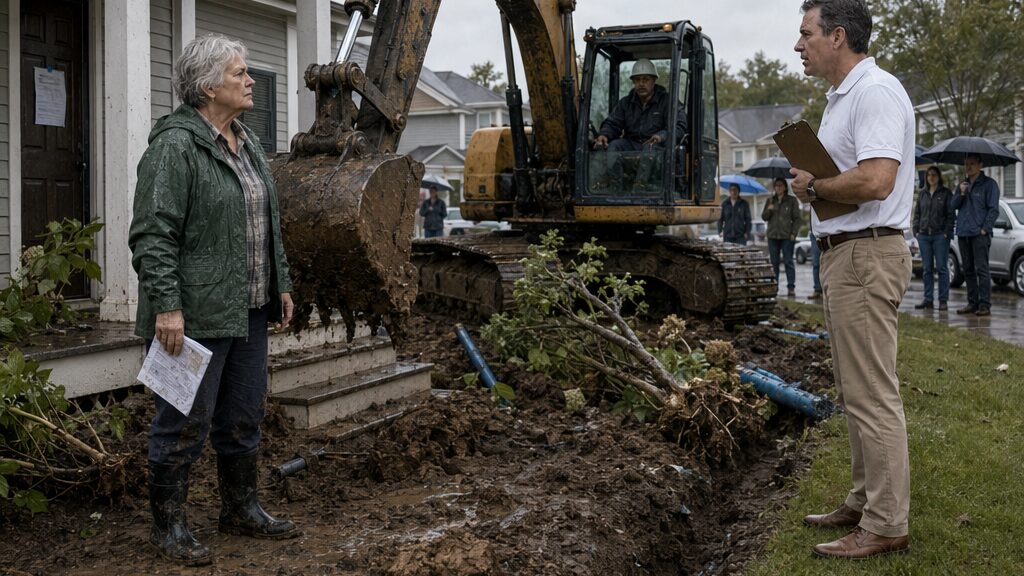
The excavator bucket swung over Carolyn Miller’s front steps with six inches to spare.
Mud slid from its teeth and struck the concrete where she had stood moments earlier. The operator raised one gloved hand in apology, but the machine never stopped. Its engine growled through the wet morning as the bucket descended again beside her walkway and tore through the roots of a dwarf maple she had planted fifteen years before.
Carolyn remained at the edge of her driveway in a green rain jacket and black rubber boots. Water ran around her soles, carrying mulch and pale wood chips toward the gutter.
“Stop the machine,” she called.
Thomas Campbell turned from the trench as though she had interrupted a conversation. His white polo remained remarkably clean. He held a clipboard under one arm and pointed toward the operator without looking at him.
“We’re already opened up,” he said. “Stopping now creates a bigger hazard.”
“It is open because you dug it open.”
“This is association work.”
The trench ran from the curb through Carolyn’s planting bed, beside the walkway, and nearly to the front steps. Blue drainage pipe lay in sections across the grass. A row of hydrangeas had been pulled out and stacked near the street with mud clotted around their roots.
Across the road, the retired couple stood beneath one umbrella. A young homeowner watched from inside a parked car. Nobody approached.
Carolyn stepped around a pile of clay and reached her porch. A sheet of paper had been taped to the front door beneath the brass knocker. Rain had soaked the upper corners.
She peeled it away carefully.
NOTICE OF VIOLATION AND CHARGE.
The association’s letterhead occupied the top third of the page. Below it, a paragraph accused her of obstructing access to a common drainage easement with “unapproved landscaping and decorative structures.” The itemized charge at the bottom read:
Removal and site access fee: $1,100.
Behind her, the excavator bucket closed around the remaining half of her maple.
Carolyn read the line again.
“You’re billing me for removing the plants your contractor is destroying?”
Thomas approached the porch but stopped before the mud reached his loafers.
“The landscaping should never have been placed in the easement.”
“I asked for the easement map three years ago.”
“You received the governing documents when you bought the property.”
“That is not an easement map.”
Thomas’s mouth tightened. “The board reviewed this. The work is necessary, and the charge stands.”
Carolyn turned the notice over. The back was blank. She examined the footer, the project reference, and the authorization line.
“Where is the county permit number?”
The excavator operator glanced toward Thomas.
Thomas gave a short laugh. “Carolyn, this is routine maintenance.”
“Routine maintenance doesn’t usually disturb this much soil.”
“The association has authority to maintain common drainage.”
“That wasn’t my question.”
Rain tapped the metal porch rail between them.
“Did you pull a county permit?” she asked.
Thomas lowered his voice. “Nobody on this street needs a lecture about permits.”
“I asked for a number.”
“And I’m telling you the board handled what needed to be handled.”
Carolyn folded the wet notice once, keeping the printed side inward.
Thomas extended the clipboard. “The contractor needs your acknowledgment of access. Sign at the bottom.”
She took the clipboard and read the single-page form. The work description called the excavation “minor drainage maintenance.” A sentence above the signature line stated that the homeowner acknowledged existing landscape obstructions and consented to their removal.
She handed it back unsigned.
“You were notified at the spring meeting,” Thomas said.
“I was present for twelve minutes. You discussed standing water near the south outlet.”
“You didn’t object.”
“Silence is not consent to excavation beside my front door.”
“You had an opportunity.”
“To object to work that was never described?”
His patience broke through the polished tone. “Pay the invoice, Carolyn. Don’t turn this into something embarrassing.”
The words landed more sharply than she expected. For years at the county, people had brought files to her desk and then looked past her for someone they assumed had authority. She had learned to answer without raising her voice. She had also learned that men who used the word embarrassing usually meant disobedient.
She reached into her jacket and removed her phone.
Thomas looked toward it. “What are you doing?”
“Documenting the site before your contractor changes it again.”
She photographed the uprooted hydrangeas, the broken edge of the walkway, the pipe sections, and the excavator bucket resting inside the trench. Then she took a picture of Thomas’s clipboard.
“Don’t photograph internal documents.”
“You held it out to me.”
She moved to the curb and photographed the full length of disturbed ground. Thomas followed, keeping to the narrow strip of intact grass.
“This work prevents flooding,” he said. “You’re treating us like trespassers.”
“You entered without showing me an approved plan.”
“We have an easement.”
“Then show me its recorded width.”
He did not answer.
Carolyn went into the garage and returned with a twenty-five-foot measuring tape. She anchored one end against the trench edge and pulled it across the widest cut.
Thomas watched her. “This is unnecessary.”
“Width is nine feet, four inches.”
“You’re interfering with the contractor.”
She wrote the number on the back of an old grocery receipt. Then she measured the length in three sections because the trench curved around her walkway. The operator shut off the excavator at last, not because Thomas instructed him, but because Carolyn was standing where the machine needed to move.
In the sudden quiet, the rain sounded louder.
“Thirty feet, nine inches,” she said.
Thomas looked at the waiting operator, then at the neighbors across the street. “Are you finished?”
“Almost.”
She multiplied the measurements on her phone, subtracting the narrow portion near the curb. Two hundred eighty-seven square feet of disturbed ground.
The number settled something inside her.
She knew the county threshold without looking it up. She had processed enough ground-disturbance files to remember when a sketch became a plan, when maintenance became construction, and when an informal project required formal review.
Thomas took a step toward his sedan. “The crew will continue once you move.”
Carolyn returned to the porch. Inside, she opened the lower drawer of a narrow filing cabinet she had not used since retirement. Several empty folders lay behind old tax records.
She chose a yellow county file folder.
The wet invoice went inside first.
Then the measurements.
Then the photographs.
Through the window, she watched Thomas signal the excavator operator to restart.
Carolyn wrote one figure on the folder tab before closing it.
287 square feet.
Chapter 2: Nineteen Years Inside a Yellow Folder
The county permit database returned one sentence in red:
NO RECORD FOUND.
Carolyn checked the project number Thomas had printed on the invoice, removed the hyphen, and searched again. Nothing. She tried the subdivision name, the HOA’s legal name, Thomas Campbell, and the drainage contractor listed on the truck.
No active permit. No pending application. No inspection request.
Outside her office window, the excavator sat silent in the rain. The crew had left by late afternoon, abandoning blue pipe beside the open trench and a sheet of plywood across the narrowest part of her walkway.
Carolyn printed the search results and placed them in the yellow folder.
Her home office had once been the spare bedroom. A framed retirement certificate hung above the desk, its seal fading beneath the glass. Nineteen years in County Land Use and Development Services, the text said. It did not mention the years before that in records intake, or the supervisors who had relied on her memory while introducing her as “our paperwork person.”
She opened the county code portal.
Ground disturbance exceeding one hundred square feet required a permit when associated with installation, alteration, or replacement of a drainage facility. Emergency stabilization could begin without prior approval only if the county received notice within twenty-four hours and the work remained limited to preventing immediate damage.
Carolyn read the exception twice.
No emergency notice appeared in the system.
She added the code section to the file, highlighting the threshold but not the conclusion. Conclusions came after records.
The HOA maintained a password-protected homeowner portal. Carolyn logged in and searched the meeting archive. The spring minutes contained two sentences about drainage: standing water had been reported near the south outlet, and the board would obtain estimates for routine maintenance.
Nothing about her property. Nothing about excavation. Nothing about removing landscaping.
She downloaded the minutes.
At six, she made tea and forgot to drink it. At seven, the room had darkened enough for her reflection to appear in the monitor. She switched on the desk lamp and pulled the association binder from the bottom shelf.
The binder was thick with amendments, election notices, insurance summaries, and architectural standards. Carolyn moved through it by year, reading only what the index required.
A page near the back caught against the ring.
PROJECT APPROVAL—SOUTH DRAINAGE OUTLET.
The letter was dated six weeks earlier and addressed to a drainage contractor. Thomas’s signature appeared at the bottom in blue ink.
Carolyn brought the page closer to the lamp.
The approved scope authorized replacement of twelve linear feet of collapsed outlet pipe within the common strip near the curb. It permitted hand excavation where possible and limited mechanical disturbance to an area no larger than eighty square feet.
She looked through the office window at the trench curving past her hydrangeas.
Eighty square feet on paper.
Two hundred eighty-seven in her yard.
The difference was not a technical oversight. Someone had changed the scope after the approval was signed, or the approval had been written to disguise the work planned from the beginning.
Carolyn copied the letter and slipped the original back into the binder. She placed the copy beside her site photographs. Thomas’s signature sat only inches from the image of the excavator bucket beside her steps.
For the first time that day, satisfaction rose in her chest.
It lasted less than a minute.
If Thomas had signed a smaller project and the contractor had exceeded it, the association might claim unauthorized field work. If Thomas had instructed the expansion, the board could face penalties. If the other directors knew, responsibility spread. If they did not, Thomas had exposed them without consent.
Carolyn opened the bylaws.
The first relevant section concerned owner access and required reasonable notice except during an immediate threat to property. The next required board authorization for expenditures above a set amount. Section Nine addressed fiduciary conduct.
A director who knowingly authorized unlawful work, concealed a material financial obligation, or acted beyond approved authority could be removed by a majority vote of the membership.
Carolyn read the section again.
On Monday morning, Thomas had spoken as though his title settled every question. Section Nine treated the title as a duty, not armor.
She copied the page.
Her printer produced each sheet with a soft mechanical sigh. By nine, the yellow folder had grown thick enough that its metal fasteners pressed against the cover. Carolyn arranged its contents in order: invoice, photographs, measurements, permit search, county code, meeting minutes, approval letter, bylaws.
Her old habits returned without invitation. Date every note. Preserve originals. Separate facts from assumptions. Record statements as closely as possible to the speaker’s words.
She wrote Thomas’s sentence on a lined page:
Your silence counted as consent.
Then another:
Pay the invoice. Don’t turn this into something embarrassing.
She stopped with the pen above the paper.
The second statement mattered less legally, but it mattered to her. That made it dangerous. Personal injury could sharpen an investigation, but it could also distort one.
Carolyn drew a line beneath it and wrote: Not relevant to permit status.
The act steadied her.
At ten fifteen, an email arrived from the HOA.
SUBJECT: INTERFERENCE WITH AUTHORIZED MAINTENANCE.
The message accused her of delaying necessary work and warned that additional contractor costs might be charged to her account. It was signed by Thomas as board president. Brian Allen, the treasurer, was copied.
Carolyn read the names twice.
Brian had been at the spring meeting. He had also signed the annual budget summary. If he knew the project scope and funding, Thomas had not acted alone. If he did not, the board’s controls had failed even more badly than she thought.
She printed the email.
The folder would barely close.
Before shutting down the computer, Carolyn opened the county complaint portal. The form asked whether the alleged work was ongoing, whether unsafe conditions existed, and whether she had contacted the responsible party.
She attached six photographs and the permit-search page. She did not attach Section Nine. County enforcement had no role in HOA elections.
At the final screen, a blue button read SUBMIT COMPLAINT.
Carolyn held the cursor above it.
Filing would make the matter official. It could stop the work, suspend her invoice, and force the association to disclose its records. It could also create daily fines that would not belong to Thomas alone.
She thought of the machine above her steps and his clean shoes at the edge of the mud.
Then she clicked.
The confirmation arrived at 10:43 p.m.
Carolyn printed it and secured it inside the yellow folder.
On top of the stack, she placed Section Nine.
Chapter 3: The Complaint That Reached Every Door
At 11:47 Wednesday morning, Elizabeth White raised one hand toward the excavator operator and said, “Shut it down.”
The engine dropped from a roar to a shuddering idle. A moment later, the bucket settled into the mud.
Thomas stood near the curb with his phone pressed to his ear. “We’re in the middle of stabilization.”
Elizabeth looked into the trench, then at the pipe sections scattered across Carolyn’s lawn. Her county identification badge rested against a navy raincoat.
“You’re installing a new line beyond the outlet area,” she said. “That is not temporary stabilization.”
“It’s association maintenance.”
“Show me the permit.”
Thomas lowered the phone.
Carolyn watched from her porch with the yellow folder held beneath one arm. She had expected an inspector sometime that week. She had not expected Elizabeth before noon.
Elizabeth had worked two floors above Carolyn during her final county years. They had spoken perhaps twenty times, always about records.
Now Elizabeth treated her as she would any complainant.
“Mrs. Miller, did you authorize access?”
“No.”
“Did you sign an acknowledgment?”
“No.”
“Do you have a copy of what you were asked to sign?”
“A photograph.”
“Send it through the case portal. Not to my personal email.”
Carolyn felt the correction more sharply than it deserved. “Of course.”
Elizabeth measured the trench, photographed the pipe, and asked the operator who had directed the work. The operator nodded toward the drainage contractor, who had not arrived. Thomas attempted to answer twice. Each time, Elizabeth told him she needed the contractor’s statement separately.
At 12:26, she taped a stop-work order to the excavator cab.
The retired couple across the street came closer to read it. The young homeowner took a picture from the sidewalk.
Thomas waited until Elizabeth had returned to her county vehicle.
“You could have called the board again,” he told Carolyn.
“I did call. You sent me an interference notice.”
“You knew this would trigger fines.”
“I knew it would trigger review.”
“Same thing, in practice.”
Elizabeth returned with a second document. “Mr. Campbell, the initial civil penalty is two hundred fifty dollars per day. The effective date may be adjusted to the documented start of unpermitted work.”
Thomas stared at her. “Backdated?”
“If the evidence supports it.”
His eyes moved to Carolyn’s folder.
By two o’clock, the HOA emailed every homeowner. The message described the shutdown as a “temporary county misunderstanding caused by a resident complaint.” It warned that project delay could increase costs.
Carolyn printed that too.
Then she copied Section Nine, the limited approval letter, and the county stop-work order. She highlighted only the relevant lines. At four, she walked the subdivision and placed one packet in each curbside mailbox where hand delivery was permitted, leaving the remainder at front doors.
She did not include a note.
Facts did not need decoration.
At the third house, a man opened the door before she reached the steps.
“Are you trying to get the board removed?” he asked.
“I’m providing documents.”
“That isn’t an answer.”
“It is the only answer I have today.”
By the time she reached Jennifer Perez’s house next door, the yellow folder felt lighter, though the situation did not.
Jennifer opened the door before Carolyn knocked. She wore dark work pants and an employee badge clipped to her waistband.
“I got your packet,” she said.
“Then I won’t leave another.”
“Come in.”
Carolyn hesitated. She and Jennifer had exchanged mail, accepted packages for each other, and spoken about trash pickup. Carolyn had never been inside.
The kitchen table was covered with unopened envelopes and a child’s school papers. Jennifer moved a lunch container aside and pointed to the county notice.
“Is it really two-fifty every day?”
“That is the stated civil penalty.”
“Who pays it?”
“The association.”
Jennifer gave a tired laugh. “The association is us.”
“The board authorized the work.”
“The board doesn’t have its own money.”
Carolyn set the folder on the table. “There may be insurance. There may be contractor liability.”
“May be?”
“I don’t have the financial records yet.”
Jennifer sat down. “Thomas sent an email saying the reserve fund was low because of the roof repairs at the common room. How low?”
“I don’t know.”
“I asked Brian last year. He said the numbers were within range.”
Carolyn remembered Brian’s name copied on the interference notice.
Jennifer turned the stop-work order over as though another answer might be printed on the back. “My mortgage went up because of taxes. Child care went up. If they assess us two or three thousand dollars, I don’t have it.”
“The work was unlawful.”
“I’m not saying it wasn’t.”
“He entered my property, tore out my landscaping, and charged me for it.”
“I know.” Jennifer’s voice softened, which somehow made Carolyn more defensive. “I saw the machine.”
“Then you understand why I filed.”
“I understand why you wanted it stopped. I’m asking whether you knew what would happen after.”
Carolyn looked at the school papers. A spelling test had been signed in purple ink.
“The county decides penalties,” she said.
“But you knew the system.”
There it was—the same recognition Carolyn had wanted from Thomas, offered now as an accusation.
Her phone buzzed. An email from Elizabeth stated that Carolyn’s $1,100 HOA charge was suspended pending the county investigation and verification of access authority.
For one clean second, relief moved through her.
She showed Jennifer the message.
Jennifer read it and nodded. “Good. They shouldn’t charge you.”
The response was too measured to count as celebration.
“What aren’t you saying?” Carolyn asked.
Jennifer stood. “Come with me.”
She led Carolyn down a short hall to a child’s bedroom at the back of the house. The room smelled faintly of detergent and damp wood. One section of baseboard had bowed away from the wall.
Jennifer crouched and pressed two fingers beneath it. The wood flexed.
“Last storm,” she said. “Water came under this wall at two in the morning. My son woke up because his rug was floating.”
Carolyn looked toward the window. Beyond the fence, the ground sloped toward the blocked south drainage outlet.
“I emailed the board,” Jennifer continued. “I copied three homeowners who had water in their crawl spaces. Thomas said he would fix it before the next heavy rain.”
“You supported the excavation.”
“I supported fixing the drain. I didn’t know he was digging across your yard without permits.”
Carolyn touched the warped baseboard. A brown line ran several inches above the floor, faint but continuous.
The trench next door no longer looked like a project invented solely to display Thomas’s authority. It remained unlawful. The invoice remained indefensible. His concealment remained his choice.
But the water had been real before the excavator arrived.
Jennifer stood behind her. “The forecast says another storm is coming this weekend.”
Carolyn looked down at the yellow folder in her hand.
For the first time since opening it, she could not tell whether it contained a solution or only the beginning of another problem.
Chapter 4: The Water Thomas Was Afraid to Name
Jennifer slid two fingers beneath the warped baseboard and lifted.
The wood separated from the wall with a damp crack. Behind it, the drywall had darkened in a line nearly four inches above the floor.
“That’s where it stopped,” she said.
Carolyn crouched beside her. The room had been cleaned, the rug replaced, the child’s books returned to a low shelf, but the damage remained in the softened wall and the faint mineral stain beneath the window.
“You reported this before the spring meeting?”
“Three days after the storm.”
“Do you still have the email?”
Jennifer looked at her. “I sent it to you too.”
Carolyn straightened.
“I copied the homeowners closest to the south outlet,” Jennifer said. “You replied.”
“I don’t remember replying.”
Jennifer took out her phone, searched, and turned the screen toward her.
The message appeared under Carolyn’s name.
Photographs alone cannot establish whether the drainage facility caused the intrusion. The board should obtain an inspection before committing association funds.
The words were neat, careful, and unmistakably hers.
Carolyn read them twice.
“I wasn’t saying the water wasn’t real.”
“You were saying it wasn’t proven.”
“That is different.”
“Not at two in the morning.”
Jennifer’s voice did not rise. She replaced the baseboard and pressed it back against the wall, though it no longer held.
Carolyn looked toward the child’s bed. A plastic storage bin had been placed beneath it, keeping shoes and toys off the floor.
“What did Thomas say?”
“He came over the next day. He saw the wall. Then he checked the houses behind mine.”
“How many?”
“Four had water. Two had damp crawl spaces.”
“And nobody called the county?”
“We called the board. That’s what we pay dues for.”
The answer followed Carolyn out of the room.
Later that morning, Jennifer walked with her to the south outlet. The open trench in Carolyn’s yard had been covered with weighted tarps, but the ground beyond the fence was still saturated. Water stood in a shallow depression near the common strip, carrying leaves and grit toward a rusted grate.
Jennifer pointed to a concrete pipe half hidden by weeds. “That’s where it backs up.”
Carolyn stepped carefully down the slope. The outlet opening was partly blocked by roots and compacted sediment. A narrow stream escaped along one edge.
“The approved plan replaced twelve feet near the curb,” Carolyn said.
“Would that have fixed this?”
“Not by itself.”
Jennifer folded her arms. “Then why approve it?”
“That is what I’m trying to find out.”
The HOA records room occupied a locked closet in the subdivision’s common building. Brian Allen met them there at noon. He wore a windbreaker zipped to his chin and carried a ring of keys that trembled slightly when he selected one.
“I shouldn’t be opening this without the secretary,” he said.
“You are the treasurer,” Carolyn replied.
“That doesn’t mean I control every record.”
“It means you signed the annual financial statement.”
Brian glanced at Jennifer. “This is exactly why Thomas wanted counsel present.”
“Counsel did not authorize you to conceal records from members,” Carolyn said.
“I’m not concealing anything.”
“Then open the door.”
He did.
Inside, cardboard bank boxes lined two metal shelves. A portable dehumidifier hummed in the corner. Brian retrieved the current budget binder and placed it on a folding table.
The reserve summary showed a balance far below the figure reported at the previous annual meeting.
Carolyn turned the page. “Where did forty-six thousand dollars go?”
“Common-room roof. Mold remediation. Insurance deductible.”
“That still leaves a difference.”
Brian removed his glasses. “We had two emergency sewer cleanouts.”
“Were those disclosed?”
“In the quarterly packet.”
“Not as reserve withdrawals.”
“They were categorized as maintenance.”
Jennifer leaned over the binder. “How much is left?”
Brian hesitated.
“Unrestricted?” he said. “A little under eighteen thousand.”
Carolyn pictured the engineer’s proposal she had found in the board records portal: fifty-four thousand dollars for a permitted drainage replacement, grading, erosion controls, inspections, and restoration.
“Three times short,” she said.
Brian nodded.
“So Thomas approved an eighty-square-foot outlet repair because that was all you could afford.”
“That was the plan.”
“And then the contractor excavated nearly three hundred square feet across my property.”
Brian rubbed his thumb along the binder edge. “After the last storm, Thomas said the outlet repair wouldn’t protect the houses before the next one.”
“Was he wrong?”
Brian looked toward Jennifer. “No.”
The answer did not excuse the trench. It changed its shape.
Carolyn opened the yellow folder and spread out the approval letter, site photographs, and county code. A smear of dried mud crossed one image where she had handled it in the yard.
“Who instructed the contractor to expand the scope?”
Brian did not answer.
“Did the board vote?”
“No formal vote.”
“Did you know?”
“I knew Thomas was asking them to expose more of the line.”
“How much more?”
“I didn’t know he meant through your planting bed.”
“But you knew the cost would exceed the authorization.”
Brian’s face tightened. “I knew we didn’t have money for the engineered plan. I also knew if another child woke up with water in the room, everybody would ask why we sat on our hands.”
“You could have called a special meeting.”
“And said what? We need a five-thousand-dollar assessment immediately? Half the neighborhood would have accused us of creating a crisis.”
“So you hid the crisis.”
“We delayed saying how bad it was.”
Jennifer gave a small, humorless breath. “That’s hiding it.”
Brian closed the budget binder. “Thomas thought if the contractor could get the line open quickly, we could stabilize everything and sort out the paperwork after.”
“By billing me?” Carolyn asked.
“I didn’t approve that charge.”
“You were copied on it.”
“I told him it was aggressive.”
“You did not tell me it was unsupported.”
Brian looked at her then, not defensively but with exhausted irritation. “You didn’t tell any of us the county would backdate fines either.”
“I filed a complaint about unlawful work.”
“And now the association may owe more every day than we have left in operating cash.”
The dehumidifier clicked off. The room became uncomfortably quiet.
Carolyn gathered the documents but left the budget binder open.
“Show me the meeting minutes from before the approval,” she said.
Brian searched the boxes and produced a thin packet clipped at the corner. The meeting had taken place seven weeks earlier. Carolyn remembered the evening dimly: folding chairs, coffee in foam cups, Thomas moving through the agenda too quickly.
Brian turned to the drainage item.
The minutes recorded Jennifer’s flood report, repair estimates, reserve concerns, and a recommendation that the membership consider an emergency assessment if the full replacement proved necessary.
Attendance was listed on the first page.
Carolyn Miller—present.
Her name looked heavier than the others.
A handwritten note in the margin stated: Member C. Miller advised that no expenditure should proceed without documented causation and proper county review.
Carolyn remembered saying it. She remembered Thomas calling the engineer’s estimate excessive. She remembered leaving early because the discussion had become repetitive.
What she did not remember was looking at Jennifer while she described carrying her sleeping child into the hallway as water spread across the bedroom floor.
Brian slid the minutes toward her.
“You weren’t silent,” he said. “You told us not to move without proof.”
Carolyn placed the page inside the yellow folder. It no longer felt like evidence belonging only to someone else’s failure.
At the door, Jennifer stopped her.
“So what happens now?”
Carolyn looked at her own name in the attendance list.
“I find out whether I was protecting the rules,” she said, “or using them to avoid hearing what you were telling us.”
Chapter 5: When Winning Became Another Assessment
The proposed assessment notice was waiting beneath Carolyn’s front door on Monday morning.
It had been pushed far enough inside that the bottom edge was streaked with mud from her boot.
EMERGENCY MEMBER MEETING.
Below the heading, the board estimated a special assessment of up to $2,850 per household to cover county penalties, temporary site stabilization, legal fees, and completion of the drainage work.
Carolyn stood in the entryway and read the number until it stopped looking like money and became a consequence.
Her phone rang.
Jennifer’s name appeared on the screen.
“I got the notice,” Jennifer said.
“So did I.”
“I can’t pay that.”
“It is a proposed maximum.”
“I can’t pay half of it.”
Carolyn looked through the front window. The tarps over the trench had sagged under weekend rain, forming dark pools. Her walkway remained passable only by a narrow plywood sheet.
“I’m reviewing the basis,” she said.
Jennifer was quiet for a moment. “That’s what you said about my email.”
The call ended politely, which made it worse.
That evening, the common room filled before the meeting began. Folding chairs had been arranged in rows, but homeowners stood along the walls and crowded the doorway. The assessment notice lay on laps, folded into pockets, or held upright like evidence.
Carolyn sat in the second row with the yellow folder across her knees.
Thomas took his place behind the front table. Brian sat to one side with the budget binder. The board secretary kept her eyes on a laptop. An association attorney occupied the final chair.
Thomas called the meeting to order, but voices continued for several seconds.
A young homeowner near the back said, “Tell us first whether that number is real.”
“It is a preliminary exposure estimate,” the attorney replied.
“That means yes,” someone said.
Thomas lifted a hand. “The board is working to reduce the amount.”
“You created the amount,” the retired man across from Carolyn said.
Thomas looked toward Carolyn. “The county complaint accelerated it.”
The room shifted with him.
Carolyn had expected blame. She had not expected how quickly faces would turn.
She stood. “The complaint stopped unpermitted excavation on my property.”
“And started daily penalties,” a woman by the wall said.
“The penalties started when the work began without a permit.”
“Who reported the start date?”
Carolyn held the folder more tightly. “I documented it.”
A low murmur passed through the room.
Thomas leaned forward. “Nobody disputes that mistakes were made. But the board acted because homes were flooding and the county process would have delayed us for weeks.”
“You did not apply,” Carolyn said. “You cannot call a process delayed when you never started it.”
“We had an engineering estimate the association could not afford.”
“Then you were required to tell the membership.”
“And wait for a vote while another storm came?”
“You were required to obtain consent before excavating private property.”
Thomas’s expression hardened. “You keep saying required as though every decision can sit in a folder until it becomes safe.”
Carolyn opened the yellow file. “This folder contains your signed authorization for eighty square feet. The contractor disturbed two hundred eighty-seven.”
“I expanded the scope.”
The room fell quiet.
Brian turned toward him.
Thomas continued before anyone could interrupt. “I made that decision. The outlet repair was not enough. The contractor exposed the line and found additional collapse. I told them to follow it.”
“Without a permit,” Carolyn said.
“Yes.”
“Without a board vote.”
“Yes.”
“And then you charged me for the landscaping.”
Thomas looked down once, then back at her. “The landscaping blocked access.”
“The access you had no authority to take.”
“I believed the easement covered it.”
“You never showed me the recorded width.”
“Because we were trying to keep water out of houses.”
His voice had risen, but it did not sound triumphant. It sounded cornered.
“You attended the meeting,” he said. “Jennifer described the flooding. You told us not to act without documented causation. Then you left.”
Carolyn heard a chair creak behind her.
Thomas pointed toward the folder. “You had the knowledge to help us navigate the county. You could have explained an emergency permit. You could have helped structure an assessment. You chose distance. Now you are using the same rules you preferred over flooded families to punish everyone.”
The accusation struck because part of it was true.
Carolyn could have answered that she was not a board member. That retirement meant she owed the association no free professional labor. That Thomas had never asked for help.
All of those things were accurate.
None addressed Jennifer’s warped wall.
Carolyn closed the folder.
“I dismissed information because it was not presented in the form I trusted,” she said. “Jennifer told us water entered her child’s room. I treated that as insufficient evidence instead of a reason to help gather better evidence.”
The room became still in a different way.
“I was wrong about that,” Carolyn said.
Jennifer sat near the aisle. She did not smile or nod.
Carolyn looked at Thomas. “But my mistake did not authorize yours. You concealed the reserve shortage, changed the scope, entered my property, and issued a charge you could not support.”
Thomas’s jaw moved before he answered. “Then what do you want?”
“Right now? Full financial records, the contractor’s insurance information, and a lawful corrective plan.”
“And if we cannot produce one?”
“The county continues enforcement.”
The young homeowner stood. “So we pay.”
Carolyn turned toward him. “Unless we identify other responsible funding.”
“Before when?”
The attorney answered. “The current fine accrues daily.”
The room erupted into overlapping questions.
Brian struck the table with his palm. “Enough.”
The sound surprised everyone, including him.
He opened the budget binder. “We have seventeen thousand eight hundred forty dollars in unrestricted reserves. Temporary stabilization is estimated at eleven thousand. Legal expenses are already above four thousand. We cannot absorb continuing penalties.”
Thomas looked at Carolyn across the room.
“I’ll resign,” he said.
The voices faded.
“I’ll resign tonight if Carolyn withdraws the complaint and asks the county to waive the fines.”
Carolyn stared at him.
The offer had the shape of accountability without its substance. His position would end; the unpermitted trench would remain. The drainage failure would remain. The county would still require remediation.
“You are making your resignation conditional on stopping review,” she said.
“I am giving the neighborhood a way out.”
“No. You are asking me to trade enforcement for your departure.”
“Isn’t that what Section Nine is for?”
“Section Nine is not a repair plan.”
Thomas sat back. For the first time since the excavator arrived, he looked older than his authority.
The side door opened.
Elizabeth White entered carrying a county case file. She had not been invited to negotiate, she explained. She had come to deliver the updated compliance order.
The board secretary accepted it with both hands.
Elizabeth addressed the room. “The site must be stabilized under an approved corrective plan. If the association submits a complete plan within forty-eight hours, the county will consider holding additional penalties during review. Existing penalties remain subject to final determination.”
“Can the complaint be withdrawn?” Thomas asked.
“A complainant may request closure,” Elizabeth said. “The county is not required to close an observed violation.”
Carolyn watched the offer collapse between them.
Elizabeth placed a copy on the front table.
Forty-eight hours.
Not to prove Thomas wrong. Not to win the meeting.
To produce a plan the county could accept before the fines consumed what little the association had left.
Carolyn opened the yellow folder and looked at the documents she had arranged like charges.
For the first time, she began sorting them by what each page might repair.
Chapter 6: The Plan That Required Everyone’s Signature
The contractor’s insurer asked for the photograph Thomas had said should not exist.
The request arrived at 7:12 Tuesday morning, marked urgent. The adjuster wanted evidence of site conditions before excavation, documentation of the authorized scope, and any homeowner access agreement signed before work began.
Carolyn read the final line twice.
Please provide the executed access acknowledgment.
She opened the yellow folder and removed the photograph of Thomas’s clipboard. The unsigned signature line was visible beneath the consent language. In the next image, the form remained in Thomas’s hand.
No executed acknowledgment existed because Carolyn had refused to sign it.
She called Brian.
“We may have coverage,” she said.
He sounded as though he had not slept. “How much?”
“I don’t know yet. Send the insurer the contractor agreement, all change orders, and the certificate of insurance.”
“There aren’t any change orders.”
“Then send proof that there aren’t.”
By nine, Carolyn’s office no longer belonged only to her. Jennifer sat at the desk with a legal pad. Brian occupied the chair by the filing cabinet, balancing the budget binder on one knee. Elizabeth joined by speakerphone long enough to explain what a complete corrective submission required: engineered stabilization, erosion controls, property-access authority, contractor responsibility, funding source, and a schedule.
“No promises,” Elizabeth said. “A complete plan allows review. It does not guarantee a waiver.”
“We understand,” Carolyn replied.
After the call, Brian looked at the documents covering the floor.
“I don’t understand half of this.”
“You don’t need to,” Carolyn said. “You need to produce the records I ask for and stop hiding bad numbers because you think people will panic.”
He accepted the rebuke without argument.
The drainage contractor arrived at eleven. He remained standing in Carolyn’s doorway until she told him the meeting would happen inside or not at all. Mud had dried along the seams of his work boots.
“Our crew followed field direction,” he said.
“From Thomas?” Carolyn asked.
“He was the board representative.”
“The written contract limited disturbance to eighty square feet.”
“We encountered a collapsed section.”
“And you expanded without a change order or permit revision.”
“We were told it was emergency work.”
“Did you notify the county?”
“That was the association’s responsibility.”
Carolyn slid the contractor agreement toward him. “This clause assigns permit compliance to both the contractor and client.”
He read it without touching the page.
Jennifer asked, “Will your insurance pay?”
“That depends on liability.”
“You cut through her yard,” Jennifer said. “Whose liability do you think it is?”
The contractor looked at Carolyn. “If the association directed work outside scope, that matters.”
“So does continuing work you knew exceeded the signed plan,” Carolyn said.
She placed the photograph of the excavator beside Thomas’s clipboard on the table. The trench dimensions were visible in the image metadata and her measurements.
The contractor’s eyes moved to the unsigned access form.
“You didn’t sign?”
“No.”
He sat down.
By early afternoon, the insurer agreed to send an adjuster and consider restoration and stabilization costs under a reservation of rights. It was not payment. It was the first opening that did not lead directly to another household charge.
Carolyn added the email to the yellow folder, then stopped.
There was no room.
She released the metal fasteners and laid every document across the dining table: county code, photographs, approval letter, budget statements, contractor agreement, stop-work order, Jennifer’s flood email, and the proposed assessment.
The folder that had served as a weapon became a map.
“What can insurance cover?” Jennifer asked.
“Possibly the property damage and contractor-caused expansion,” Carolyn said. “Not county fines. Probably not the original drainage failure.”
Brian pointed to the budget. “We could fund the engineering deposit from reserves.”
“And leave nothing for another emergency,” Jennifer said.
“We already have an emergency.”
Carolyn drew three columns on a sheet of paper.
Contractor and insurer.
Association reserves.
Member contribution.
“The assessment cannot disappear entirely,” she said. “But it can become smaller if the contractor pays restoration, if the county pauses new fines, and if the association restructures the remaining work.”
Jennifer looked at the third column. “How small?”
“Until we have bids, I won’t invent a number.”
Jennifer’s mouth tightened, but she nodded.
That afternoon, they met the engineer and contractor at the trench. The tarps were removed section by section. Water had collected along the exposed pipe, and one wall of the trench had begun to soften.
The engineer proposed a narrower permanent line along the edge of Carolyn’s property, with an inspection box near the common strip. It would require a recorded easement and restoration of her walkway and planting bed.
“You’re asking her to give up part of her property after the association took it without permission,” Jennifer said.
“I’m describing the route with the least grading and lowest cost,” the engineer replied.
Carolyn looked from the trench to Jennifer’s house. The route was practical. That did not make it easy.
“Put it in the plan,” she said. “The easement is not approved yet.”
At the common room that evening, homeowners gathered around two folding tables rather than facing a board dais. Carolyn placed copies of each supporting document in labeled stacks. Nothing remained hidden in the yellow folder.
Thomas arrived last.
He had changed out of the white polo. In a gray work shirt, without the clipboard, he looked like another tired homeowner.
The insurer’s conditional letter required a written admission identifying who authorized the expanded scope. Without it, the company could argue that no insured party had accepted responsibility.
Carolyn placed the form before Thomas.
He read the paragraph.
“You wrote this?”
“The association attorney reviewed it.”
“It says I knowingly directed work outside the approved plan.”
“Did you?”
“Yes.”
“It says you did so without confirming permit status.”
“I believed the emergency exception applied.”
“Then write that beneath the admission.”
He looked around the room. Brian stood by the budget sheets. Jennifer was collecting homeowner signatures acknowledging receipt of the proposed plan. Nobody rushed Thomas. Nobody defended him.
“If I sign,” he said, “the insurer may pursue me personally.”
“If you do not sign, the insurer may deny the association’s claim.”
Thomas looked at Carolyn. “You always make it sound simple.”
“No,” she said. “I make the choices visible.”
For a long moment, he held the pen without using it.
Then he signed.
His handwriting was larger than the signature on the original approval letter. Beneath the admission, he added one sentence stating that he believed immediate expansion was necessary to protect homes from further flooding.
Carolyn accepted the page.
Thomas did not release it.
“One more thing,” he said.
He turned the sheet over and wrote on the back.
Effective immediately, I resign as president and director of the association.
He signed again.
No one applauded.
Brian closed his eyes briefly. Jennifer set down her clipboard.
Thomas handed the page to Carolyn. “You wanted accountability.”
“I wanted the truth recorded.”
“Same thing to you.”
“Not anymore.”
He left before the meeting ended.
By midnight, the corrective package contained the engineer’s stabilization plan, insurer correspondence, funding outline, contractor admission, homeowner access proposal, and Thomas’s signed statement. Jennifer had obtained enough signatures to authorize emergency reserve spending. Brian had disclosed every account balance.
Carolyn uploaded the final document at 12:18 a.m.
The county portal confirmed receipt but offered no decision.
She placed the signed originals in the yellow folder. It closed easily now because copies had been distributed across the neighborhood.
At 8:03 Wednesday morning, Elizabeth called.
“The submission is complete,” she said.
Carolyn held the phone tighter.
“Complete is not approved,” Elizabeth continued. “The engineer must revise one erosion-control detail. If we receive it by noon, I can recommend a temporary hold on additional penalties.”
Carolyn looked at the clock.
Four hours remained.
Outside, the trench waited beneath the sagging tarps, and the next decision no longer belonged to proof alone.
Chapter 7: The Yard Repaired Without Erasing the Damage
The workers returned three weeks later with a permit posted where nobody could miss it.
A transparent sleeve had been fastened to a temporary board at the curb, and inside it sat the county approval, the erosion-control plan, the inspection schedule, and the engineer’s stamped drawing. The pages shifted slightly whenever the wind moved through Carolyn’s yard.
Before the first shovel touched soil, the site supervisor asked her to review the access boundary.
He held the plan flat across the hood of his truck. Bright orange markings traced a narrow route along the edge of her property, avoiding the front steps and most of the planting bed. The permanent inspection box would sit near the common strip. The damaged walkway would be replaced. The soil would be graded away from the house, and the hydrangeas would be replanted where possible.
Carolyn checked the measurements herself.
“Nine feet from the property line at the widest point,” she said.
“That matches the drawing.”
“And no equipment inside the marked area without my approval.”
“That’s in the work order.”
He waited while she read the page again.
No one laughed. No one told her she was making the process embarrassing.
She signed only the temporary construction-access acknowledgment.
The permanent easement remained unsigned.
By noon, the old pipe had been exposed under county supervision. The collapse extended farther than the original outlet repair but not as far as Thomas had ordered the contractor to dig. The engineer had been right: a narrower line could serve the same function with less damage.
Carolyn stood beside Jennifer near the driveway as the inspector photographed the trench.
Jennifer watched water move cleanly through a temporary bypass hose. “They approved the penalty hold?”
“Elizabeth confirmed it this morning.”
“All new fines?”
“Paused from the day the corrective submission was accepted.”
“And the old ones?”
“Reduced, not erased.”
Jennifer let out a breath. “How much does that leave us?”
Carolyn had the figure in her pocket, folded inside the final settlement summary. She had read it enough times to know every line.
“The insurer is covering the restoration and part of the stabilization. The contractor agreed to reimburse the association’s engineering deposit and deductible. The county reduced the civil penalty because the correction was completed on schedule.”
Jennifer waited.
“The remaining assessment is three hundred twenty dollars per household.”
Jennifer closed her eyes.
It was not nothing. Carolyn knew that. Three hundred twenty dollars could still rearrange a month for someone already measuring groceries against child care.
But it was not $2,850.
“I can manage that,” Jennifer said.
“If the membership approves installments, it can be spread over four months.”
“Brian put that in?”
“I made him.”
Jennifer smiled faintly. “That sounds more like you.”
Carolyn looked at the permit sleeve at the curb. “Not exactly.”
The county performed its first inspection that afternoon. Elizabeth checked the erosion barrier, pipe bedding, access width, and placement of excavated soil. She spoke to the supervisor, not Carolyn, and entered each finding into her tablet.
When she finished, she approached the porch.
“The installation can proceed,” she said.
Carolyn nodded. “Thank you.”
Elizabeth looked toward the posted documents. “The complete packet helped.”
“So did your refusal to treat me differently.”
“That did not always appear to please you.”
“It didn’t.”
Elizabeth almost smiled. “That is usually how I know I’m doing it correctly.”
Before leaving, she handed Carolyn a copy of the revised compliance order. The document confirmed that continuing penalties had stopped and that final closure would follow restoration and easement recording.
Carolyn carried it inside.
The yellow folder sat open on her desk, no longer swollen with exclusive originals. Most of the documents now existed in the association’s shared digital archive and in printed packets distributed to homeowners. The folder contained only the signed statements, county notices, and her handwritten measurements from the first morning.
She added the revised order.
Then she removed the $1,100 invoice.
A red stamp crossed its face.
VOID—CHARGE NOT AUTHORIZED.
For weeks, Carolyn had imagined that page as the cleanest proof of victory. Holding it now, she felt relief, but not triumph. The voided charge did not rebuild Jennifer’s wall. It did not return the money already spent on legal fees. It did not change what Thomas had done or what Carolyn had failed to hear before he did it.
She placed the invoice at the back of the folder.
The final HOA meeting took place two evenings later.
The front table had been removed. Chairs formed a wide rectangle around the room, leaving no raised position for the board. Brian sat with the budget documents beside him. The board secretary operated the laptop. Jennifer had organized copies of the settlement, proposed easement, installment schedule, and new records policy.
Thomas entered after everyone else had found a seat.
He wore the same gray work shirt he had worn when he resigned. No one had reserved a place for him. He took an empty chair near the wall.
Carolyn noticed the room noticing him.
He did not look toward her.
Brian called the meeting to order as acting chair. His voice lacked Thomas’s practiced certainty, but he read every motion slowly and asked twice whether homeowners had questions.
The financial settlement passed first. Contractor and insurance payments would cover most restoration costs. The reserve fund would be rebuilt over three years through existing dues and a limited assessment. Monthly financial reports would be posted for members.
The vote was not unanimous.
One homeowner argued that Thomas should pay the entire balance personally. Another said the board had acted under pressure and should not be dismantled over one crisis. The retired man across from Carolyn asked why the reserve shortage had been hidden for so long.
Brian answered without softening it.
“Because I thought bad news would be easier to manage if fewer people knew it,” he said. “I was wrong.”
The records policy came next.
Jennifer read the proposal aloud. Contracts, bids, meeting minutes, permit applications, inspection reports, insurance correspondence, and reserve statements would be available in a shared homeowner archive. A three-member records committee would review completeness each quarter.
“No one should need to know the right person to ask,” Jennifer said. “The records should be where members can find them.”
Carolyn watched her place the proposal beside the old budget binder.
The motion passed.
Thomas remained silent.
Only the permanent easement was left.
The engineer’s final route required a strip four feet wide along Carolyn’s side boundary, narrowing near the curb. The association would maintain the line, but access would require written notice except during a documented emergency. Any future disturbance would require permits and restoration at association expense.
Brian looked toward Carolyn. “The easement cannot be recorded without the owner’s signature.”
Every face turned to her, though the attention felt different from the emergency meeting. No one was asking her to surrender so the room could become comfortable. They were waiting because the decision was hers.
Carolyn had reviewed the document with the association attorney and the county clerk. The language was clear. The route was necessary. The safeguards were real.
Still, the first excavation had begun with people telling her necessity outweighed consent.
She looked at Thomas.
He met her eyes at last.
“I should have asked,” he said.
No explanation followed. No request for forgiveness.
Carolyn believed him.
She did not forgive him in that moment. She did not need to.
Jennifer placed a second document beside the easement—the membership form for the new records committee.
She signed first.
The pen made a soft scratching sound across the paper.
Carolyn opened the yellow folder and removed her original measurements. The grocery receipt had faded at the folds, but 287 remained visible in her handwriting.
She set it beside the approved plan.
“This stays in the association archive,” she said.
Brian nodded. “All of it.”
“Not as a warning against complaints.”
“No.”
“As a record of what happens when urgency is hidden instead of shared.”
Jennifer slid the easement toward her.
Carolyn signed.
Three weeks after the first bucket swung over her steps, the new walkway was poured. The hydrangeas did not all survive, but two were replanted near the porch, and fresh soil filled the places where the others had been.
The inspection box remained visible at the edge of the yard. Carolyn chose not to disguise it with shrubs.
On the morning the county closed the case, she carried the yellow folder to the common room. A new metal cabinet stood against the wall with clear labels on each drawer.
FINANCIAL RECORDS.
CONTRACTS AND INSURANCE.
PERMITS AND INSPECTIONS.
MEETING MINUTES.
Carolyn placed the folder in the first drawer of the permits section. Jennifer added the committee’s signed charter beside it.
Outside, rain began tapping against the windows.
Not hard. Not yet.
They walked back toward Carolyn’s house together. Water moved along the curb, reached the repaired outlet, and disappeared through the grate without spreading across the street.
At the yard, Carolyn paused beside the transparent permit sleeve. Mud had splashed across its lower edge during the final grading.
She wiped it clean with the corner of her jacket.
Behind the plastic, every signature, condition, and approval remained visible to anyone who stopped to look.
The story has ended.