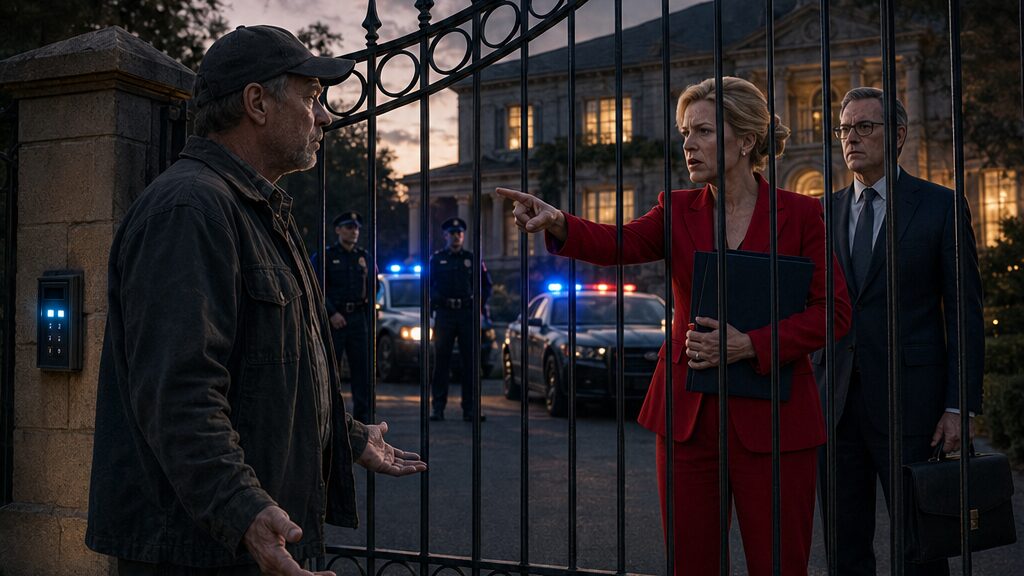
He Was Treated Like A Stranger At The Mansion His Mother Left Him
Chapter 1: The Gate Was Open For Everyone Except Joseph
“He does not have permission to be here.”
Laura White’s voice cut through the dusk before Joseph Harris had even taken his hand off the gate.
She stood on the other side of the black iron bars in a red suit too bright for the hour, one arm lifted, finger aimed at him as if the gesture itself could push him back into the road. Behind her, the long driveway curved toward the mansion where every window still held the pale reflection of a house that had once belonged to his mother. Two police cars idled near the stone pillars, blue lights washing over the hedges, the gate keypad, Laura’s face.
Joseph kept both hands visible.
He had worn his old dark cap because the air had turned cold. Under his jacket, his plaid shirt smelled faintly of sawdust from the morning he had spent replacing a loose porch rail for a neighbor, a thing he had done for money because funeral bills and missed work had already begun to stack. He had not expected police. He had expected a locked house, maybe Laura’s car, maybe a conversation neither of them wanted.
He had not expected to be pointed at like a man found climbing a fence.
One officer stepped closer to Joseph’s side of the gate. “Sir, can you tell me your name?”
“Joseph Harris.”
Laura gave a short laugh from inside the property. “He knows that doesn’t give him standing.”
The word standing came out of her mouth as if she had been practicing it.
Joseph looked past her, past the police lights, past the fountain Carol had always hated because it wasted water in August. In the upstairs east window, the curtains were still drawn crooked. He had meant to fix that before the funeral. He had meant to do a hundred small things before there was no more before.
“This is my mother’s house,” he said.
“It was your mother’s house.” Laura held up a folder, navy leather with a brass clasp. It was not their mother’s old folder. Carol’s had been blue canvas, soft at the corners, stuffed with receipts and yellow sticky notes in her careful handwriting. “And now the estate is under administration.”
“Laura,” Joseph said quietly, “open the gate.”
Her eyes sharpened. “No.”
The officer glanced between them. “Ma’am, you called this in as a trespassing issue?”
“I called because he keeps showing up and trying to enter property he no longer has any right to enter,” Laura said. “I’m the executor. I have a legal duty to secure the estate.”
Joseph looked at the keypad mounted on the brick column. He knew the old code by muscle memory. Carol had chosen it after his father died. Not a birthday, not an anniversary, nothing obvious. A number she said she could remember even if she forgot everything else.
He had punched it in three days ago after the funeral and the gate had refused him.
The second officer stood inside the open pedestrian gate near Laura, expression careful. “Mr. Harris, if the property is under estate control and you don’t have documentation with you, we may need you to leave for now.”
“For now,” Laura repeated, but softer, almost satisfied.
Joseph felt something inside him lean toward anger, but he did not move. The old habit held. Do not make a scene in front of strangers. Do not turn family pain into entertainment. Do not give Laura the picture she wanted.
A black sedan rolled up behind the police cars. A man stepped out carrying a thin briefcase, his tie loosened but his posture formal. Laura turned quickly, relief moving across her face.
“Anthony,” she called. “Thank you for coming.”
Anthony Lewis approached the gate from the inside and gave Joseph a look that was polite enough to become impersonal. Joseph had met him once, years ago, when Carol had wanted a power of attorney updated after a fall. Back then Anthony had sat at the kitchen table while Carol complained about legal fees and made him eat pound cake.
Now he stood beside Laura with the folder between them.
“Joseph,” Anthony said. “I’m sorry we’re meeting again under these circumstances.”
“Are you?” Joseph asked.
Anthony’s mouth tightened. “I’m here to avoid confusion.”
Laura opened the folder and handed him a document. Joseph saw thick paper, clipped pages, a notary stamp, signatures black against white. The sight of it made his throat close more than the police lights had.
Anthony adjusted his glasses. “Your mother executed a revised last will and testament six weeks before her death. Laura White is named personal representative. The principal residence, associated furnishings, and primary estate assets are assigned to Laura under the revised terms.”
Joseph stared at him. For a second the words did not arrange themselves into meaning. Principal residence. Associated furnishings. Primary estate assets. Assigned to Laura.
“What about my name?” he asked.
Laura looked away first.
Anthony lowered the paper half an inch. “You are not named as a beneficiary in the revised will.”
The police lights clicked and pulsed. Somewhere behind the mansion a dog barked, one sharp sound, then nothing.
Joseph heard himself breathe.
His mother’s house had fifteen gutters, three roof valleys that trapped leaves, a basement sump pump that failed every spring, and a west wall that always needed repainting where the sun hit hardest. For years, Carol had called him about every leak, every hinge, every lightbulb above the stairs because she no longer trusted herself on a ladder. He had come because she asked. He had come because she was his mother. He had come because Laura said she was busy.
Now a document held by a man in a suit said none of that had left a mark.
Laura lifted her chin. “Mom changed her mind. That was her right.”
Joseph’s eyes moved to her red sleeve, the estate folder pressed against her ribs, the police standing there as witnesses to his removal. It landed then, not all at once but in pieces. She had not asked him to meet in Anthony’s office. She had not called him after the funeral. She had waited until he came to the gate, then made sure strangers were present when he heard it.
“You wanted me told here,” he said.
Laura blinked. “Don’t twist this.”
“You wanted the gate between us.”
The first officer shifted. “Mr. Harris, I understand this is emotional, but without documentation—”
“What date?” Joseph asked.
Anthony paused. “Excuse me?”
Joseph looked at the document, not Laura. “What date does it say she signed that?”
Laura’s mouth opened before Anthony answered. “That has nothing to do with—”
“What date?” Joseph repeated.
Anthony checked the first page, then the last. The paper made a dry sound in his hand. “November eighteenth.”
Joseph’s face did not change, but the date went through him like a board splitting under weight.
November eighteenth.
That was the week Carol had called him from inside the pantry because she could not remember why she had gone in. The week she had asked him, with real fear in her voice, whether the gate code had always had a seven in it. The week he found her standing at the keypad in her slippers, pressing the same wrong number until the alarm chirped.
Laura’s eyes narrowed. “What are you doing?”
Joseph kept his voice low. “That week she couldn’t remember the gate code.”
“That doesn’t mean she couldn’t sign a will.”
“No,” Joseph said. “It means I’m going to ask who was with her when she did.”
Anthony folded the document back into the folder. “This is not the place for that conversation.”
“It became the place when you read it through a gate.”
The words came out before Joseph could stop them. For the first time, Laura’s confidence flickered. Not much. Just a tightening around her eyes, a small withdrawal of the folder against her body.
The officer nearest Joseph cleared his throat. “Sir, for tonight, I need you to step back from the gate. This can be handled through the estate process.”
Joseph looked at the mansion one last time. The porch light over the front door was still the bulb he had installed after Carol said the old one made everyone look sickly yellow. His ladder was probably still in the carriage shed unless Laura had moved it.
He stepped back.
Laura exhaled as if she had won something clean.
Joseph turned toward his truck, gravel shifting under his boots, but he stopped by the stone pillar. The keypad glowed faintly beside him. He remembered Carol’s hand hovering over it, trembling and frustrated, while she whispered, “I know this. Don’t tell me. I know this.”
November eighteenth.
The same week she had forgotten the code she had used for twenty years.
Chapter 2: The Date On The Paper Would Not Stay Quiet
The old gate code failed before Joseph finished pressing the last digit.
A flat red light blinked on the keypad. No chime. No motor hum. No slow inward swing of the black iron gate. Just a small electronic refusal that felt more personal than it should have.
Joseph stood beside his truck in the gray morning and entered the number again, slower this time, though he already knew it would not work. The keypad flashed red. Somewhere beyond the gate, sprinklers clicked across the winter lawn Carol used to complain was too expensive to keep green.
He had no police lights behind him now. No Laura in red. No attorney reading him out of his own history. Just the gate and the cold little fact of being locked out.
He took a folded receipt envelope from his jacket pocket and wrote the time on the back. 8:17 a.m. Code disabled.
It looked foolish when he saw it in his own handwriting. Too late for records. Too late to become the kind of man who saved every text, every check stub, every small proof that love had not been a scam. Carol used to hand him receipts in bunches after he bought filters, lumber, paint, medicine. He usually left them in his truck cup holder until the ink faded.
Laura had always kept folders.
That morning, he started with the gatehouse.
The gatehouse was not really a house, only a narrow brick office built into the wall near the service entrance, where the security company had once kept a panel and a binder for maintenance visits. Joseph had a key to the outer utility door because Carol had given it to him after a storm shorted the opener three summers earlier.
The key still worked.
Inside, the air smelled like dust and warm plastic. A small monitor slept on the desk. A locked metal box held old access cards. Above it, a printed sticker listed the security company number.
Joseph hesitated before calling. He did not like asking strangers for proof of family trouble. He could hear Laura already: You’re making this ugly. You’re dragging people into grief because you didn’t get what you wanted.
He dialed anyway.
After two transfers and a long hold, a security company representative came on the line. Joseph gave Carol’s address, his name, and the old service authorization code Carol had once written on masking tape inside the utility cabinet. The representative went quiet long enough that Joseph thought she might disconnect.
“You’re still listed as maintenance contact,” she said finally. “But not account administrator.”
“Who is?”
“I can’t disclose account authority details beyond what you’re authorized to access.”
Joseph closed his eyes. “Can you tell me whether my gate code was removed?”
Another pause. Keyboard clicks. “Your individual access code was deactivated on November fifteenth.”
The pen in Joseph’s hand stopped moving.
Three days before the will.
“Who requested that?”
“I’m not authorized to provide names for account changes.”
“But there was a request.”
“Yes.”
“Was a new administrator added?”
“I can confirm an administrator update was submitted that week.”
Joseph wrote it down. November fifteenth. Administrator update. He pressed the pen so hard it tore the envelope.
The representative’s voice softened just enough to become human. “Mr. Harris, I can email access logs to the account administrator. If you need records for legal purposes, an attorney can request them.”
“I don’t have an attorney.”
“Then you may want one.”
He almost laughed. Not because it was funny, but because every door seemed designed to open only for someone with the right title. Executor. Administrator. Attorney. Not son. Not the man who knew where Carol kept the spare fuses. Not the man who had held her elbow crossing the icy front walk.
Before he left the gatehouse, he took a photo of the old authorization sticker and the red light on the keypad. Then he sat in his truck, engine off, and looked through his phone.
There were messages from Laura. Three since dawn.
You need to stop showing up.
Anthony says any communication should go through the estate.
I don’t want this to get worse.
He looked at the last one until the words lost shape. Then another message arrived.
I’m willing to give you $15,000 from my personal funds if you sign a release and agree not to contest. That is more than fair considering what Mom already gave you.
Joseph put the phone face down on the passenger seat.
Fifteen thousand dollars. The number sat there like an insult wearing a clean shirt.
He had spent more than that in labor he never charged Carol for, though he had never counted it because counting had felt wrong. The west deck, the pump, the cracked tile in the upstairs bath, the winter nights sleeping in the guest room because Carol was afraid to be alone after she wandered outside once looking for a cat that had died ten years earlier.
He had no invoice for that.
His phone rang.
Laura.
He let it ring twice before answering. “What do you want?”
“For you to stop making calls like this is some investigation,” she said. She sounded contained, but not calm. “The security company notified me.”
“That was fast.”
“I’m account administrator.”
“Since November fifteenth?”
Silence.
Joseph looked up at the mansion. No lights moved behind the glass. “That was three days before the will.”
“You’re not going to intimidate me with dates.”
“I’m not trying to intimidate you.”
“You’re trying to make it look like I did something wrong because you can’t accept that Mom finally saw what was happening.”
His hand tightened around the phone. “What was happening?”
“You living off her. Taking checks. Making yourself indispensable. You think no one noticed?”
Joseph looked at the envelope in his lap, the torn paper, the ugly little notes he was learning to make. “You weren’t here enough to notice much.”
“That is exactly it,” Laura snapped. “You always say that like showing up with a toolbox made you the good child.”
He could have told her then about the nights Carol cried because she could not remember whether Laura had visited that week. He could have said that Carol defended Laura even when Laura forgot birthdays, even when she called from airports and boardrooms and promised next month, always next month.
But old pride closed his mouth. He did not want to audition grief for his sister.
Instead, he said, “Send the settlement offer through Anthony.”
Laura’s breath caught, perhaps surprised he had not shouted. “So you’ll consider it?”
“I’ll keep a copy.”
She hung up.
By noon, Joseph had found the security company’s local office beside a strip mall thirty minutes away. He did not expect much. He expected a desk, a refusal, another instruction to get an attorney.
He got a tired clerk behind glass who recognized Carol’s address before he finished giving it.
“That big place with the black gate,” the clerk said. “We had a lot of calls there last fall.”
Joseph leaned forward. “From who?”
The clerk’s face shut down. “I can’t print anything without authorization.”
“I understand.”
Maybe it was the way he said it. Maybe it was the cap in his hands, or the fact that he did not demand. The clerk glanced over his shoulder, then slid a plain intake sheet across the counter.
“I can’t give you logs,” he said. “But if you are still listed as maintenance contact, you can request your own access history. Just yours.”
Joseph filled out the form.
An hour later, a two-page printout came warm from the machine. Most lines showed old entries from months before: Joseph’s code opening the gate at normal hours, after Carol called about a breaker or a delivery. Then came November fifteenth.
Access code deactivated.
Under administrator notes, the name was redacted, but the next page listed new entry events by code number, not person. The clerk had circled one line in pencil without comment.
November seventeenth. 11:42 p.m. Administrator code. Main gate opened.
Joseph stared at the timestamp.
The night before the will was signed.
Chapter 3: The Lawyer Said Legal And Joseph Heard Alone
“The signatures are verified,” Anthony Lewis said.
“When exactly were they signed?” Joseph asked.
Anthony’s office went still around the question. Outside the interior window, a receptionist moved behind frosted glass. On the desk between them lay the revised will, Laura’s settlement letter, and the printout Joseph had folded twice so he would not keep staring at the 11:42 p.m. line like it might explain itself.
Anthony sat back in his leather chair. His office looked designed to make grief behave: framed credentials, dark shelves, a clock that ticked quietly, two identical boxes of tissues placed where clients could reach them without anyone acknowledging why.
“November eighteenth,” Anthony said. “As I told you at the property.”
“You told me the date. I’m asking the time.”
“That level of detail may be in the notary record.”
“Do you have it?”
“I have the executed document.”
“That’s not what I asked.”
Anthony looked at him over the rims of his glasses. “Joseph, I understand this is difficult.”
Joseph hated the sentence immediately. It had the shape of kindness and the function of a closed door.
“No,” he said. “You understand the document. You don’t understand why the date matters.”
Laura sat to Joseph’s left, legs crossed, red suit replaced by a cream jacket but the same estate folder on her lap. She had insisted on attending once Anthony agreed to meet. Joseph had nearly refused, then realized refusing would let her call it avoidance.
“The date matters because he wants to build a story,” Laura said. “He thinks if Mom was forgetful, nothing she signed counts.”
Joseph turned to her. “Was she forgetful?”
Laura’s eyes hardened. “She was grieving her own decline. That doesn’t mean she lost her rights.”
“She couldn’t remember the gate code.”
“She forgot words sometimes.”
“She asked why Dad hadn’t come home one morning.”
Laura flinched, but only slightly. “And then later that same day she knew exactly who I was and what she wanted for lunch. You know how it was. Good hours and bad hours.”
Anthony lifted one hand. “Capacity is not all-or-nothing. A person can have memory impairment and still possess testamentary capacity at the time of signing.”
“Were you there?” Joseph asked.
Anthony’s hand lowered.
Joseph felt the room shift before anyone spoke.
Anthony took off his glasses and folded them. “No. I prepared the revision based on instructions communicated through Laura and a phone call with your mother. The execution was handled by a mobile notary.”
Joseph looked at Laura.
She did not look back.
“You didn’t see her sign it,” Joseph said.
“I verified her wishes in advance,” Anthony replied. “I had no reason to believe she lacked capacity. Laura also provided a letter from her physician indicating Carol remained capable of making decisions.”
“Her physician?” Joseph asked. “Which one?”
Laura answered too quickly. “Her primary doctor.”
“Carol hadn’t seen her primary doctor in person for months.”
“It was a letter from the office.”
“Requested by you?”
Laura’s fingers pressed into the folder. “Someone had to handle things.”
Anthony shifted in his chair. “The medical letter is part of the file. It states there was no formal incompetency determination.”
“That’s not the same as saying she understood a new will.”
“No,” Anthony admitted. “It is not the same.”
For the first time since Joseph had entered, Anthony sounded less like a wall and more like a man choosing where to place his feet.
Laura heard it too. “Anthony.”
He did not look at her. “I am explaining the distinction.”
Joseph unfolded the access printout and placed it beside the will. He did not push it across the desk yet. Not all of it. Just enough for Anthony to see the date.
“My gate code was deactivated on November fifteenth. Administrator access opened the gate at 11:42 p.m. on November seventeenth. The will was signed November eighteenth. I want to know who entered that night and whether my mother was alone with them before she signed.”
Laura laughed once, sharp and dry. “This is ridiculous. I went to see my mother.”
“At midnight?”
“She was awake at odd hours. You know that.”
“I know she was scared at odd hours.”
Laura leaned toward him. “You don’t get to turn every visit I made into something sinister just because you didn’t like the result.”
Joseph’s face warmed, but he kept his voice even. “I didn’t know you were making those visits.”
“Because Mom asked me not to tell you everything.”
The words struck harder than Joseph expected. Not because he believed them. Because some small part of him feared them.
Carol had loved peace more than truth when the truth would start an argument. She had kept Laura’s missed visits from Joseph, and Joseph’s tired complaints from Laura. She had believed separate kindnesses could make a whole family.
Anthony opened another folder from his desk. “There was, for the record, an earlier estate plan.”
Laura’s head snapped toward him. “That isn’t relevant.”
“It may be relevant to his questions,” Anthony said carefully. “Not necessarily legally controlling, but relevant.”
Joseph leaned forward. “What did it say?”
“I don’t have a signed copy in this office.”
“Did you draft it?”
“A prior version, yes. Years ago. My notes indicate the residence was treated separately from the remainder of the estate.”
“Separately how?”
Anthony hesitated, and Joseph understood then that the man was calculating what he could say without betraying a client who could no longer speak.
“The house was to be maintained for your use, with remaining liquid assets divided differently,” Anthony said.
Laura stood up. “That was before Mom understood what he was doing.”
Joseph looked at her. “What I was doing?”
Laura opened her folder and pulled out a stack of photocopied checks. She placed them on Anthony’s desk one by one, each with Carol’s signature, each made out to Joseph Harris.
“Roof repairs. Pump work. Painting. Electrical. Five thousand here. Three thousand there. Over and over,” she said. “You want to talk about influence? You were billing our mother while living in her guest room half the time.”
Joseph stared at the checks.
He remembered every one. The roof check had gone straight to the supplier because the shingles had to match the old slate. The pump check covered parts only because he had done the labor himself. The painting check had been Carol’s argument, not his; she said no son of hers would buy paint for a house she owned.
But in a stack, on a lawyer’s desk, the checks looked different. They looked like a pattern with no tenderness in it.
Anthony looked at Joseph, not accusingly, but with new caution.
Joseph felt the old shame rise. He should have kept invoices. He should have written labor donated in the margins. He should have made Carol sign nothing, pay nothing, so Laura could never turn care into evidence.
“These were reimbursements,” he said.
Laura’s voice lowered. “That is what people always call it when they take from the old.”
Joseph pushed back his chair, then stopped himself from standing. If he walked out, the checks would stay on the desk speaking for him.
He sat still.
“Where is the old file?” he asked Anthony.
“The prior estate folder?”
“My mother kept a blue folder in the study. Canvas. Worn corners. She kept house documents in it.”
Anthony’s expression changed.
Joseph caught it. “You’ve seen it.”
“Carol brought it to a meeting several years ago,” Anthony said. “She was very particular about it.”
Laura’s jaw tightened.
“Where is it now?” Joseph asked.
Anthony looked from Joseph to Laura. “The last time Carol mentioned it to me, she asked whether I needed the blue folder for the revision. Laura told me it was already gone.”
Chapter 4: Susan Remembered The Red Suit At The Bedside
“If this is about your mother’s will,” Susan Brown said, keeping the chain on her apartment door, “I already told Laura I’m not signing anything.”
Joseph stood in the hallway with his cap in one hand and Anthony’s business card in the other. He had not told Susan why he was coming. He had only left a message saying he was Carol Harris’s son and needed to ask about November. Apparently that had been enough.
“I’m not here to make you sign,” he said.
Her eyes moved over his face through the narrow opening. She looked smaller than he remembered from the house, not because she had changed, but because Carol’s rooms had made everyone seem formal. Here, in the thin light of the apartment hallway, Susan looked tired. Her hair was pulled back. One shoulder of her sweater had slipped lower than the other. Behind her, a television flickered without sound.
“I don’t want trouble,” she said.
“I don’t either.”
“That’s not true. People say that when they’re already standing in it.”
Joseph looked down at the card in his hand. Anthony had not given Susan’s address. He had only confirmed she had been one of Carol’s private hospice nurses. The address had come from an old note Carol left near the kitchen phone, where she wrote Susan — good with tea, not too much sugar.
“My mother liked you,” Joseph said.
Susan’s face changed, not softened exactly, but struck. “She was kind to me.”
“She asked for tea when she didn’t want medicine. You made it weak because strong tea made her hands shake.”
The chain stayed on, but Susan looked away.
“I don’t have many questions,” Joseph said. “Just the ones no one else will answer.”
“You should ask your lawyer.”
“I don’t have one.”
“You should get one.”
“That seems to be what everyone tells people after the damage is done.”
Susan closed her eyes. For a moment he thought she would shut the door. Instead, she slid the chain free.
Her apartment was clean but crowded, with stacked mail on a side table and nursing shoes placed neatly beside the sofa. She did not offer coffee. He did not ask. They sat across from each other at a small dining table with a plastic cloth patterned in lemons.
“You came here because of November eighteenth,” she said.
Joseph set his cap beside his hands. “Yes.”
Susan folded and unfolded a napkin until one corner tore. “I was there that morning.”
“Was my mother clear?”
“That depends on who’s asking and what they want clear to mean.”
Joseph felt his jaw tighten. He made himself release it. “I’m asking what you saw.”
Susan looked toward the silent television. “Your mother had good spells. Sometimes she knew exactly where she was. Sometimes she could tell me which cabinet held the good cups and which one held the chipped ones. Other times she asked me if her husband had come down for breakfast.”
Joseph looked at the table.
Susan saw it and lowered her voice. “I’m sorry.”
“Don’t be sorry for saying it.”
“I should have said more when it mattered.”
The words stayed between them. Joseph did not reach for them too quickly.
“What happened that morning?” he asked.
Susan’s fingers flattened the torn napkin. “Laura came early. Before eight. She wore that red suit she liked. Your mother noticed it. Said it made Laura look like she was going to a hearing.”
Despite himself, Joseph almost smiled. Carol had hated loud clothes, except on other women, when she called them brave.
“Was anyone else there?”
“A mobile notary came later. I don’t remember the exact time. There was another witness from the notary’s office, I think. I was told to give them privacy.”
“By my mother?”
Susan looked up. “By Laura.”
Joseph waited.
Susan swallowed. “Your mother was in bed when Laura brought the papers in. Not at the desk. Not in the study. In bed. She had been asking for you that morning.”
His hands tightened around each other. “For me?”
“She asked why you had stopped visiting.”
The apartment seemed to lose air.
“I hadn’t,” he said.
“I know that now.”
“I was at the gate three times that week. No one answered. I called the house phone.”
“Laura told her you were busy.”
Joseph looked toward the window. Parked cars lined the curb below, ordinary and still. He remembered sitting outside the gate that week, calling Carol’s cell and then Laura’s, telling himself not to make a scene, not to accuse, not to push in where Laura said their mother needed quiet.
“She believed it?” he asked.
“She was upset. Then she forgot she had asked. Then she asked again.”
Susan’s voice wavered. She pressed her lips together as if angry at herself for allowing it.
Joseph wanted to stand. He wanted to walk out into the hallway and put his fist through something cheap enough to break. Instead he stayed in the chair because Susan looked like someone already expecting punishment.
“Did she understand the papers?” he asked.
Susan took too long.
“She understood they were papers,” she said. “She understood Laura was upset. She understood someone wanted her signature. But when Laura said it was about simplifying things, your mother asked if the roof had been paid.”
Joseph closed his eyes.
The roof. Always the roof. That was how Carol’s mind had worked near the end. One practical object at a time. A roof, a cup, a gate code, a missing folder.
“Why didn’t you tell anyone?” he asked.
Susan looked down at the torn napkin. “Because I wasn’t in the room when she signed. Because Laura paid for extra shifts after the hospice benefit hours ran thin. Because I told myself the notary would ask the right questions. Because families like yours have lawyers, and nurses like me learn not to step into rooms where papers are being signed.”
“Families like mine,” Joseph repeated quietly.
Susan flushed. “I didn’t mean money. I meant families with long grudges and polished floors. You can lose work getting in the middle of that.”
He believed her. That was the worst of it. Her fear was not noble, but it was real.
“Laura asked you not to discuss my mother’s confusion?”
Susan nodded once. “She said people would twist it. She said your mother had the right to decide without you hovering.”
Joseph could hear Laura saying it, not even lying completely. He had hovered. He had watched pill bottles, railings, stove knobs. He had corrected Carol when she forgot the kettle. He had taken things over because it was easier than watching her struggle. Maybe Laura had seen that and built a whole accusation around it.
“Did my mother mention a blue folder?” he asked.
Susan’s eyes lifted sharply.
Joseph leaned forward. “Anthony said she asked about it. Laura said it was gone.”
Susan stood so quickly her chair scraped the floor. She went to the kitchen counter and gripped the edge with both hands.
“Susan.”
“She told me not to let Laura move it.”
Joseph rose slowly. “When?”
“The day before. Or maybe two days. It was all close together.” Susan pressed one hand to her forehead. “Your mother was sitting in the study. She had that blue folder in her lap. She kept patting it. Laura came in and said she would put it somewhere safe, and your mother held it against her chest like a child.”
Joseph could see it: Carol’s thin hands over worn blue canvas, stubborn even when afraid.
“What did she say?”
Susan turned back. Her face had gone pale.
“She said, ‘Don’t let Laura move the folder from the study.’”
Chapter 5: The Old Code Still Opened One Locked Door
The emergency code did not open the gate, but it opened the side study door.
Joseph stood in the narrow shadow beside the mansion with his hand still on the keypad, listening to the soft click of the lock as if the house had answered him in a whisper. He had not come through the front. He had parked down the service road, walked the line of cypress trees, and used the old path Carol once called the tradesman’s route even after Joseph told her no one said that anymore.
He knew how it looked.
That was the trouble with being innocent in the wrong place. From a distance, it could resemble guilt.
The main gate code was dead. His old house key no longer fit the front door. But the side study lock had its own keypad, installed after Carol began hiding important papers from herself and then accusing the housekeeper of moving them. Joseph had set the emergency code. Carol had insisted it be different from the gate.
“What if I forget both?” she had asked.
“Then you call me.”
“What if I forget you?”
He had told her not to say that. He wished now he had answered.
Inside, the study smelled closed: paper, wood polish, a faint trace of the lavender sachets Carol tucked into drawers. Joseph did not turn on the overhead light. He used the lamp on the desk, the green-shaded one that made a small circle of gold over the blotter.
The room looked too clean.
Carol’s study had never been messy, exactly, but it had been alive with small stacks: seed catalogs, bank envelopes, handwritten lists, repair receipts tucked under paperweights, books with grocery slips as bookmarks. Now the shelves were squared. The desk tray was empty. The file cabinet drawers had labels printed in Laura’s crisp font.
Joseph stood in the quiet and felt the first hard certainty that Laura had not only taken control. She had rearranged memory.
He went to the file cabinet first. Property Tax. Insurance. Utilities. Medical. Estate. The Estate folder held photocopies of the revised will, the physician’s letter, and a list of assets. No blue canvas folder. No prior signed will. Nothing in Carol’s handwriting except her signature, shaky and dark at the bottom of a page that gave Laura everything.
He photographed each document and put it back exactly as he found it.
Then he searched where Carol would have hidden something from Laura, not from him.
The bottom drawer of the desk held old stationery and rubber bands. The closet held rolled wrapping paper, a broken humidifier, and three empty gift boxes. Under the window seat he found gardening gloves, a stack of faded magazines, and a cigar box filled with keys to locks no one remembered.
Half an hour passed. Every sound from outside made him freeze.
He was crouched near the low bookshelf when his hand struck the corner of a map tube wedged behind a row of hardbound county histories. Joseph pulled it free slowly. The tube was dusty, labeled in Carol’s handwriting: HOUSE — NOT MONEY.
His breath caught.
Inside was a folded property map and several photocopied pages clipped together. The top page bore Anthony Lewis’s letterhead from eight years earlier. Joseph set it on the desk beneath the lamp.
It was not a signed will.
He knew that before hope got too far. The pages were marked Draft Copy. But his name was there. Joseph Harris shall have the right to occupy, maintain, and inherit the principal residence at the time of my death, subject to payment of ordinary expenses. Remaining liquid assets to be divided equally between Joseph Harris and Laura White.
There it was, cold in format and still somehow Carol’s voice. House — not money.
A small yellow note clung to the second page.
Joseph fixes what breaks. Laura needs liquid, not walls.
He sat down before his knees could weaken.
It was not enough. A draft was not a deed. A note was not a judgment. Laura would say Carol changed her mind. Anthony would say an earlier draft showed prior intent but not final intent. The law would care about signatures, capacity, procedure.
Still, the room had said something.
His mother had not imagined him as a stranger.
A car door closed outside.
Joseph switched off the lamp.
Through the study window, he saw headlights spill across the gravel near the side entrance. Laura’s car. She stepped out holding her phone, cream coat open, movements sharp with purpose.
Joseph looked down at the papers. He could put them back. He could leave through the rear hall, avoid another scene, wait until he had formal permission. That would be clean. That would be smart.
But Laura’s footsteps were already on the side path, and he was tired of being careful in ways that only helped her.
He folded the copies once and slid them inside his jacket.
The side door opened with a hard push.
Laura froze in the doorway, phone in hand. For one second she looked less angry than afraid. Then her face arranged itself.
“You broke in.”
“The study code still worked.”
“That is not permission.”
“No,” Joseph said. “It’s a code Mom asked me to set because she trusted me to come when something needed fixing.”
“You are unbelievable.” Laura stepped into the room and turned on the overhead light. The brightness made everything flat and exposed. “You’re trespassing inside estate property after being told not to enter.”
Joseph looked at the printed labels on the cabinet. “You cleaned out her desk.”
“I organized it.”
“You removed things.”
“I secured documents.”
“Where’s the blue folder?”
Laura’s mouth tightened. “I don’t know.”
He let the silence answer her.
She lifted her phone. “I can call the police again.”
“You can.”
“You think I won’t?”
“I think you’ve been waiting for me to do something that looks wrong.”
Her eyes flashed. “You did that yourself.”
Joseph took the folded draft from his jacket and placed it on the desk. Laura’s gaze dropped to it.
For the first time, she did not speak.
“It’s not signed,” he said. “I know that. But it says what she meant before you started handling everything.”
Laura’s cheeks reddened. “Before she understood how much she had already given you.”
“She wrote house, not money.”
“She wrote a lot of things. She forgot a lot of things too.”
Joseph heard the cruelty before Laura did. She looked away as soon as the sentence left her, but it was too late to retrieve it.
He glanced back at the map tube on the shelf. Something remained inside, wedged against the cardboard. He reached for it.
Laura stepped forward. “Don’t.”
That was enough.
Joseph tipped the tube, and a narrow envelope slid out, yellowed at the edges. It was not sealed. Inside was a title-company receipt dated two years before Carol’s decline became impossible to deny.
Paid recording fee — Harris residence title transfer review.
Joseph looked up.
Laura’s face had gone still.
Chapter 6: Laura Offered Half Of Nothing To Buy Silence
“You’re going to tear this family apart over money,” Laura said.
Joseph stood in the mansion dining room with the title-company receipt in his jacket pocket and the gate access printout folded inside the same envelope. Morning light spread across the long table where Carol used to place too many dishes even when only three people came to dinner. Laura had chosen the chair at the head, their mother’s chair, and set her estate folder in front of her like a shield.
Joseph remained standing.
“I’m doing this because she didn’t sign that alone,” he said.
Laura’s hands flattened on the table. “You don’t know that.”
“I know my gate code was shut off three days before the will. I know you entered late the night before the signing. I know Mom asked why I stopped visiting when I was outside the gate trying to get in.”
Laura’s face tightened at Susan’s unspoken presence. “So Susan talked.”
“She remembered.”
“She was paid to provide care, not legal opinions.”
“She remembered Mom asking for me.”
For a moment, the dining room seemed to contract around that sentence. Laura looked down at the polished table. In the reflection, her red nails looked like small red marks on wood.
Then she opened the folder.
“If you want to talk about what Mom remembered, let’s talk about what she remembered paying.” Laura removed photocopies of checks and spread them across the table. “Roofing materials. Electrical work. Plumbing. Paint. Equipment rentals. Thousands of dollars, Joseph.”
He looked at the checks. They had followed him from Anthony’s office like stains.
“I told you what those were.”
“You told me your version.”
“They were reimbursements.”
“You were the one who decided what needed fixing. You were the one who bought the supplies. You were the one who told her what it cost.” Laura’s voice shook, but not from weakness. “Do you know what that looked like from the outside?”
“There was no outside. You weren’t here.”
“I had a job.”
“So did I.”
“You made Mom your job.”
The words landed with more force than the accusation about money. Joseph looked toward the doorway, toward the front hall where Carol’s walker had once scraped the baseboard because she refused to lift it over the threshold.
Laura saw his silence and pressed harder.
“You think I didn’t know she called you for everything? You think I didn’t hear it in her voice? Joseph fixed this. Joseph knows that. Ask Joseph. Wait for Joseph.” Her mouth twisted around his name. “I was her daughter too.”
Joseph had prepared for greed. He had prepared for denial. He had not prepared for hurt this old.
“You could have come,” he said.
“I did come.”
“When it was time for papers.”
Laura stood. “I came when I could. I sent money. I handled insurance calls. I dealt with tax notices. You got to be the son with the toolbox and the warm hands. I got spreadsheets and late fees and Mom telling me not to upset you because you were tired.”
Joseph looked back at the checks. For the first time, he saw not just Laura’s weapon, but the place she had sharpened it. Every reimbursement had become, in her mind, proof that Carol chose him in concrete ways and left Laura to manage abstractions.
“That doesn’t explain November,” he said.
“No. It explains why Mom finally listened when I told her the estate wasn’t fair.”
“She was confused.”
“She had clear moments.”
“You chose the moment.”
Laura’s eyes filled, but the tears did not fall. “I chose to stop pretending you were the only one who sacrificed.”
He almost answered quickly. Almost told her sacrifice did not give her the right to lock him out, to feed Carol a story, to bring papers to a bedside. But something in her face held him back. Not sympathy. Recognition, maybe. The ugly kind.
“You changed the gate code,” he said.
“Yes.”
“Why?”
“Because every time you came, she changed her mind.”
Joseph went still.
Laura seemed to hear herself and looked away.
“Changed her mind about what?”
“Everything.” Laura’s voice dropped. “The house. The accounts. Whether to sell. Whether to keep paying for repairs. Whether you should move in permanently. She was not stable, Joseph. She would tell me one thing in the morning, then look at you in the afternoon and become certain of something else.”
“So you removed the afternoon.”
Laura flinched as if he had raised a hand.
He did not feel victorious. He felt sick.
She reached into the folder and took out a single sheet. “I asked you here because I don’t want this dragged through court.”
“This is Mom’s dining room, not a court.”
“It will be worse in court.” She pushed the paper toward him. “I’ll give you fifty thousand. From my share, not the estate’s. You sign a release. You stop contacting nurses, security companies, Anthony, anyone else. You take the money and walk away.”
Joseph did not touch the paper.
“Yesterday it was fifteen.”
“Today you broke into the house.”
“I found a draft.”
“A draft isn’t a will.”
“I found a title-company receipt.”
Laura’s face changed so quickly she could not hide it. Her eyes moved to his jacket pocket, then back to his face.
Joseph noticed. He said nothing.
She recovered, but not fully. “You don’t even know what it means.”
“No,” he said. “But I know you wish I hadn’t found it.”
Laura’s voice hardened. “If you come onto this property again without permission, I will file a trespass complaint. Not a warning. A complaint.”
There it was. Not grief now. Not resentment. A threat made official enough to stand on paper.
Joseph picked up the release form and folded it once, slowly, without reading further. He put it in his pocket with the title receipt.
Laura frowned. “What are you doing?”
“Keeping a copy.”
“You are impossible.”
“No,” Joseph said. “I was quiet.”
He took the gate access printout from his envelope and placed it on the dining table between the checks and the estate folder. The circled line faced Laura.
November seventeenth. 11:42 p.m.
Administrator code. Main gate opened.
Laura looked down at it.
Before she said a word, her face gave him the first answer h
Chapter 7: The House Did Not Belong To The Loudest Voice
“The will may not control the mansion,” the probate mediator said.
Laura’s pen stopped moving.
Joseph did not look at her. He kept his eyes on the table, where the title-company receipt lay beside the revised will, the gate access printout, and a copy of the draft marked HOUSE — NOT MONEY. The documents had been arranged in neat rows by the mediator, as if order could make them less painful.
Anthony Lewis sat at one end of the conference table with his hands folded. Laura sat across from Joseph, dressed in dark blue this time, no red, her estate folder closed in front of her. Two weeks had passed since the dining room confrontation. Two weeks of calls, copies, certified letters, and the dull humiliation of learning how expensive truth became once it needed stamps and witnesses.
The mediator tapped the title receipt with one finger. “This references a title transfer review conducted two years before the revised will. It does not prove by itself that ownership changed, but the county record does show a recorded beneficiary deed naming Joseph Harris as transfer-on-death beneficiary for the residence.”
Laura’s face drained in stages.
Joseph heard the words, but they did not feel like victory. They felt like a door unlocking somewhere far away while he remained seated under fluorescent lights.
Anthony leaned forward. “I want to be clear. The revised will may still govern estate assets not covered by separate title instruments. But if this deed was properly recorded and not revoked, the residence passes outside the will.”
Laura turned to him. “You never told me that.”
Anthony’s expression remained controlled. “I did not have the receipt or the recording information until Joseph produced it and the county clerk confirmed the index.”
“You were her lawyer.”
“For the will revision,” Anthony said. “Apparently not for that title review.”
The mediator glanced at Joseph. “Do you know who handled it?”
Joseph shook his head. “No. My mother never told me she finished anything. She only said the house was settled.”
Laura laughed under her breath, but it broke before it became sound. “Of course she did.”
Joseph finally looked at her.
She was staring at the draft copy, at Carol’s handwritten note still attached: Joseph fixes what breaks. Laura needs liquid, not walls.
For a moment, her anger seemed to step aside and leave only the wound beneath it. Joseph had seen that note as love. Laura had seen it as a verdict.
The mediator shifted another paper into view. “The house is one issue. The signing conditions of the revised will are another. We are not here today to make a court determination about capacity. But the concerns raised are substantial enough that all parties should consider formal review before distribution.”
Laura’s pen rolled from her fingers and clicked against the table.
“There is nothing substantial,” she said, but no one answered quickly enough to help her believe it.
The door opened and Susan Brown stepped in with a folder clutched against her chest. She looked at Joseph first, then away, as if apology had become a place she could not stand for long.
Laura sat up. “Why is she here?”
The mediator said, “Ms. Brown provided a written statement and agreed to answer limited questions.”
“I didn’t agree to this,” Laura said.
“You agreed to mediation,” Anthony replied quietly.
Susan took the chair nearest the door. She did not remove her coat. Her hands were bare, fingers reddened by cold, and Joseph noticed how tightly she held the folder. He had not asked her to come. He had asked whether she would write down what she remembered. Her appearance in the room felt like courage arriving late and still afraid.
The mediator’s voice softened. “Ms. Brown, were you present at the Harris residence on November eighteenth?”
“Yes.”
“Did you observe Carol Harris that morning?”
“Yes.”
“Can you describe her condition?”
Susan looked at Laura, then at Joseph. “She had good moments. She knew me when I came in. She asked for tea. She also asked why Joseph hadn’t visited.”
Laura’s jaw tightened.
Susan continued, quieter. “I told her I didn’t know. Laura said he was busy. Carol became upset. Later she asked again.”
The mediator made a note. “Did Carol appear to understand that legal documents were being signed?”
“She understood there were papers. She understood Laura wanted them signed.” Susan looked down. “But when Laura said they were about simplifying the house, Carol asked if the roof had been paid.”
Joseph stared at the grain of the table.
Anthony removed his glasses and set them down.
Laura’s voice came sharp. “That is not fair. You were in and out of that room all morning.”
“Yes,” Susan said. “I was.”
“And she had clear moments.”
“Yes.”
“She knew who I was.”
“Yes.”
“She knew Joseph had taken money from her.”
Joseph looked up. Susan flinched.
Laura leaned forward, seizing the shift. “She talked about the checks. She worried about them. She said she didn’t know how much the repairs cost anymore. She said he always had another thing that needed fixing.”
Joseph felt the old shame move through him, but this time it did not seal his mouth.
“She worried about everything,” he said. “The roof. The fountain. The stove. Whether you were angry. Whether I was tired. Worry wasn’t the same as intent.”
Laura’s eyes shone. “Easy for you to say. You were the one she wanted.”
“No,” Joseph said. “I was the one she called when something broke. That isn’t the same as being wanted more.”
Laura looked as if she might answer, but Susan spoke first.
“She asked for the blue folder,” Susan said.
The room went still again.
The mediator looked up. “When?”
“Before the papers. Maybe the day before. She was in the study with it. Laura wanted to move it, and Carol said not to.” Susan swallowed. “On the morning of the signing, Carol asked where it was. Laura told her it was safe.”
Laura’s chair scraped slightly as she shifted. “It was safe.”
“Where?” Joseph asked.
Laura did not answer.
The mediator leaned back. “Laura, do you still have the blue folder?”
Laura’s mouth tightened. “I have estate materials.”
“That was not the question,” Anthony said.
She turned on him. “You are supposed to be neutral.”
“I am supposed to be accurate.”
The sentence landed harder than he seemed to intend. Laura looked down at her hands.
The mediator placed the gate access log beside the title receipt. “Let us address access. Joseph’s code was deactivated November fifteenth. Administrator access entered the gate at 11:42 p.m. November seventeenth. The revised will was signed November eighteenth. Laura, can you explain the late entry?”
Laura pressed her lips together. For the first time since Joseph had arrived at her gate, she looked not cornered by accusation but cornered by memory.
“She called me,” Laura said.
Joseph looked at her sharply.
“Mom called me,” Laura repeated, quieter. “She was crying. She said Joseph was going to take the house and leave me with nothing but bank statements and bills. She said she couldn’t remember what she had promised who. I went over because she was upset.”
Susan’s brow furrowed. “She was asleep when I left at ten.”
“She woke up,” Laura snapped, then her voice dropped. “She woke up and called.”
Joseph did not know whether to believe that. He could imagine Carol waking afraid. He could imagine Laura hearing what she wanted inside that fear.
“What did you do when you got there?” he asked.
Laura stared at the printout. “I talked to her.”
“About the will?”
“About fairness.”
“Six weeks before she died. At midnight.”
Laura’s eyes lifted to his. “Do you know what it felt like to sit across from our mother and hear her say the house was yours because you knew the furnace? Do you know what it felt like to be treated like a guest in the family you were born into?”
Joseph said nothing.
Laura looked back at the table. “I changed the gate code because every time you came, she softened. She forgot the parts that scared her. She forgot the checks. She forgot the way you made decisions before asking. I couldn’t let Carol keep choosing him.”
No one moved.
Laura seemed to realize too late that she had stopped saying Mom.
The mediator’s pen hovered over the page. Anthony closed his eyes for one second. Susan looked at Joseph as if she had heard a door shut.
Joseph felt no triumph. The sentence had not made Laura a monster. It had made her responsible.
He looked at the gate log, the title receipt, the will, the old draft, all of them lined up like fragments of a family that had tried to speak through paper because people had failed to speak in rooms.
“What do you want, Joseph?” the mediator asked.
For weeks, he had thought the answer was the house. Then the truth. Then proof. Now all three sat on the table, incomplete and cold.
Laura stared at him, no longer confident, no longer pleading, waiting to see how much of her life he would choose to break open.
Chapter 8: He Entered Through The Gate Without Making Them Watch
Joseph stood at the same black gate one month later with no police lights behind him.
The keypad had been reset that morning. A security company representative had called to confirm the new administrator code, then asked whether he wanted individual access codes issued for anyone else. Joseph had looked across his kitchen at the stack of mediation papers, the title confirmation, and the agreement Laura had signed with Anthony as witness.
“No,” he had said first.
Then, after a long silence, “Not yet.”
Now his finger hovered over the keypad in the late afternoon light. The stone pillars still stood on either side of him. The mansion still rose beyond the curve of the drive, too large, too quiet, every window reflecting the sky as if the house had learned to keep its own counsel.
He entered the code.
The green light blinked.
For a second nothing happened, and his chest tightened with the old expectation of refusal. Then the motor caught, low and steady, and the gate began to open.
Joseph did not move until there was room to walk through.
The agreement had not given him everything. The estate accounts would go under review. The liquid assets remained tangled in the revised will, physician letter, notary record, and whatever arguments lawyers could make from grief. Laura had agreed to recognize the title transfer for the house and to return personal items Carol had marked for Joseph in the older estate materials. She had agreed to pay part of the repair reimbursements back into the estate until they could be sorted properly, though she signed that line with a hand so tight the pen tore the page.
She had not said she was sorry.
Not in those words.
She stood now near the front steps, alone, holding Carol’s blue canvas folder against her coat. She was not wearing red. Her hair was pinned back, but strands had loosened in the breeze. Without the police, without Anthony’s office, without the dining table between them, she looked smaller and more familiar in a way Joseph did not welcome.
“You changed the code,” she said.
“Yes.”
“Good.”
It was not the conversation either of them had prepared for. Maybe there was no preparing for standing outside a dead mother’s house after proving each other capable of harm.
Joseph stopped several feet away. “You brought it?”
Laura looked down at the folder. “Most of it. Some things are with Anthony. Some are copies.”
“Did you remove it before the signing?”
Her fingers tightened around the canvas. For a moment he thought she would retreat into legal language again, say estate materials or secured documents or some phrase built to hold off blame.
“Yes,” she said.
The word came out flat. Bare.
Joseph absorbed it without nodding.
“Why?” he asked, though he knew parts of the answer.
Laura looked toward the house. “Because she kept opening it and changing her mind. Because every page in it made me feel like I had already lost before she was gone. Because I told myself if she wanted a new will, she needed the old things out of sight.”
“That was not your choice to make.”
“I know.”
He had wanted those two words weeks ago. Now they arrived late, carrying less relief than he expected.
Laura held out the folder.
Joseph took it. The canvas was softer than he remembered, the corners worn pale, the zipper tab bent from Carol pulling too hard when her hands grew stiff. Inside were copies of the older estate draft, house notes, insurance papers, a handwritten list of repairs, and an envelope with Joseph’s name on it in Carol’s careful, uneven script.
He looked at Laura.
“She told me to give you that,” Laura said. “Before all this. Before November.”
“You kept it.”
“Yes.”
“Why give it back now?”
Her face trembled once, then steadied. “Because Susan was right about one thing. Mom asked for you. I told myself she was confused. Maybe sometimes she was. But not every time.”
Joseph opened the envelope.
Inside was not a letter that explained everything. It was not a confession from the dead, not a perfect answer folded into paper. It was a small brass key taped to an index card.
For the study cabinet, Carol had written. Joseph knows which lock sticks. Tell him not to force it.
Under that, in smaller writing: The house is not payment. It is trust.
Joseph closed his hand around the key.
The words did not fix the will. They did not undo the gate, the police, the weeks Carol spent wondering why he had stopped coming. They did not make Laura harmless or Joseph blameless. He had been proud. He had let silence stand where records should have been. He had believed being needed would be understood without being spoken.
But the card gave back one thing the revised will had tried to take.
Carol had known the difference between money and trust.
Laura watched his hand close. “Are you going to use everything Susan said?”
“In the review?”
“In public.”
Joseph looked past her to the front door. The porch light above it was still the bulb he had installed. No one had changed it. Its glass cover held a dead moth at the bottom, a tiny ordinary thing waiting for someone to notice.
“I’m not going to make a show of it,” he said.
Laura’s shoulders lowered, but he raised his eyes to her before relief could settle.
“That doesn’t mean I’ll hide it.”
She nodded once, slowly, as if the distinction cost her something to accept.
“I thought you wanted to take everything,” she said.
“I thought you wanted me erased.”
She looked at the folder in his hand. “Maybe I did. Not all the time.”
That was as close as she came.
Joseph walked past her and unlocked the front door with the house key Anthony had returned after the title confirmation. The door opened with a familiar drag against the threshold. He stepped into the front hall, and the smell of the house came toward him all at once: wood, dust, lemon oil, old paper, the faint medicinal trace that had not yet left the rooms.
He expected triumph. Instead he felt the weight of every repair still waiting. The loose banister. The study cabinet. The west wall that would need paint by spring. The house had not become a prize because the gate opened. It had become responsibility again.
Laura remained outside.
Joseph turned back. For one moment, brother and sister looked at each other through the open doorway of a house both of them had lost in different ways.
“You can come in another day,” he said.
Laura’s eyes filled, but she did not step forward. “Another day.”
He closed the door gently, not to shut her out, but because the house was quiet and deserved quiet.
Then he walked through the front hall to the study, the blue folder under his arm and Carol’s small brass key in his palm. Outside, the black iron gate stood open long enough for the driveway to empty of ghosts. When Joseph returned to close it, there were no police cars, no flashing lights, no audience on the road.
He pressed the button from inside the pillar.
The gate moved slowly, iron folding back into place with a low, steady hum.
Joseph watched until it latched, then rested one hand on the cold metal before walking back toward the house his mother had trusted him to keep.
The story has ended.