The HOA Laughed at His Old Deed Until Twelve Trucks Entered Their New Clubhouse Lot
Chapter 1: The Flags Appeared Before Anyone Asked Why
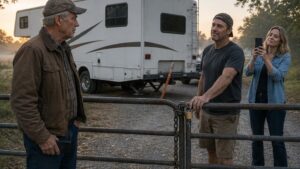
The orange flag had been driven into the ground less than six feet from George Carter’s back fence.
It leaned toward his house as if the person who planted it had been in a hurry. A strip of fluorescent plastic snapped at the top of its wire stem, bright against the clipped grass and the dark cedar boards.
George stood on his patio in his socks, coffee cooling in one hand.
His father had pointed to that same patch of ground nearly forty years earlier, before the subdivision had streets, stone mailboxes, or a name printed on monument signs.
“Whatever happens up top,” his father had said, “don’t sign away what’s underneath.”
At the time, George had been twenty-three and impatient to leave for his first land office job. He remembered nodding without asking what his father meant. He remembered the old man’s dirt-stained thumbnail pressed against a folded deed.
Now a second orange flag moved in the common field beyond the fence. Then a third.
George set his mug down.
By eight that morning, a survey crew had placed a line of stakes from the drainage swale toward the future clubhouse site. White paint marked corners in the grass. Wooden laths stood where the new parking entrance would cut across the field.
The survey crew chief glanced up when George approached.
“Association project?” George asked.
“Yes, sir. Clubhouse, parking, pickleball courts. We’re staking phase one.”
George looked past him to the flattened rectangle of grass where earthmoving equipment would arrive. “You working from a title survey or a construction survey?”
The man paused. “Construction layout.”
“Different thing.”
The crew chief gave a cautious smile. “I just put the marks where the plan says.”
George nodded. He had said the same thing himself, in one form or another, during thirty-four years of lease negotiations and title disputes. Field crews did not decide ownership. They made decisions visible.
A golf cart hummed along the paved trail. Matthew White was driving, one hand on the wheel, the other resting on a roll of plans beside him. He wore a blue polo embroidered with the neighborhood’s oak-tree emblem.
“George,” he called. “You’re getting a front-row seat.”
Matthew stopped beside the stakes and climbed out. He was carrying the optimism of a man who had repeated the same announcement until it sounded like fact.
“Groundbreaking Saturday,” he said. “You’ll finally have somewhere close to sit down with people instead of hiding behind that fence.”
George looked at the plans. “How far does the parking extend?”
“All the way to the swale. Eighty-one spaces. We added four after the accessibility review.”
“Did the association order a mineral-title report?”
Matthew’s expression changed only slightly. “We own the common area.”
“That wasn’t my question.”
“We bought a full title policy when the developer transferred it.”
“Surface title policy?”
Matthew put both hands on his hips. “George, the lawyers handled it. We are not building a refinery. We’re pouring concrete and asphalt.”
George let his eyes travel across the field. The orange flags traced a rough line that felt familiar before he could explain why.
“You might want to check the deed reservations before Saturday,” he said.
Matthew laughed once, not cruelly, but with the confidence of someone indulging an unnecessary concern. “The contractor’s deposit becomes nonrefundable after Saturday. We already delayed once for drainage. I’m not reopening title because you remember something from the oil patch.”
“I didn’t say oil.”
Matthew looked at him.
George bent and touched the base of the nearest flag. The wire was driven six inches into dry soil.
“No,” Matthew said. “You didn’t.”
He gathered the rolled plans and returned to the golf cart. “Come to the meeting Thursday. I’ll put you on the agenda if that makes you feel better.”
The cart pulled away.
George remained beside the flag until the survey crew moved farther into the field.
Inside his house, he went to the back room where two metal filing cabinets stood beneath shelves of old lease books. Retirement had left the cabinets looking excessive. Katherine Brown, next door, had once joked that he kept enough paper to rebuild the county courthouse.
He opened the bottom drawer.
Property records were arranged by tract, not date. His father’s papers occupied three hanging folders marked in pencil. George found tax receipts, an easement for a pipeline abandoned before the subdivision was built, and a warranty deed from the early 1960s.
The copy was thin and faded. He laid it under the desk lamp and read the legal description twice.
Beginning at an iron pin near the north bank of the drainage channel.
Proceeding west along the old fence line.
The old fence line no longer existed, but George could place it. It had crossed what was now the common field, then turned near the live oak the developer had preserved beside the clubhouse site.
He pulled Matthew’s project handout from the recycling basket and flattened it on the desk.
The clubhouse footprint sat north of the line.
The parking lot did not.
George reached for a ruler. He aligned the old bearing with the printed site plan, using the drainage swale and live oak as reference points. The edge of the proposed asphalt crossed the southern tract by more than a hundred feet.
His pulse did not quicken. Years of title work had trained that response out of him. Excitement made people read what they wanted to see.
He returned to the deed.
The granting language conveyed the surface and appurtenances, subject to reservations. The next page contained the clause his father had once pressed beneath his thumbnail.
All oil, gas, and other minerals were reserved to the grantors, together with rights reasonably necessary for exploration and production, subject to existing surface agreements.
George read it again.
A reservation was not proof of present ownership. Estates divided. Heirs conveyed interests. Tax foreclosures complicated chains. A single sentence could survive sixty years or be reduced to nothing through documents stored in courthouses three counties apart.
He searched the folder for later instruments.
Nothing.
At noon, Katherine knocked on the back door carrying a roll of blue ribbon and a cardboard box of plastic tablecloths.
“You saw the flags,” she said.
“I saw them.”
“We’re decorating Saturday. Matthew thinks two hundred people may come.”
“That many?”
“People like free barbecue.”
She noticed the papers on his table. “You working again?”
“Looking.”
“At what?”
George folded the project handout over the deed. “Old boundaries.”
Katherine waited. She had known him long enough to recognize when he was choosing the size of an answer.
“Is there a problem?” she asked.
“There may be a question.”
“That sounds like your way of saying yes.”
“It’s my way of saying I don’t know yet.”
She shifted the ribbon under her arm. “The clubhouse matters to people, George. Some of us are tired of every neighborhood gathering being in somebody’s garage.”
“I know.”
She studied him, then nodded toward the field. “Don’t wait until Saturday to tell them something important.”
After she left, George returned to the cabinet.
At the back of the final folder, beneath a brittle plat and an unsigned division order, he found an envelope in his father’s handwriting. Inside was a yellow index card with a recording reference written across it.
Volume 1842. Page 611.
Below the numbers, his father had added five words.
Minerals never conveyed. Keep this.
George sat very still.
Outside, the orange flag tapped against the fence.
Chapter 2: The Board Laughed Before Reading the Record
Matthew White held George’s photocopied deed above his shoulder as though the paper itself were evidence of a misunderstanding.
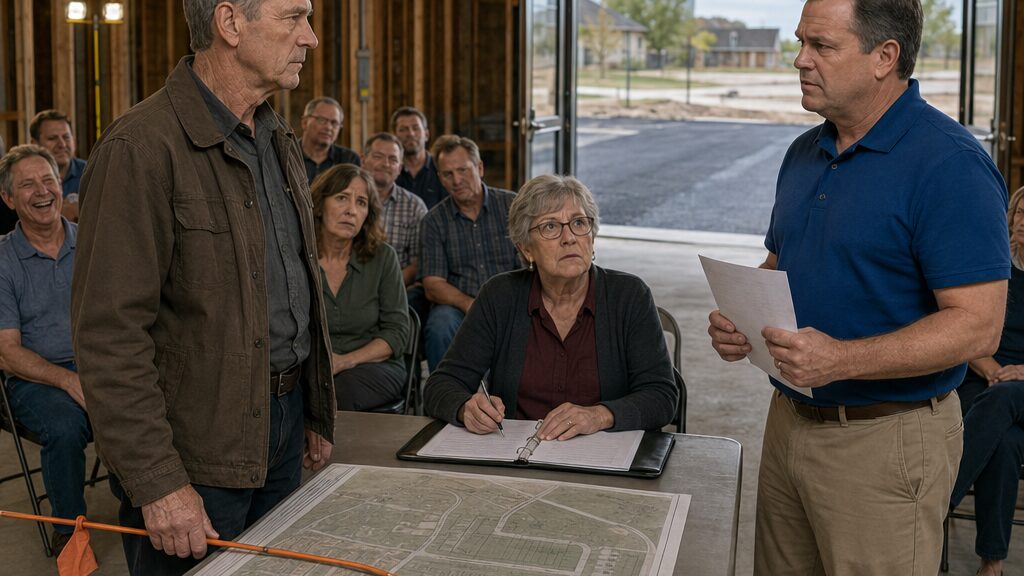
Behind him, the unfinished clubhouse smelled of cut lumber, concrete dust, and fresh paint. Folding chairs filled the main room. Through the open double doors, the first strip of black base asphalt shone under temporary work lights.
“We cannot plan a modern community around every piece of paper somebody’s grandfather saved,” Matthew said.
A few residents laughed.
The sound was brief and uneasy, but it traveled clearly across the bare concrete.
George stood beside a folding table covered with architectural drawings. He had brought one orange survey flag from the field. Its wire stem lay across the site plan, cutting through the printed parking spaces.
Matthew lowered the deed. “I gave you the floor, George. I’m trying to understand what you want us to do.”
“Pause final paving,” George said. “Order a mineral-title review. Confirm whether the estate beneath the southern common tract was severed before the developer acquired the surface.”
A board member near the wall whispered something. Another resident checked his phone.
Matthew spread his hands. “We have title insurance.”
“For the surface.”
“We have legal counsel.”
“Then ask counsel the question.”
Matthew’s jaw tightened. “We have asked every question required for construction.”
George looked toward Nancy Lee, seated at the end of the table with the meeting binder open in front of her. “Has the association received a mineral ownership report?”
Nancy adjusted her glasses. “Not that I’ve seen.”
Matthew turned. “Nancy.”
“She asked me a direct question,” Nancy said.
George placed one finger on the photocopied deed. “The reservation appears in Volume 1842, Page 611 of the county records. The legal description overlaps the southern portion of this lot.”
The room changed.
Not dramatically. No one gasped. But the restless sounds stopped. A man in the second row leaned forward. Katherine, seated near the aisle with a roll of decorative ribbon in her lap, looked from George to Matthew.
Matthew glanced down at the deed. “This copy isn’t certified.”
“No.”
“It does not establish current ownership.”
“No.”
“It doesn’t even mention the HOA.”
“The HOA did not exist when it was recorded.”
That drew another laugh, this time from Matthew alone.
George straightened the orange flag. The metal stem passed directly across the row of parking spaces nearest the drainage swale.
“I’m not asking the board to accept my conclusion,” he said. “I’m asking the board to verify the title before placing another improvement over the tract.”
“We break ground in forty-eight hours,” Matthew said. “Equipment is scheduled. Materials are ordered. Deposits are paid. You waited until now to bring us an uncertified family document.”
George could have told him about the index card. He could have explained the chain he had already traced through online records that morning. He could have named the two later deeds that carried the mineral reservation forward without conveying it.
Instead, he said, “I spoke to you before the deposit became nonrefundable.”
“You asked a vague question beside a survey stake.”
“I advised you to check the reservations.”
“You did not submit anything in writing.”
Nancy looked down at the binder.
George felt the old, familiar pressure behind his ribs. It was not anger exactly. It was the sensation of being returned to conference rooms where men who had never read a lease used his maps, his abstracts, and his conclusions, then introduced the decision as their own.
Once, during a pipeline acquisition outside Midland, an executive had ignored George’s warning about a missing heir. Six months later, when the project stalled, the same executive had asked why George had not made the risk clearer.
George had produced three memoranda.
The executive had said, You should have made me understand.
George had carried that sentence into retirement.
Now Matthew tapped the photocopy against his palm. “If we halt work every time someone finds an old clause, the association will lose nearly twenty thousand dollars this weekend alone.”
“The loss will be larger if the clause matters.”
“You don’t know that it does.”
“No,” George said. “Neither do you.”
The silence lasted long enough for the contractor near the rear doors to shift his weight.
Matthew turned to the residents. “This board has spent fourteen months planning a facility that people asked for. We completed drainage review, accessibility review, engineering, permitting, and competitive bids. Property values in neighboring communities with comparable amenities have held stronger than ours.”
His voice steadied as he spoke. George could hear the part that was not performance. Matthew believed the clubhouse was proof that the neighborhood had not begun to decline.
“We are not dismissing anyone’s rights,” Matthew continued. “But we cannot abandon a community project based on a photocopy that may not mean what one resident thinks it means.”
George saw heads nod.
Katherine did not nod, but she lowered her eyes.
Matthew set the deed on the table. “Submit a written objection with supporting records. The board will refer it to counsel.”
“I want my warning entered into tonight’s minutes.”
Nancy looked up.
Matthew’s mouth tightened again. “Fine.”
Nancy uncapped her pen. “State the wording.”
George kept his voice level. “George Carter advised the board that the proposed clubhouse parking lot may encroach upon a tract subject to a severed mineral estate recorded in Volume 1842, Page 611, and requested a mineral-title review before final paving.”
Nancy wrote it down in longhand.
Matthew watched her finish. “There. It is in the record.”
George picked up the orange flag.
“That make you feel better?” Matthew asked.
George looked at the black asphalt visible through the open doors.
“No.”
He returned to his chair.
The meeting moved to landscaping costs, guest-access rules, and whether children under fourteen should be permitted in the fitness room. George heard almost none of it. The deed copy remained on the table until Katherine carried it to him during adjournment.
“You could have shown them more,” she said quietly.
“Yes.”
“Do you have more?”
George slid the copy into his folder. “I have enough to keep looking.”
“That isn’t what I asked.”
Matthew was speaking with the contractor near the doors. His gestures were quick and controlled.
George watched him point toward the parking lot.
“I heard what you asked,” George said.
Katherine’s face closed a little. “Then I suppose I heard your answer.”
She walked away before he could decide whether to correct her.
Outside, the temporary lights threw hard white circles across the site. George crossed the common field alone. Several orange flags had been pulled and tossed into a pile near the drainage trench.
He stopped and picked up one whose plastic strip had torn halfway through.
Behind him, an engine started.
Matthew stood beside the contractor’s pickup, phone pressed to his ear. “Move the paving crew up,” he said. “Tomorrow morning if they can do it.”
The contractor shook his head. “Schedule says Monday.”
“Then change it.”
George turned toward the street.
At six the next morning, the sound of air brakes woke him.
He opened his blinds and saw three asphalt trucks lined along the curb, two days early.
Chapter 3: Certified Paper Changed the Meaning of Silence
The county clerk pressed the seal into the certified copy, and the raised circle appeared directly beneath the recording number George’s father had written on the yellow card.
Volume 1842. Page 611.
The sound was small—a dull mechanical click—but it settled something inside him that had remained suspended for days.
The clerk slid the document across the counter. “You want the related instruments too?”
“All of them through the developer conveyance.”
“That’ll take a little while.”
“I have time.”
She gave him a look that suggested she doubted it. Outside the courthouse windows, asphalt trucks were likely finishing the second layer of the clubhouse lot.
George sat at a wooden table while the clerk retrieved records. He did not check the neighborhood email chain. The previous night it had filled with photographs of the paving progress and messages thanking Matthew for keeping the project on schedule.
One message mentioned George without naming him.
Glad the board didn’t let one last-minute complaint derail years of work.
George had read it twice.
The clerk returned with copies of six instruments and a plat. “The mineral reservation carries forward,” she said. “But I’m not giving you a legal opinion.”
“I wouldn’t ask you to.”
She tapped the earliest deed. “Somebody should have caught it.”
“Somebody may have.”
George drove from the courthouse to a title company in a low office building beside a highway frontage road. The attorney met him in a conference room with no windows and read the certified instruments in silence.
After twenty minutes, the attorney turned the plat sideways.
“The surface passed through several owners,” he said. “The mineral estate did not. Based on what you’ve brought, the reserved interest appears to have descended to you.”
“Appears?”
“You know better than most why I use that word.”
George did.
The attorney traced the southern boundary with a capped pen. “The clubhouse structure is mostly outside it. The parking lot, drainage work, and part of the recreation area are not.”
“What about surface access?”
“That is where this gets expensive.”
“The reservation includes reasonable use.”
“Reasonable is not a location. It’s an argument. The surface owner can demand accommodation if there are practicable alternatives. The mineral owner cannot destroy improvements merely because the minerals came first.”
George leaned back. “So I have leverage.”
“You have an estate. Leverage depends on whether anyone wants to develop it.”
The attorney studied him.
“Do they?”
George did not answer immediately.
The attorney folded his hands. “You could seek temporary relief and force a title review. You could send formal notice and negotiate. Or you could lease the minerals and let an operator establish the commercial pressure.”
“You make the third choice sound improper.”
“I make it sound consequential.”
George gathered the documents. “Send a notice to the association.”
“Demanding what?”
“Acknowledgment of the estate. Reimbursement of title costs. No further permanent improvements on the tract without written consent.”
“And an injunction?”
“Not yet.”
The attorney looked at him for another moment. “You are leaving yourself room.”
“Yes.”
“For settlement?”
George placed the certified deed in his folder. “For the facts.”
The attorney’s expression suggested he did not believe that was the whole answer.
That afternoon, Laura Garcia called.
George had known her years earlier when she worked title curative assignments for a regional operator. She had been younger then, fast with courthouse indexes and impatient with vague legal descriptions. Now she represented an energy company that had acquired leasehold interests north of the subdivision.
“I heard you pulled certified records on the Carter tract,” she said.
“Courthouse is still public.”
“So are permit maps.”
George looked through his kitchen window. The new parking lot was black and unstriped. Workers moved along its edge installing concrete wheel stops.
“What formation are you targeting?” he asked.
Laura named it.
George opened an old county map from his desk. The formation ran beneath the subdivision at a depth that made horizontal development possible from more than one surface location.
“You mapped it already,” he said.
“Two years ago. The economics were marginal until the northern acreage assembled.”
“And now?”
“Now your tract matters.”
She arrived the next morning carrying a laptop, a rolled map, and a term sheet. Katherine watched from her driveway as Laura entered George’s house.
The map covered most of the kitchen table. Proposed well paths curved beneath the subdivision from two possible surface sites. One began on agricultural land beyond the eastern boundary. The other used the HOA’s southern common tract for temporary staging and access.
George studied the second route.
It crossed the new parking lot.
“Your engineers know that lot was paved this week.”
“They updated the aerial yesterday.”
“They could use the eastern site.”
“At higher cost. Longer lateral. Additional easements. More road construction.”
“So this is the convenient route.”
“It is the commercially preferred route.”
George looked at her. “Those are different phrases.”
Laura smiled without warmth. “You taught me that.”
She pushed the term sheet toward him. The bonus was substantial but not extravagant by industry standards. The royalty provision was better than he expected.
“The lease does not settle surface use,” she said. “That would be separate.”
“I noticed.”
“We would need access for surveys first. Then geotechnical work. If we proceed, we negotiate damages and accommodations.”
“And if the HOA refuses?”
“We attempt agreement. If that fails, counsel evaluates available remedies.”
George looked at the curved well paths again. He imagined Matthew standing in the unfinished clubhouse, tapping the photocopied deed against his palm.
Laura closed the laptop halfway. “What happened?”
“What do you mean?”
“You have negotiated enough leases to know this is not only about minerals.”
“The estate belongs to me.”
“I didn’t say it didn’t.”
“The association built over it after notice.”
“What kind of notice?”
George said nothing.
Laura’s eyes narrowed. “Certified?”
“Oral, then entered into meeting minutes.”
“Did you provide the certified deed?”
“I had not obtained it.”
“Did you provide the recording reference?”
“Yes.”
“And now you want to lease.”
“I want terms.”
She leaned back. “All right. But understand something before you turn this into a lesson for your board president. Operators do not arrive, make a point, and disappear. Roads, trucks, noise studies, fencing, surface negotiations—those become everybody’s problem.”
George’s voice cooled. “I know how operations work.”
“I know you do. That is why I’m saying it to you.”
For several seconds, the only sound was the refrigerator cycling on.
Laura opened the term sheet. “The company needs your mineral lease before it spends more on title and permitting. Surface use remains unsigned until the engineering work is complete.”
George read every clause.
He marked the depth limitation, added a no-storage provision, and revised the warranty language. Laura accepted two changes and rejected one. They argued over post-production rights and shut-in payments with the ease of people returning to an old professional language.
For the first time since retirement, George felt fully awake.
That feeling embarrassed him.
By late afternoon, they had reached a mineral lease form both sides could accept. Laura placed a signature tab at the bottom.
George signed.
Then she slid the preliminary surface-use acknowledgment toward him.
It showed the access route entering from the subdivision road, crossing the southern edge of the new lot, and occupying nearly half the parking area during operations.
George read the page without touching the pen.
“You don’t have to sign that today,” Laura said.
“No.”
“But the company will want direction soon.”
Outside, a striping machine began painting bright white lines across the asphalt.
George initialed the mineral lease term sheet.
He left the surface-use page blank.
Chapter 4: The New Clubhouse Opened Over an Old Warning
George stood at the edge of the new parking lot as if the white stripe beneath his shoes marked more than a place for cars.
Katherine Brown saw him from the clubhouse doors. Behind her, children carried paper plates toward folding tables, and a volunteer struggled to keep a balloon arch from leaning into the entrance. A blue ribbon stretched across the doorway. Music played from a portable speaker near the wall, loud enough to make conversation feel cheerful even when it was not.
George had dressed for the opening in a pressed work shirt and dark slacks. He held no gift, no plate, and no intention of crossing the asphalt.
Katherine walked out to him.
“You came.”
“I said I would.”
“You’re standing in the parking lot.”
“Beside it.”
She looked down. The toes of his shoes stopped an inch short of the black surface.
“Matthew is about to cut the ribbon,” she said.
“I can see that.”
People moved between them and the clubhouse carrying lemonade, foil pans, and trays of cookies. Residents who had spent months arguing about dues now smiled beneath a banner welcoming them to the new community center. Several older women had claimed chairs near the windows. Two widowers who rarely left their homes were playing cards at a table in the corner.
Katherine had helped plan all of it.
After her husband died, the neighborhood had become quieter than she expected. People waved from driveways, but invitations thinned. The clubhouse committee had given her a reason to knock on doors again.
“You could come inside for ten minutes,” she said.
George looked toward the ribbon. “I don’t want to spoil anything.”
“That sounds almost considerate.”
“It was meant to.”
She waited for him to look at her. “Did you sign something?”
“A mineral lease.”
Her face changed. “When?”
“Six weeks ago.”
“And you didn’t think to tell me?”
“It was private business.”
“The project isn’t private.”
“The minerals are.”
Katherine lowered her voice. “You stood in that meeting and let everyone think you were still checking.”
“I was checking.”
“You knew enough.”
“I knew the estate existed. I did not know whether anyone wanted it.”
“And now someone does.”
George looked across the lot. Fresh white lines divided the asphalt into clean rows. Wheel stops sat exactly where Laura’s preliminary access map showed temporary equipment.
“The company is evaluating options,” he said.
“That is not an answer.”
“It is the answer I have.”
Matthew’s voice rose through the speaker behind them, thanking volunteers, contractors, and residents who had supported the project. Applause followed.
Katherine glanced back. “I need to go.”
George nodded.
She took three steps, then turned. “You know what this place means to some of us?”
“Yes.”
“No. You know what it cost. That isn’t the same thing.”
She returned to the clubhouse before he could reply.
Matthew cut the ribbon with oversized silver scissors. The crowd clapped. Children pushed through the doors first. Someone handed Matthew a framed photograph of the construction crew, and for a moment he looked less like a board president than a tired man relieved to have reached the end of something.
George remained outside until the applause faded.
He noticed four orange flags near the drainage swale. The paving crew had removed most of the original stakes, but these had been left beyond the curb. Decorative blue ribbons had been tied around two of them, their bright colors twisting together in the breeze.
A resident approached George with a plate of barbecue.
“You planning to protest all afternoon?” the man asked.
“No.”
“Then eat.”
George accepted the plate because refusing would have created more attention. The resident nodded toward the clubhouse.
“Looks good, doesn’t it?”
“It does.”
“Matthew says places like this keep property values from slipping.”
“Matthew says many things.”
The man laughed, unsure whether George had made a joke, and walked away.
George ate standing beside the field.
By late afternoon, cars filled most of the lot. The clubhouse windows glowed. Katherine moved between tables collecting empty cups, laughing when a child placed a paper crown on her head. George watched her longer than he intended.
The building was not only Matthew’s monument. That fact had been easier to ignore when it was concrete forms and invoices.
Three days later, the survey trucks returned.
Katherine saw them from her kitchen window before seven in the morning. Two men carried equipment into the common field while a third unrolled a new map across the hood of a pickup.
The first new orange flag appeared beyond the drainage swale.
Then another.
By noon, they formed a grid stretching from the subdivision road to the eastern boundary, crossing the field in two bright rows. Some stood only a few yards from the clubhouse patio.
Katherine walked out wearing gardening gloves she had forgotten to remove.
The survey crew chief was using a handheld receiver near the curb.
“What are these for?” she asked.
“Additional site work.”
“For the clubhouse?”
He hesitated. “Different client.”
“What client?”
“I’m not supposed to discuss that.”
“Is it George Carter?”
“No, ma’am.”
The answer did not reassure her.
She followed the flags to the far edge of the field. One had been planted beside a small brass disk set into the ground. Another marked the corner where the common property met a utility corridor.
The pattern was too large for a boundary correction.
That evening, Katherine attended the finance committee meeting. Nancy sat at the clubhouse table with a laptop open and three folders arranged by color.
“We need to approve the final landscaping payment,” Matthew said.
Nancy did not move to the next item. “After that, our unrestricted reserve will be under eighteen thousand.”
Matthew leaned back. “We discussed this.”
“We discussed twenty-seven.”
“The lighting change order and drainage repair were necessary.”
“I know why we spent it. I’m telling you what remains.”
A board member asked whether insurance would cover any title dispute.
Matthew’s eyes moved toward Katherine. “There is no active title dispute.”
“There are new survey flags across the whole field,” Katherine said.
“Utility work.”
“The survey crew said it was another client.”
Matthew closed the folder in front of him. “George is trying to create leverage. That does not mean he has the right to tear up association property.”
“Has counsel answered his letter?” Nancy asked.
Matthew’s expression tightened. “Counsel is reviewing it.”
“Since when?”
“Since it arrived.”
“That was five weeks ago.”
Katherine watched Nancy’s hand rest on the edge of the laptop. The treasurer looked frightened, though she was trying to make it look like irritation.
“What happens if this becomes litigation?” Katherine asked.
Nancy answered before Matthew could. “We would have to assess the members or defer maintenance.”
“How much?”
“We do not know.”
Matthew stood. “This speculation is exactly why we should not discuss incomplete legal matters in an open committee session.”
“It is our money,” Katherine said.
“And I am trying to protect it.”
“From George?”
“From panic.”
The room went still.
Matthew gathered his papers. “No one is drilling beside a clubhouse. The company would need access rights, permits, engineering review, environmental compliance, and accommodations. This is not the nineteenth century.”
Katherine remembered him waving George’s photocopy and using almost the same phrase.
After the meeting, she walked home through the common field. The clubhouse lights shone behind her. Orange flags reached ahead into the darkness, each strip catching the light for an instant before disappearing again.
Near the eastern boundary, the survey crew chief was locking equipment into his truck.
Katherine stopped him. “You don’t have to tell me who hired you. Just tell me what kind of survey this is.”
He studied her face, perhaps recognizing that she lived there.
“Preliminary access,” he said.
“For what?”
He nodded toward the rows of flags.
“Energy development.”
Katherine looked back at the clubhouse, the parking lot, and the blue opening ribbon still tied to one of the old stakes.
“How much access?”
The crew chief shut the truck compartment.
“Enough to bring equipment through.”
Chapter 5: Twelve Trucks Arrived With More Than a Permit
The first truck stopped beneath the clubhouse banner at 7:12 on a Tuesday morning.
It was white, mud-streaked, and longer than three parking spaces. Amber lights flashed above the cab. Behind it, eleven more trucks turned from the subdivision road in a slow line, their diesel engines shaking the windows of the houses nearest the common field.
George watched from his driveway.
For months he had imagined this moment as clean and exact. Trucks would arrive. Matthew would finally understand. The deed would become heavier than laughter.
The reality was louder.
The convoy filled the street before the first driver had finished positioning. Service units, pipe racks, survey vehicles, and a mobile office rolled over the new asphalt. One front tire crossed the curb and flattened two orange flags against the pavement.
Residents came out in slippers and robes. Phones appeared. A dog barked until someone pulled it indoors.
Matthew reached the lot in his golf cart, wearing the same blue HOA polo he used for meetings. He drove directly in front of the lead truck and stopped sideways.
“You cannot enter private association property,” he shouted.
A man in a hard hat stepped from the mobile office. “We have temporary survey and evaluation authority under the mineral lease and pending access proceedings.”
“You have nothing from this association.”
“We provided notice to association counsel.”
Matthew looked toward George.
The distance between them was fifty yards, but the accusation carried clearly.
“You did this.”
George crossed the lot slowly. The trucks idled around him. Residents stood along the sidewalks, leaving a corridor through which he had to walk alone.
Laura Garcia emerged from the second vehicle carrying a folder.
“Morning,” she said.
“This was not the route we agreed on.”
“We did not agree on a route.”
“You said survey access.”
“This is survey and geotechnical staging.”
“With twelve trucks?”
“Some are support vehicles. The company wanted visible readiness before today’s negotiation.”
George looked at her. “Visible to whom?”
Laura glanced toward Matthew. “Everyone who needs to understand the schedule.”
The answer sounded too much like something George might once have respected.
Matthew came forward. “Tell them to leave.”
“I don’t direct their operations.”
“You own the minerals.”
“Yes.”
“And you signed the lease.”
“Yes.”
The residents nearest them went quiet.
Matthew pointed toward the vehicles. “Then this is your decision.”
“No. Surface use has not been finalized.”
Laura opened the folder. “That is why we are here.”
She handed Matthew a copy of the notice. It stated that the company sought temporary access to conduct surveys and subsurface testing while negotiating a surface-use agreement. If the parties failed to reach terms, company counsel intended to seek judicial determination of reasonable access.
Matthew read only the first page.
“This is intimidation.”
“It is notice,” Laura said.
“You cannot occupy our parking lot without a court order.”
“We are not commencing drilling.”
“You have blocked the clubhouse.”
“For today’s evaluation.”
Matthew turned to George. “You knew they were coming.”
George had known crews might mobilize that week. Laura had not given him the exact day or scale.
“I knew they were preparing.”
“You let us open this place.”
George felt the attention of the residents behind him. “I warned the board before paving.”
“With a photocopy and a speech.”
“With a recording reference.”
“You could have stopped it.”
The words landed differently now than they had in the meeting room.
George looked past Matthew to the clubhouse windows. Katherine stood inside with both hands against the glass.
Laura led them to the hood of a survey vehicle and spread out two maps. The first showed the company’s preferred access route entering from the subdivision road, crossing the parking lot, and establishing a temporary work area over nearly half the spaces. The second showed the proposed horizontal well path.
“The mineral lease is valid,” she said. “The company has begun permitting. We prefer a negotiated surface-use agreement. Today’s crews are conducting noninvasive work and confirming logistics.”
Matthew jabbed a finger at the lot. “This is not noninvasive.”
“No ground is being disturbed.”
“You have twelve industrial vehicles parked beside a fitness room.”
“The number is temporary.”
A neighbor called from the sidewalk, “How temporary?”
Laura did not answer him.
Matthew lowered his voice. “What does George have to sign?”
“The final surface-use agreement.”
He stared at her. “He hasn’t signed it?”
“No.”
The power in the scene shifted so sharply that even George felt it.
Matthew looked at the trucks, then back at George. “So you can stop this.”
“I can reject this route.”
“Then do it.”
“The company may pursue court-ordered access.”
“But you can tell them you will not support the parking-lot plan.”
George looked down at the map. The preferred route cut directly across the place where he had refused to step during the opening.
For one hard second, satisfaction rose in him. Matthew’s voice had lost its practiced authority. The board president was asking rather than announcing.
Then Katherine came through the clubhouse doors.
She walked past Matthew and stopped in front of George.
“Nancy called the insurance carrier,” she said. “They may reserve coverage because the board received notice before final paving.”
Matthew turned. “That is not confirmed.”
“No. What is confirmed is that the reserve account is nearly empty.”
Several residents began speaking at once.
Katherine kept her eyes on George. “If this goes to court, the legal fees come from us. If the lot is damaged, the repair comes from us. If the clubhouse closes, we still pay the loan and the maintenance.”
“The company pays surface damages,” George said.
“After negotiation. After lawyers. After somebody decides what counts.”
“Katherine—”
“My roof needs replacing next year. I planned for that. I did not plan for a special assessment because two men wanted to prove which one could wait longer.”
George’s face warmed.
Matthew said, “This is not on me alone.”
“No,” Katherine replied. “It isn’t.”
The answer silenced both men.
Laura closed the map folder halfway. “Company counsel needs direction by four this afternoon. If no agreement is possible, they will file for access and ask the court to approve the operational plan.”
“Today?” George asked.
“They have already invested in title, engineering, and permitting.”
“You brought the trucks to create pressure.”
“I brought the trucks because the crews were scheduled and because delays cost money.”
“That is pressure.”
“Yes.”
She did not apologize for it.
A driver moved one of the service trucks, and the tire rolled farther across the flattened orange flags. Their plastic strips disappeared beneath the rubber.
George stepped forward and pulled one free after the truck stopped. The wire was bent nearly in half.
Matthew watched him straighten it.
“What do you want?” Matthew asked.
George looked at the clubhouse, the residents lining the sidewalks, and the company vehicles filling the lot.
For months, he had believed the answer was simple.
Recognition. Respect. Consequence.
Now each word seemed to belong to someone else as well.
“I want the board’s complete title file,” he said. “All counsel correspondence. All project review documents.”
Matthew’s expression closed.
“That has nothing to do with today’s access.”
“It has everything to do with how we got here.”
Nancy’s voice came from behind him. “George.”
She stood near the clubhouse entrance carrying a brown envelope against her chest. Her face was pale, and for once she did not look toward Matthew before speaking.
“Can we meet privately?”
Matthew stepped toward her. “Nancy, not now.”
She moved the envelope away from him.
“I printed something,” she said to George. “An email Matthew told me to delete.”
Chapter 6: The Buried Email Did Not Make George Innocent
The email was dated three weeks before the board had laughed at George.
Nancy placed it on the clubhouse office desk and smoothed the page with both palms. Outside the closed door, truck engines vibrated through the walls.
George read the first paragraph twice.
The association’s title attorney had reviewed the development transfer documents and identified an unresolved mineral reservation affecting the southern common tract. The attorney recommended a mineral-title report before permanent improvements were placed on the property.
The second paragraph warned that ordinary surface title coverage might not protect the association from costs arising from an existing severed mineral estate.
George looked at Matthew.
The HOA president stood beside the filing cabinet, arms folded.
“You received this before construction?” George asked.
Matthew’s face had gone gray around the mouth. “It was preliminary.”
“It says further review was recommended.”
“It also says the reservation might have no commercially active owner.”
“That is not the same as no owner.”
“We were already under contract.”
Nancy spoke without looking up. “He asked me to remove it from the project packet.”
Matthew turned on her. “I asked you not to circulate an incomplete legal opinion that would cause panic.”
“You said counsel had cleared the title.”
“Counsel did clear the surface title.”
“You knew that was not what people were asking.”
Matthew pressed his fingers against his forehead. “The contractor’s pricing expired that month. We had delayed drainage twice. If we paused again, we lost the bid and the opening season. The reserve could not absorb another increase.”
“So you risked all of it instead,” George said.
Matthew looked at him. “You think I wanted this?”
“I think you wanted the ribbon cutting.”
“I wanted one thing in this neighborhood to finish the way we said it would.”
His voice broke at the edge, then steadied.
“For two years, every improvement died in committee. The pool repair. The playground. The entrance wall. People complained the community was aging, that houses sat longer, that families looked elsewhere. I told them we could complete this project without a special assessment.”
“And when the title warning came?”
“I believed it could be handled afterward.”
“You believed I would go away.”
Matthew’s eyes hardened. “You came to that meeting knowing more than you said.”
The accusation was accurate enough to hurt.
Nancy looked between them. “The email does not excuse what the board did.”
“No,” George said.
“It doesn’t excuse you either,” Matthew replied.
George folded the page along its existing crease.
A knock sounded at the office door. Katherine entered before anyone answered.
“The company says residents need to move their cars from the east side of the lot.”
Matthew went toward the door. “I will handle it.”
Katherine blocked him. “No. You have handled enough privately.”
Nancy flinched.
Katherine looked at the email in George’s hand. “That is what she brought?”
“Yes.”
“So Matthew knew.”
“Yes.”
She took in George’s expression. “And that makes you right?”
“The estate is mine.”
“That isn’t what I asked.”
George set the email on the desk. “I warned them.”
“With an uncertified copy.”
“I gave the recording number.”
“You also had a lawyer send formal notice after the lot was paved.”
“The board accelerated the work.”
“And you let them.”
The office seemed to shrink around the four of them.
Katherine’s voice remained low. “You could have brought the certified deed to the next meeting.”
“I did not have it yet.”
“You had it before the grand opening.”
“Yes.”
“You could have told me about the lease.”
“It was not your agreement.”
“No. Just my bill.”
George looked away.
Through the narrow office window, one of the service trucks backed into a row of spaces. Its warning alarm repeated at even intervals.
Katherine stepped closer. “When the survey crew came back, I asked you what was happening. You gave me half an answer because half an answer let you watch Matthew keep walking.”
George’s first instinct was to defend the sequence. The deed. The notice. The lease. The board’s choice.
All true.
None sufficient.
Laura called him from the parking lot ten minutes later.
He met her beside the mobile office. She had replaced the earlier maps with a larger engineering plan.
“There is another route,” she said.
George studied the line running along the eastern perimeter of the development. It used a narrow strip beside the utility corridor, then turned toward an undeveloped edge of the common field.
“You told me the parking lot was commercially preferred.”
“It is.”
“This avoids it.”
“At additional cost. We need a temporary road, noise barriers, a longer horizontal section, and two more easements.”
“Practicable?”
“Yes.”
“Then why was it not presented first?”
Laura met his eyes. “Because companies do not lead with the expensive option when the mineral owner may support the cheaper one.”
“The surface owner can demand accommodation.”
“If a reasonable alternative exists and the facts support it.”
“You knew this route was possible.”
“Possible is not approved. Engineering finished the review yesterday.”
George followed the perimeter line with his finger. It would preserve the clubhouse lot but close part of the walking trail and disturb the edge of the field for several months.
“What does the company need?”
“Your agreement to amend the proposed surface plan and accept reduced bonus consideration for the added cost.”
“So I pay part of it.”
“You receive less.”
“And the HOA?”
“Grants the corridor, accepts temporary closure, and waives claims covered by the damage schedule. The company restores the field and funds monitoring.”
George looked toward the clubhouse. Katherine stood under the covered entry speaking with residents. Matthew remained inside.
“What if I refuse both routes?”
“Counsel files before noon. They will seek broader access based on the mineral reservation and existing lease.”
“What time is it?”
“Nine forty.”
Laura handed him two folders.
One held the original parking-lot plan.
The other held the perimeter alternative.
“You still have leverage,” she said. “But not time.”
George carried both folders home.
The bent orange flag lay on his kitchen table beside the certified deed. He straightened the wire against the edge of the counter, but the metal retained a shallow angle.
Katherine entered through the back door without knocking.
“You left it open,” she said.
George nodded toward the chair.
She remained standing.
“I could have filed for an injunction before paving,” he said.
“Yes.”
“I did not know whether the company would lease.”
“You knew the title mattered.”
“Yes.”
“Why didn’t you push harder?”
George looked at the yellow index card in his father’s handwriting.
“Because Matthew laughed.”
Katherine’s face softened, but only slightly.
“That is the honest answer?”
“It is part of it.”
“What is the rest?”
George rested both hands on the table. “Most of my career, people wanted the answer but not the man giving it. They ignored warnings until something failed. Then they asked why I had not made them listen.”
“And this time you decided not to.”
“This time I decided the consequences would make the point.”
Katherine looked at the two folders. “Did they?”
“Yes.”
“Do you feel better?”
George did not answer.
She opened the perimeter plan. “Can this work?”
“With conditions.”
“Will it save the lot?”
“Yes.”
“And the field?”
“Eventually.”
“What does it cost you?”
“Money.”
“That isn’t what I meant.”
George understood.
It would cost him the clean reversal he had imagined. Matthew would still be exposed, but the clubhouse would survive. The trucks would leave the center of the lot. Residents might remember the disruption more than the warning that caused it.
He would have to admit that he had possessed choices.
Laura called at eleven fifteen.
“Company counsel is preparing the filing,” she said. “I need a decision.”
“You will have terms before noon.”
George revised the perimeter agreement by hand. He added independent noise and vibration monitoring, full restoration, limits on operating hours near homes, repair obligations secured by escrow, reimbursement of his title and legal costs, and compensation to the association for temporary loss of the common area.
Then he added a condition unrelated to the company.
The HOA would disclose the title attorney’s email, read George’s original warning into the permanent minutes, and adopt mandatory mineral and easement review before future capital projects.
At eleven forty-eight, George placed the unsigned parking-lot agreement and the revised perimeter agreement into separate folders.
He tucked Nancy’s printed email between them.
Outside, the trucks still occupied the clubhouse lot.
George picked up the bent orange flag and carried everything toward the emergency meeting.
Chapter 7: He Moved the Boundary Without Erasing the Truth
George placed two unsigned agreements on the clubhouse table.
The first was thick with engineering exhibits and legal clauses. Its access map drove a broad lane across the new parking lot, erased more than thirty spaces, and placed the temporary work area close enough to the clubhouse that the fitness room would have to close.
The second folder was thinner. Its map carried a narrow line along the eastern edge of the development, bending around the lot before entering the common field.
George laid the bent orange flag between them.
Every chair in the clubhouse was occupied. Residents stood along the walls and crowded the open doors. Beyond the windows, the twelve trucks remained in place, amber lights turning silently above their cabs.
Laura sat near the company’s attorney. Nancy had the association’s financial binder open in front of her. Katherine stood against the rear wall with her arms folded.
Matthew took the chair at the center of the board table, although no one had invited him to preside.
“We need the trucks removed before we discuss anything,” he said.
Laura looked at the clock. “Company counsel files at noon unless we have an executed framework.”
It was eleven fifty-three.
Matthew turned to George. “Then tell them to use the other site.”
“The eastern agricultural site is not under my control.”
“You told us there was an alternative.”
“There is an alternative on association property.”
George opened the thinner folder and turned the map toward the board.
The marked route followed a utility corridor along the development boundary. It avoided the parking lot but crossed part of the walking trail and occupied the far edge of the common field. The company would build a temporary reinforced road, place noise barriers near the closest homes, and directionally reach the mineral formation from beyond the clubhouse.
Nancy leaned over the map. “How long would the field be closed?”
“Four to six months under the proposed schedule,” Laura said. “Longer if weather or regulatory inspections delay restoration.”
“And the lot?”
“Open, except during limited equipment transfers.”
A man near the wall asked, “Why wasn’t this the plan from the beginning?”
Laura did not soften her answer. “It costs more.”
The room filled with low voices.
George tapped the thicker folder. “The company preferred the direct route because it was cheaper. Under this version, the lot becomes the primary staging area. The association can challenge it, but the company will argue that the mineral reservation permits reasonable access.”
“Would they win?” someone asked.
George looked at the residents rather than Laura. “No honest lawyer can promise that answer. The case would depend on available alternatives, necessity, historic documents, engineering, and whether the surface owner was reasonably accommodated.”
Matthew pointed at the perimeter map. “Then that proves this route is required.”
“No. It proves it is possible.”
“And you can choose it.”
“I can support it.”
Matthew gripped the edge of the table. “What is the difference?”
“The association must grant the corridor. The company must accept the added cost. I must accept less compensation. Everyone gives up something.”
Katherine’s gaze remained on George.
He opened the revised agreement.
“The company funds an independent monitor for noise, vibration, drainage, and restoration. No routine operations between eight at night and seven in the morning. No permanent storage. No access through residential streets except for scheduled transfers. Surface damages secured in escrow before construction begins.”
Laura said, “Those conditions remain subject to final engineering language.”
“They remain conditions,” George replied.
She held his gaze for a moment, then nodded.
“The company also reimburses the association for temporary loss of the common field,” George continued, “and pays my title and legal expenses.”
Matthew gave a humorless laugh. “There it is.”
George looked at him. “Yes. My rights were ignored. I will not pay to prove they existed.”
“No one disputes that now.”
“You disputed it when verification would have cost less.”
The room shifted toward Matthew.
He reached for the perimeter agreement. George placed his hand over it.
“There are association conditions.”
Matthew withdrew his hand. “Of course there are.”
“Nancy will read the title attorney’s email into the record.”
Matthew’s expression hardened. “That communication is privileged.”
The association’s attorney, seated at the end of the table, spoke for the first time. “The board may waive privilege. Given the circumstances, disclosure may be necessary for informed member action.”
Matthew stared at him.
George removed Nancy’s printed email from between the folders and slid it across the table.
“The permanent minutes will include this email, my recorded warning, and the board’s decision to continue construction without the recommended mineral review.”
“You are asking us to confess liability before we know whether there is any.”
“I am asking for an accurate record.”
“You want public humiliation.”
The words were quiet, but they reached the back wall.
George looked at the orange flag between them. Its wire refused to lie flat.
Several months earlier, he would have denied the accusation. He would have explained that documents were neutral, facts impersonal, consequences earned.
Instead, he said, “Part of me did.”
Katherine’s arms loosened.
George turned toward the residents.
“I had the recording reference before the board meeting. I had the certified deed before the clubhouse opened. I sent legal notice, but I did not ask for mediation. I signed the mineral lease and let the project continue while I waited to see whether the company would act.”
Matthew looked almost startled.
George continued before he could retreat into precision.
“The board had a duty to investigate. Matthew ignored a written warning from counsel. That belongs in the record. But I also knew enough to push harder before the cost spread to people who never laughed at me.”
No one applauded.
The silence was more difficult and more useful.
Katherine looked down.
Matthew’s hands rested on the table, no longer clenched. “Why are you saying this now?”
“Because being legally right does not make every choice that follows right.”
Outside, one of the trucks released its air brakes with a sharp mechanical sigh.
Laura checked the clock. Eleven fifty-seven.
Nancy pulled the microphone toward her. Her fingers trembled when she unfolded the email.
Matthew said, “Nancy.”
She looked at him.
For months, she had deferred to that tone. George had watched her rearrange numbers, soften warnings, and call loyalty prudence.
This time, she pressed the microphone switch.
“On March third,” she began, “the association received correspondence from title counsel concerning a recorded mineral reservation affecting the southern common tract.”
Matthew closed his eyes.
Nancy read the recommendation in full. When she finished, she added George’s warning from the meeting minutes: volume, page, requested review, and timing before final paving.
Then she looked toward the other board members.
“I move that both documents be incorporated into the permanent record, that the association adopt mandatory mineral, easement, and title review before future capital construction, and that we authorize negotiation of the perimeter access agreement.”
A board member seconded the motion.
Matthew opened his eyes. “Before the vote, I need to say something.”
The room waited.
He looked not at George but at the residents.
“I believed delaying the project would destroy it. The bids would expire. The reserve was already committed. I told people we could finish without another assessment, and I was afraid that if I admitted the title problem, every promise I had made would look careless.”
He touched the printed email with two fingers.
“So I treated a recommendation as a problem for later. Then I treated George as the problem.”
His voice remained controlled, but the last words came slowly.
“I was wrong.”
He did not ask forgiveness.
The vote passed with one abstention.
Matthew did not vote.
Laura took the perimeter agreement to the company attorney. They spoke in low voices, marked two provisions, and returned it to George. The reduced mineral payment appeared on the final page. He read the number once and initialed the change.
The loss was real.
So was the choice.
The HOA signed the corridor grant. George signed the amended surface-use agreement. Laura signed for the company at twelve fourteen, after counsel suspended the filing.
Outside, drivers began moving the trucks.
They did not all leave. Four relocated to the eastern boundary for preliminary measurements. The rest departed in the same slow line in which they had arrived, leaving dark tire marks across the fresh asphalt.
George carried a bundle of new orange flags into the field.
The survey crew chief followed with the revised map. Together they marked the perimeter corridor. The line began beside the utility easement, curved away from the parking lot, and continued along the edge of the development.
Katherine joined them near the walking trail.
“You moved it,” she said.
“The engineers moved it.”
“You made them.”
“I made them consider the cost differently.”
She watched him push a flag into the soil. “That sounds like you again.”
“It probably is.”
The clubhouse closed for three weeks while the company reinforced the perimeter entrance and installed barriers. The walking trail remained blocked for months. Residents endured daytime machinery, mud on the service road, and weekly monitoring reports posted beside the clubhouse office.
Matthew resigned as HOA president at the next regular meeting. He stayed on the project committee long enough to help reconcile invoices and answer residents’ questions. Some people appreciated that. Others did not.
Nancy established a capital-review checklist that required written confirmation of title exceptions before bids could be approved.
George attended the first meeting where it was used. He sat in the second row and spoke only when asked.
By early winter, the company completed its surface work. The temporary road was removed. Crews graded the field, replaced damaged soil, and reseeded the grass. Independent inspectors returned twice before George signed the final restoration acknowledgment.
Katherine met him at the edge of the field on the morning of the last inspection.
The clubhouse lot was open. Through the windows, a group of residents arranged chairs for a holiday meal. The building had survived, though the opening banner was long gone.
George handed Katherine the signed inspection.
“Drainage passed,” he said. “Ground cover needs one more review in spring.”
She read the first page. “You could take this to Nancy yourself.”
“I could.”
“But you brought it to me.”
“You asked what the field would cost.”
“And now?”
“Now you know what was repaired.”
Katherine folded the document. “That still isn’t the same as trusting you.”
“No.”
She studied him, perhaps waiting for an argument. When none came, she nodded toward the clubhouse.
“There is coffee inside.”
George looked across the parking lot.
Months earlier, he had stood at its edge and refused to place a shoe on the asphalt. Now tire marks had faded into the surface. The white stripes remained straight. At the far boundary, a row of orange flags showed where inspectors would return in spring.
“I’ll come in,” he said.
Katherine walked ahead of him.
George crossed the lot without stopping.
Later that afternoon, he returned home and placed the certified deed in its folder. His father’s yellow index card went behind it.
He kept one orange flag.
The wire was still bent from the truck tire. George set it beside the deed rather than trying to straighten it again.
The story has ended.