The Lakefront Neighbor Handed Him A Repair Bill For Damage She Caused Herself
Chapter 1: The Dock Signs That Changed Everything
The first thing Raymond Green noticed was not the damage.
It was the sign.
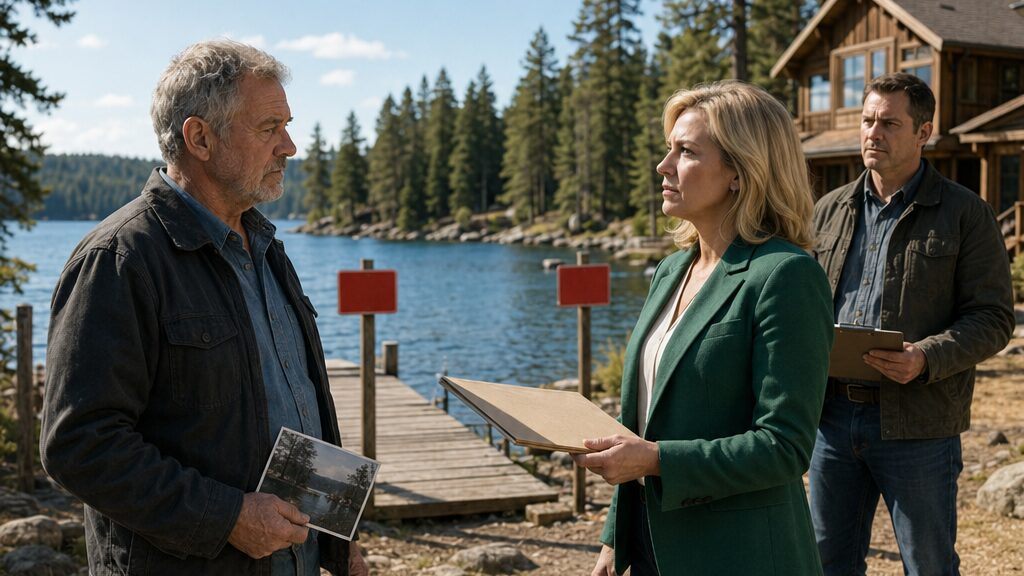
A bright red rectangle had been bolted into the old wooden post at the beginning of his dock.
PRIVATE PROPERTY — NO TRESPASSING.
Raymond stood at the edge of the gravel path leading down to the lake and stared at the words as if they belonged to someone else’s property.
For thirty-eight years, he had walked that path without seeing a warning sign. He had repaired the dock boards himself, replaced the loose bolts after winter storms, and watched generations of birds nest along the shoreline. The cabin had belonged to his parents before him. The dock had been rebuilt twice. The view had changed only with the seasons.
The sign was new.
And it was placed directly where his own dock began.
Raymond stepped closer, running his fingers along the edge of the metal frame. The screws were shiny. The wood around them was lighter than the surrounding post.
Someone had installed it recently.
A second sign stood farther down.
Then a third.
All facing the same direction.
All telling him not to enter the place he owned.
A small engine sound came from the neighboring property.
Raymond turned.
Jessica Scott walked down the slope from her lake house carrying a thick folder under one arm. She wore a green jacket despite the warm afternoon and moved with the certainty of someone arriving to deliver a decision, not start a conversation.
Behind her followed a man carrying a clipboard.
Raymond recognized him as one of the contractors who had been working near Jessica’s shoreline for the past month.
Jessica stopped several feet away.
“Raymond,” she said. “Good. You’re here.”
He looked from her to the folder.
“I was planning to ask you the same thing.”
Her expression tightened.
“I think you know why I’m here.”
Raymond looked back at the signs.
“No. I don’t.”
Jessica opened the folder and removed a single sheet of paper.
“This is a repair estimate.”
She held it out.
Raymond did not take it.
“For what?”
“The shoreline damage.”
“What shoreline damage?”
The contractor shifted his weight but said nothing.
Jessica looked surprised.
“Your dock work caused erosion along my side of the property. The support movement damaged the retaining area. The contractor inspected it.”
Raymond glanced toward the lake.
His dock was old, but he had not repaired anything recently.
“I replaced two boards last spring.”
“And the vibration affected the shoreline.”
“That doesn’t sound right.”
Jessica gave a small laugh.
“That’s exactly the kind of response I expected.”
Raymond looked at her.
“What kind?”
“The response from someone who doesn’t want to accept responsibility.”
The words hung between them.
For a moment, Raymond felt the familiar instinct to step back. To avoid making the conversation worse. To tell himself that facts would eventually speak louder than accusations.
He had spent most of his life believing that.
Measure carefully.
Record everything.
Let the truth arrive on its own.
But Jessica was already moving faster than the truth.
She tapped the paper.
“The repairs are estimated at twenty-eight thousand dollars.”
Raymond finally looked at the number.
Twenty-eight thousand.
Not a question.
Not a discussion.
A demand.
“I’m not paying this.”
Jessica’s eyebrows rose.
“Raymond.”
“No.”
The firmness in his own voice surprised him.
“I’m not agreeing that I caused damage I didn’t cause.”
The contractor looked away.
Jessica folded the paper back into the folder.
“You might want to be careful with that attitude.”
Raymond noticed something then.
The contractor was not looking at him.
He was looking at Jessica.
Like he already knew this conversation was not as simple as she wanted it to appear.
Raymond looked down at the dock boards.
The signs.
The estimate.
The new hardware.
Too many things had appeared at once.
“When did you notice this damage?” he asked.
Jessica answered immediately.
“After your repairs.”
“When?”
She hesitated.
Only for a second.
But Raymond noticed.
“After your repairs,” she repeated.
“That wasn’t my question.”
Her face hardened.
“I don’t appreciate being questioned like I’m the problem here.”
Raymond said nothing.
That was usually where he stopped.
He hated arguments that turned personal. He hated the feeling that defending himself made him look angry or difficult.
But the bill in Jessica’s hand was not going away because he disliked conflict.
Jessica stepped closer.
“My husband knows people who can make this much easier if you cooperate.”
Raymond looked at her.
“Cooperate?”
“Sign that you’ll cover the repair. We can handle everything without making this bigger.”
There it was.
The part beneath the accusation.
Not just money.
Pressure.
A demand for agreement before the facts mattered.
Raymond looked toward his cabin.
On the desk inside were decades of records. Receipts. Maps. Maintenance notes. Photographs.
Things he kept because he trusted details more than memories.
“I’ll review everything,” he said.
Jessica’s expression changed slightly.
“That isn’t what I asked.”
“No.”
Raymond looked back at the estimate.
“It’s what I’m offering.”
For a moment, neither of them spoke.
Then Jessica closed the folder.
“Fine.”
She turned away.
But before leaving, she looked back.
“The insurance company has already been contacted.”
Raymond watched her walk away.
The lake was quiet.
The dock was still.
But the situation had changed.
Someone had turned his home into a claim.
And Raymond realized something he did not want to admit.
Staying quiet had always protected his peace.
This time, it might cost him everything.
Chapter 2: The Bill Waiting On His Kitchen Table
The envelope was waiting inside the cabin when Raymond returned.
He knew immediately it was not a normal piece of mail.
The logo in the corner belonged to his insurance company.
He set it on the kitchen table but did not open it.
For several minutes, he stood there looking at it.
The cabin around him felt different.
The same wooden walls.
The same faded chairs.
The same windows facing the lake.
But now every object seemed connected to a question.
Could someone make him responsible for something simply by saying he was?
Raymond finally opened the envelope.
The letter was brief.
A claim had been submitted regarding property damage.
His name was listed as the responsible party.
He read the sentence twice.
Then again.
The strange part was not the accusation.
It was how official it looked.
A few printed lines could make a guess appear like a fact.
His phone rang.
Jessica.
Raymond let it ring once.
Twice.
Then answered.
“Hello.”
“I assume you received the notice.”
“Yes.”
“Good. Then you understand this can be handled quickly.”
Raymond sat at the table.
“Jessica, I need the date the damage was first documented.”
“I already told you.”
“No. You told me it happened after my repairs.”
“That’s when it became obvious.”
Raymond looked toward the hallway where he kept his old files.
“When was the first inspection?”
A pause.
“We have a contractor report.”
“That’s not what I asked.”
Her voice became sharper.
“You seem determined to make this difficult.”
Raymond closed his eyes briefly.
There it was again.
The suggestion that asking questions was the problem.
“I’m trying to understand why I’m being asked to pay twenty-eight thousand dollars.”
“You’re being asked because your property caused the issue.”
“Based on what?”
“Based on professionals who looked at it.”
“Which professionals?”
Another pause.
Then Jessica said, “My contractor.”
Raymond wrote that down.
Jessica noticed.
“Are you taking notes?”
“Yes.”
“Why?”
“Because I want the timeline correct.”
She laughed quietly.
“You really think a notebook is going to change this?”
Raymond looked at the old wooden cabinet beside him.
Inside was a box of photographs.
“I don’t know,” he said.
“But I know guessing won’t.”
After the call ended, Raymond pulled out the box.
Most people would have thrown away old photographs years ago.
Raymond never could.
He had spent his career as a property surveyor. He knew that land remembered things people forgot.
A crack.
A slope.
A tree root.
A shoreline that moved one inch at a time.
The first photographs showed the cabin before the dock was rebuilt.
Then pictures from repairs.
Then winter storms.
He spread them across the table.
The damage Jessica described involved a section of shoreline near an old retaining area.
Raymond searched for images from that side.
At first, he found nothing.
Then, beneath several envelopes, he found a photograph from three years earlier.
He lifted it carefully.
The image showed the lake from the same angle.
The dock.
The trees.
The shoreline.
And near the edge of the frame, a faint break in the retaining stones.
Raymond leaned closer.
The damage pattern looked familiar.
Not new.
Not caused by his repairs.
Older.
His phone rang again.
This time, it was a message from Jessica.
A picture.
A copy of the contractor estimate.
Below it was a sentence.
THE CONTRACTOR CONFIRMED YOUR WORK CAUSED THIS.
Raymond stared at the message.
The words were simple.
Too simple.
He placed the phone beside the photograph.
Two versions of the same story sat on his table.
One printed on a professional estimate.
One captured by a camera years earlier.
He picked up the old photograph.
The date was still visible on the back.
Raymond felt the first real shift inside himself.
He had spent years believing evidence would protect him without needing his voice.
But someone had already written the story before he arrived.
The next morning, he would have to decide whether to correct it.
Or let everyone else believe the version they heard first.
Chapter 3: The Woman Who Called In Authority
Jessica arrived before Raymond had finished his coffee.
The sound of her vehicle stopping outside pulled him from the kitchen window.
She was not alone.
The contractor stood beside her again.
This time, he carried measuring equipment.
Raymond stepped onto the porch.
Jessica looked at him as though she had already won.
“We’re going to document the damage today.”
Raymond walked down the steps.
“No one scheduled an inspection with me.”
“We don’t need permission to look at the problem.”
Raymond looked toward the dock.
“That’s not your problem.”
Jessica smiled without warmth.
“See? This is exactly what I mean.”
The contractor opened his clipboard.
“Mr. Green, we’re just trying to resolve this.”
Raymond noticed something.
The contractor kept avoiding eye contact.
“You inspected the shoreline before?”
“Yes.”
“When?”
The contractor looked toward Jessica.
Only briefly.
But Raymond saw it.
A question.
A hesitation.
Jessica answered for him.
“Last week.”
Raymond nodded.
“And before that?”
No answer.
He reached into his jacket pocket and removed the photograph.
Not the whole folder.
Not everything.
Just one picture.
He held it out.
Jessica looked at it.
“What is that?”
“A photograph.”
“I can see that.”
“Taken three years ago.”
She looked closer.
Raymond watched her expression change.
Only slightly.
But enough.
“The damage you’re describing is visible here.”
Jessica looked away.
“That doesn’t prove anything.”
“No.”
Raymond lowered the photograph.
“It proves the damage existed before the repair you’re blaming.”
The contractor stepped closer.
“Pictures can be misleading.”
Raymond looked at him.
“Then that’s why we inspect.”
Jessica crossed her arms.
“You’re acting like we’re attacking you.”
Raymond looked at the estimate in her hand.
“You brought me a bill before an inspection.”
Her face tightened.
“Because the facts are clear.”
“No.”
Raymond looked directly at her.
“The accusation is clear.”
For a moment, the confidence left her face.
Then it returned.
“You really want to do this?”
Raymond said nothing.
Jessica reached into her folder.
“My husband told me not to waste time arguing.”
The name came naturally.
Like a warning.
Raymond waited.
“He knows how these situations work.”
“And what situation is that?”
She stepped closer.
“The kind where people cooperate when they know they’re responsible.”
Raymond looked at the lake.
Then back at her.
“Call him.”
Jessica blinked.
“What?”
“If you believe he can change the facts, call him.”
The contractor stopped writing.
Jessica’s voice lowered.
“You don’t understand who you’re dealing with.”
Raymond looked at the red signs along the dock.
The same signs that had appeared overnight.
“No.”
He looked back at her.
“I understand exactly what’s happening.”
Jessica pulled out her phone.
“My husband’s name carries weight.”
Raymond watched her unlock the screen.
“Maybe.”
She seemed surprised by the answer.
“Maybe?”
“Weight isn’t the same thing as proof.”
The words stayed between them.
Jessica stared at him.
Then she made the call.
Raymond did not know what she expected to happen.
Perhaps she expected him to become nervous.
Perhaps she expected the mention of authority to make him surrender.
Instead, Raymond stood beside his dock holding a three-year-old photograph.
For the first time in days, he stopped feeling like someone defending himself.
He felt like someone refusing to disappear.
The call ended.
Jessica looked at her phone.
“He’ll be involved.”
Raymond nodded.
“Good.”
The confidence in her expression returned.
“We’re still waiting for the inspection results.”
Raymond looked toward the lake.
“Who is doing the inspection?”
Jessica hesitated.
“The company handling the claim.”
“Not an independent inspector?”
Silence.
That was the answer.
Raymond folded the photograph and placed it back into his pocket.
He had learned something important.
The first accusation was not the hardest thing to fight.
It was the assumption that nobody would question it.
Jessica turned away.
“We’ll let the professionals decide.”
Raymond watched her leave.
But as her vehicle disappeared up the road, his phone buzzed.
A message from the insurance company.
The inspection appointment had been postponed.
No reason was provided.
Only one sentence appeared beneath the notice.
CLAIM REVIEW PENDING ADDITIONAL INFORMATION.
Raymond stared at the screen.
The truth had not lost.
But it had not won either.
Not yet.
Chapter 4: The Report Hidden Beneath The Claim
The inspection meeting began with a sentence Raymond did not expect to hear.
“We’ve reviewed the contractor’s findings, and at this point the claim is still being considered.”
The insurance representative sat across from him at a small conference table inside a rented office near the lake. A folder rested between them.
Still being considered.
Those three words bothered Raymond more than a rejection would have.
A rejection meant someone had looked at the facts and reached the wrong conclusion.
This felt different.
It felt like the facts had not been given enough room to exist.
Jessica sat two chairs away.
She looked calmer than she had on the dock.
That worried Raymond.
People who were certain they were right usually became more nervous when challenged.
Jessica looked comfortable.
Like she had already arranged the story in her head.
The contractor sat beside her with his clipboard.
Catherine Miller, the environmental inspector, placed her own folder on the table.
Raymond recognized immediately that hers was thicker.
“Before we discuss responsibility,” Catherine said, “I want to clarify something.”
Jessica leaned forward.
“What?”
“The timeline.”
The room became quieter.
Catherine opened several pages.
“The reported damage appears to involve movement along the shoreline retaining area.”
Jessica nodded.
“Exactly.”
“But the contractor report identifies the damage as occurring after Mr. Green’s dock maintenance.”
“Yes.”
Catherine looked down.
“Based on what evidence?”
The contractor shifted in his chair.
“I inspected the area.”
“That tells me you observed the condition,” Catherine said. “It does not tell me when the condition began.”
Jessica looked annoyed.
“We’re not here to debate technical wording.”
Raymond noticed that phrase.
Technical wording.
It was how people dismissed details when details became inconvenient.
Catherine continued.
“I reviewed the photographs submitted with the claim.”
Raymond glanced at Jessica.
“I didn’t submit photographs.”
Jessica answered quickly.
“The contractor took them.”
Catherine nodded.
“Yes. But I also received older images from Mr. Green.”
Jessica looked toward Raymond.
“You gave her those?”
“Yes.”
“When?”
“Yesterday.”
A small expression crossed Jessica’s face.
Not anger.
Concern.
For the first time, Raymond saw that the photograph had changed something.
Catherine placed one image on the table.
“The damage pattern in this photo is consistent with what is currently being described.”
Jessica reached for it.
The photograph showed the shoreline.
The same shoreline.
The same section of stone.
The same slight separation between the retaining blocks.
Three years earlier.
Jessica stared at it.
“That doesn’t prove anything.”
“No,” Catherine said calmly.
“It does not prove the cause. But it does challenge the timeline.”
The contractor cleared his throat.
“Old damage can worsen.”
“Correct,” Catherine said.
Raymond looked at her.
That was not the answer he wanted.
But it was the honest one.
The old photograph did not magically solve everything.
It only opened another question.
If the damage existed before Raymond’s repairs, why had the claim been built around his work?
Jessica folded her arms.
“Are you saying Mr. Green has no responsibility?”
Catherine closed the folder.
“I’m saying the current information is incomplete.”
The room shifted.
Not a victory.
Not yet.
But the accusation was no longer standing alone.
Jessica turned toward Raymond.
“This is what you wanted, isn’t it?”
Raymond frowned.
“What?”
“To make everyone question this.”
Raymond stared at her.
“I wanted someone to inspect before I was told to pay.”
Jessica’s expression hardened.
“You keep acting like this is about a bill.”
Raymond almost responded.
Then stopped.
Because it was about the bill.
But he realized it was also about something else.
The moment Jessica had handed him the estimate, she had already decided who he was.
Someone who would accept blame to avoid trouble.
Someone who would rather lose money than create conflict.
Someone who would quietly disappear from the argument.
Raymond looked at the photograph on the table.
For years, he had saved records because he believed they protected the past.
Now he understood they also protected the present.
The meeting ended without a decision.
Catherine gathered her documents.
“I’ll need additional records from both sides.”
Jessica stood.
“My contractor already provided everything.”
Catherine looked at her.
“Then additional information should not be a problem.”
Jessica said nothing.
Outside the office, Raymond expected to feel relieved.
Instead, he felt tired.
The accusation had not disappeared.
It had only slowed down.
When he returned to his cabin, another envelope waited by the door.
This one was from the insurance company.
He opened it immediately.
The first line made his stomach tighten.
ADDITIONAL DOCUMENTATION REQUIRED TO CONTINUE DEFENSE OF CLAIM.
Raymond read the rest.
The company needed more proof before they could determine whether the claim should proceed.
He looked back toward the lake.
The signs still stood along his dock.
The bill still existed.
The accusation was still alive.
And now he had to prove a negative.
He had to prove he had not caused something that someone else had already claimed he did.
Chapter 5: The Timeline Written Before The Damage
The old photographs were spread across Raymond’s entire kitchen table when the knock came.
He did not expect anyone.
Especially not Timothy Lewis.
Raymond opened the door and found him standing alone.
No folder.
No warning.
No confident statement.
Just a man looking uncomfortable.
“Raymond.”
“Timothy.”
For several seconds, neither spoke.
Then Timothy glanced toward the table.
“I see you’ve been working.”
Raymond stepped aside.
“I’ve been trying to understand what happened.”
Timothy entered slowly.
Unlike Jessica, he did not look like he was arriving with an answer.
He looked like someone who had discovered there were questions.
“I wanted to talk before things go further.”
Raymond watched him carefully.
“Why?”
Timothy looked toward the photographs.
“Because I think my wife may have moved too quickly.”
That was not what Raymond expected.
He remained silent.
Timothy noticed.
“I’m not saying she meant to create a problem.”
Raymond looked at him.
“But?”
Timothy sighed.
“But she hates admitting when something goes wrong.”
The sentence surprised Raymond.
Not because it was shocking.
Because it sounded like the first honest thing anyone connected to Jessica had said.
“What happened?”
Timothy walked toward the table.
He picked up one photograph.
“This area.”
Raymond nodded.
“Yes.”
“She had work done here last year.”
“On her shoreline?”
“Yes.”
“By the same contractor?”
Timothy looked down.
“Yes.”
Raymond felt something shift.
The contractor.
The estimate.
The confidence.
The missing timeline.
Pieces were beginning to connect.
“Why didn’t she mention that?”
Timothy placed the photograph down.
“Because the contractor told her the problem was probably caused by movement from your side.”
“Probably?”
Timothy looked uncomfortable.
“She heard what she wanted to hear.”
Raymond leaned against the counter.
“That doesn’t explain the claim.”
“No.”
Timothy looked at him.
“It doesn’t.”
For the first time, Raymond saw the conflict on Timothy’s face.
He was not defending Jessica.
But he was not abandoning her either.
“She thinks she’s protecting herself,” Timothy said.
“From what?”
“From admitting she paid for a repair that didn’t fix the problem.”
The room went quiet.
Raymond looked at the photographs again.
The accusation had started with money.
But the reason behind it was not only money.
It was pride.
Embarrassment.
The fear of admitting a mistake.
“That still doesn’t make it acceptable.”
“I know.”
Timothy looked toward the lake.
“I’m not asking you to forget what happened.”
Raymond nodded.
“Good.”
Timothy looked surprised.
Raymond continued.
“I don’t want an apology that avoids responsibility.”
The words came out stronger than he expected.
Years ago, he would have softened them.
He would have said something easier.
Something that made everyone comfortable.
But comfort was what had allowed the accusation to grow.
Timothy gave a small nod.
“I understand.”
After he left, Raymond returned to the photographs.
He organized them by date.
Then by location.
Then by angle.
A surveyor’s habit.
A lifetime of noticing what changed and what stayed the same.
Near the bottom of the stack, he found something he had forgotten.
A photograph from the summer before Jessica bought the neighboring property.
The shoreline was visible.
But so was something else.
A small section of temporary repair material.
Not from Raymond’s dock.
From Jessica’s side.
He turned the photograph over.
On the back, written in his own handwriting, were five words.
“Temporary fix after spring erosion.”
Raymond stared at the note.
He remembered that day.
He had mentioned it casually to the previous owner.
The shoreline problem was already there.
Years before Jessica ever arrived.
He had not thought about it since.
Because to him, it was ordinary maintenance.
To Jessica, it had become evidence.
But evidence of the wrong person.
Raymond placed the photograph beside the others.
The story was changing.
Not because someone confessed.
Not because someone came forward.
Because the timeline refused to cooperate.
The next morning, Raymond received a call from the insurance company.
“We need to discuss the contractor report.”
The representative’s voice sounded different.
Less certain.
“Why?”
“There are inconsistencies.”
Raymond sat down.
“What kind?”
A pause.
“The contractor’s report references damage appearing after your dock work.”
“Yes.”
“But the contractor’s own previous service records indicate shoreline concerns existed before that.”
Raymond looked at the photograph on the table.
The same detail.
The same truth.
Finally being noticed.
“Where did you get those records?”
Another pause.
“From the contractor.”
Raymond looked out at the dock.
The person who had helped create the accusation had also created the evidence against it.
But before he could respond, the representative added one more sentence.
“There’s a complication.”
Raymond waited.
“The contractor is disputing the accuracy of those older records.”
The truth had appeared.
But it was not standing still.
Someone was already trying to move it again.
Chapter 6: The Neighbor Forced To Explain Everything
Jessica was waiting at the edge of the dock when Raymond arrived.
This time, she did not bring the contractor.
She did not bring paperwork.
She only stood beside the water looking at the damage she had insisted was his fault.
Raymond stopped several feet away.
“What do you want?”
Jessica looked tired.
Not defeated.
Not yet.
But tired.
“I heard the insurance company contacted you.”
“Yes.”
“And they’re asking questions.”
“Yes.”
She looked at the lake.
“You’re enjoying this.”
Raymond almost answered immediately.
Then stopped.
Because that was exactly the kind of reaction he would have given before.
Defend.
Explain.
Prove he was not the villain.
Instead, he said:
“No.”
Jessica looked at him.
“No?”
“I’m trying to stop something that should never have happened.”
Her expression changed.
For a moment, she looked less like an opponent.
More like someone who knew she had gone too far.
“I didn’t think it would become this.”
Raymond waited.
“What did you think would happen?”
She looked down.
“I thought you would just handle it.”
The answer was so simple that Raymond almost missed the meaning.
“You mean pay it.”
Jessica did not respond.
That was enough.
Raymond looked toward the dock.
The red signs moved slightly in the breeze.
“I want to understand something.”
Jessica folded her arms.
“What?”
“Why did you believe I caused it?”
She opened her mouth.
Then closed it.
Finally she said:
“Because the contractor told me.”
Raymond nodded.
“And you never checked.”
“I trusted him.”
“No.”
Raymond looked at her.
“You trusted the answer that was easiest to accept.”
Jessica looked away.
The accusation landed because it was true.
A long silence followed.
Then Jessica spoke quietly.
“I paid a lot of money for that repair.”
Raymond said nothing.
“And when the problem came back, I couldn’t admit I had made the wrong choice.”
There it was.
The truth beneath the accusation.
Not greed.
Not a plan.
Fear.
Fear of being wrong.
Fear of losing money.
Fear of looking foolish.
But Raymond did not let that erase what happened.
“You turned that fear into my responsibility.”
Jessica lowered her eyes.
“I know.”
The words were small.
But they mattered.
Not because they fixed anything.
Because they finally belonged to the right person.
A vehicle pulled into the driveway above the cabin.
Catherine Miller stepped out carrying a folder.
She walked toward them.
“I thought you both should hear this together.”
Jessica looked nervous.
Raymond watched Catherine open the folder.
“The contractor’s earlier records confirm the shoreline instability existed before Mr. Green’s maintenance work.”
Jessica closed her eyes briefly.
Catherine continued.
“However, the contractor also claims those earlier records were incomplete.”
Raymond frowned.
“Meaning?”
“Meaning they are trying to separate the old problem from the current damage.”
Jessica looked at the report.
“Can they do that?”
Catherine looked between them.
“Not easily.”
The lake was quiet.
The accusation had finally reached its weakest point.
But it was not over.
Raymond looked at Jessica.
For weeks, he had imagined this moment.
The moment she admitted she was wrong.
The moment he could finally say he had been right.
But standing there, he felt something different.
Relief.
Not victory.
Relief.
He turned to Catherine.
“What happens now?”
She closed the folder.
“Now we submit the complete timeline.”
Raymond nodded.
Then looked at Jessica.
“And the signs?”
Jessica followed his gaze.
The red warnings still marked his dock.
She looked away.
“I’ll remove them.”
Raymond expected satisfaction.
Instead, he felt the weight of how close everything had come to becoming permanent.
A false claim.
A damaged reputation.
A bill he never owed.
Catherine handed Raymond the folder.
“Keep these records.”
He looked at the photographs inside.
The old images.
The dates.
The evidence he had saved without knowing he would ever need it.
That evening, Raymond sat at the kitchen table and placed the first photograph back into its envelope.
For years, he had kept it because he remembered the day it was taken.
Now he kept it because it had protected him.
His phone rang.
Timothy.
Raymond answered.
“I need to tell you something,” Timothy said.
Raymond waited.
“The insurance company is asking about Jessica’s contractor.”
Raymond looked toward the lake.
“And?”
Timothy was silent.
Then:
“They want to know why the contractor’s original report left out the earlier damage.”
Raymond felt the final piece move into place.
But before he could respond, Timothy added:
“My wife wants to meet tomorrow.”
Raymond knew what that meant.
The accusation was collapsing.
Now came the part neither of them could avoid.
Responsibility.
Chapter 7: The Claim That Finally Fell Apart
The insurance letter arrived before Raymond finished his morning coffee.
He recognized the envelope immediately.
For a few seconds, he left it unopened on the table.
Not because he was afraid of what it said.
Because he understood now that a piece of paper could carry a lot of weight before anyone even read the words.
A bill.
A claim.
A notice.
A decision.
Each one had the power to make someone feel guilty before the truth had a chance.
Raymond opened it carefully.
The first sentence was simple.
THE CLAIM HAS BEEN UPDATED FOLLOWING REVIEW OF ADDITIONAL DOCUMENTATION.
He continued reading.
The insurance company had reviewed the photographs, the inspection report, the contractor records, and the timeline.
The responsibility determination had changed.
The claim against Raymond Green was withdrawn.
He read the sentence again.
Then he placed the letter down.
No celebration came.
No satisfaction.
Only a long breath.
For weeks, he had carried the accusation around like something heavy in his pocket.
Now it was gone.
But the weight of what had happened remained.
A knock came at the door.
Raymond already knew who it was.
Jessica stood outside.
She looked different.
Not because she was dressed differently.
Because she was no longer standing like someone delivering a verdict.
She was standing like someone waiting for one.
“I heard,” she said.
Raymond nodded.
“The claim was withdrawn.”
She looked toward the lake.
“I know.”
A silence followed.
The kind that existed when both people knew there was no perfect sentence to repair what had already happened.
“I removed the signs,” Jessica said.
Raymond looked toward the dock.
The red warnings were gone.
The posts remained.
Small holes marked where they had been.
Evidence of something that had existed and then disappeared.
“They shouldn’t have been there.”
“No.”
Jessica looked down.
“They shouldn’t.”
Raymond waited.
He had spent many nights imagining this conversation.
In those versions, he said everything he had held back.
He explained every unfair moment.
Every assumption.
Every time he had been treated as if he could be pushed aside.
But now that she was standing there, he realized something.
He did not need to prove he had been hurt.
He had lived through it.
“I owe you an apology,” Jessica said.
Raymond looked at her.
She continued.
“I was wrong about the damage.”
He said nothing.
“I was wrong about you.”
That mattered more.
Not because it erased anything.
Because it acknowledged what had actually happened.
Jessica looked toward the cabin.
“I thought you would just pay.”
Raymond nodded slowly.
“I know.”
“And I thought that meant you knew you were responsible.”
Raymond looked back at the lake.
“No.”
He paused.
“It meant I didn’t want a fight.”
Jessica looked at him.
The sentence seemed to surprise her.
Maybe because she had mistaken avoiding conflict for weakness.
Raymond continued.
“For a long time, I thought keeping the peace meant letting things go.”
He looked at the dock.
“But sometimes letting things go just gives someone else permission to decide the truth.”
Jessica lowered her eyes.
“I should have asked questions.”
“Yes.”
The answer was quiet.
But it was honest.
She accepted it.
“I’m going to handle the contractor situation.”
Raymond nodded.
“That’s between you and them.”
Jessica looked surprised.
“You’re not going to make this bigger?”
Raymond thought about it.
The old version of himself might have answered immediately.
The old version might have said he did not want trouble.
But he understood now that restraint and surrender were not the same thing.
“I want the record corrected.”
Jessica nodded.
“I understand.”
“But I don’t need revenge.”
The word seemed to settle between them.
Jessica looked toward the water.
“I don’t think I realized how much damage I was doing.”
Raymond believed she meant it.
That did not mean he forgot.
It meant he understood.
A mistake could become harmful without beginning as cruelty.
But someone still had to take responsibility for the result.
After Jessica left, Raymond walked down to the dock.
The lake was calm.
The same place where everything had started.
The signs were gone.
The accusation was gone.
But the dock remained.
He sat at the end and looked at the water.
For years, he had kept his photographs because they reminded him of changes.
Storms.
Repairs.
Seasons.
Small moments most people never noticed.
Now one photograph meant something different.
It had not just preserved a piece of the past.
It had protected him from someone else’s version of it.
His phone buzzed.
A message from Catherine.
The final inspection summary had been completed.
Raymond opened the attachment.
The report confirmed what the timeline had shown.
The shoreline issue existed before his repairs.
The contractor’s estimate had been based on an incomplete explanation.
The facts were finally in the right order.
Raymond closed the message.
He looked toward Jessica’s property.
The distance between the two cabins was not large.
A person could walk it in less than a minute.
But sometimes a misunderstanding could create a distance much greater.
He did not know if things would return to the way they were.
Maybe they should not.
Some relationships changed because people learned something important about each other.
Jessica had learned that quiet did not mean powerless.
Raymond had learned that protecting peace did not mean avoiding every conflict.
The lake remained.
The cabin remained.
The dock remained.
And for the first time in weeks, Raymond felt like he belonged there again.
The claim had fallen apart.
But the lesson stayed.
The story has ended.