They Ended His Federal Career on the Bridge Eighteen Days Before His Pension Vested
Chapter 1: The Two Dates Clipped Beneath the Inspection Report
The termination notice was still warm from the printer when Michael Garcia read it for the third time.
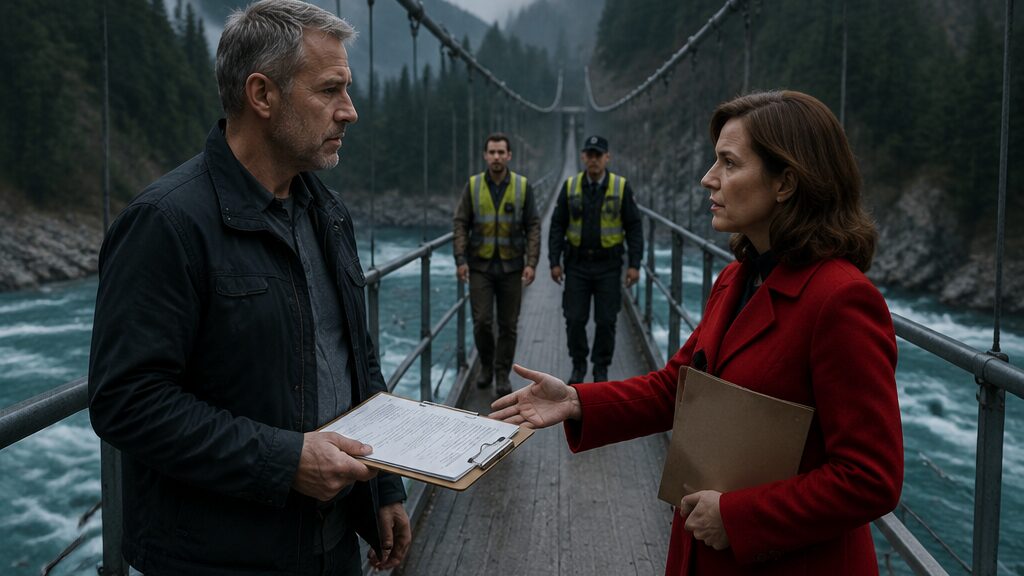
The river below him moved so fast that the water looked like a sheet of broken glass, forcing itself between the dark walls of the gorge. The suspension bridge trembled lightly beneath his boots as wind moved through the cables. He had spent nineteen years learning the difference between normal movement and dangerous movement.
This movement was normal.
The document in his hand was not.
Michael stood near the center of the bridge with his federal field jacket zipped against the cold and his inspection clipboard pressed against the metal railing. A bridge sensor report was clipped on top. Beneath it sat two papers that suddenly seemed heavier than the equipment bag at his feet.
One was the notice ending his employment.
The other was his pension schedule.
Christine Davis stood several steps away, her red coat bright against the gray steel and dark forest surrounding them. She looked uncomfortable, but not uncertain. She had practiced this conversation.
“Michael,” she said, “I need you to understand this is a position elimination. It is not a statement about your personal value.”
He looked down again.
Termination effective March thirty-first.
Pension vesting date April eighteenth.
Eighteen days.
He lifted his eyes.
“My pension reaches twenty years on the eighteenth,” he said. “This ends my service on the thirty-first.”
Christine folded her arms.
“The restructuring timeline was finalized by regional leadership.”
“That wasn’t my question.”
The bridge moved beneath them.
Michael had always noticed movement first. A vibration in a cable. A change in tension. A shift that meant something underneath the surface had changed.
He had spent his career teaching younger inspectors not to ignore small inconsistencies.
A bridge did not fail all at once.
Neither did trust.
“I understand the reason you were given,” Michael continued. “I’m asking who selected the date.”
Christine’s expression tightened.
“It’s not productive to focus on one date.”
“It is if the date changes the outcome.”
She looked toward the inspection clipboard.
“You’re making this more complicated than it needs to be.”
Michael almost smiled at the irony.
For years, he had heard that sentence from people who did not work in the field. Problems were always simple when someone else carried the responsibility.
He looked back at the pension schedule.
His father had spent thirty years in a factory before a company closure changed everything six months before his retirement benefits were supposed to begin. Michael remembered the way his father read every piece of paperwork afterward, searching for the sentence that had allowed years of work to disappear.
Michael had promised himself he would never be that unprepared.
Yet he had never actually expected to need the promise.
“Did you know about the eighteen days?” he asked.
Christine did not answer immediately.
That pause mattered.
Michael noticed it.
“I knew the restructuring date,” she finally said.
“That’s not what I asked.”
The silence between them became louder than the river.
Then Christine reached out her hand.
“I need your field credentials.”
Michael looked at the bridge beneath him.
The inspection was unfinished. A tension reading from the west cable had not yet been reviewed against the previous month’s measurements. Nothing dangerous was showing, but the final assessment mattered. He had signed his name to thousands of reports over the years because the public trusted the people who inspected structures they never thought about.
“I’m still in the middle of an active inspection.”
“Not anymore.”
The words landed harder than the termination notice.
Not because they surprised him.
Because they were final.
Michael unclipped his badge slowly and placed it in her hand.
He did not argue.
He did not raise his voice.
He simply placed the termination notice beside the pension schedule on the clipboard and took a picture with his personal phone.
Christine noticed.
“What are you doing?”
“Keeping my records.”
“That’s unnecessary.”
Michael looked at her.
“I’ve learned unnecessary records are usually the ones people wish existed later.”
For the first time, Christine looked irritated.
“You need to be careful with how you characterize this.”
Michael turned the clipboard slightly so the two dates remained visible.
“I’m not characterizing anything.”
He tapped the papers.
“I’m comparing.”
Before Christine could respond, a warning tone came from the inspection device attached near the bridge cable.
Michael turned instantly.
A small red indicator flashed.
The movement in the bridge changed.
Only slightly.
But slightly was enough.
He stepped toward the equipment.
“Don’t touch that,” Christine said.
Michael ignored her.
“Daniel should have been monitoring the west anchor sensor.”
As if summoned by the name, a figure appeared at the far end of the bridge.
Daniel Roberts was running toward them, wearing a reflective bridge operations vest over his work clothes. Behind him came a bridge patrol officer in uniform.
Christine stepped back.
“What happened?”
Daniel reached them, breathing hard.
“The west tension sensor shifted outside the expected range.”
Michael looked at the monitor.
“How long?”
“Four minutes.”
“Did it stabilize?”
Daniel hesitated.
“Not completely.”
Michael moved closer to the sensor readout.
His mind did what it had always done.
It calculated.
Distance.
Load.
Movement.
Risk.
The termination notice was still in his hand. His job had technically ended. His authority was gone.
But the bridge did not know that.
“Close the pedestrian access on both sides,” Michael said.
Daniel looked at him.
“Michael—”
“Now.”
The bridge patrol officer looked at Christine.
For a moment, nobody moved.
Then the officer followed Michael’s instruction.
The warning was not a disaster. It was not the dramatic reversal anyone expected. There was no sudden discovery that Michael’s firing had been a mistake.
The bridge still needed inspection.
The agency still needed procedures.
The termination still existed.
But as Michael watched Daniel and the patrol officer move into position, one fact became impossible to ignore.
They had removed him from the job.
They had not removed the need for his knowledge.
An hour later, after the bridge was temporarily secured, Michael returned to his truck.
His phone rang before he opened the door.
Donna Martin.
Human Resources.
He answered.
“Michael, I wanted to make sure you received the final documentation package.”
“I received the termination notice.”
“There’s also your final evaluation.”
“I haven’t received one.”
A pause.
“It was included.”
Michael looked through the digital folder she had sent.
There it was.
Final evaluation.
A section marked: transition resistance.
He stared at the phrase.
He had never seen it before.
“Donna,” he said quietly, “when was this written?”
“It was part of the final review process.”
“My last signed evaluation was four months ago.”
“This is an updated assessment.”
“Who requested the update?”
Donna did not answer.
Michael looked back toward the bridge.
The cables stretched across the gorge, carrying weight they were designed to carry.
But every structure had limits.
And every failure started somewhere.
“I’ll need the revision history,” he said.
“That may not be available.”
Michael looked at the two dates still visible on his clipboard.
Then he looked at the new document.
A termination date eighteen days before retirement.
A performance concern appearing after the decision.
Two things that did not belong together.
“Then I’ll need to know why.”
Donna’s voice became more formal.
“Michael, I hope you understand this is a difficult time. It would be better for everyone if we focused on moving forward.”
Michael closed the truck door.
For nineteen years, he had believed doing his job quietly was the best way to protect the institution.
Now he wondered if his silence had only made things easier for people who never had to answer his questions.
“I am moving forward,” he said.
He ended the call.
And for the first time in his career, Michael Garcia began investigating the people who had investigated him.
Chapter 2: The Review That Changed After the Decision Was Made
Michael’s computer access disappeared before he reached his old desk.
The security notification appeared on his phone while he was walking through the regional office lobby.
Access revoked.
Effective immediately.
He stopped beside the entrance and read the message twice.
Not because he did not understand it.
Because he understood exactly what it meant.
Someone had decided that even looking at his own records was now a privilege he no longer had.
The receptionist looked away when he entered. Not out of disrespect. More from uncertainty. People in offices rarely knew how to act around someone who had been removed but had not yet disappeared.
Donna Martin was waiting near his workstation.
A cardboard box sat on his chair.
“You can collect personal items today,” she said.
Michael looked at the box.
“My desk was already cleared?”
“Facilities prepared it.”
“Before I arrived?”
Donna adjusted the folder in her hands.
“The process begins once notices are issued.”
Michael nodded.
Another process.
Another sentence designed to make a choice sound automatic.
He sat down and opened the drawer.
Inside were three printed annual reviews.
Excellent field judgment.
Strong technical leadership.
Consistent public safety focus.
He had saved them because he was old-fashioned. He preferred paper copies of important things.
He placed them on the desk.
Then Donna handed him another document.
“This is your final evaluation summary.”
Michael read it.
The language was different.
Concern regarding adaptability.
Difficulty accepting organizational transition.
Resistance to revised operational priorities.
He looked at Donna.
“When did I become difficult to work with?”
“That’s not what this says.”
“It says exactly that.”
Donna remained calm.
“It reflects leadership observations during the transition period.”
“What transition period?”
“The restructuring discussions.”
Michael looked at the date.
The evaluation had been finalized two weeks after Christine delivered the termination notice.
He turned the paper over.
No earlier draft.
No signature from him.
No acknowledgment.
“Where is the version I signed?”
“This is the final version.”
“That wasn’t my question.”
Donna looked uncomfortable.
Michael recognized the expression.
Not guilt.
Discomfort.
The look of someone standing beside a door they did not build but were expected to guard.
“I can provide the official file,” she said.
“When?”
“I’ll have to check.”
Michael placed the negative evaluation beside his previous reviews.
The difference was not subtle.
His earlier reviews described the exact qualities the new document questioned.
He was not claiming every criticism was impossible. He had worked long enough to know everyone had weaknesses. He had argued with supervisors. He had pushed back when deadlines threatened safety reviews.
But disagreement was not the same as failure.
And the timing bothered him.
Not emotionally.
Practically.
A bridge inspector learned not to assume a crack was dangerous without measuring it.
So Michael measured.
“Donna, I need the revision history.”
“I already told you I’ll check.”
“And I need the original restructuring criteria.”
“That is not part of your personnel file.”
“Then whose file is it part of?”
Donna did not respond.
That answer told him enough.
Over the next several hours, Michael packed his belongings.
A framed photo of his first bridge inspection.
A worn notebook filled with sensor readings.
A coffee mug someone had given him after he worked through a winter closure.
Small things that represented a career.
The box felt heavier with every item.
Before leaving, he noticed something in the bottom drawer.
A printed copy of his last signed evaluation.
He compared the version numbers.
The review Donna gave him ended in revision four.
The one he found in his drawer ended in revision two.
The earlier version had no mention of transition resistance.
Michael photographed both.
A small inconsistency.
A measurable one.
The same kind of inconsistency he would have flagged in a bridge report.
That evening, he sat at his kitchen table with both documents spread out.
Termination notice.
Pension schedule.
Performance reviews.
He wrote three questions at the top of a notebook.
Who selected the date?
Who changed the evaluation?
Who benefited?
The third question bothered him most.
Not because he had an answer.
Because he did not want one.
His phone rang.
Anna Torres.
Michael stared at the name before answering.
Anna had worked as a senior inspection scheduler for almost sixteen years. She knew every bridge project in the region, every delay caused by weather, every inspector who needed extra time because safety mattered more than speed.
Six months earlier, she had called him after receiving a restructuring warning.
She had suspected something was wrong.
Michael remembered telling her not to assume the worst.
He had told her patterns could look intentional when people were afraid.
He had told her to trust the process.
He answered.
“Anna.”
Her voice was quiet.
“I heard.”
Michael looked at the papers.
“How?”
“People talk.”
“That’s not an answer.”
“No,” she said. “It’s just the truth.”
Silence followed.
Then she asked:
“How many days?”
Michael frowned.
“What?”
“How many days did they leave you short?”
He looked at the pension schedule.
“Eighteen.”
Anna exhaled.
“Mine was thirteen.”
Michael sat still.
The room seemed smaller.
“Your termination?”
“Yes.”
“When?”
“March twelfth.”
“And your benefit date?”
“March twenty-fifth.”
He closed his eyes.
For a moment, he heard the bridge warning tone again.
Small movement.
Small change.
Something underneath the surface.
“Anna,” he said, “what was your stated reason?”
She laughed once, without humor.
“Operational transition.”
Michael looked at his own document.
“Mine says position elimination.”
“Different words.”
“Same idea.”
“No,” Anna said. “Same script.”
The sentence stayed with him.
“Why didn’t you tell me?”
“I did.”
The answer was immediate.
“You asked me not to jump to conclusions.”
Michael looked down.
He remembered.
He remembered her frustration.
He remembered choosing comfort over investigation.
“I was wrong,” he said.
Anna did not answer.
Not because she disagreed.
Because an apology did not repair the months when someone had needed to be believed.
“I know two other people,” she finally said. “Maybe more.”
Michael picked up his notebook.
“Names?”
“No.”
“Why?”
“Because I don’t want a meeting where everyone says they’re sorry and nothing changes.”
“That’s not what I’m trying to do.”
“Isn’t it?”
Michael looked at the documents again.
For the first time, he understood that proving his own case might not be enough.
The dates were not just about him.
They were a pattern waiting to be tested.
“I need records,” he said.
Anna was quiet.
Then she replied:
“Six months ago, I needed someone to ask that question.”
The call ended.
Michael stayed at the table long after.
He wrote Anna’s dates beside his.
March twelfth.
March twenty-fifth.
March thirty-first.
April eighteenth.
Four dates.
One pattern.
And somewhere inside the agency that had trained him to look for hidden weaknesses in structures, someone had built a system where the cracks were hidden in plain sight.
Chapter 3: She Had Asked the Same Question Six Months Earlier
Anna arrived at the diner carrying the same kind of envelope Michael had received on the bridge.
She placed it on the table before sitting down.
Not dramatically.
Not angrily.
Just carefully.
Like it contained something fragile.
Michael looked at it.
“I didn’t know you kept it.”
“I kept everything.”
He nodded.
That answer sounded familiar.
He had spent years telling employees to document inspections, conversations, and decisions.
He had simply never believed he would need the same advice applied to himself.
The diner was nearly empty. A few people sat near the window, unaware that two former federal employees were comparing the dates that had changed their lives.
Michael placed his documents on the table.
Anna placed hers beside them.
The arrangement looked almost identical.
Termination letter.
Benefit schedule.
Two dates.
A gap.
Thirteen days.
Eighteen days.
Michael stared at the papers.
“How many?”
Anna shook her head.
“I don’t know.”
“You said you knew others.”
“I know of others.”
“Why the difference?”
“Because knowing someone was hurt is different from proving why.”
Michael looked at her.
That sentence bothered him because it sounded like something he would have said before.
Careful.
Measured.
Professional.
But he understood now that caution could become another way of avoiding responsibility.
“What did they tell you?”
Anna opened her envelope.
“Position restructuring. Reduced administrative need.”
“You were the only senior scheduler.”
“Exactly.”
Michael read her final notice.
The wording was different from his.
The reason was different.
But the structure was familiar.
Decision date.
Effective date.
Benefit impact.
He tapped the paper.
“Did anyone mention retirement costs?”
“No.”
“Healthcare?”
“No.”
“Future obligations?”
Anna looked at him.
“That phrase means something?”
Michael hesitated.
“Not yet.”
That was the honest answer.
He did not want to become someone who found proof only because he wanted to be right.
He needed to know.
Not believe.
Anna watched him.
“You’re still doing it.”
“Doing what?”
“Trying to make the system innocent until the evidence forces you not to.”
Michael looked down.
Because she was right.
His first instinct had always been to protect the institution from unfair criticism.
Even now.
Even after standing on a bridge with his badge removed.
“I spent nineteen years believing the agency deserved the benefit of the doubt,” he said.
“And now?”
“Now I think it deserves questions.”
Anna leaned back.
“That’s different.”
“Yes.”
“Why?”
Michael looked at the papers between them.
“Because questions are part of the job.”
For the first time, Anna’s expression softened.
Not forgiveness.
Not yet.
Recognition.
She reached into her bag and pulled out another page.
“I found this after I left.”
Michael took it.
A benefits continuation notice.
A handwritten calculation in the margin.
Anna’s handwriting.
“You calculated it?”
“I wanted to know if I was imagining things.”
Michael read the numbers.
Termination date.
Healthcare continuation threshold.
Difference.
Thirteen days.
She had done exactly what he was doing now.
Measured.
Compared.
Documented.
“How many people did you check?”
“Three.”
“And?”
“One more was nine days short.”
Michael looked up.
“Who?”
“Former inspector.”
“Name?”
“Michael, this is where you need to be careful.”
He stopped.
The warning was not about procedure.
It was about emotion.
Anna continued.
“If you find one person, they can say it was coincidence. Two people, they can say circumstances. Three people, they can say different departments.”
“And four?”
“They have to explain.”
Michael looked at the table.
He thought about the bridge.
About load measurements.
About how engineers never judged a structure by one reading.
A single number could mislead.
A pattern told the story.
“What were the reasons for the other terminations?”
Anna showed him.
Different words.
Same rhythm.
Operational adjustment.
Position review.
Regional efficiency.
Michael placed the papers together.
“Who approved these?”
“I don’t know.”
“Who delivered them?”
“Different managers.”
“Who controlled the dates?”
Anna looked at him.
“That’s the question.”
Michael wrote it down.
Who controlled the dates?
The same question he had asked Christine.
The same question nobody had answered.
Anna folded her hands.
“There’s something else.”
“What?”
“When I first called you, before my termination became official, I told you I thought the timing was wrong.”
Michael remembered.
He remembered sitting in his office.
He remembered saying, “Don’t assume intent where there could be process.”
“I should have listened,” he said.
Anna looked away.
“I didn’t need you to agree with me.”
“Then what did you need?”
“I needed you to check.”
The words were quiet.
But they landed harder than anger.
Michael had spent his career inspecting bridges because people depended on someone noticing problems before they became failures.
Anna had asked him to do the same thing.
And he had chosen not to.
“I’m sorry,” he said.
She did not immediately respond.
Then she nodded once.
“That matters.”
A server placed their coffee on the table.
For a moment, neither spoke.
Then Anna pulled out another sheet.
“Two former inspectors gave me permission to share this.”
Michael read the dates.
His expression changed.
One termination.
One payroll cycle before pension vesting.
He placed it beside his own.
The gaps were different.
The language was different.
The timing was not.
Three cases.
Three employees.
Three benefit thresholds.
The same direction.
Michael closed the folder.
“We need the full list.”
Anna looked concerned.
“Michael.”
“If we only collect the examples that prove us right, we’re doing exactly what they can accuse us of doing.”
She studied him.
“What changed?”
Michael looked toward the diner window.
Outside, traffic moved normally.
People crossed streets.
Cars stopped at lights.
The world continued.
That was the strange thing about institutional failures.
Nothing looked broken from the outside.
“I spent my career looking for structural problems,” he said. “I just never expected one to be inside the paperwork.”
Anna nodded slowly.
“Then find the structure.”
They spent the next hour building a list.
Not accusations.
Not conclusions.
Dates.
Positions.
Benefits.
Reasons.
When they finished, Michael looked at the page.
The pattern was no longer a feeling.
It was a question large enough to demand an answer.
Before they left, Anna received a message.
She read it and handed the phone across the table.
Another former employee.
Another termination.
Another date comparison.
Michael looked at the numbers.
His stomach tightened.
The employee had been terminated one payroll cycle before pension vesting.
Exactly like the others.
He placed the phone down.
The bridge had warned him with a sensor reading.
A small movement.
A sign that something beneath the surface was carrying more pressure than anyone admitted.
Now the same thing was happening again.
Only this time, the structure was made of paperwork.
And somewhere inside the agency records was the measurement that would explain why.
Chapter 4: The Pattern Hidden Inside an Ordinary Restructuring List
The first spreadsheet Michael created was wrong.
He knew it before he finished it.
The mistake was not in the numbers. The dates were accurate. The names were accurate. The benefit thresholds came from official documents.
The mistake was that he had started with the people who proved his suspicion.
He stared at the screen in his kitchen, the cursor blinking beside a row he had highlighted.
Selected employees.
That phrase bothered him.
Not because it was inaccurate.
Because it was how people inside institutions slowly convinced themselves that decisions were inevitable.
He closed the file.
Then he deleted it.
For twenty minutes, he sat at the table without touching the keyboard.
His old inspection notebook rested beside his laptop. The cover was worn from years of being carried into rain, snow, and construction zones. Inside were pages filled with measurements, not conclusions.
A bridge inspector did not begin by deciding what failed.
He began by recording what existed.
Michael opened a new spreadsheet.
This time, he entered every eliminated position he could verify.
Not just senior employees.
Not just people close to retirement.
Everyone.
Position.
Location.
Years of service.
Stated reason.
Termination date.
Benefit threshold.
He spent two days collecting information from public records, former colleagues, and documents employees had saved after leaving.
The larger the spreadsheet became, the less comfortable he felt.
Because the pattern was no longer something he wanted to find.
It was something he had to explain.
By Friday evening, fourteen eliminated positions filled the screen.
Fourteen people.
Fourteen different roles.
Fourteen different explanations.
But when Michael sorted the data by benefit timing, the rows changed.
Eleven employees had been within twenty-four months of major benefit thresholds.
Pension vesting.
Healthcare continuation.
Retirement contribution milestones.
Eleven.
He leaned back.
That number was large enough to matter.
But not large enough to prove intent.
He reminded himself of that.
A pattern was not a conclusion.
It was a question.
His phone rang.
Daniel Roberts.
Michael almost let it go to voicemail.
Not because he was angry.
Because he was not sure what he wanted to hear.
He answered.
“Daniel.”
“Do you have a minute?”
Michael looked at the spreadsheet.
“I have several.”
Daniel gave a short laugh.
“You always did answer like that.”
The familiarity made the conversation harder.
Daniel had been his field partner for three years. He was younger, talented, and careful. Michael had recommended him for advanced bridge assessment training.
After the termination, Daniel had inherited several of his assignments.
“I saw the request you submitted,” Daniel said.
Michael’s expression changed.
“What request?”
“For restructuring records.”
“Who told you?”
“People talk.”
Michael looked at the ceiling.
That phrase was becoming too common.
“What do you know?”
Daniel was quiet.
“I know people are saying things.”
“That wasn’t my question.”
A pause.
Michael recognized it.
Another person avoiding a direct answer.
“I know the younger engineers were told the cuts were meant to protect technical positions,” Daniel said.
Michael looked at the spreadsheet.
“What does that mean?”
“It means leadership said the region had to reduce administrative and senior costs before more field positions disappeared.”
“Senior costs.”
Daniel sighed.
“I’m not saying I agree with it.”
“But you believed it.”
Another pause.
“Yes.”
Michael closed his eyes.
The answer hurt more because Daniel was not trying to hurt him.
“You thought removing people with experience protected the future?”
“I thought losing ten positions was better than losing thirty.”
Michael looked at the bridge inspection notebook beside him.
“That’s how these things always get explained.”
Daniel did not respond.
“Michael—”
“No. I’m not saying you caused this.”
“Then what are you saying?”
Michael looked back at the spreadsheet.
“I’m saying someone decided certain people were the safest ones to remove.”
Daniel lowered his voice.
“There were meetings.”
Michael sat forward.
“What meetings?”
“Before the final list.”
“Who was there?”
“Managers. Finance. HR.”
“Was Christine there?”
“Yes.”
Michael wrote the answer down.
Not because it was surprising.
Because it was another piece.
“What was discussed?”
Daniel hesitated.
“I wasn’t in the whole meeting.”
“But you heard something.”
Daniel was silent.
Then:
“They talked about continuity.”
Michael waited.
“And?”
“They said some positions carried more future cost.”
Michael stopped typing.
Future cost.
Not performance.
Not transition.
Cost.
“What exactly did they call it?”
“I don’t know.”
“Daniel.”
“I don’t know, Michael.”
The frustration in his voice sounded genuine.
“I’m trying to tell you what I heard, not pretend I know everything.”
Michael softened slightly.
That mattered.
Daniel was not an enemy.
He was someone who had been standing inside the same system, seeing only the part directly in front of him.
“What else?”
Daniel exhaled.
“There was a spreadsheet.”
Michael looked at the screen.
“What kind?”
“I don’t know. Finance had it.”
“Did it have names?”
“I don’t think so.”
“Then what did it have?”
Daniel paused.
“Codes.”
Michael wrote that down.
“Position codes?”
“I think so.”
The word sat there.
Codes.
Numbers without names.
People reduced into categories.
Michael thought about bridge readings.
A sensor did not know the name of the person driving across the structure. It only measured weight.
But people were not bridges.
People had years attached to them.
Families.
Plans.
Promises.
“Daniel,” Michael said, “why are you telling me this now?”
The question was quiet.
Daniel answered even more quietly.
“Because I started doing your inspections.”
Michael said nothing.
“And I realized something.”
“What?”
“I keep finding notes you left behind.”
Michael looked toward his old notebook.
“Notes?”
“Things like why a measurement mattered. Why a repair couldn’t wait. Why a small change today could become a bigger problem later.”
Daniel paused.
“I thought you were stubborn.”
Michael almost smiled.
“Many people have.”
“I thought you slowed things down.”
“And now?”
“Now I think maybe you were the reason we didn’t miss things.”
The compliment did not feel good.
Not because Michael rejected it.
Because it arrived too late.
After the badge was gone.
After the decision.
After the damage.
“Do you know where the spreadsheet is?” Michael asked.
“No.”
“Can you find out?”
Daniel did not answer immediately.
“I’ll see what I can do.”
After they ended the call, Michael returned to his spreadsheet.
He added a new column.
Source of information.
He added Daniel’s statement.
Then he stopped.
Because something bothered him.
The pattern was becoming clearer.
But clarity was dangerous.
It could make him careless.
He opened a blank document and wrote:
Things I know.
He listed the facts.
His position eliminated.
Eighteen days before pension vesting.
Positive reviews before termination.
Updated criticism after termination decision.
Multiple employees with similar timing.
Possible financial scoring system.
Then he wrote:
Things I assume.
He stared at the empty space.
The list was shorter.
Intent.
Motive.
Purpose.
He had spent his career separating evidence from interpretation.
Now he had to apply the same discipline to himself.
On Saturday morning, an email arrived from a public records request.
Michael almost ignored it.
The sender line looked ordinary.
Federal records archive.
The attachment was an index of released restructuring materials.
Most of it was routine.
Meeting notes.
Budget summaries.
Position elimination documents.
Then he saw the final entry.
A file that had not been attached.
A title only.
Future Obligation Exposure.
Michael clicked the request status.
Restricted pending review.
He read the line again.
Future Obligation Exposure.
Not performance.
Not efficiency.
Not transition.
Exposure.
The word changed the shape of the question.
Michael closed the laptop.
For the first time since the bridge, he felt certain about one thing.
The dates were not the whole story.
They were only where the story had started.
Chapter 5: The Contract That Paid for His Knowledge but Not His Pension
Donna Martin called it a solution.
Michael called it a transaction.
The difference became clear before anyone finished the first sentence.
The conference room was the same one where Michael had attended budget meetings for years. Same table. Same projector. Same glass walls.
But he was sitting on the opposite side now.
Donna placed a folder in front of him.
“We want to discuss a practical path forward.”
Michael did not open it.
“Practical for whom?”
Christine sat beside Donna.
She looked tired.
Not defeated.
Tired.
That distinction mattered.
Michael had expected anger. Defensiveness. Maybe even hostility.
Instead, Christine looked like someone who had spent weeks defending a decision she was no longer comfortable with.
“We recognize your expertise is still valuable,” Donna said.
Michael looked at the folder.
“Interesting.”
“What?”
“My expertise was valuable yesterday.”
Christine looked at him.
“Michael.”
“No. I’m not trying to be difficult.”
The phrase sounded strange coming from him.
“I’m trying to understand the distinction.”
Donna opened the folder.
“A ninety-day consulting agreement.”
Michael read the first page.
Independent contractor.
Temporary assignment.
No employment reinstatement.
No pension service credit.
He placed it back.
“You want me to continue doing the work.”
“Yes.”
“But not as an employee.”
“Because the position has been eliminated.”
Michael looked at Christine.
“The work wasn’t eliminated.”
Christine did not answer.
That was answer enough.
The bridge had taught him something.
A structure could be declared unsafe, but that did not mean the forces acting on it disappeared.
The agency had removed the position.
The responsibilities remained.
“How many bridge files need my certification?” Michael asked.
Donna hesitated.
“Three active assessments.”
“Three?”
“Several others are being reassigned.”
“To whom?”
“Other engineers.”
Michael nodded.
Daniel.
He did not say the name.
He did not need to.
Christine leaned forward.
“This is not an admission that the original decision was wrong.”
“I didn’t ask for one.”
“We are trying to provide continuity.”
Michael looked at the contract.
Continuity.
Another carefully chosen word.
“What happens to my pension if I accept this?”
Donna answered immediately.
“You would remain under the current separation terms.”
“So I lose the eighteen days.”
“This contract is not connected to retirement benefits.”
Michael nodded.
There it was.
The solution.
A way to keep paying for the part of him they needed while preserving the part they wanted to avoid.
He picked up the pension schedule from his folder and placed it beside the contract.
The two dates looked almost identical to the first day on the bridge.
Termination.
Vesting.
A gap between them.
“Donna,” he said, “what happens if I accept this?”
“You continue contributing your expertise.”
“That wasn’t my question.”
She looked down.
Michael continued.
“I finish the work. The agency gets the benefit of my knowledge. The pension remains unchanged.”
“It is a standard consulting arrangement.”
“Is it?”
Christine looked at him.
“What are you suggesting?”
“I’m asking why the agency needs the work but not the position.”
No one answered.
Michael did not push.
Silence was useful.
People often filled it with more truth than they intended.
Finally Christine spoke.
“The region is under pressure.”
Michael looked at her.
“I know.”
“Programs are competing for resources.”
“I know.”
“You think this was easy?”
“No.”
That surprised her.
Michael continued.
“I think it was easier for people who weren’t losing eighteen days.”
Christine looked away.
For a moment, the room became less formal.
More human.
Then Donna returned to the folder.
“We can discuss adjustments.”
“Can you restore my service credit?”
“That is outside this agreement.”
“Can you correct the termination date?”
“Michael.”
The answer was clear.
No.
He closed the folder.
The offer was not insulting.
That was what made it difficult.
It was reasonable.
A person who needed income could accept it.
A person who wanted to believe the institution still valued him could accept it.
That was the temptation.
Not money.
Meaning.
The idea that the last nineteen years could still end with some acknowledgment.
But the contract did not say he was wrongfully removed.
It said he was useful.
Those were not the same thing.
“I can’t accept this,” he said.
Donna looked surprised.
“Because of the pension issue?”
“Because of the structure.”
Christine watched him carefully.
“You’re turning down work.”
“Yes.”
“You understand that may affect future opportunities?”
Michael nodded.
“I understand.”
He gathered his documents.
For years, he had measured his worth by whether the agency needed him.
Now he was learning a harder lesson.
Being needed was not the same as being respected.
At the door, Christine spoke.
“Michael.”
He stopped.
“I did respect your work.”
He looked back.
“I believe you.”
The answer seemed to surprise her.
“But respect without questions can still allow harm.”
Christine lowered her eyes.
Michael left the room.
That afternoon, he submitted a formal records request.
Not for an apology.
Not for reinstatement.
For the file titled:
Future Obligation Exposure.
Three days later, he received a response.
The document existed.
The agency could release it.
But only after review.
Michael read the message twice.
A file that had been hidden was now acknowledged.
And acknowledgment meant something had changed.
The question was no longer whether the spreadsheet existed.
The question was what it contained.
Chapter 6: The Column No One Wanted to Explain
The spreadsheet had no names.
That was the first thing Michael noticed.
Rows of numbers.
Position codes.
Projected costs.
Future obligations.
Nothing that directly said who had been selected.
It was the kind of document designed to look neutral.
Michael sat across from the federal labor investigator with a printed copy between them.
The investigator flipped through the pages.
“So your claim is that this spreadsheet proves employees were selected based on benefits.”
Michael shook his head.
“No.”
The investigator looked up.
“No?”
“It proves there was a financial category connected to future obligations.”
“And?”
“And I need to show whether that category influenced the decisions.”
The investigator studied him.
“You’re being careful.”
“I should be.”
“Why?”
“Because if I accuse without proving, they can dismiss the entire issue.”
That answer mattered.
Michael was not trying to win an argument.
He was trying to build a record.
The investigator turned another page.
“The agency says this was standard forecasting.”
“That’s possible.”
“You believe it wasn’t.”
“I believe the dates need explanation.”
He pointed to the spreadsheet.
“Numbers alone don’t tell the whole story.”
Then he placed another document beside it.
A list of eliminated positions.
Then another.
Benefit dates.
The investigator looked between them.
Michael explained.
“These codes correspond to positions. Not names.”
“How did you match them?”
“Old assignment records.”
“Are you certain?”
“Yes.”
The investigator nodded.
“Continue.”
Michael pointed to one row.
His position.
The code matched.
The projected future obligation score was higher than every other position in the regional bridge unit.
“Why?”
The investigator read the number.
“Higher salary?”
“Partly.”
“More benefits?”
“Partly.”
“Years of service?”
“Yes.”
Michael looked at the sheet.
“That is exactly the problem.”
The investigator leaned back.
“Explain.”
“A bridge doesn’t fail because one cable exists.”
He paused.
“It fails because multiple pressures combine.”
He pointed to the rows.
“This score combined salary, service time, and future benefits. The employees with the highest scores were the employees removed.”
The investigator looked at the data again.
“How many?”
“Eleven out of fourteen.”
The room became quiet.
Not because the conclusion was finished.
Because the question had become harder to avoid.
Later that afternoon, Christine joined the meeting.
Michael expected a denial.
Instead, she sat down and looked at the documents.
“You think I targeted people close to retirement.”
Michael looked at her.
“I think you saw the pattern.”
Christine’s expression changed slightly.
“I did not create that spreadsheet.”
“I know.”
“I didn’t tell finance which names to select.”
“I know.”
“Then why are you looking at me like I did?”
Michael held her gaze.
“Because you approved the list.”
Christine looked away.
For several seconds, nobody spoke.
Then she said:
“When the budget reduction came down, I was told we had to reduce long-term liability.”
Michael listened.
“I asked if there were alternatives.”
“And?”
“There were no alternatives that protected the same number of positions.”
“So you accepted the list.”
Christine’s voice became quieter.
“Yes.”
“Even after seeing who was on it?”
She looked at the paper.
“Yes.”
The answer was not dramatic.
That made it worse.
Michael had spent weeks imagining someone making a cruel calculation.
But the truth was more ordinary.
A person under pressure.
A person afraid.
A person who chose not to look too closely because looking closely might require action.
“You changed my evaluation,” Michael said.
Christine did not answer immediately.
“Yes.”
“Why?”
“Because I needed the decision documented.”
Michael nodded slowly.
Not because he approved.
Because the answer completed another piece.
The performance issue had not caused the termination.
It had protected it.
Christine looked at him.
“I thought I was protecting the regional program.”
Michael folded the spreadsheet.
“And I think you believed that.”
The statement surprised her.
“But?”
“But believing something does not remove responsibility.”
Christine looked down.
The investigator collected the documents.
The bridge question was finally answered.
Christine had not selected the date alone.
She had inherited a system.
But when the system revealed what it was doing, she had chosen to continue.
That evening, Michael received a call from Donna.
“We would like to resolve this.”
Michael sat at his kitchen table.
The same table where he had built the spreadsheet.
“How?”
“Restore your pension credit.”
He waited.
“And?”
“Compensation for lost salary.”
Michael looked at the paperwork.
“What’s the condition?”
A pause.
“We would need you to withdraw the broader allegation regarding the selection pattern.”
There it was.
The final calculation.
His eighteen days.
Or everyone’s questions.
Michael closed his eyes.
Six months earlier, Anna had asked someone to check.
He had not.
Now he had a chance to do more than check.
He could stop.
Or he could continue.
The bridge below the old inspection site had stabilized after the sensor warning.
The structure had held.
But only because someone paid attention when the movement began.
Michael looked at the documents.
“I’ll consider the offer,” he said.
After the call ended, he sat quietly.
Not because he was unsure what mattered.
Because he already knew.
The question was whether he was willing to lose the thing he had fought for in order to protect the reason he had fought at all.
Chapter 7: He Took Back the Eighteen Days but Not the Old Loyalty
The clause requiring Michael to withdraw the broader complaint was the only sentence he read three times.
Everything else was expected.
Pension correction.
Lost salary compensation.
Updated service record.
Those were numbers.
Those were dates.
Those were things that could be measured.
But the withdrawal clause was different.
It was asking him to separate his own recovery from everyone else’s question.
Michael sat at his kitchen table with the agreement open beside the original termination notice. The two papers had been with him for months now. They had started as proof of something that felt wrong.
Now they represented a choice.
He picked up his phone and called Donna.
“I have a question.”
“I’m listening.”
“Why is this clause included?”
A pause.
“Because the agency wants closure.”
Michael looked at the agreement.
“Closure for whom?”
Donna did not answer.
He continued.
“If the pension correction is accurate, why does the pattern allegation need to disappear?”
“Michael, these matters are complicated.”
“They are.”
He looked at the documents.
“But the dates are not.”
Donna exhaled.
“I understand why you’re frustrated.”
“I don’t need you to understand my frustration.”
“What do you need?”
Michael thought about the bridge.
About the moment Christine had asked for his credentials.
About the moment Daniel had run toward him with the warning.
About the moment he had realized that being removed did not mean being unnecessary.
“I need the correction to be mine without making everyone else’s disappear.”
The line went quiet.
Finally Donna said:
“I’ll communicate your position.”
Michael ended the call.
He did not feel victorious.
That surprised him.
For months, he had imagined this moment.
The document proving the timing.
The agency acknowledging the mistake.
The possibility that someone would finally say he had been right.
But being right did not restore what had been lost.
It did not restore the trust between him and Christine.
It did not erase the months when Anna had carried her own questions alone.
It did not change the fact that the agency had measured experienced employees as financial burdens before considering them people.
Three days later, a revised agreement arrived.
The withdrawal clause was gone.
The pension correction remained.
The broader review would continue.
Michael signed.
Not because the settlement felt complete.
Because it was honest.
The agency would correct the eighteen days.
It would not pretend the eighteen days were the entire problem.
The labor review continued over the next several weeks.
Michael submitted records.
Anna submitted hers.
The other former inspectors provided their timelines.
The complaint became larger than any one employee.
But it never became a public spectacle.
There were no headlines.
No public statements.
No moment where everyone gathered to celebrate that the truth had been discovered.
The process moved slowly.
The way serious processes usually did.
One document.
One interview.
One comparison at a time.
Anna called him after her interview.
“They accepted the timeline.”
Michael sat in his truck outside the bridge access road.
“That’s good.”
“It is.”
She paused.
“But it doesn’t feel the way I thought it would.”
Michael understood.
“Because it doesn’t give the time back.”
“No.”
A silence passed.
Then Anna said:
“You really are sorry, aren’t you?”
Michael looked through the windshield.
The bridge was visible in the distance.
“I am.”
“For not believing me?”
“For believing that my loyalty to the agency was more important than asking whether it deserved that loyalty.”
Anna did not answer immediately.
When she did, her voice was softer.
“That’s different.”
“I know.”
“You can’t fix the part where you weren’t there.”
“No.”
“But you can decide what you do now.”
Michael nodded, even though she could not see him.
That was the thing he had spent months learning.
Professionalism was not silence.
Respect was not obedience.
And loyalty without questions could become a way of protecting the wrong people.
A week later, Christine requested a meeting.
Not through HR.
Directly.
Michael almost declined.
Then he accepted.
They met in a small office away from the regional building.
No presentation.
No folders prepared in advance.
Just two people who had spent years working together and now had to acknowledge what had happened.
Christine looked older.
Not dramatically.
Just tired.
“I read your statement,” she said.
Michael waited.
“You were fair.”
“That wasn’t easy.”
“I know.”
She looked down.
“I expected you to make me the person who did this.”
Michael considered the answer.
“I thought about it.”
Christine nodded.
“I understand why.”
“But I changed my mind.”
“Why?”
Michael looked at her.
“Because that would have made it easier.”
She frowned slightly.
“Easier?”
“If this was just one person making one bad decision, then the solution would be simple.”
“And it isn’t.”
“No.”
Christine looked at the table.
“I did not create the ranking system.”
“I know.”
“I did not tell finance which people to remove.”
“I know.”
“But I saw who was affected.”
Michael said nothing.
Christine continued.
“And I told myself that if I protected the program, the damage would be smaller.”
Michael looked at her.
“Was it?”
She did not answer.
That was answer enough.
After a moment, Christine said:
“I wanted you to come back.”
Michael looked surprised.
“You did?”
“Yes.”
“Why?”
“Because the bridge unit needs people like you.”
Michael looked away.
There it was.
The old temptation.
To be needed.
To believe that usefulness could repair everything.
But he understood now.
A person could be valuable to an institution and still be treated as disposable.
“I don’t think I can,” he said.
Christine nodded slowly.
“I understand.”
That was the hardest part.
She did understand.
There was no argument left.
No villain to defeat.
No apology large enough to rebuild what had changed.
The working relationship was over because something fundamental had broken.
Two months after the settlement, Michael returned to the suspension bridge.
Not as a federal employee.
Not wearing the dark field jacket with the agency patch.
He came as an independent safety consultant.
The bridge patrol officer recognized him.
“Back again?”
Michael smiled slightly.
“Different capacity.”
The officer looked at the truck.
“You keeping the jacket?”
Michael opened the door.
Inside was the old federal jacket, folded neatly.
For years, he had carried it everywhere.
Through storms.
Through inspections.
Through long nights reviewing reports.
He touched the sleeve once.
Then he removed it from the truck.
Not dramatically.
Not as a rejection.
As an acknowledgment.
The jacket represented a chapter of his life.
It did not represent all of him.
He left it folded on the seat.
Then he stepped onto the bridge.
The same cables.
The same walkway.
The same river below.
But different.
Michael checked the latest tension readings.
The numbers were stable.
He made notes.
Small changes.
Minor adjustments.
Things worth noticing before they became failures.
A message arrived on his phone.
The final pension correction had processed.
The eighteen days had been restored.
He looked at the notification.
For a moment, he thought about how much those eighteen days had meant.
Not because of the number itself.
Because someone had decided they were small enough to take.
Michael put the phone away.
The bridge moved slightly beneath him.
Normal movement.
The kind that every structure had.
The kind that did not mean failure.
He looked back toward the truck.
The old jacket remained inside.
The institution that had given him his career was no longer where his identity lived.
That had taken longer to understand than the numbers.
The money was corrected.
The records were changed.
The review continued.
But the loyalty he once gave without question was gone.
And maybe that was the final thing he had recovered.
Not his old position.
Not his old trust.
Something more difficult.
The ability to know when a structure needed repair.
Even when the structure was the one he had spent his life serving.
The bridge tension reading remained steady.
Michael closed his inspection notebook.
Then he walked forward.
The story has ended.