The HOA President Threatened Her Father’s Fence Until She Found a Dead Man’s Signature
Chapter 1: The Yellow Notice Against the Screen Door
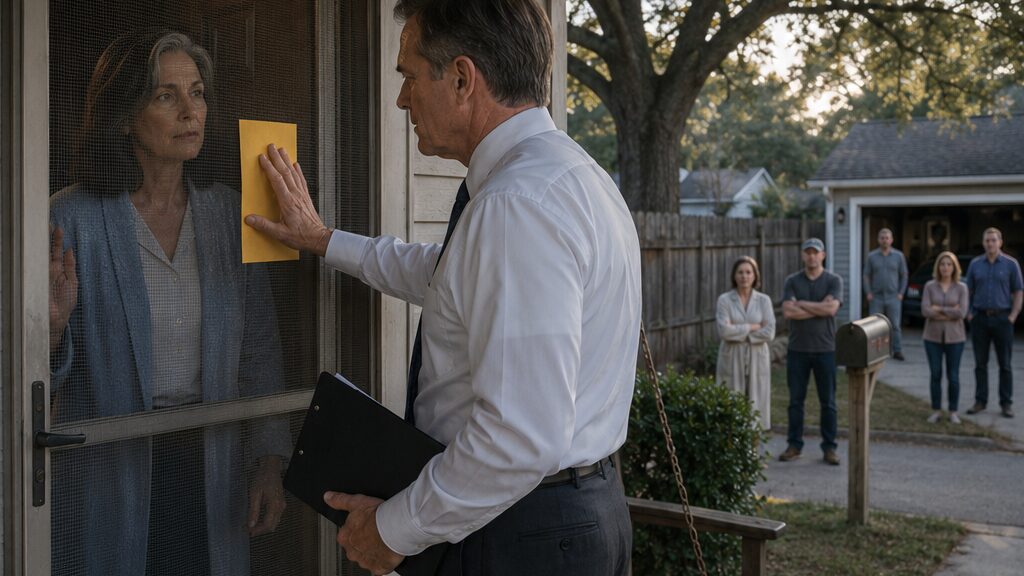
The yellow paper struck the screen door hard enough to make the latch jump.
Katherine Nelson looked through the mesh at the man standing on her porch. Richard Hall held the notice flat against the door with two fingers, as if pinning evidence to a board. Behind him, the wooden swing beneath the pecan tree moved in a slow arc, though the morning air was still.
“You have until Friday,” he said. “After that, the association will hire a contractor.”
Katherine did not open the door.
It was seven minutes past seven. She had been awake for less than half an hour, wearing the blue housecoat she had found hanging behind her father’s bedroom door three weeks earlier. Across the lane, a garage door had stopped halfway up. Someone stood in its shadow. Farther down, a woman paused beside a mailbox with a newspaper tucked under her arm.
Richard had chosen his hour well.
“For what?” Katherine asked.
He tapped the yellow sheet. “Removal of the fence. Reimbursement of contractor costs. Administrative penalties. You’ll sign acknowledgment at the bottom.”
The fence was waist-high cedar, weathered silver along the back edge of the property. Her father had installed it before his hands became too stiff to close around a hammer. It separated the pecan tree and swing from the retention ditch beyond the yard. One post leaned slightly, but it had survived hurricanes, summer heat, and the six years Katherine had spent telling herself she would come home next month.
She slid the inner door open but left the screen latched.
“Which restriction?”
Richard lifted his chin. His white shirt had been pressed too sharply for the hour, and his tie was already tight at the collar.
“Exterior structures must receive prior architectural approval.”
“What recorded instrument contains that restriction?”
His expression changed by less than an inch. “The Cedar Bluff governing documents.”
“Book and page?”
He glanced at the paper.
Katherine saw it then: Covenant Reference 94-1187, followed by no deed book, no page number, no recording date. It looked official because the words were centered and capitalized. Most people stopped reading once a document sounded confident.
Richard pushed the notice harder against the screen. “You’ve been here three weeks, Mrs. Nelson. The rest of us have followed these standards for years.”
“My name is Katherine.”
“That does not change the violation.”
“No. But a missing recording reference might.”
The garage door across the road began moving again, slowly enough that she knew the person inside was still listening.
Richard lowered the notice. “Are you refusing to comply?”
“I’m asking you to identify the authority.”
“I am the association president.”
“That’s a position. It isn’t an authority.”
His mouth tightened. The swing creaked behind him.
Katherine heard her father’s voice in that sound—not words, exactly, but the rhythm of an old habit. He used to sit on the porch step and test every knot before letting a child climb onto the swing. Pull twice. Listen once. Never trust what looks secure until it carries weight.
Richard reached into the leather folder under his arm and removed a second sheet.
“This is a notice of intent to lien,” he said. “If you continue interfering with lawful enforcement, the board will secure the debt against the property.”
He held it up for the neighbors to see.
For the first time, Katherine felt fear move through her with physical precision. It began beneath her ribs and traveled into her hands. A lien was not porch theater. A lien sat in an index. It followed title. It waited for sales, refinances, estates.
Richard must have seen something in her face, because his voice softened.
“There’s no need to make this difficult. Sign the acknowledgment. Remove the fence. Pay the twelve-dollar administrative fee today, and the board may waive additional costs.”
“Twelve dollars?”
“The current fee.”
“And the contractor?”
“That depends on whether you cooperate.”
Katherine looked down at the intent notice. It cited the same incomplete reference.
“What are the names of the five original property owners who authorized this association?” she asked.
Richard blinked.
“The founding owners,” she said. “There should be five if this reference points where I think it points. Name them without checking your folder.”
“This is absurd.”
“It should be easy.”
“I don’t conduct archival trivia contests on residents’ porches.”
“You’re threatening my title with a document you cannot identify.”
His face reddened, but his voice remained measured enough for the witnesses.
“If necessary, I’ll ask the sheriff’s office to keep the peace while the contractor removes the structure.”
“The sheriff cannot evict an owner over a fence notice.”
“I said keep the peace.”
“You said more than that yesterday.”
Richard leaned closer to the screen. “You may have worked in county records once, Mrs. Nelson, but that does not place you above your neighbors.”
Katherine held his gaze.
For twenty-nine years, she had watched people bring panic to the records counter. Divorces, unpaid taxes, inherited land, boundary disputes, names missing from deeds. The loudest person was rarely the person with the strongest claim. Paper did not care who raised his voice. Dates did not bend because someone wore a tie.
“I’m not above anyone,” she said. “That is why the rules must be real.”
Richard slid the yellow notice through the gap at the bottom of the screen. It landed inside, faceup.
“Friday,” he said.
He turned and walked down the porch steps. The woman at the mailbox looked away. The garage door across the lane closed completely.
Katherine waited until Richard reached the sidewalk before unlocking the screen. She picked up the notice without folding it and carried it to the kitchen.
Her father’s table still bore a pale ring where his coffee mug had sat every morning. She spread the notice beneath the window, then opened the cardboard box of documents she had brought from the county office on her retirement day: blank request forms, old training notes, photocopies of recording conventions that had changed over the decades.
Covenant Reference 94-1187.
The format was wrong for a deed book entry and too short for a modern instrument number. It resembled an internal file reference used before the county converted older subdivision records.
Katherine opened the public index on her laptop and entered the number.
No result.
She tried the subdivision name.
Cedar Bluff appeared in seven entries: plats, easements, utility access, a developer’s declaration, and one scanned association authorization from 1994.
She clicked it.
The index displayed a cover sheet, a legal description, and a notation reading: Attachment continued in supplemental file.
The supplemental file was not linked.
Katherine enlarged the image. At the bottom of the cover sheet, beneath a blurred notary stamp, someone had typed five names. The scan cut off before the signatures.
She looked through the kitchen window.
The swing had stopped moving.
Katherine printed the index page, placed Richard’s yellow notice beside it, and drew a line between the incomplete citation and the missing attachment.
The association might be perfectly valid.
Or someone had been counting on no one asking to see the rest.
Chapter 2: Nineteen Fines and One Wheelchair Ramp
The yellow notice on Carolyn Roberts’s ramp had been taped at eye level.
Katherine saw it before Carolyn opened the door. It fluttered against the aluminum handrail, bright against the dark rubber surface of the ramp. The top line read ARCHITECTURAL NONCOMPLIANCE. Beneath it, someone had underlined fourteen days in black ink.
Carolyn appeared behind the storm door in a wheelchair, one hand resting on the brake.
“You came about Richard,” she said.
“I came about the notice.”
“That’s the same thing now.”
Katherine stepped aside so Carolyn could see she had not touched it. “May I read it?”
Carolyn unlocked the door and rolled onto the porch. She was small, silver-haired, and dressed as if expecting company, though it was barely nine. Her eyes moved past Katherine toward the street.
“He doesn’t like people gathering,” she said.
“Then we won’t gather.”
“That depends on whether he sees two people talking.”
The notice cited Rule 7.4, Visual Harmony and Exterior Modification. Katherine photographed it, then asked whether Carolyn had a copy of the rule.
“I have a binder,” Carolyn said. “Three binders, actually. Every president adds paper.”
Inside, Carolyn led her to a dining table covered with envelopes. Yellow notices lay in stacks beside prescription bottles and grocery receipts. Some were paid. Others carried handwritten appeal dates.
Katherine sat without opening her notebook.
Carolyn noticed. “You worked at the courthouse.”
“For a long time.”
“That’s what Richard told everyone.”
Katherine looked up. “What else did he tell them?”
“That you were trying to get out of paying dues. That the fence was just the first thing. That you’d found some technicality and meant to use it to tear the association apart.”
Katherine had told no one about the missing attachment.
“Did he say what technicality?”
“No. That made it sound worse.”
Carolyn pulled one notice from the stack. It concerned a blue ceramic bird near her steps. Another cited a hose visible from the street. A third demanded removal of two pumpkins eleven days after Halloween.
“Those were mine,” she said. “The gnome belonged to the widow on Marsh Lane. Richard said its red cap violated the approved color range.”
Katherine thought she had misheard. “The approved color range for a garden gnome?”
Carolyn’s mouth twitched, but no smile formed. “She paid twenty-five dollars.”
“How many households?”
“Nineteen since Richard took over. Maybe more. People don’t tell everything.”
Katherine wrote the number down.
Carolyn tapped the ramp notice. “This one is different.”
It was. The ramp had been installed four years earlier after Carolyn’s second surgery. The association had helped arrange gravel leveling beneath it, though the work itself had been paid through a county accessibility grant. Richard’s notice claimed the side rails were visible from the lane and required screening lattice.
“That could block the turning clearance,” Katherine said.
“I told him.”
“What did he say?”
“That appearance standards apply evenly or they mean nothing.”
Katherine examined the bottom of the notice. Rule 7.4. The same covenant reference as hers. No recording information.
“Have you appealed?”
Carolyn wheeled back from the table. “I paid the last one.”
“Why?”
“Because when the storm washed mud under the ramp, the association sent two men to clear it. When the pond drain backed up, they paid the emergency call. I live alone. My nephew is forty minutes away. Richard knows what people depend on.”
The words settled between them.
Katherine had imagined the association as a false wall: find the weak section, push, and let daylight through. Carolyn was telling her there were pipes running inside it.
“I’m not trying to stop pond maintenance,” Katherine said.
“You don’t know what you’re stopping yet.”
It was not an accusation. That made it harder to dismiss.
Carolyn unlocked a drawer in the sideboard and removed a clear folder.
“These are copies from other people,” she said. “They gave them to me because I used to keep minutes before my hands got bad. Some appealed. Some paid. Some stopped coming to meetings.”
Katherine spread the notices in date order. Nineteen households. Fences, decorations, trash bins, porch chairs, a child’s basketball goal, one unapproved shade cloth. The rule numbers varied, but several did not correspond to the recorded declaration she had downloaded the night before.
“May I copy these?”
Carolyn studied her. “What will you do with them?”
“First, determine which rules exist in recorded documents and which exist only in board handbooks.”
“And after that?”
Katherine almost said, Whatever the records require.
It was the answer she had given for twenty-nine years, safe and impersonal. But this was not a counter at the courthouse. Carolyn was not asking where a document had been filed. She was asking what Katherine intended to break.
“I don’t know yet,” Katherine admitted.
Carolyn nodded once. “That’s the first honest thing anyone has said about this.”
Over the next two days, Katherine walked Cedar Bluff with a canvas folder under her arm. Some neighbors closed their doors politely. Others spoke through narrow openings.
The widow on Marsh Lane gave her the gnome citation but asked not to be named. A father near the retention pond showed her a fine for leaving a basketball goal beside his driveway during school break. A couple on the corner had been cited for replacing storm-damaged shutters before architectural approval arrived.
Each person lowered their voice when Richard’s white sedan passed.
By late afternoon, Katherine returned home with copies of thirteen notices. The wooden swing hung empty beneath the tree. She had not sat in it since arriving. Her father’s old wrench still waited in the shed beside a box of replacement bolts.
At the kitchen table, she made three columns: recorded covenant, board rule, no identifiable authority.
Most notices fell into the second and third columns.
Carolyn’s ramp notice cited Rule 7.4. Katherine opened the recorded declaration and searched every amendment available online.
There was no Rule 7.4.
She checked the architectural handbook Carolyn had lent her. Rule 7.4 appeared there under a revision date from the previous year, approved by “board consensus.” No membership vote. No recording stamp.
At the bottom of the page, in smaller type, was a sentence Katherine read twice:
These guidelines derive authority from the Association Authorization of 1994.
She placed Richard’s porch notice beside Carolyn’s ramp notice. The same missing reference sat beneath both.
The fence was no longer the question.
Someone had built an entire enforcement system on a document no one seemed willing to produce.
Chapter 3: The Five Names Filed in 1994
The replacement page was whiter than everything around it.
Katherine noticed it the moment the county records clerk placed the 1994 file on the viewing table. The original pages had softened to the color of weak tea. The final attachment was brighter, smoother, and punched with holes that did not align with the brass fastener.
She did not touch it.
“May I have the handling sheet?” she asked.
The clerk hesitated. “You know the procedure.”
“That’s why I’m asking.”
Retirement had changed the building less than she expected. The fluorescent lights still hummed. The old map cabinets still stuck in damp weather. But she no longer had keys, access codes, or the right to step behind the counter because a question interested her.
The clerk brought cotton gloves, a document cradle, and a public-record examination form.
Katherine filled out every line.
“You could have called me,” the clerk said quietly. “I would’ve scanned it.”
“No favors.”
“It isn’t a favor.”
“It would feel like one.”
The clerk gave her a look that said stubbornness had followed Katherine into retirement, then returned to the desk.
The file contained the Cedar Bluff plat, utility easements, a declaration from the original developer, and an association authorization dated October 17, 1994. Five property owners were listed as consenting to mandatory membership and enforcement powers.
William Martin.
Barbara Hernandez.
Frank Smith.
Christine Rivera.
Kevin Roberts.
The signature page was the newer sheet.
Katherine examined the staple shadows. The original pages showed rust staining near the top left corner. The replacement page did not. Its typed font was similar but not identical. That proved nothing by itself. County offices had replaced damaged pages before, sometimes years after filing, with certified reproductions.
She requested the microfilm index.
The clerk brought a reel reader from storage and cleared a station near the back wall. Katherine threaded the film herself, advancing frame by frame until Cedar Bluff appeared in pale reverse.
The authorization cover sheet was there.
The signature attachment was not.
Instead, the microfilm showed a handwritten notation: Supplemental signatures retained in developer packet.
Katherine sat back.
That phrase answered one question and opened three more. The signature page in the physical file had not been filmed with the original recording. It had entered the county jacket later, but there was no insertion note, certification, or employee initials.
She requested the developer packet.
“No public packet under that reference,” the clerk said after searching. “Could’ve been returned.”
“To whom?”
“No return receipt in the index.”
Katherine copied the five names onto her legal pad.
She could have asked the clerk to search death records. She could have mentioned that the old probate supervisor still sent her Christmas cards. Instead, she paid the certified-copy fee, walked across the courthouse corridor, took a number, and waited at the probate window like anyone else.
The probate clerk called her forward after forty minutes.
Katherine began with ownership histories. Three names matched Cedar Bluff parcels in 1994. Christine Rivera had purchased later that year, close enough to require examination of the deed date. Kevin Roberts did not appear in the subdivision index at all.
Then the probate clerk found Frank Smith.
Date of death: June 3, 1986.
Katherine read the line without moving.
“Same county?” she asked.
“Same middle initial, same prior address listed in the developer’s chain.”
“Estate closed?”
“Nineteen eighty-seven.”
Eight years before the association authorization.
She ordered certified copies of the probate cover sheet and death certificate index. The clerk watched her arrange the pages.
“You find something bad?”
“I found something impossible.”
Outside, the courthouse square was bright enough to hurt her eyes. Katherine sat on a bench beneath an oak and called Dennis Clark.
Her cousin answered on the fourth ring.
“I thought retirement meant you’d stop calling during billable hours,” he said.
“I need a real-estate attorney.”
“You know several.”
“I need one who will tell me when I’m wrong.”
A pause.
“What did you find?”
“An association authorization dated 1994. One signer died in 1986. The signature sheet appears to have been inserted after microfilming.”
Dennis stopped sounding amused. “Do not say forged yet.”
“I didn’t.”
“Do not accuse anyone.”
“I haven’t.”
“Send me certified copies. All of them, not photographs.”
“I ordered them.”
“And Katherine?”
“Yes?”
“One bad signature does not necessarily erase every recorded restriction. It may affect the association’s formation, voting authority, enforcement rights, or nothing at all, depending on the surrounding instruments.”
The caution irritated her because she knew it was correct.
“I understand.”
“No, you understand records. Let me understand the remedy.”
She nearly ended the call. Instead, she looked at the probate certificate in her lap and said, “Richard threatened a lien after I asked for the founding authority.”
“Has he filed it?”
“Not when I checked this morning.”
“Then send a written objection today. Certified mail. State the defects without conclusions. Ask them to suspend enforcement pending review.”
Katherine returned home before dusk. The swing was visible through the kitchen window, one rope darker where her father’s hands had gripped it over the years.
She prepared the letter in six paragraphs.
She identified the missing book-and-page citation, the absent microfilm attachment, the later physical insertion, and the death date of Frank Smith. She did not use the words fraud, forged, invalid, or illegal. At the end, she requested that all enforcement against her property be suspended until the association produced certified evidence of authority.
She printed two copies, signed one, and drove it to the post office before closing.
For the first time since Richard had come to the porch, she allowed herself a small sense of relief. Not victory. Order. The facts were now outside her kitchen, moving through a traceable system.
The relief lasted until the following afternoon.
A process server arrived while Katherine was tightening the screen-door latch.
He handed her a white envelope and asked her to acknowledge receipt.
Inside was a recorded claim of lien against her property for fines, administrative costs, and anticipated enforcement expenses.
The recording stamp showed it had been filed that morning.
Katherine carried it to the table and placed it beside her certified-mail receipt.
Richard had filed the lien after her warning had been delivered.
At the bottom of the lien, beneath his signature as association president, was a declaration that the board had reviewed the governing documents and confirmed its authority.
Katherine read the sentence twice.
The question was no longer whether Richard had known there might be a defect.
The question was what he had decided to do after he knew.
Chapter 4: A Lien Filed After the Warning
The county index showed the lien before Dennis finished reading Katherine’s certified letter.
He turned his monitor toward her. Her father’s address appeared beneath the words CLAIM OF LIEN, followed by Richard Hall’s name as authorized representative of Cedar Bluff Homeowners Association.
“Recorded yesterday at nine fourteen,” Dennis said.
Katherine placed the process server’s envelope beside his keyboard. “My objection was delivered the previous afternoon.”
“I see that.”
“He declared the board had reviewed its authority.”
“I see that too.”
Dennis’s office overlooked a parking lot behind a row of law firms in Beaufort. The room held no family photographs, only closing calendars and framed maps showing old parcel lines. Katherine had always suspected he arranged the maps for clients who needed reassurance that land could be made orderly.
He read the lien again, slower this time.
“The amount is small,” he said.
“That is not the point.”
“I know. Small liens can still complicate title. I’m telling you why they may expect you to pay instead of fight.”
“They filed after notice of a dead signer.”
“They filed after notice of a possible defect in one document.”
Katherine stared at him.
Dennis leaned back. “You called because you wanted someone who would tell you when you were wrong.”
“I am not wrong about the date.”
“No. You may be wrong about what the date proves.”
He opened the certified copies she had brought. The 1994 authorization, the physical signature page, the microfilm notation, Frank Smith’s probate record. He studied each without speaking.
Katherine watched his pen move. Her irritation sharpened every time he wrote a question mark.
Finally he said, “We send a formal demand today. Suspension of enforcement, withdrawal of lien, production of every governing instrument, amendment, board resolution, and account related to your property.”
“And if they refuse?”
“We decide whether to file.”
“A quiet-title action?”
“Possibly. But you need to understand something before you use that phrase like a hammer.”
Dennis pulled a yellow legal pad closer.
“The association pays liability insurance for the retention pond. It contracts for drainage clearing along common easements. It maintains the entrance lights and carries a reserve for storm debris.”
“Those services do not authorize invented fines.”
“No. But if the founding authority fails, the practical obligations do not vanish neatly. Easements may survive. Contract liabilities may survive. Insurance may lapse while everyone argues.”
Katherine thought of Carolyn’s ramp and the mud that collected beneath it after storms.
Dennis saw the change in her face.
“You didn’t ask about any of that,” he said.
“I asked whether Richard could remove my fence.”
“You asked the narrow question because it had a clean answer.”
She looked toward the window.
The loose bolt from the swing sat in her coat pocket. She had found it that morning beside the right support bracket, orange with rust. She had meant to stop at the hardware store. Instead, she had placed it in her pocket and driven to Dennis’s office.
“Send the demand,” she said.
Dennis drafted it while she waited. The letter required the association to halt physical enforcement against the fence and preserve all relevant records. It did not accuse anyone of fraud. It did not demand dissolution. It gave the board five business days to respond.
Richard replied within three hours.
He agreed not to send a contractor until the board’s emergency meeting the following week. He refused to withdraw the lien.
Attached was an announcement addressed to all eighty-four households.
URGENT COMMUNITY MEETING: THREAT TO CEDAR BLUFF PROPERTY VALUES AND SHARED SERVICES.
Katherine read the title twice.
Dennis swore under his breath.
“He’s making you the threat,” he said.
By evening, copies of the announcement had appeared under doors and inside mailboxes. Katherine found one folded beneath her porch mat.
The notice did not mention the dead signer. It said a “recently arrived homeowner” had challenged the association’s legal existence and placed pond coverage, road-edge maintenance, and neighborhood insurability at risk.
Her phone rang twice from numbers she did not recognize. No one left a message.
Across the lane, the garage door remained shut.
Katherine walked to the pecan tree. The swing tilted slightly because of the missing bolt. She touched the worn plank but did not sit.
Her father had repaired things before people noticed they were failing. Hinges, gutters, loose boards, a neighbor’s lawn mower. Katherine had inherited his instinct for hidden weakness but not his willingness to ask for help.
She closed the bolt in her fist.
The clubhouse door stood open when she arrived the next afternoon to inspect the meeting notice posted on the bulletin board. Inside, Richard and two board members arranged folding chairs. A projector faced a blank wall.
Mary Jones sat at a table with a ledger and a stack of invoices.
“You’re early,” Richard said.
“I’m reading the public notice.”
“Members only.”
“I own property here.”
He smiled without warmth. “That appears to be one of the questions you’ve raised.”
Katherine stepped closer to the table. Beside Mary’s ledger lay insurance invoices, pond-service bills, and a letter marked past due.
Mary placed her hand over it.
“The association has obligations,” she said. “Whatever you think of Richard.”
“I have never said otherwise.”
“You haven’t said much of anything. That’s part of the problem.”
Richard straightened a row of chairs. “Mrs. Nelson has been offered a reasonable pause. She has chosen escalation.”
“A pause with a lien attached.”
“A lien preserves the association’s position.”
“Even after you were warned the authority might be defective?”
Richard stopped moving chairs.
“The board reviewed the documents.”
“Which documents?”
“The appropriate ones.”
Mary’s fingers tightened on the ledger.
Katherine noticed.
“What did you review?” she asked Mary.
Mary looked at Richard first. The glance lasted only a second, but it contained an entire conversation.
“We’ll discuss records at the meeting,” Mary said.
Richard walked toward the projector. “And we’ll discuss consequences.”
Katherine left before anger made her careless.
At home, she found Dennis’s revised demand letter in her email. He had added a sentence requiring preservation of internal board communications concerning the founding file.
She called him.
“Why internal communications?”
“Because Mary looked like she knew something.”
“You’re guessing.”
“So are you.”
“No,” Katherine said. “I’m noticing.”
That night, after the porch lights along Cedar Bluff went dark one by one, someone knocked softly on Katherine’s kitchen door.
Mary stood outside holding a folded sheet inside a plastic grocery bag.
“I can’t stay,” she said.
Katherine let her in.
Mary did not remove her coat. She placed the bag on the table and stepped back as if the paper might stain her.
The document was a board memorandum dated eleven months earlier.
At the top, in Mary’s handwriting, were the words FOUNDING FILE DISCREPANCY.
Below them, she had listed the missing original attachment, inconsistent recording references, and a recommendation that the board obtain a title opinion before issuing further liens.
Katherine looked up.
“What happened to this?”
Mary’s face had gone pale.
“Richard said lender questions would destroy us before any court did.”
“Did the board vote?”
“There was no vote.”
“Then why did you sign the lien certification?”
“I didn’t.”
“Who did?”
“Richard.”
Mary moved toward the door.
Katherine held the memorandum carefully by its edges. “Why bring this now?”
“Because he told everyone you invented the problem.”
“And you let him.”
Mary stopped with her hand on the knob.
“Yes,” she said. “I did.”
Then she left Katherine alone with proof that the defect had not merely been discovered.
It had been buried.
Chapter 5: The Meeting Where Everyone Blamed the Wrong Person
Richard projected a photograph of Katherine’s house before she had even found a seat.
The image showed the cedar fence, the pecan tree, and the empty swing. A red circle had been added around the fence line. Beneath it, in large letters, were the words CHALLENGE TO ASSOCIATION AUTHORITY.
“This is not about one fence,” Richard told the crowded clubhouse. “It is about whether Cedar Bluff will remain insurable, maintainable, and stable.”
Every folding chair was occupied. Residents stood along the back wall and near the refreshment counter. Katherine recognized faces from porches that had closed when she approached.
Dennis sat beside her, a closed folder on his lap.
“You don’t have to speak first,” he murmured.
“I know.”
Richard moved to a slide listing pond insurance, drainage clearing, entrance lighting, storm cleanup, and legal expenses. Beside each item was an annual cost.
“These services exist because homeowners honor shared commitments,” he said. “A recently arrived resident has asked the county courts to erase those commitments over an alleged filing irregularity.”
“I have not filed anything,” Katherine said.
Several people turned.
Richard gave her a patient expression. “Your attorney has threatened legal action.”
“My attorney requested records and withdrawal of a lien filed after notice of a defect.”
The room stirred.
A man near the back asked, “What defect?”
Richard clicked to the next slide before Katherine could answer. Her recorded lien filled the wall.
“This challenge could affect every property,” he said. “Lenders do not like uncertainty.”
A woman in the second row looked at Katherine. “Are you trying to dissolve the HOA?”
Katherine had prepared an answer. It had been precise, accurate, and useless.
“I’m trying to determine what authority exists,” she said.
“That isn’t an answer.”
“No,” Carolyn Roberts said from the aisle. “It’s the only honest one we’ve had.”
A path opened as Carolyn rolled forward. Her ramp notice was clipped to the side of her chair.
Richard’s jaw tightened. “Mrs. Roberts, your matter is under review.”
“It has been under review for twelve days.”
“The ramp requires screening.”
“The screening blocks my turn.”
Several residents began talking at once.
Richard raised a hand. “This meeting concerns the legal threat to the association.”
Carolyn turned toward Katherine.
“I need the pond drain cleared,” she said. “I need the path beside my property kept level. If you take this association apart without something to replace it, people like me pay first.”
The room quieted.
Katherine felt Dennis glance at her.
Carolyn’s words landed harder in public than they had at her dining table. Katherine had brought copies of the nineteen notices, arranged by date in a document box at her feet. She had planned to show a pattern of selective enforcement.
Now the same evidence seemed capable of proving that everyone had been trapped inside a structure they also depended upon.
“I don’t want the services stopped,” Katherine said.
“Then what do you want?” someone called.
“My lien withdrawn. Enforcement suspended. The founding records examined.”
“And after that?”
Katherine hesitated.
Richard stepped into the silence.
“That is precisely the danger. She does not know.”
The accusation was unfair because it was true.
Katherine stood and carried the notices to the folding table at the front. One by one, she laid them in chronological order: pumpkins, shutters, hose, basketball goal, garden gnome, ramp, fence.
Yellow paper formed a line across the table.
“These are not shared-service bills,” she said. “They are penalties. Several cite rules that do not appear in recorded covenants. Some come from a handbook changed by board consensus. The association may have legitimate maintenance obligations. That does not make every rule legitimate.”
A resident picked up the basketball-goal citation.
Another asked, “Where did Rule 7.4 come from?”
Richard answered quickly. “The board is empowered to adopt reasonable guidelines.”
“By what document?” Katherine asked.
His eyes met hers.
This time the entire room heard the question.
Mary sat at the treasurer’s table with both hands folded over the ledger. Katherine had placed a copy of the memo inside Dennis’s folder, but she had promised Mary nothing.
Richard pointed toward the projected lien.
“The founding authorization was recorded in 1994. Later amendments confirm the association’s authority. We have operated openly for thirty years.”
“The original microfilm does not contain the signature attachment,” Katherine said. “The physical file contains a later page with no insertion certification. One listed signer died eight years before the authorization date.”
The room changed.
Not loudly. Chairs stopped creaking. A paper cup remained halfway to someone’s mouth.
Richard’s voice lowered. “An administrative irregularity does not invalidate decades of community governance.”
“Perhaps not. That is why I requested a title opinion before further enforcement.”
Mary shut her eyes.
Katherine looked at her.
Richard said, “No such concern was presented to the board.”
Mary opened her eyes again.
“Yes,” she said.
Richard turned.
Mary’s voice was thin, but it carried. “I presented it eleven months ago.”
A murmur moved through the clubhouse.
She stood slowly and removed a copy of the memorandum from her ledger.
“I recommended outside review before additional liens,” she said. “The file reference was incomplete. I did not know about the death record then.”
Richard’s face lost color.
“You raised a bookkeeping concern,” he said.
“I wrote founding file discrepancy.”
“You also knew our reserve was short.”
“Yes.”
“And you knew the pond insurer had requested confirmation of association continuity.”
“Yes.”
“So you understood what careless disclosure could do.”
Mary gripped the table edge. “I understood what delay could do too.”
The room divided around them. Some residents stared at Richard. Others looked toward the projected list of expenses.
Richard did not shout. That would have made him easier to dismiss.
Instead he removed a single sheet from his folder.
“The board is prepared to release Mrs. Nelson’s lien,” he said. “Immediately. We will also exempt her existing fence, provided she withdraws her challenge and agrees not to contest the association’s status.”
Dennis leaned close. “That is the clean exit.”
Katherine looked at the photograph of her house on the wall. The fence would remain. The lien would disappear. The swing would be safe.
A month earlier, that would have been enough.
Then she looked at Carolyn’s ramp notice clipped to the wheelchair. At the widow holding the garden-gnome citation. At Mary, who had finally spoken because Katherine’s private fight had made silence harder to maintain.
Richard held out the release.
“This resolves your concern,” he said.
“No,” Katherine said. “It purchases it.”
A few people muttered.
Dennis did not move.
Katherine realized how little she had trusted any of them with the full question. She had gathered records alone, spoken in careful fragments, and left Richard to define what her silence meant. Expertise had protected her from error, but it had also become a wall.
She faced the room.
“I should have told you what I was examining before tonight. I thought facts would be enough once I had them organized. They are not. You deserve to know what is at risk, including the services that may need a lawful replacement.”
Richard lowered the release.
“So you intend to dissolve us.”
“I intend to ask a court what authority exists, what does not, and what obligations survive. I will not accept a private exemption while the same unsupported rules remain over everyone else.”
Carolyn watched her carefully.
“Will you ask for a transition?” she said.
Katherine looked at Dennis.
He gave the smallest nod.
“Yes,” Katherine said. “A court-supervised one, if necessary.”
Richard gathered his papers. “You are volunteering this community for litigation.”
“No,” Katherine said. “The lien did that.”
The projector still displayed her house. Richard crossed in front of the image, briefly blocking the fence and swing with his shadow.
Katherine took the unsigned release from his hand, folded it once, and placed it beside the yellow notices.
“Withdraw the lien without conditions,” she said. “Suspend enforcement. Produce the records.”
“And if we refuse?”
“Then the court can determine what you would not.”
By the time Katherine left the clubhouse, the room had broken into arguments about dues, pond insurance, amendments, and who had known what.
The neighborhood no longer blamed only her.
That did not mean they trusted her.
Chapter 6: The Quiet-Title Petition With No Easy Winner
Dennis drew a line through the word dissolve.
Katherine watched the black ink pass over it on the first page of the draft petition.
“You used it in your notes,” she said.
“I used it while explaining possible outcomes. I am not asking a judge to destroy an organization before we identify what parts of it are lawful.”
“The opening statement in Richard’s meeting notice said I was trying to erase the association.”
“Richard writes campaign language. I write pleadings.”
Dennis replaced dissolve with determine the validity and scope of claimed enforcement authority.
The phrase was less satisfying.
It was also more honest.
A month had passed since the emergency meeting. Richard had not withdrawn the lien, but he had stopped issuing new fines. Mary had given Dennis copies of board correspondence, insurance invoices, and maintenance contracts. The association’s reserve was lower than residents had been told. A storm-drain invoice remained unpaid. The pond insurer had asked twice for updated organizational documents.
None of it proved theft.
It proved neglect, fear, and years of postponement.
Dennis spread the relevant instruments across his conference table.
“The drainage easement was granted directly to the affected property owners,” he said. “That survives regardless of the association’s status. The entrance strip is owned by the developer’s successor. The lighting contract is month to month.”
“And the pond insurance?”
“Complicated. The policy names the association, but the underlying easement requires shared maintenance. If the current association lacks authority, owners may still have to contribute through another mechanism.”
Katherine read the clauses.
She had spent weeks wanting one clean defect to collapse Richard’s power. Instead, every page separated power from obligation in a different way.
“The rules can fail while the ditch still needs clearing,” she said.
“Exactly.”
“And the lien?”
“We requested temporary relief. Hearing is Friday.”
That afternoon, Katherine repaired the swing.
She carried her father’s wrench, a replacement bolt, and a small can of oil beneath the pecan tree. The right support groaned when she lifted the plank. Rust flaked against her palm.
Her father would have corrected her grip.
She tightened the bolt anyway.
When she finished, the swing hung level. She pushed it once and watched it move.
She did not sit.
The following morning, Dennis called while she was walking toward the pond.
“The daughter of Frank Smith returned my message,” he said. “She’ll speak with us by video.”
“Does she remember the signature?”
“She remembers something better.”
At Dennis’s office, the deceased signer’s daughter appeared on a laptop screen. She was older than Katherine had expected, with a careful voice and a stack of family papers beside her.
“My father died in 1986,” she said. “That part is simple. But he also never owned property in Cedar Bluff.”
Dennis asked her to explain.
“The developer offered him a lot in 1984 as payment for grading work. My father refused. He said the drainage was wrong. There was never a deed.”
Katherine opened the chain-of-title notes.
The 1994 authorization identified Frank Smith as owner of Lot 17.
Lot 17 had remained in the developer’s name until 1996.
“Would anyone have had access to your father’s signature?” Katherine asked.
“He signed estimates and invoices for the developer. We found copies after his death.”
The answer did not prove who had placed the name on the later page.
It proved the signature was not merely dated impossibly. It was attached to ownership Frank Smith had never possessed.
The daughter agreed to provide an affidavit and copies of the old invoices.
Two days later, the court suspended enforcement of Katherine’s lien pending the title hearing. The recorded claim remained visible, but Richard could not collect, add charges, or act against the fence.
Katherine read the order on her porch.
It was the first official relief she had received.
Across the yard, the repaired swing moved evenly.
Her satisfaction lasted until Dennis arrived carrying a new binder.
“Richard produced an amendment,” he said.
The document was dated 2003. It contained signatures from more than half the homeowners then living in Cedar Bluff and language ratifying the association’s prior acts.
Katherine examined the pages.
“These are real signatures.”
“Most appear to be.”
“Then he has authority.”
“Not necessarily. Ratification can cure some defects. It cannot automatically bind non-signers, create powers beyond the recorded covenants, or validate every earlier lien.”
Katherine turned another page. Beside several names were handwritten dates and lot numbers. The signatures looked ordinary because they were ordinary.
“What were residents told they were signing?”
“That is the question.”
Mary’s records contained a 2003 cover letter describing the amendment as an update needed for insurance continuity. It did not mention that the founding authorization might be defective. It did not disclose that the association had already collected dues and imposed penalties for nine years.
Katherine felt the shape of the problem change again.
The 1994 page was not the end of the story. It was the beginning of a system that had gathered later consent without revealing what that consent was meant to repair.
At the pond, Carolyn waited in her wheelchair beside the gravel path while a maintenance crew cleared branches from the drain.
“They came because Mary paid the overdue invoice,” Carolyn said.
“With what money?”
“Emergency contributions. Voluntary, for now.”
Katherine watched muddy water begin moving through the grate.
Carolyn looked toward her. “Is that what you wanted?”
“No.”
“Good.”
Katherine almost smiled.
“I thought the false signature would answer everything.”
“Paper rarely does.”
“That is an unusual thing to say to an archivist.”
Carolyn adjusted the blanket over her knees. “People sign things because they are afraid the lights will go out.”
The maintenance crew pulled a heavy branch free. Water surged into the channel.
That evening, Katherine sat at her kitchen table with the 1994 authorization on one side and the 2003 amendment on the other.
One contained a dead man’s name.
The other contained living people’s signatures gathered after years of enforcement they had been told was already legitimate.
The legal question was no longer whether consent existed.
It was whether consent obtained without the truth could make the earlier harm lawful.
Chapter 7: Katherine Chooses What the Truth Will Destroy
Richard’s attorney offered to release the lien before Katherine was called to testify.
The proposed agreement lay on the polished conference table outside the courtroom, two pages clipped beneath a blue cover sheet. Richard sat at the far end with his hands folded. He looked older than he had on Katherine’s porch. Without the clipboard and projector, he seemed less like an institution and more like a tired man in a suit that had begun to sag at the shoulders.
Dennis read the agreement once and slid it toward Katherine.
“The lien comes off today,” he said. “Your fence is exempted permanently. Each side pays its own fees.”
“And the enforcement authority?”
“Unchanged.”
“The ramp notice?”
“Not included.”
Richard’s attorney spoke gently, as though lowering his voice could make the terms reasonable.
“This resolves the dispute before the court has to consider consequences that may affect every owner in Cedar Bluff.”
Katherine looked at Richard. “Did you approve this?”
“Yes.”
“After everything you know now?”
His jaw shifted.
“I approved a way to protect the community from unnecessary damage.”
Katherine turned the page over. The back was blank.
In the evidence packet beneath Dennis’s hand, a photograph showed her fence and the wooden swing. Richard had submitted it months earlier to prove the structure affected neighborhood appearance. Her father’s swing appeared in the corner, small and slightly crooked, reduced to background detail in someone else’s claim.
Katherine pushed the agreement back.
“No.”
Richard’s attorney exhaled. “Mrs. Nelson, you may not receive a cleaner result.”
“That is the problem.”
The courtroom clerk opened the door and called the case.
Inside, the judge began with the documents. The 1994 authorization. The missing microfilm attachment. The later physical signature page. Frank Smith’s probate record. The 2003 amendment. The lien filed after Katherine’s written objection.
Dennis presented each carefully. He did not call the association fraudulent. He asked the court to determine what authority had been created, what had later been ratified, and what had never existed.
Richard’s attorney argued that thirty years of operation, dues payments, elections, and signed amendments established practical and equitable authority even if early paperwork was defective.
“Communities cannot function,” he said, “if every historical irregularity allows one owner to undo decades of shared reliance.”
Katherine understood the argument.
That frightened her more than if it had been foolish.
When she took the witness stand, Dennis began with her work at the county office. He asked how old filings were recorded, how supplemental pages were documented, and why the Cedar Bluff file had caught her attention.
Then he showed her the porch notice.
“What did you ask Mr. Hall to provide?”
“The recorded authority for the rule and the names of the founding owners.”
“What did he do?”
“He threatened contractor removal and later filed a lien.”
“Did you initially want the association dissolved?”
Richard’s attorney stood. “Objection. Calls for a legal conclusion.”
“I’m asking about her intent.”
The judge allowed Katherine to answer.
“At first, I wanted the document defect to end the whole thing,” she said.
Dennis paused.
The courtroom was quiet enough for Katherine to hear the ventilation system click on.
“Why?” he asked.
“Because I was angry. Because the fence belonged to my father. Because Mr. Hall had used official-looking paper to frighten people who did not know where to look.”
Richard stared at the table.
“And what changed?”
“Carolyn Roberts asked who would clear the drain if the association stopped functioning. Dennis showed me the maintenance easements. The records showed that some obligations existed separately from the disputed enforcement powers.”
Richard’s attorney rose for cross-examination.
“So you agree Cedar Bluff needs an organization.”
“I agree the pond needs maintenance.”
“And insurance.”
“Yes.”
“And shared contributions.”
“For lawful shared obligations.”
“You paid association dues before this dispute?”
“I did.”
“You attended no meetings before challenging its authority?”
“No.”
“You returned after years away and immediately decided you understood the neighborhood better than the people who remained.”
The words struck where Katherine was weakest because they were not entirely false.
“I understood the records better,” she said. “I did not understand the neighborhood better.”
A few residents shifted behind her.
Richard’s attorney approached the witness stand.
“If the court invalidates the association’s authority, are you prepared to accept the consequences?”
Katherine looked at Carolyn in the second row. Mary sat beside her with the financial ledgers in her lap.
“I am asking the court not to invalidate what is lawful,” Katherine said. “The drainage easements should survive. Necessary insurance should continue. Owners should contribute through a temporary agreement while a valid structure is formed.”
“That is not the relief stated in your original notes, is it?”
“No.”
“So your position changed.”
“Yes.”
“Because your first position was wrong?”
“Because it was incomplete.”
Richard’s attorney returned to his table.
The judge asked Richard one question directly.
“When did you first learn the founding file might be defective?”
Richard glanced at Mary, then at the memorandum admitted into evidence.
“Eleven months before the lien.”
“And why did you not obtain the recommended title opinion?”
“The reserve was already short. The insurer was asking questions. I believed raising doubts without a solution would cause panic.”
“Yet you expanded enforcement.”
“I believed consistent enforcement would strengthen participation.”
The judge looked down at the file.
“You chose certainty in public after receiving uncertainty in private.”
Richard said nothing.
The ruling came after a recess.
The court found substantial doubt concerning the original authorization and rejected the association’s current claim of broad punitive authority over non-recorded handbook rules. The lien against Katherine’s property was ordered released. Fence removal, architectural penalties, and similar enforcement were suspended.
The judge did not erase every obligation.
Recorded easements remained. Necessary maintenance and insurance could continue through a limited transition process. Residents would have ninety days to establish a lawful voluntary arrangement or seek further court direction.
Richard’s attorney began gathering papers.
Richard remained seated.
There was no applause. The residents behind Katherine looked relieved, worried, or both.
Outside the courtroom, Dennis handed her the signed release order.
“You could have taken the same lien result in the hallway,” he said.
“No.”
“No,” he agreed. “You couldn’t.”
Across the corridor, Mary was already discussing invoices with several homeowners. Carolyn waited near the elevator.
Richard walked past Katherine carrying the association’s binder against his chest. He stopped but did not look at her.
“I was trying to keep the place from coming apart,” he said.
Katherine held the court order at her side.
“You kept it together by making no one safe enough to ask what held it up.”
Richard’s grip tightened on the binder.
Then he continued toward the stairs.
The court had answered what authority Cedar Bluff did not possess.
Now the neighborhood had ninety days to decide whether it could cooperate without fear.
Chapter 8: The Swing Became a Place to Sit Again
The first neighborhood meeting after the court order began without a clipboard.
Mary stood behind a folding table in Katherine’s yard with a cash ledger, three insurance estimates, and a handwritten agenda. No projector displayed anyone’s house. No yellow notices waited beneath the chairs.
The pecan tree shaded most of the lawn. Katherine had moved the chairs twice before admitting she was nervous. By six o’clock, thirty residents had arrived. Others stood near the fence or watched from porches across Cedar Bluff.
Carolyn rolled along the temporary mat Katherine had laid over the grass.
“You made the path too wide,” she said.
“I measured it.”
“You measured for a truck.”
Katherine looked at the broad strip of matting and almost laughed.
“Next time you can supervise.”
“That would require there being a next time.”
Carolyn parked beside the swing.
The court-supervised transition had divided the old association’s functions into two lists. On one side were recorded obligations: pond drainage, liability insurance, entrance lighting, storm debris. On the other were suspended powers: aesthetic penalties, handbook fines, liens based on unrecorded rules, and forced architectural approvals.
Mary read the proposed budget aloud.
“Voluntary maintenance association,” she said. “One-year term. No enforcement penalties. Contributions limited to listed services. Monthly accounting available to every participating property owner.”
A man near the fence raised his hand.
“What happens if people don’t pay?”
“We reduce services or seek a lawful cost-sharing agreement for the easements,” Mary said. “We do not invent fines.”
Another resident asked who would serve as president.
“No president,” Carolyn said. “A three-person rotating committee.”
Several people nodded.
Not everyone was pleased. One couple objected to the attorney fees drawn from the remaining reserve. Another resident said Katherine should reimburse the neighborhood because her lawsuit had caused the transition.
Katherine did not defend herself immediately.
Three months earlier, silence had allowed Richard to fill the space. Now she waited only long enough to choose honest words.
“The lien forced the case,” she said. “I will not repay the association for challenging a claim against my own title. I will contribute the same maintenance amount as every other participating owner.”
The couple remained unsatisfied.
That was allowed.
By the end of the meeting, fifty-seven households had signed the voluntary agreement. Enough money was pledged to maintain insurance, clear the pond drain, and keep the entrance lights operating through hurricane season.
It was not unanimity. It was not obedience.
It was consent given after disclosure.
As people folded chairs, a white sedan stopped at the curb.
Conversation thinned.
Richard stepped out carrying two banker’s boxes and the old association binder. He wore no tie. For a moment, no one moved to help him.
Mary crossed the yard.
“What is that?” she asked.
“Archived files. Meeting minutes, contracts, enforcement records.”
“You were instructed to deliver those to the transition committee last month.”
“I know.”
Richard looked toward Katherine.
She walked to the gate but did not open it wider.
He placed the boxes on the ground inside the fence.
“I should have turned them over sooner,” he said.
“Yes.”
He rested one hand on the top box.
“When I retired, people stopped calling. No claims to adjust. No office asking what I thought. Then the association needed someone to handle things.”
Katherine said nothing.
“I thought if the rules looked firm, the finances would follow. People pay attention when consequences are clear.”
“You mean when they are afraid.”
Richard looked at the swing.
“I suppose I stopped knowing the difference.”
It was not an apology large enough to repair Carolyn’s ramp notice or the lien. Katherine did not make it larger for him.
“Mary will inventory the files,” she said.
He nodded.
“Will you be on the committee?”
“No.”
The answer surprised her.
Richard glanced back at his car. “I resigned from the board. I don’t think changing the title would change the habit.”
That was the first thing he had said that sounded fully true.
Katherine accepted the binder from him.
“I won’t tell people to forget what happened.”
“I’m not asking you to.”
He left without entering the yard.
Mary opened the first box and found the missing insurance correspondence on top. Several residents gathered around her. Others continued stacking chairs.
Carolyn touched the swing plank.
“Is it safe?”
Katherine tested the replacement bolt with her thumb.
“My father would have pulled it twice.”
“Then pull it twice.”
Katherine did. The rope held.
Carolyn transferred carefully from her wheelchair with Katherine steadying one elbow. She settled onto the swing and looked toward the children riding bicycles along the lane.
“There,” Carolyn said. “A proper use of property.”
Katherine sat beside her.
The swing lowered beneath their combined weight, then moved forward with a small wooden creak.
Later, after everyone had gone, Katherine carried the final withdrawn yellow notice into her father’s tool shed. She opened the narrow cabinet above the workbench. Inside were rusted hinges, jars of screws, and a carpenter’s pencil worn flat on one side.
She pinned the notice to the inside of the cabinet door.
Not as a trophy.
As a record.
When she returned to the yard, Carolyn was waiting near the gate while her nephew loaded the wheelchair into his car.
“You left the swing empty,” Carolyn said.
“I thought you were leaving.”
“I can sit another five minutes.”
Katherine walked back beneath the pecan tree and steadied the plank.
This time, when Carolyn lowered herself onto it, Katherine sat beside her without testing the ropes again.
The fence remained. The pond drain worked. The entrance lights would come on at dusk.
Nothing had returned to the way it was before.
For the first time since coming home, Katherine no longer wanted it to.
The story has ended.