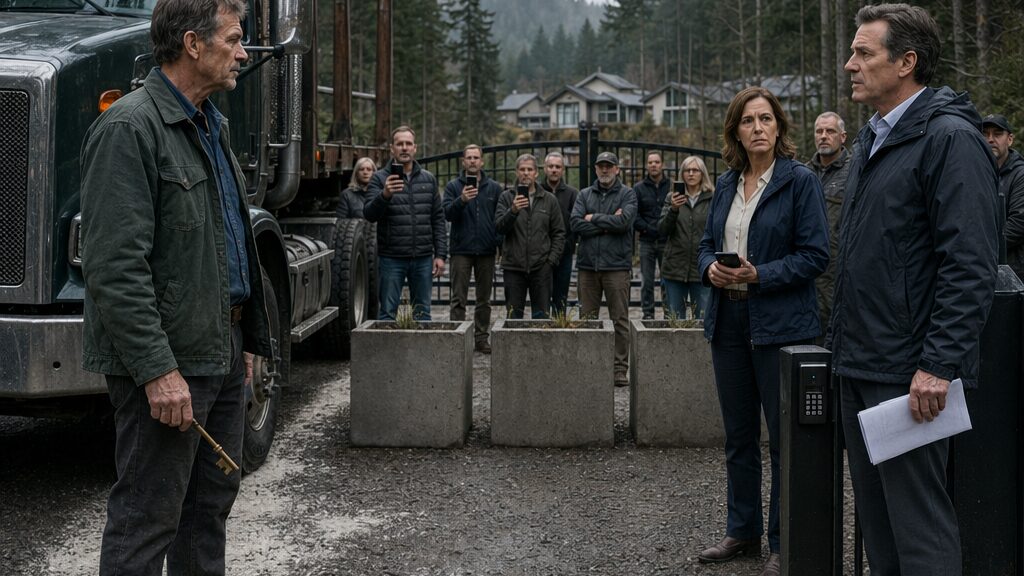
The Road They Blocked Had Carried Three Generations Home Before the HOA Arrived
Chapter 1: Three Concrete Planters Across the Only Road Home
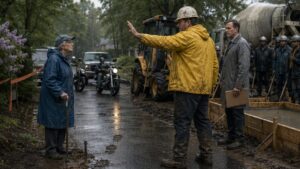
Jerry Miller saw the first concrete planter before the truck finished rounding the bend.
He lifted his boot from the accelerator and let the empty log trailer drag the rig down to a crawl. Two more planters came into view behind the first, gray blocks set shoulder to shoulder across the road. Fresh concrete dust lay pale against the dark gravel. Somebody had placed young cedar shrubs in the tops, as though greenery could make three tons of obstruction look neighborly.
Jerry stopped fifteen feet short of them.
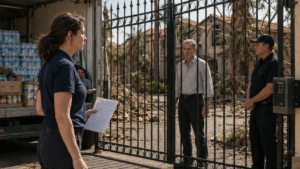
Beyond the barriers, Forest Ridge’s new electronic gate stood open. The black steel arms had been installed where the old timber gate once hung. Through the gap, the road climbed between newly built homes with steep roofs, broad windows, and porch lights still glowing in the morning shade.
A yellow school bus waited on the subdivision side.
Parents stood near the mail kiosk with children in bright jackets. Several had their phones raised before Jerry opened his door.
He shut off the engine.
The silence after the diesel stopped seemed to make the truck larger. Its empty stakes rose above the road like a cage. Jerry climbed down carefully, feeling grit shift beneath his boots.
Gregory Scott stepped from beside the gate keypad.
He wore a dark rain shell over a white shirt, though there was no rain. His hair looked recently combed. A folded sheet of paper rested in one hand.
“You need to turn around,” Gregory said.
Jerry looked at the planters, then at the road beyond them. “Who set these?”
“The association.”
“You ordered them.”
“The board authorized a traffic-control measure.”
Jerry walked to the nearest planter. A scrape along its base showed where it had been dragged into position. He took out his phone and photographed the block, the road edge, the gate, and the tire marks left by the flatbed that had delivered it.
A woman near the bus called, “He’s taking pictures of us.”
Jerry lowered the phone. “I’m taking pictures of the road.”
Gregory turned toward the residents. “Please document everything. Especially if he attempts an illegal entry.”
The words moved through the group with the quiet efficiency of a warning already rehearsed. More phones came up.
Jerry felt the heat rise behind his collar. He looked at the children instead of the adults. One boy had a backpack shaped like a dinosaur. A girl held her mother’s hand and watched the truck as if it might move by itself.
Jerry put his phone away.
“This is a recorded access road,” he said.
Gregory lifted the folded paper. “It is a private residential road governed by Forest Ridge.”
“It was here before Forest Ridge.”
“That doesn’t exempt commercial traffic from community rules.”
Jerry glanced at the school bus. Its driver had opened the door but had not yet pulled forward. “I’ve crossed during school hours for thirty years without touching a bus.”
“That was before there were thirty-two homes here.”
“There aren’t thirty-two homes.”
“There will be.”
The answer came too quickly. Jerry understood then that the conversation was not about what stood around them. Gregory was protecting a picture of what he had promised would stand there later.
Jerry moved toward the keypad. A small hook had been welded to the post beneath it, purely decorative. The old gate chain had once wrapped around the same cedar trunk six feet away. Jerry reached into his coat pocket and took out the brass key.
Its edges had softened from decades of use. His grandfather had carried it. His father had carried it. Jerry had kept it after the old gate was removed because throwing it away had felt too much like admitting the road belonged to somebody else.
He set the key on the narrow metal ledge beneath the keypad.
The brass looked dull beside the green electronic light.
“This opened the gate before your houses had foundations,” Jerry said.
A few phones tilted closer.
Gregory gave a small, tired smile. “That key doesn’t authorize a logging convoy through a residential development.”
Jerry kept his hand beside it. “County recording number seventy-one, book four-eighty-six, page two-fourteen.”
The smile left Gregory’s face.
Jerry continued, “Permanent right of access to the Miller timber tract, including equipment necessary for forestry and land maintenance.”
“You’re quoting your interpretation.”
“I’m quoting the part my father made me memorize.”
A murmur passed among the residents. Not support. Not yet. But uncertainty.
Gregory unfolded the paper. “Then you also remember the agreement you signed with me last spring.”
Jerry did not answer.
Gregory read aloud. “‘I will make every reasonable effort to reduce heavy commercial traffic through the future residential area and coordinate timber hauling with community safety needs.’ Your signature is at the bottom.”
The bus driver looked from Gregory to Jerry.
Jerry remembered the letter. Gregory had brought it to the farmhouse before the first home sold, speaking in the mild tone of a man asking for courtesy. No lawyer. No board. No language about surrendering rights. Jerry had signed because coordinating truck times had seemed like what a decent neighbor would do.
“I said I’d coordinate,” Jerry said. “I didn’t give up the road.”
“The board interprets regular logging traffic as inconsistent with that agreement.”
“The board wasn’t formed when I signed it.”
“The board inherited the commitments attached to this development.”
Jerry looked at the folded paper. “Did you show them the deed with it?”
Gregory’s eyes shifted, no more than a fraction, toward the residents.
That was enough.
A woman standing near the mailboxes lowered her phone. Jerry recognized her from one of the completed houses: Sandra Wilson, the HOA treasurer. She had once stopped him to ask whether logging trucks carried fire extinguishers. Her concern had been genuine, not hostile.
“What deed?” Sandra asked.
Gregory answered without turning. “A disputed historic document that does not override present safety obligations.”
Jerry picked up the brass key.
“The document isn’t disputed at the county.”
Gregory folded the paper again. “You can make that argument at the enforcement hearing.”
“What hearing?”
“Emergency session. Tomorrow evening.”
The contracting-company representative had called Jerry before dawn. The first load was expected by Wednesday. After that, the daily penalty began. The truck behind him was empty because the crew had planned to move equipment into the tract before cutting resumed.
Jerry could have told the residents all of that. He could have named the amount. He could have held up the contract and made Gregory’s planters look like what they were: a hand closing around his throat one day at a time.
Instead, he put the key back in his pocket.
“What happens if I move them?” he asked.
Gregory nodded toward the cameras. “The association will call the sheriff, assess property damage, and arrange towing.”
The school bus finally moved. Gregory stepped aside and gestured it through the gate. The children climbed aboard while Jerry stood beside a road his family had used before any of their parents had heard the name Forest Ridge.
When the bus pulled away, concrete dust lifted beneath its tires and settled across Jerry’s boots.
He climbed back into the cab and reversed the truck down the narrow grade.
Kathleen was waiting at the farmhouse when he returned. She stood beside her car with her arms folded, her work bag still over one shoulder. Jerry had called only to say the road was blocked. He had not mentioned the residents, the phones, or Gregory’s letter.
She climbed onto the running board before he had fully set the brake.
“What did Scott mean about something you signed?”
Jerry looked through the windshield at the empty road behind them.
Kathleen held up her phone. A resident’s video was already circulating. Gregory’s voice came through the speaker, clear and measured: regular logging traffic inconsistent with that agreement.
Her expression changed before the clip ended.
“I know that wording,” she said. “Dad, that came from the letter you refused to let me review.”
Chapter 2: The Letter Jerry Never Showed His Daughter
Kathleen laid the letter on the farmhouse table beside the first penalty notice.
The two pages did not belong together. One was a courteous, single-spaced promise on Gregory Scott’s development letterhead. The other was a formal warning from the timber buyer stating that delayed delivery would trigger charges beginning Wednesday morning.
Jerry remained standing.
“How much?” Kathleen asked.
He took off his cap and set it on the counter. “Eighteen hundred a day.”
She looked up. “You told me there was flexibility.”
“There was.”
“When?”
“Before the mill lost another supplier.”
Kathleen pressed one finger against the notice. “And when did you plan to mention that?”
“When I knew whether the road would stay blocked.”
“The road is blocked.”
“For one morning.”
“With three concrete planters.”
Jerry moved past her toward the office shed door. The brass key hung from a hook above the frame, though it no longer opened anything on the new gate. Kathleen watched him take a different key from his pocket.
The shed smelled of old paper, chain oil, and cedar dust. A steel filing cabinet stood against the back wall beneath shelves of fuel receipts and county tax maps.
Jerry unlocked the top drawer.
Kathleen came in behind him. “Where’s the easement?”
“In the Miller property file.”
He pulled the drawer open.
The folder labeled MILLER TRACT—ACCESS sat upright between insurance records and harvest reports. Jerry removed it, carried it to the desk, and opened it.
Inside were photocopies of tax statements, a hand-drawn road map, and a surveyor’s invoice from 1989.
The deed was gone.
Jerry checked the folder again, as though the paper might appear beneath thinner paper. Then he opened the drawer and ran his hand along the back.
Kathleen’s anger changed shape.
“When did you last see it?”
“Last winter.”
“Original or copy?”
“Certified copy. Original’s in the bank box.”
She exhaled. “Then we still have it.”
Jerry began opening adjacent folders.
“That’s not the point,” Kathleen said. “Someone had this file.”
“No one comes in here.”
“I come in here.”
“You don’t take records.”
“Gregory did.”
Jerry stopped.
Kathleen pointed toward the empty folder. “Last spring. You met him here, didn’t you?”
“He sat at the desk.”
“And you showed him the access papers.”
“I showed him the survey.”
“Did you leave him alone?”
“For five minutes.”
The silence in the shed grew dense.
Jerry remembered walking to the barn because Gregory had asked to see the width of the old gate hardware. When Jerry returned, Gregory had been standing by the window, the property folder closed on the desk.
“That doesn’t mean he took anything,” Jerry said.
“It means he saw enough to know exactly what the easement said.”
Jerry shut the drawer.
Kathleen picked up the letter from the table outside and brought it into the shed. “Read the last paragraph.”
“I know what it says.”
“Read it.”
He took the page.
The language was restrained. Jerry would make every reasonable effort to reduce heavy commercial traffic. He would coordinate hauling with school schedules and future community safety needs. Nothing in the letter amended or surrendered the recorded easement.
Kathleen tapped his signature. “Why didn’t you send this to me?”
“It wasn’t a contract.”
“You signed it.”
“It was neighbor business.”
“That phrase has cost you more money than lawyers ever have.”
Jerry folded the paper along its existing crease. “Gregory said families were worried about trucks. He asked for notice before heavy hauling. I thought that was fair.”
“It was fair. Hiding it wasn’t.”
“I wasn’t hiding it.”
“You put it in a locked shed and told me the development couldn’t touch our access.”
Jerry looked at the cabinet. “The letter was never recorded. It doesn’t change the deed.”
“Maybe not legally. But he’s using it to tell thirty homeowners you broke your word.”
Kathleen opened her laptop on the desk and pulled up the delivery schedule. Two equipment moves had already been missed. The first cutting crew was waiting. Fuel, wages, and insurance continued whether the road opened or not.
“The penalties are one problem,” she said. “The buyer can terminate after five days. Then we own a cut plan, a crew commitment, and no sale.”
“I know the contract.”
“Apparently I don’t know the operation.”
That landed harder than she intended. Jerry’s jaw tightened.
Kathleen had spent twelve years handling invoices, compliance forms, and mill contracts from an office in town. Jerry called when he needed a number, a signature, or someone to explain a clause. He did not call when he made promises.
His phone vibrated.
An email from Forest Ridge filled the screen.
EMERGENCY ENFORCEMENT HEARING—TUESDAY, 6:30 P.M.
The notice alleged unauthorized commercial use, safety violations, nuisance traffic, and threatened damage to association property. It warned that any attempt to enter before the hearing could result in towing charges and daily fines.
Kathleen read the final line twice.
“They’re fining you under HOA rules.”
“I’m not a member.”
“They’re claiming the easement subjects you to road-use regulations.”
Jerry gave a humorless breath. “They built houses around my road and decided I joined their club.”
Kathleen forwarded the notice to herself. “We need the certified deed, every historic hauling record, the old surveys, photographs, tax maps, and anything showing truck use after 1971.”
Jerry reached for the filing cabinet.
She stepped between him and it.
“No. We do this together.”
“I know where things are.”
“The main deed was missing from where you thought it was.”
His face hardened.
Kathleen regretted the sharpness but did not withdraw it. “You don’t get to protect me from this by keeping me uninformed.”
“I’m protecting the land.”
“You’re protecting the way you’ve always controlled it.”
The brass road key hung above them, catching a narrow line of afternoon light.
Jerry looked at it, then at the letter in his hand. “The original is at the bank. We’ll get it in the morning.”
It was not an apology. It was the nearest thing he could offer without breaking open whatever he had kept sealed for years.
Kathleen nodded once.
Her laptop chimed.
An email had arrived from Sandra Wilson.
There was no greeting, only a scanned attachment and one sentence: I’m the treasurer, and this was not in the packet we signed.
Kathleen opened the file.
The HOA purchase disclosure listed drainage obligations, private-road maintenance, wildfire evacuation limits, and restrictions on exterior lighting. Where the recorded easement should have appeared, the page jumped from one numbered section to the next.
Section twelve was missing.
A digital signature block at the bottom bore Sandra Wilson’s name.
Kathleen zoomed in on the document history. The file had been created months after Gregory sat alone in Jerry’s office shed.
She turned the screen toward her father.
“Dad,” she said, “I don’t think he hid the road from just you.”
Chapter 3: The Board Meeting Built Around Half the Truth
Jerry entered the Forest Ridge clubhouse beneath a twelve-foot image of his own truck.
The photograph had been projected onto the wall behind the board table. His rig filled the road from ditch to ditch, the perspective flattened so the cab appeared nearly as tall as the houses behind it. At the bottom of the image, the brass key rested beside the electronic keypad.
A caption read: UNAUTHORIZED COMMERCIAL ACCESS—MONDAY, 7:42 A.M.
Jerry stopped inside the doorway.
Kathleen touched his elbow. “Don’t react to the picture.”
“I’m looking at it.”
“That’s what they want.”
Nearly every chair was occupied. Parents sat together near the front. Two board members arranged papers beside Gregory Scott. Sandra Wilson sat at the far end of the table with a laptop open and a stack of closing documents beside her.
Gregory stood.
“Mr. Miller,” he said. “You may sit at the designated table.”
A folding table had been placed alone near the wall, facing the board. Jerry took the chair. Kathleen sat beside him without asking permission.
Gregory began with school-bus schedules, blind curves, emergency access, and road maintenance costs. He spoke in a careful tone, never raising his voice. Every concern was plausible on its own.
Then he showed a video clip of Jerry stepping from the truck.
The recording began after Jerry had shut off the engine and ended before Sandra asked about the deed. Gregory paused on the frame where Jerry placed the brass key below the keypad.
“This gesture,” Gregory said, “was understood by several residents as a declaration that historic personal use overrides current community safety.”
Jerry felt Kathleen shift beside him.
He kept his hands flat on the table.
Gregory continued. “No one is denying Mr. Miller reasonable access to his property. The question is whether a decades-old path intended for occasional land entry can be converted into an unrestricted industrial corridor through a residential neighborhood.”
Jerry raised one hand.
Gregory looked almost surprised. “You’ll have time to respond.”
“You just said no one is denying access.”
“That is correct.”
“There are three concrete planters across the road.”
“To prevent unauthorized heavy vehicles pending review.”
“So you’re denying access to the only vehicles I use to work the land.”
A few heads turned toward Gregory.
One of the board members leaned toward the microphone. “Personal vehicles may be accommodated by appointment.”
“My equipment won’t fit in a personal vehicle.”
Gregory placed a document beneath the projector.
Jerry’s signature appeared on the wall.
The room went still as Gregory read the traffic-reduction letter aloud. He emphasized reasonable effort, reduce heavy commercial traffic, and community safety needs. He did not read the sentence preserving Jerry’s recorded rights.
Kathleen whispered, “Half the page.”
Jerry nodded.
Gregory looked toward the residents. “Mr. Miller made this commitment before any of you purchased homes. Forest Ridge relied on it.”
Jerry stood.
“You relied on the whole letter?”
Gregory’s expression tightened. “Please remain seated.”
“Did buyers receive the whole letter?”
“This is not a discovery hearing.”
“Did they receive the deed?”
Several residents began speaking at once.
Sandra tapped her microphone. “I’d like that answered.”
Gregory turned to her. “The easement was considered legally ambiguous and therefore not included as a material commercial-access guarantee.”
Sandra lifted the scanned purchase packet. “Section twelve is missing from the signed disclosure sequence.”
“It was a drafting issue.”
“My digital signature is on a file I did not receive in that form.”
The room changed. Not dramatically. No one gasped. But phones lowered, and people began looking at their own folders instead of at Jerry.
Gregory sat down.
“The association’s counsel reviewed all disclosures,” he said.
“Then provide the review,” Sandra replied.
Jerry watched her. She did not look at him. This was not loyalty. It was fear sharpened into procedure.
A father in the second row stood. “We were told there would be no logging traffic.”
A woman beside him added, “Our child walks that road.”
Jerry faced them. “I can schedule around the bus.”
Gregory said, “You already promised to reduce traffic.”
“I did reduce it. I also asked for a meeting three months ago about this harvest.”
“You sent a proposed hauling calendar, not a request for approval.”
“Because I don’t need approval to use my own easement.”
The sentence came out harder than Jerry intended.
The room recoiled slightly. Gregory saw it.
“There,” he said. “That is the problem. Mr. Miller believes his private commercial interest supersedes every family living here.”
Jerry looked at the projected truck, the key, the keypad. Gregory had built the whole room around a single interpretation: old entitlement pressing against new homes.
Kathleen slid a document toward him. The penalty notice.
He did not pick it up.
Telling them about the money might make them understand the urgency. It might also confirm Gregory’s claim that profit mattered more than safety.
So Jerry said, “The road can be used safely. It has been used safely. Blocking it without reviewing the county record was not safety.”
Gregory produced a proposed resolution.
The board would authorize daily fines for unauthorized commercial use, towing of equipment left near the entrance, and reimbursement for any damage to association property. Pending legal review, all heavy access would remain suspended.
Sandra objected. One board member hesitated. The other voted with Gregory.
The resolution passed two to one, with Sandra opposed.
Gregory announced the result without satisfaction. His face looked drawn beneath the projector light.
Jerry understood then that Gregory was not enjoying the fight. He needed the board to ratify the story he had already sold.
A knock came at the clubhouse door.
Anthony Garcia entered carrying a county folder under one arm. He apologized for arriving late and declined the chair Gregory offered him.
“I’m here only to clarify the land record,” Anthony said.
The room quieted.
He placed a certified copy of the easement on the table. “The access right is valid, recorded, and runs with the land. Forest Ridge acquired its parcels subject to it.”
Jerry heard several residents breathe out.
Gregory folded his hands. “And does it authorize unlimited modern commercial logging?”
Anthony did not answer immediately.
He opened the deed to a marked paragraph. “The instrument grants access for forestry, maintenance, and removal of timber products. That supports Mr. Miller’s position.”
Jerry felt the tension leave his shoulders.
Then Anthony turned another page.
“However, the original language references customary equipment and reasonable use as understood at the time of recording. The association has raised a legitimate question about volume, timing, and modern vehicle scale. Mr. Miller’s later traffic letter may also be relevant to what a court considers reasonable coordination.”
The relief vanished.
Kathleen leaned toward him. “So what does that mean?”
“It means the easement exists,” Anthony said. “It does not mean either side gets everything it claims.”
Gregory’s posture straightened.
Anthony closed the folder. “Until we verify historic commercial use and the recorded survey dimensions, I’m recommending no forced removal tonight. I’m also recommending the association refrain from adding further obstructions.”
Jerry looked at Gregory.
Gregory looked back without blinking.
The road was his. The county had said so. Yet the concrete remained, the penalties had begun, and the letter Jerry once signed as a courtesy now stood between him and the only access his family had ever used.
Anthony drew a yellow tab from the folder.
“There is one more issue,” he said. “The easement is valid. What remains unclear is whether Mr. Miller’s present operation falls within the scale of use the document protects.”
Chapter 4: The Promise That Outlived the Man Who Made It
The county map showed Forest Ridge built directly over the old timber route.
Anthony Garcia spread the oversized sheet across a records-room table and pinned the corners with two metal rulers. Pale subdivision lines crossed the page in clean rectangles. Beneath them, drawn in faded black ink, the Miller road curved through the same ground like a buried root.
Jerry leaned over it.
“That line was surveyed in seventy-one?” he asked.
“Recorded then,” Anthony said. “Survey may be older.”
Kathleen stood on the opposite side of the table with the certified easement, Gregory’s traffic letter, and three decades of hauling records arranged in separate stacks. Since the board meeting, she had spoken to Jerry only about documents, times, and deadlines.
Anthony traced the black route with a capped pen. “The subdivision road didn’t replace your access. It was built on top of it.”
Jerry looked through the records-room window toward the courthouse parking lot. “Then there shouldn’t be a question.”
“There’s always a question when the paper says ‘reasonable use.’”
Anthony opened a ledger copied from the county archive. The pages contained road-maintenance assessments, timber tax entries, and equipment permits. Most were handwritten. One entry from 1978 listed two loaded log trucks per day during a six-week harvest. Another from 1996 documented culvert reinforcement for “commercial timber-haul traffic.”
Kathleen turned the ledger toward Jerry. “That’s modern equipment.”
“Modern for ninety-six,” Anthony said. “But it helps.”
Jerry tapped the culvert entry. “Same axle class we use now.”
“Similar. Not identical.”
“You keep saying almost.”
“I keep saying what I can defend.”
Anthony’s caution irritated Jerry because it resembled hesitation, and hesitation was expensive. By noon, another penalty would attach to the contract. His crew had already been reassigned to maintenance work that did not require access to the upper tract.
Kathleen slid a survey toward Anthony. “What about width?”
The survey showed a sixty-foot corridor at the old gate, narrowing to thirty feet through the timber. A notation beside the road read: ACCESS FOR FORESTRY OPERATIONS, EQUIPMENT, AND REMOVAL OF TIMBER PRODUCTS.
Anthony read it twice.
“Recorded?” he asked.
Kathleen pointed to the stamp.
Anthony checked the index number on his computer. His expression changed as the file opened.
“This was attached to a boundary adjustment in eighty-four,” he said. “The language is part of the public record.”
Jerry felt something inside him loosen.
“Does that answer your scale question?”
“It answers the purpose question strongly.” Anthony printed the indexed page. “It still allows reasonable safety regulation, but not total obstruction.”
Kathleen sat back. “So the planters come out.”
Anthony did not answer.
A county clerk appeared in the doorway holding a freshly received notice. “This came from the sheriff’s office.”
Anthony read it, then placed it on the map.
Forest Ridge had requested a temporary safety restriction during school-bus hours. The application included photographs of Jerry’s truck occupying the full road width, a letter from the bus contractor, and Gregory’s claim that heavy vehicles created an immediate hazard.
“They filed this before the board meeting ended,” Kathleen said.
Anthony nodded. “The sheriff can restrict movement during specific windows while we review traffic management.”
“Not block the road all day,” Jerry said.
“No. But if the barriers are the only current method of enforcement, the county may leave them temporarily while allowing scheduled access under supervision.”
Jerry stared at the subdivision plan. Houses had been drawn around his road, sold around his road, insured around his road. Now the road itself was being treated as the intruder.
“How long?” he asked.
“Forty-eight hours, likely. Maybe less.”
“The contract doesn’t care about likely.”
Anthony lowered his voice. “Mr. Miller, if you move those barriers yourself, you turn a strong access claim into a damage dispute. Don’t give Gregory that.”
Jerry gathered the records without answering.
At the old timber gate that afternoon, he left the pickup on the county side of Forest Ridge and walked the final quarter mile along the ditch. The concrete planters remained across the main road. Someone had wrapped reflective tape around them. The young cedar shrubs trembled in the wind from passing cars.
Beyond the subdivision, the newer electronic gate gave way to the remnants of the original line: two cedar posts, a rusted chain, and a narrow metal gate Jerry still used to secure the upper tract.
He took the brass key from his pocket.
It entered the old padlock with resistance. He turned it slowly until the mechanism gave a dry click.
The sound carried him backward.
His father had been lying in a hospital bed set up in the farmhouse living room, too weak to climb the stairs. His hands had still been broad and scarred, but they no longer closed fully around anything.
“Don’t let them close that road,” he had told Jerry.
At the time, “them” had meant no one in particular. Future buyers. County planners. People who might look at a map and mistake an old route for unused ground.
Jerry had promised.
He had been forty-two, frightened, and eager to give a dying man one answer that did not change.
Now he pushed open the rusted gate and stood looking up the road toward the timber.
Kathleen approached from behind. Gravel shifted beneath her boots.
“You found the old survey,” Jerry said.
“We found it.”
He looked at her.
She held up her phone. “I also found an email chain from a land broker.”
Jerry closed the gate halfway.
Kathleen’s voice remained controlled. “You’ve been negotiating to sell the upper tract for six months.”
“It wasn’t final.”
“The proposal says selective harvest rights, conservation easement, and transfer after this season.”
“I said it wasn’t final.”
“You were going to tell me after you signed?”
Jerry looked at the brass key in his hand.
Kathleen stepped closer. “You’re fighting like this road has to carry our family forever. But you’ve already decided to sell what’s at the other end.”
“It isn’t that simple.”
“No. It’s worse. You let me believe we were saving the operation.”
“We are saving access.”
“For whom?”
He could have told her about the debt then. About the equipment note, the shrinking margins, the months he had spent calculating how long the land could carry the business without taking her down with it.
Instead he said, “The road stays with the land.”
Kathleen’s face tightened. “That’s not an answer.”
Jerry locked the old gate again. The key resisted before turning.
When he faced her, she held the broker’s email open on her screen.
“You promised Grandpa you would never let the road close,” she said. “Did you also promise him you would never let anyone else decide what the land became?”
Chapter 5: The Sale Jerry Called a Betrayal
Kathleen placed the unsigned sale proposal beside her grandfather’s photograph.
The picture had been taken at the old gate before the chain rusted and before Forest Ridge had a name. Her grandfather stood with one boot on the lower rail, smiling in a way Kathleen remembered only from photographs. Beside him, twelve-year-old Jerry held the brass key on a piece of twine around his neck.
Jerry entered the kitchen and stopped when he saw the papers.
“You went through my desk,” he said.
“I followed the email attachment.”
“That proposal is private.”
“So was the traffic letter. So was the contract penalty. So was the fact that the business is failing.”
He took off his coat but did not sit.
Kathleen opened the proposal to the financial page. “You’d sell the upper tract to a conservation partnership. They’d keep selective harvest, close two spur roads, and retain the main easement.”
“That’s the idea.”
“And you’d keep the farmhouse and lower acreage.”
“If they accept the boundary.”
“That sounds less like betrayal than bankruptcy prevention.”
Jerry’s eyes moved to the photograph.
“You didn’t know him at the end,” he said.
“I knew him enough.”
“No. You knew the version who let you sit on the tractor and gave you peppermint candy. You didn’t know the man watching the bank take neighboring farms one by one.”
Kathleen waited.
Jerry sat at last. He looked older in the kitchen light than he had at the board meeting.
“The equipment note resets next spring,” he said. “Insurance went up again. The last two harvests covered wages and fuel, but not enough principal. If the mill contract fails, we carry the cutting costs into winter.”
“How much debt?”
He gave her the number.
Kathleen stared at him. It was not catastrophic by corporate standards. For their operation, it was enough to consume the lower acreage if another season went wrong.
“You let me manage the accounts without seeing the full loan schedule.”
“I kept the land debt separate.”
“Why?”
“So it stayed mine.”
The answer struck her as cruel until she saw that he meant burden, not ownership.
Jerry rubbed his thumb over a nick in the table. “Your job is stable. Your house is paid down. You built something away from this place.”
“You think I did that because I wanted away from you?”
“I think you did it because you were smart.”
“And you decided smart meant excluded.”
He did not deny it.
Kathleen looked at the proposal again. “You weren’t blocking me from inheriting the land.”
“I was blocking you from inheriting the debt.”
The anger she had carried since Monday did not disappear. It shifted. Beneath it was a sharper grief: Jerry had mistaken loneliness for protection and called it responsibility.
“What happens if the sale closes?” she asked.
“The partnership keeps the main road open for forest management. Limited harvest every few years. No clear-cutting. Public access stays closed.”
“And the mill contract?”
“Last full contract under my company.”
Kathleen turned to the page describing the retained easement. “Then Gregory’s blockade threatens the sale too.”
“Yes.”
“Why didn’t you say that at the meeting?”
“Because I wasn’t going to stand in front of those people and explain that I couldn’t hold the operation together.”
“You stood there while he explained you to them instead.”
Jerry flinched almost imperceptibly.
The brass key lay on the counter where he had dropped it after returning from the old gate. Kathleen picked it up. The metal was warmer than she expected.
“You keep treating this like it opens one thing,” she said. “It doesn’t. The new owner needs access. Fire crews need access. Maintenance crews need access. The residents need a road plan they can trust.”
“The easement already gives that.”
“The easement gives a right. It doesn’t give a relationship.”
Jerry looked at her.
Kathleen pulled a legal pad closer. “Retain the easement. Record a traffic schedule. No hauling during the school-bus windows. Pilot vehicle on the blind curve. Contribution to road maintenance based on axle use. Advance notice for harvest weeks.”
“That lets the HOA regulate us.”
“It lets us define reasonable use before Gregory defines it for us.”
“The county can order the barriers removed.”
“And then what? You send six trucks through at seven-thirty because you won?”
Jerry’s jaw tightened.
Kathleen softened her voice. “You told me Grandpa made you promise not to let the road close. He didn’t make you promise never to change how it was used.”
For a long moment, the only sound was the refrigerator motor and the faint tick of cooling pipes.
Jerry reached for the key. He removed it from the ring that held his house key, fuel key, and truck ignition.
The small brass piece sat alone in his palm.
“I carried this the day he died,” he said.
Kathleen did not answer.
“He asked for it. Couldn’t close his hand around it. Told me to keep it moving.”
“Maybe he meant the road.”
“That’s what I thought.”
“Maybe he meant the responsibility.”
Jerry set the key between the sale proposal and the photograph.
His phone rang.
Sandra Wilson’s name appeared on the screen.
Kathleen answered on speaker.
“I found the certification,” Sandra said without greeting. Her voice was tight. “The original version.”
“Certification for what?” Kathleen asked.
“Disclosure review. Gregory submitted it to the lender and the title company. It says the HOA treasurer verified the purchase packet contained all recorded access burdens.”
Jerry leaned toward the phone. “Did you sign it?”
“I signed a different version. The one I saw did not include that statement.”
Kathleen looked at Jerry. “Your digital signature?”
“Copied from the annual budget approval.”
Silence followed.
Sandra continued, “If I report this, buyers may have claims against the association. Property values could drop. The lender could freeze the remaining construction.”
“Then why report it?” Jerry asked.
“Because if I don’t, Gregory can say the board knew.”
Her answer held no admiration for him. Only fear, anger, and the hard edge of someone realizing rules had been used against her.
“What are you going to do?” Kathleen asked.
“I’ve requested an emergency board vote for tomorrow morning. Before the county crane arrives.”
Jerry glanced at the brass key.
Sandra lowered her voice. “Gregory is trying to move another barrier in tonight. If he gets it placed before the vote, he thinks the board will be too afraid to reverse course.”
Kathleen closed the sale proposal.
Sandra said, “I’m sending you the certification now. Be ready to explain what you’re willing to accept if we remove him.”
The call ended.
A moment later, the document arrived.
Sandra’s signature appeared at the bottom of a statement she had never seen.
Jerry read it, then looked at the key lying beside his father’s photograph.
For the first time, opening the road no longer seemed like the hardest choice before him.
Chapter 6: The President Who Could Not Admit the Road Existed
Sandra found the missing disclosure page in a locked drawer beneath a stack of model-home brochures.
The HOA records room occupied a small office behind Gregory’s showcase kitchen. Through the open doorway, soft music played beside a gas fireplace that no buyer had ever used. A decorative brass key hung on the wall beneath a wooden sign reading WELCOME HOME.
Sandra held the recovered page under the desk lamp.
Section twelve described the Miller easement in plain language: permanent forestry access, recorded commercial use, obligation binding future owners. A handwritten note in the margin read, Remove from buyer packet pending lender review.
Gregory stood in the doorway.
“You shouldn’t be in that drawer,” he said.
Sandra turned the page toward him. “You shouldn’t have had this page removed.”
He closed the door behind him. “I told you the easement was under legal review.”
“You told me it was obsolete.”
“It may be limited.”
“That’s not what this says.”
Gregory walked to the desk but did not touch the document. His face looked gray beneath the recessed lights.
“You think I wanted this?” he asked.
“I think you signed my name to a certification.”
“The certification had to be filed before the funding deadline.”
“With my signature.”
“You had already approved the disclosure process.”
“I approved the packet I saw.”
Gregory glanced toward the model home. “If the lender had seen unrestricted logging access through the center of the project, they would have paused the final draw.”
“Then buyers should have known why.”
“Buyers don’t purchase legal ambiguity. They purchase confidence.”
Sandra folded her arms. “They purchased houses next to a road you pretended did not exist.”
His restraint cracked.
“You live here because I made this place possible.”
“I live here because I paid for a house.”
“And twenty families have equity because I kept the project moving. Contractors were owed money. Roads had to be paved. Fire systems had to be installed. One delayed loan draw would have left half the subdivision exposed dirt and foundations.”
Sandra looked at the missing page.
For the first time, she understood the shape of his fear. Gregory had not hidden the easement because he misunderstood it. He had hidden it because admitting it threatened everything he had promised.
That made the choice more comprehensible.
It did not make it smaller.
“What happens now?” she asked.
“If you force a board vote, the lender may review every closing. Owners may sue the association. Prices drop. Construction stops.”
“And if I don’t?”
“We negotiate with Miller after this harvest season.”
“You blocked him during this harvest season.”
“He arrived with a full-sized logging rig during a school-bus window.”
“After you refused his hauling calendar.”
Gregory’s eyes hardened. “He knew what he was doing.”
“So did you.”
A truck engine sounded outside.
Sandra moved to the front window.
A flatbed had stopped near the subdivision entrance. On it sat a fourth concrete planter, larger than the others and empty except for a mound of dark soil.
“No,” Sandra said.
Gregory joined her. “The board authorized traffic control.”
“The county told you not to add obstructions.”
“The recommendation was not an order.”
“You’re installing it before the vote.”
“I’m securing the entrance before someone creates a dangerous situation.”
“You’re creating a fact you think we’ll be afraid to reverse.”
Gregory did not answer.
The flatbed driver lowered the hydraulic ramps.
Sandra took out her phone and photographed the truck, the planter, and Gregory standing beside the window. Then she opened the board email and attached the missing disclosure page.
Gregory reached for the phone but stopped before touching her.
“If you send that,” he said, “you could wipe out your own home value.”
“My home value is already attached to your lie.”
“Not a lie. A disputed risk.”
“You removed the page.”
His shoulders dropped slightly.
“I needed six months,” he said. “Six months to finish the last phase, build the alternate service road, and move Miller’s access away from the homes.”
“Did Jerry agree?”
“He would have once the road existed.”
“You planned to replace his right without telling him.”
“I planned to give everyone something better.”
Sandra looked at the decorative key on the wall. It had never opened a lock. It was polished, oversized, and made for photographs at closings.
“You keep calling things better when you mean easier to sell.”
Gregory turned away from her. “You think Miller is protecting tradition? He’s preparing to sell that tract. I saw the broker’s inquiry months ago.”
Sandra absorbed that. “So you knew.”
“I knew he wasn’t the permanent victim he pretended to be.”
“He never told us he was permanent. You did.”
The planter began sliding down the flatbed ramps.
Sandra sent the email.
Her phone confirmed delivery to the board, Anthony Garcia, the county clerk, and every homeowner on the association list.
Gregory stared at the screen.
“You just put thirty-two households at risk.”
“No,” Sandra said. “I documented who did.”
Outside, the driver positioned the fourth planter across the remaining narrow gap.
Sandra walked past Gregory and out of the model home.
By late afternoon, residents had gathered near the entrance again. This time fewer phones were aimed toward the county road. Most people were reading the missing disclosure page on their screens.
A sheriff’s deputy parked beside the mail kiosk. Anthony arrived ten minutes later and spoke with the flatbed driver. The planter remained, but the delivery truck left.
Gregory stayed near the gate, answering no one.
Then an engine sounded from the curve below.
Jerry’s pickup appeared without the logging trailer.
He drove slowly toward the barriers and stopped on the county side. Kathleen sat beside him. In the truck bed lay a rolled survey map, a folding table, traffic cones, and a thick stack of paper clipped into separate packets.
No chains. No cutting tools. No crew.
Jerry stepped out carrying the brass key in one hand and the packets in the other.
Gregory watched him approach.
Sandra did too.
Everyone had expected Jerry to bring proof, machinery, or anger strong enough to force the road open.
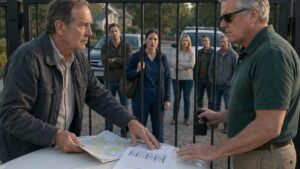
Instead, he unfolded the table in front of the fourth barrier and began setting out copies for every homeowner.
Chapter 7: The Road Opened Because Jerry Refused an Easy Victory
The county crane was already idling beside the fourth barrier when Jerry unfolded the last packet.
Its steel cable hung motionless over the concrete, the hook turning slightly in the morning air. A sheriff’s deputy stood near the control truck. Anthony Garcia spoke with the crane operator while residents gathered on both sides of the gate.
Jerry placed a paperweight on the stack and looked at the people who had filmed him four days earlier.
“This is not a surrender of the easement,” he said.
Gregory Scott stood near the keypad with his arms folded. “Then what is it?”
“A recorded use agreement.”
Gregory’s gaze moved to the packets. “Drafted by whom?”
“Me, Kathleen, and a land-use attorney who reviewed the county record last night.”
“You expect the association to accept a legal document at the side of the road?”
“I expected the road to be open.”
Sandra Wilson took the first packet.
The cover page showed a map of the existing easement. Beneath it were proposed hauling windows, school-bus exclusions, advance-notice requirements, pilot-vehicle procedures for the blind curve, and a road-maintenance formula based on heavy axle use. A final section required every future property disclosure to identify the easement plainly.
One of the residents read the schedule aloud.
“No trucks from seven to eight-thirty,” he said. “And two-thirty to four?”
“School days,” Kathleen replied. “Emergency access always has priority.”
A woman near the mail kiosk looked toward Jerry’s pickup. “How many trucks during harvest?”
“Four loaded trips on the heaviest days,” Jerry said. “Usually fewer.”
Gregory gave a short laugh. “That is not a compromise. That is commercial traffic with better paperwork.”
Jerry took the brass key from his pocket.
He did not raise it. He held it at his side.
“The county can remove these barriers today,” he said. “The sheriff can keep the road clear while the legal issue proceeds. If that happens, I use the easement as recorded and let a judge decide what reasonable means.”
Anthony looked at him. “That remains an available path.”
Jerry nodded. “I know.”
The residents shifted. The crane’s diesel engine filled the gaps between voices.
Jerry continued. “But if I use the road without rules we all understand, Gregory will be gone and the problem will still be here. The bus will still run. The curve will still be narrow. My trucks will still be bigger than they were in 1971.”
Gregory’s face changed at the words Gregory will be gone.
Sandra opened her laptop on the folding table. “The emergency board meeting is now in session.”
One board member stood beside her. The other remained near Gregory but did not meet his eyes.
Sandra read the motion: remove Gregory as president for withholding recorded property information, using the treasurer’s signature without authorization, and ordering additional obstruction after county notice. A second motion would authorize negotiation and conditional approval of Jerry’s access covenant.
Gregory stepped forward.
“You cannot hold a legitimate meeting out here.”
“The bylaws allow emergency sessions at any association property,” Sandra said. “You used that provision Tuesday.”
“This is retaliation.”
“It is governance.”
Gregory turned toward the residents. “Before you vote, understand what this does. The lender may freeze the final phase. Buyers may demand compensation. Every home here could lose value because she wants to make an example of me.”
No one answered immediately.
The fear in his voice was real now. It no longer sounded like polished concern delivered from a board table. It sounded like a man watching a structure he had held upright by concealing one damaged support.
Jerry understood the temptation to let him fall.
Gregory had blocked the road, distorted the letter, hidden the easement, and invited a neighborhood to see Jerry as a threat. The crane waited. The county had the survey. Sandra had the missing disclosure page.
Jerry could have said nothing.
Instead he stepped beside the table.
“The covenant includes a six-month transition,” he said. “No claim against homeowners who bought without disclosure, provided the corrected record is filed and the road is reopened today.”
Kathleen looked at him, surprised.
Gregory stared. “You cannot waive claims for everyone.”
“I can state what I will not pursue.”
Sandra read the clause. “He’s limiting recovery to actual road costs and contract losses caused after written notice.”
A resident asked, “What about the lender?”
“The recorded covenant gives them a defined risk instead of an unknown one,” Kathleen said. “That may help more than pretending the easement can disappear.”
Gregory shook his head. “You are trusting a timber operator to control the legal exposure of a residential project.”
Jerry looked directly at him. “No. I’m giving the board a chance to control what you refused to admit.”
For the first time that week, Gregory had no prepared answer.
Sandra called the first vote.
She voted yes. The board member beside her voted yes. The second board member looked toward Gregory, then at the fourth planter and the county crane.
“Yes,” he said quietly.
Gregory was removed as president.
No one applauded.
The absence of celebration made the decision heavier. Gregory stood in the same place, but the authority had left him.
Sandra moved to the access covenant.
Before she could call the vote, Gregory reached for the packet. He read the disclosure clause, the hauling schedule, and the maintenance payments.
“This makes the easement permanent in every sales file,” he said.
“It already is permanent,” Anthony replied.
Gregory turned to Jerry. “Withdraw it. Let the county order limited access. We can negotiate privately after the construction loan closes.”
Jerry slid the brass key onto the table.
“No more private letters.”
Gregory’s eyes settled on the key.
“You think this makes you reasonable?” he asked. “You could destroy the value of these homes and still claim the deed permits it.”
Jerry felt the old answer rise in him: The road was here first.
It was true. It was also no longer enough.
“I could use every inch the deed gives me,” he said. “And you could make every use a fight. That leaves the road open and everyone trapped.”
Sandra called the second vote.
All three board members approved conditional acceptance of the covenant, subject to Anthony’s final language and recording.
Gregory stepped away from the table. “I’ll challenge it personally.”
“You can,” Jerry said.
The crane operator climbed into the cab.
Anthony approached Jerry. “Once removal begins, access is restored under the temporary county order. Are you ready to move your equipment through?”
Jerry looked at the gathered residents. Beyond them, the school bus turned onto the lower county road, still several minutes from its morning stop.
“Not yet,” he said.
Anthony frowned. “Why?”
Jerry pointed to the proposed schedule. “Bus window starts in three minutes.”
The crane cable tightened.
The fourth planter rose first, soil spilling from its top in dark clumps. Concrete dust lifted from the gravel and settled over Jerry’s boots. The other barriers followed one by one, swinging slowly toward the flatbed.
When the final planter cleared the road, the open lane seemed narrower than Jerry remembered.
He picked up the brass key and placed it in Kathleen’s hand.
She closed her fingers around it.
“Hold it,” he said.
“For how long?”
“Until we decide what it opens next.”
The school bus passed through the unobstructed gate. Jerry stood beside his parked pickup and waited.
Only after the children were gone did Anthony gesture toward the road.
Jerry climbed into the driver’s seat, but he did not start the engine.
Kathleen opened the passenger door.
“You’re not taking the truck through?”
“Not this morning.”
“Then why bring it?”
He looked at the rolled survey, the traffic cones, and the signed packets in the bed.
“To bring the road through first.”
Chapter 8: The Key Belonged to the Person Willing to Share the Road
Six weeks later, the first permitted logging truck stopped voluntarily for the school bus.
The driver pulled onto the marked turnout fifty yards below the Forest Ridge gate and shut off the engine. A magnetic sign on the cab displayed the Miller operation’s contact number. Two orange cones marked the blind curve, and a pilot vehicle waited on the subdivision side.
The bus passed without slowing.
Jerry watched from the passenger seat of Kathleen’s pickup.
“You’re checking his timing,” she said.
“I’m observing.”
“You’ve observed three runs this week.”
“First week sets the habit.”
Kathleen smiled but kept her eyes on the road.
The recorded covenant had taken twelve days to finalize. Anthony removed language that might have allowed the HOA to suspend access unilaterally. Kathleen added a notice procedure for harvest periods. Sandra insisted the road-maintenance account be audited separately from general HOA funds.
The agreement did not satisfy everyone.
Two homeowners had demanded barriers that could be opened remotely during scheduled hauling. Jerry refused anything capable of becoming a blockade again. A compromise produced warning lights and removable cones instead.
The timber contract survived, though the mill deducted delay costs. Jerry submitted a claim against Gregory for the losses after written notice. The matter had not been resolved, and Jerry no longer expected a clean resolution.
Ahead of them, the truck restarted after the bus cleared the lower bend.
Kathleen waited until it entered the gate. “You know the crew can handle this without you.”
“I know.”
“Then why are we here?”
Jerry looked at the brass key hanging from the ignition. It no longer belonged on his ring, but Kathleen had attached it to hers.
“Because the partnership representative comes at ten.”
The conservation agreement lay signed in a folder behind the seat. The upper tract would remain privately managed, with selective harvest every several years, stream buffers widened, and two eroded spur roads closed. The main easement would remain active for forestry, fire access, and maintenance.
Jerry had expected signing the papers to feel like giving something away.
Instead, the hardest moment had been telling his crew that the current contract would be the company’s last full commercial harvest. No one had argued. The logging-truck driver had only asked whether there would still be maintenance work next year.
There would.
Less of it. Different work. Enough to keep a smaller operation alive without carrying the same debt.
Kathleen parked near the old timber gate.
The rusted chain had been removed. In its place stood a simple steel latch approved by the partnership and the county fire marshal. The electronic subdivision gate remained farther down the road, but the old posts still marked the entrance to the Miller tract.
Jerry climbed out.
On the other side of the road, residents had installed a small sign listing hauling windows and emergency contacts. No slogans. No decorative language. Just rules everyone could read.
Sandra arrived carrying an envelope and a road-account ledger.
“The first maintenance payment cleared,” she said. “And the board approved resurfacing the turnout before winter.”
Jerry nodded. “Good.”
Sandra handed Kathleen the ledger. “You’re still willing to review the invoices?”
Kathleen looked at Jerry before answering.
He said, “She doesn’t need my permission.”
Sandra noticed the shift but did not comment.
A dark vehicle stopped near the gate.
Gregory stepped out alone.
He no longer wore the polished rain shell or carried a board folder. He held a set of corrected disclosure documents in a plain manila envelope.
Sandra’s posture stiffened. “You could have mailed those.”
“My attorney advised personal delivery.”
Jerry almost smiled. “That sounds expensive.”
Gregory looked at him. “It is.”
They met beside the gate.
The corrected documents acknowledged the recorded easement, the access covenant, the unresolved loss claim, and the HOA’s duty to disclose all of them to future buyers. Gregory had signed each page as developer.
He handed the envelope to Sandra.
“I am not admitting fraud,” he said.
Sandra checked the signatures. “You are correcting the record.”
“I am complying with the settlement framework.”
Jerry heard the familiar instinct in Gregory’s wording: reduce responsibility to the smallest defensible phrase.
Six weeks earlier, that would have angered him.
Now he asked, “Is the lender still funding the last phase?”
Gregory hesitated. “At a reduced draw. Two buyers withdrew.”
“I’m sorry for the contractors.”
Gregory studied him, uncertain whether the sympathy was an insult.
“It would have been easier if you had agreed to move the easement,” he said.
“Easier for you.”
“For everyone.”
Jerry glanced toward the truck disappearing into the timber. “People say everyone when they mean the people in the room.”
Gregory looked down the road. “Your agreement is workable.”
It was not an apology. It was more than Jerry expected.
“You should have told them the road existed,” Jerry said.
“I know.”
The words came quietly.
Gregory returned to his vehicle without offering his hand. Jerry did not offer his.
Sandra carried the corrected disclosures back toward Forest Ridge.
Kathleen waited until they were alone.
“That was almost human,” she said.
“From both of us?”
“Mostly.”
The partnership representative arrived shortly before ten, and the final boundary papers were signed on the hood of Kathleen’s pickup. Jerry retained the farmhouse, lower acreage, and a smaller management contract. The upper tract passed into the partnership at the end of the season.
When the representative left, Jerry stood before the old gate.
Kathleen took the brass key from the ignition ring.
“It doesn’t open this latch,” she said.
“No.”
“It doesn’t open the electronic gate either.”
“No.”
She turned it over in her palm. “So why keep it?”
Jerry looked toward the road, where fresh gravel covered the places the concrete planters had scarred. The dust had washed from his boots weeks ago, but faint pale marks remained in the tread.
“My father thought a key meant keeping people out unless they belonged,” he said. “I thought it meant never letting go.”
Kathleen waited.
Jerry nodded toward the gate. “You use it to remember there’s something on both sides.”
She stepped to the latch and opened it.
Jerry moved toward the driver’s side of the pickup, then stopped.
“You drive,” he said.
Kathleen raised an eyebrow. “You trust me with the road now?”
“I trust you to tell me when I’m using it wrong.”
She slid behind the wheel.
Jerry took the passenger seat.
As they entered the timber tract, Kathleen hung the brass key from the rearview mirror. It turned slowly with the movement of the truck, catching light through the windshield.
Behind them, the gate remained open long enough for the next vehicle to follow.
Then Kathleen stopped, walked back, and closed it—not to erase