She Painted a Parking Line Across His Driveway, but the Survey Exposed Everyone’s Mistake
Chapter 1: The White Line Waiting Across His Driveway
Jason Harris stopped with his front tire inches from a stripe of wet white paint.
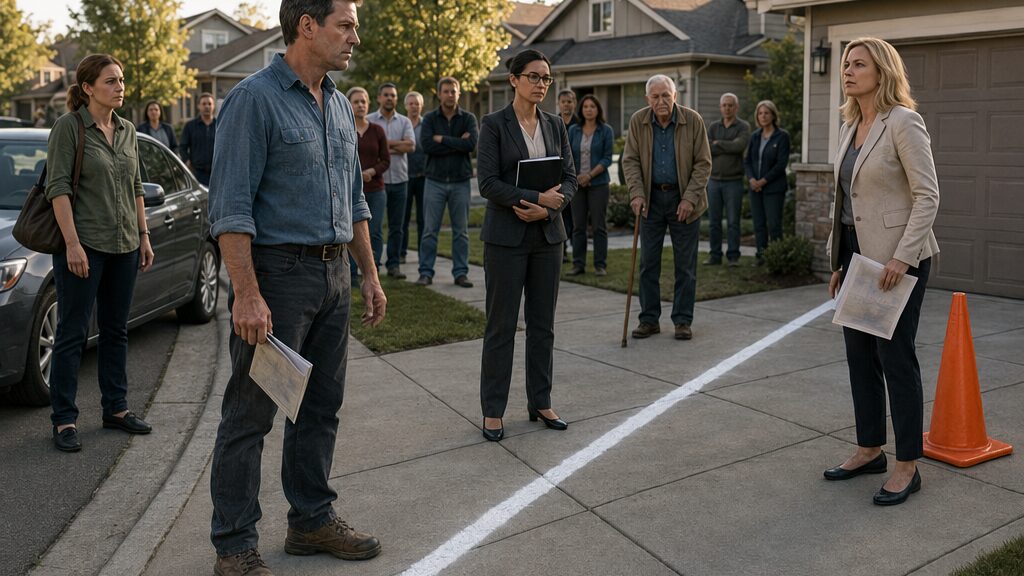
The line crossed the full width of his driveway, thick as the markings in a commercial parking lot and bright against the gray concrete. A plastic paint tray sat on the grass near the curb. The roller resting inside it still glistened.
Jason kept his foot on the brake.
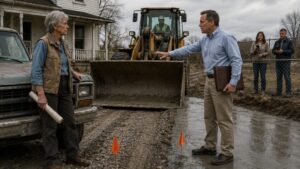
Karen Wilson stood beside his mailbox with her arms folded. She wore gardening gloves and the expression of someone waiting for a late delivery rather than a man returning home to find his property altered.
He lowered the driver’s window.
“What is that?”
“The new parking limit.”
Her answer came too quickly.
Jason looked from Karen to the paint. The line began near the narrow strip of grass between their properties, crossed his driveway at a slight angle, and continued toward Susan Adams’s house on the other side.
He eased the truck into reverse and parked along the curb.
Karen watched him climb out. “You can pull in. Just keep the vehicle behind the line.”
“The paint is wet.”
“It’ll dry.”
Jason shut the truck door more carefully than necessary. He had spent nine hours correcting drainage drawings for a municipal project because a contractor had built from an outdated revision. He knew what one wrong line could cost. He also knew the difference between a suggestion, a field mark, and an enforceable boundary.
“Who approved this?” he asked.
“The parking committee.”
“There is no parking committee.”
“There is now.”
Karen’s chin rose slightly.
Jason glanced again at the roller. “Who decided where the line went?”
“I did.”
The words sat between them.
Across the street, a neighbor slowed while bringing in a trash bin. A curtain shifted in the house beside Karen’s. Nothing in the neighborhood remained private for long, but most disputes still began with lowered voices and carefully worded emails.
Jason stepped toward the line and crouched without touching it. The paint was exterior traffic coating, not the washable marking spray contractors used for temporary layouts.
“You painted my driveway.”
“I marked the limit the board circulated.”
“Did the board tell you to paint it?”
“They told me the parking problem had to be addressed.”
“That isn’t what I asked.”
Karen removed one glove finger by finger. “For six months, delivery vans, visitors, and your truck have been crowding the shared approach. Everyone keeps pretending it isn’t a problem.”
“My truck is on my driveway.”
“Part of this is an access corridor.”
Jason looked at her then.
She pulled a folded sheet from under her arm. The page showed a simplified map of the three houses, the curb, and a shaded strip near the street. It was the kind of diagram produced for a meeting packet, not a recorded survey. The dimensions were missing. So were the bearings, monuments, revision date, and preparer’s seal.
But one angled corner looked familiar.
Jason felt a tightening beneath his ribs.
Years earlier, his father had shown him a different sheet at the kitchen table. The paper had been yellowed at the folds, with pencil notes along one edge. His father had flattened it under both palms and told him the street had been built too quickly, with favors standing where proper records should have been.
Don’t tear the street apart over this, he had said.
Jason had promised.
Karen held out the diagram. “You’ve seen it.”
“I’ve seen drawings that look like it.”
“That means yes.”
“It means this isn’t a survey.”
“It came from management.”
He took the sheet but did not unfold it completely. The paper carried the HOA logo and a heading that read PARKING ACCESS GUIDANCE. Below it, smaller text referred to a board review. No resolution number appeared on the page.
“Guidance,” Jason said.
Karen pointed toward the white paint. “The line makes the guidance clear.”
“It makes your interpretation permanent.”
Her mouth tightened. “Nothing else worked.”
A car turned onto the street and slowed before pulling into Susan’s driveway. Susan stepped out wearing office clothes and carrying a grocery bag. She saw Jason at the curb, then the paint.
“What happened?”
Karen answered before Jason could. “We finally marked the parking limit.”
Susan stared at the line. “Across all of us?”
“It identifies the shared access edge.”
Susan shifted the bag to her other arm. “I thought the board was still reviewing that.”
“They reviewed it.”
Jason handed the diagram back. “Karen painted it herself.”
Susan looked at Karen. “Were you authorized?”
“I was authorized to solve the problem.”
“That isn’t the same thing,” Jason said.
Karen picked up the tray. “The inspection is at seven-thirty tomorrow morning. Emma Rodriguez will be here, and so will management. We can settle it then.”
Jason followed the line with his eyes. It crossed his driveway, continued through the grass seam, and met Susan’s concrete several feet from the curb. The angle was too shallow. If extended in a straight course, it would not protect an access corridor. It would cut across all three lots.
Including Karen’s.
He could have said it immediately. The geometry was obvious once noticed. He could have taken a tape from the garage, stretched the alignment, and ended the argument before another neighbor opened a door.
Instead, he looked again at the corner on the HOA diagram.
It resembled the pencil sketch his father had made him promise to leave alone.
“What exactly is Emma inspecting?” he asked.
“Compliance.”
“With what?”
Karen turned toward her house. “You can ask her in the morning.”
Susan watched her carry the tray away. “Jason, is that line right?”
“No.”
The certainty in his voice made Susan pause.
“Then why aren’t you washing it off?”
He looked down at the wet paint. A thin run had collected in one of the concrete joints.
“Because I want to know what they think gives them the authority to tell me not to.”
Inside his garage, Jason found the old subdivision plat in a metal file cabinet beneath tax records and appliance manuals. He unfolded it across his workbench.
The paper had softened at the creases. Lot lines ran in precise black strokes, while later pencil marks wandered over them with less confidence. Near the three driveways, a faint angled notation had been partly erased.
He recognized his father’s handwriting beside it.
Temporary access—do not record until curb correction.
Jason stared at the words.
His father had never mentioned a curb correction. He had spoken only of an arrangement that kept neighbors from fighting.
Jason laid Karen’s copied diagram beside the plat. The two shapes were related, but they were not the same. Someone had simplified the old sketch, widened one side, and converted a temporary access idea into what looked like an established rule.
His phone sounded.
An email from the HOA management account appeared with the subject line: TEMPORARY PRESERVATION OF MARKINGS.
Jason opened it.
Pending the morning site inspection, residents are directed not to remove, cover, alter, or drive across the newly placed access boundary.
He read the sentence twice.
The message included Emma Rodriguez, Karen Wilson, Susan Adams, and the two other board members.
No rule citation appeared. No attachment showed a vote.
But someone had decided the paint on his driveway deserved protection before anyone had decided whether it belonged there.
Chapter 2: Three Driveways Under One Invented Rule
Karen placed an orange traffic cone behind Jason’s truck before he could turn the key.
He had parked along the curb overnight, leaving his driveway untouched as the HOA email demanded. At seven twenty-five Tuesday morning, he stepped outside carrying a steel tape, a carpenter’s pencil, and the folded subdivision plat.
Karen stood at the end of his driveway in a navy windbreaker. Emma Rodriguez was beside her with a tablet and a slim binder. A management representative held a clipboard. Susan waited near her car, checking the time. Gary Martin watched from the sidewalk with both hands resting on the top of a walking stick he did not appear to need.
Several other residents had gathered at a polite distance.
Jason pointed at the cone. “Move that.”
Karen did not. “Your truck needs to remain outside the marked boundary until the inspection is complete.”
“My truck is on a public curb.”
“It obstructs the view.”
“It obstructs your presentation.”
Emma stepped forward. She was younger than Jason had expected from her formal emails, perhaps early forties, with dark hair pulled back and a careful, neutral voice.
“Let’s keep this procedural.”
Jason looked at the white line. It had dried overnight into a hard, bright stripe.
“Procedure would have started before the paint.”
Emma’s eyes moved briefly toward Karen. “The board did not authorize permanent marking. That will be addressed separately.”
Karen’s shoulders stiffened. “The line follows the diagram management sent.”
“The purpose of this inspection,” Emma continued, “is to determine whether it reflects the intended access boundary.”
Jason set the folded plat on the hood of his truck. “Intended by whom?”
The management representative opened the clipboard. “A parking access resolution was reviewed last quarter.”
“Adopted?”
“We’ll confirm the record.”
“So no one here knows.”
Susan exhaled sharply. “I need to leave in twenty minutes. Can we establish where we’re allowed to park today?”
“That’s exactly what the marking does,” Karen said.
Jason looked at Susan. “It doesn’t.”
Karen turned toward him. “Then show us.”
The neighbors drew closer without appearing to.
Jason opened the plat but kept one hand over the penciled notation. He pointed to the recorded front corners of the three lots. “A boundary line needs a reliable starting point. Karen’s diagram uses the curb break as if it were a surveyed monument. It isn’t.”
“The curb hasn’t moved,” Karen said.
“Concrete placement and property location aren’t the same thing.”
“That sounds convenient.”
Jason ignored the remark. He walked to the grass strip between his driveway and Karen’s. Near the utility box, he pressed the toe of his boot into the soil, then crouched and cleared away a thin layer of dirt with the carpenter’s pencil.
A rusted iron pin emerged.
Gary leaned forward.
Jason hooked the end of the steel tape over it. “This is the recorded lot corner.”
The management representative checked the plat. Emma stepped closer.
Jason extended the tape across his driveway, following the bearing printed on the recorded document. The metal blade flashed in the morning light and crossed the white paint at an angle.
Karen pointed. “That proves the painted line is inside the access area.”
“No. It proves the painted line doesn’t follow the property boundary.”
“It’s not supposed to. It follows the corridor.”
“Then we need the corridor’s controlling points.”
Karen unfolded her diagram. “They’re right here.”
“There are no dimensions on that sheet.”
“There’s a shaded line.”
“A thick marker isn’t a legal description.”
A few neighbors smiled.
Karen heard them. “You all complained about parking until someone did something.”
“I complained about delivery trucks,” one neighbor said. “I didn’t ask you to paint Jason’s driveway.”
Emma raised a hand. “Let him finish.”
Jason shifted the tape’s hook to the edge of the white stripe, then followed its painted course toward Susan’s house. He marked the projected alignment with small chalk dashes on the dry pavement, crossing the seam between driveways.
Susan stared as the marks entered the area where she parked her car.
“That takes almost three feet from me.”
Karen moved beside the line. “Only near the curb.”
“Three feet is the difference between opening my passenger door and hitting the retaining wall.”
Jason continued.
The line crossed Susan’s driveway, passed through the narrow grass strip, and entered Karen’s property. With each chalk dash, the gathered residents moved farther along the sidewalk.
Karen stopped following when Jason reached her driveway.
“That’s enough,” she said.
He pulled the steel tape taut.
The projected white line ran directly toward the right side of Karen’s garage door. If treated as a parking limit, it would leave her vehicle only a narrow wedge of usable space.
Someone laughed.
Then another person did.
Jason did not.
He set the pencil point against the concrete at the projected intersection.
“Your line traps your own car behind the boundary.”
Karen looked from the mark to her garage. “That isn’t where it goes.”
“It is if the stripe continues straight.”
“The diagram curves.”
Jason held out his hand. She gave it to him reluctantly.
The shaded corridor did widen near Karen’s driveway, but the drawing offered no radius, dimension, or reference point. The curve could be read several ways.
Emma studied the paper. “Why was the curve omitted from the paint?”
Karen’s face colored. “I marked the straight section first.”
“You painted through three driveways.”
“To show everyone the issue.”
The laughter had faded, but a few people still exchanged glances.
Jason could have stopped there. Karen’s mistake was visible. Emma had acknowledged the board had not authorized the paint. The line that was meant to confine him had turned back toward its maker.
Then he noticed the curb point.
On the recorded plat, the western edge of Susan’s lot should have met the street several inches beyond the location of the existing driveway joint. Jason measured again. The discrepancy was not several inches.
It was nearly two feet.
He checked the iron pin, then the bearing. He repeated the measurement.
Gary came off the sidewalk.
“What are you getting?” he asked.
Jason told him.
Gary’s expression changed.
Emma noticed. “Is that significant?”
Jason walked to the opposite curb reference and measured the distance shown on the plat. The existing curb return did not match. Neither did the driveway edges.
Karen recovered enough to speak. “So the county map is wrong.”
“No,” Jason said. “The map may be right and the improvements may be misplaced. Or this may not be the final revision.”
“But my diagram—”
“Doesn’t match the physical layout either.”
Susan folded her arms. “Which one are we supposed to live by?”
Jason looked at the three driveways. The white paint, the chalk projection, and the recorded property line formed separate paths across the concrete.
Three versions of the same boundary, none occupying the same place.
“This isn’t a parking-line problem,” he said.
Emma’s professional calm tightened. “What is it?”
“I don’t know yet.”
Karen gave a short, disbelieving laugh. “You just spent twenty minutes acting like you knew everything.”
“I knew your line was wrong.”
“And now?”
“Now I know the plat doesn’t explain what was built.”
The neighbors grew quiet.
Jason saw Susan check her watch again, but she no longer looked merely impatient. Her eyes remained on the mismatched marks near her front tire.
Emma closed the binder. “Until the records are reviewed, no one should treat the painted line as enforceable.”
Karen opened her mouth.
Emma cut her off. “And no one removes it yet. It is now evidence of an unauthorized alteration.”
“That’s my driveway,” Jason said.
“And the board needs to document the condition.”
“You’ve documented it.”
“The management company will arrange photographs.”
Susan stepped toward her car. “Am I allowed to use my driveway?”
Emma hesitated just long enough to answer the question.
“For today, yes. Avoid parking across the projected access area.”
“Which projected area?”
No one replied.
The group dispersed without the satisfaction it had expected. Karen carried the traffic cone back to her garage. Susan left for work. Emma remained with the management representative, taking photographs of every mark.
Jason rolled up the tape.
Gary stood behind him.
“You found the pin quickly,” Gary said.
“I knew where to look.”
“Your father showed you?”
Jason folded the plat along its weakened creases. “He showed me a lot of things.”
Gary glanced toward Karen’s house, then toward Susan’s empty driveway.
“Did he ever show you the access letter?”
Jason stopped folding.
“What letter?”
Gary studied his face, perhaps deciding whether the question had been answered.
“The one we measured before they poured the last curb section,” he said. “The one your father said would keep these three houses from ending up in court.”
Chapter 3: The Map His Father Told Him to Fold Away
Jason found his father’s warning written on the back of the plat in blue pencil.
He had seen the faint marks before but had assumed they were calculation notes. Under the angled light of the garage workbench, the words emerged between old fold lines.
Temporary access only. Do not let association convert to boundary.
Below it, in harder strokes:
Keep private until curb correction.
Jason stood with both hands on the workbench.
Gary had left ten minutes earlier after refusing to explain more on the sidewalk. He had said the agreement was old, informal, and “not something to reconstruct from memory.” Then he had told Jason to check his father’s files.
The metal cabinet held nothing labeled access. Jason emptied folders onto the bench: insurance policies, utility easements, tax assessments, warranty papers, correspondence from the original developer.
Near the bottom of a folder marked HOUSE—EXTERIOR, he found a cream envelope folded in half.
Inside was a photocopy of a letter dated twenty-three years earlier.
The heading named the original homeowners association and the developer. The body described a “temporary shared maneuvering and service-access accommodation” across portions of three front lots. It referred to a future curb correction and promised that formal instruments would be prepared after construction review.
No formal instrument was attached.
His father’s signature appeared at the bottom beside two other homeowners. Gary Martin had signed as field witness.
Jason read the letter again.
The accommodation was not a property transfer. It was not a permanent parking boundary. It allowed vehicles to cross limited sections near the street so deliveries, service vans, and residents could maneuver around the unusually narrow curb approach.
Karen’s diagram had taken the broad shape of that arrangement and stripped away every limiting word.
Temporary.
Shared.
Accommodation.
Jason called Gary.
“You signed it.”
“I told you I measured it.”
“You didn’t tell me you witnessed the agreement.”
“I was working for the survey subcontractor then. The developer had poured the curb from the wrong stake. Three driveways were already formed before anyone admitted it.”
“Why wasn’t it recorded?”
“Because they planned to replace the curb.”
“They didn’t.”
“No.”
“And the association used the agreement anyway.”
“Informally.”
“For twenty-three years?”
Gary was silent.
Jason looked through the garage door at the white line outside. “My father told me not to reopen this.”
“He was trying to keep peace.”
“He was trying to keep it hidden.”
“Those are not always different things.”
Jason ended the call before anger pushed him into saying more.
At the county records office that afternoon, a clerk led him to a public terminal and showed him how to search the subdivision by book and page. Jason already knew the system, but he let her explain. It was easier than admitting how badly he wanted the records to contain a clean answer.
The recorded plat matched his copy.
A later filing showed utility revisions but no shared-access easement. Another document referred to a “site modification plan,” yet the image attached to the record was not the plan Karen had used.
The clerk brought out a scanned index of superseded development sheets.
Two revisions carried nearly identical titles.
Revision C showed the original curb geometry.
Revision D showed a corrected curb and adjusted driveway flares.
The neighborhood, however, had been built somewhere between them.
Jason overlaid the dimensions mentally. The developer appeared to have used Revision C for the property layout, then poured part of the curb using a field adjustment that resembled Revision D without completing the associated changes.
The result was not a secret boundary. It was unfinished work preserved by habit.
He requested copies.
While the printer ran, his phone vibrated with a message from Susan.
Management says the line stays until the board meets. I nearly backed over it this morning because I was watching the chalk marks. What are we supposed to do?
Jason typed: I’m reviewing the records.
He deleted it.
Then: The painted line is not supported by the recorded plat. Use your driveway normally unless you receive a specific written restriction.
He paused before sending. The statement was accurate, but incomplete. The old letter supported some form of access arrangement. He did not mention it.
The clerk returned with the pages.
“Anything else?”
“Do you have board resolutions?”
“Not for an HOA. Those are private records unless they were recorded.”
“What about a parking access resolution?”
She searched the index and shook her head. “Nothing under that association name.”
Jason drove home with the copies on the passenger seat.
Karen was washing the white line.
For a moment, he thought the matter had ended without him. Water ran down the driveway in milky streams. The paint had softened at the edges but remained stubbornly visible, leaving a pale band across the concrete.
Karen shut off the hose when he approached.
“Emma said it wasn’t authorized.”
“That’s different from saying it was wrong.”
“It was both.”
Karen looked at the stack of county pages. “Did you find what you wanted?”
“I found the recorded plat and two development revisions.”
“And?”
“Your diagram isn’t controlling.”
“It came from the HOA.”
“It came from something older.”
Her gaze sharpened. “You knew that yesterday.”
“I recognized the shape.”
“You let everyone laugh at me while knowing there was an access arrangement.”
“I knew there might have been one.”
“That is not the same answer you gave this morning.”
Jason’s grip tightened around the folder.
Karen stepped closer, lowering her voice. “You always do this. You wait until you have every page, every measurement, every little technical word. Meanwhile, everyone else has to live with the problem.”
“You painted my property.”
“Yes. I was wrong to do that.”
The admission disarmed him more than denial would have.
Karen gestured toward the washed stripe. “But the vans still can’t turn. Susan’s visitors still park across the approach. Your father understood that.”
Jason said nothing.
Karen watched his face. “So he did tell you.”
“He told me not to turn an informal arrangement into a fight.”
“He also signed it.”
The words landed with too much confidence.
“How do you know?”
“Because I’ve been asking the board for the full file for four months.”
Before Jason could answer, a delivery driver stopped at the curb with a large package for Susan’s house. The truck blocked part of Karen’s driveway while the driver searched for the address. Karen closed her eyes briefly, then waved him forward before he reversed into the grass.
The interruption lasted less than a minute.
It explained more than Karen had.
Jason looked at the pale stripe crossing the driveway. Washing it away had not removed the underlying conflict. It had only turned the line from an accusation into a stain.
That evening, an orange envelope appeared beneath his front door mat.
NOTICE OF PARKING AND ACCESS VIOLATION.
The document stated that Jason’s truck had been positioned within a restricted shared-access corridor on Monday evening and Tuesday morning. It ordered corrective compliance within seventy-two hours and cited Board Resolution 14-7.
Jason opened every county copy across the dining table. He searched the HOA portal, prior meeting minutes, archived newsletters, and the governing documents left by his father.
Resolution 14-6 concerned roof materials.
Resolution 14-8 concerned reserve funding.
There was no Resolution 14-7.
At the bottom of the violation notice, beneath Emma Rodriguez’s electronic signature, a sentence warned that continued noncompliance could lead to daily fines and suspension of parking privileges on common access areas.
Jason turned the page over as though the missing authority might be printed on the back.
It was blank.
Chapter 4: The Board Meeting Built on Missing Pages
The first thing Jason saw inside the clubhouse was a photograph of his own driveway projected across the wall.
The white stripe looked brighter on the screen than it had in person. Someone had increased the contrast until the paint appeared almost luminous against the concrete. His truck sat at the curb in the lower corner, partly cropped, making it look as though he had abandoned it there to avoid an established boundary.
Across the top of the slide were the words ACCESS COMPLIANCE REVIEW.
Jason stopped just inside the door.
Emma Rodriguez stood beside a folding table with a binder open in front of her. Karen sat in the first row. Susan had taken a chair near the aisle, still wearing her work badge. Gary occupied the back corner, shoulders hunched, his hands folded over the handle of his walking stick.
The management representative approached Jason with a packet.
“Materials for tonight.”
The photograph appeared again on the first page, attached to the violation notice.
Jason turned past it. The packet contained Karen’s diagram, two pages of meeting minutes, and a sheet labeled Board Resolution 14-7. The resolution carried a typed date from three years earlier, but there were no signatures.
He sat at the end of the second row.
Emma called the meeting to order. “This is a limited hearing concerning temporary parking and access enforcement across Lots Thirty-One through Thirty-Three.”
“My house number would be clearer,” Susan said.
Emma looked up. “The legal descriptions are necessary.”
“Then use the legal documents,” Jason said.
Several heads turned.
Emma’s expression remained composed. “You’ll have an opportunity to speak.”
She summarized the morning inspection, describing “competing interpretations” of the access corridor. When she referred to the painted line, she called it an unauthorized marking but also a “good-faith attempt to represent the existing guidance.”
Karen kept her eyes on the front wall.
Jason opened the packet again. Resolution 14-7 declared that a parking restriction had been adopted to preserve maneuvering access. It referenced Attachment A and an insurance review.
Neither was included.
When Emma finished, Jason raised his hand.
“You’re missing three pages.”
The management representative leaned toward the binder.
Emma said, “Which pages?”
“Attachment A, the insurance review, and whatever page contains the vote.”
“The resolution establishes the vote.”
“A resolution records a vote. This one doesn’t show who moved, who seconded, or how anyone voted.”
One board member shifted in his chair. The other began flipping through a duplicate packet.
Emma said, “The association’s records confirm adoption.”
“Then provide the record.”
“We are not conducting discovery.”
“We’re discussing a fine against my property. Calling a missing attachment ‘discovery’ doesn’t make it optional.”
The room tightened around the exchange.
Karen turned in her chair. “The board sent the diagram to everyone affected.”
“A diagram without dimensions.”
“It shows the corridor.”
“It shows someone’s idea of a corridor.”
Emma tapped the binder. “Mr. Harris, the immediate issue is whether parking should remain restricted while the discrepancy is reviewed.”
“The immediate issue is whether you have authority to restrict it at all.”
Susan raised a hand without waiting to be recognized. “I need to say something.”
Emma nodded.
Susan stood. “I don’t care which paper wins tonight. I care that I’ve had to back around cones, chalk marks, and people standing in my driveway for three days. My child was late Wednesday because a delivery truck blocked the approach while everyone argued about whose line was real.”
She looked at Jason.
“I believe you that the paint is wrong. But if there is supposed to be an access area, then we need something temporary until this is settled.”
Jason felt the room shift.
Susan was not siding with Karen. She was siding against uncertainty, and uncertainty had become Jason’s strongest position.
Emma seized it. “A temporary restriction protects all parties.”
“Based on what boundary?” Jason asked.
“The best available guidance.”
“The same guidance that runs into Karen’s garage?”
A few people looked toward Karen. She did not flinch.
Emma lowered her voice. “We can adjust the temporary area administratively.”
“Without dimensions?”
“We can use reasonable judgment.”
“That’s how the paint got there.”
Karen stood.
“I painted it before I received written approval.”
The admission silenced the room.
She faced Emma, not Jason. “I believed the diagram reflected what the board had already approved. I should not have put permanent paint on private concrete. That part was my decision.”
Emma’s hand tightened around her pen.
Karen continued. “But I did not invent the access problem, and I did not draw the diagram.”
Jason watched her sit down.
It was the first time she had separated her action from her argument. The distinction did not excuse the paint, but it made the board’s language harder to sustain.
Emma called for a five-minute recess.
The board members moved to the far end of the room. Their voices stayed low. The management representative searched through a laptop while Emma turned pages in the binder.
Jason walked to the refreshment table. Gary joined him.
“You found the letter,” Gary said.
“Yes.”
“And the revisions?”
“Yes.”
Gary nodded toward the board. “Then tell them.”
“I don’t know which parts are controlling.”
“You know enough to say the agreement existed.”
“And give them another incomplete document to enforce?”
Gary’s jaw shifted. “You sound like your father.”
Jason looked at him.
“That isn’t a compliment,” Gary said.
The meeting resumed.
Emma announced that the board would suspend parking in the front twelve feet of all three driveways for fourteen days. Vehicles could cross the area but not remain within it. Management would mark the temporary restriction with removable tape.
Susan frowned. “Twelve feet measured from where?”
“From the curb face.”
Jason stood. “The curb is the disputed construction.”
Emma’s patience broke by a fraction. “Then offer a workable alternative tonight.”
He could have shown the old letter. He could have explained that the accommodation referred to maneuvering, not parking, and that it depended on a curb correction never completed.
Instead, he heard his father’s voice at the kitchen table.
Don’t tear the street apart.
“I don’t have a verified alternative yet,” Jason said.
“Then the temporary restriction stands.”
The decision passed with two votes in favor and one abstention from Emma.
By morning, removable yellow tape would cross all three driveways.
Jason gathered his papers. Susan left without looking at him.
Gary waited beside the door.
“You wanted perfect proof,” he said. “Now Susan loses part of her driveway because you wouldn’t use the proof you had.”
“The letter isn’t complete.”
“No. But your silence was.”
Jason turned toward him.
Gary’s face had gone pale beneath the clubhouse lights.
“Your father didn’t just sign that agreement,” he said. “He stood where Karen put that paint and helped me measure the corridor himself.”
Chapter 5: What Karen Was Trying to Keep Open
The transport van stopped at an angle in front of Karen’s house and could not reach the walkway.
Its rear lift faced the street instead of the curb cut. A sedan belonging to a visitor at Susan’s house occupied the space needed for the driver to swing closer. The yellow temporary tape across the three driveways forced everyone farther toward the road.
Jason heard the van’s warning beeps from his garage and stepped outside.
The driver tried once, then again, turning the wheel hard. The rear bumper came within inches of Karen’s mailbox.
Karen stood beside the walkway with one hand raised. Behind her, a man waited in a wheelchair beneath the porch overhang. A blanket covered his knees.
“Stop,” Karen called. “You’re going to hit the post.”
The driver lowered the window. “I need another six feet.”
Susan came out carrying a lunch bag. “The sedan belongs to my mother. I can move it.”
“You’re not supposed to park inside the taped area,” Karen said.
“She’s not parked inside it.”
“That’s the problem. The restriction pushes everyone into the turning space.”
Jason crossed the street and lifted one end of the yellow tape from the temporary post.
Emma’s email had prohibited alteration.
He pulled it aside anyway.
“Bring the van across my apron,” he told the driver. “Back toward Karen’s walk from there.”
Karen looked at him. “That crosses the disputed corridor.”
“Yes.”
“You said the corridor wasn’t established.”
“I said the painted boundary wasn’t established. Move the chair back until he’s aligned.”
The driver followed Jason’s hand signals, using the open corner of Jason’s driveway to reposition. Within two minutes, the lift faced Karen’s walkway.
The man in the wheelchair raised two fingers in thanks as the driver secured him inside.
Karen remained by the curb until the van departed.
Then she said, “That is what I’ve been trying to keep open.”
Jason reattached the tape loosely. “Then you should have said that before you painted my driveway.”
“I did say it.”
“You said parking was disorganized.”
“I wrote four requests to the board. Two included photographs. One included a letter from the transport service.”
Jason looked toward the clubhouse at the end of the block. “They never shared those.”
“They sent me the diagram and said the committee should encourage compliance.”
“So you decided encouragement meant traffic paint.”
Karen’s mouth hardened. “I decided I was tired of watching drivers improvise while my husband waited outside.”
The porch behind her was empty now. The folded blanket remained on the chair.
Jason glanced at the pale stripe on his concrete. Rain and washing had dulled it, but the line still showed beneath the temporary yellow tape.
“You were wrong,” he said.
“I know.”
“You could have damaged the surface.”
“I know.”
“You presented the diagram as an adopted rule.”
Karen looked away. “I believed it was one.”
“That isn’t the same as knowing.”
“No.” She met his eyes again. “It isn’t.”
The answer left him with nowhere easy to put his anger.
Over the next two days, Jason measured turning paths instead of boundaries. He used the dimensions of the transport van, common delivery vehicles, and the existing driveway widths. A vehicle did not need a broad parking exclusion across all three lots. It needed a narrow maneuvering strip near the curb and a clear approach to Karen’s walkway.
Sunday afternoon, he marked a temporary path using small chalk dots rather than a continuous line.
Susan came out while he worked.
“Is this another restriction?”
“No. A test.”
She studied the dots. “Will I still be able to park two cars?”
“If the turn works.”
“And if it doesn’t?”
“Then we change it.”
She folded her arms. “That would have been a useful sentence at the meeting.”
Jason clipped the tape to his belt. “You’re right.”
Susan seemed almost disappointed that he did not defend himself.
Karen joined them with a folder.
“The board won’t approve your test without documentation,” she said.
“I’m documenting it.”
“I mean documentation they recognize.”
Jason looked at the folder. “What do you have?”
“The requests they ignored.”
Inside were four dated letters, photographs of blocked vehicles, and emails from management acknowledging receipt. The final response directed Karen to “reference the longstanding shared-access arrangement reflected in association files.”
No enforceable boundary was attached.
“Emma knew there was an arrangement,” Jason said.
“She knew there was something. That was enough for her when she wanted me to solve the complaints and not enough when I asked for enforcement.”
Susan read over his shoulder. “So the board let Karen pressure us without taking responsibility.”
Karen took the folder back. “I chose how to do it.”
The distinction sounded practiced now, but not false.
Jason led them through the chalk layout. Susan moved her car to its usual position. Karen stood where the transport lift needed clearance. Jason drove his truck through the approach twice, adjusting one point by eighteen inches.
The final path touched a small triangular corner of his driveway.
He stared at it longer than necessary.
Karen noticed. “That section was in the old agreement.”
Jason looked up.
“You’ve seen it?” he asked.
“Not the whole file. One photocopied page.”
“What page?”
She opened the folder and removed a sheet he had not seen at the board meeting.
It was the signature page from the temporary accommodation letter.
His father’s name appeared at the bottom.
Beside it was Gary Martin’s signature and a hand-drawn measurement table. The numbers matched the corridor Gary had mentioned, including the triangular corner on Jason’s lot.
Jason traced the faded line with his thumb.
His father had not merely agreed to tolerate access. He had helped define it.
“Where did you get this?”
“Management sent it to me after my third request, then told me it was not sufficient for formal enforcement.”
“And you still used it.”
“I used the diagram they sent with it.”
“You knew the agreement was temporary.”
“I knew it was old. The first page wasn’t included.”
Jason felt the paper tremble and realized it was his own hand.
Karen’s voice softened, though not into apology. “Your father understood why that corner mattered.”
“My father also wrote that the association should never convert the arrangement into a boundary.”
She looked at him sharply. “You have his copy.”
“Yes.”
“How long have you had it?”
“Since Tuesday.”
Susan stared at him. “Before the board meeting?”
Jason did not answer quickly enough.
Susan’s expression changed. “You let them restrict all three of us while you kept that private?”
“It doesn’t settle the legal issue.”
“It would have changed the conversation.”
Jason folded the signature page along an existing crease.
He had blamed the board for using incomplete files and Karen for acting on incomplete guidance. Yet he had brought his own incomplete truth into the same room and called it caution.
Karen pointed to the measurement table.
“Those are Gary’s field notes,” she said. “And that is your father’s signature approving them.”
The white stain crossed the concrete behind them, faint but still visible.
For the first time, Jason no longer saw it only as Karen’s intrusion.
He saw the exact corner his father had agreed to leave open—and the obligation Jason had inherited without ever consenting to it.
Chapter 6: The Agreement That Protected Everyone Except the Truth
The missing insurance review was filed under a development plan that had been obsolete for nineteen years.
The county clerk found it Monday morning after Jason asked her to search by the original developer’s parcel number instead of the HOA’s current name. The file appeared on the terminal as SUPPLEMENTAL RISK CORRESPONDENCE—REVISION D.
Jason opened the first scanned page.
White correction marks covered the plan like scars. Lines had been shifted, erased, and redrawn around the three driveways. A typed memorandum from the developer’s insurer warned that the temporary maneuvering accommodation could not be treated as a permanent easement or parking boundary without a recorded replat and physical curb modification.
The final paragraph was worse.
Enforcement based on the unfinished field arrangement may create conflicting claims of exclusive use, impair access to all three lots, and expose the association to responsibility for property damage or loss of use.
Jason read it twice.
The date was three years earlier—the same month as Resolution 14-7.
The clerk brought him the remaining pages. Attached correspondence showed that the insurer had sent the review to the HOA management company. A board response acknowledged the discrepancy and requested cost estimates for correcting the curb.
No work order followed.
No notice had been sent to the homeowners.
Instead, someone had drafted Resolution 14-7 using the phrase existing shared-access corridor, avoiding both the word temporary and any precise dimensions.
Jason photographed every page.
At the HOA management office that afternoon, the management representative met him in a small conference room. Emma arrived ten minutes later carrying the same binder from Thursday’s hearing.
Jason placed the insurance review on the table.
Emma’s eyes stopped at the first page.
“You found the attachment,” she said.
“You knew it existed.”
“I knew there had been an insurance review. I had not seen this copy.”
“The board response has your predecessor’s signature.”
“That was before my term.”
“Resolution 14-7 was during your term.”
Emma opened the binder and removed the unsigned resolution. “The board relied on management’s summary.”
“The summary removed the warning.”
“We were told the arrangement was enforceable as an operational rule while the property issue remained unresolved.”
“By whom?”
The management representative answered. “Prior counsel advised that the association could regulate parking behavior.”
“Behavior, maybe. Not invent a boundary across private concrete.”
Emma turned to the memorandum. “This says enforcement may create claims. It does not say the board has no authority.”
“It says you needed a replat and curb correction before treating the field arrangement as permanent.”
“We never called it permanent.”
“You fined me under it.”
The management representative slid a document toward Jason. “We can withdraw the violation.”
Jason did not touch it.
Emma sat back. “The board is prepared to cancel the fine, remove the temporary tape, and commission a professional review.”
“For all three houses?”
“Yes.”
“And notify the neighborhood that Resolution 14-7 was based on incomplete documentation?”
Emma hesitated.
The offer revealed itself in that pause.
“What do you want from me?” Jason asked.
“We need temporary stability,” she said. “If you acknowledge the diagram as interim guidance, the board can resolve your violation immediately and avoid unnecessary escalation.”
“You want me to accept Karen’s diagram privately.”
“As interim guidance.”
“The insurer says not to enforce the unfinished arrangement.”
“It says not to treat it as a permanent property interest.”
“You’ve spent a week doing exactly that.”
Emma closed the binder. “Mr. Harris, every option has consequences. A full correction may require construction, revised assessments, and contributions from affected owners. Publicly declaring the existing system invalid could create additional disputes throughout the subdivision.”
There it was: not ignorance, but fear of what honesty might cost.
Jason understood it because he had been doing the same thing.
He took his father’s copy of the accommodation letter from his folder and placed it beside the insurance review.
Emma read the handwritten notation on the back of the plat.
“Your father knew?”
“Yes.”
“And you had this at the hearing?”
“Yes.”
The management representative looked at him. “Why did you withhold it?”
“Because it was incomplete. Because it wasn’t recorded. Because my father asked me not to reopen the issue.”
Emma’s face hardened. “You accused the board of withholding records while doing the same thing.”
“I did.”
The admission changed the room.
Jason had expected relief from saying it plainly. Instead he felt the full weight of Susan losing access, Karen standing alone beside the transport van, and his own careful silence at the clubhouse.
“My father believed the curb would eventually be fixed,” he continued. “When it wasn’t, the temporary arrangement became habit. He protected the neighborhood from a fight, but he also helped keep everyone from understanding what they were relying on.”
Emma looked at the two documents side by side.
“So what are you proposing?”
“An open meeting. All affected records disclosed. The violation withdrawn for lack of a verified boundary. A temporary maneuvering path based on actual vehicle movement, not Karen’s paint or the HOA diagram. Then a measured correction.”
“The board will not agree to accuse itself publicly.”
“You don’t have to accuse anyone. Publish the documents.”
“That will invite claims.”
“Keeping them hidden already created one.”
Emma stood and walked to the narrow window. Outside, cars moved through the management office parking lot between painted lines that had been surveyed, approved, and maintained.
“The cost estimate from three years ago was significant,” she said.
“How significant?”
She named an amount.
Jason understood then why the board had chosen language over construction. The repair was not ruinous, but it was large enough to threaten reserve plans and provoke homeowners who would never use the corridor.
“My father’s agreement reduced the work,” Jason said. “A narrow access strip may preserve the turning path without rebuilding the full curb.”
“May?”
“I won’t pretend certainty anymore.”
Emma turned.
“I have field measurements, but they need independent review. I also need Karen’s transport service to test the path and Susan to confirm parking clearance.”
“And if the measured solution takes part of your lot?”
Jason thought of the triangular corner.
“Then I decide in public whether I’m willing to give it.”
Emma returned to the table. “You understand the board may still enforce temporary restrictions.”
“Then cite the authority and define the area. No more shaded diagrams.”
The management representative gathered the documents but Jason placed his hand on the insurance review.
“These are public county records. I’m submitting copies to the board, not surrendering mine.”
By late afternoon, he had written a formal request for a special open meeting. He attached the recorded plat, both development revisions, the temporary access agreement, the insurance review, Karen’s four ignored requests, and his field measurements.
At the end, he added a separate statement.
I recognized the shape of the old accommodation on the first evening and did not disclose that recognition. My delay contributed to confusion and to temporary restrictions affecting my neighbors. I will explain this at the meeting.
He read the paragraph several times.
His father would have crossed it out.
Jason signed it instead.
He sent the request to every board member, the management company, Karen, Susan, and Gary.
Then he walked outside and removed the loosened yellow tape from his own temporary post. He did not erase the chalk marks. They were provisional, visible, and honest about what they were.
Across the street, Karen opened her front door and checked her phone.
Susan’s garage door rose a moment later.
Within minutes, replies began appearing.
Emma scheduled the special meeting for Wednesday evening and marked it open to all residents.
Jason looked at the small chalk triangle at the corner of his driveway—the portion a fair solution might require him to surrender.
For the first time, the question was no longer whether he could prove the land was his.
It was whether telling the full truth would leave him willing to share it.
Chapter 7: Where the New Line Would Finally Belong
Jason began the meeting by admitting that he had recognized the old access arrangement on the first night.
No one moved.
The clubhouse was fuller than it had been on Thursday. Folding chairs extended along both walls, and several residents stood near the back. On the projection screen, Emma had placed four documents side by side: the recorded plat, the temporary accommodation letter, the HOA diagram, and the insurance review.
Jason stood beside the table with his father’s folded copy in his hand.
“I knew the shape on Karen’s diagram came from something older,” he said. “I did not know exactly what it was, and I told myself I should wait until I had complete proof. That choice affected Susan, Karen, and the rest of the street.”
Susan sat in the front row. She did not nod, but she held his gaze.
Jason continued. “The painted line was unauthorized. The HOA diagram is not a survey. The recorded plat does not match every improvement that was built. All of those statements are true. It is also true that my father signed a temporary access agreement, and I had that document before the last meeting.”
A murmur moved through the room.
One board member leaned toward Emma, but she raised a hand and let Jason finish.
“I criticized the board for relying on incomplete records while I was withholding part of the record myself. I was wrong.”
The words did not produce applause. They produced something more difficult: silence without hostility.
Emma stepped to the microphone.
“The association acknowledges that Resolution 14-7 relied on an incomplete management summary. The board has withdrawn Jason’s violation and suspended the resolution pending formal review.”
“What about the paint?” a resident asked.
Karen stood before Emma could answer.
“I painted it,” she said. “No one ordered me to. I believed the diagram showed an approved boundary, but I did not have written permission to mark private property.”
She placed an estimate on the table.
“I will pay the portion of the surface restoration not covered by the association’s insurance.”
Jason looked at her. She did not look back.
Emma displayed the next slide. It showed three possible plans.
The first followed the recorded property lines and ignored the practical turning path. It preserved every owner’s legal frontage but left Karen’s transport service with the same difficult approach.
The second followed the HOA diagram. It removed usable parking from all three driveways and still failed to provide reliable maneuvering space.
The third was Jason’s measured proposal: a narrow shared-access strip near the curb, widening only where vehicles needed to turn. It required minor curb work and permanent markers set flush with the ground.
It also crossed the triangular corner of Jason’s lot.
“The third option is not an easement yet,” Jason said. “It is a field-tested route that still requires professional verification and recorded consent.”
A resident in the back asked, “Who pays?”
Emma answered. “The board proposes using reserve funds for the curb modification because the original construction discrepancy affects common access. The three owners would share the survey and recording costs.”
“And the value of the land?” another resident asked.
Jason felt the question settle on him.
The triangular corner was small. Standing over it on the driveway, it seemed almost meaningless. On paper, outlined and measured, it became property—something bought, taxed, inherited, and defended.
Emma said, “No owner can be compelled to grant private property without due process.”
Everyone looked at Jason.
Before he could answer, Susan rose.
“I want to address the second revision management sent this afternoon.”
Emma’s expression tightened. “Which revision?”
“The one that shifts the full turning area onto Karen’s side.”
The management representative began searching through the binder.
Susan held up a printed page. “It preserves my two parking spaces and keeps Jason’s triangle untouched. It does that by taking most of the clearance from Karen’s driveway.”
Several people turned toward Karen.
Susan placed the page facedown.
“I’m not accepting it.”
Karen looked surprised.
Susan continued. “I supported temporary enforcement because I needed access. I was angry that Jason had information he didn’t share. I’m still angry about that. But solving my problem by making Karen’s worse is the same kind of shortcut that created this.”
The room shifted again, not toward agreement but away from the easiest division.
Gary rose slowly from the back.
“I checked Jason’s field measurements yesterday,” he said. “The narrow route works if the curb is modified six inches at the western return and the markers are placed from the original pins, not from the driveway joints.”
Emma asked, “Will you certify that?”
“No. I’m retired.”
A few people smiled.
Gary pointed toward Jason. “A licensed surveyor should certify it. I’m only telling you his numbers are sound enough to justify the next step.”
Jason unfolded his father’s plat and laid it open on the table.
For years, the paper had been something private—a warning, a burden, a promise he had interpreted as silence. Now every person in the room could see the penciled notes.
“My father agreed to keep this corner open because the curb was supposed to be corrected later,” Jason said. “That correction never happened. His temporary compromise protected the street from immediate conflict, but it also allowed the uncertainty to become permanent.”
He touched the triangular section on the plan.
“I can insist that this remains exclusively mine. I may have the legal right to do that. But then Karen’s access problem continues, Susan keeps losing maneuvering space, and the board spends money defending a layout everyone knows does not work.”
Karen spoke quietly. “You do not owe me the land because your father signed something.”
“No,” Jason said. “I don’t.”
He looked around the room.
“That is why I’m willing to grant the narrow access strip only as part of a recorded agreement that protects all three properties equally. No parking claims. No committee reinterpretation. No painted boundaries without consent. Any future change requires all affected owners and a verified survey.”
Emma asked, “And the triangular corner?”
“It goes into the shared strip.”
The choice hurt more after he said it. Not because of the square footage, but because it was the first property decision he had made without hiding behind his father’s instruction.
Karen lowered her eyes.
The board did not vote unanimously. One member objected to reserve spending. Several residents complained that correcting three driveways might invite other claims. Emma did not promise otherwise.
What passed was narrower: funding for an independent survey, temporary approval of the tested path, withdrawal of the disputed resolution, reimbursement for surface restoration, and disclosure of the complete file to residents.
Emma also announced that she would remove herself from direct handling of the matter until the review ended.
“I should have demanded the underlying documents before authorizing enforcement,” she said. “I was trying to contain uncertainty. I made it harder to correct.”
The meeting ended without celebration.
On Saturday morning, the three homeowners stood outside while the survey crew placed temporary chalk marks along the verified route.
Susan parked both cars and opened every door.
Karen’s transport van approached twice, once from each direction. The driver completed the turn without touching the grass or crossing the parking area.
Jason watched the rear lift align with Karen’s walkway.
“It works,” the driver said.
Karen looked at Jason. “Yes.”
The old white stripe was still faintly visible beneath the chalk. A paint-removal contractor had lifted most of it, but sunlight revealed a pale shadow across the concrete.
Karen stood near the place where her line had once pointed into her own garage.
“I thought making it visible would force someone to act,” she said.
“It did.”
“That doesn’t make it right.”
“No.”
She looked toward her husband’s empty porch chair. “I’ll pay what I agreed to.”
Jason nodded.
Susan came over carrying three bottles of water. She handed one to Karen, then one to Jason.
“I’m not ready to laugh about any of this,” she said.
“Neither am I,” Jason replied.
“That may be progress.”
The survey crew replaced the chalk endpoints with small flush markers. Nothing rose high enough to catch a tire. No bright stripe divided the concrete.
That afternoon, clouds moved over the subdivision. Rain began before the contractor finished packing his equipment.
The chalk softened first. Thin white streams ran toward the gutter, crossing the faded remains of Karen’s paint. Within minutes, the temporary route disappeared from the driveway surface.
Jason stood under his garage overhang and watched the water clear it away.
The permanent markers remained.
One sat at the corner he had chosen to share.
Across the street, Karen guided the transport van into the open approach without stepping onto Jason’s property or pointing to a rule. Susan’s car remained fully inside her own usable space.
The line that had begun as a claim of control was gone.
What remained was smaller, quieter, and harder to misuse: three measured points, a written agreement still to be recorded, and neighbors who now knew exactly what each of them had given up to keep the way open.
The story has ended.