They Watched the Old Farmer Dig in the Mud Until He Showed Them What the Land Was Hiding
Chapter 1: The Man Standing Where the Excavator Could Not Dig
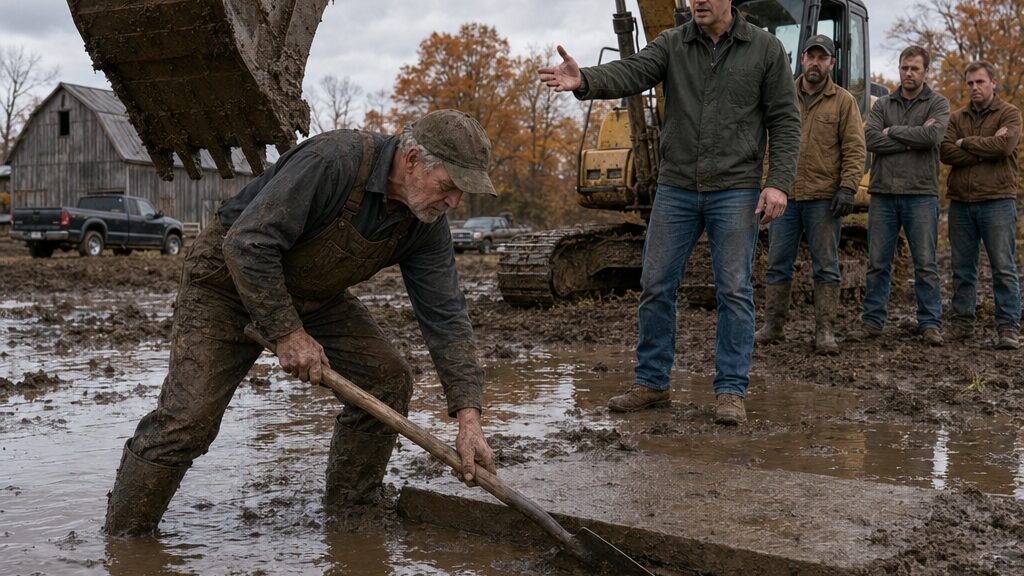
The excavator bucket stopped six inches above Raymond Miller’s back.
Mud sucked at his boots as he twisted around, one hand still wrapped around the long ash handle of his shovel. Above him, the steel teeth hung black with wet soil. A thin stream of brown water slipped from one tooth and struck the shoulder of his overalls.
Nicholas Harris leaned from the cab and killed the hydraulics.
Behind the machine, two hired hands stood beside Jack with their arms folded. One of them smiled as if Raymond had stepped into the field for their entertainment.
Jack did not smile.
“Get out of there,” he called.
Raymond turned back to the rectangular slab half buried in the lower field. It was wider than a stock trough and nearly invisible beneath the water except for one pale corner. He pushed the shovel blade into the mud along its edge.
“Dad.”
The word carried farther than Jack intended.
The machine idled behind them. Across the road, orange-leaved cottonwoods bent in the wind. The lower field had been soft since the rain two nights earlier, but Jack had brought the excavator in anyway. The drainage expansion had to be finished before frost. Stephen Lee from the bank was due before noon.
Raymond scraped the blade forward until metal met something harder than stone.
A faint vibration climbed the shovel handle into his wrists.
“Shut it down,” he said.
Nicholas had already done that, but Raymond meant the job.
Jack stepped down the slope, stopping where the standing water began. His new work boots remained on firm ground.
“We have forty acres to tile and three weeks before freeze-up. That thing is either an old footing or somebody’s idea of a joke. Nicholas can pull it in five minutes.”
“No.”
One of the hired hands glanced at the other.
Jack heard it. His jaw tightened. “You’ve been out here since daylight with a shovel.”
“That’s right.”
“You’re seventy years old.”
“Not yet.”
“This isn’t a contest.”
Raymond pressed the blade deeper. The edge slid into a narrow channel beneath the mud. He knew the feel of it before he uncovered it. Iron set inside concrete. A seam made for movement.
For seventeen years he had crossed this field every spring and autumn, always walking the same crooked line from the barn toward the county road. He checked for settling soil, washed-out stakes, muskrat holes. Jack had assumed it was habit. Raymond had let him.
Now the mud had been stripped away by the preliminary grading, and the old lid had begun to show.
Jack stepped closer. “Move.”
Raymond planted both hands on the shovel handle. “Put that bucket into this slab and you may take the road with it.”
The smile vanished from the hired hand’s face.
Jack looked toward the road, then back at Raymond. “That doesn’t make any sense.”
“It does underneath us.”
“What’s underneath us?”
Raymond could have answered. He could have said overflow chamber, cross-channel, county culvert. He could have said Rebecca’s measurements were still written in pencil on a board somewhere in the office, unless he had burned that too.
Instead he bent to the shovel again.
Jack came into the mud.
The first step sank him to the ankle. The second splashed water onto his jeans. By the time he reached Raymond, anger had replaced the embarrassment in his face.
“You don’t get to stop this because you don’t like how I’m running the farm.”
Raymond scraped another six inches of mud away.
A curved iron hinge emerged beside the slab.
Nicholas climbed down from the excavator. “Jack.”
Jack looked at it.
The hinge was thick as a man’s wrist, reddish with rust but intact. Its pin disappeared beneath the concrete.
Raymond held the shovel out.
Jack stared at him.
“Take it.”
“For what?”
“Set the blade against that seam.”
Jack did not move.
Raymond lowered his voice. “You wanted to know what’s underneath. Feel it before you decide.”
The hired hands had come nearer now. Nicholas stood at the water’s edge, watching the slab instead of Raymond.
Jack took the shovel.
He handled it awkwardly at first, too high on the grip. Raymond shifted his son’s lower hand without comment, then pointed to the mud beside the hinge.
“Push.”
The blade entered.
“Now drag it toward you.”
Jack pulled. The steel edge caught and hummed against the buried seam. The vibration carried through the handle. His expression changed, not to understanding, but to uncertainty.
“That’s not a footing,” Nicholas said.
Raymond took the shovel back. “No.”
A white pickup came down the gravel road and turned into the farm lane. Stephen Lee parked beside the barn, stepped out in a clean canvas coat, and stood for a moment taking in the excavator, the mud, and Raymond waist-deep in the middle of the stalled job.
Jack climbed out of the water.
Stephen approached with a folder tucked beneath one arm. “I thought the old obstruction would be gone.”
“It will be,” Jack said.
Raymond drove the shovel down beside the hinge.
Stephen studied the slab. “What is it?”
Nobody answered.
The wind carried the sour smell of stirred clay from the lower ditch. Somewhere beneath Raymond’s boots, water moved with a low, steady sound.
Stephen opened his folder. “The drainage work was part of the loan condition. I need a clear field, contractor signoff, and an updated tile map before we release the equipment funds.”
“How long?” Jack asked.
“Forty-eight hours.”
Nicholas looked toward the dark line of clouds gathering beyond the cottonwoods.
Stephen followed his gaze. “The forecast may complicate things. All the more reason not to leave an open excavation.”
Raymond wiped mud from the slab with his glove. At the exposed corner, beneath a crust of mineral stain, shallow marks appeared in the concrete.
Jack crouched.
Raymond tried to cover them with his palm, but Jack caught his wrist.
Three letters had been stamped into the wet concrete before it hardened.
R.M.
Jack looked from the initials to his father.
“You built this.”
Raymond pulled his hand free.
Jack’s voice lost its anger. What remained was worse.
“You built it,” he repeated, “and you never put it on a single map.”
Chapter 2: The Missing Line on Rebecca’s Field Map
The missing section had been cut from Rebecca’s map with a razor.
Jack held the paper against the farm-office window, where the afternoon light showed a clean rectangular gap near the lower field. The cut removed the drainage line from the barn to the county road and nothing else.
Behind him, Raymond stood in the doorway, leaving small drops of mud on the linoleum.
“Put it back,” Raymond said.
Jack lowered the map. “Back where?”
“In the drawer.”
“The drawer where you hid it?”
“It wasn’t hidden.”
“You kept it under six years of fertilizer receipts.”
Raymond stepped into the room. He had changed his overalls but not washed the mud from his hands. It had dried dark in the seams around his knuckles.
On the desk lay the farm’s current tile plan, printed in clean blue lines. Every lateral, outlet, and riser installed during the last thirty years was marked. The lower field showed nothing except the proposed expansion grid.
Jack placed Rebecca’s map beside it.
His mother’s handwriting ran along the margins in small, upright notes: fall grade, culvert depth, clay shoulder, check after thaw. Near the missing section, a tiny drawing remained—only the top of a shovel and an arrow pointing toward the space that had been removed.
“You cut this,” Jack said.
Raymond’s gaze stayed on the map.
“Did you?”
“Yes.”
The answer came so plainly that Jack almost missed it.
He looked toward the machine shed through the office window. Nicholas had parked the excavator on higher ground. The hired hands were washing mud from the tracks, stealing occasional glances toward the office.
“Why?”
Raymond reached for the map.
Jack pulled it away. “No. You don’t get to answer one word at a time.”
A weather alert sounded from Jack’s phone. Heavy rain was expected late the following night, with a second system behind it. Two to four inches, locally higher.
Raymond heard the alert but did not look.
Jack opened the steel filing cabinet. “Where are the old contractor records?”
“Gone.”
“County permits?”
“Ask the county.”
“Drawings?”
Raymond said nothing.
Jack removed folders one by one, stacking them on the desk. Property surveys. Seed contracts. Insurance claims. Rebecca’s handwriting appeared throughout the older files, practical and exact. She had recorded frost dates, culvert depths, and even which side of the barn roof shed water fastest.
But the lower-field channel had vanished.
The machine-shed door slammed outside.
Nicholas entered without knocking. His cap was wet around the brim.
“I cleaned enough mud off the hinge to see the casting mark,” he said. “It’s an old floodgate assembly.”
Jack turned. “You’re sure?”
“I’ve pulled two from county ditches. Smaller than this, but the hardware’s the same.”
Raymond closed his eyes for a moment.
Nicholas noticed. “You knew.”
Raymond picked up a rag and wiped his hands, though the mud had already dried.
Jack pointed to the cut map. “He built it.”
Nicholas leaned over the desk. The color drained slightly from his face when he saw Rebecca’s handwriting.
“What?” Jack asked.
Nicholas straightened. “I remember the pour.”
The office seemed to contract around them.
“You were what, fifteen?” Jack said.
“Sixteen. Maybe seventeen. Your dad paid me and my brother cash to carry forms and mix bags when the truck couldn’t get down the hill.”
Raymond dropped the rag.
Nicholas continued slowly, as if testing each memory before saying it. “Your mom had stakes all across the lower field. Red tops on one line, white on another. She kept checking grade with a level. I thought it was for a culvert.”
“Why didn’t you say that this morning?”
“I didn’t recognize it under the mud.”
Jack turned to Raymond. “Was Mom an engineer now?”
“No.”
“Then what was she doing designing drainage?”
“She knew the land.”
“That isn’t an answer.”
“It’s the one you’ve got.”
Nicholas studied the map. He placed one finger beside the small shovel drawing. “This curve here. If it continued through the missing section, it would meet the road culvert.”
Jack spread the current county map over the desk. The culvert was still marked, but as an isolated road structure with no farm connection.
“So the gate drains where?” he asked.
Raymond looked toward the window.
“Downstream,” Nicholas said. “Across the lower corner, then under the road.”
“Toward whose land?”
Raymond’s silence answered before his words did.
“The Robinson place,” he said.
The neighboring acreage sat lower than theirs, beyond the cottonwoods and the county road. Two homes had been built near the drainage depression after the old flood, on raised foundations but not raised enough for a failed culvert.
Jack felt the morning’s anger shift into something colder. “You told me hitting that slab could flood the road.”
“It could.”
“And you erased it from the records.”
“Yes.”
Nicholas pushed away from the desk. “Why would you bury a working overflow gate?”
Raymond took Rebecca’s map from Jack’s loosened hand. For an instant, his thumb rested over the cut edge.
“Because it wasn’t used again.”
“That’s not the same as not existing,” Jack said.
The office phone rang.
Jack answered. It was the county drainage inspector returning Stephen’s call. Jack listened, wrote down a time, and hung up.
“They’ll meet us at the county office tomorrow morning. They want the old flood file and any construction record we have.”
Raymond folded the map.
Jack stopped him. “That stays here.”
Their eyes met.
For years, Jack had mistaken his father’s silences for simple stubbornness. Now he saw effort in them. Raymond was not refusing because he had forgotten. He was refusing because every answer had been arranged behind a locked door.
Nicholas stood near the office heater, rubbing his palms together.
“There’s something else,” he said.
Raymond’s head lifted.
Nicholas looked at Jack, not at him. “After we poured it, your dad came to our place. He told my father none of us were to talk about that gate again. Not to the county, not to neighbors, not even to you.”
Jack glanced at the cut map.
Outside, the excavator stood motionless above the lower field while the first scattered drops of rain darkened the dust on its arm.
“What happened the last time it opened?” Jack asked.
Raymond folded Rebecca’s map once more, along an old crease.
Then he walked out without answering.
Chapter 3: The Flood Story Everyone Remembered Wrong
The neighboring landowner set Raymond’s coffee on the table and said, “You nearly drowned two families with that gate.”
Jack stopped halfway into the kitchen.
The farmhouse belonged to the Robinson property now, though the original family had sold years earlier. Its current owner stood behind a chair with both hands gripping the back. Through the window, Raymond could see the long depression where overflow water had once crossed the yard. A newer house sat on a raised pad farther uphill. The older foundation remained near the machine shed, its concrete stained darker along one wall.
“We came for the old drainage agreement,” Jack said.
“There wasn’t an agreement.”
“The county said your property file references one.”
“It references a dispute.”
The owner looked at Raymond. “You know that.”
Raymond removed his cap. He had not wanted Jack to come here. He had wanted to meet the county inspector, answer only what was required, and keep the rest where it had remained for seventeen years.
Jack pulled out a chair but did not sit. “What did the gate do?”
“It sent Miller water across this place.”
“It relieved the upper basin,” Raymond said.
The owner gave a humorless laugh. “That’s how you described it then too.”
“The road would have gone otherwise.”
“Maybe. But the road didn’t have children sleeping beside it.”
Jack’s eyes shifted toward Raymond.
The owner opened a drawer and removed a plastic sleeve containing several photographs. The first showed water spread across the Robinson yard, carrying boards, corn stalks, and one white propane tank. Another showed the county road under a fast brown current. In the last, the old house stood with water above the bottom window frames.
Raymond remembered the view from the cab of his tractor. He remembered Rebecca standing beside the gate in a yellow raincoat, both hands raised as she shouted over the storm.
The photographs had no sound, but he heard her anyway.
Open it now.
Jack lifted the last photograph. “The gate caused this?”
“It redirected the water,” the owner said. “Whether it caused it depends on who you ask.”
Raymond looked at the coffee growing cold before him. “The upper field held more water than the main tile could carry. The gate was built to send overflow toward the county culvert before the basin breached.”
“Then why did it come through the yard?”
“Because the county ditch was already full.”
“And because the gate was opened late,” the owner said.
Jack set the photograph down.
The words settled harder than accusation. Late.
Raymond stood. “We need the county file.”
The owner blocked the door with one arm. “You planning to use that thing again?”
“If the basin fills.”
“No.”
“It may not be our choice.”
“It was your choice last time.”
Jack looked between them. “What does that mean?”
Neither man answered.
The county office occupied a low brick building beside the highway department garage. The drainage inspector met them in a records room smelling of dust and warm paper. Stephen Lee was already there, his folder open on the table.
“I asked him to attend,” the inspector said. “Any undocumented structure affects the project financing as well as county drainage.”
Stephen nodded to Raymond without judgment. That almost made it worse.
The inspector rolled out an old watershed map. Faded red pencil marked a route from the Miller lower field to the road culvert, then south along the Robinson boundary.
“This was filed as an emergency overflow proposal,” she said. “Temporary authorization after the spring flood seventeen years ago.”
Jack leaned over the table. “Who designed it?”
“No licensed engineer is listed.”
Raymond’s gaze rested on a handwritten calculation in the margin. Rebecca’s numbers. She had measured elevation from the barn sill because it was the only fixed point they trusted after the survey stakes washed out.
“My mother did,” Jack said.
Raymond looked at him.
Jack tapped the figures. “That’s her handwriting.”
The inspector adjusted her glasses. “Then she understood grade better than most applicants who come through here.”
A second document lay beneath the map: a sequence sheet listing when the gate should be opened as water reached marked levels on three survey stakes.
Red stake: prepare channel.
White stake: clear culvert.
Black stake: full release.
Beside the sequence, someone had drawn a small shovel.
Jack glanced at Raymond’s long-handled shovel propped near the records-room door. The ash handle had been polished smooth by decades of work. Near the grip, beneath a dark layer of age and dirt, two letters had been carved into the wood.
R.M.
Below them, smaller and shallower, were two more.
R.M.
Rebecca Miller.
Jack rubbed his thumb over the carving.
“She used that shovel,” he said.
Raymond nodded.
The inspector opened the incident report.
“The overflow gate was fully opened at 2:17 a.m.,” she read. “The black stake level was recorded at approximately 10:40 p.m.”
Stephen looked up. “That’s more than three hours.”
“Three hours and thirty-seven minutes,” Jack said.
The inspector turned another page. “By the time of release, the road culvert had backed up. The redirected flow crossed the Robinson yard. One injury was reported.”
Raymond’s hands tightened on his cap.
Jack did not ask whose injury. He knew.
Rebecca had died two days after the flood. The family explanation had always been simple: her truck left the county road in high water while she was checking fences. Raymond had never corrected it.
The inspector continued. “There’s no final closure order, but the county noted that the structure should remain inactive until the downstream channel was widened.”
“Was it widened?” Stephen asked.
“No record.”
“It was,” Raymond said. “The following summer. By hand and backhoe. I paid for it.”
The inspector searched the file. “That isn’t documented.”
“I know.”
Jack turned sharply. “You fixed the channel but hid the gate.”
Raymond stared at Rebecca’s release sequence.
“She designed it to protect both sides of the road,” he said. “The basin, the homes, the culvert. Not one at the expense of the others.”
“Then why didn’t it work?”
Raymond’s voice hardened. “Because nothing works if you wait too long.”
The inspector closed the file. “Until we determine the condition of the chamber and downstream route, all excavation is suspended. No machine work within fifty feet of the structure.”
Stephen’s expression tightened. “That makes the forty-eight-hour deadline impossible.”
“It makes the site unsafe,” the inspector replied.
Jack pushed away from the table. “You told everyone the gate was dangerous because it could flood the road. You didn’t say it had already flooded the Robinson place.”
“The gate wasn’t the only reason.”
“What was?”
Raymond picked up the shovel.
The inspector handed Jack a copy of the incident timeline. At the bottom, beneath the official entries, was a statement written in Rebecca’s hand.
Release delayed despite black stake. Raymond refused full opening.
Jack read it twice.
When he spoke, the anger was gone. His voice was quiet enough that everyone in the room had to listen.
“Did Mom die because you waited?”
Chapter 4: What Raymond Chose to Save First
Jack locked the barn doors from the inside.
The metal latch struck hard enough to startle the cattle below. In the loft, rain tapped against the roof in scattered, impatient drops. Raymond stood near the hay elevator with Rebecca’s old release sheet folded in his coat pocket and the shovel leaning against a post between them.
“You’re going to answer me now,” Jack said.
Raymond looked toward the shuttered window. The lower field lay beyond it, out of sight, but he knew where the water would be gathering first.
“County shut the work down.”
“That isn’t what I asked.”
“No.”
Jack crossed the loft and shoved the incident report onto a stack of feed sacks. Rebecca’s handwritten line faced upward.
Release delayed despite black stake. Raymond refused full opening.
“Did she die because you waited?”
Raymond took off his cap. His hair had gone nearly white at the temples, but the rain had darkened it where it touched his forehead.
“She died because the road shoulder gave way under her truck.”
“That’s how she died. I asked why she was out there.”
Raymond set the cap on a beam.
Below them, a cow kicked against a stall gate. The sound traveled through the boards, then stopped.
“The rain started three days earlier,” Raymond said. “Not hard at first. Enough to fill the tile lines and keep them full. Your mother checked the stakes every two hours.”
Jack remained standing.
“The red stake went under before supper. We cleared the culvert. White went under at nine-thirty. She told me to open the gate halfway.”
“Did you?”
“Yes.”
“And the black stake?”
Raymond’s hand moved toward the shovel handle but stopped short of touching it.
“The black stake disappeared at ten-forty.”
Jack waited.
Raymond had repeated the rest of the story to himself for seventeen years, but never in words. In memory it existed as separate objects: the tractor lights shining across water, Rebecca’s yellow raincoat, corn leaning flat under wind, the gate lever vibrating in his hands.
“The seed field was on the other side of the berm,” he said. “Two hundred acres. We’d borrowed against the house to plant it.”
Jack’s mouth tightened. “So?”
“If I opened the gate all the way, the overflow channel would cut across it.”
“Toward the Robinson place.”
“Toward the county culvert first. The grade was supposed to carry it under the road.”
“But the ditch was already full.”
“Yes.”
“Mom knew that?”
“She knew all of it.”
Raymond looked at the loft boards. Dust had settled in the cracks, but near the shovel’s blade the floor was marked by a damp crescent of mud.
“She told me the water behind the basin would choose its own path if we didn’t choose one first. She said a controlled loss was still controlled.”
“And you said no.”
“I said wait.”
Jack gave a short laugh without humor. “For what?”
“For the rain to ease. For the main tile to catch up. For something to change.”
“Did it?”
“No.”
Rain began drumming harder on the roof.
Raymond stepped toward the shovel. His fingers closed around the handle below the carved initials.
“When the black stake went under, she brought this down to the gate. The hinge had packed with corn trash and branches. She cleared it while I held the lever.”
Jack looked at the carving.
“She used that shovel?”
“She picked it because the blade was narrow enough to enter the notch without striking the pin.”
For years Jack had watched Raymond carry it on his twice-yearly walks through the lower field. He had assumed his father preferred it because it was old, like the barn and the grain drill Raymond refused to sell.
“Then what happened?”
“I opened it another quarter.”
“Not all the way.”
“No.”
“Because of the seed.”
Raymond nodded.
The word lodged in the loft with the rain and animal heat.
Jack moved to the window and unhooked the shutter. Beyond the glass, the barnyard lights shone across shallow water moving toward the lower field.
“You chose corn.”
“I chose time.”
“You chose what you thought you could replace least.”
Raymond took the blow without correcting him.
“At midnight,” he said, “the berm began to seep. Your mother said the basin would break above the gate if we waited another hour. We argued beside the truck.”
Jack turned. “You never argued.”
“We did that night.”
“What did she say?”
Raymond could see Rebecca’s face as clearly as he saw Jack’s. Wet hair against her cheek. Mud to her knees. Not pleading. Furious because he had made the problem smaller than it was.
“She said the farm wasn’t only the ground inside our fence.”
Jack looked away.
Raymond continued. “She told me to open the gate. I told her I would after checking the north culvert.”
“You left?”
“For twenty minutes.”
“And she went back alone.”
Raymond’s grip tightened on the shovel.
“When I returned, her truck was gone. The gate was still three-quarters closed. She’d taken the road toward the Robinson place to warn them and check whether the culvert had cleared.”
Jack’s face changed, but his voice remained level. “She went because you wouldn’t open it.”
“Yes.”
The rain thickened into a steady roar.
Raymond drew the folded release sheet from his pocket and placed it beside the incident report.
“I opened the gate at 2:17. The basin had started cutting around the chamber by then. Water hit the channel too fast. It crossed the Robinson yard and took part of the road shoulder. Her truck went through before she reached the highway.”
Jack pressed both hands against the window frame.
“You let me believe she made a bad turn.”
“I let you believe the road took her.”
“You let me believe there was no choice.”
“There wasn’t one by then.”
“There was at ten-forty.”
Raymond lowered his eyes.
Jack faced him. “You buried the gate because you were ashamed.”
“Partly.”
“What was the other part?”
“I rebuilt the downstream channel the next summer. I widened it and reset the culvert entrance. The gate could have worked after that.”
“But you hid it.”
“I didn’t trust myself to decide again.”
Jack stared at him.
Raymond had imagined anger, perhaps even hatred. What he saw instead was recognition, and that was harder to bear. Jack understood that every autumn inspection had been Raymond standing before the same decision without making it.
“You thought leaving it buried was protection,” Jack said.
“Yes.”
“For who?”
Raymond did not answer.
“For yourself,” Jack said.
The first hard gust struck the barn. A loose sheet of metal snapped above them.
Jack walked to the loft stairs.
“Where are you going?”
“To call Nicholas.”
“The county suspended work.”
“I’m not asking permission to remove it.”
Raymond followed him down. “Then what?”
Jack opened the barn door. Rain blew across the aisle.
“I’m telling him to be here at dawn. That slab comes out.”
“You heard what the inspector said.”
“I heard what you said for seventeen years without telling me why.”
“The gate may be the only thing keeping the basin from—”
“I don’t know whether to believe you.”
Jack stepped into the rain.
Raymond caught his arm. “If Nicholas lifts the lid without clearing the chamber, it can crack.”
Jack looked at his father’s hand until Raymond released him.
“Then you should have put it on the map.”
He crossed the yard toward the office.
Raymond stood beneath the barn light, listening to the water strike the roof, the gravel, and the old shovel blade behind him.
Sometime after midnight, a deep tearing sound rolled up from the lower field.
The temporary ditch beside the buried block had collapsed.
Chapter 5: The Field Began Filling Before Sunrise
Water touched the bottom barn step before Jack reached the yard.
It was not flowing fast yet. That made it worse. A flat, dark sheet had spread across the lower gravel, reflecting the security light and the open machine-shed door. Beyond it, the lower field had disappeared beneath rain and mud.
Nicholas’s truck came through the lane with its hazards flashing.
Jack pulled on his coat and waded toward him.
“I thought you wanted the slab out,” Nicholas said through the open window.
“That was before the ditch collapsed.”
Nicholas looked past him. “Where’s Raymond?”
“In the barn.”
“He know I’m here?”
“He heard the truck.”
Nicholas killed the engine. “The county said no machine work.”
“The county isn’t standing in water.”
“No, but they can still pull my license.”
Jack looked toward the road. The ditch beside it had become a brown ribbon moving south. “If the basin breaks, you’ll have more than a license problem.”
Raymond emerged from the barn carrying the shovel, a coil of chain, and three survey stakes stained dark with age. He wore chest waders over his clothes.
Jack met him near the machine shed.
“You kept those?”
Raymond handed him the stakes. Red, white, and black paint remained beneath the mud.
“Set them on the west shoulder.”
“You’re not in charge of this.”
Raymond looked at the water around Jack’s boots. “Then decide quickly.”
Nicholas climbed from his truck. The two hired hands arrived behind him in another pickup, both quieter than they had been the day before.
Raymond pointed toward the submerged block. “No bucket over the lid. Use the machine to pull soil from the north side only.”
Nicholas hesitated.
Jack took the black stake from the bundle. “Do it.”
The excavator crawled onto the higher strip beside the barn. Its work lights cut through the rain. Nicholas lowered the bucket short of the waterline and peeled back saturated soil in careful passes.
Raymond drove the red stake into the shoulder. Water already covered its lower paint.
“The main tile’s full,” he said.
Jack planted the white stake farther down the grade. “How long?”
“Depends on the culvert.”
They crossed the road on foot. Water pushed through the ditch hard enough to bend dead grass flat. At the culvert mouth, corn stalks and branches had formed a dense mat.
Jack reached for it.
Raymond caught the back of his coat. “Not by hand.”
They used forks from the pickup and the shovel to pull debris away. The first opening released a surge that rocked Jack against the bank.
He recovered and looked beneath the road. The culvert was still drawing.
“It connects,” he said.
Raymond nodded. “The gate channel is underneath the field between here and the chamber.”
“You’re sure it hasn’t collapsed?”
“No.”
The answer irritated Jack, but he trusted it more than certainty.
They returned to the lower field. Nicholas had uncovered the slab’s northern edge. Water swirled where the temporary ditch had fallen in.
He waved them closer, then pointed with the bucket.
A fresh crack ran diagonally across the concrete lid.
“That wasn’t there yesterday,” Raymond said.
Nicholas shut down the machine and climbed out. “Track sank on the west side when I repositioned. I didn’t touch the slab, but the ground moved under it.”
Raymond crouched beside the crack. Muddy water pulsed through it in small bursts.
“The chamber’s pressurized.”
Jack looked toward the barn. Water had reached the second step.
“What happens if the lid fails?”
“It may jam the gate closed. Or break the wall.”
“And then?”
“The basin picks its own outlet.”
The phrase carried Rebecca’s voice even though Jack had never heard her say it.
Raymond began clearing mud from the hinge with the shovel.
Jack grabbed the handle. “You can’t stay in there alone.”
“I’m lighter than the machine.”
“That’s not what I said.”
Raymond released the shovel.
Jack stepped into the excavation. Mud closed around his calves. The cold went through his jeans immediately.
“Blade flat,” Raymond said. “Don’t stab.”
Jack slid the shovel edge beside the iron seam. At first he felt only stones and roots. He moved farther right.
A sharp vibration traveled through the ash handle.
There.
The same hidden hum he had felt the day before, now stronger beneath the pressure of moving water.
“Follow it,” Raymond said.
Jack dragged the blade through the mud. The seam curved around the lid toward a recessed slot clogged with clay.
“What is that?”
“Release notch.”
“You said the hinge was the important part.”
“It was what I could show you without opening it.”
Jack looked up. “Still doing that?”
Raymond did not defend himself.
Nicholas joined them with a pry bar. “There’s another problem.”
He pointed toward the line Raymond had marked with the old stakes. The proposed expansion berm, built to dry and level the new acreage, now blocked the original overflow path.
“If we get this open,” Nicholas said, “the water has nowhere to spread.”
Jack knew what came next before Raymond said it.
“The berm has to go.”
“That field was graded last month.”
“Yes.”
“The seed and fertilizer contract is tied to those acres.”
“Yes.”
Stephen’s loan figures ran through Jack’s mind: additional yield, equipment payment, winter operating line. Twelve acres made the difference between a difficult year and one the bank could call viable.
“How much of it floods?” Jack asked.
“All of the lower expansion. Maybe more.”
The hired hands waited near the excavator, rain running from their hoods.
Raymond took the shovel from Jack and offered it back handle-first.
“Your field,” he said. “Your decision.”
Jack stared at him. For years, Raymond had answered every question about the farm as if ownership still belonged solely to memory. Now, when Jack wanted an order, his father refused to give one.
“What would you do?” Jack asked.
Raymond looked toward the Robinson property beyond the road.
“That answer cost us enough once.”
Jack’s anger flared. “I’m not asking what you did then.”
“I know.”
“Tell me.”
Raymond’s face remained still, but his voice did not.
“I would cut the berm before the black stake goes under.”
Jack glanced at the three markers. The water had climbed halfway up the white paint.
Nicholas wiped rain from his eyes. “Once I break that berm, there’s no putting it back before spring.”
Jack thought of the loan, the equipment, the years he had spent proving he could run the farm without asking Raymond for permission. Then he looked at the cracked lid pulsing under pressure and the road carrying water toward two downstream homes.
He climbed out of the excavation.
“Nicholas.”
The operator waited.
“Take the machine to the east end. Cut the berm along Raymond’s stakes. Keep the bucket shallow until he marks the old channel.”
Nicholas nodded once.
The excavator engine turned over.
Raymond stepped aside, but Jack caught his shoulder.
“You don’t disappear into the barn after this,” Jack said.
Raymond met his eyes.
“You don’t get to hand me the choice and keep the rest.”
“I understand.”
Jack took the shovel from him and went back into the mud.
Behind them, Nicholas raised the excavator bucket above the new berm.
“Cut it,” Jack called.
The steel teeth came down into the field he had borrowed against.
Chapter 6: The Gate Opened Toward the Land They Could Lose
The first hinge tore loose before Raymond reached the chamber.
A sound like a rifle crack split through the rain. The concrete lid jumped, then settled crookedly as brown water burst from beneath its western edge.
Jack staggered backward in the excavation.
“Out!” Raymond shouted.
Jack drove the shovel into the mud and used the handle to pull himself toward firmer ground. Nicholas swung the excavator bucket away while the hired hands dragged the chain clear.
The loosened corner rose again.
Raymond waded in.
Jack seized the back of his waders. “You said out.”
“The second hinge won’t hold that angle.”
“What do we do?”
Raymond knelt beside the release notch. Water struck his chest and curled around him. The crack across the lid had widened enough to show darkness beneath.
“Chain the north eye,” he said. “No lift. Just hold it level.”
Nicholas moved the excavator into position on the higher bank. One hired hand carried the chain down while the other guided its hook toward a rusted lifting eye.
Raymond cleared the notch with the shovel tip. Each time he loosened mud, pressure forced more back into place.
Jack knelt beside him.
“Tell me the sequence.”
“Not yet.”
“You said no more of that.”
Raymond looked at the water climbing the black stake. Only six inches of paint remained.
“Rebecca wrote another set of instructions,” he said. “For a jammed release.”
“Where?”
“Inside the handle.”
Jack stared at the shovel.
Near the grip, below the carved initials, a thin wooden plug sat flush with the end. Raymond had sealed it there after the flood, using wax and varnish until it looked like part of the handle.
“You carried it all this time?”
“I carried what I couldn’t say.”
“That isn’t the same thing.”
“No.”
Raymond struck the plug against the concrete edge. It broke free. Inside the hollow grip was a narrow roll of oil-darkened paper.
Jack pulled it out and unfolded it beneath his coat.
Rebecca’s handwriting had blurred at the edges but remained legible.
Clear lower notch. Brace lid. Open one quarter. Wait for culvert draw. Full release only after downstream marker drops.
At the bottom she had added: If Raymond argues, make him look at the water, not the field.
Jack read the line once. Then he handed the paper back.
“Lower notch first.”
They worked together. Jack used the shovel blade to loosen packed clay while Raymond reached into the recess with the pry bar. The gate mechanism shifted less than an inch.
Across the field, Nicholas cut through the last section of berm.
Water poured into the opening and began spreading across the expansion acreage in a broad fan. Seedbed ridges vanished one by one beneath the current.
“The barn channel’s backing up!” one of the hired hands shouted.
Raymond looked over his shoulder. Water had reached the machine shed and was curling around the barn foundation.
Nicholas leaned from the excavator cab. “I can cut a relief trench toward the north ditch. Save the buildings.”
Raymond followed the proposed line with his eyes.
The trench would pull pressure away from the barn, but it would also slow the flow toward the gate. Downstream, the Robinson ditch was nearly bank-full. If they delayed now, the basin could break at its weakest point and send an uncontrolled wall across the road.
Jack waited for Raymond’s answer.
Seventeen years earlier, Raymond had looked at a field and asked for more time.
Now the barn doors shuddered as water struck the bottom boards. Inside were the remaining cattle, winter hay, tools collected over three generations.
Nicholas called again. “Raymond?”
Raymond turned away from the barn.
“No north trench. Keep the overflow open.”
Jack’s eyes stayed on him for half a second, then he nodded toward Nicholas. “You heard him.”
The excavator continued cutting toward the road.
Raymond set the pry bar into the lower notch. “Quarter release.”
Jack planted the shovel blade into the release slot and leaned his weight against the handle.
The mechanism resisted.
“Again,” Raymond said.
They pushed together. Rust broke somewhere beneath the concrete. The gate shifted with a deep grinding sound, and a hard stream of water shot into the old channel.
The force twisted the shovel from Jack’s hands.
Raymond reached for it. The cracked lid dropped suddenly, catching his forearm against the chamber edge.
Pain flashed white through him.
Jack dragged him backward as Nicholas tightened the chain and steadied the lid.
Raymond tried to rise, but his right hand would not close.
“Your arm?”
“Not broken.”
“You don’t know that.”
“The gate’s only a quarter open.”
Water rushed through the channel, but the black stake disappeared beneath the surface.
Jack looked downstream. The culvert was drawing, yet the level near the chamber continued to climb.
“We wait for the marker to drop,” he said.
“We don’t have time.”
“That’s what her instructions say.”
“They were written before the lid cracked.”
Jack stared at the gap beneath the concrete. “Then tell me what she would do.”
Raymond pressed his injured arm against his chest.
“She’d brace the lid, clear the upper notch, and open it by hand.”
“You can’t.”
“No.”
For the first time, he said it without trying to stand.
Jack retrieved the shovel from the water.
Raymond pointed with his left hand. “The upper notch is beneath the broken hinge. Put the blade sideways. If you strike down, you’ll shear the pin.”
Jack entered the excavation alone.
The water reached his waist. He felt along the concrete with the shovel tip until the steel found a narrow recess. The vibration traveled up the handle, through the initials carved by both his parents, and into his hands.
“Now what?”
“Turn the blade. Use the handle as a lever.”
Jack braced one boot against the chamber wall.
The lid shifted above him. Nicholas adjusted the chain, holding its weight without lifting.
“Easy,” Raymond called.
Jack leaned.
The release pin moved.
A roar rose beneath the concrete as the gate opened another six inches. Water struck Jack sideways, but he kept the shovel planted.
“Full release?” he shouted.
Raymond looked toward the road. The downstream marker, barely visible near the culvert, had begun to drop.
He looked once toward the barn. Water had entered the machine shed and surrounded the cattle lot. The expansion field was already a shallow lake.
“Full release,” he said.
Jack drove the shovel handle down.
The gate opened.
Water surged through the buried chamber and into Rebecca’s restored channel. It raced across the twelve acres Jack had leveled, split around the old survey stakes, and passed beneath the road in a controlled brown current.
The cracked lid settled against the chain instead of collapsing.
For several minutes no one spoke. They watched the basin level fall inch by inch from the barn steps.
Jack climbed out of the excavation carrying the shovel.
Raymond sat on the bank, his injured arm held close.
Jack placed the shovel beside him.
“The field’s gone,” he said.
“For this season.”
“The loan may be gone too.”
“Yes.”
Jack looked toward the water spreading across the acreage he had planned to expand.
Then he looked at the road still standing, the downstream homes above the redirected flow, and the old gate working beneath the mud.
Raymond waited for blame.
Jack crouched and lifted the shovel again.
“Show me where the next inspection point is,” he said.
Raymond looked at his son’s muddy hands.
“After the water drops.”
“No.” Jack held the shovel across both knees. “Now. Before either of us decides silence is easier.”
Behind them, the lower field disappeared beneath the controlled overflow, carrying away the plan they had made and leaving the rest of the farm standing.
Chapter 7: The New Map Left the Low Ground Empty
Stephen Lee placed the revised loan packet on the farm-office desk and kept one hand on it.
“The twelve acres stay out of production,” he said. “Permanently.”
Jack did not reach for the papers.
Outside the window, the lower field lay brown and flattened beneath a hard November sky. The floodwater had drained, leaving pale grass wrapped around the survey stakes and a dark channel curving toward the county road. The excavator sat beside the machine shed with its cracked side window covered in plastic. Raymond’s shovel leaned inside the office door, cleaned of mud but scarred where the concrete lid had trapped it.
Raymond sat opposite Stephen with his injured arm in a brace. The emergency-room nurse had called it a deep bruise and a small fracture near the wrist. He had ignored the sling after the third day.
Stephen opened the packet.
“The county will approve the restored channel as a protected drainage easement. That means no planting, grading, storage, or structures within the marked corridor.”
“How wide?” Raymond asked.
“Wider than the old route. They want room for inspection equipment.”
Jack glanced at the new map. A green band crossed the exact acreage he had intended to tile. It left the low ground blank except for the gate chamber, the overflow channel, and access from the road.
The empty space looked larger on paper.
Stephen turned to a page of figures. “The conservation adjustment lowers the land’s projected income. We can still restructure the operating line, but the equipment loan would be smaller. You would need to keep the current tractor another two years and reduce spring input costs.”
“And the excavator bill?” Jack asked.
“Insurance will cover part of the storm damage. Not the original grading.”
Raymond studied the figures. “What if we sell the cattle?”
Jack looked at him.
“The remaining herd would cover most of the shortfall,” Raymond continued. “We can lease pasture afterward if we decide to start again.”
“No,” Jack said.
Stephen stopped turning pages.
Raymond kept his eyes on the packet. “It is the cleanest asset.”
“No.”
“The cattle were mine before you took over the books.”
“That doesn’t mean you get to sell them without asking.”
Raymond’s mouth tightened. “I am asking.”
“You’re offering the first thing that hurts you.”
Stephen closed the packet quietly. “I can step outside.”
“Stay,” Jack said. “This concerns the loan.”
Raymond leaned back in the chair. “The farm needs cash.”
“The farm also needs you to stop treating loss like the only honest answer.”
The words landed harder than Jack intended, but he did not take them back.
For two weeks Raymond had worked one-handed along the restored channel. He checked stakes, measured the gate drop, and walked the county inspector through every place water had crossed the lower ground. He answered technical questions directly. Anything about Rebecca, Jack, or the seventeen hidden years received the old silence in a thinner form.
Stephen looked from father to son. “The revised plan is viable without selling livestock, but barely. There will be less margin.”
“Then we run with less margin,” Jack said.
Raymond tapped one finger against the table. “You wanted a farm that could grow.”
“I wanted one that could survive.”
“That was the purpose of the expansion.”
“No. The expansion was the number that made me feel like I was moving forward.”
Stephen’s expression changed slightly, not with pity but recognition. He had spent enough years across farm tables to know the difference between a plan and a defense.
Jack pulled the original expansion sheet from beneath the revised packet. Rows of projected yield covered the twelve acres now occupied by the easement.
He tore the sheet once through the center.
Raymond looked up.
Jack tore it again and placed the pieces in the wastebasket.
“The field stays open,” he said.
Stephen slid the revised agreement toward him. “Then this is the plan I can recommend.”
Jack signed first.
Raymond took the pen with his left hand. His signature came out uneven, the letters compressed together. He stared at it for a moment before adding the date.
Stephen gathered the papers. At the door, he paused beside the shovel.
“My father kept a wrench in his truck for thirty years,” he said. “Wouldn’t let anyone replace it. I assumed it was sentiment. Turned out he’d ground it to fit one valve on an old grain dryer.”
Raymond glanced at the scarred blade.
Stephen put on his coat. “Records matter. So does knowing what the records missed.”
After he left, Jack opened the bottom drawer of the filing cabinet. He had spent the previous evening sorting Rebecca’s remaining notebooks. Most contained ordinary things: calf weights, seed orders, rainfall totals, reminders to sharpen mower blades.
One envelope had been taped inside the back cover of her final field book.
Jack placed it on the desk.
Raymond recognized the handwriting and went still.
The envelope had Jack’s name on it.
“You opened it?” Raymond asked.
“No.”
“You should.”
Jack slid a finger under the flap.
Inside was one sheet folded around a small photograph. The picture showed Jack at twelve, standing beside the red survey stake with mud up to his knees. Rebecca stood behind him holding the shovel, one hand resting on his shoulder. Raymond was visible at the edge of the frame, turning away from the camera toward the lower field.
Jack unfolded the note.
Raymond stared at the window while he read.
Jack,
Your father understands water better than people. He thinks danger becomes smaller when he carries it alone. It does not. It only becomes harder for the rest of us to see.
If anything happens to me, make him tell you what he chose and why. Do not let him turn work into an apology that never ends.
The gate belongs on the map. So does the mistake.
Rebecca
Jack read the final line again.
Raymond remained turned toward the field.
“She knew,” Jack said.
“Yes.”
“You found this before?”
“No.”
Jack watched him carefully.
Raymond reached toward the photograph but stopped before touching it. “She told me something similar.”
“And you still cut the map.”
“Yes.”
The admission did not ask to be softened.
Jack set the note between them. “I spent years thinking you didn’t trust me because I wasn’t ready.”
“I didn’t trust myself to tell it without making excuses.”
“You could have told it badly.”
Raymond looked at him.
“That would have been better than not telling it.”
“Yes.”
The office heater clicked off. In the sudden quiet, they could hear Nicholas outside, hammering a new marker post near the machine shed.
Raymond touched the edge of Rebecca’s note.
“I kept thinking if I inspected the gate, kept the channel clear, paid for the Robinson ditch, then I had answered for it.”
“You answered the land.”
Raymond waited.
“Not me.”
“No.”
It was not an apology. Jack did not need one shaped for comfort.
He folded the note and returned it to the envelope.
They walked to the lower field before noon.
The county had installed bright posts along the easement, but Raymond disliked their spacing. He carried a measuring tape in his left hand. Jack carried the shovel.
At the gate chamber, the repaired lid sat level above the mud. New steel reinforced the broken hinge, but the old concrete remained, including Raymond’s initials near one corner.
Jack set the shovel against the chamber.
“You said there are more inspection points.”
“Six.”
“You only showed me four during the county walk.”
“The other two are easy to miss.”
Jack looked at him. “That sounds familiar.”
Raymond accepted it.
They followed the channel toward the road. At the first bend, Raymond pointed to a patch where the grass grew slightly darker.
“Tile junction beneath that. Check for sinking after thaw.”
Jack drove a new stake into the ground.
At the second point, they found a narrow crack in the clay bank. Raymond showed him how to judge whether it came from drying soil or pressure below. At the culvert, Jack cleared a handful of leaves from the grate before Raymond could reach for them.
They returned along the easement slowly.
Near the gate, Jack stopped and pushed the shovel blade into the release seam. The repaired metal sent a clean vibration through the handle.
Raymond stood beside him.
“Feel that?” Jack asked.
“Yes.”
“What does it mean?”
“That the pin is seated.”
“And if it changes?”
“We open the chamber and find out why.”
Jack rested both hands on the handle. The initials carved into the wood sat between them, worn but readable.
He looked across the twelve empty acres. They no longer appeared wasted. The shallow grade, the road culvert, and the raised foundations beyond it formed a single system now that he knew where to look.
Raymond pointed toward the far end of the channel.
“The last inspection marker is beyond the cottonwoods.”
Jack lifted the shovel.
“Show me.”
Raymond started walking, then slowed until Jack came alongside him.
Together they followed the open ground Rebecca had left on the map.
The story has ended.