They Paved Over Barbara’s Only Driveway—Then the Old Survey Line Divided the Neighborhood
Chapter 1: The Flags Appeared Before Sunrise
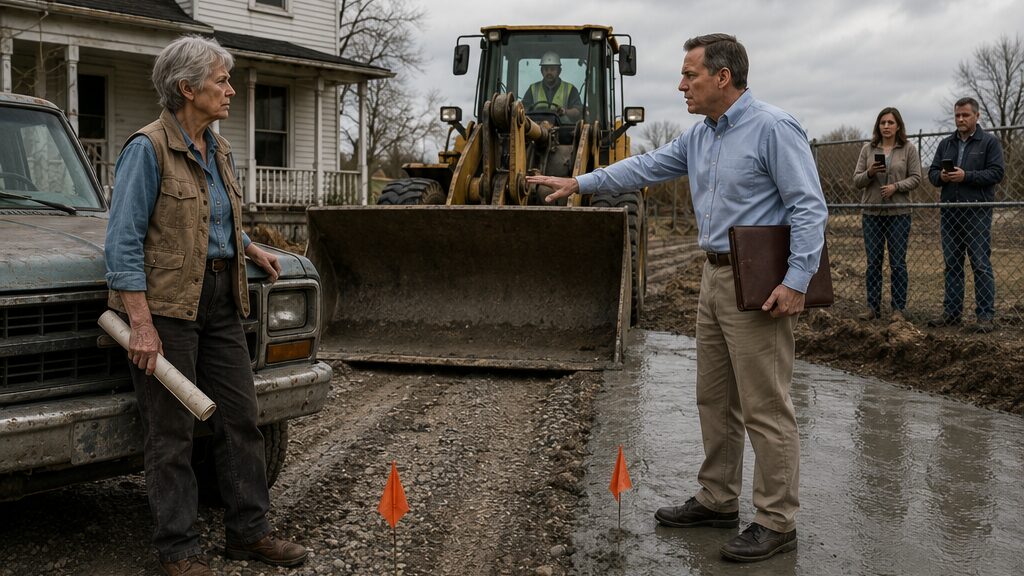
The loader bucket dropped into Barbara Moore’s driveway before she had reached the bottom porch step.
Steel teeth struck gravel with a crack that carried through the old farmhouse. Stones sprayed beneath the lilac hedge, and an orange survey flag bent flat under the front tire before snapping upright again.
Barbara stopped with one hand on the porch rail.
Her truck sat thirty feet away, angled where she had left it after groceries on Sunday. Beyond it, a yellow loader occupied the narrow lane between her house and the chain-link fence surrounding the homeowners association’s construction site.
The equipment operator saw her and lifted both palms from the controls.
The machine idled.
A construction foreman in a reflective vest walked toward Barbara with a folded plan under one arm.
“Mrs. Moore, you need to move the truck.”
Barbara stepped onto the gravel. “You need to move the loader.”
The foreman glanced toward the fence as if expecting someone else to handle her. Beyond him, workers were unloading forms beside a scraped field that had once held scrub grass and three mature maples. A sign near the clubhouse entrance showed an architectural rendering of the planned expansion: event rooms, landscaped walkways, and rows of parking.
“What are you doing to my lane?” Barbara asked.
“This section is part of the access work.”
“It is my driveway.”
“It’s in the approved construction area.”
Barbara looked down. Orange flags ran along the lane in a wavering line, some planted in gravel, others pushed into the exposed clay where the loader had scraped away the shoulder. One stood beside the worn track her late husband’s truck had made for nearly thirty years.
The foreman pointed toward her vehicle. “We can work around most things. We can’t work around that.”
“You are not working around anything until someone tells me why machinery is on my property.”
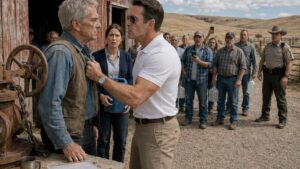
A black SUV stopped beside the temporary gate. Jonathan Davis emerged in pressed khakis, a pale-blue shirt, and shoes that were wrong for mud. He carried a leather folder embossed with the neighborhood association’s seal.
Barbara knew him by sight. He had chaired the association for eighteen months and sold houses in the newer streets beyond the clubhouse. He had once left a holiday cookie tin on her porch with a business card taped to the lid.
“Barbara,” he said, walking toward her. “I was hoping we could avoid this.”
“You could have avoided it by staying off my driveway.”
Jonathan exhaled through his nose. “The association acquired the strip along the expansion parcel. Notices went out months ago.”
“I received notices about parking construction. None of them said you were taking the only way into my house.”
“We aren’t taking away your house access.”
“You have a loader sitting in it.”
“You’ll still be able to reach the porch from the east side.”
Barbara turned slowly toward him. The east side of the farmhouse faced a drainage ditch, a split-rail fence, and a slope steep enough that Catherine refused to walk it in winter.
“My car does not climb porch steps,” she said.
Jonathan lowered his voice. “The project requires a dedicated entrance. The current clubhouse entrance can’t safely handle event traffic, deliveries, and emergency vehicles. This lane is the most practical route.”
“This lane is not an empty route. It is my driveway.”
“The association’s purchase includes the land beyond your porch boundary.”
For a moment, Barbara heard only the loader’s diesel engine and the distant rattle of metal forms.
“Beyond my porch,” she repeated.
Jonathan opened his folder. “The surveys were reviewed. The county approved the site plan. The lender approved the project. We have contractors scheduled through Friday, and concrete arriving this afternoon.”
“You bought the field,” Barbara said. “You did not buy my way home.”
A pair of neighbors stood beyond the fence, watching without pretending otherwise. One held a travel mug. The other had a small dog under one arm.
Jonathan followed Barbara’s gaze.
“No one is trying to embarrass you,” he said.
“Then stop doing it publicly.”
His face tightened, but his tone remained polished. “Move the truck, and I’ll have the foreman preserve a pedestrian strip beside the porch until permanent access is completed.”
“Permanent access to where?”
“To your residence.”
“From whose road?”
Jonathan looked at the plan instead of answering.
That was when Barbara stopped listening to his assurances and began studying what had been placed in the ground.
The orange flags nearest the porch ran close together. One stood beside the lilac hedge. The next stood only four feet away, near the scraped shoulder. Farther down the lane, another pair followed the same side of the gravel.
Barbara had spent twenty-two years shelving county histories, property atlases, and old planning books in the records room of the public library. She was not a surveyor. She knew enough, however, to understand that two flags supposedly marking opposite sides of a right-of-way should not both stand along the same tire track.
She took out her phone.
Jonathan frowned. “What are you doing?”
“Taking pictures.”
“We’ve already documented the preconstruction condition.”
“I’m documenting yours.”
She photographed the loader bucket, the crushed gravel, every visible flag, and Jonathan standing with the HOA folder. Then she walked toward the nearest marker.
The foreman moved as if to stop her.
Barbara raised one finger. “Do not touch me.”
He stopped.
She crouched, ignoring the pull in her knee, and photographed the printed code on the flag stem. The writing was small, but the same code appeared on both flags nearest her house.
Jonathan came closer. “Those are construction layout markers.”
“What do they mark?”
“The approved boundary and access alignment.”
“Which one is the boundary?”
He looked toward the foreman.
The foreman looked toward the plan.
Barbara stood. “That is what I thought.”
“This isn’t a roadside argument,” Jonathan said. “If you dispute the survey, there is a process.”
“The process usually comes before the loader.”
“The process has been underway for six months.”
“And during those six months, did anyone ask how I reach the county road?”
“You were offered meetings.”
“I was sent invitations to discuss landscaping and construction hours.”
“You didn’t attend.”
“I did not know attendance was required to keep my driveway.”
The equipment operator leaned out of the cab. “Sir, you want me to back out?”
Jonathan looked at the scraped ground, the workers waiting near the forms, and the concrete crew assembling beside the gate.
“No,” he said. “Continue on the west edge. Work around the vehicle for now.”
The operator did not move immediately.
The foreman approached the truck and paced around it, calculating clearance.
Barbara stepped between him and the driver’s door. “No one moves my truck.”
“We’re not moving it yet,” Jonathan said.
“Yet?”
“We cannot allow personal property to obstruct an approved construction area.”
The phrase landed with the flat weight of something rehearsed.
Barbara returned to the porch. She did not retreat inside. She brought out a wooden chair, set it beside the railing, and opened the camera application again.
For the next forty minutes, the loader shaved gravel from the western edge of the lane. Barbara recorded each pass. The machine left a raw trench beside the old wheel tracks. Orange flags trembled in the churned earth.
At ten seventeen, the foreman received a phone call. He walked to Jonathan, and they spoke beside the SUV. Jonathan glanced toward Barbara twice.
Then the foreman returned carrying a white sheet sealed inside a clear plastic sleeve.
He held it out.
Barbara did not take it.
“What is that?”
“Vehicle-removal notice.”
“From the county?”
“From the homeowners association.”
The association seal appeared at the top. Beneath it, in bold type, the document declared her truck an obstruction within an active construction easement and authorized removal at the owner’s expense.
Barbara photographed it in the foreman’s hand.
“When does this take effect?” she asked.
He pointed to the final line.
Four o’clock that afternoon.
Chapter 2: She Asked Them to Name the Line
By noon, concrete had been poured around one of the orange flags.
Barbara saw the gray slurry spreading from the chute as Catherine’s car turned into the county road. Workers guided the pour along the scraped edge of the driveway, leaving Barbara’s truck on a shrinking island of gravel.
The orange marker nearest the lilacs stood ankle-deep in wet concrete, its plastic ribbon twitching in the exhaust from the cement truck.
Catherine stopped her car on the roadside and got out before shutting off the engine.
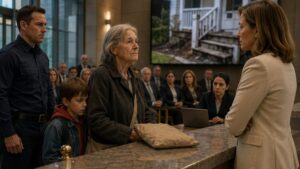
“Tell me that isn’t your driveway.”
“It was when I woke up.”
Catherine stared at the forms, the loader, and the neighbors gathering behind the fence. “Why didn’t you call me sooner?”
“I called when there was something useful for you to do.”
“What is useful?”
“Park where they can’t tow you.”
Catherine gave her a sharp look but moved the car onto the grass shoulder beyond the association’s marked area.
Jonathan stood near the pour with the construction foreman. He was speaking to two board members when Barbara approached carrying a rolled county parcel map she had kept in the hall closet for years.
“Stop the concrete,” she said.
Jonathan barely turned. “We discussed this.”
“No. You told me what you intended to do.”
“The removal notice remains in effect.”
Barbara looked at the equipment operator. He was seated in the loader with the engine off, watching the cement crew instead of her.
She unrolled the map across the hood of her truck and placed two stones on the corners.
Jonathan’s expression changed. Not fear. Annoyance sharpened by caution.
“That map is outdated,” he said.
“The deed reference is still current.”
“Modern surveys control the construction layout.”
“Then name the line.”
One of the neighbors lifted a phone.
Jonathan noticed. “Barbara, this is not the place.”
“This is exactly the place. Your flags are here. Your concrete is here. My driveway is here. Show me which flag marks the north side of the easement and which one marks the south.”
The foreman unfolded his plan.
Barbara pointed to the flag trapped in concrete. “Does that mark one side?”
The foreman studied the plan legend. “It’s a layout point.”
“For what?”
“The access alignment.”
“Which edge?”
He traced a line with his finger and looked toward a second orange flag four feet away.
Barbara pointed to it. “And that one?”
“Another layout point.”
“On which edge?”
The workers had stopped raking the concrete. The only movement came from the drum of the cement truck.
Jonathan stepped closer to the map. “The access has been shifted to accommodate the parking geometry.”
“Shifted off what?”
“The association parcel.”
“That is not an answer.”
He tapped the modern drawing. “This entire section is shown within the project limits.”
Barbara placed one finger on the old map. “This recorded easement is twelve feet wide. It begins at the county road and runs to my parcel. Your two flags are four feet apart, and both are on the west wheel track. They cannot mark opposite sides of a twelve-foot lane.”
A murmur passed among the neighbors.
Jonathan turned to the foreman. “Where are the offset stakes?”
The foreman scanned the churned shoulder. “They may have been removed during clearing.”
“By whom?”
“No idea.”
Barbara looked toward the loader. “The code on both flags is the same.”
The equipment operator climbed down from the cab.
Jonathan’s voice hardened. “Nobody asked you to shut down.”
The operator removed his gloves. “I’m not grading another foot until the layout gets confirmed.”
“You have approved plans.”
“I also have two stakes on one side and a homeowner saying there’s a recorded access under us.”
“The survey company certified the plan.”
“Then they can certify where I put the bucket.”
For the first time that morning, Jonathan appeared uncertain in front of everyone.
He took out his phone and walked several steps away.
Catherine came beside Barbara. “Do you actually know that map is enforceable?”
“I know it was recorded.”
“That isn’t what I asked.”
Barbara rolled the edge tighter beneath her fingers. “It is enough to make them stop.”
“Temporarily.”
“That is what stopping means.”
The cement crew began pulling the chute back. One worker placed a barricade beside the wet slab. Another rinsed his tools into a shallow pan.
The small payoff should have felt clean. Machinery silent. Concrete contained. Jonathan forced to make calls instead of declarations.
Instead, Barbara noticed Robert Green approaching from the clubhouse path.
Robert had known her husband before the first subdivision house was built. He had retired from a survey contractor ten years earlier and now served on the architectural committee. He walked with his eyes on the flags, not on Barbara.
“You reviewed this?” she asked when he reached the truck.
“The committee reviewed the site package.”
“That is not what I asked.”
Robert rubbed a thumb along the edge of the rolled map. “The fieldwork came from a licensed firm.”
“Did you see the old alignment?”
“I saw references to it.”
“Did you walk it?”
He glanced toward Jonathan. “I assumed the title company had resolved the conflict.”
“You assumed.”
Robert did not defend himself.
Jonathan returned with his phone still in his hand. “The survey firm is sending someone. Work is paused on the lane, not on the remainder of the project.”
Barbara nodded toward the concrete. “You already poured over a marker.”
“It can be corrected.”
“So can a removal notice.”
“That notice remains valid.”
Catherine turned on him. “On what basis?”
Jonathan opened the leather folder. “On the basis that the association has written authorization to use this access.”
Barbara felt something tighten below her ribs.
Jonathan removed a photocopy and held it where the board members and neighbors could see the first page.
The date was eight years old.
At the bottom, beneath a paragraph authorizing temporary construction access through the lane, were two signatures.
One belonged to Barbara’s husband.
The other belonged to Barbara.
Catherine took the page before Barbara could stop her.
“This says you gave them permission.”
“For six months,” Barbara said.
Jonathan tapped the copy. “It authorizes construction traffic and associated improvements.”
“Temporary traffic.”
“There is no revocation recorded with the association.”
“It ended on the date printed in the letter.”
“That is your interpretation.”
“It is English.”
A few of the watching neighbors shifted. The certainty that had moved toward Barbara now loosened. A woman near the fence lowered her phone.
Jonathan’s composure returned.
“The association has relied on this access before,” he said. “Maintenance trucks, drainage contractors, utility crews. Your household allowed repeated use without formal objection.”
“That does not make it yours.”
“It creates a question that cannot be settled by standing beside wet concrete.”
Catherine turned the page over.
“Where is the second page?”
Barbara said nothing.
Catherine looked at the staple marks in the upper corner. Two punctures, but only one sheet.
“There was another page.”
Jonathan’s eyes moved from Catherine to Barbara.
Barbara reached for the copy. Catherine held it away.
“Mom.”
“Give it to me.”
“What was on page two?”
“The conditions.”
“Then where is it?”
“At the house.”
Jonathan closed his folder. “Convenient.”
Barbara faced him. “You had the same agreement.”
“We received this copy from archived project files.”
“Then your archive is incomplete.”
“Or yours has been altered.”
Catherine flinched as if the accusation had touched her instead.
Barbara stepped toward Jonathan, but the wet concrete blocked the straight path between them. The orange flag trembled in the middle of it.
“My husband and I allowed six months of access,” she said. “There were conditions. The permission expired.”
“Then provide the complete document.”
“I will.”
“And until then, the association considers the authorization unresolved.”
The equipment operator remained beside the loader, arms folded. “Still not moving.”
Jonathan’s jaw tightened. “We’ll address your contract separately.”
He left with the board members and the foreman, taking the incomplete photocopy.
The neighbors dispersed more slowly than they had gathered. Several avoided Barbara’s eyes.
Catherine waited until they were alone beside the truck.
“Show me the second page.”
Barbara carried the old map into the farmhouse. Catherine followed her through the front room and into the kitchen.
The property file was in the bottom drawer of the hutch, beneath tax receipts and appliance manuals. Barbara placed it on the table but kept one hand on the cover.
Catherine opened it.
A faded orange survey flag, folded flat, lay between two sheets like a bookmark.
Beneath it was the missing second page.
Catherine read the conditions once, then again. Her expression shifted from anger to something harder.
“This says the lane had to be restored.”
“Yes.”
“And the drainage ditch had to be repaired.”
“Yes.”
“It says permission ended automatically after six months.”
“I know what it says.”
Catherine looked up. “Then why did you stand out there and act like you never gave them permission at all?”
Barbara reached for the page.
Catherine did not release it.
“Why did you lie?”
Chapter 3: The Permission Had an Ending Date
Catherine found the third sheet while Barbara was still denying there had ever been one.
It slipped from the back pocket of the property folder and landed face down beneath the kitchen table. Catherine bent before Barbara could reach it.
The paper was not part of the access agreement. It was a handwritten note on yellow legal paper, folded twice and stained along one edge.
Catherine read the first line.
Barbara took it from her.
“That is not relevant.”
“It has Dad’s handwriting.”
“It is private.”
“So was page two, apparently.”
Barbara returned the note to the folder and closed it. Outside, a truck reversed near the clubhouse, its warning signal repeating through the kitchen wall.
Catherine stood with both hands braced against the table. “You called me because they were taking your driveway. I came because I thought someone was trying to bully you off land you had never given them.”
“They are.”
“You signed an agreement.”
“For six months.”
“You told Jonathan nobody had ever asked.”
“Nobody asked this time.”
“That is not what everyone heard.”
Barbara looked toward the window. From there, she could see the top of the cement truck and the orange flag imprisoned in the cooling slab.
Catherine’s voice softened, which made it worse. “What happened after those six months?”
“The permission ended.”
“That is a date, not an answer.”
Barbara opened a kitchen drawer and took out a large brown envelope. She placed the original two-page agreement inside, then added the deed and the old parcel map.
“We are going to the county records office.”
Catherine remained still. “And the note?”
“It stays here.”
“Why?”
“Because it has nothing to do with whether the easement exists.”
“It has something to do with why you hid the agreement.”
Barbara sealed the envelope with a strip of tape. “Bring your car around.”
The county administration building stood twelve miles away, a low brick structure shared by planning, assessments, permits, and land records. By the time they arrived, the afternoon counter had closed, but a clerk recognized Barbara from her years at the library and allowed them to submit a same-day records request before the office locked.
They returned Tuesday morning at eight.
The records clerk brought out a bound index, a scanned deed packet, and a survey plat copied from microfilm. The older sheets carried handwritten references in the margins. Barbara followed each number with the tip of a pencil.
The easement appeared in three places.
It originated in a deed recorded decades before the homeowners association existed. It granted permanent access from the county road to the farmhouse parcel. A later subdivision plat acknowledged it. The temporary-use agreement did not extinguish or transfer it.
Catherine leaned closer. “So Jonathan can’t claim the agreement gave them the lane forever.”
“Not honestly.”
The clerk adjusted her glasses. “I can only tell you what is recorded. Legal interpretation belongs to counsel or the court.”
“Is there any recorded release?” Barbara asked.
The clerk searched again.
“No release. No relocation agreement. No abandonment filing.”
Barbara let out a breath she had been holding since Monday morning.
It was not victory. It was something sturdier: a fact that had survived without her help.
The clerk printed certified copies. As she arranged them, Catherine pointed to a notation beside the temporary-use reference.
“What is that?”
The clerk rotated the page. “An attachment index. Restoration covenant, drainage conditions, expiration.”
“Page two,” Catherine said.
The clerk nodded. “Recorded with the planning file, not the deed book. Different department.”
Barbara’s copy was not the only complete version.
For eight years, she had treated the second page like a burden only she could carry. Yet it had been sitting beneath fluorescent lights in a county file, available to anyone willing to request the correct packet.
The realization did not comfort her.
At the planning counter, a staff member retrieved the original construction-access file. The temporary permission had begun on April 1 and expired September 30. It allowed vehicles serving an earlier utility installation to cross the lane during specified hours. It required the developer to restore the gravel surface, preserve the drainage ditch, and repair any damage within thirty days.
Stapled behind it was a final inspection notation marked incomplete.
Catherine touched the word with one finger. “They never closed it.”
“The prior developer dissolved,” Barbara said.
“And the association inherited the records?”
“Some of them.”
“Enough to find page one.”
Barbara did not answer.
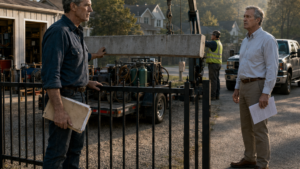
The county access-and-drainage inspector met them at the farmhouse shortly after noon. He wore work boots and carried a tablet loaded with the current site plan. Jonathan arrived with the HOA attorney and Robert Green.
The inspector walked the lane twice.
He measured from the old fence post to the surviving iron pin near the ditch. He photographed the two orange flags standing on the same side of the drive. He checked the new concrete and the scraped shoulder.
Then he compared the construction permit with the certified plat.
“The parking expansion is permitted within the association parcel,” he said. “The access shown on the field layout does not match the recorded easement.”
Jonathan’s attorney stepped forward. “There is a history of permissive use.”
“There is a six-month agreement from eight years ago,” Barbara said.
The attorney looked at her. “Followed by repeated unopposed access.”
“Utility and maintenance vehicles used the lane occasionally.”
“Without objection.”
“Because they were servicing lines that crossed my land, not carrying event traffic to eighty parking spaces.”
The inspector raised one hand. “I am not deciding prescriptive or implied rights. I am deciding whether the current work matches the approved permit and whether the drainage impact was disclosed.”
He looked at the wet concrete.
“It does not.”
Jonathan’s face remained controlled, but Barbara saw the pulse in his temple.
The inspector issued a temporary stop-work notice for the lane and requested a drainage review. The remainder of the parking project could continue, but no vehicle could cross the disputed section and no additional concrete could be placed there.
The equipment operator, waiting beside the loader, removed the key and climbed down.
Barbara watched Jonathan read the notice.
For one brief moment, the scene resembled the clean reversal she had imagined while driving to the county office. The official paper was in his hand now. His crews were stopped. Her truck remained where she had left it.
Then the HOA attorney opened a second folder.
“We will appeal the access restriction,” she said. “The association has evidence of continued reliance after the expiration date.”
She produced maintenance logs listing trucks that had entered through Barbara’s lane over several years.
Barbara recognized some dates: utility repairs, culvert inspections, emergency tree removal.
“You let them through,” Catherine said quietly.
“They asked,” Barbara replied.
“Did you object in writing?”
“No.”
The attorney heard her. “Then the association will argue that the written expiration did not end the practical arrangement.”
“It ended commercial construction use.”
“That distinction is not stated in your later conduct.”
Barbara felt the ground shift again, not legally perhaps, but socially. The two neighbors who had returned to watch were speaking together near the fence. One gestured toward the unfinished parking area.
The inspector crouched beside the drainage ditch, where fresh soil had been pushed across an older depression.
“Was this culvert functional before construction?” he asked.
Robert answered first. “There was an older pipe under the lane.”
“Shown on the current survey?”
Robert looked at the tablet.
“No.”
The inspector scraped loose dirt from the edge of a crushed metal opening. “This predates the new work.”
Barbara’s hand tightened around the envelope.
The inspector looked up at her. “The temporary agreement required restoration of drainage damage. Was there a known failure after that earlier work?”
Catherine turned toward Barbara.
Jonathan stopped reading the notice.
Robert lowered his eyes.
The yellow note in Barbara’s property folder seemed suddenly heavier than the deed, the map, and every certified page combined.
The inspector stood.
“Mrs. Moore, was anyone injured when this drainage first failed?”
Chapter 4: The Injury No One Put in Minutes
Robert Green found the culvert by driving a steel probe through the fresh shoulder until it struck metal.
The sound was dull and hollow beneath the new fill.
He pushed the probe down again, then looked toward the inspector. “There’s a pipe under here.”
The construction foreman shifted his weight. “Nothing was shown on the utility sheet.”
“That doesn’t mean nothing was there,” Robert said.
The inspector marked the spot on his tablet. An orange flag was planted beside the probe, not to claim a boundary this time, but to trace what had been buried. Robert moved six feet toward the ditch, struck metal again, and planted another flag. By the third marker, the line angled beneath the newly poured concrete.
Barbara watched from the porch with the property folder pressed against her hip.
The inspector’s question still hung between them.
Was anyone injured when this drainage first failed?
Catherine stood beside the porch steps, waiting for Barbara to answer. Jonathan and the HOA attorney remained near the stopped loader. Two neighbors had drifted closer to the fence, close enough to hear but far enough to deny listening.
Barbara looked at the crushed mouth of the culvert. Rust flaked from the exposed edge. Mud had hardened around it in ridges.
“My husband fell,” she said.
Catherine’s head turned sharply.
The inspector lowered his tablet. “When?”
“Eight years ago. After the temporary construction use ended.”
“Was an incident report filed?”
“No.”
“Was medical treatment required?”
Barbara stared at the buried pipe. “Yes.”
Jonathan’s face changed. Not sympathy exactly. Recognition.
The HOA attorney spoke first. “Was the association notified that the fall was connected to drainage?”
“The old board was notified that the ditch had washed out.”
“That is not the same as an injury claim.”
“I did not say it was.”
Catherine stepped down from the porch. “You told me Dad fell in the barn.”
Barbara said nothing.
“You said he missed the step.”
“He did miss a step.”
“Where?”
Barbara’s fingers tightened around the folder. “At the lane.”
The answer seemed to remove the air from the space around Catherine.
The inspector motioned toward the farmhouse. “We need the earlier agreement, any repair requests, and whatever documentation exists concerning the drainage.”
“There is no formal injury report,” Barbara said.
“Then give me what there is.”
The yellow note remained inside the folder.
Barbara could feel its shape through the cardboard.
The emergency HOA meeting began at four in the clubhouse room overlooking the unfinished parking field. Folding chairs had been set in rows, though only six board seats occupied the front table. The smell of cut lumber and drywall dust drifted through the temporary wall.
Barbara sat beside Catherine. Robert took a chair at the end of the board table, though he avoided looking toward them.
Jonathan called the meeting to order without ceremony.
“The purpose is to address the temporary stop-work notice affecting the eastern access,” he said. “We are not conducting a trial.”
A neighbor in the second row muttered, “Feels like one.”
Jonathan heard but continued. He summarized the permit, the parking need, the temporary-use letter, and the association’s history of maintenance access. His language was careful. He did not say the lane belonged to the HOA. He said the HOA had relied on access.
Then the attorney placed Barbara’s signed first page on the screen.
The enlarged signatures filled the wall.
A woman near the aisle whispered, “She said they never asked.”
Barbara kept her eyes on the paper.
Jonathan turned toward her. “Mrs. Moore, did you sign this agreement?”
“Yes.”
The room shifted.
“Did your husband sign it willingly?”
Barbara looked at Catherine before answering.
“Yes.”
“Were construction vehicles permitted to use the lane?”
“For six months.”
“Did vehicles continue to use it after that?”
“Occasionally.”
“Did you physically prevent them?”
“No.”
“Did you send a cease-and-desist letter?”
“No.”
The attorney began to speak, but Jonathan lifted one hand.
“Why not?”
Barbara had expected accusation. The plainness of the question unsettled her more.
“Because utility work is not a parking entrance,” she said.
“That was not my question.”
“I did not object every time a maintenance truck crossed because some of those trucks serviced lines connected to my property.”
Jonathan nodded once. “So your position is not that no one could ever use the lane.”
“My position is that permission belonged to us.”
A man in the back row said, “But you never told anybody the whole story.”
Barbara turned toward him.
He lived on the newer side of the neighborhood. She had seen him pushing his wife’s wheelchair along the clubhouse walk.
“We were told this entrance would provide accessible parking close to the event room,” he said. “Now everything is stopped because of a private fight from eight years ago.”
“It stopped because the plan did not match the recorded easement,” Barbara replied.
“And because you waited until concrete was being poured.”
“I did not know they were using my driveway until the loader arrived.”
Jonathan’s eyes moved down.
Catherine noticed.
“You knew she hadn’t agreed to this plan,” she said.
“This meeting is not for personal accusations,” Jonathan replied.
“Then answer without taking it personally.”
The attorney objected, but Robert pushed his chair back.
“I should say something.”
Every face turned toward him.
Robert placed a rolled survey sheet on the table. “The current plan omitted an older culvert beneath the lane. It also treated two construction offsets as though the historical access alignment had been resolved.”
“Were you aware of the older markers?” Jonathan asked.
“I saw a reference.”
“That is not the same as verifying them.”
“No.” Robert swallowed. “It is not.”
Barbara watched him struggle with the next sentence.
“I recognized the likely pin alignment when we walked the site in spring,” he said. “I assumed the title company had reconciled it with the purchase.”
“Did you tell the committee?” a board member asked.
“I noted that the old line should be checked.”
“Where?”
Robert opened his committee packet. The note appeared in the margin, written small enough to be overlooked: confirm legacy access before final layout.
The room grew quiet.
Jonathan leaned back. “You still voted to recommend approval.”
“Yes.”
“Why?”
Robert rubbed his thumb against the paper. “Because the project was already behind. Because the survey was stamped. Because I did not want to be the person who delayed it over something I thought professionals had handled.”
The admission changed the room more than the map had. Robert was not exposing a conspiracy. He was exposing a habit shared by everyone at the table: someone else must have checked.
The inspector, seated near the wall, spoke. “The omitted culvert requires review regardless of the access dispute.”
The attorney said, “That does not establish liability for an injury.”
“No one asked you to establish liability,” Catherine said.
Barbara touched her daughter’s sleeve. Catherine pulled away.
Jonathan turned back to Barbara. “What happened to your husband?”
The question was quieter now.
Barbara looked at the projected agreement. The signatures were still there, large and black.
“He trusted the old board,” she said. “They promised the lane would be restored before winter. Heavy trucks crushed the culvert. Water began crossing the gravel instead of passing under it.”
She stopped.
Catherine’s jaw tightened.
“Continue,” Jonathan said.
Barbara disliked him for asking, and herself for needing to be asked.
“One night after rain, my husband went out to move a barricade that had washed toward the road. The shoulder gave way. He fell into the ditch and injured his hip.”
A woman in the front row covered her mouth.
“He recovered enough to walk,” Barbara continued. “But not the same way. He blamed himself for signing. He said he should have known a promise without enforcement was only a favor to the person making it.”
“Why wasn’t this in the association minutes?” Robert asked.
“Because he did not want it there.”
Jonathan frowned. “The board never received an injury report?”
“They received requests to repair the drainage.”
“From whom?”
“From me.”
“Do you have copies?”
“Yes.”
“Then why not provide them before now?”
Barbara looked at the folder on her lap. “Because the letters contain details he asked me not to make public.”
The neighbor whose wife used the wheelchair shook his head. “So we were supposed to guess.”
“No,” Barbara said. “You were supposed to stay within your own survey.”
The sentence struck harder than she intended. The man looked away.
The small sympathy she had gained dissolved into something more complicated. Several residents had legitimate needs. Several had also accepted Jonathan’s assurances without asking what those assurances cost Barbara.
Jonathan closed the projected document.
“The association will submit the full drainage file for review,” he said. “But we must also consider whether Mrs. Moore’s prior conduct created continuing access.”
Barbara stood.
“Prior permission did not become ownership because no one wanted to ask again.”
A board member replied, “And private grief did not tell us the permission had consequences.”
Catherine stared at Barbara. The hurt in her face was worse than the accusation.
The meeting ended without resolution. Chairs scraped. Neighbors collected their bags and spoke in low groups. No one approached Barbara.
Outside, the orange flags marking the buried culvert glowed in the late sun. They no longer looked like an invading line. They looked like points where something neglected had finally surfaced.
Jonathan followed Barbara to the clubhouse steps.
“I need to tell you something before counsel does,” he said.
Catherine stopped beside her.
Jonathan held a folded title report.
“The report was issued six weeks before construction.”
Barbara waited.
He opened to a paragraph underlined in yellow.
“Subject to unresolved access rights affecting the eastern lane,” he read.
Catherine looked from the paper to him. “You knew.”
“I knew there was a title exception.”
“And you ordered them to pave anyway.”
Jonathan folded the report again.
“Yes.”
Chapter 5: Jonathan Had Already Promised Completion
The lender’s email arrived at six twelve Wednesday morning.
Jonathan read it twice in the darkened HOA office.
Compliance inspection confirmed for Friday, 9:00 a.m. Draw availability, insurance continuation, and accessibility certification dependent upon demonstrable project progress.
He set the phone face down.
Through the office window, the parking field looked nearly complete. White lines divided rows of fresh asphalt. Concrete walks curved toward the new event-room entrance. Only the eastern approach remained broken: Barbara’s truck on gravel, the stopped loader, the raw trench, and orange flags marking a dispute everyone could now see.
The loan had been approved on a construction schedule Jonathan had personally guaranteed to the board.
The association’s reserve account had already been thinned by roof repairs and an emergency sewer replacement. Without the final draw, contractors would demand payment from funds the HOA did not have. Without the accessibility work, the insurer had warned it could restrict event use at the clubhouse.
He had not invented the urgency.
He had only decided urgency made uncertainty tolerable.
Jonathan walked outside before the crews arrived. Near Barbara’s lane, four orange flags stood around the exposed culvert. He pulled one free, then another.
The plastic ribbons snapped in the morning air.
“What are you doing?”
Robert stood beyond the fence holding a coffee cup.
Jonathan looked at the flags in his hand. “They are temporary markers.”
“They mark the drainage review.”
“The inspector has coordinates.”
“They also show where the problem is.”
Jonathan planted one back into the soil but kept the others. “The lender does not need to arrive Friday and see the site looking abandoned.”
Robert’s expression tightened. “It isn’t abandoned. It is stopped.”
“You had the chance to distinguish those things in your committee report.”
Robert absorbed the blow without answering.
By nine, Jonathan was at Barbara’s kitchen table.
The HOA attorney sat beside him with a settlement packet. Catherine stood near the sink, arms folded. Barbara remained across from them, the property folder closed in front of her.
Jonathan slid a single-page summary across the table.
“The association will pay for a licensed survey, restore the gravel surface, and provide twenty-five thousand dollars in exchange for a permanent access grant.”
Barbara did not touch it.
“The grant would be limited to ingress and egress for the clubhouse parking area,” he added. “The HOA would maintain the lane.”
“You mean widen it, light it, salt it, and send event traffic past my bedroom.”
“We can include operating-hour restrictions.”
“How many cars?”
“The lot has eighty spaces.”
“That was not my question.”
Jonathan’s eyes moved to the attorney, then back. “Traffic volume would vary.”
“On wedding nights?”
“Higher.”
“On holidays?”
“Yes.”
“Delivery trucks?”
“Scheduled.”
“Emergency vehicles?”
“As needed.”
Barbara pushed the paper back.
Jonathan placed a second document beside it. “The payment can increase.”
Catherine looked at her mother. “At least read everything.”
“I heard enough.”
“You heard an offer,” Catherine said. “That isn’t the same as agreeing.”
Barbara opened the first page and read the clauses. The grant was permanent. It ran with the land. It allowed paving, lighting, drainage modification, signage, and reasonable expansion related to community use.
“Reasonable expansion,” she said. “That phrase will still be here after all of us are dead.”
The attorney answered, “It is standard language.”
“So was the paragraph Jonathan ignored.”
Jonathan leaned forward. “Barbara, the project is not merely decorative. The clubhouse entrance does not meet current accessible-route requirements. We have residents who cannot safely cross the upper lot. Our insurer gave us a deadline. The association delayed these repairs for years.”
“Then build access on association land.”
“The grade on the western side requires additional retaining work.”
“Meaning more money.”
“Meaning months of redesign and potentially losing spaces.”
“There are eighty.”
“We need revenue from events to stabilize dues.”
Barbara gave a small, humorless smile. “So my driveway is expected to stabilize your finances.”
Catherine took the settlement summary. Her eyes stopped at the amount.
“This could pay for the porch foundation,” she said quietly. “And the roof.”
Barbara looked at her.
“I am not saying sign it,” Catherine added. “I am saying the house needs work, and you have been pretending it doesn’t.”
Jonathan watched the exchange but did not interrupt.
Barbara turned toward him. “What else?”
He hesitated.
The attorney removed a confidentiality agreement.
“No,” Barbara said before it reached the table.
“It protects both parties from inflammatory public statements.”
“It protects the association from telling residents why they are paying me.”
“It prevents reputational damage while legal questions remain disputed.”
“The title warning was not disputed when you read it.”
Jonathan’s shoulders stiffened. “The title company advised that the exception might be insurable.”
“Might.”
“The project could not survive another delay.”
“So you chose my risk.”
“I chose the community’s deadline.”
Catherine set down the summary. “You also chose not to tell her.”
Jonathan looked toward the window. The stopped machinery was visible between the kitchen curtains.
“I came here twice before construction,” he said.
Barbara frowned.
“You left letters.”
“I knocked. You watched me from this room and did not open the door.”
Catherine looked at her mother.
Barbara remembered the visits. Jonathan’s SUV. His leather folder. Her decision to remain still until he left.
“You had already mailed the plan,” she said.
“I wanted to discuss buying or relocating the access.”
“You wanted me alone, without a record.”
“I wanted a conversation.”
“You wanted an answer before I saw machinery.”
Jonathan’s voice rose, then steadied. “I believed you were refusing any discussion because you wanted the project to fail.”
“And because you believed that, you stopped asking?”
“I believed the association could establish continued use.”
“That is not permission.”
“No. It was a gamble.”
The honesty did not excuse him. It made the choice visible.
From the road came the soft electric whine of a mobility scooter. The neighbor whose wife used a wheelchair passed the kitchen window with her, guiding the scooter around a rough patch in the roadside shoulder. They were taking the long way to the clubhouse.
Barbara watched them until they disappeared behind the fence.
Jonathan saw where she was looking.
“The accessible spaces were supposed to open next week,” he said.
“That does not make this lane yours.”
“I know.”
It was the first time he had said it.
The attorney shifted in her chair. “If settlement fails, the association will petition for emergency access based on historical use and public-safety necessity.”
Barbara turned back. “You are threatening court.”
“I am explaining the next step,” Jonathan said.
“You offered money with one hand and brought a petition with the other.”
“The lender inspects Friday. I do not have the luxury of pretending time is neutral.”
“And I do not have the luxury of granting away the only entrance to my home because your calendar is expensive.”
Jonathan gathered the papers. Before leaving, he placed the title report beside Barbara’s folder.
“The board did not see the full language until yesterday,” he said. “I summarized it as a routine exception.”
Robert’s warning. Jonathan’s summary. Barbara’s silence. Every person had reduced something inconvenient until the reduced version became the decision.
After they left, Catherine remained at the table.
“You could take the money,” she said.
“And listen to traffic every weekend.”
“You could sell.”
“To whom? The HOA?”
“To anyone. You would not have to fight over this place until there is nothing left of you but the fight.”
Barbara looked toward the old hall where her husband’s cane still leaned in the corner.
“You think I stayed because of the house.”
“I think you stay because leaving would feel like admitting Dad trusted the wrong people.”
Barbara flinched.
Catherine’s face softened, but she did not withdraw the words.
“The note,” she said. “The one in his handwriting. What does it say?”
Barbara opened the property folder.
The faded orange flag lay across the papers. She moved it aside and took out the yellow sheet.
Her husband had written it after the fall, when pain medication kept him awake and shame kept him from calling the board.
I signed because I thought being neighborly would be remembered. It was only remembered when they needed more.
Below that, in a different pressure of pen:
Do not let them turn my mistake into your whole life.
Barbara had read the first sentence for years.
She had avoided the second.
She folded the note and placed it before Catherine.
“Get the storage box from the attic,” Barbara said.
“What is in it?”
“Every repair request. The hospital discharge papers. His letters to the old board. Mine too.”
Catherine looked at her carefully. “All of it?”
Barbara closed the settlement packet and pushed it away.
“All of it. Including the page I kept to protect him.”
Chapter 6: Barbara Put the Whole Record Forward
“The signature is mine.”
Barbara’s admission reached the back wall of the emergency hearing room without help from the microphone.
On the screen behind her was the temporary-use letter Jonathan had displayed two days earlier. Her name appeared at the bottom beside her husband’s.
Every board seat was occupied. Residents filled the folding chairs and stood along the walls. The county inspector sat near the aisle. Jonathan faced Barbara from the center of the board table, the lender’s Friday deadline less than fifteen hours away.
Barbara placed the original agreement on the document stand.
“My husband and I permitted construction vehicles to cross our lane for six months,” she said. “We signed willingly. No one forged this, tricked us, or forced us.”
A whisper moved through the room.
Catherine sat in the front row with the storage box at her feet.
Barbara continued. “I also allowed later maintenance and utility vehicles through when they asked. When I said no one had permission on Monday, I meant no one had permission for this project. That was true. It was not the whole truth.”
The HOA attorney watched without writing.
Barbara lifted the second page.
“The permission expired September thirtieth. It required restoration of the gravel, protection of the ditch, and repair of damage. Those conditions were recorded in the county planning file.”
She placed photographs beneath the camera: the lane before the earlier work, the crushed culvert afterward, water cutting through the shoulder, her husband’s cane beside the washed-out gravel.
The final photograph showed no injury. Only an empty ditch under a work light.
“He fell there,” Barbara said. “He injured his hip. The old board knew the drainage had failed, but we did not file an injury claim. He was ashamed that he had trusted a promise without demanding enforcement.”
The neighbor with the mobility scooter lowered her eyes.
“I kept his note and the medical details private because he asked me to. I convinced myself that silence protected him. It did not protect the lane. It did not protect me. And it did not give this board the full history when the same mistake began again.”
She laid the yellow note face down. She did not project it.
Some things could be disclosed without being displayed.
Jonathan looked at the table.
Barbara turned to Robert. “You have something to add.”
Robert rose from his chair with a corrected committee report.
“I recognized that the historical pin alignment might conflict with the construction layout,” he said. “I noted it, then voted to approve because I assumed the title company and surveyor had resolved it. They had not.”
He faced the board.
“I withdraw my recommendation for the eastern access as designed.”
A board member asked, “Are you saying the entire plan is defective?”
“No. I am saying the entrance is.”
Robert unrolled a new survey sketch. Orange marks showed Barbara’s twelve-foot lane from the county road to the farmhouse. A second line curved west of the drainage area and entered the parking field from association land.
Jonathan leaned forward.
“That reroute was rejected for grade,” he said.
“Rejected as drawn,” Robert replied. “The retaining wall can be shortened if twelve parking spaces are removed.”
The room reacted immediately.
“Twelve?”
“We paid for those spaces.”
“What happens to event capacity?”
Robert waited until the voices settled. “The accessible spaces remain. The western row loses twelve standard spaces. The entrance no longer crosses Barbara’s permanent easement.”
Barbara took a worn orange flag from the property folder and laid it across the modern plan. Its faded ribbon followed the old access line. Then she placed one of the newly removed flags beside it along the proposed emergency crossing.
“I am not offering the HOA permanent commercial access,” she said. “I am offering a recorded emergency-only crossing at the southern end of the lane.”
Jonathan looked up.
Barbara pointed to the terms Catherine had typed.
“Emergency vehicles only. No event traffic. No deliveries. No parking. Any damage restored within ten business days. The HOA maintains the culvert and drainage inspection schedule. Repeated noncompliance terminates the grant.”
The attorney reached for the page.
Barbara held it back. “You may have a copy after I finish.”
A resident near the wall said, “Why offer anything after what they did?”
Barbara looked at the accessible-parking plan.
“Because the woman using that scooter did not pour concrete on my driveway. Neither did the residents who were promised safe access. Correction should reach the people who caused the harm without creating new harm for everyone else.”
The room quieted.
Another neighbor asked, “How much does the reroute cost?”
Jonathan answered before anyone else could.
“Removing twelve spaces, revising drainage, cutting out the eastern concrete, and rebuilding the western entrance would require most of the remaining reserve fund.”
“And an assessment?” someone asked.
“Likely.”
The mood changed again. Justice had acquired a number, even if no one had stated it yet.
A board member turned toward Barbara. “You could demand that the project stop entirely.”
“Yes.”
“Why aren’t you?”
Barbara looked at Jonathan.
“Because I want my home protected. I do not need his failure to become the neighborhood’s ruin.”
Jonathan’s face tightened.
She continued. “But correction must include a public record. The title warning, the omitted culvert, Robert’s note, my earlier permission, and its expiration. No confidentiality agreement. No summary that makes any of us cleaner than we were.”
The attorney objected. “Publicizing privileged communications is not acceptable.”
“I did not ask for privileged communications. I asked for the decisions.”
Jonathan spoke quietly. “The title report should have gone to the full board.”
The attorney turned toward him.
He did not look at her.
“I received it,” he said. “I described the exception as routine because counsel said there were arguments supporting continued access.”
Counsel’s expression hardened. “I said the issue might be insurable and required clarification.”
Jonathan nodded. “You did.”
Barbara felt the room shift toward him, but not with the simple outrage she had imagined on Monday.
Jonathan gripped the edge of the table.
“The prior board left drainage repairs unfunded. The insurer warned us last year. The clubhouse lost two event contracts because guests could not reach the lower entrance safely. The loan rate expired once already. I believed delay would cost every household more and leave the accessibility problem unresolved.”
He looked at Barbara.
“I also believed your refusal to meet meant you would oppose any plan regardless of terms.”
“You believed silence was an answer,” Barbara said.
“Yes.”
“And then treated the answer you invented as permission.”
“Yes.”
The admission was not an apology. It was more useful than one.
The board recessed for twenty minutes. Residents crowded the hall. Some thanked Barbara. Others avoided her. One man said his assessment could not increase again. Another said the HOA should sell part of the recreation field instead of touching reserves. The woman with the scooter stopped beside Barbara.
“I needed those spaces,” she said. “But I would not have wanted them built through your front yard.”
Barbara nodded. “They are still in the plan.”
“Because you kept them there.”
“Because they should have been there without my lane.”
When the board reconvened, Robert’s revised layout was displayed beside the original. The contrast was plain. The first plan ran traffic along Barbara’s house. The second sacrificed a row of spaces and curved through association land.
The treasurer gave the cost estimate. The reserve fund could cover most of it, but a limited special assessment would still be required.
Groans rose from the room.
Jonathan called for public comment, then for the vote.
Two board members voted for the correction.
Two voted to continue legal action while preserving the current design.
One abstained because her property bordered the western reroute.
The tie sat on the table like another document no one wanted to own.
Under the bylaws, the president could cast the deciding vote.
Jonathan looked first at the original site plan, then at Barbara’s complete file. The old orange flag lay across the corrected survey between them.
The attorney leaned toward him and whispered something.
Jonathan did not respond.
Barbara waited without asking him for mercy, agreement, or courage.
At last, he placed both hands flat on the table.
“My vote,” he said, “is the deciding vote.”
Chapter 7: The New Line Left Room for Home
The concrete saw reached Barbara’s driveway at seven forty on Monday morning.
Its blade screamed through the slab the HOA had poured three weeks earlier, sending a pale mist across the orange flags now standing on both sides of the restored access line. Barbara watched from the porch as the worker guided the machine along Robert’s corrected marks.
This time, every flag had a purpose someone could name.
One line protected the twelve-foot gravel lane leading from the county road to her house. The second marked the edge of the rerouted entrance curving west toward the clubhouse parking field. At the southern end, two flags stood farther apart where the emergency crossing would be recorded.
Jonathan’s deciding vote had approved the correction.
He had cast it after a silence long enough for one board member to ask whether he understood the motion. His answer had been simple.
“Yes. I understand what it costs.”
The board had voted to use the reserve fund, remove twelve parking spaces, rebuild the western entrance, restore Barbara’s drainage, and publish the complete project chronology in the association records. Jonathan had also accepted a formal censure for withholding the title warning from the full board.
He had not resigned.
Some residents thought that was cowardice. Others thought remaining long enough to manage the correction was the first responsible decision he had made.
Barbara had not offered an opinion.
The saw completed its first cut. A worker drove wedges beneath the slab, and a broad section of concrete lifted away from the old wheel track. Gravel appeared beneath it, dark with trapped moisture.
Catherine stood beside Barbara holding two cups of coffee.
“You’re not going to tell them they’re doing it wrong?” she asked.
“They measured twice.”
“That has never stopped you before.”
Barbara accepted a cup. “The flags are correct.”
Below them, Robert checked the slope with a level rod. He had spent most mornings on-site since the board vote, though no one was paying him. His revised report was now attached to the public minutes beside his original approval.
He looked toward the porch and raised one hand.
Barbara returned the gesture.
The correction had not made the neighborhood peaceful. The special assessment notice had arrived four days after the vote. Several residents blamed Jonathan. Several blamed Barbara. Someone had left a printed copy of the assessment on her mailbox with the twelve-space reduction circled in red.
Catherine had wanted to install a camera.
Barbara had thrown the paper away.
By midmorning, the crew exposed the crushed culvert. The metal pipe had flattened nearly closed beneath the lane. Mud packed the remaining opening.
The county inspector photographed it before the workers removed it.
“This would have failed again,” he told Barbara. “Even without the parking entrance.”
“It already failed once.”
“Yes.”
There was no comfort in being proved right eight years late, but there was relief in seeing the damaged pipe placed on the back of a truck instead of left beneath another promise.
A larger replacement culvert went in beneath the gravel. Stone was packed around it, and the ditch was shaped to carry water away from the lane. The restoration terms required inspection every spring and after any major storm.
Nothing depended on memory now.
That afternoon, Barbara met Jonathan and the HOA attorney at a folding table beside the southern crossing. Catherine sat next to her with the final documents arranged in order.
The emergency-access agreement was six pages long.
Barbara read every line again.
It allowed fire engines, ambulances, and other emergency vehicles to cross a short section of her lane only when the primary clubhouse entrance was blocked or unsafe. It prohibited event traffic, maintenance shortcuts, deliveries, parking, storage, lighting, and future widening. Damage had to be repaired within ten business days. Repeated violations would terminate the grant after written notice and review.
The agreement would be recorded with both properties.
Jonathan signed first.
He slid the pen across the table.
Barbara did not pick it up.
“What does ‘temporary staging’ mean in paragraph four?” she asked.
The attorney answered, “An emergency vehicle may stop briefly while responding.”
“No equipment storage?”
“No.”
“No construction trailers?”
“No.”
“No traffic-control cones left overnight?”
Jonathan looked at the attorney.
She amended the phrase by hand and initialed it.
Barbara read the sentence once more. Only then did she sign.
The pen moved more easily than it had eight years earlier.
The difference was not trust. It was precision.
Jonathan closed his copy. “Thank you.”
“This is not a favor,” Barbara said.
“I know.”
“It is not permanent access to the parking lot.”
“I know that too.”
Catherine gathered the remaining pages.
Jonathan remained seated.
“The assessment meeting is Thursday,” he said. “It may be unpleasant.”
“That would make it consistent.”
He almost smiled, then did not.
“I should have brought the title report to the board,” he said. “And when you refused to meet, I should have treated that as a reason to slow down, not permission to assume the worst.”
Barbara looked toward the workers grading the new entrance.
“I should have opened the door.”
Jonathan seemed surprised.
“That would not have made your plan legal,” she added.
“No.”
“But it might have made the problem visible before the concrete.”
He nodded.
It was not reconciliation. It was an accurate division of responsibility, and for the moment that was enough.
Two days later, the accessible spaces opened through the western entrance.
The rerouted road rose gently from the county road, passed the rebuilt drainage swale, and entered the lower lot without crossing Barbara’s lane. Blue-painted spaces stood nearest the clubhouse doors. The woman with the mobility scooter tested the route while the inspector checked the grade.
Her husband walked beside her.
At the entrance, she stopped and looked across the ditch toward Barbara.
The distance was too great for conversation. She lifted one hand.
Barbara lifted hers.
Behind them, the missing row of twelve spaces remained an open strip of seeded soil. Several residents complained that the reduction would hurt event revenue. Others had begun discussing shuttle parking for larger gatherings.
The corrected project did not solve every problem.
It simply stopped using Barbara’s home as the easiest answer.
That evening, Catherine carried the storage box from the dining room to the porch. The construction crews had gone. Fresh gravel lay pale between the orange flags, cleanly separated from the paved entrance beyond the ditch.
“Where do you want this?” Catherine asked.
Barbara looked at the box containing the deed, the temporary agreement, the repair requests, the medical records, the corrected survey, and her husband’s yellow note.
For years, she had kept parts of the history in different places: the deed in the hutch, the letters in the attic, the note hidden behind the agreement. Separation had felt like protection.
It had also made the truth dependent on her willingness to assemble it.
She removed the yellow note and read the last line again.
Do not let them turn my mistake into your whole life.
Then she placed it inside a clear sleeve at the front of the file.
“Take the complete box,” she said.
Catherine frowned. “To my house?”
“For safekeeping. Make copies. Put the recorded documents in one folder and the personal papers in another.”
“You’re giving it to me?”
“I am giving you access to it.”
Catherine sat on the porch step. “That sounds carefully worded.”
“It is.”
They listened to a car enter the new parking road. Its tires never touched Barbara’s gravel.
Catherine ran a thumb along the edge of the box. “I thought you cared more about keeping this place unchanged than about anything else.”
“So did I.”
“What changed?”
Barbara looked toward the paired orange flags. In the beginning, they had appeared before sunrise like stakes driven into a decision already made. Later, they had exposed the wrong line, the buried culvert, and the parts of the past no one wanted to name.
Now they stood far enough apart for her truck to pass between them.
“The house did not need to stay unchanged,” Barbara said. “It needed room to remain a home.”
Catherine leaned her shoulder against Barbara’s knee.
At the road, the last strip of cut concrete was loaded onto a truck. The worker closed the tailgate and drove away through the HOA’s new entrance.
Barbara’s lane stayed quiet.
She picked up the property file, placed it in Catherine’s hands, and let go.
The story has ended.