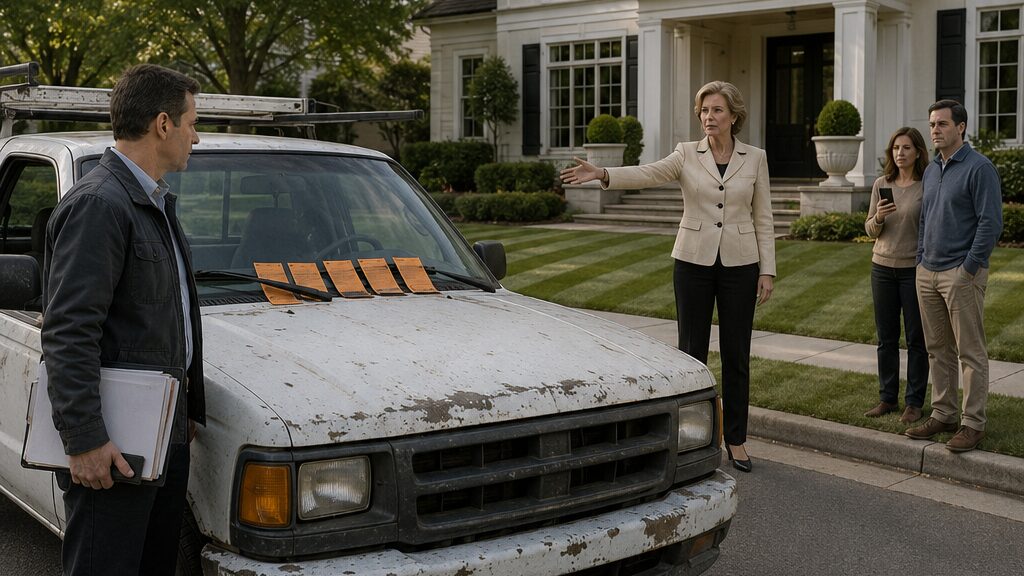
They Kept Ticketing His Old Work Truck Until He Parked It Outside the HOA President’s Perfect Home
Chapter 1: The Fifth Orange Notice Waited Across Her Perfect Lawn
Tyler Moore had already peeled the backing from the orange notice when Ryan Williams stepped out from behind the truck.
“Before you stick that on,” Ryan said, “tell me what changed.”
Tyler froze with one hand raised toward the windshield. Across the street, Deborah Hill stood at the edge of her driveway beside two members of the landscaping committee. Her lawn had been cut into perfect diagonal stripes. White flowers sat in identical stone planters beneath the front windows. Even her trash cans, hidden behind a painted screen, seemed to understand the rules.
Ryan’s truck did not.
Its white paint had faded differently on every panel. A dent ran beneath the passenger door. The rear bumper carried a rust stain from years of hauling tile, lumber, and broken cabinets for weekend repair jobs. Four orange notices rested in a precise row beneath the driver-side windshield wiper.
The fifth was in Tyler’s hand.
“Mr. Williams,” Deborah called, “you were instructed to remove that vehicle from this street.”
Ryan kept his eyes on Tyler. “Was I instructed by the city?”
“The association has authority over community appearance.”
“This is a public curb.”
“You are still inside the community.”
A phone camera appeared in the hands of one of the neighbors standing near Deborah. Another resident slowed while walking a dog, then stopped entirely.
Ryan had expected that. It was why he had placed the earlier notices under the wiper instead of leaving them at home in his file drawer. He wanted the progression visible: fifty dollars, seventy-five, one hundred, one hundred fifty. Four demands written in nearly identical language, all accusing the truck of being inconsistent with community standards.
He set a thick binder on the truck’s hood.
“What defect are you citing?” he asked Tyler.
Tyler glanced toward Deborah. “The vehicle’s overall condition.”
“That isn’t a defect. Is it the dent?”
“I don’t make the standards.”
“The paint?”
“I document violations.”
“The bumper?”
Deborah crossed the street in low heels that made sharp sounds against the pavement. “This performance is unnecessary.”
Ryan opened the binder to a marked page. “I’m asking the compliance officer to identify the violation.”
“You know exactly what the violation is,” Deborah said. “The truck is unsightly.”
A faint heat moved up Ryan’s neck. He had imagined her saying something like that, but imagination had softened it. Hearing the word in front of neighbors made him aware of every scratch, every mismatched patch of paint, every hour the truck had sat outside a rental house while he helped someone review a closing packet or hauled away a demolished sink.
He placed his hand flat on the hood.
“Unsightly according to what measurement?”
Deborah’s expression tightened. “Reasonable people do not require a ruler to recognize neglect.”
Ryan looked at Tyler. “Do you have a photograph attached to the inspection record?”
Tyler said nothing.
“A repair standard?”
Nothing.
“A list of prohibited conditions?”
Tyler lowered the notice slightly.
Ryan took out a small notebook. “Inspection time?”
“Eight forty-two,” Tyler said.
“Who requested the inspection?”
“I’m not required to discuss internal assignments.”
“So this wasn’t part of your regular route.”
Deborah stepped closer. “You deliberately parked here to provoke a confrontation.”
“I parked legally on a public street.”
“You parked directly opposite my home on inspection morning.”
“That’s also legal.”
She pointed toward the cab. “You are harming the appearance of this block to make a personal point.”
Ryan turned one page in the binder and held it outward. “County road map. The association owns the common landscaping strip. It does not own the curb lane.”
The neighbor with the phone lowered it long enough to look at Deborah.
Tyler examined the page without moving closer. “He’s right about the curb.”
Deborah looked at him. “That does not eliminate the covenant violation.”
“What covenant provision?” Ryan asked.
“You have received four notices.”
“I have received four conclusions. I’m asking for the rule.”
For several seconds, the only sound was a sprinkler ticking two houses down.
Tyler looked at the orange form in his hand. Two boxes had been checked: vehicle appearance and general nuisance. The spaces labeled specific condition, photographic reference, and rule number were blank.
Ryan tapped each empty space with the end of his pen.
“Specific condition?”
Tyler swallowed. “Not listed.”
“Photograph?”
“No.”
“Rule number?”
“The appearance clause.”
“That is a category, not a standard.”
Deborah’s composure shifted by less than an inch, but Ryan saw it. She folded her arms too quickly.
“The board is not going to litigate vocabulary on the street,” she said. “Move the truck by noon. If you continue refusing, the account may be referred for collection, with legal costs added.”
The threat changed the air around them. Fifty-dollar tickets were irritating. Collection notices could become liens, attorney fees, and letters printed to look more official than they were. Ryan knew the sequence because he processed similar language for work. Most homeowners paid before learning whether the demand was valid.
He closed the binder.
“You’re threatening collection on a fifth violation your officer cannot describe.”
“I’m informing you of the consequences of continued noncompliance.”
“Then put that in writing too.”
For the first time, Deborah’s voice rose. “Tyler, issue the notice.”
Tyler did not move.
“Now,” she said.
He pressed the orange slip beneath the wiper, beside the other four. Ryan wrote down the time. He also wrote Deborah’s instruction exactly as she had spoken it.
The observers began to drift away once it became clear nobody would shout. Deborah returned to her driveway, but before she reached it, she turned.
“The board meeting is Thursday,” she said. “I strongly suggest you resolve this before then.”
“Why before Thursday?”
She looked at him for a moment too long.
“Because unnecessary disputes waste everyone’s time.”
She walked back across the striped lawn.
Tyler gathered his clipboard and headed toward a gray sedan parked at the corner. Ryan followed until they were beyond easy hearing distance.
“You could have refused,” Ryan said.
Tyler unlocked the car but did not open the door. “I could lose the contract.”
“That doesn’t make the notice valid.”
“I didn’t say it did.”
Ryan looked back at the truck. Five orange rectangles glowed against the chipped white paint.
“Why did she need it issued today?”
Tyler’s eyes flicked toward Deborah’s house. His voice dropped.
“Stop looking only at your own truck,” he said. “Find out who else has been getting those.”
Then he got into the sedan and drove away.
Chapter 2: Every Fine Used Words No Rule Could Measure
The amount had changed four times. The truck had not changed once.
Ryan spread the notices across his home-office desk that evening, arranging them by date. The first had appeared eight weeks earlier on an ordinary Tuesday morning. He remembered lifting the wiper and assuming it was a landscaping flyer until he saw the association logo and the fifty-dollar charge.
Vehicle appearance not consistent with community standards.
No photograph. No rule number. No description beyond the sentence.
He had called the management office during lunch.
“What exactly is wrong with it?” he had asked.
The receptionist had sounded tired before he finished the question. “The compliance officer determines whether a condition is inconsistent with neighborhood appearance.”
“I’m asking what condition he observed.”
“The notice states vehicle appearance.”
“Was it the paint? A missing part? Oil leakage?”
“I don’t have that information.”
“Then what am I supposed to correct?”
“You can request a hearing after paying the administrative deposit.”
That detail had caught him. “A deposit to challenge a fine?”
“It is credited back if the board overturns the violation.”
“And if they don’t?”
“It covers review costs.”
He had kept the notice instead of paying.
Three weeks later, the second one appeared for seventy-five dollars. The third came ten days after that for one hundred. The fourth, one hundred fifty, arrived with bold language warning that unpaid balances could trigger collection action.
Now the fifth sat beside them, its amount left blank pending board review.
Ryan opened the association declaration on his second monitor and searched every occurrence of vehicle, appearance, nuisance, maintenance, and condition. The documents prohibited commercial vehicles above a certain weight, vehicles lacking current registration, inoperable vehicles, and parking that blocked sidewalks or fire access.
His truck met none of those descriptions.
The appearance clause was broader: properties and visible personal items must be maintained in a manner consistent with community standards as adopted by the board.
As adopted by the board.
Ryan followed the cross-reference to the rules index. Landscaping standards existed. Fence-color standards existed. Holiday-decoration dates occupied nearly two pages. There were specifications for mailbox height, basketball hoops, portable storage containers, and the permitted shade range for exterior beige.
There was no adopted vehicle-appearance schedule.
He searched the board minutes going back ten years. The association had discussed drafting one twice. Both discussions ended with instructions to obtain legal review. No final standard appeared in later minutes.
Ryan leaned back.
The violation process was defective. That did not automatically mean the board had no authority; declarations often contained language broad enough to survive sloppy administration. But it meant the notices were asking him to correct an undefined problem under a standard that appeared never to have been formally adopted.
He returned to the five slips.
Each contained spaces for a photograph number and specific rule citation. Every space was blank.
The next morning, Ryan carried copies to the property-management office in a shopping center two miles from the subdivision. The receptionist sat behind glass beneath a framed sign requesting respectful communication.
“I’d like the inspection records for these notices,” he said.
She looked at the orange pages. “You need to submit that online.”
“I did. The portal closed the request as resolved and directed me here.”
She typed his address into her computer. Her expression changed.
“Your account has been flagged.”
“For what?”
“Pre-collection review.”
“The newest notice doesn’t even state an amount.”
“The existing balance is three hundred seventy-five dollars.”
“Based on what adopted standard?”
She pressed her lips together. “The board has discretion.”
Ryan placed a copy of the declaration on the counter. “The clause says standards as adopted by the board. Please show me the adopted vehicle-appearance standard.”
“I’m not legal counsel.”
“I’m not asking for an opinion. I’m asking for the document your office is enforcing.”
She left the desk and returned with a thin policy binder. Together they checked the index. Nothing appeared under vehicles except parking and registration.
“There may be a board resolution not included here,” she said.
“Then I’d like that resolution.”
“I’ll ask the manager.”
“And the inspection photographs.”
“If photographs exist.”
Ryan looked at her. “Your notice form has a field for them.”
“It doesn’t require one in every case.”
“What was I supposed to repair after the first notice?”
She glanced toward the closed manager’s door. “Mr. Williams, I understand your frustration.”
He disliked the sentence because it cost her nothing. “Do you?”
“I can place a temporary note on the account.”
“Will that stop collection?”
“No. Only the board can suspend enforcement.”
“When do they review it?”
“Thursday.”
The same meeting Deborah had mentioned.
Ryan wrote down the receptionist’s name, the time, and the fact that no adopted schedule could be found in the office’s enforcement binder. By the time he returned home, an email waited in his inbox.
NOTICE OF PRE-COLLECTION STATUS.
The message gave him ten business days to pay the existing balance and administrative fees. It also warned that additional attorney charges might be added if the matter remained unresolved.
Ryan printed it and placed it behind the orange notices.
For the first time since the ticketing began, he felt something steadier than anger. The empty spaces were no longer signs of careless paperwork. They were openings in the board’s position.
He began a formal records request for all vehicle-appearance citations issued during the previous twenty-four months, including addresses, dates, amounts, inspection records, photographs, hearing outcomes, and related board authorizations.
At nine that night, someone knocked.
Stephanie Johnson stood on his porch holding three orange pages inside a clear plastic sleeve.
“I heard what happened outside Deborah’s house,” she said.
Ryan stepped aside to let her in.
She laid the notices on his desk. One belonged to a pickup with peeling clear coat. One cited a minivan with a mismatched replacement door. The third accused an older mobility van of having visible exterior deterioration.
The language was nearly identical to Ryan’s.
“Where did you get these?”
“People who thought they were the only ones.”
Ryan compared the dates. All three had been issued after the budget vote.
Stephanie watched him notice.
“There are more,” she said. “Most people paid because they didn’t want trouble.”
“How many?”
“I don’t know yet.”
Ryan slid the notices beside his own. Eight orange rectangles now covered most of the desk.
Stephanie tapped the one issued to the mobility van.
“That belongs to Robert Green,” she said. “And he thinks you’re the last person in this neighborhood who should be complaining about vague rules.”
Chapter 3: The Map Filled With Homes That Had Voted No
By the twentieth address, the pattern no longer looked accidental.
Ryan stood over his dining-room table while Stephanie pressed another orange pin into the printed subdivision map. The pins began near the southern entrance, crossed the center loop, and clustered around the older section where homes had smaller garages and longer driveways.
Every pin represented a vehicle-appearance notice issued during the previous two years.
Every one of the first twenty households had voted against the latest budget increase.
“That can’t be right,” Ryan said.
Stephanie handed him the voting list. “Check it again.”
The association had not published individual ballots, but the budget increase had required signed proxies from absent owners. Stephanie had served on the volunteer committee that counted them. She had retained the tally sheets after resigning when Deborah refused to include the committee’s concerns in the meeting minutes.
Ryan compared each address.
No. No. No.
Twenty times.
The records request had produced 114 violation entries, although many were repeat notices against the same properties. Ryan created a spreadsheet with columns for address, vehicle type, alleged condition, amount, date, hearing request, and board connection. He avoided conclusions the data could not prove. A correlation was not yet intent. Some residents who opposed the budget may have owned older vehicles because they lived in the subdivision’s less expensive section.
So he and Stephanie drove every street.
They did not photograph people. They recorded only vehicles visible from public roads and used the same neutral categories: faded paint, dents, mismatched panels, rust, cracked trim, commercial markings.
On Deborah’s block, a board member’s son kept a pickup with a crushed tailgate in the driveway. No citations appeared in the records.
Near the clubhouse, the treasurer’s household had an SUV with peeling paint across the roof. No citations.
A landscaping-committee member owned a van with rust above both rear wheels. No citations.
Ryan sat in the passenger seat as Stephanie wrote the addresses.
“Maybe they fixed the violations before the records period,” he said.
“The van has been like that for years.”
“We still note only what we can verify.”
Stephanie gave him a sideways look. “You sound like you’re preparing to defend them.”
“I’m preparing evidence that won’t collapse when they challenge one detail.”
“That is not the same thing as being honest about what you see.”
He did not answer.
By the end of the afternoon, they had identified seventeen board-connected or board-supporting households with visible vehicle conditions similar to those cited elsewhere. None appeared in the enforcement records.
Ryan returned to the dining table and separated the orange pins by household. Forty-six properties had received at least one appearance citation. Forty-one were confirmed opponents of the budget increase. Three had not voted. Two records were unclear because ownership had changed.
Zero confirmed supporters appeared on the list.
Stephanie placed the budget tally beside the map.
“There,” she said. “Independent lists. Same result.”
It was the small confirmation Ryan had needed. The pattern was real.
But calling it retaliation required more. They needed instructions, communications, or enforcement criteria showing that voting history influenced inspections.
Ryan drafted requests for inspection routes and assignment logs. Stephanie began calling cited homeowners.
The first two refused to speak.
The third said she had paid one hundred twenty-five dollars to avoid a hearing.
A neighbor with a dented sedan agreed to provide documents but asked that his name remain out of any public presentation. Another said his wife served on a school committee with Deborah and could not risk a neighborhood feud.
Fear made the map quiet. Each orange pin represented a household, but most of those households preferred to remain invisible.
Robert Green did not.
He opened his garage before Ryan reached the front step. His mobility van sat in the driveway with a replacement side door in a slightly darker shade of blue. A folding ramp was visible through the rear window.
“I wondered how long it would take you,” Robert said.
Ryan held up an empty folder. “I’m collecting citation records.”
“I know what you’re collecting.”
“Stephanie said you received multiple notices.”
Robert looked at the truck parked at the curb. “Still driving that thing?”
“Yes.”
“Funny how standards change when the ugly vehicle belongs to you.”
Ryan felt the words land before he understood their full direction.
“I’m not here to argue about taste.”
“No. You’re here because someone used the rule against the wrong person.”
“The rule may not have been properly adopted.”
Robert laughed once. It contained no humor. “That your new position?”
“My position is that enforcement was selective.”
“Your position seven years ago was that officers needed flexibility.”
Ryan went still.
Robert stepped into the garage and returned with a weathered file folder. He removed an old orange warning and placed it on the hood of Ryan’s truck.
The paper had faded to pale rust, but the form was the same. Vehicle appearance inconsistent with community standards.
“This was for my old service van,” Robert said. “The one I used before my knees got bad. Deborah wanted it gone because it had company lettering and a primer patch.”
“Commercial markings were covered by a separate rule.”
“Not when it was parked inside my garage. So she needed something broader.”
Ryan remembered meetings from years earlier: folding chairs in the clubhouse, residents complaining about one another’s boats, work vans, trailers, and basketball hoops. He remembered Deborah arguing that a detailed rule could never anticipate every situation.
He also remembered agreeing.
Robert watched recognition move across his face.
“You wrote the committee summary,” he said.
“I helped with it.”
“You defended it at the meeting.”
Ryan looked down at the old notice. There was a handwritten reference number in the corner and, like his, no photograph.
“I don’t remember all the details.”
“You remembered enough to tell everyone that reasonable people could recognize neglect.”
The phrase was almost identical to Deborah’s words outside her house.
Ryan’s throat tightened.
Robert removed the notice from the hood. “You want my records, request them through the association.”
“They may not produce everything.”
“That sounds like your problem.”
“This affects more than me.”
“It affected more than you the first time.”
Robert closed the garage door while Ryan was still standing in the driveway.
Back at the dining table, Ryan said nothing about the encounter until Stephanie slid a scanned document across her laptop screen.
The heading read APPEARANCE-STANDARDS WORKING COMMITTEE. Beneath it were five names.
Ryan Williams appeared second.
A paragraph farther down recommended retaining broad enforcement discretion where fixed standards could not protect neighborhood character.
Stephanie did not accuse him. Her silence was worse.
“How much of this did you write?” she asked.
Ryan stared at the orange pins covering the map.
Before he could answer, Stephanie opened another file: minutes from the meeting where the recommendation had been presented.
A quoted sentence was attributed directly to him.
Reasonable officers must be trusted to address conditions no rulebook can fully describe.
Chapter 4: The Rule He Hated Had Once Carried His Signature
Robert placed the committee minutes on the hood of Ryan’s truck and kept one hand on the page so the wind could not lift it.
Ryan’s own words sat beneath the meeting date.
Reasonable officers must be trusted to address conditions no rulebook can fully describe.
“You said you barely remembered,” Robert said.
Ryan stared at the sentence. “I remembered the committee. I didn’t remember that wording.”
“You wrote the summary.”
“I helped write it.”
Robert’s mouth tightened. “There it is again.”
“What?”
“The difference between doing something and helping do it.”
Stephanie stood several feet away near the curb, holding the folder she had brought from the association archives. She had not spoken since Robert asked Ryan to meet him.
The old orange warning lay beside the minutes. Its edges had softened with age, but the printed accusation was the same one now appearing on Ryan’s truck: vehicle appearance inconsistent with community standards.
Ryan touched the paper with one finger.
Seven years earlier, Robert’s work van had carried the name of his repair business in faded blue lettering. One rear panel had been gray primer after a minor collision. Robert usually parked it inside the garage, but on days when his knees swelled, he left it in the driveway because the extra steps hurt.
Deborah had called it commercial clutter.
Ryan had called the issue complicated.
At the clubhouse meeting, residents had argued over whether a written standard could cover every possible vehicle condition. Someone asked whether a rust spot should be measured. Someone else mentioned missing hubcaps. Deborah said a neighborhood could not protect itself if every judgment required a separate amendment.
Ryan, already working in real-estate law, had explained how discretionary clauses operated.
He had sounded calm. Useful. Informed.
He remembered Robert standing in the back row with both hands resting on the top of a folding chair.
“We weren’t voting on my van,” Robert had said.
Nobody answered him directly.
Instead, they approved broader language.
Ryan lifted his eyes. “I was wrong.”
Robert gave a short nod, as though confirming a fact about the weather. “Yes.”
“I told myself the rule would be used reasonably.”
“You told everyone else that too.”
“I didn’t know Deborah would—”
Robert slapped the minutes lightly against the hood. “You didn’t need to know what Deborah would do. You only needed to know what the rule allowed.”
Ryan felt the instinct to defend himself rise fast and familiar. He could explain that the committee had no enforcement power. He could point out that the declaration already contained broad nuisance language. He could say Robert’s van had also raised a separate issue involving commercial markings.
Every explanation was technically available.
None changed the old orange notice.
“I’m sorry,” Ryan said.
Robert looked at him carefully.
Ryan forced himself not to add anything.
No explanation. No request to be understood. No sentence beginning with but.
“I helped create the language they used against you,” he continued. “Then I forgot because I wasn’t the one paying for it.”
Stephanie looked down at the folder in her arms.
Robert folded the minutes once, precisely. “You expect me to forgive you because your truck got ticketed?”
“No.”
“Good.”
“I’m asking for your records because they may prove the board has been targeting people.”
“You already have my notice.”
“I need the later fines and hearing response.”
Robert’s face hardened again. “You mean the hearing where Deborah told me the board had to trust its officers?”
Ryan remembered that phrase too.
Robert walked to the side door of the van and pulled it open. A metal handrail had been installed beside the seat. The floor had been lowered, and a folding mobility aid rested behind the passenger side.
“I sold the old service van after the third fine,” he said. “Not because the board was right. Because fighting them cost more than I could carry then.”
Ryan looked at the darker replacement door on the current van.
“And now they’ve started again,” Robert said. “They call this one deteriorated because the paint doesn’t match.”
“How much?”
“Two hundred twenty-five so far.”
“I can include it in the pattern without identifying you publicly.”
“You’re still treating this like a filing problem.”
Ryan said nothing.
Robert closed the van door. “People withdrew from your little group this morning.”
Stephanie finally spoke. “Four households.”
“Why?” Ryan asked, though he already knew.
“Someone sent the committee minutes around,” she said. “They think you’re trying to lead a revolt against a rule you wrote.”
“I didn’t write the declaration.”
“You wrote the recommendation that kept it broad.”
Ryan looked down the street. His truck sat beneath five orange notices, the paint chipped where years of work had stripped away the clean surface. Until that morning, he had seen the damage as evidence of honest labor and the notices as proof of someone else’s abuse.
Now the truck looked different.
Not less worthy. Not more deserving of punishment.
Simply imperfect in a way that no longer made him innocent.
“I’ll step back,” he said.
Stephanie’s head lifted. “From what?”
“The presentation. You can organize the records. I’ll provide the analysis.”
“That would make this easier for Deborah,” she said.
“It may make it easier for the residents to trust the evidence.”
Robert studied him. “Or easier for you not to say what you did in front of them.”
Ryan met his eyes.
The accusation was accurate enough to hurt.
“I don’t know yet,” Ryan said.
“That’s the first honest answer I’ve heard from you.”
Robert returned to the garage. Before the door closed, he tossed a thick envelope onto the driveway.
Ryan picked it up.
Inside were six notices, two hearing requests, a payment receipt, and a letter denying Robert’s appeal. The denial cited the board’s duty to preserve neighborhood character but identified no measurable defect.
The signature at the bottom belonged to Deborah Hill.
Ryan carried the envelope home and added the documents to the growing evidence file. By evening, two more residents had emailed to say they no longer wanted their names associated with the challenge. One accused him of using the campaign to repair his reputation.
He did not answer immediately.
Instead, he opened the old committee minutes and read every page.
His participation had been greater than he remembered. He had proposed removing a list of examples because he believed examples could unintentionally limit enforcement. He had recommended the phrase reasonable discretion. He had argued that hearings would protect homeowners from misuse.
At the time, he had considered those safeguards.
Now he could see they depended on the same people exercising the power.
At 10:47 p.m., his phone vibrated.
The message came from Tyler.
The fines were never about the vehicles.
Ryan typed, What were they about?
The typing indicator appeared, vanished, then returned.
No answer came.
A minute later, Tyler sent a second message.
Saturday. 7:00 a.m. Coffee shop by the east drainage easement. Come alone.
Chapter 5: The Landscaping Overrun Was Hiding a Larger Failure
Tyler slid the spreadsheet across the coffee-shop table and kept his hand on it.
“Don’t photograph this.”
Ryan looked at the first column. The entries were organized by month, projected violation count, average collection rate, and anticipated revenue.
The dates began before several of the inspections had occurred.
“You forecasted fines?” Ryan asked.
“I didn’t.”
“Your name is on the file.”
“I built the template for routine compliance reports. The numbers were added later.”
The shop had just opened. A delivery driver stood at the counter waiting for coffee, and an employee stacked cups beneath the register. Tyler had chosen a corner facing both doors.
Ryan lowered his voice. “Who added them?”
“You know who approves the budget.”
“Deborah?”
Tyler stared at the table.
Ryan read the totals. The forecast assumed increasing revenue across three months. Vehicle appearance represented the largest category, followed by landscaping and trash-container violations.
Orange notices had been converted into a line item.
“How much of this was collected?”
“Not enough.”
“Enough for what?”
Tyler released the spreadsheet. “You need to see the wall.”
They drove separately to the eastern edge of the subdivision, where a drainage channel ran behind a row of houses. The landscaping there looked unfinished. Fresh soil covered one slope, and several young shrubs had been planted in an uneven line.
Below them, a retaining wall showed a wide repaired section of new concrete.
Tyler pointed toward it. “That started bowing after the winter storms.”
Ryan stepped closer to the fence. The ground behind the wall dropped sharply toward the channel.
“Was it in the reserve study?”
“Replacement was scheduled for three years from now.”
“But it failed early.”
“Not exactly.” Tyler rubbed both hands over his face. “The inspection report warned about drainage pressure two years ago. The board delayed the work.”
“Why?”
“The reserve account was already low.”
Ryan looked at the repaired wall. “How low?”
“Low enough that the contractor wanted a deposit the association couldn’t cover without moving money.”
“From landscaping.”
Tyler nodded.
The annual landscaping contract had recently increased, and Deborah had promoted new entrance plantings as evidence that the neighborhood remained desirable. The budget increase was supposed to replenish reserves and cover rising maintenance expenses. When residents voted it down, the board had been left with the damaged wall, incomplete landscaping obligations, and little room to admit both problems.
“So she moved the landscaping funds to the wall,” Ryan said.
“Emergency authorization.”
“Without owner approval.”
“She believed the wall couldn’t wait.”
Ryan studied the repaired concrete. On that point, Deborah may have been right. If the wall had collapsed, the repair would have cost more and possibly threatened the nearest properties.
“What did she tell residents?”
“That the landscaping project was delayed by scheduling.”
“And the reserve shortfall?”
“Not disclosed.”
They returned to the coffee shop. Tyler took out a thin folder but held it against his chest.
“I have a daughter,” he said. “College starts next year. This contract is almost half my income.”
Ryan waited.
“I didn’t choose who got inspected at first. I was given routes.”
“At first?”
“When the collections fell short, Deborah started sending addresses.”
“Budget opponents.”
“She called them repeat-problem properties.”
“Were they?”
“Some had prior complaints. Most didn’t.”
“Why did you keep issuing notices?”
Tyler’s jaw moved. “Because the board president signs my renewal. Because the forms said officer discretion. Because every time I left the description general, I told myself I wasn’t accusing anyone of a specific violation.”
“You were still charging them.”
“I know.”
The answer held no performance. Tyler did not ask to be excused.
He opened the folder.
Inside was an email chain printed in black and white. Deborah’s messages were brief, written late at night or early in the morning. She asked Tyler to prioritize visible conditions before the upcoming meeting. She instructed him to increase inspection frequency where voluntary compliance remained low.
One line had been underlined.
Flag the usual suspects before Thursday. We need fine revenue to close the landscaping overage before the treasurer’s report.
Ryan read it twice.
“Usual suspects.”
Tyler looked toward the window. “She meant the people who always challenged the board.”
“She meant the people who voted no.”
“She believed they were more likely to have violations because they resisted community standards.”
“That is not an inspection method.”
“I know.”
“Did the treasurer know?”
“I don’t know. The financial reports showed fine income. I don’t know whether the treasurer knew how the addresses were chosen.”
Ryan set the email beside the spreadsheet.
This was stronger than the map. It showed motive and direction. It did not prove every fine was invalid, but it connected political opposition, revenue pressure, and targeted enforcement.
It also made the story less simple.
The retaining wall had been real. The reserve shortfall was real. The board had not invented the need for money.
Deborah had faced a dangerous maintenance failure and a rejected budget increase. She could have called a special meeting. She could have admitted the delay and requested an assessment. She could have cut visible projects or opened the records.
Instead, she had chosen residents least likely to trust her and made them pay through fines they would be ashamed to contest.
Ryan gathered the papers.
“Will you give these to the association attorney?”
Tyler’s face tightened. “Not yet.”
“Then they can say I fabricated them.”
“You can cite the records and request the originals.”
“Deborah is trying to adopt a vehicle standard Thursday.”
“What?”
Ryan checked his phone. A new association email had arrived while they were talking.
SPECIAL BOARD MEETING NOTICE.
The proposed agenda included adoption of clarified vehicle-maintenance standards, effective immediately, with enforcement authority applying to unresolved existing violations.
“She’s making the rule retroactive,” Ryan said.
Tyler took the phone and read the notice. “She can’t fix missing standards by calling them clarification.”
“She can make the argument. Most residents won’t know the difference.”
Tyler looked at the folder in Ryan’s hands.
“If this comes out, I lose the contract.”
“If it doesn’t, she legalizes what you’ve been doing.”
For several seconds, Tyler seemed smaller than the man who had approached Ryan’s truck with an orange notice. He pulled the spreadsheet back and folded it once.
“I’ll send you the email headers and the report version history,” he said. “Not the originals.”
“Why help at all?”
Tyler looked toward the east drainage easement beyond the window.
“Yesterday she gave me nine new addresses,” he said. “One belongs to a widow with a cracked taillight cover. She voted against the budget because she couldn’t afford the increase.”
He stood.
“I haven’t issued those notices yet.”
Ryan returned home with copies, dates, and enough information to force questions, but not enough to guarantee an answer.
At noon, Deborah’s meeting notice was posted on every mailbox kiosk.
Clarified standards would be voted on in three days.
Chapter 6: Forty-Two Neighbors Could Not Agree on What Justice Meant
Only twenty-three of the forty-two invited residents entered Stephanie’s garage.
Three remained on the driveway with their arms folded. Two left after seeing Ryan beside the evidence table. The rest arranged themselves among folding chairs, storage shelves, and a workbench cleared of tools.
A cardboard box sat in the center of the table.
Stephanie had written ENFORCEMENT RECORDS across one side.
“We need to decide who speaks Thursday,” a homeowner near the door said. “And I don’t think it should be him.”
Nobody asked who he meant.
Ryan stood at the back rather than beside the map. He had spent the previous night preparing to explain the missing vehicle standard, the citation pattern, the projected fine revenue, and the retroactive rule proposal.
None of it mattered until he answered the older question.
Stephanie closed the garage door.
“Before we discuss the meeting,” she said, “Ryan has something to say.”
A resident in the first row muttered, “We’ve all seen the minutes.”
Ryan walked to the table and placed Robert’s faded orange notice beside his own first citation.
“I was on the appearance-standards committee seven years ago,” he said. “I recommended keeping the language broad.”
Someone laughed without humor.
Ryan continued. “I argued that reasonable officers should have discretion because a rulebook couldn’t describe every condition.”
“And now that your truck got hit, discretion is corruption?” another resident asked.
“No. It was dangerous before it reached my truck.”
The garage went still.
“I didn’t understand that because I trusted the people using it. More honestly, I trusted them while their decisions affected someone else.”
He looked toward Robert, who stood outside the open side door but had not taken a chair.
“I helped create the language used against Robert’s van. I defended it when he objected. I was wrong.”
A woman near the workbench crossed her arms. “So why should we trust your legal analysis now?”
“You shouldn’t because of my job. Check the documents yourselves.”
Ryan placed copies of the declaration, policy binder index, citation forms, and board minutes on the table.
“The standard referenced in these notices was never adopted. The forms lack specific conditions. The citation addresses align with budget opposition. But my role does not disappear because the board later abused the rule.”
Stephanie watched the room.
One man said he wanted every fine refunded immediately. Another warned that refunds would come from association funds, meaning homeowners would pay themselves back through higher dues. A resident near the garage door wanted the matter handled privately to protect property values.
“Buyers hear ‘recall’ and ‘financial misconduct,’ and they walk,” she said.
“They’ll also walk when they see collection letters over paint,” someone answered.
A third resident wanted Deborah removed but opposed any special assessment. Another said the retaining wall had protected homes and asked what else the board should have done after the budget failed.
The arguments overlapped until Stephanie struck the evidence box with her palm.
“We are not going to solve the budget tonight.”
“What are we solving?” someone asked.
“Whether the board gets to hide it by choosing who to fine.”
The question quieted them.
Ryan explained the recall procedure. Under the bylaws, seventeen verified owner signatures could compel an emergency membership ballot. They already had fifteen residents willing to sign, but two had withdrawn after learning about Ryan’s past.
“We need seventeen before Thursday?” a resident asked.
“To demand the ballot at the meeting,” Ryan said. “The actual vote would happen afterward under the notice rules.”
“And if the attorney threatens us?”
“The association attorney represents the association, not Deborah personally. But any public accusation needs to stay tied to documents.”
As if summoned, Stephanie’s phone chimed.
She read the email aloud. The association attorney warned homeowners against distributing unverified allegations and stated that defamatory claims could expose individuals to legal liability and impose defense costs on the association.
Several people shifted in their chairs.
“There,” said the woman worried about property values. “This is exactly what I mean.”
Ryan took the phone and read the wording.
“It does not say we cannot present records at an open meeting.”
“It says we can get sued.”
“It says false statements can create liability. So we do not make claims beyond what the records show.”
“And the email?” someone asked.
“I have a copy, metadata, and report history. Tyler has not agreed to appear.”
The room reacted at once.
“So your best evidence comes from a man who won’t stand behind it?”
“He is afraid of losing his contract.”
“We’re afraid of losing our homes.”
The sentence cut through Ryan’s prepared response.
For years, he had believed precision could neutralize fear. State facts carefully. Cite the correct section. Avoid claims that exceeded the evidence.
But the people in Stephanie’s garage were not deciding an abstract question. Some had paid fines from grocery money. Some feared assessments. Some feared liens. Some wanted revenge badly enough to ignore the reserve crisis. Others wanted silence badly enough to accept retaliation.
Ryan could not give them a clean version because none existed.
“I’m not asking anyone to follow me,” he said. “I’m asking you to choose what rule you want applied when the board dislikes you.”
Robert stepped inside.
He carried his newest orange notice folded lengthwise. Without looking at Ryan, he placed it in the cardboard box.
The sound was almost nothing.
Then another resident added hers.
A third followed.
Soon the box contained notices with different dates, amounts, and addresses. Some were bright orange. Older ones had faded toward brown. Each represented a private moment when someone had lifted a windshield wiper or opened an envelope and realized the neighborhood had decided something about them.
Robert remained beside the table.
“This doesn’t mean I trust him,” he said.
Nobody needed clarification.
“It means the rule was wrong when he supported it and wrong when they used it on him.”
Stephanie counted the residents willing to sign the recall demand.
Seventeen.
Exactly enough.
The meeting ended without unity. Five homeowners still refused to participate. Two wanted their documents used anonymously. One withdrew after another argument over assessments.
But the evidence box remained full.
Ryan carried it to his truck after dark. As he set it on the passenger seat, Deborah stood at the end of Stephanie’s driveway.
She had come alone.
“I need five minutes,” she said.
Stephanie moved toward them, but Ryan shook his head.
Deborah waited until they were beside the truck.
“The board can rescind your current fines,” she said. “All of them.”
Ryan looked through the windshield at the box of orange notices.
“In exchange for what?”
“You withdraw your hearing request and do not present unsupported accusations Thursday.”
“Are the other fines rescinded?”
“I am discussing your account.”
“Then no.”
Her face remained composed, but exhaustion showed beneath it.
“You think exposing this will save the neighborhood,” she said. “It may bankrupt it.”
“Then show everyone the books.”
“They voted against the increase without understanding the consequences.”
“So you decided who should pay anyway.”
“I decided not to let a retaining wall fail because people preferred a lower number on a ballot.”
Ryan studied her. For the first time, he could see the fear beneath her control.
It did not make the offer cleaner.
“Erase my fines,” he said, “and I still bring the box.”
Deborah looked through the windshield.
“You are choosing public damage over a practical resolution.”
“No. I’m refusing a private one.”
She drew a folded paper from her bag and placed it beneath the truck’s windshield wiper.
It was not another violation notice.
It was a written settlement offer, expiring at noon the next day.
Ryan watched her walk back toward the street.
The document promised to clear his account completely if he canceled his presentation and released the association from all related claims.
At the bottom was a blank signature line.
Above it, in bold type, was the deadline.
Chapter 7: He Read Her Email After Reading His Own Confession
Deborah Hill introduced the new vehicle rule before Ryan was recognized to speak.
She stood behind the folding table at the front of the clubhouse, one hand resting on a stapled packet labeled CLARIFIED VEHICLE-MAINTENANCE STANDARDS. The room was already full. Residents lined the back wall and stood in the doorway. The cardboard evidence box sat on the floor beside Ryan’s chair, packed with orange notices.
“The board’s intent,” Deborah said, “is to remove ambiguity and ensure consistent enforcement going forward.”
“Going forward?” someone called. “It says unresolved violations.”
The meeting moderator raised a hand. “Please allow the president to finish.”
Deborah did not look toward the voice. “Existing cases remain subject to review under clarified standards where the underlying condition continues.”
Ryan opened his binder to the marked page. The proposal defined faded paint, visible body damage, mismatched exterior panels, and other conditions deemed materially inconsistent with neighborhood character. The definitions were still broad, but they were more specific than anything the board had used before.
If adopted, Deborah would argue that Ryan’s continuing violations were not retroactive at all. The truck still had the same dent. The paint was still chipped. The condition continued.
Stephanie leaned toward him. “She’s trying to make the notices valid after the fact.”
“I know.”
“Then object.”
Ryan kept his eyes on Deborah. “Not yet.”
The board secretary read the motion. A board member seconded it.
The moderator asked for discussion from owners. Ryan raised his hand.
Deborah called on a resident near the front instead.
The resident asked whether stricter standards would improve resale values. Deborah answered smoothly, citing curb appeal, lender perceptions, and complaints from homeowners who believed visible deterioration weakened the community’s image.
Another resident asked about fines already paid.
“Those matters have been handled under the authority existing at the time,” Deborah said.
Ryan raised his hand again.
This time, too many residents turned toward him for the moderator to ignore.
“Mr. Williams,” the moderator said, “you have five minutes.”
Ryan stood and carried three items to the projector table: his first orange notice, the old committee minutes, and a flash drive.
Deborah’s eyes moved first to the notice, then to the minutes.
Ryan connected the drive. The subdivision map appeared on the screen, covered with marked addresses.
Before anyone could react, he replaced it with a scanned page from seven years earlier.
His own name was visible beneath the committee heading.
“I need to start with this,” he said.
Stephanie’s shoulders eased slightly.
Ryan faced the room.
“Seven years ago, I served on the appearance-standards committee. I recommended keeping the enforcement language broad. I argued that reasonable officers should be trusted to address conditions no written list could fully describe.”
A murmur passed through the chairs.
Deborah folded her hands.
Ryan continued. “That language was used against Robert Green’s work van. I supported it then because I believed hearings and reasonable judgment would protect residents from misuse.”
Robert stood along the side wall, expression unreadable.
“I was wrong,” Ryan said. “I helped create the discretion now being used against my truck and against other vehicles in this neighborhood.”
A board-aligned neighbor spoke from the second row. “Then this is your mess too.”
“Yes.”
The direct answer quieted the room more effectively than denial would have.
Ryan placed his first orange notice beneath the document camera. Its blank fields appeared on the screen.
“No specific condition. No photograph. No adopted vehicle standard. No rule number beyond a general appearance clause.”
He advanced to the next image: Robert’s faded notice.
“The same process existed years ago. I ignored the danger because I was not the homeowner paying the fine.”
Deborah leaned toward her microphone. “Mr. Williams, your time is limited. Please address the current proposal.”
“I am.”
He returned to the map.
Forty-six cited properties appeared in orange. Seventeen board-connected or board-supporting homes with comparable visible vehicle conditions appeared in blue.
“This map is based on twenty-four months of association records and publicly visible conditions documented using the same categories. Forty-one of the forty-six cited households opposed the most recent budget increase. No confirmed budget supporter appears in the citation list.”
A resident near the aisle said, “That doesn’t prove why they were inspected.”
“No,” Ryan said. “The map proves a pattern. The communications show direction.”
He opened the email chain.
Deborah stood. “I object to the publication of unverified private correspondence.”
Ryan looked at the moderator. “The messages were produced with metadata and report-history records. I will read only the language relevant to enforcement.”
The association attorney, seated near the board table, leaned toward Deborah and spoke too quietly for the room to hear.
Ryan read the line.
“Flag the usual suspects before Thursday. We need fine revenue to close the landscaping overage before the treasurer’s report.”
The room changed.
Not loudly at first. A few residents turned toward Deborah. Someone in the back said, “Usual suspects?”
Deborah took the microphone.
“That phrase has been stripped of context.”
Ryan looked at her. “What was the context?”
“The board was facing a legitimate financial emergency.”
“Why were budget opponents selected for inspection?”
“They were not selected because of their votes.”
“The addresses align almost completely.”
“They were properties with repeated compliance concerns.”
“Then produce the prior complaints.”
“The board is not required to litigate every operational decision in a public meeting.”
A man near the door lifted an orange notice from the evidence box. “You litigated it on my windshield.”
The moderator called for order.
Deborah did not sit. “The retaining wall on the east drainage channel was at risk of failure. The reserve account was insufficient. The budget increase failed. The board had a duty to protect homes and common property.”
Ryan switched the projector image to photographs of the repaired wall.
“I agree the wall required action.”
That answer surprised her.
He continued. “The emergency was real. The board could have disclosed the reserve shortfall, requested a special assessment, delayed the entrance landscaping, or called an owner meeting.”
“And caused panic,” Deborah said. “Property values were already softening. Contractors were demanding deposits. A public announcement that reserves were inadequate would have harmed every owner in this room.”
“So you hid the shortfall.”
“I managed it.”
“With projected fine revenue.”
“With lawful association revenue.”
“Collected disproportionately from people who opposed you.”
Deborah’s voice sharpened. “From properties with visible violations.”
Ryan glanced at the truck notice still projected beside his old committee statement.
“That is what discretion sounds like when the person using it gets to define both the problem and the target.”
The room broke into overlapping questions. Residents demanded the reserve balance, the contractor invoices, and the amount transferred from landscaping. One asked how much had actually been collected in vehicle fines. Another wanted to know whether refunds would come from dues.
Deborah raised both hands.
“You deserve the full financial picture,” she said. “The current reserve deficit, including pending drainage work, is significant. If these fines are suspended and the board is recalled, the next leadership group will still face that deficit. There will almost certainly be a special assessment.”
The anger in the room faltered.
Money made the consequences immediate.
“How much?” someone asked.
“The final figure is under review.”
“That means you know,” Stephanie said.
Deborah looked at her. “It means the amount depends on the audit and the remaining contractor obligations.”
Ryan understood the move. Deborah was not inventing the financial cost. She was placing it where everyone could finally see it, beside the misconduct, forcing residents to admit that honest governance would be expensive.
A homeowner near the front turned toward Ryan. “So even if you win, we pay more?”
Ryan could have blamed Deborah entirely. The room was ready for it.
Instead, he said, “Probably.”
The homeowner shook his head.
Ryan went on. “The wall still has to be paid for. The reserves still have to be repaired. Canceling unsupported fines does not erase those costs.”
“Then what are we accomplishing?” another resident asked.
“Choosing whether the bill is shared openly or assigned quietly to people the board thinks won’t be defended.”
The room settled again.
Robert stepped forward from the wall.
“The first time this rule hit me,” he said, “most of you thought it was about an ugly van. Now you know it was always about who got to decide whose problem counted.”
He did not look at Ryan.
The association attorney whispered to the moderator. The moderator reviewed the bylaws, then announced that an owner petition containing seventeen verified requests could compel an emergency recall ballot.
Stephanie lifted the signed pages.
Deborah’s face changed, not into panic but something closer to disbelief.
“You are replacing experienced leadership in the middle of a financial crisis,” she said.
Stephanie handed the petition to the moderator. “We are asking the owners to decide.”
The moderator began verifying signatures.
Ryan returned to his chair. The evidence box remained open at his feet. From where he sat, he could see his first orange notice beside Robert’s older one, both flattened beneath the projector light.
The moderator counted once, then again.
Before he announced the result, seventeen residents raised their hands.
Chapter 8: The Truck Stayed Scarred After the Rules Finally Changed
The recall passed by eleven votes, and the notice announcing it included a warning about a special assessment in the second paragraph.
There was no celebration.
Six weeks after the meeting, residents filled the clubhouse again to hear the interim board’s report. Deborah sat in the third row rather than behind the front table. Tyler stood near the side door holding a file box of inspection records.
The independent review had confirmed that vehicle citations lacked consistent standards and that enforcement patterns required further audit. All unresolved appearance fines were suspended. Refunds for paid fines would be considered after the association determined which charges had been supported by other valid provisions.
The reserve deficit remained.
The retaining-wall repair, delayed drainage work, legal review, and unfinished landscaping contract would require money the association did not have. The interim board proposed a smaller special assessment than the one residents had rejected months earlier, paired with monthly financial reports and an outside reserve study.
Several residents complained anyway.
Ryan understood them. Accountability did not reduce the number printed on the invoice.
The revised vehicle standards were passed that night. They defined inoperability, registration requirements, fluid leakage, safety hazards, and body damage severe enough to create sharp exposed edges. Faded paint, ordinary dents, and mismatched panels were not violations by themselves. Every citation now required a photograph, a specific rule number, a correction method, and review by someone other than the inspecting officer.
Tyler submitted his assignment logs and declined to seek another compliance contract.
“I should have refused earlier,” he told Ryan near the door.
“Yes,” Ryan said.
Tyler nodded, accepting the answer. “I know.”
Deborah left before the final vote. As she passed Ryan, she paused.
“They will blame the interim board when the assessment arrives,” she said.
“Some will.”
“And the wall would still have failed if I had waited for everyone to agree.”
“I know.”
She looked toward the crowded room. “You think transparency makes people brave.”
“No. I think it gives them the chance to be responsible.”
Her expression tightened, but there was no sharp reply left. She walked out alone.
After the meeting, Ryan found Robert beside the mobility van in the parking lot. The darker blue replacement door caught the light from the clubhouse windows.
“The new rule passes,” Ryan said.
“I heard.”
“Your current fines are suspended.”
“I heard that too.”
Ryan waited, then said, “I’d like to help with your refund packet.”
Robert closed the van’s side door.
“I can handle the packet.”
“All right.”
Ryan looked toward the clubhouse entrance, where Stephanie was stacking unused ballots.
“I was also thinking we could get coffee sometime.”
Robert studied him long enough that Ryan wished he had not asked.
“I voted for the standards,” Robert said. “I signed the recall. That doesn’t mean we’re friends.”
“I understand.”
“No, you understand the sentence. Understanding the rest may take longer.”
Robert got into the van.
Before closing the door, he added, “Serve on the committee if they ask you. This time, write down what the rule cannot do.”
Then he drove away.
The request came the next morning.
Stephanie called while Ryan stood in his driveway removing the last orange notice from beneath the truck’s windshield wiper. The paper had faded along one edge from sun exposure. A crease ran through the amount.
“The interim board wants you on the standards-review committee,” she said.
Ryan looked at the notice in his hand.
“Robert said they might.”
“Will you do it?”
He glanced at the truck. The dent remained under the passenger door. The chipped paint still exposed gray primer along the bed. Nothing about the vehicle had improved during the fight.
That was no longer the point.
“Yes,” he said. “But I don’t chair it.”
Stephanie was quiet for a moment. “Good.”
He carried the notice into his home office. The revised standards binder lay open on the desk beside the old committee minutes. Ryan placed the orange page inside the front cover rather than filing it with the canceled charges.
At the first committee session, he argued for definitions, required evidence, appeal timelines, and automatic review of repeat fines. When someone suggested including a general clause for unforeseen conditions, Ryan asked who would be protected if that judgment was wrong.
No one had an immediate answer.
They left the clause out.
The special assessment passed narrowly the following month. Some residents paid in full. Others used the installment plan. A few blamed Deborah. A few blamed Ryan. Most blamed both of them depending on the day.
The audit did not produce a simple ending. Some paid fines were refunded. Others remained under review because the original notices also involved registration or parking violations. The association canceled Ryan’s full balance, but he did not frame the letter.
He kept only the first orange notice in the binder.
On the first Saturday after the new standards took effect, Ryan washed the truck in his driveway. He removed dirt from the wheel wells and cleaned the windows, but he did not repaint the panels or cover the dent.
When he finished, he parked beneath the afternoon light and read the published rules once more.
Specific condition.
Photographic evidence.
Named provision.
Defined correction.
Independent review.
Across the street, a neighbor glanced at the truck and kept walking.
Ryan set the binder on the passenger seat and closed the door. The truck remained scarred, useful, and fully visible.
For the first time in years, the rule beside it was required to be just as clear.
The story has ended.