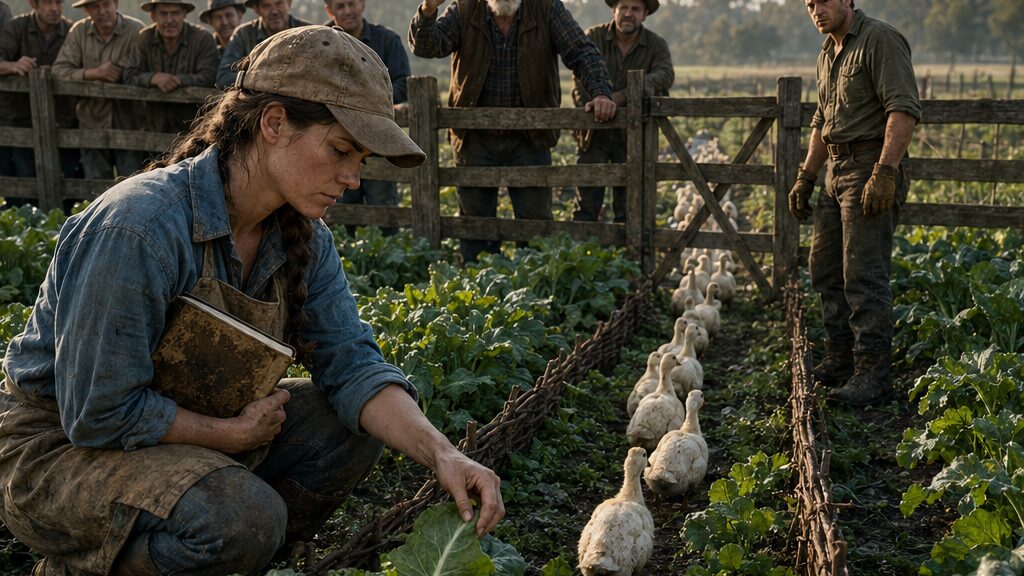
They Laughed When She Released the Ducks, Until the Harvest Exposed What the Field Had Been Hiding
Chapter 1: The Ducks Entered the Rows While Everyone Watched
The first duck slipped through the gate just as laughter rose behind Rachel Walker.
It was not nervous laughter. It carried cleanly across the field, loud and deliberate, from the cluster of farmers leaning against the boundary fence. Someone slapped a fence post. Another man called out something Rachel could not make out over the rustle of leaves and the excited clucking of the flock.
The duck paused on the packed-earth lane, pale head tilted, as if even it understood that half the valley had come to watch Rachel make a fool of herself.
“Keep them moving,” she told Dennis.
Dennis Harris lifted the hinged panel at the rear of the holding pen. “They’re moving.”
“Not into the lettuce.”
“I know where the lettuce is.”
Rachel did not look at him. She watched the lead duck step between the low woven barriers she had spent four evenings building from willow strips and salvaged wire. One after another, the others followed. Their bodies made a pale, rippling line between the green rows.
For three seconds, the field behaved exactly as she had imagined.
Then Gregory Miller spoke from behind the fence.
“You planning to harvest vegetables or feathers?”
The laughter came again.
Rachel opened the stained notebook tucked into her apron pocket. At the top of the page she had written: Lane Three, 6:42 a.m. She drew a short line beneath it and checked the kitchen timer clipped to her belt.
Gregory stepped away from the others. His gray beard had gone almost white since Rachel had last spoken to him at her father’s funeral. He wore the same brown canvas jacket he had worn for years, the cuffs dark with grease and soil. People listened when Gregory walked forward. He had been farming the north slope longer than Rachel had been alive, and he carried that fact like another tool on his belt.
“You file anything with the county?” he asked.
Rachel crouched beside the nearest row and turned over a leaf.
A striped beetle clung to its underside. Two more hid near the stem. She pinched one between her gloved fingers and held it low enough that the nearest duck saw the movement. The bird lunged, swallowed it, and began searching the leaves.
“I asked you a question,” Gregory said.
“I heard it.”
“That isn’t an answer.”
She moved three plants farther down and checked another leaf.
Dennis stood at the rear gate with one hand on the panel. He had warned her that inviting no one would not keep anyone away. In the valley, unusual work became public business before breakfast. Gregory had likely heard about the ducks from the feed-store clerk, who had watched Rachel buy two sacks of layer pellets and ask whether portable poultry fencing could be repaired with baling twine.
Now six neighboring farmers stood behind the boundary fence. Gregory’s adult son was among them, arms folded. None had come to help construct the lanes. None had asked why Rachel had stopped ordering the treatment used on nearly every vegetable field in the county.
They had come for the failure.
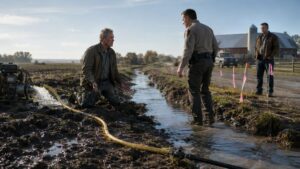
The ducks moved steadily, necks darting beneath the outer leaves. Their feet pressed shallow marks into the damp lane but did not enter the raised beds. Rachel had measured the barriers twice. She had studied how the flock followed one another through narrow spaces. She had started with twelve birds near the barn, then twenty in a fallow strip.
This morning she had released all forty-three.
A foolish number, according to Dennis.
A necessary number, according to the unpaid invoices in the kitchen drawer.
Gregory rested his forearms on the fence. “Those birds cross into the irrigation ditch, everybody below you gets to share whatever they carry.”
“They won’t reach the ditch.”
“You know that?”
Rachel wrote the time beside Lane Three.
“I asked if you know it.”
She looked up at last. “I built two gates between here and the ditch.”
“You built willow baskets.”
“They’re barriers.”
“They’re kindling.”
A few of the men smiled. Gregory did not. His expression had sharpened, and Rachel could see the concern beneath the performance. That almost made it worse. Ridicule she could dismiss. Concern gave him permission to interfere.
Dennis lowered his voice. “Rachel.”
She followed his gaze. The flock had reached the first turn in the lane. The lead birds hesitated before the cross panel, then redirected exactly as planned and began moving along the next row.
The laughter weakened.
One farmer leaned forward.
The pale line bent cleanly through the field, contained between the barriers. Ducks stretched their necks beneath the plants, plucking insects from the leaves and weeds from the bed edges. Their movement was messy in detail but orderly from a distance.
Rachel checked the timer. Nine minutes.
She opened the next divider.
“Now,” she said.
Dennis tapped the side of the lane with a narrow board. The lead duck stepped through. The flock followed in a tight procession, leaving the first section behind.
Rachel entered the cleared lane. She examined the soil, then the plants. One leaf had been torn. Two seedlings leaned slightly where a duck had brushed the barrier. The damage was less than she had expected.
She turned over leaf after leaf.
On the untreated row beside it, she counted eleven beetles across five plants.
In the cleared lane, she found three.
The small difference struck her with enough force that she forgot the people watching. She checked another plant, then another.
Two beetles. Then none.
Her pulse moved into her throat.
Dennis saw her face. “What?”
“Get the jars.”
“What did you find?”
“Get them.”
He hurried toward the equipment shed.
Gregory called from the fence. “Something wrong already?”
Rachel stood and brushed soil from her gloves. She could tell him. She could walk over with the leaves and the counts and show him that the birds were doing exactly what she had brought them to do.
Instead, she put the notebook back into her apron.
“Nothing’s wrong.”
The words sounded defensive even to her.
Gregory’s mouth tightened. “Then you won’t mind if I come look.”
“You’re not coming into the field.”
That restored the spectators’ attention. Gregory straightened.
“This isn’t a private garden,” he said. “Your irrigation runs into shared channels. Your field borders three others.”
“It’s still my acreage.”
“Partly your aunt’s.”
Rachel felt heat climb beneath her collar. Kathleen’s name did not belong in Gregory’s mouth, not here, not in front of men who had already decided Rachel was a daughter pretending to be a farmer.
“Stay behind the fence,” she said.
Gregory looked past her toward the ducks. “You think refusing questions makes you look sure of yourself?”
“No.”
“What does it make you look like?”
“Busy.”
A man behind him laughed once, uncertainly.
Gregory did not. “I’ll call the county office before sunset.”
Dennis returned carrying four glass jars and stopped when he heard it.
Rachel’s grip tightened around the notebook through the apron fabric.
“Tell them what you saw,” she said.
“I intend to.”
“Tell them the birds stayed in the lanes.”
“So far.”
“Tell them the plants are standing.”
“So far.”
“Tell them you came here hoping they wouldn’t.”
The field went quiet except for the ducks.
For a moment Gregory looked less like the valley’s unofficial authority and more like the man who had once sat at Rachel’s kitchen table with her father, both of them speaking in low voices after she had gone upstairs. Then the older expression returned.
“I hope you understand what happens if you’re wrong,” he said.
He walked back toward the road. The others followed more slowly, their interest shifting between Gregory’s retreat and the pale flock moving through Rachel’s green rows.
Dennis set the jars beside her.
“You didn’t need to say that.”
“He didn’t need an audience.”
“That doesn’t make him wrong about the county.”
Rachel crouched and began dropping beetles into separate jars. “Lane Three. Cleared and untreated comparison. Label them.”
Dennis did not move.
She looked up. “What?”
“The south divider.”
“What about it?”
“I told you the bottom stake was loose.”
“You tightened it.”
“I braced it.”
“That’s the same thing for one morning.”
“No, it isn’t.”
Rachel rose. Across the field, the flock was approaching the next turn. The lead duck bumped the woven panel and redirected. The second followed. The third pressed its breast against the lower edge.
The barrier bowed.
Rachel watched it spring back.
“See?” she said.
Dennis’s face remained fixed on the lane. “You should have let me replace it.”
“With what money?”
“That doesn’t make the willow stronger.”
She ignored him and wrote the beetle count. Behind them, a truck engine started near the road. Gregory was leaving to make good on his threat.
Rachel turned another leaf, forcing her attention onto the clean underside.
A sudden flutter came from the south end.
One duck had fallen behind the flock. It waddled along the barrier, testing the woven edge with its bill. When it reached the loose section, the bottom lifted above the soil.
The duck lowered its head and pushed beneath it.
Rachel was already running when its pale body disappeared into the tender planting row.
Chapter 2: One Broken Divider Changed the Whole Argument
Rachel heard the stems snapping before she reached the open divider.
The sound was small—dry, quick breaks beneath webbed feet—but each one landed in her chest. The first duck had entered the tender row. Three others followed before she dropped to her knees and pressed the barrier down with both hands.
“Dennis, close the rear gate!”
He was running before she finished.
The scattered birds did not move like the disciplined line Gregory had seen. They spread toward the young plants, excited by open soil and insects. One stepped directly onto a seedling. Another shook a leaf hard enough to tear it from the stem.
Rachel lunged for the nearest bird. It dodged her, wings beating, and drove two more ducks deeper into the row.
“Easy,” Dennis shouted. “Don’t chase them.”
“I know that.”
“You’re chasing them.”
He entered from the far end carrying the narrow board. Instead of advancing, he crouched and tapped the soil behind the birds. Their heads lifted. One turned toward the lane opening. The others followed its movement.
Rachel stayed still, though every instinct told her to grab them.
Dennis guided the first bird through the gap. Five more trailed after it. Rachel counted seven in the crop row, then eight. The last duck stopped beneath a broad leaf and swallowed something from the stem before following the others out.
Dennis dropped the barrier and drove his boot against the loose stake.
For several seconds neither spoke.
The ducks resumed their line as if nothing had happened.
Rachel looked down the damaged row. Broken seedlings lay at angles in the soil. Leaves were pressed into mud. The destruction covered no more than fifteen feet, but it was concentrated and obvious.
Dennis exhaled through his nose. “I told you.”
“Not now.”
“I told you yesterday. I told you Monday.”
“I said not now.”
She stepped into the row and began lifting plants. Some had only been bent. She pressed soil around their roots and tied the worst stems to thin sticks from the barrier pile.
Dennis watched her for a moment, then knelt beside another plant.
“This one’s gone,” he said.
“Set it aside.”
“So you can count it?”
“So I can replant.”
“You don’t have enough starts.”
“I’ll thin the north bed.”
“That puts the north bed behind.”
Rachel pulled a crushed leaf free. “Then stop talking and help.”
They worked without speaking. The flock progressed through the next lane under the closed gates, their pale backs moving above the woven panels. The sight that had looked deliberate twenty minutes earlier now felt precarious.
Rachel found a beetle on a damaged plant, then another. A duck had stripped a cluster of them from the stem beside it. She turned over leaves along the section the birds had crossed.
Almost every underside was clean.
The discovery offered no comfort. It was proof tangled with damage, usefulness mixed with carelessness. She placed three beetles in one of the jars and wrote the counts in her notebook.
Dennis glanced over. “You’re recording this row?”
“Of course.”
“All of it?”
Rachel looked at the broken seedlings.
“All of it.”
A truck slowed on the road.
Dennis stood first.
Gregory’s pickup stopped beside the boundary fence. He got out with his phone already in his hand.
“You called him,” Rachel said.
Dennis stared at the truck. “Not about this.”
“What did you call him about?”
“I didn’t call him today.”
Gregory opened the gate at the roadside but stopped at the field boundary. His eyes moved from the resecured divider to the muddy row.
“That didn’t take long,” he said.
Rachel rose. “Stay there.”
“I am staying here.”
He lifted the phone and took a photograph.
“Put that down.”
“It’s my side of the fence.”
“You’re photographing my crop.”
“I’m documenting livestock outside the controlled lane.”
“They were out for less than two minutes.”
Gregory took another picture. “Then the damage should be hard to see.”
Rachel stepped toward him, but Dennis caught her arm.
“Don’t,” he said quietly.
She pulled free. “How did you know?”
Gregory lowered the phone. “Know what?”
“That something happened.”
“I drove past.”
“You left ten minutes ago.”
“I stopped at the road bend to make the call.”
Rachel turned to Dennis. “What did you tell him?”
Dennis wiped his palms against his jeans. “Before today?”
The answer changed the air between them.
Gregory looked away, giving neither of them privacy but pretending to.
Rachel’s voice dropped. “When?”
“Two nights ago.”
“You went to him?”
“I saw him at the feed store.”
“And you told him what?”
“That the dividers weren’t ready.”
“They were ready.”
Dennis pointed toward the damaged row. “That one wasn’t.”
“You told him before anything happened.”
“I told him because something could happen.”
“You work for me.”
“I work on the farm. That doesn’t mean I have to watch you risk it and keep my mouth shut.”
Gregory put the phone into his jacket pocket. “He was trying to keep this from becoming exactly what it became.”
Rachel faced him. “You don’t get to use him against me.”
“I didn’t ask him to make the barrier fail.”
“No. You only brought people to laugh when it did.”
Gregory’s jaw tightened. “I brought neighboring growers because what happens here can reach their water and their contracts.”
“The ducks never went near the ditch.”
“Today.”
“They entered one planting row.”
“And you lost control of them.”
“For less than two minutes.”
“That sentence won’t look better in a county report.”
He walked back toward his truck.
Rachel followed as far as the fence. “Make sure you include the beetle counts.”
Gregory stopped.
“The birds cleared insects from the damaged section,” she said. “Photograph that.”
“I can photograph a broken plant. I can’t photograph an insect that isn’t there.”
“You could inspect the comparison row.”
“I’m not the one running an experiment without records.”
“I have records.”
“You have a notebook in your apron.”
“It contains dates, lane times, bird numbers and counts.”
“Does it contain a containment plan?”
Rachel said nothing.
Gregory’s expression shifted—not triumph, exactly, but confirmation.
“I’ll send the photographs with the complaint,” he said.
When his truck disappeared down the road, Rachel returned to the row. Dennis was resetting the bottom stake with a length of scrap metal.
“You could have come to me,” she said.
“I did.”
“You could have kept coming.”
“You kept saying there wasn’t money.”
“There isn’t.”
“So that was the end of the conversation?”
“What did you expect me to do? Cancel the trial and spray?”
“I expected you to hear that a weak barrier was weak.”
She opened her notebook. “How many plants?”
“Rachel.”
“How many?”
He counted with her. Eleven destroyed. Seven badly damaged. Four likely to recover.
By noon they had returned the flock to the pen. The empty crop lanes looked wider without the ducks, exposing every uneven stake and patched section.
In the equipment shed, Rachel found a coil of better wire beneath a rusted seed spreader. There was not enough for the full system. She cut it anyway.
Dennis held the loose panel while she reinforced it.
“You should go home,” she said.
“You need help.”
“I said go.”
He released the panel. “You think firing me changes what happened?”
“I didn’t fire you.”
“You’re working toward it.”
Rachel twisted the wire until it cut through her glove.
Dennis picked up his jacket. “Gregory’s wrong to make a show of this. But you’re wrong to act like anyone who questions you wants the farm gone.”
She did not answer.
He waited, perhaps hoping she would stop him. When she did not, he left.
The farmhouse kitchen was hot by late afternoon. Rachel spread invoices across the table: seed, feed, fuel, equipment repair, the first payment due on the operating loan. Beside them lay the produce contract specifying minimum volume and quality.
She calculated how many plants the north bed could spare. Then she calculated what would happen if the county suspended the flock. The chemical treatment cost more than the farm had available. Without treatment, beetle damage could reduce the harvest below contract volume.
A knock sounded at the back door.
Kathleen Clark entered without waiting. She wore a clean work shirt and carried Gregory’s printed photographs in one hand.
“He sent these to the county office,” she said.
Rachel did not ask how her aunt had received copies. In the valley, information often arrived before the person carrying it.
“It’s fifteen feet of one row.”
“It’s the section he photographed.”
“It’s the only section.”
Kathleen laid the pages on the table. Pale ducks stood among flattened seedlings. From the angle Gregory had chosen, the damage seemed to continue beyond the frame.
“He made it look worse.”
“Did he arrange the ducks?”
“No.”
“Did he break the plants?”
“No.”
Kathleen sat across from her. “I’m not selling tomorrow. I’m not calling the bank tomorrow. But I need you to understand where we are.”
“I know where we are.”
“Your father used to say that whenever he didn’t want to explain.”
Rachel gathered the invoices into a stack. “Don’t do that.”
“Do what?”
“Turn me into him because you’re scared.”
Kathleen’s face hardened, then tired. “I am scared. Your father left debt, a failing pump and a promise nobody else heard. You inherited all three and treat questions like insults.”
“The ducks are working.”
“The row in those photographs says something else.”
“The row says the divider failed.”
“And who approved the divider?”
Rachel looked toward the window. The holding pen stood beyond the barn, the flock clustered around the water trough.
Kathleen slid the produce contract across the table.
“Thirty days,” she said. “Show me the field can still meet this agreement.”
“And if it can’t?”
“I lease the lower acreage to Gregory for next season.”
Rachel stared at her.
“You already talked to him.”
“I talked to three farmers. He was the only one willing to take the debt payment with the lease.”
“You’d give him my father’s field.”
“I would keep the bank from taking all of it.”
Kathleen stood, leaving the photographs on the table.
“Thirty days,” she repeated. “Not to prove Gregory wrong. To prove this farm can still pay for being ours.”
After she left, Rachel picked up the worst photograph. Gregory had captured one duck with its foot on a broken seedling and its head raised toward the camera. Behind it, the barrier lay open.
The image looked like carelessness.
Rachel turned it facedown.
Outside, the ducks began calling as evening settled over the empty lanes. She opened her notebook to the damage count, then wrote Kathleen’s deadline beneath it.
Thirty days.
Chapter 3: The County Officer Asked for Records She Never Made
William Garcia asked for the management log before he looked at a single duck.
He stood beside the county truck with a clipboard under one arm and clean boots that had not yet touched Rachel’s field. Gregory waited near the boundary fence, far enough away to appear uninvolved. Dennis had returned that morning without apology and was repairing the southern panels behind the equipment shed.
Rachel held out her stained notebook.
William examined its warped cover. “This is the full log?”
“It has every release.”
“Bird count?”
“Yes.”
“Entry and exit times?”
“Yes.”
“Lane map?”
“In the back.”
“Cleaning schedule, water controls, manure management, contingency procedure?”
Rachel hesitated.
William opened the notebook.
Her entries filled the pages in cramped handwriting: dates, temperatures, beetle counts, minutes per lane, damaged leaves, feed changes. What it did not contain was any formal plan for escaped birds, contamination risk, equipment failure or shared-water protection.
William turned three more pages.
“You filed a livestock registration,” he said. “You didn’t file a field-integration plan.”
“I was told I didn’t need one unless the birds entered a commercial processing area.”
“You were told wrong.”
“By the county office.”
“By whom?”
“The clerk at the front desk.”
“Do you have the date?”
“No.”
“The clerk’s name?”
“No.”
Gregory shifted at the fence. Rachel heard the dry scrape of his boot against gravel.
William closed the notebook. “Walk me through your system.”
Rachel led him to the first lane. The ducks remained in the holding pen, their calls carrying across the empty field. Without them, the barriers looked less like a method than a collection of low fences assembled from whatever the farm could spare.
She showed him the entry gate, timed dividers and turning points. She explained how Dennis advanced the flock from behind while she inspected plants and controlled each opening. She demonstrated the reinforced southern panel without mentioning that the better wire had come from beneath a broken machine.
William pressed one boot against the barrier. It flexed.
“What happens if twenty birds crowd this section?”
“They don’t.”
“What happens if they do?”
“Dennis redirects them.”
“What if Dennis isn’t here?”
“I redirect them.”
“What if neither of you reaches it in time?”
Rachel glanced toward the damaged lane.
William followed her gaze. “That’s the section in the complaint?”
“Yes.”
“How many birds escaped the lane?”
“Eight.”
“For how long?”
“Less than two minutes.”
“Plant loss?”
“Eleven destroyed. Seven damaged. Four recovering.”
Gregory called from the fence, “The report said more.”
Rachel turned. “Your report said twenty-seven destroyed.”
“That’s what the photographs showed.”
“The photographs showed one angle.”
William raised a hand without looking at either of them. “I’ll count the affected plants myself.”
He entered the row and crouched. The surviving plants had been tied to thin support sticks. Several leaves bore muddy prints. Rachel stood behind him, aware of Gregory watching and Dennis’s hammer falling silent near the shed.
William counted each plant. He inspected stems and roots, then wrote a number on his clipboard.
“Eleven dead,” he said. “Seven materially damaged.”
Gregory’s mouth tightened.
Rachel should have felt vindicated. Instead, she watched William write another note beneath the count.
“What’s that?” she asked.
“Observed failure of primary containment.”
“It was one loose stake.”
“That makes it a containment failure.”
He moved to the untreated comparison row. Rachel followed with her jars and notebook.
“These five plants were counted before the release,” she said. “Eleven beetles total.”
“And after?”
“Three.”
“You preserved the specimens?”
She handed him the labeled jars.
William held them toward the light. “Who verified your count?”
“Dennis.”
“Before or after the complaint?”
“Before.”
Dennis approached from the shed, carrying the repaired panel. “I saw the count.”
William asked him to describe the release. Dennis did so plainly, including the birds’ escape and Rachel’s response. He did not soften anything for her, but he did not exaggerate it either.
Then William spent nearly an hour comparing leaves.
He chose plants Rachel had not marked. He inspected the completed duck lanes, untreated rows and damaged section. He counted beetles, holes and visible egg clusters. Rachel followed with her notebook open, resisting the urge to direct him toward the strongest results.
Gregory finally came through the boundary gate after William waved him over.
“You claimed increased pest movement toward neighboring acreage,” William said.
“That’s the concern.”
“I asked what you observed.”
Gregory looked across the field. “More beetles near the north boundary.”
“When?”
“Earlier this week.”
“Before or after the duck release?”
“Before.”
William wrote something down. “Then it isn’t evidence that the flock displaced them.”
Gregory’s face colored. “I didn’t say it was evidence.”
“It appears under observed impacts in your complaint.”
“I filled out the section the way the office told me.”
Rachel felt a small, sharp satisfaction.
William noticed. “This doesn’t settle your operation,” he told her. “It only means that particular claim isn’t supported.”
He selected ten plants from a completed duck lane and ten from the untreated row. When he finished, he showed Rachel the page.
The treated lane had less visible pest activity.
Not none. Not enough to prove a harvest advantage. But less.
Gregory studied the figures. “One morning doesn’t make a season.”
“No,” William said. “It doesn’t.”
Rachel folded her arms. “But it means the method isn’t nonsense.”
William looked at her. “I didn’t say that either.”
The satisfaction vanished.
He walked toward the irrigation ditch. Two gates separated the field from the shared channel, as Rachel had told Gregory. The first was solid. The second sagged at one hinge.
William lifted it with two fingers.
“This has to be repaired.”
“The ducks never come this far.”
“Your plan has to account for where they could go, not only where you intend them to go.”
Rachel heard her own answer forming—They won’t reach it—but stopped before saying it.
William returned to the county truck and set his clipboard on the hood. Gregory stood on one side, Rachel on the other. Dennis remained several steps back.
“The preliminary finding is mixed,” William said. “There is visible reduction in pest activity in the completed lanes. There is also inadequate containment, incomplete documentation and no written response procedure.”
“What happens now?” Gregory asked.
William looked at Rachel. “The field releases are suspended.”
Her hands went cold.
“For how long?”
“Until you submit an acceptable operating plan and repair the identified barriers.”
“The beetles won’t suspend themselves.”
“I understand.”
“No, you understand forms.”
William’s expression changed slightly. “Ms. Walker, I spent forty minutes on my knees counting insects because your notebook suggested there was something worth checking. Don’t confuse a requirement you dislike with a refusal to look.”
Dennis lowered his eyes.
Rachel felt Gregory listening.
“When can I submit?” she asked.
“As soon as it’s complete.”
“And how long for review?”
“Usually ten business days.”
“Ten days could cost the crop.”
“It could.”
“Then your process makes the decision for me.”
“My process is the reason I’m not ordering the flock removed from the property.”
That silenced her.
William tore a copy from the form and handed it over. Temporary suspension. Required corrections. Documentation standards. County contact information.
He then returned Rachel’s notebook.
“Keep recording field conditions,” he said. “Even without releases. Comparison data may matter later.”
She took it. “If there is a later.”
William closed the truck door. “That depends partly on what you write before then.”
Gregory remained after the county vehicle left.
“You got more consideration than most people would,” he said.
Rachel folded the suspension notice. “Disappointed?”
“No.”
“You wanted them gone.”
“I wanted someone besides you deciding whether they were safe.”
She looked toward the empty lanes. “You wrote things you hadn’t observed.”
Gregory rubbed a thumb along the fence rail. “I wrote what I thought was happening.”
“That isn’t the same.”
“No.”
It was not an apology, but it was the first admission she had heard from him.
He started toward the road, then stopped. “Your father kept records.”
Rachel’s attention sharpened. “What records?”
Gregory glanced back. “Better than those.”
He nodded toward her stained notebook and left.
That afternoon, Rachel and Dennis reinforced barriers they were not permitted to use. They worked through the list William had left: secondary gate, runoff control, cleaning station, emergency enclosure.
Near dusk, Rachel went into the farmhouse to look for old farm files.
Her father’s desk stood beneath the stairs, its drawers swollen from years of damp. She searched invoices, seed orders and tax records. The bottom drawer was locked.
Kathleen had once said the key was lost.
Rachel pried the thin backing loose with a screwdriver.
Inside lay a narrow notebook wrapped in a faded feed sack. Its cover was stained dark at the corners, much like her own. She carried it to the kitchen table and opened it.
The first pages contained sketches of vegetable rows divided by narrow lanes. Small arrows showed the movement of a flock. Beside them were dates from seventeen years earlier.
Rachel leaned closer.
Her father had drawn the same turn she had built at the south end.
Below it, in cramped handwriting, he had recorded beetle counts from treated and untreated rows.
The pattern matched hers.
Fewer insects where the ducks had passed.
She turned the page, expecting confirmation.
Across the top of the next entry, her father had written two words and underlined them twice.
Trial stopped.
Chapter 4: Her Father’s Notes Did Not Prove What She Wanted
The first page Rachel opened was headed FAILED TRIAL.
The words were written in her father’s block capitals, pressed so hard into the paper that their shape remained on the page beneath. Under them sat a date from seventeen years earlier and a short list of losses: damaged starts, extra feed, six hours of labor, one broken gate.
Rachel read the entry twice.
The kitchen clock clicked behind her. On the table, William Garcia’s suspension notice lay beside her own stained notebook, its blank sections waiting for procedures she had never thought she would need to explain.
Her father’s notebook offered no rescue.
She turned the page.
A hand-drawn map showed three vegetable beds divided by narrow lanes. Small arrows curved through them in a pattern nearly identical to hers. Beside the second lane, he had written twelve birds, eight minutes. Beside the third: crowding at turn—reduce group.
Rachel traced the line with her finger.
He had started smaller. He had tested timing. He had marked failures she had treated as inconveniences.
Dennis stood in the kitchen doorway, hat in his hands.
“You found something?”
She closed the notebook halfway. “Old records.”
“About the ducks?”
“You knew he tried them?”
Dennis shook his head. “I was a kid.”
“You were here.”
“I worked summers. Mostly picking stone and cleaning tools.”
Rachel opened the notebook again. “He built lanes.”
Dennis came closer but did not sit. She turned the book so he could see the diagrams.
“He used fixed panels,” Dennis said.
“Wooden frames.”
“Stronger than willow.”
“He stopped after one season.”
Dennis looked at the heading. “Maybe that’s why.”
Rachel flipped through the entries faster.
The early pages were practical. Bird counts. Feed costs. Insect pressure. Notes about moving the flock before the heat rose. Several pages showed lower beetle numbers in the duck lanes. One entry reported fewer weeds at the bed edges and less damage to leaf surfaces than expected.
Then the tone changed.
Labor too high.
Flock broke turn.
Water fouled after rain.
Contract risk if repeated.
Each line cut against the version Rachel had been carrying in her head—the version in which her father had discovered a better way and abandoned it only because everyone around him lacked courage.
Dennis pointed to a column of harvest totals. “Those aren’t good.”
“They were still learning.”
“They’re lower than the untreated rows.”
“Because the birds damaged the first planting.”
“That sounds familiar.”
Rachel looked up.
Dennis held her gaze. “You asked what I thought.”
“I didn’t.”
He pulled out a chair. “You’re reading this like there has to be one page that proves you were right.”
“I’m reading it because William suspended the flock and Kathleen gave me a deadline.”
“You were looking before that.”
Rachel turned another page.
A folded sheet had been tucked into the binding. It was an old invoice for chemical treatment, the paper yellowed and softened at the creases. Her father had written across the bottom: Cannot carry this cost another year.
Below it, in smaller handwriting: hands numb after mixing. Chest tight by evening.
Rachel stopped breathing for a moment.
Dennis leaned closer. “What is it?”
She covered the note with her hand.
“Nothing.”
His expression changed. “Rachel.”
“It’s an invoice.”
“You don’t cover invoices.”
She folded it and put it back.
Dennis pushed away from the table. “That’s what I mean.”
“What?”
“You make every problem private, then get angry when nobody understands your decisions.”
“This was his.”
“You’re using it to run the farm.”
She closed the notebook. “Go repair the ditch gate.”
“It’s already repaired.”
“Then check it again.”
Dennis stood still.
For a moment she thought he would argue. Instead, he set his hat on his head and left through the back door.
Rachel waited until his boots crossed the yard before reopening the book.
The next entries were scattered across months. Her father recorded headaches after spraying, a rash along one wrist, and a visit to a clinic he had never mentioned to Rachel. None of the notes established that the treatment caused his later illness. He had written no diagnosis, no accusation, only physical details and dates.
Near the back, another line appeared:
Gregory says stop the bird trial until barriers and ditch access are rebuilt. He is right about the water.
Rachel’s fingers tightened on the page.
She read the sentence again.
Gregory had not opposed the idea from the beginning. He had objected to how her father ran it.
A truck door closed outside.
Kathleen entered carrying a box of empty canning jars. She saw the open desk drawer and stopped.
“You found it.”
Rachel looked up. “You knew it was there.”
“I knew he kept a notebook.”
“You said the key was lost.”
“It was.”
“I didn’t use a key.”
Kathleen set the box down carefully. “I can see that.”
Rachel held up the old book. “Why didn’t you tell me?”
“Because your father wrote things when he was angry, sick, tired or afraid. He changed his mind from one page to the next.”
“That was his choice.”
“And reading it was yours?”
“It’s a farm record.”
“It’s also the last private thing he had.”
Rachel slid the chemical invoice across the table. “Did you know about this?”
Kathleen read the handwritten lines. Her mouth tightened.
“I knew he felt bad after spraying.”
“Did you know his hands went numb?”
“He said it was the cold.”
“In July?”
“He said a lot of things.”
Rachel heard bitterness in her aunt’s voice, older than the present argument.
“Why did Gregory make him stop the duck trial?”
Kathleen looked at the notebook but did not touch it.
“He didn’t make him.”
“It says Gregory told him to stop.”
“Gregory helped him stop.”
“That is not the same thing.”
“No.” Kathleen pulled out a chair. “It was worse for your father because he had to admit Gregory was right about part of it.”
Rachel waited.
Kathleen looked toward the window. Dennis was tightening a hinge at the far ditch gate, his shape small beyond the field.
“The birds got through once,” she said. “Years ago. Your father told me it was nothing. Gregory came over for three days and helped rebuild the pens.”
“Why?”
“Because your father was exhausted. Because you were twelve. Because I was handling the house and the loan papers and pretending none of us were scared.”
“What happened when they got through?”
Kathleen rubbed one thumb against the edge of the invoice. “Ask Gregory.”
“I’m asking you.”
“I saw the repairs. I didn’t see the incident.”
“Did it involve the ditch?”
Kathleen’s silence answered first.
“He told me there was no lasting harm,” she said. “He also stopped the trial.”
Rachel stood so quickly the chair struck the floor.
Kathleen did not flinch. “Where are you going?”
“To ask Gregory why he waited until now to mention any of this.”
“He didn’t wait. He tried to stop you before the first release.”
“He brought an audience.”
“Yes.”
“He made me a joke.”
“Yes.”
Kathleen’s voice stayed level. “And you are using that to avoid asking whether he knew something you didn’t.”
Rachel snatched the notebook from the table.
At the barn, she found wooden panels stacked behind rusted equipment. They were gray with age, their wire mesh sagging but intact. One frame had her father’s initials burned into the corner.
The dimensions matched the lane sketches.
Dennis came in behind her. “Those were under the hay racks.”
“He kept them.”
“Looks like it.”
“He kept them after he called the trial a failure.”
Dennis ran a hand along the frame. “People keep failed things.”
“Why?”
“Because failure isn’t always the same as useless.”
Rachel looked at him.
He nodded toward the notebook. “Did you find what you wanted?”
“No.”
“Maybe that helps.”
She almost laughed, but there was nothing funny in it.
By evening, the untreated comparison rows showed new holes in the leaves. Rachel counted beetles while the ducks called from their pen. The birds paced along the enclosure, forming and breaking lines against the wire.
Her father’s notes had given her roots, but not proof. Worse, they had shown that he knew the method required stronger barriers, more labor and better control than she had allowed herself to admit.
At dusk, Rachel drove to Gregory’s farm.
He was closing the barn doors when she pulled into the yard. He glanced at the notebook under her arm and seemed to understand before she spoke.
“You told my father to stop,” she said.
Gregory rested one hand on the door. “He needed to.”
“Why?”
“You read his records.”
“I read enough to know you were involved.”
“You read enough to know the trial failed.”
“It reduced insects.”
“It also created a problem he couldn’t afford.”
“What problem?”
Gregory looked past her toward the road, where the irrigation ditch crossed beneath a narrow culvert.
Rachel stepped closer. “What happened when the ducks got out?”
His face closed.
“Tell me.”
“I’m not discussing your father in a barnyard argument.”
“You discussed him in front of half the valley when you said I didn’t know what I was doing.”
“I said the flock was not controlled.”
“You knew he tried the same thing. You never said that.”
“It wasn’t mine to tell.”
“You made it yours when you filed the complaint.”
Gregory’s grip tightened on the door edge.
Rachel opened the notebook to the page with his name. “He wrote that you were right about the water.”
Gregory read the line. For the first time since the release, he looked tired rather than certain.
“Your father asked me for one promise,” he said.
Rachel waited.
“He asked me not to let you repeat his mistake.”
Chapter 5: The Man Behind the Fence Finally Told the Harder Truth
Gregory had no report, no photograph and no official record to place between them.
Only a memory.
“That is convenient,” Rachel said.
They stood inside his barn beneath a single hanging bulb. Dust drifted through its yellow light. Beyond the open doors, the shared irrigation ditch moved along the edge of his property, dark water sliding beneath weeds and timber crossings.
Gregory shut the door behind her, leaving one side open for the evening air.
“I never filed anything,” he said. “Neither did your father.”
“So there’s no proof.”
“There was a dead section of lettuce below the ditch and a buyer asking questions.”
“Whose lettuce?”
“Mine.”
Rachel held the notebook against her ribs. “You blamed his ducks.”
“I found them in the channel.”
“You found birds. That doesn’t prove contamination.”
“No.”
The answer unsettled her more than certainty would have.
Gregory walked to a workbench and lifted a rusted latch from a pile of old hardware.
“This came off the lower ditch gate,” he said. “Your father used baling wire to hold it after the hinge split. Rain lifted the water. The wire pulled loose.”
Rachel stared at the latch.
“Six birds crossed into the ditch,” Gregory continued. “Maybe eight. We never settled the number. They were in the water before he saw them.”
“What happened to your crop?”
“A section wilted two days later.”
“That could have been anything.”
“It could have.”
“Disease, runoff, fertilizer—”
“Yes.”
“Then why did he stop?”
“Because the buyer heard livestock had entered shared irrigation.”
Rachel said nothing.
Gregory set the latch down. “They were prepared to reject both farms while they investigated. Your father told them the birds had stayed in a closed pasture.”
The barn seemed to narrow.
“He lied?”
“He protected the contract.”
“You helped him.”
“I didn’t correct him.”
The admission came without defense.
Rachel thought of her father at the kitchen table, refusing to discuss bills in front of her. She thought of the promise she had made beside his bed, believing his silence meant certainty rather than fear.
“What happened to the crop?” she asked.
“The lab found no poultry-linked disease. The damaged section was probably root stress after the ditch overflowed.”
“Then the ducks did not cause it.”
“Probably not.”
“But the trial ended anyway.”
“The buyer warned us that another livestock incident near the channel would end the contract. Your father couldn’t afford separate water lines or commercial panels. Neither could I.”
Rachel looked at the old latch. “And now you tell everyone my flock will poison the valley.”
“I said there was a contamination risk.”
“You wrote that pest movement had increased when you had not observed it.”
Gregory looked down.
“You made the complaint sound worse,” she said.
“Yes.”
The word landed hard.
“Why?”
“Because William might have treated it like a neighbor dispute otherwise.”
“It was a neighbor dispute.”
“It was an uncontrolled flock beside shared water.”
“The ducks never reached the ditch.”
“Neither had your father’s until the morning they did.”
Rachel stepped closer. “You stood at my fence and laughed.”
“I didn’t laugh.”
“You brought men who did.”
“I wanted witnesses.”
“You wanted pressure.”
“Yes.”
His willingness to admit it gave her nowhere easy to place her anger.
Gregory leaned against the workbench. “I thought if you were embarrassed early, you might stop before the farm had more at risk.”
“You thought humiliation was protection.”
“I thought it was cheaper than another lost contract.”
Rachel looked toward the open barn door. The ditch reflected the last gray light.
“You supported the spray program,” she said.
Gregory’s face changed.
“My father wrote about numb hands and tightness in his chest after mixing.”
“He never told me about his chest.”
“He wrote it.”
“I knew about the rash.”
“And you still told him to spray.”
“I told him to meet the contract.”
“He was trying not to.”
“So was I.”
Rachel turned back.
Gregory rubbed both hands over his beard. “The treatment program was what the extension office recommended. It was what the buyer expected. We thought measured use was safer than losing the farms.”
“And when he got sick?”
“By then he blamed everything on the chemicals. Maybe he was right about some of it. Maybe he wasn’t. I don’t know.”
“You never questioned it?”
“Not soon enough.”
The answer was not apology. It was guilt with its edges worn down by years.
Rachel opened the notebook. “He wrote that you helped stop the trial.”
“I helped build the stronger pen. I helped move the flock away from the ditch. I helped him spray the next field because he could barely hold the wand.”
Her throat tightened.
“He told me he was fine.”
“He told everyone that.”
Gregory took the notebook from her only when she allowed it. He turned pages slowly until he found the diagrams.
“He had good observations,” he said. “He also skipped bad ones when he was scared.”
Rachel stiffened.
Gregory tapped a harvest table. “This column is missing two rows.”
“How do you know?”
“Because we picked them together.”
“You remember numbers from seventeen years ago?”
“I remember throwing half that lettuce into the compost pit.”
She pulled the notebook back. “You are saying he changed the records.”
“I’m saying he recorded what he could bear to see.”
The sentence followed Rachel out of the barn.
Kathleen was waiting in Rachel’s kitchen when she returned. The old latch lay on the table between them; Gregory had made her take it.
“You knew he lied to the buyer,” Rachel said.
Kathleen closed her eyes briefly. “I knew there was a scare.”
“That was not my question.”
“I knew he said the birds had stayed out of the ditch.”
“And you knew they hadn’t.”
“He told me after.”
“You kept it from me.”
“You were twelve.”
“I’m not twelve now.”
“No. Now you are doing the same thing with different equipment.”
Rachel set the notebook down. “I recorded the damaged row.”
“After Dennis forced the issue.”
“That isn’t true.”
Kathleen looked at her. “Would you have reported it to the buyer if Gregory had not taken pictures?”
Rachel opened her mouth, but no answer came.
The silence exposed more than an admission.
Kathleen’s face softened, which made Rachel angrier.
“Don’t pity me.”
“I don’t.”
“You think I’m repeating him.”
“I think you loved him enough to inherit his best ideas and his worst habits without separating them.”
Rachel turned away.
On the counter sat the county suspension notice. Beside it, the produce contract. Both required records, measurements and disclosure. Her father’s notebook had seemed like a private inheritance. Now it felt like a warning written in his own hand.
The next morning, Dennis met her in the field with a clipboard.
“I made a daily comparison sheet,” he said.
Rachel took it. The page listed row numbers, insect counts, visible damage and treatment status.
“You think William will accept this?”
“It’s a start.”
“You should have done it earlier.”
Dennis gave a short, humorless laugh. “There it is.”
“What?”
“The part where your decision becomes my failure.”
Rachel looked at the sheet.
He pointed toward the damaged lane. “I opened the wrong divider. That is mine. I told Gregory instead of forcing the argument with you. That is mine too. But the barriers were not ready, and you knew it.”
Rachel folded the clipboard against her chest. “I know.”
Dennis waited, surprised by the answer.
She walked into the untreated half of the field. Beetle holes stippled the leaves. Several plants had begun to yellow at the edges. She checked ten leaves and found clusters of eggs beneath four.
The duck lanes were imperfect, but cleaner.
“Start comparisons today,” she said. “Every row. Include the damaged one.”
Dennis nodded once.
A truck entered the yard before noon. The produce buyer stepped out holding a sample crate from the untreated section. Several leaves were ragged, their edges chewed nearly to the stems.
“I need to speak with whoever is responsible for field quality,” the buyer said.
Rachel wiped her hands on her apron. “That is me.”
He set the crate on the tailgate.
“These came from your west half,” he said. “If the rest looks like this at inspection, we cannot take the contracted volume.”
Rachel looked across the field. The west half was the untreated comparison section—the part untouched by ducks and undamaged by their feet.
“How much loss are you estimating?” she asked.
“Too early to say. Enough that you should be concerned.”
Dennis came to stand beside her.
The buyer lifted one leaf, revealing three striped beetles beneath it.
“Whatever you are doing,” he said, “it is not working there.”
Rachel looked toward the suspended duck lanes, then at the damaged row she could no longer pretend did not belong in the same argument.
For the first time, proving the method worked seemed easier than telling the whole truth about how it had failed.
Chapter 6: She Could Save the Farm Only by Admitting the Failure
The worst lane was missing from Dennis’s report.
Rachel found the omission thirty minutes before William Garcia was due to arrive.
The comparison sheets lay in neat stacks on the temporary review table at the edge of the field. Each page listed plant count, marketable weight, visible pest damage and treatment status. Duck lanes on the left. Untreated rows on the right.
Lane Seven—the row where eight birds had crushed seedlings—did not appear.
Rachel flipped through the pages again.
“Dennis.”
He was weighing a crate beneath the packing shed awning. He kept his eyes on the scale.
“Where is Lane Seven?”
“Separate sheet.”
“Bring it.”
He set the crate down. “It distorts the comparison.”
“It happened during the trial.”
“It was a barrier failure, not a treatment result.”
“Bring the sheet.”
Dennis wiped his hands against his jeans but did not move. “The county wants to know whether the ducks reduced pests.”
“The county wants all operating results.”
“The lane was replanted. Half the plants are a week behind. Including it makes the marketable yield look worse than the method deserves.”
Rachel watched the road. William’s truck could appear at any moment. Gregory had already arrived and stood near the rebuilt ditch gate, speaking quietly with Kathleen.
“How much worse?” Rachel asked.
Dennis looked toward the table.
“How much?”
“Enough to threaten the contract comparison.”
Rachel felt the old answer rise inside her: Then it does not belong in the comparison. The damaged lane had resulted from execution, not principle. Gregory would use it to erase every clean leaf and every lower beetle count.
Her father had likely told himself the same thing when he omitted two rows.
“Bring it,” she said.
Dennis’s jaw tightened. “I am trying to save the trial.”
“So was he.”
Dennis understood whom she meant.
He went into the packing shed and returned with a folded sheet. Lane Seven showed fewer beetles than the untreated rows, but its total marketable weight was the lowest in the field.
Rachel placed it in sequence with the others.
“You know what William may do with that,” Dennis said.
“Yes.”
“He may end the trial.”
“Yes.”
“And Kathleen may lease the lower acreage.”
Rachel looked at her aunt across the field. “Yes.”
Dennis stared at the table. “Then why does it feel like I am the only one trying to keep the farm?”
“Because you still think keeping it means protecting the answer.”
A vehicle turned onto the road.
William’s county truck stopped beside the fence. The produce buyer arrived behind him. Two land-use committee members stepped out of another vehicle, followed by Gregory’s adult son and several neighboring farmers who had apparently decided the review was public.
Rachel’s stomach tightened at the familiar gathering.
This time no one laughed.
The ducks waited in a temporary pen beyond the final row. Forty-three pale bodies stood close along the wire, their heads turning toward the field they had not entered in two weeks. From a distance, they formed an uneven white line.
William approached the table. “Everything ready?”
Rachel looked at the stacked records.
“Everything we have.”
He began with the barriers. Dennis demonstrated the reinforced panels, secondary gate and emergency enclosure. William checked the ditch hinge and runoff controls. Gregory watched without comment.
Then they moved through the crop rows.
The difference was visible before anyone counted. Untreated leaves carried more holes. Several plants had lost enough surface that their growth had slowed. The completed duck lanes showed cleaner edges and fewer egg clusters.
The produce buyer cut samples from each section and weighed them.
“Marketable quality is better here,” he said, indicating a duck-treated lane.
Gregory crouched beneath one plant and turned over a leaf. He found no beetles.
One of the neighboring farmers murmured, “They did clear it.”
Rachel heard the words but did not allow herself to hold them.
William returned to the review table.
“Show me the figures.”
Dennis presented the summary. William compared total yield, pest loss and damaged plants. The untreated section showed significant insect pressure. The controlled duck lanes showed reduced damage and lower treatment costs.
The first committee member looked at Gregory. “Your complaint described the method as ineffective.”
“I described it as uncontrolled,” Gregory said.
“You described both.”
Gregory accepted the correction with a small nod.
William turned a page. “Where is the barrier-failure lane?”
Rachel pointed to Lane Seven.
Dennis looked down.
William studied the figures. “This reduces the trial’s average yield advantage.”
“Yes.”
“Considerably.”
“Yes.”
The produce buyer leaned over the sheet. “That lane would not meet our quality threshold.”
“It is replanted stock,” Rachel said. “The surviving original plants meet it. The replacement plants do not.”
“Why include them together?”
“Because the replanting was caused by the trial.”
Silence settled around the table.
The second committee member asked, “Could the lane reasonably be classified as an equipment incident rather than an agricultural result?”
Rachel knew what the easier answer would be.
“It was both,” she said. “The ducks reduced the beetles. The barriers failed to contain the ducks. A method that depends on containment has to include the failure of containment.”
Dennis lifted his eyes.
William placed both hands on the table. “Was this sheet included in your original summary?”
“No.”
“Why not?”
“Dennis separated it.”
Dennis stepped forward. “I did that.”
“Under Rachel’s instruction?”
“No.”
William looked at her. “When did you restore it?”
“This morning.”
“Before or after you knew the committee was coming?”
“I knew they were coming.”
A farmer near the fence shifted impatiently. Rachel could feel the old public judgment forming again, but it no longer had the same shape. They were not waiting to laugh. They were waiting to see whether she would protect herself.
William asked, “Would you have included it if I had not specifically requested complete data?”
Rachel looked at the stained notebook lying beside the reports.
“I would like to say yes.”
“That is not an answer.”
“No,” she said. “I do not know.”
Kathleen’s shoulders lowered slightly, as if the uncertainty itself carried more truth than a confident lie.
Rachel continued before anyone else could speak.
“I started the field release without a proper contingency plan. Dennis warned me about the southern barriers. I decided the risk was acceptable because I could not afford stronger material and because I believed the insects were the greater threat.”
She turned toward Gregory.
“He exaggerated parts of the complaint.”
Gregory met her gaze. “I did.”
“But the containment concern was real.”
The admission seemed to move through the group more strongly than any accusation.
Rachel placed her father’s notebook on the table.
“He attempted a similar system years ago. It showed lower pest counts and created a livestock incident near the shared ditch. He stopped the trial. I knew the first part. I did not know the second when I began.”
William opened the old book but did not read beyond the first page.
“You are submitting this as historical context?”
“Yes.”
“Are you claiming it validates your results?”
“No. It shows what was tried and what was hidden.”
Gregory looked toward the ditch.
The produce buyer studied the final totals. “Even with Lane Seven included, the farm may meet reduced contract volume. Not the original amount.”
“How reduced?” Kathleen asked.
He named a figure low enough to keep the agreement alive but not enough to cover every projected expense.
Kathleen’s expression remained controlled. Rachel knew she was already calculating what would have to be postponed.
William gathered the reports into one stack.
“The results support further evaluation,” he said. “They do not support unrestricted operation.”
Rachel waited.
“A full-field trial will not be approved next season.”
The words struck with less force than she expected. Perhaps because she had already surrendered the version of victory in which everyone else stepped aside.
William continued. “A limited monitored trial may be considered. Restricted acreage. Fixed commercial-grade barriers. Recorded entry and exit counts. Water protection procedures. Weekly reporting during active use.”
Dennis shifted beside her.
One committee member added, “Shared access for inspection.”
Rachel looked at the empty lanes. Under those conditions, every release would belong partly to the county, the buyer, Kathleen, Dennis and anyone authorized to review the records.
It would no longer be hers alone.
William closed the folder. “Would you accept that?”
Gregory watched from the opposite side of the table. Kathleen stood near the produce crates, waiting without rescuing her. Dennis looked at the missing lane now restored among the others.
Rachel rested one hand on her stained notebook.
“What happens if I say no?”
“The suspension remains. A future application would be reviewed without the current trial data.”
“And if I say yes?”
“You submit a revised plan. The committee decides after harvest.”
“That is not approval.”
“No.”
“It is not a promise.”
“No.”
The ducks called from the temporary pen. Their bodies shifted together along the wire, forming a pale line that led nowhere.
Rachel thought of her father’s locked drawer, Gregory’s old latch, Dennis’s omitted page and her own instinct to hide whatever weakened the argument.
Then she looked at William.
“Put the monitoring conditions in writing,” she said.
He held her gaze. “That is not the same as accepting them.”
“I know.”
William slid a blank acknowledgment form across the table.
“Then decide whether you can farm under rules you did not write.”
Chapter 7: The Final Row Was Never About Proving Them Wrong
The produce buyer accepted the harvest and rejected nearly a quarter of it before the first crate left the packing shed.
He marked the damaged section with a strip of red tape and pushed the crate aside.
“This portion does not meet the contract grade,” he said.
Rachel looked at the torn leaves, uneven heads and undersized plants packed inside it. Lane Seven had followed them all the way to harvest. No explanation could straighten the stems now.
“How much will you take?” Kathleen asked.
The buyer checked his sheet. “The original crop from the controlled duck lanes. Most of the north bed. Part of the untreated section after sorting.”
“And the total?”
He gave them the number.
It was lower than the contract Rachel had signed in spring, but higher than the amount Kathleen had feared after the beetles spread. The farm would not clear every bill. It would cover the loan payment, feed, fuel and most of the planting account. The pump repair would have to wait. So would the roof over the equipment shed.
The buyer lifted a marketable head from one of the duck-treated crates. Its outer leaves showed little damage.
“These are good,” he said. “Better than I expected after the complaint.”
Rachel did not look toward Gregory.
He stood near the packing-shed door with his hands in his jacket pockets, close enough to hear but far enough to avoid appearing part of the decision. He had come because William’s final field review required the neighboring water user to be present. He had stayed after the county truck left.
The buyer signed the reduced-volume agreement.
“This keeps the account open,” he said. “Next year depends on consistency.”
Rachel took the paper. “Understood.”
He glanced toward the rejected crates. “What will you do with those?”
“Sort what we can sell locally. Compost the rest.”
“No mixing them into the shipment.”
“They will remain separate.”
The answer came easily now. That surprised her.
After the truck pulled away, Kathleen carried the reduced agreement into the farmhouse. Dennis began moving rejected crates to the far end of the shed.
Rachel remained beside Lane Seven.
The replanted section had never caught up. The plants stood smaller and paler than the others, a visible interruption in the field. Beyond them, the untreated rows bore more insect damage. Neither side of the argument had produced a clean victory.
Gregory approached the woven barrier.
“You kept the contract,” he said.
“Part of it.”
“That is usually how farms keep anything.”
Rachel folded the agreement and put it into her apron pocket.
“I have not forgotten the complaint.”
“I did not expect you to.”
“You made claims you could not support.”
“Yes.”
“You brought people to my fence because you thought embarrassment would control me.”
Gregory looked across the harvested lanes. “It nearly did the opposite.”
“It did the opposite.”
He nodded.
Rachel waited for an apology. Gregory seemed to know she was waiting. He removed his cap, rubbed the flattened hair beneath it and put the cap back on.
“I was responsible for what I wrote,” he said. “Concern did not give me the right to make the facts larger.”
It was not graceful. It did not erase the laughter or the photographs. But it was more than he had offered before.
Rachel looked at Lane Seven. “I was responsible for what I left unwritten.”
Gregory’s gaze moved to her.
“That does not make us even,” she said.
“No.”
It was the right answer.
A vehicle rattled over the cattle guard. Dennis stepped out of the shed, expecting William. Instead, Gregory’s pickup came around the barn with his adult son driving. Long wooden frames extended beyond the lowered tailgate.
Gregory walked toward it.
“What is that?” Rachel asked.
“Panels.”
“I can see that.”
His son stopped beside the field. The frames were built from straight lumber with galvanized mesh fixed tightly across each opening. Metal feet extended from the bottom corners to anchor them into the ground.
Dennis examined the nearest frame. “These are commercial-grade.”
“Close enough for the county specification,” Gregory said.
Rachel touched one of the measured crosspieces. “Why did you build them?”
Gregory opened the truck bed and pulled out a folded page protected inside a clear sleeve.
It was a copy of one of her father’s lane drawings.
“He had the width right,” Gregory said. “He did not have the materials.”
Rachel compared the diagram to the panel. The measurements matched, including the narrower turn designed to keep the flock from crowding.
“You copied his design.”
“I corrected the lower brace.”
“You expect me to use these?”
“I expect you to decide that.”
“What do they cost?”
“Lumber and mesh.”
“That is not an answer.”
Gregory looked toward the ditch. “Call it repayment for the three days he helped me after the overflow.”
“You said you helped him.”
“He helped me first. That part never made it into either notebook.”
Rachel studied his face, unsure whether the omission mattered because it softened him or because it proved again how much history depended on who chose to record it.
“I cannot accept free equipment,” she said.
“Then pay over the season.”
“With interest?”
“No.”
“That sounds like charity.”
“It is an invoice without a deadline.”
Dennis turned away to hide a smile.
Rachel almost refused. The old instinct rose quickly: her field, her system, her debt. Then she looked at the stronger frames and remembered William’s question.
Could she farm under rules she had not written?
“Make an itemized bill,” she said.
Gregory nodded. “I will.”
“And the panels become farm property after payment.”
“Yes.”
“And you do not enter the field without asking.”
His mouth shifted slightly. “Agreed.”
Kathleen appeared at the shed door holding another document.
“Before anybody installs anything,” she said, “Rachel needs to read this.”
She placed the paper on an empty crate. It was a financial operating limit for the coming season. Kathleen’s share of the acreage would remain in the farm, but only if the monitored trial stayed within a fixed budget. Any additional equipment debt required both signatures. No expansion beyond the county-approved rows.
Rachel read every line.
“You had this prepared already.”
“I prepared two versions,” Kathleen said. “The other was a lease agreement for the lower field.”
“Is it still prepared?”
“Yes.”
The honesty stung, but Rachel had asked for honesty from everyone else.
She looked at the limit. Under the old terms she would have considered it an insult. Now it looked like a boundary drawn before fear became an emergency.
“What happens if the pump fails?” Rachel asked.
“We revise the plan together.”
“And if the county adds costs?”
“We decide together whether the trial remains viable.”
“You mean you get veto power.”
“I already own part of the land.”
Rachel took the pen.
Kathleen stopped her. “Read the last paragraph.”
Rachel did.
The agreement required monthly financial records shared between them. No unopened invoices. No private borrowing against the acreage.
Her father had hidden bills until there were no good choices left. Rachel had kept her own stack in the kitchen drawer.
She signed.
Kathleen signed beneath her.
Dennis tapped the side of the strongest panel. “We can set the first lane before dark.”
“No,” Rachel said.
He looked surprised.
“We measure before we set anything.”
She brought her father’s notebook from the farmhouse, along with her own. At the review table, she opened both to the lane diagrams. Gregory’s panels matched the older dimensions, but William’s conditions required numbered gates, double-fastened turns and a clear emergency route.
They spent the afternoon measuring.
Gregory held the tape while Dennis drove stakes. Kathleen recorded equipment costs. Rachel marked every panel number in the new operating plan. No one treated the work as proof that she had won. It was simply the next version of the system, built from what had succeeded and what had failed.
By planting season, only four lanes had county approval.
The rest of the field would use standard treatment at reduced application levels. Rachel disliked the compromise each time she looked across the rows, but the cost projections showed the farm could survive it.
William arrived before the first monitored release. He inspected every gate, counted the flock and signed the top of the daily record.
Gregory waited outside the boundary fence.
This time, he had come alone.
Rachel opened Gate One.
The first duck entered the lane. The others followed, pale bodies moving between green rows and straight wooden panels. Numbered markers stood at each turn. Dennis controlled the rear gate while Rachel checked the timer.
No laughter crossed the field.
At the first inspection point, Rachel turned over a leaf. A striped beetle clung beneath it. The nearest duck stretched its neck, took the insect and moved on.
Rachel wrote the count.
Dennis leaned over the record. “You missed the damaged leaf beside it.”
She checked again.
He was right.
She added it.
At the end of the lane, the flock redirected through the measured turn without crowding. Gregory watched from behind the fence but said nothing. When the final duck cleared the gate, Rachel secured the latch and recorded the exit count.
Forty-three entered.
Forty-three returned.
William signed beneath the figures.
After he left, Rachel sat at the review table with the two notebooks before her. Her father’s pages were crowded with private calculations, crossed-out fears and gaps nobody could fully explain. Her own notebook had begun the same way.
She turned to the first clean page.
At the top, she wrote the date and the approved lane number. Beneath that, she wrote her own name.
Then she paused.
Dennis was stacking the portable panels near the shed.
“Dennis.”
He looked over.
“Come here.”
He approached, wiping soil from his hands.
Rachel moved the notebook between them. “You verified the count.”
“Yes.”
“Then sign it.”
He stared at the blank space beneath her name.
“You never asked me before.”
“I know.”
Dennis took the pen and wrote his name beside hers.
Rachel closed the notebook only after the ink dried.
Across the field, the ducks waited behind the first numbered gate, no longer a spectacle and no longer only hers. Their pale line curved between the rows, held not by certainty, but by stronger barriers, shared records and people willing to see both the clean leaves and the broken stems.
The story has ended.