They Called His Farm Workshop an Eyesore Until He Finally Opened the Locked Door
Chapter 1: The Hazard Notice on the Locked Door
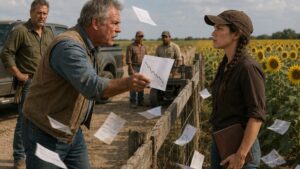
Karen Brown drove the first staple through the orange notice before Edward reached the workshop.
The hammer strike cracked across the farmyard. A second blow pinned the paper flat against a door that had survived six decades of rain, machinery vibration, and men leaning their whole weight against it on winter mornings.
Edward stopped beside the fuel tank, one gloved hand still wrapped around a grease gun.
“What are you doing?”
Karen stepped back to inspect her work. She wore clean riding boots despite having no horses yet, and her blond hair was pulled tight beneath a navy cap embroidered with the name of the boarding business she intended to open next spring.
“Making sure you see it this time.”
The notice was bright enough to be read from the county road. UNSAFE STRUCTURE appeared across the top in black block letters. Below it were smaller paragraphs, a case number, and the county land-use office seal.
Edward set the grease gun on the tank.
“You don’t have authority to post my buildings.”
“The county does.”
“You’re not the county.”
“No,” Karen said. “I’m the person who got tired of waiting for you to answer them.”
The workshop stood thirty yards from the shared fence. Its gray siding had silvered almost white in places, and ivy had climbed across the north wall until it reached the rusted roof edge. One corner sagged enough to catch the eye from Karen’s pasture. From a distance it looked abandoned.
Edward knew every sound it made.
He knew which roof sheet snapped when the afternoon sun warmed it. He knew where the sill had softened near the drainpipe and which hinge lifted when the door opened. He knew the weight of the iron key in his right pocket without touching it.
Karen pointed at the roofline.
“My insurance inspection is next week. They already flagged that wall from the photographs.”
“You took photographs over my fence.”
“I took photographs of something leaning toward my property.”
“It’s not leaning.”
“The county can decide that.”
Edward pulled the orange notice away from the wood far enough to see the staple had split the edge of an old brushstroke beneath it. His father had painted the door red once, long before the color faded into brown.
He released the paper carefully.
Karen watched the gesture. “You care more about that door than you do about what happens if the building comes down.”
“It isn’t coming down.”
“You said that in March.”
“And April,” Edward said.
Her mouth tightened. “Yes. You did.”
She opened a folder tucked beneath her arm and removed two white notices. Edward recognized both. One had been left in his mailbox. The other had arrived by certified mail and remained unopened in the kitchen drawer for eleven days.
“Two requests for voluntary inspection,” Karen said. “No response.”
“They asked to enter.”
“That is generally how inspection works.”
Edward picked up the grease gun again, though the tractor fitting no longer needed grease.
Karen lowered the papers. “I’m trying to reopen my parents’ place. The insurer won’t bind the policy while they think there’s a fire hazard beside the horse lot.”
“Then move the horse lot.”
“It has a well, shelter, and drainage already installed. You know that.”
He did. Her father had laid the water line with Edward’s father forty years earlier.
Karen took a breath and softened her voice, which made him trust it less.
“Repair it, then. Replace the roof. Let an electrician look at the wiring. I don’t care what you do as long as you stop pretending nothing is wrong.”
Edward’s fingers found the iron key through the cloth of his pocket. Its teeth pressed against his thigh.
“You called it abandoned in your complaint.”
“It looks abandoned.”
“That’s not the same thing.”
“Then show them otherwise.”
His hand closed around the key.
For one dangerous second, he imagined pulling it free. He imagined crossing the weeds, lifting the lock, and opening the door wide enough to silence her. He could picture the benches beneath their canvas covers, the tools arranged by size, the drill press his father had rebuilt from three broken machines. He could almost smell cold iron and old cutting oil.
Then he saw the far wall in his mind.
He let go of the key.
Karen noticed. Her gaze dropped to his pocket, then returned to his face.
“What’s in there, Edward?”
“None of your concern.”
“That answer stopped being good enough when the roof started shedding metal.”
A pickup slowed on the county road. The driver looked toward them before continuing. Karen glanced after it, aware of being seen.
Edward understood then that this was not merely a conversation. The notice, her folder, the clean boots—she had prepared a scene in which she was the reasonable one.
He pointed to a photograph clipped inside her folder.
“That corner picture.”
“What about it?”
“You stood in your drainage ditch and tilted the camera. The wall looks six inches farther out than it is.”
Karen looked down. “The angle doesn’t change the missing brace.”
“It changes what you told them.”
“It shows the condition.”
“It shows what you wanted it to show.”
Color rose along her neck. “Fine. Measure it tomorrow. Photograph it from every direction. But the warped picture doesn’t repair the wiring, and it doesn’t put metal back on that roof.”
“Tomorrow?”
Karen closed the folder.
“The emergency inspection is at eight.”
Edward stared at her.
“You filed for emergency action?”
“I filed last Thursday.”
“You said the insurance inspection was next week.”
“It is. That doesn’t mean I have to wait until a sheet of roofing lands in my pasture.”
Emergency action allowed the county to order stabilization, closure, or demolition without the usual thirty-day correction period. Edward had helped a neighbor appeal such an order after a tornado. He knew how quickly a backhoe could appear once liability entered the paperwork.
“Who’s coming?” he asked.
“Scott Rivera from land use. The fire marshal may join him.”
Scott knew farm buildings. That was better than a general inspector, but not enough to settle the unease climbing Edward’s ribs.
Karen slid the notices back into her folder. “You can blame me if it helps. But I asked you privately first.”
“You asked me to tear it down.”
“I asked you to make it safe. You heard the part you wanted.”
She walked toward the gap in the fence, then stopped.
“Your daughter is listed as the secondary contact.”
Edward’s grip tightened on the grease gun.
“What?”
“The county had her number from the old preservation application. They called her this morning.”
The farmyard seemed to narrow around him. For months, Emma had refused to come farther than the kitchen porch. She had not crossed the workshop yard in nearly three years.
Karen read the change in his face and looked almost sorry.
“I assumed you knew.”
Edward said nothing.
She left through the fence gap and crossed toward the clean white posts of her future horse lot. The orange notice moved in the breeze, scraping faintly against the door.
Edward waited until she disappeared behind the equipment shed. Then he crossed the yard.
He did not tear the notice down. He worked the staples loose with the flat edge of his pocketknife, careful not to rip the paper or gouge the wood. He folded it once and tucked it under the rusted hasp.
The iron key lay heavy in his palm.
Its bow had been worn smooth by his father’s thumb, then Nicholas’s, then his own. Edward inserted it halfway into the lock.
From the county road came the hard, familiar rattle of a diesel engine changing gears.
A white service truck turned into his lane.
Emma parked beside the house but did not shut off the engine immediately. Through the windshield, she looked past Edward toward the workshop. Her work shirt carried the dark oval patch of the equipment dealership where she managed the repair floor. A steel ruler protruded from her breast pocket.
She climbed out and closed the door.
“You gave them my number?” Edward asked.
“No.”
“Then why are you on the application?”
“Because I filled out half of it.”
“That was years ago.”
“That does not erase my phone number.”
He removed the key from the lock.
Emma saw it. Her jaw shifted, but she did not look away.
“They want me here at eight,” she said.
“I can handle an inspection.”
“That is what you told me the last time.”
“There was no need to involve you.”
“There was every need. You just didn’t want anyone asking why the public-use section was blank.”
Edward slipped the key into his pocket. “Karen says the roof is falling into her pasture.”
“Karen says a lot of things.”
“Then tell the county that.”
Emma’s expression hardened.
“No.”
The word landed more heavily than Karen’s hammer.
Edward looked toward the workshop, then back at his daughter.
Emma stepped closer, lowering her voice.
“I’ll tell them what can be repaired. I’ll tell them which machines are worth saving. I’ll tell them her photograph is distorted if it is.” She paused. “But I will not lie for you again.”
Chapter 2: What the Weathered Door Was Hiding
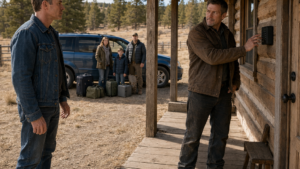
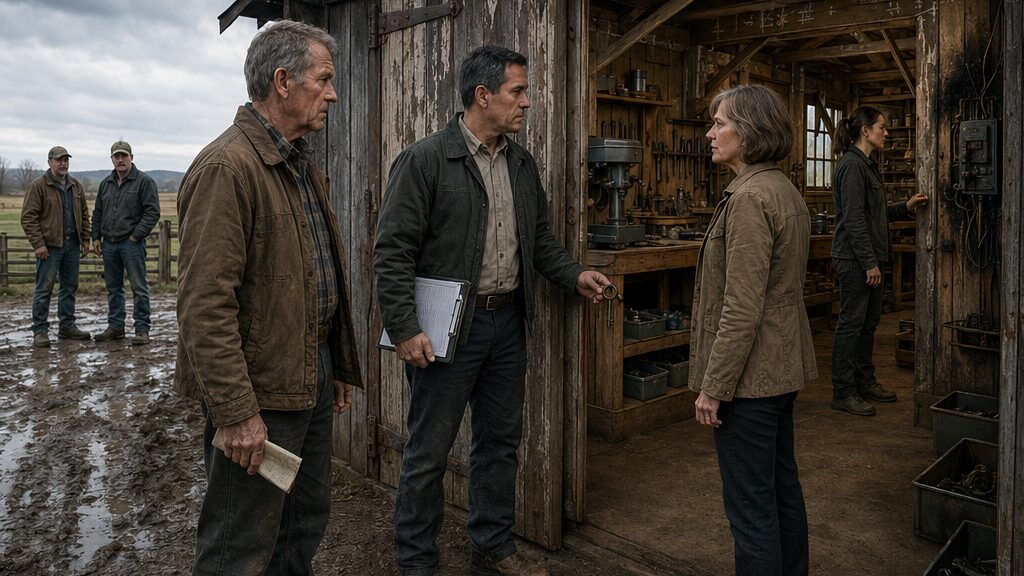
Scott Rivera stood in front of the workshop at eight the next morning and held out his hand.
“The key, Mr. Miller.”
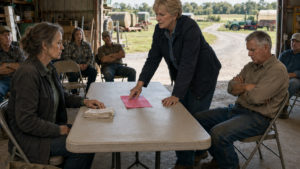
Karen waited beside the fence with her folder pressed against her chest. Two neighboring farmers had stopped their trucks along the lane, apparently without intending to stay, and now leaned against a tailgate pretending to discuss soybean prices. The fire marshal had not come, but a county vehicle idled beside Scott’s pickup.
Emma stood nearest the workshop, a voltage tester and flashlight clipped to her belt.
Edward kept his hand in his coat pocket.
“I open my own building.”
“That works too,” Scott said. “But it opens now.”
He was younger than Edward remembered, perhaps forty, with dust already caught along the edges of his boots. He carried no hard hat, only a clipboard, a measuring level, and the tired patience of a man accustomed to disputes where both sides insisted the facts belonged to them.
Karen pointed toward the north wall.
“You can see the lean from here.”
Scott did not look. “I’ll measure it.”
“And the roof panel above—”
“I’ll inspect it.”
“She has photographs taken from a ditch,” Edward said.
Scott glanced between them. “Then I’ll take my own.”
One of the farmers coughed to hide a laugh. Karen’s shoulders stiffened.
The orange hazard notice remained tucked beneath the hasp, folded but visible. Scott noticed it.
“Why did you remove the posting?”
“I removed the staples. I preserved the notice.”
“That is technically better than most people do.”
Edward drew out the iron key.
The talking at the lane stopped.
The lock had swollen after the previous night’s damp air. Edward pushed the key in, felt resistance, and adjusted the angle. The old mechanism yielded with a solid internal click.
He did not turn the handle.
Instead, he placed the key in Scott’s open palm.
Karen shifted her weight.
Edward looked at the inspector. “You decide what it is after you see all of it.”
Scott studied him for a moment, then opened the lock.
The lower edge of the door dragged over the threshold with a long wooden groan. Dust lifted in the band of morning light. Behind the weathered boards and curling ivy, the workshop emerged piece by piece.
A maple workbench ran beneath the east windows, its surface scarred but clean. Hand planes rested in fitted shelves. Wrenches hung by size on a pegboard darkened by age. Coffee cans labeled in Edward’s father’s block lettering held cotter pins, bushings, and machine screws. At the center stood a belt-driven drill press with a cast-iron base, oiled and covered against moisture. Beyond it were a metal lathe, a forge hood, two vises, and wooden drawers built to fit parts no dealer stocked anymore.
The nearer farmer removed his cap.
Karen said nothing.
Scott stepped over the threshold. “This equipment is maintained?”
“Some of it,” Edward said.
Emma gave him a sharp look. “Most of it.”
She entered without waiting for permission. Her boots sounded too loud on the plank floor.
The air smelled of iron, dry wood, and the faint mineral sweetness of old cutting oil. Chalk marks crossed the support beams: measurements, initials, repair dates, notes about belt lengths and bearing sizes. Some were pale enough to vanish unless the light struck sideways.
Scott moved slowly.
“This was a commercial repair shop?”
“Farm cooperative, more or less,” Edward said. “No formal company. People brought what they couldn’t afford to replace.”
“Your father ran it?”
“My father. Later my brother and me.”
Karen remained outside. From the doorway, her bright jacket looked misplaced against the gray lumber.
“You told the county it was unused,” she said.
“I told them it was closed to the public.”
“That is not what abandoned means,” Scott said without turning.
Edward felt a brief, hard satisfaction.
Scott lifted the canvas from the lathe and examined the bed. “Prewar casting. Replacement motor?”
“Nineteen sixty-eight.”
“Original gears?”
“Most.”
Scott nodded once. “There may be heritage value here. Industrial and agricultural, not just architectural.”
The farmers at the lane exchanged a look. Karen lowered her folder slightly.
Edward’s chest loosened. For the first time since the notice appeared, the outcome seemed plain. Scott had eyes. He understood tools. No reasonable board would demolish a working collection because the siding offended someone’s insurer.
Emma crossed to the west wall.
“Don’t,” Edward said.
She ignored him and opened a narrow cabinet beside the breaker panel.
Her flashlight beam stopped.
“Scott.”
The inspector joined her.
Edward stayed by the door. Cold moved through him despite the close air.
Emma ran one finger near the edge of the cabinet without touching it. “Burn scoring.”
Karen stepped inside at last. “What does that mean?”
“It means something overheated,” Emma said.
“Years ago,” Edward replied.
Scott crouched. Black feathering marked the wood behind the panel. Several wires entered through mismatched metal fittings, and one cloth-wrapped line had been cut but never removed.
“Power active?” he asked.
“Main feed is disconnected.”
“Where?”
“Pole switch.”
“Locked out?”
Edward did not answer quickly enough.
Emma did. “No.”
Scott stood. “Then we treat it as potentially active until verified.”
“It has been off for years.”
“That is not the same as locked out.”
The satisfaction in Edward’s chest collapsed.
Scott walked the length of the west wall, pressing the level against two studs. He photographed the sill, then moved outside to measure the north corner. Karen followed, asking no questions now.
Emma remained by the panel.
“You left it like this,” she said quietly.
“It is disconnected.”
“You left the bypass in the wall.”
“No current reaches it.”
“That was not my question.”
Edward looked toward the chalk marks above the cabinet. A short diagonal line crossed one beam, followed by the letters N.M. and a date nearly twelve years old.
He turned away.
Outside, Scott called for them.
The north wall was out of plumb by less than Karen’s photograph suggested, but more than Edward had claimed. The roof edge had shifted, and one sheet was held by two remaining fasteners. Scott marked both conditions on his form.
“So it stays?” Edward asked.
“I didn’t say that.”
“You said it has heritage value.”
“Possible heritage value. That does not make unsafe wiring safe or a moving roof stable.”
Karen opened her folder, but Scott raised a hand.
“Your emergency request is not automatically granted either. The building is not collapsing today. I can recommend temporary closure and immediate stabilization while status is reviewed.”
“It’s already closed,” Edward said.
“To everyone, apparently.”
Emma looked at him.
Scott returned inside to photograph the benches and machinery. He measured the drill press, copied the maker’s plate, and examined the chalk records.
“This kind of continuous repair history matters,” he said. “If documented.”
“We have records.”
“Where?”
Edward gestured toward the desk beneath the south window.
Scott opened the top drawer. Receipts, parts lists, and handwritten repair cards filled it in tight rows. Beneath them lay a brittle county envelope.
Edward recognized the blue edge before Scott removed it.
Scott unfolded the contents and read silently.
Emma stepped beside him. “What is it?”
“A provisional preservation assessment.”
Edward held out his hand. “That is old.”
Scott turned over the attached tag. A stamped date showed it had expired three years earlier.
“Provisional only,” Scott said. “Conditional on structural review, electrical inspection, and documented community access.”
Karen’s eyes moved from the paper to Edward.
“You already knew it could be protected.”
Edward took the tag from Scott. “It should still count.”
“It does not,” Emma said.
Scott checked the final page.
“There are two missed inspection appointments and a withdrawal notation.”
“I never withdrew.”
“No,” Scott said. “The county closed the application after access was refused.”
The workshop seemed to contract around Edward. The ordered tools, the clean benches, the old machine—all the evidence that had seemed capable of defending him now stood behind a document proving that he had prevented the protection himself.
Scott placed the expired tag on the bench.
“Why did you stop the inspections, Mr. Miller?”
Edward looked at the iron key still resting in Scott’s palm.
He had no answer he was willing to give with Karen in the doorway and Emma beside the burned wall.
Chapter 3: The Protection That No Longer Applied
“The workshop has no active protected status,” the township clerk said.
Emma watched her father’s hand flatten against the county counter.
The expired tag lay between them in a clear evidence sleeve, its blue border faded nearly gray. Beside it, Scott’s inspection photographs showed the workshop interior from several angles: the ordered tools, the drill press, the chalked beams, the scorched electrical cabinet.
Edward tapped the sleeve.
“This was approved.”
“It was provisionally assessed,” the clerk said. “Approval required the remaining inspections.”
“They inspected yesterday.”
“Yesterday begins a new case. It does not revive the old one.”
The county office occupied a converted brick schoolhouse where every sound carried. A printer clicked behind the counter. Someone dragged a chair across the floor in the records room. Karen stood ten feet away with Scott, speaking to an insurance representative on her phone.
Edward lowered his voice. “The building did not stop being historic because a date passed.”
“No,” Emma said. “The protection did.”
He turned on her. “You don’t work here.”
“I can read.”
The clerk pushed a copied file toward them.
The chronology was brief and brutal. Initial heritage survey. Provisional finding. Required structural access. Appointment canceled by owner. Second appointment denied at gate. Public-use documentation not supplied. Application administratively closed.
Emma had seen parts of it before. Seeing the full sequence made her stomach tighten.
“You refused them twice,” she said.
“They came without understanding what they were looking at.”
“They came with an engineer.”
“A man who called the drill press scrap.”
“So you locked the gate.”
Edward folded his arms.
The clerk looked down, offering them the privacy of not being watched.
Scott approached with Karen behind him.
“The fire marshal reviewed my photographs,” he said. “He wants the main feed physically disconnected and tagged today. The loose roof panel needs temporary fastening within seventy-two hours.”
“That can be done,” Emma said.
Edward’s gaze remained on Karen.
She held out three photographs. Unlike the first tilted image, these were square to the property line. One showed the lifted roof sheet. Another showed dry weeds gathered against the north sill. The third showed a cable entering the workshop from an overhead service line.
Emma examined them.
“These are current?”
“Sunday,” Karen said. “Taken from my side of the fence.”
Edward pointed to the cable. “That line is dead.”
Scott answered. “The pole switch is off, but there is no lockout and the service has not been verified at the transformer.”
Karen’s tone was quieter than it had been in the farmyard. “My insurer says visible abandoned wiring beside the boarding lot is enough to suspend the application.”
“It is not abandoned wiring,” Edward said.
Emma looked again at the scorched cabinet photograph. “It is unsafe until tested.”
His expression closed.
The insurance representative ended the call and handed Karen a printed email. She read it once, then placed it on the counter.
“I have ten days,” she said.
“For what?” Edward asked.
“To show the hazard is removed, under an enforceable repair order, or separated by a county-approved exclusion zone. Otherwise they decline the property.”
“Then build the exclusion fence.”
“It would cut off the well and half the shelter lane.”
“That is your layout.”
“And that is your roof.”
Their voices drew looks from the records room.
Scott stepped between them. “No one is deciding demolition at this counter. Temporary work buys time for the hearing.”
“What hearing?” Emma asked.
“Combined safety and preservation review. Early next week if the board can assemble.”
Karen gathered the photographs. “And if he refuses access again?”
“Then I recommend closure and enforcement based on available evidence.”
Edward’s laugh held no humor. “You already entered.”
“Yesterday. Preservation review may require an engineer, an electrician, and board access.”
“No group tour.”
Emma stared at him. “You are doing it again.”
“I let them see enough.”
“You do not get to decide what enough is after asking the county to protect it.”
“I didn’t ask yesterday.”
“You asked three years ago.”
“And they mishandled it.”
“They scheduled inspections.”
Edward picked up the old tag. “We’re done here.”
He walked out before Emma could stop him.
By Wednesday afternoon, the workshop roof panel had been fastened with temporary screws, the dry weeds were cleared, and a utility crew had installed a visible disconnect tag at the service pole. Emma performed most of the work while Edward handed her tools in silence.
Inside, she assessed the machinery one piece at a time.
The lathe needed belts and guarding but remained sound. The drill press spindle turned cleanly. Moisture had reached two lower tool drawers, yet most of their contents could be cleaned. The forge hood required reinforcement. The main bench was scarred but square.
There was more worth saving than she had expected.
That fact did not comfort her.
Edward stood at the doorway as she checked the vise anchors.
“Well?” he asked.
“The machines can stay if the floor support is repaired.”
“I told Scott that.”
“You told him they worked. That is not the same thing.”
She crossed to the electrical cabinet. The cut cloth-wrapped line remained where it had been left years earlier.
Edward’s voice sharpened. “You don’t need to inspect that again.”
“I need to know what a licensed electrician will find.”
“The feed is disconnected now.”
“The damage did not happen yesterday.”
He looked toward the door.
Emma pulled the iron key from her pocket. Scott had returned it to her after the utility crew finished because Edward had been on the roof.
She held it out.
“You keep acting like this is proof the building belongs only to you.”
“It does belong to me.”
“Legally, yes.”
He took the key but did not put it away.
Emma gestured around the room. “The tools are preservable. The machines are useful. The structure can probably be stabilized without rebuilding it into something unrecognizable. I’ll tell the board all of that.”
Edward’s shoulders eased by a fraction.
“Then we agree.”
“No.”
The word echoed against the rafters.
“I will not tell them the public-use requirement was a misunderstanding. It wasn’t. You stopped letting anyone in.”
“It was my decision.”
“And it is why the protection expired.”
He closed his hand around the key.
Emma looked up at the beam above the panel. Among the old chalk notes was Nicholas’s slanted handwriting, quick and narrow, marking the size of a breaker and a date.
Her throat tightened, but she kept her voice level.
“I called the county once.”
Edward went still.
“When?”
“Three years ago. Before the second inspection.”
“You called them?”
“I asked what happened if an owner refused to correct an electrical hazard in a building other people used.”
“No one was using it.”
“Not then.”
“You told them to close it.”
“I asked them to make you face it.”
The key pressed so hard into Edward’s palm that its teeth left pale marks.
“You had no right.”
“I was trying to keep you from opening it again without repairs.”
“I never reopened it.”
“You told Frank he could bring a baler gearbox in that spring.”
“He never brought it.”
“Because I stopped him.”
Edward’s face changed. Not surprise—recognition.
“You spoke to Frank.”
“Yes.”
“You went around me.”
“You would not speak to me.”
“I said it was handled.”
“You always said that.”
The workshop held the silence between them. Outside, a temporary roof screw ticked as the metal cooled.
Emma pointed toward the burned cabinet.
“You want the board to believe this place is a legacy. Then tell them why you locked it. Tell them why you refused the electrician. Tell them why every time someone says Nicholas’s name, you reach for that key like the door is the only thing keeping him here.”
Edward’s eyes lifted to the chalk mark.
“Leave him out of this.”
“He is already in it.”
“You betrayed your family.”
Emma’s face tightened, but she did not step back.
“No,” she said. “I stopped protecting your version of it.”
Edward turned the key over in his hand. The worn iron bow caught the light from the open doorway.
Then he looked at her with a grief sharpened into accusation.
“You betrayed Nicholas.”
Chapter 4: The Night the Repair Lights Stayed On
Frank Anderson found Nicholas’s chalk mark before Edward managed to stop him.
It was a narrow slanted line above the electrical cabinet, followed by the letters N.M. and a date written in the hurried hand Nicholas used whenever someone was waiting on a machine.
Frank touched the beam with two fingers.
“He wrote that the night of the Peterson baler.”
Edward stood inside the workshop door with the iron key in his fist.
“You came to look at the roof.”
“I came because you asked me to tell the board what this place meant.”
“I didn’t ask you to inventory memories.”
Frank turned. His face had narrowed with age, but his shoulders still carried the stoop of a man accustomed to lifting things before asking whether he should.
“You want me to say your father fixed equipment here for half the county. That Nicholas could make a worn bearing last through harvest. That nobody got turned away because they were short on cash.”
“All true.”
“So is the rest.”
Edward shut the door behind them, though there was no one in the yard.
Three days had passed since Emma told him she had contacted the county. She had not returned. Scott had left two messages about the upcoming hearing. Karen’s temporary demolition petition remained under review.
Frank looked again at the chalk mark.
“The breaker tripped twice that night,” he said.
Edward set the key on the bench. “You weren’t here.”
“I was in the yard.”
“You left before midnight.”
“I left when Nicholas told me to. He said you had it handled.”
Edward’s jaw tightened.
The workshop had been crowded that evening twelve years earlier. A broken baler gearbox sat open on the center bench. Rain hammered the roof hard enough to drown ordinary conversation. The Petersons needed the machine by dawn or they would lose another day before a larger storm reached the county.
Nicholas had worked beneath a hanging lamp, shirt sleeves dark with sweat. The old drill press motor had stalled once, then the breaker snapped.
Edward had reset it.
An hour later it snapped again.
“We needed the press,” Edward said.
Frank did not answer.
“The gearbox plate had to be drilled. There was no replacement within two hundred miles.”
“Nicholas wanted to stop.”
“He wanted to finish.”
“He said the panel was heating.”
“He said he could bypass the weak breaker long enough for one hole.”
Frank stepped closer. “And what did you say?”
Edward looked at the cut cloth-wrapped line disappearing behind the cabinet.
The memory returned without mercy: Nicholas crouched beside the open panel, insulated pliers in one hand. Rainwater had worked through a seam in the roof and collected near the west wall. Edward had known the floor was damp. He had known the wiring was old.
He had also known a dozen families were waiting on that baler.
“I said we had ten minutes of work left.”
Frank’s voice lowered. “You told him to keep going.”
“I approved the bypass.”
The admission seemed to change the air pressure in the room.
Frank sat on the edge of the bench. For years they had spoken around those words as though the county itself might crack if one of them said them directly.
Edward picked up the key again.
“Nicholas made the connection,” he said. “He knew electrical work better than I did.”
“That does not make you less responsible.”
“I was his brother, not his supervisor.”
“You were running the shop.”
Edward faced him.
Frank did not retreat.
The bypass had held long enough to start the press. Nicholas drilled the first hole. On the second, the motor seized. The improvised connection overheated inside the wall. A spark reached the metal cabinet while Nicholas’s hand was still on the housing.
By the time Edward knocked the power loose with a length of dry lumber, Nicholas was on the floor.
The ambulance arrived in eleven minutes.
For Edward, every one of those minutes had remained inside the workshop.
“He died at the hospital,” Edward said.
Frank’s eyes stayed on the floorboards. “I know where he died.”
“I locked the place because I was done risking people for machinery.”
“No. You locked it because you didn’t want anyone asking who made the call.”
Edward’s fist closed around the key.
Frank stood and crossed to the old desk. He opened the lower drawer, searched beneath several repair cards, and removed a thin ledger Edward had not seen in years.
The cover bore Nicholas’s handwriting.
RURAL REPAIR COOPERATIVE—PROPOSED MEMBERS.
Edward reached for it, but Frank kept hold.
“You knew about this?”
“He asked me whether six farms would pay annual dues. Not much. Enough for wiring, insurance, and shared parts.”
“He never showed me.”
“He planned to after the baler was finished.”
Frank opened the ledger. Names filled two pages. Beside several were notes about equipment each farmer could contribute: welding leads, hydraulic gauges, a portable hoist.
The workshop had not been meant to remain a private family room. Nicholas had imagined it safer, broader, and less dependent on one exhausted person saying yes to every emergency.
Edward sat down.
For years he had told himself he preserved Nicholas’s work by touching nothing. Yet the ledger showed that stillness was the opposite of what his brother intended.
Frank placed it beside the expired preservation tag.
“The board needs to see that,” Edward said.
“They also need to know why it never happened.”
Edward stared at the two objects.
“You could testify.”
“I could.”
“You were here. You know the history.”
“I also know what you leave out.”
Edward looked up.
Frank’s voice remained calm. “I won’t stand there and tell them this place was closed by bad luck or county interference. Not unless you put the accident in the record.”
“They’ll demolish it.”
“Maybe.”
“You call that honoring Nicholas?”
“I call it telling the truth before asking everyone else to carry your risk.”
Edward rose sharply enough to knock the bench with his knee.
“You waited twelve years to grow a conscience?”
Frank’s expression hardened. “I waited twelve years because I was glad it wasn’t my hand on that switch.”
The words stopped Edward.
Frank looked toward the chalk mark.
“I let you carry all of it because that was easier than admitting I wanted the baler fixed too. I left, but I didn’t tell Nicholas to stop. I didn’t call anyone. I went home and hoped you two would solve it.”
His shame did not absolve Edward. It made the room less simple.
Frank slid the ledger across the bench.
“I’ll testify about the workshop. I’ll tell them what it gave this county. But if you hide the accident, I stay home.”
He left through the side door.
Edward remained by the bench until afternoon light faded across the tools. Once, he walked to the main door and placed the key in the lock. He meant to secure the building.
The metal would not turn beneath his hand.
For an instant he saw Nicholas at closing time, smiling with one shoulder against the door while he complained that Edward always overtightened the lock. The memory weakened Edward’s wrist until he had to remove the key.
He left the door unlatched and crossed to the house.
A county envelope waited on the kitchen table. He had carried it in that morning and forgotten it beneath the mail.
Inside was notice of the preservation hearing.
Clipped behind it was Karen’s emergency demolition petition, filed that afternoon.
The supporting statement described unresolved structural movement, unsafe historic wiring, and an owner unwilling to permit reliable oversight.
At the bottom, the clerk had stamped a hearing date.
Edward had four days to decide whether saving the workshop was worth telling the county how Nicholas died.
Chapter 5: The Woman Asking for Demolition
The insurance representative did not sit down.
Karen had set coffee on the kitchen table and cleared a space among the boarding-business plans, but the woman remained standing with a tablet held against her coat.
“The underwriter will decline the property unless the adjacent hazard is addressed within ten days.”
Karen looked through the window toward Edward’s workshop.
From her kitchen, the rusted roof rose beyond the boundary fence like a dark wedge against the pasture.
“The county has already required temporary repairs.”
“Temporary fastening is not a final correction.”
“There’s a hearing Monday.”
“That leaves three possible outcomes we can accept: demolition, an enforceable stabilization order, or an approved exclusion zone.”
“The exclusion zone cuts through the well lane.”
“I understand.”
“And without the lane, I cannot open the boarding operation.”
The representative’s expression remained professionally sympathetic. “That is the current assessment.”
Karen had invested nearly everything from the sale of her apartment into restoring her parents’ acreage. She had replaced fencing, cleaned the well, repaired the shelter roofs, and ordered stall fronts that were now stacked in the barn. Five clients had expressed interest. Two had paid deposits she could not afford to return.
She folded her arms to stop herself from gripping the table.
“What if the structure is historically significant?”
“Significance does not remove fire or collapse exposure.”
After the representative left, Karen carried the untouched coffee outside.
The shared boundary ran behind the old equipment shelter. Through the wire fence, she could see Edward standing at the workshop door. The iron key turned once in his hand before he slipped it into his pocket.
To him, the key seemed to mean ownership.
To Karen, it meant that every answer stopped at a locked door.
She remembered another door from when she was seventeen: the red sliding door of her parents’ barn, glowing along its edges before anyone understood the interior was already burning. Faulty wiring had started it above the feed room. By the time the fire department arrived, the roof was gone and three animals were trapped behind warped stall latches.
Her father never rebuilt fully.
Edward knew that history. Everyone on the road did.
Yet when she had first asked about the workshop wiring, he had said, “It’s handled,” in the same tone people used when they wanted questions to end.
A county truck pulled beside her gate.
Scott Rivera stepped out carrying a rolled sheet and two forms.
“I’m offering both parties a temporary route,” he said.
Karen unfolded the sheet across the hood of his truck. It showed bracing along the workshop’s north wall, full electrical disconnection, roof stabilization, and a fenced buffer narrow enough to preserve her well lane.
“How long?”
“Ninety days for final engineering and preservation review.”
“And if Edward refuses?”
“The emergency petition proceeds.”
She studied the drawing. “Who pays?”
“He does, unless the board approves grant assistance later.”
“Has he agreed?”
Scott looked toward the workshop. “Not yet.”
They crossed the field together.
Edward was sorting rusted roofing screws into a coffee can. He did not invite them closer.
Scott explained the plan in practical terms. Temporary posts. Certified lockout. No public access. Engineering assessment within thirty days.
Edward listened without interruption.
Karen expected an argument about expense. Instead he asked, “Who controls access?”
“The county during inspection,” Scott said. “You otherwise, until the hearing determines conditions.”
“No.”
Scott lowered the plan. “Which part?”
“County access without me present.”
“That is not negotiable if you want the structure protected.”
“Then there’s nothing to discuss.”
Karen stared at him.
“This plan keeps the building standing.”
“It gives strangers a standing invitation.”
“It gives inspectors access to a building you want them to certify.”
Edward picked up the coffee can.
Scott said, “Think about it until tomorrow.”
“I have.”
He entered the workshop and closed the door.
Not slammed. Closed.
The deliberate quiet made Karen angrier than shouting would have.
For a moment she had been ready to withdraw the demolition request. The interior had changed something for her. Those tools were not junk. She recognized several pieces from childhood, when her father brought broken pump housings across the boundary and returned with them working. The workshop had once made small farms less dependent on dealerships forty miles away.
But value without access still looked like danger.
Scott watched the closed door.
“He may come around.”
“He has had years.”
“He has reasons.”
“So do I.”
Karen folded the stabilization plan. “Does his grief insure my property?”
“No.”
“Does it stop current from reaching old wiring?”
“No.”
“Then do not ask me to pretend caution is cruelty.”
“I’m asking you to separate caution from punishment.”
The words stayed with her after he left.
That evening, she opened the emergency petition on her laptop. The withdrawal button remained active until the hearing. She moved the cursor over it.
Then she saw the email from the insurer confirming the deadline.
Karen closed the withdrawal page without submitting it.
On Sunday afternoon, the township clerk called to confirm the hearing order.
“Ms. Brown presents first,” the clerk said. “Then Mr. Miller.”
“Will his attorney be there?”
A pause.
“He has not listed counsel.”
“What about his daughter?”
“She is scheduled only as a technical witness.”
Karen looked through the window again. Edward stood alone near the workshop, reading pages at the bench inside.
“He’s representing himself?”
“That is what he filed.”
After the call, Karen opened the folder containing her photographs. She removed the distorted image taken from the drainage ditch and set it aside.
The accurate photographs remained.
She could still make the strongest possible case for demolition.
Now she also knew Edward would stand in that meeting room alone and decide how much truth to reveal.
Chapter 6: What Edward Chose to Say in Public
Karen’s first photograph filled the portable screen before Edward’s name was called.
The workshop looked worse enlarged. Rust streaks ran beneath the roof screws. Ivy hid part of the north sill. From that angle, the sag in the corner seemed deep enough to pull the whole structure sideways.
Edward sat at the end of the second row with Nicholas’s ledger inside a plain folder on his lap.
Emma occupied a chair near the board table. She had not spoken to him since the workshop argument except to confirm the hearing time.
Scott stood beside the screen.
Karen addressed the preservation and safety board without raising her voice.
“I am not asking you to erase local history. I am asking you not to make my property, business, and future depend on a building whose owner has refused inspection and repair.”
She advanced to a photograph of the loose roof panel.
“This is current.”
Then the overhead service line.
“This was active until the county intervened.”
Then the dry weeds before they were cleared.
“These conditions existed after two notices.”
She did not show the distorted photograph.
Edward noticed.
Karen finished by describing the insurance deadline and the failed attempt at a stabilization agreement. She did not call the workshop junk. She did not mention property values or appearance.
Her case was stronger for being fair.
The board chair thanked her and called Scott.
He summarized the inspection: no immediate collapse, documented structural movement, unsafe obsolete wiring, potentially significant tools and repair records, possible agricultural heritage value, expired provisional status.
“Your recommendation?” a board member asked.
“Conditional preservation if the owner accepts engineering review, electrical remediation, restricted access, and ongoing oversight. Demolition if those conditions are refused.”
Edward heard a murmur behind him.
The outcome had narrowed to a choice only he could make.
During a recess, Scott found him near the hallway drinking fountain.
“You don’t need to discuss the accident today,” Scott said quietly.
Edward looked at him.
“The board needs structural facts and a viable plan. Personal history is relevant only if you make it relevant.”
“You read the old file?”
“I read the withdrawal notes. There’s no detailed accident record attached.”
“So I could say the workshop closed after a family loss.”
“You could.”
“And that would be enough?”
“For procedure, possibly.”
Edward looked through the meeting-room doorway. Emma was arranging repair estimates beside a wiring diagram. Karen sat alone, hands folded over her folder.
Scott continued. “You should understand that public disclosure cannot be taken back.”
“Neither can refusing it.”
“That is your decision.”
When the hearing resumed, Edward carried the iron key to the front table.
He placed it beside Nicholas’s ledger and Emma’s proposed safety plan.
The board chair asked whether he wished to make an opening statement.
Edward unfolded the page he had written the previous night. The first paragraph described the workshop’s age. The second listed the equipment. The third blamed the county for mishandling the old preservation application.
He folded the page again.
“My father built the first bench in that shop,” he said. “My brother Nicholas and I kept it running after he got sick. We repaired equipment for farms that could not wait three weeks or afford a new machine.”
A board member leaned toward the microphone. “Do you have documentation of community use?”
Edward opened the ledger.
“Names, repairs, parts, and a proposed cooperative plan.”
He passed it to the clerk.
“Nicholas wrote most of that.”
Emma looked at him for the first time.
Edward rested both palms on the table.
“The workshop did not close because the county misunderstood it. It closed because Nicholas died there.”
The room became still.
Karen’s head lifted.
Edward described the baler gearbox, the storm, and the breaker tripping twice. He kept the sentences short because anything longer threatened to become an excuse.
“We knew the panel was heating. Nicholas proposed a temporary bypass. I approved it. I told him we had ten minutes of work left.”
Emma lowered her eyes.
“The motor seized. The connection failed. He was injured while his hand was on the cabinet. He died later at the hospital.”
The board chair gave him time to stop.
Edward did not.
“I left the damaged line in the wall. I refused later electrical inspections because I did not want anyone tracing what happened. I applied for preservation, then blocked the people required to approve it.”
He slid the iron key closer to the center of the table.
“I said I was protecting the workshop. What I protected was my right not to answer.”
No one murmured now.
Frank sat in the rear row. Edward had not seen him enter. Frank gave no sign of approval, only a small nod that meant the record was finally complete.
A board member asked, “Why should we trust you to comply now?”
Edward could have said because Emma would supervise. Because Scott would inspect. Because public attention made refusal impossible.
Instead he said, “You should not rely on trust alone.”
He opened Emma’s plan.
It required full rewiring by a licensed contractor, structural bracing, moisture repair, machinery guarding, a posted operating schedule, and a three-person safety committee. Edward would remain owner, but he would not control certification or public access by himself.
“The key goes in a county-approved lockbox during inspections and cooperative hours,” he said. “No one works alone. No bypasses. No emergency repairs after closing.”
Emma’s gaze moved to the key.
“And the cost?” the chair asked.
“I sell the unused combine head and part of the south acreage lease. Grant money can come later or not.”
Karen shifted in her chair. “You rejected a similar stabilization plan yesterday.”
“Yes.”
“What changed?”
Edward looked at her.
“I stopped pretending the locked door made anyone safe.”
The board called Emma as technical witness.
She approached with three estimates and a condition report. Her voice remained measured.
“The north wall can be stabilized without replacing the chalk-marked beams. The roof requires partial sheathing and new metal. The machinery can remain if guarded and inspected. The old panel must be removed entirely.”
“Can the building be used safely?” a member asked.
“Yes,” Emma said. “Not as it stands. Not under one person’s uncontrolled authority. But yes.”
“Are you willing to oversee the safety program?”
Emma glanced at Edward.
“I am willing to design it and chair the first-year review. I am not accepting ownership of the farm.”
Edward nodded before anyone asked him.
The distinction mattered. She was offering work, not surrendering her life to his unfinished obligations.
Karen was recalled for response.
She stood beside the screen, looking at the accurate photographs she had brought.
“My insurer requires an enforceable order,” she said. “If the board issues one with deadlines and independent inspection, I will withdraw the emergency demolition request.”
It was not an apology.
It was enough to change the outcome.
The board recessed for twenty minutes.
When they returned, the chair read the conditions: immediate closure except for approved work; engineering review within thirty days; electrical removal within forty-five; exterior stabilization within ninety; supervised cooperative operation only after final inspection; quarterly review for the first year.
Failure at any stage would reactivate demolition proceedings.
“Mr. Miller,” the chair said, “do you accept outside oversight and shared-access conditions?”
Edward looked at the iron key.
For twelve years, it had allowed him to decide who entered, what was remembered, and which questions remained outside.
He picked up the pen.
“Yes.”
He signed the order.
The clerk handed copies to Karen, Scott, and Emma. Karen read the first page twice before closing her folder.
Edward approached her near the exit.
“The north boundary repairs start Tuesday,” he said.
She waited.
“You should inspect the setbacks yourself before the posts are set.”
Her expression shifted, cautious rather than triumphant.
“You’re inviting me onto the property?”
“For the boundary work.”
“Nothing else?”
“Not yet.”
Karen accepted the signed plan.
“That is more access than I had yesterday.”
Edward looked back into the hearing room. Emma stood beside the table, holding the iron key he had left there.
For the first time, he did not ask her to return it immediately.
Chapter 7: The Second Key in the Lockbox
Frank Anderson arrived with a broken irrigation pump before Edward had finished unlocking the workshop.
The pump sat in the bed of Frank’s pickup beneath a frayed canvas strap, its cast-iron housing stained with mineral deposits. One flange had split clean through.
Edward looked from the pump to the clipboard hanging beside the restored door.
“You scheduled this?”
Frank climbed down. “Emma did.”
“Cooperative hours start at nine.”
Frank checked his watch. “It is nine.”
Edward’s hand remained on the new lockbox mounted beside the doorframe. The county-approved box looked too clean against the old gray boards. Inside it rested a second iron key, cut from the original after the final inspection.
For four months, contractors and inspectors had crossed the threshold under schedules Edward did not control. They had braced the north wall, replaced sections of the roof, raised the machinery wiring into metal conduit, and installed guards around belts that had spun bare since his father’s time.
The workshop was safer.
It was also louder with other people’s decisions.
Emma’s service truck turned into the lane. She parked beside Frank, stepped out carrying two binders, and nodded toward the pump.
“First approved repair.”
“I can see that,” Edward said.
“Then let’s get it inside.”
Frank reached for the tailgate, but Edward raised a hand.
“What failed?”
“Lower mounting ear. Pump started walking against the frame.”
“You ran it after it loosened?”
“For half a day.”
“That housing may be twisted.”
“Which is why I brought it here instead of welding it in the field.”
Edward examined the split without touching it. The old response rose in him automatically: move aside, let him decide, let him repair it alone.
Emma opened the workshop doors.
“We inspect first,” she said. “Then we decide whether it is repairable.”
Edward looked at her.
She wore a dark work shirt with the cooperative safety patch stitched above the pocket. She had designed the patch without asking him: an open-end wrench crossed with an ear of corn, simple enough to be seen from the road.
“You mean whether I decide,” Edward said.
“I mean what the operating rules say.”
Frank pretended to tighten the canvas strap.
Edward released the tailgate.
Together they moved the pump onto a low cart and rolled it inside.
Morning light entered through the repaired windows. The old benches remained where they had always been, but the aisles were wider. Yellow floor markings defined machine clearances. Fire extinguishers hung beside both doors. A printed sign near the panel listed emergency shutoff procedures and prohibited anyone from working alone.
Edward disliked the sign most on quiet mornings.
It stated plainly what Nicholas had never lived long enough to enforce.
Frank positioned the pump beneath the hoist. Emma opened the inspection binder and assigned the first repair number. Edward caught himself reading over her shoulder.
“You left out the impeller condition.”
“We have not opened it.”
“You can hear bearing drag when the shaft turns.”
Emma rotated the shaft. A faint scrape came from inside.
She added a note.
Edward said nothing.
For the next hour, they worked within the new sequence. Photograph before disassembly. Lock the lifting chain. Verify the load. Mark each removed part. No shortcuts because the repair was familiar.
The housing was not twisted. The shaft remained straight. The broken flange could be rebuilt with a fitted steel reinforcement rather than replaced.
Frank exhaled. “New housing would cost more than the pump is worth.”
Edward ran his thumb along the fracture.
“We can save it.”
The words changed the room.
For the first time since reopening, the workshop held the old purpose without the old urgency. No one was waiting at midnight. No storm pressed against the roof. The repair did not need to be completed by fear.
Emma wrote the method on the work order.
Then she crossed to the west wall with an electrician’s pry bar.
Edward straightened.
“What are you doing?”
“Finishing the panel removal.”
“The panel is already disconnected.”
“The enclosure still has the bypass fitting behind it.”
“It is part of the record.”
“It is unsafe material.”
“The wire is dead.”
“The sharp conduit and scorched insulation are still there.”
She removed the cabinet cover.
Behind it, sealed beneath clear protective material during restoration, Nicholas’s chalk mark remained visible on the beam. The old bypass line entered through a dark fitting below it.
Emma placed the pry bar against the fitting.
Edward stepped forward.
“Leave it.”
Frank stopped sorting bolts.
Emma held still. “We agreed it would be removed after documentation.”
“It has been documented.”
“Then there is no reason to keep it.”
“It shows what happened.”
“The burn marks show what happened. The inspection photographs show what happened. Your hearing statement shows what happened.”
Edward’s hand closed around the original key in his pocket.
For years he had believed that moving any object from that wall would make the account less true. The cut wire, the damaged cabinet, the fitting Nicholas had tightened—they had become evidence in a trial no one else was conducting.
Emma lowered the pry bar.
“I will not remove the chalk,” she said. “I will not paint over his initials. But I am taking out the thing that can cut someone’s hand and teaches the wrong lesson to anyone who sees it.”
Edward looked at the mark above the cabinet.
N.M. The date. The breaker size. A short arrow pointing toward the line.
Nicholas had written the note to make future work easier, not to create a shrine.
Edward stepped back.
“Use a backing wrench,” he said. “The conduit will turn inside the wall.”
Emma watched him for a moment, then handed him the second wrench.
They removed the fitting together.
The scorched wire came out in one stiff length. Emma placed it in a labeled archive sleeve and stored it with the inspection records rather than throwing it away.
The chalk remained on the beam.
Beside it, the new conduit ran straight and clean.
By noon, the reinforcement plate for Frank’s pump was cut and drilled. Edward guided the plate into position while Emma checked alignment. Frank held the housing steady.
No one rushed.
When the repaired shaft turned without scraping, Frank smiled.
“First one counts,” he said.
Edward wiped his hands on a rag. “It counts after testing.”
The pump passed the pressure test twenty minutes later.
Frank loaded it into his truck with the completed work order tucked inside a plastic sleeve.
At the gate, another vehicle waited.
Karen stood beside her pickup, one hand resting on a small electric water pump in the bed. Her restored horse lot stretched behind her, white fence posts now following the approved boundary line.
Emma looked at Edward.
Karen approached without entering the workshop.
“My well transfer pump stopped,” she said. “The horses still have trough water until tonight.”
Edward examined the motor from a distance. “Did the breaker trip?”
“Twice.”
His eyes moved to hers.
“I shut it off after the second time.”
The words were deliberate. She knew what they meant in this place.
Emma opened the scheduling binder. “We can inspect it this afternoon.”
Karen glanced at the lockbox.
“I do not have access authorization.”
“Property owners with approved emergency farm equipment can receive temporary access,” Emma said. “The code changes afterward.”
Karen looked back at Edward.
He could have required her to wait outside. The rules allowed it. He could have made Scott approve the request or asked for a written withdrawal of every complaint she had filed.
Instead, he crossed to the lockbox.
He entered the four-digit code, opened it, and removed the second key.
“Seven, four, two, six,” he said.
Karen did not move.
“That is the code until six tonight. Sign the entry sheet. No machine use without Emma or me present.”
“You’re giving it to me?”
“I’m giving you access to repair the pump.”
Her face tightened with something close to embarrassment.
“I should not have called the workshop abandoned.”
Edward closed the lockbox.
“No.”
“And the first photograph was misleading.”
“Yes.”
She waited, perhaps expecting him to make her say more.
He pointed toward the entry sheet.
“Sign in.”
Karen did.
They carried the pump to the same bench where Frank’s had been inspected. Emma removed the motor cover while Edward checked the impeller. A failed bearing had overloaded the circuit, but Karen had stopped the pump before the winding burned.
The replacement bearing came from a drawer labeled in Edward’s father’s handwriting.
By late afternoon, they drove to Karen’s well house and reinstalled the pump. Edward stood beside the pressure tank while she reset the breaker.
The motor started with a low, even hum.
Water moved through the line. Beyond the fence, the nearest trough valve opened, and clear water struck metal with a bright, steady sound.
Karen watched the pressure gauge rise.
“Thank you,” she said.
Edward nodded once.
When he returned to the workshop, Emma was putting away tools. The original iron key lay beside the open ledger. The second key was back inside the lockbox.
“You gave her the code,” Emma said.
“She needed the pump.”
“You could have made her wait.”
“She shut it down after the second trip.”
Emma understood the answer beneath the answer.
She closed Nicholas’s ledger and placed it on the shelf with the active repair records rather than in the locked desk.
Edward noticed but did not move it.
At the doorway, he reached for the handle out of habit.
The repaired pump on Karen’s property started again in the distance, feeding another trough. Inside the workshop, Frank’s completed work order hung from the first hook on the board. Nicholas’s chalk marks remained above the new conduit, pale but visible.
Emma switched off the bench lights.
Edward left the door open.
The story has ended.