They Cut Down His Father’s Dock, Then the Old Property Line Changed Everything
Chapter 1: The Dock Fell Before Richard Understood Why
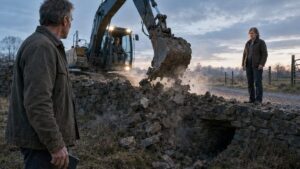
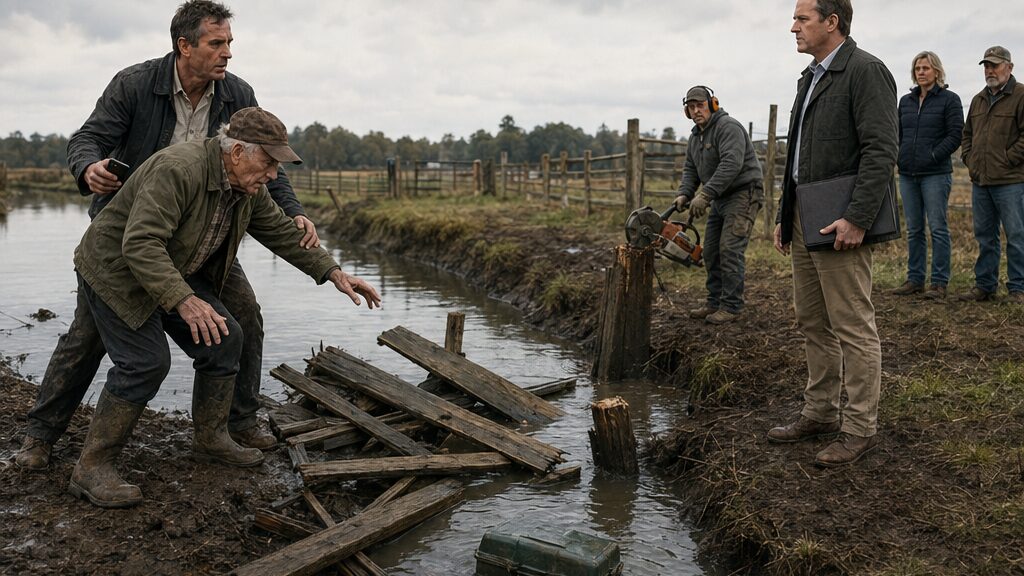
The chainsaw was already biting through the last piling when Richard Martin reached the bank.
“Stop!”
The operator looked up, but the saw did not.
Richard slid the final few feet down the muddy slope. His boots struck the narrow strip of shoreline just as the weathered piling gave a deep wooden crack.
For one suspended second, the dock his father had built forty-three years earlier seemed to remain exactly where it had always been.
Then the outer corner dropped.
Boards twisted. Rusted nails screamed free. The railing tipped sideways, and half the dock folded into the channel with a tremendous splash.
Samuel Martin stood ten feet away.
At eighty-one, he was still lean through the shoulders, but his balance had worsened over the winter. Richard saw his father flinch as water rolled over the bank.
Something green slipped from the collapsing platform.
Samuel’s tackle box.
It struck a broken plank, flipped once, and floated into the channel.
“Dad.”
Samuel wasn’t looking at Richard.
He was staring at the dock.
Paul Carter stepped around the contractor.
His navy jacket looked absurdly clean beside the mud and sawdust. A clipboard rested beneath one arm.
“You were notified,” Paul said.
Richard turned on him. “You cut down his dock.”
“The association removed an unapproved structure.”
“That structure was here before I was born.”
“That doesn’t make it compliant.”
Richard took a step toward him.
Samuel moved first.
Not toward Paul.
Toward the water.
His rubber boots entered the shallows as the tackle box drifted beyond a broken piling.
“Dad, wait.”
Samuel reached down for a loose board, apparently intending to use it to pull the box closer.
Paul caught his arm.
“You can’t interfere with the removal.”
Samuel stared at the hand on his sleeve.
Paul released him, but moved between Samuel and the water.
“Anything in the removal area is under the contractor’s control until cleanup is finished.”
“My box is floating away,” Samuel said.
His voice was quiet.
That made Richard angrier than shouting would have.
He stepped between them.
“Move.”
“Richard,” Samuel warned.
Paul raised his clipboard. “Don’t turn this into something it isn’t.”
Richard looked at the ruined dock.
The brass cleat Samuel had used for decades was still attached to one section, barely visible above the water. Richard remembered tying a blue rowboat to it when he was twelve.
“What exactly is this, then?”
“Enforcement.”
“Of what?”
“Association shoreline rules.”
Paul opened the clipboard.
“The board adopted a uniform access policy last month. Beginning Monday, nonmember water access through maintained association frontage is forty dollars per day.”
Richard stared at him.
“You destroy his dock on Friday and start charging him to reach the water on Monday?”
“That’s not what I said.”
“It sounded exactly like that.”
Paul’s jaw tightened.
Behind them, the contractor shut down the chainsaw.
The sudden silence made every small sound distinct: water tapping loose boards, reeds rubbing together, Samuel’s breathing.
Richard pulled out his phone.
Paul noticed.
“Go ahead. Photograph whatever you want.”
Richard did.
The severed pilings.
The contractor.
The remains in the channel.
Then Paul.
“What document gives you the authority to remove this structure?”
“The bylaws.”
“Not the bylaws. The recorded document.”
Paul hesitated.
Only briefly.
But Richard saw it.
“The association has managed this channel for decades.”
“That isn’t what I asked.”
Samuel caught Richard’s sleeve.
“Enough.”
“No.”
Richard regretted the sharpness the instant he saw his father’s expression.
But guilt only pushed him harder.
For years Richard had let Samuel handle the shoreline, the fences, the drainage ditch, the old permits and county notices that arrived in envelopes Samuel stacked beside the refrigerator.
Richard handled crops, equipment, taxes and suppliers.
The old man handled the old things.
Until suddenly he couldn’t.
Paul pulled several pages from the clipboard.
“Here. Section six.”
Richard took them.
The pages were association bylaws. He skimmed references to docks, maintenance, liability and access fees.
There was no deed description.
No plat number.
No conveyance of shoreline rights.
“Where’s the document showing the association owns this?”
Paul’s face hardened.
“If you want to challenge the board, there’s a process.”
“You don’t know, do you?”
“I know we’ve maintained this waterway for thirty years.”
Richard stepped closer.
“You cut down something my father built without knowing whether you owned the ground under it.”
“That dock created liability.”
“So you decided that made it yours?”
Samuel suddenly stumbled behind him.
Richard turned.
His father had tried to move around them toward the tackle box. One boot had slipped into soft mud.
Richard caught him beneath the arm.
For a moment Samuel’s weight rested almost completely against him.
That frightened Richard more than the demolition.
“I’m all right.”
“No, you’re not.”
“I said I’m all right.”
The tackle box had reached the reeds on the opposite bend.
Samuel watched it go.
Paul lowered his clipboard.
Something like discomfort crossed his face, but it disappeared quickly.
“The contractor will retrieve anything salvageable.”
Samuel straightened.
“Don’t bother.”
He climbed the bank without looking back.
Richard followed after taking one final photograph.
At the top, he turned toward Paul.
“Don’t touch anything else.”
Paul’s answer came immediately.
“Then tell your father not to interfere with association property.”
Richard stopped.
The wreckage of Samuel’s dock was still settling into the water.
“You just called his broken dock association property.”
“I called the removal material association property.”
Richard almost laughed.
Instead, he looked at the pages in his hand.
“You’d better hope your paperwork says what you think it says.”
That afternoon Samuel refused lunch and disappeared into the machine shed.
Richard went into the farmhouse.
He found the property folder in the bottom drawer of an old metal filing cabinet.
Tax maps. Survey receipts. Insurance papers. A deed copied so many times the type had faded gray.
Richard spread everything across the kitchen table.
The legal description meant little to him at first.
Then he saw a handwritten notation beside one boundary paragraph.
Samuel’s handwriting.
Three words and a number.
Navigation easement—Plat 14-B.
Richard read it twice.
Outside, from somewhere near the machine shed, a hammer struck metal.
Richard looked toward the window.
Paul had brought bylaws.
His father had kept a plat number.
And Richard suddenly wanted to know why Samuel had never mentioned it.
Chapter 2: The Number Hidden Inside the Old Deed
Richard carried the deed into the machine shed.
Samuel took one look at the paper and turned back to the mower blade clamped in his vise.
“What is Plat 14-B?”
The file rasped across steel.
Samuel didn’t answer.
Richard set the deed on the workbench.
“You wrote it there.”
“I’ve written plenty of things.”
“Navigation easement.”
That stopped the file.
Samuel kept his eyes on the blade.
Richard waited.
Finally Samuel said, “Old survey.”
“Old enough to stop Paul?”
“Leave it alone.”
Richard stared at him.
Yesterday that answer might have ended the conversation.
Not today.
“He cut your dock apart.”
“And shouting won’t put it back.”
“I’m not shouting.”
“You’re getting ready to.”
Samuel resumed filing.
Richard took the deed and left.
At the county records office the next morning, a clerk studied the notation through reading glasses.
“Fourteen-B isn’t in the current subdivision index.”
“Does that mean it doesn’t exist?”
“It means it’s old.”
She searched another database, then disappeared into a back room.
Richard waited beneath fluorescent lights while two people paid recording fees at the counter.
The clerk returned carrying a thin ledger.
“Here.”
She pointed to a handwritten entry.
The original parcel had been divided years before the shoreline association existed. The notation referenced an archived plat and an easement recorded with it.
Richard felt the first clean satisfaction he’d had since the dock fell.
“What year?”
She gave him the date.
Richard calculated quickly.
The dock Samuel built in 1983 was already there when the association was formed roughly twelve years later.
“So their rules came afterward.”
The clerk gave him a careful look.
“I didn’t say that means their rules don’t apply.”
“But the easement—”
“I haven’t shown you the easement yet.”
She turned the ledger around.
The plat had been transferred to county archive storage, and the scanned image in the system was incomplete.
Richard’s satisfaction thinned.
“Can I get the original?”
“You can request a certified copy. Survey department may have a better working image.”
“How long?”
“If they can locate it? Maybe tomorrow.”
He filled out the request before leaving.
On the drive home he stopped beside the channel.
Broken boards had been stacked on the bank. The contractor had removed most of the wreckage.
Something metallic glinted near the reeds.
Richard climbed down.
Half buried in mud was the bent latch from Samuel’s green tackle box.
He picked it up.
The paint had worn away along the edges from decades of use. Richard remembered that box beneath Samuel’s folding chair, beside a dented thermos, every summer of his childhood.
The box itself was still missing.
He put the latch in his pocket.
Paul’s truck appeared on the access road before Richard reached the house.
Richard waited.
Paul stopped beside him and lowered the window.
“You’ve been to county records.”
It wasn’t a question.
“News travels fast.”
“I’ve got board members asking whether you’re accusing the association of stealing your father’s property.”
“I said you took property you hadn’t proved was yours.”
“You said it in front of my contractor and two neighbors.”
Richard felt the mistake immediately.
He had been angry enough yesterday to call it theft.
Paul had remembered the exact word.
“If I was wrong, the records will show it.”
“And if you’re wrong publicly?”
Richard folded his arms.
“Then I’ll correct it publicly.”
Paul studied him.
“You think I’m doing this because I enjoy collecting forty-dollar fees?”
“I don’t know why you’re doing it.”
“Exactly.”
Paul drove away.
The exchange stayed with Richard longer than he wanted.
Inside the farmhouse, Samuel was at the kitchen table.
Richard placed the muddy tackle-box latch beside him.
Samuel touched it with one finger.
“They found the box?”
“Not yet.”
Samuel withdrew his hand.
Richard told him about the archived plat.
He expected relief.
Instead Samuel’s mouth tightened.
“I told you to leave it.”
“Why?”
“Because everybody along that channel remembers something different.”
“That isn’t an answer.”
“It is if you’ve lived here long enough.”
Richard pulled out a chair.
“Dad, Paul thinks the association owns the access. County records show something older. Why wouldn’t you want me to find it?”
Samuel pushed himself upright.
“Because a line on paper doesn’t tell you what people did with it.”
“What did you do with it?”
Samuel walked toward the back door.
Richard followed.
“You’ve spent my whole life telling me to keep deeds, receipts, agreements. Now somebody tears down your dock and suddenly paperwork doesn’t matter?”
Samuel stopped with his hand on the door.
“You want Paul to be wrong so bad you’re not asking what happens after you prove it.”
“He is wrong.”
“There.”
Samuel looked back.
“That’s what I’m talking about.”
Richard said nothing.
Samuel opened the door.
“Being right about one thing doesn’t make you right about everything around it.”
Then he stepped outside.
Near dusk, Richard’s phone rang.
The county clerk had found the archive reference.
The plat showed an access corridor extending from the Martin parcel toward the channel, but the old reproduction was too faint to establish its full dimensions.
A county surveyor could meet him the following morning.
Richard thanked her.
Samuel was on the porch when Richard walked outside.
“They found it.”
Samuel didn’t ask what.
“The easement is real.”
The old man looked toward the empty place where his dock had stood.
Richard expected him to smile.
Instead Samuel rubbed both hands slowly over his knees.
“What aren’t you telling me?”
Samuel was quiet for so long that Richard thought he would refuse again.
Then he said, “That line was never meant to belong to just us.”
Chapter 3: The Promise Samuel Never Put on Paper
Samuel recognized the easement number before Richard finished reading it aloud the next morning.
“Fourteen-B,” he said. “I know.”
Richard lowered the county copy.
“Then tell me what it means.”
Samuel sat at the kitchen table with coffee untouched in front of him.
“It means people used the channel.”
“That isn’t what an easement means.”
“It was what that one meant around here.”
Richard leaned against the counter.
He had promised himself he would not push too hard.
He lasted less than a minute.
“Did you give the association the easement?”
“No.”
“Did you transfer it?”
“No.”
“Did you sign anything?”
Samuel’s eyes lifted.
“No.”
“Then why did you tell me it wasn’t meant to belong just to us?”
Samuel pushed his chair back.
“Come on.”
They walked down toward the channel.
Without the dock, the bank looked strangely unfinished. Two old pilings remained above the waterline.
Samuel pointed upstream.
“Before those houses went in, there were farms along most of this.”
Richard knew that.
What he didn’t know was why Samuel was finally talking.
“One spring we had water clear across the lower ground,” Samuel continued. “Took out the old landing upstream. Washed part of the bank with it.”
“When?”
“Long before that association.”
Samuel pointed toward the neighboring properties.
“Some of those families had no decent way into the channel afterward. So we let them come through here.”
“We?”
“Your grandfather first. Then me.”
Richard looked at the empty dock site.
“You let them use our access.”
“We shared it.”
“For how long?”
Samuel shrugged.
“Long enough that people stopped asking.”
There it was.
Not theft.
Not exactly.
Something messier.
“Why wasn’t it written down?”
“Because nobody thought we needed a lawyer to launch a johnboat.”
Richard exhaled.
“That worked great.”
Samuel gave him a tired look.
“You think I don’t know that?”
A movement in the reeds caught Richard’s eye.
Something green.
He climbed down carefully and pulled at it.
The tackle box came free with a sucking sound from the mud.
Its lid was dented. One hinge had torn loose where the latch had broken.
Samuel took it without speaking.
Back at the kitchen table, they opened it.
Most of the contents were ruined.
There were corroded hooks, faded fishing tags, a small wrench and a key Richard didn’t recognize.
Samuel lifted the key.
“Old storage shed.”
“Still standing?”
“No.”
For the first time since the demolition, Samuel almost smiled.
Richard touched one of the old fishing tags.
The box had seemed important because it belonged to his father.
Now it felt important because Samuel had carried pieces of forty years inside it without ever explaining any of them.
Richard’s phone buzzed.
Carolyn Wright.
She lived two properties upstream.
“I heard you’re trying to close the channel,” she said when Richard answered.
“What?”
“That’s what people are saying.”
“I’m trying to find out why Dad’s dock was destroyed.”
“Well, Paul says you’re challenging everybody’s access.”
Richard looked at Samuel.
“I’ll come over.”
Carolyn met him beside the remains of her small canoe rack.
One rope hung empty.
“Paul cut my canoe loose last month,” she said before Richard could ask. “Said I hadn’t paid the new shoreline assessment.”
“So you’re defending him?”
“No. I’m asking whether I’m going to get punished because he’s an idiot.”
The bluntness stopped Richard.
Carolyn crossed her arms.
“My husband used this channel forty years. Samuel never asked us for a dime.”
“That doesn’t make it association property.”
“I didn’t say it did.”
“What did people think?”
Carolyn hesitated.
“That Samuel had given the channel over.”
Richard stared at her.
“Given it to whom?”
“The neighborhood. Later, the association.”
“Based on what?”
“Based on Samuel letting everybody use it.”
Richard felt irritation rise again.
“That isn’t how ownership works.”
“No. But it’s how people remember things.”
Almost the same words Samuel had used.
Carolyn looked toward the Martin property.
“When my husband was alive, if a piling broke, he helped Samuel replace it. Other people cleared brush. Somebody brought gravel. Nobody sent invoices.”
“So everybody treated private permission like a community right.”
“Maybe Samuel treated a community responsibility like his private burden.”
That landed harder.
Richard walked home slowly.
By afternoon two neighbors had called.
Neither supported Paul.
Both wanted to know whether Richard intended to block the channel if the easement favored the Martins.
His victory had somehow frightened the same people Paul had been charging.
Samuel sat on the porch repairing the tackle box.
Richard stopped at the bottom step.
“You should’ve put it in writing.”
Samuel didn’t look up.
“Yes.”
The simple admission took the argument out of Richard.
“You let people believe something that wasn’t legally true.”
“Yes.”
“Why?”
Samuel fitted the bent hinge together.
“Because for a long time, what we were doing worked.”
“And when it stopped working?”
“I should’ve dealt with it.”
Richard sat beside him.
For once, neither man tried to make the silence mean agreement.
Near five o’clock, Richard’s phone sounded again.
This time the message came from the association.
Emergency membership meeting.
The attached notice proposed a vote to confirm association authority over shoreline access, maintenance zones and the shared channel.
Tomorrow evening.
Richard read it twice.
Paul wasn’t waiting for the survey.
He was moving first.
Richard handed the phone to Samuel.
His father read the notice, then set the damaged tackle box between them.
“So,” Samuel said quietly, “now you know why finding the line isn’t going to be the same thing as fixing it.”
Chapter 4: The Map Gave Richard Less Than He Expected
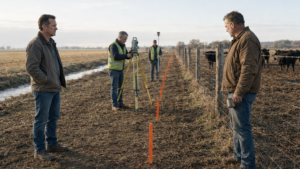
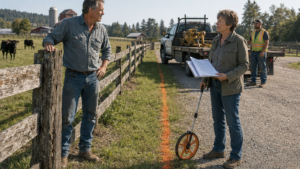
Amy Hernandez spread the old plat across the hood of the county truck and pinned one corner beneath a tape measure before the wind could lift it.
Richard stood opposite her.
Paul Carter stood several feet away with his arms folded.
A sheriff’s deputy remained near the passenger door, saying nothing.
Samuel had refused to come.
“Show me the line,” Richard said.
Amy glanced up.
“I’ll show you what the record shows.”
“That’s what I mean.”
“No,” she said. “It isn’t.”
Richard felt Paul watching him.
Amy flattened the brittle reproduction with both hands.
“This is Plat 14-B. Original subdivision survey. Recorded before the shoreline association existed.”
Richard leaned closer.
The map looked simple until he tried to follow it.
Property lines crossed drainage marks. Faded measurements ran beside the channel. A narrow hatched strip began inside what was now Martin land and continued toward the water.
Amy placed one finger on it.
“This is the easement referenced in your father’s deed.”
“For navigation.”
“Yes.”
Paul stepped closer.
“Our documents say the association maintains the channel.”
Amy did not look at him.
“I haven’t reached your documents.”
Richard almost smiled.
Then she traced the hatched area.
It crossed the old shoreline.
Continued through the narrow waterway.
And kept going.
Richard followed her finger farther than he expected.
“That’s the whole channel.”
“Most of the usable corridor, yes.”
Paul unfolded his arms.
“That can’t be right.”
Amy moved her finger back to the recording stamp.
“It was right when the county recorded it.”
“The association owns the common frontage.”
“Some frontage.”
“We’ve maintained it for thirty years.”
“Maintenance and title aren’t the same thing.”
Richard felt something inside him release.
Not completely.
But enough.
He looked at Paul.
“You cut down a dock sitting inside an access right that predates your board.”
Paul’s face reddened.
“That dock wasn’t permitted under current standards.”
“Current standards don’t erase an easement.”
Amy lifted her hand.
“Careful.”
Richard turned.
She pointed to the map again.
“The easement establishes a right of passage and access. It does not automatically answer every question about structures, modern dock safety, liability, maintenance allocation, or which improvements may be built inside the corridor.”
Richard’s relief narrowed.
“But the association doesn’t own the channel.”
“I didn’t say that either.”
“You just said—”
“I said this recorded easement crosses it.”
Amy met his eyes.
“You wanted a clean answer. Old land records rarely give clean answers.”
Paul seized on that.
“So the board can regulate the dock.”
“Possibly some aspects.”
Richard stared at her.
“Possibly?”
Amy nodded.
“Depending on later agreements, permits, state rules, drainage authority and recorded changes. I’m not going to invent certainty because two people are angry at each other.”
The deputy shifted his weight.
Paul looked almost pleased now.
Richard hated that.
Amy walked around the hood.
“These stakes mark the easement edges based on the original survey calls. I’ll verify them against current monuments before issuing anything final.”
She pointed toward the shoreline.
Richard followed.
Near one fresh survey stake, half concealed in mud, something round and dull caught the light.
He crouched.
The old brass cleat.
It had been torn loose with a chunk of decking still bolted beneath it.
Richard picked it up.
Heavy.
Cold.
Familiar.
Samuel had tied boats to that cleat for most of Richard’s life.
Paul looked at it.
“That should’ve been collected with the debris.”
Richard wiped mud from the brass with his thumb.
“Good thing it wasn’t.”
They walked the marked corridor.
Amy explained where the old line turned, where the modern bank had shifted, and why the water itself complicated the measurements.
Richard listened, but impatience kept pressing at him.
“So bottom line.”
Amy stopped.
“That phrase is usually where people stop listening.”
“Humor me.”
She looked toward Paul, then back at Richard.
“The association’s claim that it has exclusive control over access through this channel is not supported by this plat.”
Richard held still.
There it was.
Paul said nothing.
Amy continued.
“The Martin parcel has a recorded navigation easement predating the association. That is significant.”
“How significant?”
“Significant enough that anybody making rules about this channel needs to account for it.”
Richard looked directly at Paul.
“You heard her.”
“I heard all of it.”
“Then refund the fees.”
Paul laughed once without humor.
“You think one old map settles every bill we’ve paid?”
“No. I think it settles whether you could call this exclusively yours.”
Paul stepped closer to the truck.
“And who clears fallen trees?”
Richard said nothing.
“Who pays when the bank washes out? Who carries liability coverage? Who hires a contractor after a storm? Who keeps the channel open when people who don’t pay dues still use it?”
“That doesn’t give you the right to cut down my father’s dock.”
“I didn’t say it did.”
The answer came too quickly.
Richard noticed.
Amy did too.
Paul looked away.
For the first time, his certainty seemed less like confidence than something he was forcing himself to maintain.
Richard took out his phone.
“I want the survey certification as soon as it’s ready.”
“You’ll get my findings,” Amy said.
“Can the board vote tomorrow?”
“They can vote on whatever their bylaws allow them to vote on.”
“That sounds useless.”
“It means their vote cannot rewrite a county recording.”
That was enough.
Not victory.
But enough to stop Paul from turning a meeting-room vote into a new property line.
Amy began rolling the plat.
The deputy returned to his vehicle.
Paul walked toward his truck, then stopped.
“Richard.”
Richard did not answer immediately.
Paul opened the passenger door and pulled out a thick envelope.
“No board meeting talk. No speeches. Just look at these.”
He handed Richard several photocopies.
Contractor estimates.
Bank stabilization.
Debris clearing.
Channel dredging.
Insurance adjustment.
Richard skimmed the totals.
His anger faltered.
The numbers were not small.
Several invoices were already overdue.
Paul watched his face.
“You think I woke up wanting to charge people forty dollars a day?”
Richard looked up.
“I think you demolished something before you knew whether you had the right.”
Paul nodded once.
“That doesn’t make those bills disappear.”
He got into his truck and drove away.
Richard remained beside the county vehicle with the brass cleat in one hand and the unpaid repair estimates in the other.
The old map had proved Paul wrong about the one thing Richard cared about most.
It had also opened a question Richard had never bothered to ask.
If Paul had been wrong about ownership, who had actually been paying to keep everyone’s water open?
Chapter 5: Paul Was Wrong, But the Bills Were Real
The first thing Richard saw when he entered the association office was a stack of invoices held down by a coffee mug.
Not legal threats.
Not fee notices.
Bills.
Paul pushed the stack toward him.
“Start wherever you want.”
Richard remained standing.
The office was small, barely more than a converted room beside the equipment shed.
A faded channel map hung on one wall.
Another wall held photographs from storm cleanup.
Richard picked up the first invoice.
Bank reinforcement.
The next was for removing fallen timber.
Another for dredging sediment after the spring flood.
The totals added quickly.
Too quickly.
“You paid these?”
“The association did.”
“Some are overdue.”
“I know.”
Richard set them down.
“So this is the excuse.”
Paul sat back.
“No.”
“Sounds like one.”
“It’s the reason.”
“Same thing if you use it to justify what happened to Dad’s dock.”
Paul rubbed his forehead.
“I’m not asking you to like what I did.”
“Good.”
“I’m asking you to understand what was happening before I did it.”
Richard nearly left.
Then he saw a letter clipped to the back of one invoice.
Insurance renewal.
Conditions.
Required maintenance documentation.
Updated access control.
Paul followed his eyes.
“Carrier threatened to drop us.”
Richard read the page.
“You could’ve shown people this.”
“I did.”
“At meetings?”
“Yes.”
“And?”
“Half the room complained about dues. The other half said the people using the channel without paying should cover it.”
Richard thought of Carolyn.
Of Samuel.
Of all those years nobody sent invoices.
“You decided Dad was one of the freeloaders.”
“I decided the system was unsustainable.”
“You charged an eighty-one-year-old man for using water beside his own farm.”
“I charged every nonmember user.”
“That sentence doesn’t improve anything.”
Paul stood.
“No, it doesn’t.”
He walked to the wall map.
Red marks showed erosion points along the waterway.
“You know what happened after the big storm?”
Richard shook his head.
“Three banks failed. Two culverts plugged. One property owner threatened to sue because floating debris hit his boat.”
“So?”
“So everybody wanted the association to fix it.”
Paul tapped the map.
“Everybody.”
His finger moved along the channel.
“Members. Nonmembers. People who’d never paid a dollar. People who said Samuel had always let them use the water.”
Richard’s jaw tightened.
“Then ask for maintenance contributions.”
“I tried.”
“You demanded fees.”
“After asking failed.”
Richard stared at him.
There was something Richard did not like about the answer.
Mostly because part of it made sense.
“What did your deed review say?”
Paul became still.
Richard saw it immediately.
“What?”
Paul looked at the invoices.
“When we started rewriting the access policy, the association attorney asked for old title documents.”
“And?”
“We didn’t have all of them.”
Richard stepped closer.
“You knew.”
“I knew the file was incomplete.”
“When you cut down the dock?”
Paul did not answer.
That was answer enough.
Richard felt his anger return, cleaner now.
“You knew you didn’t have the full chain of title.”
“I knew the association had exercised control for decades.”
“That isn’t the same thing.”
“I know that now.”
“No. You knew it then.”
Paul’s face tightened.
“What I knew was that the dock was deteriorating, the insurer wanted consistent enforcement, and every month I waited we got further behind.”
“So you guessed.”
“I made a decision.”
“You guessed with somebody else’s property.”
Paul turned away.
Richard waited.
Finally Paul said, “Yes.”
Not loudly.
Not comfortably.
But clearly.
Richard had imagined hearing that admission since the dock fell.
It gave him less satisfaction than expected.
“Say that tomorrow.”
Paul looked back.
“At the meeting?”
“Yes.”
“No.”
“Why not?”
“Because if I stand up and say I knowingly enforced a policy before title review was complete, the board loses whatever leverage it still has.”
“Maybe it should.”
“And then what?”
Paul pointed at the invoices.
“You taking those home?”
Richard did not answer.
“Carolyn?”
Silence.
“Your father?”
Richard looked at him sharply.
“Leave him out of this.”
“He’s been part of this longer than either of us.”
Paul lowered his voice.
“That’s the problem, Richard. Everybody wants the old arrangement until somebody has to pay for the old arrangement.”
Richard left before he said something he would regret.
He drove the gravel road slowly.
At the storm-damaged bend, he stopped.
The damage was worse than it looked from the farm.
Roots hung exposed where several feet of bank had fallen away.
A cracked piling leaned into the water.
Richard still had the brass cleat in his truck.
He carried it down and set it on the broken timber.
For years he had looked at the channel as part of the scenery.
Samuel had looked at it as work.
Paul looked at it as liability.
Carolyn looked at it as access she could not afford to lose.
None of them were looking at exactly the same thing.
At home, Samuel was in the machine shed with the green tackle box.
He had straightened part of the bent hinge.
Richard leaned against the bench.
“Paul showed me the bills.”
Samuel kept working.
“He finally show you that?”
“You knew?”
“I knew they had repair trouble.”
“Why didn’t you tell me?”
“You weren’t asking about repair trouble.”
Richard laughed once.
“No. I was asking why somebody cut down your dock.”
Samuel fitted the hinge pin carefully.
“Both things can be true.”
Richard put the brass cleat beside him.
Samuel stopped.
“You found it.”
“By the survey stake.”
Samuel lifted it.
His thumb moved across the worn metal.
“They used to tie three boats to this when the lower landing washed out.”
Richard watched him.
“That flood you told me about?”
Samuel nodded.
“One family almost lost their farm after.”
“How does water access save a farm?”
“It wasn’t just boats.”
Samuel placed the cleat down.
“They needed the channel to move equipment and supplies while the road crossing was gone. Needed access long enough to keep working.”
Richard waited.
Samuel looked toward the open shed door.
“I made somebody a promise back then.”
“What promise?”
Samuel picked up the damaged tackle box.
“Not tonight.”
Richard felt his patience snap.
“Dad, tomorrow Paul is asking people to vote on a right you’ve known about for decades.”
Samuel’s expression hardened.
“And tomorrow you’ll decide whether you want to own a line or take care of what runs through it.”
“That doesn’t answer me.”
“No.”
Samuel returned to the hinge.
Richard stayed where he was.
After several quiet seconds Samuel spoke again.
“The man I made that promise to nearly lost everything because one piece of ground stopped being usable.”
Richard said nothing.
Samuel pressed the hinge into place.
“I told him nobody along this channel would be stranded just because the map said the good way through belonged to us.”
The small metal pin clicked home.
Richard stared at his father.
For the first time, the easement stopped looking like a weapon against Paul.
It started looking like something Samuel had been afraid Richard might use as one.
Chapter 6: The Right of Way Was Never the Whole Promise
“Bring me the tackle box.”
Samuel said it before Richard had finished his coffee.
The repaired box sat on the kitchen counter.
Richard carried it to the porch.
Samuel took it onto his knees and opened the lid.
The ruined hooks had been thrown away. What remained was arranged neatly: old fishing tags, the corroded storage-shed key, a small wrench, two faded photographs and several scraps of paper dried flat beneath a book.
Samuel lifted one photograph.
Two younger men stood beside a flooded field.
Richard recognized his father immediately.
The other man he did not.
“That him?”
Samuel nodded.
“The neighbor?”
“Yes.”
Richard sat beside him.
Samuel looked at the photograph for a while.
“The flood took his crossing first.”
The old man spoke without drama.
That made Richard listen harder.
“Road crew couldn’t get to it for days. His lower fields were cut off. Feed deliveries couldn’t reach the back side. He had equipment stuck where it couldn’t do him any good.”
“So you let him use the channel.”
“I let everybody use it.”
“Through the easement.”
Samuel nodded.
“Your grandfather had already allowed some passage. After the flood we made it plain. If somebody needed the channel, they used it.”
“Why not record that?”
Samuel gave him a sideways look.
“Because people are smarter after forty years.”
Richard almost smiled.
Almost.
Samuel turned the photograph over.
Nothing was written on the back.
“The neighbor wanted to pay.”
“For access?”
“For gravel. Repairs. Whatever he could manage.”
“And?”
“I told him to help when somebody else needed it.”
Richard looked toward the water.
“That became the system.”
“For a while.”
“What changed?”
“People.”
Samuel closed the box halfway.
“Owners died. Farms got divided. Houses went up. Folks who remembered helping each other got replaced by folks who inherited the result.”
“And the association.”
“Eventually.”
Richard thought of Carolyn saying Samuel had given the channel over.
“Why didn’t you correct them?”
Samuel’s fingers tightened around the tackle-box edge.
“At first, because it didn’t matter.”
“It mattered eventually.”
“Yes.”
“And then?”
Samuel looked at him.
“Then I was embarrassed.”
The answer surprised Richard more than any plat.
“You?”
“I let it go too long.”
Samuel tapped the box.
“I kept thinking I’d straighten it out when the next issue came up.”
He gave a dry laugh.
“Then the next issue came, and I thought the same thing again.”
Richard leaned back.
“You hate paperwork that much?”
“I hate admitting I made a mess.”
There it was.
Not nobility.
Not sacrifice polished into something perfect.
Pride.
The same stubbornness Richard had inherited.
Samuel continued.
“When people started calling it association water, I should’ve corrected them. But by then they were paying to clear brush and repair banks. They were doing work. I didn’t want to sound like I was taking something away.”
“So you said nothing.”
“Yes.”
“And Paul took silence for ownership.”
“Among other things.”
Richard looked at the repaired hinge.
“You realize that silence is part of why he thought he could cut down your dock.”
Samuel’s jaw moved.
“Yes.”
It was the first time he had admitted that directly.
Richard had spent days trying to make Paul admit fault.
He had never expected to need the same from Samuel.
The realization hurt in a quieter place.
He said, “I wanted this to be simple.”
Samuel nodded.
“I know.”
“You were right. He was wrong. I find the map. We win.”
“And now?”
Richard watched a small boat move slowly through the channel.
“Now the map tells me we have a right, but not what kind of neighbors we want to be.”
Samuel set the photograph back inside the tackle box.
“That’s closer.”
Richard glanced at him.
“Don’t sound pleased.”
“I’m eighty-one. Let me enjoy the little things.”
Richard laughed despite himself.
Later they walked the old boundary.
Samuel moved slowly, using a fence post for balance where the ground dipped.
Richard carried Amy’s preliminary survey copy.
At one stake, Samuel stopped.
“This used to be clear ground.”
“Bank moved.”
“Everything moves.”
Richard looked at the map.
“Except this line.”
Samuel shook his head.
“The line stays. What it means to people changes.”
Richard folded the paper.
“I could force exclusive access.”
“You could try.”
“Amy says the easement belongs to the parcel.”
“Yes.”
“I could tell the association to stay out.”
“Yes.”
“And you don’t want that.”
Samuel considered before answering.
“I don’t want you to repeat my mistake from the other direction.”
Richard waited.
“I left too much unclear,” Samuel said. “You could make everything so clear nobody can breathe.”
They stood beside the stake.
Richard thought about Paul’s invoices.
Carolyn’s canoe.
The damaged bank.
The families who had helped repair pilings without ever seeing a formal agreement.
He thought about the dock contractor cutting through the final post because Paul had convinced himself management was ownership.
Richard had spent four days preparing to take something back.
Now the harder question was how much of it should remain shared.
That afternoon he called Amy.
“I need another map.”
“What kind?”
“One showing the recorded easement, current bank, shared maintenance areas and access points.”
She paused.
“You planning to litigate?”
“No.”
“Then why?”
“I want to propose something.”
Amy was silent for a moment.
“That’s usually harder.”
“I’m learning.”
He spent the rest of the day at the kitchen table.
Not writing a speech.
Drawing terms.
Recorded protection of the Martin easement.
No exclusive association ownership claim.
No daily use fee imposed as though the water belonged to the board.
Reasonable maintenance contributions tied to actual costs.
Clear rules for repairs.
No demolition of private structures without verified authority and notice.
Refund or cancellation of penalties issued under the disputed policy.
Samuel read the pages once.
“You’re charging people?”
“For maintenance.”
Samuel raised an eyebrow.
“You sound like Paul.”
“Maybe Paul was right about one thing.”
“That’ll upset you for years.”
Richard pushed the paper toward him.
“Tell me what’s wrong with it.”
Samuel read more carefully.
After a long silence, he tapped one paragraph.
“Don’t call it permission.”
Richard looked down.
“What?”
“Shared access isn’t permission from us. Not anymore.”
“But legally—”
“I know what the law says.”
Samuel met his eyes.
“If you want this to last, don’t write it like everybody has to come bow at our porch.”
Richard crossed out the word.
At six thirty, he parked outside the association meeting room.
Cars already filled the gravel lot.
Carolyn stood near the entrance.
Paul was visible through the window, arranging papers on a folding table.
Richard reached into the passenger seat.
Amy’s new survey map lay rolled beside the association notice.
He picked it up.
For the first time since the dock fell, he was not walking into a room to prove Paul wrong.
He was walking in to draw the line everyone else had spent decades avoiding.
Chapter 7: Richard Drew the Line Everyone Had Avoided
Richard unrolled Amy’s survey map across the association table and laid Paul’s bylaws beside it.
The room went quiet.
Paul stood at the far end with the association treasurer and two board members. Carolyn sat in the first row. Behind her were several property owners Richard recognized from the channel.
The sheriff’s deputy was not there.
Neither was Amy.
Richard had wanted it that way.
Nobody else was going to settle this for him.
Paul looked at the map.
“You asked to speak before the vote.”
“I did.”
“You have five minutes.”
Richard glanced at the wall clock.
“I’ll try not to waste them.”
One board member shifted impatiently.
Paul folded his arms.
Richard placed a certified copy of the recorded easement beside the newer association map.
“These are not the same thing.”
Nobody answered.
“This one was recorded before this association existed.”
He touched the older plat.
“It gives the Martin parcel a navigation easement through the channel.”
A murmur moved through the chairs.
Paul raised a hand.
“We’ve already discussed that the easement does not settle maintenance authority.”
“No,” Richard said. “It doesn’t.”
Paul seemed surprised.
Richard continued.
“It also doesn’t make every person who used the channel for forty years a trespasser.”
Carolyn leaned forward.
One of the board members looked down at the table.
Richard tapped the newer map.
“This is where we went wrong. Everybody started treating use, maintenance and ownership like they were the same thing.”
Paul’s expression tightened.
“You mean the board went wrong.”
“I mean everybody.”
That quieted the room again.
Richard looked toward Carolyn.
“My father let people use the channel after the old access upstream washed out. Families helped repair pilings. Cleared brush. Hauled gravel. Nobody recorded much of it.”
Carolyn nodded slowly.
“Over time, people started calling it association water.”
Richard looked back at Paul.
“That was wrong.”
Paul said nothing.
“But my father heard people say it and didn’t correct them.”
A few heads turned.
Richard felt the old reflex to protect Samuel rise inside him.
He let it pass.
“He should have.”
Paul’s arms lowered.
Richard continued.
“And I came in here ready to make the opposite mistake.”
Carolyn’s eyes narrowed.
“I thought if that easement belonged to our parcel, the answer was simple. Shut everybody out. Make the association pay. Let somebody else worry about the channel.”
A man near the back muttered, “Wouldn’t blame you.”
Richard looked at him.
“I would.”
He turned the survey map so the room could see it.
“Because a right of way that nobody maintains eventually becomes a right to mud and fallen trees.”
Paul’s gaze shifted toward him.
That was the first thing Richard had said all evening that seemed to surprise him in a different way.
Richard placed several typed pages beside the maps.
“This is what I’m proposing.”
Paul reached for them.
Richard kept one copy.
“The Martin easement stays recorded and protected. The association stops claiming exclusive ownership over the channel.”
One board member immediately said, “That strips the board of authority.”
“No. It limits authority to what you actually have.”
The man started to respond, but Paul lifted a hand.
“Let him finish.”
Richard did.
“No daily access fee based on the idea that the board owns the water. No penalties issued under that policy.”
The treasurer spoke.
“We’ve already collected some.”
“Refund them.”
Paul shook his head.
“We don’t have spare cash.”
“Then credit them against future maintenance assessments.”
The treasurer looked at Paul.
Richard continued.
“Every invalid charge gets canceled or accounted for. Including Carolyn’s.”
Carolyn sat straighter.
“And the disabled fisherman you billed two hundred dollars.”
Paul looked down at the papers.
Richard had almost forgotten that charge until that afternoon.
He had not forgotten the sight of Samuel reaching for the tackle box while Paul stood between him and the water.
Paul turned one page.
“And maintenance?”
“Shared.”
A man in the back spoke again.
“Shared how?”
“Actual costs. Published. Proportional contribution from people who regularly use the maintained access.”
Carolyn frowned.
“So we still pay.”
“Yes.”
That answer changed the room.
Richard saw it immediately.
Some people who had been nodding stopped.
A woman near the wall whispered to the person beside her.
Carolyn said, “How is that different from what Paul was doing?”
“Because you’re paying for maintenance, not permission.”
“And who decides the amount?”
“Not Paul alone. Not me either.”
Richard pointed to the proposal.
“Annual costs disclosed. Contractor estimates reviewed. Emergency work documented. Property owners get a vote on major maintenance.”
One of the board members leaned forward.
“What about nonmembers?”
“They contribute when they use maintained facilities regularly. But nobody invents ownership to force them into membership.”
Paul finally spoke.
“And if they refuse?”
“Then you deal with the actual maintenance obligation you can legally enforce.”
“That sounds easy when you say it.”
“It won’t be.”
Paul stared at him.
Richard stared back.
That was the point.
Nothing about the last week had been easy.
Paul lifted the proposal.
“You expect the association to reimburse your father’s dock too?”
“Yes.”
“The entire replacement?”
“The structure you ordered removed before confirming authority.”
“It was deteriorating.”
“Then negotiate depreciation with us. You don’t get to make the demolition disappear.”
One of the board members whispered something to Paul.
Paul ignored him.
“Can I speak with you outside?”
Richard hesitated.
Then followed.
They stopped beside the gravel parking lot.
Through the window Richard could see Carolyn reading the proposal.
Paul lowered his voice.
“I can get the board to reimburse Samuel.”
Richard waited.
“And cancel his charges.”
“All the invalid charges.”
Paul looked toward the building.
“Richard.”
“All of them.”
“You know what that does to the budget.”
“Give credits against future maintenance where necessary.”
“That still costs us.”
Richard nodded.
“So did your mistake.”
Paul’s jaw tightened.
“I’m offering to settle with your family.”
“And I’m saying no.”
“You’d turn down reimbursement?”
“I’ll turn down a private deal.”
Paul stared at him.
“This started with your father.”
“No. That’s when I noticed it.”
The words came out before Richard had fully formed them.
He realized they were true.
Carolyn’s canoe.
The fisherman’s bill.
The channel repairs.
Samuel’s silence.
Paul’s policy.
His own rush to turn one easement into a weapon.
None of it had started with the chainsaw.
That was simply where everything old and unresolved finally broke at once.
Paul looked tired.
Not defeated.
Just tired.
“You think people in there are going to vote to charge themselves?”
“They’ve been paying already.”
“Some of them.”
“Then make the burden visible.”
Paul glanced back through the window.
“If they reject this?”
“Then Amy finalizes the survey. We protect our easement separately. And you can explain why you turned down a shared maintenance agreement after learning the association never had exclusive control.”
Paul gave a short humorless laugh.
“That sounds like leverage.”
“It is.”
“At least you admit it.”
Richard looked at him.
“I learned that from you.”
For a moment Paul almost smiled.
Then it disappeared.
“If I agree to bring this forward, I want one change.”
“What?”
“Emergency maintenance.”
Richard waited.
“If a storm blocks the channel, the board needs authority to act immediately. No waiting three weeks for a vote while trees sit in the water.”
Richard considered.
“That’s reasonable.”
“And actual users contribute.”
“Document the costs.”
Paul nodded.
“You’re going to hate committee meetings.”
“I already do.”
When they returned, Carolyn was standing beside the table.
“I’ve got a question,” she said.
Richard sat down.
“If this passes, nobody gets to tell me Samuel gave away his property.”
“No.”
“And nobody gets to tell me I’ve been stealing his water for forty years.”
Richard looked toward Samuel’s empty chair.
“No.”
Carolyn nodded.
“Then put my name on the maintenance agreement.”
The room changed.
Not dramatically.
Nobody applauded.
Nobody stood up.
But one of the property owners asked for another copy.
Then another.
The treasurer began calculating how credits against invalid fees might work.
One board member objected to the reimbursement provision.
Another asked whether Amy could attach the final survey directly to the recorded agreement.
Paul stood at the front, answering questions instead of issuing declarations.
The emergency vote on exclusive control never happened.
It was withdrawn.
The replacement proposal took longer.
There were arguments.
Changes.
A second meeting.
Amy corrected two measurements and refused to certify one access point until a monument was rechecked.
The association agreed to cancel the disputed access penalties.
Samuel’s dock replacement was negotiated at a depreciated value plus the cost of installing a safer structure inside the confirmed easement.
Paul did not apologize publicly.
Richard stopped expecting him to.
What Paul did instead was sign the corrected access agreement.
His signature sat beneath Richard’s and Carolyn’s.
Not reconciliation.
Responsibility.
Several weeks later, the new dock stood on fresh pilings.
It was smaller than Samuel’s old one.
Straighter.
Safer.
Samuel complained that the new rail was too high.
Richard told him that at eighty-one he was no longer the person allowed to criticize handrails.
Samuel called that nonsense.
Richard carried the green tackle box down after lunch.
The hinge now worked.
The dents remained.
He set it beside Samuel’s folding chair.
Samuel looked at it.
“You didn’t repaint it.”
“No.”
“Good.”
Richard reached into his jacket pocket.
The old brass cleat rested in his palm.
Samuel stared at it.
“Thought you were keeping that.”
“I thought you were.”
Richard handed him a wrench.
Samuel crouched slowly beside the outer post.
Richard started to help.
Samuel waved him away.
“I can still tighten a bolt.”
Richard stood beside him.
It took longer than it once would have.
Samuel adjusted the cleat twice before he was satisfied.
Finally he pressed his thumb against the worn brass and gave it a small shake.
Solid.
Across the channel, Carolyn lowered her canoe into the water from the repaired common landing.
She lifted one hand.
Samuel returned the gesture.
No one asked permission.
No one pretended maintenance was free.
On a post near the access path, a small weatherproof box now held the recorded survey, maintenance terms and emergency contact information.
The lines were written down.
The responsibilities were written down.
So were the limits.
Richard looked at the channel.
He had spent the first days after the demolition thinking justice meant finding the document that would prove the water belonged to his family.
The document had done something more difficult.
It had shown him what belonged to them and what did not.
The right was theirs.
The burden was shared.
And the promise Samuel had made decades earlier no longer depended on memory alone.
Samuel settled into his folding chair.
Richard placed the repaired green tackle box beside his boot.
The old man rested one hand on its lid.
Then he looked at the brass cleat fastened to the new wood.
“Not exactly where I put it the first time.”
Richard sat beside him.
“No.”
Samuel nodded toward the channel.
“Still does the same job.”
Richard followed his gaze as Carolyn’s canoe moved slowly past the reeds and into open water.
“Yeah,” he said. “I think it does.”
The story has ended.