She Sent Two Starving Mastiffs Across His Farm Road, Not Knowing What Catherine Had Already Seen
Chapter 1: Two Mastiffs Came Down the Gravel Road
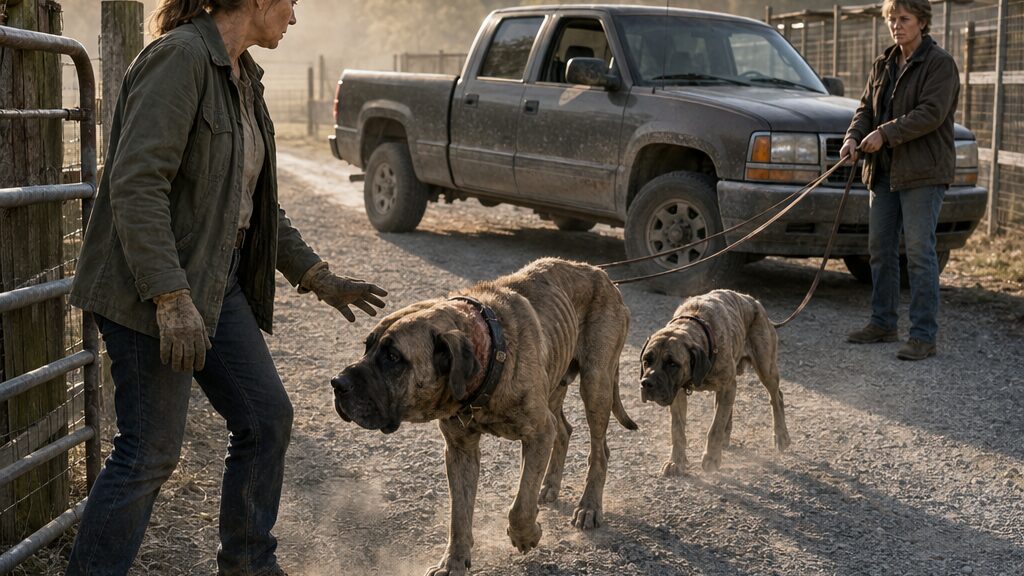
The first mastiff hit the end of its leash hard enough to pull Elizabeth Wright one step off balance.
Then Elizabeth let more leather slide through her hand.
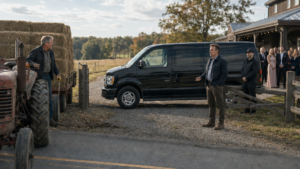
Catherine Harris had just climbed down from her tractor at the pasture gate. One boot was still on the gravel when the second dog lunged after the first, both animals coming down the narrow farm road with their heads low and their heavy shoulders rolling.
“Use the south entrance,” Elizabeth called from beside her pickup.
Catherine did not move.
There was no useful south entrance. There was an old cattle track that turned to mud after rain and ended on the wrong side of the lower pasture. Elizabeth knew that.
The dogs covered the distance quickly.
Catherine’s first instinct was the one she had trained other people not to follow: step back, raise your arms, create motion.
She made herself stop.
“Elizabeth,” she said. “Call them back.”
Elizabeth stood with one hip against the pickup door. “You heard me. Take the other way.”
The larger mastiff pulled again. Its collar creaked.
Catherine lowered her hands.
She had spent seventeen years walking into barns, kennels, backyards, roadside pens, and once a motel bathroom where somebody had tried to hide twelve puppies. She knew what a dog preparing to strike looked like.
These two were wrong.
Too loose in the rear legs.
Too slow between bursts.
The first dog reached her and stopped so abruptly its claws scratched through the loose gravel. Its head swung toward Catherine’s right hand.
Her glove smelled of sweet feed.
The mastiff inhaled.
Then, instead of biting, it pushed its muzzle against her knuckles.
Catherine felt its breath through the leather.
The second dog came alongside, panting harder than the short run justified.
“Back,” Elizabeth snapped.
Neither dog looked at her.
Catherine’s stomach tightened.
From ten yards away they had looked enormous. Close up, their size made what she saw worse.
The first dog’s ribs showed beneath a dull brown coat, not faintly but distinctly enough that Catherine could count the spaces between them. The leather collar sat too tightly against the neck. Hair had rubbed away beneath the lower edge.
The second mastiff had the same raw band.
Catherine crouched slowly.
Elizabeth pushed away from the truck. “Don’t touch my dogs.”
Catherine ignored her for three seconds longer.
Long enough to see the hollow behind the second dog’s ribs.
Long enough to notice the pale gums.
Long enough to feel the first animal lean its full head against her hand as though standing upright required negotiation.
She rose.
“How long have they looked like this?”
Elizabeth’s mouth tightened. “Like what?”
Catherine turned.
For weeks, Elizabeth had complained about Catherine’s hay wagon sitting too near the shared road, Catherine’s tractor tires leaving mud after storms, Catherine’s temporary fence repair, even a delivery driver who had backed six feet onto the gravel shoulder.
Every complaint had carried the same message beneath it.
Your farm is the problem.
Your access is temporary.
Eventually you will get tired enough to sell me the strip.
Catherine had answered each one in writing and nothing more.
Now the dogs stood between them.
“Call them back,” Catherine said again.
Elizabeth gave a short laugh. “You afraid?”
“No.”
“You should be.”
Catherine looked at the animals.
“No,” she repeated. “I really shouldn’t.”
Something shifted in Elizabeth’s expression.
Catherine had seen that shift in livestock owners before—the instant they realized the person standing in front of them had stopped seeing an argument and started seeing evidence.
The first dog nosed Catherine’s glove again.
She opened her fingers but did not offer food.
Feeding an unfamiliar animal in a confrontation could change behavior and muddy what she was observing. Training sat deeper than sympathy.
That did not stop the guilt.
She had noticed these dogs twice before.
Once behind Elizabeth’s kennel fence three weeks earlier, when Catherine had been checking the washed-out culvert near the easement.
Once from the cab of her truck, when Elizabeth had walked them beside the road.
Both times Catherine had seen something she did not like.
Both times she had told herself she was too far away.
Both times she had reminded herself that Elizabeth was already accusing her of using her government job to bully a neighbor.
So Catherine had done nothing.
The realization landed harder than Elizabeth’s threats.
The second mastiff sat heavily on the gravel.
Elizabeth came forward and jerked its leash.
“Come on.”
The dog flinched before the collar even tightened.
Catherine saw that too.
“Easy,” she said.
Elizabeth’s eyes narrowed. “Don’t tell me how to handle my animals.”
“I’m telling you not to drag a dog with sores under its collar.”
For the first time, Elizabeth looked down.
Not at the dog.
At Catherine.
“You don’t get to come onto my road and start inspecting things.”
“This isn’t your road.”
“That’s exactly the question, isn’t it?”
The gravel strip ran between their properties, but Catherine’s recorded easement allowed her to cross it to reach her lower acreage. Elizabeth had spent the past four months trying to renegotiate that right into something narrower and less useful.
Catherine’s father had warned her about the road years before his death.
Never give away access you already own.
Land can become useless one narrow strip at a time.
Catherine had promised him she would remember.
Elizabeth tugged the leash again. “Move your tractor.”
Catherine looked past her.
Behind Elizabeth’s fence, partly hidden by a machine shed, something metallic flashed between the boards. A kennel gate.
Then she heard barking.
Not one dog.
Several.
Elizabeth followed her gaze and stepped sideways.
The movement was small.
It told Catherine more than the barking did.
“How many are back there?” Catherine asked.
Elizabeth’s chin lifted. “None of your concern.”
“How many dogs?”
“You’re standing here because you want that easement.”
“I’m standing here because you sent two animals down a road at me.”
“They never touched you.”
One mastiff was still pressed against Catherine’s thigh.
Catherine looked down at it.
“No,” she said. “They didn’t.”
Elizabeth finally reeled in both leashes. The dogs resisted only enough to keep their noses toward Catherine’s glove.
For a moment Elizabeth had to pull with both hands.
Catherine watched the leather collars compress against irritated skin.
She memorized the width. The buckle shape. The cracks near the holes. The rubbed patch under the larger dog’s jaw.
Professional habit.
Or professional guilt.
She was no longer sure which.
Elizabeth got the dogs beside the truck.
“You bring inspectors out here,” she said, “and everybody will know what this is.”
Catherine said nothing.
“A land fight.”
Still nothing.
“You think a badge makes your deed stronger?”
“My badge has nothing to do with my deed.”
“Good. Keep it that way.”
Catherine looked toward the kennel fence again.
The barking had stopped.
That silence bothered her more.
Elizabeth opened the rear door of the pickup and pointed the dogs toward it.
Neither jumped in.
The larger mastiff put its front paws on the sill, hesitated, then looked back at Catherine.
Elizabeth shoved from behind.
Catherine’s hand closed around the gatepost.
She could feel the old habit returning: wait, document privately, make absolutely certain, avoid any action that could be called personal.
It had once felt like discipline.
Standing there, watching the dog struggle into the truck, it felt like cowardice wearing a cleaner shirt.
Elizabeth slammed the door.
“You’ll regret it,” she said.
“Regret what?”
“Bringing state business into a private road dispute.”
Catherine met her eyes.
She had not mentioned the state.
Not once.
Elizabeth climbed into the pickup and drove away.
Catherine remained by the gate until the dust settled.
Then she pulled off her right glove.
There was a wet smear across the knuckles where the mastiff had pressed its mouth against her hand.
She turned the glove over.
Sweet feed dust clung to the palm.
The dog had not come to her because it trusted her.
Not yet.
It had smelled food.
Catherine went back to the tractor, took the small field notebook from behind the seat, and wrote the time.
Then she began describing the collars.
Chapter 2: The Complaint File Was Already Thick
The new complaint was sitting in Catherine’s email before she made it back to the farmhouse.
She read it standing at the kitchen counter with her boots still on.
Unauthorized heavy equipment use on shared private access.
The attachment contained three photographs of her tractor.
All three had been taken that morning.
One showed the tractor before the mastiffs came down the road.
Catherine stared at the timestamp.
Elizabeth had been documenting the confrontation before it happened.
She set the phone down.
“That answers one question.”
The empty kitchen gave no reply.
Catherine washed her hands, opened her work laptop, and created a personal incident note rather than an enforcement file.
She kept the distinction deliberate.
Time.
Location.
Observed body condition.
Two adult mastiff-type dogs.
Prominent ribs.
Possible muscle loss.
Collar-associated hair loss and visible irritation.
Exercise intolerance inconsistent with distance traveled.
Owner allowed extended leash during property-access disagreement.
She stopped before writing intentional intimidation.
That was an interpretation.
She went back and replaced it with behavior.
Owner did not recall dogs after first request.
Better.
She drew the collar beside the notes: wide leather strap, brass-colored buckle, heavy cracking around the adjustment holes.
The sketch looked crude.
It also made the memory sharper.
At ten-thirty, Catherine drove to the county offices.
She was not there under state authority. She used the same public counter as anyone else.
The zoning clerk recognized her.
“You here for us or you?”
“Me.”
“That usually means worse paperwork.”
Catherine almost smiled.
“Parcel file on Wright acreage.”
The clerk brought up the property record.
Elizabeth’s tract was larger than Catherine’s, with pasture, a machine shed, residence, and two outbuildings permitted for agricultural use.
Catherine pointed at the structure nearest the north fence.
“What’s that listed as?”
“Equipment storage.”
“No kennel?”
The clerk searched.
“No current kennel permit.”
“Previous?”
Another search.
“There was an application six years ago. Approved for a limited boarding setup.”
“How limited?”
The clerk opened the scanned approval.
Catherine read it twice.
The permit had expired.
It also covered fewer animals than the barking behind Elizabeth’s fence suggested.
Catherine leaned back.
That should have felt like vindication.
Instead, she felt the first real edge of danger.
She asked for the public parcel map.
When it printed, the bold line showing her easement cut directly along Elizabeth’s north boundary.
Her own name appeared in the file history.
HARRIS ACCESS OBJECTION.
HARRIS DRAINAGE COMPLAINT.
HARRIS EQUIPMENT DISPUTE.
HARRIS EASEMENT REVIEW REQUEST.
Elizabeth had filed so many complaints that Catherine could trace their relationship through county paperwork.
The clerk handed her another page.
“This one came in yesterday.”
Catherine read it.
Elizabeth alleged that Catherine was using commercial farm traffic beyond the scope of the easement.
It was not ridiculous.
That was the problem.
The language was exaggerated, but the underlying question—what types of vehicles the old easement covered—was legitimate enough that reasonable people could disagree.
Catherine folded the page once.
If she initiated an animal-welfare action now, Elizabeth would not need to invent a motive.
The motive would already be sitting in a county file.
Catherine returned to her farm with copies of the public records.
She spread them across her desk.
Parcel map on the left.
Complaint history on the right.
Field notebook between them.
The rough collar sketch sat almost exactly against the printed boundary line.
She stared at both.
This was why she had waited.
Not because she had been careless.
Because she had understood what one accusation could do to a legitimate inspection.
An animal-welfare investigator involved in a private land dispute with the owner she reported?
Every defense attorney, county commissioner, neighbor, and feed-store gossip would begin in the same place.
Retaliation.
Catherine picked up the phone and called her supervisor anyway.
She did not soften it.
“I need to disclose a conflict.”
There was a pause.
“Active case?”
“Not yet.”
“Potential?”
“Yes.”
She described the road confrontation without conclusions.
When she finished, her supervisor asked, “How long have you had the easement dispute?”
“Four months formally.”
“And before that?”
“Friction for years.”
Another pause.
“Have you inspected her property in your official capacity?”
“No.”
“Run her state records?”
“No.”
“Contacted local enforcement?”
“No.”
“Why not?”
Catherine looked at the collar sketch.
“Because of exactly this conversation.”
“That wasn’t my question.”
Catherine leaned back.
“I saw the dogs before today.”
“How long ago?”
“Three weeks, maybe.”
“And?”
“I thought they looked thin.”
“You reported it?”
“No.”
“Why?”
Catherine closed her eyes for a second.
“I couldn’t be certain at that distance.”
“Anything else?”
There it was.
The question Catherine had avoided asking herself all morning.
“Yes,” she said. “I didn’t want it to look personal.”
Her supervisor exhaled.
“Catherine, avoiding a report because you have a conflict can be its own kind of problem.”
“I know.”
“Do you?”
She let the silence sit.
Finally her supervisor said, “Send me a factual incident memorandum. No enforcement recommendation. Include the easement history.”
“Understood.”
“You’re not the primary on this if it moves.”
“I expected that.”
“And don’t contact the owner about animal compliance.”
“I already spoke to her during the incident.”
“Beyond what happened today.”
“Understood.”
Catherine ended the call.
For the next hour she assembled only what she could defend.
Her observations.
The public permit status.
The fact that more than two dogs had been audible behind the fence.
The road dispute.
Her previous visual concern.
Her failure to report it.
She included that too.
At three-thirty, her supervisor called back.
“There’s enough for an independent preliminary review.”
Catherine’s shoulders loosened a fraction.
Then came the rest.
“But your disclosure is going in the file.”
“It should.”
“And until another investigator establishes probable cause independently, you stay out.”
“I will.”
“You understand what that means?”
Catherine did.
If the other investigator saw healthy animals, adequate feed, current veterinary records, or a plausible explanation, Catherine would have to live with it.
No second attempt.
No correcting the narrative.
No private use of databases.
No leaning on professional relationships.
Being right did not entitle her to control the process.
“Yes,” she said.
Her supervisor continued, “One more thing. The county sent over the local dog registration history.”
Catherine sat straighter.
“How many?”
“Records show three currently associated with the property.”
Catherine thought of the barking behind the fence.
“How old are those records?”
“One renewed this year. Two last year.”
“And kennel authorization?”
“Nothing active.”
Catherine looked again at her parcel map.
Elizabeth had spent months building a record against her.
In doing so, she had made the boundary, the structures, the access, and the history unusually easy to trace.
Paperwork could be a weapon.
It could also be a trail.
“When does the independent review start?” Catherine asked.
“First thing tomorrow, assuming county animal control can accompany.”
Catherine nodded even though nobody could see her.
Then her supervisor added, “Before anything moves beyond review, I need your formal written disclosure signed.”
“I’ll send it tonight.”
“No, Catherine. I need you to understand this. If you leave out one ugly detail because you think it makes you look bad, and it surfaces later, the whole matter can die.”
Catherine’s eyes went to her field notebook.
Three weeks ago.
Two thin dogs behind a fence.
She had seen them.
She had done nothing.
“I’ll include everything.”
“Good.”
The call ended.
Outside, a tractor moved somewhere beyond the lower field.
Catherine signed the disclosure.
For the first time all day, the question was no longer whether Elizabeth had done something wrong.
It was whether Catherine’s own silence had already made the truth too difficult to prove.
Chapter 3: A Veterinarian’s Receipt Changed the Case
Raymond Miller put three paid invoices on the exam table and said, “You need to see these before you decide what kind of person she is.”
Catherine had not expected invoices.
She had expected gaps.
No veterinary history.
No vaccination records.
No evidence of care.
Something simple enough to fit the picture she had carried away from the gravel road.
Instead, Raymond tapped the first receipt.
“Skin infection. Eight months ago.”
The second.
“Collar lesion and weight loss. Five months.”
The third.
“Same dog, different visit. Three months.”
Catherine did not touch the papers.
She was at the clinic as the reporting witness, not as the investigator. The independent state technician had requested confirmation of any veterinary relationship and allowed Catherine to attend only because Raymond wanted clarity about what information could be released.
“How many dogs did she bring you?” Catherine asked.
Raymond’s eyes narrowed slightly.
“That is already beyond what I was asked.”
“Fair.”
He studied her.
They had known each other professionally for more than a decade. Not friends. Not enemies. The kind of rural working relationship built from shared barns, winter emergencies, and disagreements over what constituted enough evidence to remove an animal.
“You think she starved them,” he said.
“I think two dogs were significantly underweight.”
“That’s not what I said.”
“It’s what I can support.”
Raymond leaned against the counter.
“Good answer.”
“It’s the true one.”
“Sometimes those aren’t the same thing when neighbors are fighting.”
Catherine absorbed that without reacting.
The state technician asked Raymond whether he had discussed nutrition with Elizabeth.
“Yes.”
“When?”
“Twice that I documented. Probably more than twice in conversation.”
He pulled up a note.
Catherine saw the date.
Three months earlier.
Raymond read from the record. “Owner advised to increase caloric intake, monitor body condition, reduce prolonged tether or collar pressure until lesion resolves.”
Catherine felt something cold move through her.
“You told her they were too thin.”
Raymond looked at her.
“I told the owner the dogs needed to gain weight.”
“Twice?”
“Documented twice.”
“And she brought them back?”
“One came back.”
“What condition?”
“Some improvement in the skin. Not much in body score.”
The neat story broke apart.
Elizabeth had not simply ignored sick dogs.
She had taken at least one to a veterinarian.
She had paid.
She had received instructions.
And somehow the dogs Catherine saw on the road had still deteriorated.
That was worse in one sense and harder in another.
Intentional neglect was not proved by failure.
Neither was partial care proof of adequate care.
Raymond folded his arms.
“She bought medication.”
Catherine said nothing.
“She followed through on antibiotics.”
“Did she follow the feeding recommendation?”
“I can’t tell you what happened every day on her property.”
“I know.”
“Do you?”
His tone sharpened.
The technician glanced between them.
Raymond continued. “Because you came in here looking like somebody expecting me to confirm your case.”
Catherine felt the accusation land exactly where it should.
“I came because I was asked.”
“And because you know her.”
“Yes.”
“And because she’s fighting you over that road.”
“Yes.”
Raymond nodded once.
“That matters.”
“I disclosed it.”
“To the state. I’m asking whether you disclosed it to yourself.”
Catherine looked through the clinic window.
A dog in the recovery run was pacing behind chain-link, cone around its neck.
She thought of the mastiff pressing its muzzle into her feed-scented glove.
“I waited three weeks,” she said.
Raymond’s expression changed.
Not softer.
More attentive.
“I saw them before.”
“And didn’t report it?”
“No.”
“Why?”
“Because I thought exactly what you’re thinking.”
Raymond remained quiet.
“I thought if I touched anything involving Elizabeth, nobody would believe the reason.”
“So you waited.”
“Yes.”
“And now?”
“Now I’m wondering whether waiting made me more neutral or just more comfortable.”
Raymond looked down at the invoices.
“That part I can’t answer for you.”
The technician requested copies of the relevant records through proper authorization.
Catherine stepped outside.
At the feed store twenty minutes later, she bought mineral blocks and baling twine she did not urgently need.
She had come because she wanted normal work in front of her.
The clerk rang up the order, then said, “You still getting feed delivered north road?”
“For now.”
“Wright place still taking the big pallets?”
Catherine looked up.
“What big pallets?”
The clerk hesitated.
Rural communities ran on the assumption that everybody knew something and nobody wanted to be the person officially saying it.
“Dog feed,” the clerk said. “Used to get a lot.”
“Used to?”
“That’s all I meant.”
Catherine did not press.
She was not investigating.
That boundary was becoming harder to carry than she had expected.
Back at the farm, she repaired a sagging section of fence and tried not to think about Elizabeth’s receipts.
By evening, Raymond called.
“I remembered something after you left.”
Catherine set down the fencing pliers.
“Is the technician on the call?”
“No. This is not evidence. This is me telling you what I already told them to request.”
“All right.”
“I checked my billing history because the number bothered me.”
“What number?”
“Three.”
Catherine waited.
“That’s how many dogs county registration shows, correct?”
“Yes.”
“I’ve treated more than three from that property.”
The pasture seemed to go silent around her.
“How many?”
“I’m not giving you records over the phone.”
“Raymond.”
“I mean it.”
She forced herself to wait.
Finally he said, “Enough that the state technician needs to compare my patient list against whatever they find on-site.”
“Were they all hers?”
“They came from that address.”
“That isn’t the same thing.”
“No. Which is why I’m not making the claim.”
Catherine leaned against the fencepost.
“Breeds?”
“Mostly mastiff-type dogs.”
A truck passed on the county road beyond the field.
Catherine watched it disappear.
Six months of complaints about tractors, gates, tires, drainage, road width, and easement language suddenly felt less like Elizabeth guarding a road and more like Elizabeth guarding what could be seen from it.
But Catherine stopped herself before the thought hardened into fact.
Raymond had just spent an hour reminding her why.
“You said the feeding orders were documented twice,” she said.
“Yes.”
“Anything showing why they weren’t followed?”
“Not medically.”
“Debt?”
“I’m a veterinarian, Catherine.”
“Right.”
He was silent for a moment.
Then he said, “For what it’s worth, she always paid me.”
That surprised Catherine more than anything else he had said.
“On time?”
“Sometimes late. But she paid.”
“So she wasn’t refusing care because she thought it was unnecessary.”
“I didn’t say that either.”
Catherine rubbed her thumb against the handle of the pliers.
No clean villain.
No clean excuse.
Just animals losing weight while an owner made choices Catherine did not yet understand.
Raymond lowered his voice.
“I warned her the last time. Specifically. The dog couldn’t afford more weight loss.”
“And she heard you?”
“She got angry.”
“What did she say?”
“That I didn’t understand what it cost to keep a working property alive.”
Catherine looked across her own pasture.
The tractor needed a hydraulic line.
Two fence posts were rotten.
The lower field still depended on a strip of gravel another landowner wanted her to surrender.
She understood more than Elizabeth probably believed.
“That doesn’t feed a dog,” Catherine said.
“No.”
Raymond paused.
“And Catherine?”
“Yes?”
“If they find more dogs out there, don’t act surprised.”
The call ended.
Catherine stood with the phone in her hand until the screen went dark.
Behind Elizabeth’s fence, she had heard several animals barking.
County records showed three.
Raymond had treated more.
Tomorrow, independent inspectors would count what was actually there.
For the first time, Catherine was afraid the number would explain why two giant dogs had come running toward the smell of feed on her gloves.
Chapter 4: Behind the Kennel Fence Were Six Bowls
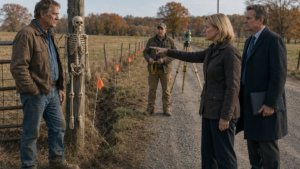
Catherine saw the inspection truck turn through Elizabeth Wright’s gate at 8:07 the next morning.
She was standing on her own side of the fence with a wrench in one hand and a broken water-line clamp in the other.
The truck slowed at the cattle guard, bounced once, then disappeared behind the machine shed.
Catherine stayed where she was.
Every useful instinct in her told her to walk closer.
Every rule told her not to.
A county animal-control deputy followed in a second vehicle. Behind him came the state veterinary technician Catherine had spoken to the day before.
Elizabeth appeared on the porch before either vehicle had fully stopped.
Even at a distance, Catherine could read the angle of her shoulders.
No surprise.
Only anger.
Catherine turned back to the water line.
She tightened the clamp too hard, stripped the screw, and swore under her breath.
For the next twenty minutes she pretended to work.
Doors opened.
Voices carried.
A kennel gate clanged somewhere behind the barn.
Then the barking started.
One dog.
Two.
Then several voices layered over one another, low and heavy.
Catherine stopped pretending.
She stood with both hands on the wrench and counted.
At least five distinct barks.
Maybe six.
The technician crossed the yard with a clipboard.
Elizabeth followed close behind.
“I told you,” Elizabeth said loudly enough for the words to carry across the road, “this is retaliation.”
The technician answered too quietly for Catherine to hear.
Elizabeth pointed toward Catherine’s property.
“There she is. Ask her.”
Catherine did not move.
The deputy glanced in her direction and then deliberately turned away.
That small gesture helped.
The inspection had to belong to them now.
Not her.
A kennel door opened.
Two dogs were led out.
Not the mastiffs from the road.
These were younger, both broad-headed and muscular, though one showed the same dullness through the coat that Catherine had noticed before.
Then another dog appeared.
Then a fourth.
By the time the fifth crossed the yard, Catherine had stopped counting bark tones and started counting bodies.
Six adult dogs in all.
Three more than current county registration showed.
A folding table was set up near the kennel shed.
The technician examined each animal.
Catherine could not hear the findings.
She did not need to.
One dog flinched when its collar was lifted.
Another had a patch of bare skin behind one ear.
The two mastiffs from the road emerged last.
The larger one recognized Catherine before she expected it to.
Its head came up.
For several seconds it stared through the fence.
Then it pulled toward her.
The deputy steadied the lead.
Elizabeth saw.
Her face changed.
“Don’t,” she snapped.
The dog ignored her.
Catherine’s grip tightened on the stripped clamp.
The technician crouched beside the mastiff and ran both hands carefully along its ribs.
Then she looked at the deputy.
Even from across the road, Catherine understood that look.
They began photographing.
Not casually.
Methodically.
Each side.
Collar.
Neck.
Body profile.
Kennel floor.
Water containers.
Feed storage.
When the machine shed doors opened, Catherine saw the first thing that made the case larger than two thin dogs.
Metal breeding partitions.
Stacked plastic whelping boxes.
Heat lamps.
A rack of unused collars.
And six feed bowls lined beneath the wall.
Six bowls.
Only one open bag of dry food sat nearby.
It was less than half full.
The technician disappeared inside.
Elizabeth paced beside the pickup.
“This is a working property,” she said.
The deputy replied, “Nobody said it wasn’t.”
“You people see one empty bin and decide you know everything.”
“Ma’am, let them finish.”
“There’s feed coming.”
“When?”
Elizabeth did not answer.
Catherine turned away.
That part hurt more than she expected.
She had spent years around struggling farms. Feed deliveries ran late. Bank balances emptied. A broken tractor could swallow money meant for fencing, seed, medicine, or groceries.
Poverty was not neglect by itself.
But six large dogs ate regardless of what the bank said.
A state truck arrived just before noon.
The technician carried two cardboard file boxes from Elizabeth’s office.
Not seized records, Catherine assumed. Copies or voluntarily produced paperwork.
One loose paper slipped to the ground.
Elizabeth bent quickly to pick it up.
Before she did, Catherine saw the red block lettering across the top.
PAST DUE.
Nothing more.
She looked away before she could read details.
That was not her evidence.
Still, the image stayed.
Past due.
Empty feed bin.
Six dogs.
Veterinary warnings.
Elizabeth had paid Raymond eventually. That meant money had existed somewhere.
The question was what she had chosen to pay first.
At twelve-thirty, the inspection team left.
The deputy drove out first.
The technician stopped briefly at Catherine’s gate.
She did not get out.
“You did the right thing staying back,” she said through the window.
Catherine nodded.
“Anything I need to know?”
“Not from me.”
“That bad?”
The technician considered the question.
“Your observations were independently supported.”
Relief came.
Then shame followed it.
Catherine had wanted those words.
She hated that she had wanted them.
“How many?” she asked.
“Six adult dogs physically present.”
Catherine looked toward Elizabeth’s kennel.
“Authorized?”
“Not for this use.”
“What use?”
The technician paused.
“Evidence of breeding activity beyond what the county permit history supports.”
There it was.
Not just too many dogs.
An operation.
“How are the two mastiffs?”
“Concerning.”
“Removal?”
“Not yet.”
Catherine exhaled slowly.
The technician continued, “We need complete medical review and owner response before the next step.”
“She’ll say it’s me.”
“She already has.”
Catherine looked back toward the house.
Elizabeth stood on the porch watching them.
“What exactly?”
“That you created an animal case to force leverage on the easement.”
Catherine laughed once without humor.
“And?”
“And your disclosure is why that accusation doesn’t end the inspection.”
The technician put the truck in gear.
Before pulling away, she added, “Keep it that way.”
Catherine understood.
No victory laps.
No confrontation.
No using what she knew at the next road meeting.
Especially no road meeting.
Her phone rang before the truck reached the county road.
Brian Clark.
She almost let it go to voicemail.
“Catherine.”
“Emergency association meeting tonight.”
“About what?”
“You know what.”
“No, Brian. I don’t.”
There was a silence.
“Elizabeth says state trucks were on her place because of you.”
“I can’t discuss an inspection.”
“That’s going to be a problem.”
“Why?”
“Because she’s asking the association to suspend your equipment access until the easement dispute is settled.”
Catherine looked down the narrow gravel road.
Her lower pasture depended on it.
“So she gets inspected,” Catherine said, “and my tractor loses access?”
“She says you’re using the road to harass her.”
“Do you believe that?”
Brian did not answer quickly enough.
“That’s why we’re meeting,” he said.
Catherine looked toward Elizabeth’s porch again.
Elizabeth was still standing there.
Even from that distance, Catherine could see the folded paper in her hand.
Past due.
Behind her, through the open shed, six empty bowls sat in a row.
“Tonight,” Brian said. “Seven.”
Then he hung up.
Chapter 5: The Road Meeting Turned Against Catherine
Elizabeth was already standing when Catherine entered the equipment shed.
“No more delays,” she said. “She gives up the disputed access or we restrict her use of the road.”
Catherine had not even taken off her jacket.
Mud from the gravel road marked both boots.
The shed smelled of diesel, dust, and old hay. A folding table had been dragged into the center. Brian Clark sat behind it with two association members, a yellow legal pad in front of him.
Nobody offered Catherine a chair.
She took one anyway.
Brian rubbed his forehead.
“Let’s keep this about road use.”
Elizabeth gave him a sharp look.
“This became about more than road use when she sent state inspectors onto my property.”
Catherine said nothing.
Elizabeth turned toward her.
“Tell them.”
“I can’t discuss an active animal-welfare review.”
“There. You hear that?”
One of the members shifted.
Elizabeth spread her hands.
“She files complaints, refuses to negotiate the easement, then suddenly my dogs are a state matter.”
Catherine kept her voice flat.
“I did not conduct the inspection.”
“You caused it.”
“I reported what I personally observed.”
“And what did you observe?”
Catherine hesitated.
The answer was safe in one sense.
Dangerous in another.
“Two dogs in concerning condition.”
“Concerning according to whom?”
“Me.”
Elizabeth laughed.
“Exactly.”
Brian tapped the legal pad.
“We need to separate issues.”
“Fine,” Elizabeth said. “Road issue. Her tractor blocks my entrance. Her hay wagons tear up the shoulder. Delivery trucks cut the corner. She wants an easement written fifty years ago to cover traffic nobody imagined then.”
That was the strongest version of Elizabeth’s argument.
Catherine knew it.
“Some of that deserves review,” she said.
The room went quiet.
Elizabeth had expected denial.
Brian looked up.
Catherine continued. “The road needs maintenance standards. We should have had them years ago.”
“So you admit it,” Elizabeth said.
“I admit a shared road requires rules.”
“And your equipment?”
“My farm needs access.”
“To your lower field.”
“Yes.”
Elizabeth leaned forward.
“And you refuse the alternate track.”
“It isn’t all-weather access.”
“It was good enough before.”
“It washes out.”
“You could improve it.”
“Across drainage ground I don’t own.”
One association member raised a hand.
“Can we get back to the state inspection?”
Catherine shook her head.
“No.”
Elizabeth smiled.
“Convenient.”
Catherine felt the urge to answer.
She could tell them about the ribs.
The collar sores.
The veterinary warnings she now knew existed.
Six dogs.
Expired permits.
The half-empty feed bag.
She could turn the room with facts.
She also knew exactly which facts she was allowed to disclose.
Almost none of them.
So she sat still.
Elizabeth saw weakness in the silence.
“You people know me,” she said to the table. “My family has maintained that road longer than Catherine has owned her place.”
“I inherited my place,” Catherine said.
Elizabeth waved the distinction away.
“My point stands.”
“No, it doesn’t.”
Brian held up a hand.
“Enough.”
Elizabeth turned on him.
“You wanted this meeting.”
“I wanted to keep the road open.”
“Then keep her commercial traffic off it.”
Something in Brian’s expression tightened.
Catherine noticed.
“You don’t actually want my traffic off it,” she said.
Brian looked at her.
“Not permanently.”
“Why?”
“Because that’s not the issue.”
“Then what is?”
He glanced at Elizabeth.
That was answer enough.
Catherine leaned back.
“What aren’t you saying?”
Brian’s jaw moved once.
Elizabeth cut in. “This isn’t about Brian.”
“It became about Brian when he stopped looking at me.”
“Catherine,” he warned.
She waited.
Finally Brian put down his pen.
“If Elizabeth shuts down the kennel operation, her road contribution changes.”
The shed became very still.
Elizabeth’s face hardened.
“That is private.”
Brian ignored her.
“The association budget assumes proportional contributions based on use.”
Catherine understood before he finished.
Elizabeth’s vehicles.
Feed deliveries.
Buyers.
Service traffic.
A larger share of maintenance.
“If that income disappears,” Brian said, “the rest of us absorb more.”
Catherine stared at him.
“So this isn’t just about whether you believe me.”
“I didn’t say that.”
“You don’t have to.”
Brian’s cheeks reddened.
“I’m trying to keep everybody’s costs down.”
“That’s a reason.”
“It’s a practical one.”
“It’s still a reason.”
Elizabeth stood straighter.
“You see? She’s turning you into the problem now.”
Brian’s chair scraped backward.
“No. You don’t get to do that.”
It was the first time he had challenged Elizabeth all evening.
“You told me this meeting was about protecting the road,” he continued. “You didn’t tell me your kennel permit had questions attached to it.”
“My permit is being handled.”
“By whom?”
Elizabeth’s silence answered.
Catherine said nothing.
She watched the room shift.
Not toward her.
Away from certainty.
That was enough.
Brian picked up the association bylaws.
“We can’t adjudicate animal issues. We can’t settle the full easement tonight either.”
Elizabeth crossed her arms.
“So?”
“So temporary restriction.”
Catherine felt the words before he finished.
“Heavy vehicle use limited until the access review is complete.”
“No,” Catherine said.
Brian looked at her apologetically.
“Passenger vehicles stay unrestricted.”
“My tractor isn’t a passenger vehicle.”
“I know.”
“My lower pasture needs feed access.”
“You can use the south track.”
Elizabeth’s expression almost became a smile.
Catherine looked at Brian.
“You know that track washes out.”
“For a temporary period.”
“How temporary?”
“Until review.”
“That could take weeks.”
“No better option tonight.”
There it was.
The cost of staying clean.
Catherine could have defended herself more aggressively.
She could have leaked enough truth to frighten the room into her corner.
Instead, she had kept the inspection separate.
Now her own farm would pay for it.
Brian called for a vote.
Two in favor of temporary restriction.
One opposed.
Brian hesitated before adding his own vote in favor.
Elizabeth did not vote because her complaint had initiated the motion.
The result stood.
Catherine rose.
Mud had dried around the edges of her boots and flaked onto the concrete floor.
Elizabeth looked down at it.
“You always leave something behind,” she said.
Catherine met her eyes.
“So do you.”
Elizabeth’s expression sharpened.
Catherine regretted the line immediately.
Too personal.
Too close to satisfaction.
She picked up her jacket.
Outside, Brian followed her.
“Catherine.”
She kept walking.
“I’m not against you.”
“That vote felt surprisingly similar.”
“I’ve got forty percent of that road-maintenance budget tied to her traffic.”
“So?”
“So if her operation collapses, everybody pays.”
Catherine turned.
“And that makes the dogs what? Infrastructure?”
Brian looked away.
“I didn’t say that.”
“No. You just built your vote around it.”
His face tightened.
“You think farms run on principles?”
“No. They run on bills. I know.”
“Then you know why I’m worried.”
“I do.”
That stopped him.
Catherine continued, “Understanding it doesn’t make it right.”
Her phone vibrated.
State office.
She answered.
Her supervisor spoke without greeting.
“The independent veterinary review is complete.”
Catherine moved away from Brian.
“And?”
“Two dogs meet criteria for immediate protective removal pending further proceedings.”
She looked through the darkness toward Elizabeth’s property.
“Which two?”
“You know which two.”
The mastiffs.
“When?”
“Transport order is signed for tomorrow morning.”
Catherine closed her eyes.
Her supervisor added, “You are not leading the removal.”
“I know.”
“You may be present as reporting witness because of the original incident, but you do not direct.”
“Understood.”
“Catherine.”
“Yes?”
“Prepare for resistance.”
The call ended.
Brian was watching her.
“What happened?”
“I can’t tell you.”
He gave a tired laugh.
“Of course you can’t.”
Catherine looked down the road toward the dark kennel fence.
Tomorrow morning, somebody would arrive with an order to take the two dogs Elizabeth had used to make that road feel dangerous.
Catherine no longer wondered whether Elizabeth would be angry.
She wondered what Elizabeth would do when anger stopped being enough.
Chapter 6: Elizabeth Reached for the Worn Collar
The mastiffs backed away from the transport driver and went straight toward Catherine.
Not fast.
Not aggressively.
They simply chose her.
The larger dog crossed the kennel yard with its head low, passed the state veterinary technician, and pressed against Catherine’s leg.
Elizabeth made a sound behind them.
“Of course.”
Catherine did not touch the dog immediately.
The transport order had already been read.
The deputy had explained the temporary protective removal.
The technician had documented the current condition.
Catherine’s role was narrow.
Witness.
Nothing more.
The second mastiff joined the first.
Its tail moved once.
Elizabeth stood beside the kennel door with both arms folded tightly across her chest.
“You fed them,” she said.
Catherine looked at her.
“No.”
“They don’t do that.”
“They did it on the road.”
“Because you smelled like feed.”
“Yes.”
Elizabeth’s mouth tightened.
The admission made the scene worse, not better.
The transport driver clipped a secondary lead to the first dog’s collar.
The cracked leather creaked.
Catherine recognized the same buckle she had drawn in her notebook.
One of the adjustment holes had stretched into an oval.
The skin beneath it looked angrier now.
The technician touched the strap.
“This needs to come off before transport.”
Elizabeth stepped forward.
“No.”
The deputy raised a hand.
“Ma’am.”
“That collar belongs to me.”
“The dog is being removed under order.”
“You can take the dog. You don’t take my property.”
Catherine watched the technician’s face.
Professional patience.
Measured distance.
Exactly the restraint Catherine had practiced for years.
“Once it’s removed,” the technician said, “the collar can be retained as case material if necessary or returned after documentation.”
Elizabeth laughed sharply.
“Case material.”
Nobody answered.
She looked at Catherine.
“This is what you wanted.”
Catherine kept her voice low.
“No.”
“You wanted me off this land.”
“I wanted access to my field.”
“Same thing.”
“No.”
Elizabeth stepped closer.
“You think I don’t know how this works? First the dogs. Then the kennel. Then buyers stop coming. Then the road association says I can’t pay my share. Then the bank decides I’m finished.”
Catherine felt Brian’s words from the night before settle into place.
Forty percent of road maintenance.
Kennel traffic.
Buyers.
Feed deliveries.
“You expanded too fast,” Catherine said.
Elizabeth stared at her.
Catherine immediately wished she had stayed silent.
“Don’t pretend you understand.”
“I understand bills.”
“You understand a state paycheck.”
“And a farm.”
“A hobby farm.”
The insult had less force than Elizabeth intended.
Catherine looked around the kennel yard.
Six runs.
Whelping boxes.
Heat lamps.
Feed bins.
Repairs made with whatever had been available.
This was not the property of someone who had done nothing.
It was the property of someone who had kept cutting corners because stopping felt worse than continuing.
The technician began loosening the mastiff’s collar.
Elizabeth said, “I kept them alive.”
Nobody answered.
“I took them to Raymond.”
Catherine nodded.
“Yes.”
That surprised Elizabeth.
“He told you?”
“Records were reviewed.”
“I paid those bills.”
“Yes.”
“Late sometimes, but I paid.”
Catherine looked at the dog leaning against her leg.
“That isn’t the whole job.”
Elizabeth’s eyes flashed.
“You think I don’t know that?”
For the first time, her voice cracked.
Not with sadness.
With exhaustion.
“I had buyers cancel. Feed went up. The litter last spring barely covered the loan. Then the road work hit. Then you started pushing that easement.”
“I didn’t start it.”
“You refused to change it.”
“My lower field depends on it.”
“And my property depends on controlling who comes through.”
There was the deeper truth.
Not ownership alone.
Visibility.
Catherine looked toward the machine shed.
“Because of the kennel?”
Elizabeth did not answer.
The deputy shifted.
The technician stopped working on the collar.
Catherine should have stopped too.
Instead she asked, “Is that why you kept sending complaints? To reduce traffic past the fence?”
Elizabeth’s gaze moved from Catherine to the dogs.
“I needed time.”
“For what?”
“To get through one season.”
The words came out quietly.
Then the pride returned.
“One good season and I could have fixed everything.”
The mastiff against Catherine’s leg shifted its weight.
Its shoulder felt too sharp beneath the coat.
“By feeding them less?” Catherine asked.
Elizabeth looked away.
That was answer enough.
Catherine felt anger rise.
Not hot.
Cold.
“You knew.”
“I rationed.”
“They were underweight.”
“I know what they weighed.”
“Raymond warned you.”
“I know.”
The technician glanced at Catherine, warning her with her eyes not to push beyond her role.
Catherine stopped.
Elizabeth did not.
“You want the truth?” she said. “Those two didn’t need to be fat.”
The yard went quiet.
Elizabeth pointed toward the mastiffs.
“People saw them and stayed where they belonged.”
Catherine stared at her.
“People?”
“Buyers. Drivers. Anybody coming down the road.”
“You wanted them to look dangerous.”
“I wanted them to look like mastiffs.”
“That isn’t what you said.”
Elizabeth’s face hardened.
“You know what I mean.”
Catherine thought of the first morning.
The leash sliding through Elizabeth’s hand.
Use the south entrance.
You afraid?
You should be.
The dogs had never been the weapon Elizabeth thought they were.
Their size had been.
Their hunger had simply been hidden by it.
The technician returned to the collar.
“Ma’am, step back.”
Elizabeth moved before anyone expected it.
She reached down and grabbed the leather strap.
The mastiff jerked away.
Elizabeth tightened her fist.
“Mine.”
The dog yelped.
Catherine moved.
Not as investigator.
Not as state employee.
As the nearest person who could stop pressure on an injured neck.
She caught Elizabeth’s wrist with one hand and took the collar with the other.
“Let go.”
Elizabeth stared at her.
“Take your hand off me.”
“Let go of the collar.”
The deputy stepped in.
“Ma’am, release it.”
For one second Elizabeth held on.
The dog crouched lower.
Catherine saw the rubbed skin disappear under the strap.
“No,” she said.
Not loudly.
Not as a warning.
A decision.
Elizabeth released.
The deputy guided her backward.
Catherine immediately let go of Elizabeth’s wrist.
The technician slid blunt shears beneath the leather.
One cut.
The collar separated.
The mastiff shook its head violently, then froze.
A raw line circled the neck where the strap had rested.
The technician held up the broken collar for documentation.
Catherine stared at it.
For days she had treated that collar as evidence.
Now, in two pieces, it looked smaller than she remembered.
The transport driver replaced it with a loose slip lead.
The dog breathed.
Elizabeth stood beside the fence.
Whatever argument she had prepared was gone.
The deputy spoke quietly with her.
The mastiffs were loaded into the transport vehicle.
This time neither had to be shoved.
The larger one stopped on the ramp and looked back at Catherine.
She did not go to it.
“Go on,” she said.
The dog climbed inside.
The doors closed.
When the vehicle pulled away, the yard became strangely empty.
Six bowls remained beneath the machine-shed wall.
Four dogs remained on the property under restrictions.
Two spaces were open.
Catherine turned toward the road.
Elizabeth spoke behind her.
“You think this saves anything?”
Catherine stopped.
“I think it saves two dogs from getting worse.”
Elizabeth laughed, but there was nothing sharp in it anymore.
“The bank is taking the farm.”
Catherine turned.
Elizabeth looked toward the house instead of at her.
“I got the final notice last week.”
Catherine said nothing.
“The kennel was supposed to carry the loan until cattle prices came back.”
“You don’t have cattle.”
“I sold them.”
That explained the empty back pasture.
The missing stock trailer.
The too-clean loading chute Catherine had stopped noticing months ago.
Elizabeth rubbed both hands over her face.
“I kept thinking one more litter. One more buyer. One more month.”
Catherine looked toward the road between their properties.
For months she had imagined the fight ending with a line on a survey map.
Her access recognized.
Elizabeth defeated.
Simple.
Now the dogs were gone, the kennel case was moving forward, and the woman who had tried to frighten her was standing beside a failing farm.
Justice had arrived.
It did not look clean.
Elizabeth finally faced her.
“You got what you wanted.”
Catherine thought of the mastiff’s neck after the collar came free.
“No,” she said. “I got what I should have done sooner.”
Elizabeth frowned.
Catherine walked toward the gate.
Behind her, the kennel yard stayed silent.
For the first time since the dispute began, Catherine understood that the next decision would not be about whether she could win the road.
It would be about how much she was willing to take from someone who had already lost almost everything.
Chapter 7: The Gate Stayed, but the Road Opened
The independent findings arrived in Catherine’s inbox at 6:12 on a Monday morning.
She read the first page standing at the kitchen counter.
By the third paragraph, she sat down.
The two mastiffs had been in worse condition than she had believed from the road.
Both were significantly underweight. Both showed recurring collar injury. One had dehydration markers. The other had muscle loss beyond what Raymond’s earlier notes had documented.
Four additional dogs had shown lesser but still concerning deficiencies.
The kennel operation had no current authorization for the number and use of animals found on the property.
The report did not accuse Elizabeth of every ugly motive people had begun assigning her.
It did something more damaging.
It listed facts.
Dates.
Weights.
Photographs.
Veterinary warnings.
Food availability.
Permit history.
Catherine read the whole thing twice.
Then she opened the attachment containing her own original incident memorandum.
Her first notes looked almost timid beside the independent findings.
Prominent ribs.
Possible muscle loss.
Visible irritation.
She had been careful because caution was part of the job.
But seeing the full record made another truth difficult to avoid.
She had also been careful because she had been afraid.
Afraid Elizabeth would call it retaliation.
Afraid the road dispute would contaminate the case.
Afraid that doing the right thing while angry would somehow make it wrong.
Catherine closed the laptop.
Outside, the farm road was still restricted to light traffic.
Her tractor sat on the near side of the pasture gate.
The south track had dried enough for an ATV, not enough for a loaded hay wagon.
Practical consequences had continued while the investigation moved forward.
That afternoon, Brian Clark called another association meeting.
This one was held in the same equipment shed.
Catherine arrived last.
Elizabeth was already seated.
She looked smaller than she had three weeks earlier.
Not physically.
Structurally.
The confidence that had once filled every silence around her had disappeared.
A folder lay closed in front of her.
Brian had a survey proposal and two estimates for future road work.
He started without ceremony.
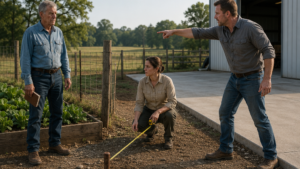
“We have three things to settle. Temporary restrictions, the easement review, and maintenance shares.”
Elizabeth said, “Four.”
Brian looked at her.
“The sale.”
Catherine turned.
Elizabeth kept her eyes on the table.
“I’m listing the west acreage.”
Nobody spoke.
Brian finally asked, “All of it?”
“Twenty-eight acres.”
The kennel side.
Not the farmhouse.
Not the road.
Enough land to reduce debt.
Catherine understood what that meant.
Elizabeth had found a way to lose part of the property without losing the place entirely.
Brian looked at Catherine.
“That changes the road question.”
“How?”
“If the west acreage sells separately, we could widen the association road while boundaries are being adjusted.”
Catherine knew what was coming.
Brian opened the survey proposal.
“If we secure another twelve feet along Wright’s north side now, we could create permanent two-lane clearance at the worst section.”
Elizabeth’s head snapped up.
“No.”
Brian ignored her.
“It would solve equipment conflicts. Better drainage. Easier winter access.”
Catherine studied the map.
The proposed widening crossed Elizabeth’s land.
More land than Catherine’s easement required.
Much more.
Three weeks earlier she might have welcomed it.
Elizabeth had spent months trying to reduce Catherine’s access. Now the association could expand it while Elizabeth had less money to resist.
Brian tapped the page.
“This is probably our only chance to fix the road properly without everyone paying twice later.”
Catherine looked at him.
“You mean while she can’t fight it.”
His expression hardened.
“I mean while the parcel is being divided.”
“That isn’t the same sentence.”
“It’s the practical sentence.”
Elizabeth stared at Catherine.
There was no accusation in her face this time.
Only calculation.
She expected Catherine to take the advantage.
Catherine thought about her father.
Never give away access you already own.
He had not said take access you never needed.
“What does the recorded easement require?” Catherine asked.
Brian frowned.
“We know what it says.”
“I’m asking the surveyor’s interpretation.”
He flipped pages.
“Existing traveled width plus necessary clearance for reasonable farm access.”
“How much?”
“Depends on the section.”
“At the narrowest point?”
“About what’s there now, properly graded.”
“Then that’s what I want.”
Brian stared at her.
“You’re turning down a wider road?”
“I’m turning down land that isn’t required for my access.”
Elizabeth looked up fully now.
Brian said, “Catherine, five years from now you’ll wish you took it.”
“Maybe.”
“Then why not?”
Catherine looked across the table at Elizabeth.
Because winning was becoming too easy.
Because the kennel case had already done what it needed to do.
Because Elizabeth would lose the breeding operation.
Because two dogs had been removed.
Because four more were under monitoring and restrictions.
Because debt had already taken twenty-eight acres before any neighbor needed to take another foot.
“I wanted my road open,” Catherine said. “I didn’t want her farm.”
Elizabeth’s face tightened.
For a second Catherine thought she might say thank you.
She did not.
That made the moment feel more honest.
Brian leaned back.
“So neutral survey. Existing easement confirmed. Drainage improvements within current limits.”
“Yes.”
Elizabeth said quietly, “And the kennel?”
Catherine did not answer.
That was not hers to negotiate.
Elizabeth seemed to realize it.
“I signed the surrender yesterday,” she said.
Brian looked confused.
“What surrender?”
“The breeding authorization application. The pending one.”
She swallowed.
“I’m done.”
Catherine watched her hands.
They were rougher than Catherine remembered.
The nails were broken short.
This was the first time she had seen Elizabeth without rings.
“The remaining dogs?” Catherine asked.
“Two are going to relatives after approval. Two stay with me under the county limit.”
Her voice flattened.
“No more breeding.”
Brian nodded slowly.
“That should reduce traffic.”
Elizabeth gave him a tired look.
“Always thinking about the road.”
“I’m treasurer.”
For the first time in weeks, Catherine almost laughed.
So did Elizabeth.
Only for a second.
The vote that followed was uneventful.
Heavy-vehicle access restored immediately.
Independent survey accepted.
No permanent widening beyond the recorded easement without separate agreement.
Maintenance shares recalculated after the acreage sale.
Nobody applauded.
Nobody apologized.
The result went into the minutes.
That was enough.
Two days later Catherine drove her tractor down the road again.
The repaired section still shook the front axle.
The curve beside Elizabeth’s property remained too tight.
The gate was still there.
So was Elizabeth’s mailbox.
Nothing had been transformed into a symbol of conquest.
The road simply worked again.
Elizabeth stood near the fence while Catherine passed.
Catherine slowed.
Neither woman waved.
Elizabeth looked at the tractor, then at Catherine.
“Surveyor comes Thursday.”
“I know.”
“He says your line is where you said it was.”
Catherine nodded.
Elizabeth looked toward the west field.
“For what it’s worth, I thought if you got more control of the road, buyers would see too much.”
Catherine stopped the tractor.
Elizabeth continued before she could answer.
“I kept thinking privacy was the difference between getting another month and losing everything.”
“And the dogs?”
Elizabeth’s face changed.
“I told myself they were fine because they were standing.”
Catherine waited.
“That sounds stupid now.”
“It sounds like something people tell themselves when the next answer costs money.”
Elizabeth looked at her.
“That supposed to make me feel better?”
“No.”
“Good.”
Catherine put the tractor back in gear.
Before she moved, Elizabeth said, “I shouldn’t have sent them at you.”
Catherine looked over.
Elizabeth stared at the road.
“I knew they wouldn’t do much.”
“That isn’t better.”
“I know.”
It was not an apology large enough to repair anything.
It was more truth than Catherine had expected.
She drove on.
The following week, Raymond called.
“You want to see something?”
Catherine almost said no.
She had reports stacked on her desk, a fence contractor due at noon, and no reason to turn the dogs into a private reward for herself.
Then Raymond said, “The big one gained nine pounds.”
Catherine was in her truck five minutes later.
The clinic’s recovery yard sat behind the main building.
The mastiff was standing beside the chain-link gate when Catherine came around the corner.
For one instant she did not recognize it.
The body was still lean.
But not hollow.
The coat had begun to show a little shine.
Its head came up.
Then the entire animal changed.
The tail struck the fence once.
Twice.
The mastiff moved forward.
Raymond opened the gate.
“Easy.”
The dog walked directly to Catherine.
No rushing.
No desperate nose searching for feed.
It stopped in front of her and leaned.
Catherine put one hand against its shoulder.
The pressure was different now.
Solid.
Warm.
Alive in a way it had not been on the gravel road.
Around its neck was a new collar.
Soft nylon.
Loose enough for two fingers.
Catherine touched it.
On a hook beside the clinic door hung an evidence bag.
Inside was the old leather collar.
Cracked.
Stiff.
Cut cleanly through.
Catherine looked at it for a long moment.
Raymond noticed.
“State released it after documentation.”
“You keeping it?”
“Until the case closes.”
The mastiff nudged Catherine’s hand.
She scratched beneath the new collar.
No raw skin.
No flinch.
Raymond leaned against the fence.
“You know what bothers me?”
“What?”
“You were right early.”
Catherine shook her head.
“Not early enough.”
“You reported it.”
“After I had seen enough to worry before.”
Raymond did not argue.
That was why she trusted him.
Catherine looked down at the dog.
“I thought staying out of it made me responsible.”
“Sometimes it does.”
“Sometimes it doesn’t.”
“No.”
The mastiff lowered itself beside her boots.
Catherine crouched.
For weeks she had treated restraint as the opposite of abuse.
Elizabeth had grabbed too tightly.
Pushed too far.
Held too much.
Catherine had done the reverse.
She had kept backing away from her own judgment until somebody weaker paid for the distance.
Different mistakes.
Not equal ones.
But real.
The mastiff rolled one shoulder against her knee.
Catherine smiled despite herself.
Raymond said, “He doesn’t do that with everybody.”
“He used to like my gloves.”
“You’re not wearing gloves.”
Catherine looked down.
She wasn’t.
The dog lifted its head.
For the first time, there was nothing in Catherine’s hand for it to smell.
No feed dust.
No evidence.
No reason to approach except recognition.
She ran her fingers beneath the loose collar again.
Outside the clinic yard, a truck passed on the county road.
Somewhere beyond it, Catherine’s gravel lane still crossed Elizabeth Wright’s property exactly where it always had.
The gate remained.
The easement remained.
The farmhouse remained.
So did consequences.
Nothing had been erased.
It had only been put back within its proper boundaries.
Catherine stood.
The mastiff rose with her.
When she stepped toward the gate, it followed for three paces before Raymond called it back.
This time the dog stopped willingly.
Catherine looked once at the old collar hanging in the clear bag.
Then at the new one resting loose around the dog’s neck.
She left without taking either.
The road home was open.
The story has ended.