They Tore Out His Grandfather’s Vines, Never Realizing Their Entire Development Drank From His Land
Chapter 1: The Morning the Oldest Row Came Down
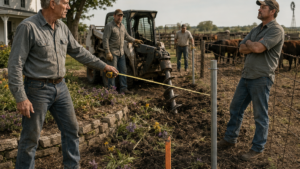
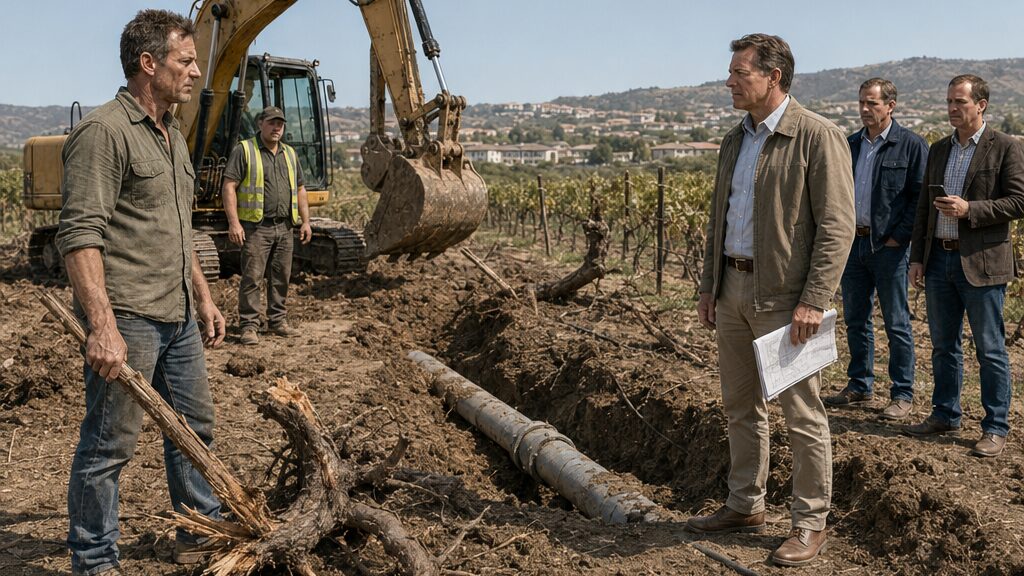
The excavator bucket was hanging over the oldest vine in the vineyard when Jason Carter came around the equipment shed.
For a second he could not make sense of what he was seeing.
The machine sat where there had been a narrow strip of grass the evening before. Its steel tracks had flattened the shoulder beside the county road and ground pale dust into the first vineyard row. Fresh earth lay piled along a rough corridor aimed toward the neighboring development.
Then the bucket lowered.
“Stop!”
Jason ran.
The equipment operator jerked his hands from the controls. The bucket stopped less than a foot above the twisted remains of a vine.
Three others were already gone.
Jason stepped over a severed irrigation tube and dropped beside the nearest trunk. The old wood had split near its crown. A weathered stake lay underneath it, broken across the faded numbers his grandfather had burned into the cedar decades ago.
Jason picked up one half.
A truck door slammed behind him.
Brian Walker came down the graded strip wearing clean boots, pressed khakis, and a light jacket that looked wrong beside the torn soil. Two members of the residential association followed him. One held a phone low at her side.
Brian glanced toward the stalled excavator.
“You shut them down?”
“They’re forty feet inside my fence line.”
Brian’s expression tightened, but not with surprise.
“The entrance work was approved.”
“Not by me.”
“We went through this twice.”
Jason stood slowly, still holding the broken stake.
“No. You sent me two purchase offers. I rejected them.”
Brian looked toward the development beyond the low rise. From here Jason could see the upper edge of the clubhouse roof and the tops of ornamental trees that had no business being as green as they were in August.
“This isn’t just about you,” Brian said. “That entrance serves three hundred households. It raises values across the whole valley.”
Jason looked down the raw strip where vines had stood that morning.
“So you raised their value with my land?”
One of the board members shifted her weight.
Brian let out a breath through his nose. “There’s an access corridor on the recorded map.”
“There is no road easement through these vines.”
“There is a corridor.”
“For what?”
Brian turned toward the equipment operator. “Give us a minute.”
The operator climbed down but did not leave. He stood beside the track, looking from Brian to Jason.
Brian took a folded copy from beneath his arm. He opened it on the hood of a utility vehicle.
The map was old enough that the lines had been copied several times. Jason recognized the shape of his parcel immediately, the county road, the western drainage, the narrow strip running along the northern edge.
Brian tapped that strip.
“There.”
Jason leaned closer.
The line existed.
But not where the excavator stood.
“You moved it.”
“No.”
“This line runs north of the row.”
“Depending on which monument you use.”
Jason looked at him.
Brian continued, more quietly now. “Our surveyor says the old fence wandered south over time.”
“That fence was rebuilt on the same posts.”
“Your grandfather’s posts.”
“My grandfather owned the ground.”
Brian folded the map.
“And the association has a recorded corridor. We’re not going to stop a funded project because you don’t like the interpretation.”
Funded.
That word changed the shape of the conversation.
Jason looked toward the excavator again. “You’ve already committed the money.”
“The contracts are signed.”
“Before resolving the boundary?”
“We resolved it.”
“You decided it.”
Brian’s jaw hardened. “Prove otherwise.”
The line should have made Jason angrier.
Instead, something cooled inside him.
He crouched beside the torn row.
The excavator’s teeth had opened a trench deep enough to expose more than vine roots. Beneath the dry topsoil was a band of darker earth and, several inches below that, a rounded gray surface.
Pipe.
Jason brushed soil away with his fingers.
It was larger than an irrigation lateral. Much larger.
He cleared another few inches and found a coupling.
Brian was still talking behind him.
“We offered you fair market value. More than fair. You refused to discuss an adjustment, refused the second meeting, and sent back our attorney’s letter unopened.”
Jason barely heard him.
He pulled a small tape from his pocket.
The pipe measured close to eighteen inches across the exterior.
He sat back on his heels.
He knew that size.
Years earlier, while consulting on drought projections for the county, Jason had reviewed pumping summaries from several large users in the valley. The neighboring development had submitted numbers for landscape demand, lake replenishment, and emergency storage.
There had been a transmission line listed in those records.
Eighteen inches.
Brian noticed where Jason was looking.
“That’s utility infrastructure.”
Jason wiped his fingers on his jeans.
“Whose?”
“The association’s.”
“Then why is it here?”
Brian’s answer came too quickly.
“Because of the corridor.”
Jason looked toward the direction of the buried line. It ran almost exactly beneath the graded path, disappearing southwest—toward his old well field.
Not toward the county main.
Toward his land.
He raised his phone and photographed the exposed coupling.
One of the board members gave a short, uneasy laugh. “Is that necessary?”
Jason took another picture, including the broken stake in the frame.
“Yes.”
Brian folded his arms. “You can document anything you want. The work continues.”
Jason turned to the equipment operator.
“Until the county confirms this utility and the boundary, don’t put that bucket beyond this pipe.”
The operator hesitated.
Brian said, “You’re contracted to us.”
The operator stared at the exposed line.
“You got a utility clearance for this section?”
Brian did not answer immediately.
That was enough.
The operator climbed back into the cab, but he did not restart the engine.
The silence that followed was louder than the machine had been.
Brian stepped closer to Jason.
“This delay is going to cost money.”
Jason looked at the uprooted vines.
“It already has.”
For the first time, Brian seemed to see the broken stake in Jason’s hand.
His expression softened by perhaps half a degree.
“I understand those rows are old.”
“No, you understand they’re in your way.”
“Jason, this valley isn’t what it was thirty years ago. People live here now. They invested here. We have obligations too.”
Jason wanted to tell him that vines planted before either of them had gray hair were also an obligation.
He didn’t.
He walked the exposed line instead.
At the edge of the trench he stopped, knelt again, and brushed dirt from a stamped metal band on the coupling. The manufacturer’s mark had nearly disappeared, but the installation code remained.
Jason knew the era.
He knew who had been digging wells on this property then.
And he remembered something else.
A low concrete enclosure near the northwest corner of the vineyard, half-hidden behind blackberry canes. His grandfather had always called it the lower valve house.
Jason had assumed it belonged to the old irrigation system.
He had never bothered opening it after converting the newer blocks to drip.
Behind him Brian said, “We’ll resume when our surveyor gets here.”
Jason stood.
“You do that.”
The answer surprised Brian.
Jason slipped the broken 1962 stake into the bed of his pickup and took one last photograph of the pipe.
Then he drove toward the vineyard office.
He spent the next twenty minutes digging through old hydrology files.
The county pumping summary was where he remembered it, buried in a folder from a drought study seven years earlier.
He found the development’s entry.
Landscape irrigation. Lake replacement. Common-area demand.
And beneath those numbers:
Transmission main: eighteen inches.
Jason read the source designation twice.
Then he looked through the office window toward the northwest corner of his property.
The line listed in the development’s own pumping records did not begin at a municipal connection.
It began at a private well.
On the Carter parcel.
Chapter 2: The Map That Proved Too Little
The county clerk found the older map only because Jason asked her to search under his grandfather’s parcel number instead of his own.
She returned from the records room carrying a wide folder with cracked cardboard edges.
“This predates the subdivision,” she said.
Jason cleared space on the counter.
It was a hand-drafted parcel map from the late 1960s. His vineyard occupied most of the page. North of it lay grazing land that had later been divided, sold, and eventually absorbed into what was now the residential development.
The disputed strip was there.
So was a narrow line crossing it.
Jason bent closer.
“What is that notation?”
The clerk adjusted her glasses. “Utility accommodation.”
“For what utility?”
“It doesn’t say.”
“No width?”
“Not on this copy.”
Jason felt some of the certainty he’d carried into the building begin to thin.
He had expected a clean answer: property line here, association over there.
Instead, the map gave both sides something.
His parcel boundary clearly ran north of the freshly damaged vines. The excavation appeared to be on his land.
But the old utility notation existed almost exactly where Brian’s map said it did.
The clerk brought out the deed history next.
Jason followed the transfers backward through his father’s estate and into his grandfather’s ownership.
The land was his.
That part was plain.
Then he reached a paragraph buried in an older deed.
The grantor acknowledged “continued accommodation for existing agricultural and domestic utility conveyance benefiting adjoining parcels.”
No dimensions.
No payment schedule.
No expiration.
No description of the utility.
Jason read it again.
“That could mean anything.”
“It could,” the clerk said. “Which usually means you’ll want an attorney to tell you what it means now.”
He photographed the page.
“What about the well?”
The clerk searched a separate index.
The well record came from the county environmental health archive. Its coordinates placed it inside Jason’s northwest parcel corner.
Forty-two feet south of the old boundary.
Jason stared at the number.
“Can I get a certified copy?”
“Of the location record, yes. Ownership rights are a different question.”
“I understand.”
He did.
At least professionally.
Emotionally, he was already imagining Brian’s face when he saw the coordinates.
That bothered him.
By noon Jason was back at the vineyard office with maps covering his desk.
He set the broken 1962 stake along one edge to stop a curled survey sheet from rolling closed.
The irony was difficult to miss.
His grandfather’s old wood was now holding down the paperwork that might decide what remained of his grandfather’s land.
Jason aligned the county parcel map with the grading photographs.
The excavator had crossed the boundary.
Probably.
The water line occupied an old utility corridor.
Apparently.
The well sat on Jason’s property.
Definitely.
Three answers.
None of them solved the whole problem.
His phone buzzed.
Brian.
Jason let it ring.
A minute later a message appeared.
Our surveyor can meet tomorrow. We intend to resume immediately after verification.
Jason read it, put the phone facedown, and pulled another file box from beneath the desk.
He found irrigation permits, pump invoices, handwritten flow readings, and old maintenance receipts.
Then he found envelopes.
Four of them.
All unopened.
The return address on the first belonged to a law office that had represented the residential association before Brian became president.
Jason knew exactly why he had ignored them.
The first letter had arrived a few months after his grandfather died.
Jason had been sorting probate documents, renewing operating loans, and trying to keep forty acres alive through a bad dry year. Every week somebody seemed to want a signature.
Buy this strip.
Lease that corner.
Let us widen this lane.
Sell the old well.
His grandfather had hated those conversations.
“Once people start drawing lines through a farm,” he used to say, “they never stop drawing.”
So Jason had stopped answering.
He had convinced himself silence was protection.
The second envelope was from six years earlier.
The third from five.
The fourth—
Jason froze.
The postmark was only three years old.
He remembered this one.
He had opened the mailbox, seen the association law firm’s name, and thrown it on the office shelf without reading it.
He turned the envelope over.
Still sealed.
For several seconds he simply held it.
Then he found a knife.
The letter inside was dry, formal, and less aggressive than he’d expected.
The association requested discussions regarding “formal documentation of historic water conveyance and maintenance access across the Carter parcel.”
Jason read that sentence twice.
Further down:
Existing arrangement appears to derive from longstanding permission between predecessor landowners and should be clarified for the protection of all parties.
He leaned back.
There was no demand to buy the well.
No threat.
No claim of ownership.
Just an invitation to formalize something that apparently everyone had been living with.
Jason looked toward the broken stake.
Three years ago, he could have answered.
He had not.
The afternoon light shifted across the maps while he went through the remaining envelopes.
The oldest contained even more.
A photocopy of a handwritten maintenance note from 1978 referred to “Carter well supply” and a shared line serving adjoining homes during summer shortages.
Not the association.
There had been no association then.
Just neighboring parcels.
Jason took the documents to Mary Roberts before closing time.
Her office occupied the second floor of a brick building across from the courthouse. She read without speaking, marking pages with small yellow tabs.
Finally she looked up.
“You own the parcel.”
Jason waited.
“You likely own the well infrastructure on it.”
He nodded.
“And?”
“And Brian’s grading position is weaker than he told you.”
Jason sat back.
There it was.
The clean victory he’d wanted.
But Mary did not look finished.
“The utility history is messy.”
“How messy?”
“Long use. Multiple successor owners. A deed reference without precise terms. Decades of apparent permission. Maybe maintenance contributions we haven’t found yet.”
“Does any of that give them a road?”
“No.”
“Does it give them the right to tear out vines?”
“No.”
“Then stop there.”
Mary removed her glasses.
“That attitude is why you have unopened letters on your desk.”
Jason said nothing.
She tapped the three-year-old letter.
“They tried to clarify the water arrangement.”
“They also tried to buy my frontage.”
“Different issue.”
“Same people.”
“Not necessarily. And even if it was, you can’t merge every request into one insult because you don’t want to deal with them.”
The words landed harder than he expected.
Jason looked out her window at the courthouse lawn.
Mary continued.
“Your boundary case may be strong. Your water position may also be strong. But those are not the same question.”
Jason looked back at the maps.
“If the well is mine, why does their pipe cross my property?”
Mary slid the oldest note toward him.
“That’s what we need to understand.”
He picked it up.
At the bottom, below the maintenance notation, was a phrase he had missed.
Permission continued by handshake with Carter.
No contract number.
No recorded water agreement.
Just a sentence written by somebody dead long enough to have become handwriting in a file.
Jason drove back to the vineyard near dusk.
He stopped at the northwest corner instead of going to the house.
Blackberry canes had almost swallowed the old concrete valve enclosure.
He pulled them aside.
The metal door resisted, then opened with a rusted groan.
Inside was a heavy iron valve and an old pressure gauge.
The pipe leaving the chamber was eighteen inches.
Jason rested his hand on the wheel.
For years he had walked within fifty yards of it without asking where it went.
Now the answer seemed to run beneath half the valley.
Chapter 3: The Water Everyone Thought Was Theirs
The pipe was humming before sunrise.
Jason stood inside the old valve enclosure with one hand against the steel line and felt the vibration through his palm.
Water was moving.
A lot of it.
He followed the buried route on foot, using old utility markers and subtle depressions in the ground. The line cut along the north edge of the vineyard, crossed beneath the disputed frontage, then angled toward the residential development.
At the fence he could hear pumps cycling beyond the trees.
Jason climbed onto the low embankment.
The development spread below him in tiers of pale-roofed houses, winding streets, ornamental landscaping, and the artificial lake at its center. Two fountains threw white arcs into the morning air. Beyond them, sprinklers moved across common lawns in synchronized sweeps.
Jason had seen the place a thousand times.
He had never looked at it as a hydraulic system.
Now he couldn’t see anything else.
Elevation.
Storage.
Pressure zones.
Demand.
He watched a fountain plume fall and rise.
His water, he thought.
The sentence came too easily.
Mary disliked it as soon as he said it in her office later that morning.
“Don’t start there.”
“The well is on my land.”
“Yes.”
“The transmission line originates on my land.”
“Looks that way.”
“They never bought either one.”
“So far, correct.”
Jason leaned forward. “Then what do you want me to call it?”
“A legal question you haven’t finished asking.”
Mary spread copies across the conference table.
She had pulled additional records from the county and state databases. Some went back nearly fifty years.
The earliest documents made the arrangement look almost embarrassingly simple.
Jason’s grandfather had owned a productive agricultural well. Several neighboring parcels had shallow domestic wells that struggled in dry summers. A buried line had been installed with permission to supplement them.
No sale.
No permanent transfer.
No formal water company.
The neighboring owners had paid portions of electrical and maintenance costs when needed.
Then the parcels changed.
Houses multiplied.
A homeowners association formed.
The old line remained.
“Your grandfather let neighbors use surplus water,” Mary said.
“He didn’t agree to feed a golf-course landscape.”
“There isn’t a golf course.”
“You know what I mean.”
“I do. A lake, common lawns, fountains, roadside landscaping.”
“Three hundred houses.”
“Yes.”
Jason looked at her.
Mary pointed to another document.
“And fire storage.”
He stopped.
“What?”
“The development’s emergency reserve tank is replenished from the same system.”
Jason pulled the page toward him.
There it was: secondary fill source.
Carter transmission line.
“That doesn’t mean their hydrants run directly off my well.”
“No. But the reserve is part of their fire-suppression planning.”
Jason sat back.
His fantasy from the previous night—closing the iron valve and watching Brian explain the consequences—collapsed in an instant.
Mary saw it happen.
“This is why I told you not to touch anything.”
“I wasn’t going to.”
“You thought about it.”
Jason looked at the window.
“I thought about a lot of things yesterday.”
“I’d expect you to.”
He pictured the broken vines.
The excavator tracks.
Brian telling him the valley had changed.
Then he pictured families turning taps and getting nothing because of an argument they had not started.
“Could I shut it off legally?”
Mary folded her hands.
“That’s not a yes-or-no question.”
“Everything seems to be that answer lately.”
“Longstanding beneficial use can create claims. So can reliance. We need to examine permits, maintenance history, any cost sharing, every deed reference, and whether the arrangement has been treated as revocable permission or something stronger.”
“But they don’t own the source.”
“I have found nothing showing they purchased it.”
That was the small piece Jason needed.
Not victory.
But ground beneath his feet.
He left Mary’s office and drove to the development’s perimeter road.
From the public shoulder he could see the lake.
A grounds supervisor stood beside an open utility cabinet while two workers adjusted irrigation controls.
Jason walked over.
“Morning.”
The supervisor recognized him. Everyone near the boundary seemed to know him now.
“We’re not supposed to discuss the project.”
“I’m not asking about the entrance.”
Jason nodded toward the irrigation piping.
“I’m doing a flow review on the transmission line.”
The man’s guarded look changed.
“A county thing?”
“My property.”
That made it worse.
Jason softened his tone.
“I don’t need access. Just one question. Have your common-area demands changed recently?”
The supervisor looked toward the clubhouse.
“You’d need the board for numbers.”
“I’m asking whether they changed.”
A long pause.
Then: “We’re running more.”
“How much more?”
“I said I can’t give numbers.”
“Why more?”
The supervisor wiped his palms on his work pants.
“New lake circulation schedule. New planting on the east side. And they increased storage refill.”
“When?”
“This summer.”
Jason looked toward the lake.
That matched what Mary had noticed.
Recent pumping records showed a sharp increase.
Not over years.
Over months.
“What changed this summer?”
The supervisor’s eyes went back to the clubhouse.
“You’ll have to ask your neighbor.”
Brian.
Jason returned to Mary’s office that afternoon with the information.
She already had another spreadsheet open.
“This is what I was about to call you about.”
Monthly estimates ran across the screen.
The development’s withdrawals had climbed steadily through spring, then jumped again in early summer.
Jason traced the figures.
“That isn’t household growth.”
“No.”
“They didn’t add enough homes.”
“No.”
“Landscape expansion?”
“Some.”
He looked at the peak.
“Not all of it.”
Mary nodded.
Jason began calculating automatically.
Evaporation replacement from the lake. Irrigation acreage. Storage volume. Seasonal domestic use.
Even with generous assumptions, there was too much.
“They’re using the old system as if it’s guaranteed capacity.”
“That’s my concern.”
“It was never designed for this.”
“And that’s the legal problem attached to the engineering problem.”
Jason stood and walked to the window.
Below, traffic moved slowly around the courthouse square.
His grandfather’s handshake had made sense when the other side of the fence held a few families and dry wells.
A neighbor needed water, so you gave water.
Nobody had imagined decorative lakes.
Nobody had imagined homeowners associations.
Nobody had imagined refinancing packages built on expected supply.
Jason turned.
“Did Brian know the arrangement wasn’t formal?”
“We don’t know.”
“He had lawyers sending letters.”
“That tells us somebody knew it needed clarification.”
“Before he sent equipment onto my land.”
Mary closed the spreadsheet.
“Don’t jump ahead.”
“He increased withdrawals, pushed an entrance through the same corridor, and told me they had rights they may not have.”
“You’re combining facts again.”
“Because they connect.”
“Maybe. But if they connect the way you think, we prove it.”
Jason looked at the flow figures.
The old anger was returning, but it felt different now.
Less hot.
More precise.
Mary slid a printed page toward him.
“One other thing.”
It was a comparison of annual demand estimates.
Jason scanned the final column.
The increase wasn’t merely large.
It was timed.
The biggest jump began shortly before Brian’s first offer to buy the vineyard frontage.
Jason looked up.
Mary tapped the number.
“Before we decide what Brian was trying to take from you,” she said, “I want to know why his development suddenly needed so much more of what was already coming from your land.”
Chapter 4: The Promise Brian Could Not Afford
Jason had not made it ten feet inside the association meeting room before he heard Brian describe the vineyard as “unused frontage.”
The words came through a ceiling speaker while Jason was still standing beside the back wall.
A rendering filled the screen at the front of the room: stone pillars, ornamental trees, a wider entrance road, and two sweeping lanes where his oldest vines had stood three days earlier.
Brian held a remote in one hand.
“The revised entrance resolves the safety issue at the north gate,” he said. “It also improves access for emergency vehicles and protects long-term property values.”
Nobody laughed.
That surprised Jason.
Nearly every chair was occupied. Most of the residents looked less interested in triumph than in cost. Some held printed packets. Others whispered to spouses or neighbors. A man near the aisle kept circling figures with a pen.
Brian changed slides.
Jason saw projected construction costs, landscaping, lake improvements, and a refinancing timeline.
It was the first time he understood that the entrance was not a separate vanity project.
Everything had been bundled together.
Brian noticed him at the back.
His expression tightened.
“We have a guest.”
Jason walked down the aisle carrying a manila folder and one photograph.
Nicole Davis sat at the board table beside Brian. She watched him approach with the guarded look of someone expecting an attack.
Brian said, “You asked to address the board.”
“I asked to correct the record.”
A murmur moved through the room.
Brian gestured toward an empty chair.
Jason stayed standing.
“You told these people the frontage was unused.”
“It is not currently productive at the edge.”
Jason placed the photograph on the document camera.
The screen changed.
The broken 1962 stake filled the wall behind Brian.
Beside it lay the uprooted vine and exposed transmission pipe.
The room went still.
“That row was planted by my grandfather,” Jason said. “It was producing fruit last season.”
Brian looked at the screen, then at Jason.
“No one authorized destruction of productive acreage.”
“You authorized grading.”
“Within the corridor identified by our surveyor.”
“The corridor is under dispute.”
“And our legal counsel disagrees with your interpretation.”
Jason opened his folder.
“I rejected the first purchase proposal in February. I rejected the second in April. Both rejections were in writing.”
A resident near the front raised a hand without waiting to be recognized.
“We were told negotiations were ongoing.”
Brian answered before Jason could.
“They were.”
“No,” Jason said. “Offers were ongoing. Negotiations were not.”
Nicole looked sharply at Brian.
He did not look back.
Jason continued.
“The equipment entered before the boundary question was resolved. I have not asked anyone here to take my word for it. The county records are available.”
Brian set the remote down.
“What Jason is not saying is that he has now raised a separate water-rights claim after construction began.”
That changed the room.
People shifted.
A woman whispered, “Water?”
Brian faced the audience.
“The community has used that supply for decades. We believe this is pressure designed to force concessions on the entrance project.”
Jason felt every pair of eyes move toward him.
There it was.
Not greedy farmer.
Something worse.
A man threatening people’s taps.
“I haven’t shut off anything,” Jason said.
Brian spread his hands. “Not yet.”
Jason looked at Nicole.
She was studying him rather than Brian now.
He said, “The old line crosses my property. The well feeding it is on my parcel. My attorney is still determining what rights and obligations exist. That’s all.”
“Then why bring it up now?”
“Because your excavator exposed the pipe.”
That produced a different kind of silence.
Brian picked up the remote again.
“We’re getting away from the agenda.”
Jason almost laughed.
Instead he said, “Your agenda crossed my fence.”
The meeting chair called for order.
For the next forty minutes, Jason listened.
That was harder than speaking.
Residents asked about the entrance delay, refinancing costs, landscaping contracts, and a possible assessment.
Brian answered carefully.
The numbers were not catastrophic, but they were large enough to frighten people.
If the refinancing package failed, each household could face an additional charge.
Jason watched a retired couple near the wall exchange a look.
A younger man asked whether construction could simply be postponed.
Brian’s answer came quickly.
“Postponement increases costs and threatens the favorable lending terms already negotiated.”
Nicole added, “We also have vendor deposits committed.”
Her voice was calm, but her fingers pressed hard around her pen.
During a brief recess, Jason stepped outside.
Nicole followed him.
“You enjoy doing that?”
He looked at her. “Doing what?”
“Dropping a water issue into a room full of people who didn’t know it existed.”
“I didn’t put it on the agenda. Brian did.”
“You knew what would happen.”
Jason looked across the parking lot toward the dark line of his vineyard beyond the road.
“I knew they’d hear the truth.”
“Not all of it.”
“Neither have I.”
Nicole folded her arms.
“You think we’re all trying to take your farm.”
“Your equipment did.”
“That was wrong.”
The sentence stopped him.
Nicole looked toward the glass doors to make sure nobody was standing there.
“Brian should have waited for the survey review.”
“Then why did you vote for the project?”
“Because I believed the corridor was settled.”
She paused.
“And because people are scared.”
“Of what?”
“The assessment.”
Jason said nothing.
Nicole lowered her voice.
“The lake work ran over budget. Insurance went up. Reserve funding is behind where it should be. The refinance was supposed to stabilize all of it.”
“And the entrance?”
“Part of the package.”
“So Brian promised something he couldn’t afford to delay.”
“He promised residents the numbers were manageable.”
“Are they?”
Nicole looked tired for the first time.
“If this package collapses, some people here can pay the assessment without thinking twice. Some can’t.”
Jason thought of the retired couple.
The anger he had carried into the meeting did not disappear.
It changed shape.
Nicole said, “I still don’t think you get to hold three hundred households hostage over a property dispute.”
“I haven’t.”
“Then don’t.”
Jason looked at her.
“Did Brian tell you the water arrangement was formal?”
She hesitated.
“He said it had been established for decades.”
“That isn’t what I asked.”
Her face tightened.
Before she could answer, the meeting-room doors opened.
Brian stood inside.
“Nicole.”
She turned.
“We’re reconvening.”
Nicole started back, then stopped beside Jason.
“He told us your attorney was inventing problems that had already been resolved.”
Jason opened his folder.
“I have letters from the association’s old counsel asking me to formalize the water arrangement.”
Nicole frowned.
“What letters?”
“The ones Brian said don’t exist.”
She stared at him.
“Show me.”
Chapter 5: Thirty Days Was Not a Threat
Mary placed two letters side by side on the conference table.
One had been ignored by Jason.
The other had been signed for by Brian.
“Before either of you says anything,” she said, “look at the dates.”
Jason leaned forward.
His letter was three years old.
Brian’s was eleven months old.
Attached to Brian’s copy was a delivery receipt carrying his signature.
Jason read the attorney’s language slowly.
The association was advised that continued reliance on the Carter well and transmission corridor should not be treated as evidence of permanent unrestricted entitlement. Formal terms were recommended before additional capital improvements dependent on the supply were approved.
Jason read the paragraph again.
“He knew.”
Mary did not answer immediately.
“He received a warning,” she said. “That’s not the same as knowing exactly how a court would rule.”
“He authorized the grading after this.”
“Yes.”
“And increased withdrawals.”
“Yes.”
“And told residents the arrangement was established.”
Mary folded her hands.
“That language is harder for him to defend.”
Nicole sat at the far end of the table.
She had asked to attend after Jason showed her the old correspondence. She looked pale.
“Why wasn’t this in our board packet?”
Mary glanced at Jason.
“This isn’t my question to answer.”
Nicole looked at the signed receipt.
“I review the financial disclosures. I’ve never seen this.”
Jason felt the first clean surge of vindication he’d had all week.
He wanted to hold onto it.
Then his eyes moved to his own unopened letter.
Mary noticed.
“You received the same basic warning years earlier.”
“Not the same.”
“No. Yours was less urgent.”
“But I ignored it.”
“Yes.”
Nicole looked between them.
Jason tapped his envelope.
“I thought it was another attempt to get at the land.”
“Why?”
“Because by then I’d had enough people making offers.”
“That doesn’t explain not opening it.”
Jason pushed his chair back slightly.
He could have said he was busy.
He could have blamed probate, drought, loans, grief.
All of those things were true.
None were the reason.
“My grandfather hated contracts around the water,” Jason said.
Nicole frowned.
“He trusted neighbors?”
“He trusted handshakes.”
“And you?”
“I trusted refusing everything.”
Mary gave him a level look.
Jason let out a slow breath.
“I thought if I started discussing access, the next conversation would be about selling the well. Then the frontage. Then another strip.”
Nicole said, “So you decided silence was safer.”
“Yes.”
She looked again at Brian’s signed receipt.
“Apparently he did too.”
That sentence stayed with Jason.
For different reasons, both men had avoided the same problem.
Jason because he feared surrender.
Brian because he feared exposure.
By the afternoon, Mary had drafted a proposed temporary agreement.
Jason read it in his vineyard office while the broken 1962 stake lay on the windowsill.
The terms were strict but not punitive.
Metered nonessential use.
Seasonal conservation limits.
Association responsibility for pipeline maintenance.
Full restoration of the graded vineyard frontage.
Independent survey costs paid by the association.
Emergency and household supply protected while long-term rights were negotiated.
Jason stopped at the restoration clause.
“Put replacement vines in there.”
Mary looked up.
“You want specific varietal stock?”
“I want equivalent agricultural restoration. Soil, trellis, irrigation, vines.”
“That will take years to mature.”
“I know.”
Mary watched him.
“That’s not something money fixes quickly.”
“No.”
She added the language.
The meeting with Brian took place the next morning at the association property office.
Brian arrived ten minutes late.
He read the proposal standing up.
“This isn’t temporary.”
“It lasts through the legal review,” Mary said.
“You’re imposing operational limits.”
Jason said, “On nonessential use.”
Brian dropped the packet onto the table.
“You don’t get to decide what’s essential for our property.”
“I get to object to increased withdrawals from a well on mine.”
“You’re weaponizing a fifty-year-old arrangement.”
Jason felt his jaw tighten.
Mary spoke before he could.
“The household minimum and emergency reserve remain protected.”
Brian looked at Jason.
“You want the fountains off so everyone can see you won.”
“No.”
“Then why name them?”
“Because ornamental use isn’t the same as domestic supply.”
Brian laughed once without humor.
“You really think this makes you reasonable.”
Jason stood.
“I think sending equipment into my vines while knowing your water agreement was unresolved makes you reckless.”
Brian’s face changed.
Only slightly.
But Nicole saw it too.
“You got the letter,” she said.
Brian looked at her.
“You knew counsel had warned us.”
“The letter was preliminary.”
“You never gave it to the board.”
“It wasn’t a legal determination.”
“You gave us the refinancing package as if water access was settled.”
“It has operated for decades.”
Nicole leaned forward.
“That isn’t an answer.”
Brian’s voice hardened.
“I was trying to prevent a panic over a theoretical risk.”
Jason understood then.
Not everything Brian had done came from contempt.
Some of it came from fear.
Brian had promised stability.
Once he made that promise, every unresolved fact became something to minimize.
Every delay became a threat.
Every objection became a person standing between him and the outcome he’d guaranteed.
That did not excuse the vines.
But it made the man easier to read.
Jason slid the temporary agreement back toward him.
“Thirty days.”
Brian stared at it.
“Or what?”
Mary answered.
“After thirty days, Jason will restrict nonessential withdrawals to the level our water-resources consultant determines can be maintained without prejudicing his agricultural use or existing emergency obligations.”
Brian looked at Jason.
“You’re going to shut us off.”
“No.”
“That’s exactly what this is.”
“No. If I wanted to shut you off, we wouldn’t be discussing meters.”
Brian took the packet.
His eyes settled on the restoration clause.
“You expect us to rebuild your vineyard and pay you for water we’ve used for generations.”
“I expect you to stop treating permission as ownership.”
Brian leaned over the table.
“If I sign this, I tell every lender and every homeowner that our water supply isn’t secure.”
Jason said nothing.
There it was.
Not the law.
Not even the land.
The promise.
Brian had told too many people the risk did not exist.
Signing would prove that it did.
Nicole’s voice was quiet.
“So that’s why you won’t sign.”
Brian straightened.
“You’re the treasurer. You know what happens if financing falls apart.”
“I know what happens if residents learn we hid a material risk.”
“We didn’t hide it.”
“You did from me.”
Brian turned toward her.
“I made a judgment.”
Nicole’s expression closed.
“So did Jason.”
The room went quiet.
Jason looked down at his own unopened letter inside Mary’s folder.
For once, he did not enjoy the comparison.
Brian gathered the proposal.
“I’ll have counsel respond.”
He left without shaking anyone’s hand.
The response arrived two days later.
Rejected.
No counterproposal.
That Friday, Jason met a water-resources inspector at the old valve enclosure. They measured flows, identified the emergency bypass, and documented the current configuration.
The inspector turned the iron wheel slightly to test it.
Rust broke loose beneath his glove.
Jason watched the valve move.
He could have closed it.
The thought came and went.
“Leave it where it was,” Jason said.
The inspector reset the wheel.
On Monday morning, certified notices went to the association, its counsel, and the relevant county offices.
Jason watched the postal clerk stamp the receipt.
Thirty days.
Not a threat.
A deadline with conditions.
When he returned to the vineyard, the old transmission pipe was still humming beneath the ground.
For now.
Chapter 6: When the Fountains Went Quiet First
The water-resources inspector locked the emergency bypass in the open position before he let Jason touch the old iron valve.
“Household minimum and reserve fill remain protected,” he said.
Jason nodded.
Brian stood six feet away with his attorney and two board members.
Nicole was among them.
Thirty days had passed.
No agreement had been signed.
The inspector checked the meter one last time.
“This wheel controls the nonessential branch. You’re authorized to reduce flow to the documented conservation setting.”
Brian stepped forward.
“Under protest.”
The inspector looked at him.
“Your protest is noted.”
“This is coercion.”
Mary stood beside Jason with the permit file tucked beneath one arm.
“It’s a noticed temporary restriction pending resolution.”
Brian ignored her.
He looked directly at Jason.
“You know exactly what this will look like.”
Jason placed both hands on the iron wheel.
“Yes.”
“People are going to blame you.”
“Maybe.”
“You could leave it alone while the lawyers work.”
“You could have signed temporary terms.”
“Terms that admit your interpretation.”
“Terms that keep water moving.”
Brian’s mouth tightened.
Jason pulled.
The valve resisted.
For a moment nothing happened.
Then rust cracked beneath the stem.
The wheel turned.
One quarter turn.
Another.
The vibration inside the pipe changed.
Jason stopped at the inspector’s mark.
“That is the conservation setting,” the inspector said.
Nobody applauded.
Nobody smiled.
Jason was grateful for that.
The development did not go dry.
Kitchen faucets still ran.
The reserve tank remained connected.
The landscape system retained limited flow.
But by afternoon, the first decorative fountain fell silent.
Jason saw it from the county road.
The plume at the lake’s center weakened, broke into uneven bursts, then disappeared.
The second fountain lasted another ten minutes.
By evening, both were still.
Photos began circulating among residents.
Not of empty taps.
Of quiet water.
The distinction mattered.
The next morning Nicole drove to the vineyard.
Jason was replacing damaged irrigation tubing when she walked down the row.
“You’ve become very popular.”
“I assumed.”
“Half the messages say you’re holding us hostage.”
“And the other half?”
“That Brian lied.”
Jason straightened.
Nicole looked toward the development.
“The household pressure is normal.”
“That was the point.”
“I know that now.”
She handed him a printed email.
It was from the grounds supervisor to the board.
Under conservation flow, ornamental irrigation schedules would need to be cut immediately. Lake replenishment would be suspended except for system protection. New landscaping would be prioritized for survival rather than appearance.
Jason read it.
“No emergency problem.”
“None.”
He gave the page back.
Nicole did not leave.
“The board meets tonight.”
“That’s your business.”
“No. Tonight it’s yours.”
Jason looked at her.
Nicole said, “There are four votes to remove Brian’s sole authority over the negotiations.”
“How many do you need?”
“Five.”
“And you’re asking me for the fifth?”
“I’m asking you to come.”
Jason shook his head.
“I don’t vote.”
“No, but you can make it impossible for people to pretend they don’t understand the options.”
That evening the meeting room was fuller than before.
This time there was no glossy entrance rendering on the screen.
There were numbers.
Water-use figures.
Reserve levels.
Restoration estimates.
Legal costs.
Brian sat at the center of the table.
He looked older than he had a month earlier.
Jason stood at the side with Mary.
A resident asked the question everyone had been circling.
“Can Mr. Carter shut off our houses?”
Mary answered.
“That’s not what the current order allows, and it is not what Mr. Carter has proposed.”
Another resident turned toward Brian.
“Then why did your email say our water supply was under attack?”
Brian leaned toward the microphone.
“Because any private party controlling a critical resource creates risk.”
Jason almost spoke.
Nicole did first.
“The risk existed before Jason raised it.”
Brian looked at her.
She continued.
“We received counsel’s warning eleven months ago.”
The room stirred.
Brian said, “A preliminary opinion.”
“You signed for it.”
“I reviewed it.”
“And didn’t disclose it.”
“I discussed the issue with counsel.”
“Not with the board.”
A board member beside Nicole looked down at his hands.
Brian’s composure began to crack.
“I was trying to complete a refinance that protects everyone in this room.”
Nobody interrupted.
He turned toward the residents.
“If the financing package fails, reserve contributions increase. Assessments increase. Planned maintenance gets delayed. Property values take the hit.”
A man in the second row said, “So you knew the water was uncertain.”
Brian exhaled.
“I knew counsel wanted it formalized.”
“Same thing.”
“No, it isn’t.”
Jason understood why Brian kept making that distinction.
If he admitted the supply had been uncertain, then the entrance project looked reckless.
If the project looked reckless, the financing package looked worse.
Every promise behind it weakened.
Brian looked at Jason.
“You knew what would happen when you turned that valve.”
Jason stepped forward.
“Yes.”
A few people murmured.
He continued.
“I knew your fountains would stop. I knew nonessential irrigation would be reduced.”
“And you did it anyway.”
“Yes.”
Brian spread his hands as if the admission proved everything.
Jason said, “I also knew your household minimum would stay open. I knew your fire reserve would stay connected. That’s why the inspector separated the systems before I touched anything.”
The room quieted.
Jason looked around.
“I don’t want your homes dry. I don’t want your reserve tank empty. I want the association to stop using my land and my well as if neither requires permission.”
A resident near the aisle asked, “What do you want?”
Jason could have said compensation.
He could have said Brian gone.
He could have demanded an apology in front of everyone.
Instead he answered with the terms already on the table.
“Restore the vineyard frontage. Meter the nonessential water. Share maintenance costs. Put drought limits in writing. And stop the entrance project on my parcel.”
Someone asked, “That’s it?”
Jason looked at Brian.
“That’s enough.”
Brian pushed back from the table.
“You make it sound simple.”
“It could have been simpler eleven months ago.”
Brian’s face tightened.
Then he said the thing Jason had suspected but had not heard aloud.
“I couldn’t take that letter to the lenders.”
Nicole went still.
Brian realized what he had said.
But there was no way to pull it back.
A resident asked, “Why not?”
Brian looked around the room.
“Because the refinance was based on stable long-term operating costs. If I disclosed that our primary landscape and reserve source required a new private agreement, the terms could change.”
Nicole stared at him.
“So you left it out.”
“I considered the arrangement historically stable.”
“You considered the risk inconvenient.”
Brian stood.
“I was trying to prevent thousands of dollars in assessments for every household here.”
For the first time, his voice held no polished authority.
Only fatigue.
A woman near the back said, “And you graded his vineyard to keep the package alive?”
Brian did not answer.
That silence decided more than anything Jason could have said.
Nicole opened the meeting packet.
“I move that negotiating authority regarding the Carter water agreement and frontage dispute be transferred from the president to the full board, effective immediately.”
One of the board members beside her said, “Second.”
Brian looked at Nicole.
“You know what this does.”
“Yes.”
“Do you?”
Her voice stayed level.
“It stops one person from deciding what the rest of us are allowed to know.”
The vote began.
Jason stood beside Mary while hands rose around the table.
One.
Two.
Three.
Four.
Then the fifth.
Nicole looked toward Jason only after the motion passed.
“The board will meet with you tomorrow,” she said.
Brian remained standing at the head of the table, his refinancing packet closed beneath one hand.
For a moment Jason expected satisfaction.
Instead he felt the weight of the old valve in his palms.
He had the leverage Brian once believed he lacked.
Tomorrow he would have to decide what kind of man he intended to be with it.
Chapter 7: What Grew Back Beside the Valve
The contractors arrived at the vineyard frontage before Jason had finished his first cup of coffee.
This time, nobody crossed the line without asking.
A white utility truck stopped beside the county road. The crew chief stepped out, unfolded a survey sheet on the hood, and waited until Jason walked over.
“We have the restoration limits marked from the new survey,” he said. “Want to walk them with us?”
Jason looked past him.
Orange flags traced the corrected boundary through the dirt where the association entrance had briefly existed. The torn ground had been graded back down. The trench around the exposed water line had been filled and compacted, leaving only the old valve enclosure and the scars where equipment tracks had passed through the row.
For two months, the frontage had looked wounded.
Now the work was pointed the other direction.
“Yeah,” Jason said. “Let’s walk it.”
Nicole Davis was already there.
She stood near the first survey flag in work boots and jeans instead of the clothes Jason had only ever seen her wear at meetings. She held a clipboard under one arm.
“You’re early,” he said.
“So are they.”
“That worries me more.”
She smiled briefly.
It was the kind of exchange neither of them would have managed two months earlier.
They followed the flagged line.
The final agreement had taken three weeks of arguments after Brian lost sole negotiating authority. Nothing about it had been clean.
The association wanted certainty.
Jason wanted limits.
Mary wanted language neither side could pretend not to understand later.
The county wanted the emergency supply separated from decorative demand.
The board wanted predictable costs.
Jason wanted the vineyard restored before anyone talked about future access.
In the end, all of it had been put on paper.
The association would pay to restore the destroyed frontage, including trellis, irrigation, soil preparation, and replacement vines.
The entrance project would be abandoned on Jason’s parcel and redesigned entirely within association land.
A meter would be installed on the nonessential water branch.
The association would pay a scheduled maintenance share and a usage fee tied to actual draw.
Household minimums and fire-suppression reserve would remain protected under separate operating conditions.
No one would be able to describe the arrangement as a handshake again.
The crew chief stopped at the surviving edge of the 1962 row.
“This is where the old line resumes?”
Jason crouched.
A few trunks had survived beyond the damaged section. Thick, gray-brown wood twisted around the trellis wire, scarred by decades of pruning and summer heat.
He touched one.
“Here.”
The crew chief marked the point.
“We can match the spacing.”
“Do that.”
Nicole looked down the row.
“You really think the replacements will blend in eventually?”
“No.”
She glanced at him.
Jason stood.
“They’ll always be younger.”
For some reason, Nicole seemed relieved by the answer.
The crew began removing broken posts.
The sound of hammers and augers filled the frontage.
It should have bothered Jason.
Instead, it sounded like repair.
Later that morning, Mary arrived with the final execution copies of the water agreement.
They met beside the valve enclosure because Jason had insisted on it.
Not in a boardroom.
Not in Mary’s office.
Here.
The place where decades of informal trust had hardened into dependence.
The old iron wheel sat inside the concrete chamber, cleaned now but still stained dark with age.
Mary set the agreement on a folding table.
“The board approved the conservation schedule last night.”
Nicole nodded.
“All but one.”
Jason did not ask who.
Brian had attended fewer meetings since losing negotiating authority. He had not resigned as president, but several responsibilities had been redistributed.
The story had not ended with him disappearing.
Jason preferred that.
People rarely vanished just because they were wrong.
Mary turned to the final exhibit.
“There’s one addition.”
Jason read it.
Drought-triggered reductions.
If the well fell below agreed levels, nonessential association use would automatically step down before agricultural or emergency supply.
If county restrictions tightened, ornamental use would be the first category reduced.
Jason looked up.
“This wasn’t in yesterday’s draft.”
“It is now.”
Nicole said, “The board accepted it.”
“All of them?”
“Enough.”
Jason looked again at the page.
Mary watched him.
“You asked for objective triggers. There they are.”
Jason took the pen.
Then stopped.
The contract contained another provision he had argued for and nearly removed twice.
Permanent termination rights.
If the association violated the metering terms or exceeded agreed emergency limits repeatedly, Jason could seek termination after notice and cure periods.
But the final version also gave him something broader.
At his option, after a review period, he could end the nonessential arrangement entirely.
Nicole noticed what he was reading.
“You could use that now.”
Mary glanced at her.
Nicole shrugged. “He could.”
Jason set the pen down.
Two months earlier, he would have signed that line first.
Then he would have imagined the fountains stopping forever.
The lake shrinking.
Brown grass.
Brian explaining it all to angry homeowners.
At the time, that image had felt like justice.
Now Jason thought about the retired couple in the meeting room.
The grounds supervisor.
The workers adjusting irrigation clocks.
People who had bought houses without ever seeing his grandfather’s handwriting.
People who had not sent the excavator.
He looked at the valve.
His grandfather had not built that system because a contract told him to.
He had built it because neighboring wells went weak in summer.
The arrangement had outgrown the kindness that created it.
That did not mean the kindness itself had been foolish.
Jason picked up the pen.
“I want one change.”
Mary sighed.
Nicole laughed under her breath.
“What?”
Jason tapped the termination clause.
“Keep termination for breach.”
“Of course.”
“Remove the discretionary termination after review.”
Mary studied him.
“You’re sure?”
“No.”
“That isn’t reassuring.”
“It doesn’t need to be.”
Nicole looked from the document to Jason.
“You’re choosing continuation.”
“Regulated continuation.”
“Why?”
Jason looked toward the workers resetting posts in the vineyard.
“Because I don’t want the next owner of this place deciding everything based on whether he’s angry that morning.”
Mary’s expression changed.
“That may be the smartest thing you’ve said since this started.”
“Don’t get used to it.”
She revised the clause.
Jason signed first.
Nicole signed for the association.
Mary notarized the signatures.
There was no ceremony.
No photographs.
No applause.
The crew kept working twenty yards away.
By afternoon, the new meter had been installed and inspected.
Jason walked with the water-resources inspector to the valve chamber.
The inspector checked both branches.
“Emergency bypass is secure.”
Jason nodded.
“Nonessential line is ready at the agreed setting.”
He placed his hand on the iron wheel.
The same wheel he had turned downward thirty days earlier.
This time he opened it.
Slowly.
The pipe began to hum.
Not at the old unrestricted flow.
At the measured one.
The inspector read the gauge.
“Right on target.”
Jason let go.
From the hill above, the development looked different without the entrance project.
The lake was still there.
The fountains remained off during the hottest part of the season under the new conservation schedule.
Some common lawns had faded from perfect green to something closer to the hills around them.
Jason found that he liked the place better that way.
Less like it was pretending the valley had unlimited water.
Nicole walked up carrying two lengths of red survey ribbon.
“The crew wants confirmation on the last boundary marker.”
Jason followed her to the restored row.
A new cedar post had been set beside the oldest surviving vine.
Nicole tied one ribbon around the marker.
Jason tied the other.
“There,” she said.
“No argument?”
“Not today.”
He looked at her.
“That could change.”
“I know.”
That was another thing he had learned.
Peace was not the same as certainty.
Sometimes it was simply a set of rules people had finally agreed to follow.
The replacement vines arrived before sunset.
Young grafted stock in black nursery sleeves.
Small.
Plain.
Nothing about them looked historic.
Jason carried the first one himself.
The crew had already opened the planting holes.
He lowered the young vine into the soil beside the oldest surviving trunk from the 1962 row.
For a moment, he saw his grandfather’s hands.
Not clearly.
Just the shape of them around a shovel handle.
Jason had spent years believing loyalty meant keeping everything exactly as it had been left to him.
Same ground.
Same lines.
Same refusals.
But the vineyard itself had never worked that way.
Old vines died.
New ones went in.
Trellises were repaired.
Water moved where it was needed.
What mattered was not freezing the land in time.
What mattered was deciding what deserved to continue.
Jason filled the hole.
He pressed the soil down around the young roots and tied the thin trunk loosely to its stake.
Behind him, water moved through the old transmission line at the new agreed rate.
Not taken.
Not gifted without limit.
Shared under terms everyone could see.
Jason stood and brushed the dirt from his hands.
The young vine leaned slightly toward the older trunk.
He adjusted the tie until it stood straight.
Then he walked back toward the valve.
The story has ended.