She Laughed at the Survey Until the Property Line Cut Straight Through Her New Patio
Chapter 1: The Patio Was Already Coming Apart
The jackhammer struck the flagstone at eight minutes past eight on Monday morning.
A pale gray slab split down the middle, lifted at one edge, and dropped into the shallow trench beside Kimberly Clark’s grill island. Dust rolled across the lawn in a thin cloud. One of the demolition workers stepped back while the other waved him toward the next stone.
Six feet away, Kimberly stood in her own yard with both hands wrapped around an oversized coffee mug.
She did not look at Cynthia Lewis.
Cynthia watched from the edge of her patio, one hand resting against the back of a chair. Near the worker’s boot, half-buried by loose gravel, an orange survey stake leaned toward the broken stone.
Three weeks earlier, Kimberly had laughed when Cynthia suggested paying for a survey.
Cynthia could still hear it.
Not cruel laughter, exactly. That might have been easier. It had been the quick, dismissive laugh people used when they believed a question was too ridiculous to deserve a serious answer.
Three weeks earlier, there had been no jackhammer.
There had only been a landscaping crew, a wheelbarrow full of gravel, and a widening crescent of flagstone pushing farther across the strip between their houses.
Cynthia had noticed it while carrying recycling to the side gate.
For years, the space between the two yards had been visually loose. There was no tall privacy fence, only a low section of decorative fencing near the back and a change in mowing patterns that most people treated as the boundary. Cynthia’s late husband had preferred it that way.
“Looks less boxed in,” he used to say.
Kimberly’s renovation changed the shape of everything.
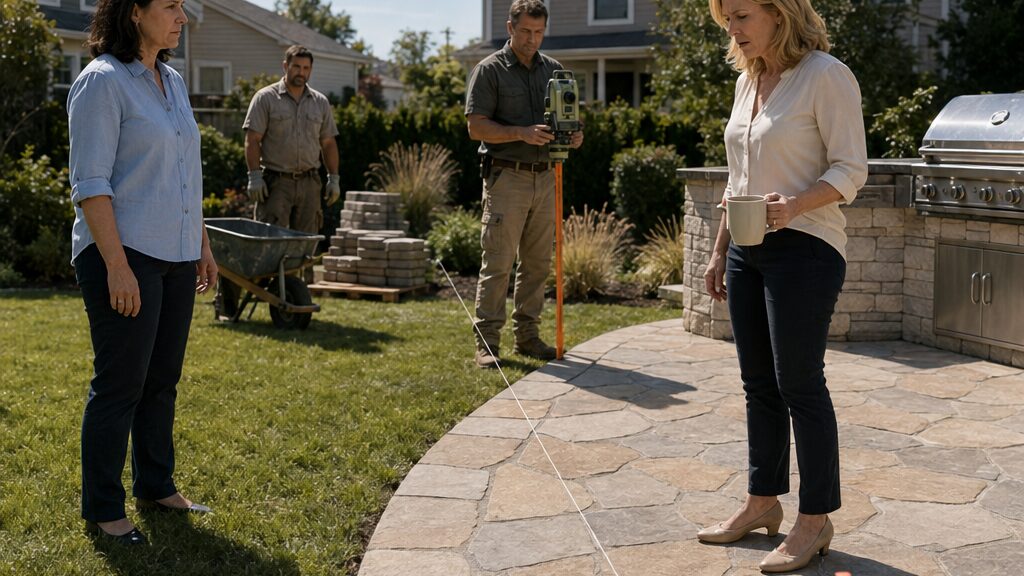
The new patio curved outward from Kimberly’s rear door, then swept toward Cynthia’s yard before bending around a rectangular grill station faced with pale stone. Fresh mulch and ornamental grass followed the same curve. A contractor had already removed a section of sod Cynthia had always thought belonged to her.
Cynthia stood there longer than she intended.
The landscaping contractor noticed her first.
“Need through?” he asked, moving a wheelbarrow.
“No. I’m fine.”
That was the kind of answer Cynthia gave too often.
Fine meant she could postpone the uncomfortable sentence.
Kimberly came out a few minutes later in slippers, carrying the same large mug she would later hold on demolition morning.
“Isn’t it coming together?” she asked.
“It’s a big project.”
“We finally decided to do it right.”
Cynthia looked at the line of gravel.
“Kimberly, how far over is this supposed to come?”
Kimberly followed her gaze.
“To the edge.”
“The edge of what?”
Kimberly smiled as if Cynthia were teasing.
“The property line.”
Cynthia felt heat creep into her face. She hated that reaction. It made calm conversations feel like arguments before they had started.
“I’m not sure that’s where the line is.”
Kimberly took a drink.
“The HOA approved everything.”
“I understand. I’m just saying the actual boundary might be farther your way.”
Kimberly glanced toward the landscaper, then back at Cynthia.
“We’ve used this side forever.”
Cynthia knew that was true.
She also knew it was not the same thing.
“I think we should check before you put anything permanent there.”
The smile disappeared.
“Check how?”
“A boundary survey.”
For half a second Kimberly only stared.
Then came the laugh.
“Cynthia, seriously?”
Cynthia folded her arms, then immediately unfolded them because she did not want to look defensive.
“I’m serious.”
“This has been the line since before we moved in.”
“It’s been where everybody treats the line.”
“Exactly.”
“That doesn’t necessarily make it the legal one.”
Kimberly shook her head.
“You’re talking about inches.”
“I don’t know what I’m talking about. That’s why I’m suggesting a survey.”
The landscaper had stopped pretending not to listen.
Cynthia wished she had spoken to Kimberly privately the night before. She had seen the gravel delivery. She had watched the grass disappear. She had told herself she would mention it if the project came any farther.
It had come farther.
And now she was raising it in front of workers.
Her timing had been cowardly, not careful.
“I’ll pay for it,” Cynthia said.
Kimberly blinked.
“What?”
“The survey. I called around a few months ago about something else. It should be a few hundred dollars for them to locate the pins and verify the line. I’ll cover it.”
For the first time, Kimberly looked irritated rather than amused.
“You called surveyors about my yard?”
“No. About mine.”
“Why?”
Cynthia hesitated.
There were several answers. None felt safe.
“Because I wanted to know where things were.”
Kimberly turned toward the grill station.
The base had already been set. Stone veneer was stacked beside it. A worker was laying out pavers.
“I have an approved plan,” she said. “I have a contractor here. I’m not stopping a whole crew because you suddenly decided the line might be somewhere else.”
“I’m asking you to pause one part.”
“And if the survey says exactly what the HOA plan says?”
“Then I paid for reassurance.”
Kimberly stared at her.
That should have ended it. Cynthia had imagined that sentence ending it.
Instead Kimberly called to the contractor.
“You’re good. Keep going.”
The wheelbarrow started moving again.
Cynthia stood beside the gravel while a worker tipped another load onto the ground.
The sound of stone hitting stone made something in her settle.
Not anger. Anger would have been easier too.
It was the realization that politeness had reached the limit of what it could accomplish.
“All right,” Cynthia said.
Kimberly turned.
“I’m going to schedule the survey.”
“Do what you need to do.”
“I will.”
Cynthia walked back through her side gate before she could soften the sentence.
That afternoon she called Patrick Green, a licensed surveyor whose name had appeared twice in recommendations from local homeowners. She explained that she did not need a full dispute report yet. She wanted the existing corners located and the boundary between two lots verified.
Patrick asked for the addresses.
Then he paused.
“Is there construction happening now?”
“Yes.”
“Near the disputed line?”
“Yes.”
“How near?”
Cynthia looked through the window.
A worker was kneeling where her grass had been two days earlier.
“Near enough that I’d like you here as soon as you can.”
Patrick came the following Tuesday with a tripod, measuring equipment, copies of recorded plats, and a long metal locator.
Kimberly came outside before he had finished unloading.
“So this is really happening.”
Patrick looked from one woman to the other.
“I’m here to establish the recorded boundary. That’s all.”
Kimberly crossed her arms.
“The HOA has the plan.”
“Happy to look at anything relevant once I’ve located the monuments.”
Cynthia expected Kimberly to argue.
Instead she walked back toward her patio and told the landscaping crew they could continue.
Patrick began near the front corner, moved along the side lot, checked measurements, then worked toward the rear.
For almost an hour, nothing dramatic happened.
That made Cynthia increasingly nervous.
Perhaps Kimberly was right.
Perhaps she had turned an old informal line into a neighborhood fight over six inches.
Patrick stopped near a planting bed and swept his locator slowly across the ground.
A tone sounded.
He moved six inches.
The tone sharpened.
He crouched and scraped away soil with a narrow hand tool.
Kimberly had wandered over again.
“What is it?”
Patrick did not answer immediately.
He cleared another inch of dirt.
A rust-darkened circle of metal appeared beneath the soil.
Cynthia looked toward the curved edge of Kimberly’s new patio.
Then back at the pin.
The two were nowhere near each other.
Patrick wiped the top of the old iron monument with his glove and studied his equipment.
Kimberly’s mug lowered slowly from her mouth.
Cynthia heard herself ask the question she had been afraid to ask for three weeks.
“How far off are we?”
Patrick stood.
“I’m not giving you a number until I verify the other corner.”
He looked toward the back of the property.
“But this pin is not where that landscaping line assumes it is.”
Chapter 2: The Orange Stakes Crossed the Grill
“Mrs. Clark, I need you to move that chair.”
Patrick Green pointed toward one of Kimberly’s cushioned patio chairs.
Kimberly stared at him.
“Why?”
“Because I need access beneath it.”
“To what?”
Patrick extended the tip of his measuring rod toward the patio.
“The boundary.”
The chair sat almost five feet inside the finished curve of Kimberly’s new hardscape.
For one strange second nobody moved.
Cynthia stood on the grass with her arms loose at her sides, afraid that even crossing them would look like satisfaction.
Kimberly finally grabbed the chair by its back.
“You’re telling me my property line is under my furniture?”
“I’m telling you where my measurements are taking me. I’m still verifying.”
She dragged the chair away with both hands.
The landscaping crew had stopped work. The contractor stood beside a pallet of pavers, his expression carefully blank.
Patrick checked the rear measurement again, then walked back toward the front corner. He compared figures on his tablet with the recorded plat he had brought from the county records.
Kimberly followed him.
“That pin could have moved.”
“It could have,” Patrick said.
“So?”
“So I don’t rely on one pin.”
He said it without irritation.
That seemed to frustrate Kimberly more than an argument would have.
Patrick returned to the back corner and used the locator again. Several feet from the edge Kimberly had treated as the property line, the device sounded.
He dug.
The second iron monument took longer to uncover because roots had grown around it. When the top finally appeared, Patrick cleaned it, took another reading, and stood silently for several seconds.
Cynthia’s stomach tightened.
She had wanted certainty.
Now that it was coming, she was not sure she wanted what certainty might require.
Patrick walked to his truck and brought back two bright orange stakes.
Kimberly gave a short, humorless laugh.
“You can’t be serious.”
Patrick pushed one stake into the soil near the front measurement.
Then he carried the other to the rear and drove it beside the newly built grill island.
He strung a taut line between them.
The effect was immediate.
No map was necessary.
No explanation was necessary.
The orange line entered Kimberly’s landscaping near the curve of the patio, crossed directly through several rows of new flagstone, passed beneath the space where the chair had been, and continued beside the stone-faced grill structure.
Kimberly stared at it.
Cynthia did too.
She had imagined a foot.
Maybe eighteen inches.
Enough to matter, but still enough to explain how everyone had been mistaken.
This was not eighteen inches.
“How far?” Cynthia asked.
Patrick looked at his measurements.
“At the widest point of the improved area, approximately six feet across the recorded line.”
Kimberly shook her head immediately.
“No.”
Patrick said nothing.
“No. Absolutely not.”
Cynthia looked at the grill island. The line ran so close to it that depending on the exact structure below grade, part of its foundation appeared to cross onto her property.
“Check it again,” she said.
Kimberly turned toward her.
“What?”
Cynthia kept her eyes on Patrick.
“Please check it again.”
Patrick gave a small nod.
“I planned to.”
For another forty minutes he worked without offering conclusions. He checked coordinates against the plat. He measured from the opposite side of both lots. He compared the lot widths. He returned to the front monument, then to the rear.
Kimberly paced.
Once, she kicked lightly at the loose gravel beside the line.
Cynthia almost told her to stop.
She did not.
Patrick eventually came back to them.
“The monuments, recorded dimensions, and current measurements are consistent.”
Kimberly’s face changed.
The disbelief remained, but something harder entered it.
“So your answer is that everybody else is wrong.”
“My answer is that this is the recorded property boundary.”
“The HOA approved this.”
“I don’t work for the HOA.”
“They had a site plan.”
“That may be useful. I’d be happy to review it.”
Kimberly pointed toward Cynthia.
“She knew we were doing this.”
Cynthia felt the accusation land harder than she expected.
“I knew you were renovating.”
“You watched the crew for days.”
“I asked you to stop before they got this far.”
“After they started.”
“Yes.”
Kimberly turned away and picked up her mug.
The contractor approached slowly.
“Do you want us to hold?”
Kimberly looked at the unfinished outer section, then at the orange line.
Cynthia expected her to say yes.
Instead she said, “Don’t put anything else across that string until I figure out what this is.”
It was not an apology.
But it was the first time she had treated the line as real.
The crew began gathering loose tools.
Cynthia should have felt victorious.
Instead she felt tired.
Patrick packed away part of his equipment but left the stakes.
“These need to stay undisturbed while I finish the survey documentation.”
Kimberly looked at the stake beside her grill.
“You’re leaving that there?”
“For now.”
“It’s in the middle of my patio.”
Patrick glanced at the line.
“That’s the issue.”
Cynthia looked away before Kimberly could catch the reaction in her face.
By noon, the workers had left.
The silence made the yard look stranger than the construction noise had. Two orange stakes stood like punctuation marks in a sentence neither woman wanted to read.
At one thirty, Kimberly rang Cynthia’s doorbell.
She had changed clothes and was carrying a large white folder.
“I found the approval.”
Cynthia opened the storm door but did not invite her inside.
Kimberly held up a drawing.
A curved patio was clearly shown behind her house. A thick dashed line ran along the edge of the proposed landscaping.
There was an approval stamp from the homeowners association.
“This is what I submitted,” Kimberly said. “This is what they approved.”
Cynthia studied the sketch.
The dashed line appeared almost exactly where Kimberly had assumed the boundary to be.
“Where did this line come from?”
“From the neighborhood plan.”
“Which plan?”
“The master layout. Gary sent it when we started designing.”
Cynthia felt her certainty loosen.
Kimberly noticed.
“You thought I just made this up.”
“I thought you should have had the property surveyed.”
“I relied on what the HOA gave me.”
“An HOA drawing isn’t necessarily a survey.”
“You don’t know that.”
“No. I don’t.”
Kimberly took out her phone.
“I’m calling Gary.”
Gary Moore arrived shortly before four carrying a laptop bag and a thick association binder.
He walked the orange line once without speaking.
When he reached the grill station, he stopped.
“This is Patrick Green’s work?”
“Yes,” Cynthia said.
Gary nodded slowly.
“I know the company.”
Kimberly handed him the approved plan.
“You sent me the underlying layout.”
Gary studied it.
“I remember the application.”
“You approved it.”
“The committee approved the design.”
“Based on this line.”
Gary looked toward Cynthia’s yard.
Then toward the orange stakes.
“We need to compare the file.”
Kimberly’s voice sharpened.
“There’s nothing to compare. You told me where my lot ended.”
Gary did not answer immediately.
That silence bothered Cynthia.
“Does the HOA have an actual recorded survey?” she asked.
Gary closed the binder.
“We have subdivision files.”
“That wasn’t my question.”
Gary looked at her.
“No. I don’t believe we have individual boundary surveys for every lot.”
Kimberly stepped closer.
“You gave me a plan.”
“I know.”
“And now?”
Gary rubbed his thumb along the edge of the folder.
“Now we determine what that plan actually represents.”
He asked Cynthia if they could meet again after he pulled the architectural file and original neighborhood documents.
Patrick agreed to attend.
As Gary walked toward his car, Kimberly stayed beside the orange stake.
For the first time since the dispute began, she looked less angry than frightened.
Cynthia understood why.
If Kimberly’s document was what she claimed, then this was no longer simply a neighbor who had ignored a warning.
It meant someone had told her the wrong thing.
The following morning Gary called Cynthia.
His voice was controlled, almost formal.
“I pulled Kimberly’s submission.”
“And?”
“There’s an issue.”
Cynthia gripped the phone.
“What kind of issue?”
“The drawing she used is in our records. The approval is real.”
Cynthia looked through the window at the orange stake standing beside Kimberly’s grill.
Gary continued.
“And based on the file alone, I can see why she believed that line was correct.”
Chapter 3: The HOA Map Was Not a Deed
Gary Moore laid Kimberly’s approved plan on Cynthia’s kitchen counter.
Patrick Green placed his survey beside it.
The two lines were separated by nearly six feet.
Nobody spoke.
Through the window over Cynthia’s sink, one orange stake stood bright against the grass. From this angle it appeared almost absurdly ordinary. A piece of painted wood had managed to turn two neighboring households and an HOA committee inside out.
Kimberly stood on the opposite side of the counter with her hands flat against the granite.
“That,” she said, tapping her plan, “is what I was given.”
Gary nodded.
“I understand.”
“No, I don’t think you do.”
“I approved the application, Kimberly.”
“Exactly.”
Patrick adjusted the recorded plat so its orientation matched the HOA drawing.
Gary leaned closer.
“The confusion is here.”
He pointed to a faint dashed line on an older page beneath Kimberly’s application.
Cynthia could see landscaping symbols along it—small circles for shrubs and a notation near what had once been a hedge.
Patrick said, “That’s not a boundary designation.”
Gary exhaled.
“I know that now.”
Kimberly looked at him sharply.
“What is it?”
“A landscape reference.”
“A what?”
Gary opened another folder.
Years earlier, the HOA had created simplified property diagrams to help residents identify common landscaping zones, drainage areas, fence restrictions, and utility corridors. They had not been surveys. They had not been intended to establish legal lot boundaries.
But somewhere during years of copied files and digital scans, the dashed landscaping edge beside Kimberly’s house had begun appearing on architectural review packets without the original legend.
Her designer had treated it as the property line.
So had the committee.
Gary had approved the plan without asking for anything more.
Kimberly stared at him.
“You’re telling me your office sent me a map with a line on it, I designed to that line, you approved the design to that line, and now you’re saying the line meant shrubs?”
“I’m telling you we should not have represented that drawing as sufficient for locating a boundary.”
“You did represent it that way.”
Gary’s jaw tightened.
“I said the committee made an error.”
“That patio cost me months of planning.”
“I know.”
“No, you know what’s in a folder.”
Cynthia watched Gary take the accusation without answering.
For the first time, she saw how badly he wanted the problem to remain procedural. A corrected form. A committee vote. A letter to residents.
Kimberly had made it personal because for her it was personal.
Patrick tapped his survey.
“The HOA approval and the legal boundary are separate questions.”
Kimberly turned on him.
“Convenient.”
“It’s not convenient for anybody.”
“You expect me to tear out half my yard because of a buried piece of metal?”
“No. I expect the recorded measurements and monuments to be treated as evidence of the property line.”
“And the approval?”
“That’s between you and the association.”
Gary looked as if he wished Patrick had chosen different words.
Cynthia almost felt sorry for him.
Then Gary turned to her.
“We also need to discuss prior use.”
The sympathy vanished.
“What prior use?”
Kimberly pushed away from the counter.
“Don’t do that.”
“Do what?”
“Act like you don’t know.”
Cynthia felt her throat tighten.
Patrick looked from one woman to the other.
Gary opened a smaller envelope from the HOA file.
“Kimberly says her household used that strip for years before this project.”
“That doesn’t make it hers.”
“I didn’t say it did.”
“She used it because there wasn’t a fence.”
Kimberly laughed once, but there was no amusement in it.
“That is not the whole story.”
Cynthia stared at her.
Kimberly continued.
“Your husband told us we could use it.”
The kitchen seemed to narrow.
Gary stopped moving papers.
Cynthia knew exactly what Kimberly meant.
That was the worst part.
Years earlier, before Kimberly had replaced her old shed and before Cynthia’s husband became ill, the Clarks had needed access along the side of Cynthia’s lot. The path behind Kimberly’s hedge was too narrow for a wheelbarrow and some landscaping equipment.
Cynthia’s husband had told them they could come through.
Temporary access.
That was how Cynthia remembered it.
A practical favor between neighbors.
Nothing permanent.
But she had not mentioned it to Patrick.
She had not mentioned it to Gary.
She had not mentioned it when Kimberly said, We’ve used this side forever.
Cynthia had told herself the old favor was irrelevant because permission to cross land was not permission to build on it.
Legally, that might still be true.
Emotionally, standing in the kitchen, it looked like an omission.
Kimberly saw the recognition on her face.
“There,” she said quietly. “You remember.”
Cynthia forced herself not to look away.
“I remember him letting you use the side for access.”
“He said we didn’t need to worry about that strip.”
“He did not give you the property.”
“I didn’t say he signed over a deed.”
“You’re making it sound like he told you it was yours.”
“I’m saying your family treated that space like something we were allowed to use.”
Gary raised a hand.
“We need to separate historical use from legal ownership.”
Kimberly turned on him.
“You were happy to blur those things when you approved my patio.”
Gary’s face reddened.
Patrick gathered one set of papers into a clean stack.
“If you want legal conclusions about historical use, that’s beyond the scope of my survey. My job is location.”
His refusal to take sides irritated everybody equally.
Cynthia suddenly understood why that mattered.
Facts could establish where the line was.
They could not decide what everyone had believed about it.
Gary spent another twenty minutes tracing the history of the HOA diagram. The original landscape map was nearly fifteen years old. Later architectural packets had copied sections of it. Nobody had intentionally changed a boundary. Nobody had fabricated anything.
The mistake was duller and more believable than that.
A line had lost its label.
People had stopped asking what it meant.
Kimberly had trusted it because it was official enough to feel safe.
Gary had trusted it because it had been used before.
Cynthia had trusted her own memory of the property because she had lived there longer.
Three different kinds of certainty had occupied the same six feet.
When Patrick left, Gary promised to bring the matter before the HOA board.
“That doesn’t stop the county issue if Cynthia files,” he told Kimberly.
Kimberly looked toward Cynthia.
“You’re filing?”
“I haven’t decided.”
“You paid for a survey.”
“That’s not the same thing.”
“It feels pretty close.”
Gary left soon afterward.
Kimberly remained.
Neither woman spoke for several seconds.
Then Kimberly opened her phone.
“I want to show you something.”
She scrolled through old photographs until she found one taken years earlier.
The image showed the rear corner of both yards during what looked like a summer cookout. Cynthia’s husband stood near the low fence. Kimberly’s old wheelbarrow was parked well inside the strip now marked by Patrick’s orange stakes.
Behind it sat bags of mulch and several garden tools.
Kimberly enlarged the photograph.
“Look.”
Cynthia did.
She wished she had not.
The image did not prove ownership.
It did not prove permission to build.
But it proved something Cynthia had been avoiding.
The Clarks had not begun using that strip last month.
Her husband had been standing right there while they used it.
Kimberly lowered the phone.
“You knew there was history.”
Cynthia swallowed.
“Yes.”
“And you let me stand out there looking like I invented all of this.”
“I knew there had been access.”
“You knew more than you said.”
Cynthia could have defended herself.
She had several technically accurate answers ready.
Instead she looked through the kitchen window at the orange stake.
“Yes,” she said.
Kimberly’s expression changed—not into triumph, but into something more wounded.
“Then before you file anything,” she said, “you need to tell me exactly what your husband promised us.”
Chapter 4: What Her Husband Had Actually Promised
The note was folded inside a folder Cynthia had not opened since her husband died.
She found it Saturday morning between an old irrigation receipt and a handwritten list of repairs to the back fence. His handwriting stopped her before the words did—dark block letters, hurried at the ends, the way he wrote when he expected a reminder to matter for a week instead of years.
CLARKS — TEMPORARY SIDE ACCESS FOR SHED / YARD WORK. KEEP CLEAR UNTIL FINISHED.
Cynthia read it three times.
There was no date on the paper, but she knew the project. Kimberly’s old shed had been replaced almost eight years earlier. Workers had moved materials through the open strip between the houses because the passage on Kimberly’s side was too narrow.
Cynthia sat on the floor beside the file box.
She remembered her husband holding the side gate open while Kimberly pushed a wheelbarrow through. She remembered bags of mulch stacked near the hydrangeas. She remembered telling him she did not like people cutting across their lawn.
“It’s temporary,” he had said.
She had never asked him to put anything in writing because there had been nothing to negotiate.
Neighbor helping neighbor.
That had been the whole meaning.
Or so she had believed.
Now a curved patio crossed the same strip, and an orange stake stood where the wheelbarrow once had.
Cynthia carried the note outside.
One of Patrick’s stakes was leaning several inches off vertical. The soil around it had been disturbed.
She knew immediately who had done it.
Kimberly was on her patio watering a planter.
Cynthia walked to the stake, pushed it straight with both hands, and pressed the soil around its base.
Kimberly shut off the hose.
“You going to accuse me of moving that too?”
“I’m putting it back.”
“I bumped it.”
Cynthia looked at her.
Kimberly’s expression hardened.
“Fine. I kicked it.”
Neither woman spoke.
Then Cynthia held up the note.
“I found something.”
Kimberly put the hose down.
“What?”
“A note my husband wrote when you replaced the shed.”
Cynthia crossed the grass but stopped at the survey line.
For the first time, the orange stake felt less like proof and more like a place where she had to decide how honest she was willing to be.
“He wrote that you had temporary side access for shed and yard work.”
Kimberly read the paper without touching it.
“That’s not how I remember it.”
“It’s what he wrote.”
“He said we could use that side.”
“Yes. Temporarily.”
“He never said temporary to me.”
“He wrote it.”
“On a note to himself.”
Cynthia felt the old impulse rise—to retreat into the paper, to say the document spoke for itself.
Instead she stayed where she was.
“What do you remember him saying?”
Kimberly folded her arms.
“That when we were doing the shed, I apologized because we kept crossing onto your side. He said, ‘Don’t worry about that strip. Use what you need.’”
“For the project.”
“That’s your interpretation.”
“You were replacing a shed.”
“And after that, nobody told us to stop using it.”
Cynthia looked toward the narrow grass.
That was true too.
Kimberly’s landscaper had sometimes rolled equipment through it. Her household had moved garden materials across it. People stepped over the invisible boundary because there was no fence and no reason to make a point of it.
Cynthia had noticed.
She had disliked it.
She had said nothing.
“My husband did not give you permission to build on our property,” she said.
“I never said he used those exact words.”
“Then what are we arguing about?”
Kimberly gave her a tired look.
“Whether I woke up one morning and decided to steal six feet of your yard.”
“I never said that.”
“You didn’t have to. You brought out a surveyor and now everybody sees orange stakes through my patio.”
“I asked you to pause before the patio reached them.”
“And I had an approved plan.”
The two facts sat between them.
Cynthia could not remove either one.
That afternoon she drove to the county records office with copies of Patrick’s survey, the HOA plan, and her husband’s note.
The clerk listened without reacting much. Cynthia appreciated that.
“So they had prior permission to cross the area?” the clerk asked.
“For a project. Years ago.”
“Any written easement?”
“No.”
“Recorded agreement?”
“No.”
“Transfer?”
“No.”
The clerk nodded.
“Then informal use by itself doesn’t change the recorded ownership. But I can’t give you legal advice about every possible claim. If you’re seeking county action on the current encroachment, we deal with the physical improvement and applicable permits.”
“How fast?”
The clerk gave her the kind of look people gave when they knew the answer would disappoint.
“Not fast.”
Cynthia almost laughed.
“Of course.”
“There’s notice, time to respond, time to correct if there’s a violation. If the owners dispute title beyond that, it can move outside our process.”
Cynthia looked at the folder in her lap.
“So filing doesn’t make the patio disappear.”
“No.”
“And it doesn’t prove I behaved perfectly.”
The clerk’s expression softened slightly.
“That’s definitely outside our process.”
On Monday evening, Gary called an informal HOA meeting in the small clubhouse office.
Kimberly arrived with the old photograph on her phone. Cynthia brought her husband’s note.
Gary had copies of both.
When he summarized the situation for the board members, Cynthia interrupted him.
“There’s something I want said clearly.”
Gary stopped.
Cynthia felt Kimberly watching her.
“My husband did let the Clarks use the strip for access years ago. I knew that before the survey.”
A board member shifted in his chair.
Cynthia continued before she lost her nerve.
“I didn’t think it mattered because it wasn’t permission to build. But I should have said it earlier.”
Kimberly looked surprised.
Not pleased.
Just surprised.
Gary asked, “Do you believe your husband intended permanent use?”
“No.”
Kimberly spoke immediately.
“I believe he was less restrictive about it than Cynthia is being now.”
Cynthia turned toward her.
“That may be true.”
The room went quiet.
Kimberly’s face changed again.
Cynthia had spent days afraid that admitting any uncertainty would collapse her position. Instead it simply made the room more honest.
Gary tapped the HOA plan.
“This still doesn’t resolve the legal boundary.”
“No,” Cynthia said.
“It does explain why Kimberly believed the area had historically been shared.”
“Yes.”
Kimberly leaned forward.
“And it explains why I relied on the line you gave me.”
Gary nodded reluctantly.
“Yes.”
For a moment Cynthia could almost see a way to end it without filing anything.
Then she remembered the day she had offered to pay for the survey.
She remembered Kimberly telling the contractor to keep working.
There had been uncertainty before that moment.
After that moment, there had been a choice.
Cynthia left the meeting with the county complaint form still unsigned in her folder.
She sat in her car for nearly ten minutes.
Then she drove back to the records office before it closed.
At the counter, the clerk looked over the packet.
“Are you sure you want to submit this?”
Cynthia looked at her husband’s note.
Then at Patrick’s survey.
“I’m sure I want the construction off my property.”
“That isn’t quite the same question.”
“I know.”
The clerk waited.
Cynthia signed.
The stamp came down on the first page with a flat mechanical sound.
When Cynthia stepped outside, she knew Kimberly now had a story that some neighbors would find sympathetic.
Bad HOA information.
Years of tolerated use.
A dead man’s informal permission.
And Cynthia had filed anyway.
Chapter 5: Thirty Days Changed the Entire Street
The county correction notice arrived while a contractor was standing in Kimberly’s yard estimating what it would cost to remove the patio.
Cynthia saw the envelope in Kimberly’s hand before she knew what it contained.
Kimberly tore it open beside the grill island, scanned the first page, and looked directly across the orange survey line.
Thirty days.
That was the practical number.
Not an instant order. Not a dramatic government crew arriving with equipment. Thirty days for Kimberly to address the encroaching improvement before escalating consequences became possible.
By afternoon, half the street seemed to know.
Nobody openly confronted Cynthia.
That was almost worse.
A neighbor who normally waved from a driveway gave her a shorter nod. Two women stopped talking near the cluster mailbox when Cynthia approached. At the HOA meeting three days later, nobody used the phrase unreasonable neighbor, but Cynthia heard softer versions.
Couldn’t they work something out?
Did all of it really have to come up?
Wasn’t the HOA partly responsible?
Cynthia agreed with the last question.
Gary did not enjoy hearing that.
“The association is reviewing the approval process,” he said at the meeting.
Kimberly sat three chairs away.
“Reviewing it doesn’t rebuild my patio.”
Gary’s voice stayed measured.
“No.”
“Then what does it do for me?”
“It determines what changes are needed so this doesn’t happen again.”
Kimberly gave a small laugh.
“So I’m the training exercise.”
Gary closed his folder.
“I’ve already acknowledged that the committee should not have relied on that diagram.”
“Should not have? You approved it.”
“And you proceeded after Cynthia requested a survey.”
Kimberly’s chair shifted sharply against the floor.
That was the first time Gary had said it in front of the board.
Cynthia looked at him.
Kimberly did too.
“You’re switching sides now?”
“I’m separating two decisions,” Gary said. “The HOA made an approval error. You also made a decision after being warned that the boundary was disputed.”
“I had already hired people.”
“That doesn’t make the warning disappear.”
The room went still.
For days Cynthia had wanted someone else to say exactly that.
Hearing it brought less satisfaction than she expected.
Kimberly gathered her papers and left before the meeting ended.
The following week, the landscaping contractor sent records requested during the correction process.
Cynthia received copies because her parcel was affected.
The dates were plain.
Cynthia had spoken to Kimberly on a Thursday morning.
She had offered to pay for the survey before noon.
That afternoon, according to the contractor’s change record, Kimberly authorized the crew to continue laying the outer patio section and complete the grill foundation without delay.
The work that caused the most expensive part of the encroachment had happened after the warning.
Cynthia sat at her kitchen table reading the line twice.
She did not feel triumphant.
She felt relieved.
The old access arrangement mattered.
The HOA mistake mattered.
But this mattered too.
Kimberly had been given a chance to stop.
She had chosen certainty over caution.
The next time they spoke, Kimberly was standing beside one of the orange stakes.
“You got the contractor records.”
“Yes.”
“So now you think that proves everything.”
“No.”
Kimberly looked genuinely startled.
Cynthia stepped closer.
“It proves one thing. I asked you to stop, and you chose not to.”
“You asked me to stop a crew I was paying by the day because you had a feeling.”
“I offered a survey.”
“And I had HOA approval.”
“Yes.”
Kimberly looked away.
Cynthia continued.
“The HOA was wrong. My silence about the old access was wrong. You continuing after I asked for verification was also wrong.”
For several seconds Kimberly said nothing.
Then she looked at the patio.
“You know what removal costs?”
“No.”
“I do now.”
The bitterness in her voice was quieter than before.
She told Cynthia the number.
It was enough to make Cynthia inhale slowly.
The grill island could not simply be shifted. Part of its base had to be dismantled. Several runs of stone had to come up. Drainage and landscaping had to be redone. The contractor expected additional costs for matching materials if Kimberly wanted the remaining patio to look intentional.
“And the HOA?” Cynthia asked.
“Still discussing what they might cover.”
Gary had begun speaking with the association’s insurer, but no resolution had been promised.
Meanwhile the thirty-day clock continued.
The orange stakes remained.
Summer mowing continued around them. Deliveries arrived. People walked dogs. Sprinklers came on each morning. Everything ordinary about the street made the dispute feel more exposed.
On the twelfth day, Cynthia found an envelope taped to her side gate.
No stamp.
No county seal.
Inside was a typed proposal from Kimberly.
Cynthia read it standing in the yard.
Kimberly offered to purchase the disputed strip.
The amount was more than Cynthia expected.
Enough to cover several overdue repairs inside Cynthia’s house. Enough to replace the aging furnace before winter without touching savings. Enough to solve the leak near the upstairs window she had postponed since the year her husband died.
In exchange, Cynthia would agree to a permanent boundary adjustment or other legally acceptable transfer, subject to whatever professional work was required.
The patio could remain.
The grill could remain.
The orange stakes would become irrelevant because the land beneath them would no longer belong to Cynthia.
She took the paper inside.
For the rest of the afternoon it sat on the kitchen counter beneath a ceramic bowl.
Cynthia tried not to look at it.
The money was not absurd.
Kimberly was not trying to steal anything now.
She was offering to buy what she had built over.
That distinction bothered Cynthia because it made the choice harder.
Near sunset she went outside.
Her yard looked smaller than it had before the survey, though nothing had physically changed.
She stood near the orange line and remembered why her husband had resisted a tall fence when they first bought the house.
He had liked the open stretch of grass because it made the backyard breathe.
They had planted nothing permanent there. No shed. No raised beds. No hardscape.
Just space.
Cynthia had always thought that meant they had never decided what to do with it.
Now she wondered whether leaving it open had been the decision.
Kimberly came through her back door carrying her mug.
“You found the proposal.”
“Yes.”
“It’s fair.”
“I haven’t said it isn’t.”
Kimberly stopped on her side of the line.
“That money is more than the strip is worth by itself.”
“I know.”
“Then what’s the issue?”
Cynthia looked toward her house.
Through the kitchen window she could see the edge of the envelope.
“The issue is whether I want to sell it.”
Kimberly’s mouth tightened.
“Do you?”
Cynthia did not answer.
That night she spread bills, repair estimates, Kimberly’s offer, and Patrick’s survey across the kitchen table.
On paper, selling six feet was the easier solution.
The county complaint could end.
Demolition could end.
The HOA could negotiate its part separately.
Cynthia could repair her house.
Nobody would have to break another piece of stone.
She rested her hand on the unsigned proposal.
The only thing required was for her to decide that the land itself did not matter as much as everything the money could fix.
Chapter 6: Cynthia Refused the Easier Settlement
Cynthia returned Kimberly’s proposal without a signature.
She carried it next door herself.
Kimberly opened the door, saw the envelope, and did not ask what Cynthia had decided.
Her expression answered first.
“You’re saying no.”
“Yes.”
“Even at that amount?”
“Yes.”
Kimberly took the envelope.
“Why?”
Cynthia almost gave her the easiest answer.
Because it is mine.
It was true.
It was also incomplete.
“I want to show you.”
Kimberly frowned.
“Show me what?”
“The line.”
“I’ve been looking at that line for three weeks.”
“Not the survey. The yard.”
Kimberly hesitated, then followed her outside.
Cynthia started at the front orange stake.
They walked slowly toward the rear, keeping beside the taut boundary rather than stepping over it.
At first there was nothing remarkable to see.
Grass.
The side of Cynthia’s house.
A patch where an old shrub had been removed.
Then the space widened behind the houses.
“This is where my husband wanted a shed,” Cynthia said.
Kimberly glanced at her.
“We never built one.”
“Why not?”
“He changed his mind.”
They walked farther.
“He said we already had enough things taking up space. He liked being able to stand at the kitchen window and see straight through the yard.”
Kimberly looked toward Cynthia’s window.
Cynthia continued.
“I thought that was him refusing to make a decision. He did that sometimes. He’d postpone something long enough that the postponing became permanent.”
A trace of amusement touched Kimberly’s face, then vanished.
“But after he died, I kept it open too.”
They reached the place where the line crossed the flagstone.
Cynthia stopped.
“It’s not valuable because it’s six feet wide.”
Kimberly stared at the stones.
“It’s valuable because he liked it empty.”
“Yes.”
“You could have said that.”
Cynthia almost defended herself.
Instead she nodded.
“I should have.”
Kimberly looked up.
Cynthia forced herself to continue.
“I should have said a lot of things sooner. I should have told you the first time your landscapers started using the strip regularly that I wasn’t comfortable with it. I should have told you exactly what I remembered about the shed access when we argued about the survey.”
“You thought it would hurt your case.”
“Yes.”
The admission came easier than Cynthia expected.
Kimberly gave a short breath.
“At least you’re saying it.”
“I kept thinking if I had enough paperwork, nobody could accuse me of being difficult.”
“And now?”
“Now I think I made this more difficult by waiting until I needed paperwork.”
Kimberly studied her.
“But you’re still making me remove it.”
“Yes.”
The softness vanished from Kimberly’s face.
“Then what exactly is this? An apology before demolition?”
“No.”
Cynthia pointed toward the grill island.
“The county gives me options too. I could keep pursuing damages beyond restoration. I could argue over every landscaping cost, every patch of grass, every day this remains after the deadline.”
Kimberly folded her arms.
“And?”
“I won’t.”
Kimberly said nothing.
“If removal starts before the deadline and my property is restored, I won’t seek additional compensation from you for the encroachment.”
“You already talked to someone about that?”
“I asked what my options were.”
Kimberly’s mouth tightened.
“So you could punish me more, but you’ve decided not to.”
“That’s not how I mean it.”
“It’s how it sounds.”
Cynthia let the silence sit.
She had spent years filling silences with softer language until nobody knew where she stood.
Not this time.
“I don’t want your money,” she said. “I want my yard back.”
Kimberly looked toward her own house.
“The HOA made the mistake.”
“Yes.”
“Your husband let us use the strip.”
“Yes.”
“You let it happen for years.”
“Yes.”
“And I’m the one tearing up the patio.”
Cynthia met her eyes.
“You’re the one who told the crew to keep building after I asked you to stop.”
That landed.
Kimberly looked away.
Neither woman spoke for several moments.
Finally Kimberly said, “I thought you were bluffing.”
“I know.”
“You always backed off before.”
Cynthia felt something unpleasantly close to recognition.
Kimberly continued.
“Every little thing between us—you’d smile, say it was fine, and disappear inside. The trash cans. The landscapers cutting through. The hedge getting wider. I thought that was just how you were.”
“It was.”
“So when you suddenly said survey, I thought you were making a point, not drawing a line.”
Cynthia looked at the orange stake.
“That was my mistake.”
Kimberly gave a faint, exhausted laugh.
“No. Apparently drawing the line was Patrick’s job.”
For the first time in weeks, Cynthia almost smiled.
Almost.
They finished walking to the rear stake.
It leaned slightly from where Cynthia had straightened it days before, but it remained in place.
“What happens if I start removal?” Kimberly asked.
“I notify the county that correction is underway.”
“And the complaint?”
“It stays open until restoration is verified.”
“Of course.”
“I’m not asking you to trust me instead of the process.”
Kimberly looked at her sharply.
“That’s probably smart.”
“Yes.”
Cynthia realized she meant it without bitterness.
Kimberly touched the top of the stake with two fingers.
“I hate these things.”
“I did too.”
“Did?”
“They’re not the problem.”
Kimberly let her hand drop.
That afternoon Gary stopped by after Cynthia emailed him the terms she had offered.
He read them twice.
“You’re waiving damages?”
“Beyond restoration, yes.”
“That may make the HOA negotiations easier.”
“This isn’t for the HOA.”
“I understand.”
Cynthia gave him a look.
Gary corrected himself.
“I’m trying to.”
He told her the board had agreed on the first procedural change: future architectural applications involving permanent improvements near uncertain side boundaries would require owners to provide reliable boundary information rather than relying on HOA reference diagrams.
“It should have been that way already,” Cynthia said.
“Yes.”
Gary no longer tried to soften the admission.
Before leaving, he paused near the patio.
“Kimberly may still fight the correction.”
“I know.”
“She’s under a lot of financial pressure.”
“I know.”
“And you’re sure you don’t want the settlement?”
Cynthia looked at the open strip beyond the stones.
“Yes.”
For once, the answer required no paperwork.
The final week began.
On Tuesday, Kimberly did nothing.
On Wednesday, a contractor’s truck stopped at her house for twenty minutes and left.
On Thursday morning Cynthia found herself watching the deadline instead of the yard.
She hated that.
By afternoon, she wondered whether Kimberly planned to let the clock expire and challenge the county action.
At five twelve, Cynthia heard voices outside.
She stepped onto her patio.
Kimberly stood near the grill island with her phone pressed to her ear. Her oversized mug sat untouched on the outdoor table.
“Yes,” Kimberly was saying. “I understand.”
A pause.
“No. Start with the section over the line.”
Another pause.
Kimberly closed her eyes briefly.
“The earliest you can.”
Cynthia stayed where she was.
Kimberly ended the call.
For several seconds she looked at the patio she had spent months designing.
Then she looked across the orange stakes.
“They’re coming Monday.”
Cynthia nodded.
Kimberly picked up her mug.
“The grill first.”
Neither woman said anything else.
By sunset, the patio was still intact.
But for the first time since the survey began, the argument about whether it would remain was over.
Chapter 7: When the Last Paver Crossed Back
The first stone came up from the exact place where Kimberly had laughed about needing a survey.
A demolition worker wedged a steel bar beneath the flagstone, leaned his weight into it, and lifted. The stone tipped, scraped across the gravel, and landed with a heavy crack beside the orange boundary line.
Kimberly stood near her back door with both hands around her oversized mug.
Cynthia watched from her own patio.
For a moment, the scene looked almost identical to the one Cynthia had imagined in the worst days of the dispute: machinery, broken stone, Kimberly forced to watch.
But it did not feel like victory.
It felt expensive.
The workers had arrived shortly after eight. They began at the grill island as Kimberly had promised. One man disconnected what could be safely removed while the other marked the portion of the base that crossed Patrick’s line. The contractor moved between them, checking measurements and trying to preserve as much of the remaining patio as possible.
Nobody rushed.
That made the destruction harder to watch.
Each piece came apart because someone had measured it, decided where the legal line fell, and determined what could stay.
Kimberly did not speak to Cynthia for the first hour.
She spoke to the contractor in short sentences.
“Keep that section.”
“No, don’t damage the matching row.”
“Can the edge be cut instead?”
Sometimes the answer was yes.
Sometimes it was no.
Cynthia stayed mostly inside.
At ten, the sound of a saw cutting stone vibrated through her kitchen window.
She looked out and saw one of the workers kneeling beside the orange string. Half the grill surround was already gone. The polished counter that had once stretched toward her yard now ended abruptly in exposed block.
Kimberly stood beside it.
Her mug was still in her hand, but she had not taken a drink.
Cynthia went outside.
Kimberly heard the door and looked over.
“They say the whole corner has to be rebuilt,” she said.
Cynthia did not know whether it was an accusation.
“I’m sorry.”
Kimberly gave a tired laugh.
“Are you?”
“Yes.”
“That’s inconvenient.”
“I know.”
Kimberly looked back at the workers.
“I thought I’d hate you more today.”
Cynthia waited.
Kimberly rubbed her thumb along the rim of the mug.
“I’m still angry.”
“That makes sense.”
“You always say things like that now.”
“What things?”
“Reasonable things.”
Cynthia almost smiled.
“I’m trying.”
Kimberly looked at the torn patio.
“I should have stopped them.”
The sentence was quiet enough that Cynthia nearly missed it.
She turned.
Kimberly continued.
“When you asked for the survey. I should have stopped the crew for one day.”
Cynthia felt the strange temptation to make it easier for her.
To say anyone could have made the same mistake.
To blame Gary.
To blame the old map.
To blame Cynthia’s own silence.
All of those things were partly true.
Instead she said, “Yes.”
Kimberly nodded once.
No dramatic apology followed.
None was needed.
By noon, most of the encroaching flagstone had been lifted. The workers stacked salvageable pieces on Kimberly’s side and loaded broken sections into a trailer.
The strip of Cynthia’s land underneath looked worse than she expected.
Compacted gravel.
Cut roots.
Patches of pale dirt.
A shallow trench where part of the grill foundation had been.
It was not a restored yard.
It was evidence of how much work remained.
Gary arrived shortly after lunch.
He wore no HOA badge, no committee polo, nothing that made him look official. Just jeans and a button-down shirt with the sleeves rolled to his forearms.
Kimberly saw him and frowned.
“If you’re here to inspect my misery, you can go.”
“I’m not.”
Gary walked carefully around the demolition area.
“The board approved the procedure changes this morning.”
Cynthia stepped closer.
“What changes?”
“Permanent improvements near side or rear lot lines will require reliable boundary documentation when the location isn’t obvious from recorded monuments or a recent survey. The old reference diagrams are being removed from architectural packets.”
Kimberly stared at him.
“So this finally taught everybody something.”
Gary did not defend himself.
“Yes.”
“And what about my claim against the association?”
“Still being reviewed.”
Kimberly nodded.
“At least you didn’t pretend otherwise.”
Gary looked toward the cut patio edge.
“No.”
It was the first conversation Cynthia had heard between them that contained no argument about who had been right.
Perhaps because there was no longer much left to argue about.
The correction itself was already happening.
Patrick returned two days later.
The heavy work was finished by then. The grill had been rebuilt completely on Kimberly’s side. The patio edge had been cut into a smaller curve. Fresh topsoil covered Cynthia’s strip, waiting for grass seed.
Patrick checked the corners again.
The rear marker had become partly exposed during the work, so he reset the surrounding soil and verified its position.
Then he replaced the final orange stake.
Kimberly watched from several feet away.
“I never want to see another one of those.”
Patrick packed his equipment.
“That’s usually a good sign.”
She looked at him.
He added, “Means nobody needs me.”
That earned the faintest smile from Kimberly.
Before Patrick left, he handed Cynthia the final verification.
“The improvements are clear of the line.”
Cynthia looked at the paper.
Months earlier—though it had really been only weeks—she would have treated that sentence as the finish line.
Now it felt like one piece of it.
The county confirmed restoration soon after.
A few outstanding landscaping details remained, but the permanent encroachment was gone.
That evening Kimberly came to Cynthia’s side gate.
She did not bring paperwork.
She did bring the mug.
“Are you going after the penalties?” she asked.
Cynthia knew what she meant.
Some administrative costs and possible additional claims still existed depending on how aggressively Cynthia wanted to pursue them.
“No.”
Kimberly studied her.
“Because you said you wouldn’t?”
“Because you removed it and restored the property.”
Kimberly shifted the mug from one hand to the other.
“You could probably get more.”
“I know.”
“You need work on your house.”
Cynthia looked toward the upstairs window with the old leak.
“Yes.”
“And you still wouldn’t sell me the strip.”
“No.”
Kimberly sighed.
“I still think that’s slightly insane.”
Cynthia smiled.
“I can live with that.”
They stood beside the side gate where so much of the trouble had begun.
Kimberly glanced toward the yard.
“I’m not promising we’re going to become people who have coffee together.”
“That’s probably safer.”
A small laugh escaped Kimberly before she stopped it.
Then she said, “I’m sorry I kept building.”
Cynthia looked at her.
Kimberly did not add excuses.
Cynthia appreciated that more than she expected.
“I’m sorry I waited so long to tell you when things bothered me.”
“That was extremely annoying.”
“I’m learning.”
Kimberly nodded.
“So am I.”
Several weeks later, the new grass began to come in.
It was thin at first, a green haze over the soil where flagstone had covered the ground. Cynthia watered it in the mornings and moved the sprinkler carefully so it did not wash out the seed.
Patrick’s final orange stake remained near the rear corner until the permanent marker was secured.
One evening, Cynthia walked down the line alone.
The grill island now ended where it should.
Kimberly’s smaller patio looked finished again, though anyone who knew the old design could see where the curve had changed.
Cynthia reached the orange stake.
She pulled it from the ground.
For weeks it had represented proof, conflict, stubbornness, embarrassment, and a question nobody wanted answered.
Now it was only painted wood.
Cynthia carried it to the garage.
The next morning she spread another handful of grass seed over the narrow patch nearest the old patio.
Kimberly was outside watering her planters.
She looked over.
“You missed a spot.”
Cynthia followed her gesture and saw a thin bare patch beside the restored line.
“I see it.”
Kimberly pointed with the hose.
“Right there.”
Cynthia scattered seed over it.
“Better?”
“Better.”
The water from Kimberly’s hose stayed carefully on her side.
Cynthia noticed.
She did not say anything.
Then Kimberly looked at the open strip between the houses.
“You know, you could still put up a fence.”
“I could.”
“Are you going to?”
Cynthia looked across the grass.
“No.”
Kimberly raised an eyebrow.
“You trust me that much?”
Cynthia brushed soil from her hands.
“No.”
Kimberly laughed.
This time Cynthia did too.
Then Cynthia looked at the place where the orange stakes had stood.
“I just don’t need a fence to know where the line is anymore.”
Kimberly’s smile faded into something quieter.
Cynthia picked up the seed bag.
“And I’m not going to confuse keeping quiet with giving permission again.”
Kimberly nodded.
“Fair enough.”
Cynthia walked back toward her house while the sprinkler swept across the new grass.
Behind her, Kimberly adjusted her hose before the water could cross the boundary.
The story has ended.