They Took His Late Wife’s Christmas Wreath at Dawn—Then He Asked Who Had Actually Approved the Rule
Chapter 1: The Wreath Was Already in Their Cart
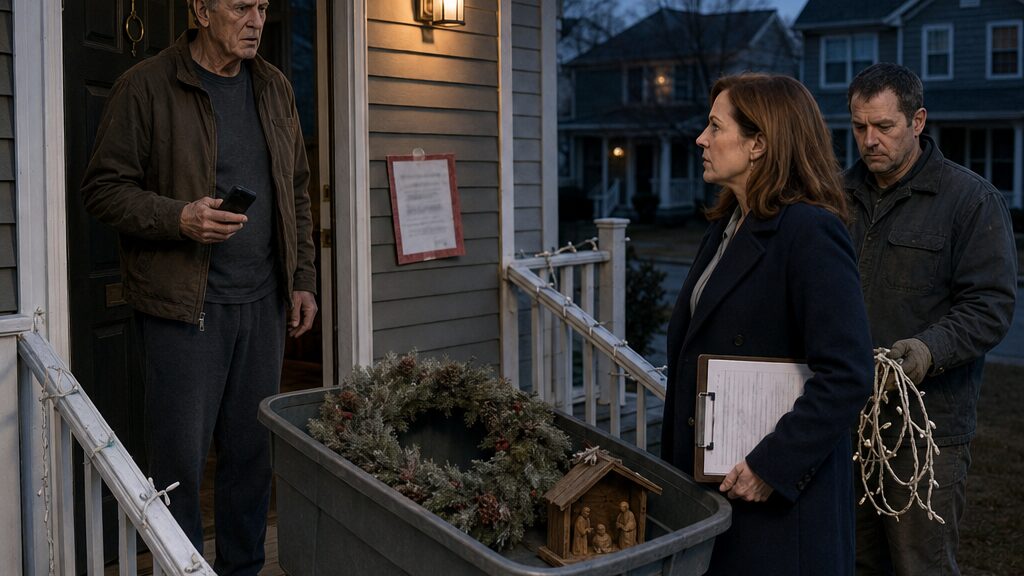
Stephen Campbell knew the wreath before he saw the woman holding it.
The red berries had faded to a dull burgundy years ago, and one of the pinecones leaned crookedly because Katherine had wired it back on after it fell during an ice storm. At six in the morning, under the weak yellow porch light, those details were unmistakable.
The wreath was lying faceup in a gray utility cart at the bottom of his steps.
Beside it sat the small wooden nativity his father had carved in 1971.
Stephen opened the storm door.
“Stop.”
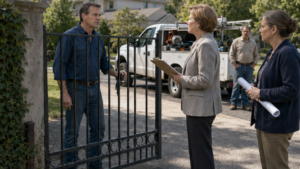
The woman beside the cart turned. She wore a dark coat over business clothes and held a clipboard against her chest. Stephen had seen her twice from a distance at association meetings he had not attended.
Jennifer Clark.
The new compliance chair.
A maintenance worker stood near the porch rail with Stephen’s strand of white lights gathered loosely around one arm.
Jennifer glanced at him, then at Stephen.
“Good morning, Mr. Campbell.”
“You’re taking my property.”
“We’re removing unapproved exterior items under the new enforcement policy.”
Stephen looked down at the wreath again.
For one dangerous second, he imagined stepping past her, lifting it out of the cart, and carrying everything back inside without another word.
His hands had already curled.
Then he saw Katherine as clearly as if she were standing behind him in the doorway, telling him the same thing she used to say whenever he got angry at a utility crew meeting.
If you’re right, Stephen, don’t make it harder to prove.
He reached into the pocket of his sweatpants instead.
His phone came out.
Jennifer’s expression changed slightly.
Stephen took a photograph of the cart.
Then another.
“Mr. Campbell, you’ve already been notified.”
“I’m documenting what you’re removing.”
He photographed the nativity, the wreath, the loose strand of lights, and Jennifer standing beside them.
She exhaled through her nose.
On the front door behind him, a sheet of paper had been taped below the brass knocker.
Stephen pulled it free.
The first number he saw was $450.
He read the page once, then again.
Three violations.
One hundred fifty dollars each.
He looked up.
“You fined me four hundred and fifty dollars?”
“The policy is one hundred fifty per violation per day.”
“For decorations you just removed?”
“For items displayed without approval.”
Stephen held the notice between two fingers.
“I submitted for approval November fourteenth.”
Jennifer’s eyes flickered.
It was small, but he saw it.
“I submitted photographs,” Stephen continued. “Measurements. A diagram showing clearance from the walkway. Everything the application asked for.”
“I’m aware you submitted a request.”
“Was it denied?”
Jennifer said nothing for half a beat too long.
Stephen’s chest tightened.
“Was it denied?”
“No formal determination has been issued.”
The maintenance worker looked down at the lights in his hands.
Stephen stared at Jennifer.
“So you took the wreath off my door before deciding whether I could put it there.”
“A pending request does not suspend enforcement.”
“Show me where it says that.”
Jennifer’s jaw set.
“The board has authorized enforcement of the exterior-display rule.”
“That wasn’t my question.”
“Mr. Campbell, I’m not going to debate policy on your porch.”
“No. You’re just going to come onto it before sunrise and take things.”
Her face hardened.
“We are applying the same standards to everyone.”
Stephen looked toward the row of dark houses across Sycamore Court. Curtains were beginning to glow here and there as people woke.
Twenty-two years on this street.
Twenty-two Christmases.
Katherine had hung that wreath for sixteen of them before her hands became too weak to twist the wire around the hook. The last two years of her life, Stephen had hung it while she stood inside the doorway giving instructions he pretended to resent.
Higher on the left.
No, your other left.
After she died, he had kept doing it exactly the same way.
He had never thought of the wreath as an exterior item.
He put the fine notice on the small table inside the entryway and came back with a yellow legal pad.
Jennifer watched him.
Stephen wrote the date.
6:07 a.m.
He wrote her name.
“What exactly are you taking?”
Her eyebrows rose.
“The wreath, the nativity display, and the railing lights.”
“Who authorized physical removal?”
“The compliance committee.”
“Names?”
“You can request the meeting record.”
“Was there a vote on my property specifically?”
Jennifer shifted her clipboard.
“The policy authorizes removal.”
Stephen wrote that sentence down.
“Did anyone notify me you were coming?”
“You were notified that noncompliant items were subject to removal.”
“That isn’t what I asked.”
Jennifer’s restraint cracked just enough to show irritation.
“You received the notices, Mr. Campbell. You chose not to attend the last two meetings. You chose to display the items before written approval was issued. We are not going to keep making exceptions because someone has lived here a long time.”
The words landed harder than Stephen expected.
Not because they were true.
Because part of them might be.
He had thrown the meeting notices into a drawer unopened.
Katherine had always gone to those meetings. After she died, he stopped.
He told himself it was because the meetings were petty.
Parking complaints. Fence colors. Lawn treatments.
The real reason was that the first time he walked into the clubhouse without Katherine, three people had turned to ask where she was.
He had never gone back.
Jennifer gestured to the maintenance worker.
“Please finish.”
Stephen stepped sideways, not blocking him but not moving far.
“Nothing else leaves this porch until I call someone.”
Jennifer looked at him carefully.
“Are you threatening us?”
“I’m calling the non-emergency line.”
Her expression changed again.
Not fear.
Calculation.
“That’s your right.”
Stephen made the call.
He gave the dispatcher his address, explained that association personnel had entered his porch and removed personal property, and said there was no physical confrontation.
Then he waited.
Jennifer did not leave. Neither did the maintenance worker. The cart stayed at the foot of the porch steps, Katherine’s wreath visible between them like something placed into evidence.
The officer arrived forty-three minutes later.
He spoke first to Stephen, then Jennifer, then asked to see the notice.
Jennifer explained the HOA policy in a clipped, professional tone.
The officer did not argue with her.
He asked Stephen whether he had documents showing the application.
“I do.”
“Any ownership documents?”
“My deed should be in the house.”
The officer looked at the porch, then at the short walkway leading to the sidewalk.
“This porch,” he said, “is it a common element under the association documents, or is it deeded with the house as private property?”
Stephen opened his mouth.
Then stopped.
In twenty-two years, no one had ever made him answer that question.
Chapter 2: Nineteen Days Without an Answer
The receipt was exactly where Stephen had left it nineteen days earlier.
He found it clipped to the back of his copy of the application, stamped November 14 in blue ink.
RECEIVED.
For the first time that morning, something in his chest loosened.
Not much.
Enough.
He spread the packet across the kitchen table while the officer waited in the living room.
Photograph of the wreath.
Photograph of the nativity.
Measurements of the porch.
Distance from the steps.
Width of the walkway.
Stephen had even drawn a box showing where the wooden figures would sit.
Katherine would have laughed at the precision.
“You made a construction drawing for a Christmas wreath?”
“That’s how they wanted it.”
“No, Stephen. That’s how you wanted it.”
He almost smiled.
Then he noticed two envelopes beneath the packet.
HOA meeting notices.
Unopened.
He remembered placing them there without reading more than the dates.
November 18.
November 29.
He had told himself neither had anything to do with his application.
Now he was less certain.
Stephen carried the stamped application to the porch.
The officer reviewed it without offering an opinion.
Jennifer looked at the receipt.
“You submitted it,” she said.
“I told you I did.”
“I didn’t say you didn’t.”
“You said I chose to display the items without approval.”
“You did.”
“Because nobody answered.”
“That doesn’t equal approval.”
“No. It also doesn’t equal denial.”
The officer handed the application back.
“This is a civil association issue unless there’s a separate property matter,” he said. “I’m not here to decide whether the fine is valid.”
Jennifer seemed relieved.
Then the officer added, “But if the porch is privately deeded and somebody entered without consent to remove personal property, you may want legal advice before anyone does anything further.”
Nobody spoke.
The maintenance worker slowly lowered the coiled lights into the cart.
The officer looked at Jennifer.
“I’m not ordering you to return anything. I’m also not telling you your policy gives you legal authority to take it. Those are different questions.”
Stephen wrote that down too.
By eight-thirty, Jennifer and the cart were gone.
So was the wreath.
Stephen spent the next hour finding his deed.
Then he called the management office.
The property manager sounded tired before Stephen finished explaining.
“Yes, Mr. Campbell. I can see your application.”
“You can?”
“It’s in the system.”
“What’s the status?”
A pause.
“Received.”
“That’s not a status.”
“It means we received it.”
“Was it assigned for review?”
Another pause.
Stephen sat straighter.
“Was it assigned?”
“No.”
He looked through the kitchen window at the empty brass hook on the front door.
“Why not?”
“We had a backlog after the policy change.”
“For nineteen days?”
“We’ve had a high volume.”
“And someone still approved a fine.”
“I don’t handle enforcement.”
“Who does?”
“You know the compliance chair is Jennifer Clark.”
Stephen pinched the bridge of his nose.
“Was my application on her desk?”
“I don’t know.”
“Was she told it existed?”
“I can’t answer that.”
“You just told me you can see it in the system.”
“I can see that it was received. That doesn’t tell me who reviewed what.”
Stephen almost snapped at her.
Instead he looked at the unopened meeting notices.
“Were applications discussed at the November eighteenth meeting?”
“Some were.”
“And the twenty-ninth?”
“There were compliance matters.”
“Was mine?”
“I’d have to check the minutes.”
There it was again.
Everything existed somewhere.
Minutes.
Policies.
Systems.
Packets.
Except an answer.
The property manager lowered her voice.
“Mr. Campbell, I’m not trying to make this harder. But the association has had complaints for months about inconsistent enforcement. The new committee is trying to clean that up.”
“By ignoring applications?”
“That’s not what I said.”
“No. It’s what happened.”
He ended the call more sharply than he intended.
For several minutes he sat at the table with the stamped packet in front of him.
He wanted to see himself as entirely different from the people on the other side of the dispute.
He had followed the process.
They had not.
Simple.
Then the envelopes kept pulling his attention.
He finally opened the November 18 notice.
General compliance meeting.
Exterior items.
Open homeowner comment period.
The November 29 notice was similar.
Katherine would have gone.
Not because she loved association meetings. She complained about them almost every time.
But she believed that if somebody was going to make rules about your house, you should at least sit in the room while they did it.
Stephen had stopped sitting in the room.
By noon, Jennifer called him.
“I understand you contacted management.”
“I asked about my application.”
“You also called the police.”
“You were taking things off my porch.”
“We were carrying out an adopted policy.”
“Was my request in the system when you authorized that?”
Silence.
“I knew you had submitted something.”
“Something?”
“I was told you had an application pending.”
Stephen stood.
The chair legs scraped hard against the kitchen floor.
“You knew it was pending.”
“Yes.”
“And you authorized removal anyway.”
“The board cannot freeze enforcement every time a resident submits paperwork after receiving notice.”
“I submitted before the deadline.”
“I’m aware of the date.”
“Then why didn’t you review it?”
Jennifer’s voice cooled.
“Because there were thirty-seven pending requests, multiple compliance disputes, and a board that had spent years letting certain residents treat procedures as optional.”
“Certain residents.”
“You have lived here twenty-two years, Mr. Campbell. You skipped two meetings where this policy was discussed.”
“So that gave you the right to take my wife’s wreath?”
“I didn’t know it was your wife’s.”
The answer stopped him.
Jennifer continued, less sharply now.
“And if I had known, it still could not be the basis for a special exception.”
Stephen stared at Katherine’s photograph on the bookshelf.
“I didn’t ask for one.”
“From my side, that’s not how it looked.”
She ended the call soon after.
Stephen remained standing.
He disliked Jennifer’s assumption.
He disliked even more that his own behavior had helped create it.
At three in the afternoon, someone knocked.
Anna Mitchell stood outside with a casserole dish wrapped in foil.
She looked at the empty wreath hook before she looked at Stephen.
“I heard.”
“Everybody heard.”
“Probably.”
He stepped aside.
Anna had been Katherine’s closest friend on the street. Since Katherine’s funeral, she had stopped by less often—not because she cared less, Stephen suspected, but because he had become very skilled at ending conversations at the door.
She set the dish on the kitchen counter.
“Jennifer had no business taking the wreath while your application was pending.”
“Good. Then we agree.”
Anna did not answer.
Stephen looked at her.
“What?”
She folded her arms.
“You’re going to hate this.”
“I’m already having a pretty bad day.”
“Jennifer didn’t invent the anger.”
Stephen’s expression hardened.
Anna held his gaze.
“The crackdown started before she ever took that chair.”
Chapter 3: The Neighbors Who Wanted One Rule
“Jennifer didn’t invent the anger.”
Anna said it again because Stephen had reacted as if he had not heard her the first time.
He leaned against the kitchen counter.
“Then who did?”
“Half the neighborhood, eventually.”
Stephen almost laughed.
“That’s nonsense.”
“No. It’s inconvenient.”
Anna pulled out a chair and sat.
Stephen remained standing.
She had known him too long to be intimidated by that.
“Last spring,” she said, “the family in the corner house got fined over two planters beside their garage.”
“I remember something about that.”
“You remember calling it ridiculous.”
“It was ridiculous.”
“They appealed. The board upheld it. Two weeks later, one of the original owners had four decorative barrels along his driveway and nobody cited him.”
Stephen frowned.
“That’s not the same thing.”
“That’s exactly what everybody said.”
Anna listed more examples.
A newer resident ordered to remove a basketball hoop while an older homeowner’s remained untouched.
A family cited for a storage box visible from the street while another resident kept gardening equipment beside a garage for years.
Holiday decorations approved verbally for people who knew board members while newcomers were told to complete forms.
None of it sounded dramatic by itself.
Together, it sounded worse.
Stephen pulled out the chair across from her.
“So Jennifer decided to fine everybody.”
“No.”
Anna’s answer came quickly.
“She originally asked the board to stop fining anybody under the unclear rules until they sorted out what was actually enforceable.”
Stephen stared at her.
“That doesn’t sound like Jennifer.”
“It was Jennifer.”
“When?”
“June.”
Anna had still been helping the board then, mostly because no one else wanted to organize old records.
At one meeting, she explained, Jennifer had brought a spreadsheet showing the same rule enforced three different ways over four years. She wanted a ninety-day pause, a homeowner notice, and a proper review.
“What happened?” Stephen asked.
Anna looked tired.
“The room happened.”
He waited.
“Some longtime owners got offended. One said they weren’t going to have their properties reexamined because ‘people who moved in yesterday’ were complaining. Somebody laughed when Jennifer said the system had to be defensible. Another person told her she was trying to turn Sycamore Court into a government agency.”
Stephen could imagine the room.
He could imagine himself agreeing with at least part of it.
That bothered him.
“She lost the vote on the pause,” Anna continued. “Then complaints kept coming. People started accusing the board of protecting friends. Jennifer took over compliance in September and went the other direction.”
“Zero discretion.”
“Pretty much.”
“That still doesn’t make what she did legal.”
“I didn’t say it did.”
Anna leaned forward.
“This is the part you keep doing, Stephen. You hear an explanation and think somebody is asking you to surrender your complaint.”
“Aren’t you?”
“No. I’m asking you to understand the thing you’re fighting.”
He looked away.
Outside, a delivery truck rolled slowly past the house.
Across the street, a neighbor had hung a green wreath inside a front window rather than on the door.
Stephen wondered whether that had always been there.
Or whether somebody had moved it inside after hearing what happened to him.
Anna noticed where he was looking.
“People are nervous.”
“Good.”
She gave him a disappointed look.
Stephen rubbed his jaw.
“All right. That came out wrong.”
“It came out exactly how you feel.”
He did not deny it.
Anna’s gaze moved to the application packet on the table.
She picked up the photograph attached to the top.
Katherine’s wreath was centered against the blue front door.
“She loved this thing.”
“She did.”
“I once told her it looked tired.”
Stephen almost smiled.
“She said you looked tired.”
“She said worse.”
Anna turned the photograph over.
“Do you know what she told me when somebody complained about your lights one year?”
“No.”
“She said, ‘Living here longer doesn’t mean we get different rules. It means we should know the rules better.’”
Stephen’s smile disappeared.
“That sounds like her.”
“You’ve turned her into somebody who would have hated all of this.”
He looked sharply at Anna.
“She would have hated somebody taking that wreath.”
“Yes.”
Anna did not blink.
“And she would have hated that you stopped showing up to everything after she died.”
The words hurt because there was no cruelty in them.
Stephen pushed back from the table.
“I didn’t ask for a grief evaluation.”
“No. You asked why people think longtime residents expect exceptions.”
“I submitted the application.”
“I know.”
“I followed the rule.”
“I know.”
“Then why are we talking about whether I attended meetings?”
“Because you’re going to decide Jennifer is simply a power-hungry idiot, and then you’ll miss how this happened.”
Stephen went quiet.
Anna gathered the application photographs into a neat stack.
For years, he had told himself the neighborhood had changed.
The new people didn’t wave.
The board sent too many emails.
Everything needed a form.
Katherine would have known half those people by name within a month.
Stephen had known almost none of them.
“You defended me, didn’t you?” he asked.
Anna’s hands stopped.
“At meetings.”
She said nothing.
“You did.”
“Sometimes.”
“Why didn’t you tell me?”
“Because you didn’t want to know anything that happened in that clubhouse.”
There was no accusation in her voice now.
That was worse.
Stephen looked toward the empty hook on the front door.
The house felt suddenly less like something invaded from outside and more like a place he had been slowly sealing shut from within.
“Does Jennifer know you’re telling me this?”
“No.”
“Are you on her side?”
Anna sighed.
“There shouldn’t be sides for everything.”
“There are when somebody takes your property.”
“Yes. And she was wrong.”
Anna stood.
“But if you want this fixed instead of merely reversed for you, you need to understand why people supported her.”
At the door she stopped.
“I still have some old board files.”
Stephen looked at her.
“From when you were secretary?”
“Copies. Nothing confidential.”
“What kind of files?”
“Minutes. Draft policies. Amendment discussions.”
Stephen’s attention sharpened.
“Amendments?”
Anna hesitated.
“That exterior rule Jennifer is enforcing.”
“What about it?”
“I remember the board talking about it years ago.”
“That doesn’t tell me anything.”
“No.”
She looked at the empty hook.
“What I don’t remember is homeowners ever voting on it.”
An hour later, Anna returned with a thin banker’s box.
They placed it on Stephen’s kitchen table.
Most of the papers were exactly as dull as he expected—budgets, landscaping bids, pool schedules, insurance summaries.
Then Anna found a stapled set of meeting minutes from six years earlier.
She slid them across.
Stephen read the paragraph once.
Then twice.
One phrase had been typed in plain black letters halfway down the page.
Proposed amendment regarding visible exterior items.
Stephen looked up.
“Proposed?”
Anna nodded slowly.
“That’s what it says.”
Stephen turned to the next page.
There was discussion.
A motion to circulate language.
A recommendation for homeowner review.
Nothing about a final vote.
Nothing about ratification.
He felt the shape of the dispute change beneath his hands.
The question was no longer whether Jennifer had enforced the rule too aggressively.
It was whether the rule had ever become a rule at all.
Chapter 4: The Rule Behind the Fine
Jacob Harris put two documents side by side and tapped them with the capped end of a pen.
“They can’t both be what Jennifer says they are.”
Stephen leaned over the desk.
The first document was the exterior-items policy he had received with his violation notice. Clean formatting. Association letterhead. A section prohibiting visible porch items without prior written approval.
The second was older.
It came from Anna’s box.
Near the top, in plain language, were the words proposed amendment.
Stephen read the paragraph again.
“What’s the difference?”
Jacob looked at him.
“About two-thirds of your neighborhood.”
Stephen sat back.
Jacob had handled Katherine’s estate three years earlier. He was not dramatic by nature. He had once delivered news about a tax problem with the same tone he used to ask whether Stephen wanted coffee.
That made Stephen pay attention when he stopped joking.
“Start at the beginning,” Stephen said.
Jacob opened a thick copy of the recorded covenants.
“Your association can adopt operating rules on plenty of things without changing the covenants. Pool hours. Meeting procedures. Maybe certain maintenance standards, depending on the documents.”
He turned several pages.
“But this restriction is being treated as if it changes what owners can keep on portions of their property.”
His finger stopped beneath a heading.
Section 11.
Stephen moved closer.
“Read that.”
Stephen did.
Any amendment affecting use restrictions required approval from two-thirds of eligible homeowners.
He looked up.
“So there had to be a vote.”
“A valid one.”
“And Anna doesn’t remember one.”
“I’m less interested in what Anna remembers than in what was recorded.”
Jacob pulled his chair toward the computer.
They searched county property records.
Stephen expected it to take minutes.
It took hours.
References led to older references. Property books pointed to scanned documents. One filing described landscaping responsibilities but had nothing to do with porches. Another amended assessment procedures. A third corrected a legal description.
Nothing matched Jennifer’s exterior-item rule.
At noon, Stephen was tired of looking at screens.
Jacob was not.
“You want to know the problem with these cases?” Jacob said.
“The people?”
“The paper.”
Stephen gave him a look.
“The paper tells you what someone intended. Then another piece tells you what they actually did. Then a third tells you whether it counted.”
“Sounds efficient.”
“You worked for a utility company for thirty-eight years.”
“Exactly why I recognize inefficiency.”
Jacob smiled without looking away from the monitor.
Then he stopped.
“What?”
Jacob scrolled upward.
“Here.”
Stephen came around the desk.
It was a board resolution from six years earlier.
The language looked familiar.
Visible exterior objects.
Prior approval.
Uniform appearance.
Board authority.
Stephen felt irritation rise.
“So Jennifer does have something.”
“She has a resolution.”
“That sounds like something.”
“It is something.”
Jacob printed it.
Stephen waited.
Jacob placed the resolution next to Section 11.
“The question is whether the board could create this kind of restriction by resolution alone.”
“You think they couldn’t.”
“I think we need to be careful.”
Stephen frowned.
“That’s lawyer language.”
“It’s good lawyer language.”
Jacob read the resolution again.
“This explains Jennifer’s position. If she inherited this binder and was told this was the governing policy, she had a reason to believe it existed.”
“She still took my property.”
“I’m not defending that.”
“Sounds like you are.”
Jacob looked up.
“No. I’m keeping you from making the mistake of thinking one bad document turns everybody on the other side into an idiot.”
Stephen folded his arms.
That sounded uncomfortably similar to Anna.
Jacob noticed.
“Someone else already tell you that?”
“Something close.”
“Good.”
Jacob went back to the documents.
“The resolution may have been intended to implement an amendment. But if the amendment itself required a homeowner vote and that vote never happened, the resolution may not be enough.”
“May not.”
“Yes.”
Stephen hated uncertainty when he was angry.
It felt like delay dressed as professionalism.
“What do we do?”
“We verify.”
They drove to the county records office after lunch.
The clerk brought out archived association filings on a monitor.
Stephen watched Jacob work through them.
He could have sat back.
He nearly did.
Then he remembered the wreath in the utility cart.
He pulled Anna’s meeting minutes from his folder.
“Look at this date.”
Jacob leaned over.
The minutes said the proposed amendment would be circulated to homeowners for review.
Stephen found the next regular meeting.
No vote.
Then another.
No vote.
Three months later, the board resolution appeared.
“That’s the jump,” Stephen said.
Jacob looked at him.
“What?”
“They went from talking about an amendment to passing a board resolution.”
Jacob took the papers.
He compared dates.
Then returned to the county index.
“Let’s see if anything was recorded between these.”
There wasn’t.
No homeowner ratification.
No amendment signed by the required percentage.
No certificate of vote.
No recorded change to the covenant restriction.
Jacob leaned back.
“That matters.”
Stephen stared at the screen.
“How much?”
“Potentially all of it.”
A small satisfaction moved through him, but it did not feel like victory.
Not yet.
Jacob continued.
“If Section 11 controls, the board couldn’t turn a proposed use restriction into an enforceable covenant just by approving a resolution internally.”
“And the fines?”
“If the restriction was never properly adopted, fines based solely on that restriction have a serious problem.”
“And taking the wreath?”
“That’s a separate problem.”
Stephen looked toward the records counter.
“So we have them.”
Jacob closed the folder.
“No.”
Stephen’s head turned.
“No?”
“We have an argument.”
“You just said—”
“I said the rule appears not to have been properly ratified. I didn’t say a judge has ruled on it. I didn’t say every authority the HOA claims disappears. And I definitely didn’t say you should walk into the clubhouse and start threatening people.”
“I wasn’t planning to.”
Jacob raised an eyebrow.
Stephen sighed.
“Maybe a little.”
“That’s why you hired me.”
“I haven’t paid you yet.”
“Then consider this free advice.”
Back at Jacob’s office, they assembled the sequence.
The proposed amendment.
The missing vote.
The board resolution.
Stephen’s November 14 application.
The unanswered status.
The December 3 fine.
The photographs of the removal.
Jacob placed Stephen’s photograph of Katherine’s wreath on the desk beside the covenants.
The old red berries looked almost brown in the print.
“What do you want?” Jacob asked.
“My things back.”
“That’s first.”
“The fine gone.”
“Reasonable.”
“And I don’t want them doing this again.”
“To you?”
Stephen looked at him.
Jacob waited.
Stephen understood the question.
An hour earlier, he would have answered yes.
To me.
That was the dispute he had brought into the office.
His porch.
His wreath.
His $450.
But Anna’s words had followed him all day.
New residents fined while old residents got exceptions.
People asking for one rule.
Jennifer responding badly to a problem that had not been imaginary.
Stephen touched the edge of the photograph.
“What are my options?”
Jacob leaned back.
“I can send a narrow demand. Withdraw your fine, return your property, close your case.”
“And the rule stays.”
“Possibly.”
“Then someone else gets the same notice next week.”
“Possibly.”
Stephen looked at Section 11 again.
Jacob folded his hands.
“Or we make the rule itself the issue.”
“What happens then?”
“More resistance. More people involved. Maybe more expense. Maybe they decide you’re the reason everything in the neighborhood has to be reopened.”
Stephen gave a humorless laugh.
“I’m already popular.”
“I’m serious.”
“So am I.”
Jacob studied him.
“You came in here angry because they took Katherine’s wreath.”
“They did.”
“And now?”
Stephen looked down at the photograph.
The empty place on his front door bothered him.
But suddenly it was not the only empty place he could see.
“What would Katherine have done?” Jacob asked.
Stephen’s eyes narrowed.
“That’s unfair.”
“Probably.”
“She would’ve gone to the meeting.”
“Then maybe that’s the real question.”
Jacob slid the two documents toward him.
“Do you want me to get Stephen Campbell out of trouble, or do you want the board forced to answer whether this rule applies to anybody?”
Chapter 5: Jennifer Had a Reason, Not Permission
“I would make the same enforcement decision again.”
Jennifer Clark said it before Stephen had even taken off his coat.
The clubhouse conference room went still.
The HOA president sat at the head of the table. Two board members occupied one side. Jacob sat beside Stephen with a slim folder in front of him.
Jennifer sat opposite them.
Stephen looked at her.
“You knew my application was pending.”
“Yes.”
“And you’d still remove the property.”
“If the same facts existed, yes.”
Jacob shifted slightly but said nothing.
Stephen had expected denial.
He had expected Jennifer to say she had not known about the application or that the property manager had failed to tell her.
Instead she was owning the decision.
That made him angrier.
It also made the situation harder.
The HOA president cleared his throat.
“Let’s keep this productive.”
Stephen placed three photographs on the table.
The first showed Katherine’s wreath in the gray utility cart.
The second showed the nativity beside it.
The third showed his front door after removal.
An empty brass hook.
Jennifer looked at the pictures.
Her expression did not change.
Stephen pushed his stamped application forward.
“November fourteenth.”
Jennifer nodded.
“I know the date.”
“Then explain it.”
She folded her hands.
“We had dozens of unresolved applications. Some residents were filing after notices simply to delay enforcement.”
“Mine was filed before the deadline.”
“Yes.”
“And complete.”
“As far as I know.”
“Then why didn’t you wait?”
Jennifer glanced toward the board.
No one answered for her.
She looked back at Stephen.
“Because the association had spent years refusing to enforce rules consistently.”
“That doesn’t answer my question.”
“It does.”
“No. It explains why you wanted consistency. It doesn’t explain why my application didn’t matter.”
A small muscle moved in Jennifer’s jaw.
“When I took over compliance, we were dealing with complaints from residents who had been fined while other residents had been allowed to do the same things.”
“I know.”
That surprised her.
Stephen saw it.
“Anna told me.”
Jennifer sat back.
“Then you know the context.”
“I know part of it.”
She glanced at the photographs again.
“I recommended a temporary pause last summer.”
“I know that too.”
This time the surprise stayed longer.
The HOA president looked from one to the other.
Jennifer’s voice became quieter.
“The board rejected it. Residents complained that we were refusing to enforce our own standards. Newer owners accused us of protecting people who had been here longer.”
“And after that?”
“I decided if enforcement was going to continue, it would be uniform.”
Stephen leaned forward.
“Uniform doesn’t mean automatic.”
“It does when discretion is what created the problem.”
There it was.
Not cruelty.
Fear.
Jennifer was afraid that one exception would prove every accusation against the committee true.
Stephen could see the logic.
He could also see where it had broken.
“You knew my application hadn’t been decided.”
“Yes.”
“You could have delayed my case.”
“And then the next resident would ask why Stephen Campbell got extra time.”
“Because Stephen Campbell had a pending application.”
“So did others.”
“Were their things taken too?”
Jennifer hesitated.
“Some exterior items were removed.”
Jacob opened his folder.
“How many fines have been issued under this policy since September?”
The HOA president answered.
“I don’t have that number in front of me.”
“Then you should get it.”
Jennifer looked at Jacob.
“This meeting is about Mr. Campbell.”
“No,” Stephen said.
Everyone turned toward him.
He had not planned to interrupt.
The words had come before he could stop them.
Stephen looked down at the empty-hook photograph.
“That’s what I thought too.”
The HOA president rubbed his forehead.
“Can we address Mr. Campbell’s immediate situation first?”
Jacob slid copies of Section 11 across the table.
The president read the marked paragraph.
Jennifer did not.
“I’ve seen the covenants.”
“Have you seen a recorded ratification of the exterior-items amendment?” Jacob asked.
Jennifer’s eyes narrowed.
“We have a board resolution.”
“A board resolution isn’t necessarily a covenant amendment.”
“It has been treated as enforceable for six years.”
“That doesn’t answer whether it was validly adopted.”
One board member picked up the copy.
“What exactly are you saying?”
Jacob kept his tone neutral.
“The governing documents appear to require approval from two-thirds of homeowners before this type of restriction can be added. We found the proposed amendment. We found the later board resolution. We have not found evidence of the required homeowner vote.”
The room changed.
Not dramatically.
No one gasped.
But papers stopped moving.
The HOA president looked at Jennifer.
“Did compliance know about this?”
Jennifer shook her head once.
“We relied on the policy binder approved by prior boards.”
Stephen believed her.
That was the irritating part.
She had not invented the document.
She had trusted it too much.
The president turned to Jacob.
“What are you asking for?”
Jacob looked at Stephen.
It was deliberate.
Stephen knew it.
His lawyer could answer.
Instead he was making Stephen do it.
Stephen placed both hands on the table.
“Return the wreath, the nativity, and my lights. Withdraw the four-hundred-fifty-dollar fine.”
The president nodded quickly.
“That seems manageable.”
“And suspend enforcement under this rule until you determine whether it was properly adopted.”
The nod stopped.
One board member shifted in her chair.
The president glanced toward Jennifer.
“That is a broader request.”
“It’s the same problem.”
“We could resolve your account separately.”
There it was.
The easy exit.
Stephen felt it open in front of him.
His things returned.
Fine gone.
No meetings.
No committee fights.
No neighbors calling him difficult.
He could hang Katherine’s wreath and close the door.
The old Stephen—the Stephen of two days earlier—would have taken it.
Jennifer spoke.
“If his violation is canceled individually, that creates exactly the kind of selective enforcement we were trying to eliminate.”
The president looked irritated.
“Jennifer.”
“She’s right,” Stephen said.
Jennifer stared at him.
Stephen almost disliked saying it.
“Not about taking my things. Not about the fine. But she’s right about that.”
The president leaned back.
“Mr. Campbell, we’re offering to fix your situation.”
“You’re offering to erase mine.”
“Yes.”
“What about everyone else fined under the same rule?”
No one answered.
Stephen looked at Jennifer.
“How many?”
She said nothing.
“How many people have you fined since September?”
Her eyes dropped to the table.
“More than one.”
“That’s not a number.”
“I don’t have the total memorized.”
“Then find it.”
The president held up a hand.
“Let’s not turn this into an accusation.”
“It isn’t.”
Stephen’s voice surprised even him with how calm it sounded.
“It’s a request.”
He pushed his application toward the center of the table.
“I did what the policy told me to do. You didn’t answer. Jennifer knew it was pending and enforced anyway because she thought slowing down would look like favoritism.”
Jennifer’s face tightened, but she did not deny it.
Stephen continued.
“Now you’re offering me exactly that. A private exception.”
The room went quiet.
He looked again at the photograph of the empty hook.
For days, he had wanted someone in this room to admit that what happened to him mattered.
Now he understood that an admission limited to him would not be enough.
“Canceling my fine isn’t a solution if the rule itself was never adopted.”
The HOA president closed the folder in front of him.
“Mr. Campbell, if you insist on challenging the policy as a whole, this may require a special meeting and counsel review.”
“Then have one.”
“It could delay returning your property.”
Stephen’s stomach tightened.
That was the cost.
Katherine’s wreath was somewhere in an association storage room while people argued over procedure.
The president saw the hesitation.
“We can settle your account today.”
Stephen looked at Jennifer.
For the first time since dawn on December 3, she did not look certain.
Then he remembered something Anna had said.
If you want this fixed instead of merely reversed for you.
Stephen pulled the $450 notice from his folder and laid it over the empty-hook photograph.
“No.”
The president frowned.
“No?”
“I don’t want a private cancellation.”
Jacob remained perfectly still beside him.
Stephen heard himself continue.
“I want every fine issued under that rule reviewed.”
Chapter 6: Two Thirds of a Neighborhood
“The association’s counsel has advised us to suspend enforcement of the exterior-items policy pending review.”
The HOA president had barely finished the sentence before the room erupted.
Not loudly at first.
Chairs shifted.
People whispered.
Someone near the back said, “You’ve got to be kidding.”
Stephen sat in the second row with Jacob beside him.
Two nights earlier, he had imagined this meeting differently.
He had imagined Jennifer being forced to admit she was wrong.
He had imagined the board looking embarrassed.
He had imagined feeling satisfied.
Instead, he felt tired.
The clubhouse was fuller than he had seen it in years.
Longtime homeowners occupied one side almost by habit. Newer residents clustered elsewhere. Several people held violation notices. Others had printed emails.
Stephen had brought only three things.
His November 14 application.
A certified copy of the recorded covenants.
The photograph of the empty brass hook on his front door.
Not the wreath.
The wreath still had not been returned.
The HOA president raised his hand.
“Please. Everyone will have an opportunity to speak.”
A man behind Stephen muttered, “They never cared about opportunity before.”
Jennifer sat at the board table.
She looked composed, but the stack of papers in front of her had been squared so precisely that Stephen suspected she had aligned them several times.
The president continued.
“Counsel’s preliminary review indicates the board resolution currently being used for exterior-item enforcement may not satisfy the amendment procedure in Section 11.”
A newer homeowner in the aisle raised her hand.
“So the fines are invalid?”
“We are reviewing them.”
“That wasn’t my question.”
Stephen glanced at her.
He did not know her name.
Three days earlier, that would not have bothered him.
Now it did.
The president answered carefully.
“Any fine based solely on the disputed restriction will be examined.”
A longtime resident stood without waiting to be recognized.
“If this board couldn’t pass that rule, then every rule passed in the last ten years should be thrown out.”
Several people murmured agreement.
Jacob leaned toward Stephen.
“This is what I warned you about.”
Stephen nodded.
The man continued.
“Parking rules, landscaping, trash cans. All of it.”
“No,” Stephen said.
The word carried farther than he intended.
The man turned.
“What?”
Stephen stood.
He had not planned to speak yet.
The president looked relieved and worried at the same time.
Stephen held up his copy of the covenants.
“We found a problem with one rule.”
“Same board passed others.”
“Maybe. That doesn’t mean we burn the whole book.”
A few heads turned.
The longtime resident frowned.
“You started this.”
“No.”
Stephen felt the old urge to make the sentence sharper.
He let it pass.
“I challenged a fine on a rule that appears to require a homeowner vote.”
The newer homeowner in the aisle spoke.
“He’s right.”
Everyone looked at her.
She held a yellow violation notice.
“I got fined in October for a storage bench on my porch.”
Stephen saw Jennifer’s eyes shift toward her.
The woman continued.
“I paid it.”
Someone behind her said, “Then ask for your money back.”
“I intend to.”
A few people laughed.
She did not.
“But I also complained last year because my neighbor had the same thing and never got cited.”
The laughter stopped.
She looked toward the longtime residents.
“I wanted consistent enforcement.”
Then she looked at Jennifer.
“I still do.”
Jennifer’s expression changed slightly.
The woman held up the notice.
“But consistent enforcement of a rule that wasn’t properly adopted isn’t fairness.”
Stephen sat down slowly.
That sentence did what his anger had not.
It crossed the aisle.
The HOA president asked the property manager to summarize the preliminary account review.
Seven homeowners had received fines under the disputed policy since September.
Three had paid.
Two had appealed.
One was in collections review.
Stephen’s was the most recent.
The room grew quieter with every number.
Jennifer asked for the microphone.
The president handed it to her.
She stood.
“I want to clarify something.”
Stephen expected a defense.
She surprised him.
“The exterior policy was in the compliance binder when I assumed the chair position. It included the board resolution and prior enforcement records. I believed it was valid.”
A voice from the back said, “Convenient.”
Jennifer stopped.
Stephen turned.
The speaker was one of the longtime homeowners.
Jennifer looked at him.
“No. It isn’t.”
Her voice remained controlled.
“It would be convenient if I could say I didn’t know Mr. Campbell had an application pending.”
Stephen watched her carefully.
“I did know.”
The room shifted again.
Jennifer continued.
“I believed pausing his enforcement while enforcing other cases would repeat the selective treatment residents had complained about.”
The newer homeowner with the yellow notice spoke.
“So you took his decorations anyway?”
“Yes.”
“Before reviewing his application?”
“Yes.”
Jennifer’s fingers tightened around the microphone.
“That decision was mine.”
Stephen had wanted to hear those words.
Now that he did, they gave him less satisfaction than expected.
The president took the microphone back.
“Counsel recommends three immediate actions. Suspension of the disputed policy. Review of fines issued under it. And preparation of a properly noticed homeowner process before any replacement restriction is adopted.”
A board member asked, “Including a vote?”
“If the replacement affects the covenant use restrictions, yes.”
“Two-thirds?”
“Yes.”
That number moved through the room.
Two-thirds.
Not a board majority.
Not a committee interpretation.
Not whoever happened to be sitting at the table.
Two-thirds of the homeowners.
Stephen looked at the photograph in his lap.
The empty hook.
Katherine had always insisted neighborhood rules mattered because people had to live beside one another after the meeting ended.
He had treated that as her hobby.
Now he understood it differently.
The president opened the floor.
Predictably, the first few comments were angry.
One longtime owner wanted Jennifer removed immediately.
Another demanded reimbursement for every fine issued by the association in the previous decade.
A newer resident accused the old board of creating the mess.
An older woman accused newer homeowners of treating Sycamore Court like a corporation.
The old division returned so quickly it almost felt rehearsed.
Stephen raised his hand.
The president called on him.
He stood with the covenants in one hand.
“I don’t think we should fire Jennifer because she relied on a document previous boards treated as valid.”
Jennifer looked at him sharply.
Several longtime residents looked more offended by that than by the rule.
Stephen continued.
“I also don’t think relying on that document excuses what happened on my porch.”
Jennifer lowered her eyes.
“My application was pending. No one denied it. My property was removed anyway.”
He held up the photograph of the empty hook.
“That decision needs to be accounted for.”
No one interrupted.
“But this neighborhood had a fairness problem before my wreath came down.”
He looked toward the newer homeowner with the yellow notice.
“People were treated differently depending on how long they’d lived here or who they knew.”
A few older residents shifted.
Stephen recognized one of them.
He had borrowed a ladder from the man ten years ago.
That was Sycamore Court.
Nobody was only a position in a meeting.
“I didn’t help,” Stephen said.
The admission felt rough in his throat.
“I stopped coming to meetings. I stopped paying attention. I decided Katherine had been the person who dealt with all this, and after she died, I didn’t want to.”
He placed the photograph on the table.
“So I missed what was happening until the rule landed on my door.”
The room stayed quiet.
“I want my things back. I want the fine canceled. I want everyone fined under this rule reviewed.”
He looked at the board.
“But I don’t want every rule thrown out because we found one that wasn’t adopted correctly.”
The longtime resident who had spoken earlier frowned.
“Why not?”
“Because then we’re doing the same thing Jennifer did.”
The man stared at him.
Stephen continued.
“Replacing judgment with something automatic.”
Jacob glanced at him.
Stephen had not planned that line.
It was simply true.
The president called for a vote.
First: suspend enforcement of the exterior-items restriction immediately.
The vote passed.
Second: direct management and counsel to review all fines issued solely under the disputed policy.
Passed.
Third: begin a homeowner review process before any replacement restriction.
Passed.
Jennifer had voted yes each time.
The president paused before the final procedural motion.
Stephen watched Jennifer.
She did not look defeated.
She looked like someone who had reached the end of an argument she could no longer defend.
When the meeting adjourned, people did not applaud.
Some still argued in small groups.
A few residents approached the property manager with notices.
The newer homeowner with the yellow paper stopped beside Stephen.
“Thank you.”
He shook his head.
“You were fined too.”
“Still.”
She walked away.
Stephen gathered his papers.
Jennifer remained at the board table.
For a moment, he considered leaving without speaking to her.
Then she looked up.
“The storage room is being inventoried tomorrow,” she said. “Your property should be released after that.”
Stephen felt irritation rise.
“Should?”
Jennifer gave the faintest tired nod.
“Will.”
He put the empty-hook photograph into his folder.
“What happens to you?”
She looked toward the people leaving the clubhouse.
“That’s up to the board.”
Stephen waited.
Jennifer added, “For what it’s worth, I still think this neighborhood needs consistent rules.”
“So do I.”
She looked at him.
Stephen closed the folder.
“I just think we should make sure they’re rules first.”
Something almost like a smile appeared, then vanished.
The president called Jennifer back to the table.
Stephen walked toward the door.
Behind him, he heard the roll-call vote on the formal suspension.
When Jennifer Clark’s name was called, there was a brief pause.
Then her answer came clearly across the room.
“Yes.”
Chapter 7: The Wreath Went Back on the Door
The box arrived forty-eight hours after the meeting.
Stephen knew what was inside before he cut the tape.
The association had used a plain cardboard carton, the kind normally used for office paper. It sat on his porch beneath the empty brass hook, with no note on top and no attempt to make the return ceremonial.
He carried it inside and set it on the kitchen table.
For several seconds, he did nothing.
Then he opened the flaps.
The wooden nativity was on top, wrapped in brown packing paper.
Stephen lifted each piece carefully.
The small roof.
The carved figures.
The base with the date cut into the underside: 1971.
Nothing appeared broken.
Underneath was the strand of white lights, wound more neatly than Stephen ever managed himself.
The wreath was at the bottom.
He reached for it with both hands.
One pinecone had been bent sideways.
Stephen touched the wire beneath it.
The old repair was still holding.
Katherine’s repair.
His throat tightened.
He carried the wreath to the front door but stopped before hanging it.
The hook waited at eye level.
All week, he had thought returning the wreath to that hook would be the end of something.
Instead it felt like the easiest part.
A car door closed outside.
Stephen looked through the sidelight.
Jennifer Clark was walking up the path.
She carried a white envelope.
He opened the door before she knocked.
Jennifer glanced at the wreath in his hands.
“So they returned everything.”
“It looks like it.”
“Nothing damaged?”
“Not that I can see.”
She nodded.
For a moment neither of them spoke.
She seemed less formal without a clipboard. Still controlled, still carefully dressed, but no longer protected by a table full of board members.
Jennifer held out the envelope.
“This is the written withdrawal of your fine.”
Stephen took it.
“All four hundred and fifty?”
“All of it.”
“And the violation record?”
“Removed from your account.”
He opened the envelope enough to confirm the document inside.
Jennifer looked past him toward the kitchen table.
The wooden nativity pieces were still lying in the open box.
“I didn’t know the wreath belonged to your wife,” she said.
Stephen looked at her.
She did not add an apology.
Not exactly.
“I told you that wouldn’t have changed your decision.”
“It wouldn’t have changed whether I thought the rule should apply.”
Stephen waited.
Jennifer continued.
“It might have changed how I handled the removal.”
“That’s not the same thing.”
“No.”
Her answer came quickly.
Stephen appreciated that more than he wanted to.
She looked at the wreath again.
“I was wrong to authorize removal before your application was decided.”
There it was.
Plain.
No audience.
No microphone.
No board counsel.
Stephen leaned one shoulder against the doorframe.
“You were.”
Jennifer accepted it.
He could have stopped there.
Part of him wanted to.
But the week had made easy endings feel suspicious.
“You were also right about something.”
Her eyes narrowed slightly.
“That sounds dangerous.”
Stephen almost smiled.
“The neighborhood had a fairness problem.”
Jennifer glanced toward the street.
“Yes.”
“You tried to fix it with a rule nobody checked.”
“I relied on what I was given.”
“I know.”
“And then I overcorrected.”
Stephen studied her.
“That sounds like lawyer language.”
“It sounds like two nights of board meetings.”
This time he did smile.
Only briefly.
Jennifer tucked her hands into her coat pockets.
“The review is expanding beyond exterior items.”
Stephen’s smile disappeared.
“How far?”
“Not every rule. The board listened to you.”
“That’s a first.”
“We’re checking anything that depends on amendments rather than ordinary operating authority.”
“And the other fines?”
“Management has already contacted the six other homeowners.”
“Seven including me.”
“Yes.”
Stephen nodded.
Jennifer started to turn away, then stopped.
“For what it’s worth, I don’t regret trying to make enforcement consistent.”
“I know.”
“I regret treating consistency like it excused everything else.”
Stephen looked down at the wreath.
Katherine would have had something to say.
Probably something sharper than anything he had managed.
Jennifer stepped off the porch.
“Have a good Christmas, Mr. Campbell.”
“You too, Jennifer.”
She looked back once, perhaps surprised by the first name.
Then she walked to her car.
Stephen stayed in the doorway until she drove away.
He could have hung the wreath then.
Instead he returned to the kitchen.
He placed it beside the open box and made coffee.
The house was quiet.
It was the same quiet he had lived in for three years, but it no longer felt neutral.
He had always told himself solitude had simply happened.
Katherine died.
The meetings became pointless.
Neighbors changed.
He got older.
Life narrowed.
Those were facts.
But facts could become excuses if you arranged them carefully enough.
He carried his coffee into the small room Katherine had used as an office.
Most of her papers were gone.
He had sorted them the year after she died.
Insurance.
Medical bills.
House records.
Recipes he had kept despite knowing he would never make half of them.
One drawer still contained neighborhood material.
Stephen opened it.
Inside were old directories, volunteer lists, Christmas potluck notes, landscaping complaints, and copies of meeting agendas with Katherine’s handwriting in the margins.
He sat down.
On an agenda from several years earlier, she had circled a vacant committee seat.
Beside it she had written:
Stephen could do this someday.
He stared at the sentence.
It was not a grand message.
Not a final letter.
Not something she had written knowing he would eventually find it.
That made it harder to dismiss.
Below it she had added another note.
He understands systems better than people. Might be good for both.
Stephen laughed once.
The sound surprised him.
“You could’ve said that nicer.”
The empty room gave no answer.
Someone knocked at the front door.
Anna stood outside.
She saw the wreath in his hand and immediately smiled.
“They returned it.”
“Forty-eight hours almost exactly.”
“Of course they did.”
“You sound disappointed.”
“I was hoping bureaucracy would miss its own deadline for once.”
Stephen stepped aside.
Anna entered and handed him a folded sheet of paper.
“What’s this?”
“Temporary rules-review committee.”
He looked at her.
“No.”
“You haven’t even read it.”
“I know what it says.”
“It says three volunteers are needed.”
“I just finished fighting the HOA.”
“Exactly.”
“That is not a qualification.”
“It apparently is now.”
Stephen put the sheet on the table.
Anna looked toward Katherine’s old office.
The drawer was still open.
She noticed the agenda on the desk.
“What did you find?”
“Evidence of a conspiracy.”
Anna raised an eyebrow.
Stephen handed her the page.
She read Katherine’s note.
Her expression softened.
“She tried to get you onto committees for years.”
“She did not.”
“She absolutely did.”
“She complained about every committee she served on.”
“That’s why she wanted you there.”
Stephen took back the page.
Anna tapped the volunteer form.
“Meeting’s Thursday.”
“No.”
“Seven o’clock.”
“No.”
“Clubhouse.”
“I know where the clubhouse is.”
“That’s progress.”
Stephen shook his head.
Anna walked toward the door.
Before leaving, she looked at the wreath.
“You going to hang that?”
“Yes.”
“When?”
“I was working up to it.”
“Stephen, it’s a wreath, not a transmission replacement.”
“Katherine cared about the angle.”
Anna smiled.
“I remember.”
After she left, Stephen stood alone on the porch.
He lifted the wreath onto the brass hook.
It leaned slightly to the right.
He adjusted it.
Too far.
He moved it back.
Higher on the left, he remembered.
No, your other left.
Stephen stopped.
Then he let it hang a little crooked.
The nativity went beside the door.
The white lights returned to the railing.
Nothing about the porch looked rebellious.
That was the strange part.
It looked almost exactly as it had before.
But Stephen did not.
Thursday evening, he put on his coat.
The volunteer form was folded in his inside pocket.
He locked the front door, then stood for a moment beneath the wreath.
Across Sycamore Court, a porch light came on.
A neighbor he barely knew was carrying groceries from a car.
Stephen lifted a hand.
The neighbor looked surprised.
Then waved back.
Stephen stepped off the porch.
He could have stayed home.
For years, he had.
The wreath was back.
The fine was gone.
His house was his again.
That would once have seemed like enough.
Stephen walked past the empty place where the HOA utility cart had stood that morning and continued toward the clubhouse.
The wreath remained behind him on the door, holding Katherine’s memory exactly where it belonged.
Stephen kept walking toward the people who were still there.