They Painted Over His Parking Space, but the Missing Number Led Him to the HOA’s Missing Money
Chapter 1: The Morning Parking Space Fourteen Disappeared
David Carter knew something was wrong before he reached his car.
The white number that had been beneath the driver’s door every morning for three years was gone.
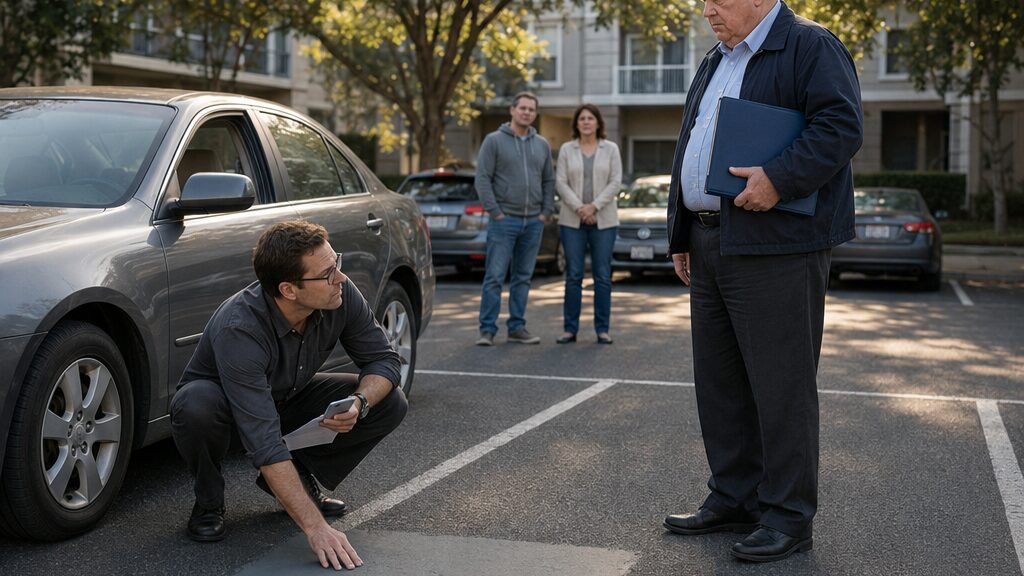
He stopped halfway across the condominium parking lot, coffee in one hand, laptop bag over his shoulder, and stared at a rectangle of gray paint several shades darker than the surrounding asphalt.
Space 14 had disappeared.
Not faded. Not chipped away.
Painted over.
David set his coffee on the curb and crouched. The gray surface was tacky enough that his fingertip came away stained.
Fresh.
He rubbed harder near the lower edge of the rectangle. Beneath the gray, a thin curve of white appeared.
Then a straight line.
Fourteen was still there. Somebody had simply buried it.
He took out his phone and photographed the paint, then the neighboring numbers—13 on one side, 15 on the other.
His sedan sat exactly where it always had.
A man in a maintenance shirt rolled a trash cart toward the dumpsters. David called to him.
“Do you know when they repainted this?”
The man glanced at the pavement, then toward the management office.
“You’d have to ask Ronald.”
“Was the whole lot scheduled?”
“Not that I know of.”
He kept moving.
David stood slowly.
He had lived at the complex long enough to know the rhythms of maintenance. Roof inspections came with emails. Parking restriping came with notices taped near the mailboxes. Even pressure washing generated three reminders and an orange cone.
Nobody had announced this.
By nine-thirty, David was inside the management office.
Ronald Martin sat behind the front desk with his familiar blue regulations binder open beside him. Ronald was in his late fifties, thick through the shoulders, with the practiced expression of someone accustomed to hearing complaints before deciding how much of them mattered.
David placed a copy of his parking assignment on the desk.
“My space was painted over.”
Ronald looked at the document, then at David.
“What space?”
“Fourteen.”
“There’s no fourteen in that section now.”
“That’s the problem.”
Ronald leaned back.
“The current markings determine usable spaces.”
David looked at him for a moment.
“My assignment didn’t disappear because somebody rolled paint over the number.”
Ronald turned the paper around with two fingers.
“This is an old allocation sheet.”
“It’s the allocation sheet your office gave me when I bought the unit.”
“Parking designations can change.”
“Then show me the change.”
Ronald’s eyes narrowed slightly.
David kept his voice even.
“I’m not trying to make this complicated. If the association reassigned the space, there should be something approving it. A board decision. A parking map revision. A work order for the repaint.”
Ronald closed the blue binder.
“Mr. Carter, you’re making a parking issue sound like an audit.”
“I’m asking who authorized paint.”
Ronald stood.
“The lot is managed by the association. If a marking is gone, residents need to follow the current layout.”
David reached for his paper but did not pick it up.
“What’s the work-order number?”
Ronald said nothing.
David waited.
“What’s the work-order number for repainting fourteen?”
“I don’t have every maintenance request memorized.”
“Of course not. Could you look it up?”
Ronald’s expression changed almost imperceptibly.
“I have other residents waiting.”
There was nobody behind David.
David glanced toward the empty lobby, then back at Ronald.
“What time was the work authorized?”
“I said I’d have to look into it.”
David took out his phone, opened a note, and typed.
9:42 a.m. Management unable to identify work order authorizing removal of space 14 marking.
Ronald watched him.
“What are you doing?”
“Keeping track.”
“You don’t need to turn this into something adversarial.”
“I came in asking you to restore my parking number.”
“And I told you the current markings govern.”
David picked up the allocation sheet.
“So your position is that because the number has been painted over, my documented assignment no longer counts.”
“My position is that you need to park in an authorized marked space.”
“Which one?”
Ronald opened the binder again.
“That’s something we can review.”
David left before his irritation could become an argument.
At home he pulled his closing documents from a file box.
There it was again.
Unit information.
Storage assignment.
Parking: 14.
He checked the association packet from the year he moved in.
Fourteen.
He checked an email from the previous property manager about resurfacing.
Fourteen.
Whatever had happened outside, the paper trail had not changed.
By late afternoon, that gave him enough confidence to believe the morning had been an administrative mess, nothing more.
Then he returned to his car.
A yellow notice had been tucked beneath the windshield wiper.
UNAUTHORIZED PARKING.
David read the smaller print twice.
His vehicle had been observed in an unmarked area. Continued violations could result in towing.
He looked down.
Rain earlier in the afternoon had darkened the pavement, but the gray rectangle stood out clearly. Near one corner, where his finger had disturbed the surface that morning, a small white edge of the old 14 had begun showing through.
Ronald was crossing the lot toward the office.
David held up the notice.
“You issued this?”
Ronald stopped.
“The vehicle is in an unmarked area.”
“It’s my assigned space.”
“Not according to the lot.”
“According to every document I have.”
Ronald gave him the weary look of a man explaining something obvious.
“You can appeal the notice.”
“While parking where?”
“There are visitor spaces near the south fence.”
“They have two-hour limits.”
“Then move your vehicle as required.”
David stared at him.
That was when the problem stopped feeling accidental.
“You still haven’t found the work order.”
Ronald’s jaw tightened.
“I told you I’d look into it.”
“And meanwhile you’re threatening to tow me from a space assigned to my unit.”
“You’ve received a warning, David. Another violation can trigger towing under the association rules.”
Ronald walked away.
David remained beside the car with the yellow paper in his hand.
Three years of parking in the same place.
One coat of gray paint.
And suddenly Ronald Martin was willing to tow his car for standing on top of a number somebody had deliberately erased.
Chapter 2: Every New Fine Made the Pattern Harder to Ignore
The second notice arrived before David received a date for appealing the first.
This one was not a warning.
It was a fine.
He found it inside his mailbox eight days after space 14 vanished, folded behind a grocery advertisement and the electric bill.
The reason listed was repeated parking noncompliance.
David carried it upstairs and laid it beside his parking assignment.
For several seconds, he simply looked at the two sheets.
One said the space belonged to his unit.
The other punished him for using it.
He had spent his career examining disputes in which two sets of records told different stories. Usually, the contradiction was buried inside thousands of transactions.
This one sat on his kitchen table.
He emailed the management office requesting the board-approved change to the parking rules and received a two-sentence reply from Ronald.
Current parking policies had been communicated to all residents. Enforcement would continue.
David replied asking for the date of the amendment.
No response.
He began parking in visitor spaces when he could, moving his car between calls, before breakfast, and sometimes late at night. Twice he returned from work to find every visitor spot occupied and had to leave the property entirely.
By the third week, the inconvenience had become expensive.
Another fine appeared.
Then another notice warning that unpaid violations could affect parking privileges.
David was standing in the mail area reading it when Samantha Green came through the door carrying a canvas grocery bag in one arm and a stack of envelopes in the other.
She saw the paper.
“They got you too?”
David looked up.
“What do you mean?”
Samantha hesitated.
She lived two buildings over and usually confined their conversations to package deliveries and complaints about the recycling bins. She lowered her voice.
“I got one last month because my sister parked overnight.”
“Visitor parking?”
“Yes.”
“That’s allowed if it’s registered.”
“She was registered.”
Samantha shifted the groceries and pulled a folded notice from between two envelopes.
“Ronald said there’s a new forty-eight-hour rule.”
David read it.
Vehicles belonging to recurring guests, the notice said, could not occupy visitor parking beyond forty-eight cumulative hours in a seven-day period.
He looked at Samantha.
“You have the rulebook from when you bought?”
“Somewhere.”
“Can you check whether this wording is in it?”
She gave him a cautious look.
“Why?”
“Because Ronald keeps saying current rules were communicated to everyone. I can’t find the version he’s enforcing.”
Samantha almost smiled.
“You sound like my tax preparer.”
“I’m an accountant.”
“That explains a lot.”
An hour later she knocked on his door carrying a thick homeowner packet with a bent corner.
The visitor section allowed seventy-two consecutive hours with management registration.
Nothing about forty-eight cumulative hours.
David read both versions again.
“These aren’t the same rule.”
“That’s what I told him.”
“What did he say?”
“That policies get updated.”
“Did he show you the update?”
Samantha shook her head.
“No. And I didn’t push it.”
“Why not?”
She looked toward the hallway as though Ronald might somehow be standing outside.
“Because I need to live here.”
That answer stayed with David.
Samantha was raising a child on one income. A $180 fine was not an irritating fee to her. It could change what she bought at the grocery store that week.
“How many people have gotten these?” he asked.
“I know of four.”
“Parking only?”
“Mostly. There was one trash-can thing. Another neighbor got something about a balcony chair.”
David leaned against the counter.
“What happened when they challenged them?”
“Mostly they paid.”
There it was.
Not proof of anything improper.
But a pattern.
David spent that evening assembling copies of every parking-related document he had received. He placed the yellow warning beside the original assignment and Samantha’s visitor notice.
Then he searched his email archives.
Ronald had sent several messages over the previous year referring generally to “updated enforcement standards,” but none included board minutes or amended policy pages.
The next morning David went back to the management office.
Ronald looked annoyed before David sat down.
“I need the dated amendment for the parking provisions.”
“You’ve asked for this.”
“And you haven’t provided it.”
“The board authorized management to enforce community standards.”
“That’s not what I asked.”
Ronald tapped the blue binder.
“This contains the current standards.”
David looked at it.
“What date were they adopted?”
Ronald closed the binder.
“Residents elected the board to handle these matters.”
“Then there should be minutes.”
“You’re turning routine enforcement into a procedural argument.”
“No. I’m asking whether the procedure exists.”
Ronald’s voice dropped.
“The association does not need individual homeowners second-guessing every operational decision.”
David felt his temper rise, but he forced it back.
He had made mistakes before when irritation became certainty.
“Then help me stop second-guessing,” he said. “Show me the amendment.”
Ronald stood.
“The fines remain valid.”
David left.
For the first time, he stopped thinking primarily about space 14.
That evening he pulled the association’s annual financial summary from the owner portal.
He expected to find ordinary categories—dues, insurance, landscaping, utilities, reserves.
Instead, one line caught his attention.
Administrative processing and enforcement revenue.
The amount was larger than he expected.
David opened the previous year.
Smaller.
He opened the year before that.
Smaller again.
He sat back.
The increase roughly matched the period since Ronald had taken over management.
That alone proved nothing.
More enforcement produced more revenue. More revenue produced a bigger number.
But Samantha’s words returned to him.
Mostly they paid.
David printed the summaries and placed them beside the fines.
Space 14 had started as a dispute over ten feet of asphalt.
Now he wanted to know how many notices Ronald had issued—and what happened to the money after residents paid them.
Chapter 3: The Numbers Did Not Match the Notices on Their Doors
David reached the total at 11:17 on a Thursday night.
He checked it twice.
Then a third time.
Nineteen thousand and change.
He had assembled the figure from financial summaries, enforcement reports attached to old board packets, and payment entries residents had voluntarily shown him after Samantha began asking around.
The precise amounts varied.
Parking.
Towing administration.
Trash violations.
Unapproved items on patios.
Late compliance fees.
Together, the documented collections over roughly eighteen months came to a little more than $19,000.
David opened the association’s general-fund statements.
Fine and enforcement deposits: approximately $11,000.
He stared at the difference.
Eight thousand dollars did not vanish through rounding.
He took a yellow legal pad and wrote one number at the top.
Beneath it he built a chronology.
Parking marking removed.
No work order provided.
Warning issued.
Fine issued.
Rule amendment requested.
No dated amendment supplied.
Other residents fined under altered wording.
Enforcement revenue increased.
Collections did not reconcile to reported deposits.
At work, David handled investigations large enough that an $8,000 discrepancy would barely earn a footnote.
At home, eight thousand dollars felt different.
It belonged to people he saw carrying laundry, unloading groceries, walking dogs, scraping ice from windshields.
The next morning he submitted a formal records request to the HOA board.
Invoices.
Vendor payments.
Fine-payment logs.
Relevant bank entries.
Board approvals involving parking policy changes and administrative processing charges.
Patricia Lewis called him that afternoon.
“You requested almost two years of records.”
“I requested the records connected to the categories I’m reviewing.”
“David, this is a condominium association, not a corporation under investigation.”
“I know.”
“Then why are you treating it like one?”
He paused.
“Because I can’t reconcile the reported fine collections.”
Silence.
When Patricia answered, her voice had lost some of its irritation.
“What do you mean?”
“I mean the amounts collected do not appear to match the deposits reported under the expected accounts.”
“How much?”
“I’m not making an accusation until I see the underlying records.”
“That isn’t what I asked.”
“About eight thousand dollars.”
Another silence.
Patricia had served as treasurer for years. She was careful with words and famously unwilling to approve a landscaping invoice if the invoice number was missing.
“Send me your calculation,” she said.
“I will. I still want the records.”
“You understand some vendor material may contain information that needs review before release.”
“I understand.”
“And this may take time.”
“Within whatever period the association is required to provide.”
Patricia exhaled.
“You really are an accountant.”
“Unfortunately.”
She almost laughed, but not quite.
The records came in stages.
First, spreadsheets.
Then scanned invoices.
Then a payment ledger that used different labels from the annual summary.
David worked at his dining table each evening, refusing to jump to the conclusion that kept trying to form.
The first spreadsheet was messy but plausible.
The second created a problem.
Several payments tied to enforcement revenue had not been posted directly to the general fund. They were recorded under administrative processing and offset by vendor charges.
David followed one transaction.
Then another.
Then five more.
The totals began matching pieces of the missing $8,000.
He highlighted them.
A recurring vendor appeared beside several entries.
The invoice descriptions were frustratingly broad: processing support, emergency coordination, compliance administration.
One payment landed within days of a burst of parking fines.
Another appeared shortly after a towing campaign.
David leaned back, rubbing his eyes.
It looked bad.
Too bad.
That bothered him.
Good investigations rarely arranged themselves into such clean moral lines.
He called Patricia the next morning.
“I need the contracts for the recurring vendor.”
“You have the invoices.”
“I need the underlying agreement.”
“What are you implying?”
“Nothing yet.”
“You keep saying that.”
“Because implications are cheaper than facts.”
Patricia was quiet.
Then she said, “Come to the office tomorrow. I’ll have what we can release.”
When David arrived, Patricia was waiting at the conference table with three file folders and Ronald’s blue regulations binder pushed to one side.
Ronald was not there.
Patricia noticed David looking at the binder.
“He left it after the board meeting.”
David sat.
She slid the first folder toward him.
“You should understand something before you decide what these numbers mean.”
“That’s why I’m here.”
“Last winter we had expenses nobody planned for.”
“What kind?”
“Building expenses.”
“That’s broad.”
“It’s accurate.”
She opened one folder but kept her hand on the page.
“Some of the invoices you’re questioning are not fake.”
David said nothing.
“They correspond to real work.”
“That doesn’t explain why they’re being offset against enforcement revenue.”
“No.”
“Or why they’re categorized as processing.”
“No.”
“Or who authorized the arrangement.”
Patricia’s expression hardened.
“You’re getting ahead of yourself again.”
Again.
David noticed the word.
“What do you know?”
“I know the board has been trying to keep this property solvent while insurance rose, delinquencies increased, and reserve work kept getting delayed.”
“That’s not an answer.”
“It’s context.”
“Context doesn’t reconcile the ledger.”
Patricia pushed the folder toward him.
Inside were vendor invoices tied to the same recurring company.
David scanned the first page.
Emergency plumbing coordination.
He scanned another.
Electrical service.
Another.
Water intrusion response.
His certainty weakened.
“These jobs actually happened?”
Patricia nodded.
“The plumbing one certainly did. Building C had no hot water for two days.”
David remembered the maintenance trucks.
At the time he had barely noticed them.
He turned another page.
The dollar amount aligned almost exactly with one of the transfers he had marked suspicious.
His stomach tightened.
The discrepancy still existed.
The accounting was still opaque.
But a missing dollar was not necessarily a stolen dollar.
Patricia watched him process that.
“You thought Ronald was pocketing all of it.”
“I thought the transactions suggested diversion.”
“You told Samantha there might be eight thousand missing.”
“I said there was an unexplained difference.”
“And Samantha told two people. They told more.”
David looked up.
“I didn’t circulate an accusation.”
“You circulated a number.”
The distinction landed harder than he wanted it to.
Years earlier, David had completed an internal investigation for a company that had been manipulating expense reports. His findings had been accurate. Management had used them to justify cuts far beyond the people responsible.
Technically, none of that had been his decision.
He still remembered employees carrying cardboard boxes through the lobby.
Numbers could be correct and still be used carelessly.
David closed the folder.
“I need to know which transactions paid legitimate expenses and which didn’t.”
Patricia nodded once.
“Then stop trying to solve it from summaries.”
He looked at her.
“That sounds like you already know there’s more.”
“There is always more when a building is short on money.”
She stood.
“I’ll arrange access to the remaining invoices.”
At the doorway she stopped.
“And David?”
“Yes?”
“Before you decide Ronald stole eight thousand dollars, look at where the money actually went.”
David returned to the table after she left and opened the final folder.
Three transfers to the recurring vendor matched expenses he could now connect to real work.
Two did not.
One lacked a supporting invoice entirely.
The last had a description so vague it might mean almost anything.
David wrote the vendor’s name at the bottom of his chronology.
Then he drew a line from it to the unexplained transfers.
The eight-thousand-dollar gap was real.
But the simple explanation was already beginning to break apart.
Now the harder question was whether Ronald Martin had been diverting money—or whether the people running the association were hiding something they believed homeowners could not afford to know.
Chapter 4: The Missing Eight Thousand Dollars Was Not a Simple Theft
The first suspicious invoice turned into a real pipe.
David stood in the basement mechanical room with one hand on a rust-specked valve housing while a maintenance worker pointed toward a section of newer copper line running along the wall.
“That whole run was replaced in January,” the worker said.
David looked down at the invoice in his hand.
The date matched.
So did the amount.
He had highlighted that payment two nights earlier because it had passed through the same recurring vendor that appeared beside several unexplained processing charges.
Now he was looking at the repair itself.
“Who authorized it?”
The worker shrugged.
“Ronald called us in. Building C had no hot water.”
“Was there a purchase order?”
“You’d have to ask the office.”
That answer had become familiar.
David followed the piping with his eyes.
Nothing about it looked imaginary.
The next invoice took him to an electrical panel near the laundry room. A licensed contractor had replaced a failed component after residents reported burning smells.
Another invoice corresponded to emergency water cleanup after a leaking supply line.
Three transactions David had initially circled as possible diversion were tied to work that had actually happened.
By noon, the clean theory he had built around the missing $8,000 was falling apart.
Not disappearing.
Changing shape.
That afternoon he met Patricia in the association records room.
She had arranged bank statements, invoices, and several folders across a narrow table. Ronald’s blue binder sat on a filing cabinet behind her.
David placed the verified invoices down.
“These are legitimate expenses.”
Patricia nodded.
“I told you.”
“They still weren’t recorded cleanly.”
“No.”
“They were offset against enforcement-related revenue.”
“Yes.”
“And some approvals are missing.”
Patricia looked tired.
“That’s where this gets unpleasant.”
David pulled out a chair.
“I’m listening.”
She remained standing.
“Last winter, the association had three problems hit within about six weeks. The plumbing failure. The electrical issue. Then the insurance renewal.”
“How bad?”
“Bad enough that the reserve account couldn’t comfortably absorb everything without delaying roof work.”
“So the board approved emergency spending.”
“Not the way we should have.”
David waited.
Patricia folded her arms.
“We talked by phone. We exchanged emails. Two board members agreed Ronald could get the work done immediately and we would formalize it at the next meeting.”
“Did you?”
“No.”
“Why not?”
“Because by the next meeting we were already dealing with something else.”
David stared at her.
“That is exactly how controls disappear.”
“I know what it is.”
“Then why did you keep doing it?”
Her expression sharpened.
“Because when a building has no hot water, homeowners do not want a lecture about procurement controls.”
“That doesn’t justify obscuring the money.”
“No. It explains why it started.”
David looked at the ledger.
“And the enforcement revenue?”
Patricia pulled out another sheet.
“Collections had been higher than expected.”
“That’s obvious.”
“Ronald suggested using some of that cash flow to cover emergency operating needs rather than issuing a special assessment immediately.”
David looked up.
“You used fines to plug operating gaps.”
“We used available cash.”
“Residents paid those fines under enforcement policies the board may not even have properly adopted.”
Patricia’s face tightened.
“You think I don’t understand how that sounds?”
“I think it sounds like residents were being pressured for money while the board avoided telling them the budget was in trouble.”
Patricia sat down.
For a moment, neither spoke.
Then she said, “Do you know what a special assessment would have done here?”
David did not answer.
She continued.
“Some owners could have absorbed it. Some couldn’t. The older man downstairs from you is living on retirement income. Samantha has one paycheck coming into her household. We had delinquent dues already. Another three or four thousand dollars per unit could have forced people to sell.”
“That fear doesn’t make undisclosed charges acceptable.”
“No.”
Her answer came quickly.
David had expected resistance.
Instead, the lack of it unsettled him.
Patricia looked toward the blue binder.
“We told ourselves we were buying time.”
“And Ronald?”
“He told us he could increase compliance collections and reduce discretionary spending.”
“Compliance collections.”
“Fines.”
David leaned back.
There it was.
Not theft in the simple sense he had imagined.
Something more ordinary and, in some ways, more dangerous.
A board afraid to confront homeowners with financial reality.
A manager who learned that enforcement could produce revenue.
Procedural shortcuts becoming normal because each one solved an immediate problem.
David thought of the yellow notices on Samantha’s kitchen counter.
“How much of the $8,000 can you tie directly to real emergency work?”
“Most of it.”
“Most isn’t all.”
“No.”
He separated the remaining transfers.
One had no invoice.
Another was labeled only as administrative coordination.
A third carried a processing percentage that seemed unusually high.
“What about these?”
Patricia shook her head.
“I don’t have a good answer.”
“Did the board approve them?”
“Not formally.”
“Verbally?”
“I don’t remember discussing those specific charges.”
David’s attention returned to the recurring vendor.
“Who selected this company?”
“Ronald.”
“Competitive bids?”
“Not for emergency work.”
“What about the processing fees?”
“I assumed they were part of the management arrangement.”
“Did you read the agreement?”
Patricia did not answer immediately.
That was answer enough.
David felt anger returning, but now some of it pointed toward himself.
He had told Samantha there was an unexplained $8,000 discrepancy.
Technically true.
But he had known exactly what conclusion people would draw.
He had let the simplicity of the number do the accusing for him.
“How many people has Samantha told?”
Patricia asked.
“I don’t know.”
“You should.”
David looked at her.
“She didn’t invent the discrepancy.”
“No. But people hear ‘missing money’ differently from ‘poorly documented emergency expenses.’”
David closed the ledger.
“I haven’t accused Ronald of theft.”
“You didn’t have to.”
The words landed hard.
That evening, David called Samantha.
She answered on the second ring.
“I was actually going to call you. People are asking what’s happening.”
“That’s why I’m calling.”
He explained what he had found.
Some of the payments he thought looked suspicious corresponded to real emergency work.
There were still unexplained charges.
There were still governance failures.
But the $8,000 could not honestly be described as money simply disappearing into someone’s pocket.
Samantha was quiet.
“So he didn’t take it?”
“I don’t know that he did.”
“That’s different from what everybody thinks.”
“I know.”
“Did you know this when you showed me the numbers?”
“No.”
“But you thought it.”
“Yes.”
“And now people are saying Ronald stole from the HOA.”
David closed his eyes.
“I need to correct that.”
“You better do it fast.”
After they hung up, he sat at his desk and deleted three paragraphs from the summary he had been drafting.
The most dramatic version of the story was becoming less defensible by the hour.
The next morning Patricia asked him to meet privately in her unit.
She did not offer coffee.
She closed the door and said, “There’s something else.”
David remained standing.
“What?”
“When you challenged the parking rule last month, Ronald mentioned you at a board call.”
“In what context?”
“He said you were becoming disruptive.”
David gave a short, humorless laugh.
“For asking for a work order?”
“He said you were demanding internal records and questioning management authority.”
“I hadn’t requested financial records yet.”
“I know.”
David stared at her.
“When was this?”
“Three days before your first fine.”
His irritation sharpened into something colder.
“What exactly did he ask the board to do?”
Patricia looked down at her hands.
“He said your parking complaint needed to be handled aggressively before other residents started challenging every management decision.”
David did not move.
“He used that word?”
“Yes.”
Aggressively.
The painted number.
The immediate warning.
The repeated fines.
The refusal to produce the amendment.
David had spent a month wondering whether he was seeing deliberate retaliation where there might only be incompetence.
Now Patricia had given him a different question.
Ronald had not merely been trying to keep the association solvent.
He had decided that one resident asking the wrong questions needed to be made an example.
Chapter 5: The Camera Explained Why Ronald Needed David to Stop Looking
The garage recordings would be deleted in four days.
David learned that from a maintenance access log Patricia had finally authorized him to review.
He read the retention note twice.
Thirty days rolling storage.
The date space 14 had been painted over sat near the edge of that window.
“If the footage exists, we need to preserve it today,” David said.
Patricia looked uneasy.
“The cameras are for security, not resident investigations.”
“This involves association property.”
“It also involves privacy.”
“I’m not asking for every camera.”
He pointed to the diagram.
“Only the parking lane covering spaces twelve through sixteen during the repainting window.”
Patricia hesitated.
“Ronald controls system access.”
“Then don’t ask Ronald.”
She frowned.
“That is exactly the kind of procedural shortcut you’ve been criticizing.”
David almost smiled despite himself.
“Then do it properly. Call a board officer. Document the request. Preserve the footage before it overwrites.”
Patricia studied him.
“You really cannot help yourself.”
“No.”
By late afternoon, two board members had approved preservation of the relevant segment.
David was allowed to view it in the garage office but not take a copy until the association attorney reviewed access rules.
The footage was silent and grainy.
For the first forty minutes, nothing happened.
Cars entered.
Cars left.
A delivery van backed through frame.
David watched at accelerated speed until a maintenance truck appeared shortly after dusk.
He slowed the recording.
A worker stepped out carrying a paint roller and a small bucket.
David leaned closer.
The camera angle showed spaces 13, 14, and part of 15.
The worker crossed directly to 14.
Then another figure entered frame.
Ronald.
David stopped the video.
Patricia, standing behind him, said nothing.
He resumed playback.
Ronald pointed toward the pavement.
The worker crouched.
White disappeared beneath gray.
There was no resurfacing crew.
No adjacent restriping.
No larger project.
Just one space.
Fourteen.
David watched the number vanish in under three minutes.
Ronald remained beside the worker until the job was finished.
Then both walked out of frame.
David sat back.
For weeks, part of him had still entertained the possibility that someone had misunderstood instructions.
That possibility was gone.
“Can you verify there was no work order?” he asked.
Patricia answered quietly.
“I already checked.”
“And no board vote?”
“No.”
“Any maintenance request?”
“No.”
David looked again at the frozen image.
Ronald standing over space 14.
“This proves he ordered it.”
“It proves he was there.”
“Patricia.”
She exhaled.
“Yes. It proves enough.”
David should have felt triumphant.
Instead, he felt tired.
The footage answered the first question and complicated the larger one.
It proved retaliation.
It did not prove that Ronald had personally taken money.
It did not turn every questionable transaction into theft.
It did not erase the board’s role in allowing undocumented emergency spending.
Evidence was refusing to arrange itself into the story residents already wanted.
When David left the garage office, Ronald was standing beside the management building.
He had the blue binder tucked under one arm.
“You’ve been busy,” Ronald said.
David stopped.
“So have you.”
Ronald glanced toward the garage.
“You accessed security footage.”
“The board preserved relevant footage.”
“For what purpose?”
“To determine who authorized the repainting of my space.”
Ronald’s expression did not change.
“And?”
“You were there.”
A long pause.
Then Ronald said, “I supervise maintenance.”
“You supervised one worker painting over one parking number.”
“The lot needed to be brought into compliance.”
“With what approved plan?”
Ronald’s voice hardened.
“You continue to assume that every operational choice requires your permission.”
“I’m asking whether it required anyone’s permission.”
“You think running this property is a spreadsheet.”
David looked at him carefully.
“No. I think that’s what you tell yourself every time the records stop supporting what you did.”
Ronald’s jaw tightened.
“You have no idea what this board has refused to deal with.”
“Then explain it.”
“They want repairs without assessments. Insurance without increases. Enforcement without complaints. Everybody wants the building maintained until you send them the bill.”
“That still doesn’t explain my parking space.”
Ronald stepped closer.
“You were challenging every decision.”
“I challenged one rule.”
“You were encouraging others to do the same.”
“I asked for the rule’s adoption date.”
“And then Samantha started asking questions. Then other residents did. You think that has no cost?”
David stared at him.
“That is your defense?”
“My job is keeping this property functioning.”
“By making residents afraid to question you?”
“By maintaining order.”
There was conviction in Ronald’s face.
Not innocence.
Conviction.
That distinction mattered.
David thought about Patricia describing the board’s fear of a special assessment. About real pipes replaced with badly documented money. About the unsupported fees still sitting in the ledger.
Ronald had not invented every problem.
He had simply decided the problems gave him permission to control people.
“Did you have my number painted over because you thought I was disruptive?”
Ronald looked away for the first time.
“The parking layout needed adjustment.”
“Only my space?”
“You were using an area management had determined should not remain assigned.”
“Where is that determination?”
Ronald said nothing.
David nodded once.
“That’s what I thought.”
He walked away before Ronald could turn silence into another rule.
Back inside his unit, David opened the draft summary he had been preparing.
The first version had a heading: Missing Funds.
He deleted it.
He replaced it with: Financial and Governance Irregularities Requiring Independent Review.
Then he rebuilt the entire document.
Confirmed facts went in one column.
Unverified concerns went in another.
He listed real emergency expenditures separately from unsupported processing charges.
He included the lack of board-approved parking amendments.
The missing work order.
The preserved footage.
The timing of his fines after Ronald described him as disruptive.
He also included his own correction.
The full $8,000 discrepancy should not be characterized as theft because several payments had been tied to legitimate emergency work.
David stared at that sentence before saving the file.
It weakened the accusation.
It strengthened the truth.
By evening, rumors had moved faster than his correction.
Someone had taped an anonymous note near the mailboxes accusing management of stealing thousands.
Another resident had posted in the community message board demanding Ronald’s immediate removal.
Samantha knocked on David’s door just after seven.
“You saw the note?”
“Yes.”
“People think you proved all of it.”
“I didn’t.”
“They’re using your number.”
“I know.”
“What are you going to do?”
David looked at the stack of documents on his dining table.
Thirty-two units.
Thirty-two households that had been governed by a system most of them barely understood.
“I’m going to give them the corrected version.”
Samantha looked skeptical.
“They won’t like it.”
“They don’t have to.”
“You could just show the footage. That alone would destroy Ronald.”
“That isn’t the whole issue.”
“He painted over your space.”
“Yes.”
“He fined you afterward.”
“Yes.”
“And you’re worried about being fair to him?”
David shook his head.
“I’m worried about being accurate.”
He printed the first packet.
The cover page contained no accusation.
Just a photograph of the gray rectangle in the parking lot with the faint white edge of 14 showing beneath it.
Below that came the timeline.
The rules.
The payments.
The repairs.
The unsupported fees.
The footage preservation notice.
And his correction.
Samantha picked up one copy.
“You really put in here that some of the money was legitimate.”
“It was.”
She flipped another page.
“And that the board approved some things informally.”
“They did.”
“You know people wanted a cleaner answer.”
David looked at the photograph of 14.
“So did I.”
He loaded the printer with more paper.
By nine o’clock, thirty-two packets were stacked on his table.
The case was less dramatic than the rumor now moving through the building.
It was also harder to dismiss.
Chapter 6: Thirty-Two Doors Turned One Complaint Into a Governance Crisis
David placed the first packet outside Samantha’s door.
She was standing behind him with her arms folded.
“You know what everyone is going to notice first?”
“The photograph.”
“No. The part where you say the eight thousand wasn’t all stolen.”
David slid the packet beneath the edge of her doormat.
“That’s why it’s in there.”
“You’re weakening your own case.”
“I’m correcting it.”
“Same effect.”
He stood.
The hallway stretched ahead of them with identical doors on both sides.
Thirty-one packets remained in the box.
Samantha followed him to the next unit.
“You could lead with the footage.”
“I do.”
“Then why spend three pages explaining emergency repairs?”
“Because they happened.”
“Ronald still manipulated the rules.”
“Yes.”
“Then what exactly are you trying to protect?”
David stopped.
The question irritated him because he had already asked it of himself.
“I’m not protecting Ronald.”
“It looks like you’re protecting the board.”
“I’m separating things.”
“Residents don’t think in columns.”
“I know.”
“That’s the problem.”
David looked down at the packet.
“You think I should leave out facts because they complicate the message?”
“No.”
Samantha’s answer softened.
“I think you need to understand people are angry because they’ve been paying fines they could barely afford. They don’t want an accounting lesson. They want someone to tell them whether they were being used.”
David nodded.
“They were.”
She waited.
“But not every dollar proves the same thing,” he said.
They continued.
At one door, the older downstairs neighbor opened before David could set down the packet.
“What’s that?”
“Information about the parking enforcement and association finances.”
The man glanced at the cover photograph.
“That your space?”
“Yes.”
“I wondered why they covered it.”
“You can read the packet. There’s a meeting request form at the back if you want one.”
“Is someone stealing from us?”
David felt the old temptation.
A direct question wanted a direct answer.
“I found improper accounting and unsupported charges. I also found emergency expenses that were real. I have not proved that Ronald personally stole the missing amount.”
The neighbor frowned.
“So what did you prove?”
“That the rules were changed or enforced without proper records. That some money was handled outside normal approval. And that my parking space was deliberately painted over while Ronald was present.”
The man looked at the photograph again.
“That’s enough for me to attend a meeting.”
By the time David reached the final hallway, residents were already opening packets behind him.
Phones came out.
Doors stayed open.
Low conversations spread between units.
The private dispute had become communal before David returned upstairs.
Patricia called at eight-ten.
“I read your packet.”
“And?”
“You included my statement.”
“You approved it.”
“I know.”
“You can withdraw permission if anything is inaccurate.”
“No. That isn’t why I called.”
Her voice sounded strained.
“Ronald is furious.”
“That was predictable.”
“He says you are distributing defamatory material.”
“Everything presented as fact is documented.”
“He’s telling the board you misrepresented the $8,000 and are now trying to repair the damage by blaming management procedures.”
David closed his eyes.
“Part of that is fair.”
Patricia went silent.
“What?”
“I did let the discrepancy travel before I understood all of it.”
“You’re not supposed to agree with him.”
“I’m supposed to tell the truth.”
“That is not how an emergency meeting works.”
David sat down.
“There’s an emergency meeting?”
“There will be.”
“When?”
“Tonight.”
He looked at the clock.
“Who called it?”
“Ronald requested an immediate board session. The president agreed because residents are already demanding answers.”
David almost laughed.
Of all the outcomes he had expected, Ronald calling the meeting first had not been one.
“What is he planning?”
“To present your packet as evidence that you’ve created panic based on incomplete accounting.”
“That’s not entirely wrong.”
“David.”
“I’m not saying he’s right about the rest.”
Patricia lowered her voice.
“You need to decide what you’re actually asking for.”
“Independent review.”
“Anything else?”
“Void enforcement actions based on unapproved rule changes. Restore documented parking assignments. Require board approval for material policy changes and vendor fees.”
“And Ronald?”
David looked toward the stack of leftover pages.
“That depends on what he admits.”
Patricia was quiet.
Then she said, “I need to tell them something too.”
“What?”
“The informal approvals.”
David waited.
“All of them?”
“The ones I participated in.”
“That could cost you your board seat.”
“I know.”
“Why now?”
“Because I’m tired of telling myself that avoiding a special assessment made silence responsible.”
David leaned back.
For the first time since the investigation began, Patricia sounded less like a treasurer protecting a system and more like a homeowner trapped inside one.
“Then say exactly what happened,” he told her.
“I intend to.”
The clubhouse was already half full when David arrived.
Residents sat in folding chairs facing a long table where the board usually conducted meetings.
There was no applause when he entered.
No heroic silence either.
People whispered.
Some looked at him with expectation.
Others looked suspicious.
One resident held the packet open to the financial pages.
Another had underlined David’s correction about the emergency expenses.
Samantha stood near the back wall.
“You’re losing some of them,” she said quietly.
“Good.”
She stared at him.
“Good?”
“If everyone walks in already certain, nothing tonight matters.”
“That is a very accountant thing to say.”
David almost smiled.
Across the room Patricia arranged documents in front of her seat.
The HOA president spoke with the association attorney.
Then Ronald entered.
The blue regulations binder was tucked against his side.
Conversation dropped.
Ronald walked to the front table, set the binder down, and looked directly at David.
When the meeting was called to order, Ronald asked to speak first.
The president allowed it.
Ronald stood.
“I requested this meeting because inaccurate financial claims are circulating throughout the community.”
Several residents shifted in their chairs.
Ronald lifted one of David’s packets.
“This document was distributed tonight by a homeowner who initially told residents there was an $8,000 discrepancy in association funds.”
David did not move.
Ronald continued.
“The same homeowner now admits that much of that money paid legitimate association expenses.”
A murmur passed through the room.
Samantha looked toward David.
He remained seated.
Ronald placed the packet beside the blue binder.
“This is what happens when residents treat partial records as proof of misconduct.”
The words were carefully chosen.
And, unlike several things Ronald had told David over the previous month, they contained enough truth to be dangerous.
Ronald looked around the room.
“Our property has faced serious financial pressure. Management has made difficult operational decisions to keep services functioning and costs under control. We cannot govern a community through rumor.”
Then he looked directly at David.
“If Mr. Carter wants to accuse me of stealing money, he should say so clearly and prove it.”
The room went still.
David felt thirty-two households waiting for the clean accusation Ronald had just offered him.
All David had to do was take it.
Instead, he rose with his corrected packet in one hand and the photograph of the painted-over number 14 on top.
“No,” he said. “That isn’t the case I’m here to make.”
Chapter 7: When the Numbers Were Finally Public, Nobody Got an Easy Victory
Ronald stared at David as if the answer had been rehearsed incorrectly.
“No?” he said.
“No.”
David walked to the small projector table beside the board.
“I’m not here to accuse you of stealing eight thousand dollars.”
A few residents murmured.
Ronald’s shoulders loosened almost imperceptibly.
David connected his laptop.
“I’m here because the association’s records show three separate problems, and putting them all under the word theft would make the truth easier to dismiss.”
The first slide appeared.
Two figures sat side by side.
Fine and enforcement collections: just over $19,000.
Deposits recorded through the expected general-fund categories: roughly $11,000.
David faced the room.
“That difference is real.”
Ronald leaned back in his chair.
“And you now know why.”
“I know why some of it exists.”
David changed the slide.
Several payments appeared under emergency plumbing, electrical work, and water-response expenses.
“These expenses correspond to work that actually happened. I verified the repairs. Patricia provided supporting records. The board handled the approvals badly, but I cannot honestly call these payments stolen.”
Someone near the back asked, “Then what are we doing here?”
David looked toward the voice.
“Because legitimate repairs do not explain everything.”
The next slide separated the transactions.
On the left were verified emergency costs.
On the right were processing charges, unsupported administrative fees, and one transfer with no complete invoice.
The room quieted.
David continued.
“These are different questions. If we mix them together, nobody has to answer either one properly.”
Ronald picked up the blue regulations binder.
“You’re presenting ordinary management charges as suspicious because you don’t like the way they’re categorized.”
“Then show the authorization.”
Ronald opened the binder.
“The management agreement gives broad operational discretion.”
David nodded toward it.
“Which page authorizes a percentage-based processing charge against enforcement revenue?”
Ronald flipped through several sections.
David waited.
So did everyone else.
Ronald finally closed the binder.
“The agreement does not list every operational cost individually.”
“That may be true. But I found no board vote approving those specific fees.”
The HOA president turned toward Patricia.
“Is that accurate?”
Patricia looked down at the documents in front of her.
“Yes.”
Ronald turned sharply.
“Patricia.”
She did not look at him.
“The board did not formally approve those charges.”
“You knew we were using enforcement revenue to manage the operating shortfall.”
“I knew some revenue was being redirected to urgent expenses.”
“That is exactly what I did.”
“No,” Patricia said quietly. “It isn’t exactly the same.”
The room shifted.
David stepped away from the projector.
Patricia placed both hands on the table.
“We did approve some emergency work informally,” she said. “I participated in those conversations. We should have recorded the votes properly, and we didn’t.”
A resident near the front asked, “Why?”
Patricia swallowed.
“Because we were afraid.”
Nobody spoke.
She looked around the room.
“The insurance renewal was higher than projected. Reserves were already strained. Some owners were behind on assessments. We believed a large special assessment could force people to sell.”
Samantha stood near the wall, arms crossed.
“So instead you fined people more?”
Patricia winced.
“We allowed Ronald to increase enforcement while telling ourselves that stronger compliance was good for the property anyway.”
“That isn’t an answer,” Samantha said.
“No,” Patricia replied. “It’s an admission.”
The words changed the room more than any accusation had.
David watched Ronald.
For the first time that evening, the manager looked less angry than cornered.
He stood.
“You are all forgetting what condition this property was in eighteen months ago.”
His voice remained controlled, but the edges had sharpened.
“Deferred repairs. Owners ignoring rules. Delinquent assessments. Insurance costs climbing. Every month the board told me to solve problems without raising dues.”
He looked directly at Patricia.
“You asked me to keep the building functioning.”
“I did.”
“And I did.”
David said, “That still doesn’t explain space 14.”
Ronald turned toward him.
“It was a parking adjustment.”
David clicked once.
The projector displayed a still image from the preserved garage footage.
The old white 14 was visible on the asphalt.
A maintenance worker stood beside it with a roller.
Ronald stood several feet away.
There was a murmur through the room.
David did not speak until it settled.
“There was no work order.”
Ronald’s face hardened.
“No recorded board authorization.”
Silence.
“No revised parking map.”
Ronald looked toward the board members.
David continued.
“And the repaint happened three days after Ronald told the board my complaint should be handled aggressively.”
The HOA president looked at Ronald.
“Did you say that?”
Ronald’s eyes stayed on David.
“I said repeated challenges to routine management decisions were becoming disruptive.”
“That is not what I asked.”
Ronald finally faced the president.
“Yes. I used the word aggressively.”
The admission landed without drama.
No one shouted.
That made it heavier.
Ronald placed both hands on the table.
“You want the truth? Fine. David was becoming a problem.”
Samantha let out a disbelieving breath.
Ronald continued.
“He questioned every step. He demanded records for a parking issue. Other residents started doing the same. At a time when this association could barely make decisions, we were heading toward paralysis.”
David felt the anger that had carried him through the first weeks rise again.
This time he let it pass before speaking.
“So you erased my assigned space.”
“I removed a designation management believed should be reconsidered.”
“Without authority.”
Ronald said nothing.
“And then fined me for parking there.”
“I enforced the lot as marked.”
A resident near the back laughed once, without humor.
David looked at Ronald.
“That is the problem.”
He changed the slide one final time.
On the left was the photograph David had taken the first morning: gray paint covering the faint edge of 14.
On the right were the reconciled figures.
“The association has real financial problems,” David said. “Removing Ronald will not repair the reserves. Voiding bad fines will not lower insurance. And the board cannot pretend the emergency spending happened without its knowledge.”
He glanced at Patricia.
She nodded.
“But none of those problems give management permission to create rules after the fact, hide approvals, charge unsupported fees, or punish residents for asking questions.”
Ronald looked at him.
“You think transparency pays invoices?”
“No.”
David closed his laptop.
“But hiding invoices doesn’t pay them either. It only changes who finds out too late.”
The HOA president asked David what he wanted the board to do.
A month earlier, the answer would have been simple.
Restore fourteen.
Cancel the fines.
Remove Ronald.
Now David looked around at the residents who would still have to pay for roofs, pipes, insurance, and every other problem after tonight.
“Independent financial review,” he said. “All enforcement actions based on unapproved rule changes should be reviewed and voided where appropriate. Parking assignments should return to the documented map unless the board changes them through the proper process. Any new vendor fee should require written approval.”
“And management?” the president asked.
David looked at Ronald.
“That is a board decision.”
Ronald seemed almost surprised.
David continued.
“But nobody responsible for enforcing rules should be allowed to change the practical effect of those rules to silence a resident.”
The association attorney leaned toward the president.
A quiet discussion followed.
Then the board voted.
Ronald’s operational authority was suspended pending review.
The financial records would go to an independent accountant.
Improperly issued fines would be examined and refunded or credited where warranted.
The board would adopt written approval procedures for emergency expenditures and vendor fees.
Patricia voted yes on every item.
Afterward, Samantha found David stacking his papers.
“You could have buried him,” she said.
“That wasn’t the point.”
She glanced toward Ronald, who was standing alone beside the blue binder.
“You sure?”
David looked at the binder.
“No.”
Samantha smiled faintly.
“Better answer.”
The next morning, David woke to the sound of a maintenance truck outside.
He crossed the lot before breakfast.
A worker had placed two cones around the gray rectangle.
Ronald was nowhere in sight.
The worker knelt with a stencil and white traffic paint.
David stopped several feet away.
“You restoring the number?”
The worker nodded.
“Board authorization came through this morning.”
David almost asked for the work-order number.
Instead, he smiled.
“Good.”
The stencil lifted.
A clean white 14 remained on the pavement.
It looked almost too bright against the weathered asphalt.
Patricia approached from the sidewalk carrying a folder.
“The review is going to hurt,” she said.
David looked at her.
“Financially?”
“That too.”
She handed him a notice about the upcoming budget meeting.
“We still have a reserve problem.”
“I know.”
“People are going to be angry when they see the real numbers.”
“They should see them anyway.”
Patricia nodded.
“I know that now.”
She walked toward the clubhouse.
David remained by the freshly painted space.
Nothing about the morning fixed the association’s finances. Ronald’s suspension did not erase the board’s choices. Some residents would receive credits, others difficult budget news. There might still be a special assessment.
But the number was visible again.
Not because David had won an argument.
Because the rule governing that small rectangle of pavement could no longer exist only inside one person’s binder.
David waited until the paint dried before moving his car back into space 14.
The story has ended.