They Paved Across His Farm Lane, Then Learned Why the Old Survey Marker Still Mattered
Chapter 1: The Morning Blacktop Crossed the Old Line
By the time the jackhammers arrived, the asphalt was less than two weeks old.
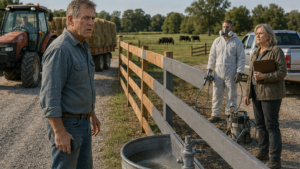
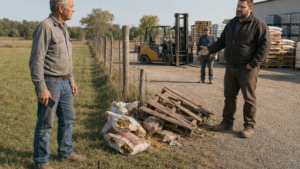
Timothy Walker stood beside the farm lane with his hands tucked into the pockets of his canvas jacket and watched a steel bit punch through the black surface in a spray of gray dust. Each strike exposed pale gravel underneath. Twenty feet away, an equipment operator waited beside a loader while broken chunks accumulated along the edge of the hay field.
The strangest part was how finished the pavement still looked beyond the demolition line.
Smooth. Dark. Expensive.
As though nobody had imagined it might ever have to come back out.
But that morning was the end of the argument.
The beginning had been quieter.
Two Saturdays earlier, Timothy had come around the corner of his equipment shed carrying a grease gun and heard the low mechanical growl of a paving machine.
For a second he thought the county had started road work on the gravel route beyond his north fence. Then he smelled hot asphalt.
He stopped.
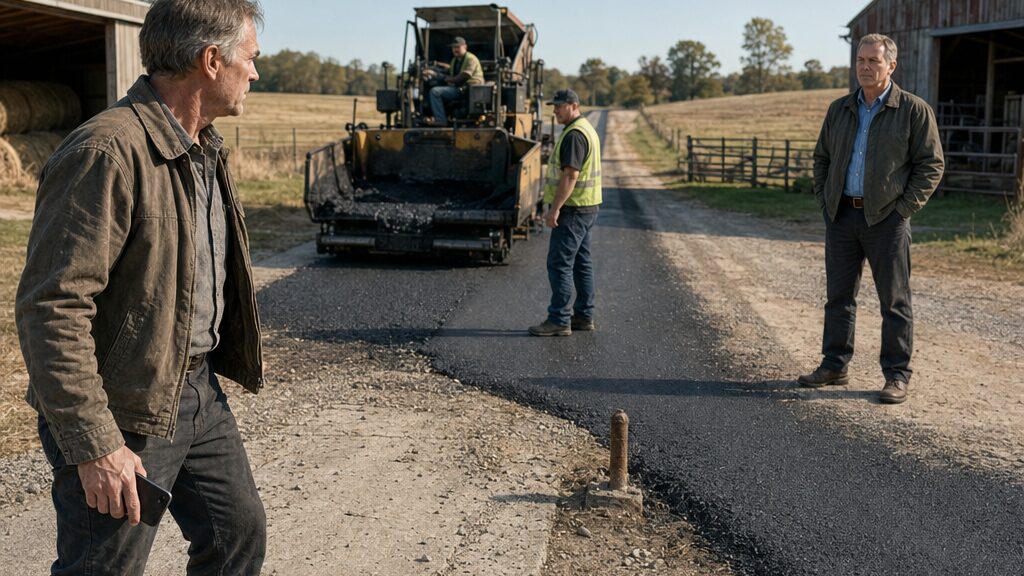
A dump truck sat angled across the far end of his farm lane. Three workers were spreading blacktop from Gary Campbell’s barn approach directly toward the concrete strip Timothy used to reach his own equipment yard.
Fresh pavement covered the gravel like dark water.
And it was moving toward the old iron survey marker.
Timothy set the grease gun on a fence post.
“Morning,” he called.
The paving foreman turned, one hand raised against the machinery noise.
Timothy walked closer.
“How far are you taking this?”
The foreman pointed toward Gary’s barn. “Connecting that approach into this lane. Makes a clean turn for trucks.”
Timothy looked down.
There it was.
Or what was left visible of it.
The old iron marker had stood beside the lane for as long as Timothy could remember, barely three inches above ground. His father used to warn him not to catch the mower blade on it. Now fresh asphalt had flowed halfway around the rusted top.
Timothy crouched and touched the exposed metal with two fingers.
“Stop here.”
The foreman frowned. “Gary said the whole lane was shared.”
“It isn’t.”
The man glanced toward the adjoining parcel.
Timothy stood.
“Nothing else crosses this marker.”
The foreman shut down the paving machine.
Silence arrived so suddenly that Timothy could hear blacktop crackle as it cooled.
He took out his phone and photographed the marker, the paving edge, the truck, and the line where Gary’s new barn approach merged onto Timothy’s property.
He had barely finished when Gary came walking from the house.
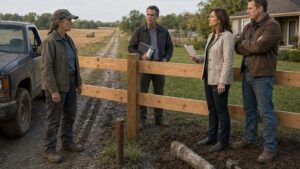
Gary was a broad man in his early sixties with a stiff-backed way of moving that made every disagreement look deliberate before he said anything.
“What’s the problem?”
Timothy pointed at the pavement.
“This is my lane.”
Gary looked at the marker, then toward the concrete strip running behind Timothy’s shed.
“It’s been used from this side for years.”
“Used isn’t owned.”
Gary gave a short laugh.
“The previous owner drove through here all the time.”
Timothy felt his jaw tighten.
That much was true.
He also knew immediately that he should have answered differently.
Instead, he said, “That doesn’t give you the right to pave it.”
Gary folded his arms.
“I bought the place with this access in use.”
“You bought your parcel.”
“And the access that came with it.”
“No.”
Gary glanced toward the waiting crew. “That’s not what I was told.”
Timothy looked at the fresh asphalt curling around the survey pin.
“When I tell you it’s private, that should be enough to stop until we sort it out.”
Gary’s expression changed slightly.
Not anger.
Confidence.
That bothered Timothy more.
“You may want to check the old records before you start making threats.”
“I haven’t threatened you.”
“You’re stopping my contractor.”
“On my property.”
Gary looked toward the lane stretching back to Timothy’s equipment yard.
“We’ll see.”
Timothy watched him walk away.
The paving crew waited.
The foreman finally asked, “What do you want us to do?”
“Nothing beyond that point.”
Timothy tapped the marker with the toe of his boot.
The crew finished what they could on Gary’s side and packed up before noon.
For the rest of the day, Timothy kept finding reasons to pass the lane.
Each time, the new pavement looked more permanent.
The black surface erased the visual difference between Gary’s approach and Timothy’s lane. A stranger driving past would assume they had always been connected.
That was what unsettled him.
Not the few feet of asphalt.
The appearance of permission.
That evening he pulled the deed from the metal file cabinet in his farmhouse office. The legal description was old, dense, and written in a language that turned fences into bearings and distances.
Timothy found the parcel map attached behind it.
His lane was inside his boundary.
He knew that.
He had known it since he was a boy.
Still, Gary’s words followed him.
The previous owner drove through here all the time.
Timothy sat back.
He remembered mud.
A wet spring.
A truck struggling near the neighboring gate.
He remembered waving someone through.
Then another year.
Another favor.
He closed the file.
For decades, the iron marker beside the lane had seemed sufficient.
The land knew where the line was.
Timothy had assumed people did too.
The next morning Gary drove his pickup down the paved connection, crossed onto Timothy’s lane, and continued toward the county road as if the argument had never happened.
Timothy stepped onto his porch.
Gary slowed just enough to lower his window.
“You find those records yet?”
Timothy stared at him.
Gary gave a small shrug.
“Check before you call anybody.”
Then he drove on.
For the first time since the paving crew arrived, Timothy was no longer wondering whether Gary had crossed the boundary.
He was wondering whether some old kindness had.
Chapter 2: The Favor Nobody Ever Put in Writing
Timothy found exactly what he feared in the file cabinet.
Nothing.
No letter granting temporary access.
No note limiting use to wet weather.
No signed agreement saying the neighboring owner could pass through only with permission.
Nothing stating that the favor could be withdrawn.
Because Timothy had never thought a favor needed paperwork.
He spread the deed, parcel map, tax records, and old farm photographs across the kitchen table.
The photographs bothered him most.
One showed the lane twelve years earlier after a spring storm. Deep tire tracks ran along the gravel near the iron marker. In the distance, the previous owner’s truck sat beside Timothy’s equipment shed.
Timothy remembered that day clearly once he saw it.
The neighboring entrance had turned into mud after three days of rain. A delivery truck could not climb the shallow rise to the barn.
The previous owner had come over on foot.
“Mind if we cut through yours till this dries?”
Timothy had been repairing a hydraulic hose.
He had waved toward the lane.
“Go ahead.”
That was all.
No conditions spoken because the conditions seemed obvious.
Until the ground dried.
Until the problem passed.
Until next time.
The next wet year, the same thing happened.
Then occasionally during hay season.
Sometimes a truck used the lane because turning was easier.
Timothy had noticed.
He had not objected.
His father had always said a farmer who refused every reasonable favor eventually discovered that nobody came when his own tractor was stuck.
Timothy believed that.
Still did.
What he had never considered was that repetition could begin to look like entitlement.
By the time Gary and Sarah bought the neglected parcel, Timothy had already gotten used to seeing occasional tire tracks beside the marker.
Gary’s first few trips had not bothered him.
The property had been empty for nearly two years. Fences needed repair. The barn roof sagged at one corner. Gary hauled lumber, feed panels, tools, and eventually a small tractor onto the place.
The first time Gary used Timothy’s lane, Timothy saw him from the hay field.
He thought about walking over.
Instead, he kept driving the baler.
The second time, he told himself Gary probably assumed the same arrangement remained.
By the fifth or sixth time, saying something felt more awkward than it would have on the first.
That was Timothy’s habit.
He could replace a PTO shaft in freezing rain without complaint, but he would postpone an uncomfortable conversation until the problem became heavier than the conversation itself.
By late summer, Gary’s pickup was using the lane almost daily.
Then feed deliveries started.
One afternoon Timothy found a long truck backed near his equipment shed because the driver had missed the turn toward Gary’s barn.
Timothy directed him out.
He almost walked over to Gary afterward.
Instead, he went back to work.
Now, sitting at the kitchen table, he understood that every avoided conversation had left another tire track.
Timothy called the county office before noon and asked for current parcel information.
The clerk confirmed what his paperwork already showed.
His parcel extended to the surveyed boundary beside the lane.
The adjoining parcel began beyond it.
“That lane is listed inside my tract?”
“Yes, from what I can see here.”
“Any shared access?”
There was a pause.
“I can tell you what the current plat shows. I can’t give you a legal opinion.”
Timothy rubbed his forehead.
“What does the plat show?”
“No shared lane marked.”
For several seconds he felt relief.
Then he remembered the photographs.
“What about an old easement?”
“That would need a deeper records search.”
Timothy looked at the iron marker through the kitchen window.
Gary’s fresh blacktop was just visible beyond the equipment shed.
The title said one thing.
History looked messier.
That afternoon Timothy drove into town to meet Deborah Mitchell.
Her office occupied the second floor of a converted brick building across from the courthouse. She listened without interrupting while Timothy described the paving, Gary’s claim, and the years of occasional access.
When he finished, Deborah asked, “Did you ever tell the previous owner the use was temporary?”
“I didn’t have to.”
She waited.
Timothy heard how that sounded.
“I mean, he asked.”
“Each time?”
“Not each time.”
“How often did he use it?”
“Depends on the year.”
“For how many years?”
Timothy looked toward the window.
“Off and on? Maybe fifteen.”
Deborah leaned back.
“That doesn’t mean Gary has an easement.”
Timothy exhaled.
“But?”
“But I’m not going to tell you this is simple until I know what exists in the chain of title and how the use was treated.”
“The land is mine.”
“Ownership and access rights can be separate questions.”
He disliked the sentence immediately.
Deborah slid the parcel map closer.
“Where’s the old marker?”
Timothy pointed.
“Right here.”
“And the paving crossed it?”
“Yes.”
“After you objected?”
“The crew had already crossed some. I stopped them before they went farther.”
“That helps us with the alteration. But Gary’s access claim still needs review.”
Timothy stared at the paper.
“So I did this to myself by trying to help somebody?”
“That’s not what I said.”
“It’s what it sounds like.”
Deborah shook her head.
“You may have created ambiguity. That is not the same as giving away a right.”
The distinction should have comforted him.
Instead, Timothy thought about his father.
Neighbors survive by helping one another.
He wondered whether his father would have thought calling a lawyer was protecting the farm or betraying the rule.
Deborah gathered copies of the deed and photographs.
“We’ll check the chain. Recorded easements first. Old plats. Any references to access. Then we decide what to do.”
Timothy stood.
At the door she stopped him.
“One more thing.”
He turned.
“Do not block Gary physically. Do not put equipment across the lane. Do not tear up the asphalt yourself.”
“I wasn’t planning to.”
“Good.”
She looked again at the photograph of the old tire tracks.
“And don’t assume that because the deed favors you, the history won’t matter.”
Timothy left with less certainty than he had brought in.
At the farm, Gary’s pickup tracks were visible on the fresh pavement.
Two dark lines crossed the old boundary and continued down Timothy’s lane.
For years, Timothy had seen tracks like those and thought they meant he had helped a neighbor.
Now he could not stop wondering what somebody else might say they meant.
Chapter 3: Forty Years of Records and One Missing Right
The county clerk found the first thirty-seven years of records without finding the one thing Gary needed.
No easement.
No shared-access agreement.
No deed language granting the neighboring parcel use of Timothy’s lane.
Timothy stood at the counter while the clerk moved through scanned documents and older index references.
“Nothing recorded so far,” the clerk said.
Timothy felt his shoulders loosen.
Deborah, beside him, did not react.
“Keep going.”
The search worked backward through transfers, surveys, mortgage releases, parcel divisions, and old descriptions written before either property had its present barn layout.
The lane appeared repeatedly inside Timothy’s tract.
The neighboring parcel had its own entrance from the county road.
Narrow, yes.
But separate.
After nearly an hour the clerk pulled up an older plat.
Timothy leaned closer.
The drawing showed the same boundary line he knew, marked from the roadside corner toward the back field.
Near the lane was a survey reference corresponding to the iron pin still in the ground.
Timothy tapped the screen.
“That’s the marker.”
Deborah nodded.
“And the lane is west of it.”
“Mine.”
“According to this plat, yes.”
For the first time since the paving crew arrived, Timothy felt something solid return beneath him.
Gary had told him to check the records.
Now Timothy had.
The records showed exactly what he believed.
Then the clerk said, “There is one notation.”
Deborah looked up.
“What kind?”
The clerk opened another document.
It was not an easement.
It was a surveyor’s field note from years earlier referencing “permissive agricultural passage” near the adjoining tract during seasonal conditions.
Timothy’s relief narrowed.
“Permissive?”
Deborah read the entry carefully.
“That actually may help.”
“How?”
“Because somebody described the use as permission.”
The clerk added, “But I can’t tell you what legal effect it has.”
Timothy looked at Deborah.
She was already writing down the document reference.
Back at her office, she placed three piles on the conference table.
“The good news is straightforward,” she said. “We found no recorded easement. No access grant. No shared-lane agreement. The plats consistently put the lane inside your parcel.”
Timothy nodded.
“And the bad news?”
“I wouldn’t call it bad. I’d call it the reason we stay careful.”
She tapped the field note.
“Gary can argue long-standing use. We answer that the use was permissive, not adverse. Your photographs and your own account support that.”
“So he has nothing.”
“That isn’t how I would say it.”
Timothy frowned.
Deborah continued.
“He has a factual story. The previous owner used the lane for years. Gary apparently saw that use or was told about it. That explains why he may genuinely believe access came with the property.”
“Believing it doesn’t make it his.”
“No.”
“Then why are we still talking?”
“Because if this reaches a hearing, judges generally prefer facts to certainty.”
Timothy leaned back.
That sounded aimed at both Gary and him.
Deborah prepared a formal notice objecting to further use and alteration while she sought temporary relief. Timothy read every line.
He disliked how severe ordinary facts looked in legal language.
Unauthorized use.
Encroachment.
Interference with exclusive possession.
The words made the neighbor dispute sound as if armed men had crossed a border.
“Can we make it less hostile?”
Deborah looked at him.
“We can make it accurate.”
“I still have to live beside him.”
“And he still has to understand that paving first and discussing later is not acceptable.”
Timothy signed.
The deputy served the notice that afternoon.
Timothy did not watch from the road.
He stayed in the equipment shed changing filters on the tractor, though he heard the vehicle stop at Gary’s property and leave several minutes later.
Near dusk Gary appeared at the end of the lane.
He held the papers folded in one hand.
“You went straight to a lawyer.”
Timothy wiped his hands on a rag.
“I told you to stop using the lane.”
“You told the paving crew to stop.”
“I told you it was private.”
Gary shook the papers once.
“This says I’m not supposed to drive through.”
“That’s right.”
“For now.”
“For as long as it’s my land and you don’t have a right to it.”
Gary looked toward the old marker.
“You really think fifteen years of access disappears because you say it was a favor?”
Timothy’s answer came slower than he wanted.
“The records call it permissive.”
Gary’s eyes shifted back to him.
That was the first time Timothy saw uncertainty.
It lasted only a second.
“Records don’t show everything.”
“No,” Timothy said. “That’s what got us here.”
Gary folded the papers again.
“My lawyer will call yours.”
“You already have one?”
“I do now.”
He turned toward his property.
Timothy watched him go.
The exchange should have felt like progress.
Instead, the speed with which Gary had hired counsel told him something the records had not.
Gary was not going to treat the missing easement as the end of the matter.
The next morning Deborah called before Timothy finished feeding cattle.
“Gary’s attorney contacted me.”
Timothy rested one hand on the gate.
“What does he want?”
“To contest the restrictions and preserve his access claim.”
Timothy looked down the lane toward the fresh black pavement.
The county records had answered the first question.
The lane belonged to him.
But Gary had decided that was not enough to stop fighting for the right to use it.
Chapter 4: The Real Reason Gary Needed That Lane
The feed truck stopped halfway into Gary Campbell’s legal entrance and began sliding sideways.
Timothy saw it from his hay field.
The driver had eased the rear wheels off the county road onto Gary’s narrow gravel approach, but the ground along the ditch was still soft from two nights of rain. One tire sank. Then another. The trailer leaned just enough to make the driver stop moving.
Gary stood beside the cab, waving him forward.
The driver shook his head.
Even from across the fence, Timothy could see why.
Gary’s entrance had never been designed for long trucks. The opening was narrow, the culvert sat too close to the turn, and rainwater collected along the inside shoulder. A pickup could manage it. A loaded feed truck had to swing wide, and there was nowhere to swing without dropping a wheel into the ditch.
The driver finally backed out.
It took four tries.
When the truck returned to the county road, it idled there while Gary walked toward Timothy’s lane.
Timothy was already waiting.
“No.”
Gary stopped.
“I didn’t ask yet.”
“You were going to.”
“It’s one delivery.”
“That’s how we got here.”
Gary looked past him toward the smooth strip of pavement leading toward Timothy’s equipment yard.
“The truck can’t get in.”
“I can see that.”
“So let him cut through this once.”
Timothy almost laughed, but there was nothing funny in it.
A temporary order had been issued two days earlier restricting further use while the dispute was reviewed. Gary knew that.
“You have an attorney,” Timothy said. “Call him.”
Gary’s face tightened.
“You know what that feed costs sitting on a truck?”
“No.”
“You know what it costs when they have to come back?”
“No.”
“Then maybe don’t act like this doesn’t affect anybody but you.”
Timothy stared at him.
For several seconds neither man spoke.
Then the feed truck pulled away.
Gary watched it go.
Something in his expression had changed. The confidence Timothy had seen beside the paving crew was still there, but now it looked thinner.
That afternoon Deborah called.
“Gary’s attorney agreed to informal mediation before the next hearing.”
“Why?”
“Because everyone involved is beginning to understand that litigation will cost more than talking.”
Timothy glanced toward Gary’s entrance.
The muddy ruts left by the feed truck were visible from his porch.
“When?”
“Thursday.”
The mediation room was small enough that Timothy could hear the air conditioner cycle on and off.
Gary sat across the table with his attorney. Sarah Roberts sat beside him.
Timothy had spoken to Sarah only a handful of times since she and Gary bought the property. She usually waved from the barnyard or stopped briefly at the fence when Timothy was working nearby.
That morning she looked tired.
Deborah started with the records.
No recorded easement.
No shared-access agreement.
No deed language transferring use rights.
Gary’s attorney responded with the history of passage.
The previous owner had used Timothy’s lane for years. Delivery trucks had entered. Farm equipment had crossed. Timothy had never erected a gate or demanded written permission.
Timothy listened until Gary’s attorney said, “From my client’s perspective, the access was part of the practical use of the property.”
“Practical use isn’t ownership,” Timothy said.
Deborah touched his arm lightly.
Gary leaned forward.
“I never said I owned the lane.”
“You paved it.”
“I connected an approach.”
“Across my boundary.”
“You stopped the crew before they finished.”
“After they crossed it.”
Gary’s attorney interrupted before the argument could harden.
“What would resolve this?”
Timothy looked at Gary.
“Stop using it. Remove what crossed the line. Restore the lane.”
Gary gave a humorless smile.
“That easy.”
“It was easy before you paved it.”
Sarah shifted in her chair.
Gary glanced at her.
Deborah asked whether Gary would consider improving his existing entrance instead.
For the first time, Gary did not answer immediately.
Sarah did.
“We looked at it.”
Gary’s head turned.
Sarah continued anyway.
“The culvert needs replacing. The ditch needs reshaping. We’d have to widen the opening and probably move part of the fence.”
Gary said, “Sarah.”
She ignored him.
“And the contractor said the shoulder needs reinforcement if we want loaded trucks coming through regularly.”
Timothy looked from her to Gary.
“How much?”
Sarah hesitated.
“More than we expected.”
Gary leaned back.
“That’s not relevant.”
“It is if it’s why you need my lane.”
Gary’s jaw tightened.
Sarah folded her hands together.
“We bought the place thinking the access problem was basically solved.”
Timothy said nothing.
She looked at him.
“The previous owner told us trucks had always come through your side.”
“Sometimes.”
“He didn’t say sometimes.”
There it was.
Not a fabricated story.
Not exactly.
A different version of the same history.
Gary finally spoke.
“When we bought that place, I walked the lane. Tire tracks went straight from the barn approach through to the road. Nobody had blocked it. Nobody had posted it. I asked around. I was told it had been used for years.”
“You could have asked me.”
“I should have.”
The admission was small, almost reluctant.
Timothy felt some of the anger leave him.
Not enough to change the boundary.
Enough to see the man across the table differently.
The Campbell property had looked cheap from the road because it needed work. Timothy knew they had repaired the barn roof, replaced fencing, cleaned the pond, and hauled away two collapsed sheds.
Every improvement had cost money.
Now the entrance problem sat at the front of all of it.
After the session, Timothy stayed behind while Deborah gathered her papers.
“What if I allowed deliveries only?” he asked.
She looked up.
“You mean a written limited license?”
“Maybe.”
“With conditions?”
“Yes.”
“You’re considering that?”
“I’m considering whether tearing everything apart is the only answer.”
Deborah studied him.
“That would be your decision.”
Outside, Timothy found Sarah beside her pickup.
Gary was already inside the truck.
She waited until Timothy passed, then said, “He isn’t trying to steal your farm.”
Timothy stopped.
“I know.”
Sarah looked toward Gary through the windshield.
“We are nearly through the money we set aside for improvements.”
Timothy said nothing.
“We expected the barn. We expected fencing. We did not expect another major entrance project.”
“That still doesn’t make the lane yours.”
“No.”
Her answer came immediately.
Then she lowered her voice.
“I told him that.”
Timothy looked at her.
Sarah continued.
“The Saturday you stopped the paving crew, I told Gary to leave it alone until the lawyers checked everything.”
Timothy felt the sympathy he had carried out of the mediation room tighten into something else.
“When?”
“That morning.”
“Before the crew left?”
“Yes.”
“And he knew I objected.”
“Yes.”
Gary’s truck started.
Sarah opened her door.
Timothy looked past her toward the farm lane.
Until that moment, he had believed the worst possibility was that Gary had mistaken an old favor for a permanent right.
Now he knew there had been a point when the misunderstanding ended.
Gary had simply kept going.
Chapter 5: He Knew the Line Was Disputed
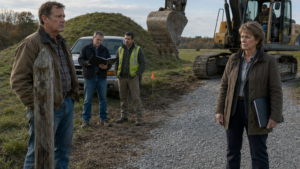
The surveyor cut a neat square through the new blacktop and exposed the iron marker underneath.
Timothy stood three feet away while loose pieces of asphalt were brushed from the rusted pin.
For decades, the marker had barely risen above the weeds.
Now it sat inside fresh pavement.
A bright survey string stretched from the roadside corner past the marker and toward the rear field.
The string crossed Gary’s new asphalt connection at an angle so obvious that nobody needed a legal description to understand it.
Gary stood on the other side.
The surveyor checked the instrument again.
Then he pointed.
“Boundary runs here.”
Timothy looked at the string.
Gary’s attorney asked, “Margin of error?”
“Not enough to change what you’re looking at.”
The surveyor measured the paved intrusion and recorded the figures.
The blacktop crossed Timothy’s parcel before joining the established farm lane.
The physical question was finished.
Gary stared down at the marker.
“That thing was practically buried before.”
Timothy answered, “It was still there.”
Gary gave him a sharp look.
“So now a piece of iron decides everything?”
“No. The line does.”
The surveyor continued toward the back field.
Gary’s attorney followed.
That left Timothy and Gary beside the fresh cut in the asphalt.
Timothy thought about what Sarah had told him.
“You knew.”
Gary’s eyes remained on the survey string.
“Knew what?”
“That I objected before the crew finished.”
“I knew you were upset.”
“You knew I said it was private.”
Gary said nothing.
“Sarah told me she asked you to stop.”
That brought his head up.
For the first time since the dispute began, Gary looked less angry than exposed.
“She shouldn’t have dragged herself into this.”
“She already was in it.”
Gary rubbed a hand across his face.
“The paving company was booked. The trucks were there. The material was hot.”
“So?”
“So stopping wasn’t free.”
“Neither is paving somebody else’s land.”
Gary looked toward his barn.
“You think I don’t know that now?”
Timothy waited.
Gary’s voice dropped.
“If I stopped that morning, I had to admit the access might not be ours.”
“That was already true.”
“I had just spent months fixing a property I thought we’d gotten under control.”
Timothy said nothing.
Gary continued.
“Barn roof. Fencing. Drainage behind the shed. Electrical service. Every time we opened something, there was another problem under it.”
His eyes moved toward the muddy legal entrance.
“The lane was the one thing I thought was settled.”
“Because somebody told you trucks used it.”
“Because I saw that they did.”
“Permission.”
Gary gave a bitter laugh.
“That word means a lot now.”
“It meant the same thing then.”
“No. It meant something to you. Nobody bothered explaining it to the next person.”
The words landed harder than Timothy expected.
Because they were not entirely wrong.
He had spent years trusting context to survive after the people who understood it were gone.
Gary had abused that ambiguity.
Timothy had helped create it.
They returned to mediation that afternoon.
The independent survey simplified the legal issue. Gary’s attorney no longer argued that the paving stayed on his parcel.
Instead, he presented another option.
Gary would pay Timothy for a permanent agricultural easement.
The proposed amount was substantial enough to make Timothy read the figure twice.
Gary sat across from him, expression unreadable.
“You get paid,” Gary said. “I get truck access. We stop paying lawyers.”
Deborah did not speak.
She left the decision where it belonged.
Timothy studied the map attached to the proposal.
A defined strip would run along his lane from the county road to Gary’s barn approach.
It looked narrow on paper.
But Timothy could imagine loaded feed trucks using it. Gravel deliveries. Equipment. Future owners. People he had never met crossing beside his shed because he had once accepted a check.
“What about maintenance?”
“We split it,” Gary said.
“And damage?”
“Written terms.”
“Hours?”
“Reasonable.”
“What happens if you sell?”
“The easement stays with the property.”
Timothy looked up.
That was the sentence that decided it.
The argument had started because an old favor had outlived the people who understood it.
Gary was now asking Timothy to make the access permanent for every owner who came afterward.
For money.
Timothy folded the proposal.
“No.”
Gary’s face hardened.
“You haven’t even countered.”
“I’m not selling it.”
“You said you were willing to consider delivery access.”
“I was.”
“So what changed?”
Timothy looked at him.
“I found out you knew I objected and paved anyway.”
Sarah lowered her eyes.
Gary leaned forward.
“You’re making this personal.”
“It became personal when you decided my no didn’t count.”
Gary’s attorney tried to redirect them.
“If a permanent easement is off the table, perhaps a temporary license—”
Timothy shook his head.
“No.”
Deborah glanced at him.
He understood what he was doing.
The easier path was right there.
Take the money.
Avoid the hearing.
Avoid the removal.
Avoid years of looking across the fence at a man who believed Timothy had cost him thousands of dollars.
That was exactly how Timothy had handled uncomfortable things all his life.
Leave enough room.
Stay quiet.
Make the favor.
Hope everyone understood.
He looked at the survey drawing again.
Then at the tiny circle marking the old iron pin.
“No more unwritten understandings,” he said.
Gary sat back.
“You really want me to tear all that out?”
“I want my property restored.”
Gary’s attorney asked for a recess.
Outside the mediation room, Deborah closed the door behind them.
“You know this may go to a hearing.”
“I know.”
“And a judge could still encourage settlement.”
“I know.”
“You’re comfortable rejecting the easement payment?”
Timothy looked through the courthouse window toward the parking lot.
“No.”
Deborah waited.
“But I’m sure.”
When the parties returned, Gary did not make another offer.
His attorney stated that they would contest removal if necessary.
Deborah gathered her papers.
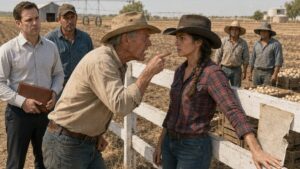
As Timothy rose, Gary said, “You’d rather watch me spend money tearing it up than take money yourself.”
Timothy stopped.
“No.”
He looked directly at Gary.
“I’d rather know where the line is next year.”
Gary’s expression did not change.
“And ten years after that,” Timothy added.
The hearing date remained on the calendar.
For the first time since the paving began, Timothy left knowing he had chosen the harder option deliberately.
Now the question was whether the court would make the new pavement disappear—or decide that money was enough.
Chapter 6: Every Foot of Asphalt Had to Come Back Out
The first jackhammer started before sunrise.
Timothy had been awake for nearly an hour.
He stood beside the equipment shed holding a mug of coffee when the demolition crew unloaded their tools beneath portable work lights.
The settlement had been signed late the previous afternoon.
Gary had chosen not to risk the hearing.
His attorney had finally advised that the survey, the absence of a recorded easement, the field note describing permissive use, and the evidence that Gary continued after Timothy objected made the removal fight expensive and uncertain.
The agreement was plain.
All pavement crossing Timothy’s boundary would be removed.
Any damage to the original lane would be repaired.
Gary would pay the contractors.
Neither side admitted broader liability.
No permanent access right was created.
Timothy had read those last two lines more than once.
Now the paper had become machinery.
The jackhammer bit struck the blacktop.
A crack shot across the fresh surface.
Timothy flinched.
He had wanted restoration.
He had not expected the sound of it to feel so much like destruction.
The crew worked from the outer edge inward.
The loader lifted broken slabs and stacked them beside a dump truck.
Underneath, crushed gravel appeared.
Then compacted soil.
Then the pale edge of Timothy’s older lane.
The paving foreman from that first Saturday had returned for the removal.
He walked over during a pause.
“Never had to undo one this new before.”
Timothy looked at the pile.
“Neither have I.”
The foreman nodded toward the survey string that had been reset as a guide.
“We’re taking everything back to the line.”
“That’s what the agreement says.”
“Survey pin too?”
“Leave it visible.”
The foreman gave a small nod.
“That I can do.”
By midmorning the crew reached the exact place Timothy had stopped them two weeks earlier.
The old iron marker stood exposed in the square cut made by the surveyor.
A worker cleared the surrounding asphalt by hand so the jackhammer would not strike it.
Timothy watched from several yards away.
The machine broke pavement on Gary’s side of the marker.
Then stopped.
For a moment, the whole dispute could be seen in a single strip of ground.
Fresh blacktop on one side.
Broken asphalt on the other.
A rusted piece of iron between them.
Gary came out of his barn.
He had not spoken to Timothy since the settlement.
He stood beside the fence with his hands on his hips while the crew loaded another bucketful.
Timothy looked away first.
There was no satisfaction in watching a neighbor pay to undo work that had cost him money to install.
Vindication, Timothy discovered, was cleaner in his imagination.
Reality had invoices.
It had idle machinery.
It had two people who still had to see each other across a fence after the lawyers were gone.
Around noon, Sarah walked down toward the lane carrying bottled water.
She offered some to the crew.
Then she approached Timothy.
“Gary won’t come over.”
“I didn’t expect him to.”
She handed Timothy a bottle.
“He thinks you won.”
Timothy looked at the half-demolished connection.
“Doesn’t feel much like winning.”
Sarah followed his gaze.
“The contractor for our entrance comes next week.”
Timothy looked at her.
“You’re doing it?”
“We don’t have a choice.”
“You always had that choice.”
She nodded.
“Yes.”
There was no accusation in her answer, which somehow made it heavier.
“How bad?”
“Bad enough.”
Timothy knew what she meant.
The legal entrance needed a wider culvert, gravel base, drainage work, and enough reinforced shoulder for long trucks.
Money Gary had hoped not to spend.
Timothy took a drink of water.
“I’m sorry it costs that much.”
Sarah looked surprised.
Then tired.
“So are we.”
A loader dumped broken asphalt into the truck.
The crash interrupted them.
Sarah glanced toward Gary.
“He’s angry.”
“I know.”
“He’s mostly angry at himself.”
Timothy said nothing.
“He won’t admit that yet.”
She walked back toward the barn before he could answer.
By afternoon the unauthorized pavement was gone.
The crew graded the disturbed shoulder and restored the edge of Timothy’s lane. Where the blacktop connection had been, there was now compacted gravel and a clean separation between the two properties.
The marker stood fully visible.
Timothy crouched beside it.
For years, grass had nearly hidden the top.
He brushed dirt from the iron with his glove.
His father had treated the marker as something too obvious to discuss.
A fixed fact.
Timothy no longer believed fixed facts stayed obvious when nobody said them aloud.
The dump truck hauled away the final load shortly before four.
The paving foreman walked the restored section with Timothy.
“Anything else?”
Timothy examined the shoulder.
“No.”
“You want soil around the pin?”
“Not over it.”
The foreman smiled faintly.
“Understood.”
When the equipment left, the farm seemed strangely wide.
No engine noise.
No legal representatives.
No survey string.
Just the lane, the adjoining field, and the visible boundary marker.
Gary remained by his barn.
Timothy considered walking over.
He took three steps in that direction.
Then stopped.
That old instinct—the one that wanted to smooth discomfort immediately—rose inside him.
Offer something.
Explain something.
Make the silence easier.
He recognized it now.
Not kindness exactly.
Avoidance dressed as kindness.
So Timothy did nothing.
He returned his empty coffee mug to the shed.
Gary had choices to make too.
Near sunset, a gravel contractor arrived to measure Gary’s existing entrance.
Timothy watched from his side of the line as the contractor paced the ditch, examined the culvert, and marked the edge of the county shoulder.
Gary followed several feet behind him.
They talked briefly.
The contractor pointed toward the barn, then toward the road.
Gary nodded.
No one looked toward Timothy’s lane.
The next morning, all that remained of the disputed pavement was a faint dark stain on the gravel and several small black chips near the marker.
Timothy swept them into a shovel.
As he worked, Gary came out of the barn.
He stood there for a long moment.
Timothy straightened.
Neither man waved.
Neither spoke.
A truck carrying drainage pipe turned into Gary’s field entrance, stopped, and backed out to reposition for the work scheduled there.
Gary watched it struggle through the turn.
Then his eyes moved toward Timothy.
For a moment Timothy thought he might say something.
Gary only gave one short nod.
It was not an apology.
Timothy did not mistake it for one.
He nodded back.
Then Gary turned away as the truck driver called for him.
The line between their farms was clear again.
What remained uncertain was whether anything could ever cross it except machinery and resentment.
Chapter 7: The Line Stayed, but the Silence Changed
The gravel truck made the turn on its first try.
Timothy heard it before he saw it, the steady grind of a loaded diesel climbing from the county road. He stepped out of the equipment shed expecting, by habit, to see another truck slowing near his lane.
Instead, it turned into Gary’s rebuilt entrance.
The new approach was wider now, with fresh stone packed over a reinforced base. A larger culvert crossed the ditch, and the fence had been moved back enough to give long vehicles room to swing.
The truck never touched Timothy’s property.
It rolled straight toward Gary’s barn.
Timothy stood beside the shed until the dust settled.
Three weeks had passed since the unauthorized asphalt had been removed. In that time the contractors on Gary’s side had dug out mud, replaced drainage pipe, widened the opening, spread truckloads of gravel, and rebuilt part of the roadside fence.
The work had not been cheap.
Timothy knew that without asking.
Gary had spoken to him only twice.
Both times consisted of a nod.
That morning was no different.
Gary stood near the barn directing the gravel driver. When he noticed Timothy watching, he paused.
Timothy raised one hand slightly.
Gary gave the same short nod.
Then they both returned to what they were doing.
It was not friendship.
But it was no longer war.
Later that morning Timothy walked down the lane with a shovel.
Grass had begun growing again along the restored shoulder. Near the boundary, the iron survey marker stood several inches above the soil.
Timothy had deliberately cleared around it.
For most of his life, he had thought a boundary was strongest when nobody needed to talk about it.
Now he understood the opposite could be true.
Unspoken things were easy to reinterpret.
He pushed loose gravel away from the marker and left the rusted top plainly visible.
A pickup door closed behind him.
Sarah was walking from Gary’s property.
She carried something small in one hand.
“Got a minute?”
Timothy rested the shovel against his shoulder.
“Sure.”
She stopped at the boundary rather than crossing it.
The gesture was so deliberate that Timothy noticed immediately.
Sarah opened her hand.
A brass key lay in her palm.
“I found this in the kitchen drawer.”
Timothy recognized it.
For years there had been a simple chain gate near the back end of his equipment lane. He rarely locked it anymore, but long ago he had given the previous owner a spare key for emergencies and seasonal access.
Timothy stared at the key.
“He still had that?”
“Apparently.”
Sarah held it out.
“The old owner left a jar of miscellaneous keys in the house. Gary tried some of them when we moved in. This one fit your gate.”
Timothy took it.
The metal was dull from age.
For several seconds neither spoke.
Then Sarah said, “That didn’t help.”
“No.”
“We saw the key. We saw the tire tracks. We saw trucks use the lane. Gary thought all of it meant the same thing.”
Timothy closed his fingers around the key.
“And I never explained otherwise.”
Sarah studied him.
“You didn’t sell us the property.”
“No.”
“You didn’t tell us the lane came with it either.”
“No.”
She glanced toward the new entrance.
“I’m not saying Gary handled it right.”
Timothy waited.
“He didn’t.”
It was the closest anyone from the other property had come to saying the words directly.
Sarah continued.
“But I understand why he convinced himself he was right at first.”
“So do I.”
She looked surprised.
Timothy turned the key over in his palm.
“The previous owner asked before he used it. At least in the beginning.”
“And later?”
“Later we both stopped asking and answering.”
Sarah nodded.
“That’s usually when people start remembering things differently.”
Timothy gave a faint smile.
“Seems so.”
From Gary’s barn came the sound of a loader starting.
Sarah stepped backward.
“I should go.”
“Sarah.”
She stopped.
“Thanks for bringing this back.”
She nodded.
When she reached the fence, Timothy called again.
“How’s the new entrance working?”
Sarah looked toward the gravel approach.
“Better than the bank account.”
Timothy laughed once despite himself.
She did too.
Then she walked home.
That afternoon another neighboring farmer called Timothy about borrowing his livestock trailer the following week.
Timothy agreed automatically.
“Key’s where it usually is,” he said.
Then he stopped.
The words felt familiar.
Too familiar.
“Actually,” Timothy added, “come by tomorrow. I’ll give it to you.”
After the call, he went into the farmhouse office.
The deed and parcel records were still stacked on one corner of the desk. Deborah had returned Timothy’s originals after the settlement, along with copies of the signed agreement.
For weeks he had wanted to put all of it away.
Instead, he pulled out a blank sheet of paper.
He wrote a few simple lines.
Permission to use the trailer.
Where it could be taken.
When it should be returned.
No transfer of any permanent access or property right.
Timothy read the page and felt ridiculous.
His father would never have done this.
That thought came first.
Then another followed.
His father had spent his whole life surrounded by the same neighbors.
Timothy lived in a world where farms changed hands, children moved away, parcels were divided, and favors survived longer than the people who remembered why they had begun.
Writing something down did not make the favor smaller.
It made its meaning harder to lose.
Near evening, Timothy carried the old brass key back toward the lane.
Gary was repairing a section of fence near the new entrance.
For several minutes they worked within sight of each other without speaking.
Then Gary straightened.
“Truck made it in.”
Timothy looked toward the new gravel.
“I saw.”
Gary wiped his hands on his jeans.
“Contractor says it should hold.”
“That’s good.”
Another pause.
Gary looked toward Timothy’s lane.
“The old setup was easier.”
Timothy waited.
Gary added, “For me.”
There was no apology in the words.
But there was something Timothy had not heard from him before.
Ownership.
Not of the lane.
Of the mistake.
Timothy nodded.
“The easy way usually is.”
Gary gave a faint, tired smile.
“Apparently.”
He returned to the fence.
Timothy continued toward the survey marker.
He stopped beside it and looked down at the rusted iron.
Nothing about it had changed.
It stood where it had always stood.
The difference was that Timothy no longer expected a piece of metal, a tire track, a handshake, or twenty years of habit to speak for him.
The following morning the neighboring farmer arrived for the trailer.
Timothy handed him the key.
Then he handed him the single sheet of paper.
The man read it and looked up.
“What’s this?”
“Just says what we agreed to.”
The farmer raised an eyebrow.
“You turning into a lawyer?”
Timothy smiled.
“No.”
He looked past him toward the lane, where the old survey marker remained visible beside the grass.
“I’m trying to stay a neighbor.”
The man signed.
Timothy folded the paper and placed it beside the spare keys in the office drawer.
Outside, a truck entered Gary’s new driveway without slowing.
Timothy heard it travel toward the barn, entirely on the other side of the line.
For the first time, the sound did not bother him.
The boundary had stayed exactly where it had always been.
What changed was that Timothy finally understood kindness did not require leaving it unspoken.
The story has ended.