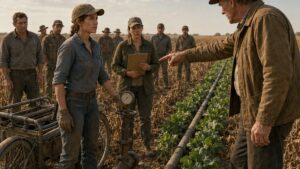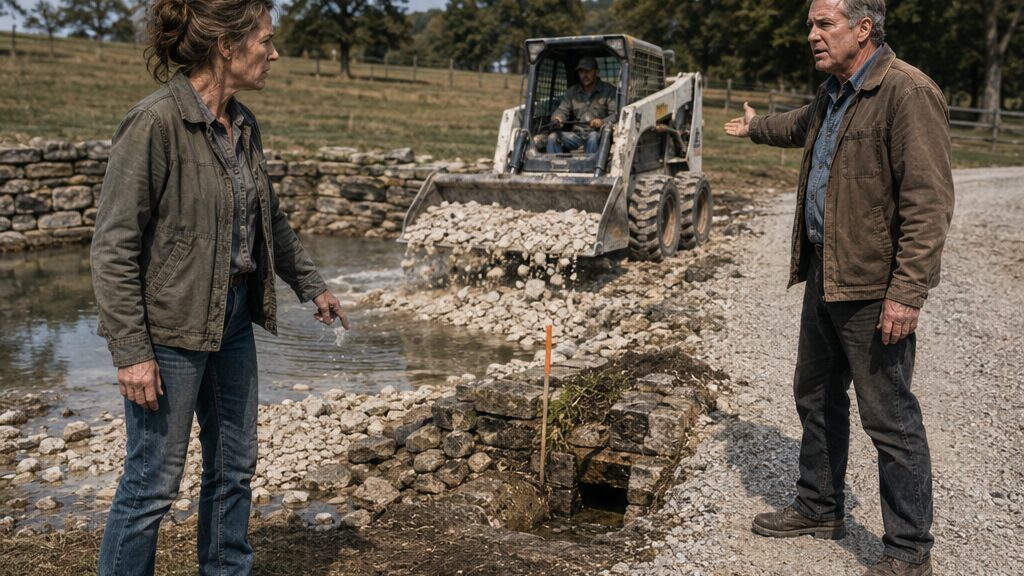
He Filled the Old Farm Pond With Gravel, Then Learned Why Three Fields Needed It
Chapter 1: The Morning the Pond Disappeared
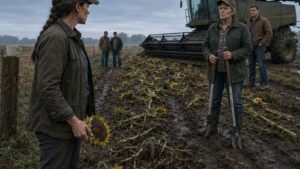
The first bucket of gravel hit the pond before sunrise.
Rebecca Harris heard it from her kitchen.
Not the low growl of a tractor she knew, or the hard rattle of a hay wagon on the lane, but the blunt crash of stone dumped where stone had no business being dumped.
She set her coffee down and went outside without a jacket.
The sky was still gray enough that the pasture fence looked like a charcoal line. Beyond it, at the low corner where her ground met Jonathan Miller’s, work lights swept across the pond.
A skid steer sat with its front bucket raised.
Behind it, a dump truck was backing toward the water.
Rebecca stopped at the gate.
For several seconds she simply watched.
The pond had been there longer than she had. Her father had lined one side with flat fieldstone and planted willow and sedge along the shallows. Later, Rebecca had added a narrow boardwalk and a few hardy fish, enough to make the place look intentional rather than like a wet hole in the lowest acre.
Now half the boardwalk lay crooked in the mud.
A mound of gray crushed rock covered the western bank.
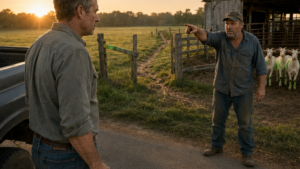
Jonathan stood near the truck in work boots and a canvas jacket, pointing toward the lane.
Rebecca crossed the pasture.
“Stop the machine.”
The skid-steer operator looked at Jonathan.
Jonathan turned.
“Morning.”
“Stop it.”
He looked past her at the pond.
“We’re just leveling the corner.”
“That corner isn’t yours to level.”
“The line runs through the upper edge. You know that.”
“I know where the line runs.”
Another truck gave a short reverse alarm.
Rebecca stepped farther into the work lights.
“Nothing else goes in that pond.”
Jonathan exhaled through his nose.
“We already talked about this.”
“No. You told me what you planned to do. That isn’t the same thing.”
He folded his arms.
“It’s an old fish pond, Rebecca.”
She looked at the skid steer.
The operator had lowered the bucket but kept the engine running.
Jonathan continued.
“I need the turning room. Hay trucks can’t swing through that lane without backing into the fence. I’ve got equipment coming in next week. That hole sits there collecting mosquitoes and weeds.”
“It collects water.”
“So does every ditch in the county.”
“Not like that.”
He gave her a tired look.
Rebecca knew that look. She had seen it at feed counters and county meetings whenever somebody decided she was making something harder than it needed to be.
She pointed toward the pond.
“Three fields drain through this low ground.”
Jonathan glanced toward the dark slope above them.
“Three fields used to.”
“They still do.”
“Then show me the easement.”
The words stopped her.
Not because she thought he was right.
Because she knew exactly which drawer held the old papers, and exactly which paper was not among them.
Jonathan saw the pause.
“That’s what I thought.”
Rebecca’s jaw tightened.
“My father maintained this basin for forty years.”
“Your father isn’t the deed office.”
“No.”
“And I paid for that strip.”
“You paid for ground that drains downhill.”
He turned toward the operator.
Rebecca moved one step closer.
“I said stop.”
Jonathan held up a hand.
The operator killed the engine.
The sudden quiet made the morning feel larger.
A meadowlark called somewhere beyond the hayfield.
Rebecca walked down the slope toward the water.
The western edge had already been torn apart. Fieldstone her father had stacked by hand lay scattered in fresh dirt. One clump of reeds had been pushed flat.
Then she saw something pale beneath the broken bank.
Concrete.
Rebecca crouched.
The skid-steer bucket had peeled away enough stone to expose a squared masonry throat buried under the edge of the pond.
The old spillway.
Beside it, leaning at an angle in the disturbed soil, was a faded orange survey stake.
Rebecca reached down and wiped mud from it.
Jonathan came closer.
“What is that?”
“You tell me.”
He said nothing.
“That elevation was set for overflow.”
Jonathan looked at the concrete opening.
“It’s a drain.”
“It’s part of the basin.”
“It’s a pipe.”
“It’s a controlled outlet.”
“To where?”
“Across my lower lane, then into the county ditch.”
Jonathan stared at the exposed structure.
For the first time that morning, uncertainty moved across his face.
Rebecca stood.
“That pond doesn’t just hold water because somebody liked fish.”
He looked toward the operator, then back at her.
“You have plans for this?”
“Yes.”
“Current ones?”
Rebecca did not answer quickly enough.
Jonathan’s expression changed.
Not triumph exactly.
Something harder.
“I asked you about this last month.”
“You told me you wanted to straighten the lane.”
“I asked whether anything recorded stopped me.”
“And I told you the basin was shared drainage.”
“You told me your dad always handled it.”
“He did.”
“That isn’t paperwork.”
Rebecca looked at the orange stake in her hand.
She remembered the county envelope still sitting unopened in a box after her father died. Then another letter. Then a form she meant to deal with after calving season.
There had always been something more immediate.
Fencing.
Taxes.
A broken pump.
Her mother’s estate.
The paperwork had waited because the water kept behaving the way it always had.
Until now.
Jonathan rubbed both hands over his face.
“I’ve got a truck scheduled Monday. If I lose that equipment pad, I lose the whole turnaround.”
“That’s not my problem.”
“It becomes your problem when you’re telling me what I can do on land I bought.”
Rebecca looked directly at him.
“If you bury that outlet after seeing it, whatever happens next is yours.”
Jonathan’s face hardened.
“You don’t get to make that decision.”
“No.”
She looked at the exposed spillway.
“Gravity does.”
Rebecca turned toward the pasture gate.
“Where are you going?”
“To the courthouse.”
“For what?”
“To bring back the papers you’re pretending don’t exist.”
Jonathan called after her.
“Bring the recorded ones.”
Rebecca kept walking.
Her anger had carried her across the field.
It did not carry her back.
By the time she reached the house, doubt had settled underneath it.
She pulled on boots, found the folder from her father’s desk, and drove toward town with the old survey maps on the passenger seat.
Halfway down the county road, her phone rang.
She ignored it.
Then it rang again.
She glanced at the screen.
One of the neighboring farmers.
Rebecca answered.
“You leave already?”
“Yes.”
There was a pause.
Then the farmer said, “Jonathan’s bringing the second truck in.”
Rebecca tightened her grip on the steering wheel.
“I told him to stop.”
“I heard you.”
Another pause.
“He told the driver to dump the whole load.”
Chapter 2: Three Fields Above One Low Place
The county clerk found the drainage plat in twelve minutes.
She did not find the easement Rebecca expected.
“That can’t be all of it,” Rebecca said.
The clerk pushed her glasses higher and looked again at the computer.
“That’s the recorded subdivision sheet.”
“What about the maintenance agreement?”
“I have an original reference.”
“Good.”
“But not a later filing under Harris.”
Rebecca leaned closer to the counter.
“What does that mean?”
“It means exactly what I said.”
The clerk was not rude. That made it worse.
Rebecca opened her father’s folder.
Inside were tax maps, a brittle photocopy of a survey, two drainage sketches, and a county letter with her father’s handwriting across the top.
CHECK OUTLET AFTER BIG RAIN.
She slid the documents over.
“This basin has always been there.”
The clerk glanced down.
“I’m not disputing that.”
“Three parcels feed it.”
“I’m not disputing that either.”
“Then where’s the agreement?”
The clerk searched again.
Rebecca watched the spinning icon on the screen.
She had come to town expecting a simple kind of vindication.
A stamped page.
A clear boundary.
Something she could place on Jonathan’s hood and let the county ink settle the argument.
Instead the records room smelled like dust and copier heat, and every new page seemed to tell her half of what she wanted.
The clerk printed a large plat.
Rebecca unfolded it across the counter.
Three narrow drainage arrows came down from separate parcels.
All three converged at the low corner of her farm.
At the center was an outlined basin.
Rebecca tapped it.
“There.”
“Yes.”
“What does the note say?”
The clerk turned the sheet.
Rebecca read the faded engineering text.
DETENTION STORAGE.
Below it were figures she did not immediately understand.
The clerk pointed.
“That looks like required volume.”
Rebecca felt something in her chest loosen.
“So it was engineered.”
“It appears so.”
“Not ornamental.”
“No.”
Rebecca looked again.
Another line identified the outlet elevation.
It matched the orange stake.
Almost exactly.
She took out her phone and photographed the sheet.
“Can you print the whole set?”
“I can.”
“And anything tied to the permit.”
“That may take longer.”
“I’ll wait.”
The clerk began pulling associated records.
Rebecca moved to a table beside the window and laid her father’s folder open.
The more she compared the old papers with the county plat, the more the pond changed in her mind.
Not in purpose.
She had always known its purpose.
But in scale.
Her father had never talked about storage volume or discharge rates. He talked about watching the waterline.
He knew which stone should stay dry after a normal rain.
He knew when to clear leaves from the outlet.
He knew when water moving across the lower lane meant something upstream had changed.
Rebecca had inherited all of that as habit.
Not paperwork.
The clerk returned carrying another stack.
“Found the engineering notes.”
Rebecca straightened.
The first sheet showed the basin cross-section.
The second listed an emergency storage capacity tied to the exact elevation of the old spillway.
Rebecca read the paragraph twice.
The pond did not merely receive runoff.
It delayed it.
Water from the upper acreage was meant to collect, rise, then leave at a controlled rate through the outlet before crossing the lower lane toward the public ditch.
Without the basin, the flow could move faster and farther.
Rebecca looked up.
“This was designed for all three lots.”
“That’s what it says.”
“Then Jonathan can’t fill it.”
The clerk hesitated.
“He may not be allowed to alter the drainage feature.”
“Same thing.”
“Not legally.”
Rebecca felt the warning before the clerk finished.
“What?”
“The maintenance instrument attached to this plan refers to the original owners.”
“So?”
“I don’t see a recorded amendment after the properties transferred.”
Rebecca stared at her.
“My father inherited this parcel.”
“Yes.”
“And Jonathan bought his.”
“Yes.”
“The land still drains the same way.”
The clerk gave her a sympathetic look.
“The water doesn’t care what gets recorded.”
“Exactly.”
“The county does.”
Rebecca sat back.
That sentence followed her out of the courthouse.
By noon she had copies of the original drainage plan, permit references, and an engineering sheet proving the pond’s purpose.
She also had no clean document establishing how the maintenance obligation had been updated after multiple ownership changes.
In the truck, she opened her father’s folder again.
Behind an old tax bill she found a county form.
Dated six years earlier.
A transfer-and-maintenance acknowledgment.
Unsigned.
Rebecca closed her eyes.
She remembered it now.
The county had mailed it after her father’s death.
She had read the first page at the kitchen table.
She had meant to call.
Then the cattle got through a fence.
Then her mother fell.
Then six months became a year.
The pond kept working.
The neighbors kept mowing.
Nobody complained.
So Rebecca did what people often did with problems that appeared not to be problems.
She left it alone.
Her phone buzzed.
A weather alert.
Heavy storms possible within forty-eight hours.
Rebecca looked toward the west.
The sky was bright.
The fields beyond town were dry and pale under September sun.
She drove home faster than she should have.
When she turned into her lane, the first thing she saw was the dump truck leaving.
The second was the pond.
Half of it was gone.
Gray gravel filled the western basin from the lane to nearly the center. The stone edge was buried. Muddy water had been squeezed toward the far bank into a shrinking crescent.
Rebecca parked and walked down.
Jonathan stood beside the skid steer.
“You found it?”
“Yes.”
“The easement?”
“The drainage plan.”
“That isn’t what I asked.”
“It proves this basin was engineered for three parcels.”
Jonathan shrugged once.
“I didn’t say it wasn’t.”
“You called it a fish pond this morning.”
“I said that’s what it looks like now.”
Rebecca pulled out the engineering sheet.
“This shows storage volume. Outlet elevation. Flow direction.”
Jonathan barely glanced at it.
“Recorded maintenance agreement?”
Rebecca said nothing.
His eyes narrowed.
“There isn’t one, is there?”
“There was one.”
“That’s not the question.”
“The drainage doesn’t disappear because somebody missed a filing.”
“No. But you don’t get to use your paperwork problem to freeze my project.”
“My paperwork problem?”
Rebecca felt heat rise into her neck.
She almost told him about the unsigned form.
Almost.
Instead she folded the drawing.
“Stop filling it until the county looks at this.”
Jonathan looked toward the sky.
“I’ve got equipment coming Monday.”
“You may have water coming first.”
He followed her gaze.
The forecast meant nothing to him yet.
It meant something to her.
She walked to the exposed side of the basin.
The orange stake was no longer visible.
“Where’s the marker?”
Jonathan pointed toward the gravel.
“Probably under there.”
Rebecca stared at him.
“You buried it?”
“It was a stake.”
“It marked the overflow elevation.”
“It was rotten.”
“You knew what it marked?”
“I knew what you said it marked.”
Rebecca held up the plan.
“And now you know what the engineer said.”
Jonathan looked away.
That was the first moment Rebecca understood the argument had changed.
Morning ignorance could still be repaired.
Afternoon certainty was something else.
Her phone buzzed again.
The weather alert had been upgraded.
Two to three inches of rain were possible overnight into Friday.
Rebecca looked at the half-filled basin.
The water remaining in it was already pressed high against the eastern stones.
The pond had lost half its room before a single drop fell.
Chapter 3: Water Takes the Grade It Is Given
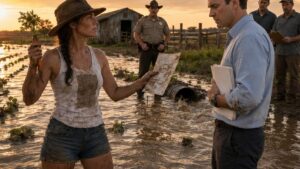
By daylight Friday, water had reached Rebecca’s south gate.
She stopped the truck so hard the dog slid against the passenger door.
The gate stood nearly two feet above the ditch.
In thirty years, Rebecca had seen water touch the bottom rail twice.
She had never seen it run through the hinges.
Brown runoff crossed the gravel in a wide sheet.
Rebecca stepped out into rain and stared uphill.
The old pond was invisible behind the curtain of water.
Where the basin should have spread and held the runoff, a gray hump of gravel now pushed it sideways.
The water found the next low path.
Her lane.
Then Jonathan’s.
Rebecca climbed back into the truck and drove toward the cattle lot.
She opened the upper gate and pushed the small herd toward higher pasture.
The cattle moved reluctantly, heads low against the rain.
By the time she latched the gate again, water was pouring across the lower track.
She called Jonathan.
No answer.
She called again.
This time he picked up.
“What?”
“Get your equipment out of the lower shed.”
A pause.
“What?”
“The flow is crossing the lane.”
“I’m looking at it.”
“Then move your equipment.”
“You did something.”
Rebecca shut her eyes.
“Jonathan.”
“That water never came this way before.”
“Exactly.”
“You opened something.”
“No.”
“I’m standing in six inches of water.”
“Then stop arguing and move your tractor.”
He hung up.
Rebecca drove toward the boundary.
The storm had flattened the pasture grass into shining ribbons. Water came off the upper fields in converging channels, exactly as the county plat showed.
Three fields.
One low place.
Except the low place was no longer low enough.
The remaining crescent of pond had filled to the top of its stone edge.
Water spilled over the gravel.
Rebecca saw an orange flicker near the surface.
The old survey stake.
For one second it appeared in the rushing brown water.
Then the current bent it flat and covered it.
Rebecca felt no satisfaction.
Only fear.
Because the water did not stop at Jonathan’s property.
It crossed his turnaround, passed the new gravel pad, and spread toward the equipment shed.
Jonathan was outside with the tractor.
Patricia stood under the shed roof, waving him back.
The front tires hit water deep enough to throw muddy spray across the hood.
Rebecca pulled in near the upper fence.
Jonathan jumped down.
“What did you change?”
“Nothing.”
“This never happened before.”
“The pond happened before.”
“Don’t start.”
Rebecca pointed uphill.
“Look at the grade.”
“I know what the grade is.”
“No, you knew what it looked like when the basin was holding the water.”
He stepped closer.
Rain ran from the brim of his cap.
“My whole lower yard is flooding.”
“And it’ll keep flooding until the runoff drops.”
“You said that outlet ran toward your ditch.”
“It did.”
“Then open it.”
“You buried it.”
His expression went still.
Behind him, water crossed the shed threshold.
Patricia shouted.
Jonathan turned.
A shallow brown sheet slid beneath the door.
He ran toward it.
Rebecca followed far enough to help move two pallets and a portable welder onto higher concrete.
For twenty minutes nobody argued.
The storm did the talking.
Water rose around the shed tires.
A stack of feed sacks had to be moved.
The tractor was driven uphill.
A compressor was dragged onto a trailer.
When there was finally nothing else Rebecca could lift, she stood under the roof, soaked through.
Jonathan stared at the floor.
“You knew this would happen.”
Rebecca looked at him.
“I knew the basin mattered.”
“That’s not what I asked.”
“No. I didn’t know exactly where the water would go.”
He laughed once without humor.
“Convenient.”
Patricia looked between them.
“Jonathan.”
“No. She comes down here with maps after I’ve already started work. Then the first storm in months puts water in my shed.”
Rebecca said, “The map existed before either of us owned these parcels.”
“And the pond was on your land.”
“The storage was on my land. The runoff isn’t.”
Jonathan wiped water from his face.
“You changed that pond after your father died.”
Rebecca stiffened.
“What?”
“You put fish in it. Plants. That little walkway.”
“I landscaped the basin.”
“You altered it.”
“I didn’t change the grade.”
“Prove it.”
Rebecca stared at him.
The words landed harder than she wanted them to.
Because there had been no engineer standing beside her when she reset the stones after one winter washout.
No county inspector when she replaced rotted boards.
She knew she had not changed the basin’s function.
But knowledge and proof had stopped being the same thing.
Jonathan saw the hesitation.
Again.
He turned to Patricia.
“Call the insurance company.”
Rebecca said, “Tell them the truth.”
“I intend to.”
“The whole truth.”
Jonathan looked at her.
“You mean your version.”
By afternoon the rain weakened.
The damage did not.
Mud covered Jonathan’s lower yard.
Water stood inside the equipment shed.
Across Rebecca’s lane, the ditch had cut a new channel through the shoulder.
One fence post leaned at an angle.
Edward Thompson arrived from the county shortly after four.
He wore rubber boots and carried a survey rod.
Rebecca met him near the buried basin.
He looked at the gravel.
Then at the water marks.
Then at the county plan Rebecca held out.
“You have the original drainage sheets?”
“Yes.”
“And this was filled when?”
“Started Thursday morning. Half of it by afternoon.”
Jonathan came down from his yard.
“The basin had been altered before I touched it.”
Edward looked at him.
“How?”
“Landscaping. Stone. Fish. She changed it.”
Rebecca said, “Not the grade.”
Edward held up one hand.
“I’m not deciding this in the rain.”
He walked the perimeter slowly.
At the remaining eastern edge he stopped.
“What was the outlet elevation?”
Rebecca showed him the sheet.
Edward looked toward the mound of gravel.
“Marker still there?”
“Under that.”
He let out a quiet breath.
Then he drove the rod into the gravel at several points.
Jonathan folded his arms.
“What does that tell you?”
“That I need more than five minutes.”
Edward moved closer to the former spillway.
“Was the outlet exposed during excavation?”
Rebecca looked at Jonathan.
Jonathan answered first.
“I saw some concrete.”
“Pipe?”
“Maybe.”
“Structure?”
“It was old.”
“That wasn’t my question.”
Jonathan’s mouth tightened.
Patricia stood several yards behind him.
Rebecca noticed her looking at the gravel, not at Edward.
Something in that look stayed with her.
Edward wrote several notes.
“Until we sort this out, no more fill. No excavation either.”
Jonathan said, “I have equipment delivery Monday.”
“Then you have a scheduling problem.”
“You can’t just shut down my access.”
“I can tell you not to alter a drainage feature under review.”
Jonathan pointed toward Rebecca.
“What about her alterations?”
Edward looked at Rebecca.
“We’ll look at those too.”
Rebecca felt the words land exactly where Jonathan wanted them.
Not because Edward believed him.
Because Edward was not going to assume she was blameless.
By evening, the storm had moved east.
Rebecca returned home, peeled off wet clothes, and spread the county papers across her kitchen table.
Her father’s unsigned form lay beneath the engineering plan.
She stared at the blank signature line.
The phone rang.
An unfamiliar number.
“Rebecca Harris?”
“Yes.”
The voice identified himself as an insurance adjuster representing the Millers.
He asked whether she had modified the drainage basin after inheriting the property.
Rebecca looked at the fish-pond photograph clipped inside her father’s folder.
“I maintained it.”
“That wasn’t my question.”
Her grip tightened around the phone.
“What exactly are you asking?”
“I’m asking whether the present configuration of the basin was engineered, approved, or inspected after ownership transferred to you.”
Rebecca said nothing.
The adjuster continued.
“Mr. Miller states that drainage from your parcel was altered before his excavation began.”
Rebecca looked through the kitchen window toward the low field.
The pond had been there to catch water from three farms.
Now Jonathan was trying to make it catch blame too.
Chapter 4: The Missing Agreement Between Neighbors
Edward Thompson did not bother sitting down.
He stood at Rebecca’s kitchen table with his boots still damp from the lower field, one hand resting on the county drainage plan and the other on the unsigned maintenance form.
“You being right about where the water goes does not make your paperwork complete.”
Rebecca folded her arms.
“The basin is still the basin.”
“I didn’t say it wasn’t.”
“Then Jonathan filled a drainage structure.”
Edward looked at her.
“And you inherited a drainage structure with shared obligations you never formally transferred.”
Rebecca glanced at the unsigned line.
The insurance adjuster’s questions had already made the omission feel heavier. Hearing Edward say it aloud gave it shape.
“I maintained it.”
“That helps.”
“I didn’t change the grade.”
“That also helps.”
“But?”
“But I need to establish what everybody was legally responsible for before the excavation started.”
Rebecca pushed the old engineering sheet toward him.
“That says exactly what the basin was built to do.”
Edward tapped the drawing.
“It tells me what the engineer intended in the beginning.”
“And water still follows it.”
“Yes.”
“Then what are we arguing about?”
“We’re not arguing.”
He pulled out a chair and finally sat.
“We’re separating function from responsibility.”
Rebecca disliked the distinction because she understood it.
Edward turned to a second page.
“The county can order emergency stabilization if altered drainage creates a hazard. Long-term restoration is different. If three parcels benefit from the basin, I need to know who is obligated to maintain it, what modifications were allowed, and whether any later ownership changes broke the chain.”
“They didn’t break the water.”
“No.”
Edward’s expression softened slightly.
“But paperwork is how you keep the next owner from saying exactly what Jonathan is saying now.”
Rebecca looked toward the window.
The lower pasture was still streaked with mud.
“People used to talk to each other.”
Edward followed her gaze.
“People still do. Then people sell.”
He gathered the plans.
“Jonathan is meeting us at the basin in twenty minutes.”
Rebecca’s eyes narrowed.
“He asked you here?”
“He asked for an inspection. You did too.”
“I asked you first.”
Edward gave her a dry look.
“The runoff did not file separate complaints.”
At the basin, Jonathan was already waiting.
Patricia stood near their truck but did not come closer.
Jonathan carried a rolled survey under one arm.
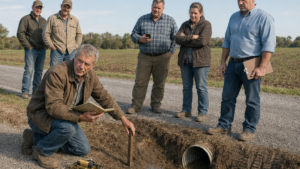
Edward began at the remaining eastern bank and worked outward, comparing elevations with the original plan. He asked Rebecca where her father had repaired stone after winter washouts. He asked whether she had ever deepened the pond.
“No.”
“Added soil?”
“No.”
“Removed soil?”
“Only silt by hand near the outlet.”
Jonathan made a quiet sound.
Edward looked at him.
“You’ll get your turn.”
Rebecca felt her face warm.
The questions were fair.
That did not make them easy.
For years she had described what she did as maintenance because that was what her father had called it.
Clear the leaves.
Reset the stones.
Pull sediment from the throat.
Replace rotten boards.
Nobody had submitted a form for every shovel of mud.
Then Jonathan unrolled his survey across the hood of his truck.
“This is what I was given when we bought.”
Edward leaned over it.
Rebecca did too.
The survey showed the boundary clearly.
Near the low corner was a small irregular shape.
Beside it, one word.
POND.
Nothing about detention.
Nothing about storage.
Nothing about a controlled outlet.
Jonathan looked at Rebecca.
“That’s what I saw.”
Rebecca stared at the page.
For the first time since the skid steer arrived, she understood his confidence.
Not his decision.
His confidence.
“If that’s all you had,” she said, “I can see why you asked.”
Jonathan’s expression shifted as though he had expected a fight and found no place to put it.
“That is all I had.”
Edward pointed to the survey date.
“This was prepared after the original drainage plan.”
“So whoever made it called it a pond,” Jonathan said.
“Surveyors label visible features,” Edward replied. “That does not necessarily cancel earlier drainage obligations.”
“But it doesn’t exactly warn anybody either.”
“No.”
Rebecca looked down at the single word.
POND.
It was not false.
That was the problem.
The basin had become a pond.
The pond had become landscaping.
The landscaping had become something a later surveyor could reduce to one harmless word.
Rebecca thought about the unsigned county form in her kitchen.
She had let the knowledge stay inside her family until it no longer traveled with the land.
Edward rolled the survey back up.
“I’m going to recommend temporary stabilization immediately.”
Jonathan said, “Meaning?”
“No additional fill. No additional excavation. We get an engineer to determine interim flow until restoration responsibility is settled.”
“Restoration?”
“Possibly.”
Jonathan’s shoulders stiffened.
“I haven’t agreed to rebuild anything.”
“You don’t have to agree for the county to require correction of an unlawful alteration.”
“And if the alteration wasn’t unlawful?”
“Then we determine that too.”
Jonathan pointed toward Rebecca.
“She landscaped the thing.”
Edward nodded.
“And I’m documenting that.”
Rebecca felt the old instinct rise—to defend every stone, every plant, every choice.
She forced herself not to.
“I should have filed the transfer form.”
Jonathan looked at her.
Edward stopped writing.
Rebecca continued.
“I found it yesterday. My father died, the county sent it, and I never completed it.”
Jonathan’s face tightened.
“So you knew the paperwork wasn’t current.”
“I knew after I found the form.”
“You stood right here and acted like everything was recorded.”
“I told you the basin was shared drainage.”
“That isn’t the same thing.”
“No.”
The admission cost Rebecca more than she expected.
Jonathan glanced at Edward.
“You hear that?”
“I heard it.”
Rebecca looked directly at Jonathan.
“It still doesn’t make filling the basin safe.”
“I didn’t say it did.”
Edward stepped between the lines of the argument before either could retreat into an older version of it.
“This is why I’m not assigning final responsibility today.”
Jonathan frowned.
“What does that mean for the insurance claim?”
“It means I’m not your adjuster.”
Edward tucked the notebook away.
“It also means restoration may require signatures from both properties.”
Rebecca said, “Both?”
“The original plan treats the basin and the upstream conveyance together. If we repair the low point but ignore what feeds it, we may recreate the same ambiguity.”
Jonathan looked toward his new
Chapter 4: The Missing Agreement Between Neighbors
Edward Thompson did not wait for Rebecca to finish explaining.
“You can be right about the water and still be wrong about the paperwork.”
They stood beside the damaged basin six days after the storm. The mud had dried into plates around the gravel mound, and a pale stain marked the highest point the water had reached on the fence posts.
Rebecca folded her arms.
“I never said the paperwork was perfect.”
Edward looked at her.
“You told the insurance adjuster the basin was maintained under an existing shared agreement.”
“It was.”
“Existing where?”
She did not answer.
Edward tapped the folder under his arm.
“That’s the problem.”
Jonathan stood thirty feet away near the equipment lane. Patricia was beside him, but neither had come closer.
Edward walked to the western edge of the basin.
“Your county drainage plan is clear. The basin was engineered. The outlet elevation is clear. The three contributing parcels are clear.”
Rebecca waited.
“But the transfer language is not.”
She hated the calmness of his voice.
“You think that makes filling it acceptable?”
“No.”
“Then say that.”
“I just did.”
Edward pointed toward the gravel.
“That work should have stopped once a drainage structure was exposed. But your records also show the maintenance acknowledgment was never updated after ownership transfers.”
Rebecca looked away.
The damaged stonework lay in uneven piles.
A few pieces still carried pale lichen.
Her father had stacked those stones before Rebecca was old enough to drive.
Edward continued.
“If the county requires a restoration, we need to know who is responsible for what.”
“Jonathan filled it.”
“Yes.”
“He buried the outlet.”
“Yes.”
“He ignored me when I told him what it was.”
Edward paused.
“That part I’m still documenting.”
Rebecca looked toward Jonathan.
He was watching them.
Not nervously.
Waiting.
As if he had learned that the more Rebecca insisted she was completely right, the more useful her unfinished paperwork became to him.
Edward lowered his voice.
“When did you inherit?”
“Six years ago.”
“And when did the county send the maintenance acknowledgment?”
Rebecca did not ask how he knew.
“Same year.”
“Did you receive it?”
“Yes.”
“Did you sign it?”
“No.”
“Why?”
Rebecca looked at the pond.
“Because I didn’t.”
“That’s not why.”
She turned sharply.
Edward did not move.
Rebecca could have told him about her mother. About calving season. About the broken well pump and the farm account that had gone negative twice that winter.
None of those things answered the real question.
“I thought it was unnecessary.”
Edward nodded once.
“Why?”
“Because the basin was already there.”
“And?”
“My father had maintained it for decades.”
Edward waited.
Rebecca hated that too.
She finally said, “Nobody needed a county form to tell us where the water went.”
Edward looked at the filled basin.
“Apparently somebody did.”
The words landed harder than Jonathan’s accusations.
Rebecca turned toward the house.
“I’ve got my father’s notes.”
“Bring them.”
In the kitchen, Rebecca spread everything across the table.
Edward took off his jacket and sat opposite her.
The papers looked less convincing indoors.
Outside, the basin had weight. Water marks. Broken stone. Mud.
Here, it was all lines and old signatures.
Rebecca pulled out one of her father’s hand-drawn maps.
He had marked the spillway with a blue pencil and written three sets of initials beside the upper parcels.
Edward leaned closer.
“What are these?”
“Old landowners.”
“Original owners?”
“Not all of them.”
Rebecca studied the page.
Her father had drawn arrows from each field toward the basin.
Beside one arrow he had written:
KEEP LOWER GRASS SHORT BEFORE OCTOBER RAINS.
Edward turned the sheet over.
Nothing.
“No dates?”
“Not on this one.”
“Any invoices?”
“Maybe.”
Rebecca searched another folder.
She found receipts for stone, culvert work, and an old load of riprap.
None said enough.
Edward sighed.
“This proves people maintained something.”
“It proves they maintained this.”
“I believe you.”
“Then why are we still talking?”
“Because belief isn’t an allocation of liability.”
A truck door closed outside.
Jonathan entered without knocking but stopped just inside the kitchen.
Patricia remained on the porch.
Edward said, “You brought what I asked for?”
Jonathan placed a rolled survey on the table.
“Closing survey.”
Edward opened it.
Rebecca stood.
The drawing was newer than hers.
It showed Jonathan’s parcel, Rebecca’s lower field, the shared lane, and the pond.
But beside the water feature was a simple label.
POND.
Nothing about detention.
Nothing about stormwater storage.
Nothing about an outlet.
Jonathan tapped the page.
“This is what I got when I bought the property.”
Rebecca stared at the survey.
“That doesn’t erase the county plan.”
“No. But it explains why I didn’t assume your fish pond was county infrastructure.”
“You saw the concrete spillway.”
“Later.”
Edward looked up.
“How much later?”
Jonathan’s hand remained on the paper.
“After work started.”
Rebecca said, “Before you finished.”
Jonathan looked at her.
“We’re not talking about that yet.”
Edward said, “We are now.”
Jonathan rolled his jaw.
“I saw concrete.”
“Pipe?”
“Something like one.”
“Outlet?”
“I didn’t know what it was.”
Rebecca almost spoke, but stopped.
Because she had suddenly understood something she had refused to understand for days.
Jonathan’s closing survey really did make the basin look ornamental.
If someone bought that land without the older drainage plat, they could reasonably think the pond belonged only to Rebecca.
That did not justify what came later.
But it explained the beginning.
Rebecca sat down.
Edward noticed.
“What?”
She shook her head.
“Nothing.”
Jonathan gave a short laugh.
“That’s the first time I’ve heard you say that.”
Rebecca looked at him.
“I should have updated the agreement.”
Patricia lifted her head from the doorway.
Jonathan said nothing.
Rebecca continued before she lost the nerve.
“I got the county form after my father died. I put it aside. I thought the old plan was enough.”
Edward said, “It wasn’t.”
“I know that now.”
Jonathan looked almost disappointed.
Rebecca understood why.
Her denial had given him something to fight.
Her admission took it away.
Edward gathered the documents into separate piles.
“Here’s where we are. The basin was engineered. The agreement governing maintenance is incomplete after transfer. Jonathan altered the feature. Rebecca failed to update the maintenance instrument.”
Jonathan said, “So we’re both responsible.”
Edward looked at him.
“I didn’t say equally.”
Silence settled across the kitchen.
Edward continued.
“The county can require restoration regardless of the private dispute. But access, cost allocation, and long-term maintenance may require both of you.”
Jonathan frowned.
“You mean I need her signature to fix something on my side?”
“You may need each other’s signatures to restore a system that crosses both properties.”
Rebecca almost laughed.
Not because it was funny.
Because it was exactly the kind of answer her father would have hated.
Three farms, one drainage path, four stacks of paperwork.
Edward stood.
“I’ll prepare a joint review.”
“When?”
“Soon.”
“How soon?”
“Before the next major rain, if everyone cooperates.”
Jonathan looked toward the window.
The lower field was still scarred with dried mud.
“What if we don’t?”
Edward put on his jacket.
“Then the county decides what it can decide, and attorneys decide the rest.”
He left them in Rebecca’s kitchen.
Jonathan rolled up his survey.
“I’m not signing anything that makes me responsible for forty years of somebody else’s pond.”
Rebecca said, “And I’m not paying for gravel you dumped into it.”
Patricia finally stepped inside.
“Enough.”
Jonathan looked at her.
She did not look back.
Instead she watched Rebecca.
“There’s something I want to ask.”
Jonathan stiffened.
Patricia said, “When the machine opened that bank…”
She glanced toward the pond.
“That concrete pipe Rebecca keeps talking about.”
Jonathan said, “Patricia.”
She ignored him.
“Does it matter if it was already exposed before the last truck came?”
Rebecca did not answer immediately.
She looked at Jonathan.
His face had changed.
Only slightly.
But enough.
“Yes,” Rebecca said.
Patricia nodded once.
Then she looked at her husband.
“I thought so.”
Chapter 5: What Jonathan Saw Beneath the Stones
Patricia came back after dark carrying Jonathan’s phone.
She held it like something she did not want to possess.
Rebecca opened the kitchen door but did not invite her in immediately.
“What happened?”
Patricia looked behind her toward the road.
“Can we talk inside?”
Rebecca stepped aside.
Patricia placed the phone on the table.
“I’m not giving this to you.”
“I didn’t ask you to.”
“I know.”
She sat down.
Rebecca remained standing.
Patricia stared at the dark screen.
“He took pictures.”
Rebecca felt her stomach tighten.
“Of what?”
“The pipe.”
Silence.
“When?”
“The morning they started.”
Rebecca pulled out the chair across from her.
Patricia unlocked the phone.
“I do the books. He uses my laptop for invoices. His pictures sync to the farm account.”
She opened a folder.
The first image showed broken stone and disturbed mud.
The second showed the concrete throat clearly.
In the third, a section of round pipe protruded from beneath the bank.
Beside it stood the orange survey stake.
Straight.
Unburied.
Rebecca looked at the timestamp.
Hours before she went to the courthouse.
Patricia swiped again.
A fourth photograph showed a tape measure stretched from the top of the pipe toward the lane.
Rebecca looked up.
“Why was he measuring it?”
Patricia shook her head.
“He said he wanted to know how deep it was.”
“Before he ordered the second load?”
“Yes.”
Rebecca sat back.
The room seemed suddenly too quiet.
“He told Edward he didn’t know what it was.”
“He might not have known exactly.”
“He knew enough to measure it.”
Patricia looked down.
“Yes.”
“Why are you showing me this?”
That question hurt Patricia more than Rebecca intended.
Her mouth tightened.
“Because I told the insurance company the same thing he did.”
Rebecca waited.
“That the pond had been changed before we bought the place. That we had no reason to think it was drainage.”
“You did have a reason.”
“Not at first.”
Rebecca said nothing.
Patricia pushed the phone aside.
“The first day, no. We honestly didn’t.”
She looked toward the window.
“When we bought the property, the survey said pond. Jonathan asked the seller about it. He was told it sat mostly on your side and that your father kept fish in it.”
“That much is true.”
“And Jonathan had been fighting that turn for a year. Trucks kept cutting the shoulder. He wanted to level the corner.”
Rebecca folded her hands.
“So he did.”
“He thought it would solve three problems at once.”
“What problems?”
Patricia laughed softly, but there was no humor in it.
“You really don’t know.”
“No.”
“Our operating note renews next month.”
Rebecca waited.
Patricia continued.
“We bought the baler last year. Then the loader needed a transmission. Hay prices were good in spring, so Jonathan signed for the storage addition before we had the full down payment.”
Rebecca felt her anger shift.
Not disappear.
Shift.
Patricia touched the phone.
“The lender wanted better equipment access before releasing the last construction draw. The truck turnaround was part of that.”
“So stopping the work—”
“Could have delayed the draw.”
“And the building.”
“And the contractor.”
Rebecca looked at the photographs again.
“Then he saw the outlet.”
“Yes.”
“And kept going.”
Patricia’s eyes filled, but she did not cry.
“He came in for lunch and said they found an old drain. I asked if he should call somebody.”
“What did he say?”
“That if it mattered, someone would have put it on the survey.”
Rebecca looked at her.
Patricia whispered, “I wanted that to be true.”
There it was.
Not ignorance.
Not malice.
Something more ordinary and harder to dismiss.
Two people under pressure choosing the version of the facts they could afford.
Rebecca stood and walked to the sink.
Outside, the yard light shone across the wet pasture.
For days she had imagined this moment.
Proof.
A clean line dividing her responsibility from Jonathan’s.
Now she had it, or something close to it.
And it did not feel like victory.
Patricia said, “He’s scared.”
“So am I.”
“I know.”
Rebecca turned.
“He still blamed me to the insurer.”
“Yes.”
“He told Edward he didn’t know what he saw.”
“Yes.”
“And you backed him.”
Patricia looked down.
“Yes.”
Rebecca let the silence stretch.
Then Patricia said, “I won’t do it again.”
Rebecca studied her.
“What does that mean?”
“If the county asks me, I’ll tell them.”
“And the insurance company?”
Patricia closed her eyes for a moment.
“I’ll correct my statement.”
Rebecca sat again.
“That could cost you.”
“I know.”
“Your loan?”
“Maybe.”
“Your building?”
“Maybe.”
Patricia looked exhausted.
“But if we keep saying we didn’t know anything, then every conversation becomes about protecting the first lie.”
Rebecca glanced at her father’s unsigned maintenance form.
She understood more of that sentence than Patricia realized.
For years Rebecca had told herself the form did not matter because the pond still worked.
Then when the pond became a problem, admitting the form mattered meant admitting she had made a mistake.
So she had defended the old arrangement more fiercely than she had ever documented it.
Different scale.
Same instinct.
“Does Jonathan know you’re here?”
“No.”
“He will.”
“Yes.”
Rebecca pushed the phone back across the table.
“I don’t need a copy tonight.”
Patricia looked surprised.
“Why not?”
“Because I’m not building the whole case on your marriage.”
“It isn’t about that.”
“It will be if I make it that.”
Patricia stared at her.
Rebecca continued.
“Tell Edward what you saw. Tell the insurer. Keep the originals.”
“You trust me?”
“No.”
That answer almost made Patricia smile.
“But I believe you’re trying to stop making it worse.”
Patricia nodded.
“That’s fair.”
She left twenty minutes later.
Rebecca did not sleep much.
The next morning she walked the damaged basin alone.
Broken stones had been stacked beside Jonathan’s equipment shed, apparently to keep them out of the mud.
Rebecca stopped at the pile.
One stone was broad and flat, with a white seam running through it.
She recognized it.
Her father used to stand on that stone when he cleared leaves from the outlet.
For years she had thought of the pond as his.
Then hers.
Now she wondered whether that was the mistake underneath all the others.
Jonathan appeared from behind the shed.
He saw where she was standing.
“Patricia told me.”
Rebecca turned.
“That she came over?”
“That she showed you the pictures.”
“Yes.”
He rubbed his hands together.
“She shouldn’t have done that.”
“She thought you shouldn’t have lied.”
His expression tightened.
“I didn’t lie.”
“You measured the pipe.”
“I measured concrete.”
“You photographed the outlet.”
“I photographed what we uncovered.”
“And then you buried it.”
Jonathan looked toward the fields.
“My contractor was already scheduled.”
“That isn’t an answer.”
“Yes, it is.”
Rebecca waited.
He finally faced her.
“You know what happens when you tell a lender the project they’re financing just lost its access plan?”
“No.”
“They stop everything.”
“So you gambled on the water.”
“I gambled that an old pipe nobody bothered to record properly wasn’t carrying what you said it carried.”
Rebecca nodded slowly.
“That’s different.”
Jonathan looked at her.
“From what?”
“From not knowing.”
He said nothing.
Rebecca looked at the broken stones.
“You were under pressure.”
“Yes.”
“You had a bad survey.”
“Yes.”
“You had a deadline.”
“Yes.”
“And you still chose.”
Jonathan’s face hardened.
“So did you. Six years ago.”
Rebecca felt the words strike.
This time she did not fight them.
“Yes.”
Jonathan seemed unprepared for the answer.
“I should have signed the maintenance transfer.”
He stared at her.
“I should have made sure you got the drainage plan when you bought the property.”
Jonathan looked away.
Rebecca continued.
“That doesn’t make burying the outlet my choice.”
“No.”
It was the first time he had said it.
Quietly.
Almost unwillingly.
But he had said it.
Rebecca heard a vehicle on the lane.
Edward’s county truck.
He stopped beside them and got out carrying a folder.
“I was hoping to find both of you.”
Jonathan glanced toward the house.
“Patricia call you?”
“She corrected her statement this morning.”
Jonathan closed his eyes.
Edward continued.
“I’ve scheduled the joint drainage hearing for Thursday.”
“How joint?” Jonathan asked.
“You, Rebecca, county drainage, records, and the contractor if necessary.”
Rebecca said, “What happens there?”
“We determine restoration responsibility and long-term maintenance.”
Edward looked toward the west.
“And you’ll want to decide quickly.”
Rebecca followed his gaze.
High clouds were already thickening.
Edward held out his phone.
A new forecast showed another heavy system forming for the end of the week.
He said, “Next time, you may not get away with one flooded shed.”
Chapter 6: The Hearing Before the Next Storm
The easiest version of Rebecca’s case was sitting on the table in front of her.
Edward had arranged it himself.
Photographs of the exposed outlet.
The engineering plan.
The timestamps.
The flood marks.
Jonathan’s insurance statement.
Patricia’s correction.
Rebecca could have pointed to the stack and said one simple thing.
He knew.
Instead she slid another paper beside it.
The unsigned maintenance acknowledgment.
Jonathan looked up.
Edward stopped sorting documents.
“What’s that?”
“The form I should have filed six years ago.”
The county agricultural services room was small enough that nobody could pretend not to hear.
Patricia sat beside Jonathan.
A licensed drainage contractor occupied the chair at the end of the table.
Edward looked at Rebecca.
“You understand you don’t need to volunteer an argument against yourself.”
“I’m not.”
Jonathan frowned.
Rebecca continued.
“I’m telling you where the system failed.”
Edward leaned back.
“The physical system or the paperwork?”
“Both.”
Nobody spoke.
Rebecca put her father’s annotated drainage sketch beside the unsigned form.
“I knew the basin mattered. I knew three properties drained there. I maintained it the way my father taught me.”
She tapped the blank signature line.
“But I treated that knowledge like it belonged to me.”
Jonathan watched her closely.
Rebecca looked at him.
“When you bought your land, you should have received the drainage history.”
Jonathan said, “I didn’t.”
“No.”
Rebecca turned back to Edward.
“That part is on me.”
Patricia shifted in her chair.
Jonathan said quietly, “Rebecca—”
She raised a hand.
“Not all of it.”
Edward almost smiled.
“Good distinction.”
The drainage contractor unfolded a fresh site plan.
“The existing fill has to come out.”
Jonathan leaned forward.
“How much?”
“All of it within the storage footprint.”
“That removes my turnaround.”
“Yes.”
“What about access?”
“We can reshape the upper corner, but the basin needs its volume back.”
Rebecca examined the drawing.
A shaded strip crossed part of her lower pasture lane.
“What’s that?”
“Maintenance access.”
“That’s where I move cattle.”
“Not anymore, if we use this design.”
Rebecca looked at him.
“You’re taking my lane too?”
“I’m widening the protected area so nobody can build or fence over the outlet again.”
Jonathan gave a bitter laugh.
“So we both lose ground.”
The contractor said, “You both gain drainage.”
No one laughed.
Edward opened the original county file.
“We also found something else.”
He removed a brittle sheet of paper.
Rebecca recognized her father’s signature immediately.
Below it were two other names from families who had owned the adjoining parcels decades earlier.
“What is that?” Patricia asked.
Edward handed it to Rebecca.
“A cost-sharing acknowledgment from the original improvement.”
Rebecca read the first paragraph.
The words were plain.
After a flood had washed out the lower road and damaged two hay barns, three landowners had agreed to pool money for a detention basin, controlled outlet, and downstream ditch improvements.
Rebecca read the date.
Thirty-eight years earlier.
She looked at Edward.
“My father never told me they paid for it together.”
“He may have assumed you knew.”
Rebecca almost laughed.
Of course he had.
Her father had taught by repetition, not explanation.
Clear the outlet.
Watch the waterline.
Keep the lower grass short.
Never stack hay bales near the spillway.
He had passed down the work without passing down the agreement that made the work belong to everyone.
Rebecca read the handwritten note at the bottom.
Each owner responsible for keeping his portion open.
His portion.
Not his pond.
Not his water.
His portion.
Something inside Rebecca shifted.
For years she had defended the basin as part of her father’s farm.
The document said otherwise.
It had always been shared infrastructure sitting on her ground.
Edward said, “This doesn’t fix the modern transfer problem. But it establishes the origin.”
Jonathan rubbed his forehead.
“So my parcel paid into it too.”
“The prior owner of your parcel did.”
Jonathan looked at Rebecca.
Neither spoke.
Edward turned to Jonathan.
“I need your answer on the excavation sequence.”
Jonathan stiffened.
“What answer?”
“The one you avoided outside.”
Patricia looked at him.
Jonathan stared at the table.
Edward continued.
“You uncovered the outlet before the second truckload arrived.”
“Yes.”
“You photographed it.”
“Yes.”
“You measured it.”
Jonathan’s jaw tightened.
“Yes.”
“Why?”
“I wanted to know if it crossed the area we were leveling.”
“And after you confirmed it did?”
Jonathan was silent.
The rain forecast printed on Edward’s desk seemed suddenly louder than paper had any right to be.
Patricia said, “Tell them.”
Jonathan looked at her.
Then at Rebecca.
“I thought if I stopped, the contractor would pull out.”
Edward said nothing.
“The lender was waiting on the access work. I had a draw scheduled. If I called everybody and said we found drainage nobody had disclosed, I figured it would turn into exactly this.”
He gestured around the room.
“A hearing. Engineers. Delays.”
“So you kept filling,” Edward said.
“Yes.”
“Even after Rebecca warned you.”
“Yes.”
Jonathan rubbed one hand over his mouth.
“I told myself if the pipe mattered, it wouldn’t have been buried under a fish pond.”
Rebecca said softly, “It wasn’t buried.”
Jonathan met her eyes.
“No.”
That was the midpoint of the room.
Before it, everyone had been assembling proof.
After it, they were deciding what proof required them to do.
Edward turned to the contractor.
“Restoration.”
The contractor pointed at the plan.
“Remove fill. Reestablish basin volume. Replace or inspect the outlet. Stabilize the banks. Protect emergency overflow. Establish maintenance access.”
“Cost?”
He gave a range.
Jonathan closed his eyes.
Patricia stared at the table.
Rebecca’s stomach tightened too.
Even split, it was substantial.
Edward said, “Cost allocation will reflect both the unauthorized alteration and the incomplete maintenance transfer.”
Jonathan looked up sharply.
“So she pays some.”
Edward said, “For updating and future compliance, yes. For damage caused by your fill, that’s different.”
Jonathan did not argue.
Rebecca studied the plan.
The new protected area cut across the lower path she had used for years.
She could fight it.
She knew that.
She could demand that the restoration copy the old footprint exactly and preserve her lane.
For a moment, she wanted to.
Then she looked again at her father’s note.
Each owner responsible for keeping his portion open.
Rebecca picked up the pen.
Edward said, “You should read the entire agreement first.”
“I did.”
“This version gives up your lower access.”
“I know.”
Jonathan looked at her.
“You’re signing?”
“Yes.”
“Before we know final cost?”
“I know what my part costs.”
He frowned.
“What part?”
“Six years of pretending the old arrangement could maintain itself.”
Rebecca signed.
The sound of the pen against paper was small.
But the room changed around it.
Edward slid the document toward Jonathan.
No one told him to sign.
Patricia did not touch his arm.
Rebecca did not look at him.
Jonathan stared at her signature.
Then he looked through the window toward the darkening sky.
“When does the contractor start?”
“If authorization is complete,” Edward said, “tomorrow morning.”
Jonathan picked up the pen.
He held it above the line.
Outside, thunder rolled somewhere beyond the county grain elevators.
Chapter 7: Putting the Low Ground Back
The excavator dug into the gravel Jonathan had paid to put there and lifted the first bucket out of the basin.
Rebecca stood beside the fence with both hands in her coat pockets.
Across the lane, Jonathan watched from near his equipment shed.
Neither of them said anything.
There was nothing useful to say about a machine removing material another machine had dumped only weeks earlier.
The work began at the western edge, where the fill was deepest. Each bucket exposed a little more of the old contour beneath it: dark soil, broken stone, the buried slope that had once carried water toward the outlet.
The drainage contractor walked beside the excavation with a grade rod.
“Another six inches there.”
The operator scraped again.
Jonathan crossed the lane.
“How much of that gravel can I reuse?”
The contractor looked at the pile.
“Most of it, if it tests clean.”
“For the upper turnaround?”
“If you keep it outside the protected storage area.”
Jonathan nodded.
Rebecca glanced at him.
A month earlier, he would have argued about the protected area.
Now he only asked where its edge was.
The county agreement had changed the geometry of both farms.
Jonathan lost the flat equipment pad he had wanted.
Rebecca lost the narrow cattle path she had used along the lower pasture.
The new maintenance corridor cut across it in a clean strip that would have to remain open.
She did not like that.
She had signed anyway.
By noon, the machine reached the old spillway.
The top stones emerged first.
Then the square concrete throat.
The outlet pipe had survived.
The contractor crouched beside it and ran a small inspection camera into the opening.
Rebecca watched the screen.
Mud.
Leaves.
One crushed section near the mouth.
But farther in, the pipe remained round and open.
“We can save it,” the contractor said.
Jonathan let out a breath.
Rebecca had not realized he was holding one.
The contractor pointed toward the pile of broken fieldstone beside the shed.
“If you want the old look back, we can rebuild the edge with those.”
Rebecca looked at the stones.
For weeks she had imagined the pond restored exactly as it had been.
Same shape.
Same reeds.
Same narrow boardwalk.
Same flat stone where her father had stood to clear leaves.
But standing beside the excavation, she understood that recreating the old pond would mean pretending nothing had changed.
It had.
“Use the stone around the spillway,” she said.
The contractor looked at her.
“Not the whole bank?”
“No.”
Jonathan glanced over.
Rebecca continued.
“Keep the basin open enough to inspect. Grass the upper slopes. Stone only where it protects the outlet.”
“What about the fish?”
Rebecca looked at the exposed earth.
“No fish.”
Jonathan seemed surprised.
“I thought you wanted the pond back.”
“I want the drainage back.”
That was not entirely true.
Part of her wanted the old pond.
But she wanted something else more now.
A system nobody could mistake for decoration.
The contractor nodded.
“That’ll be easier to maintain.”
“And easier to understand.”
Jonathan looked at the excavation.
“That would’ve helped.”
Rebecca turned to him.
“Yes.”
He seemed ready for an argument.
She did not give him one.
“So would reading the old drainage plan,” she said.
He gave a small nod.
“Yes.”
That was as close to an apology as either of them had managed.
By the third day, the basin had taken shape again.
Its sides were broader than before.
The bottom sat lower.
The spillway was rebuilt with the original stones, including the flat one with the white seam.
A new orange elevation marker stood beside it.
Not faded.
Not hidden.
Its top matched the engineered overflow level to the inch.
Edward Thompson arrived late that afternoon with the revised maintenance map.
He walked the perimeter and checked the marker.
“Looks right.”
Jonathan said, “That mean we’re done?”
Edward looked at him.
“No.”
Jonathan sighed.
Edward handed him the maintenance schedule.
“Annual outlet inspection. Vegetation control. No fill. No permanent fencing in the corridor. After major storms, all three parcel owners inspect their assigned sections.”
Jonathan read the page.
“Three owners.”
“Yes.”
Rebecca looked at the third signature line.
The neighboring parcel upstream had changed hands twice since her father’s original agreement, but this time the obligation had been recorded with the land.
Edward turned to Rebecca.
“You’ve got the lower outlet section.”
“I know.”
“Jonathan has the west storage slope.”
“I know,” Jonathan said.
“And the upper owner maintains the field swale.”
Rebecca folded her copy.
For the first time, the work her father had done by habit existed in a form that would survive him.
And her.
She expected that thought to feel cold.
Instead it felt useful.
The rain came nine days later.
Not a violent storm.
A steady autumn rain that lasted from morning into evening.
Rebecca checked the basin twice before lunch and once at dusk.
On the fourth visit, she found Jonathan already there.
He stood beside the orange marker with a flashlight.
Water filled the lower basin.
It had risen past the first stones and stopped below the marked overflow elevation.
The surface was brown from field runoff, but calm.
No sheet of water crossed Rebecca’s lane.
No current ran toward Jonathan’s equipment shed.
The outlet released a controlled stream through the pipe and into the lower ditch.
Jonathan aimed his light at it.
“That much water used to be moving across my yard?”
“Not all at once.”
He watched the basin.
Rebecca stepped onto the flat stone beside the spillway.
Her father’s stone.
Only now it did not belong to memory alone.
It marked a job.
A shared one.
Jonathan looked toward the upper fields.
“You think it’ll hold if we get another two inches?”
“It’s supposed to.”
“That’s not what I asked.”
Rebecca smiled despite herself.
“No.”
He looked at her.
“I think it will.”
They stood there until the rain strengthened.
The basin rose another inch.
Then stopped.
The outlet kept working.
Jonathan nodded toward the orange marker.
“That thing staying there?”
“Yes.”
“Good.”
Rebecca looked at him.
He added, “I’d rather know what I’m looking at.”
A week later, the county closed the restoration order.
Jonathan’s insurance claim remained complicated, and neither farm escaped expense. He paid most of the cost tied to the unauthorized fill and flood damage. Rebecca paid for her portion of the updated drainage work and gave up the lower cattle path permanently.
It was not cheap.
It was not even.
But it was clear.
The new basin never became the old pond again.
Grass covered the upper slope.
Native sedges took hold along one shallow edge.
The stonework remained only around the outlet, visible from the lane.
Rebecca kept one photograph of the old pond in her father’s folder.
She did not rebuild the boardwalk.
In early November, she found Jonathan standing beside the maintenance corridor with two fiberglass markers in his hands.
Rebecca stopped the tractor.
“What are those?”
“Boundary markers.”
“For what?”
“The inspection strip.”
He pointed toward the west side of the basin.
“Edward said we ought to mark the section I’m responsible for before winter.”
Rebecca climbed down.
Jonathan held one marker at the edge of the grass.
“Here?”
She studied the grade.
“Too far downhill.”
He moved it.
“Here?”
“Another foot up.”
He stepped back.
Rebecca nodded.
“There.”
Jonathan pushed the marker into the soil.
Then he held out the second one.
“Where do you want this?”
Rebecca looked across the basin.
Water from a small rain two days earlier still sat in the lowest part, exactly where it belonged.
For years she had thought protecting the farm meant keeping outsiders from telling her what she already knew.
Now the important things were marked.
Recorded.
Shared.
Not because trust had failed completely.
Because trust needed something to stand on.
Rebecca pointed toward the stone spillway.
“Put it where all three of us can see it.”
Jonathan carried the marker down the slope.
The story has ended.