The HOA Ordered His Backyard Gate Removed, So He Read Every Rule They Forgot to Check
Chapter 1: The Path Everyone Used Until Robert Closed It
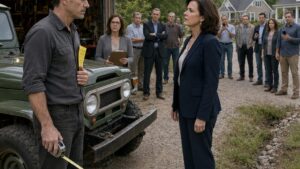
Carolyn Mitchell was standing on Robert Carter’s lawn when he stepped through his back door Monday morning, and the white envelope in her hand told him she had not come to discuss the weather.
She stood beside the wooden gate he had installed two days earlier, one hand resting on her clipboard, the other holding the envelope against her hip. Beyond her, the narrow dirt track across Robert’s grass ran toward the community parking lot.
Ronald Hall stood on the parking side of the fence with two other neighbors.
Robert stopped on the patio.
“You could have knocked.”
“I did.” Carolyn held up the envelope. “This is an architectural violation notice.”
Robert looked from her to the gate.
The gate was plain cedar, six feet wide, mounted between two posts at the back edge of his lot. It matched the fence. No spikes. No signs. Nothing dramatic.
Its only remarkable feature was that it stayed closed.
“What violation?”
“The gate wasn’t approved.”
Robert walked toward her.
During the previous week, people had crossed his yard seventeen times that he had personally seen. Some came alone. Some pushed bicycles. One man dragged a rolling cooler across the grass. Nobody asked.
The route saved perhaps three minutes between the homes on the east side of the development and the shared parking area.
Over the years, those three minutes had carved a bare strip through Robert’s lawn.
He pointed at it.
“That is why there’s a gate.”
Carolyn barely glanced down.
“That doesn’t change the architectural process.”
“No. But it explains why I stopped people walking through my property.”
Ronald folded his arms.
“We’ve been using that path forever.”
Robert turned.
“Using it and owning it are two different things.”
Ronald gave a short laugh. “Nobody said we owned it.”
“Then it shouldn’t be a problem when I close it.”
One of the neighbors looked away.
Carolyn extended the envelope.
“This isn’t about who owns what. The association has standards. Exterior changes require review.”
Robert took the notice without opening it.
He knew Carolyn socially in the limited way neighbors in planned communities often knew one another. She organized annual meetings, sent reminders about trash bins, and could remember the approved paint colors without checking the binder.
Until that morning, he had never considered her an enemy.
He still did not want to.
“How long do I have?”
“Ten days to remove it or bring the property into compliance.”
“Meaning remove it.”
“Unless the board approves something else.”
Robert looked at the wooden gate again.
“Was there a complaint?”
Carolyn hesitated just long enough for him to notice.
“There were concerns.”
“From whom?”
“We don’t disclose individual complaints.”
Ronald shifted his weight.
Robert did not need the answer.
For months Ronald had been the most vocal person whenever Robert mentioned the shortcut. The previous fall, Robert had found Ronald halfway across the yard carrying grocery bags.
Robert had said, “I’d appreciate it if you went around.”
Ronald had answered, “Everybody comes this way.”
As though that settled it.
Now Ronald pointed toward the gate.
“Did you even get a permit for that?”
The question came loudly enough that the other neighbors could hear.
Robert felt something tighten behind his ribs.
He could have answered sharply. He could have reminded Ronald that Ronald had never once asked permission before crossing the property.
Instead he looked at Carolyn.
“Does this gate require a city permit?”
Carolyn said, “That’s your responsibility to determine.”
Ronald smiled faintly.
It was the smile that bothered Robert more than the words.
He opened the envelope.
The document had the association letterhead at the top. Beneath it was his address, the date, and a paragraph stating that an unapproved exterior modification had been observed along the rear property area.
The letter instructed him to correct the violation.
Robert read it twice.
“What rule?”
Carolyn frowned. “Excuse me?”
“What specific rule says the gate can’t be there?”
“The architectural guidelines require prior approval.”
“That’s not what I asked.”
Her posture changed slightly.
Robert continued, careful to keep his voice level.
“Does the association prohibit a rear boundary gate? Is there a height restriction? Material restriction? Visibility rule? Setback?”
Carolyn glanced toward the clipboard.
“There are multiple standards that may apply.”
“Which one applies to mine?”
“We’ll discuss that through the normal process.”
Robert looked again at the path.
In places it had become six inches lower than the surrounding grass. The soil was compacted hard and smooth. Near his patio, recent rain had turned part of it to mud.
A line created by hundreds of small choices.
Nobody had intended to claim his yard.
That, somehow, made it worse.
Nobody had needed to decide.
They had simply continued until convenience became habit and habit began to resemble permission.
Carolyn tapped the envelope with one finger.
“I’d recommend taking this seriously, Robert.”
“I am.”
“Then remove the gate while the board reviews it.”
“No.”
The word came out more quickly than he intended.
Carolyn’s eyes narrowed.
Robert corrected his tone, but not his answer.
“I’ll respond to the notice. Until then, the gate stays closed.”
Ronald shook his head.
“This is going to make things harder for everybody.”
Robert looked at him.
“Walking around my property isn’t a hardship.”
Ronald’s face hardened.
For a moment Robert almost added something else. Something about respect. About years of footprints. About the flower bed near the patio that had been crushed twice because people drifted off the path.
He stopped himself.
Arguments rarely improved when someone began listing everything they had quietly resented.
Carolyn gathered her clipboard.
“You have ten days.”
She crossed through the opening toward the parking area.
Robert closed the gate behind her.
The latch clicked.
Ronald stared at it from the other side before walking away.
That evening Robert carried the violation letter into the kitchen. Dirt had dried along the bottom of his shoes from standing near the path.
He set the envelope beside a mug of coffee and opened the association website on his laptop.
He downloaded the current CC&Rs and architectural guidelines.
The documents ran more than eighty pages.
Robert began with the violation letter.
He underlined every phrase that sounded like a citation.
Unapproved exterior modification.
Architectural conformity.
Association standards.
Required corrective action.
Then he looked for numbers.
Article.
Section.
Paragraph.
Rule.
There were none.
He turned the letter over as though the missing information might somehow be on the back.
Nothing.
Robert placed the notice beside the CC&Rs.
For the first time that day, his irritation faded.
Something colder and more useful replaced it.
The association had ordered him to correct a violation.
But nowhere in the letter did it say exactly what rule he had violated.
Chapter 2: The Violation Letter With Nothing Specific Behind It
By nine that evening, Robert had searched the CC&Rs for the word gate fourteen times and still had not found the prohibition Carolyn seemed so certain existed.
He sat at the kitchen table with the architectural guidelines open on one side of his laptop and the violation letter on the other.
The rules discussed fences in detail.
Street-facing fences could not exceed specified heights. Certain materials required approval. Decorative structures visible from the street had to match the neighborhood’s exterior standards.
Rear boundary structures were treated differently.
Robert leaned closer.
He read the relevant section twice, then a third time.
Nothing in it said rear gates were forbidden.
Prior approval might still matter. A city permit might matter. Setbacks might matter.
But forbidden was a different word.
Carolyn had used it as though there were no question.
Robert looked toward the dark kitchen window.
Mud from the shortcut had dried in two brown crescents on the tile near the patio door.
He had tracked it inside himself.
That irritated him more than it should have.
The next morning he called the city planning counter.
A permit clerk listened while Robert described the gate.
“Residential rear boundary?” the clerk asked.
“Yes.”
“Existing fence?”
“Yes.”
“Vehicle access or pedestrian?”
“Mostly pedestrian, although the opening is wide enough for equipment.”
There was a pause while the clerk typed.
“You may need a simple fence-and-gate permit depending on the width and footing. It isn’t automatically prohibited.”
Robert wrote that phrase down.
“Would an HOA approval substitute for the city permit?”
“No. Separate issues.”
“And an HOA objection doesn’t prevent me from applying?”
“Not from applying.”
That answer was less dramatic than Robert had hoped, but more useful.
He spent his lunch hour gathering the parcel description and the survey he had received when he bought the house.
The old survey showed the rear boundary as a straight line several feet beyond where the dirt path crossed the lawn.
Robert studied it.
The gate appeared to sit close to that line, but “close” was not something he intended to argue about.
He called a licensed surveyor.
The earliest appointment was Tuesday afternoon.
Before the surveyor arrived, Robert emailed Carolyn.
He kept the message short.
Please identify the specific covenant or architectural section supporting the violation notice so I can respond accurately.
Her reply came twenty minutes later.
The gate was installed without architectural approval and remains subject to enforcement. The board will review the matter during inspection.
No citation.
Robert wrote back.
Which section prohibits the gate itself?
This time Carolyn called.
“Robert, I think we’re making this harder than necessary.”
“I’m asking for the rule.”
“You made an exterior modification without approval.”
“I understand your position. I’m asking what makes the structure noncompliant.”
“The committee has discretion over exterior changes.”
“So the problem is that I didn’t ask first?”
“That is part of the problem.”
“What’s the other part?”
Silence.
Then Carolyn said, “We’ll discuss it at the inspection tomorrow.”
Robert looked at the printed notice.
“Fine.”
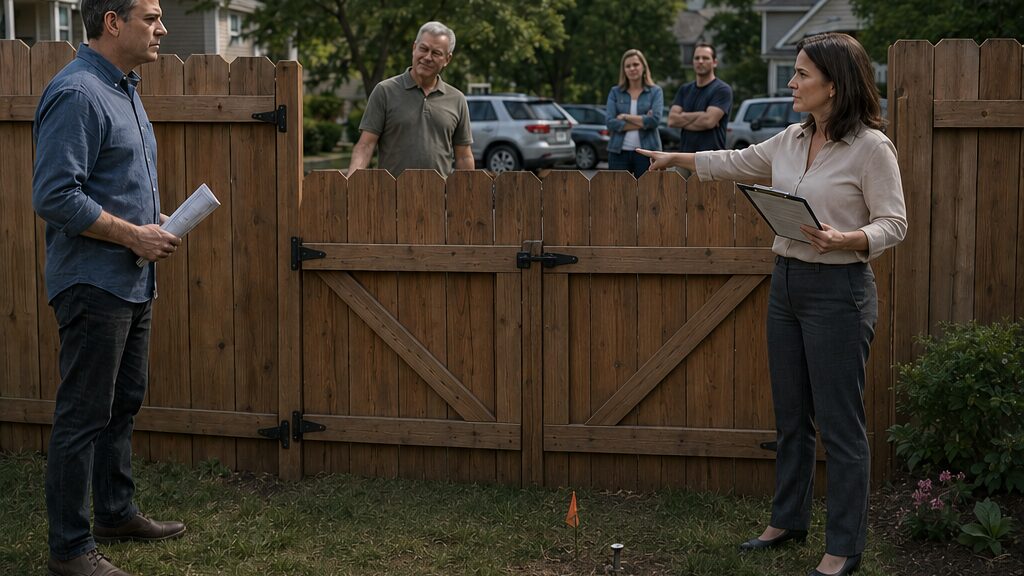
Tuesday afternoon brought Carolyn, Ronald, one board member, and three neighbors to Robert’s rear fence.
More people than necessary.
Robert noticed that immediately.
Carolyn carried the same clipboard. Ronald stood near the closed gate with his hands in his pockets.
The surveyor had arrived earlier and marked two points with small flags.
Robert held a folded copy of the property survey.
Carolyn began without greeting.
“The committee’s concern is that you’ve obstructed an established pedestrian route with an unapproved structure.”
Robert looked at her.
“Established by what?”
“By longstanding use.”
“That’s not an architectural rule.”
Ronald sighed.
“There you go again.”
Robert ignored him.
Carolyn pointed toward the wooden gate.
“The simplest solution is removal.”
Robert crouched beside one of the survey flags.
Near the base of the fence line, partially buried beneath packed soil, was a metal survey pin.
He brushed away dirt with his fingers.
The small exposed cap looked almost insignificant compared with the argument surrounding it.
Robert unfolded the survey.
“This point here matches this pin.”
Carolyn looked down.
“And?”
Robert traced the rear boundary with his finger.
“The path crosses my parcel well before reaching the gate.”
Nobody answered.
He stood.
“Now show me the section I violated.”
Carolyn flipped through several pages attached to her clipboard.
Robert waited.
Ronald glanced between them.
Carolyn found a highlighted paragraph.
“Architectural changes require committee approval before installation.”
Robert nodded.
“That says approval is required. It doesn’t say a rear gate is prohibited.”
“You didn’t obtain approval.”
“I’m addressing that. Your notice says the structure is noncompliant and must be removed. I’m asking what standard the structure violates.”
The board member leaned toward Carolyn’s clipboard.
Carolyn’s jaw tightened.
Robert felt the temptation to press harder.
He wanted to ask whether she had read the entire rule before sending the letter. He wanted Ronald to hear the answer.
Instead he held out the violation notice.
“Where is the citation?”
Carolyn did not take it.
“It doesn’t have to list every applicable provision.”
“I didn’t ask for every provision.”
The neighbors had gone quiet.
Robert heard a car door close in the parking lot behind them.
For once, nobody was looking at the gate.
They were looking at the paper.
Carolyn lowered the clipboard.
“The violation remains active pending board review.”
“So you still can’t tell me what makes the gate itself illegal.”
“I didn’t use the word illegal.”
Ronald shifted uncomfortably.
Robert almost smiled.
He didn’t.
That would have turned the exchange into a contest, and he was beginning to understand that contests were exactly where his temper wanted to take him.
“I’ll file for the city permit,” he said. “I’ll also submit the gate formally. But I’m not removing it because this letter tells me to unless you can identify a rule requiring removal.”
Carolyn’s expression hardened again.
“Then we’ll schedule this for the board.”
“Do that.”
The group slowly broke apart.
Ronald lingered.
“You enjoy this?”
Robert looked at him.
“What?”
“Making everybody go through all this.”
For a second Robert had no answer.
Then he looked at the worn track behind Ronald.
“I didn’t make that path.”
Ronald followed his gaze but said nothing.
After they left, the surveyor finished measuring the rear line and several adjacent points.
Near dusk, he came to the patio with his field notes.
Robert expected confirmation and little more.
Instead the surveyor tapped the map.
“There’s something you should know.”
Robert looked down.
“The path isn’t on a recorded pedestrian easement.”
Robert felt a small surge of satisfaction.
Then the surveyor moved his finger farther east.
“There is an access strip shown here on the older plat, though. Common property. Not through your yard.”
Robert studied the narrow band.
“Where is it?”
The surveyor looked toward a row of shrubs and landscape stone between two sections of fencing.
“Probably under that landscaping.”
Robert frowned.
The route on the old plat connected the homes to the same parking area.
Not through Robert’s property.
Beside it.
He looked again at the path worn across his grass.
If a common route already existed on paper, why had the neighborhood spent years walking through his yard instead?
Chapter 3: The Shortcut Was Older Than the Argument
Lisa Brown was waiting beside Robert’s gate Wednesday morning.
She did not have a clipboard or an envelope. She had one hand wrapped around the handle of a folded shopping cart.
Robert stopped before unlatching the gate.
“If you’re here about the board—”
“I’m not.”
Lisa glanced toward the parking lot.
“My mother stays with me most weeks now. Her knees aren’t good.”
Robert said nothing.
“When this is closed, the walk from my house to the parking area nearly doubles.”
“It’s still common property.”
“I know.”
Her answer came quickly enough to disarm him.
Lisa looked at the dirt path.
“I’m not saying this belongs to us.”
Robert’s hand remained on the latch.
“Then what are you saying?”
“I’m asking what we’re supposed to use.”
He looked toward the shrubbed strip the surveyor had identified.
“The common walkway.”
Lisa followed his gaze.
“What walkway?”
“That’s what I’m trying to figure out.”
They walked along the fence toward the landscaping.
Behind a bed of mature shrubs was a narrow strip of uneven ground bordered by old concrete edging. Most of it had disappeared beneath mulch and decorative stone.
Lisa stared at it.
“That used to be open.”
Robert turned.
“You remember it?”
“Not clearly. We moved in twelve years ago. There was some kind of walkway here when we first came.”
“What happened to it?”
She shook her head.
“Landscaping project, maybe.”
Robert stepped onto the edge of the strip.
Under the mulch, the ground felt unnaturally flat.
He scraped back a little material with his shoe.
A broken piece of concrete appeared.
The route on the plat had not been imaginary.
It had physically existed.
By afternoon, Robert had another surprise waiting for him.
Ronald approached while Robert was measuring the common strip.
“You planning another fence?”
“No.”
Ronald stopped beside him.
Robert pointed at the exposed concrete.
“When did this walkway disappear?”
Ronald looked at it for several seconds.
“Oh.”
“That’s not an answer.”
“I’d forgotten about that.”
Robert straightened.
“Try remembering.”
Ronald did not react to the edge in his voice.
“Years ago. Maybe eight or nine. The association redid the drainage and landscaping along here.”
“And removed the walkway?”
“It was cracked. Water collected on it.”
“Then what?”
Ronald shrugged.
“People started cutting across your side.”
“You mean my yard.”
“Yes.”
“And nobody thought to replace this?”
“I assumed they were going to.”
“For eight years?”
Ronald gave him an irritated look.
“You didn’t complain for eight years either.”
The sentence landed harder than Robert expected.
He opened his mouth, then stopped.
Ronald was right about one thing.
Robert had disliked the shortcut for years, but for most of that time he had dealt with it by muttering after people were already gone.
He had asked individuals to stop. He had planted shrubs. He had moved patio furniture.
What he had not done was force the issue into the open until he installed the gate.
Ronald nodded toward the strip.
“When the old path was here, nobody needed yours.”
“So why didn’t the HOA rebuild it?”
“I don’t know.”
“You’re at every annual meeting.”
“That doesn’t mean I read the landscaping invoices.”
Robert looked at him.
Ronald sighed.
“Look, I shouldn’t have said what I did yesterday.”
“About whether I enjoy this?”
“About the permit too.”
Robert waited.
Ronald rubbed his chin.
“We got used to the shortcut. That’s the truth.”
It was the closest thing to an admission Robert had heard.
“You got used to my property.”
“We got used to nobody stopping us.”
There was a difference.
Robert did not like it, but there was a difference.
That evening, a neighbor forwarded him a petition circulating by email.
The subject line read: Restore Established Pedestrian Access.
Robert read the first paragraph standing at his kitchen counter.
The petition described his gate as an obstruction to a longstanding neighborhood route and asked the HOA board to require immediate removal.
Twenty-three residents had added their names.
Robert felt the old anger return.
Established route.
The phrase made his own lawn sound like public infrastructure.
He printed the petition and placed it beside the survey.
Then he thought of Lisa’s folded shopping cart.
Her mother’s knees.
Ronald saying, We got used to nobody stopping us.
The anger did not disappear.
It became less convenient.
On Thursday Robert requested older association records.
The HOA maintained scanned board minutes going back more than a decade.
He searched for landscaping.
Drainage.
Walkway.
Pedestrian.
Parking.
Most results were useless.
Then he found minutes from a meeting nine years earlier.
A drainage improvement project had required removal of a deteriorated concrete pedestrian walk near the eastern parking area.
Robert leaned closer.
The next paragraph discussed access during reconstruction.
Residents would be permitted a temporary pedestrian accommodation across adjacent Lot 47 until replacement access could be completed.
Robert’s stomach tightened.
He checked his closing documents.
Lot 47.
His property.
He read the paragraph again.
Temporary pedestrian accommodation.
No easement.
No permanent transfer.
No recorded access right.
Temporary.
Robert scrolled to the following month’s meeting.
Nothing about replacement.
The next month, nothing.
Six months later, landscaping expenses appeared, but no walkway.
A year later, the subject vanished entirely.
Robert sat back.
The worn path outside suddenly looked different.
It was still on his land.
The people crossing it still should have asked.
But the shortcut had not begun simply because neighbors were lazy.
At some point, an HOA board had deliberately redirected pedestrian traffic across the lot—temporarily—and then never finished the job.
Robert printed the minutes.
At the bottom of the page, beneath the discussion of the removed walkway, someone had typed a sentence that changed the entire argument:
Temporary accommodation to remain only until permanent common-area pedestrian access is restored.
Chapter 4: The Board Had Called It Temporary Years Ago
Robert read the sentence four times before he trusted what it meant.
Temporary accommodation to remain only until permanent common-area pedestrian access is restored.
His lot number appeared three lines above it.
There was no ambiguity left about how the shortcut had started.
What bothered him was what came after.
Nothing.
No follow-up vote.
No construction approval.
No recorded easement.
No notice to a future buyer.
The board had redirected people across private property, called it temporary, then let enough years pass for memory to harden into assumption.
Robert printed the minutes and drove to the association office Friday morning.
The records room occupied one side of the clubhouse, behind a door most residents probably never noticed. Carolyn was already there when he arrived, seated at a folding table with a stack of binders.
“You asked for older maintenance records,” she said.
“I found something else first.”
Robert placed the printed minutes in front of her.
Carolyn’s eyes moved down the page.
He watched her reach the sentence.
Her expression changed only slightly.
But it changed.
“You knew about this?”
“I knew there used to be another walkway.”
“That isn’t what I asked.”
She looked up.
“No. I did not know the exact wording of these minutes.”
Robert pointed to his lot number.
“The board directed people across my property.”
“Temporarily.”
“For nine years.”
Carolyn leaned back.
“The current board did not make that decision.”
“The current board is enforcing the result of it.”
“That’s not fair.”
Robert almost laughed.
“Fair?”
“I mean procedurally. You’re treating every board action over fifteen years like one continuous decision by the same people.”
“No. I’m treating the association like the same association.”
Carolyn folded her hands.
“The corporation continues. Volunteers change.”
“Then the obligations continue too.”
She looked back at the minutes.
For a moment neither spoke.
The room smelled faintly of paper and carpet cleaner. Somewhere in the clubhouse a ventilation unit clicked on.
Robert opened another folder.
“Was a permanent walkway ever proposed?”
Carolyn glanced at the binder beside her.
“Yes.”
The answer surprised him.
“When?”
“Several times.”
“Why wasn’t it built?”
She did not answer immediately.
Instead she opened the binder and turned several pages.
There were cost estimates.
Drainage work.
Concrete removal.
Retaining adjustments.
The numbers were higher than Robert expected.
Carolyn tapped the most recent estimate.
“This was three years ago.”
Robert stared at the total.
“That much?”
“The common strip isn’t flat. Water still runs through part of it. It needs proper drainage, not just concrete.”
“So the board decided using my yard was cheaper.”
“No.”
“That is exactly what happened.”
“No,” Carolyn said again, more sharply. “The board kept postponing a project it didn’t know how to pay for.”
“Same result.”
“Not the same motive.”
Robert looked at her.
She held his gaze.
For the first time since the conflict began, she looked less like the woman carrying enforcement papers and more like someone tired of holding together decisions she had not created.
“We have roofs coming due on the townhome buildings,” she said. “Stormwater repairs. Insurance increases. People show up furious if assessments rise twenty dollars.”
“That doesn’t make my lot free.”
“I know.”
The words were quiet.
Robert paused.
It was not the answer he expected.
Carolyn looked down at the meeting minutes.
“I know it doesn’t.”
“Then why send me that violation notice?”
“Because your gate shut down something dozens of households had been using overnight.”
“Something they had no right to use.”
“Something they had been told to use years ago.”
Robert stopped.
Carolyn continued.
“I had complaints from people who honestly believed that route was established access. I had two board members telling me we needed consistency. I had residents asking whether you could block a route that had existed longer than some of them had lived here.”
“So you decided I was the easiest part to fix.”
Her face tightened.
“I decided an unapproved gate was a problem I could address immediately.”
“That isn’t the same thing.”
“No.”
This time she did not defend it.
Robert should have felt vindicated.
Instead he looked at the cost estimate again.
Carolyn had made a bad decision. She had sent the notice before verifying what authority supported it. She had let urgency turn into certainty.
But she had not invented the underlying mess.
Years of deferred decisions had delivered it to her.
Robert folded the minutes.
“Withdraw the violation.”
“I can’t do that by myself.”
“You issued it.”
“I issued it on behalf of the committee. The board has already been notified. At this point, it needs a vote.”
“So even though you know the letter doesn’t identify a prohibited structure, it stays active.”
“Until the meeting.”
Robert felt his patience harden again.
“When?”
“Tuesday.”
“That gives me four days.”
“To submit anything you want considered.”
He stood.
Carolyn closed the binder.
“Robert.”
He stopped at the door.
“I should have checked the old records first.”
He looked back.
She seemed uncomfortable saying it.
That mattered.
Not enough to erase the notice, but enough to complicate his anger.
“You should have checked the current rules too.”
“Yes.”
He left.
Saturday morning, Robert walked the entire common strip with his survey in hand.
The old concrete appeared in fragments beneath mulch, shrubs, and decorative stone. At one point the route disappeared entirely behind a drainage swale.
The worn shortcut through his lawn was smoother, shorter, and easier.
That explained why no resident had demanded restoration of the original route.
Convenience had hidden neglect.
Robert stood at the rear fence and looked at both paths.
One existed because the association had once planned something temporary.
The other existed because temporary had become normal.
His phone rang.
The city permit clerk.
Robert answered.
“We finished the review on your gate application,” the clerk said.
Robert straightened.
“And?”
“You’re approved, subject to the footing dimensions on the plan and maintaining the required setback.”
Robert looked toward the wooden gate.
“Approved as submitted?”
“Yes.”
A moment later the confirmation arrived by email.
Robert opened the attachment.
There it was.
Permit number.
Site reference.
Approved gate location.
He had wanted this.
For days, he had imagined the satisfaction of placing the permit on the table in front of Carolyn and Ronald.
Now that he had it, the feeling was different.
The city had answered the legal question.
The gate could stay, once properly built.
But standing between the worn shortcut and the buried common walkway, Robert understood that the permit answered only the easiest part.
He could make the boundary stronger than ever.
The harder question was what he intended to do with that victory.
Chapter 5: He Won the Permit and Nearly Lost the Point
The gate contractor studied Robert’s plans, then looked at the rear opening.
“You really want something this permanent?”
Robert glanced at him.
“That sounds like a strange question from a man I’m paying to build a gate.”
The contractor smiled.
“I build whatever people order. I’m asking because this isn’t a normal backyard gate.”
The steel design lay across the hood of Robert’s truck.
Powder-coated frame.
Heavy hinges.
Deep concrete footings.
A reinforced locking post.
Nothing ornamental about it.
Robert tapped the drawing.
“Can you build it exactly to the permit?”
“Yes.”
“Then build it.”
The contractor nodded, though the question seemed to remain in his face.
By Monday afternoon, the wooden gate was gone.
Excavation for the new footings tore through the end of the old shortcut. Dirt and broken grass spread across the area where years of footsteps had packed the soil smooth.
Robert watched from the patio.
He felt satisfaction.
Not relief.
Satisfaction.
That distinction bothered him only later.
At the neighborhood meeting that evening, Carolyn sat at the front table with the two board members. Ronald occupied a chair in the second row. Lisa stood near the side wall.
Robert brought a folder containing the permit, survey, photographs of the property markers, and highlighted CC&R sections.
Before the meeting began, Ronald leaned over.
“Heard you’re putting in a steel gate.”
Robert sat beside him.
“You heard correctly.”
“How big?”
“Big enough.”
Ronald gave him a tired look.
“That answer is exactly why people are mad at you.”
Robert opened his folder.
“People were mad when it was cedar.”
“They thought cedar was temporary.”
“So did I.”
Ronald almost smiled.
The board called the meeting to order.
Carolyn summarized the pending violation without using the word illegal.
Robert noticed that immediately.
When his turn came, he kept his statement short.
“The city approved the gate at the surveyed rear boundary. The architectural standards do not prohibit a gate in that location. I’m asking the association to withdraw the removal demand.”
One board member asked about prior approval.
Robert acknowledged he had installed the first gate before submitting an application.
“That part was my mistake,” he said. “I should have filed first.”
Carolyn looked at him.
He could tell she had not expected that admission.
Robert continued.
“But lack of prior approval doesn’t make every structure prohibited. I’ve now submitted the replacement design and city permit.”
A few residents murmured.
Then Lisa raised her hand.
Carolyn recognized her.
Lisa stood.
“I’m not here to say Robert’s yard belongs to us.”
Robert looked over.
Lisa continued.
“It doesn’t. But closing that route changed daily access for several homes. I think the board needs to address that separately.”
Someone behind her said, “We had access for years.”
Lisa turned.
“We had permission to use it temporarily. That isn’t the same thing.”
The room quieted.
Robert looked down at his folder.
He had expected to spend the meeting defending himself.
Instead Lisa had done something more difficult.
She had separated two issues everyone kept trying to combine.
The boundary.
The access problem.
After the meeting, she caught Robert outside.
The clubhouse parking lot was nearly empty.
“You don’t like me very much right now,” she said.
“That’s not true.”
“You look like you’re deciding whether it’s true.”
Robert exhaled.
Lisa rested one hand on the roof of her car.
“I saw the construction.”
“The gate is permitted.”
“I know.”
“Then what?”
She looked at him directly.
“Do you want the neighborhood to stop crossing your property, or do you want them to regret that they ever did?”
Robert stared at her.
The question was too precise.
“I’m protecting my property.”
“That wasn’t what I asked.”
He felt anger rise.
Not because she was wrong.
Because part of him had an answer he did not want to say aloud.
He had imagined Carolyn arriving after installation.
He had imagined Ronald looking at the steel frame.
He had imagined the message the gate would send.
You pushed.
I checked.
You lost.
Lisa lowered her voice.
“My mother doesn’t need your yard. She needs a safe route to the parking lot. If the association fixes that, I’m fine with your gate.”
Robert said nothing.
“You’re right about the boundary,” she said. “Just don’t make everybody pay for what the board failed to fix.”
She drove away.
Robert remained beside his truck.
When he returned home, the contractor had set the steel posts temporarily in place.
They stood upright in the fading light, far heavier than the cedar posts they replaced.
Robert walked toward them.
The contractor had excavated part of the worn path for the footing.
For the first time in years, the path did not run continuously across the yard.
Robert should have felt victorious.
Instead Lisa’s question followed him to the patio.
Do you want them to stop, or do you want them to regret it?
He went inside and opened the old site plat.
The common strip ran east of his property, connecting the same residential cluster to the parking area.
He pulled out the latest cost estimate Carolyn had shown him.
Most of the expense came from restoring the route exactly as it had once existed in concrete.
Robert studied the drawing.
Then he noticed something.
The route did not necessarily need to follow the old footprint.
A narrower pedestrian path could curve around the drainage swale.
He took a pencil.
Instead of crossing his lot, the line stayed entirely within common property.
He sketched a route around the shrubs, across the flatter ground, then back toward the parking area.
The next morning he walked it.
The distance was longer than his backyard shortcut but shorter than the street route.
The surface would need work.
The association would still have to pay for it.
But the steepest drainage section could be avoided.
At the property line, the contractor approached.
“Footings go in tomorrow.”
Robert folded the sketch.
“Good.”
The contractor gestured toward the steel posts.
“You’re sure?”
Robert looked at the old path.
“Yes.”
Then he looked toward the common strip.
“But I need a price on something else.”
The contractor followed his gaze.
Robert handed him the rough drawing.
“I want to know what it would cost to put a pedestrian path there.”
The contractor studied it.
“That’s not your property.”
“I know.”
“So why are you pricing it?”
Robert looked toward the steel frame waiting to be installed.
“Because apparently winning one argument didn’t solve the problem.”
Chapter 6: The Gate Became Legal Before the Conflict Became Fair
The steel gate swung shut for the first time Wednesday afternoon while Carolyn stood twenty feet away photographing it.
The sound was not dramatic.
A low metallic weight.
Then the latch settled into the reinforced post with a clean click.
Carolyn lowered her phone.
“That is substantial.”
Robert looked at the gate.
Powder-coated steel stretched across the opening where the cedar gate had stood. The hinges were mounted into reinforced posts set deep in concrete.
Beside the western footing, the survey pin remained visible.
Exactly where it had been during the inspection.
“Substantial isn’t prohibited,” Robert said.
Carolyn glanced at him.
“No.”
The contractor gathered his tools.
Robert walked to the boundary and placed one shoe beside the pin.
“The setback matches the approved plan.”
“I can see that.”
“I have the final permit documentation.”
“I assumed you would.”
There was no sarcasm in her voice.
That surprised him more than sarcasm would have.
Carolyn took one more photograph, then turned toward the parking area.
“The board meeting is at seven.”
“I’ll be there.”
That evening Robert carried two folders into the clubhouse.
One contained everything he needed to defeat the violation.
The other contained his sketch for the common-area path.
He had spent most of the afternoon deciding which folder mattered more.
The meeting drew more residents than usual.
Word of the steel gate had traveled quickly.
Robert saw Ronald near the center aisle. Lisa sat three chairs behind him.
Carolyn began with the violation.
“The architectural committee previously issued a notice concerning the gate at Lot 47,” she said. “Since that notice, the owner has submitted additional documentation.”
Additional documentation.
Robert almost smiled.
When she recognized him, he stood and walked to the front.
He laid the permit on the table.
Then the survey.
Then the relevant covenant section.
He did not rush.
“The city approved the structure as installed,” he said. “The survey confirms it is on my rear boundary. The architectural rules require review, which I have now requested, but I have found no provision prohibiting a compliant rear gate in this location.”
One board member read the highlighted section.
The other studied the survey.
Carolyn remained quiet.
Robert could have stopped there.
He had the room.
He could feel it.
The same people who had watched Carolyn challenge him beside the cedar gate were now watching the board search the documents he had brought.
The temptation returned.
He could ask Carolyn to read the original notice aloud.
He could ask which rule she had relied on.
He could make the moment hurt.
Instead he said, “I installed the first gate before submitting it to architectural review. That was my mistake.”
Several heads turned.
Robert continued.
“But the removal demand was also issued before the association confirmed that the gate itself violated any standard.”
Carolyn looked at him.
He met her eyes.
“I’m asking that the violation be withdrawn.”
The board member beside Carolyn whispered something to her.
She nodded.
Then she spoke into the room.
“I agree.”
A murmur moved through the chairs.
Carolyn did not look pleased.
She did not look defeated either.
“The original notice should not have stated corrective removal as the required outcome without identifying the applicable architectural provision. The committee should have completed that review first.”
Robert felt the release he had expected all week.
It was quieter than he imagined.
The board voted.
The violation was withdrawn.
No applause followed.
Robert was grateful for that.
Ronald leaned back in his chair.
Someone near the rear whispered, “So that’s it?”
Robert looked at the second folder.
This was the moment when it could have been it.
Gate legal.
Notice gone.
Argument won.
He opened the folder.
“No,” he said.
Carolyn frowned slightly.
Robert unfolded the site plat.
“The gate solves my property issue. It doesn’t solve the access issue.”
Lisa sat forward.
Robert placed his sketch beside the survey.
“The original common walkway used to run here. Restoring the old concrete footprint is expensive because of the drainage section. But there’s another route.”
One board member leaned closer.
Robert traced the line.
“It stays entirely on association property. It curves around the swale and reconnects near the parking lot.”
Ronald stood enough to see.
“How much?”
“I asked the contractor who installed the gate for a preliminary estimate.”
Robert slid the paper across.
Carolyn examined it.
Her eyebrows rose.
“It’s still not cheap.”
“No.”
“But it’s much less than the old proposal.”
“Because it avoids the retaining work.”
One board member tapped the page.
“We don’t have all of this available this year.”
Robert nodded.
“I know.”
The answer came from Carolyn before he could continue.
“We could possibly fund the grading and base work now, then finish the surface later.”
Robert looked at her.
Carolyn was already studying the estimate.
“The reserve line for common-area repair might cover the first phase,” she said. “I’d need to verify that.”
A resident in the back complained about another assessment.
Carolyn lifted a hand.
“I didn’t say assessment.”
Another neighbor asked whether Robert would reopen the old shortcut until construction was complete.
Robert felt every eye return to him.
This was where his old answer would have been immediate.
No.
Not my problem.
Instead he chose his words carefully.
“The gate stays closed.”
A few people shifted.
Robert continued.
“But I’ll help the board plan the alternate route. I’ll provide the survey information I already paid for, and the contractor is willing to give the association a separate written estimate.”
Lisa nodded once.
The distinction felt important.
Helping did not require surrender.
Carolyn looked at Robert.
“You’re offering the survey?”
“A copy of the relevant boundary data.”
“Thank you.”
The words landed strangely between them.
Ronald raised his hand.
Carolyn called on him.
He stood.
“I’ve probably used Robert’s yard more than anybody in this room.”
A few people laughed softly.
Ronald did not.
“I thought that path was ours because nobody told me otherwise.”
He looked toward Robert.
“That was lazy thinking.”
Robert stayed still.
Ronald faced the board again.
“If the association can build the new route in phases, I’ll help organize volunteers for whatever work residents are allowed to do ourselves.”
Someone asked what volunteers could realistically contribute.
“Clearing brush,” Ronald said. “Moving mulch. Whatever doesn’t require licensed work.”
Lisa added, “I’ll help.”
Then another resident did.
Not applause.
Not a sudden reconciliation.
Just people beginning to discuss a different problem than the one they had entered the room arguing about.
Carolyn drew a line beneath the estimate.
“We’ll need formal bids before approving anything.”
Robert nodded.
“Of course.”
She looked at him.
“And architectural review still technically applies to your replacement gate.”
He almost laughed.
“Of course.”
A faint smile crossed her face and disappeared.
After the meeting, Robert stood outside near the clubhouse entrance.
Ronald came out carrying a folded copy of the proposed route.
“You know,” Ronald said, “that steel gate is ridiculous.”
Robert looked at him.
“It’s permitted.”
“I know. That makes it worse.”
Robert laughed despite himself.
Ronald unfolded the route.
“I meant what I said in there.”
“About helping?”
“Yes.”
Robert studied him.
“Why?”
Ronald shrugged.
“Because I complained for two weeks about losing a shortcut and never once asked why the proper walkway disappeared.”
He looked toward the parking lot.
“That part’s on us too.”
Robert nodded.
Ronald started toward his car, then stopped.
“You think the board will actually do this?”
Robert looked back through the clubhouse windows.
Carolyn and the two board members were still gathered around his sketch.
“I think they’ll have to decide in public this time.”
Ronald smiled.
“Good enough.”
Robert drove home.
Under the porch light, the new steel gate looked almost severe.
The old dirt path ended directly against it.
For years that line through the grass had meant one thing to Robert: people taking what he had not offered.
Now it meant something else too.
A problem left temporary long enough that everyone forgot someone had been expected to fix it.
He put his hand on the gate.
The boundary was real.
So was the failure on the other side of it.
For the first time, Robert no longer felt compelled to choose between those truths.
Behind him, his phone buzzed.
A neighborhood email had arrived from Ronald.
The subject was simple: Common Walkway Volunteers.
Robert opened it.
Twelve residents had already replied.
Chapter 7: The New Path Did Not Cross His Yard
The first thing Robert noticed was the grass.
Not the new walkway. Not the steel gate. Not the row of shrubs volunteers had cleared from the common strip three months earlier.
The grass.
A narrow green seam had finally grown across the place where the shortcut used to cut through his yard.
Robert stood on the patio with his coffee and stared at it.
For years that line had remained brown no matter what he did. Seed washed away. New sod thinned. Footsteps returned before roots could take hold.
Now the path was disappearing.
A woman crossed the new common walkway beyond the fence, pushing a shopping cart toward the parking area.
She did not look toward Robert’s yard.
She did not need to.
The new route curved through association property exactly as the revised plan had shown. It was not as direct as the old shortcut, but it avoided the drainage swale and connected cleanly with the parking lot.
The first phase had taken longer than everyone hoped.
The association paid for grading, drainage base, and compacted surface. Residents volunteered for brush clearing and cleanup where the contractor allowed it. A later budget vote funded the finished walking surface.
There had been arguments.
Of course there had.
Some residents wanted concrete immediately. Others opposed spending anything. One man insisted the whole problem could have been solved if Robert had simply reopened his yard.
Ronald had answered that one before Robert could.
“He shouldn’t have to donate his property because we postponed fixing ours.”
Robert had remembered the sentence.
Not because Ronald said it perfectly.
Because three months earlier Ronald would never have said it at all.
Robert finished his coffee and walked toward the gate.
The powder-coated steel still looked almost excessive against the wooden fence.
He had stopped apologizing to himself for that.
The gate was legal. It was useful when he brought equipment through the rear of the lot. It protected a boundary that should never have become ambiguous.
But he no longer looked at it and thought of Carolyn’s violation notice.
Most days, it was simply a gate.
He checked the latch, then heard footsteps on the common walkway.
Lisa appeared around the curve with an older woman moving carefully beside her.
Lisa raised a hand.
“Morning.”
“Morning.”
Her mother used a cane and kept one hand lightly on the path railing near the sloped section.
Robert watched them reach the parking area without crossing his lawn.
Lisa turned back.
“This grade is a lot better.”
“For her?”
“For me too.”
Robert smiled.
Lisa’s expression softened.
“You know she hated the street route.”
“I remember.”
“She thought the cars moved too fast near the corner.”
Robert looked toward the new path.
“That never came up when we were arguing about the gate.”
“We were all arguing about the wrong thing.”
She gave him a small wave and continued toward the parking lot.
Robert remained by the fence.
That sentence stayed with him.
The gate conflict had felt enormous while it was happening because every conversation reduced itself to a single question.
Who was right?
Robert owned the land.
The association mishandled the notice.
The residents had no recorded easement.
Those facts mattered.
They had saved him from being pushed into surrendering something that belonged to him.
But they had never explained why Lisa’s mother needed the shortcut.
They had never explained why Ronald believed the route was communal.
They had never explained why Carolyn had chosen enforcement before investigation.
A correct answer could still be incomplete.
Later that afternoon Robert attended what Carolyn had called the final walkway review.
Only six residents came.
That was probably a good sign.
Community meetings attracted crowds when people were angry and empty chairs when systems worked.
Carolyn stood beside the new route with a folder under one arm.
“The contractor needs to replace two sections of edging,” she said. “Otherwise the inspection passed.”
Ronald nudged one section with the toe of his shoe.
“That’s it?”
“That’s it.”
He looked almost disappointed.
“You mean we don’t have to argue about anything?”
Carolyn gave him a flat look.
“I can find something if you need the experience.”
Ronald laughed.
Robert did too.
The sound surprised him.
When the others walked ahead toward the parking area, Carolyn remained behind.
“Robert.”
He stopped.
She held the folder closer against her side.
“I owe you something.”
“If this is another notice, I’m going home.”
She smiled briefly.
“No.”
Then the humor left her face.
“I should have verified the covenant before I sent that letter.”
Robert said nothing.
Carolyn continued.
“I thought I was dealing with an unapproved modification and a dozen resident complaints. I treated the gate like the simplest part of the problem.”
“It was.”
“That doesn’t mean it was the right part to pressure.”
Robert looked toward the new walkway.
“No.”
Carolyn nodded.
“I knew the old route had become important. I knew people were relying on your lot. And I knew rebuilding common access would force us into a budget argument.”
She glanced toward the clubhouse.
“I let that make the enforcement decision easier than it should have been.”
Robert felt no urge to correct her wording.
Months earlier he would have wanted a more explicit admission.
You were wrong.
The letter was wrong.
The gate was legal.
Now those things were already established.
He said, “I could have handled it better too.”
Carolyn looked at him.
Robert rubbed a thumb along the edge of the gate post.
“I’d complained privately for years. I’d told individual people to stop. But I never brought the actual traffic problem to the board before I put the first gate up.”
“You didn’t have to ask permission for people to stop trespassing.”
“No.”
He paused.
“But I knew closing it would affect people. I just didn’t care very much at that point.”
Carolyn did not rescue him from the admission.
That was one thing he had come to respect about her.
She could let an uncomfortable statement remain where it landed.
“I was angry,” Robert said. “And once the notice came, I started wanting more than a solution.”
“What did you want?”
He looked at the steel gate.
“To make sure nobody ever questioned me again.”
Carolyn followed his gaze.
“Well, you certainly achieved the visual portion of that goal.”
Robert laughed.
“There’s the old Carolyn.”
“She never left.”
“I know.”
They walked toward the parking lot.
Before getting into her car, Carolyn turned.
“The board is updating the architectural notice form.”
Robert raised an eyebrow.
“Specific citation field?”
“Mandatory.”
“Good.”
“And a review step before removal is listed as the required correction.”
“Even better.”
Carolyn opened her car door.
“Try not to build anything else for a while.”
“No promises.”
She shook her head and drove away.
Robert walked home using the street instead of cutting beside the common strip.
When he reached his backyard, Ronald was approaching along the new walkway carrying two grocery bags.
Years earlier, the sight would have ended differently.
Ronald would have stepped off the route, crossed the worn track, and entered Robert’s yard as though the shortest line between two places automatically belonged to whoever needed it.
This time Ronald stayed on the common path.
At the junction, he stopped.
“You know this adds almost forty seconds.”
Robert leaned against the gate.
“I’m sorry for your suffering.”
“It’s been difficult.”
“I can tell.”
Ronald lifted one grocery bag.
“I may need a support group.”
Robert reached for the latch.
For one impulsive second, he considered opening the gate and letting Ronald through.
Then he stopped.
Not because he was angry.
Because he finally understood that friendliness did not require making the boundary uncertain again.
“See you around, Ronald.”
Ronald grinned.
“Forty seconds from now.”
He continued down the walkway.
Robert closed his hand around the steel latch.
Beyond the gate, the old shortcut was almost gone.
A few patches of thinner grass remained, tracing the route if someone knew where to look. By another season, even those might disappear.
Robert remembered how much meaning he had once assigned to that bare strip.
Disrespect.
Entitlement.
Proof that nobody listened until he forced them.
Some of that had been true.
Not all of it.
The path had also been proof of an unfinished promise, a board decision left temporary for too long, and a community that had stopped asking where convenience came from.
Robert swung the steel gate shut.
The latch settled with the same heavy click it had made on installation day.
This time the sound did not feel like victory.
It felt like definition.
His yard ended here.
The community path began over there.
Both could exist.
Across the fence, Ronald reached the curve in the new walkway and kept going toward home without stepping onto Robert’s grass.
Robert watched him disappear behind the shrubs.
Then he looked down at the uninterrupted strip of green where the shortcut had once been.
He left it alone.
The story has ended.