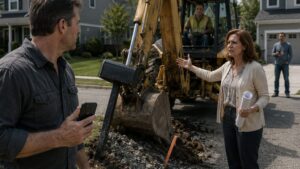
My Neighbor Used Three Feet of My Yard for Years—Then the HOA Learned Why the Fence Was Wrong
Chapter 1: The Mowers Were Already in My Yard
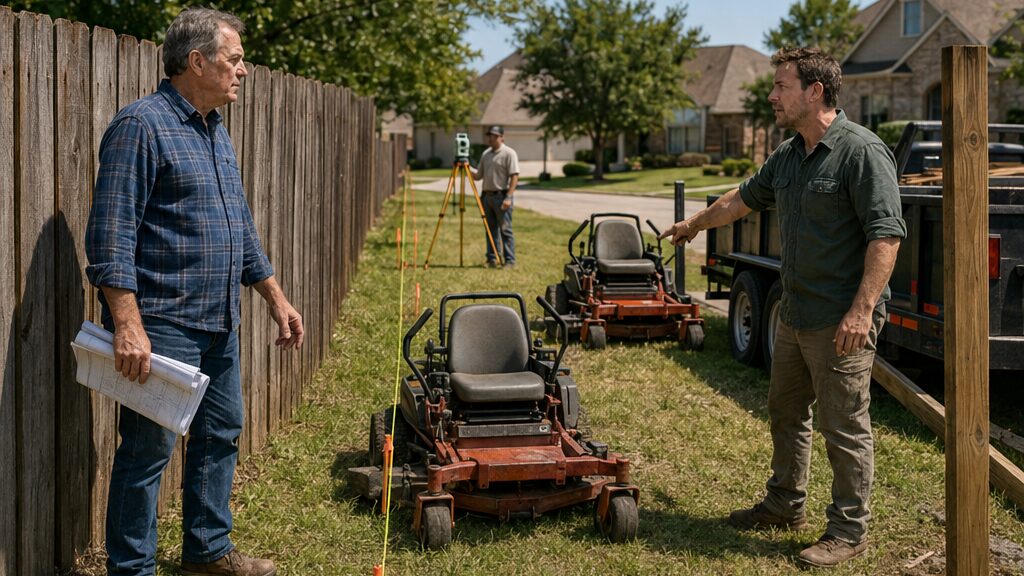
When William Miller opened his side gate at 6:47 Monday morning, two commercial zero-turn mowers were sitting where his wheelbarrow should have been able to pass.
One was angled toward the wooden fence. The other sat almost parallel to it, dew shining on its black seat. Beyond them, a landscaping employee was lowering another machine down the ramp of a white trailer.
William stood with one hand on the gate.
“Morning,” the employee said.
William looked at the mower, then at the narrow strip of grass between the fence and Joshua Brown’s driveway.
“Morning. Why is that here?”
The employee glanced over his shoulder. “We’re loading out.”
“I can see that.”
The young man stopped moving.
William had lived in the house long enough to know every awkward corner of the property. The cedar fence along the east side had been there since before he inherited the house from his father. It ran straight from near the rear patio toward the front, leaving a narrow strip of grass on Joshua’s side.
William had always thought the strip looked odd.
He had never thought much more than that.
Another worker came through Joshua’s driveway carrying a blower. He set it beside the mower.
William pointed.
“That equipment needs to be moved.”
The first worker hesitated. “You’ll have to talk to Joshua.”
“Is he here?”
“He’s coming.”
William closed the gate behind himself instead of going back inside.
By seven, a pickup rolled into Joshua’s driveway. Joshua stepped out with a travel mug in one hand and a phone in the other. At forty-something, he still moved with the quick, compressed energy of someone whose day was always five minutes behind him.
He saw William and sighed before he reached the fence.
“What’s going on?”
William nodded toward the mowers.
“Your crew is staging equipment beside my fence.”
Joshua looked at the machines as if William had pointed out a cloud.
“Yeah.”
“On my property.”
That got his attention.
Joshua lowered the coffee.
“No, it isn’t.”
William waited.
Joshua gestured toward the fence. “That’s your yard. This is ours.”
The confidence in his voice irritated William more than the equipment did.
“The fence isn’t necessarily the property line.”
Joshua gave a short laugh. “It’s been the line since before I bought the place.”
“That doesn’t answer what I said.”
“It’s always been on our side, William.”
One of the employees looked suddenly fascinated by a ratchet strap.
William glanced down at the grass. It was perhaps three feet wide in most places, narrower near the back. Fresh tire marks cut through the damp surface. He could see where mower wheels had repeatedly traveled over it.
“How long have you been doing this?”
“Doing what?”
“Using this strip.”
Joshua’s expression changed, just slightly.
“For years.”
“You never asked me.”
“Why would I ask you to use my own side yard?”
William disliked arguments that began by pretending the disputed point had already been settled.
“Move the equipment for today.”
Joshua stared at him.
“We’re trying to get three crews out before traffic gets bad.”
“I’m not stopping your crews. I’m asking you to keep your equipment on property you know belongs to you.”
“I do know.”
“No. You’re assuming.”
Joshua stepped closer to the fence.
“And what are you doing?”
“Checking.”
Joshua shook his head.
“Fine. Check whatever you want. But don’t start telling my guys they can’t work because you suddenly decided the fence is wrong.”
William said nothing.
That silence was an old habit. At work, before retirement cut his schedule down to occasional consulting, people had learned that when William stopped talking, he was usually gathering facts. He trusted measurements more than tone and records more than memory.
Joshua interpreted the silence differently.
He turned to his crew.
“Get loaded.”
The mowers stayed.
William went inside.
He did not call the HOA. He did not knock on Joshua’s door again. He did not send an angry text.
He went to the filing cabinet in the room that had once been his father’s office.
The deed was where he expected it, inside a folder with tax records and old insurance paperwork. William spread the pages across the desk and found the legal description.
Numbers.
Bearings.
Distances.
Nothing that immediately told him whether a mower was sitting on his land.
He opened the county property website and pulled up the parcel map.
The online graphic was approximate, but the dimensions bothered him.
He took a tape measure outside.
From the opposite side boundary to the fence, the width of his enclosed yard came up short.
He measured again.
Then a third time.
It was not inches.
Even allowing for his crude method, something was off by several feet.
William walked the length of the wooden fence slowly.
On Joshua’s side, the landscaping crew had departed. The strip looked harmless again, nothing but flattened grass and a few dark tracks.
Three feet.
Maybe a little more in places.
For years, William had treated it as the meaningless space outside his fence.
Joshua had apparently treated it as useful space inside his property.
William went back to the computer and enlarged the county map.
The dimensions did not change.
His lot extended farther east than the fence did.
Several feet farther.
He printed the parcel page and set it beside the deed.
For the first time that morning, the irritation left him.
What replaced it was suspicion.
The question was no longer why Joshua had parked two mowers there.
The question was why William’s fence had been built three feet inside what appeared to be his own property.
Chapter 2: Three Feet Beyond the Wooden Fence
The archived plat showed the boundary line running through the place where Joshua’s crew parked its mowers.
William stared at it long enough for the county records clerk to ask whether he needed another copy.
“No,” he said. “I just want to make sure I’m reading this correctly.”
The clerk leaned closer without offering an opinion about ownership.
“This is the recorded survey associated with that filing.”
“And this dimension here?”
She pointed to the number.
“That’s the distance shown.”
William wrote it down.
By the time he left the county office Tuesday morning, he had a certified copy of the older plat, his current deed information, and less patience than he had arrived with.
But he still did not confront Joshua.
Instead, he called a licensed surveyor.
The surveyor came Wednesday morning carrying equipment that made William’s tape measure look childish. He worked quietly, checking records first, then measuring from known points along the property.
Joshua’s landscaping trailer arrived at 7:05.
Two employees unloaded equipment onto the grass exactly as they had Monday.
William watched from his driveway.
The surveyor did not.
He moved along the line, scanning, measuring, checking notes.
Near the rear third of the yard, he stopped.
“There should be something around here.”
He scraped away soil near a patch of thick grass.
A few minutes later, the tip of an old metal pin appeared.
William crouched beside him.
“That’s it?”
“That’s consistent with the recorded corner.”
The surveyor checked again before answering further.
When he established the line toward the front, the result became impossible to ignore.
The wooden fence sat inside William’s parcel.
Not by a few inches.
Roughly three feet.
The surveyor drove temporary stakes along the measured boundary and stretched a bright line between two points.
It ran directly through the area where Joshua’s workers routinely staged equipment.
One mower sat on the wrong side of it.
William felt something settle inside him.
For two days Joshua’s confidence had bothered him. Now William had measurements, an old pin, and a professional standing in his yard.
Evidence.
Something clean.
Something that did not depend on who spoke louder.
The first landscaping employee noticed the stakes.
He stopped beside the trailer.
“What are those?”
“Boundary markers,” William said.
The employee looked at the mower, then at William.
Joshua arrived less than ten minutes later.
He got out of his pickup and walked straight toward the line.
“What is this?”
William held out the copy of the plat.
“I had the boundary surveyed.”
Joshua barely glanced at the page.
“You put stakes through my yard.”
“The surveyor did.”
Joshua turned toward the licensed surveyor.
“You’re saying that’s the line?”
“I’m saying my measurements are consistent with the recorded plat and the existing monument we located.”
Joshua looked back at William.
“That fence has been there forever.”
“I know.”
“So now what? You found a piece of paper and suddenly three feet of my yard becomes yours?”
“It was never your yard.”
Joshua’s jaw tightened.
“You don’t know that.”
William unfolded the plat on the hood of his car.
“The county record says it. The monument says it. His measurements say it.”
For the first time, Joshua actually studied the document.
His eyes moved from the measurements to the stakes and back again.
The change in his face was small but unmistakable.
Confidence had become calculation.
Then he said, “This doesn’t make sense.”
William expected an argument.
Instead Joshua walked toward the old fence and looked along its length.
“My closing survey showed the fence.”
“A fence isn’t necessarily a boundary.”
“You think I don’t know that?”
“I think you told me Monday that it was.”
Joshua ignored the comment.
He stepped across the line and pointed toward the rear.
“This setup existed before I bought my house.”
“That may be true.”
“The previous owner used this side. I’ve used it since I moved in. Nobody ever told me different.”
William folded the plat.
“I’m telling you now.”
Joshua looked at the stakes again.
“What are you planning to do?”
William had not intended to answer yet.
That was how he preferred to operate: verify first, decide second, announce last.
But he had already called a fence contractor for an estimate.
“The fence belongs on the property line.”
Joshua stared at him.
“You’re moving it?”
“I’m considering correcting it.”
“Correcting.”
“Yes.”
Joshua gave a humorless laugh.
“You’re talking about taking three feet off the side I’ve been using for years, and you call it correcting.”
“It isn’t taking anything from you if it was never yours.”
One of the employees quietly moved the mower back across the survey line.
Joshua saw him do it.
That seemed to make the measurement more real than anything William had said.
“Don’t move those markers,” William said.
Joshua looked at him sharply.
“You think I’m going to pull them up?”
“I’m telling everyone the same thing.”
“No. You’re telling me.”
William could have softened it.
He did not.
“I’m making sure there’s no misunderstanding.”
Joshua walked away without answering.
By noon, the fence contractor had measured the entire run. Replacing the existing fence on the surveyed line would cost more than William wanted to spend, but not enough to make him abandon the idea.
The contractor had an opening Thursday.
“Tomorrow?”
“If you want it.”
William looked through the kitchen window at the stakes.
Three feet of grass.
That was all.
Yet he could already picture the new fence sitting where the bright line now ran.
He thought about walking next door.
He thought about telling Joshua that the contractor could come in the morning.
Then he remembered Joshua saying, You found a piece of paper and suddenly three feet of my yard becomes yours?
William picked up his phone.
“Thursday works,” he told the contractor.
He ended the call without sending Joshua a message.
Chapter 3: Thursday Morning Changed Both Yards
By the time Joshua’s pickup turned into the driveway Thursday morning, six sections of the old fence were already lying flat on William’s grass.
The contractor’s crew had arrived at 6:30.
William had been outside before them.
He told himself it was because he wanted to verify the work.
It was only partly true.
At 7:03, the landscaping trailer appeared.
Joshua braked harder than usual.
His two employees climbed out, then stopped when they saw the open gap where the fence had stood.
Stacks of weathered cedar boards lay near William’s patio. Fresh holes marked the surveyed line three feet farther toward Joshua’s side. A string stretched between stakes, straight and undeniable.
Joshua closed his truck door.
“What the hell are you doing?”
The fence contractor looked toward William.
William stepped forward.
“Moving the fence to the surveyed boundary.”
“Today?”
“Yes.”
“You didn’t think to tell me?”
William kept his voice level.
“You knew I was considering it.”
“I knew you were talking about it.”
“The survey was completed yesterday.”
“That isn’t what I asked.”
Behind Joshua, one employee lowered the trailer ramp halfway and stopped.
Joshua pointed toward the strip.
“My crews use this every morning.”
“I know.”
“No, I don’t think you do.”
He turned toward the trailer.
“We stage two mowing crews here. Sometimes three. We move machines between trailers here. We fuel at the shop, bring everything here, and roll out. You push that fence over and I lose the entire working lane.”
William looked past him.
For the first time, he saw the arrangement as a system rather than an annoyance.
Mowers came off one trailer and were matched to another. Hand tools rested against the fence while workers reorganized equipment. The narrow strip was not merely where Joshua sometimes parked something.
It functioned as a small outdoor loading bay.
“How long has it been part of your operation?” William asked.
Joshua looked almost offended.
“Six years.”
“You’ve been running commercial equipment across my property for six years.”
“I thought it was mine.”
“You never checked.”
Joshua stepped closer.
“Neither did you.”
That landed harder than William expected.
The contractor called from the line.
“William, we’re ready for the first posts.”
William turned.
“Go ahead.”
Joshua stared at him.
“That’s it?”
“The boundary has been verified.”
“I’m not arguing about the survey right now.”
“What are you arguing about?”
“The fact that you knew yesterday this would shut down the way my crews leave in the morning, and you said nothing.”
William felt the familiar urge to retreat into facts.
The deed.
The survey.
The iron pin.
The measurements.
Instead he said, “Your business shouldn’t depend on land you don’t own.”
Joshua’s expression hardened.
“That’s a good line when it isn’t your payroll.”
One of the crew members shifted awkwardly near the trailer.
Joshua noticed and lowered his voice.
“I’ve got jobs booked today. These guys need to get out.”
William looked at the mowers.
“You can load from your driveway.”
“Not all of it at once.”
“Then change the order.”
Joshua gave a short laugh.
“You think a business rearranges itself in ten minutes because you decided to make a point?”
“I’m not making a point.”
“Then why didn’t you knock on my door last night?”
William had no answer that sounded as good aloud as it had in his own head.
Because I had proof.
Because I didn’t owe you permission.
Because every conversation with you becomes an argument.
None of those answered the actual question.
The contractor started setting the first post.
The auger bit into the ground directly along the surveyed line.
Joshua watched it turn.
For a moment, neither man spoke.
Then Joshua told his employees to move the equipment.
They worked around the narrowing space, loading one mower, shifting another, backing the trailer farther into the driveway. The process took longer than usual. One employee had to guide the truck while the other squeezed a mower through a tight angle.
William stood near the old fence boards.
The new line looked correct.
That gave him less satisfaction than he had expected.
By midmorning, several posts were set. Each stood approximately three feet beyond the location of the former fence.
The visual difference was startling.
A strip that had seemed almost incidental now looked substantial because it was being physically absorbed into William’s enclosed yard.
Joshua returned around eleven.
He carried a folder.
William assumed he had brought his closing papers.
Instead Joshua handed him a printed page.
“I called the management company.”
William looked down.
It was an HOA architectural request form.
“You’re reporting my fence?”
“I’m asking whether you have approval to relocate it.”
“It’s my fence on my property.”
“That isn’t the same question.”
William felt irritation rise again.
“You’ve been using my land commercially for six years, and now you’re worried about HOA procedure?”
“I’m worried because you moved a structure overnight without saying anything.”
“I didn’t move it overnight.”
“You know what I mean.”
William handed the page back.
“I’m correcting an existing fence.”
Joshua shook his head.
“You’re relocating it three feet.”
“To the boundary.”
“And the HOA may require approval.”
The contractor approached slowly.
“We can keep working,” he said to William, “but if there’s an association issue, that’s between you and them.”
William looked at the line of new posts.
For the first time since finding the old survey, the facts did not form a complete shield.
He had checked ownership.
He had checked measurements.
He had hired a licensed professional.
He had not checked whether the association required approval for relocating an existing fence.
Joshua seemed to read the realization.
“I’m not saying the land is mine,” he said.
That surprised William.
Joshua looked toward the stakes.
“I’m saying you don’t get to do this like nobody else exists.”
William folded his arms.
“You told me two days ago it was your yard.”
“I believed it was.”
“And now?”
Joshua hesitated.
“Now I believe your survey may be right.”
The admission was so quiet William almost missed it.
“Then why fight the fence?”
Joshua looked toward his trailer.
“Because being wrong about three feet doesn’t magically give me somewhere else to put ten thousand pounds of equipment tomorrow morning.”
There it was.
Not ownership.
Dependence.
William had wanted Joshua to admit the survey was valid. He had imagined that admission ending the dispute.
Instead it opened another one.
By late afternoon, the new posts were all set, but the fence contractor had not installed every panel. William had decided to stop at a workable point until he confirmed the HOA rules.
At 5:20, Joshua came back from his final job.
He stood beside the new posts and looked along the changed line.
The grassy strip was effectively gone from his side.
“You could have given me one day,” he said.
William replied, “You could have asked before building a business routine on land you didn’t own.”
Joshua nodded once.
“That’s fair.”
William did not expect that either.
Then Joshua added, “But you still could have given me one day.”
He walked toward his house.
At the driveway, he stopped.
“The board president is reviewing it tonight.”
William turned.
“Katherine Davis?”
Joshua nodded.
“I sent her the survey too. I’m not hiding that part.”
“What exactly are you asking for?”
“A stop until they review the fence.”
William looked at the new posts standing precisely where the measurements said they belonged.
For two days, he had believed the survey would settle everything.
Joshua opened his truck door.
“Oh, and they found an old file on the original fence.”
William’s attention snapped back to him.
“What file?”
Joshua looked over the truck roof.
“Katherine said the HOA approved that setback years ago.”
Then he got in and drove away, leaving William beside a fence line that was legally clear and suddenly much less simple.
Chapter 4: The HOA Found an Older Approval
Katherine Davis placed a yellowed architectural approval on the clubhouse table before William had finished sitting down.
The paper was more than twenty years old.
Across from him, Joshua rested both hands on a closed folder. He did not look pleased. He looked tired.
Katherine tapped the document once.
“This is why I asked the contractor not to finish the fence today.”
William pulled the paper closer.
The HOA clubhouse was barely large enough for the table, six padded chairs, and a cabinet filled with binders. A property-management representative sat beside Katherine with a laptop open. Two other board members occupied the far end.
William read the date twice.
The approval had been issued when his father still owned the house.
“This says replacement fence,” William said.
“It says the application was approved,” Katherine replied.
“At the old location?”
“That appears to be what the submitted drawing shows.”
Joshua leaned forward.
“So the fence wasn’t accidentally put in the wrong place.”
William looked at him.
Joshua opened his folder and slid over a copy of the same diagram.
“The setback was known.”
“Known by whom?”
“Your father. The HOA. Whoever owned my house back then.”
“That doesn’t make the strip yours.”
“I didn’t say it did.”
“You did Monday.”
Joshua’s mouth tightened.
Katherine raised a hand.
“We’re not going to replay Monday.”
William turned back to the paper.
The drawing was crude, but clear enough. A property boundary had been sketched in one line and the proposed fence in another, several feet inside it.
William had spent three days believing somebody had simply measured badly decades ago.
Now the mistake appeared deliberate.
The property-management representative adjusted her laptop.
“We checked the association records we have. There is nothing showing a transfer of land, an easement, or a permanent right of access.”
William looked at Joshua.
Joshua said, “But there is proof everyone knew where the fence was.”
“Yes,” Katherine said. “Those are different things.”
It was the first statement that morning William agreed with completely.
He leaned back.
“Then ownership is settled.”
“Ownership may be,” Katherine said. “The fence process isn’t.”
William felt his shoulders stiffen.
“I’m replacing an existing fence.”
“You’re relocating an existing fence.”
“To my boundary.”
“I understand that.”
“Then why are we here?”
Katherine folded her hands.
“Because the association has architectural rules, because your contractor changed the footprint before approval was confirmed, and because your neighbor filed a complaint before the work was complete.”
William glanced toward Joshua.
“You knew the survey was probably right when you filed?”
Joshua did not answer immediately.
Katherine said, “We’ll get to that.”
William disliked the phrasing.
He had come expecting to show the survey, establish ownership, and leave.
Instead the table now held two separate facts that refused to cancel each other: his boundary was real, and the old fence had apparently been placed inward on purpose.
Joshua opened his folder again.
“My understanding when I bought my house was that the fence separated the lots.”
“From whom?” William asked.
“The seller. The way the property was used. The fact that nobody objected for years.”
“None of those are a survey.”
“No. They aren’t.”
Joshua’s willingness to concede small points made William more uneasy than arguing would have.
Joshua continued.
“But if your father intentionally put the fence there, then this wasn’t some forgotten mistake I took advantage of.”
William stared at the old approval.
“You still ran a business over land you didn’t own.”
“I ran equipment over a strip everybody treated as part of my side.”
“Everybody except the deed.”
Joshua gave a tired exhale.
“There you go again.”
“Go where?”
“Back to the paper like that answers every part of it.”
William pushed his chair back half an inch.
“It answers the part about whose land it is.”
One of the board members shifted.
Katherine looked directly at William.
“And no one here is disputing that the deed matters.”
“Then what exactly are you disputing?”
“Your process.”
The word irritated him more than it should have.
Katherine continued.
“You had the survey Wednesday. You hired a contractor for Thursday morning. Did you tell Joshua the fence would be moved before the crew arrived?”
“He knew I was considering it.”
“That isn’t what I asked.”
William heard Joshua’s question from the day before in almost the same words.
“No.”
Katherine nodded once.
“Did you submit an architectural modification request before relocating the fence?”
“I believed it was a correction.”
“That is also not what I asked.”
“No.”
The room became quiet.
William looked down at the approval again.
For the first time, the fence itself seemed less like proof of somebody else’s mistake and more like evidence of a decision he did not understand.
The management representative turned the old document toward him.
“There’s an attachment.”
William had not noticed the second page because it was clipped behind the diagram.
It was a photocopy of a handwritten note.
Most of the writing was faded.
William could make out only fragments.
Access.
Mower.
Keep clear.
He felt something tighten in his chest.
“I need a better copy.”
“This is all we have,” Katherine said.
Joshua leaned over slightly.
“What does it say?”
“I don’t know.”
William read it again.
The handwriting looked familiar, but old documents often did that. His father had written in blocky capital letters on labels, receipts, garage shelves, even plastic freezer containers.
Rachel would know.
She had spent far more time sorting their grandfather’s things after he died than William had.
Katherine pulled the papers back.
“For now, the board is asking both sides to maintain the current condition. No commercial equipment on the disputed strip, and no additional fence panels until Monday’s review.”
“Disputed?” William said.
“The use is disputed. Not necessarily the deed.”
“That distinction matters.”
“I know.”
Joshua looked at Katherine.
“So I can’t stage there?”
“No.”
His face fell.
“For the entire weekend?”
“Yes.”
“I have crews Saturday.”
“Then make other arrangements.”
William expected to enjoy hearing that.
He did not.
Joshua closed his folder.
Katherine looked at William again.
“And you don’t finish the fence.”
William nodded reluctantly.
The meeting ended without anyone winning.
At home, he spread the county survey, the HOA approval, and his contractor invoice across the desk.
The documents no longer lined up into one clean story.
The survey said the strip belonged to him.
The HOA drawing said his father knew the fence was inside the line.
And the faded note suggested the gap had something to do with a mower.
Rachel arrived shortly after six carrying takeout she set unopened on the kitchen counter.
“You sounded strange on the phone,” she said.
William handed her the photocopy.
She read it standing beneath the kitchen light.
Then she stopped.
“What?”
Rachel lifted the page closer.
“That’s Grandpa’s handwriting.”
“You’re sure?”
She looked at him as though the question itself was ridiculous.
“He used that same block lettering on everything.”
William pointed to the faded line.
“Can you read this?”
“Not all of it.”
She traced one line with her finger.
“‘Leave room for his mower,’ maybe.”
William said nothing.
Rachel looked toward the back window, where the unfinished new posts stood beyond the old fence line.
“Dad.”
“What?”
“This wasn’t a mistake.”
William took the page from her.
Rachel was already reaching for her keys.
“There are still boxes of Grandpa’s papers in the closet upstairs.”
William looked again at the words he had spent all week wishing someone had written down.
His father apparently had.
The question was no longer why the fence had been built three feet inside the property line.
It was what, exactly, his father had promised when he did it.
Chapter 5: Why My Father Left the Gap
Rachel found the note in a cardboard box labeled HOUSE—OLD before William finished opening the second carton.
“There.”
She was sitting on the floor of the spare bedroom with papers spread around her knees.
William took the sheet.
Unlike the HOA photocopy, this one was legible.
His father’s handwriting filled half a page.
Fence moved in about 3 ft. Leave room for his mower so he can get from front to back without tearing up the drainage edge. No property change. Just neighbor arrangement.
William read it twice.
Rachel watched him.
“That’s pretty clear.”
“Yes.”
She picked up another paper.
“There’s more.”
It was an old contractor estimate with a sketch on the back. The fence line had been moved inward around a narrow drainage area between the properties. A handwritten arrow marked the gap.
William sat on the edge of the bed.
For four days, he had pictured the three-foot strip as evidence of neglect.
Somebody had put the fence in the wrong place.
Somebody had failed to check.
Somebody had created a problem that eventually became his.
But his father had known exactly what he was doing.
Rachel leaned against the closet door.
“Who owned Joshua’s house then?”
“I don’t remember.”
“You lived here.”
“I was already working across town. I wasn’t keeping track of Dad’s neighbors.”
She gave him a look.
William ignored it.
He returned to the note.
“‘Without tearing up the drainage edge.’”
“So Grandpa was helping him.”
“Helping the old neighbor.”
“Right.”
“Not Joshua.”
Rachel waited.
William knew what she was waiting for.
“That matters.”
“It does.”
“It wasn’t an easement.”
“I didn’t say it was.”
“He specifically wrote no property change.”
Rachel nodded.
William set the note on the bed.
“Then this supports me.”
Rachel’s expression shifted.
“That’s what you got from it?”
“It establishes intent.”
“It establishes more than that.”
“What?”
“That Grandpa let somebody use the strip because it made their life easier.”
William frowned.
“And because he didn’t write down a formal agreement, I’m supposed to keep doing it forever?”
“No.”
“Then what are you saying?”
“I’m saying you keep looking for a document that tells you whether you’re allowed to be angry.”
He stared at her.
Rachel continued before he could answer.
“You were right to check the property line. Joshua was wrong to assume. But Grandpa created this arrangement on purpose, and whoever came after him probably treated it like normal.”
“Joshua runs a landscaping business off it.”
“Yes.”
“That is not a neighbor pushing a mower from the front yard to the back.”
“No.”
William picked up the note.
That distinction mattered.
His father had given a neighbor enough room to pass a residential mower. He had not donated a commercial staging lane. Nothing in the papers suggested permanent access, business use, or transferred ownership.
The discovery did not make Joshua right.
It merely made the beginning of his mistake understandable.
Rachel found another photograph beneath a stack of tax papers.
It showed the old fence shortly after installation. The strip was visible beside it, wider and cleaner than William remembered. A push mower sat near the rear corner.
“No trailers,” Rachel said.
“No zero-turn machines either.”
She handed him the photograph.
“Joshua may not know any of this.”
“He filed the old HOA approval.”
“Katherine found it.”
William considered that.
Joshua had possessed evidence that the fence had long been treated as the division between the yards. He did not appear to possess the handwritten note defining the original favor.
That meant he could have genuinely believed he had inherited something permanent.
Not ownership, perhaps.
But permission.
William disliked the sympathy the thought produced.
It was easier when Joshua was simply wrong.
His phone buzzed on the dresser.
A message from Joshua.
There was no greeting.
First storage place I called. This is what I’m looking at.
An image followed.
It was a commercial lot quote.
Monthly rent, security deposit, access conditions, insurance requirements.
William read the monthly figure and then the deposit.
Rachel glanced over.
“That bad?”
“It’s not nothing.”
“Can he afford it?”
“He owns a landscaping company.”
“That’s not an answer.”
William set the phone down.
He remembered Joshua on Thursday morning saying, That’s a good line when it isn’t your payroll.
At the time, William had heard it as manipulation.
Now he pictured the two employees standing beside the trailer while Joshua tried to reorganize the morning in a driveway too narrow for the routine he had built.
Rachel returned the papers to a neat pile.
“What are you going to do Monday?”
“Establish that the fence stays on the surveyed line.”
“And after that?”
“That is after that.”
“No. That’s the property question.”
William looked at her.
“You sound like Katherine.”
“Maybe Katherine has a point.”
He gave her a flat look.
Rachel smiled briefly, then grew serious.
“Dad, you don’t have to give him the strip.”
“I’m not going to.”
“I know. But you also don’t have to act like telling him something before you do it is the same as asking his permission.”
William went still.
She had found the exact distinction he had spent the week avoiding.
When his father was alive, William had often been frustrated by informal arrangements like this. Tools loaned without receipts. Favors remembered differently by different people. Handshake understandings that later became somebody else’s responsibility.
William had built his adult life around preventing that kind of ambiguity.
Records.
Schedules.
Confirmation.
Yet when his own dispute arrived, he had gathered everything except the one thing that might have prevented Thursday morning’s confrontation.
A conversation.
His phone buzzed again.
Another message from Joshua.
Two other places are full. This one can take me next month, not Monday.
William did not answer immediately.
Rachel watched him.
“You’re enjoying making him wait?”
“No.”
“Then why are you?”
William picked up the phone.
Because he did not know what to say without weakening his position.
That was the truth, and he disliked it.
Finally he typed:
I found paperwork explaining why the old fence was set back. We should discuss it at Monday’s meeting.
He paused.
Then added:
The original arrangement was for mower access. It did not transfer the land.
Joshua replied several minutes later.
That makes more sense than anything I’ve heard all week.
A second message appeared.
Doesn’t solve Monday morning.
William stared at those four words.
The legal question was becoming simpler.
The human one was becoming harder.
On the bed beside him lay his father’s note about leaving room for a mower.
On his phone was a commercial-storage quote Joshua could not make effective for weeks.
William still intended to reclaim every inch inside his deed.
What he no longer knew was whether justice required reclaiming it all at once.
Chapter 6: The Meeting Was No Longer About Ownership
Katherine Davis opened Monday night’s meeting with a question William had not prepared for.
“Do you want your property back,” she asked, “or do you want Joshua punished?”
Nobody moved.
William had placed the certified survey in front of him. Beside it lay the photograph of the old fence and his father’s handwritten note.
Across the table, Joshua stared at Katherine.
“That’s a loaded question.”
“It’s addressed to William.”
William folded his hands.
“I want my property returned to my exclusive use.”
“That answers the first half.”
“It should answer the whole thing.”
Katherine shook her head.
“No. Because the board can address several things tonight, and the consequences are different.”
The property-management representative opened a folder.
Katherine continued.
“The surveyor’s documentation confirms William’s deeded boundary. We found nothing granting an easement or transferring ownership of the strip.”
Joshua looked down.
William felt the satisfaction he had expected days earlier.
It lasted perhaps two seconds.
Katherine added, “We also confirmed that the original fence setback was approved by the association based on the former owner’s request.”
William slid his father’s note toward the center.
“We found the reason.”
Katherine read it.
Then Joshua did.
His eyes stopped on the line about mower access.
“So he did let them use it.”
“For a mower,” William said. “Residential access. Not commercial staging.”
Joshua nodded slowly.
“I see that.”
William had expected resistance.
Again Joshua refused to give him the clean fight he had imagined.
Katherine turned to Joshua.
“When did you first believe William’s survey was probably accurate?”
Joshua rubbed his thumb along the edge of the note.
“Wednesday.”
William looked at him sharply.
Before William could speak, Katherine asked, “Before you filed the complaint?”
“Yes.”
“Then why did you tell management there was an unresolved ownership question?”
Joshua sat back.
“Because there was, as far as I was concerned.”
“You just said you thought his survey was probably accurate.”
“I thought the boundary was probably accurate. I didn’t know whether the old setup gave my property some kind of access right.”
“Did you ask an attorney?”
“No.”
“Did you locate an easement?”
“No.”
“Did you tell management you had already seen William’s survey?”
Joshua hesitated.
“Not in the first email.”
William felt heat rise into his face.
“So you knew.”
Joshua looked at him.
“I knew enough to realize I had a problem.”
“And you tried to stop me anyway.”
“Yes.”
The single word changed the room.
Joshua leaned forward.
“I needed time.”
“You could have asked.”
“I did Thursday.”
“After the contractor arrived.”
“Because Thursday was the first time I knew you were actually moving the fence.”
William almost answered, then stopped.
That was true.
Joshua looked toward Katherine.
“I’m not proud of how I worded the complaint. But I had employees scheduled, trailers loaded, jobs booked, and nowhere lined up to put everything. I thought if the board paused him for a few days, I could figure something out.”
“So you used the HOA process to buy time,” Katherine said.
“Yes.”
The admission sounded worse than an excuse because Joshua did not try to decorate it.
William looked at the photograph of the old fence.
For the first time, he understood the shape of the conflict without deciding who deserved to feel righteous.
Joshua had inherited an assumption.
Then he had expanded it into a business convenience.
When challenged, he had resisted.
When the evidence became strong, he had still manipulated the HOA process to delay the consequence.
William had done something different but not entirely unrelated.
He had discovered the truth.
Then he had scheduled an irreversible correction without warning Joshua because he did not want a conversation that might complicate his certainty.
Katherine addressed William.
“The board’s position is that the surveyed boundary is valid for association purposes unless a court or corrected deed says otherwise.”
William nodded.
“The relocated fence may be approved?”
“Subject to normal architectural requirements, yes. The setback rule does not require you to leave three feet outside your fence.”
Joshua exhaled.
It was finished.
At least the part William had thought mattered most.
Then the management representative spoke.
“There is another issue.”
William looked at her.
“The commercial use.”
Joshua’s expression tightened.
The representative continued.
“The association rules limit regular business operations involving equipment storage and staging on residential lots. The board has historically distinguished someone keeping work tools at home from operating a daily dispatch point.”
Joshua leaned back.
“You’re saying I can’t stage from my property either?”
Katherine answered.
“We’re saying the level of activity described in your complaint caused us to review it.”
Joshua stared at her.
“So by filing this, I reported myself.”
“No one is trying to be clever about it,” Katherine said. “But yes, the board now has information it can’t ignore.”
William looked across the table.
This was the punishment Katherine had meant.
The board could enforce not only the boundary but Joshua’s entire residential staging operation.
“What happens now?” Joshua asked.
“You would normally receive a compliance notice and a deadline.”
“How long?”
“Given the scale, potentially short.”
Joshua gave a quiet laugh with no humor in it.
“My lot doesn’t open for three weeks.”
Katherine looked at the management representative.
“The board has discretion on the compliance period.”
One board member spoke for the first time.
“If we allow the operation to continue after formally identifying it, we create a problem.”
The other added, “And there have been noise complaints before.”
Joshua looked toward the far end.
“From who?”
“We’re not discussing other owners.”
Joshua shook his head.
“I’m not asking to run it forever. I’m asking for time to move.”
William looked down at the survey.
His property line was confirmed.
The fence could remain.
Joshua had admitted he knew enough to doubt his own claim and had used the HOA process to delay William.
William had every reason to let the board proceed.
A week earlier, he would have done exactly that.
He imagined the strip empty the next morning.
No mowers.
No trailer ramps.
No workers.
No tire tracks.
Complete enforcement.
Complete vindication.
Then he pictured his father’s note.
Leave room for his mower.
His father’s solution had been too informal, too dependent on goodwill, too poorly documented.
William had spent years resenting that kind of looseness.
But the mistake was not the generosity.
The mistake was failing to define its limits.
Katherine looked at him.
“You’re the most directly affected neighbor. Do you want immediate cessation?”
Joshua’s eyes shifted toward William.
William disliked having the power so openly placed in front of him.
He could say yes.
No one could reasonably accuse him of cruelty. Joshua had been using his property. Joshua had continued after the survey. Joshua had filed a misleading complaint.
William looked at Joshua.
“When can the commercial lot actually take your equipment?”
“Three weeks. Maybe a few days sooner.”
“Do you have anywhere else in the meantime?”
“A couple trailers can stay at job sites overnight. Some equipment can fit behind my garage. Not all of it safely.”
“Safely?”
“Without blocking the sidewalk or stacking machines where somebody can steal them.”
William nodded.
Katherine waited.
He could feel everyone expecting him to choose a side.
Instead he said, “The fence stays on the surveyed line.”
Joshua nodded once.
“That was already decided,” Katherine said.
“I know. I’m making the condition clear.”
William turned to Joshua.
“No equipment crosses that new line again. Not a wheel, not a ramp, not a blower leaning against the fence.”
“Understood.”
“You move what you can immediately.”
Joshua nodded.
“And you get three weeks for the rest.”
One board member frowned.
“William—”
He raised a hand.
“I’m not asking the board to ignore the rule. I’m asking you to set the compliance deadline three weeks from today.”
Katherine studied him.
“Why?”
William glanced at his father’s note.
“Because the old arrangement existed for a reason. It wasn’t meant for what it became, and Joshua should have checked before relying on it. But I should have told him before a contractor showed up.”
Joshua looked at him.
William continued.
“I was right about the line. I handled the correction badly.”
The admission felt more uncomfortable than any argument that week.
Katherine said, “And if Joshua doesn’t comply by the deadline?”
“Then enforce it.”
Joshua leaned forward.
“I will.”
William looked at him.
“Put it in writing.”
A faint change crossed Joshua’s face.
Not quite amusement.
Recognition, perhaps.
“Of course you’d say that.”
“Yes.”
This time William almost smiled.
Katherine called for a brief recess. The board conferred at the far end of the room while William and Joshua remained seated.
After a minute Joshua said quietly, “I still think you should’ve knocked on my door.”
William kept his eyes on the survey.
“You’re right.”
Joshua seemed surprised.
William added, “And you should have stopped using the strip Wednesday.”
“You’re right.”
Neither apology erased anything.
That made them more useful.
When the board reconvened, Katherine announced the decision.
The relocated fence was approved subject to final inspection. William’s recorded boundary would be recognized for association purposes. Joshua would receive a three-week compliance period to end commercial staging from the residence, with no use whatsoever of William’s strip during the transition.
The management representative began preparing the written conditions.
Joshua read them carefully before signing.
Then the paper reached William.
He read every line.
Rachel would have laughed.
At the bottom was a blank for acknowledgment.
William signed.
As they stood to leave, Joshua gathered his folder.
“Three weeks,” he said.
“Three weeks.”
“And after that, nothing staged here.”
“Correct.”
Joshua nodded.
William expected him to leave.
Instead Joshua looked at the old photograph one more time.
“Your father sounds like he was trying to be decent.”
“He was.”
“Created a mess.”
“He did that too.”
Joshua gave a small, tired smile.
Then he left.
William stayed behind long enough to place his father’s note back inside its plastic sleeve.
For years, three feet of grass had carried an agreement nobody still understood.
Now the boundary was clear, the deadline was written, and the favor had limits.
What remained unanswered was whether Joshua would honor them without turning William’s restraint into one more thing he could take for granted.
Chapter 7: The New Fence Stayed, but So Did the Lesson
Joshua’s last mower left the strip before sunrise on the twenty-first day.
William heard the trailer gate rattle at 5:42 and went to the kitchen window.
He did not turn on the light.
Across the narrow space between the houses, one of Joshua’s employees guided a zero-turn mower up the trailer ramp while Joshua stood near the hitch checking something on a clipboard. No one crossed the bright line the surveyor had established weeks earlier. The equipment stayed entirely on Joshua’s driveway.
The strip itself was empty.
No blowers leaned against the unfinished fence. No fuel cans sat in the grass. No tire tracks crossed into William’s property.
Joshua closed the trailer gate and looked toward William’s house.
For a second, William wondered if he had seen him in the dark window.
Then Joshua climbed into the truck.
The trailer pulled away.
William checked the clock again.
The deadline was not until midnight.
Joshua had left more than eighteen hours to spare.
By seven, the fence contractor arrived to finish the remaining panels.
William met him outside with the HOA approval in one hand and the final survey sketch in the other.
The contractor smiled when he saw the bare strip.
“Looks quieter.”
“It is.”
“Still want it exactly on the marked line?”
William looked at the posts.
“Yes.”
No hesitation this time.
The crew worked steadily, setting the final rails and attaching the cedar boards. What had looked dramatic on the first Thursday now felt almost ordinary.
A fence being finished.
Boards aligned.
Posts checked.
A gate rehung.
The three-foot strip gradually disappeared from Joshua’s side and became part of William’s enclosed yard.
William stood where the old fence had been.
The difference was larger than he remembered.
Three feet across the length of the property was not nothing.
Enough room for a wheelbarrow.
Enough room for shrubs.
Enough room for a mower to pass.
Enough room, apparently, for two households to misunderstand each other for years.
Rachel arrived around noon with sandwiches.
She walked straight to the new fence.
“So this is it.”
“This is it.”
She stepped into the newly enclosed strip.
“It feels wider from this side.”
William nodded.
“When it was outside the fence, I barely noticed it.”
“That’s probably how Grandpa thought about it.”
William looked at her.
Rachel touched one of the new cedar boards.
“He saw three feet he wasn’t using and somebody else could use.”
“And didn’t think about what happened twenty years later.”
“No.”
William almost smiled.
“That part sounds like him.”
Rachel laughed.
They ate on the patio while the crew finished.
Near one, Joshua’s pickup appeared.
He parked in his own driveway and got out alone.
William watched him walk toward the fence.
Rachel lowered her sandwich.
“You want me to stay?”
“Yes.”
She looked surprised.
William added, “But don’t say anything unless you need to.”
“That sounds more like you.”
Joshua stopped several feet from the property line.
“Contractor almost done?”
“Another hour.”
Joshua nodded.
“The commercial lot opened early.”
William remembered the quote.
“You got in?”
“Yesterday.”
“How far?”
“About two miles.”
“That’s manageable.”
“It costs money.”
William waited.
Joshua glanced at Rachel, then back at him.
“I’m not saying that like it’s your fault.”
William appreciated the distinction.
Joshua leaned one shoulder against his truck.
“We moved most of the small equipment over the weekend. Trailers went yesterday. Last mower went this morning.”
“I saw.”
“Of course you did.”
There was no accusation in it.
Only recognition of William’s habits.
Joshua rubbed the back of his neck.
“The lot’s better in some ways.”
William raised an eyebrow.
“More room. Locked gate. I don’t have to shuffle trailers every morning.”
“Sounds terrible.”
Joshua gave a small laugh.
“The commute’s annoying.”
“Two miles.”
“With three crews, every day.”
“Fair.”
Rachel stood.
“I’m going inside.”
She gathered the empty wrappers before either man could object and left them alone.
Joshua watched the patio door close.
“She the one who found the note?”
“Yes.”
“Tell her thanks.”
William looked at him.
Joshua shrugged.
“I’d rather know what actually happened.”
“So would I.”
They stood without speaking for a moment.
The fence contractor started a saw farther down the line.
Joshua said, “I talked to the property-management representative.”
William waited.
“She said the board’s changing the architectural form.”
“How?”
“They’re adding a section for boundary verification whenever somebody relocates a fence.”
“That seems sensible.”
“And written neighbor notice.”
William looked at him.
Joshua smiled faintly.
“I figured you’d like the first part more.”
“I like both.”
That surprised Joshua enough to erase the smile.
William continued.
“I should have told you before the crew came.”
Joshua nodded.
“And I should’ve checked the survey years ago.”
“Yes.”
“Still think you enjoyed watching those posts go in.”
William considered lying.
“A little.”
Joshua laughed once.
It was the first uncomplicated sound between them in weeks.
Then his expression settled.
“I was angry because I thought you were taking something from me.”
“You thought it was yours.”
“I thought the use was mine.”
“That isn’t the same thing.”
“I know that now.”
William looked toward the new fence.
The contractor had reached the final section.
Joshua followed his gaze.
“My seller told me the fence was the division.”
William said nothing.
Joshua continued.
“The previous owner used that strip too. Not for commercial equipment like I did, but he mowed it. Stored trash cans there sometimes. I moved in and copied what I saw.”
“That explains the beginning.”
“Doesn’t explain six years of not checking.”
“No.”
Joshua looked down.
“That part’s mine.”
William had spent much of his life believing an admission should lead directly to a solution.
He was beginning to understand that sometimes an admission was the solution available.
Not friendship.
Not forgiveness.
Just accuracy.
The contractor called William over.
He checked the final post, the gate swing, the spacing, and the alignment against the survey points.
Everything was where it belonged.
William signed the completion form.
When he turned back, Joshua was still there.
“The management company wants written acknowledgment that I’m no longer staging commercially from the house,” Joshua said.
“Good.”
“I signed it this morning.”
“Good.”
Joshua gave him a look.
“You really do like paperwork.”
“Paperwork tends to remember what people forget.”
Joshua glanced at the fence.
“That’s probably the whole reason we’re standing here.”
William thought of his father’s note.
A favor remembered imperfectly.
A boundary remembered incorrectly.
An arrangement that had lasted longer than anyone who understood it.
“Yes,” he said. “Probably.”
Joshua stepped toward his driveway.
Then he stopped.
“I’m not going to pretend I’m happy about the storage bill.”
“I wouldn’t expect you to be.”
“And I’m not inviting you over for dinner.”
“That would concern me.”
Joshua smiled despite himself.
“But the fence is where it’s supposed to be.”
“Yes.”
“And three weeks was fair.”
William said nothing.
Joshua looked at him directly.
“More fair than I expected.”
Then he walked away.
The contractor left shortly after two.
For the first time in decades, William’s fence followed the same line as his deed.
He walked along it slowly.
The strip of grass no longer looked like disputed territory.
Inside the fence, it was simply yard.
Rachel came back outside carrying the plastic sleeve with his father’s note.
“You leaving that in a drawer?”
“No.”
William took it.
That evening, he sat at the old desk and placed the note beside the signed HOA decision, the final survey, and the contractor invoice.
Then he opened a blank document.
He wrote the date.
He wrote that the fence now followed the surveyed boundary.
He wrote that Joshua had been given temporary access only during the three-week transition, with no continuing right created by the accommodation.
He wrote that both parties acknowledged the arrangement had ended.
He printed two copies.
The next morning, he carried one next door.
Joshua opened the door holding a mug.
“What’s this?”
“Record of what we agreed to.”
Joshua took the page.
“You couldn’t leave well enough alone.”
William almost turned away.
Then he heard Joshua laugh.
He looked back.
Joshua was already signing.
William took the signed copy home and filed it with the survey.
Before closing the folder, he placed his father’s old handwritten note behind it.
Two generations of neighbor agreements.
One informal.
One precise.
William did not decide that his father had been wrong to leave three feet for another man’s mower.
He decided the kindness had deserved clearer boundaries.
Outside, the new fence stood straight along the legal line.
On Joshua’s side, the driveway was empty of trailers.
On William’s side, the reclaimed grass held nothing at all.
For once, three feet of yard did not have to mean anything more than three feet of yard.
The story has ended.