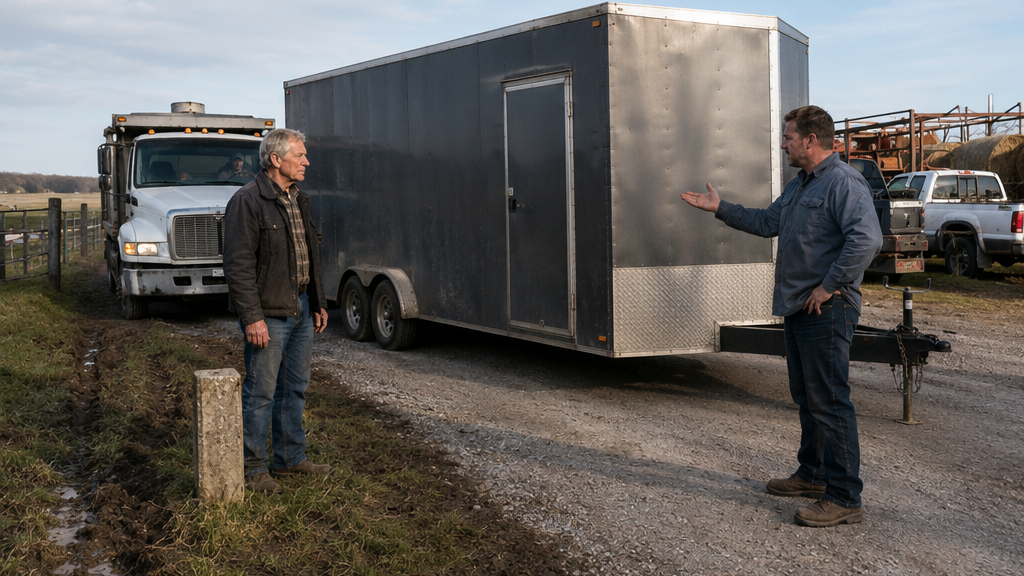
He Blocked the Farm Lane With His Work Trailer, Then Dared the Wrong Neighbor to Fight
Chapter 1: The Trailer Waiting in Donald’s Headlights
Donald Mitchell turned off the county road and hit the brakes so hard the feed bucket behind his seat struck the floor.
For a second, he thought he had taken the wrong driveway.
His headlights stopped against a wall of white metal.
An enclosed work trailer sat across the shared farm lane, angled enough that its rear wheels nearly touched one ditch while its tongue reached toward the other. Reflective strips flashed red and silver in Donald’s beams. A muddy company pickup was parked beyond it near Brian Clark’s place, but there was nobody outside.
Donald lowered his window.
Cold air came in carrying the smell of wet grass and diesel. The lane was silent except for the idling truck.
He had used this road for more than thirty years. His father had used it before him. It ran along the edge of Brian’s parcel for roughly two hundred yards before bending toward Donald’s cattle lot, hay ground, and house.
Tonight, it looked like somebody had decided it was a parking pad.
Donald leaned over the steering wheel, measuring the gap.
There wasn’t one.
He took out his phone and called Brian.
It rang until voicemail.
He tried again.
Nothing.
Donald set the phone on the console and stared at the trailer. Under ordinary circumstances, he would have backed out and dealt with it in the morning.
But he had already been on the road most of the day. There were mineral tubs in the pickup bed, medicine that needed to be put away, and cattle to check before he could stop for the night. More important, this was the only practical vehicle access to the rear portion of his property.
He got out.
His boots sank slightly into the damp shoulder.
Walking around the trailer only made the problem clearer. Whoever had backed it in had left perhaps five feet between the trailer and the fence on Donald’s side. The opposite shoulder dropped toward a shallow drainage swale.
Donald crouched near the grass.
The soil was dark and soft from two days of rain.
“Wonderful,” he muttered.
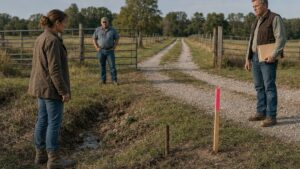
His headlights caught something farther ahead: a short, square concrete post nearly swallowed by weeds. Its top was chipped, one corner rounded from age.
The old easement marker.
Donald remembered helping his father clear brush around it when he was younger. Back then, his father had treated every marker and fence corner as though it were part of the family Bible.
Don’t move what was measured before you got here.
Donald had never cared for the phrasing, but he had remembered it.
He returned to the truck.
There was just enough room, he decided, if he put the right tires off the gravel and kept moving.
He shifted into four-wheel drive.
The front tire rolled into the grass.
Immediately the steering wheel pulled.
Donald eased onto the throttle.
The truck moved another six feet before the rear tires sank.
He felt it through the seat—the sudden soft drop, the engine taking weight.
“No.”
He straightened the wheel and gave it a little more fuel.
Mud sprayed behind him.
For one ugly second the truck barely moved.
Donald pictured himself calling for a tow from fifteen yards away from a perfectly usable road.
He backed half a foot, turned slightly toward the trailer, and tried again.
The truck climbed forward.
The passenger mirror passed the trailer with inches to spare. Donald could see the white metal side almost close enough to touch through the window.
Then the rear tires caught firmer ground.
He came back onto gravel beyond the trailer.
Donald stopped.
In his mirror, two dark ruts cut through the grass beside the road.
He sat with both hands on the wheel.
He had made it through.
That should have been the end of it.
Instead, the sight of those ruts bothered him more than the blocked lane itself.
Donald got out again and walked back with his phone.
Up close, the trailer was plainly commercial. Hoses were strapped beneath one side. Metal racks had been added to the roof. Muddy equipment cases were visible through a small rear window. Brian’s operation had grown over the last couple of years—from one pickup and a utility trailer to several trucks coming and going at irregular hours.
Donald had never objected.
People had to make a living.
He took three photographs: the trailer across the gravel, the narrow clearance beside it, and the ruts his truck had left in the grass.
Then he called Brian once more.
Straight to voicemail this time.
Donald nearly left a message.
He stopped himself.
He had a habit, his daughter had told him more than once, of waiting until he was furious before telling people something was wrong. He considered it patience. She called it storing ammunition.
Tonight, he did neither.
He sent a short text.
Your trailer is blocking the lane. I had to drive through the grass to get home. Please move it tonight.
He looked at the message for several seconds before pressing send.
There was no reply.
At the house, Donald put away the medicine and checked the cattle by flashlight. The chores settled him some, but not enough.
When he came inside, mud had dried in thick ridges along the truck’s rocker panels.
He washed his hands at the kitchen sink and glanced toward the dark window over it.
Brian’s lights were visible through the trees.
Donald could have driven over.
He could have knocked until somebody answered.
Instead, he made coffee he did not need and sat at the kitchen table.
Years earlier, his father had kept property papers in a metal document box. Donald had transferred most of the current records into a filing cabinet after the old man died, but he could not remember exactly what the shared-road document said.
He remembered “access.”
He remembered survey numbers.
He remembered his father saying the road could never be closed.
Memory, Donald knew, had a way of becoming more precise the angrier a man got.
That was reason enough not to trust it.
He left the papers alone.
For now.
Before going to bed, Donald stepped onto the porch.
The night had turned clear. Through the bare branches, he could make out the pale rectangle of Brian’s trailer where it still sat across the lane.
No movement.
No headlights.
No attempt to shift it even a few feet.
Donald went inside without calling again.
At dawn, the first thing he did was look from the front window.
The trailer was still there.
Chapter 2: He Called It Only a Driveway
Brian Clark smiled before Donald finished explaining what had happened to the truck.
Not a friendly smile.
Not quite a mocking one, either.
It was the look of a man who had already decided a problem was too small to deserve the amount of attention someone else was giving it.
Donald stood several feet from Brian’s porch steps, hands in the pockets of his work jacket.
“The shoulder’s soft,” Donald said. “I nearly buried the rear axle getting around you.”
Brian glanced toward the lane.
“So don’t drive on the shoulder.”
Donald waited.
Brian seemed to hear the stupidity in that only after he said it, but instead of correcting himself, he folded his arms.
“The trailer’s there for a couple days. I’ve got a job coming up.”
“The trailer is across the road.”
“It’s a shared road.”
“It’s shared for getting through.”
Brian exhaled through his nose.
“You’ve been getting through.”
Donald felt heat rise behind his collar.
That was the part Brian did not understand. Or perhaps understood perfectly.
Donald had managed to get around the obstruction once, so Brian was treating the obstruction as proof that there was no obstruction.
“I went through the grass.”
“And you got home.”
Donald looked at him for several seconds.
Brian was in his forties, thick through the shoulders, with the restless energy of someone whose phone rang all day. A year earlier, he had been complaining about not having enough work. Now Donald regularly saw company trucks leaving before sunrise.
He had been glad for him.
That made the conversation worse.
“I’m asking you to move it,” Donald said.
“I heard you.”
“When?”
Brian looked past him toward the trailer.
“Next job’s Thursday. It’ll go then.”
It was Tuesday.
Donald removed his hands from his pockets.
For a moment he almost said exactly what he was thinking: that Brian could hook to it right now, pull it fifty yards into his own yard, and end the entire conversation.
Instead he said, “The lane isn’t storage.”
Brian gave a short laugh.
“Come on, Donald. It’s a driveway.”
The word landed harder than it should have.
Only a driveway.
As if access to barns, cattle, deliveries, emergency vehicles, and Donald’s own house became insignificant because gravel was involved.
Brian stepped down from the porch.
“You’ve lived back there how long?”
“Long enough.”
“And we’ve ever had a problem?”
“Not until somebody parked a trailer across it.”
Brian shook his head.
“You make it sound like I built a wall.”
Donald looked toward the road.
A diesel engine was climbing the county grade.
Seconds later, the feed truck turned in.
The driver slowed.
Then stopped.
The large trailer occupied the center of the lane exactly as it had the night before. The feed truck could not squeeze around it without putting several tons of vehicle onto the same wet shoulder Donald had torn up.
The driver lowered his window.
“You want me to try that?”
“No,” Donald called immediately.
Brian walked toward them.
“There’s room.”
Donald turned.
“No, there isn’t.”
The driver looked from one man to the other and kept the transmission in neutral.
Brian pointed toward the grass.
“He can swing wide.”
Donald walked past him to the edge of the lane.
The old concrete marker stood beside the fresh ruts, half buried under dead weeds.
Donald brushed the weeds aside with his boot.
He rested two fingers on the chipped top.
“My father showed me this before you owned that place.”
Brian’s expression changed slightly.
Not worry.
Annoyance.
“This marks the easement line,” Donald said.
“So?”
“So the lane is for passage. Not parking.”
“You got the deed memorized now?”
“No.”
Brian smiled again.
“Then maybe don’t tell me what it says.”
That did it.
Not because Brian had raised his voice. He had not.
Because Donald knew, suddenly and absolutely, that nothing he said in the lane would change the man’s mind.
He had come over expecting a neighborly problem. Two men, one inconvenience, ten minutes.
Brian had turned it into a contest over who could be made to yield.
Donald removed his hand from the marker.
“I’ll check it.”
Brian spread his arms.
“Check whatever you want.”
Donald looked at the feed driver.
“I’m sorry. Back out. I’ll call when the road’s clear.”
The driver nodded, visibly relieved, and began reversing toward the county road.
Brian stared after him.
“You didn’t have to send him away.”
“Yes, I did.”
“That was your choice.”
Donald almost laughed.
Instead he said, “Move the trailer.”
“Thursday.”
“Move it today.”
Brian’s jaw tightened.
For the first time, the easy expression disappeared.
“I’m running a business, Donald. I can’t reshuffle everything because you don’t like looking at a trailer.”
“This isn’t about looking at it.”
“There’s a difference between an actual problem and you deciding something’s your territory.”
Donald felt the old reflex rise in him: say nothing, walk away, remember every word.
It had served him badly before.
He made himself answer.
“If I’m wrong about the easement, I’ll tell you I’m wrong.”
Brian gave a small shrug.
“And if I’m right?”
“Then bring me the paper.”
Brian turned toward his house.
“Until then, trailer stays.”
Donald watched him go.
There were a dozen things he could have shouted after him.
He chose none of them.
He walked back down the lane, stopping once beside the marker.
The concrete was weathered almost white. A faint survey stamp was still visible under the dirt. Donald remembered his father kneeling beside it with a hand level and an old plat folded into quarters.
He had forgotten most of what the man said that day.
One sentence remained.
Paper settles what memory fights over.
At home, Donald went into the spare room he used as an office.
The filing cabinet held tax statements, insurance papers, cattle records, and newer surveys.
The easement document was not there.
He checked twice.
Then he remembered the metal box.
It was in the bottom of a bedroom closet behind two wool blankets and an old pair of work boots.
Donald carried it to the kitchen table.
The lock was stiff.
He found the small key on the ring he kept in a drawer with things too important to throw away and too old to use often.
The lid opened with a dry metallic click.
Inside were deeds, surveys, handwritten notes, and a folded plat browned slightly along the creases.
Donald lifted the first bundle out.
On the second page, he saw the old legal description of the lane.
He pulled his chair closer.
Chapter 3: The Old Marker Had Never Moved
The easement said less than Donald remembered and more than Brian wanted it to.
Donald read the paragraph three times.
There was no sweeping declaration that the lane belonged to him. No sentence announcing that nobody else could touch it. The document was narrower than the version that had lived in his memory for years.
That bothered him at first.
Then he reached the operative language.
Ingress and egress.
Access across the described corridor for travel to and from the benefited parcel.
Donald ran one finger under the line.
A later clause dealt with obstruction. It did not name commercial trailers specifically, but it prohibited structures, stored property, or other uses that materially interfered with passage.
He sat back.
Not ownership.
Not absolute control.
Access.
That distinction mattered.
For several minutes, Donald simply looked at the paper.
Part of him had wanted language so decisive that he could walk straight to Brian’s house, lay the deed on the porch rail, and end the argument with one paragraph.
What he had was better than that, because it was real.
And reality required more care.
He unfolded the old plat.
The road corridor ran in a long narrow strip beside what was now Brian’s property. A survey notation matched the marker near the muddy shoulder.
Donald carried the plat outside.
The trailer still sat where it had been.
He walked to the marker, crouched, and compared the drawing to the land.
Fence line.
Drainage swale.
Bend toward his rear field.
Everything lined up.
The marker had not moved.
Neither had the easement.
Only the way Brian was using it had changed.
Donald took a picture of the marker and another of the plat held nearby, careful not to pretend the photograph proved more than it did.
Then he called the county records office.
The survey clerk who answered listened while Donald explained that he wanted to confirm a recorded easement and obtain a certified copy.
“Do you have the instrument number?”
Donald found it along the top margin.
“Yes.”
“Bring that in. We can pull the recorded image.”
“I also want to know if there have been amendments.”
There was a pause.
“Good question.”
Donald almost smiled.
By late morning, he was standing at a counter in the county building while the clerk moved through scanned records on a monitor.
The original easement appeared first.
Then an indexing page.
Then decades of transfers involving the two parcels.
“No amendment that I see,” the clerk said.
“No release?”
“No.”
“No widening?”
“Not recorded here.”
Donald nodded.
The clerk printed a certified copy and placed it on the counter.
“Property disputes get ugly when people remember different versions of the same thing.”
“That’s why I came.”
The clerk looked at him.
“Most people come after they’ve already threatened each other.”
Donald thought of Brian telling him to bring the paper.
“I’m trying something new.”
The clerk almost laughed.
Before leaving, Donald asked for the current parcel map.
The clerk printed that too.
Donald folded neither document.
At home, he spread them across the kitchen table.
The restriction was clearer in the certified copy. Temporary crossing, ordinary maintenance, necessary access—those ideas fit naturally with the document.
Parking equipment across the usable path did not.
Donald called a local attorney’s office, not to start a lawsuit but to ask whether a written notice based on the recorded language was reasonable. He was careful about how he phrased the question.
He did not want someone telling him what he wanted to hear.
The response was cautious: document the obstruction, avoid blocking Brian in return, make a written demand, give a reasonable period to correct it, and preserve records.
That was enough.
Donald began drafting a notice.
He deleted the first version after reading it aloud.
Too angry.
The second sounded like something written for a courtroom.
He deleted that too.
The third was four paragraphs.
It identified the easement.
It cited the recorded instrument.
It described the trailer obstruction and the damaged shoulder.
It asked that stored vehicles and equipment be removed from the travel corridor and remain clear of it.
And it gave ten days.
No insults.
No threats.
No speculation about Brian’s business.
Donald printed it and put it in an envelope.
Before leaving for the post office, he looked again at the parcel map the clerk had given him.
Something had caught his eye earlier without fully registering.
Brian’s parcel classification was marked rural residential.
Donald looked through the window toward the neighboring property.
From where he stood, he could see the top of the enclosed trailer.
Behind it, partly hidden by trees and a machine shed, sat another work trailer.
He thought of the pickups he had seen leaving in the mornings.
The stacks of pipe that had appeared beside Brian’s building that summer.
The employees who sometimes parked along the fence.
None of it had bothered Donald before.
It still did not, exactly.
But now that he was looking at a county map, the activity looked different.
He folded the notice into the envelope and forced himself to stop.
The problem was the lane.
Nothing else.
He drove to the post office and sent the letter certified.
The clerk slid the receipt beneath the glass.
Donald put it in his wallet.
On the way home, he expected to feel satisfied.
Instead, he felt tired.
He had spent half a day proving something he had tried to settle in five minutes.
When he turned into the lane, Brian was beside the trailer tightening a strap.
Donald slowed.
Brian looked up.
Neither man waved.
Donald drove past on the gravel because Brian had shifted the trailer just enough to allow a pickup through.
For one hopeful second, Donald thought that meant the dispute was ending.
Then he noticed that the trailer had not been removed.
It had only been straightened.
The certified letter was delivered the following morning.
Donald knew because the tracking notification appeared on his phone shortly after ten.
At eleven seventeen, another message appeared.
This one was from Brian.
Donald opened it.
Hire a lawyer if you want.
Then a second message arrived.
Trailer stays.
Chapter 4: The Message That Made It Official
Donald read Brian’s second message twice.
Trailer stays.
He stood in the kitchen with the phone in one hand and the certified-mail receipt still tucked into his wallet. For several seconds, he felt something close to satisfaction. Brian had finally stopped pretending the obstruction was accidental.
Now there was a written refusal.
Then Donald caught himself smiling.
That bothered him.
He set the phone facedown on the table.
The point was not to collect evidence against Brian. The point was to clear the lane.
Outside, a diesel engine started next door. Donald stepped to the window and saw Brian’s pickup backing toward the enclosed trailer.
For a hopeful moment, Donald thought the letter had worked despite the messages.
Brian hitched the trailer and pulled it forward.
Donald watched him swing it away from the lane.
Then Brian backed a smaller flatbed into nearly the same place.
Stacks of irrigation pipe and two metal tanks were strapped to it.
Donald stared.
The enclosed trailer disappeared behind Brian’s machine shed. The flatbed remained with one wheel close to the gravel and the rear corner narrowing the passage.
Technically, a pickup could get through.
A feed truck would still struggle.
Donald went outside.
Fresh tire marks crossed the wet edge of the lane beside the old marker. Brian had driven over the grass while repositioning the equipment.
Donald crouched near the ruts.
They cut parallel to the older tracks Donald’s truck had made.
The concrete marker stood untouched between them.
He photographed the new arrangement.
Then he hated himself for doing it.
Ten days passed that way.
Not with one dramatic confrontation, but with a series of small substitutions.
The flatbed left.
A service truck appeared.
The service truck moved.
A utility trailer loaded with hose stayed overnight.
Two employees began leaving their pickups along the fence because Brian’s yard was crowded with equipment.
Nothing completely closed the lane after the certified letter.
Nothing completely cleared it, either.
Donald found himself looking out the window each morning before making coffee.
That was when he realized the dispute had begun controlling more than access.
It was occupying his attention.
On the sixth day, he was replacing a broken gate hinge when a pickup slowed beside him.
Rebecca Young was driving.
Donald knew her well enough to wave but not well enough for personal conversations. She handled the paperwork for Brian’s business and had brought homemade bread to Donald after his father died. For years, their exchanges had been ordinary and easy.
Now she stopped.
“Can I talk to you?”
Donald set the wrench down.
Rebecca looked toward Brian’s property before getting out.
She kept her voice low.
“I know about the letter.”
“I assumed you did.”
“He shouldn’t have sent those texts.”
Donald said nothing.
Rebecca pushed both hands into the pockets of her coat.
“He gets that way when he thinks somebody’s cornering him.”
“I asked him to move equipment out of a road.”
“I know.”
That answer took some force out of Donald.
Rebecca looked at the muddy ruts.
“We need two weeks.”
“For what?”
“To get through the jobs already scheduled.”
Donald frowned.
“The trailer doesn’t have to sit in the lane for him to finish a job.”
“No. But moving everything is not as simple as he’s making it sound.”
“Everything?”
Rebecca glanced at him.
There it was.
A word she had not meant to emphasize.
Donald waited.
She sighed.
“The business has grown faster than we expected.”
He looked toward the neighboring property. From this angle, he could see more than he usually noticed: the machine shed, the enclosed trailer behind it, a second pickup near the house, pallets stacked along the far fence.
“How much faster?”
Rebecca rubbed her forehead.
“We gave up the rented yard in the spring.”
Donald remembered seeing Brian’s equipment increase around the same time.
“Why?”
“Rent went up. Then one customer held payment on a big job. Brian said we could keep everything here for a few months and catch up.”
“So this is storage.”
Rebecca’s expression tightened.
“I’m not asking you to argue definitions with me.”
“I’m not.”
“Yes, you are.”
Donald almost answered sharply.
Instead, he looked at the marker.
Rebecca followed his gaze.
“I told him the lane was a bad idea.”
“Then why is anything still there?”
“Because every square foot up by the shop is full.”
Donald stared at her.
For the first time, Brian’s refusal made practical sense.
Not legal sense.
Not neighborly sense.
But practical sense.
Moving one trailer meant finding space for another. Brian had not been defending a convenient parking place. He had been defending an improvised storage system that was already stretched past its limit.
Rebecca said, “Give us two weeks.”
Donald shook his head.
“No equipment in the travel lane.”
Her face closed.
“You won’t bend at all?”
“I already have. That’s how we got here.”
The words came out harder than he intended.
Rebecca looked away.
Donald softened his voice.
“I’m not asking him to shut down. I’m asking him to stop using my access as overflow.”
“It’s not only your access.”
“No. It’s shared. Which means neither of us gets to block it.”
Rebecca studied him.
Then she nodded once.
“I’ll tell him.”
She returned to her pickup.
Before leaving, she lowered the window.
“He’s scared, Donald.”
Donald did not respond.
Rebecca drove away.
For the rest of the afternoon, that sentence stayed with him.
Brian’s arrogance had been easier to deal with than fear.
Fear made room for explanations.
Donald was not sure he wanted explanations.
The next morning, the small flatbed was gone.
Donald saw empty gravel and felt an immediate lift in his chest.
Then, around noon, Brian arrived with a larger enclosed equipment trailer.
He backed it beside the shed.
The turn was too tight.
For several minutes, the trailer blocked the entire lane while Brian repositioned.
Donald waited in his pickup fifty yards away.
Brian saw him.
He continued maneuvering without acknowledgment.
When he finally cleared the road, Donald drove through.
Neither man waved.
That evening, Donald put the photographs in chronological order on his computer.
One trailer.
Another.
Employee trucks.
Materials.
Repeated use of the lane as temporary overflow.
He opened the county parcel map again.
Rural residential.
The phrase had seemed irrelevant when the clerk printed it.
Now it did not.
Donald searched the county website for planning and zoning.
His hand rested on the mouse.
He thought about Rebecca asking for two weeks.
He thought about Brian’s text.
He thought about his own habit of waiting until restraint became resentment.
Then he called the number.
When the woman answered, Donald said, “I have a question about commercial equipment storage on a rural residential parcel.”
Chapter 5: The Business Had Outgrown the Property
Karen Flores stopped typing.
“You said how many commercial vehicles?”
Donald shifted in the chair across from her desk.
“I’m not sure.”
“Approximately.”
“Three pickups regularly. Two enclosed trailers that I’ve seen. A flatbed. Sometimes employee vehicles.”
Karen looked back at the monitor.
“And the business operates from the residence?”
“I don’t know what counts as operating from it.”
“Fair answer.”
Donald had driven to the county office because the phone conversation produced more questions than answers. He had brought the easement record, photographs of the obstruction, and the parcel map.
He had not brought every photograph he possessed.
That choice was deliberate.
He did not want to arrive looking like a man who had spent two weeks building a prosecution file against his neighbor.
Karen clicked through another screen.
“What kind of business?”
“Agricultural service contractor. Irrigation work, pumps, livestock-water systems. Maybe some excavation.”
“Customers come to the property?”
“Not that I’ve noticed.”
“Employees?”
“Yes.”
“Deliveries?”
“Sometimes.”
“Outdoor materials storage?”
Donald thought of pipe stacked by the fence.
“Yes.”
Karen leaned closer to the monitor.
“This parcel is rural residential.”
“I saw that.”
“That does not automatically mean no business activity.”
Donald nodded.
“I’m not asking you to shut anybody down.”
Karen looked at him.
“I didn’t say you were.”
Her tone was neutral, but Donald heard the warning underneath it.
County offices had probably seen plenty of neighbor disputes disguised as zoning concerns.
He slid the easement photographs across the desk.
“My problem started here.”
Karen examined the first image.
The commercial trailer filled most of the lane.
The second showed the muddy shoulder.
The third showed the marker.
“This is private access?”
“Recorded easement.”
“And you already addressed that separately?”
“Yes.”
Karen returned the photographs.
“Zoning does not decide private easement rights.”
“I understand.”
“But if commercial equipment is being stored or staged on the property, that’s a separate question.”
She searched again.
Donald watched lines of text appear and disappear on the screen.
Karen opened a scanned application from years earlier.
Then another document.
Her expression changed—not dramatically, but enough that Donald noticed.
“What?”
“I’m looking for an approved home occupation.”
“And?”
“I don’t see one in this file.”
Donald felt the same hard little satisfaction he had felt after Brian’s text.
This time he recognized it immediately.
He pushed it down.
“Does he need one?”
“Depends on the activity.”
Karen began counting conditions on her fingers.
“Office-only work is one thing. Employees reporting to the site, outdoor storage, commercial vehicle staging, materials, customer traffic—those can change the analysis.”
“There are employees.”
“I heard you.”
“And storage.”
“I heard that too.”
Donald sat back.
“So what happens?”
“First, we verify.”
Karen’s answer disappointed him more than it should have.
Part of him had expected a clean sentence. Yes, violation. No, violation.
Instead he got procedure.
Karen searched the address under another database.
“I don’t see a zoning variance.”
“What about storage approval?”
“That may not be a separate document under the current code. I’d need to check what rules applied when the use began.”
“So nothing’s simple.”
Karen almost smiled.
“Land use rarely is.”
She printed a page.
A map emerged showing both parcels, the narrow access corridor, and the road.
Donald leaned forward.
The old easement marker corresponded almost exactly to one boundary point.
For thirty years, that little block of concrete had sat beside the gravel while everything around it changed—owners, fences, businesses, trucks.
Karen pointed toward Brian’s parcel.
“If the activity is what you describe, the county may need to determine whether it qualifies as a home occupation, whether the outdoor storage is allowed, and whether the traffic intensity exceeds what’s permitted.”
“Would one complaint trigger all that?”
Karen paused.
“Yes.”
The word landed heavily.
Donald looked at the photographs.
He had wanted leverage.
Now he had it.
Karen continued, “That does not mean instant closure. Usually the first goal is compliance.”
“What does that look like?”
“Could mean moving equipment. Applying for approval. Limiting employees or storage. Relocating some activity. Depends on what the officer finds.”
Donald folded his hands.
“And if I only want the lane clear?”
“The county cannot enforce your private easement for you.”
He looked up.
“But if I file the zoning complaint, you investigate the whole use.”
“Yes.”
There was his choice.
Not yet final, but real.
He could stay inside the narrow private dispute, hire a lawyer if necessary, and spend money enforcing the easement.
Or he could open a county review that might reach much farther than the trailer.
Karen slid a complaint form toward him.
“You don’t have to fill this out today.”
Donald stared at it.
Before he could answer, his phone vibrated.
Rebecca.
He ignored it.
The phone vibrated again.
Karen glanced away politely.
Donald finally answered in the hallway.
“What?”
Rebecca did not react to his tone.
“Can you come by?”
“Why?”
“Because Brian isn’t here.”
That made him stop.
“What happened?”
“Nothing happened. I need to show you something before he turns this into a bigger mess.”
Twenty minutes later, Donald stood inside Brian’s machine shed.
He had never been invited in before.
The space was packed.
Shelves held pumps, fittings, tools, hose reels, boxes of parts. Two workbenches were buried beneath invoices and equipment. A whiteboard listed upcoming jobs.
Rebecca stood beside a folding table covered with paperwork.
“This is why he won’t move anything,” she said.
Donald looked around.
“There’s nowhere to put it.”
“No.”
“Then rent another yard.”
Rebecca gave a tired laugh.
“With what?”
She opened a folder.
Donald did not touch it.
“You don’t have to show me your finances.”
“I’m not showing you everything.”
She pointed at three invoices.
“One customer is sixty days late. Another disputed a change order. We gave up the rented storage because Brian thought it would save us through winter.”
Donald looked toward the open shed door.
Beyond it, the trailers were visible.
“He knew there could be a zoning issue?”
Rebecca hesitated.
That was enough.
“He knew.”
“He knew there might be.”
“And he did it anyway.”
“He thought nobody would care.”
Donald’s jaw tightened.
Rebecca said, “That doesn’t make what he did to you right.”
“No.”
“But if the county orders everything off this property immediately, we may not make payroll.”
Donald looked at her.
For the first time, the business had faces beyond Brian.
Employees whose pickups he had complained about.
Families he did not know.
Bills he had never considered.
Rebecca folded the invoices.
“Brian is proud. When he gets scared, he acts like rules are insults.”
“That’s not an excuse.”
“I know.”
Donald believed her.
That made the situation worse.
He returned to the county office before closing.
Karen was still there.
Donald placed the complaint form on her desk.
It was completed.
“I want the use reviewed,” he said.
Karen read it.
“You understand this may go beyond the lane.”
“Yes.”
“You can withdraw a complaint later, but if staff observes independent violations, the county may still proceed.”
Donald nodded.
Karen stamped the form.
“I’ll send this for field review.”
“How soon?”
“Depends on scheduling.”
As Donald stood to leave, she looked at the photographs again.
“Probably next week.”
Two days later, Karen called him.
“The officer has scheduled a site inspection.”
Donald looked across the field toward Brian’s property.
“When?”
“Three days from now.”
Chapter 6: Three Days Later the County Arrived
The county vehicle stopped beside the same enclosed trailer that had started everything.
Donald was repairing a section of fence when it came down the lane.
He straightened slowly, hammer still in his hand.
The code officer parked on the gravel rather than the shoulder.
Brian came out of the machine shed before the officer had fully opened the door.
Donald could not hear the first exchange, but he could read Brian’s posture.
Shoulders high.
Arms moving.
Pointing once toward Donald’s property.
The officer looked in Donald’s direction.
Donald set the hammer down.
He had expected this moment to feel good.
For three days, he had imagined the county arriving and Brian finally understanding that “Trailer stays” had not ended the argument.
Now, watching the officer pull a clipboard from the vehicle, Donald mostly felt tired.
He walked toward them.
Brian saw him coming.
“There he is.”
Donald stopped several yards away.
The officer raised one hand.
“Let’s keep this straightforward.”
Brian laughed without humor.
“Straightforward? He called the county because he doesn’t like where I park.”
Donald said, “I called because you kept blocking access.”
“I moved it.”
“After the letter.”
“I moved it.”
The officer looked between them.
“I’m not here to decide the private easement dispute. I’m here to inspect the land-use complaint.”
Brian stared at him.
“What land-use complaint?”
Donald watched the realization arrive.
Brian turned.
“You called zoning on my business?”
Donald did not answer quickly enough.
Brian took a step toward him.
Rebecca appeared in the shed doorway.
“Brian.”
He stopped.
The officer said, “I need to look at the storage areas, employee parking, commercial vehicles, and how the property is being used.”
“This is my property.”
“Yes.”
“I run a small business.”
“Yes.”
“So what?”
“So I need to determine whether the current use matches the approvals on file.”
Brian looked at Donald again.
“You couldn’t just leave it at the trailer?”
Donald felt the accusation because part of it was true.
He had gone looking.
Not immediately.
Not without reason.
But he had gone looking because Brian’s refusal had become personal.
Donald said, “I tried leaving it at the trailer.”
Brian turned away.
The inspection took nearly an hour.
The officer photographed the enclosed trailers.
He measured their distance from property boundaries.
He counted commercial vehicles.
He photographed pipe and equipment stored outside the shed.
At the shared lane, he crouched near the old easement marker.
Donald watched him take a picture of a trailer wheel positioned several feet beyond it.
The marker looked absurdly small beside the machinery.
Still there.
Still doing its job.
Brian followed the officer everywhere.
At first he argued.
Then he explained.
Then, slowly, he began answering questions with shorter sentences.
“How many employees report here?”
“Four. Sometimes five.”
“Do they park here daily?”
“Usually.”
“Where are materials delivered?”
“Here.”
“Where do crews load?”
“Usually here.”
“Do customers come to the site?”
“Not often.”
“Is this your primary equipment storage location?”
Brian hesitated.
Rebecca answered from behind him.
“Yes.”
Brian turned toward her.
She did not look away.
The officer wrote something down.
That small exchange changed the entire afternoon.
Until then, Brian had treated the visit like an exaggerated parking complaint.
Now he understood that the county was documenting how the property functioned as a whole.
He lowered his voice.
“What happens now?”
The officer closed the clipboard.
“I’ll compare the observed use with the zoning record and applicable standards. Based on what I’ve seen, there are likely compliance issues.”
“Are you shutting me down?”
“No.”
Brian blinked.
Donald did too.
The officer continued.
“Our first step is generally notice and an opportunity to correct. You may need to relocate outdoor commercial storage, change where employees report, reduce activity at this address, or apply for whatever approvals are available.”
“What about my trucks?”
“That depends on the final determination.”
“And the trailers?”
“At minimum, none should obstruct a travel corridor while this is being sorted out.”
Brian looked at Donald.
There it was.
The small payoff Donald had wanted from the beginning.
Clear the lane.
Nothing more complicated than that.
Yet the cost of reaching it now filled the entire yard.
The officer walked with Donald toward the county vehicle.
“I have a question for you.”
Donald waited.
“You documented several separate obstructions?”
“Yes.”
“How many?”
“I’d have to count.”
“Do you want to submit all of them?”
Donald looked back.
Brian stood near the machine shed with Rebecca. They were arguing quietly. Rebecca held the folder of invoices against her chest. Brian had both hands on his hips, but the defiance had drained out of him.
“What would submitting them do?”
“It could help establish a pattern if you pursue additional enforcement or civil remedies. I can also note the access issue as part of the complaint history.”
Donald thought of the photographs on his computer.
The first trailer.
The second.
The flatbed.
The employee vehicles.
The ruts.
He had built exactly the file the officer was now asking for.
For a moment, his father’s voice came back to him.
Paper settles what memory fights over.
But paper could do more than settle things.
Paper could bury a man if you stacked enough of it.
Donald said, “What do you need to get the lane cleared?”
“The current obstruction documented. Future violations can be addressed if they happen.”
“And the rest?”
“That’s your decision.”
The officer opened the vehicle door.
Donald looked at Brian’s yard again.
A week earlier, he would have submitted everything without hesitation.
Brian had mocked him.
Challenged him.
Told him to hire a lawyer.
Donald had spent nights replaying those words.
Now he had the power to make them expensive.
That was exactly why he needed to be careful.
Brian approached before the officer left.
“So what did he tell you?”
Donald said, “That the lane needs to stay clear.”
Brian’s mouth tightened.
“That all you wanted?”
“Yes.”
“Then why bring zoning into it?”
Donald took a breath.
“Because you showed me the trailer wasn’t the problem.”
Brian stared at him.
“The problem was that every time space ran out on your property, you decided my access could absorb it.”
“Our access.”
“Fine. Our access. You still don’t get to block it.”
Brian looked toward the officer.
“You happy now?”
Donald could have said yes.
Instead he said, “No.”
That seemed to surprise Brian more than anything else that day.
The officer started the county vehicle.
Before leaving, he told Brian formal notice would follow and that he should begin moving equipment that could not remain under existing rules.
When the vehicle disappeared toward the county road, silence settled over the yard.
Brian kicked at the gravel.
“You know what this could cost me?”
“Yes.”
“No, you don’t.”
Donald looked at Rebecca.
She looked exhausted.
Maybe he did not know.
Not fully.
Brian said, “You could have ruined me over a road.”
Donald’s temper flickered.
“You could have moved one trailer.”
Neither man spoke.
That was the whole dispute reduced to two sentences.
Brian turned toward the shed.
Donald called after him.
“Brian.”
He stopped.
Donald looked at the marker beside the lane.
“I’m not asking the county to punish every time you blocked it.”
Brian turned slowly.
“What?”
“I’m not submitting the full history unless this keeps happening.”
Suspicion crossed Brian’s face.
“Why?”
“Because I want the lane open. I don’t need you destroyed to get that.”
Rebecca closed her eyes for a moment.
Brian said nothing.
Donald picked up his hammer from the fence line.
Before walking home, he gave the officer’s departing vehicle one final glance.
Then he looked at Brian.
“Clear the access. Keep it clear. Deal with the county on the rest.”
For the first time since the trailer appeared in Donald’s headlights, Brian had no answer.
Chapter 7: The Lane Was Clear, but Not Forgotten
The feed truck never touched its brakes.
Donald heard it before he saw it, the diesel climbing the county grade with the familiar heavy growl. He stepped away from the gate he was repairing and watched the truck make the turn onto the shared lane.
For weeks, that sound had made him tense.
This time, the driver came straight through.
No trailer stood across the gravel. No employee pickup crowded the shoulder. No stack of pipe narrowed the turn. The truck passed the old easement marker, rolled cleanly between the fences, and continued toward Donald’s feed bins without so much as a hesitation.
The driver lowered his window as he went by.
“Looks better.”
Donald lifted one hand.
“That it does.”
The truck continued toward the barn.
Donald looked down the lane after it.
The county notice had not produced the dramatic collapse Brian had feared. There had been no padlock on the machine shed, no line of government vehicles, no order forbidding him from earning a living.
There had been paperwork.
Deadlines.
Photographs.
A requirement that commercial storage inconsistent with the property’s use be reduced or moved. A review of employee parking and equipment staging. Instructions for what Brian could apply for and what he could not reasonably continue doing at the residence.
The process was slower than anger.
That was probably why it worked.
Within the first week, two trailers disappeared.
By the second, the stacks of irrigation pipe along the fence were gone.
Rebecca told Donald only once where they had gone.
Brian had rented a small gravel yard beside an old farm-supply warehouse several miles away. It was not ideal. It cost money he did not want to spend. Crews now had to meet there for certain jobs.
But it existed.
The business had not collapsed.
It had simply lost the privilege of pretending Brian’s property had no limits.
Donald had not spoken to him since the inspection.
They had seen each other.
That was different.
One morning Brian drove past while Donald was opening a gate. Neither waved.
Another afternoon Donald saw him loading tools at the machine shed. Brian looked up, then deliberately returned to his work.
Donald did the same.
It was not peace.
It was functioning distance.
For the moment, Donald accepted that.
After the feed delivery, he walked down toward the shared section of lane.
The county had required Brian to repair the worst of the shoulder damage where his equipment had repeatedly cut across the grass. Fresh gravel had been spread along part of the road. A grader had smoothed the edge.
In doing so, somebody had nearly buried the old marker.
Only an inch of concrete remained visible above the new material.
Donald stopped beside it.
He could have left it there.
The recorded survey did not depend on whether the marker was pretty. He had photographs, plats, certified records.
Still, seeing it almost hidden bothered him.
He returned to the barn for a shovel.
The work took longer than expected.
Donald carefully cleared gravel away from the concrete without disturbing the ground beneath it. He exposed the chipped top, then several inches of the sides. Years of dirt had darkened the lower portion.
He was crouched beside it when a pickup stopped behind him.
Donald knew the engine.
He kept working.
The driver’s door opened.
Brian stepped out.
For several seconds, neither man spoke.
Donald placed another shovelful of gravel along the edge of the lane.
Brian looked at the marker.
“They covered that thing up?”
“Nearly.”
“Probably could’ve left it.”
Donald leaned on the shovel.
“Probably.”
Brian nodded.
He looked thinner than he had a month earlier. Or maybe just tired.
His work shirt was stained at the cuff. There was dust across one knee of his jeans.
Donald waited.
Brian kicked a loose stone off the travel surface.
“We leased a yard.”
“I heard.”
“Rebecca tell you?”
“She mentioned it.”
Brian gave a humorless smile.
“Of course she did.”
Donald said nothing.
Brian looked toward his property.
“The county wants a site plan if I keep any employee activity here. They’ll let me keep the office in the house. Maybe one work truck. Some enclosed storage.”
“That sounds workable.”
“It sounds expensive.”
Donald put the shovel blade into the gravel.
Brian glanced at him.
“I know. Not your problem.”
Donald almost agreed.
Instead he said, “Wasn’t what I wanted.”
Brian laughed once.
“No. You just wanted your road.”
“Our road.”
Brian looked at him.
Donald waited.
After a moment, Brian nodded.
“Yeah.”
It was a small thing.
Donald noticed it anyway.
Brian walked closer to the marker.
“I should’ve moved the trailer that first night.”
Donald said nothing.
“I knew it was in the way.”
That surprised him.
Brian had argued inconvenience, shared use, temporary parking, lack of space.
He had never admitted that.
Donald asked, “Then why didn’t you?”
Brian studied the gravel.
“Because I’d already moved it twice that day.”
Donald frowned.
Brian continued.
“The yard we were renting gave us a deadline. I thought I had another week. Owner changed his mind. I had crews coming in, two jobs behind schedule, one customer refusing to pay, and nowhere to put half the equipment.”
“So you put it in the lane.”
“For one night.”
“It stayed longer than one night.”
“I know.”
Donald waited.
Brian rubbed the back of his neck.
“When you came over the next morning, I knew you were right about it being in the way.”
Donald felt his grip tighten slightly on the shovel.
Brian went on.
“But you came over talking about the easement, and all I heard was somebody else telling me where I could put my own equipment.”
“It wasn’t your own road to block.”
“I know that now.”
“You knew it then.”
Brian’s jaw moved.
“Yes.”
There it was.
Not an excuse.
Not misunderstanding.
A choice.
Brian looked directly at him.
“I thought if I moved it because you told me to, then the next thing would be the trucks. Then the employees. Then the shed. I was already scared somebody would look too closely at how much we were running out of the property.”
Donald rested both hands on the shovel handle.
“So you dared me to look.”
Brian gave another short laugh.
“Pretty much.”
For the first time, Donald could see the stupidity of it without feeling angry.
Brian had been guarding a secret by planting a sign over it.
Donald looked toward the machine shed.
“You knew the business had outgrown the place.”
Brian stared down the lane.
“For about a year.”
“Rebecca knew.”
“She knew before I did.”
“That sounds like Rebecca.”
Brian almost smiled.
The expression vanished quickly.
“We should’ve kept the rental yard. I kept thinking one more contract would fix everything. Then another truck would make us faster. Then another employee would let us take bigger jobs.”
“And every solution needed more room.”
“Exactly.”
The feed truck started behind Donald’s barn.
Both men listened to the diesel rise.
Brian said, “That truck couldn’t have passed three weeks ago.”
“No.”
“I saw it waiting that morning.”
Donald looked at him.
Brian was staring at the gravel.
“I could’ve hooked up the trailer in five minutes.”
“Yes.”
“I was being an idiot.”
Donald considered the sentence.
A month earlier, he would have enjoyed hearing it.
Now it felt smaller than he expected.
Useful.
But small.
The feed truck appeared around the bend and approached them.
Donald and Brian both stepped aside.
It passed between them without slowing.
The driver lifted two fingers from the steering wheel.
Neither man had to guide him.
Neither had to argue about the shoulder.
When the truck was gone, Brian looked at the clean tire tracks in the gravel.
“I thought you were trying to prove you owned the road.”
Donald looked at the marker.
“I almost was.”
Brian frowned.
Donald said, “Not legally. In my head.”
He pushed some loose gravel away from the concrete with his boot.
“My daughter’s told me for years I wait too long to say something bothers me. Then when I finally say it, I’m already mad enough to make it a principle.”
Brian said, “This was a principle.”
“It was also a road.”
Brian smiled faintly.
Donald did too, though he did not mean to.
Then Brian’s expression became serious again.
“You could’ve handed the county everything.”
“I could have.”
“Why didn’t you?”
Donald looked at the marker.
The answer had taken him weeks to understand.
“Because once the road was protected, the rest would’ve been about you.”
Brian waited.
“And I didn’t want to become the kind of man who keeps pushing just because he finally has somebody under his thumb.”
Silence settled between them.
It was not comfortable.
But it was clean.
Brian nodded slowly.
“I appreciate that.”
Donald did not say he was welcome.
Gratitude was not the same as trust.
The county process was still active. Brian still had deadlines to meet. Donald still had photographs stored on his computer in case the lane became crowded again.
Nothing had been erased.
That mattered too.
Brian looked at the shovel.
“You resetting that marker?”
“Just uncovering it.”
“Want a hand?”
Donald nearly said no automatically.
The word reached the back of his throat.
He stopped it.
“Grab the rake.”
Brian went to Donald’s utility cart and took the rake.
They worked without much conversation.
Donald cleared around the concrete while Brian pulled loose gravel back from the edge. Together they left a shallow, neat space around the marker so a grader would be less likely to bury it again.
When they finished, several inches of weathered concrete stood above the roadbed.
Brian leaned on the rake.
“Ugly little thing.”
“My father loved it.”
“Why?”
“He loved anything that told people exactly where they stood.”
Brian laughed.
“That explains some things.”
Donald looked at him.
Brian raised both hands.
“Not an insult.”
“I know.”
Brian returned the rake to the cart.
At his pickup, he stopped with the door open.
“We’re moving the last enclosed trailer tomorrow.”
Donald nodded.
“The lane will stay clear.”
Donald met his eyes.
“That’s all I asked.”
“I know.”
Brian got in and drove home.
Donald remained by the marker.
Fresh gravel surrounded it. The old concrete looked smaller than ever against the widened, repaired road.
For years, Donald had thought boundaries were mostly about keeping things apart.
Fence from pasture.
Road from ditch.
One property from another.
His father had treated them differently. A good boundary did not merely tell a man where to stop.
It told both men where they could safely stand.
Donald picked up the shovel.
He could have pushed gravel back over the marker until only the chipped top showed. It would have been easier for mowing. Easier on tires. Easier to ignore.
Instead, he left it exposed.
Then he walked home along the clear lane.
The story has ended.