The HOA Turned His Private Lane Into a Construction Shortcut—Then Friday Morning Forced Everyone to Read the Old Easement
Chapter 1: The Trucks That Did Not Belong on Richard’s Lane
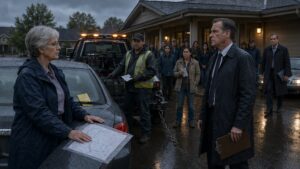
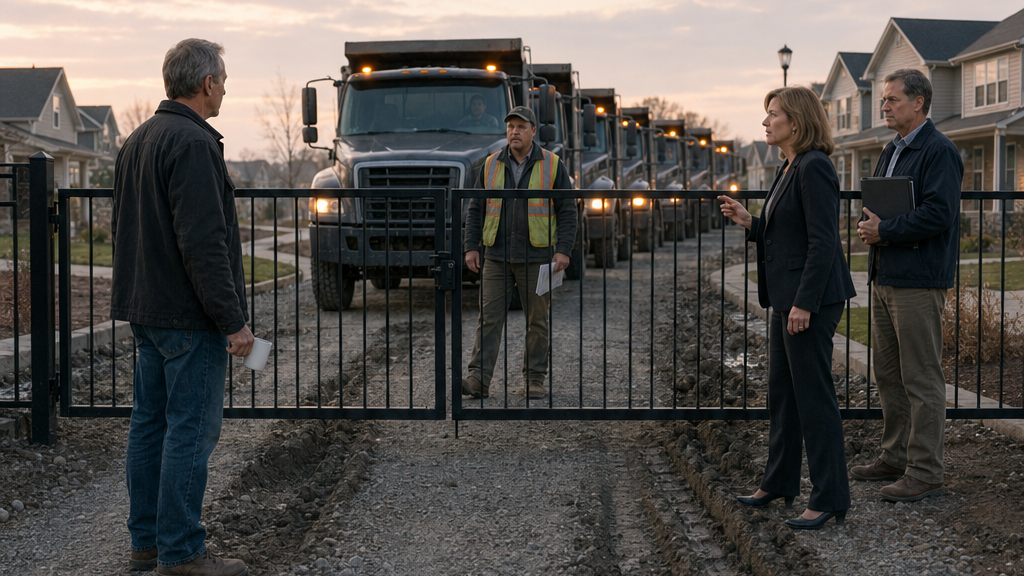
At 7:12 on Friday morning, the first dump truck stopped so hard that its empty bed gave a metallic shudder.
Richard Lewis stood twenty feet inside his property with a white coffee mug warming both hands.
The truck idled in front of the new steel gate stretched across his gravel lane.
A second truck rolled up behind it.
Then a third.
By 7:16, six of them sat nose to tail along the subdivision road, amber hazard lights blinking against the pale morning.
The first driver climbed down, looked at the gate, then at Richard.
“You Richard?”
Richard nodded.
The driver pointed toward the lock. “We’re supposed to go through.”
“I know.”
The driver stared at him for a second, waiting for the rest.
Richard took a sip of coffee.
Six weeks earlier, there had been no gate.
There had only been the lane.
It ran along the east side of Richard’s property, a narrow strip of gray gravel bordered by drainage grass on one side and a line of mature maples on the other. It had never been pretty enough to photograph. Richard liked it for exactly that reason.
He had maintained it for years with a rented grader blade, bags of gravel, and the kind of attention people gave to things nobody else noticed until they failed.
Most mornings, the lane was quiet enough that he could hear birds in the hedges from his kitchen.
Then one Tuesday, a dump truck came through.
Richard had been standing beside his mailbox when it slowed.
The driver leaned out the window.
“Clubhouse project?”
Richard knew about the project. Everyone did.
The homeowners association had spent months talking about replacing a failed drainage line behind the clubhouse and rebuilding part of the common patio. Residents along the lower end of the subdivision had complained about standing water after heavy storms. The board had finally approved the work.
The normal construction entrance was on the opposite side of the neighborhood.
Richard pointed down his lane. “You cutting through?”
“Foreman said it saves us from backing around the south entrance.”
Richard hesitated.
It was one truck.
“Go ahead,” he said. “Just take it slow.”
The driver lifted two fingers from the steering wheel in thanks.
Richard watched the truck rumble away.
That should have been the end of it.
The next morning there were three.
By Friday, there were seven.
The week after that, Richard began hearing diesel engines before he finished his first cup of coffee.
He stood at his kitchen window one morning and counted eleven vehicles before eight thirty: dump trucks, a flatbed hauling pipe, a concrete truck, two pickups pulling equipment trailers.
The lane had become a route.
No one had asked.
Richard told himself the work would not last forever.
He had spent most of his career as a facilities supervisor. He understood schedules, contractors, deliveries and the thousand small compromises required to finish a job without turning every inconvenience into a dispute.
That was partly why he did not complain the first week.
Or the second.
Then rain came.
Not much. Less than an inch overnight.
But the next morning, the first loaded dump truck pressed a pair of dark grooves into the softened gravel. The second deepened them. By afternoon, water sat inside the tire ruts.
Richard walked the lane with his coffee after the crews left.
At one curve, the outside wheels had pushed gravel into the grass.
Farther down, the shoulder had begun to collapse toward the drainage ditch.
He stood there longer than he meant to.
A pickup approached behind him.
Richard stepped aside.
The driver waved.
Richard did not wave back.
That afternoon he called the HOA office.
Edward Davis, the property manager, answered on the third ring.
“Edward, it’s Richard Lewis.”
“Hey, Richard. What can I do for you?”
“The construction traffic needs to stop using my lane.”
There was a pause.
“Your lane?”
“The gravel lane beside my house.”
“Oh. The contractor route.”
Richard looked through the kitchen window as another truck went by.
“That’s not a contractor route.”
Edward’s tone changed slightly, becoming careful. “I was under the impression the association has access there.”
“For maintenance, maybe years ago. Not thirty-ton trucks all day.”
“I’ll check.”
Richard disliked arguments, especially the kind that began with somebody saying they would check something he thought was obvious.
Still, he waited.
The next morning the trucks came through again.
He called Edward a second time.
Edward apologized and said he had contacted the board.
The traffic continued.
Richard began taking photographs.
At first they were simply pictures of the ruts.
Then he photographed license plates.
Then times.
6:58.
7:11.
7:26.
7:44.
By Thursday, he realized he was not documenting random contractor behavior.
The arrivals were too regular.
He pulled a folding chair onto the porch one morning and wrote them down.
Seven trucks between seven and eight.
Five more before nine.
A flatbed at 9:17.
Another dump truck at 9:31.
The same vehicles returned later empty.
It was a scheduled route.
Richard felt something settle in him then.
The crews were not occasionally borrowing his lane because of a difficult turn.
Someone had planned around it.
That afternoon, rain clouds gathered again.
By five, water was flowing through the deepest rut like a narrow stream.
Richard walked down with a metal rake and pulled gravel back from the ditch.
Frank Ramirez came around the corner with his dog and stopped.
“That project beating you up?”
Richard straightened.
“Apparently.”
Frank looked at the tracks.
“They should fix that when they’re done.”
“They shouldn’t be using it.”
Frank gave him a surprised look but did not argue.
That bothered Richard more than disagreement would have.
It told him Frank thought the traffic was normal.
Richard spent the next morning going through a file box in his study.
He found his closing documents, title insurance papers and the recorded parcel description from when he bought the house.
His property line ran exactly where he remembered it running.
The gravel lane was inside it.
Not beside it.
Inside it.
At 3:42 that afternoon, his phone chimed.
An email from Edward Davis.
Richard opened it standing at the kitchen counter.
Edward had written only four short paragraphs.
The first apologized for the road damage.
The second said the contractor had been advised to reduce speed.
The third said the association would review restoration once construction was complete.
Richard read the final paragraph twice.
According to the HOA’s existing records, Edward wrote, the association had existing access rights across that portion of Richard’s property.
Richard looked out the window.
A loaded dump truck rolled past.
For the first time, the question was no longer how much damage the trucks were doing.
It was what the HOA believed it owned.
Chapter 2: The Old Map Everyone Thought Settled the Question
The map arrived the next morning with a thick yellow line drawn straight across Richard’s property.
Nancy Walker had attached it herself.
Her message was polite.
Richard found that almost worse.
The scan showed the subdivision as it had looked decades earlier, when streets ended in unfinished circles and several lots had not yet been built. Along the eastern boundary, a narrow corridor passed close to the same place Richard’s gravel lane now ran.
Nancy had highlighted it.
“Richard,” she had written, “this is the access area I mentioned. The association has historically used this corridor for maintenance and construction access.”
Richard printed the map.
He laid it beside his deed on the kitchen table.
The highlighted strip and his current lane were close.
But close was not the same thing.
He found an old ruler in a drawer and compared dimensions.
Then he pulled up the county parcel viewer on his laptop.
The modern boundary matched his deed.
The gravel lane sat wholly inside his parcel.
The old map did not change that.
What it did change was Richard’s certainty about why everyone else seemed so comfortable using it.
At ten, Nancy called.
“Did you see what I sent?”
“I did.”
“Then you understand why the contractor is using the route.”
“No. I understand why you think they can.”
Nancy exhaled softly.
She had lived in the neighborhood nearly as long as Richard. They were not friends, but they had shared enough annual meetings and mailbox conversations that neither could pretend the other was a stranger.
“Richard, this isn’t something we invented last month.”
“I didn’t say it was.”
“That corridor has been used for association work for years.”
“Occasional maintenance is not the same as a construction haul route.”
“It’s still access.”
Richard tapped the old map with one finger.
“The map references something.”
“What?”
“Here. Bottom corner.”
The scan was blurry, but the notation was visible.
Access subject to recorded instrument.
A book and page number followed.
Nancy went quiet.
Richard said, “Do you have that instrument?”
“I assume management does.”
“You sent me the map.”
“Because the map establishes the corridor.”
“No. The map says another document establishes what the corridor means.”
Another pause.
Then Nancy’s voice sharpened.
“We’re not stopping a drainage project based on your interpretation of a notation.”
Richard looked out at the lane.
Fresh tire marks crossed yesterday’s repairs.
“I’m asking you to stop using my property until you know what right you have.”
“We do know.”
“Then send me the document.”
Nancy did not.
By lunchtime, another eight trucks had passed.
Richard walked the lane after each cluster and took photographs from the same marked spots. He set a tape measure across the deepest rut and photographed the depth.
Three inches.
At the curve, almost four.
He kept receipts from the gravel delivery he had paid for the previous fall and found another from two years earlier.
The habit came naturally.
Facilities work had taught him that memories were arguments and records were facts.
Still, documenting his own driveway felt ridiculous.
That afternoon he went to the HOA office.
Edward sat behind a desk crowded with project binders.
Nancy was already there.
A copy of the highlighted map lay between them.
Edward gave Richard a restrained smile.
“We’ve been looking.”
“Find the recorded instrument?”
“Not yet.”
Richard sat.
Nancy folded her hands.
“The absence of a scanned copy in the office doesn’t mean the right disappeared.”
“I didn’t say it did.”
“You keep talking like the contractor is trespassing.”
Richard glanced at Edward.
“I’m talking like none of us knows.”
Edward looked uncomfortable.
That was the first thing that made Richard think the situation was not as settled internally as Nancy claimed.
Richard placed his deed on the desk.
Then the county parcel printout.
“The lane is mine.”
Nancy barely looked at them.
“We’re not disputing your ownership.”
“Then what exactly are you claiming?”
“Access.”
“Under what terms?”
“The historical corridor.”
Richard pointed to the notation.
“Whose terms?”
Nancy leaned back.
For a moment, neither spoke.
Edward finally said, “I’ve requested archived association records.”
“County records will have it,” Richard said.
Nancy’s eyes moved to him.
“You’re going to the county?”
“Yes.”
“For what?”
Richard almost smiled.
“To read the thing everybody keeps telling me gives you access.”
Nancy’s expression hardened.
“I need to be clear about something. We have residents whose yards flood. The contractor is already behind. Stopping that traffic will affect more people than you.”
Richard felt the familiar pull to make things easier.
It was the same instinct that had made him wave through that first truck.
He looked down at the map instead.
“I’m not asking you to stop the project.”
“You’re asking us to lose the direct route.”
“I’m asking you not to decide my lane is part of the project before you know why you’re allowed to use it.”
Nancy stood.
“The trucks will continue while counsel reviews it.”
There it was.
Not anger.
Not threat.
A decision.
Richard folded his deed and put it back in the folder.
On the way home, a concrete truck met him at the entrance to his lane.
The driver slowed, uncertain who had priority.
Richard pulled onto the grass and let it pass.
As the rear wheels went by, one dropped into the softened shoulder and threw a fan of mud across Richard’s front fender.
The driver stopped.
Richard waved him on.
Then stood beside his truck looking at the mud.
He was beginning to understand something about himself that he did not like.
He kept making small accommodations because each one felt easier than conflict.
Everyone else remembered the accommodation.
Nobody remembered the reason.
The county records office occupied the ground floor of an older municipal building downtown.
Richard arrived the following morning with the book and page number from Nancy’s map.
The clerk typed it into a terminal.
“Old one,” she said.
“How old?”
She gave him the year.
Older than his house.
She disappeared into the back.
Richard waited beside a counter stacked with subdivision plats.
Ten minutes passed.
Then fifteen.
When she returned, she carried a thin folder.
“Found the index,” she said. “The original has been digitized, but it was filed under the developer’s name, not the association.”
Richard leaned forward.
“So this is the access document?”
“Looks like an easement.”
She turned the folder toward herself and read the first page.
Then she stopped.
Her finger moved farther down.
“Huh.”
Richard watched her expression.
“What?”
She looked up.
“There’s a termination section.”
Chapter 3: The Favor Richard Never Realized Had Become Evidence
The easement did not say what Nancy thought it said.
Richard knew that before he finished reading the second page.
The recorded instrument had been created during the original subdivision development. It granted the developer and designated contractors temporary access across what had then been an undeveloped parcel for construction, grading and drainage work.
The language was dry and specific.
So was the ending.
The easement terminated when the original development work was completed, or upon a fixed outside date, whichever came first.
That date had passed years ago.
Richard read the clause again.
Then a third time.
For several seconds, the county records office seemed unusually quiet.
“So it expired?” he asked.
The clerk shook her head slightly.
“I can tell you what the document says. I can’t give you a legal interpretation.”
Richard nodded.
He knew better than to press.
He paid for a certified copy.
Outside, he stood on the courthouse steps with the pages in his hand.
His first emotion was relief.
The second was anger.
Nancy had kept sending trucks down his lane while insisting the board had a right that appeared to have ended before Richard even bought his house.
He called Jessica Lee before reaching his truck.
Jessica had handled a boundary matter for one of Richard’s former coworkers years earlier. Her office scheduled him for the next afternoon.
Until then, Richard did what he should probably have done sooner.
He walked the neighborhood.
Frank Ramirez was trimming dead branches from a shrub beside his driveway when Richard stopped.
“You got a minute?”
Frank set the clippers down.
“Sure.”
Richard held up the certified easement.
“That old access corridor? It was temporary.”
Frank frowned.
“What do you mean?”
“Development access. It ended years ago.”
Frank wiped his hands on his jeans.
“So Nancy was wrong?”
“Looks that way.”
Frank did not react the way Richard expected.
Instead, he glanced toward the gravel lane.
“Maybe on the paperwork.”
Richard felt his shoulders tighten.
“What’s that supposed to mean?”
Frank hesitated.
“You’ve let them use it forever.”
Richard stared at him.
“I let maintenance crews through.”
“Right.”
“That doesn’t make it theirs.”
“I didn’t say it did.”
“Sounds like you’re saying something close.”
Frank picked up the clippers, then set them down again.
“Richard, I’m not trying to get in the middle of this. But when they did the drainage inspection three years ago, you waved their truck through.”
“One truck.”
“And when they replaced the common fence?”
“That was a pickup.”
“And the tree crew.”
Richard opened his mouth.
Stopped.
Frank continued carefully.
“You told me yourself you didn’t mind them coming through as long as they weren’t tearing anything up.”
Richard remembered the conversation.
Not every word.
Enough of it.
They had been standing near the mailbox after a storm. An HOA maintenance pickup had gone down the lane to inspect a fallen tree near the rear common strip.
Frank had joked that Richard ought to charge a toll.
Richard had said something like, I don’t mind. Saves them driving all the way around.
At the time it had meant almost nothing.
Now it sounded different.
Richard looked down at the easement in his hand.
“The trucks now are not the same thing.”
“I agree.”
“Then why bring it up?”
“Because maybe Nancy thinks they are.”
That followed him home.
Richard had spent days seeing himself as the only person in the dispute paying attention to facts.
Frank had just given him another fact.
For years, Richard had behaved as though occasional association access was acceptable.
Not legally required.
Acceptable.
And he had never once written down the distinction.
Jessica Lee’s office smelled faintly of paper and coffee.
She read the easement without interrupting him.
When Richard finished explaining the truck traffic, she returned to the first page and worked through the document again.
“This clause matters,” she said.
“The termination?”
“Yes.”
“So they don’t have access.”
Jessica looked up.
“Slow down.”
Richard sat back.
“It ended.”
“This easement appears to have ended.”
“That’s what I said.”
“No. You said they don’t have access. That’s a broader conclusion.”
Richard disliked the distinction immediately.
Jessica continued.
“I need the deed chain, current plat, HOA declarations, any amendments and whatever correspondence you’ve had with them.”
“I have most of that.”
“And I need to understand the history.”
Richard told her about the maintenance trucks.
Her expression changed.
“How often?”
“Not often.”
“That’s not a number.”
“Maybe a few times a year. Some years none.”
“Did they ask?”
“Usually.”
“Usually?”
Richard looked toward the window.
“Sometimes somebody would show up and I’d wave them through.”
“Did you ever object?”
“Not until the construction traffic.”
“Did you ever tell the association that permission was limited?”
Richard was silent.
Jessica waited.
“No.”
“Did you post the lane?”
“No.”
“Gate?”
“No.”
“Written conditions?”
“No.”
He shifted in his chair.
“They knew it was mine.”
“That helps. It doesn’t answer everything.”
Richard felt irritation rising.
“I came here because an easement expired.”
“And that is important.”
“But?”
“But property disputes are rarely improved by pretending inconvenient facts don’t exist.”
She slid the certified copy toward him.
“The association may have a weak recorded-access argument. That doesn’t mean they won’t make another one. Historical use matters. Permission matters. Expectations matter. The exact facts matter.”
Richard thought of Frank.
Jessica folded her hands.
“You may be right about the lane, Richard. But being right about the document doesn’t mean every part of the story favors you.”
The words landed harder than Nancy’s emails.
Nancy had become easy to resist because Richard believed she was simply ignoring the truth.
Jessica was making him look at his own part in how the truth had become blurred.
That evening, Richard sat on his porch as two contractor pickups drove down the lane.
Both drivers waved.
One had been through enough times to recognize him.
Richard did not wave back.
The trucks were lighter than the dump trucks, but their tires still followed the same worn lines.
Old tracks beneath new ones.
Courtesy layered into habit.
Habit turning into expectation.
The following morning, Nancy called.
“I understand you obtained the old easement.”
“Yes.”
“Then you saw the access corridor has been used historically.”
Richard almost laughed.
“The recorded construction right terminated.”
“That doesn’t erase decades of actual use.”
There was less certainty in her voice now, but not less resolve.
“Our counsel is reviewing historical access.”
“While the trucks keep coming.”
“The project cannot stop every time someone finds an old clause.”
Richard looked at the lane.
A dump truck was approaching slowly from the subdivision road.
He stepped farther onto his porch.
“Nancy, from this point forward, I’m telling you clearly that I do not consent to heavy construction traffic on my lane.”
A pause.
“That’s a significant change from how you’ve handled access for years.”
Richard gripped the phone.
There it was again.
His own generosity handed back to him as evidence.
“We’ll talk after counsel reviews it,” Nancy said.
The call ended.
Richard stood there as the dump truck entered his property.
He could have blocked it with his pickup.
For one sharp moment he wanted to.
Instead, he photographed it.
Then he sent the image, time stamp and Nancy’s latest statement to Jessica.
Her reply came twenty minutes later.
It contained only one question.
Richard read it twice.
Not: Was the HOA wrong?
Not: Did the easement expire?
Jessica asked:
“When, before today, did you clearly tell them their permission to use the lane had ended?”
Chapter 4: The Easement Ended, but the Pressure Did Not
Jessica Lee circled one sentence on the photocopy and turned the page toward Richard.
“There.”
Richard leaned over her desk.
The termination clause was easy to miss because it sat inside a paragraph dense with references to grading, drainage installation and construction access. Jessica had underlined the final two lines.
The easement ended when the original development work was completed or on the stated expiration date, whichever came first.
Richard read it again.
“So that’s it.”
Jessica capped her pen.
“It’s strong.”
“That means they stop using the lane.”
“It means the recorded easement Nancy has been relying on does not appear to give them a current right.”
Richard sat back.
“You always find a way to make a simple sentence longer.”
“That’s why you’re paying me.”
He almost smiled.
Then a truck rumbled past somewhere outside the office, and the sound pulled him back to the lane.
Jessica slid a legal pad toward him.
“Now we make your position clean.”
Richard frowned. “It isn’t clean already?”
“You gave them informal permission before. You clearly withdrew permission last week. That matters. We also need to give them a reasonable opportunity to respond.”
“How many reasonable opportunities does a dump truck get?”
Jessica looked at him.
Richard looked away first.
“I know.”
“No, you’re frustrated. That’s different.”
She began listing what she wanted him to document: current photographs, dates, vehicle counts, repair receipts, communications with the HOA, any indication that the lane had been treated as private in prior years.
Richard had already collected most of it.
By the time he left, he carried a folder thick enough to feel useful.
The lane looked worse when he returned home.
Two fresh grooves cut through the gravel near the curve. One outer tire had broken the shoulder so deeply that damp soil showed beneath the stone.
Richard set his coffee mug on the hood of his pickup, fetched a tape measure and crouched beside the rut.
Four and a quarter inches.
He photographed it.
At the ditch, the shoulder had dropped nearly six.
Another photograph.
He did not feel angry while taking them.
That was new.
For weeks, every image had felt like proof that nobody was listening.
Now each one was part of a boundary he was finally learning to state.
The HOA called a special meeting two nights later.
Richard sat at the end of a rectangular table in the small association conference room. Nancy Walker sat across from him with Edward Davis and two board members. The treasurer had a binder open to a page marked with colored tabs.
Nancy began without small talk.
“We received the letter from your attorney.”
Richard nodded.
“And our counsel is reviewing it.”
“Good.”
Nancy’s jaw tightened.
“You understand we cannot simply stop the project.”
“I’ve never asked you to.”
“You’re asking us to remove the contractor’s access route.”
“My lane is not your route.”
One of the board members shifted in his chair.
Nancy looked at the treasurer.
The treasurer turned the binder around.
“These are the delay provisions.”
Richard did not touch it.
Nancy said, “The drainage contractor is already behind eleven working days. If we change routing now, they’re estimating additional labor, additional trucking time and possible schedule penalties.”
“How much?”
The treasurer named a figure large enough that Richard finally looked at the page.
Nancy noticed.
“We also have six homes along the lower basin that took water into their yards during the last two storms. Two owners have been sending photos after every rainfall.”
Richard knew one of those streets.
He had seen standing water near the curb himself.
Nancy leaned forward.
“This isn’t a clubhouse cosmetic project anymore. The drainage section has to be finished.”
Richard looked at Edward.
“Does it have to be finished through my lane?”
Nancy answered first.
“It is the shortest route.”
“That wasn’t my question.”
The room became quiet.
Edward cleared his throat.
“There is another access point.”
Nancy turned toward him.
“It adds almost two miles per round trip.”
Richard said, “So there is another route.”
“It is less efficient,” Edward replied.
Nancy tapped the table.
“And more expensive. Every load.”
For the first time, Richard understood the pressure behind her certainty.
Not agreed with it.
Understood it.
If she admitted the lane was not available, she would have to explain why the board had budgeted around something it did not control. Residents already angry about drainage would hear that the project was slower and more expensive because nobody had secured access in advance.
Nancy had a problem.
Richard simply refused to let her solve it with his property.
“I’ll give the association written notice,” he said. “No heavy construction traffic after a specific date. That gives the contractor time to reroute.”
Nancy’s expression sharpened.
“You cannot unilaterally disrupt an association project.”
“I can withdraw permission to use my lane.”
“You’re assuming you have the right to do that.”
Richard glanced at Jessica’s letter beside Nancy’s folder.
“So are you.”
The meeting ended without agreement.
The trucks came the next morning.
And the next.
But Richard’s anger kept narrowing into something more useful.
He documented.
He answered emails briefly.
He stopped arguing about whether Nancy was fair and focused on what the HOA could actually show.
Three days later, Edward called him from the association office.
His voice was lower than usual.
“Richard, can you come by?”
“What happened?”
“I found something.”
Richard was there twenty minutes later.
Edward closed the office door after him.
On the desk sat an old records box, its cardboard sides softened with age.
“I’ve been going through prior board files,” Edward said.
Richard waited.
Edward pulled out several folders.
“There are maintenance invoices going back years. Tree work. Drainage inspections. Fence repairs.”
“I know.”
“But I cannot find a current access agreement for your lane.”
Richard studied him.
“Nothing?”
“Nothing recorded. Nothing signed. Nothing in the management files.”
“What about board minutes?”
“References to using the east access. No authorization attached.”
Richard felt the brief satisfaction of being proved right.
Then Edward added, “There’s something else.”
He opened a more recent project folder.
“Before the contractor mobilized, somebody asked whether access had been confirmed.”
Richard’s attention sharpened.
“Who?”
“I don’t know yet. It’s in the project correspondence.”
“Did Nancy see it?”
Edward hesitated.
“I need to check the distribution.”
Richard looked at the folder.
The question had changed again.
It was no longer whether the HOA had a current agreement.
Edward had just admitted it did not.
Now Richard wanted to know something more uncomfortable.
Had Nancy approved the route because she believed the paperwork existed—
or because she knew it did not?
Chapter 5: What the Board Knew Before the First Dump Truck Arrived
The note was one sentence long.
Before contractor mobilization, please confirm written access through Lewis parcel.
Richard read it twice.
The project email had been printed as part of a chain Edward found in the association’s records. It was dated almost three weeks before the first dump truck ever entered Richard’s lane.
“Who wrote this?” Richard asked.
Edward pointed to the header.
“The contractor’s project coordinator.”
“And who received it?”
Edward did not answer immediately.
Richard looked down the distribution list.
Nancy Walker.
Edward Davis.
The HOA treasurer.
Two board members.
Richard felt something colder than anger.
“What was the response?”
Edward turned the page.
There was one.
Nancy had written that the east access had historically been available and that management was checking the file.
Richard looked at Edward.
“You were checking?”
“I thought I was.”
“What does that mean?”
Edward rubbed a hand over his forehead.
“I pulled the old map. The same one Nancy sent you. I saw the corridor. I assumed the corresponding agreement would be in archived records.”
“But you didn’t find it.”
“Not before they mobilized.”
“And you told them that?”
Edward did not answer.
Richard understood.
“You never told the contractor access was confirmed.”
“No.”
“But nobody told them it wasn’t.”
Edward’s silence was answer enough.
Richard took the copies home.
He set them beside the photographs, gravel receipts and repair estimates accumulating on his dining table.
The mess had started to look like a second job.
Years earlier, Richard would have hated that.
Now it steadied him.
Every page made the dispute less personal.
At four that afternoon, Nancy pulled into his driveway.
Richard saw her from the porch.
She got out without a folder or phone in her hand.
That was unusual enough that Richard stayed where he was.
Nancy stopped at the bottom step.
“Edward showed you the email.”
“Yes.”
“I assumed he would.”
Richard waited.
Nancy looked toward the lane.
A contractor pickup passed slowly.
“You know why I approved the route.”
“I know why you wanted it.”
“That isn’t the same thing?”
“No.”
Nancy’s mouth tightened.
Richard expected an argument.
Instead she said, “The original bid came in higher than projected. Then the first contractor backed out. We rebid. By the time this crew started, we were already into contingency.”
Richard said nothing.
“If we delayed mobilization again, we risked losing their slot.”
“So you treated my lane as available.”
“I treated it the way it had always been treated.”
Richard looked at her.
“That’s not true.”
Nancy met his eyes.
“You let people use it.”
“Sometimes.”
“Exactly.”
“No. Not exactly.”
Richard stood.
“When the tree crew needed to inspect one fallen maple, I said yes. When maintenance needed to look at the drainage outlet, I said yes. Those were favors, Nancy.”
“You never called them favors.”
“I didn’t think I had to.”
For the first time, Nancy looked tired rather than defensive.
“That’s the problem, Richard. You keep saying everyone should have understood what you meant when you never actually said it.”
The words stung because Jessica had already made the same point.
Richard leaned against the porch rail.
“You’re right about that part.”
Nancy seemed surprised.
He continued.
“I should have been clearer years ago. But you knew this project was different.”
Nancy looked away.
A second pickup rolled past.
“You knew nobody had confirmed access,” Richard said.
“I knew the file was incomplete.”
“And you sent trucks anyway.”
“I thought you’d work with us.”
“Like before.”
Nancy’s eyes returned to him.
“Yes.”
There it was.
Not corruption.
Not some secret scheme to seize his property.
Something more ordinary and more dangerous.
She had expected Richard to yield because Richard usually did.
A low rumble approached from the subdivision entrance.
Another loaded dump truck.
Richard stepped off the porch and watched it turn onto the lane.
The outer wheels found the rut automatically now.
Nancy watched too.
“It’s going to rain again this weekend,” she said.
“I saw.”
“The lower basin still isn’t finished.”
“I know.”
“If the crew has to reroute now, they lose time.”
Richard looked at the broken shoulder.
“And if they keep using this, I lose my road.”
Nancy folded her arms.
“So what are you going to do?”
That evening Richard called Jessica.
They drafted a formal notice.
Heavy construction access would end Friday at 7:00 a.m.
The notice acknowledged prior limited permission for maintenance access and explicitly withdrew that permission for construction traffic.
It included photographs of the damage.
It referenced the expired recorded easement.
It also identified the southern contractor entrance and stated that Richard would not interfere with lawful access through that route.
Jessica insisted on that paragraph.
“You need to show you are protecting your property, not trying to stop the drainage work.”
Richard understood.
For once, clarity did not feel like aggression.
The notices went out Monday morning.
Tuesday, the contractor foreman called.
“I hear we’re losing your road Friday.”
“You are.”
“Board says it’s still under review.”
“My permission isn’t.”
The foreman sighed.
“The south entrance is a pain.”
“I believe you.”
“Adds time.”
“I believe that too.”
“You sure we can’t finish the week?”
Richard looked out the window at a fresh load of gravel he had ordered for repairs he could not yet make.
“Yes.”
There was no argument.
Only a pause.
“All right,” the foreman said. “I’ll tell dispatch.”
Richard hung up feeling almost disappointed by how ordinary the conversation had been.
Then, on Wednesday afternoon, a flatbed truck stopped beside his mailbox.
Workers unloaded black steel gate hardware.
Nancy happened to drive past while the hinges were being set.
She slowed.
Did not stop.
Thursday brought the storm forecast closer.
The weather service warned of heavy rain beginning late Saturday.
Neighbors began talking about the unfinished drainage line.
Frank stopped Richard near the mailbox.
“You really closing it?”
“Friday.”
Frank glanced at the gate frame.
“What if that delays the drainage work?”
“They have another route.”
“Longer.”
“Yes.”
Frank rubbed his jaw.
“I get why you’re doing it.”
Richard waited.
Frank added, “I also get why some people won’t.”
Richard nodded.
“That’s fair.”
Frank looked surprised.
Richard might once have argued.
Instead he said, “I should have set rules before this became a fight.”
Frank nodded toward the lane.
“And they should’ve asked before making it a highway.”
That was as close to agreement as either needed.
Thursday evening, the gate was finished.
Richard walked its length while the installer packed up.
The black steel looked almost too formal against the old gravel.
For years, the lane had required no gate because Richard believed everyone understood where courtesy ended.
Now the boundary had hinges.
At 6:18 p.m., he swung it closed.
The latch settled into place with a heavy metallic click.
Richard put the key in the padlock.
For a second, he hesitated.
He thought of the storm.
The flooded yards.
Nancy’s budget.
The drivers who had nothing to do with the board’s decision.
Then he thought of the email written before the first truck arrived.
Please confirm written access through Lewis parcel.
Nobody had.
Richard turned the key.
The lock snapped shut.
Tomorrow morning, there would be no more ambiguity.
Chapter 6: Friday Morning, the Shortcut Finally Had a Gate
At 7:12 Friday morning, the first dump truck rounded the curve and hit its brakes.
Richard heard the air system hiss before he saw the driver’s face.
The truck stopped three yards from the steel gate.
Its amber hazards began blinking.
Richard stood inside the property line with his white coffee mug.
For a moment, nothing moved.
Then the second truck appeared.
The first driver climbed down.
“You Richard?”
“Yes.”
“We’re scheduled through here.”
“I know.”
The driver looked at the locked gate.
“Can you open it?”
“No.”
He did not say it sharply.
That seemed to confuse the driver more than anger would have.
The second truck stopped.
Then the third.
By 7:16, six dump trucks occupied the edge of the subdivision road.
Diesel engines idled.
Hazard lights flashed in an uneven rhythm.
One driver stepped out and immediately put a phone to his ear.
Another walked toward the first truck.
Richard took another sip of coffee.
He had imagined this moment too many times during the previous week.
In some versions, Nancy arrived yelling.
In others, someone threatened police or towing or an injunction.
The reality was quieter.
The first driver rubbed the back of his neck.
“Our dispatcher says this is the haul route.”
“It was.”
“What happened?”
“Permission ended.”
The driver gave him a long look.
“Above my pay grade.”
“Mine too, probably.”
That earned a brief smile.
Richard had no interest in humiliating the men behind the wheels.
They had been given a route.
He walked to a small plastic sleeve attached to the gate and pulled out a copy of the contractor notice.
“The south entrance is open,” he said. “Your foreman has this already.”
The driver read the page.
“That route adds twenty minutes.”
“I know.”
He handed the paper back.
The driver stared down the line of trucks.
“Dispatch is going to love this.”
At 7:28, the contractor foreman arrived in a pickup.
He parked beside the convoy and walked straight to Richard.
“You weren’t bluffing.”
“No.”
“I told them to change dispatch.”
“Apparently dispatch disagreed.”
The foreman shook his head.
“Board told them this was still being resolved.”
Richard felt a small shift inside him.
There it was.
He had wondered whether the trucks would arrive because of a mistake.
They had arrived because somebody expected the gate not to matter.
The foreman looked at it.
“You understand I can’t have these sitting here.”
“Then send them south.”
“I’m making that call.”
He stepped away.
At 7:41, Nancy’s SUV pulled up.
She got out before the engine fully settled.
Edward arrived less than five minutes later.
Nancy walked toward Richard without greeting him.
“This needs to open.”
Richard held his coffee with both hands.
“No.”
“Richard, you are blocking an active association project.”
“I’m blocking my lane.”
“We have crews on the clock.”
“You have another entrance.”
Nancy glanced at the trucks.
“That route changes the entire delivery sequence.”
The foreman, standing nearby, said, “We can route south.”
Nancy turned.
“How much delay?”
“Today? Maybe forty-five minutes getting everyone repositioned. After that, twenty or so per cycle.”
Nancy closed her eyes briefly.
Richard watched the frustration move through her.
Not theatrical anger.
Calculation.
She turned to Edward.
“Call counsel.”
Edward remained still.
“Nancy.”
“What?”
“I can call them. But I can’t tell the contractor we have a verified current access right.”
Nancy’s expression changed.
“You’re the property manager.”
“Yes.”
“So manage the property.”
Edward’s face reddened.
Richard expected him to retreat.
He did not.
“I went through the records again last night. There is no current agreement.”
Nancy lowered her voice.
“We have historical use.”
“We have historical permission and an expired development easement.”
“That is for counsel to decide.”
“Exactly,” Edward said. “Which means I’m not certifying access to a contractor this morning.”
The foreman looked between them.
The power in the scene changed almost invisibly.
Until that moment, Richard had been one homeowner refusing an HOA president.
Now the association’s own manager was unwilling to tell the contractor that the HOA possessed a right it could not document.
Nancy looked at Richard.
“You planned this.”
Richard almost answered defensively.
Instead he set the mug on the fence post and pulled another sheet from the gate sleeve.
“This is the alternate route.”
Nancy took it.
“I sent it Monday. Jessica sent it to association counsel. The contractor got it too.”
The foreman nodded.
“I have it.”
Nancy looked at him.
“And you still sent them here?”
“Dispatch said board direction hadn’t changed.”
For several seconds, only the diesel engines filled the silence.
Richard understood then why the scene felt less satisfying than he had imagined.
There was no defeated villain.
No single person to blame for every truck.
There was an expired document, years of informal favors, an incomplete file, a board under pressure and a president who had decided uncertainty could be treated as permission.
And there was Richard, who had spent years believing boundaries did not need words.
Nancy folded the alternate-route notice.
“If we call an emergency board meeting today, we can seek temporary relief.”
“You can.”
“You understand what that means?”
“Yes.”
“Legal fees.”
“Yes.”
“Possibly an order requiring access until the dispute is resolved.”
Richard nodded.
“That’s why I waited until counsel reviewed the document and why I gave notice.”
Nancy studied him.
The old Richard would have softened the statement.
Would have added something conciliatory.
He did not.
A truck driver walked up to the foreman.
“We moving or what?”
The foreman checked his phone.
“We’re moving.”
He turned toward the line.
“Everybody south entrance.”
Engines changed pitch one by one.
The last truck reversed carefully away from the gate.
Then the next.
The procession unwound itself from the subdivision road until only the foreman’s pickup remained.
By 8:06, the lane was quiet.
Richard looked down at the gravel.
No fresh tire marks.
It should have felt like victory.
Instead, he noticed how badly the shoulder needed repair.
Nancy remained beside her SUV.
Edward had stepped away to take a phone call.
Richard picked up his mug.
The coffee had gone cold.
Nancy said, “You could have opened it for today.”
Richard looked at her.
“You could have rerouted them Monday.”
“That’s not the same.”
“No.”
She glanced toward the empty road.
Then, quieter, “I didn’t think you’d actually lock it.”
Richard let that sit between them.
It was the clearest thing she had said all morning.
“You thought I’d give in.”
“I thought you’d work with us.”
“Those aren’t always the same thing.”
Nancy looked away.
At 8:32, she received a call and walked toward her vehicle.
Before getting in, she turned back.
“Don’t make plans this afternoon.”
Richard frowned.
“Why?”
“I’m asking for a private meeting.”
“With the board?”
“No.”
She looked toward Edward, then back at Richard.
“You, me, Edward. No audience.”
Richard had expected retaliation.
Instead, Nancy sounded tired.
Almost relieved.
“About what?”
She opened the driver’s door.
“About how we fix this without pretending any of us got here by accident.”
Chapter 7: The Road Was Repaired, but the Old Arrangement Was Not
Nancy slid the repair estimate across the conference table without saying anything.
Richard stopped it with two fingers.
The number at the bottom was less dramatic than he had expected and more expensive than he wanted to think about. It covered new gravel, reshaping the damaged shoulder, restoring the drainage edge and compacting the lane where months of heavy traffic had pressed ruts into the base.
Edward sat between them with a yellow legal pad.
Jessica Lee sat beside Richard.
The HOA treasurer had already left after confirming the association could cover the work without a special assessment if the board used part of the remaining project contingency.
Richard read the estimate once.
Then he looked at Nancy.
“This includes the shoulder?”
“Yes.”
“And the drainage cut where the trucks broke it down?”
“Yes.”
“Not just fresh stone on top?”
Nancy gave him a tired look.
“No. Full repair.”
Richard pushed the estimate toward Jessica.
A month earlier, that would have felt like winning.
It did not feel that way now.
The lane had been quiet since the Friday gate closure. Contractor traffic had been rerouted through the south entrance. The drainage project had continued, slower but not stopped. The storm that weekend had filled the lower basin nearly to the top, but the temporary pumps and partial new line had held.
No homes flooded.
Richard had been relieved.
He had also been forced to admit that Nancy’s urgency had not been invented.
Edward turned a second document toward him.
“This is the proposed access agreement.”
Richard read the heading.
Temporary and Emergency Access.
He kept going.
The draft allowed association maintenance vehicles to use his lane during declared emergencies and for specifically scheduled inspections, subject to notice, vehicle limits and restoration responsibility.
Then he reached a paragraph granting the HOA ongoing maintenance rights if it paid for annual gravel work.
Richard stopped.
“No.”
Nancy leaned back.
“You haven’t finished.”
“I don’t need to.”
Jessica looked at the paragraph, then at him.
Richard tapped it.
“This turns temporary permission into standing access again.”
“The association would maintain the lane,” Nancy said.
“That isn’t what I want.”
“You’ve complained for six weeks about paying to maintain it.”
“I complained about your trucks damaging it.”
Nancy folded her arms.
“We’re offering to take that burden off you.”
Richard looked through the conference-room window toward the common parking lot.
A month earlier he might have been tempted.
Free gravel. Professional grading. No more renting equipment or spending Saturdays filling washed-out edges.
But the offer carried the same assumption that had caused the entire dispute: convenience in exchange for a boundary becoming less clear.
“No unrestricted access,” he said.
Nancy’s expression tightened.
“Richard, there has to be some practical way to maintain the drainage structures behind your property.”
“There is.”
“Which is?”
“You ask.”
Silence settled over the table.
Richard continued before it could harden.
“You call. You tell me what vehicle is coming, why it needs to come through and when. If it makes sense, I open the gate.”
Nancy looked at Jessica.
Jessica did not rescue either of them.
Edward wrote something on his pad.
Nancy said, “And if you decide you’re in a bad mood that morning?”
Richard almost answered sharply.
Instead he stopped.
That had been part of the problem too.
Rules could not depend entirely on whether everyone remained reasonable.
“Emergency access can be written clearly,” he said. “Fire, utility failure, drainage failure, immediate property protection. You don’t need my mood for those.”
“And scheduled maintenance?”
“Written request. Reasonable notice. Limited vehicles.”
Nancy watched him for several seconds.
Then she said, “You’ve gotten very specific.”
Richard nodded.
“I should’ve done that years ago.”
The edge went out of her expression.
She looked down at the draft.
“So should we.”
It was the closest either of them came to apologizing.
Edward drew a line through the standing-access paragraph.
They spent the next forty minutes replacing assumptions with sentences.
Emergency access.
Forty-eight hours’ notice for routine inspections when reasonably possible.
No construction haul traffic without a separate written agreement.
No commercial use merely because the lane shortened a route.
Damage repaired by the party causing it.
The gate remained Richard’s.
Before they finished, Nancy rested both hands on the table.
“There’s something I should say.”
Richard waited.
“When the contractor asked whether access was confirmed, I knew Edward hadn’t found a signed agreement.”
Edward looked down.
Nancy continued.
“I also knew you’d let us through before. I thought if we started, you’d complain about the traffic, we’d promise repairs, and you’d work with us.”
Richard said nothing.
“I was trying to keep the project from slipping again. Residents were angry. The reserve was thin. Every delay made the numbers worse.”
“That explains it.”
“I know it doesn’t excuse it.”
Richard looked at her.
That distinction mattered.
Nancy had not secretly plotted to take his road.
She had simply decided that the cost of asking permission properly was greater than the risk of assuming she already had it.
And Richard had made that assumption easier by spending years treating every small favor as something too obvious to define.
Jessica closed her folder.
“I think we have terms.”
The repairs began the following Monday.
The road-repair contractor stripped loose gravel from the worst section, rebuilt the shoulder and reshaped the drainage edge. Fresh gray stone went down in layers and was compacted until the old ruts disappeared.
Richard watched from the porch with his white mug.
The lane looked almost new.
But the steel gate remained.
So did a small sign beside it identifying the lane as private access.
Nothing threatening.
Nothing theatrical.
Just clear.
Two weeks later, Edward called.
A maintenance crew needed to inspect a drainage outlet behind Richard’s property.
One pickup.
Two workers.
Wednesday at nine.
Richard looked at the written request Edward had emailed.
For years, he would have said yes immediately and assumed everyone understood what yes meant.
This time he replied with the approved time and the condition that the gate be closed after the crew left.
Wednesday morning, the pickup arrived at 8:58.
Richard walked down the freshly repaired gravel with his coffee.
The driver waited on the public side of the gate.
Richard unlocked it.
He swung the steel frame open.
The pickup passed slowly.
The driver lifted a hand in thanks.
Richard returned the gesture.
Then he stood beside the gate and watched the truck continue toward the rear drainage area.
The lane was still useful.
The neighborhood was still his neighborhood.
Nancy was still HOA president.
Nothing had needed to be destroyed for the boundary to become real.
Later, when the pickup returned, Richard opened the gate again.
The crew drove out.
Richard swung it shut behind them.
The latch settled into place.
This time the metallic click did not sound like a fight beginning.
It sounded like an agreement being kept.
The story has ended.