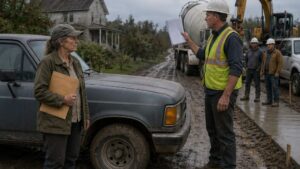
They Ordered the Flag Down at My Farm Gate, but the Boundary They Questioned Exposed Something Bigger
Chapter 1: The Notice Hanging From My Cedar Gate
The first thing I saw Monday morning was a brass-colored chain looped through my cattle gate.
The second was the cream envelope hanging from it.
Someone had punched a hole through the corner and fastened it where I couldn’t miss it, directly beneath the American flag that had flown beside that cedar post for eleven years.
I killed the engine of my feed truck and sat there a moment.
The cows were already crowding the lower fence, complaining because breakfast was late. Beyond them, hay lay in square windrows from Saturday’s cutting. Everything on my side of the gate looked exactly as it had the evening before.
Except for that envelope.
I stepped down and read the heading.
PRIVATE AGRICULTURAL ROAD ASSOCIATION.
The paper was heavier than it needed to be. There was an embossed seal at the top and a formal border around the page.
I had spent more than twenty years working around deeds, easements, subdivision plats, and property files before coming back to the farm full-time. Fancy paper had never impressed me much.
The third paragraph did.
It said my flagpole and livestock gate encroached into a twelve-foot association setback measured from the edge of the shared gravel lane.
Both were to be removed or relocated by sunset.
After that, daily penalties would begin.
I read it twice.
Then I looked at the gate.
My father had set those cedar posts when I was thirty-two. The galvanized gate had been replaced once, but its hinge post had never moved. The flagpole stood several feet farther inside the pasture, beside a rusted iron pin I had always understood to mark the old frontage line.
Twelve feet.
The number bothered me more than the threat.
I folded the notice into quarters and put it in my shirt pocket.
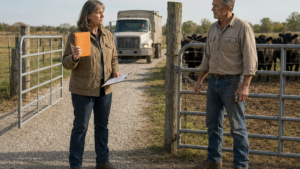
An hour later, Gary Wilson’s pickup rolled down the association lane.
He stopped with his driver’s-side tires still on the gravel and stepped out as if he had an appointment.
Gary owned pasture farther up the ridge and had been president of the road association for three years. He was broad through the shoulders, gray at the temples, and never seemed to hurry unless somebody else was making him wait.
His eyes went first to the flag.
Then to me.
“You got the notice.”
“I did.”
He glanced toward the cedar posts. “We need that entrance cleared back.”
“Cleared back from what?”
“The association setback.”
“Twelve feet.”
“That’s right.”
I watched him carefully.
“Measured from where?”
Gary’s mouth tightened just enough for me to notice.
“The traveled edge.”
“That’s not the same thing as a recorded easement.”
His expression changed. Not much. Enough.
“Edward, I’m not here to argue deed language with you.”
“I didn’t ask you to.”
He planted both hands on his hips.
“The lane’s getting tighter every year. Feed trucks are bigger. Contractors are bigger. Folks put up gates, rocks, posts, whatever they please. We finally have to enforce one line.”
“One line.”
“Same for everybody.”
Behind him, the association lane curved past my pasture and disappeared between two wooded slopes. At the bend, last winter’s rain had cut a shallow channel along the shoulder.
I knew the road had problems.
That did not explain twelve feet.
Gary pointed toward the flagpole.
“That pole is inside the setback. So is part of your gate swing.”
“My gate opens inward.”
“It still occupies the access area.”
“According to what recorded instrument?”
He sighed.
There it was.
The look I remembered from conference rooms where somebody wanted the question to disappear because answering it would require paperwork.
“We’ve been through this,” he said.
“You and I haven’t.”
“The board approved the standards.”
“A board can approve maintenance rules. It can’t manufacture land.”
Gary looked past me toward the cattle.
“I knew you’d make this harder than it needed to be.”
That irritated me more than the notice had.
Still, I kept my voice level.
“When did the association acquire twelve feet off my frontage?”
“You’ll get whatever records you need.”
“I’d like the one you’re enforcing.”
His jaw worked once.
“Sunset, Edward.”
Then he turned and walked back to his truck.
I could have stopped him.
I could have told him exactly why the number sounded wrong.
Instead, I let him leave.
That was pride, though I called it patience at the time.
The rest of the day I worked cattle, checked a leaking water line near the lower pasture, and tried not to think about the paper in my pocket.
By three o’clock, I had failed.
I went into the house, washed my hands, and pulled open the bottom drawer of the old oak cabinet in the dining room.
My father had kept every farm document in brown envelopes labeled in pencil.
Taxes.
Timber.
Road.
North pasture.
The deed I wanted was beneath a stack of survey receipts from the early 1990s.
I carried it to the kitchen table.
The paper smelled faintly of dust and old cardboard. I flattened it beneath two coffee mugs and traced the boundary description with my finger.
I remembered enough of the language that I almost skipped ahead.
Almost.
Then I saw the call describing the private road.
The recorded right-of-way was narrower than the line in Gary’s notice.
Not by inches.
By several feet.
I sat back.
For a moment, satisfaction came first.
Then something colder.
Because if my deed was right, the problem wasn’t simply that Gary had measured badly.
Someone had chosen twelve feet.
And they had printed it on official paper as if the land had already been given away.
I unfolded the cream notice beside my father’s deed.
Two measurements lay on the table.
Only one of them could be real.
Chapter 2: Six Flags Along the Recorded Line
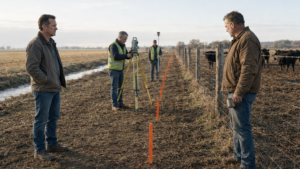
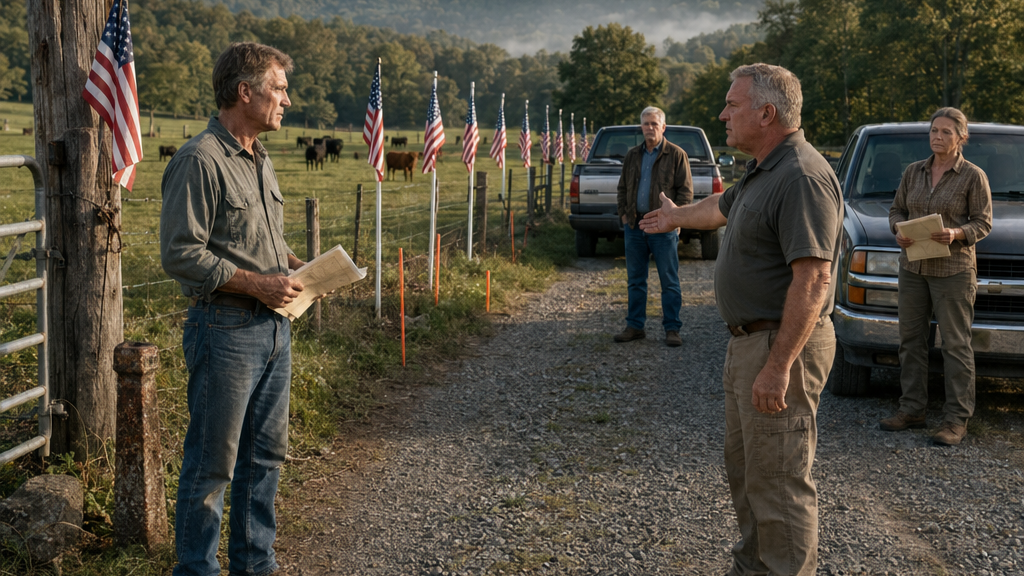
William Clark arrived at four forty-five Tuesday morning with six American flags, a bundle of bright survey stakes, and the expression of a man who had been waiting all night to be invited into an argument.
He climbed out of his truck and held up the flags.
“Tell me we’re using all of these.”
“Temporarily.”
“That’s not what I asked.”
“Get the measuring tape.”
William grinned.
He was four years older than me and had retired from cattle farming with the conviction that retirement meant having more time to interfere with mine.
We worked by headlamp.
The first thing we did was locate the old iron pin beside the cedar gatepost. It was almost hidden by grass, rust-dark and barely two inches above ground.
From there I measured using the deed description and two other known points along the frontage.
The line fell where I expected.
Well behind Gary’s twelve-foot claim.
William drove the first bright stake.
Then another.
At each point, we set one of the temporary flags several inches inside the line.
By sunrise, six American flags ran along the pasture frontage like punctuation marks.
The original flag remained beside the cedar gate.
William stepped back into the lane and admired our work.
“Subtle.”
“It isn’t supposed to be subtle.”
“Good. I was worried you’d gotten reasonable in your old age.”
I ignored him and clipped a copy of my deed plat to a plywood board resting against the gatepost.
Then I placed Gary’s cream notice beside it.
William looked at me.
“You planning to call him?”
“No.”
“Then how’s he supposed to see it?”
“He’ll come.”
I hated how certain I sounded.
He came twenty-three minutes later.
Gary’s truck rounded the bend faster than usual, gravel ticking under the chassis. He slowed as soon as the first flag came into view.
Then the second.
Then the rest.
He stopped directly across from us.
For several seconds he did not get out.
William leaned toward me.
“I wish I had coffee.”
“Don’t.”
“I’m just saying.”
Gary stepped from the truck.
His eyes moved along the flags, then to the survey stakes, then to the copied plat.
“What is this?”
“A question.”
“It looks like a stunt.”
“Then answer the question and it’ll be over.”
His face reddened.
“You were ordered to clear the setback.”
“I marked the line described in my recorded deed.”
“You don’t get to decide the association boundary.”
“Neither do you.”
William shifted beside me. I could feel him enjoying this far too much.
Gary walked to the nearest flag.
“These need to come out.”
“Show me what recorded easement they violate.”
“The board has maps.”
“Which recorded easement?”
“You know perfectly well what we’re talking about.”
“No. I know what your notice says.”
I took the folded original from my pocket and opened it.
“Twelve feet from the traveled edge. Show me where my land became subject to that width.”
Gary stared at the page.
For the first time since he had arrived Monday, he did not have an immediate answer.
That silence pleased me.
Too much.
I could feel it in the way I waited instead of helping him.
Finally he said, “The association has a road plan.”
“A plan isn’t necessarily a conveyance.”
“You’ve been waiting to say that.”
“Since yesterday.”
William let out a short breath that might have been a laugh.
Gary looked at him.
“This doesn’t concern you.”
William’s smile disappeared.
“My brother’s gate concerns me.”
“William.”
He stepped back at the warning in my voice.
Gary walked toward the cedar post and pointed at the original flag.
“This was never about patriotism.”
“I didn’t say it was.”
“Then why all this?”
I looked along the six temporary flags.
“Because you told me one had to move based on a line you still haven’t identified.”
For a moment, nobody spoke.
Wind stirred the fabric overhead.
Gary’s confidence had changed. It had not vanished, but it had become defensive.
“The board can impose penalties,” he said.
“Not for occupying my own land.”
“We’ll see.”
“There it is again.”
“What?”
“Authority before documentation.”
His eyes hardened.
“You think because you used to work with deeds, everyone else is stupid.”
That landed closer than I wanted it to.
“I didn’t say that.”
“You don’t have to.”
He turned toward his truck.
“Formal enforcement goes out today.”
“Then attach the recorded easement.”
Gary stopped.
He did not turn around.
“We have a map.”
Then he climbed into the truck and drove away.
William waited until the dust settled.
“That went well.”
“No, it didn’t.”
“You had him.”
“That’s not the same thing.”
I knew it even while satisfaction still hummed beneath my ribs.
I had wanted an answer.
But when Gary failed to give me one, I had also wanted him to feel small.
That bothered me.
I began pulling the temporary flags.
William frowned.
“What are you doing?”
“The point’s made.”
“You could leave them.”
“I could.”
I removed five.
The original flag remained beside the gate.
We had just loaded the last stake into William’s truck when another pickup stopped behind his.
Rebecca Jackson stepped out holding a cream-colored sheet of paper.
She did not say good morning.
She walked straight to me and held it out.
“Edward, is this what yours looked like?”
I took the page.
Same border.
Same association seal.
Same enforcement language.
My eyes dropped to the measurement.
Twelve feet.
I looked up at her.
“When did you get this?”
“Last year.”
My satisfaction disappeared.
Rebecca folded her arms.
“And I moved my fence.”
Chapter 3: The Same Twelve Feet on Three Farms
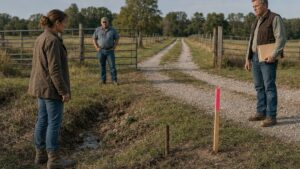
Rebecca took us fifty yards down the lane and showed me exactly what twelve feet had cost her.
Her old fence line was still visible in places.
A weathered post leaned beside a blackberry thicket, and a strip of flattened grass ran parallel to the replacement fence she had installed the previous summer.
“That was my equipment turnaround,” she said. “Not much, but enough to back the hay wagon without putting a wheel in the ditch.”
William stared at the abandoned post.
“They made you move all this?”
“They said it was association access.”
“Did they show you an easement?”
Rebecca looked at me.
“They showed me a map.”
That word again.
“What map?”
“Gary had a copy. Blue lines, measurements, the whole thing. I didn’t know what I was looking at.”
“Did you sign anything?”
“No.”
“Get paid for anything?”
Her expression sharpened.
“No.”
I walked the old line slowly.
The replacement fence sat roughly where Gary’s twelve-foot rule would have put mine.
Rebecca watched me measure with my eyes.
“I figured everybody had the same requirement,” she said. “You get enough official paper, you stop asking whether somebody has the right to send it.”
William muttered something under his breath.
I turned to Rebecca.
“Anybody else?”
She nodded toward the upper lane.
“Two that I know of.”
By noon, we had seen both.
One farmer had moved a mailbox turnout and cut back a line of posts. Another had shifted a small gate into his pasture. Neither had signed a new easement. Neither could remember seeing a recorded instrument.
All had received the same measurement.
Twelve feet from the traveled edge.
On the drive back toward my farm, William slapped the steering wheel.
“That’s it.”
“What?”
“That’s what?”
“You’ve got him.”
I looked out the passenger window.
“Gary?”
“Who else?”
“This isn’t a card game.”
“He told people they had to give up land they didn’t have to give up.”
“We don’t know that yet.”
William glanced at me.
“Yesterday you knew.”
“Yesterday I knew my deed didn’t match his notice.”
“Sounds close enough.”
“It isn’t.”
That irritated him.
It also irritated me that I had to say it.
At my gate, I took down four of the remaining temporary stakes and stacked them beside the shed. I had already removed five flags that morning. The bright display suddenly felt different.
At sunrise it had looked like proof.
By afternoon it looked like celebration before the facts were finished.
I left only the original flag flying.
Then we heard the truck.
Not Gary’s.
A large feed truck came down the association lane carrying several tons of bulk feed. The driver slowed near my entrance, eased left, then corrected right as the road narrowed into the bend.
His rear wheels dropped onto the soft shoulder.
Mud pressed outward.
The truck stopped.
The driver backed six feet, tried again, and swung wider.
This time the front bumper cleared my cedar post by what looked like less than two feet.
William’s face changed.
The driver leaned out the window.
“That corner keeps getting worse.”
He pulled forward and disappeared up the lane.
Neither William nor I spoke for a moment.
I walked to the bend.
The drainage channel along the uphill side had pushed gravel toward the center. On the lower side, repeated truck tires had broken the shoulder into mud.
The usable lane was narrowing.
Gary had been wrong about my boundary.
That didn’t make him wrong about the road.
Rebecca joined us a few minutes later.
She looked at the tire marks.
“That’s what they keep talking about.”
“How long?”
“Couple years.”
“Why didn’t anyone fix the drainage?”
“They patched it.”
“That’s not fixing it.”
She gave me a dry look.
“You’ve attended exactly two association meetings in five years.”
I had no answer for that.
William kicked a loose stone into the rut.
“So now what? We give them twelve feet because a truck can’t make a corner?”
“No.”
I said it too quickly.
Rebecca heard it.
“There you are.”
“What?”
“Back to your fence.”
“My land matters.”
“So does mine.”
“I didn’t say it didn’t.”
“But you’ve been talking like the whole thing is Gary wanting to push people around.”
I looked up the lane.
Maybe that was what I had wanted it to be.
A clean problem.
An official-looking notice with no legal foundation. An arrogant man. A deed. A line. Something I could solve by putting the right document on a table.
Real problems were usually messier.
Late that afternoon, Gary returned.
He parked beside the damaged bend instead of at my gate.
Under one arm he carried a cardboard mailing tube.
Rebecca stood with me. William had gone home.
Gary looked from us to the tire tracks.
“Feed truck?”
“Yes.”
He nodded as if the road had made part of his argument for him.
Then he removed a rolled sheet from the tube and spread it across the hood of his pickup.
It was a large road plan.
Blue lines followed the association lane. Dashed lines widened the corridor through several properties.
At my entrance, one dashed line cut across the area Gary had ordered me to clear.
At Rebecca’s property, it followed the line where she had already moved her fence.
I leaned closer.
“This is what you’ve been using?”
“This is the association road-widening plan.”
“What book and page?”
Gary’s expression tightened.
“It’s the approved plan.”
“That wasn’t my question.”
He tapped the blue line.
“This is the width we need.”
“Need isn’t the same as own.”
“Edward, you saw that feed truck.”
“I did.”
“You want to wait until an ambulance can’t make that turn?”
Rebecca shifted beside me.
The question hung there.
Gary rolled the map halfway closed, then stopped.
“This wasn’t invented to bother you.”
“I believe that.”
He seemed surprised.
“But I still want the recording reference.”
Gary looked down at the map.
For a second, the defensiveness left his face.
What replaced it was harder to read.
“The county has the road file.”
“Good.”
“Go look.”
“I will.”
He rolled the plan completely and pushed it back into the tube.
As he turned away, I saw a small notation printed near the bottom corner.
Not a deed reference.
Not an easement book.
A project date.
And one word beneath it.
Preliminary.
Gary slid the map away before I could examine anything else.
But I had seen enough to know what I needed to find Wednesday morning.
The line might solve the road problem.
The question was whether it had ever become anybody’s legal boundary.
Chapter 4: The Map That Was Never Recorded
Christine Lewis looked at the screen, frowned, and searched again.
Then she turned toward me across the county records counter.
“I’ve got the road agreement. I’ve got two maintenance amendments. I’ve got the old parcel plats. I do not have a recorded widening easement matching what you’re describing.”
“Try the project date.”
“I did.”
“The association name?”
“Twice.”
She leaned closer to the monitor and typed more slowly.
The records office had changed since the years when I spent half my working life in places like it. Fewer paper index books. More terminals. Same fluorescent lights, same low conversations, same peculiar smell of toner and old folders.
I had arrived ten minutes after opening with a copy of my deed, Gary’s notice, and the project date I had glimpsed on the map.
Christine knew me from years earlier, when I had called her office while researching easements for attorneys in Asheville. She had been helpful then because she was careful, not because she bent rules.
She was careful now.
“I can tell you what is recorded,” she said. “I can’t tell you what legal effect anything has.”
“I know.”
“And I’m not taking sides in your association dispute.”
“I didn’t ask you to.”
She gave me a look.
“You always say that right before asking a question designed to make somebody take sides.”
I almost smiled.
She was not wrong.
Christine printed an index sheet and slid it toward me.
“The recorded road width hasn’t changed since the last maintenance amendment.”
I read the entries.
Nothing corresponding to twelve feet from the traveled edge.
No conveyance from my father.
No easement from Rebecca.
No widening document from the other farms we had checked.
“Then where did the map come from?”
“That’s a different question.”
She stood.
“Come on.”
She led me through a side door into the older records room, where bound volumes still occupied steel shelves. A county clerk brought out a cardboard file box after Christine gave him the project number.
The label on the lid included the same date I had seen on Gary’s map.
Inside were engineering notes, drainage sketches, correspondence, meeting minutes, and three rolled plans held by brittle rubber bands.
Christine placed the first plan on a wide table.
It wasn’t Gary’s.
The second wasn’t either.
The third was.
Blue widening lines followed the association lane.
I leaned over the bottom-right corner.
There, in small block letters, was the word I had seen Tuesday afternoon.
PRELIMINARY.
Below it was something I had not been able to read from Gary’s truck hood.
FOR DISCUSSION PURPOSES ONLY.
I rested both hands against the edge of the table.
Christine stayed quiet.
The plan had never been a boundary.
It had been a proposal.
I followed the dashed line across my parcel, then Rebecca’s.
Beside several curves were handwritten engineering notes.
INSUFFICIENT TURNING RADIUS.
DITCH FAILURE.
SHOULDER LOSS.
HEAVY VEHICLE CONFLICT.
I moved farther down the sheet.
Near the bend below my gate was a note dated almost four years earlier.
RECOMMEND ACQUISITION OF ADDITIONAL WIDTH BY AGREEMENT.
Acquisition.
By agreement.
Not enforcement.
Not automatic setback.
I pulled a chair closer.
The satisfaction I had expected was there, but it was thinner now.
“Can I see the correspondence?”
Christine handed me the folder.
A consultant had sent the road association several options. One proposed rebuilding drainage within the existing corridor. Another suggested acquiring narrow strips at specific bends. The broadest concept showed the twelve-foot line Gary had been enforcing.
That version was also the most expensive.
An attached estimate listed surveying, grading, drainage pipe, easement acquisition, and compensation to affected owners.
I read the total twice.
“So they didn’t do it.”
Christine glanced at the document.
“Looks like they studied it.”
“That’s not what I said.”
She closed the file halfway.
“Edward.”
I looked at her.
“You came here wanting to know whether your deed changed.”
“It didn’t.”
“Then you have your answer.”
“No. I have one answer.”
She understood what I meant.
Gary had not invented the line from nothing.
Someone had studied it.
Someone had priced it.
Someone had recommended acquiring it properly.
The question was what happened after that.
I spent another hour going through meeting records.
The oldest minutes showed concern about the road. Trucks had clipped fenceposts. Water had crossed the gravel during hard rain. One contractor refused to bring a loaded dump truck past the lower bend.
Then the minutes changed.
The widening project was discussed less often.
Maintenance assessments increased.
References to “clear access standards” began appearing.
A later set of notes mentioned owners being asked to maintain “the planned corridor.”
Planned.
Not owned.
I copied everything I was permitted to copy.
At home that afternoon, I spread the records over my kitchen table.
My father’s deed lay on one side.
Gary’s cream notice lay on the other.
Between them was the preliminary plan.
The difference was no longer mysterious.
It was procedural.
But procedure was not the part that kept bothering me.
The engineering report made clear that the road had genuine defects.
The drainage ditch near my gate had been undersized even before the shoulder began failing. The turn Gary kept complaining about really did become difficult for long trucks.
I had seen that myself.
I had also ignored association meetings where people probably talked about it.
That fact sat less comfortably on the table than the map did.
Near five o’clock, Rebecca stopped by.
I showed her the preliminary label.
She stared at it.
“So they never owned that strip?”
“Not according to anything I’ve found.”
“And Gary knew this?”
“I don’t know.”
She tapped the map.
“He had this exact sheet.”
“Yes.”
“Then how could he not know?”
I looked at the acquisition note again.
That was the question.
After Rebecca left, I called the association treasurer.
I did not ask what Gary knew.
I asked for the most recent financial summary and the minutes surrounding the abandoned road work.
Association members were entitled to inspect them.
An hour later, the treasurer emailed several scanned pages.
The reserve balance was lower than I expected.
Much lower.
The road-widening estimate from four years earlier would have consumed nearly everything they had then.
Current reserves would not cover even half of it.
One line in an old budget note caught my attention.
LAND ACQUISITION DEFERRED — INSUFFICIENT FUNDS.
Below it, in another hand:
MAINTAIN REQUIRED CLEARANCE THROUGH MEMBER COMPLIANCE.
I read that sentence three times.
The folded cream notice was still beside my elbow.
For the first time, I stopped wondering whether Gary had mistaken a proposed line for a legal one.
I started wondering whether he had known exactly what it was.
Chapter 5: Why Gary Needed Everyone to Believe Him
“We don’t have the money.”
Gary said it before I had even taken a seat.
Thursday evening, six folding chairs had been arranged inside the equipment shed the association used for small meetings. Only two were occupied: mine and Gary’s.
The big overhead door stood open.
Through it, across the lane and down the slope, I could see the single American flag beside my cedar gate.
Gary followed my eyes.
“You took the others down.”
“They were temporary.”
“I know.”
His voice carried none of Tuesday’s certainty.
I placed copies of the preliminary road plan and the budget notes on the folding table between us.
“You knew this wasn’t recorded.”
Gary did not look at the papers.
“I knew it wasn’t an easement.”
“That’s not the same answer you gave people.”
“I told people we had an access standard.”
“You told them to move fences.”
“We told them to clear the planned corridor.”
“As though they had no choice.”
Gary rubbed both hands over his face.
He looked older than he had standing at my gate.
“You want me to say I handled it badly?”
“I want you to say what you did.”
His eyes came up.
“Fine. I pushed it.”
“Why?”
“Because asking didn’t work.”
I leaned back.
“There it is.”
“No, Edward. You don’t get to do that.”
“Do what?”
“Sit there like you’ve solved the whole thing because you found one word on a map.”
I felt my shoulders stiffen.
Gary saw it.
“That road has been falling apart for years. Everybody wants it fixed until there’s an assessment. Everybody wants more room until the room comes off their property. Everybody wants trucks to get through, but nobody wants a ditch moved or a fence touched.”
“That doesn’t give you land.”
“I know that.”
“Then why send notices saying it did?”
He stared out through the open shed.
For several seconds, I heard only insects and the faint metallic rattle of a loose panel in the wind.
“Three winters ago,” he said, “an ambulance came up here for a man on the upper ridge.”
I said nothing.
“It cleared your gate. Barely. Got to the lower bend and had to back once because a trailer was parked too close on the other side. Then the driver got a wheel into the shoulder.”
Gary pointed toward the lane.
“Two minutes, maybe three. That’s all it cost.”
“Was anybody hurt because of the delay?”
“The man survived.”
“Then—”
“That’s not the point.”
His voice sharpened, then lowered again.
“I stood there watching them work that truck around the bend thinking, if somebody dies because we spent five years arguing over six feet of dirt, what am I supposed to tell their family?”
That stopped me.
Not because it excused anything.
Because it explained something.
Gary pulled the preliminary plan closer.
“The engineer told us where the trouble spots were. We priced acquisition. We priced drainage. We priced rebuilding shoulders. Then the members saw the assessment.”
“How much?”
“Enough that half the room threatened to vote the board out.”
“So you found another way.”
“I found a bad way.”
The admission came so quietly I almost missed it.
Gary looked at the plan.
“I thought if we established one clearance line and everybody complied, eventually we’d have enough room to maintain the road safely. No lawyers. No appraisals. No fighting parcel by parcel.”
“No compensation.”
“Yes.”
“No recording.”
“Yes.”
“No consent.”
He looked at me.
“Not real consent.”
That was the first moment in the entire dispute when he sounded less like an association president than a tired landowner.
It would have been easier if he had stayed arrogant.
I had come prepared to corner him with documents.
Instead, I found myself looking at a man who had taken a real problem and chosen an illegitimate shortcut because he believed the legitimate path would fail.
I tapped the cream notice.
“You put fines behind it.”
“I know.”
“You chained mine to my gate.”
“I didn’t chain it. The road contractor did.”
“You authorized delivery.”
Gary nodded.
“Yes.”
“You made people think the association already had rights it didn’t have.”
“Yes.”
The shed went quiet again.
I should have felt victorious.
I didn’t.
Gary leaned forward.
“Now you tell me what I should have done.”
“Ask.”
“We did.”
“Negotiate.”
“With money we don’t have?”
“Then do less.”
“Less doesn’t fix the bend.”
“Maybe the whole twelve-foot corridor isn’t necessary.”
“That’s the engineer’s plan.”
“One engineer’s broadest plan.”
Gary narrowed his eyes.
I slid the report toward him.
“There were alternatives.”
He glanced down.
“I know.”
“Drainage work inside the existing corridor.”
“Temporary.”
“Targeted widening at specific points.”
“Still costs money.”
“But less land.”
“Still land.”
“Then you acquire the land you actually need.”
He gave a short humorless laugh.
“Listen to yourself. ‘Acquire the land.’ With what?”
I did not answer immediately.
That irritated him.
“Exactly.”
Then he pointed through the shed opening toward my farm.
“And before you make yourself the only innocent man in this room, your gate isn’t perfect either.”
I stared at him.
“The hinge post is outside the recorded road.”
“I know where the post is. I’m talking about the turn.”
“My gate opens inward.”
“The opening itself narrows where long vehicles set up for the bend. Not twelve feet. Not even close. But you’ve watched trucks swing around it.”
I thought about Tuesday’s feed truck.
The rear wheels dropping into mud.
The bumper passing near the cedar post.
I had blamed the shoulder.
The shoulder was part of it.
My entrance geometry was another part.
Gary waited.
I disliked him a little for being right.
I disliked myself more for having noticed the same thing and said nothing.
“My gate contributes some.”
He leaned back.
It was not a triumphant gesture.
Just recognition.
“Thank you.”
“Don’t make too much of it.”
“I wasn’t planning to.”
We sat there facing the same map that had started as evidence against him.
Now it looked more like evidence against everybody’s preferred version of the problem.
Gary tapped the estimate.
“We can’t afford this.”
“Not this version.”
“What version can we afford?”
“I don’t know yet.”
He studied me.
On Tuesday morning, I would have enjoyed making him ask.
On Thursday evening, the question felt heavier.
“What if there isn’t one?” he said.
“Then the association lives within the rights it has.”
“And waits for the road to get worse.”
“Or finds another solution.”
Gary folded his arms.
“You spent twenty years telling people what land they owned.”
“I spent twenty years reading what they had signed.”
“Fine.”
He pushed the map across the table toward me.
“Read this mess.”
I looked down at the blue lines.
Then at the original flag moving lightly beside my distant gate.
Gary’s voice was quiet when he spoke again.
“You’ve proved I can’t take twelve feet from you.”
He paused.
“Can you show me how to fix the road without taking twelve feet from everybody else?”
Chapter 6: The Boundary I Could Defend or Share
By eight Friday morning, I had driven six bright stakes into the ground.
None of them marked Gary’s twelve-foot line.
The first pair stood near the damaged bend below my gate. The second pair marked the narrow shoulder farther uphill. The last two sat near Rebecca’s old equipment turnaround.
William arrived while I was stretching mason’s line between them.
He stopped beside the truck and looked over the layout.
“Please tell me we’re not putting the flags back.”
“No flags.”
“Shame.”
“I need you to hold the tape.”
He came closer.
“What are we measuring?”
“The road we actually need.”
That changed his expression.
For most of Friday, we measured turns.
Not property lines at first.
Turns.
We watched where the feed truck’s tires had traveled. We measured existing ditch width, shoulder loss, and the space between fixed obstacles. We compared the preliminary engineering plan with the narrower alternatives in the county file.
By noon, a pattern emerged.
The road did not need twelve extra feet along every farm frontage.
It needed better drainage.
It needed a rebuilt shoulder.
And at two short sections, it needed more width.
One of those sections touched my property.
The other touched Rebecca’s.
William stood over my sketch.
“How much?”
“At the widest point? A few feet.”
“For how long?”
“Maybe sixty feet.”
He whistled softly.
“You giving it to them?”
“No.”
“Good.”
“That doesn’t mean what you think it means.”
He looked at me suspiciously.
I walked to the cedar gate.
The original flagpole complicated one measurement, so I loosened its ground sleeve and moved the pole temporarily farther inside the pasture.
William watched me carry it.
“Now that,” he said, “is going to confuse people.”
“It’s a flag, not a legal argument.”
“You treated it like one Tuesday.”
I stopped.
He was smiling, but the point landed.
Tuesday morning I had used those flags because I wanted something Gary could not ignore.
The display had been effective.
It had also been partly about winning.
I set the pole down carefully in the grass.
“Hold the tape.”
Rebecca arrived after lunch.
I showed her the proposed narrower alignment.
She studied it in silence.
Then she pointed toward her property.
“No.”
“You haven’t heard the whole thing.”
“I heard enough.”
“This isn’t the old twelve-foot line.”
“It comes across my land.”
“For a short section.”
“No.”
William looked at me and wisely moved away.
Rebecca folded her arms.
“I already moved one fence because they told me I had to. Now you’re telling me I should give them another piece because you found a nicer way to draw it?”
“I’m telling you the truck turn needs room.”
“Then take it off your side.”
“Some of it is on my side.”
“Take all of it.”
“That would move the approach into the ditch.”
“Fix the ditch.”
“We are.”
Her face hardened.
“This is exactly how it started last time. Somebody says it’s necessary. Somebody has a plan. Then suddenly my property is the easiest answer.”
I could have reached for the documents.
Instead, I let her finish.
That was harder for me than it should have been.
“When you got the notice last year,” I said, “you didn’t really get a choice.”
“No.”
“So I’m not asking you for an answer today.”
She looked at me.
“If this happens, it happens with a survey. A written easement. A valuation. Compensation. Everything recorded.”
“And if I say no?”
“Then we design around it.”
“Even if it costs more?”
“Yes.”
She studied my face.
“And Gary agreed to that?”
“Not yet.”
That almost made her laugh.
I unfolded my sketch across the hood of the truck.
“The association withdraws every unsupported notice first. Yours. Mine. Everybody’s.”
Rebecca looked down.
“Then what?”
“Then we fix drainage inside the existing corridor. After that, a surveyor identifies the minimum extra width needed at the two problem sections.”
“And who pays?”
“The association.”
“With what money?”
“Assessment, reserves, staged work. Whatever the members approve.”
“So we’re back to the part everybody hates.”
“Yes.”
She looked at me for a long moment.
“That’s at least honest.”
Friday evening, Gary came down the lane.
I showed him the stakes.
He stared at them, then at me.
“That’s all?”
“That’s what preliminary measurements suggest.”
“The engineer wanted more.”
“The engineer gave several options.”
Gary walked the bend.
He paced the distance twice.
“You’d give an easement here?”
“Not give.”
His eyes narrowed.
“I’d negotiate one.”
“Edward.”
“Properly.”
He waited.
“Surveyed. Appraised if necessary. Recorded. Compensation. And every old twelve-foot notice gets withdrawn before anyone signs anything.”
Gary rubbed his jaw.
“You know what the members will say.”
“That they don’t want another assessment.”
“Correct.”
“Then they can vote against the work.”
“And live with the road?”
“If that’s the choice they make.”
He stared toward the upper farms.
“You make it sound simple.”
“It isn’t simple.”
“You’re asking people to pay for land they thought they already had clearance over.”
“No. I’m asking them to pay for rights they never acquired.”
He winced slightly.
I did not enjoy it this time.
That mattered.
Saturday morning, Gary brought the association treasurer and two neighboring farmers to look at the layout.
Nobody applauded.
Nobody immediately agreed.
One farmer argued that widening should come entirely from the largest parcels.
The other insisted drainage alone would solve everything.
Rebecca repeated that she would not surrender another inch based on pressure.
William stood near my truck with his arms folded, saying nothing unless asked.
For nearly an hour, the conversation went in circles.
Then I did the one thing none of them expected.
I pointed to the first narrow strip beside my gate.
“Start with mine.”
Gary looked at me.
Rebecca did too.
“I’ll negotiate this section first,” I said. “Limited width. Limited length. Only what the survey shows is needed.”
One of the farmers frowned.
“Why would you volunteer?”
“I’m not volunteering the land.”
I tapped the sketch.
“I’m volunteering to be first through the correct process.”
The distinction settled over the group.
“No blanket setbacks,” I continued. “No letters pretending a proposed line is already enforceable. No free land because somebody doesn’t want an assessment. If the association needs a property right, it asks for it and records it.”
Rebecca nodded once.
“And if an owner says no?”
“Then the board comes back with another design.”
Gary studied the stakes.
“What if the members reject compensation?”
“Then they reject the widening.”
He looked at me.
There was no threat in his face now.
Only arithmetic.
Money, trust, road width, votes.
Problems no document could make disappear.
Finally he exhaled.
“I’ll call a full meeting.”
“When?”
“Next week.”
“Not before the notices are addressed.”
Gary hesitated.
Then nodded.
“I’ll recommend suspension immediately.”
“Withdrawal.”
“That requires the board.”
“Then recommend withdrawal.”
He looked toward Rebecca.
Then toward the damaged bend.
“All right.”
William unfolded his arms.
Gary rolled up my sketch.
“I want to show this to the membership.”
“Take a copy.”
He paused beside his truck.
“Edward.”
“Yes?”
“If they vote it down, don’t pretend I didn’t warn you.”
“I won’t.”
“And if they vote it through, don’t pretend you did this alone.”
For once, the remark did not irritate me.
“I won’t.”
Gary climbed into his truck.
As he drove away, Rebecca came to stand beside the temporary location where I had set the original flag.
“You putting that back?”
“Eventually.”
“After the vote?”
“After we know where the line belongs.”
She looked at the stakes, then up the gravel lane.
For the first time since Monday, the boundary in front of me no longer felt like something I had to defend from everyone.
It felt like something we might finally define together.
But first Gary had to put that idea in front of the same people who had once refused to pay for it.
Chapter 7: One Flag Back Beside the Gate
The survey crew arrived three weeks later and drove its first stake into the ground six feet inside the line Gary had once told me the association already controlled.
I stood beside the cedar gate while the county surveyor checked the instrument again.
Gary stood on the opposite shoulder with his hands in his pockets.
Neither of us said anything.
The new stakes were plain wooden laths with bright ribbon tied near the tops. They followed the existing recorded easement until they reached the damaged bend. There, the line widened gradually across a narrow strip of my frontage, narrowed again, then crossed toward Rebecca’s property farther uphill.
Not twelve feet everywhere.
Not even close.
The final design needed additional land in only two short places.
Everything else could be handled with drainage work and a rebuilt shoulder.
The surveyor pointed toward my cedar post.
“Your gate stays.”
I nodded.
“And the flagpole?”
“Outside everything we’re recording.”
Gary looked at me.
I resisted the temptation to say anything.
The association meeting the week before had lasted nearly four hours.
Nobody had enjoyed it.
The proposed assessment passed by three votes.
Rebecca agreed to negotiate a narrow easement after the survey showed exactly what was needed. I agreed to mine. Both agreements included compensation, defined maintenance rights, restoration requirements, and limits on future widening.
No phrase such as planned corridor appeared anywhere.
Gary had insisted on that himself.
The association also voted to withdraw every twelve-foot compliance notice issued under the preliminary map.
That part mattered more to me than I had expected.
Two days after the survey, Gary asked me to come to the equipment shed.
The cream notices were stacked on the folding table.
Mine was on top.
Rebecca’s was beneath it.
There were several more.
Gary picked up mine.
“You want this?”
“I’ve already got my copy.”
He looked at the paper.
“Board voted these withdrawn.”
“I heard.”
“I’m removing them from the active enforcement files.”
He opened a cardboard records box and placed the notices inside a folder marked for superseded material.
No ceremony.
No apology speech.
Just paper being moved from one place to another.
It suited the situation better.
Gary rested one hand on the box.
“I should’ve done this differently.”
“Yes.”
He gave me a tired look.
“You could make it a little harder to apologize to you.”
“I didn’t realize that’s what you were doing.”
“It was close.”
I almost smiled.
Then he said, “Rebecca gets her old strip back.”
That caught my attention.
The survey had confirmed that the fence she moved the previous year sat well outside the recorded road easement except for the small section now being negotiated separately.
“The board approved restoration?”
“Fence can go back to the original line at association expense.”
That was more than I had expected.
“Good.”
Gary nodded.
“She said the same thing.”
He started closing the records box.
I stopped him.
“What happens to the preliminary map?”
“Stays in the historical file.”
“Marked properly?”
He gave me another look.
“Yes, Edward. Marked properly.”
“Just checking.”
“I know.”
A week later the road contractor arrived.
The first work was not widening.
It was drainage.
They cleaned the clogged ditch near my entrance, replaced a crushed section of pipe, and shaped the uphill channel so water would stop pushing gravel toward the middle of the lane.
Then they rebuilt the soft shoulder where the feed truck had dropped its rear wheels.
Only after that did they begin working inside the two newly acquired easement strips.
The difference was almost disappointing to look at.
No broad new road.
No dramatic cut through anybody’s pasture.
A slightly easier curve.
A firmer shoulder.
Enough additional room for a long truck to set up properly before entering the bend.
The next feed delivery came on a Thursday morning.
I heard the diesel engine before I saw the truck.
It slowed near my entrance.
I stepped away from the gate.
The driver lined up for the curve, swung once, and came through without backing.
His rear wheels stayed on gravel.
The bumper cleared the cedar post comfortably.
He lifted two fingers from the steering wheel as he passed.
That was all.
Yet I stood there watching until the truck disappeared over the rise.
William found me ten minutes later.
“That’s what all this was for?”
“Apparently.”
He studied the rebuilt bend.
“Not much to look at.”
“No.”
“All those papers for four feet here and a few feet up there.”
“Land tends to become important when somebody else decides how much of yours they need.”
He nodded toward the empty sleeve beside the gate.
“You ever putting that flag back?”
I had taken the original pole down during the survey and left it stored behind the barn through construction.
I walked over to it.
William helped me carry it back without another word.
We slid the pole into its ground sleeve beside the cedar post.
When the flag rose above the gate again, there was only one.
No line of six temporary flags.
No survey stakes arranged as an argument.
Just the same flag that had been there before Gary’s notice appeared.
Later that afternoon, one of the neighboring farmers stopped while I was checking the gate.
“The association’s talking about electing officers again next month,” he said.
“I imagine they are.”
“Some folks think Gary ought to step down.”
I waited.
“They’d support it if you pushed.”
There had been a time, not many weeks earlier, when that offer would have satisfied something in me.
Gary had used authority he did not possess.
He had frightened owners into surrendering practical control of land without proper agreements.
Being afraid of a bad road did not erase that.
But I had also watched him vote to withdraw the notices, support compensation, admit the mistake in front of the membership, and spend two Saturdays marking drainage problems with the contractor.
“I won’t push it,” I said.
The farmer looked surprised.
“Why not?”
“Because correcting what he did matters more to me than deciding whether everybody stays angry at him.”
“You trust him now?”
“That’s a different question.”
He considered that, then drove on.
Near sunset, Gary came down the lane on foot.
He stopped at the rebuilt bend first, pressed one boot against the new shoulder, and looked toward the drainage ditch.
Then he walked to my entrance.
His eyes went to the flag.
“Thought you might put all six back.”
“They were markers.”
“I seem to remember you enjoying them.”
“I did.”
“Too much?”
I looked at him.
“Probably.”
He nodded as though that answer cost both of us less than pretending otherwise.
For a while we stood beside the gate without speaking.
The cattle were scattered across the pasture, dark shapes against the cut hayfield.
Gary touched the nearest cedar post.
“So that’s staying too.”
“The gate?”
“The flag.”
I followed his gaze upward.
The fabric moved once in the evening breeze and settled again.
“Yes,” I said. “The flag stays.”
Gary looked down at the new survey marker set beyond the shoulder.
“And the road line?”
“That stays where we agreed it belongs.”
He nodded.
Then he continued up the lane.
I watched him go until the curve hid him.
The cream association notice was still in my kitchen drawer, folded along the same creases I had made the morning I found it chained to the gate.
For weeks I had kept it close because it reminded me what happened when somebody confused a plan with a right.
Eventually I put it into the farm records with the corrected survey and the new easement.
Not framed.
Not displayed.
Just filed where it belonged.
Outside, one flag remained beside the cedar gate.
And for the first time since the notice appeared, nobody needed it to prove where the boundary was.
The story has ended.