He Tore Down a Farmer’s Gate Over Six Inches, Then Learned Who Controlled the Only Road Out
Chapter 1: Six Inches Was Enough to Tear the Gate Down
The tractor chain snapped tight around Anthony Miller’s cedar gatepost while he was still twenty yards away.
He heard the metallic crack before he understood what he was seeing.
“David!”
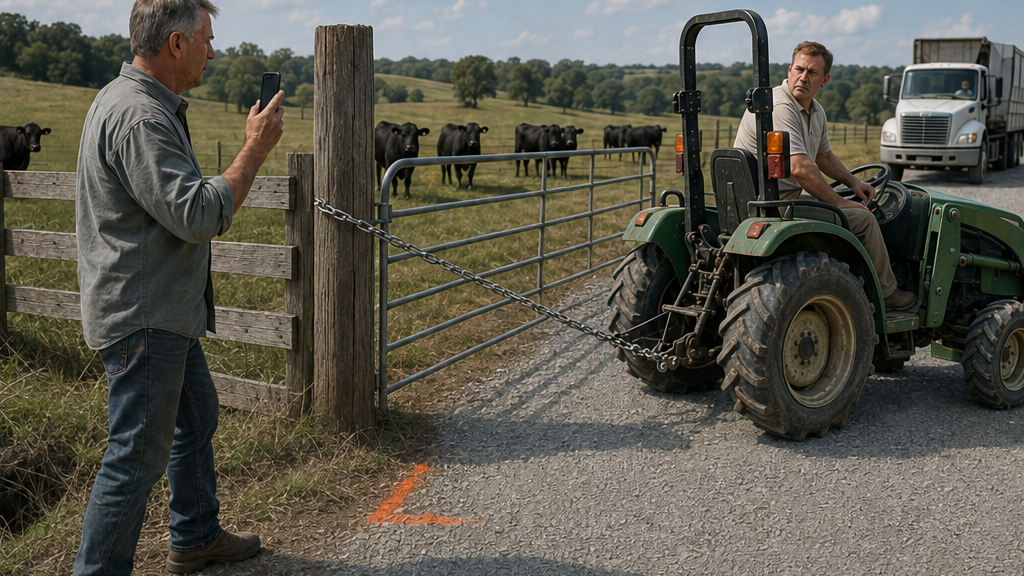
Anthony broke into a run down the gravel turnout, boots sliding on loose stone. Beyond the fence, three black cattle lifted their heads from the grass. At the entrance, David Green sat on the association’s compact tractor with one hand on the hydraulic lever. A galvanized chain ran from the tractor hitch to the lower hinge post of Anthony’s livestock gate.
David looked over his shoulder.
“Stay clear.”
Anthony stopped because the rear tire was already turning.
The chain drew taut.
The cedar post shuddered.
“You touch that post again,” Anthony said, “and you’re doing it without my permission.”
David eased off the lever. “You already had notice.”
Anthony stared at him.
On the shoulder beside the tractor stood a can of orange marking paint, a measuring tape, and two wooden stakes. A bright line crossed the gravel six inches inside the edge David had marked the week before.
“That isn’t a survey,” Anthony said.
“It’s the road clearance.”
“It’s paint.”
“It’s six inches.”
Anthony walked closer, but not into the chain’s path. “Then wait for the survey.”
David’s mouth tightened.
For two weeks he had been saying the same thing: Anthony’s western gatepost narrowed the agricultural association lane and violated the clearance standard adopted after the spring road repairs.
Anthony had said the same thing back: prove where the right-of-way was.
Now the argument had a tractor attached to it.
David climbed down.
He wore a clean work shirt and boots that had seen more committee meetings than mud that morning. He picked up the tape and hooked it over the gravel edge.
“From here to the face of your post,” he said. “Six inches inside.”
Anthony did not look at the tape.
“Inside what?”
“The maintained corridor.”
“The gravel isn’t the boundary.”
“It’s the road.”
“That’s not what I asked.”
David let the tape recoil with a sharp metallic hiss. “Anthony, every feed truck that comes through here cuts toward the ditch because of this entrance. We’ve had two members complain. The insurance review says we need the lane clear.”
“Then show me the recorded line.”
“We don’t need to relitigate this every time you decide a rule doesn’t apply to your farm.”
Anthony felt heat climb into his neck.
Behind David, the lane curved between fenced pasture and a drainage ditch, then disappeared toward the other farms served by the association. Anthony’s family had used that entrance before the association had a name, before the lane had fresh gravel every spring, before anyone had thought to measure clearance with orange paint.
His father had reset that cedar post after a flood.
Anthony had helped him tamp the dirt.
He could still remember his father’s palm against the top of it.
Never let anybody move that gate.
It had sounded like practical advice when Anthony was twenty-three.
Now it felt like an instruction written into his bones.
“Get the chain off,” Anthony said.
David shook his head.
“Final chance.”
“For what?”
“To move it yourself.”
Anthony almost laughed.
Instead, he reached into his pocket and pulled out his phone.
David noticed.
“What are you doing?”
“Recording.”
“For what?”
Anthony switched to video and aimed at the tractor, then the chain, then the orange line.
He spoke clearly.
“Saturday, eight forty-two in the morning. David Green has attached the agricultural-road association tractor to my livestock gatepost. I have told him I do not consent to removal. He has not provided me a completed survey.”
David’s face hardened.
“You done?”
“No.”
Anthony walked sideways, keeping the chain and hitch in frame.
“Show me the written authorization.”
“You received the violation notice.”
“That’s not authorization to tear down my gate.”
David looked toward the lane.
A feed truck had appeared around the bend and slowed when the driver saw the tractor blocking half the road. The truck stopped thirty yards away.
David glanced at it, then back at Anthony.
“That right there is the problem.”
“The problem right now is your tractor.”
“The problem is you think because your family’s been here a long time, nobody can tell you anything.”
That landed harder than Anthony wanted it to.
He took one step forward.
David did not move.
For a second Anthony pictured himself grabbing the chain, ordering the driver out of the tractor, making the whole thing physical enough that there would be no pretending what this was.
Then he saw his phone screen.
The red recording dot.
His own hand shaking.
He lowered his shoulders.
“You know the survey isn’t finished,” he said.
David’s eyes flickered.
Only once.
But Anthony saw it.
David climbed back onto the tractor.
“We have measurements.”
“That isn’t what I said.”
“We have a duty to maintain access.”
“And you have no permission to remove my property.”
David started the engine.
The cattle behind the fence backed away from the noise.
Anthony stepped well clear.
“David.”
The tractor idled.
“If you pull that post,” Anthony said, “you own the decision.”
David looked at him for several seconds.
Then he pulled the lever.
The chain tightened.
The cedar post bent first at the base. Soil cracked around it in a dark crescent. The top rail of the gate twisted, one hinge tore loose, and the whole assembly fell sideways with a grinding crash.
The feed-truck driver swore from inside his cab.
Anthony said nothing.
The chain went slack across the gravel.
David climbed down and stared at the wrecked entrance as if he had completed a maintenance job.
“There,” he said. “Now the road is clear.”
Anthony kept the phone aimed at him.
David seemed to realize, too late, how that sentence sounded.
He unhooked the chain.
The gate itself lay diagonally across Anthony’s turnout, one end buried in crushed weeds. The livestock opening was now useless. Anthony would have to string temporary panels before moving cattle through the lower pasture.
David carried the chain toward the tractor.
Anthony held out his hand.
“That chain is mine.”
David stopped.
The chain had been looped through Anthony’s gate for nearly fifteen years.
For a moment David looked as though he might argue about that too.
Then he dropped it in the gravel.
“Fix the entrance to standard,” he said.
“What standard?”
David climbed onto the tractor without answering.
The feed truck backed up to give him room.
Anthony stood beside the fallen gate until the tractor disappeared around the curve.
Only then did he stop recording.
The driver eased forward, rolled down his window, and looked at the wreckage.
“You still want me in there?”
Anthony looked at the cattle, the twisted hinge, and the open gap.
“Not through this entrance.”
The driver nodded. “I can come around by the lower field.”
“That’ll add twenty minutes.”
“I got twenty.”
Anthony thanked him.
When the truck left, the farm went quiet again.
He dragged the fallen gate out of the lane and laid the chain across it. Anger kept asking him for something useful to do with his hands.
Instead, he went to the shed for a measuring tape.
David’s orange line was still bright against the gray gravel.
Anthony hooked the tape at the line, measured to the gatepost hole, and got six inches almost exactly.
For one satisfying second, he imagined how simple the argument would be.
Then he looked past the paint.
At the edge of the grass, half hidden under dock leaves, something rusty caught the light.
Anthony crouched.
It was an old survey stake.
Not near David’s painted line.
Several feet beyond it.
Chapter 2: The Gravel Edge Was Not the Boundary
Anthony measured three times before he trusted the number.
From the old stake to the center of the post hole, the distance was nothing like six inches.
It was several feet.
He stood in the road with the tape pulled tight and stared from one point to the other.
David had measured from the edge of the gravel.
The old stake suggested the recorded line was somewhere else entirely.
By noon, Anthony had photographed everything.
The orange paint.
The stake.
The post hole.
The bent hinges.
The tractor marks.
He photographed the gate chain last.
After washing the dirt from it, he laid it across the workbench in the equipment shed. One link had a fresh silver scrape where David’s hitch had pulled against it.
Anthony ran his thumb across the mark.
He wanted to call David.
He wanted to say, You tore down my gate because you measured from the wrong place.
He reached for his phone.
Then stopped.
A photograph was not a survey.
An old stake was not necessarily the right stake.
That distinction irritated him because it sounded exactly like something David would say.
Anthony opened the metal filing cabinet in the farm office instead.
The property folder was where it had always been, packed with deeds, tax maps, fencing receipts, and documents his father had saved without any system Anthony could understand.
He spread the oldest plat across the desk.
The lane appeared as two parallel lines running between parcels. The drawing showed bearings and distances but did not show the modern gravel width.
Anthony found a newer county map online and printed it.
Then another.
The more documents he collected, the less certain he became.
The lane had been graded wider at least twice during his lifetime. The ditch had been cleaned and recut. Trucks had pushed gravel outward at the bend. Nobody had ever treated the loose edge of the stone as a permanent legal boundary.
That seemed obvious.
But “obvious” had already cost him one gate.
By Monday morning Anthony was standing at the county records counter with a folder under one arm.
The clerk pulled several plats and directed him to a small office where Joseph Hill sat behind a monitor displaying parcel lines.
Joseph listened without interrupting.
Anthony gave him the short version.
Private agricultural lane.
Association chairman.
Six-inch claim.
Gate removed.
Joseph leaned back.
“What are you asking me to determine?”
“Where the road is.”
Joseph nodded slowly.
“That’s not as simple as it sounds.”
Anthony felt his patience tighten.
“I’ve noticed.”
Joseph brought up an aerial map.
The lane showed as a pale gray ribbon between fields. He added a parcel layer, then a recorded easement overlay.
Anthony leaned closer.
The gravel did not sit neatly inside the lines.
At the bend near Anthony’s entrance, the maintained road had drifted toward his property over time.
Joseph pointed.
“This layer is approximate on the screen. Don’t use it as a field survey.”
“I’m not.”
“But you can see the issue.”
“The gravel moved.”
“Probably grading, traffic, drainage work. Roads like this migrate if nobody pins the maintenance edge to the recorded easement.”
Anthony stared at the map.
“So David measured from a moving target.”
Joseph raised one hand.
“I didn’t say that. I wasn’t there.”
“He measured from the gravel edge.”
“That’s different from saying where the legal corridor is.”
Anthony finally felt something unclench.
There it was.
Not victory.
But a crack in David’s certainty.
“So the county can tell the association to put my gate back.”
Joseph shook his head.
Anthony’s relief vanished.
“No?”
“This is a private road association.”
“The county has the records.”
“We have the recorded documents. We don’t administer the association’s private agreement.”
“He used association equipment to pull down my gate.”
“That may matter. But not because I say so.”
Anthony folded his arms.
“Then what exactly can you tell me?”
Joseph clicked through another map.
“I can tell you the county-maintained road ends here.”
He pointed to the junction nearly half a mile away.
“Everything beyond that is private.”
“I know.”
“I can tell you the easement shown on the recorded plat does not appear to use the present gravel edge as its definition.”
Anthony nodded.
“And?”
“And I can tell you that if there’s a dispute about the precise boundary, you need a field survey.”
“There’s one pending.”
Joseph looked at him.
“Then wait for it.”
Anthony almost smiled at the irony.
“That was my suggestion Saturday.”
Joseph did not ask what happened Saturday.
Instead, he printed two pages.
One showed the recorded corridor.
The second showed the modern aerial image.
He laid them on top of each other at the window, holding both against the glass.
Even with the imperfect scale, the mismatch was visible.
The gravel bend had crept sideways.
Anthony stared at the overlapping lines.
Six inches had sounded exact when David said it.
Now it looked almost meaningless.
“Can I get certified copies?”
“Of the recorded plat, yes.”
Anthony paid the fee and left with stamped documents in his folder.
He should have felt vindicated.
Instead, standing beside his truck, he heard Joseph’s warning again.
We don’t administer the association’s private agreement.
The county could show him where its authority stopped.
It could not tell him where David’s began.
Back at the farm, Anthony placed the plat beside the old chain on his workbench.
Amy Sanchez arrived shortly after lunch with a laptop bag and a cardboard tray of coffee.
She managed the farm accounts three days a week and had inherited her mother’s ability to know when Anthony was withholding half a problem.
She looked at the gate leaning against the shed.
Then at the chain.
Then at him.
“You going to tell me why the entrance looks like a tornado picked one thing to hate?”
“David.”
“That explains the irritation. Not the gate.”
Anthony told her.
By the time he finished, Amy had stopped drinking her coffee.
“He actually pulled it down?”
“I have video.”
“With what authority?”
“That’s what I’m finding out.”
She looked at the papers spread across the workbench.
“What are these?”
“County plat. Easement overlay.”
“And?”
“The gravel edge isn’t the boundary.”
Amy studied the documents.
“So he was wrong.”
“He was wrong to tear it down.”
“That’s not the same answer.”
Anthony looked at her.
She knew it.
He knew it.
He did not enjoy hearing it.
Amy set down her coffee and walked into the office.
“What are you doing?”
“Finding the association file.”
“It’s in the cabinet.”
“I know.”
She opened the second drawer.
Anthony stayed by the workbench.
A minute later, paper shifted inside the office.
Then stopped.
“Amy?”
She came back holding three envelopes.
Certified mail.
All addressed to Anthony Miller.
All unopened.
She placed them beside the chain.
“You might want to tell me,” she said, “why you never opened these.”
Chapter 3: The Letters Anthony Never Wanted to Read
Amy lined the three certified envelopes along the kitchen table as if she were presenting evidence against him.
Anthony remained standing.
“That doesn’t mean anything.”
“They’re unopened.”
“I can see that.”
“They’re from the road association.”
“I can see that too.”
Amy slid the oldest envelope toward him.
“So open it.”
Anthony looked at the return address.
He remembered each one arriving.
He also remembered setting them aside.
The first had come after David started talking about widening the bend.
The second came before an association meeting Anthony had no intention of attending.
The third arrived after he told David that nobody was moving his gate.
At the time, refusing the letters had felt like refusing the argument.
Now the gate was lying against the equipment shed.
Anthony sat down.
He opened the oldest envelope.
The letter was not aggressive.
That irritated him more.
It described proposed updates to the association’s access and maintenance agreements. Members were being asked to confirm gate locations, drainage access, and responsibility for repairs caused by heavy vehicles.
Amy watched him read.
“What?”
“Nothing.”
“That usually means something.”
Anthony passed her the letter.
She read it once.
“This isn’t a violation notice.”
“No.”
“It’s asking you to review an agreement.”
“I know what it says.”
“And you didn’t answer.”
Anthony opened the second.
This one referred to a meeting about road width after a loaded cattle trailer had damaged the ditch bank near the bend. It asked affected landowners to attend because the association was considering minimum clearance for larger trucks and emergency vehicles.
Anthony read that paragraph twice.
Amy noticed.
“What?”
He handed it over.
She read silently.
Then her voice changed.
“Emergency access.”
“It says they were discussing it.”
“That’s different from David making up six inches because he doesn’t like your gate.”
Anthony pushed his chair back.
“I never said he made up every concern.”
“You’ve been saying exactly that since Saturday.”
“I said he had no right to tear down my gate.”
“That part I agree with.”
“Then what are we arguing about?”
“We’re arguing about whether you ignored this until he became the only person talking.”
Anthony looked toward the window.
From the kitchen he could see the temporary livestock panel he had wired across the entrance. It sagged slightly at one end.
“My father used that gate for forty years.”
Amy lowered the letter.
“I know.”
“Nobody needed an agreement every time a truck came through.”
“Traffic changed.”
“The land didn’t.”
“The trucks did.”
Anthony said nothing.
Amy opened the third letter herself.
He let her.
Her eyebrows drew together.
“This one says they sent you a draft amendment.”
“I didn’t sign it.”
“You didn’t open it.”
“Same result.”
“No, Dad.”
The word landed softly but firmly.
“Not the same result.”
Anthony stood and carried his coffee to the sink though it was still half full.
He could hear David’s voice from Saturday.
You think because your family’s been here a long time, nobody can tell you anything.
Anthony had dismissed it because David had said it while standing beside a tractor chained to his property.
That did not make every word false.
Amy spread the correspondence in date order.
“There’s a copy of meeting minutes attached.”
Anthony returned to the table.
The minutes summarized complaints about heavy feed trucks using the bend. One member had reported that a trailer had crossed the ditch edge during wet weather. Another had raised concerns about whether emergency equipment could clear the narrowest entrances.
David’s name appeared several times.
Not as someone demanding punishment.
As someone asking for measurements.
Anthony did not like the effect that had on the story he had been telling himself.
“He still pulled the gate without a survey,” he said.
Amy looked up.
“Yes.”
“He still had no written authorization.”
“Probably.”
“Not probably.”
“Then prove that part.”
Anthony stared at her.
Amy gathered the letters into a stack.
“You can be right about what he did and still be wrong about what you ignored.”
That sentence followed Anthony into the equipment shed.
He spent the next hour replacing a bent latch on the temporary panel. The work required little thought, which meant he had too much room for everything else.
His father had hated paperwork.
Not all paperwork.
Tax forms got done.
Feed accounts got paid.
Deeds went into the metal cabinet.
But anything involving permission from another landowner had been treated differently.
Anthony remembered one winter evening years ago when his father came in carrying a draft road agreement.
He had tossed it onto the table.
“Don’t sign away something they already know is ours.”
Anthony had believed him without asking what the document actually said.
Later, after his father died, Anthony found that same unsigned draft in a folder.
He had never read that one either.
He had promised his father nobody would move the gate.
Somewhere along the years, he had turned that promise into a reason not to answer questions about it.
Amy came into the shed carrying another page.
“I found something.”
Anthony wiped his hands on a rag.
“What?”
“Minutes from Thursday.”
“Which Thursday?”
“Two days before the gate came down.”
Anthony took the page.
The association had met briefly to discuss the pending clearance survey. Only a few members were present. The wording was dry and ordinary.
Road-width concerns reviewed.
Member access documents outstanding.
Survey technician expected the following week.
Then one line stopped him.
Final boundary verification pending. No permanent corrective work recommended until survey completion.
Anthony read it again.
Amy stood quietly.
“That was Thursday?”
“Yes.”
“David was there?”
She pointed lower on the page.
Attendance listed David Green as chairman.
Anthony’s grip tightened on the paper.
All afternoon he had been forced to make room for the possibility that David’s concern was real.
Now something worse took its place.
Not that David had been mistaken.
That he might have known he did not yet know.
Anthony went back into the kitchen and spread everything across the table.
The certified letters.
The county plat.
The aerial overlay.
The association minutes.
Photographs of the gate.
A still image from his video showed the galvanized chain running from Anthony’s cedar post to the association tractor.
He studied David’s face in the frame.
Not furious.
Not reckless.
Certain.
Amy pulled out the chair opposite him.
“What are you thinking?”
Anthony placed the Thursday minutes beside the photograph.
“I’m thinking he didn’t pull that gate because the survey told him to.”
Amy waited.
Anthony tapped the line with his finger.
“He pulled it while the survey was still pending.”
“Why?”
Anthony looked again at David in the photograph.
That was no longer a question about six inches.
It was a question about why a man who claimed to be enforcing a settled rule had acted before the rule was settled at all.
Chapter 4: He Needed Everyone to Believe the Rule Was Settled
“We never voted to tear anything down.”
Rebecca Adams said it before Anthony had fully sat down.
He remained on the edge of the chair across from her desk, one hand still resting on the folder he had carried in from the truck.
“You’re sure?”
Rebecca gave him a tired look.
“I keep the minutes.”
The agricultural-road association office was barely an office at all, just a converted room behind the equipment barn with two filing cabinets, a printer, and a folding table scarred by years of coffee cups and maps. Anthony had been inside only twice.
That fact bothered him now.
Rebecca opened a binder.
“We discussed clearance. We discussed the survey. We discussed your unsigned access agreement.” She glanced at him. “More than once.”
Anthony accepted the hit.
“But nobody approved removal?”
“No.”
“Did David say the board had?”
Rebecca closed the binder halfway.
“What exactly did he tell you?”
“He told me the association had a duty to keep the road clear. He said I had notice. Then he chained my post to the tractor.”
Rebecca’s mouth tightened.
Anthony took out his phone and opened the still image.
The galvanized chain ran from his cedar post to the association tractor. David stood beside it, tape measure in hand.
Rebecca looked at the photograph longer than Anthony expected.
“Send me that.”
“Why?”
“Because I need it in the file.”
Anthony did not move.
“I’m already in the file.”
“You’ve been in the file for years.”
The answer was sharper than he expected from her.
Rebecca leaned back.
“You want me to say David had no reason to be frustrated. I can’t say that.”
“I didn’t ask you to.”
“You skipped meetings.”
“I know.”
“You never returned the access amendment.”
“I know.”
“You told him, in front of two members, that the road association could measure whatever it wanted as long as nobody touched your gate.”
Anthony remembered saying it.
At the time, it had felt restrained.
Now it sounded like a challenge.
Rebecca watched his face.
“That doesn’t make Saturday right.”
“Then why did he do it?”
She looked toward the window.
Outside, a loader bucket clanged against concrete somewhere near the maintenance shed.
“David’s been hearing complaints for months. Repair costs went up. One trailer dropped a wheel into the ditch. Then the insurer asked whether the association had documented clearance.”
“That still doesn’t answer my question.”
“No.”
She folded her hands.
“He thought he was losing control.”
Anthony said nothing.
Rebecca continued.
“Every time he brought up the road, somebody argued. One member wanted wider shoulders but didn’t want to pay. Another wanted drainage fixed before widening anything. You wouldn’t come to meetings. Then you told him the gate wasn’t moving.”
“So he decided to prove it would.”
Rebecca exhaled.
“I think he decided that if he backed down in front of everybody after calling the gate a violation, nobody would listen the next time he needed something done.”
Anthony looked at the photograph again.
That was worse in a different way.
Not blind anger.
Not a mistake made in five bad seconds.
A decision made because authority had become personal.
“Did he know the survey was pending?”
Rebecca opened another binder.
“Yes.”
The word came quietly.
Anthony felt his jaw tighten.
“You knew too.”
“Yes.”
“And nobody stopped him.”
“I didn’t know he was taking the tractor Saturday.”
“Would you have stopped him?”
Rebecca did not answer immediately.
That hesitation told Anthony more than a fast denial would have.
“I would have told him not to,” she said at last.
“That’s not what I asked.”
Her eyes hardened.
“No. I probably would not have stood in front of the tractor.”
Anthony leaned back.
For the first time since Saturday, he saw the shape of the institution itself.
Not David alone.
Not a board secretly authorizing destruction.
Something weaker.
People letting the loudest person decide because challenging him was inconvenient.
Rebecca reached into the binder and pulled out a copy of the bylaws.
“The chairman can arrange ordinary maintenance.”
“Is tearing out a private gate ordinary maintenance?”
“No.”
“Can he remove an obstruction?”
“If it is clearly within the association corridor and creates an immediate access hazard.”
“My gate had been there for decades.”
“I know.”
“Was there an emergency Saturday?”
“No.”
Anthony nodded slowly.
“So he had no authority.”
Rebecca held up one hand.
“Don’t run ahead of what I’m saying.”
He stared at her.
“The board never authorized removal,” she said. “And I don’t see language here that clearly gave David unilateral authority to do what he did. But your access agreement is still a problem.”
Anthony’s satisfaction vanished almost as quickly as it had arrived.
“What problem?”
Rebecca pulled a thin file from the cabinet.
The folder was older than the current association.
Anthony recognized his father’s handwriting on one page.
His stomach tightened.
“This was the original shared-lane agreement,” Rebecca said. “Your father signed the first version. When the lane was widened after the drainage project, everybody was supposed to sign an amended maintenance and access description.”
“Everybody?”
“Most did.”
“Most.”
“You didn’t.”
“My father was still alive then.”
“He didn’t either.”
Anthony looked at the signature line.
Blank.
The same blank he remembered from the old paper his father had thrown onto the kitchen table.
Rebecca tapped the page.
“That doesn’t give David the right to tear down your gate.”
“But?”
“But it means your family’s use of the widened section was never cleaned up on paper.”
Anthony’s anger had become something harder to hold.
He had come looking for a clean division.
David wrong.
Anthony right.
Instead, every document drew a different line.
At the roadside later that afternoon, Rebecca met him near the broken entrance.
Anthony showed her the old stake he had found beneath the weeds.
She stood with one boot in the gravel and one in the grass.
“That could be original.”
“Could be?”
“I’m not a surveyor.”
Neither of them stepped on David’s orange line.
A truck approached and passed slowly.
Its right tires rolled close to the ditch before swinging around Anthony’s temporary panel.
Rebecca watched it.
“That’s what David sees every time he comes through here.”
Anthony followed the truck with his eyes.
“And what I see is a road that moved toward my property.”
“Both things can be true.”
He looked at her.
Rebecca tucked her hands into her jacket pockets.
“That’s been the problem.”
On Thursday evening she called him.
Anthony was tightening a hinge on the lower cattle pen when his phone rang.
“The surveyor confirmed Friday morning,” she said.
“What time?”
“Eight.”
“Who’s attending?”
“You. David. Me. The survey technician.”
Anthony rested the wrench against his knee.
“David agreed?”
“He didn’t like being told.”
“But he agreed.”
“He’ll be there.”
Anthony looked toward the farm entrance.
The temporary panel leaned where his gate had stood.
Beyond it, the old stake waited in the grass, David’s orange paint still visible several feet away.
Tomorrow somebody would finally put instruments on the ground.
For the first time, neither man would get to choose where the line was.
Chapter 5: The Survey Gave Neither Man the Victory He Wanted
The survey technician drove the new pin into the ground on Anthony’s side of David’s orange line.
The hammer struck twice.
Then once more.
Anthony watched the bright cap settle into the soil.
David stood six feet away with his arms folded.
Nobody spoke.
The technician checked the instrument again, sighting toward another monument farther down the lane.
Rebecca held a clipboard against her coat.
Anthony looked from the new pin to the old gatepost hole.
“How far?”
The technician measured.
“Your post center was outside the recorded road corridor.”
Anthony felt something rise in his chest.
Not joy exactly.
Relief with teeth in it.
“How far outside?”
“Just over three feet from the corridor line at this point.”
Anthony looked at David.
David stared at the pin.
The orange paint sat well inside Anthony’s property.
Six inches had been measured from gravel that had migrated over years of grading.
Anthony could have ended the morning there in his own mind.
He could have let that one fact become the whole story.
David had been wrong.
The gate had been legal.
The tractor had no business touching it.
Instead, the technician walked twenty yards farther down the lane.
“We still need to check the widened access section.”
Anthony’s satisfaction cooled.
“What section?”
Rebecca looked at him.
“The amended area.”
They moved down the bend.
The lane narrowed between Anthony’s fence and the drainage ditch, then widened near the feed-truck turnout.
The technician found another monument and stretched a line between points.
He marked two locations with flags.
David spoke for the first time.
“That’s the problem.”
Anthony looked at him.
David pointed toward the turnout.
“Trucks use that extra width.”
“They’ve always used it.”
“Exactly.”
The technician straightened.
“Let me finish.”
David stepped back.
The second measurement took longer.
The technician consulted an older plat, then the newer association maintenance exhibit.
Finally he walked to Anthony.
“The physical gate was not in the recorded corridor.”
Anthony nodded.
“But the association’s maintained access area extends wider through this bend than the original agreement attached to your parcel.”
Anthony frowned.
“That doesn’t make sense.”
“It means the road use changed.”
Rebecca opened the old file.
“This is what I showed you.”
Anthony took the document.
His father’s unsigned amendment was clipped behind the original agreement.
The technician pointed to the sketch.
“When the drainage work widened the traveled area, the amended document was supposed to formalize maintenance and access across this strip.”
Anthony looked at the paper.
“So because my father didn’t sign this, the association owns it?”
“No.”
The technician shook his head.
“That’s not what I said.”
“Then what does it mean?”
“It means the recorded boundary and the practical road use don’t line up neatly with your current paperwork.”
Anthony turned to Rebecca.
“You said most people signed.”
“They did.”
“Did David?”
“Yes.”
Of course he had.
Anthony looked toward the road.
A loaded feed truck could clear the bend, but only if it used part of the turnout that Anthony’s family had allowed for years without thinking of it as permission.
David stepped closer.
“This is what I’ve been trying to tell you.”
Anthony turned.
“No. You told me my gate was six inches inside the road.”
“It restricted clearance.”
“It was three feet outside the corridor.”
“It still affected how trucks swung through.”
“Then you should have waited for this.”
David’s jaw flexed.
“I had complaints and an insurance deadline.”
“You had a survey scheduled.”
David did not answer.
The technician packed one measuring rod into its case.
Anthony watched him.
“Can you put in writing that the gate was outside the corridor?”
“Yes.”
“And that the maintained access area is wider than the old agreement?”
“Yes.”
There it was.
One sentence for Anthony.
One sentence for David.
Neither erased the other.
Rebecca stepped between them before the argument could restart.
“We need to separate two issues. Removal of the gate, and updating access.”
David looked at her.
“I was addressing access.”
“You removed private property.”
“I removed an obstruction.”
“It wasn’t in the corridor.”
“The clearance problem was real.”
Anthony almost interrupted.
Then he stopped.
The clearance problem was real.
That was the part he hated most.
Not because it excused David.
Because it denied Anthony the clean victory he had wanted.
The technician moved toward the old post location and placed a temporary flag beside it.
“This is where the recorded line crosses.”
The flag stood near the gate chain Anthony had brought from the shed.
He had laid it on the ground that morning without quite knowing why.
Now the scraped silver link rested beside the new survey pin.
David saw it.
His face changed briefly.
Anthony could not tell whether it was embarrassment or irritation.
“Why did you do it Saturday?” Anthony asked.
Rebecca glanced at him.
David looked toward the road.
“You already know.”
“No. I know what you said.”
David remained silent.
Anthony lowered his voice.
“You knew the survey was coming.”
“Yes.”
“And you knew the board hadn’t approved removal.”
David’s eyes came back to him.
“I knew if I let another week go by, every person on this road would think the clearance rule was optional.”
“That’s why?”
“You told me nobody was moving that gate.”
Anthony remembered the sentence.
David continued.
“You didn’t come to meetings. You didn’t answer letters. Every time we tried to formalize the road, you acted like we were stealing your farm.”
Anthony had no quick response because enough of it was true to hurt.
David pointed toward the bend.
“I’m the one who gets called when a truck drops into the ditch. I’m the one people blame when the repair bill comes. I’m the one the insurer asks whether we have standards.”
“And that made the gate yours?”
“No.”
The answer surprised Anthony.
David looked at the broken post hole.
“No. It didn’t.”
There was no apology in it.
But there was a boundary David had finally admitted.
Rebecca closed her folder.
“The association meeting is tomorrow.”
Anthony looked at her.
“We’ll need the survey report, the minutes, the removal footage, and the old access documents.”
David said, “Fine.”
Anthony picked up the gate chain.
The weight of it felt different now.
He had proof David exceeded his authority.
He also had proof his own family had left something unfinished.
That evening Amy found him at the kitchen table sorting papers into two stacks.
She looked at the left stack.
“What’s that?”
“What helps me.”
Then the right.
“And that?”
“What doesn’t.”
Amy sat across from him.
Anthony moved the two stacks together.
“I’m taking all of it.”
“The unopened letters too?”
“Yes.”
“The unsigned agreement?”
“Yes.”
Amy studied him.
“That might make tomorrow harder.”
Anthony looked at his father’s blank signature line.
“It should.”
Chapter 6: Anthony Brought the Evidence That Hurt Him Too
Anthony began the meeting by placing the unopened letters on the table.
The equipment barn went quiet.
Two neighboring association members sat along one side. Rebecca had the minutes and survey report arranged in front of her. David sat opposite Anthony, arms folded, expression unreadable.
The broken gate chain lay between them.
Anthony had brought it for evidence.
Now it looked like an accusation against more than one man.
“I didn’t answer these,” Anthony said.
Nobody interrupted.
“I skipped the meeting about clearance. I ignored the amended access agreement. And when David asked me to discuss the gate, I told him nobody was moving it.”
One of the members shifted in his chair.
David looked up.
Anthony kept going.
“I thought answering meant giving ground on something my family had already settled.”
He touched the oldest envelope.
“I was wrong about that.”
Rebecca watched him carefully.
Anthony had expected the admission to make him feel smaller.
Instead, it removed something he had been carrying since Saturday.
A defense he no longer needed.
“The survey says my gate was outside the recorded road corridor,” he continued. “It also says the widened access area was never properly documented on my parcel.”
He slid copies around the table.
“So both things need to be dealt with.”
David leaned forward.
“Then we agree the clearance issue was legitimate.”
Anthony looked at him.
“The clearance issue was legitimate.”
David’s shoulders loosened slightly.
“The removal was not.”
The looseness disappeared.
Anthony placed his phone beside the chain.
“The board never voted to remove my gate. The minutes two days before Saturday say final boundary verification was pending.”
Rebecca opened the official minute book.
“That is correct.”
David looked at her.
“You know why I acted.”
“I know why you said you acted.”
Rebecca’s voice was calm.
“That isn’t the same as authorization.”
One neighboring member cleared his throat.
“You used the association tractor?”
“Yes.”
“With Anthony telling you not to?”
David looked at the table.
“Yes.”
The second member frowned.
“I thought we voted on that.”
“We didn’t,” Rebecca said.
A long silence followed.
Anthony realized something important then.
Until that moment, at least one person in the room had believed David possessed authority he never actually had.
Not because David had produced a vote.
Because he had acted as though one must exist.
Anthony pulled out the photograph.
The galvanized chain ran from his post to the tractor hitch.
He slid it across the table.
“That was taken before the post came out.”
David looked at it.
Anthony expected anger.
Instead, David seemed tired.
“I was trying to stop this road from becoming impossible to manage.”
“No,” Rebecca said. “You were trying to keep anybody from seeing you back down.”
David’s eyes snapped toward her.
Rebecca did not retreat.
“You told me that Friday.”
Anthony stayed silent.
David’s face reddened slightly.
“What exactly did I tell you?”
“That if Anthony got away with refusing the clearance request, nobody else would follow the rules.”
One member looked at David.
“Did you know the survey wasn’t done?”
“Yes.”
“Then why not wait?”
David leaned back.
“Because every month we wait on something, nothing happens. Ditch work gets delayed. People don’t pay assessments. Trucks tear up the edge. Everybody wants a good road and nobody wants to be told what that requires.”
Anthony understood the frustration.
He had helped create some of it.
That did not make the next part any less necessary.
“You wanted people to follow the rules,” Anthony said. “So did you.”
David looked at him.
Anthony pointed at the bylaws.
“Where does it say you could take a tractor to private property before the survey came back?”
David said nothing.
The room stayed still.
The answer was already there.
Rebecca turned to the practical issues.
“The association has three decisions. Restoration cost. Enforcement authority. Updated access standards.”
One member said, “David should pay for the gate.”
Anthony shook his head.
“No.”
Everyone looked at him.
Even Amy, seated near the barn door with the farm paperwork, raised her eyes.
Anthony continued.
“He used association equipment while acting as chairman. The association needs to restore what was removed.”
David’s expression tightened.
“You want everybody else paying for what you say I did wrong?”
“I want the organization that let one person act without a vote to own its part.”
Rebecca gave a small nod.
Anthony turned to David.
“That doesn’t erase yours.”
David stared at the chain.
The discussion lasted nearly an hour.
They argued over repair estimates, whether future enforcement needed two officers or a recorded vote, and whether emergency access should be measured from legal corridor boundaries or practical turning clearance.
Then David pushed his chair back.
“Fine.”
Rebecca looked at him.
“What does that mean?”
“I’ll step down as chairman.”
Nobody spoke.
David continued.
“But if that means we drop the clearance standard because Anthony got his gate survey, I won’t support it.”
One member rubbed his forehead.
“Those are separate questions.”
“They won’t stay separate.”
David looked directly at Anthony.
“You got your proof. Your gate wasn’t in the corridor. If everybody wants me gone, fine. But the next loaded trailer that puts a wheel in that ditch is still going to cost money.”
Anthony felt the old temptation rise.
Take the win.
Let David resign.
Put the gate back exactly where it had been.
Make the association admit he had been right.
Then he pictured the feed truck on Saturday, stopped because the tractor blocked the lane.
He remembered the driver later swinging wide around the temporary panel.
He remembered the insurance language in the letter Anthony had refused to open.
Most of all, he remembered telling Amy that he would bring every document.
Honesty could not stop at evidence.
Anthony pulled the survey map toward him.
“What clearance did you want at the bend?”
David frowned.
“Fourteen feet usable width.”
“From the gravel?”
“From the travel path.”
Anthony studied the survey lines.
“What if the entrance was rebuilt to sixteen?”
David stared at him.
Rebecca leaned forward.
Anthony traced a route with his finger.
“Not by moving the property line. By setting the replacement gate back inside my parcel enough to give trailers a cleaner turn. The legal boundary stays marked. The association gets documented clearance. Nobody gets to pretend gravel is a survey line again.”
Amy said nothing, but Anthony could feel her attention on him.
One member asked, “You’d give up that much entrance?”
“I’d redesign the swing.”
David looked suspicious.
“Why?”
Anthony met his eyes.
“Because you were wrong to tear it down.”
He paused.
“And I was wrong to act like every request about the road was an attempt to take something from me.”
The room went quiet again.
Anthony tapped the map.
“We can fix both.”
Rebecca pulled a blank legal pad toward her.
“Then say exactly what you’re proposing.”
Anthony looked at the broken chain lying beside the approved survey.
For most of the week, he had wanted that chain to prove where David’s authority ended.
Now he saw another use for it.
A reminder that a boundary could protect ownership without becoming a wall against every shared obligation.
He turned the map so everyone could see.
“Surveyed property markers. Sixteen feet of usable turning clearance at my entrance. No unilateral removal of private improvements. Any emergency obstruction gets documented and requires two association officers unless there’s an immediate danger. Maintenance access gets written into every parcel agreement, including mine.”
David stared at the map.
“That’s stricter than what I proposed.”
“Yes.”
“And you’ll sign it?”
Anthony looked once at Amy.
Then back at David.
“If it says where the road ends and where my land begins, yes.”
Rebecca lowered her pen to the page.
For the first time since the tractor chain tightened around Anthony’s gatepost, the question was no longer who had won six inches.
It was whether everyone at the table was willing to accept a boundary that applied to them too.
Chapter 7: The New Gate Opened on a Different Kind of Boundary
The replacement gate swung across the same patch of ground David Green had called six inches illegal.
Anthony Miller pushed it once with two fingers and watched it travel cleanly on the new hinges.
No scrape.
No sag.
No need to lift the far end with his boot the way he had done with the old gate for years.
The new cedar posts stood farther inside his parcel, not because the association had taken the ground, but because Anthony had chosen a wider turning mouth for trucks. Bright survey caps marked the actual corridor beyond the gravel. The distinction was visible now.
Property line.
Travel path.
Neither pretending to be the other.
Amy Sanchez stood near the fence with the signed agreement tucked beneath one arm.
“Sixteen feet,” she said.
Anthony took the tape from the gatepost and looked at the number again.
“Sixteen and two inches.”
“You planning to complain about the extra two?”
“I might write myself a violation.”
Amy smiled.
It was the first joke either of them had made about measurements in weeks.
Behind them, the farm-equipment mechanic loaded the last of his tools into his truck. The association had paid for the replacement posts, hardware, and labor. Anthony had paid the small difference for a heavier gate and a better hinge assembly.
That division had been his suggestion.
He had not wanted the new entrance to become a trophy purchased entirely by someone else’s mistake.
The old galvanized chain lay in the bed of his truck.
Amy pointed toward it.
“You decided what you’re doing with that?”
Anthony had.
He lifted the chain out.
The scraped link from David’s tractor was still easy to find. Fresh metal had dulled to gray, but the mark remained.
The mechanic had offered to replace it.
Anthony had said no.
He threaded the old chain through the new gate and around the cedar post, leaving enough slack for the gate to open freely.
Amy watched.
“I thought you hated that thing now.”
“I hated what it was attached to.”
“That’s a very specific distinction.”
“Been learning those.”
The new association agreement had taken three meetings and more edits than Anthony wanted to remember.
The road would keep its practical turning clearances.
Recorded survey points would control boundary disputes.
Routine maintenance could be authorized normally, but private gates, fences, culverts, or other improvements could not be removed by the chairman alone.
If there was an immediate danger, two association officers had to document it.
If there was no immediate danger, there had to be notice and a recorded decision.
Anthony had signed the updated access section himself.
He had also agreed to maintain the widened turnout on his side and keep vegetation clear around the new survey markers.
For years he would have heard those requirements as surrender.
Now they seemed more like the ordinary cost of expecting other people to respect lines he wanted respected too.
A truck appeared at the far end of the lane.
Anthony recognized David’s pickup before it reached the bend.
Amy noticed his expression.
“You want me to stay?”
“No.”
“You sure?”
“Yes.”
She hesitated, then walked toward the barn with the agreement still under her arm.
David slowed as he approached the gate.
He parked on the gravel instead of pulling into Anthony’s turnout.
That detail did not escape Anthony.
David got out alone.
He was no longer association chairman.
Rebecca had taken the temporary chair role until the next election, and the members had approved the new enforcement limits by a clear vote.
David had not fought the result after the final meeting.
He had not apologized either.
Now he walked toward the entrance with his hands empty.
Anthony remained beside the new post.
David looked first at the survey marker.
Then at the gate.
“You set it back.”
“By choice.”
David nodded once.
“I can see that.”
Anthony waited.
David stepped into the lane and looked down the approach as though imagining a trailer through it.
“Sixteen?”
“Little over.”
“That’ll work.”
Anthony almost said, It would have worked without you tearing down the first one.
The sentence formed perfectly.
He let it go.
David crouched near the survey cap.
“This is the recorded line?”
“Yes.”
David stood.
“So the gravel’s still over on you here.”
“About two feet at the widest spot.”
“We’ll pull some back next grading.”
Anthony shook his head.
“Don’t.”
David looked at him.
“The agreement gives the association maintenance access across that strip. Moving the gravel just to make the picture prettier doesn’t help the turn.”
David studied him for a moment.
“You’re okay with it?”
“I’m okay with what I agreed to.”
The distinction settled between them.
David glanced at the chain.
“That the old one?”
“Yes.”
“I bent a link.”
“You scraped one.”
David nodded.
For once, he did not correct the wording.
They stood without speaking while cattle moved behind the fence, pushing quietly through late grass.
Then David said, “I should have waited for the survey.”
Anthony looked at him.
It was not the apology people might have expected after seeing the video.
No admission of humiliation.
No request for forgiveness.
Just one sentence identifying the precise decision where David had crossed his own boundary.
Anthony found that he preferred it.
“Yes,” he said. “You should have.”
David looked toward the farm.
“And you should have answered the letters.”
Anthony almost smiled.
“Yes.”
Neither man offered a hand.
Trust had not returned simply because paperwork had become clearer.
David walked back toward his truck, then stopped.
“Next month we’re talking ditch repairs.”
Anthony raised an eyebrow.
“We?”
“You’re still a member.”
“I know.”
“You coming?”
Anthony looked at the new gate.
For years he had treated association meetings as places where other people discussed taking things from him.
Now an empty chair there felt less like independence than absence.
“I’ll be there.”
David nodded and drove away.
Later that afternoon, a feed truck came down the lane.
Anthony opened the gate.
The driver slowed as he approached, swung through the widened mouth without touching the ditch edge, and rolled into the farm in one smooth turn.
Anthony watched the rear wheels clear the marker by more than a foot.
The road was safer.
His property was still his.
Neither fact had required the other to disappear.
When the truck was through, Anthony swung the gate closed.
The old chain made a familiar sound against the cedar post.
For a moment he saw his father’s hands there, remembered the day they had tamped soil around the old post.
Never let anybody move that gate.
Anthony had kept the promise for years by treating the gate itself as sacred.
It had taken losing it to understand that his father had probably meant something larger.
Protect what belongs to you.
Know what that is.
Do not confuse refusing every change with holding your ground.
Amy came down from the barn carrying a manila folder.
“The final signed copy.”
Anthony took it.
His father’s old habit would have been to put it in the metal cabinet behind tax records and deeds, somewhere safe enough that nobody would touch it and hidden enough that nobody would remember it existed.
Anthony walked toward the office.
Amy followed.
At the filing cabinet, he opened the drawer containing his father’s papers.
The unsigned old amendment was still there.
Anthony touched its edge.
Then he closed the drawer without adding the new agreement.
He turned and held the folder out to Amy.
“Put this with the current farm records.”
She took it.
“Not in here?”
“No.”
“You sure?”
Anthony looked through the office window toward the entrance.
The new gate stood inside the surveyed line. The original chain hung around its post, not pulled tight this time, but resting with enough slack to open.
“Yes,” he said. “Some things are supposed to be used, not inherited unopened.”
Amy held his gaze for a second, then carried the agreement to the cabinet where they kept the records they actually worked from.
Outside, the gate remained closed against the cattle and open to the road whenever it needed to be.
Anthony no longer needed six inches to prove who controlled it.
The line was marked.
The agreement was signed.
And for the first time in years, so was his responsibility to both sides of it.
The story has ended.