The HOA Called Him a Squatter at the Clubhouse—A Year Later, He Returned With the One Receipt They Couldn’t Explain
Chapter 1: Six Hundred Dollars on the Clubhouse Counter
The red light on Jack Mitchell’s key card flashed twice.
Then the clubhouse door stayed locked.
Jack tried it again because three people were watching.
Behind the glass, the front-desk attendant looked toward the boardroom. A few seconds later she came around and opened the door manually.
“Your access has been suspended.”
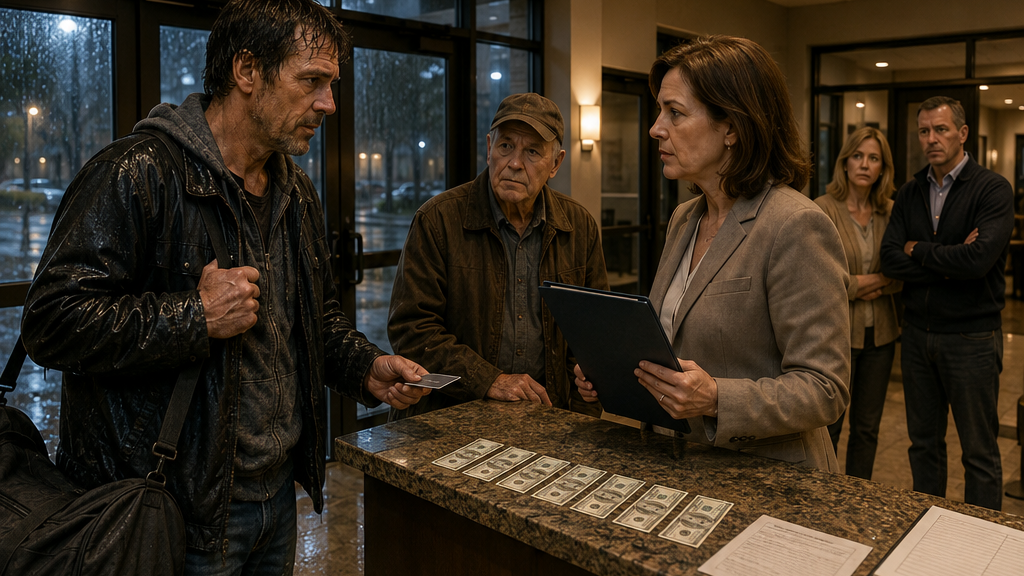
Jack stepped inside, rain running from his jacket onto the tile. His beard had gone several days without trimming, and the duffel bag over his shoulder made him look less like a homeowner arriving for a board meeting than a man who had wandered in looking for shelter.
“I know what the account says,” he replied. “I just need to speak to Rachel.”
Karen Miller had heard him from the doorway of the meeting room.
“She’s busy.”
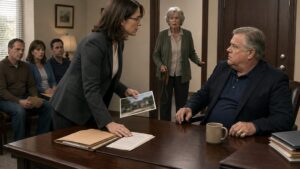
The board president held a folder against her chest. Behind her, residents were taking seats for the monthly meeting. Daniel Baker sat near the front and looked away when Jack caught his eye.
Jack had lived beside Daniel for six years.
They had once traded ladders, extension cords, lawn tools.
Now Daniel studied the agenda as though they had never spoken.
Jack lowered his voice. “I need until tomorrow morning.”
“For what?”
“That’s between me and the management office.”
Karen’s gaze moved to his wet clothes, then to the bag.
“You already have an outstanding balance.”
“I’m aware.”
“And you’ve missed notices.”
“I’m aware of that too.”
A homeowner waiting near the coffee station turned slightly toward them.
Jack felt the room listening.
He had spent most of the afternoon trying not to come here.
At four thirty, the escrow-office clerk had told him the temporary hold would expire at ten the next morning unless he brought the account current by six hundred dollars. Without the hold, the payment tied to his car would be pulled automatically, leaving him unable to cover the insurance reinstatement he needed before picking up his daughter.
Six hundred dollars.
Not five ninety-eight.
Not something he could talk down.
Six hundred by morning.
Karen unfolded a statement.
“Your association account is not being kept open simply because you ask us to wait.”
Jack stared at her.
“I didn’t ask you to erase anything.”
“You’ve been given months.”
“That isn’t the charge I’m talking about.”
Karen’s expression tightened.
Daniel finally looked up.
Jack noticed two other residents near the meeting-room door. He could feel himself becoming tonight’s entertainment.
Karen said, “You cannot refuse to pay assessments and then come in here asking people to cover you.”
“I haven’t asked anyone here for money.”
“Not yet.”
The words landed harder because Karen said them quietly.
Jack shifted the duffel higher on his shoulder.
“Can I speak to Rachel?”
“You can schedule an appointment Monday.”
“Monday is too late.”
Karen gave him the look people used when they believed the urgency belonged to the person who had created it.
“Jack, everybody has deadlines.”
A chair scraped behind him.
Larry Davis rose from a table near the lobby window. He was in his late sixties, gray-haired, wearing the same brown cap Jack had seen him wear while walking his dog most mornings.
They knew each other well enough to wave.
Not well enough for this.
Larry came closer.
“How much do you need?”
Jack immediately shook his head.
“No.”
“I asked how much.”
“I heard you.”
Karen exhaled. “Larry, you really don’t need to get involved.”
Larry ignored her.
Jack said, “Six hundred.”
The room changed.
It was such a clean number that it sounded rehearsed.
Daniel’s eyebrows lifted.
Karen closed the folder.
Larry reached into the inside pocket of his coat and removed an envelope.
Jack stared at it.
“Don’t.”
“I was going to the bank tomorrow.”
“That doesn’t make this a good idea.”
Larry counted the money onto the clubhouse counter.
One hundred.
Two.
Three.
Four.
Five.
Six.
The bills looked unnaturally bright under the lobby lights.
A woman by the coffee station whispered something Jack could not hear.
Karen looked at Larry rather than Jack.
“You know he owes the association money.”
Larry stopped with his hand resting beside the bills.
“I know what he told me.”
“And what exactly did he tell you?”
“That he needs six hundred dollars by morning.”
“That’s all?”
“That’s all I asked.”
Karen’s mouth tightened.
Jack wanted to leave.
He wanted to push the bills back toward Larry and walk through the rain until the embarrassment burned itself out.
Instead he looked down at the statement Karen had left partly exposed.
There it was.
Emergency Drainage Assessment: $600.
He touched the line with one finger.
“Show me where the board approved this.”
Karen blinked.
“What?”
“The six-hundred-dollar assessment. Show me the meeting minutes where the board voted on it.”
“This is not the time.”
“It became the time when you told everyone in this room I refused to pay.”
“You did refuse.”
“I disputed it.”
“You stopped paying.”
Jack looked at her.
“That isn’t the same thing.”
Karen opened the folder and pulled out an account ledger.
“No?”
She placed it beside Larry’s money.
The ledger showed several monthly entries, late charges, and one unmistakable gap.
Karen tapped it.
“You wrote a partial check. You deducted exactly six hundred dollars from what you owed.”
Nobody whispered now.
Jack stared at the page.
The worst part was that Karen was right.
He had done exactly that.
Daniel leaned back in his chair, the uncertainty on his face hardening again.
Larry looked from the ledger to Jack.
“You knew you were short?”
Jack’s throat tightened.
“I knew what I was refusing to pay.”
“That’s not what I asked.”
Jack said nothing.
That silence was enough.
Karen gathered the folder.
“This is what I mean. People hear half a story and think the association is doing something cruel.”
Jack folded Larry’s money once and placed it carefully inside his wallet.
“I’ll pay you back.”
Larry’s expression had changed.
Not anger.
Something worse.
Doubt.
Jack picked up the delinquency notice.
Karen stopped at the boardroom doorway.
“For the record, Monday we begin the next enforcement step.”
Jack looked at her.
“What step?”
Karen met his eyes.
“The one your notices already explained.”
Chapter 2: The Saturday Jack Would Not Explain
Jack’s daughter noticed the dead key card before she noticed the duffel bag.
She held it against the clubhouse reader and frowned when the light flashed red.
“Did they change the system?”
Jack took the card from her.
“Something like that.”
“You said we could go to the pool.”
“We can do something else.”
She looked through the glass at the blue water beyond the lobby.
“You live here.”
“I know where I live.”
The answer came too sharply.
Her face closed a little.
Jack put the card in his pocket.
“Sorry. Come on. Breakfast.”
They walked back across the townhouse parking lot toward his car.
The rain had stopped overnight, leaving the pavement shining beneath a pale Saturday sky. Jack’s townhouse stood halfway down the row. From outside it still looked exactly as it had when his daughter was younger—cream siding, narrow porch, small maple tree she had once decorated with ribbons.
What she did not know was how little of the place currently felt secure.
Jack unlocked the car.
His phone showed the escrow-office receipt from that morning.
$600 received.
Temporary hold confirmed.
He had driven across town at eight, handed over Larry’s six bills, and watched a clerk stamp the receipt.
For twenty seconds afterward, he had sat in the car with both hands on the steering wheel.
The deadline was met.
The car payment would not sweep the account.
The insurance reinstatement could clear.
He could drive his daughter where he had promised.
It felt less like solving a problem than moving one heavy object from one side of a sinking room to the other.
At the restaurant, his daughter ordered pancakes and pushed the strawberries into a neat line along the edge of the plate.
Jack ordered coffee and nothing else.
She noticed.
“You’re not eating?”
“Already did.”
“No, you didn’t.”
He smiled.
“I had something earlier.”
She gave him the same expression her mother used to give him when she knew he was lying but had not decided whether to challenge it.
Jack reached for the receipt when he pulled cash from his wallet.
The paper came out with it.
His daughter saw the amount.
“Six hundred dollars?”
He folded it immediately.
“Work thing.”
“What kind of work thing?”
“Boring kind.”
She stared at him.
“You don’t work there anymore.”
Jack’s fingers stopped.
The restaurant noise seemed to move farther away.
She looked down at her pancakes.
“I know you lost that job, Dad.”
He had told himself she knew only that his hours had been cut.
Then that he was between contracts.
Then that he was “figuring some things out.”
Each phrase had bought him another week without having to say the sentence plainly.
“I’ve got interviews.”
“You said that last month.”
“I do.”
She pushed one strawberry through a streak of syrup.
“Are you moving again?”
Jack looked at her.
“What?”
“Mom said I should ask you.”
His first reaction was anger at his ex-wife.
His second was worse: relief that someone else had said it first.
“No.”
The answer came too fast.
His daughter watched him.
Jack softened it.
“Not if I can help it.”
“So maybe.”
“The HOA thing is administrative.”
“What does that mean?”
“It means grown adults created paperwork so other grown adults can argue about paperwork.”
She almost smiled.
He wished she had.
Instead she asked, “Is that why your card doesn’t work?”
Jack reached for his coffee.
“They restrict amenities when accounts are flagged.”
“So you owe them money.”
“There’s a disagreement.”
“That means yes.”
He could have told her then.
He could have explained the drainage charge, the damaged reserve account, the disputed six hundred dollars, the notices he had shoved unopened into a kitchen drawer because each envelope felt like another person explaining his life to him.
Instead he said, “It’s being handled.”
Her eyes dropped.
Jack knew that look.
She had heard him use the same phrase during the divorce.
About the house.
About work.
About everything that had not, in fact, been handled.
He changed the subject and asked about school.
She let him.
That hurt more.
They spent the afternoon together without going near the clubhouse. Jack drove her to the bookstore, then to the park where she had wanted to meet two friends. He waited in the car rather than admit he could not afford to sit in the café across the street ordering something every hour.
At four, she came back carrying a paper bag.
She handed him half a sandwich.
“I wasn’t hungry.”
He knew she was lying.
He took it anyway.
When he dropped her at her mother’s house, she paused with the car door open.
“You can tell me if something’s bad.”
Jack looked straight ahead.
“I know.”
“I mean really tell me.”
“I know.”
She waited.
He said nothing else.
The door closed.
Jack drove home with the folded $600 receipt pressing against the inside of his wallet.
For the first time, it no longer felt like proof that he had saved the weekend.
It felt like proof of what the weekend had cost.
The townhouse was dark when he returned.
A cardboard envelope leaned against the front door.
Certified mail.
Someone had attempted delivery while he was gone.
Jack picked it up.
The return address belonged to the association’s management company.
He stood on the porch, staring at it.
For months, he had treated those envelopes like traps: if he did not open them immediately, the thing inside them could remain theoretical.
This one was different.
Across the front, beneath the mailing label, someone had written in block letters:
SECOND DELIVERY ATTEMPT.
Jack unlocked the door.
Inside, three older certified envelopes were still stacked unopened at the end of the kitchen counter.
He placed the new one beside them.
Four white rectangles.
Four things he had refused to know.
His phone rang.
Rachel Green.
Jack almost let it go to voicemail.
Then he answered.
“Jack?”
“Yes.”
“We need to meet Monday.”
“What about?”
There was a pause.
“The enforcement letter you haven’t signed for.”
Jack looked at the envelope.
“How bad?”
Rachel did not answer immediately.
When she did, her voice had lost its professional flatness.
“You need to open your mail.”
Chapter 3: The Charge He Chose Not to Pay
Rachel Green placed three postal records on the management-office desk.
“All three were delivered.”
Jack did not sit.
“I know.”
“No, two were attempted twice before they were delivered. One was signed for.”
“Probably me.”
Rachel looked up.
“You don’t remember?”
“I remember the envelopes.”
“That isn’t what I asked.”
Jack stared at the papers.
The office was small and aggressively orderly: gray cabinets, white binders, a printer with labeled trays. Even the pens sat straight in a cup.
Rachel opened a file.
“You requested this meeting because you said the association was enforcing a charge that was never properly approved.”
“Yes.”
“You also told Karen you disputed the six hundred dollars.”
“Yes.”
“What you did not say was that you received repeated notices before your account reached enforcement.”
“I didn’t say I didn’t.”
Rachel leaned back.
“You understand how that sounds.”
There it was again.
Not what happened.
How it sounded.
Jack finally sat.
“I worked maintenance for apartment complexes for nineteen years. Boiler invoices, emergency repairs, contractor approvals, purchase orders. I know what paperwork looks like when somebody did the process backward.”
Rachel’s expression changed slightly.
“You think the board did?”
“I think somebody decided what needed to happen and filled in the authority afterward.”
“That’s a serious accusation.”
“It’s a question.”
“You withheld payment over a question.”
“I withheld six hundred.”
“You withheld part of an amount legally billed to your unit.”
“If it was legally billed.”
Rachel opened another document.
“This is your ledger.”
Jack recognized it immediately.
Monthly dues.
Late fee.
Another late fee.
Then the emergency assessment.
Six hundred dollars.
The line seemed to pull every other number toward it.
Rachel traced the entries.
“You paid your regular assessment that month.”
“Yes.”
“You deducted exactly six hundred dollars.”
“Yes.”
“The next month you paid your normal dues again but not the emergency assessment.”
“Yes.”
“So Karen was correct.”
Jack looked up.
“About what?”
“You deliberately did not pay it.”
“Yes.”
Rachel waited, perhaps expecting him to soften the admission.
He did not.
“And you ignored the hearing notice.”
“Yes.”
“Why?”
“Because the hearing notice assumed the charge was valid.”
“That was where you could have challenged it.”
“I challenged it before that.”
“With whom?”
“The board.”
“How?”
“Email.”
Rachel searched the file.
“I don’t have it.”
Jack took out his phone.
The message took less than a minute to find because he had read it enough times to know the date.
He slid the phone across the desk.
Rachel read silently.
Jack had written only four sentences.
He had asked for the date of the board vote approving the emergency owner assessment, the vote count, the amount authorized, and the minutes reflecting that authorization.
Karen had replied two days later.
The work was necessary and had already been approved.
No minutes were attached.
Rachel scrolled.
“Did you follow up?”
“Twice.”
“Then?”
“I stopped paying that line.”
Rachel returned the phone.
“That was still a mistake.”
“I know.”
It was the first time Jack had said it aloud.
The admission surprised both of them.
Rachel closed the ledger halfway.
“Why not come to the hearing?”
Jack almost gave her the answer he usually gave himself: because it was pointless.
Instead he pictured his daughter pushing strawberries around her plate.
“Because I was angry.”
“That’s not much of a defense.”
“It isn’t one.”
Rachel studied him for a moment.
Jack continued.
“I thought if I walked into a room where they’d already decided I was wrong, I’d be begging them to treat me fairly.”
“And ignoring the meeting improved that?”
“No.”
The word sat between them.
Rachel turned back to her computer.
“What exactly do you want me to find?”
“The vote.”
She typed.
“Board minutes are in the owner portal.”
“Not those.”
“What do you mean?”
“The public minutes say emergency drainage repairs were discussed. They say a contractor was authorized. They don’t say owners were assessed six hundred each.”
Rachel stopped typing.
“You checked?”
“Every posted set for four months.”
“You said you ignored the notices.”
“I ignored the collection notices.”
The distinction sounded thin even to Jack.
Rachel opened a folder on the server.
Meeting Minutes.
Emergency Session.
She clicked.
The document was three pages.
Jack leaned forward as she read.
Drainage failure behind the east row.
Standing water against foundations.
Emergency contractor authorization.
Maximum repair expenditure.
Reserve balance discussion.
Rachel reached the final page.
Nothing.
She reopened the ledger.
Then the minutes.
Then the ledger again.
“The assessment may have been approved in executive session.”
“Can owners be assessed in executive session?”
Rachel did not answer.
She opened another folder.
Board Resolutions.
Several PDFs appeared by date.
She clicked through them.
None matched.
“Maybe it’s filed under finance.”
Jack said nothing.
For the first time since he entered, he did not feel the need to push.
Rachel searched the finance folder.
Reserve transfer.
Vendor authorization.
Insurance renewal.
Nothing authorizing the six-hundred-dollar charge.
Her professional composure tightened rather than disappeared.
“That doesn’t mean it didn’t happen.”
“I didn’t say it did.”
“It may be in a paper file.”
“Okay.”
“Or the attorney may have it.”
“Okay.”
Rachel looked at him sharply, perhaps irritated that he was making her supply the excuses he had expected to hear.
Jack kept quiet.
She stood.
“Wait here.”
She returned ten minutes later carrying a thick binder.
The original accounting ledger was inside.
Unlike the digital record, it included handwritten notes beside several entries.
Rachel turned to the month of the drainage repair.
Twenty-eight units.
Each charged $600.
At the bottom of the page was a notation:
Emergency owner assessment per board direction.
Rachel ran her finger along the row.
Jack saw the problem before she did.
Every ordinary assessment entry included a resolution number.
This one did not.
Rachel looked toward the filing cabinets.
Then back at the ledger.
“Who enters these?”
“Management accounting, usually.”
“Based on what?”
“Board authorization.”
“And where’s the authorization number?”
Rachel’s finger remained on the empty space.
“I don’t know.”
Jack felt something dangerous rise in him.
Vindication.
He wanted to stand.
He wanted to tell her he had been right from the beginning.
Then he looked at the unopened-notice records still lying on the desk.
Right about one thing did not erase the others.
Rachel photocopied the ledger page.
“I’m going to ask Karen for the original emergency-session packet.”
Jack nodded.
“And Jack?”
He stopped at the door.
“If there was no proper vote, that matters.”
He waited.
“But so does the fact that you ignored months of correspondence. Those are separate issues.”
“I know.”
This time, he meant it.
Outside, Jack sat in his car for several minutes before starting the engine.
His phone buzzed.
A message from Rachel, sent less than five minutes after he left.
I requested the original emergency-meeting minutes and any signed resolution from Karen.
Jack read it twice.
Then a second message appeared.
No response yet.
Chapter 4: The Meeting Nobody Wanted Reopened
“The repair could not have waited.”
Karen Miller said it before Jack had fully taken his seat.
Two weeks had passed since Rachel’s message about the missing authorization. The boardroom felt different now—not friendlier, just less certain. The same folding tables had been arranged in a rectangle. The same coffee machine hissed near the wall. But nobody looked at Jack as though his presence alone settled the question.
Karen had a stack of photographs in front of her.
She pushed the first one toward the center.
Brown water covered a strip of lawn behind the east row of townhouses. Another photograph showed water standing against a foundation vent. A third showed a trench cut along the rear property line.
“This was not cosmetic,” Karen said. “The drainage system failed after three days of heavy rain. We had water against six foundations.”
Jack looked at the photographs.
He had worked enough maintenance calls to recognize the problem immediately.
“How long did the contractor give you?”
“Hours, not weeks.”
Rachel sat to Karen’s right with the management file open.
Daniel Baker was across from Jack. He had barely spoken since the meeting began.
Karen continued.
“The reserve account was already below target. Insurance had increased. We had two delinquent units at the time. The contractor wanted a deposit before mobilizing.”
Jack nodded once.
None of that surprised him.
“What was the reserve balance?”
Rachel answered.
“Just under thirty-two thousand.”
“And the repair?”
“Twenty-seven thousand, before restoration.”
Jack sat back.
For the first time, he understood why Karen had looked at him as though his refusal to pay six hundred dollars endangered more than a bookkeeping line.
Karen saw the change in his face.
“You keep describing this as though someone invented a fee because we felt like it.”
“I never said the repair wasn’t necessary.”
“You implied the charge was illegitimate.”
“I asked who authorized it.”
“You knew the money had to come from somewhere.”
“That isn’t the same question.”
Karen’s hand tightened around a pen.
One of the homeowners attending the meeting shifted in his chair.
Rachel said, “We need to keep the issues separate.”
Karen looked at her.
“I am keeping them separate.”
“No. Right now we’re discussing whether the board had authority to levy the emergency assessment in the manner it did.”
Jack noticed the phrase.
In the manner it did.
Not whether.
Daniel cleared his throat.
“I think I need to say something.”
Karen turned.
Daniel looked at the papers in front of him before speaking.
“When the drainage issue came up, I supported charging the owners.”
Jack watched him carefully.
Daniel continued.
“I remember being told we didn’t have enough reserve cash without pushing other bills. I agreed that everybody needed to contribute.”
Karen nodded.
“Exactly.”
Daniel did not look at her.
“But I don’t remember voting on six hundred dollars.”
The room went still.
Karen’s face changed.
“Daniel.”
“I’m not saying we didn’t.”
“You were there.”
“I was there for the emergency call.”
“And you approved the repair.”
“Yes.”
“And the funding.”
Daniel looked up.
“I approved the repair. You told us there would have to be an owner contribution.”
Karen stared at him.
Daniel’s voice stayed level.
“I don’t remember a motion. I don’t remember a vote count. I remember you explaining what needed to happen, and I said I supported it.”
Karen turned toward Rachel.
“Minutes are not transcripts.”
“No,” Rachel said. “But formal actions are normally recorded.”
Jack felt his anger returning.
This time it was different.
Less hot.
More dangerous because it had facts underneath it.
He looked at Karen.
“So there wasn’t a vote.”
“I did not say that.”
“Daniel doesn’t remember one.”
“Daniel also said he supported the assessment.”
Daniel corrected her.
“I said I supported collecting money somehow. I didn’t say we voted on the amount.”
Karen exhaled sharply.
“The homes were taking water.”
“I understand that,” Jack said.
“Do you?”
“Yes.”
The answer stopped her.
Jack leaned forward.
“I’ve shut down water mains at two in the morning. I’ve approved emergency pumps without waiting for an office manager to get out of bed. I understand emergency work.”
Karen looked at him differently.
He continued.
“But I also knew which expenses I could authorize and which ones needed somebody else’s signature.”
Rachel lowered her eyes to the file.
Jack almost kept going.
He could feel the room shifting toward him.
A year earlier, that would have been enough.
He would have pushed until Karen had nowhere left to stand.
Then Rachel pulled another ledger from the folder.
“This also needs to be addressed.”
Jack recognized his account number.
Rachel slid the sheet toward him.
“Even if the emergency assessment is removed temporarily, you have unpaid regular dues and late fees unrelated to the six hundred dollars.”
The room shifted back.
Jack stared at the page.
Three months.
One partial payment.
One missed payment.
Another amount transferred into collections.
Karen said nothing.
She did not have to.
Jack heard his own voice from the management office two weeks earlier.
Those are separate issues.
Now they were.
His six-hundred-dollar objection might have been justified.
His broader financial trouble was not created by it.
Daniel looked at Jack.
“I thought that was all you owed.”
“It wasn’t.”
“You never said that.”
“No.”
Karen sat back.
“And yet you let everyone believe this entire enforcement action came from one disputed charge.”
Jack’s first instinct was to fight the wording.
He stopped himself.
“I let people believe a lot of things because I didn’t want to explain my finances in a clubhouse.”
“That doesn’t make our records wrong.”
“No.”
Karen seemed almost surprised by the answer.
Rachel said, “That is why we need to determine exactly which entries are valid.”
She pulled the accounting records closer.
“Regular dues stay separate. Valid late fees stay separate. The emergency assessment needs documentation.”
Karen folded her arms.
“You are acting as if there was some scheme.”
Rachel shook her head.
“I’m acting as if we need a resolution number.”
“There was an emergency.”
“That explains the expenditure. It does not automatically explain the assessment.”
Karen stood.
For a moment Jack thought she might leave.
Instead she walked to the window.
“The association had one major drainage failure, an insurance renewal coming due, and owners already behind on dues. The contractor wanted twelve thousand dollars up front.”
Her voice was quieter now.
“If I had waited for a perfect meeting packet, we could have had water inside homes.”
Jack looked at her.
There it was.
Not greed.
Fear.
Karen had made a decision under pressure and then treated any challenge to that decision as a challenge to the community she believed she had protected.
It did not make the charge proper.
But it made her understandable.
Daniel rubbed his forehead.
“I should have asked more questions.”
Karen looked at him sharply.
“You agreed with me.”
“I did.”
“Then don’t sit here now pretending you were misled.”
“I’m not.”
Daniel finally met her eyes.
“I’m saying I agreed too easily.”
The sentence changed something.
Not because it cleared Jack.
Because it was the first time someone on the board admitted that being convinced was not the same as verifying.
Rachel turned to Jack.
“I still need the complete packet.”
“When?”
“When I have it.”
Karen returned to the table.
“You have copies of everything I had.”
Rachel shook her head.
“No. I don’t.”
Karen frowned.
Rachel opened a thin folder she had brought from the records cabinet.
“I found this this afternoon.”
Inside was a single sheet.
Across the top was a draft resolution authorizing the emergency owner assessment.
Six hundred dollars per unit.
Twenty-eight units.
Jack leaned closer.
The document looked exactly like something official should look.
Resolution number.
Date.
Purpose.
Amount.
Signature lines.
Except the signature lines were blank.
Daniel picked it up.
“I never saw this.”
Karen’s face lost color.
Rachel said, “It was in the old paper finance file.”
Karen took the page.
“It was drafted for the emergency meeting.”
“Was it adopted?”
Karen did not answer.
Rachel tapped the empty lines.
“There’s no signature. No certification. No vote count. And I still cannot find minutes showing adoption.”
The homeowner at the end of the table whispered, “Then who told accounting to charge us?”
Nobody answered.
Jack looked at Karen.
For the first time since the rainy night in the clubhouse, she did not look angry at him.
She looked as if she were trying to remember a decision she had once believed was too obvious to require remembering.
Chapter 5: What Jack Had Let His Daughter Believe
“You cared more about winning than keeping the house.”
Jack’s daughter said it in the school parking lot with the passenger door still open.
He had expected her to complain that he was late.
He had not expected that.
“What?”
She looked at him from beneath the edge of her hood.
“That’s what it seemed like.”
Jack glanced toward the line of cars crawling past them.
Several months had passed since the board reopened the drainage assessment. The argument had moved into letters, attorney review, revised ledgers, and long silences between meetings.
Jack had moved too.
The townhouse was no longer where he slept.
He rented a furnished room across town while the lender and association sorted through what remained of his account. His daughter had been there twice. Both times he had called it temporary.
She got into the car and closed the door.
Jack did not start the engine.
“Your mom told you that?”
“No.”
“Then where did you get it?”
She turned toward him.
“From you.”
He looked away.
She continued.
“Every time I asked what was happening, you said the HOA was wrong.”
“They were wrong about the assessment.”
“I know.”
“No, you don’t know what—”
“I do. You explained that part.”
Her voice was calm.
That was worse than anger.
“But you made it sound like if they fixed the six hundred dollars, everything else would go back to normal.”
Jack said nothing.
His daughter looked down at her hands.
“And then you moved anyway.”
The old receipt was still in his wallet.
He had carried it so long that the fold had begun to split. The ink from the escrow office was fading.
Six hundred dollars.
Once, that number had seemed large enough to explain everything.
Now it looked almost small.
Jack took the wallet from his pocket and placed it on the console.
“I lost my job before the drainage assessment.”
She nodded.
“I know.”
“I had some contract work after that. Not enough.”
She waited.
“The divorce cost more than I expected. I got behind on the mortgage once, caught up, then got behind again. I used a credit card for utilities. Then another card to make the first card payment.”
He stopped.
The words sounded uglier out loud because they were ordinary.
No conspiracy.
No dramatic collapse.
Just a series of choices made one week at a time.
“When the HOA added the six hundred,” Jack said, “I was already stretched.”
“So why didn’t you say that?”
“Because I thought it made me look irresponsible.”
She stared at him.
“You were irresponsible.”
Jack gave a short laugh with no humor in it.
“Yeah.”
That answer caught her off guard.
He continued.
“I was also right about the assessment.”
“Both can be true.”
Jack looked at her.
She shrugged.
“You say that to me all the time.”
He remembered.
When she had argued with a teacher.
When she had blamed a friend.
When she wanted an apology without admitting what she had done first.
Two things can be true.
He had been teaching her a lesson he had refused to use on himself.
Jack took out the worn receipt.
“This is the six hundred Larry gave me.”
“You still have the receipt?”
“I kept it.”
“Why?”
He rubbed his thumb along the crease.
“At first because I wanted proof I used the money for what I said.”
“Who were you proving it to?”
Jack almost said Larry.
Then stopped.
“Me, probably.”
His daughter looked through the windshield.
“Did you ever pay him back?”
“Not yet.”
Her head turned.
Jack felt the shame of that more sharply than he expected.
“I told him I would.”
“When?”
“When I can do it without borrowing from somebody else to do it.”
She nodded slowly.
It was not approval.
But it was honest.
Jack started the engine.
Before he put the car in gear, she said, “I thought you were fighting them because you wanted to prove you were right.”
“I was.”
“Even when other things mattered more.”
He tightened his hands around the wheel.
“That too.”
She looked at him.
“I thought maybe you picked the fight over me.”
The sentence took several seconds to reach him.
“What do you mean?”
“When you stopped telling me stuff. When you kept saying everything was fine. It felt like you wanted to win more than you wanted me to know what was actually happening.”
Jack swallowed.
“I didn’t pick it over you.”
“I know that now.”
“No.”
He forced himself to continue.
“I need you to know something else.”
She waited.
“I was ashamed.”
The word did not break him.
That surprised him.
“I didn’t want you seeing me lose the job, then lose the house, then ask somebody for six hundred dollars. So I made the HOA part bigger because that was the part where I could say I was right.”
She blinked hard and looked away.
Jack did not reach for her.
He had spent months trying to make discomfort disappear too quickly.
This time he let it remain.
Finally she said, “That makes more sense.”
“Doesn’t make it better.”
“No.”
He nodded.
“No.”
His phone buzzed on the console.
Rachel.
Jack almost ignored it.
His daughter looked at the screen.
“You should answer.”
He opened the message.
The association attorney had proposed resolving the disputed assessment.
Jack read the terms twice.
The six-hundred-dollar charge would be credited from his account. Some associated fees would be reduced. His remaining balance would be placed on a payment plan.
In exchange, the matter would be treated as an individual account correction.
No broader admission that the assessment procedure had been defective.
No reopening of other owner accounts.
No public board action.
His daughter watched his face.
“What?”
“They offered to settle.”
“That’s good, right?”
Jack looked at the message.
Months earlier, he would have accepted immediately.
He would have called it proof.
He would have taken the credit, corrected his own account, and let everyone else keep the same six-hundred-dollar line because his personal problem was solved.
“What do they want?”
“For me to stop pushing the issue.”
“Would you get the house back?”
Jack hesitated.
“No. That’s already more complicated than this.”
She nodded.
“So what happens to everybody else who paid it?”
Jack looked at her.
The question was simple.
He wished it were not.
That evening, in the room he rented, Jack placed the settlement proposal beside the old receipt.
He read every line again.
Then he wrote back to Rachel.
He did not accuse Karen.
He did not threaten the board.
He did not ask for damages.
He wrote that he would accept a lawful payment plan for every valid amount he owed, but he would not accept an individual credit in exchange for leaving the assessment unresolved for the other owners.
His finger rested over Send.
For years, silence had been Jack’s way of protecting himself.
Now speaking meant risking the one offer that could make his own account easier.
He pressed Send.
Chapter 6: The Vote That Finally Had to Be Public
“I move that we discuss the emergency drainage assessment in open session.”
Daniel Baker’s voice carried farther than he intended.
The annual meeting room was full.
Not packed, but full enough that no one could pretend the matter belonged only to Jack Mitchell anymore.
Karen sat at the center table.
Rachel had three binders beside her and a laptop open to the corrected account records.
Jack sat in the second row.
He had nearly chosen the back.
Instead he took the first empty seat he saw and stayed there.
Karen looked at Daniel.
“The attorney advised that portions of the account discussion may involve confidential owner information.”
“I’m not asking to discuss Jack’s account.”
Daniel glanced toward the residents.
“I’m asking to discuss the assessment applied to all twenty-eight units.”
A murmur moved through the room.
Karen’s expression remained composed.
“Is there a second?”
Another board member raised a hand.
“Second.”
Karen waited.
Then nodded.
“All in favor?”
The motion passed.
Not unanimously.
But it passed.
Rachel stood and distributed a one-page summary.
Jack watched residents scan the figures.
Emergency drainage repair: valid.
Contractor authorization: valid.
Reserve expenditure: valid.
Special owner assessment: no record of formal adoption located.
The distinction that had consumed nearly a year now fit in four lines.
Karen spoke first.
“I want to be clear about one thing. The drainage repair saved this association from potentially much larger damage.”
Nobody argued.
She looked toward Jack.
“Mr. Mitchell has never disputed that.”
It was the first time Jack had heard her say so publicly.
Rachel continued.
“The review found that the contractor was properly retained under emergency authority. However, the subsequent six-hundred-dollar per-unit charge does not appear to have been formally adopted under the procedure required by the governing documents.”
A homeowner near the aisle raised his hand.
“So was it legal or not?”
The HOA attorney answered from the side table.
“The cleaner answer is that the association cannot establish that the assessment was properly authorized.”
Another resident said, “That sounds like lawyer language for no.”
The attorney did not smile.
“It means the association should correct it.”
The room became louder.
Karen lifted a hand.
“Please.”
Someone asked whether refunds would be issued.
Another person asked about interest.
A third wanted to know why the problem had not been found sooner.
Jack felt the familiar heat in his chest.
This was the moment he had imagined during the worst months.
The room turning.
Questions pointed at Karen instead of him.
He had imagined enjoying it.
He did not.
Karen waited until the noise faded.
Then she folded her hands.
“I authorized management to bill the assessment.”
The room quieted immediately.
Rachel looked at her.
Daniel sat very still.
Karen continued.
“The board had approved the emergency repair. We had discussed the reserve shortage. I believed there was consensus that the owners would have to make up the difference.”
Daniel said, “Consensus isn’t a vote.”
“No.”
Karen’s answer came without hesitation.
Jack looked at her.
She had never said that word to him before.
No.
Karen drew a breath.
“The contractor required a deposit. The reserve account was close to being exhausted. Insurance and landscaping invoices were still due. We had delinquent accounts. I believed waiting for another formal meeting would leave us unable to pay obligations.”
A homeowner said, “So you just charged us?”
Karen looked at him.
“Yes.”
The answer landed harder than an excuse would have.
“I believed the board’s approval of the emergency expenditure and the discussion of owner contributions were sufficient. I was wrong about that.”
No applause followed.
No dramatic silence either.
Someone shifted a chair.
Another person whispered.
It sounded like a real room receiving an uncomfortable fact.
Jack thought about the photographs of water against the foundations.
Karen had made the wrong procedural decision because she was afraid of a real financial problem.
Then she had made a second decision.
She had defended the first one too long.
Rachel changed the screen.
A ledger appeared.
“The proposed correction removes the six-hundred-dollar assessment from all affected accounts. Payments already made toward that charge become credits.”
Someone immediately asked the question Jack had expected.
“What does that do to reserves?”
Rachel clicked to the next page.
The number made the room go quiet.
The association would have to return or credit nearly sixteen thousand eight hundred dollars, plus certain related charges.
Karen said, “That money has already been used.”
A homeowner near the back muttered, “Of course it has.”
Jack turned slightly.
He recognized the tone.
It was the same tone people had used about him.
Of course he did not pay.
Of course he ignored notices.
Of course he was asking somebody else to rescue him.
Certainty felt good when it belonged to your side.
Jack stood.
Karen looked at him.
The room expected a confrontation.
Jack could feel it.
He hated that part of him still wanted to give them one.
Instead he said, “The repair happened.”
Karen nodded carefully.
“It did.”
“And it had to.”
“Yes.”
Jack looked at the residents.
“So correcting the charge doesn’t put that money back in the reserve account.”
“No,” Rachel said.
“Then we still have a funding problem.”
A man near the aisle frowned.
“You’re defending them now?”
Jack shook his head.
“No. I’m saying two things can be true.”
The words came back to him in his daughter’s voice.
“The assessment was handled wrong. The drainage work still cost money.”
Karen watched him.
Jack continued.
“My account has regular dues I didn’t pay. Those are mine.”
Rachel looked toward him.
“I don’t want those erased because the board made a different mistake.”
The attorney leaned forward.
“The settlement proposal—”
“I’m not asking for that proposal.”
Karen’s eyebrows lifted.
Jack faced her.
“I’ll pay the valid balance under the same payment plan available to anybody else.”
Rachel said, “Jack, given the circumstances, the board could approve different terms.”
“That’s what got us here.”
A few people looked down.
Jack went on.
“I don’t want a favor. I want the ledger corrected.”
For the first time in months, saying exactly what he wanted did not feel like begging.
Daniel looked at Karen.
“We also need a policy change.”
Rachel nodded.
“Emergency expenditures, owner assessments, record retention, and management instructions should all be separated in writing.”
Karen rubbed her thumb across the edge of the agenda.
“I agree.”
Daniel looked surprised.
Karen noticed.
“You don’t have to look so shocked.”
A faint, uncomfortable laugh moved through part of the room.
It disappeared quickly.
The board voted.
The assessment would be reversed.
Paid amounts would become owner credits unless residents requested eligible refunds.
Valid dues would remain.
A repayment plan would be created for Jack and any other owner with legitimate arrears.
Future emergency expenditures would require documented follow-up authorization, and any special assessment would need a recorded motion and vote before billing.
When the vote ended, Rachel closed the old ledger.
Jack remained standing near the aisle.
Daniel approached him.
“I said things about you.”
Jack waited.
Daniel looked toward the board table.
“I told people you were using the assessment as an excuse not to pay anything.”
“I did owe other money.”
“That’s not what I said.”
Jack said nothing.
Daniel nodded as if Jack’s silence was answer enough.
“I should’ve asked.”
It was not an apology shaped for public consumption.
That made Jack believe it.
Across the room, Karen was gathering papers.
She looked exhausted.
Jack remembered the rainy Friday when she had stood beside six hundred dollars and made him feel as though his debt explained his character.
He could have gone to her.
He could have demanded something.
Instead he walked to Rachel.
“Send me the payment-plan terms.”
Rachel looked up.
“You’re sure?”
“Yes.”
“No special adjustment?”
“Correct the invalid charge. Leave the rest.”
Rachel studied him for a moment.
Then nodded.
“All right.”
Jack turned toward the exit.
Behind him, Karen said his name.
He stopped.
She did not come closer.
“The access restriction will be lifted when the corrected account is processed.”
Jack looked at her.
“Thank you.”
Karen seemed to expect more.
So did part of him.
But there was nothing else that needed to be said tonight.
Outside the meeting room, his phone vibrated.
A message from his daughter.
How did it go?
Jack typed his answer.
They fixed what was wrong.
He stopped.
Then added:
And I’m paying what I actually owe.
Chapter 7: One Year Later, the Same Six Bills
Larry Davis stopped halfway across the clubhouse lobby when he saw the money on the counter.
Six one-hundred-dollar bills.
Jack Mitchell had arranged them in a straight line without meaning to. The old habit came from invoices and maintenance orders: if something mattered, make it easy to count.
Larry stared at the bills, then at Jack.
“You’ve got to be kidding me.”
Jack smiled.
“No.”
“You brought cash?”
“You gave me cash.”
“That was a year ago.”
“I noticed.”
The clubhouse looked almost exactly as it had on the rainy Friday when Jack had stood there soaked through, carrying a duffel bag and trying not to let anyone see how close his life was to coming apart.
The flooring was the same.
The counter was the same.
Even the coffee machine in the meeting room still made the same uneven mechanical hiss.
Jack was different enough that the front-desk attendant had looked twice when he walked in.
His beard was trimmed. His work shirt was clean but not new. A company badge hung from his belt beside a ring of keys. He had been working for a regional apartment-maintenance company for seven months now, supervising three properties instead of fixing everything himself.
It was not glamorous.
It was steady.
Steady had become more impressive to him than glamorous.
Larry came closer to the counter.
“You could’ve written me a check.”
“I could have.”
“Or sent it electronically like a normal person.”
“I could have done that too.”
Larry looked at the six bills again.
Then he noticed the folded paper beneath them.
He picked it up.
The escrow-office receipt had nearly worn through at the crease.
“You kept this?”
Jack nodded.
Larry read the fading amount.
$600.
He looked up.
“Why?”
“At first? Because I figured someday you might ask if I actually used the money for what I said.”
Larry’s face tightened slightly.
“I never asked.”
“I know.”
“And later?”
Jack rested both hands on the counter.
“Later I kept it because I needed to remember what that night actually was.”
Larry waited.
Jack looked toward the glass doors.
“The HOA issue was real. The assessment was wrong. But I spent a long time acting like being right about that meant I was right about everything else.”
Larry folded the receipt carefully along its old crease.
“You don’t owe me an explanation.”
“I used to like hearing that.”
Larry studied him.
“What changed?”
“I realized I was using it as permission not to give one.”
For several seconds neither man spoke.
Larry slid one of the bills toward Jack.
“Keep a hundred.”
Jack pushed it back.
“No.”
“You’ve got expenses.”
“So do you.”
“I’m retired.”
“That does not mean free money appears in your kitchen.”
Larry almost laughed.
Then his expression shifted.
“You know something I never told you?”
Jack waited.
“About a month after I gave you that money, I thought I’d been an idiot.”
Jack looked at him.
Larry put both hands in his coat pockets.
“You disappeared. Your townhouse went dark. Nobody saw you around here much. Karen wouldn’t discuss your account, but people were talking.”
Jack glanced down at the money.
“What did they say?”
“What people always say when they know half of something.”
Jack gave a small nod.
Larry continued.
“Daniel said you were using the HOA dispute to avoid paying bills. Somebody else said you’d borrowed money from more than one person. I didn’t know what was true.”
“Did you think I scammed you?”
Larry took his time answering.
“I wondered.”
The honesty hurt less than Jack expected.
Maybe because Larry did not dress it up.
“I was embarrassed,” Larry said. “Not because of the six hundred. Because I thought maybe everybody else had seen something I was too soft to see.”
Jack looked at him.
“And?”
“And then I decided it didn’t matter quite the way I thought it did.”
Jack frowned.
Larry tapped the receipt.
“You told me you needed six hundred by morning. You did. Whatever else was going on, that part was true.”
“I still made you wait a year.”
“Yes.”
“I should have called.”
“Yes.”
“I should have explained.”
“Probably.”
Jack smiled despite himself.
Larry gathered the six bills and placed them back in the envelope Jack had brought.
“You know, I was hoping for interest.”
Jack stared at him.
Larry held the expression for two seconds before laughing.
Jack shook his head.
“I knew there was a reason I avoided you.”
The front doors opened behind them.
Karen Miller entered carrying a thin folder.
Her hair was shorter than Jack remembered from the previous year. She no longer carried three binders everywhere she went. After the annual meeting, the board had redistributed several duties, and Rachel had rewritten the association’s emergency-expenditure policy with the attorney.
The reserve account had taken months to stabilize.
Owners had voted on a smaller, properly noticed contribution and deferred two landscaping projects.
Nobody had liked it.
That had made Jack trust the solution more.
Karen noticed him.
Then the cash.
For a moment, Jack saw recognition move across her face.
Not recognition of him.
Recognition of the scene.
Six bills on the clubhouse counter.
Larry beside him.
The same place where she had once told Larry not to get involved.
Karen approached slowly.
“Jack.”
“Karen.”
Larry picked up his envelope.
“I’m going to remove myself before this becomes a board meeting.”
Karen gave him a restrained smile.
“Probably wise.”
Larry turned to Jack.
“We’re square.”
Jack nodded.
“We’re square.”
Larry walked toward the parking lot.
Jack watched until the door closed behind him.
Karen placed her folder on the counter.
“I heard you finished the payment plan.”
“Last month.”
“Rachel said you were early on the final installment.”
“By four days.”
“That doesn’t sound like you.”
Jack looked at her.
Karen’s expression held for a moment.
Then she said, “That was poorly phrased.”
“A year ago I would’ve agreed with the original version.”
She nodded.
The apology was small enough to be believable.
Jack reached into his wallet and removed his key card.
The replacement had arrived three weeks after the annual meeting, once the corrected balance and payment arrangement were entered.
He had not used it yet.
Karen noticed.
“You never came back to the clubhouse?”
“Didn’t have much reason.”
“The pool opened last month.”
“My daughter is seventeen now. Apparently pools are only interesting if I’m not there.”
Karen almost smiled.
She looked toward the meeting room.
“The new assessment procedure passed its first test.”
“What happened?”
“Storm damaged part of the perimeter fence.”
“And?”
“We documented the emergency repair, scheduled the funding question separately, mailed notice, held the vote.”
Jack nodded.
“Sounds painfully boring.”
“It was extremely boring.”
“Good.”
Karen looked at him.
“I used to think procedure was something people complained about when they didn’t understand how urgent a problem was.”
Jack waited.
“Now I think urgency is when you need it most.”
It was not the apology he might once have wanted.
She did not say she had judged him unfairly.
She did not try to rewrite what had happened.
Jack found that he preferred this.
He picked up the worn receipt Larry had returned to him.
Karen looked at it.
“Same one?”
“Same one.”
“I remember thinking that money proved he was being taken advantage of.”
Jack folded it once.
“I remember thinking proving the assessment was wrong would prove I wasn’t.”
Karen said nothing.
Jack slipped the receipt into his wallet.
“It didn’t.”
“No.”
He looked at her.
“No.”
The agreement between them felt strange but clean.
Outside the clubhouse, Jack’s daughter was waiting beside his car.
He had promised to help her move a desk into his townhouse.
His townhouse.
Not the rented room across town.
The return had taken months of negotiations, catch-up payments, lender paperwork, and work schedules that left him too tired to celebrate much of it. He had not recovered everything he lost.
He had recovered enough.
Jack walked toward the door.
The card reader was mounted beside the glass exactly where it had been the year before.
He pressed his key card against it.
For an instant nothing happened.
Then the light turned green.
The lock clicked.
Jack opened the door.
He stepped halfway through before noticing Karen behind him with the folder tucked under her arm.
A year earlier, he might have let the door close.
He held it instead.
Karen paused.
“Thank you.”
Jack nodded.
She walked through.
Then he followed her outside, where his daughter lifted one hand impatiently from beside the car.
Jack raised his own hand back.
Behind him, the clubhouse door closed with a soft click.
The story has ended.