The HOA Rejected His Ten-Foot Garage Setback—Then He Measured the Chairman’s Own Exception Across the Street
Chapter 1: The Ten Feet Edward Would Not Allow
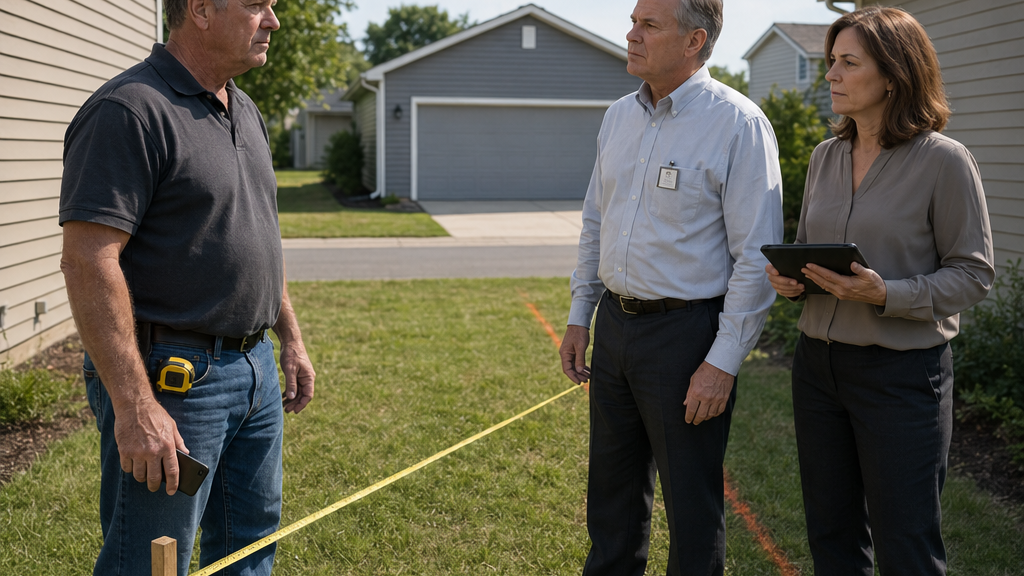
Edward Walker hooked the end of Raymond Clark’s tape measure over the wooden survey stake, pulled the yellow blade tight across the grass, and stopped at the orange paint marking the proposed garage wall.
“Ten feet,” he said.
Raymond waited.
Edward looked at Nicole Wilson, then at the two architectural-review committee members standing near the driveway.
“This cannot be approved.”
The tape stayed stretched between them like a bright line neither man was willing to cross.
Raymond had expected questions. He had brought drainage drawings, exterior elevations, roof samples, even a photograph showing that the garage siding would match the house. What he had not expected was for Edward to announce the decision before Nicole had finished opening the packet.
“The application says fifteen feet is preferred,” Raymond said.
“Required for this type of structure.”
“That isn’t what the covenant says.”
Edward released the tape. It snapped back hard enough to make one committee member flinch.
“The committee interprets the guidelines,” Edward said. “That is what you elected us to do.”
Raymond felt the familiar heat rising behind his collar.
For thirty-six years he had run plumbing crews by measurements. A pipe was either pitched correctly or it was not. A valve either cleared the wall or it did not. He had thrown away expensive fittings because an apprentice had tried to make a quarter inch disappear.
He respected measurements.
What he did not respect was someone pretending a preference was a law.
He bent, picked up the tape measure, and locked it again at ten feet.
“I’m asking for an exception,” he said. “That’s why we’re standing here.”
Edward’s mouth tightened.
“And we’re telling you an exception would damage the consistency of the neighborhood.”
Raymond almost laughed.
His house sat on one of the oldest corner lots in the subdivision, built before the association had adopted half its current architectural standards. The side yard narrowed toward the rear fence. Moving the garage five additional feet inward would place one wall too close to the concrete drive and make the door angle nearly useless for his two vintage trucks.
He had explained that in writing.
Twice.
Nicole crouched beside the orange mark and typed something into her tablet.
Raymond pointed toward her. “Please put ten feet in the inspection notes.”
Edward turned. “The plans already show ten.”
“I want today’s measurement recorded.”
Nicole glanced from one man to the other. “I can note that the field measurement matches the submitted plan.”
“Thank you.”
Edward exhaled through his nose.
It was a small thing, but Raymond felt better once Nicole typed it.
Then he looked past Edward.
Across the street, partly hidden behind a row of boxwoods, stood Michael Torres’s detached garage.
Raymond had seen it almost every day for three years. Gray siding. White trim. Two carriage-style doors. Nothing unusual about it.
Except from where Raymond stood now, the side wall looked awfully close to Michael’s property boundary.
He stared for several seconds.
Edward noticed.
“What?” he asked.
Raymond did not answer immediately.
He walked toward the curb.
“Raymond,” Edward said.
Raymond stopped at the edge of his lawn and looked across the street again. Michael’s fence line ran straight behind a maple tree. The garage wall sat only a short distance inside it.
“How far is Michael’s garage from his line?”
No one answered.
Raymond turned.
One committee member studied the grass. The other looked at Nicole.
Edward said, “That property has nothing to do with your application.”
“It’s the same subdivision.”
“Different lot.”
“Same detached structure.”
“Different circumstances.”
Raymond felt the old impulse—to push until someone admitted what he already believed.
He almost said, So the rule changes depending on whose yard you’re standing in?
Instead, he opened the camera on his phone.
Edward frowned. “What are you doing?”
“Taking a picture.”
Raymond photographed the tape measure locked at ten feet. He framed a second shot from slightly farther back, catching Edward, the orange wall line, and Michael’s garage across the street in the same image.
Edward stepped aside.
“You don’t need to photograph me.”
“I’m photographing my property.”
The silence that followed was sharper than anything either man had said.
Nicole stood.
“Raymond, the committee can consider a redesign.”
“I already did.”
“You could reduce the garage width.”
“And lose one bay.”
“Or shift it toward the driveway.”
“I wouldn’t have the turning radius.”
Edward folded his arms. “Then perhaps this lot simply doesn’t support the building you want.”
That one landed.
Raymond had owned the house for twelve years. He had replaced the roof, rebuilt the porch, planted the maple beside the driveway, and paid association assessments every January without missing one. He had saved for the garage slowly, through water-heater replacements, frozen-pipe calls, weekend emergencies and years when his own truck had more rust than resale value.
Edward spoke as if Raymond had bought the wrong piece of property yesterday.
“You’re telling me,” Raymond said carefully, “that ten feet is unsafe here.”
“I’m telling you fifteen feet is the standard.”
“And that garage?”
Edward did not look across the street.
“Different.”
“How?”
“You would have to review that file.”
Raymond nodded once.
“That’s what I’ll do.”
Edward seemed to hear the sentence as a challenge.
“It won’t change your application.”
“Maybe not.”
Raymond reeled in the tape measure and clipped it to his belt.
“But I’d still like to understand the rule.”
The inspection ended without a handshake.
After the committee members left, Nicole stayed near her car, tapping through screens on her tablet.
Raymond was gathering the orange flags when she called to him.
“Raymond.”
He walked over.
She turned the tablet enough for him to see a property search page.
“I checked Michael’s address.”
“And?”
“There’s no architectural approval attached to the digital property record.”
Raymond frowned. “But the garage was approved.”
“I assume it was.”
“You assume?”
Nicole lowered the tablet.
“The online archive only goes back so far, and some older files were scanned incompletely.”
“That garage isn’t that old.”
“No.”
Raymond looked across the street again.
Michael’s garage had not moved. It was simply standing there, plain and solid and suddenly full of questions.
Nicole slipped the tablet into her bag.
“If there was a variance,” she said, “it may still be in the paper archive.”
“Where?”
She hesitated.
Then she gave him the address of the management office.
Chapter 2: The Garage File That Was Missing Online
The denial arrived at 7:14 the next morning.
Raymond was drinking coffee at his kitchen table when his phone vibrated beside the architectural packet.
He opened the email.
The first paragraph was polite. The second quoted the association’s architectural guidelines. The third informed him that his proposed detached garage failed to maintain the required fifteen-foot side setback and therefore could not be approved as submitted.
Raymond read the phrase required fifteen-foot side setback twice.
Then he pulled the printed guidelines from his packet.
The actual sentence used the words generally maintain.
He set the two pages side by side.
For ten minutes he considered calling Edward.
Instead, he reached for the tape measure lying near the blueprints.
He placed it across the papers like a paperweight.
At his plumbing shop later that morning, one of his employees asked whether the garage had been approved.
“No.”
“That bad?”
“Not sure yet.”
It was the most honest answer Raymond had.
By noon he was at the management office.
Nicole had warned him that the archived files were not arranged for casual browsing. She had not exaggerated. A records clerk brought out two banker’s boxes labeled by year and property range, each packed with folders in no obvious order.
Raymond began with Michael Torres’s address.
Nothing.
He checked the year Michael’s garage had gone up.
Nothing.
After forty minutes, the clerk returned with an older index binder.
“Try this,” she said. “Sometimes the property files were logged under project number instead of address.”
The binder contained pages of typed entries with handwritten corrections.
Raymond ran his finger down the column.
Fence replacement.
Roof color modification.
Rear patio.
Shed.
Detached structure.
He stopped.
Michael’s address appeared beside an architectural-review number.
Status: Approved Exception.
Raymond sat back.
“Can I see this file?”
The clerk leaned over the binder.
“That project number should be in off-site storage.”
“How long?”
“Maybe today. Maybe tomorrow.”
Raymond stared at the words Approved Exception.
For most of the previous twenty-four hours he had been angry because the neighboring garage looked too close to the line.
Now he had something more solid than appearance.
Not proof of favoritism.
Not yet.
But proof that an exception existed.
He photographed the index entry and sent it to Nicole with a single message.
Found it.
Her reply arrived two minutes later.
I’ll check our internal archive too.
Raymond returned to work and tried to focus on a leaking commercial backflow assembly.
He failed.
Every time he tightened a fitting he saw Edward standing in the side yard, saying different.
At four-thirty the records clerk called.
The file had arrived.
Raymond drove back in his work shirt.
The folder was thinner than he expected.
Inside were a site plan, a garage elevation, two committee review sheets and several pages of correspondence.
The site plan was on top.
Raymond saw the number before he sat down.
10′-0″.
He stared at it.
The dimension ran from Michael’s detached garage wall to the side property line.
Exactly ten feet.
Raymond took his own plan from his folder and placed it beside Michael’s.
Ten feet.
Ten feet.
Same measurement.
Same subdivision.
Different result.
He felt the rush of vindication so quickly that his hands became unsteady.
Then he found the approval page.
Three signatures appeared at the bottom.
One belonged to Edward Walker.
Raymond leaned closer.
Edward had not merely been on the committee.
His initials appeared beside a handwritten notation:
Exception acceptable due to site limitations.
Raymond let out a short breath.
For one reckless minute, he imagined walking into Edward’s office, dropping both plans on the desk and asking him to say rules are rules again.
He took out his phone.
His thumb hovered over Edward’s number.
Then he remembered Nicole’s expression the day before when he had asked how Michael’s garage was different.
She had not looked guilty.
She had looked uncertain.
Raymond put the phone away.
He began reading the entire file.
Halfway through the correspondence, his satisfaction faded.
One letter referenced emergency access along Michael’s opposite side yard. Another referred to an underground utility easement that limited placement options.
Raymond read both again.
That did not erase the ten-foot approval.
But it meant Edward had not necessarily invented the distinction.
He turned another page.
Near the bottom of an inspection checklist, in handwriting different from Edward’s, someone had written:
Carrier concern addressed through exception configuration. Maintain fire access.
Raymond frowned.
Carrier.
Insurance carrier?
He copied the pages and paid for certified duplicates of the approval sheet and site plan.
Before leaving, he called Nicole.
“I found the file.”
There was a pause.
“And?”
“Ten feet.”
Another pause, longer this time.
“Edward signed it?”
“Yes.”
Nicole sighed quietly.
Raymond added, “There are notes about emergency access and an insurance issue.”
“That may be what he meant by different circumstances.”
“Maybe.”
“You sound disappointed.”
“I’d rather be right.”
Nicole did not respond to that.
Raymond realized how it sounded.
He rubbed a hand across his face.
“That came out wrong.”
“No,” she said. “It came out honest.”
He looked down at the two plans.
“I still want to know why one ten-foot setback was acceptable and mine isn’t even discussable.”
“That’s fair.”
“Can you get me the meeting minutes?”
“I’ll see what exists.”
Raymond gathered the copies.
As he slid the final page into his folder, he noticed a handwritten reference in the margin of the insurance note.
Exception requested following carrier review.
The satisfaction he had felt ten minutes earlier was gone.
He had found the contradiction.
Now he had to find out whether it was actually unfair.
Chapter 3: The Exception Was Not as Simple as Raymond Hoped
Michael Torres was waiting beside his driveway when Raymond crossed the street Thursday morning.
He did not say hello.
He looked at the folder under Raymond’s arm and said, “Don’t use my family as ammunition.”
Raymond stopped at the curb.
“I haven’t used anybody.”
“You pulled my garage file.”
“So?”
“So people notice when records get pulled.”
Michael was usually easygoing, the kind of neighbor who waved from his mower without turning it off. Now his shoulders were tight.
Raymond held up one hand.
“I’m trying to understand why your garage got ten feet and mine got denied at ten.”
“That doesn’t mean we had the same situation.”
“That’s what Edward said.”
“Well, on that part, he’s right.”
Raymond hated how quickly the sentence irritated him.
He forced himself to wait.
Michael pointed toward the far side of his house.
“When we built, the fire department wanted clear access there. Then the utility company confirmed the buried line on the other side. We couldn’t move the garage either direction without creating another problem.”
“And the insurance note?”
“The association’s carrier got involved because there’d been a claim on another detached building. They wanted the access lane preserved.”
Raymond opened the folder.
“So they let you come within ten feet of this line.”
“Yes.”
“Which means fifteen wasn’t absolute.”
Michael looked toward his garage.
“No. But neither was ten just because I asked.”
That stopped Raymond.
He had spent two days constructing a clean version of the story in his head.
Edward denied him.
Edward approved Michael.
Therefore Edward was a hypocrite.
The truth standing in Michael’s driveway was less satisfying.
Raymond crouched near the fence and pulled out his tape measure.
“What are you doing?”
“Checking.”
Michael gave him a tired look but did not stop him.
Raymond hooked the tape against the fence post and walked it to the garage wall.
Ten feet and a fraction.
He stared at the yellow blade.
Same number.
Different circumstances.
For the first time, the measurement felt less like proof and more like a question.
He reeled it in.
“I told Edward yesterday he was playing favorites.”
Michael’s eyebrows lifted.
“Before you had my file?”
“Yes.”
“That was smart.”
“I didn’t say it was.”
Michael’s expression softened slightly.
Raymond leaned against the fence.
“Did Edward push your exception?”
Michael hesitated.
There it was.
Not denial.
Hesitation.
“Michael.”
“He supported it.”
“How much?”
“He knew the committee was nervous about making an exception. He argued that the safety issue justified it.”
“So he advocated for you.”
“He advocated for the configuration.”
“That’s not what I asked.”
Michael’s jaw tightened again.
Raymond knew he was pressing too hard. It was the same habit that got him into arguments with suppliers and inspectors: once he sensed somebody withholding something, he pushed harder instead of giving them room to say it.
He closed the folder.
“Forget it.”
Michael looked at him.
Raymond started toward the street.
“Raymond.”
He turned.
Michael rubbed the back of his neck.
“Edward’s related to my wife.”
Raymond said nothing.
“Not close,” Michael added quickly. “Her mother and Edward are cousins.”
Raymond felt the story in his head snap back into place.
“Was that disclosed?”
“I don’t know.”
“You don’t know?”
“I wasn’t sitting in their committee meetings.”
“But he helped push it through.”
“Because we had a legitimate problem.”
“That wasn’t my question.”
Michael stepped closer.
“And this is exactly why I told you not to use my family as ammunition. We didn’t fake the utility line. We didn’t invent the fire access. I didn’t bribe anybody. I submitted plans, answered questions, and got an exception.”
Raymond held his gaze.
Michael was right.
That was the worst part.
Raymond had been so eager to prove Edward corrupt that he had nearly turned Michael into evidence of corruption without knowing what Michael had actually done.
“I’m not accusing you,” Raymond said.
“You were about to.”
Raymond looked away.
“Yes.”
The admission cost him more than he expected.
Michael nodded once.
“Then don’t.”
Raymond returned to his plumbing shop with less certainty than he had brought across the street.
The afternoon was full of ordinary problems: a delivery short two fittings, a customer disputing a service charge, an apprentice who had ordered the wrong diameter valve.
Normally Raymond liked problems with dimensions and model numbers.
They stayed still long enough to solve.
People did not.
Near closing time, he spread both garage plans across the break-room table.
His own.
Michael’s.
He wrote two notes on a legal pad.
Same setback.
Different site conditions.
Then below them:
Possible family relationship.
He stared at the words.
The first did not cancel the second.
The second did not cancel the first.
That was the problem.
His phone buzzed.
Michael.
Raymond answered.
“I’m not calling to fight,” Michael said.
“All right.”
There was background noise, a car door shutting.
Michael lowered his voice.
“Edward came by this morning before you crossed the street.”
Raymond straightened.
“Why?”
“He wanted to know if you’d contacted me.”
“What did you tell him?”
“That you hadn’t yet.”
A cold feeling moved through Raymond’s chest.
“What did he want you to say?”
Michael was quiet for several seconds.
Then he said, “He told me if you asked about my garage, I should make it clear that my exception was nothing like yours.”
Raymond looked at the two ten-foot plans lying side by side.
“Did he tell you why that mattered so much?”
“No.”
“Did you agree?”
“No.”
The answer came immediately.
Michael continued, “My situation was different. I’ll tell anybody that. But I’m not going to pretend ten feet was impossible here when I’ve got ten feet sitting behind my house.”
Raymond ran his thumb along the edge of the tape measure on the table.
For the first time since the inspection, the question was no longer whether Edward had a reason for treating the cases differently.
He did.
The question was why Edward seemed so afraid of anyone examining how he had done it.
Chapter 4: What Edward Never Put in the Minutes
Elizabeth Smith did not look impressed by Raymond’s two ten-foot site plans.
She looked at them for less than a minute, slid them back across her desk, and said, “This does not prove what you think it proves.”
Raymond sat straighter.
“One got approved. Mine didn’t.”
“Yes.”
“Edward signed that one.”
“Yes.”
“And he’s related to Michael’s wife.”
Elizabeth folded her hands.
“That may matter. But the older application also had documented access and utility constraints. If you walk into an appeal saying favoritism is obvious, they will spend the entire meeting proving the properties are different.”
Raymond felt the same heat that had risen in his side yard three days earlier.
“So I’m supposed to pretend none of this matters?”
“I didn’t say that.”
“You’re telling me he can approve ten feet over there and call ten feet unsafe at my house.”
“I’m telling you to stop trying to win the argument you wish you had.”
That quieted him.
Elizabeth pulled Michael’s approval sheet closer.
“The stronger question is not whether the two garages are identical. They aren’t. The stronger question is whether the association had a consistent process for deciding when fifteen feet could become ten.”
Raymond looked down at the papers.
“And if they didn’t?”
“Then we ask why.”
She tapped Edward’s signature.
“And we ask whether anyone disclosed this relationship.”
By Friday afternoon, Raymond was back in the HOA records room with Nicole.
She had stopped sounding defensive around him. If anything, she seemed embarrassed by the state of the files.
Boxes occupied one wall. Old binders had been stacked sideways to keep loose pages from sliding out. Some meeting packets were clipped together; others were missing attachments referenced in the minutes.
“This is why we moved everything digital,” Nicole said.
“After Michael’s garage?”
“Mostly after.”
Raymond opened a binder marked ARCHITECTURAL REVIEW.
He found the meeting date from Michael’s approval.
The minutes were brief.
Three applications approved.
One fence request returned for modification.
Michael’s detached garage appeared under old business.
Raymond read the entry twice.
Exception approved based on site-specific access considerations.
No recorded vote count.
No note of Edward leaving the room.
No disclosure of family relationship.
“Was he supposed to recuse?” Raymond asked.
Nicole stood beside him.
“If there was a material personal relationship, yes.”
“Cousin to Michael’s mother-in-law?”
Nicole grimaced. “That gets into definitions.”
“Convenient.”
“Raymond.”
He looked at her.
She had been helping him for nearly an hour. The old version of him—the version from Monday—would have heard caution as defense.
He took his hand off the binder.
“Sorry.”
Nicole nodded.
They continued.
The next document was not minutes but a committee worksheet.
Edward’s handwriting appeared in the margin beside Michael’s application.
Site constraints justify reduced side clearance. Recommend approval.
Raymond felt his jaw tighten.
There was no ambiguity about his involvement.
Nicole read it over his shoulder.
“That should have been attached to the final record.”
“But it wasn’t online.”
“No.”
“Was the relationship disclosed anywhere?”
“Not that I’ve found.”
Raymond photographed the page.
Nicole looked uncomfortable.
“Before you decide this proves some big scheme, you need to understand something.”
“I’m listening.”
“These committees used to operate very informally. Especially before I managed the association. They’d walk a property, talk it through, vote, and somebody would type three sentences into the minutes.”
“That’s not a defense.”
“No. But it means Michael’s file may not be the only sloppy one.”
Raymond studied her.
“What are you saying?”
“I’m saying if your attorney asks for a broader review, we may find a lot of decisions with incomplete findings.”
“Approvals?”
“And denials.”
The room suddenly felt smaller.
Raymond had imagined Edward as the problem because Edward was the face he could see.
Nicole was telling him the problem might be older and wider than one man.
“How many?”
“I don’t know.”
“Ten?”
“I don’t know.”
“Twenty?”
“Raymond.”
She closed the binder.
“This is exactly why I don’t want to guess.”
That evening, Elizabeth called him at the shop.
Raymond sat at his desk while the last plumbing truck rolled out of the lot.
“I reviewed what you sent,” she said. “Now we have something.”
“The family connection?”
“The combination. Personal connection, active advocacy, no recorded recusal, no clear written standard explaining why one exception was accepted and another isn’t even being considered.”
“So we file?”
“We send a preservation and review request first. Narrowly.”
Raymond leaned back.
“I thought you liked pressure.”
“I like useful pressure.”
He smiled despite himself.
Elizabeth continued.
“If you demand five years of every board record and accuse everyone of corruption, they’ll close ranks. If you ask them to explain their process and preserve relevant files, somebody has to answer.”
“What about Edward?”
“What about him?”
“I want him to explain why he pushed Michael’s approval.”
“You’ll probably get that chance.”
“That isn’t what I meant.”
Elizabeth was silent.
Raymond knew what she had heard.
He wanted Edward cornered.
He wanted the man who had stood in his yard and dismissed him to feel the same loss of control.
It was not a legal objective.
It was personal.
Elizabeth said, “Decide what you want before this gets bigger.”
“My garage.”
“That was your answer Monday.”
Raymond looked at the tape measure on his desk.
“And a fair review.”
“Good. Hold onto that answer.”
By Monday morning, the association had received Elizabeth’s letter.
At 10:06, Nicole emailed Raymond confirming receipt.
At 11:40, she called.
Her voice was low.
“The board is scheduling a closed session.”
“When?”
“Wednesday.”
“My appeal is Friday.”
“I know.”
“What are they discussing?”
“I can’t disclose closed-session topics.”
“Then why call me?”
There was a pause.
“Because I thought you should know it’s happening.”
Raymond stood beside his office window.
Across the parking lot, one of his employees loaded copper pipe into a van.
“Are they trying to fix this?”
Nicole did not answer immediately.
“I don’t know yet.”
That was the second time she had said those words to him in less than a week.
Only now the uncertainty was no longer about one missing garage file.
It was about what the entire board planned to do before Raymond ever entered the room.
Chapter 5: The Calls Began Before the Appeal Did
Edward called Raymond at 6:48 Tuesday morning.
Raymond was in his truck outside a plumbing supply warehouse when the name appeared on the dashboard screen.
He almost let it go to voicemail.
Then he answered.
“Clark.”
A pause.
“Raymond, it’s Edward.”
“I know.”
Another pause.
The balance between them had changed enough that both men could hear it.
“I thought we should talk directly,” Edward said.
“About what?”
“Your application.”
“You had plenty to say about it Monday.”
Edward ignored that.
“I think this has become more complicated than it needed to be.”
Raymond looked through the windshield at a forklift carrying a pallet of water heaters.
“Complicated for who?”
“That’s exactly the kind of tone I’d like to avoid.”
Raymond almost laughed.
Instead, he said, “Then say what you called to say.”
Edward exhaled.
“The board is reviewing your file. There may be a path to approval without turning this into a broader dispute.”
There it was.
Not an apology.
Not an explanation.
A path.
Raymond rested his hand on the steering wheel.
“What path?”
“I’d rather discuss it in person.”
“I’ve got jobs all day.”
“I can come by.”
Edward Walker had never once visited Raymond’s plumbing shop.
By four that afternoon, he was standing beside Raymond’s desk.
He had traded the blazer he usually wore to meetings for a pale button-down shirt with the sleeves rolled once at the wrist.
He looked older outside the clubhouse.
Less official.
Raymond did not enjoy noticing that.
Edward glanced at the plans on the desk.
“You keep everything.”
“It’s useful.”
“So I’m learning.”
Raymond sat.
Edward remained standing for a moment before taking the chair opposite him.
“The insurance issue is real,” Edward said.
“I never said it wasn’t.”
“Our carrier has been concerned about detached structures for over a year.”
“Then why didn’t anyone mention that when you denied mine?”
“Because your application was reviewed under the setback standard.”
“Which you’ve treated as flexible before.”
Edward’s jaw moved.
“For specific reasons.”
“I know.”
That seemed to surprise him.
Raymond pulled Michael’s old approval from the folder but did not slide it across the desk.
Edward looked at it anyway.
“So Michael explained.”
“He explained the fire access and utility easement.”
Edward nodded.
“Then you understand why the cases are different.”
“I understand why they aren’t identical.”
“That’s the same thing.”
“No.”
Raymond said it quietly.
Edward looked away.
For several seconds, the only sound came from the shop floor, where someone dropped a length of pipe into a rack.
Then Edward said, “The problem is precedent.”
Raymond waited.
“If we approve yours without a documented site constraint, every homeowner with a narrow lot can point to it.”
“Then write a standard.”
“It isn’t that simple.”
“Why?”
“Because this association has twenty years of decisions made under three different guideline revisions.”
Raymond stared at him.
Edward continued, reluctantly now.
“Some were written carefully. Some weren’t.”
“How many?”
“I don’t know.”
“That’s what Nicole said.”
Edward looked irritated at her name.
Raymond noticed.
“You thought she wouldn’t tell me?”
“I thought management would understand the consequences of opening historical reviews.”
“Meaning?”
“Meaning insurance counsel could decide our existing procedures are inadequate. Meaning prior approvals could be challenged. Meaning homeowners could demand reconsideration of old denials. Meaning the board spends a year paying attorneys instead of maintaining the neighborhood.”
The words came faster now.
For the first time, Raymond heard something beneath Edward’s certainty.
Fear.
Not fear of Raymond personally.
Fear of everything Edward had helped hold together becoming questionable at once.
Raymond should have enjoyed it.
Instead, he felt tired.
“You knew that when you stood in my yard.”
Edward looked at him.
“You knew ten feet had been approved before.”
“Yes.”
“You knew you supported it.”
“Yes.”
“You knew Michael’s family was connected to you.”
Edward’s face hardened.
“That relationship had nothing to do with the merits.”
“Then why wasn’t it disclosed?”
Edward said nothing.
Raymond reached for the tape measure lying beside the plans.
He extended several inches, then stopped.
On Monday, he had wanted to measure everything Edward said against the neighboring garage.
Now he folded the blade back into its case and set it down.
Edward watched him.
“I can get your permit approved,” he said.
Raymond looked up.
“Just like that?”
“With conditions. Drainage review, materials as submitted, and the ten-foot placement.”
“What do you want?”
Edward’s answer came too quickly.
“Withdraw the procedural complaint.”
Raymond leaned back.
“So that’s the deal.”
“It isn’t a deal.”
“It sounds like one.”
“It resolves your problem.”
“My garage.”
“Yes.”
“And leaves everything else alone.”
Edward’s face tightened.
“There is no reason to destabilize the entire association because you’re angry with me.”
Raymond felt that old impulse again.
He could say yes.
He could have the permit.
He could break ground in weeks.
For five years, every extra service call and every weekend job had fed the account for that garage. He could picture the two vintage trucks inside it, protected from hail and winter rain.
This was what he wanted.
Edward had finally put it within reach.
And somehow that made the offer worse.
“You called Michael,” Raymond said.
Edward’s expression changed.
“He told you.”
“He said you asked him to tell me his garage was nothing like mine.”
“I asked him to explain the distinction.”
“You asked him to help shut this down.”
“I asked him not to let you misrepresent his case.”
Raymond considered that.
There was enough truth in it to make the answer uncomfortable.
He had nearly misrepresented Michael’s case.
Edward knew that.
But Edward had also gone looking for support before Raymond ever spoke to Michael.
“You weren’t protecting Michael,” Raymond said. “You were protecting the board from the question.”
Edward stood.
“You have no idea what it takes to keep a community like this functioning.”
Raymond stood too.
“No. I know what it takes to run a business where every apprentice watches what rule the boss follows.”
Edward stared at him.
Raymond did not raise his voice.
“If I make one employee redo work for being half an inch wrong, and then I let my cousin leave the same mistake in a customer’s wall, I don’t get to call that consistency.”
“This is not plumbing.”
“No. But people notice fairness in pretty much the same way.”
Edward picked up his folder.
“I’m offering you the outcome you asked for.”
Raymond thought of Elizabeth’s question.
What do you want?
On Monday, the answer had been the garage.
Now he understood that accepting the private approval would leave him wondering whether the next homeowner would have to discover an old file before being treated seriously.
“I’ll be at the appeal Friday,” he said.
Edward’s face went still.
“You’re refusing the permit?”
“I’m refusing this permit.”
Edward moved toward the door.
At the threshold, he stopped.
“You may regret turning a solvable problem into a principle.”
Raymond looked at the folded tape measure on his desk.
“Maybe.”
Then he looked back at Edward.
“But Friday, if the board approves my garage, I want them to be able to explain why.”
Chapter 6: Raymond Asked for a Rule That Applied to Everyone
The appeal meeting had been called to order for less than two minutes when Edward Walker asked to recuse himself.
Raymond sat at the end of the first row with Elizabeth beside him.
Nicole was at the board table with a stack of files.
Across the room, Michael Torres leaned against the back wall.
Edward stood beside his chair.
“In light of questions raised regarding a distant family connection,” he said, “I think it would be appropriate for me not to participate in the vote.”
Raymond almost turned to Elizabeth.
Instead, he watched the board president ask whether Edward had disclosed that connection during Michael’s original review.
Edward paused.
“I don’t recall that being formally necessary at the time.”
Nicole looked down.
One of the board members asked, “Was it disclosed?”
Edward’s mouth tightened.
“Not in the minutes, apparently.”
The room stayed quiet.
No applause.
No dramatic outrage.
Just the faint hum of the clubhouse air conditioner and the sound of somebody shifting in a folding chair.
Edward moved to a seat along the wall.
The board president turned to Raymond.
“You may present your appeal.”
Raymond carried his folder to the table.
He had practiced what he would say.
Elizabeth had cut half of it.
Then she had cut most of the angry half.
He opened both site plans.
His and Michael’s.
Finally, he took the tape measure from his pocket.
He set it between them.
“I asked for a ten-foot setback,” he said. “The committee told me fifteen feet was required and that ten could not be approved.”
He pointed to Michael’s plan.
“This garage was approved at ten feet.”
A board member raised a hand.
“We understand the prior property had different site constraints.”
“Yes,” Raymond said.
Several faces shifted.
They had expected an argument.
Raymond continued.
“I know that now. I didn’t know it Monday. I accused people of favoritism before I understood the whole file. That was my mistake.”
Elizabeth remained still beside him.
Across the room, Michael looked down.
Raymond went on.
“The point I’m making tonight is not that these properties are identical. They aren’t. The point is that fifteen feet was treated as an absolute rule in my case even though your own history shows it can be varied.”
Nicole opened a binder.
The board president asked her to explain what management had found.
She took a breath.
“We reviewed a sample of architectural variances and denials from prior years.”
“How many?” a board member asked.
“Twenty-seven.”
“And?”
Nicole looked toward Edward, then back at the binder.
“Documentation is inconsistent.”
The word landed harder than accusation would have.
Nicole continued.
“Some approvals include written findings. Some include only a vote. Several denials cite guideline language without explaining why an exception was not considered. Conflict disclosures are not consistently documented.”
A board member frowned.
“Were the decisions improper?”
“I can’t make that conclusion.”
“So what are you saying?”
“I’m saying the file system does not always show how the committee reached them.”
Raymond watched Edward.
For the first time since Monday, he did not look angry.
He looked exhausted.
The board president asked Raymond what remedy he wanted.
Elizabeth had told him this moment mattered more than proving the past.
Raymond looked down at the plans.
“My garage approved under a written finding.”
“That’s all?”
Raymond hesitated.
This was where he could ask for Edward’s removal.
For his attorney’s fees in full.
For a five-year review.
He had imagined the words many times.
Before he could answer, a chair scraped against the floor behind him.
Michael stood.
“I need to say something.”
The board president looked uncertain, then nodded.
Michael walked forward but did not sit.
“My garage really did have utility and fire-access issues,” he said. “I don’t want anyone leaving here thinking my approval was fake.”
Raymond nodded once.
Michael continued.
“But Edward came to me before Raymond ever asked about my file.”
Edward closed his eyes briefly.
Michael looked toward him.
“He wanted me to make clear that my case was nothing like Raymond’s.”
Edward said, “Because it wasn’t.”
Michael turned.
“I know. But you weren’t asking me to explain the differences. You were asking me to help stop the comparison.”
“That is your interpretation.”
“No. You said if Raymond reopened old exceptions, we’d have every homeowner in the neighborhood demanding special treatment.”
The room changed.
Not dramatically.
No one gasped.
But several board members stopped looking at Raymond and started looking at Edward.
Michael’s voice stayed calm.
“You helped me when I needed an exception. I’m grateful for that. But that doesn’t mean I’m going to pretend an exception never existed.”
Edward looked at him for a long moment.
Then he looked down at his hands.
Raymond felt the satisfaction he had expected all week.
It lasted perhaps three seconds.
Then it turned into something else.
Edward was still responsible.
But he was no longer a man laughing behind a rule.
He was a man who had spent years making informal decisions and had become frightened of what would happen if anyone examined them closely.
That did not excuse him.
It made the problem larger than him.
The board went into discussion.
One member proposed approving Raymond’s ten-foot request immediately and addressing policy at a later workshop.
Another supported it.
Raymond should have been relieved.
Instead, he leaned toward Elizabeth.
“That leaves the same problem.”
She gave him a small nod.
The board president asked whether Raymond would accept immediate approval.
Raymond stood again.
“I’ll accept approval if the board makes written findings tonight.”
A board member sighed.
“What findings?”
“That you considered the lot shape, driveway turning radius, drainage, neighboring structures and the history of prior exceptions.”
“That can be done.”
“And I want a written variance procedure adopted before the next architectural cycle.”
The room became quieter.
The board president said, “That is broader than your appeal.”
“Yes.”
“So you’re conditioning your own approval on a policy change?”
“Not exactly.”
Raymond picked up the tape measure.
He extended it across his plan.
Ten feet.
Then he shifted his finger one foot farther inward.
“I can move the garage to eleven.”
Elizabeth turned toward him.
They had discussed compromise, but not that number.
Raymond continued.
“It costs me some storage. It makes the turn tighter. But it gives the association something it can explain as a site-specific compromise instead of pretending ten or fifteen is magic.”
Edward looked up.
Raymond met his eyes.
“In return, I want the board to write down how exceptions are reviewed, when conflicts are disclosed, and how homeowners appeal.”
The board president leaned back.
“You would accept eleven feet?”
“Yes.”
“Even though you believe ten could be justified?”
Raymond looked at the tape measure stretched across the paper.
A week earlier, giving up one foot would have felt like losing.
Now the number seemed less important than whether anyone could explain it honestly.
“Yes,” he said. “I’m not asking for the rule to disappear. I’m asking for the rule to mean the same thing when the next person walks through the door.”
The board recessed for twenty minutes.
When they returned, the president read the motion slowly.
Conditional approval at eleven feet, subject to drainage review and materials already submitted.
Partial reimbursement of Raymond’s professional review costs.
A policy workshop within thirty days.
Mandatory written findings for future variances.
Recorded conflict disclosure and recusal standards.
The vote passed.
Edward did not participate.
Raymond did not smile until he was outside.
Michael came through the clubhouse doors behind him.
“You gave up a foot,” he said.
“Looks that way.”
“You okay with that?”
Raymond looked toward the parking lot, where his truck sat under the lights.
“I think so.”
Nicole stepped outside holding a folder.
“There’s one more thing,” she said.
Raymond turned.
“The board wants the revised policy drafted before the next architectural meeting.”
“That sounds like your problem.”
“It is.”
She almost smiled.
“But they also want homeowner input.”
Raymond shook his head.
“No.”
Nicole handed him the folder anyway.
“Read it before you say no.”
Inside was the first draft of the new variance procedure.
At the top of the second page was a blank section labeled for objective review factors.
Raymond looked at the empty lines.
For the first time, he understood that winning the garage had been the easy part.
Now somebody had to decide how the next ten feet would be measured.
Chapter 7: The Garage Rose Beside a Different Kind of Boundary
Six weeks later, the contractor stood in Raymond’s side yard with a chalk reel in one hand and asked the simplest question anyone had asked about the garage.
“Where do you want the first wall?”
Raymond looked down at the grass.
For months he had imagined answering ten feet.
He had pictured that number with the stubborn clarity of a man who had spent most of his life solving problems by making things fit exactly where they were supposed to fit.
Now he took the tape measure from his belt, hooked it to the property marker, and walked toward the planned foundation.
Ten feet passed beneath his boots.
He kept going.
At eleven, he stopped and locked the blade.
“Here.”
The contractor looked toward the driveway.
“You sure?”
Raymond checked the angle once more.
It would work.
Barely.
The turn into the second bay would be tighter than he had wanted. The interior wall would steal enough space that one of his storage cabinets would have to move. He had redrawn the shelving twice already.
A month earlier, those things would have felt like proof that he had been cheated.
Now they felt like the cost of an agreement he could explain.
“Eleven,” he said.
The contractor snapped the chalk line.
A blue stripe appeared across the grass.
The sound was small.
Raymond still felt it in his chest.
By noon, the first excavation marks were visible. Lumber would not arrive until the following week, but stakes outlined the foundation, and the garage was finally more than a collection of paper dimensions.
Across the street, Michael stood near his mailbox.
He lifted a hand.
Raymond returned the gesture.
Neither man crossed the street.
They did not need to.
The weeks since the appeal had been less dramatic than the meeting itself.
That surprised Raymond.
He had expected consequences to arrive loudly.
Instead, they came as emails, revisions, conference calls and a policy workshop held on a Wednesday evening with bad coffee and seven homeowners sitting in folding chairs.
Nicole had sent Raymond three drafts of the new variance procedure.
He had marked the first too aggressively.
Must became shall.
Shall became will.
He had circled vague phrases and written questions in the margins until Elizabeth called and reminded him that he was helping create a process, not rewriting a plumbing code.
“You’re doing it again,” she had said.
“Doing what?”
“Trying to eliminate judgment entirely because somebody used judgment badly.”
Raymond had stared at the draft.
She was right.
No written rule could anticipate every lot shape, drainage problem, utility easement or fire-access issue.
The goal was not to remove discretion.
The goal was to make people explain it.
By the third workshop, the policy had changed in ways Raymond could live with.
Future variance requests would receive written findings.
Reviewers had to identify the factors they considered.
Prior exceptions could be used as comparisons without automatically controlling a new case.
Personal relationships had to be disclosed.
A member with a meaningful conflict would recuse from discussion and voting.
Appeal deadlines were written plainly instead of buried in management correspondence.
Nicole had also created a checklist for archived documents so future homeowners would not have to chase paper files through multiple offices.
The board approved the policy on a five-to-one vote.
Edward voted for it.
Raymond had not expected that.
He had expected Edward to oppose every line as an admission of failure.
Instead, Edward said very little during the final workshop.
When the vote ended, he gathered his papers and left before Raymond could decide whether to speak to him.
Two days later, the association announced that Edward was stepping down as architectural-review chair.
He remained temporarily on the board.
There was no dramatic resignation letter.
No public apology.
No neighborhood celebration.
The new chair would be selected at the next regular meeting.
That, Raymond discovered, was enough.
Late that afternoon, while the contractor packed his tools, a familiar sedan stopped near the curb.
Edward got out.
He was not wearing the association badge he used to clip to his belt during inspections.
He carried a short rusted metal stake.
Raymond recognized it immediately.
“That yours?” Edward asked.
Raymond walked toward him.
“It used to be.”
Edward held it out.
During the original site inspection, they had pulled the old marker because it sat almost exactly where the proposed foundation line needed to be checked. Raymond had forgotten Edward had taken it with the other inspection materials.
“Found it in my garage,” Edward said.
Raymond accepted it.
For a moment, neither spoke.
Behind them, the contractor’s truck started.
Edward looked toward the new stakes.
“Eleven feet.”
“Eleven feet.”
“You lose much inside?”
“Enough to annoy me.”
The corner of Edward’s mouth moved.
“Sounds about right.”
Raymond could have left it there.
Part of him wanted to.
Then Edward said, “You know, I wasn’t trying to keep you from building a garage.”
Raymond looked at him.
“I know that now.”
Edward seemed surprised.
“I thought if we opened another exception without a hard reason, we’d lose control of the standard.”
“You almost did.”
Edward nodded.
“Probably.”
It was the first time Raymond had heard him say the word without defending himself afterward.
Raymond turned the old marker in his hand.
“You should’ve told me about Michael’s case.”
“Yes.”
“And disclosed the relationship.”
“Yes.”
“And not gone to Michael before my appeal.”
Edward looked down.
“Yes.”
There was no excuse attached.
Raymond had imagined this moment too.
In those earlier versions, Edward apologized and Raymond delivered one perfect sentence that made everything balance.
The real version offered no such satisfaction.
Edward looked tired.
Raymond felt less angry than he had expected.
“What happens now?” Raymond asked.
Edward glanced toward the clubhouse beyond the neighborhood roofs.
“I stay out of architectural review.”
“That’s probably wise.”
Edward gave a short laugh.
“Probably.”
He walked back to his car.
Raymond did not stop him.
The following week, framing began.
For three days the garage existed as vertical studs and open rectangles against the sky.
Raymond walked through it each evening after work.
The second bay was tighter.
He had to move the workbench location and shorten one storage shelf.
The first time he backed one of the vintage trucks into the framed opening, he needed an extra correction at the steering wheel.
Michael watched from across the street and called out, “You want your foot back?”
Raymond leaned out the window.
“Not enough to start over.”
Michael laughed.
Raymond did too.
By the end of the sixth week, sheathing covered the walls.
Before the crew closed the interior framing, Raymond stood alone inside with the same tape measure he had carried to the first inspection.
He hooked it against the outer wall.
Eleven feet to the boundary.
He looked at the yellow blade.
Ten had once meant humiliation.
Then evidence.
Then leverage.
Now eleven meant something stranger.
Not surrender.
Not victory.
Something measured between the two.
Raymond released the lock.
The blade snapped home.
He climbed a short ladder and drove a screw into a wall stud above the future workbench.
Instead of framing the original denial letter or keeping the old architectural packet on display, he hung the tape measure there.
From the open garage doorway, he could see Michael’s garage across the street.
Both buildings stood closer to their boundaries than the old fifteen-foot preference.
Both now had written reasons explaining why.
Raymond stepped down from the ladder.
The contractor called from outside.
“You ready for us to close this wall?”
Raymond looked once more at the tape measure hanging inside the studs.
“Yeah,” he said.
“Close it.”
The story has ended.