The Feed Trucks Blocked His Farm Lane Every Morning—Then His Old Notebook Changed the County’s Answer
Chapter 1: The Truck Waiting Across Michael’s Gate
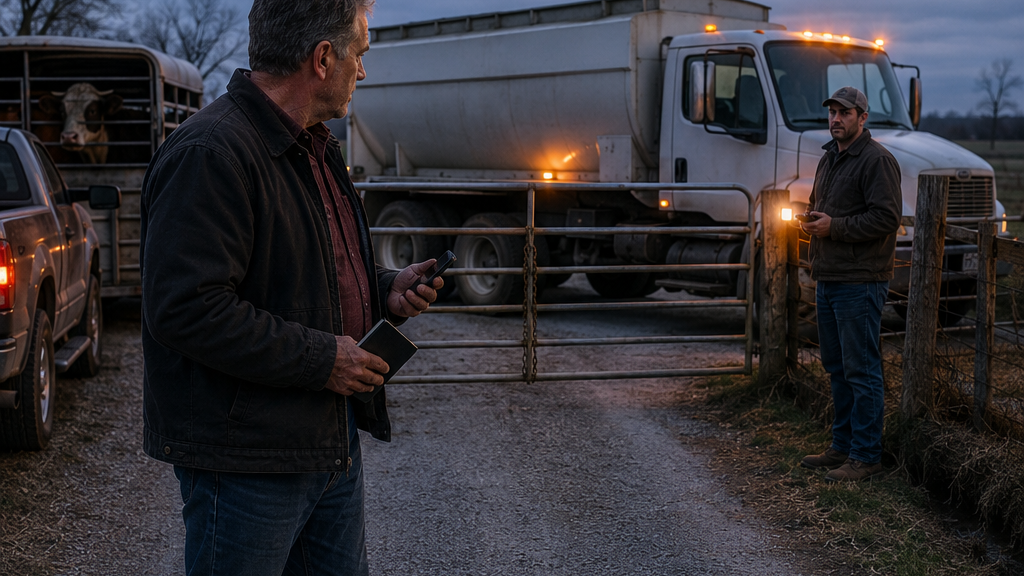
Amber hazard lights flashed against Michael Adams’s cattle gate before he had both boots on the ground.
He stopped halfway down the porch steps.
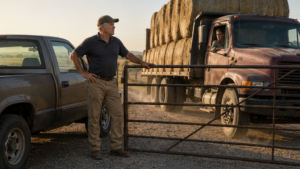
A white feed truck sat crosswise at the end of his gravel lane, its rear wheels near the ditch and its cab angled toward the county road. The engine idled with a heavy diesel pulse that carried through the dark. Every few seconds, the amber lights washed over the galvanized gate, the fence posts, and the black sides of the livestock trailer hitched behind Michael’s pickup.
Michael looked at his watch.
5:42.
He was supposed to have the trailer on the road in eight minutes.
One of his cows had developed a swelling along the jaw over the weekend. The veterinary clinic had squeezed him into an early livestock appointment before Michael’s shift at the processing plant. If he left on time, he could unload the cow, make the twenty-minute drive to work, and still walk through the maintenance shop before six-thirty.
If the truck moved.
Michael crossed the yard without hurrying. He had learned a long time ago that walking faster rarely made another man move faster.
The driver was standing behind the truck with one cargo door open, checking something on a handheld device.
“You need to pull forward,” Michael said.
The driver looked up. “Morning.”
“You’re across my entrance.”
The man glanced toward the gate as if seeing it for the first time. “I’ll only be a few minutes.”
“I need out now.”
Behind Michael, the cow shifted in the trailer. Metal rattled.
The driver looked past him. “You hauling?”
“Yes.”
“I’m waiting on my release time.”
Michael stared at him. “Wait somewhere else.”
The driver’s face tightened, not hostile exactly, but tired. “Dispatch has us use this spot.”
Michael thought he had misheard him.
“This spot?”
“The turnaround.”
“It isn’t a turnaround.”
The driver lifted the handheld unit. “That’s what it shows.”
Michael stepped far enough toward the road to see the truck’s position clearly. There was no room to swing the pickup and trailer around it without dropping a wheel into the drainage ditch.
“What does it show?” he asked.
The driver hesitated. “Approved rural turnaround.”
Michael looked at his gate again.
For thirty-two years, that opening had been where cattle trucks entered, hay wagons cleared the road, and his father backed machinery into the equipment shed. Nothing about it looked public. The gate stood on Michael’s fence line. A weathered mailbox carried his surname. Beyond it, gravel narrowed immediately between pasture fencing.
“You’ve got the wrong place,” Michael said.
“I don’t make the map.”
“No. But you are blocking the gate.”
The driver rubbed the back of his neck. “I’ve got another truck coming through. We meet here, then split the northern stops.”
“Not today.”
Michael expected an argument.
Instead the man gave him the sort of resigned look people gave when they had already been blamed for a decision made in an office fifty miles away.
“I can call dispatch.”
Michael looked at his watch again.
5:47.
The cow struck one hoof against the trailer floor.
“Call while you move.”
The driver started to speak, then stopped.
Michael took his phone from his pocket and photographed the truck. One picture showed the cab across the entrance. A second caught the plate and fleet number. Then he pulled a small black notebook from the breast pocket of his work shirt.
The driver watched him.
Michael wrote:
Monday. 5:48 a.m. Feed truck blocking east gate. Fleet 214.
“You writing me up?” the driver asked.
“I’m writing down what happened.”
“It’s not my route decision.”
“I heard you.”
There was no threat in Michael’s voice. That seemed to make the driver more uncomfortable than shouting would have.
Michael clicked the pen closed.
“Who authorized the turnaround?”
“I told you. Dispatch.”
“Who at dispatch?”
The man sighed. “Regional routing. Gregory Nelson’s office.”
Michael wrote the name beneath the time.
The driver stared at the notebook. “You work for the county or something?”
“Not anymore.”
The answer came out before Michael intended it to.
The driver waited, but Michael said nothing else.
Finally the man climbed into the cab. The truck gave a hiss of air brakes, reversed six feet, then pulled forward along the shoulder until Michael had enough room.
By the time Michael opened the gate, it was 5:54.
He backed the pickup, corrected the trailer angle, pulled through, stopped again to close the gate, then headed toward the clinic.
The veterinarian worked quickly. The swelling appeared treatable, but Michael spent the entire visit watching the clock over the examination chute.
At 6:31, he called the plant.
His supervisor answered on the second ring.
“I’m on my way,” Michael said.
“You all right?”
“Farm issue.”
There was a pause.
Michael had been at the plant nineteen years. He had been late twice because of weather closures that delayed everybody on the shift, but he had never called to say he himself was running behind.
“You want me to cover the morning inspection?” the supervisor asked.
Michael tightened his grip on the steering wheel.
“No. I’ll do it when I get there.”
He arrived at 6:47.
No one made a scene. That somehow bothered him more. A mechanic glanced at the clock and then quickly away. His supervisor had already initialed the boiler-room check Michael normally completed before anyone else arrived.
Michael took the clipboard without comment.
All morning, he found himself remembering the amber lights blinking against his gate.
At lunch he called the number printed on the feed contractor’s website.
After two transfers, a woman said Gregory Nelson was unavailable but could return the call.
Michael gave his number.
Gregory called at 4:18, when Michael was home checking water troughs.
“This is Gregory Nelson with regional dispatch. I understand there was a problem this morning.”
“A truck blocked my farm entrance.”
“I spoke with the driver. He said he moved as soon as you requested.”
“He moved after he told me dispatch had authorized my lane as a turnaround.”
Gregory paused.
“Yes. That location is on our rural routing map.”
Michael looked toward the gravel entrance from across the pasture.
“Who put it there?”
“I couldn’t tell you who originally entered it. Those routes have been in use for years.”
“My land hasn’t been a commercial staging lot for years.”
“I’m not calling it a staging lot.”
“What are you calling two trucks meeting there before daylight?”
Another pause.
Gregory’s voice remained level. “Mr. Adams, the map lists that entrance as an authorized agricultural turnaround point. If you believe that designation is incorrect, I’m happy to review any documentation you have.”
Michael’s hand tightened around the phone.
“You’re using my property. Why am I the one proving it?”
“I can only tell you what our current records show.”
Michael looked at the black notebook on the hood of his pickup.
5:48 a.m.
Fleet 214.
Gregory Nelson.
For the first time that day, the irritation in Michael settled into something colder and more useful.
“What exactly does your map say?” he asked.
Gregory answered without hesitation.
“Authorized turnaround.”
Chapter 2: The Route Map Said It Was Allowed
The second truck arrived Wednesday while Michael was still eating breakfast.
He saw the amber reflection move across the kitchen window before he heard the diesel.
For a moment he simply sat there with his coffee halfway to his mouth.
Then he placed the cup down, opened the black notebook beside his plate, and checked the kitchen clock.
5:36.
Outside, a feed truck had stopped partly across the entrance again. This one faced the opposite direction. Its hazard lights blinked over the ditch and fence.
Michael wrote the time before he put on his coat.
The driver was different.
So was the truck number.
The explanation was not.
“Dispatch told me to stage here until five-forty-five.”
Michael held the gate chain in one hand.
“This is private access.”
The driver frowned at the tablet mounted beside his steering wheel. “It’s marked as a turnaround.”
“Who told you that?”
“It’s in the route.”
“Gregory Nelson?”
The driver shrugged. “Regional dispatch builds the route.”
Michael photographed the truck.
Wednesday. 5:37. Fleet 188.
By Friday there were four entries.
Monday, Wednesday, Thursday, Friday.
Different trucks.
Different drivers.
Same instruction.
The pattern changed something in him. One truck could have been a mistake. Four trucks meant somebody had built the mistake into a system.
He called Gregory again from the kitchen table.
The black notebook lay open beside him. Michael had written down every call, including the time he placed it and how long he waited.
Gregory came on the line after six minutes.
“Mr. Adams.”
“You’ve had three more trucks use my entrance.”
“I received your messages.”
“And?”
“We’re reviewing the route.”
“They’re still coming.”
Gregory exhaled quietly. “The issue is that the location is in the existing rural delivery plan. Removing it affects sequencing.”
“That isn’t my problem.”
“No, but I’m trying to explain why this isn’t as simple as deleting an address.”
Michael looked through the kitchen window toward the lane.
There were fresh tire marks where one truck had cut the gravel shoulder too sharply.
“It is simple on my end,” he said. “Don’t block my gate.”
“I understand your position.”
“No. You understand the sentence.”
Gregory went silent.
Michael regretted the line almost immediately, not because it was false but because it sounded more like anger than he preferred to give anybody.
Gregory’s tone hardened slightly.
“Our drivers are generally there less than fifteen minutes.”
“That fifteen minutes made me late Monday.”
“If your departure window is consistently around five-forty-five, one possible short-term solution would be shifting it twenty minutes while we review the route.”
Michael stared at the wall.
“Say that again.”
“I’m suggesting a temporary scheduling adjustment.”
“For me.”
“For either side, depending on what we can accommodate.”
“You want me to change when I leave my own farm because your trucks are parked across it.”
“I’m trying to prevent another conflict while we verify the designation.”
Michael picked up his pen.
Friday. 12:14 p.m.
Suggested I shift departure twenty minutes.
He wrote it slowly.
Gregory heard the scratching.
“Are you taking notes?”
“Yes.”
Another pause.
“All right,” Gregory said. “Then note that I said temporary.”
Michael closed the notebook.
“I did.”
That afternoon Patricia Moore pulled into Michael’s yard in a dusty pickup.
She farmed three miles north, where her family milked just under two hundred cows. She was also one of the people who could hear about a county road problem before the road department did.
“I heard you’ve got a fight with the feed company,” she said.
“I’ve got trucks blocking my gate.”
“That’s what I said.”
Michael went back to tightening a fitting on the stock-water line.
Patricia leaned against the fence.
“They called the cooperative.”
“Good for them.”
“They’re worried you’re going to shut the north route down.”
“I’m shutting my entrance down.”
“Same trucks serve four farms past you.”
“They have a county road.”
“They also have delivery windows.”
Michael straightened.
“So do I.”
Patricia studied him for a moment.
“I’m not saying they should block you.”
“That sounded close.”
“I’m saying if Gregory has to rebuild the route in a hurry, somebody’s feed gets pushed.”
“That’s between Gregory and his customers.”
“You are one of his customers sometimes.”
“Not on that route.”
“No. But you might need them next month.”
Michael wiped his hands on a rag.
Patricia’s expression softened.
“There’s a cooperative meeting Tuesday. Come. Put it on the table.”
“I already put it on the table. They told me to leave twenty minutes later.”
“That’s not what I mean.”
“I know what you mean.”
He turned back toward the water line.
Patricia waited.
“You always do this,” she said.
Michael looked over his shoulder.
“Do what?”
“Decide asking anybody else to help means they get a vote over whether you were wronged.”
His jaw tightened.
“That’s not what I’m doing.”
“All right.”
She pushed away from the fence.
“Then come Tuesday.”
“I’ll handle it.”
Patricia gave him a small nod that said she had expected exactly that answer.
After she drove away, Michael stood alone beside the trough.
He knew she had meant well.
That did not make her right.
Saturday morning, he spread his notebook, phone photographs, and a printed copy of Gregory’s route image across the kitchen table.
Gregory had emailed the image the night before.
The lane was represented by a thin gray line ending in a small square.
Beside the square was a code.
AG-T/A.
Michael looked at it for a long time.
Something about the letters bothered him.
Not the wording.
The format.
He went to the hall closet and pulled down a cardboard box he had not opened in years. Inside were old county transportation manuals, training binders, and notes from the eight years before he left public work for the processing plant.
He found a faded access-classification sheet.
Private agricultural entrances used one series.
Temporary commercial access used another.
But AG-T/A belonged to neither.
Michael sat down.
The code came back to him all at once.
Agricultural temporary access.
A designation used when harvest traffic needed short-term room to turn or stage off a county road.
Temporary.
He picked up Gregory’s route map again.
The same code was printed beside Michael’s gate as if it were current.
Michael reached for the black notebook.
For the first time, he did not write down a truck number.
He wrote a question.
Who carried an expired temporary access code into a permanent commercial route?
Chapter 3: Eight Years He Rarely Talked About
By nine Saturday morning, Michael had found two things that should not have existed together.
Gregory’s current route map showed AG-T/A beside Michael’s farm entrance.
Michael’s old county manual said the designation required an expiration date.
Gregory’s map showed none.
He sat at the farmhouse desk with both documents side by side.
For eight years, Michael had worked in county transportation compliance, mostly reviewing access permits, temporary haul routes, farm entrances, culvert placement, and the endless arguments that occurred wherever private ground met public pavement.
He had not hidden the job.
He simply rarely mentioned it.
People heard “county” and assumed office work. The truth had been less impressive: measurements in August heat, paperwork nobody wanted, farmers angry about drainage, contractors angry about setbacks, and supervisors reminding everybody that a bad note in the wrong box could create a problem ten years later.
Michael had been good at the notes.
Maybe too good.
That was where the black notebooks had started.
At the county, he had carried one because memory became unreliable the moment two people disagreed. Later he kept one at the farm for calving dates, machinery hours, feed orders, fence repairs, and the time he left for work.
Facts stayed still when people did not.
He drove to the county administration building just before noon.
The records counter was staffed by a clerk he did not know. Michael was relieved.
He had no interest in walking into an old office and turning the matter into a favor between former coworkers.
“I need historical access records for this parcel,” he said, sliding the parcel information across.
“Current permit?”
“Anything tied to temporary agricultural access or turnaround use.”
The clerk typed.
Michael waited.
After a minute, she frowned.
“There’s an archived reference, but the scan isn’t attached.”
“How old?”
“Looks like late nineties.”
His stomach tightened.
“Can you pull the index?”
She disappeared into a back room.
Michael looked through the glass doors toward the parking lot. He could have called Larry Green. Larry had worked two desks down from him during Michael’s final county year and now handled right-of-way inspections.
But Michael had not called.
If the record supported him, he wanted it because it existed, not because somebody remembered him.
The clerk returned with a printed index page.
“There was a temporary agricultural traffic accommodation tied to the property.”
Michael read the line twice.
AG-T/A.
Permit reference.
Seasonal.
“Is there a termination date?”
“Not on the index.”
“That would have been required.”
She looked at him. “You used to work here?”
“A while ago.”
“That explains the questions.”
“Can the original be retrieved?”
“Archive request. Probably Monday.”
Michael nodded.
Then he saw the name attached to the applicant field.
Adams.
Not Michael.
His father.
The clerk turned the page toward herself.
“Benjamin—”
Michael touched the paper before she could continue reading aloud.
“That’s enough.”
He took a breath.
“Can I get a copy?”
Five minutes later he was back in the truck with the index page on the passenger seat.
His confidence had changed shape.
The company’s map was still outdated. He was almost certain of that. Temporary access did not silently become permanent because nobody bothered to remove a code.
But somebody from his own farm had once asked for the designation.
His father had died fourteen years earlier.
Michael remembered harvest seasons with trucks everywhere—grain trailers lined along county roads, hay wagons moving after dark, neighbors lending equipment because somebody’s baler had failed.
But he did not remember commercial feed trucks using their gate.
He drove home and went straight to the old equipment shed.
Dust lay thick on the shelves behind the workbench. His father had stored paperwork in coffee cans, tobacco tins, plastic toolboxes, and once, inexplicably, inside an empty seed broadcaster.
Michael searched for two hours.
He found tax receipts.
Old cattle records.
A tractor manual.
Three faded county notices about ditch maintenance.
Nothing about temporary access.
At three-fifteen, Patricia called.
“You still mad at me?”
“No.”
“So yes.”
“What do you need?”
“I heard you went to records.”
Michael leaned against the workbench.
“How?”
“Small county.”
He closed his eyes.
“Patricia.”
“All right. I’ll stop.”
She did not.
“Did you find the old turnaround?”
Michael straightened.
“What old turnaround?”
Silence.
Then Patricia said, “You really don’t know.”
“What?”
“I thought that was why you were so angry.”
“Tell me.”
Another pause.
“The harvest year when the bridge washed out on Miller Creek Road.”
Michael remembered that year. Everybody did. Rain had cut one end of the county in half for nearly six weeks.
“What about it?”
“Your dad let trucks turn through your lower entrance.”
“My father?”
“Feed trucks. Fertilizer. Anybody who couldn’t get a tandem turned at the closed bridge.”
“For how long?”
“A few weeks. Maybe longer.”
Michael looked through the open shed door toward the gate.
The gravel lane seemed unchanged.
Same fence.
Same pasture.
Same shallow ditch.
Patricia continued carefully.
“Your father told people to use it until the county reopened the road.”
“Did he sign something?”
“I don’t know.”
“Did he tell the county?”
“I assume so. There were temporary signs.”
Michael looked at the copied index page lying on the workbench.
His father’s surname sat beneath the permit reference.
“Why didn’t you tell me this Tuesday?”
“You wouldn’t come Tuesday.”
The answer landed harder than he expected.
Michael said nothing.
Patricia’s voice softened.
“I figured you knew. Michael, nobody around here thought your place had become public. But drivers have been turning there off and on for years. Not every day. Mostly when routes got crowded.”
“And nobody asked me.”
“No.”
“That matters.”
“Yes.”
He had expected resistance from her.
Instead she agreed.
That made the next part worse.
“But,” Patricia said, “if the feed company inherited a map from an old temporary arrangement, Gregory may not have invented the thing out of thin air.”
Michael stared at the black notebook.
Monday. Wednesday. Thursday. Friday.
All those entries had felt like proof of somebody else’s carelessness.
Now one missing entry seemed just as important:
the day, years ago, when his father had said yes.
Michael picked up the county index again.
Temporary agricultural traffic accommodation.
Seasonal.
No termination date visible.
The route map was wrong.
But perhaps not for the reason he had wanted.
“When did the bridge reopen?” he asked.
“Before Thanksgiving that year.”
“So the permission should have ended then.”
“Should have.”
Michael looked toward the gate.
“Did it?”
Patricia was quiet long enough that he already knew the answer.
“I don’t think anybody ever bothered to say so.”
Chapter 4: The Favor His Father Never Recorded
Patricia laid the photograph on the hood of her pickup and held one corner down with her finger.
“There,” she said.
Michael did not touch it.
The picture had faded toward yellow around the edges. In it, a tandem-axle feed truck was halfway through the lower entrance of his farm. The gate stood open. Beyond it, Michael recognized the old equipment shed before the roof had been replaced.
And beside the truck stood his father.
One hand rested on the open gate.
Michael leaned closer.
“That could have been one day.”
“It wasn’t.”
Patricia’s voice carried no satisfaction.
She had asked him to stop by her dairy after morning chores. He had expected conversation. He had not expected proof.
“How long?” he asked.
“The bridge was out six weeks.”
“You said a few weeks.”
“I said I remembered a few weeks. It was a long time ago.”
Michael picked up the photograph.
His father was smiling at somebody outside the frame.
That bothered him more than the truck.
The county archive request had arrived by email that morning. The original accommodation record was incomplete, but enough survived to confirm what Patricia remembered: temporary agricultural turnaround use requested during the Miller Creek Road closure.
No permanent easement.
No commercial staging agreement.
No transfer of access rights.
But no clear cancellation notice either.
Michael handed the photograph back.
“My father let them turn around during an emergency.”
“Yes.”
“That doesn’t give a delivery company the right to sit across my gate thirty years later.”
“I didn’t say it did.”
“You keep defending them.”
Patricia’s expression changed.
“I’m defending the farms on the other end of those trucks.”
She led him toward the milking barn.
Inside, the sharp smell of feed and disinfectant mixed with warm air from the cattle. A half-empty bulk bin stood beside the wall.
“We were eight hours late on supplement last month,” she said. “Another farm got pushed until the next morning. Gregory’s running fewer drivers over more miles.”
“That still doesn’t make my entrance his.”
“No.”
“Then why does everybody keep talking like I’m supposed to accept it?”
“Because you’re hearing one question when there are two.”
Michael stopped.
Patricia faced him.
“Is Gregory wrong to block your gate? Yes. Is everybody who uses that route going to be affected when you force him off it? Also yes.”
Michael looked toward the bin.
“You should have told me about my father earlier.”
“I tried to get you into the room where it was being discussed.”
“That’s not the same thing.”
“No. It isn’t.”
She let the silence stand.
Michael knew what she was waiting for him to admit.
He had refused the cooperative meeting because the idea of sitting around a table while other people debated his private entrance had made him angry.
He had wanted the question to stay simple.
His land.
Their trucks.
Move them.
Now the old photograph sat between those ideas like a stone.
“Did my father ever tell you why he agreed?” Michael asked.
“The bridge closure backed trucks onto the county road. Your lower entrance was wide enough to keep them from reversing into traffic.”
“That was it?”
“That was enough.”
Michael knew that sounded like his father.
Not generous in speech. Generous in practical things.
By afternoon, Michael was back in his own equipment shed searching again.
This time he was not looking for evidence against Gregory.
He was looking for evidence against himself.
That distinction made the work slower.
Near the bottom of an old metal file box, he found a packet of farm receipts from the bridge-closure year. Fuel. Twine. Veterinary supplies. A handwritten note from a fertilizer company thanking his father for “turnaround access during road repairs.”
No agreement.
No duration.
No payment.
Just gratitude.
Michael carried the note to the workbench and opened his black notebook.
He drew a line down the center of a blank page.
On one side he wrote CURRENT.
On the other, THEN.
Under CURRENT:
Daily or near-daily staging.
Truck waiting across gate.
Dispatch-directed.
Commercial route scheduling.
Under THEN:
Bridge closure.
Temporary turning only.
Emergency traffic problem.
Permission from landowner.
He stared at the two lists.
For the first time, he understood how the mistake could have survived.
A dispatcher inherited a route.
A driver inherited a habit.
A temporary courtesy became a map symbol.
Then the original reason disappeared while the symbol remained.
That explained the mistake.
It did not explain Gregory.
Monday afternoon, Michael finally attended the agricultural cooperative meeting.
Gregory was not there, but Patricia was.
A board member slid a printed route proposal across the table.
“We could ask them to move staging south,” the board member said. “But Gregory says it adds mileage and creates delivery conflicts.”
“Then let Gregory explain that to me,” Michael said.
Patricia raised an eyebrow.
“You could have heard him last Tuesday.”
Michael looked at her.
“I know.”
It was not an apology.
But it was close enough that Patricia did not press.
After the meeting, Michael drove to the county office and asked Larry Green to review the records.
Larry read the old accommodation file, Gregory’s current map, and Michael’s notebook without saying much.
“You kept good logs,” Larry finally said.
“Habit.”
“I remember.”
Michael ignored that.
“What matters?”
Larry tapped the old temporary designation.
“This was never an easement.”
“I know.”
“It also wasn’t properly closed in the old index.”
“I know that too.”
Larry looked up.
“The contractor can reasonably argue they inherited bad information.”
Michael felt his jaw tighten.
“Reasonably?”
“For the beginning of the problem. Not necessarily the continuation.”
Larry turned his monitor around.
“There’s something else.”
An email chain filled the screen.
Three months earlier, county staff had reviewed several outdated agricultural-access notations after a road inventory update. One message had gone to Gregory’s dispatch office.
Michael read the line twice.
Temporary designation requires current landowner authorization prior to continued commercial use.
Below it was Gregory Nelson’s reply.
Received. We will review affected routing locations.
Michael looked at Larry.
“He knew.”
“He knew there was a question.”
“He kept sending trucks.”
Larry folded his hands.
“That’s what needs explaining.”
Michael took out the black notebook.
For weeks, the entries had been about truck numbers, times, and blocked access.
Now he added a new date.
Three months before the first morning he had complained.
Beside it he wrote:
Gregory notified reauthorization required.
He closed the notebook.
The old favor explained how the mistake began.
It no longer explained why anyone had allowed it to continue.
Chapter 5: Gregory Had Three Months to Fix It
Gregory Nelson arrived at the cooperative office carrying a folder thick enough to make Michael suspicious before either man spoke.
He set it on the table and opened directly to a page of delivery times.
“These are the numbers everyone needs to see.”
Michael remained seated.
Patricia sat two chairs away. Larry Green had taken the end of the table, not as a cooperative member but as the county official reviewing the access complaint.
Gregory slid copies around.
“Since February, we’ve lost two route drivers. We consolidated three rural runs into two. Every change adds minutes somewhere.”
Michael looked at the page.
Columns showed farms, estimated arrival windows, mileage, loading times.
Gregory pointed to a highlighted section.
“If we remove the Adams turnaround without replacing it, four northern stops shift. Two of those are dairy operations.”
Patricia leaned forward.
“How much?”
“Potentially forty-five minutes on the morning route. More if the county road is busy.”
Michael could feel the room turning toward him without anyone moving.
Gregory did not smirk.
That would have made things easier.
Instead he looked tired.
“This isn’t about disrespecting anybody’s property,” he said. “It’s about keeping service workable.”
Michael opened his black notebook.
“Then why did you tell me to leave twenty minutes later?”
Gregory’s mouth tightened.
“I offered a temporary adjustment.”
“For me.”
“For both sides while we reviewed it.”
“You had already been told to review it.”
Larry looked up.
Gregory glanced toward him.
Michael placed a copy of the county email on the table.
“Three months before my first call.”
Gregory did not deny it.
He rested both hands on the folder.
“We had fourteen flagged route locations in that notice.”
“And mine was one.”
“Yes.”
“You kept using it.”
“Yes.”
The simple answer changed the room.
Patricia looked down at the delivery sheet.
Larry asked, “Why?”
Gregory rubbed his thumb along the folder edge.
“Because we were already short-staffed. Every route change had to be field-tested. We prioritized locations with safety complaints.”
“A blocked livestock entrance isn’t safety?” Michael asked.
“Not until you reported it as one.”
“You were told landowner authorization was required.”
“I was told the designation needed review.”
Michael leaned back.
There it was.
Not ignorance.
Not exactly defiance either.
Delay.
The sort that became somebody else’s problem until somebody forced it back onto the right desk.
Gregory opened another page.
“Our regional contract is under performance review. Missed delivery windows count against us. I had drivers leaving before dawn trying to cover routes designed for more staff.”
Patricia spoke quietly.
“That explains pressure. It doesn’t explain keeping an unauthorized staging point.”
Gregory nodded once.
“No. It doesn’t.”
Michael had expected him to fight harder.
The admission unsettled him.
Gregory continued.
“I believed the historical use meant we had time to sort it out.”
“Historical use,” Michael said.
“Yes.”
Michael reached into his folder.
This was the moment he could have left one document out.
Nobody in the room had yet mentioned his father.
Larry knew, but Larry would not build Michael’s case for him.
Michael put the old county index and a copy of Patricia’s photograph beside Gregory’s route sheets.
“My father allowed trucks to use the entrance during the Miller Creek bridge closure.”
Gregory stared at the photograph.
Patricia looked at Michael.
“He gave temporary permission,” Michael continued. “There was a county accommodation code. The file wasn’t closed correctly.”
Gregory picked up the index page.
“This supports our route map.”
“No,” Michael said. “It explains your route map.”
Gregory looked at him.
“It does not make the current use permanent. But I’m not going to sit here and pretend your company invented the location from nothing.”
Larry reached for Michael’s notebook.
“You have copies of the logs?”
Michael handed him a packet.
Every blocked morning was listed with time, vehicle number, photographs, work or farm consequence, and whether Michael had contacted dispatch.
Larry compared the packet with the old record.
“You included the historical permission in your complaint supplement?”
“Yes.”
Gregory frowned slightly.
Michael understood why.
Leaving it out might have made the argument cleaner.
It also would have made Michael less credible the moment somebody else found it.
Larry closed the packet.
“This is useful.”
Gregory gave a dry laugh. “Useful for whom?”
“For determining what actually happened.”
Larry looked at Michael.
“The old permission explains the origin. Your documentation shows the present use is different in frequency and purpose. The county notice establishes that reauthorization was required.”
Then he looked at Gregory.
“And your office continued the practice after receiving notice.”
Gregory’s shoulders lowered.
For the first time, he seemed less like a representative defending a system and more like the man who had made the calculation.
“What do you want?” he asked Michael.
The question came too quickly.
Michael had spent weeks knowing exactly what he wanted.
No trucks.
No staging.
No one rearranging his mornings.
Now Patricia’s feed bin, the route sheet, and the old photograph all sat in the same room.
“I want my gate clear.”
“That I can understand.”
“I want the designation corrected.”
Gregory nodded.
“And damage to the shoulder?”
“Document it.”
Larry raised one hand.
“There is another issue.”
Everyone turned.
“If the county orders immediate cessation at this location and the contractor has no compliant alternative ready, there may be a service interruption.”
“That isn’t Michael’s responsibility,” Patricia said.
“No,” Larry replied. “But it is a practical consequence.”
Michael looked at her.
She had defended the other farms against him two days earlier.
Now she was defending him against the county.
Mixed motives, he thought.
Or maybe simply honest ones.
Gregory pushed the route sheet forward.
“I can redesign it. I can’t do it overnight without somebody taking a hit.”
Michael almost answered immediately.
That was his habit.
Make the boundary clear.
Let other people handle the consequences they had created.
Then he saw the photograph again.
His father beside the open gate, making room because a washed-out bridge had created a problem bigger than one farm.
Michael did not owe Gregory access.
But perhaps that was not the only question anymore.
Larry pulled a single-page form from his folder.
“I can proceed two ways,” he said.
“Michael can request immediate closure of the disputed access designation. Based on what I have, I have enough to elevate that request.”
Gregory stared at the table.
“Or?”
“Or Michael can request formal correction while proposing a temporary compliant alternative during the transition.”
Michael looked at Larry.
“You’re asking me to solve their routing problem.”
“No.”
Larry slid the form toward him.
“I’m telling you the choice that belongs to you.”
Michael did not touch the paper.
For weeks he had wanted somebody official to say exactly that.
His land.
His choice.
Now that the choice had arrived, it weighed more than he expected.
Chapter 6: The Boundary Was His, the Choice Was Too
The feed truck slowed at Michael’s entrance at 5:43 the next morning.
Michael was already standing beside the gate.
The driver touched the brakes.
Amber lights blinked once.
Michael unhooked the chain, opened the gate wide enough to make his meaning unmistakable, then stepped into the gravel shoulder and raised one hand.
“Don’t turn in.”
The truck stopped.
The driver lowered his window.
“Dispatch still has this as the waiting point.”
“I know.”
Michael held up a sheet of paper.
“County pull-off is eight-tenths south. Right side, past the culvert. You can wait there without blocking traffic.”
The driver glanced at the road behind him.
“That’s not on my route.”
“It may be soon.”
“I’m supposed to meet another truck.”
“Call dispatch.”
The driver looked tired enough that Michael felt some of his anger drain away.
Not disappear.
Just narrow itself toward the people who had actually made the decisions.
After a short call, the truck continued south.
Michael closed the gate.
Then he opened the black notebook.
He almost wrote another violation entry.
Instead he turned to a clean page.
Tuesday.
County pull-off: 0.8 mile south.
He drew three columns beneath it.
Farm.
Current window.
Possible window.
At work, the notebook stayed in his shirt pocket.
By lunch he had filled half the page.
Michael had spent eight years reviewing access problems. He knew the county road south of his farm widened near an old maintenance pull-off. Trucks already used it occasionally during roadwork. It was not perfect, but unlike his entrance, it was public right-of-way and wide enough for a feed truck to wait without trapping anyone.
The problem was sequencing.
If every farm insisted on its current delivery time, Gregory would still have trucks crossing and doubling back.
Michael called Patricia.
“I need to ask you something.”
She laughed once.
“That must hurt.”
“Do you want me to hang up?”
“No. Go ahead.”
“Could you take your supplement delivery thirty minutes later on Tuesdays and Thursdays?”
Silence.
“What are you doing?”
“Trying something.”
“Does Gregory know?”
“Not yet.”
Patricia considered.
“If the bulk bin is topped the evening before, yes. Not every week.”
“Most weeks?”
“Yes.”
Michael wrote it down.
“Thank you.”
“Michael.”
“What?”
“This is what the meeting was for.”
He closed his eyes briefly.
“I know.”
He called two role-only cooperative members next.
He did not ask them to surrender delivery reliability.
He asked what flexibility actually existed.
One could move a dry-feed delivery earlier.
Another could accept a wider window provided the driver called first.
By evening, Michael had enough changes to sketch a route that made the county pull-off workable without adding the full forty-five minutes Gregory had warned about.
Patricia stopped by after milking.
Michael spread the notebook open on the hood of his pickup.
She studied the page.
“You turned your complaint log into a dispatch sheet.”
“It’s not a dispatch sheet.”
“It has time windows.”
“It’s a proposal.”
She smiled.
Michael pointed to the lower part of the page.
“If your delivery moves here, the truck can stage south, run your place first, then come back north without turning through mine.”
“What about the two farms past the ridge?”
“Earlier load time on one. Flexible window on the other.”
“You called them?”
“Yes.”
Patricia looked at him.
“What?”
“Nothing.”
“That look means something.”
“It means three weeks ago you wouldn’t sit in the same room with us.”
Michael folded his arms.
“Three weeks ago I thought the only issue was my gate.”
“And now?”
“My gate is still the issue.”
Patricia waited.
Michael sighed.
“And not the only one.”
She tapped the notebook.
“That’ll work.”
The next morning, Michael and Patricia drove the proposed route with Larry.
The county pull-off had enough width, but Larry paced its edge and pointed toward a shallow drainage channel.
“No overnight staging. No trailer drop. Engines attended.”
“Fine,” Michael said.
“And if they use it regularly, dispatch needs written county acknowledgment.”
“Better.”
Larry looked at him.
“You seem to enjoy that word.”
“Written?”
“Yes.”
“It saves arguments.”
By noon, three cooperative farms had agreed to the trial windows.
Gregory had not.
His call came while Michael was replacing a belt guard at the processing plant.
“I saw your proposed route.”
“And?”
“It doesn’t account for loading variability.”
“It accounts for more than the one you’re using now.”
Gregory ignored that.
“If the first truck leaves ten minutes late, Patricia’s window slips. Then the northern delivery overlaps with the second load.”
“So adjust the load order.”
“It’s not that simple.”
Michael leaned against the workbench.
“You said that about deleting my entrance.”
“Because it wasn’t.”
“No. It was inconvenient.”
Gregory went quiet.
Michael could hear office noise on the other end.
Finally Gregory said, “Your route makes the current schedule look inefficient.”
Michael understood.
Not just inefficient.
Avoidably inefficient.
If the alternative worked, then the trucks had been blocking his gate partly because Gregory had chosen the least disruptive solution for dispatch, not because there was no other option.
“Is that the real problem?” Michael asked.
“No.”
“It sounds like it.”
“The real problem is that I’m responsible for service performance.”
“And I’m responsible for my farm.”
“I know that.”
“Then stop trying to make those responsibilities compete.”
Gregory exhaled.
“What are you asking for?”
“A two-week trial using the pull-off. No truck stages at my entrance. Participating farms use the adjusted windows. You track the route.”
“And after two weeks?”
“The county decides the permanent designation.”
Gregory was quiet.
Michael added, “Unless you’d rather let Larry close my access point immediately and figure it out afterward.”
“That sounds like leverage.”
“It is.”
He said it without anger.
For once, he did not feel guilty about the word.
A boundary without consequence was merely a preference.
Gregory finally said, “Send me the revised windows.”
“I already did.”
“Of course you did.”
The trial began the following morning.
One delivery ran twelve minutes late.
Another arrived early.
Nobody’s feed was missed.
And for the first time in weeks, Michael drove through his gate before dawn without a truck in the way.
Two days later, Gregory emailed objections to three parts of the proposal. Michael answered each one with a practical revision rather than an accusation.
On Friday afternoon, Larry called.
“If you want the county to act, I need your formal request by five.”
Michael sat at the kitchen table.
The original closure form lay on his left.
On his right was the corrected route proposal, signed by the participating farms and annotated with the county pull-off conditions.
His black notebook lay between them.
For weeks, it had recorded what other people had done wrong.
Michael opened to the page of revised delivery windows.
Then he signed the formal request.
He did not ask the county simply to close his entrance.
He requested removal of the obsolete commercial turnaround designation, restoration of the entrance to private agricultural access, documented reimbursement for shoulder damage, and approval of the alternate staging location under the trial conditions.
He attached the route proposal himself.
At 4:41, he sent the packet.
His gate remained his.
But the solution no longer stopped at the property line.
Chapter 7: The Morning the Hazards Stayed Off
At 5:45 on Monday morning, headlights appeared beyond the bend.
Michael stood beside his pickup with one hand on the door.
For three weeks, that sight had meant the same thing: diesel noise, amber hazard lights, a truck easing toward his entrance as if the gate belonged to the route instead of the farm.
The headlights came closer.
Michael waited.
The feed truck did not slow.
It passed his mailbox, continued south, and disappeared toward the county pull-off.
No brakes.
No hazards.
No white cab turning across the gravel.
For several seconds Michael remained where he was.
Then he looked toward the gate.
Nothing blocked it.
The livestock trailer could have cleared the entrance without correction. His pickup had a straight line to the county road. Even the gravel shoulder looked wider without a commercial truck sitting over it.
Michael reached into his shirt pocket and pulled out the black notebook.
Monday. 5:45 a.m.
He paused.
For months the next words had come automatically.
Truck blocking east gate.
Fleet number.
Time moved.
Dispatch contacted.
This morning he wrote only:
No obstruction.
He stared at the words, then closed the notebook.
The county’s decision had arrived Friday afternoon.
The old agricultural temporary-access designation was being removed from current commercial routing records. Michael’s entrance would remain what it had legally been for years: private agricultural access.
The southern pull-off had received conditional approval for attended commercial staging. No dropped trailers. No overnight parking. No blocking the county road.
The cooperative’s revised delivery windows would continue through the season.
It was almost exactly what Michael had requested.
Almost.
The final question of reimbursement still required signatures, and Gregory had asked for one last cooperative meeting before the corrected routing plan became permanent.
Michael had considered refusing.
Then he had remembered Patricia telling him that sitting in a room did not give anybody a vote over whether he had been wronged.
So at four that afternoon, he walked into the cooperative office carrying the same folder he had used throughout the dispute.
Gregory was already there.
No thick stack of delivery statistics this time.
Only a legal pad and a printed copy of the county decision.
Patricia sat near the window. Larry occupied the same end chair as before.
Gregory nodded when Michael entered.
“Mr. Adams.”
“Gregory.”
Michael took his seat.
Larry began without ceremony.
“The county has completed its review. The temporary code was improperly carried forward in secondary routing records after the original accommodation ceased to serve its stated purpose.”
Gregory looked down at the document.
Larry continued.
“There is no current authorization for commercial staging on the Adams entrance. The correction has already been transmitted to the contractor.”
Michael said nothing.
He had imagined this moment more than once.
In those imagined versions, vindication had felt sharper.
Instead it felt like hearing a machine finally stop rattling after weeks of trying to find the loose bolt.
Larry turned one page.
“We also reviewed the documented property impacts.”
Two trucks had crushed the edge of the gravel shoulder deeply enough that Michael had needed additional stone. One driver had clipped a drainage marker. Michael had also submitted the veterinary hauling delay and the missed plant time from the first morning, though he had not tried to inflate either.
“The contractor has agreed to reimburse the verified gravel repair and hauling-related costs,” Larry said.
Gregory added, “Including the replacement marker.”
Michael looked at him.
“That wasn’t expensive.”
“It was damaged by one of our trucks.”
Michael nodded once.
“All right.”
Patricia shifted in her chair, but said nothing.
Larry folded his hands.
“That leaves future routing.”
Gregory pushed the revised map into the center of the table.
Michael’s entrance was no longer marked.
The southern pull-off had replaced it.
Seeing the blank space beside his farm affected Michael more than the reimbursement figure had.
Gregory tapped the delivery sequence.
“We ran the alternative for seventeen operating days.”
“Problems?” Patricia asked.
“Some.”
Gregory looked at Michael.
“The first week was rough. Two late loads. One missed connection between trucks.”
Michael waited.
“But the adjusted windows reduced the northern route’s backtracking more than I expected.”
Patricia smiled faintly.
Gregory noticed.
“Don’t enjoy that too much.”
“I’m trying.”
Gregory looked back at Michael.
“The route works.”
It would have been easy for Michael to say, I told you so.
Instead he asked, “Then why did you fight it?”
Gregory sat back.
The room quieted.
He could have blamed staffing. The old map. Contract expectations. Every explanation he had already given contained enough truth to be useful.
This time he did not reach for any of them.
“Because changing it meant documenting why it had to be changed.”
Michael watched him.
Gregory continued.
“I received the county notice. I knew the temporary locations needed review. We were short drivers, and I made the decision to keep the existing map until somebody forced the issue.”
Patricia’s expression tightened.
Gregory looked at her, then at Larry.
“I told myself historical use gave us room.”
Then his eyes returned to Michael.
“It didn’t give us as much room as I acted like it did.”
There was no dramatic apology.
No long confession.
Michael preferred that.
“What about telling me to change when I left?” he asked.
Gregory winced slightly.
“That was a bad answer.”
“Yes.”
“I was trying to solve the easiest part of the schedule.”
“For you.”
“Yes.”
The admission settled between them.
Michael did not forgive him in that instant, and Gregory did not ask him to.
Larry moved the paperwork forward.
“The written protocol makes future use straightforward. No commercial vehicle stages on private farm access without current landowner consent. Temporary permissions receive specific start and expiration dates. Route changes affecting cooperative members are circulated before implementation.”
Patricia tapped the page.
“That last part might save all of us trouble.”
Michael looked at her.
“You mean meetings?”
“I know you dislike the concept.”
He almost smiled.
“Depends on the meeting.”
“Progress.”
Michael signed the access correction.
Gregory signed the contractor routing acknowledgment.
Patricia signed the cooperative schedule.
The documents moved around the table without ceremony.
When they were finished, Gregory gathered his papers.
“We may still need occasional changes during harvest.”
Michael put the cap back on his pen.
“Then ask.”
Gregory nodded.
“That simple?”
“No.”
Michael slipped the notebook into his pocket.
“But that’s where you start.”
Outside, Patricia walked with him toward the parking lot.
“You know what your father would have done?” she asked.
Michael stopped beside his pickup.
“No.”
“He probably would have opened the gate.”
Michael looked toward the road.
“During a washed-out bridge.”
“Yes.”
“And then forgotten to make anybody write down when they were supposed to stop.”
Patricia laughed.
“That also sounds like him.”
Michael opened the truck door.
For years he had thought his father’s way of helping people was proof that boundaries mattered less when neighbors needed something.
Now he understood it differently.
His father had not surrendered the entrance.
He had chosen to share it.
The problem came later, when choice disappeared from the arrangement.
Three mornings after the meeting, Michael was at the kitchen table before sunrise.
The notebook lay open beside his coffee.
He checked the previous pages.
Dates.
Truck numbers.
Photographs referenced by time.
Calls.
Gregory’s name.
The county warning.
Then the later pages changed.
Delivery windows.
Pull-off conditions.
Patricia’s adjustment.
Cooperative trial.
County approval.
He turned to the newest page.
At the top was Monday’s entry:
5:45 a.m. No obstruction.
Below it was empty space.
Michael held the pen over the page.
He could have left a line for Tuesday.
Another for Wednesday.
A place to record the next violation.
Instead he drew a short line beneath Monday and turned the page.
On the clean sheet he wrote:
North pasture fence.
Check trough valve.
Hay moisture.
Thursday delivery—confirm with cooperative.
He stopped after the last item.
The words looked ordinary.
That was the point.
Outside, an engine approached along the county road.
Michael listened.
The truck continued past his farm without slowing.
He did not get up to check.
The gate remained closed.
The road remained open.
And inside the black notebook, the next blank line was no longer waiting for somebody to cross a boundary.
It was waiting for Michael to decide what came next.
The story has ended.