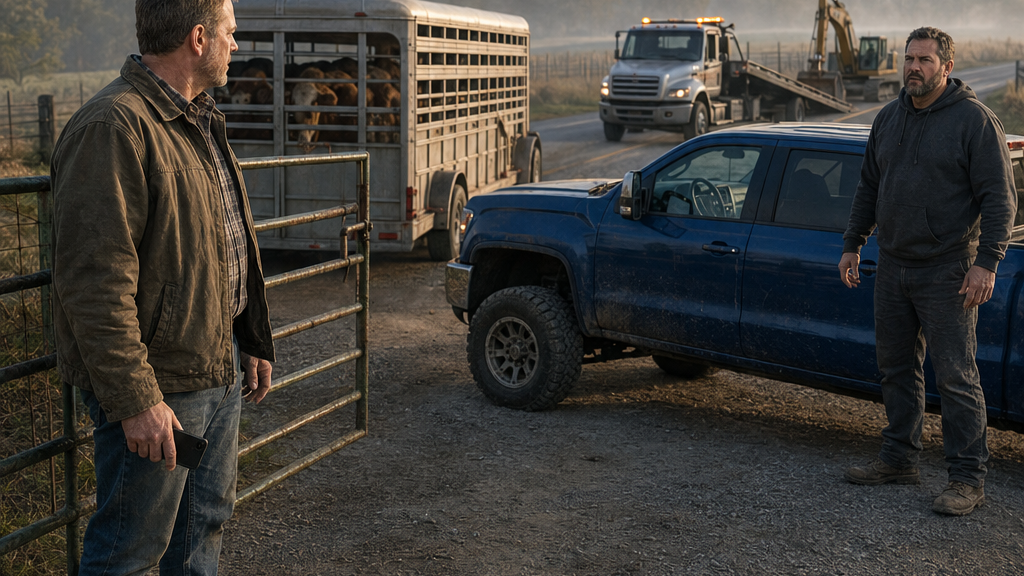
His Neighbor Kept Blocking the Farm Gate—Then One Tow Changed What Their Fathers Had Left Unsaid
Chapter 1: The Morning the Gate Cost Him More Than Time
The cattle were loaded, the diesel was running, and Benjamin Hill’s blue pickup sat sideways across Kevin Hall’s only way out.
Kevin stopped beside the open farm gate and looked at his phone.
6:42.
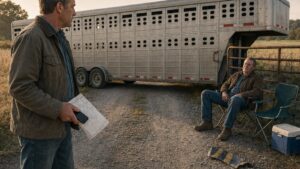
The livestock hauler had backed the aluminum trailer down the lane before sunrise. Twenty-six steers stood packed inside, their weight shifting against the partitions with dull metallic thumps. They were supposed to be on the county road already. Kevin had a sale window to make, and the auction yard was nearly an hour away.
Benjamin’s lifted pickup occupied the strip of gravel between Kevin’s gateposts and the pavement as though somebody had dropped it there deliberately. Its front wheels were on Kevin’s entrance apron. The rear end angled toward the road. A small equipment trailer sat behind it with a compact trenching attachment chained down.
There was enough space for a car to squeeze around.
There was not enough space for a cattle rig.
Kevin could see Benjamin fifty yards down the road beside an excavator, talking with two workers near a drainage ditch.
The livestock hauler leaned out his window.
“You want me to try it?”
Kevin looked at the ditch on one side and the mailbox post on the other.
“No.”
“Could maybe swing wide.”
“With twenty-six head behind you?”
The driver settled back into his seat. “Your call.”
Kevin already knew it was.
That was the part that bothered him.
He walked to the road and raised one hand. Benjamin noticed him eventually, said something to one of his workers, then continued talking.
Kevin raised his hand again.
Benjamin pointed at the excavator as if that explained everything.
Kevin checked the time.
6:47.
The white sign fixed to the cedar post beside the gate was visible from the road.
PRIVATE FARM ACCESS
KEEP CLEAR
Kevin’s father had put up the original version years ago after a propane truck nearly got trapped during calving season. Kevin had replaced it with an aluminum one when the old painted board split down the middle.
Benjamin had seen it hundreds of times.
Kevin walked toward him.
“Ben.”
Benjamin glanced over. “Morning.”
“I need the entrance.”
“Yeah, I know. Give me a minute.”
“I needed it five minutes ago.”
Benjamin looked past Kevin toward the cattle trailer. “He can’t get around?”
“No.”
Benjamin squinted as if the answer were unreasonable.
“We’re just setting that machine,” he said. “Road’s too narrow to unload on.”
Kevin kept his voice even. “Then pull your truck forward.”
“I will.”
“When?”
Benjamin looked toward his worker. “Soon as we get this off.”
Kevin had heard that before.
Sometimes the truck had been there eight minutes. Sometimes twelve. Once Benjamin had left a skid-steer trailer across half the gate while he drove back home for a missing chain binder. Kevin had waited because it had seemed easier than making an issue of it.
They had known each other since they were boys.
Their fathers had traded labor during harvest. Benjamin’s father had welded a hay-rake tongue for Kevin’s father one Sunday afternoon and refused payment. Kevin’s father had pulled Benjamin’s family truck out of a flooded crossing years later.
That history had a way of making small inconveniences feel too petty to name.
Until they stopped being small.
Kevin’s phone vibrated.
The auction-yard scheduler.
He answered immediately.
“Hall.”
“You rolling?”
Kevin looked toward the blocked gate.
“Not yet.”
There was a pause.
“You told me seven-thirty arrival.”
“I know.”
“We’ve got three consignments behind you.”
“I know.”
Another pause, shorter this time.
“If you miss your slot again, I can’t keep holding the front run.”
Kevin felt the word again land harder than the sentence around it.
Again.
“We’ll be there.”
“I need a better answer than that, Kevin.”
“You’ll have one.”
He ended the call.
The livestock trailer clanked behind him as one of the steers shifted hard against another. The driver climbed down and checked the side vents.
Kevin looked at Benjamin.
Benjamin was laughing at something one of his workers had said.
That was when irritation changed shape.
It stopped being about five minutes.
Kevin walked back down the road.
“Ben.”
Benjamin turned.
“I need it moved now.”
Something in Kevin’s voice must have registered, because Benjamin’s smile disappeared.
“We’re almost done.”
“No. Move your truck. Finish after.”
Benjamin exhaled through his nose. “Kevin, I’ve got a crew standing here.”
“And I’ve got cattle standing in a trailer.”
“It’s ten minutes.”
“It’s my entrance.”
That made one of the workers look away.
Benjamin glanced at him, then back at Kevin.
“You really want to make a thing out of this?”
Kevin did not answer immediately.
That hesitation irritated him more than Benjamin’s question.
“No,” he said. “That’s why I’m asking you to move it.”
Benjamin stared at him another second, then pulled the keys from his jacket pocket.
“All right.”
He walked back to the pickup slowly enough that Kevin understood the gesture. Not refusal. Not compliance either. A kind of deliberate reminder that Benjamin would decide the pace.
The truck started with a low roar. Benjamin pulled forward thirty yards and parked on the grassy shoulder beyond the ditch work.
Kevin lifted one hand toward the hauler.
The driver climbed back into the cab.
By 7:03 the cattle trailer was on the county road.
Kevin followed in his own pickup.
He should have felt relieved.
Instead, every mile made the lost minutes feel heavier.
At the auction yard they were placed behind two other loads. The front run was gone. Buyers had already started sorting their attention toward the first groups through. Kevin watched from the rail as his steers entered later than planned.
They sold reasonably.
Not badly.
That almost made it worse.
There was no clean disaster to point to, no dramatic number that would justify anger. Just a softer price than he had hoped for and an auction scheduler who met him near the office afterward with a clipboard tucked beneath one arm.
“You got here.”
Kevin nodded.
“But you didn’t get here when you said.”
“I know.”
The scheduler looked toward the pens.
“You’ve been reliable a long time. I’m telling you because I’d rather tell you once than start moving you automatically.”
Kevin understood.
The warning was a courtesy.
That meant next time would not be.
On the drive home, he thought about the entrance sign.
He thought about how many times Benjamin had stopped there because the county road had no shoulder wide enough for his trailers. Kevin had never objected when it was five minutes and somebody remained with the vehicle.
Somewhere along the way, temporary had become normal.
Normal had become expected.
Expected had become something Benjamin no longer thought he had to ask about.
When Kevin reached home, the farm gate was still open from the morning.
Benjamin’s pickup was gone.
The gravel where it had stood showed two dark tire impressions.
Kevin got out and rested one hand on the gate.
He had kept it open for years whenever he was working nearby. His father had done the same.
Not as an invitation.
Just because closing and reopening it twenty times a day was inconvenient.
A truck slowed on the county road.
Benjamin was driving back from the job.
He rolled down his window.
“You make your sale?”
Kevin stepped toward the road.
“Eventually.”
Benjamin nodded as if the issue had settled itself.
Kevin said, “Don’t block the gate again.”
Benjamin’s expression changed.
Not anger exactly.
Surprise.
“You serious?”
“Yes.”
Benjamin rested one arm on the open window.
“Kevin, we’ve been pulling off there since before either of us owned these places.”
“Pull off somewhere else.”
“There is nowhere else.”
“That doesn’t make the entrance yours.”
Benjamin gave a short laugh.
Then he said the thing Kevin carried with him long after the truck disappeared down the road.
“Your dad never had a problem with it.”
Chapter 2: The Permission Neither Man Could Clearly Explain
Kevin walked to Benjamin’s house that evening because calling felt too much like turning a neighbor problem into business.
He nearly turned back twice.
Benjamin’s place sat less than half a mile down the road, close enough that Kevin could see the light over his machinery shed from his own cattle lot. Their families had lived within walking distance for more than forty years.
That was exactly why Kevin kept walking.
Benjamin opened the door before Kevin knocked a second time.
“You lose something?”
“No.”
Benjamin looked past him toward the road. “Everything all right?”
“I want to clear up this gate business.”
Benjamin’s mouth tightened slightly.
“Thought we already did.”
“No. You moved the truck. That’s not the same thing.”
Benjamin stepped onto the porch and pulled the door mostly closed behind him.
“All right.”
Kevin had rehearsed a clean sentence during the walk.
It sounded more formal now that Benjamin was standing in front of him.
“When you’re working along that road, don’t use my entrance unless you ask first. And if I’ve got livestock moving, don’t use it at all.”
Benjamin blinked.
“That what you walked down here for?”
“Yes.”
“Kevin, I was there ten minutes.”
“You cost me my auction slot.”
“You still sold.”
“That isn’t the point.”
Benjamin leaned against the porch post.
“Seems like the point.”
Kevin felt heat rise in his neck.
He kept his hands in his jacket pockets.
“This has happened more than once.”
“Because there’s no shoulder.”
“I understand why you do it.”
“Then what are we talking about?”
“My gate.”
Benjamin laughed once, quietly.
Not because anything was funny.
“You sound like somebody who just moved here.”
Kevin said nothing.
Benjamin pushed away from the post.
“My dad pulled equipment into that entrance thirty years ago. Your dad knew it. Your dad used our lower lane when his hay field flooded. Nobody stood around drawing lines.”
“That was them.”
“That was how this worked.”
Kevin looked past Benjamin toward the machinery shed. A portable work light burned inside. His father had helped Benjamin’s father pour part of that slab.
Kevin remembered carrying lemonade to them as a boy.
He also remembered his father getting angry when somebody left machinery in the cattle lane.
Memory could make an argument for either man if you selected the right day.
“I’m not asking you to erase anything,” Kevin said. “I’m telling you what I need now.”
Benjamin shook his head.
“No, you’re changing the rules.”
“What rules?”
“The ones we’ve always had.”
“Then tell me what they are.”
Benjamin opened his mouth.
Nothing came out immediately.
Kevin waited.
Benjamin finally said, “We helped each other.”
“That’s not a rule.”
“It was enough before.”
There it was.
The problem neither of them could make precise.
Kevin nodded toward the road.
“If you need the entrance for a few minutes, call me.”
Benjamin gave him an incredulous look.
“I’m supposed to call every time I pull off the highway?”
“If you’re pulling onto my land, yes.”
“You’re really doing this.”
“I’m trying not to make it bigger than it is.”
Benjamin’s face hardened.
“You already did.”
Kevin walked home in the dark.
The conversation bothered him because he had expected Benjamin to be dismissive.
He had not expected him to sound wounded.
The next morning Kevin closed the farm gate after feeding.
The chain hung from the post as it always had, but instead of looping it loosely over the latch, Kevin pulled it tight enough that the gate could not drift open.
He stood there longer than necessary.
It looked strange closed.
Not hostile.
Just final.
A pickup from the feed store slowed as it passed. The driver raised two fingers from the steering wheel.
Kevin returned the gesture.
Nobody stopped.
That should have settled something in him.
It did not.
Three days passed without trouble.
On the fourth afternoon, Kevin returned from checking a back pasture and found Benjamin’s equipment trailer sitting partly inside the entrance.
Benjamin himself was nearby, tightening a binder over a trencher attachment.
Kevin parked.
Benjamin looked over.
“You’re not blocked.”
“That isn’t what I asked.”
“There’s twenty feet clear.”
“I told you to call.”
Benjamin tugged the binder chain.
“And I told you this is where we’ve always loaded.”
Kevin got out.
The gate stood open because he had been moving a hay wagon through earlier.
He regretted leaving it that way.
“Move it.”
Benjamin straightened.
“Nothing needs through.”
“That doesn’t matter.”
Benjamin stared at him.
For a moment Kevin saw the argument preparing itself again.
Then Benjamin shook his head and said, “You know what? Fine.”
He loaded faster, pulled away, and did not wave.
That night Kevin sat at the kitchen table with a sheet of notebook paper.
He disliked written disputes.
Writing changed the weight of a disagreement. A spoken sentence could soften tomorrow. Ink stayed where you put it.
He wrote anyway.
Ben—
I’m putting this in writing because we’re not hearing each other clearly. The farm entrance needs to remain unobstructed for livestock, deliveries, veterinary access, and equipment. If you need temporary pull-off space, call first. Do not leave trucks or trailers there without permission.
Kevin
He read it twice.
No threats.
No accusations.
He folded it and carried it down the road.
Benjamin’s pickup was parked beside the machinery shed. Kevin slipped the note beneath the windshield wiper.
For the next week nothing happened.
Benjamin did not call.
He also did not use the gate.
Kevin began to believe the note had accomplished what conversation had not.
Then, on a Tuesday morning, he walked down to open the entrance for a hay delivery and saw a folded white square wedged beneath the gate chain.
His own handwriting showed through the paper.
Kevin pulled it free.
It was the note.
Benjamin had folded it smaller, twice more than Kevin had.
Across the bottom, beneath Kevin’s signature, Benjamin had written a single sentence.
Ask your dad who gave us permission.
Kevin stood beside the closed gate with the paper in his hand.
His father had been dead six years.
Chapter 3: Forty Minutes Beside a Loaded Trailer
At 6:18 in the morning, one of the steers kicked the inside wall of the livestock trailer hard enough to make Kevin look up from his phone.
The trailer rocked once and settled.
6:19.
Benjamin’s pickup had been blocking the entrance for twenty-three minutes.
This time it was worse than before.
A flatbed equipment trailer extended behind the truck, and a compact excavator sat chained across it. Benjamin had pulled in at an angle that sealed nearly the entire apron between Kevin’s posts.
Kevin had called him twice.
No answer.
The livestock hauler stood beside the cab rubbing his jaw.
“They’re getting warm in there.”
“I know.”
“We can unload them.”
Kevin looked back toward the pens.
They had spent forty minutes sorting and loading before daylight. Unloading meant starting over. More stress. More handling. More delay.
“No.”
The driver nodded toward the road.
“Where is he?”
Kevin could see a yellow work light farther down the ditch line.
“Somewhere over there.”
He called again.
Voicemail.
Kevin disconnected without leaving a message.
The local veterinarian had once told him that cattle remembered pressure better than people assumed. A bad gate, a hard turn, too many voices in a narrow chute—those things stayed with them.
Kevin had always believed handling livestock well meant planning the trouble out before it reached them.
Now twenty-six animals stood inside a trailer because he had failed to plan for Benjamin.
That thought stung more than it should have.
He walked down the road.
Benjamin was standing inside the ditch beside the excavator bucket with one boot on a length of drainage pipe. A worker held a grade rod nearby.
“Ben.”
Benjamin looked up.
Kevin stopped at the edge.
“Move your truck.”
“I’m tied up.”
“You’ve been tied up twenty-five minutes.”
“We hit old stone.”
“That’s not my problem.”
Benjamin stared at him.
It was the first time Kevin had said anything like that.
“Give me ten.”
“No.”
“I can’t leave this open.”
“Then give your keys to your worker.”
Benjamin shook his head. “Trailer brake’s acting up.”
Kevin almost laughed.
Not from humor.
From disbelief.
“You parked a trailer with a bad brake across my cattle entrance?”
“It holds. I just don’t want anybody else moving it.”
Kevin looked at him for a long second.
“You hear yourself?”
Benjamin’s jaw tightened.
“Don’t start.”
“I started nothing.”
“Then quit standing there like I did this to spite you.”
Kevin glanced back toward the farm.
The trailer roof was visible above the hedgerow.
“I don’t care why you did it anymore.”
That landed.
Benjamin stepped out of the ditch.
“I’ve got a business to run too.”
“So run it on your property.”
“The county gives us six feet from pavement to ditch. Where do you want me to unload?”
“I want you not to block me.”
“You act like there’s some perfect answer.”
“No. I act like your problem can’t automatically become mine.”
For a moment neither man spoke.
Then Benjamin pointed toward the excavator.
“Ten minutes.”
Kevin looked at his phone.
6:27.
He walked back without answering.
The hauler had opened two vents farther.
“They okay?”
“For now.”
Kevin called the auction yard.
The scheduler answered on the fourth ring.
“You moving?”
“Not yet.”
A breath came through the speaker.
“Kevin.”
“I know.”
“You told me after last time this was handled.”
“I thought it was.”
“What’s going on?”
Kevin looked at Benjamin’s truck.
“Road-access problem.”
“That the same road-access problem?”
Kevin did not answer quickly enough.
The scheduler sighed.
“I can hold you to eight-thirty. After that, you’re behind whatever comes in.”
“We’ll make it.”
“You need to.”
The call ended.
Kevin watched the clock.
6:31.
6:34.
6:38.
At 6:42 Benjamin finally emerged from the ditch.
He did not hurry.
Kevin felt something cold settle inside him.
Benjamin climbed into his pickup, started it, then sat there another half minute while one of the workers disconnected a chain from the rear trailer.
By the time the truck rolled clear, Kevin’s phone read 6:57.
Forty minutes.
The livestock hauler looked at him through the windshield.
Kevin opened the gate fully.
“Go.”
The diesel growled. The trailer eased forward. Gravel snapped beneath the tires.
Kevin stood aside as the cattle passed between the posts.
Usually that moment gave him a small sense of relief—the load assembled, the gates secured, the difficult part moving toward its destination.
Not today.
Benjamin parked along the road after clearing the entrance.
Kevin expected him to say something.
Benjamin did.
“Told you I’d move.”
Kevin looked at the phone still in his hand.
“Forty minutes.”
Benjamin shrugged.
“Job went sideways.”
“So did mine.”
Kevin got into his pickup and followed the cattle trailer.
They missed the eight-thirty window by eleven minutes.
The auction yard was already crowded when they arrived. Trucks idled in two rows. A handler waved Kevin’s trailer toward a holding lane he had never used before.
The scheduler met him there.
No clipboard this time.
That made the conversation worse.
“Kevin, I can’t keep moving other consignments.”
“I understand.”
“You’ve been one of the easiest people on the schedule for years.”
Kevin nodded.
“I understand.”
“I don’t think you do.”
Kevin looked toward the trailer.
The cattle had made the trip well. That was something.
The scheduler lowered his voice.
“Next late arrival, I stop guaranteeing your preferred run. Not as punishment. I have other producers calling me too.”
Kevin felt the words differently from the previous warning.
Last time had been courtesy.
This was policy.
“All right.”
“You need to fix whatever this is.”
Kevin almost said, I’m trying.
He stopped himself.
Trying had become the problem.
His cattle sold that afternoon.
The prices were fair enough that nobody looking at the check later would call the day a disaster.
But Kevin had spent hours waiting between groups, and a buyer he had expected to be present for his steers had already left.
He drove home after dark with the auction paperwork on the passenger seat.
At the farm entrance, he stopped.
The gate was open.
He got out and shut it.
Then he wrapped the chain around the post.
Once.
Twice.
He did not lock it.
He had no lock with him.
Still, tightening the chain felt like admitting something he had resisted for weeks.
Inside the farmhouse, Kevin heated leftovers and barely touched them.
The note Benjamin had returned still lay on the kitchen counter.
Ask your dad who gave us permission.
At 11:36, Kevin opened his laptop.
He searched the county property database first.
Nothing useful.
Then recorded easements.
Nothing under Benjamin’s name.
He searched old road agreements, right-of-way documents, farm access notices.
Near midnight he almost stopped.
Then he entered his father’s full name instead of the parcel number.
A scanned index appeared.
One result.
Kevin leaned closer.
The document was not an easement.
It was listed as a roadside-use acknowledgment from years before Kevin had taken over the farm.
He opened the image.
The first page was faded and crooked.
Most of the handwriting was difficult to read.
But halfway down, beside a line referring to temporary equipment pull-off during seasonal field work, Kevin saw two surnames.
Hall.
Hill.
Below them was his father’s signature.
Kevin sat back.
For the first time since the argument began, Benjamin’s claim no longer sounded like an excuse.
It sounded like part of the truth.
Chapter 4: What Their Fathers Actually Agreed To
The county records clerk laid two pages on the counter and tapped the older one with her fingernail.
“This is what your search pulled.”
Kevin looked at the copy of his deed beside it, then at the faded handwritten note he had first seen on his laptop.
In daylight, the document was easier to read.
Not much easier.
The ink had browned with age. One corner carried a coffee-colored stain. His father’s signature sat near the bottom, slanting uphill the way Kevin remembered from canceled checks and feed invoices.
The other signature belonged to Benjamin’s father.
Kevin read the first paragraph twice.
Temporary pull-off permission.
Seasonal field work.
Equipment loading where roadside conditions made shoulder use unsafe.
Nothing about permanent access.
Nothing about ownership.
Nothing saying the Hill family could occupy the entrance whenever they pleased.
But it was permission.
Real permission.
Kevin rubbed a thumb across the edge of the paper.
“Was this recorded as an easement?”
The clerk shook her head.
“No. It was filed with a roadside-use packet. Looks like there was county ditch work happening around the same time.”
“So it runs with the land?”
“I can’t tell you that.”
“I’m not asking for legal advice.”
“You’re asking a legal question.”
Kevin almost smiled.
“Fair enough.”
She turned the page toward herself.
“What I can tell you is what’s here. Two property owners acknowledged temporary use of this pull-off area during certain work. There’s no termination date written in this copy.”
Kevin looked at the wording again.
That was the problem.
Benjamin had not invented the history.
Kevin had assumed he had.
The clerk slid another sheet from the file.
“This was attached.”
It was a photocopy of a photograph.
Two tractors stood near Kevin’s gate, though the gate itself was older—wooden, sagging slightly at one hinge. A flatbed wagon occupied the same gravel apron Benjamin had been using.
Kevin recognized his father immediately.
He stood beside the post wearing a pale work shirt, one hand resting on the gate.
Beside him was Benjamin’s father.
Both men were smiling.
Kevin stared at the open gate.
The image tugged loose a memory he had not thought about in years: harvest traffic running between both farms, wagons pulling in and out, the men shouting over tractors, his father telling him to stay clear of the road.
For one week every fall, that entrance had seemed less like a property boundary than part of a larger machine.
Kevin turned the photograph over.
Nothing was written on the back.
“Can I get copies?”
The clerk nodded.
On the drive home, Kevin placed the documents on the passenger seat where he could see them.
He disliked what they had done to his anger.
Anger had been simpler when Benjamin was simply wrong.
Now Kevin had to admit something else.
He had never asked what his father had allowed.
He had only decided what he believed his father would have meant.
At the farmhouse, he spread the copies across the kitchen table.
The returned note from Benjamin lay nearby.
Ask your dad who gave us permission.
Kevin read the sentence again.
It no longer felt entirely mocking.
That irritated him in a different way.
He called the feed-store owner, not because the man would know anything official, but because he had been around both families long enough to remember how things worked.
“You remember Dad letting the Hills use our entrance?”
A pause.
“For loading?”
“Anything.”
“Sure.”
Kevin leaned back.
“How often?”
“Back then? Depends. During harvest, plenty.”
“Any time they wanted?”
The feed-store owner laughed.
“I wouldn’t say anybody did anything around your father any time they wanted.”
Kevin looked toward the window.
“That’s not what I mean.”
“I know. Your dad was generous. He wasn’t careless.”
That answer stayed with Kevin.
Generous.
Not careless.
There was a difference.
Kevin spent the afternoon checking fence, then moved hay into the winter lot. Each time he passed the front lane he looked at the gate.
Closed now.
The chain hung around the post.
He had begun closing it almost automatically.
Before this dispute, the gate had represented inconvenience when shut and convenience when open.
Now it seemed to demand a position.
Open meant something.
Closed meant something.
He resented that too.
The next morning, Benjamin drove past without slowing.
Two days later he passed again.
No equipment appeared in the entrance.
Kevin should have been satisfied.
Instead, uncertainty kept gnawing.
He phoned a local property attorney’s office and stopped before scheduling anything. Then he called the county road office and got transferred twice. The employee who finally answered repeated what the clerk had already told him: the note was not a county-granted right-of-way.
That narrowed the issue.
It did not settle it.
Kevin wanted something practical.
Not a lawsuit.
Not a feud.
A way to get his cattle through his own gate when they needed through.
That evening he searched towing companies serving rural properties.
The first dispatcher he reached asked three questions before discussing anything else.
“Is the entrance on your property?”
“Yes.”
“Is it posted?”
“Yes.”
“Are we talking abandoned vehicles or active obstruction?”
“Active obstruction. Repeat problem.”
The dispatcher became more careful.
“Then don’t assume anything from a website. We have requirements before we remove from private property.”
Kevin appreciated that.
“What requirements?”
The dispatcher explained the company’s policy: ownership verification, compliant signage, documentation of the obstruction, and a written authorization arrangement if Kevin wanted repeat service without renegotiating every incident.
“We still decide whether we can lawfully take it when we arrive,” the dispatcher said. “You don’t get to point at any vehicle you dislike and have us haul it.”
“That isn’t what I want.”
“Good.”
Kevin looked at the old photograph on the table.
“What if the person claims he has permission to be there?”
“Then you need to know whether he does.”
Kevin was quiet.
The dispatcher continued.
“If it’s disputed access, straighten that out first. If he’s simply blocking a private operational entrance after permission has been withdrawn, that’s different.”
Permission withdrawn.
The phrase was plain.
Kevin realized that was the one thing he had never done cleanly until recently.
For years he had allowed the Hill trucks to pull off there.
Then he had become irritated.
Then he had complained.
Then he had asked Benjamin not to block livestock.
But a long history of casual use had survived inside those conversations like an unanswered question.
Kevin looked at his handwritten note.
Do not leave trucks or trailers there without permission.
That was clear enough.
The dispatcher asked, “Want me to send you our authorization form and signage requirements?”
Kevin hesitated.
The old photograph showed his father standing beside an open gate.
Benjamin’s father beside him.
Two men cooperating because cooperation had made both farms work better.
Kevin had spent weeks telling himself that Benjamin was abusing something that had never existed.
Now he knew better.
Something had existed.
That did not mean Benjamin owned it.
“Yes,” Kevin said. “Send it.”
The dispatcher took his email address.
A minute later Kevin’s phone chimed.
He opened the message.
The towing company’s form was attached.
Kevin read the first line, then looked once more at his father’s signature on the old roadside-use note.
For the first time, the choice in front of him was not whether Benjamin was completely wrong.
It was whether Kevin was willing to enforce a boundary even after learning Benjamin was partly right.
Chapter 5: The Tow Truck Reached the Gate First
Four mornings later, Kevin came over the rise in his pickup and saw Benjamin’s blue truck sitting across the gate again.
He did not feel surprised.
That surprised him.
Behind Kevin, the livestock hauler idled in the lane with another loaded trailer. The cattle were quiet. Dawn had barely lifted enough to show the fence line.
Benjamin’s pickup was angled almost exactly as it had been the morning Kevin lost his auction slot.
Only this time Kevin had already done the paperwork.
He stopped twenty yards from the gate.
6:11.
Benjamin stood farther down the county road beside a small crew, one hand resting on the hood of an excavator. His equipment trailer was parked on the shoulder beyond the truck.
Kevin got out.
The cattle trailer hummed behind him.
Benjamin saw him.
Kevin waited.
Benjamin lifted one finger.
One minute.
Kevin almost laughed.
Instead, he opened the gate as far as the parked truck allowed.
Then he took out his phone.
He photographed the truck from the lane.
He photographed the posted sign.
He photographed the loaded trailer waiting behind it.
Then he called the number the dispatcher had given him.
“This is Kevin Hall. I’ve got an active obstruction at the farm entrance.”
The dispatcher asked for the address and authorization number.
Kevin gave both.
“Driver will assess it when he gets there.”
“All right.”
“You already told the owner he can’t park there?”
“In writing.”
“And you want the entrance cleared?”
“Yes.”
Kevin ended the call.
The livestock hauler lowered his window.
“He moving?”
“Eventually.”
The driver studied Kevin’s face, then nodded.
“All right.”
Benjamin came walking back ten minutes later.
He looked toward Kevin, then toward the trailer.
“You need out?”
“Yes.”
“I’ll be done in a few.”
Kevin said nothing.
Benjamin slowed.
“What?”
“Nothing.”
Benjamin looked at the open gate.
“You could’ve said something.”
“I did.”
“I mean today.”
Kevin slipped his phone into his pocket.
“We’ve already had that conversation.”
Benjamin’s expression tightened.
“I’m not blocking you for forty minutes.”
“You don’t know how long you’re blocking me.”
“I’m standing right here.”
“That wasn’t enough last time.”
Benjamin stared at him.
Then he looked toward the road as an unfamiliar diesel engine approached from the east.
The tow truck came around the bend slowly.
Benjamin watched it for two seconds before understanding.
His head turned toward Kevin.
“You called a tow truck?”
Kevin did not answer.
The flatbed pulled onto the shoulder beyond Benjamin’s equipment trailer. The driver stepped down carrying a tablet.
Benjamin walked toward him.
“No. Hold on.”
The driver glanced at the pickup, the sign, the gate, then at Kevin.
“You the property owner?”
“Yes.”
Benjamin cut in.
“He knows I use this entrance.”
Kevin looked at him.
“Used.”
Benjamin’s jaw flexed.
“My family’s used it for thirty years.”
The tow-truck driver lifted one hand.
“I’m not deciding family history. I’m looking at whether this vehicle is obstructing the entrance and whether the authorization checks.”
Benjamin turned to Kevin.
“You actually signed papers over this?”
“Yes.”
“For ten minutes?”
Kevin looked at the cattle trailer.
“For however long you decide my time belongs to you.”
Benjamin stepped closer.
“You found the old agreement?”
“I did.”
For the first time, uncertainty appeared on Benjamin’s face.
“And you still called?”
“Yes.”
Benjamin gave a disbelieving laugh.
“That’s unbelievable.”
“No,” Kevin said. “What’s unbelievable is that you knew I needed the gate clear and parked here anyway.”
“I’m working.”
“So am I.”
The driver finished checking his tablet.
He walked around the pickup, photographed its position, then returned.
“I can take it.”
Benjamin moved toward his truck.
“I’ll move it myself.”
The driver shook his head.
“I’m already dispatched and authorized.”
“Then un-dispatch.”
“That’s between you and the company after I follow procedure.”
Benjamin pulled his keys out.
Kevin felt a momentary temptation to stop the whole thing.
There it was—the old instinct.
End the discomfort.
Make peace now.
Let Benjamin move it.
Tell the driver never mind.
Everybody goes back to work.
For half a second Kevin could almost hear his father telling him not to make neighbors into enemies over something that could be solved with a conversation.
Then he remembered the auction scheduler.
Next late arrival, I stop guaranteeing your preferred run.
He remembered the forty minutes.
The returned note.
The repeated shrug.
Kevin kept his hands at his sides.
Benjamin saw the decision before Kevin spoke.
“You’re serious.”
“Yes.”
The tow driver asked Benjamin to step clear.
Benjamin did, but only because there was nowhere useful to direct his anger.
The flatbed lowered with a hydraulic whine.
The livestock hauler remained behind the gate, engine idling.
It took several minutes to secure the pickup.
Benjamin paced beside the road.
His crew watched from a distance.
Kevin wished they would not.
He had wanted enforcement.
He had not wanted an audience.
When the pickup began moving up the tilted bed, Benjamin came back toward Kevin.
“You know what this is going to cost?”
Kevin said, “I know what being late is costing me.”
“That’s not an answer.”
“It’s the only one I’ve got.”
The truck settled onto the flatbed.
The driver secured the final chain and raised the bed.
Benjamin walked quickly toward him.
“Where are you taking it?”
The driver gave him the company information.
Benjamin looked once toward his crew, then started after the tow truck as it pulled onto the road.
For several steps he actually jogged beside it, waving for the driver to stop.
The truck kept moving.
Benjamin slowed.
His work boots skidded in the loose gravel.
He stopped near Kevin’s mailbox and turned back.
The expression on his face had changed from anger to something more exposed.
Humiliation, Kevin thought.
And immediately disliked thinking it.
The livestock hauler tapped the horn once.
Kevin looked at the clock.
6:36.
He swung the gate fully open.
The cattle trailer rolled past him without touching the ditch or post.
For the first time in weeks, nothing stood between Kevin’s animals and the county road.
He followed them to the auction yard and arrived with time to spare.
The scheduler looked up when Kevin checked in.
“Better.”
Kevin nodded.
“Handled?”
Kevin thought of Benjamin watching his pickup disappear.
“For today.”
The scheduler seemed to hear the qualification.
“That’s all I need.”
Kevin’s cattle made the preferred run.
The buyer he had missed before was there.
The prices came in stronger.
Nothing spectacular happened.
No one congratulated Kevin.
No one knew what had occurred at the gate that morning.
By afternoon, the practical problem felt almost embarrassingly simple.
An entrance had been blocked.
Then it had been cleared.
Kevin drove home with the strange sensation that he ought to feel victorious.
He did not.
When he reached the farm, the gate was closed.
He had chained it before leaving.
Kevin parked and walked over.
A clean tire mark from the tow truck crossed the gravel.
He rested one hand on the top rail.
The gate had done nothing.
It had been there every morning.
Open or closed, it had never been the real boundary.
The boundary existed only when Kevin was willing to enforce it.
That realization brought less satisfaction than he expected.
At 7:14 that evening, someone pounded on his front door.
Not knocked.
Pounded.
Kevin knew who it was before opening.
Benjamin stood on the porch holding a crumpled sheet of paper.
Sharon Hill stood three steps behind him with her arms folded.
Benjamin slapped the paper flat against the porch rail.
Across the top was the towing company’s name.
Near the bottom, the total had been circled hard enough to tear the paper slightly.
Benjamin looked at Kevin.
“You’re paying this.”
Chapter 6: The Receipt Was Not the Real Argument
Benjamin struck the tow invoice against the porch rail a second time.
“You called them. You pay it.”
Kevin stayed inside the doorway.
Sharon stood behind Benjamin near the steps, her face tight with the expression of someone who had already heard too much of the argument before arriving.
Kevin looked at the total.
Storage had been added before Benjamin could collect the truck.
The amount was enough to hurt.
Not enough to ruin a business.
Enough to feel personal.
“No,” Kevin said.
Benjamin stared at him.
“No?”
“No.”
“You had my truck taken.”
“You parked it across my entrance after I told you not to.”
“We had permission.”
“Your father had permission for certain work.”
Benjamin pointed the invoice at him.
“Same entrance. Same families.”
“Not the same agreement.”
Benjamin laughed sharply.
“There wasn’t a lawyer standing there when our dads worked this out.”
“I know.”
“No county inspector. No contract. They shook hands.”
“I know.”
“And now you find one piece of paper and decide you’re the sheriff of the driveway?”
Kevin felt his own temper rise.
He stepped onto the porch.
“I found the paper because you told me to.”
“Then you know I wasn’t lying.”
“I know there was an arrangement.”
“There is an arrangement.”
Kevin shook his head.
“No. There was.”
Benjamin stepped closer.
“You don’t get to decide that by yourself.”
Kevin almost answered immediately.
Then stopped.
Because that sentence was not entirely foolish.
An agreement between two people could not simply survive forever because one side preferred it.
But Kevin had also allowed the old use to continue for years without defining anything.
He had benefited from ambiguity when ambiguity was convenient.
Now he wanted precision because it was not.
“I told you to call first,” Kevin said.
“And I told you why that doesn’t make sense when we’re working the road.”
“That’s not your decision.”
“It’s not only yours either.”
Sharon spoke for the first time.
“Ben.”
He ignored her.
Kevin said, “It’s my entrance.”
“It was your father’s entrance when my dad used it.”
“And my father could say yes.”
“So could you.”
“I could.”
Benjamin waited.
Kevin finished.
“I didn’t.”
Silence held for a few seconds.
Sharon came up one step.
“Can we quit pretending this is about seven hundred dollars?”
Benjamin looked back at her.
“It is seven hundred dollars.”
“No. That’s what you’re holding.”
He turned fully.
“You were the one who said we didn’t have room for another stupid expense.”
“I did.”
“Then why are you helping him?”
“I’m not helping him.”
She looked at Kevin.
“I’m trying to get both of you to stop saying half of what happened.”
Kevin felt the conversation shift.
Benjamin did too.
His shoulders stiffened.
“Sharon.”
She ignored the warning in his voice.
“You told him your dad had permission.”
“He did.”
“You didn’t tell him the rest.”
Benjamin looked away.
Kevin said nothing.
Sharon climbed onto the porch.
For years Kevin had known her mostly through brief conversations at the feed store, church suppers, roadside waves. He knew she handled invoices for Benjamin’s excavation business. He knew the last year had been lean because two development jobs had been delayed.
He had not known she knew anything about the gate.
Sharon looked at him.
“Ben’s father did use this entrance. A lot. Especially when they were working those fields together.”
Kevin nodded.
“I found that.”
“But he didn’t just pull in whenever he wanted.”
Benjamin said, “It wasn’t that formal.”
“No,” Sharon said. “It was simpler. He asked.”
Benjamin shook his head.
“Most of the time.”
“Most of the time matters.”
Kevin watched him.
Sharon continued.
“Your dad would call Kevin’s dad. Or he’d stop at the house. If nobody answered and it was harvest, sometimes he used it anyway because everybody knew what was happening.”
Benjamin said, “Exactly.”
“No. Not exactly.”
Her voice remained calm.
That made Benjamin more uncomfortable than shouting would have.
“Your dad told you after Kevin took over that you needed to start checking with him.”
Benjamin’s face changed.
Kevin felt the words before he fully understood them.
“When?”
Benjamin said nothing.
Sharon answered.
“A few years ago. Before his father died.”
Kevin looked at Benjamin.
“You knew?”
Benjamin rubbed a hand over his mouth.
“It wasn’t like that.”
“What was it like?”
“My dad said Kevin was running more cattle and the entrance was busier.”
Sharon added, “He said the old arrangement wasn’t something you inherited.”
Benjamin snapped, “He also said neighbors ought to help neighbors.”
Kevin nearly answered.
Sharon beat him to it.
“He said both.”
That stopped them.
Benjamin looked toward the yard.
The invoice sagged in his hand.
Kevin understood suddenly why Benjamin had returned Kevin’s note instead of answering it.
Why he had written Ask your dad who gave us permission rather than producing the document himself.
Benjamin had known there was more to the history than the part that benefited him.
Not because he was running some calculated scheme.
Because asking would have changed the relationship.
As long as he did not ask, he could tell himself nothing had changed.
Kevin recognized the habit because he had been doing his own version of it.
He had never formally objected for years because that would have forced him to decide what kind of neighbor he wanted to be without his father there to define it.
Benjamin looked back at him.
“You think I’m doing this for fun?”
Kevin said nothing.
Benjamin waved toward the road.
“You know what a lowboy costs to park while a crew waits? You know what happens when I have to bring another truck just because there’s nowhere safe to stage? We lost two jobs this summer. I’ve got equipment payments whether the work comes or not.”
Sharon’s expression tightened, but she did not contradict him.
Benjamin continued.
“That entrance saves me twenty minutes some mornings.”
Kevin looked at the receipt.
“There it is.”
“What?”
“You save twenty minutes by giving them to me.”
Benjamin opened his mouth, then closed it.
Kevin stepped down from the porch.
“I understand why you use it.”
“Doesn’t sound like it.”
“I do. That’s what makes this worse.”
Benjamin’s anger faded slightly.
Kevin pointed toward the road.
“You had a reason. You also had a choice.”
“So did you.”
“Yes.”
Kevin looked at him.
“And I should’ve made mine sooner.”
That seemed to surprise both Benjamin and Sharon.
Kevin continued.
“I let this go too long. I thought keeping quiet was keeping peace.”
Benjamin looked down at the invoice.
Kevin said, “It wasn’t.”
For several seconds, none of them spoke.
A cow bawled from the lot beyond the house.
Benjamin folded the receipt once.
“You could’ve warned me you were calling the truck.”
“I warned you not to park there.”
“That isn’t the same.”
“No.”
Kevin accepted that.
“It isn’t.”
Benjamin looked at him, perhaps expecting more.
Kevin had nothing else to give on that point.
Finally Benjamin said, “So what now? Chain the gate forever?”
Kevin looked past him toward the entrance.
The question hurt because it was the version Kevin had been avoiding from the beginning.
His father’s open gate.
Benjamin’s father pulling equipment through.
Years of favors neither family had bothered to price.
And now a tow invoice reducing all of it to a number.
“No,” Kevin said.
Benjamin frowned.
Kevin stepped back onto the porch.
“Meet me at the gate tomorrow morning.”
“For what?”
“We write down what this actually means.”
Benjamin laughed without humor.
“Paper.”
“Yes.”
“That your answer to everything now?”
“No.”
Kevin looked at the crumpled invoice in Benjamin’s hand.
“It’s my answer to pretending we remember the same agreement.”
Benjamin glanced at Sharon.
She said nothing.
Kevin added, “Seven o’clock. If you want access, come.”
Benjamin folded the invoice again.
“And the tow bill?”
“That’s still yours.”
His jaw tightened.
For a moment Kevin thought that would end it.
Then Benjamin tucked the receipt into his jacket.
“Seven.”
He turned toward the steps.
Sharon followed him, but before leaving the porch she looked back at Kevin.
Not grateful.
Not apologetic.
Just tired.
Kevin understood that better.
The next morning would not be about restoring what their fathers had.
It would be about deciding whether either son could accept something smaller, clearer, and finally their own.
Chapter 7: The Gate Stayed Open for a Different Reason
Kevin reached the gate at 6:53 carrying one sheet of paper.
No tow authorization.
No county record.
No copy of the old roadside-use note.
Just one page he had written at the kitchen table before sunrise.
The gate was closed behind him.
At seven precisely, Benjamin’s pickup appeared over the rise.
He slowed well before the entrance and parked on the shoulder without touching Kevin’s gravel.
Kevin noticed that immediately.
Benjamin got out alone.
“No Sharon?”
“She said this part’s ours.”
Kevin unfolded the paper against the hood of his truck.
Benjamin glanced at it.
“You really typed rules.”
“I typed what I’m willing to agree to.”
“That sounds like rules.”
“It probably is.”
Benjamin gave a tired half-smile that disappeared almost immediately.
Kevin turned the page so both men could read it.
It was short.
Temporary staging at the Hall entrance would be allowed when the county shoulder was unsafe, but only after advance contact. Livestock movements, veterinary access, deliveries, and Kevin’s farm equipment always had priority. Nothing could be left unattended. Nothing could block the gate. Permission on one day created no permission for another.
At the bottom, Kevin had added one final sentence.
Either property owner could end the arrangement.
Benjamin read it twice.
Then he tapped that line.
“So you can just shut it down whenever you want.”
“Yes.”
“That’s not much of an agreement.”
“It’s access to my land.”
Benjamin stepped away from the hood.
“My dad never had to sign something like this.”
Kevin folded his arms.
“Your dad asked.”
Benjamin looked down the road.
“That’s Sharon’s version.”
“It was yours too, once she said it out loud.”
Benjamin turned back.
“You going to hold that over me forever?”
“No.”
“Feels like it.”
Kevin studied him.
A week earlier, he would have softened the answer simply to end the discomfort.
He almost did it again.
Then he remembered how many problems had grown out of saying less than he meant.
“I’m not holding it over you,” he said. “I’m refusing to pretend it didn’t matter.”
Benjamin stared at the paper.
“What if I’m already on a job and I need five minutes?”
“Call.”
“What if you don’t answer?”
“Don’t use it.”
Benjamin laughed once.
“There. That’s what I’m talking about.”
Kevin waited.
Benjamin gestured toward the road.
“You know what it’s like trying to stage equipment out here. You’ve watched us do it.”
“Yes.”
“You know there’s no shoulder.”
“Yes.”
“And you still want me sitting there with a trailer halfway in traffic because you didn’t pick up your phone?”
“No. I want you to plan before you arrive.”
Benjamin’s face tightened.
“Easy for you to say.”
“Why?”
“Because your work happens here.”
Kevin looked toward his barns.
Then back at Benjamin.
“My work happens wherever the cattle decide to make it difficult.”
Benjamin almost smiled.
Kevin continued.
“You’re right about one thing. That pull-off helps you. I’m not denying that.”
“Then why make it this hard?”
“Because easy for you became expensive for me.”
The smile vanished.
Neither spoke for several seconds.
A truck passed them, slowing slightly as it approached the narrow stretch and accelerating once clear.
Benjamin watched it go.
Then he said, “I shouldn’t have left the equipment there that morning.”
Kevin said nothing.
Benjamin kicked a loose stone with his boot.
“I thought you’d wait.”
“I know.”
“That’s not the same as thinking your time didn’t matter.”
Kevin looked at him.
“It was from where I stood.”
Benjamin nodded slowly.
“I get that now.”
It was not an apology.
Not quite.
But it was the first thing Benjamin had said in weeks that did not ask Kevin to surrender some part of what had happened.
Kevin unfolded the page again.
“There’s another thing.”
Benjamin braced himself.
“The tow bill is still yours.”
Benjamin stared at him.
“You couldn’t let that go for five minutes?”
“No.”
Benjamin looked toward the sky as if requesting patience from somebody unavailable.
Kevin said, “I’m serious. I’m not paying it, splitting it, trading hay for it, or pretending it was an accident.”
“I figured.”
“I want that clear before we sign anything.”
Benjamin shoved his hands into his jacket pockets.
“It hurt.”
“I know.”
“We’ve been short since July.”
“I know that now too.”
Benjamin looked toward Kevin’s gate.
“My old man would’ve paid it and complained about you for ten years.”
Kevin smiled despite himself.
“My dad would’ve told him he deserved it and then helped him fix something for free.”
Benjamin laughed.
This time it lasted.
Then the laugh faded, and both men stood looking at the gate.
Kevin said, “Maybe that was their problem.”
Benjamin frowned.
“What?”
“They could afford to leave half of everything unstated because they’d known each other forever.”
Benjamin considered that.
“They also argued plenty.”
“Exactly.”
Kevin handed him the page.
Benjamin read the terms again.
“What does ‘advance contact’ mean?”
“Before you’re parked there.”
“Ten minutes?”
“If I answer and nothing’s moving, probably.”
“Probably?”
Kevin shrugged. “Farming.”
Benjamin gave him a look.
“That’s convenient.”
“So is my entrance.”
Benjamin nodded reluctantly.
He took a pen from his shirt pocket but did not use it.
“Emergency?”
Kevin understood the question.
“If there’s an actual emergency, use it.”
“No call?”
“If somebody’s hurt, I don’t care about a phone call.”
Benjamin tapped the paper.
“Put that in.”
Kevin took the pen.
He leaned over the hood and added a line in the margin: emergency access permitted when immediate safety requires it.
Benjamin read it.
“That works.”
Kevin signed first.
Then Benjamin did.
No handshake followed.
Kevin did not offer one.
Benjamin did not ask.
They each took a photograph of the page, and Kevin folded the original.
Before leaving, Benjamin looked at the gate chain.
“You keeping it shut now?”
“When I’m not using it.”
“That because of me?”
“Partly.”
Benjamin nodded.
“Fair.”
He walked back to his pickup.
Kevin expected him to leave.
Instead Benjamin stopped beside the driver’s door.
“For what it’s worth,” he said, “Dad did tell me to ask you.”
Kevin waited.
Benjamin looked embarrassed now, not angry.
“I didn’t because I thought asking meant you could say no.”
Kevin let the sentence sit between them.
“That’s generally how asking works.”
Benjamin shook his head and laughed at himself.
“I know.”
Then he got into his truck and drove away.
Kevin stood beside the gate until the sound faded.
He looked at the single page in his hand.
For weeks he had believed he was fighting Benjamin over access.
Now he understood that both of them had been protecting something else.
Benjamin had wanted to believe his father’s permission still belonged to him.
Kevin had wanted to believe his father’s openness obligated him to keep saying yes.
Neither man had wanted to admit that inherited goodwill still required present-tense consent.
Kevin unwrapped the chain.
He opened the gate.
Not because anybody was waiting.
Because he had cattle to feed.
Over the next few weeks, nothing dramatic happened.
Benjamin called twice.
The first time Kevin had a hay delivery coming and told him no.
Benjamin said, “All right,” and found somewhere else.
The second time Kevin told him he had twenty minutes before the veterinarian arrived.
Benjamin pulled a small equipment trailer into the apron, stayed with it, and was gone in twelve.
The gate worked exactly as a gate should.
Sometimes open.
Sometimes closed.
Neither condition meant more than the moment required.
Three weeks after they signed the page, Kevin was repairing fence near the entrance when he heard Benjamin’s diesel coming down the county road.
A loaded trailer followed behind him.
Benjamin slowed.
For an instant Kevin expected the old movement—the nose of the blue pickup swinging automatically onto the gravel.
It did not happen.
Benjamin stopped on the road as far to the edge as he safely could.
Kevin’s phone rang.
He looked across twenty yards of grass at Benjamin sitting behind the wheel.
Kevin answered.
“You need in?”
“About fifteen minutes, if you can spare it.”
Kevin looked behind him.
The lane was empty.
No livestock trailer.
No delivery truck.
Nothing due until afternoon.
He slipped the phone into his pocket.
Then he walked to the gate.
Benjamin waited.
Kevin loosened the chain and swung the gate inward.
Only after it was fully open did Benjamin turn his wheels toward the entrance.
As the pickup rolled past, Benjamin raised two fingers from the steering wheel.
Kevin returned the gesture.
The gate stood open between them.
Not because their fathers had once left it that way.
Because this time, someone had asked.
The story has ended.