The HOA Marked My Father’s Driveway as Common Property—Then One Buried Survey Pin Changed Everything
Chapter 1: The Line They Painted Across Dad’s Driveway
The orange line began at the curb, crossed the edge of the concrete driveway, and disappeared beneath the gate my father had opened every morning for twenty-three years.
I stood in the garage with his coffee mug still on the workbench behind me and watched a landscaping contractor drive a wooden stake into the flower bed.
“Excuse me,” I called.
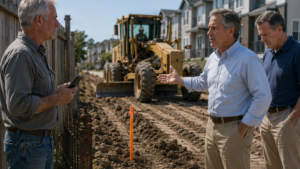
The man stopped hammering. A second worker looked toward the white SUV parked at the curb.
Stephanie Martin stepped out holding a clipboard.
I had known Stephanie for years in the shallow way people know an HOA president: holiday emails, annual meetings, reminders about trash cans. That morning, she walked toward me with the careful expression people use when they have rehearsed bad news.
“Samantha, we sent notice Friday.”
“I was at the funeral home Friday morning.”
Her eyes shifted for half a second.
“I know. And I’m sorry about your father. But the association has a boundary issue we can’t ignore.”
I pointed at the orange paint.
“That line is on my driveway.”
Stephanie glanced down as though the fact had already been considered.
“According to the updated exhibit, part of the driveway isn’t inside your lot.”
For a moment I thought I had misunderstood her.
Behind the gate was a narrow strip of mulch, three boxwoods my father had planted, and the paved apron where he used to park his truck while washing it. Beyond that stood Robert Walker’s fence.
“My father built this driveway when the house was finished.”
“I understand.”
“No, you don’t.”
The contractor lowered his eyes.
Stephanie’s mouth tightened. “The association’s counsel reviewed the records. The side strip is common property. It also affects access serving the Walker lot.”
Robert’s house was next door. His curtains moved once at an upstairs window.
I folded my arms.
“What exactly are you planning to do?”
“The gate has to come out. The landscaping inside the strip has to be removed, and the pavement extending past the established lot line will need to be addressed.”
“Addressed how?”
“The contractor is marking the affected area today.”
The words sounded deliberately clean.
I stepped toward the painted line. It cut several feet into the concrete.
“You’re talking about cutting my driveway.”
“We’re talking about correcting an encroachment.”
“My father lived here since this subdivision opened.”
“That doesn’t establish ownership.”
The sentence hurt more than it should have.
Dad had been dead nineteen days.
His boots were still by the mudroom door. His handwritten reminders were still taped inside the kitchen cabinet. I had spent two weeks sorting medical bills, condolence cards, insurance forms, and the strange bureaucracy that arrives after a person disappears.
Now someone was standing on his driveway telling me it might never have been his.
A gray sedan pulled up behind Stephanie’s SUV.
George Adams got out carrying a leather portfolio.
I recognized him from board meetings. He was the association attorney, always calm, always slightly removed from whatever argument was happening around him.
“Ms. Lewis,” he said.
He opened the portfolio on the hood of Stephanie’s SUV and removed a large printed exhibit.
The page showed the houses, lot numbers, easements, and a heavy line running between mine and Robert’s property.
George tapped it.
“This is the controlling boundary configuration supplied to the association.”
I leaned closer.
My house was represented by a rectangle. My father’s driveway curved beyond the bold line into a shaded strip.
“What record is this based on?”
“A boundary correction prepared after the original subdivision documents.”
“Recorded where?”
George paused only long enough for me to notice.
“We can provide the supporting materials.”
“That wasn’t my question.”
Stephanie exhaled.
“Samantha, this does not need to become hostile.”
“I’m asking where the document came from.”
“And you’ll receive it,” George said. “But the association has been advised that continued use of the strip creates liability once the discrepancy is known.”
I looked at the contractor.
“Are you cutting concrete today?”
He glanced at Stephanie.
“Not today. We’re marking.”
“And the gate?”
“We were told to remove it.”
I moved between him and the hinge post.
“I’m not giving permission.”
Stephanie’s face changed.
Not anger. Pressure.
“Samantha, please don’t make the contractor part of this.”
“Then don’t send a contractor before I’ve even seen the records.”
One of the workers quietly set his pry bar back into the truck.
George closed the portfolio.
“You cannot indefinitely prevent the association from maintaining property it owns.”
“I’m not trying to indefinitely prevent anything. I’m asking for enough time to verify whether you own it.”
Stephanie looked toward the house, then at the contractor.
“How much time?”
“Until I can find Dad’s survey.”
“You have until this afternoon before we resume marking.”
“That isn’t enough.”
“It’s what I can give you today.”
I stared at her.
She softened slightly.
“I have homeowners asking why a known encroachment is being ignored. We also have insurance renewal questions. I can’t simply pretend counsel didn’t flag it.”
For the first time, I heard something besides authority in her voice.
Fear.
Not of me. Of being the president who had known about a property problem and done nothing.
“Forty-eight hours,” I said.
George shook his head.
Stephanie looked at him, then back at me.
“Forty-eight hours before physical removal. The violation remains open.”
It wasn’t much.
But the contractor packed the pry bar away.
By noon, the orange line still cut across the driveway, but the gate was standing.
I went inside and pulled Dad’s property folder from the bottom drawer of his desk.
I had always treated that folder as sacred because he had.
Tax bills. Insurance surveys. Closing papers. Utility easements. Receipts for concrete work. A faded copy of the subdivision plat.
Everything was labeled in his square handwriting.
Everything except the thing I needed.
There was no recent survey.
I sat on the floor beside the desk, papers spread around me, and felt the first crack in my certainty.
Dad had always said the iron markers were what mattered.
I had never asked what he meant.
Near the back of the folder, tucked behind a receipt from a fencing company, I found a yellow legal sheet folded twice.
It was a rough field sketch.
Dad had drawn the garage corner, the driveway edge, the side gate, and three measurements in pencil.
At the bottom was a small circle beside the mulch bed.
An arrow pointed to it.
Beside the arrow, Dad had written two words:
IRON PIN.
I looked through the office window toward the orange line outside.
The circle on his sketch sat almost four feet beyond it.
Chapter 2: The Rusted Pin Beneath the Mulch
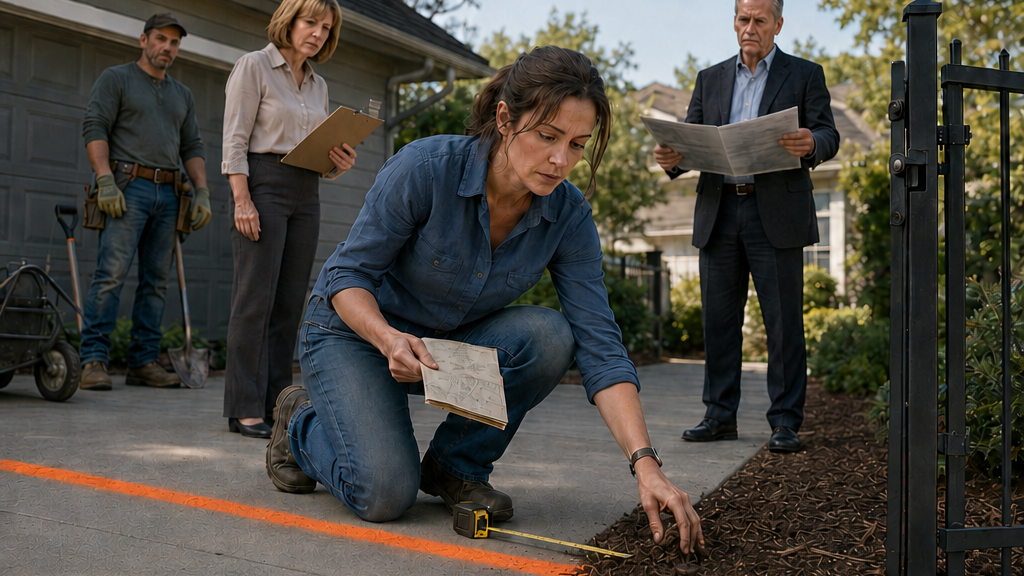
At one twenty-five, the contractor’s truck turned back into the cul-de-sac while I was stretched across the driveway with my father’s tape measure hooked to the garage corner.
I had thirty-five minutes before the afternoon work was supposed to resume.
The first number on Dad’s sketch was eleven feet, seven inches.
I measured it twice.
The end of the tape landed inside the mulch bed.
The second measurement put me nearer the boxwoods.
The third created a rough intersection at a spot covered by three inches of cedar mulch and years of packed soil.
I dropped to my knees.
The contractor parked at the curb.
Stephanie arrived less than a minute later.
George was with her again.
“You found something?” Stephanie asked.
“Maybe.”
I scraped mulch aside with my hands.
Nothing.
I pushed deeper.
Tree roots. Landscape fabric. A bottle cap.
The contractor began unloading tools.
“Can you give me five minutes?” I asked.
He looked at Stephanie.
She checked her phone.
“Five.”
I went inside, grabbed a garden trowel, and came back.
George stood beside the orange line with the exhibit open.
“Samantha, even if your father placed a marker here, that does not necessarily establish a legal boundary.”
“I didn’t say he placed it.”
I dug.
The trowel struck something hard.
Not stone.
Metal.
The sound was thin and unmistakable.
Everyone heard it.
I cleared the dirt with my fingers until a rust-dark circle appeared beneath the soil, scarcely wider than my thumb.
I stopped.
For nineteen days, nearly everything connected to Dad had felt soft around the edges—his clothes, his voice in old messages, the shape of him in the recliner.
The metal did not.
It was cold, fixed, and exactly where his pencil mark said it would be.
“There,” I said.
The contractor stepped closer.
George did not.
I cleaned another inch of soil from around the object.
It was an iron rod driven vertically into the ground.
Stephanie crouched beside me.
“That could be anything.”
“It could.”
I held Dad’s field sketch beside it.
“But the distance from the garage matches.”
George finally approached.
“Old subdivisions contain abandoned stakes, construction rods, utility markers—”
“Does this look like a utility marker?”
“I’m not a surveyor.”
“Neither am I.”
I stood and handed Stephanie the end of the tape.
“Hold this against the garage corner.”
She hesitated.
Then she did.
I stretched the tape to the pin.
Eleven feet, seven inches.
Exactly.
The contractor’s foreman leaned over the sketch.
“What’s the next measurement?”
I showed him.
He paced toward the driveway edge, then back.
“Looks close.”
George folded his arms.
“Close is not a legal standard.”
“No,” I said. “But it’s enough reason not to rip out my gate this afternoon.”
Stephanie stared at the pin.
For the first time since Friday’s notice, she looked uncertain.
Robert had come outside now.
He stood near his fence with one hand in his pocket.
“That marker has been there forever,” he said.
I looked at him.
“You knew about it?”
“I knew there was metal there. Frank used to tell the landscapers not to bury it too deep.”
“Then why didn’t you mention that?”
Robert shrugged.
“Because I was told it wasn’t the controlling marker anymore.”
“By whom?”
His eyes went briefly toward George.
George spoke before Robert answered.
“Boundary monuments can be superseded when there is a properly executed correction.”
I wiped dirt from my hands.
“So show me the correction.”
“I told you this morning that I would.”
“No. You showed me an exhibit.”
Stephanie stood.
“George, is there a recorded document?”
“There is a later correction in the property record set.”
“That is not what she asked,” Stephanie said.
The silence after that was small, but important.
The contractor closed the tool compartment on his truck.
“I’m not pulling anything until somebody gives me a surveyor’s stakeout,” he said. “I don’t want to be the guy removing a fence on the wrong parcel.”
No one argued with him.
That was the first real victory I had had all week.
It lasted less than a minute.
George pointed toward the exposed iron rod.
“Even assuming that is an original monument, it does not prove the current line. A later subdivision correction may control.”
“May?”
“Depending on its status.”
I looked at him.
“This morning you said the boundary was settled.”
“I said the association had been advised based on the records available.”
“That sounds different.”
Stephanie rubbed her forehead.
“Stop. Both of you.”
She turned to me.
“Get an independent survey if you want one. I will hold physical removal until we have something more reliable.”
“And the violation?”
“Stays open.”
“And the forty-eight-hour deadline?”
“I’ll suspend further work, not the enforcement file.”
It was a narrow concession, but it mattered.
The contractor left.
Stephanie followed.
George stayed at the curb long enough to say, “Do not confuse one piece of old iron with a complete title history.”
Then he drove away.
Robert remained by his fence.
I looked at him.
“What were you told?”
“That the original plat had an error.”
“Who told you?”
He frowned.
“I don’t remember exactly. It came up when I bought the place.”
“You bought eight years ago.”
“Yes.”
“My father lived here then.”
“I know.”
Something in his tone sharpened.
“He also parked halfway into what I was told was my access strip. Every time I asked, he said the monument settled it.”
“That sounds like him.”
Robert almost smiled.
Almost.
“He wasn’t easy.”
“No.”
Neither of us said he was wrong.
That evening I photographed the pin from every angle and placed a small bucket over it so nobody would accidentally cover it again.
At 8:17, my phone chimed.
An email from George.
Subject: Boundary Documentation.
Attached was a single PDF.
The page looked far more official than the association exhibit.
It carried a survey company seal, signature blocks, revision notes, and a title describing a boundary correction affecting our two lots.
A heavy line placed the side strip exactly where George had claimed.
At the bottom was a date.
Nine years after the original subdivision plat.
One year before Robert bought his house.
I zoomed in on the document until the seal filled the screen.
For the first time since finding the iron pin, I felt the ground shift again.
Chapter 3: The Survey That Should Have Ended It
The surveyor would not tell me who was right.
Not when he arrived.
Not after I showed him Dad’s sketch.
Not even after I walked him to the exposed iron pin and explained what George had sent.
He set his equipment case on the driveway and said, “If you want someone to agree with you, hire somebody else.”
I blinked.
“I want the line.”
“Good. Then don’t tell me where you think it is.”
That was how Tuesday began.
He set a tripod near the curb and spent the first hour looking everywhere except the disputed strip.
He found monuments at two neighboring lots, checked the subdivision plat, measured street geometry, and disappeared behind Robert’s fence with permission to search his rear corner.
I followed twice.
Both times he told me to stay back.
By noon, I was annoyed enough to understand why I needed him.
Dad’s folder sat on my kitchen table.
For days, I had treated it like a witness whose testimony deserved to be believed because I trusted the man who assembled it.
The surveyor treated every page as a claim.
Nothing more.
When he finally set a survey rod directly over the rusted pin, my throat tightened.
He checked his instrument.
Then checked again.
“What?” I asked.
He ignored me.
Robert stood several yards away.
Stephanie had come by after I notified the management office that fieldwork was underway. She watched from the sidewalk without the clipboard this time.
The surveyor wrote something down.
“Is it an original monument?” Stephanie asked.
“It appears consistent with one.”
“Consistent how?”
“Location. Material. Relation to adjoining calls.”
George was not there.
I was glad.
“Does it match my deed?” I asked.
The surveyor looked at me.
“I’m not finished.”
He worked until late afternoon.
The next morning, I met him at his office.
He placed three sheets on a conference table.
The first was the original subdivision plat.
The second was my deed description.
The third was his retracement.
He tapped the line between my property and Robert’s.
“The monuments I recovered are consistent with the original recorded plat. Your deed closes to that configuration within normal tolerances.”
I stared at the page.
“So the driveway is mine.”
“Based on the recorded instruments I reviewed and the field evidence I recovered, the disputed strip falls within your described lot.”
I let out a breath I had not realized I was holding.
“What about George’s correction?”
The surveyor leaned back.
“That’s the problem.”
He opened the PDF George had emailed me.
“This document is formatted like a corrective survey. It references the correct subdivision and the correct lot numbers.”
“But?”
“I don’t see a recording stamp.”
I looked at the bottom of the page.
There were seals, signatures, dates, revision numbers.
No book and page.
No instrument number.
“What does that mean?”
“It means I can’t tell from this copy whether it was ever recorded.”
“If it wasn’t?”
“That depends on what it actually is, who executed it, what authority they had, whether deeds were later changed, whether an instrument incorporating it was recorded. I’m not giving you legal advice.”
“But you didn’t use it.”
“I can’t treat an unverified sheet someone emailed you as though it supersedes a recorded plat.”
My relief thinned.
I had wanted the survey to end the argument.
Instead, it had opened another one.
By that afternoon, Stephanie had the report.
Her response arrived through the management portal.
The HOA acknowledged the survey but stated that association counsel maintained the later boundary correction governed the dispute. Enforcement would remain pending while the board reviewed both records.
I called Stephanie.
“You have an independent survey now.”
“I know.”
“It agrees with my deed.”
“I know.”
“And you’re still leaving the violation open?”
Her voice sounded tired.
“George says the surveyor only retraced the original record and did not account for the later correction.”
“The surveyor said he couldn’t verify that correction was ever recorded.”
“I heard him.”
“Then why are you treating it like law?”
There was a pause.
“Because if George is right and I ignore him, the association may be accepting liability for an encroachment after being formally advised of it.”
“And if he’s wrong?”
Another pause.
“That is what we need to determine.”
I almost told her that was what I had been saying from the beginning.
Instead I said, “I’m going to the county.”
The recorder’s office occupied the lower level of a government building twenty minutes away.
I brought the original plat reference, my deed, Robert’s lot number, the date on George’s correction, and the PDF itself.
The clerk listened, then began searching.
First by subdivision name.
Then by both lot numbers.
Then by the survey company named on the sheet.
She checked one database, then another.
Finally she searched the older scanned index manually.
I watched her expression change from routine concentration to mild irritation.
“Let me try the date range.”
She widened it by five years in each direction.
Nothing.
“Could it have been filed under another owner?”
“Possibly.”
She searched again.
The screen filled with deeds, releases, liens, easements, and plats.
Not the correction.
After nearly forty minutes she turned the monitor slightly toward me.
“I can find the original plat. I can find later deeds referencing it. I can find several recorded easements.”
“But not this.”
“Not as a recorded plat correction under the information you gave me.”
I looked down at George’s PDF.
The seals suddenly looked less impressive.
“Does that mean it’s fake?”
“No.”
Her answer came quickly.
“It means I can’t locate a recorded version of it. Those are different things.”
The same lesson again.
Evidence was not loyalty.
Suspicion was not proof.
“What should I look for next?”
The clerk examined the revision block.
“This date is close to a transfer on the adjoining property.”
Robert’s property.
She pulled up the transaction history.
The correction had been prepared during the year before Robert purchased the house.
I felt a small, precise shift in the question.
Not whether Dad had remembered the boundary correctly.
Not even whether the iron pin was real.
Someone had created this later sheet.
Someone had put it into a record set convincing enough for George to use against me.
But the county could not find where it had ever become part of the public land record.
I folded the copy and slipped it into Dad’s folder.
Then I stopped.
For the first time, I took it back out and put it into a separate file of its own.
Dad’s papers were no longer the answer.
They were only part of the evidence.
And as I left the recorder’s office, one question followed me all the way to the parking lot.
If the county had never recorded George’s correction, where had George gotten it?
Chapter 4: The Document Nobody Could Find Recorded
The clerk searched the subdivision name a fourth time, then pushed her chair back from the monitor.
“There’s one more place I can check.”
I had already watched her search the recorded plat index, the instrument database, and the scanned records from the years surrounding the date on George’s correction sheet. Each search had produced deeds, easements, releases, and old mortgage documents.
Nothing had produced the page George had sent me.
The clerk disappeared through a door marked STAFF ONLY.
I stood at the counter with the folded copy in my hand.
The survey company’s seal looked official. The signatures looked official. The neat revision box in the corner looked official.
That was what bothered me now.
It wasn’t crude enough to dismiss.
It was exactly convincing enough to be dangerous.
The clerk returned carrying a thin file jacket.
“This isn’t a recorded instrument,” she said. “It’s an archived reference packet tied to a title inquiry.”
She opened the jacket on the counter.
Inside were photocopies of documents related to Robert’s property from nearly a decade earlier.
I saw the familiar outline before she even pulled the sheet free.
The correction.
Same lot numbers.
Same heavy boundary line.
Same date.
But this copy had something George’s version did not.
Across the upper right corner, faint enough that it had nearly vanished in copying, were the words:
DRAFT FOR REVIEW.
I stared at them.
“Can I get a certified copy of this?”
“Not certified as a land record. It was never recorded as one.”
“But I can get a copy showing where it came from?”
“Yes.”
She flipped through the remaining pages.
“There’s correspondence attached.”
My pulse quickened.
“From whom?”
She read the header.
“A title company requested clarification during a pending transaction on the adjoining lot.”
Robert’s purchase.
The date matched.
I leaned closer.
“Does it say who prepared the clarification?”
“There’s a survey firm referenced. And legal correspondence.”
“Whose?”
The clerk hesitated before turning the page toward me.
The letterhead belonged to George Adams’s firm.
I felt a hot wave of anger rise into my face.
Not because the letter proved everything.
It didn’t.
But George had stood on my driveway and described the correction as though it came from some independent chain of authority that had nothing to do with him.
He had never said he had seen it before.
He had never said his office appeared in the old transaction file.
I paid for copies and carried them to the parking lot.
For several minutes I sat in my car without starting it.
My first instinct was to call Stephanie and tell her George had lied.
I stopped myself.
The clerk had taught me something Dad never had.
A strong suspicion was not the same thing as a finished record.
I spread the copies across the passenger seat.
The title company had apparently raised a question about side access on Robert’s lot before his purchase. George’s office had responded that a corrected boundary exhibit was being prepared. The survey sheet was attached.
But nowhere in the packet could I find evidence that the draft had ever been executed, incorporated into new deeds, or recorded.
The distinction was small on paper.
On my driveway, it was several feet of concrete and twenty-three years of family history.
That evening, the HOA board met in the clubhouse.
Stephanie had put the boundary dispute near the end of the agenda.
By the time my turn came, half the folding chairs were empty.
George sat at the end of the board table.
I placed the county copies in front of Stephanie.
“The recorder’s office cannot find the correction as a recorded instrument.”
George barely glanced at them.
“That doesn’t mean it has no legal significance.”
“I didn’t say it did. I’m asking what significance it has.”
“We have discussed this.”
“No. You told me it was a later correction. You didn’t tell me your office was involved when it was created.”
Stephanie looked sharply at him.
George’s posture did not change.
“Our firm provided limited transactional advice during a prior transfer. That is not unusual.”
“You were involved with Robert’s purchase?”
“With aspects of the transaction.”
“And now you’re advising the HOA that a draft from that transaction controls my boundary.”
“It is not accurate to characterize the document merely as a draft.”
I slid the county copy toward him.
“Then why does this one say ‘draft for review’?”
One of the board members leaned forward.
George examined the page.
“Documents evolve during transactions.”
“Where is the final version?”
“That is what the association is still determining.”
Stephanie looked at him.
“You told us the later correction governed.”
“I told the board that the later materials created a substantial basis for enforcement.”
“That isn’t the same sentence,” I said.
George turned toward me.
“Ms. Lewis, your independent survey retraced the original plat. The association has competing evidence. It would be irresponsible to ignore it simply because you prefer one record.”
The anger I had been holding finally slipped.
“My father is dead. I am not doing this because I prefer his version.”
The room went quiet.
I heard my own voice harden.
“I’m doing it because you were ready to cut his driveway before anyone checked whether the document you relied on had ever become anything more than a draft.”
George looked down at the papers.
Stephanie spoke before he could answer.
“Samantha, no physical work is happening right now.”
“The violation is still open.”
“Yes.”
“Why?”
She rubbed both hands together.
“Because counsel has not advised us to withdraw it.”
There it was.
Not cruelty.
Dependence.
A board that had stopped asking where its certainty came from because certainty was what it paid George to provide.
I gathered my papers.
“Then you don’t have a boundary problem anymore.”
Stephanie frowned.
“You have a record problem.”
I left before the meeting ended.
The following afternoon, I was pulling weeds near the exposed survey pin when Robert came through the side gate of his yard.
He stopped several feet away.
“You went to the county.”
“Yes.”
“I heard.”
I kept working.
Robert looked toward the bucket I had been using to protect the pin.
“You found the old title packet?”
I straightened.
“How did you know there was one?”
His jaw shifted.
“Because some of those papers were in my closing file.”
I stared at him.
“You have a copy?”
“I have a box of closing documents somewhere.”
“Did George work on your purchase?”
Robert looked toward his house.
“When I bought this place, his name was everywhere.”
Chapter 5: The Neighbor Who Wasn’t Lying
Robert knocked on my door Saturday morning carrying a cardboard file box.
“I found it.”
He did not wait for me to invite him inside.
He just stood there holding the box with both hands as though it had become heavier since leaving his house.
I stepped aside.
We sat at opposite ends of my kitchen table.
Dad’s worn property folder was on the counter behind me. I had deliberately left it there.
Robert opened his box.
“I’m not saying you’re right about everything.”
“I didn’t ask you to.”
His mouth tightened.
“This affects me too.”
“I know.”
“No, I don’t think you do.”
He pulled out a stack of papers.
“When I bought next door, the side access was one of the reasons I bought it. I had a trailer then. The agent told me I’d have usable access beside the house. The title people raised a question because Frank’s gate and landscaping looked like they crossed into it.”
I remembered Dad complaining about a “new fellow next door” asking too many questions.
At the time I had taken Dad’s side automatically.
Probably because I always did.
“What did Dad tell you?”
“That the pin marked the line.”
“That sounds familiar.”
Robert gave me a dry look.
“He also told me if my closing people couldn’t read a plat, that wasn’t his problem.”
Despite myself, I almost laughed.
“That also sounds familiar.”
Robert looked down at the file.
“For years I figured he was just stubborn.”
“He was.”
“I figured he knew he had been using more than his lot and had gotten comfortable with it.”
That hit differently.
Because I had been assuming almost the mirror image about Robert—that he knew the strip was ours and was using the HOA to take it after Dad died.
We had both built motives for each other out of incomplete records.
Robert removed an old email printout.
“This is where I remember George’s name.”
The thread began with the title company requesting clarification on the side boundary.
A response from George’s office referred to a proposed correction exhibit.
Then another email appeared two days later.
I read it once.
Then again.
Robert watched me.
“See the second paragraph?”
I did.
George had written that the exhibit reflected the access configuration intended for the adjoining lot and that the paperwork could be “cleaned up later” if additional record changes were required.
The phrase was casual.
That made it worse.
“Cleaned up later,” I said.
Robert nodded.
“My closing went through.”
“Was the deed changed?”
“Not that I know of.”
“Did anyone tell you the correction was only a draft?”
“No.”
I looked at him.
“What did they tell you?”
“That the side access issue had been resolved.”
“And you believed that.”
“Why wouldn’t I?”
There was no good answer.
Robert had a deed, title insurance, a closing packet, and professional assurances.
So had Dad.
Two homeowners had been allowed to leave the same transaction chain believing incompatible things.
“You supported the HOA complaint,” I said.
“Yes.”
“Pretty enthusiastically.”
He leaned back.
“Because your father made it impossible to use that side.”
“He was using his own property.”
“If your survey is right.”
“You’ve seen the survey.”
“I have.”
He looked toward the window.
“And if it’s right, then I bought a house believing I had access that I may not actually have.”
For the first time, I understood why Robert had not celebrated the iron pin.
Truth cost him something.
Not an abstract embarrassment.
Practical access. Usefulness. Maybe resale value.
We carried the closing box outside and stood beside the disputed strip.
The orange paint had faded slightly, but the line was still visible.
The survey pin sat exposed between us.
Robert remained on his side.
I remained on mine.
Neither of us crossed.
“I hated that gate,” he said.
“I know.”
“Frank knew I hated it.”
“He probably enjoyed that.”
Robert laughed once.
Then his expression changed.
“That doesn’t mean I want property that isn’t mine.”
I looked at him.
It would have been easy to distrust the sentence.
A week earlier, I would have.
Instead I asked, “Will you send me the full email chain?”
Robert stared at the ground.
“If I do, the board may decide the line is yours.”
“The board should decide based on the record.”
“That’s easy for you to say. You keep everything.”
“Not everything.”
He looked at me.
“If the side strip is mine,” I continued, “that doesn’t magically solve your access problem. But pretending the boundary is somewhere else isn’t a solution either.”
Robert rubbed the back of his neck.
“I’ve been thinking about that.”
“So have I.”
He looked at the exposed pin.
“Your dad should’ve explained more.”
“He thought the pin explained everything.”
“That was his problem.”
I felt the instinct to defend him rise.
Then I let it pass.
“Yes,” I said. “Sometimes it was.”
Robert studied me for a moment.
Something in the conversation shifted.
Not into friendship.
Into accuracy.
Back inside, we went through the remaining emails.
Several copied George’s office. One referenced a conference call with the survey company. Another said the title issue could proceed using the proposed exhibit while follow-up documentation was prepared.
There was no follow-up documentation in Robert’s box.
“Did you ever ask?” I said.
“No.”
“Why not?”
“Because I moved into the house. The bank funded. The title company issued the policy. Everybody acted like it was done.”
That was how errors survived.
Not always through grand schemes.
Sometimes because five people moved forward and nobody turned around.
But George had turned around.
Years later, when the HOA asked him about the same boundary, he had reached back into that old file and pulled out the draft.
Then he had presented it as the reason my driveway was wrong.
“Did he ever tell you he represented the HOA now?” I asked.
“I knew he did.”
“Did he ever tell you the HOA was relying on your closing material?”
“No.”
Robert went silent.
I could see the thought reach him.
The same attorney had once helped reassure his transaction.
Now that attorney was advising the association in a dispute where Robert benefited from the old reassurance.
“You think he’s covering himself,” Robert said.
“I think we need to know exactly what he knew.”
Robert gathered the emails slowly.
“If I give you these, I may be handing you the thing that makes my own position worse.”
“Yes.”
He gave me an irritated look.
“You could pretend to be less pleased about that.”
“I’m not pleased.”
“You’ve spent three weeks looking at me like I was waiting for Frank to die so I could steal three feet of driveway.”
I looked away.
He was right.
“I’m sorry.”
Robert did not immediately accept it.
That felt fair.
Finally he picked up his phone.
“I’ll scan the entire chain.”
“Not selected pages.”
“All of it.”
“Thank you.”
He stopped at the door.
“If it turns out I was promised something I never legally had, I’m going to need a practical answer.”
“I know.”
“And I’m not agreeing to your version just because George may have handled this badly.”
“I’m not asking you to.”
Robert nodded.
That evening, thirty-seven pages arrived in my inbox.
The final attachment was an email George had sent the title company nine years earlier.
His office had not merely received the proposed correction.
It had helped circulate it.
Chapter 6: The Conflict Hidden Inside the Legal File
George asked the board to approve enforcement before I finished my third sentence.
“We have delayed this matter through two meetings,” he said. “At some point the association has to act on the advice it has received.”
I was standing at the end of the clubhouse table with a folder open in front of me.
Stephanie looked from George to me.
“She hasn’t presented yet.”
“The core issue has already been presented repeatedly.”
“No,” I said. “The boundary has. I’m here about where your evidence came from.”
George leaned back.
I had expected him to interrupt.
That was why I had brought less.
No boxes.
No Dad folder.
No stack of sentimental papers.
Only five pages and one photograph.
The photograph showed the rusted survey pin beside the orange enforcement line.
I placed it in front of the board.
“This is where we started.”
Then I placed the independent survey beside it.
“This confirmed the original recorded plat.”
Then the county search statement.
“The recorder’s office could not locate the later correction as a recorded instrument.”
George spoke.
“We’ve covered all of this.”
I slid the fourth page forward.
“This is the copy in the archived title packet. It says ‘draft for review.’”
One board member adjusted his glasses.
Stephanie looked at George.
“You said the wording didn’t change its significance.”
“That remains my position.”
I placed the fifth page on the table.
“And this is an email from your office during Robert Walker’s purchase.”
George’s face did not move.
But his hand stopped tapping his pen.
Stephanie read the page.
The room stayed silent long enough for the air conditioner to cycle on.
“What does ‘cleaned up later’ mean?” she asked.
George folded his hands.
“It reflects the ordinary reality that closing issues are sometimes addressed in stages.”
“Was it cleaned up?” I asked.
“The absence of a recording in the index does not necessarily establish that no later instrument addressed the matter.”
“That wasn’t my question.”
George’s gaze sharpened.
“You are attempting to turn a technical property issue into an accusation of misconduct.”
“I’m trying to determine why you advised the HOA that this document controlled without telling them your office had been involved with it before.”
Stephanie looked up.
“George, did you disclose that?”
“I did not consider the prior involvement material to the association’s enforcement decision.”
One of the board members spoke.
“You worked on the transaction?”
“Our firm provided limited advice.”
“For Robert?”
“For parties involved in resolving a title concern.”
“That sounds like yes.”
George’s voice remained even.
“It sounds like what I said.”
The door behind us opened.
Robert walked in.
I had not been certain he would come.
He sat near the back.
George saw him.
For the first time that night, I thought he looked uncomfortable.
Stephanie noticed too.
“Robert, Samantha said these emails came from your closing records.”
“They did.”
“Do you recognize them?”
“Yes.”
George turned slightly in his chair.
“Robert, I would caution against characterizing legal communications without complete context.”
Robert looked at him.
“That’s the thing. I’m not characterizing them.”
He held up his phone.
“I gave her the whole chain.”
A small sound came from one of the board members.
Not surprise exactly.
Recognition.
George set his pen down.
Robert continued.
“When I bought the house, I was told the access issue was resolved. I believed that. I still need that access. But nobody told me the exhibit was sitting around as a draft that was supposed to be cleaned up later.”
George’s expression hardened.
“The transaction closed with title coverage.”
“That’s not the same as saying the lot line changed,” I said.
George turned to the board.
“This is precisely why property disputes should not be decided in a clubhouse through selective interpretations of old correspondence.”
I almost answered sharply.
Then I looked at the photograph of the pin.
The whole fight had changed.
At first I had wanted George embarrassed.
Then Robert.
Then Stephanie.
Each of them had stood between me and the certainty I thought Dad’s folder entitled me to.
But humiliating George would not fix the map.
It would not solve Robert’s access.
It would not make the board better at handling the next homeowner’s dispute.
So I closed my folder.
“I agree.”
George looked at me, surprised.
“This should not be decided by us arguing over old emails.”
Stephanie frowned.
“What are you asking for?”
“Independent counsel. Someone who has never represented Robert, me, or this association on this boundary. Give them the recorded plat, both deeds, the survey, the draft correction, the title file, and the full email chain.”
George laughed softly.
“That is unnecessary expense.”
“So was sending a contractor to remove a gate before anyone found the original monument.”
Stephanie flinched.
I regretted the edge in my voice immediately.
But I did not take the sentence back.
George leaned toward her.
“If the association abandons the corrected configuration, it may create exposure on the Walker side. Robert purchased with an expectation of functional access. There may be title implications, reliance issues, potentially even claims involving prior representations.”
Robert spoke from the back.
“That sounds like a reason to get it right.”
George turned.
“It is a reason not to oversimplify.”
“No one is asking you to oversimplify,” Stephanie said.
Her tone had changed.
She was no longer looking at me as the emotional homeowner slowing down a necessary enforcement action.
She was looking at George as one source among several.
That distinction mattered.
“I need to ask you something directly,” she said. “When you advised us to enforce, did you remember your office had handled the earlier transaction?”
George paused.
“Yes.”
“And you didn’t think the board should know?”
“I did not believe it changed the legal analysis.”
Stephanie sat back.
“Maybe it doesn’t.”
George nodded once.
“But I should have been told.”
That was the moment the room changed.
Not because George confessed to anything.
He didn’t.
Not because the board suddenly declared me right.
They didn’t.
Stephanie simply stopped treating his certainty as a substitute for their judgment.
George looked around the table.
“You are free to seek another opinion. I would simply advise against suspending enforcement indefinitely while a known dispute remains.”
“The enforcement has already been suspended physically,” Stephanie said.
“The violation remains open.”
“For now.”
George stared at her.
One board member requested an executive recess.
Stephanie agreed.
Before the board left the room, she looked at me.
“Samantha, we’re going to have independent counsel review the complete file.”
“And the fines?”
“Frozen until the review is finished.”
Robert stood.
“What about my access?”
Stephanie looked tired again, but different.
“We’ll include that question.”
George gathered his papers without speaking.
As the board moved toward the smaller conference room, Stephanie stopped beside him.
“Please leave your copy of the file.”
His hand remained on the leather portfolio.
Then he released it.
For the first time since the orange line appeared across Dad’s driveway, nobody in the room seemed certain what the final answer would cost.
But at least now the question belonged to more than one man.
Chapter 7: What the Board Corrected After the Truth
Stephanie did not begin with the fines.
She did not begin with my gate, Robert’s access, or the orange line that had once crossed my father’s driveway.
She opened a blue folder at the front of the clubhouse table and said, “Independent counsel has completed its review.”
No one moved.
Robert sat two chairs behind me. George’s usual seat at the end of the board table was empty.
Stephanie looked down at the first page.
“The review concludes that the original recorded subdivision plat remains controlling for the boundary between the Lewis and Walker lots.”
I heard Robert exhale behind me.
Stephanie continued.
“The later boundary-correction sheet was never recorded as a plat amendment, was never incorporated into a deed modifying either lot description, and did not legally relocate the boundary.”
There it was.
Not a dramatic confession.
Not an apology.
Just a sentence in a quiet meeting room confirming that the line Dad had defended for years was the recorded line after all.
My hands were folded on the table.
I kept them there.
One of the board members asked, “And the survey?”
“Consistent with the recorded plat and recovered monuments.”
Stephanie turned a page.
“The independent review also determined that the association should not have relied on the draft correction as controlling evidence without verifying its status.”
Her voice tightened on the final words.
She looked at me.
“The violation against the Lewis property will be withdrawn.”
I thought I would feel something larger.
Triumph, maybe.
Instead, I looked through the clubhouse window toward the row of houses beyond the parking lot and remembered Dad kneeling beside that flower bed, telling a landscaper not to bury the iron marker.
At the time I had thought he was being fussy.
Now I understood he had been protecting something he assumed would outlast every argument about it.
Stephanie continued.
“All fines related to this enforcement action will be reversed. The association will reimburse the reasonable cost of the independent boundary survey.”
A board member asked about George.
Stephanie’s expression became careful.
“The association has ended his involvement in this matter. We are separately reviewing future legal representation.”
That was all she said.
It was enough.
Robert raised his hand.
Everyone turned.
“I need to address the access issue.”
The room changed again.
Of course it did.
Truth had fixed the map.
It had not widened the space beside Robert’s house.
Stephanie nodded.
Robert stood.
“When I bought my property, I was told I would have usable side access. I relied on that. The independent review says the disputed strip belongs to Samantha.”
He glanced at me.
“I’m not contesting that.”
A few people shifted in their chairs.
Robert continued.
“But I still need a way to move larger equipment around the side of my house. I don’t think pretending the property line is somewhere else helps either of us.”
Stephanie looked between us.
“Are you proposing an easement request?”
“A private written access agreement, maybe. Limited use. Whatever makes sense.”
The board member beside Stephanie said, “That would be between the owners.”
“Yes,” Robert said. “That’s why I’m asking Samantha, not the board.”
Every eye in the room moved to me.
Three weeks earlier I would have hated that.
I would have heard pressure.
Now I heard a problem that had survived the correction.
Robert had been wrong about the boundary.
He had also been promised something real enough to shape his decision to buy the house.
I did not owe him my property.
But I no longer needed him to lose in order for me to win.
“I’m willing to discuss it,” I said.
Robert nodded once.
“Thank you.”
“Discuss,” I added.
A faint smile appeared.
“Understood.”
Stephanie closed the blue folder.
“There is one more policy recommendation.”
She explained that any future HOA boundary enforcement would require verification of recorded ownership records and, where monuments or surveys conflicted with association maps, independent review before physical alteration could be authorized.
One of the board members asked about the cost.
Stephanie answered without hesitation.
“It will cost less than doing this again.”
No one argued.
After the meeting, I stayed while people folded chairs and gathered papers.
Stephanie approached me near the door.
“I owe you an apology.”
I looked at her.
She did not make it grand.
“I believed I was protecting the association. I let that become a reason not to question the advice I was getting.”
“You were under pressure.”
“That doesn’t make the contractor showing up at your house acceptable.”
“No.”
She nodded.
“I should have stopped it earlier.”
I appreciated that she did not add an excuse.
“I should have explained earlier that Dad’s paperwork wasn’t complete,” I said.
Stephanie looked surprised.
“I kept acting like his folder should settle everything because he kept it.”
“You were grieving.”
“I was also stubborn.”
“That may run in the family.”
For the first time, we both smiled.
A week later, the surveyor returned.
Not to decide the boundary.
To document it.
He checked the recovered iron pin, placed a new reference marker nearby where it would be easier to locate, and added the updated measurements to his final survey.
Robert came outside while he worked.
We stood together watching the surveyor finish.
The old orange paint across the driveway had nearly disappeared.
Only a faint broken stripe remained near the curb.
Robert pointed toward the side yard.
“If we can agree on occasional access through there, I can probably avoid doing anything permanent.”
“We’ll put it in writing.”
“I figured you’d say that.”
“After all this?”
“Fair point.”
He looked at the gate.
“Frank would have hated giving me access.”
I laughed.
“Yes.”
Robert smiled.
“But he would’ve liked the part about putting it in writing.”
“That too.”
When the surveyor left, I carried a bag of fresh mulch from the garage.
For years Dad had kept the flower bed smooth and level. Every spring he covered the iron pin until only he seemed to remember exactly where it was.
I opened the bag and spread mulch around the boxwoods.
When I reached the marker, I stopped.
The old iron pin remained just visible beside the new reference point.
I could have covered both.
Instead I cleared a small circle around them.
Dad had trusted the marker because it was physical, fixed, certain.
I had trusted Dad’s folder for almost the same reason.
But neither memory nor paper had been enough alone.
The truth had survived because eventually we checked all of it—the monument, the deed, the plat, the survey, the draft, the emails, and even the people I had been certain were against me.
I stood and brushed mulch from my hands.
The driveway looked ordinary again.
No stakes.
No contractor.
No orange line cutting through the concrete.
Just the gate, the flower bed, and a small rust-dark piece of iron beside the place my father had built.
This time, I left it where everyone could see it.
The story has ended.