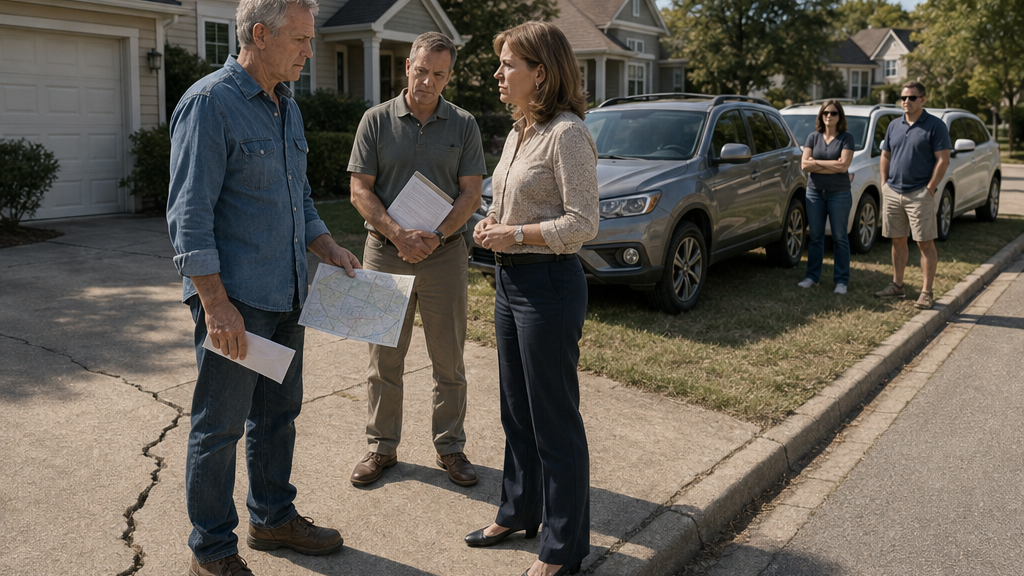
They Fined Him for His Cracked Driveway—Then Learned Who Really Controlled the Strip They Used for Parking
Chapter 1: The Fine Arrived Before the Concrete Could Be Fixed
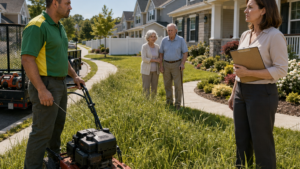
The contractor was kneeling over the widest crack in Frank Miller’s driveway when Stephanie Carter walked up carrying a white envelope.
Frank saw her before the contractor did.
She crossed the sidewalk with the same measured pace she used at association meetings, sunglasses pushed up into her hair, one hand holding the envelope against her side. The contractor’s yellow tape measure stretched across the slab between them.
“Morning, Frank.”
He looked at the envelope.
“Morning.”
The contractor rose slowly. “I’ve got the settlement difference. About an inch and three-eighths here. Worse toward the garage.”
Stephanie’s eyes dropped to the tape, then to the jagged line running across the concrete.
“That’s actually what I came about.”
Frank almost laughed.
Instead, he wiped his palms on his jeans.
For three months he had been trying to get permission to remove the damaged sections and pour replacement concrete. He had submitted photographs, a contractor proposal, a drainage sketch, and then a revised proposal after the architectural committee asked for more detail.
The association had not approved any of it.
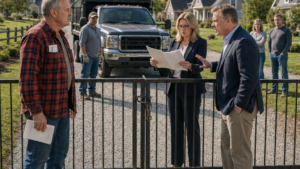
Stephanie held out the envelope.
“This is the current violation notice.”
Frank did not take it immediately.
“You’re giving me another violation for the driveway?”
“For the deteriorated condition, yes.”
“And my repair application?”
Her pause was barely noticeable.
“The board reviewed the revision last night.”
The contractor looked from Stephanie to Frank.
Frank finally took the envelope.
“And?”
“It wasn’t approved.”
For a moment the three of them stood directly over the crack.
The absurdity of it was almost physical.
Frank opened the envelope. The notice used the same language as the previous one: exterior surfaces must be maintained in good repair; visible deterioration affecting neighborhood appearance must be corrected within the compliance period.
He read the first paragraph twice.
Then he looked up.
“You’re telling me I have to correct the condition.”
“Yes.”
“But I’m not permitted to remove the damaged concrete.”
“That’s not exactly what the board said.”
“It denied replacement.”
“It denied the proposed replacement as submitted.”
The contractor cleared his throat. “For what it’s worth, there isn’t much to patch here.”
Stephanie turned toward him.
He pointed with the end of the tape.
“The slab has moved. Water’s been getting underneath it for a while. You can fill the crack, but that won’t fix the settlement. It’ll open again.”
Frank had known that, but hearing someone else say it gave the fact weight.
The driveway sloped gently toward the street. Years of runoff had cut along one edge, slipping beneath the concrete whenever summer storms overwhelmed the shallow drainage path. The damage had begun as a hairline fracture. Now part of the slab rocked faintly when a vehicle crossed it.
Stephanie folded her arms.
“The board isn’t disputing that maintenance is necessary.”
Frank stared at her.
“Then what are we disputing?”
“The manner of repair.”
He looked back at the notice.
Near the bottom was a sentence he had not seen before.
Failure to cure after the stated period could result in daily monetary penalties.
He tapped it with one finger.
“What does this mean?”
Stephanie glanced at the page.
“The enforcement schedule allows continuing fines once the correction deadline passes.”
“How much?”
“That depends on the violation.”
“How much for this one?”
She hesitated again.
“Potentially one hundred dollars per day.”
The contractor stopped winding the tape.
Frank felt something inside him shift—not explode, not even rise. It simply hardened.
“You denied the repair yesterday.”
“The board denied that design.”
“And this morning you’re warning me I may owe a hundred dollars a day if I don’t repair what you denied me permission to repair.”
Stephanie’s mouth tightened.
“You can submit another revision.”
“What am I revising?”
“That will be explained in the written decision.”
“You have it?”
“The notice will be mailed.”
He held up the violation envelope.
“You managed to hand-deliver this one.”
Her face changed just enough for him to notice.
“This isn’t personal, Frank.”
He had heard that sentence in workplaces, utility disputes, insurance calls, and committee meetings for most of his adult life. It nearly always meant that something very personal was about to be justified by procedure.
He looked down at the crack.
His father used to tell him that a man could ruin twenty years of neighborly peace in twenty seconds if he insisted on winning every argument.
Keep the peace with people you have to live beside.
Frank had followed that advice so faithfully that he had begun using it even when no peace remained.
“All right,” he said.
Stephanie appeared almost relieved.
“I’ll wait for the written denial.”
“That’s probably best.”
The contractor looked at Frank after she walked away.
“You want me to hold the estimate?”
“Yes.”
“I can revise it if they want a different finish.”
“I don’t think the finish is the problem.”
The contractor glanced toward Stephanie, now halfway down the sidewalk.
“No?”
Frank folded the violation notice and slipped it back into the envelope.
“I’m starting to think the problem is that nobody wants to be the person who says yes.”
They finished measuring the driveway.
The contractor confirmed what Frank already suspected: the damaged slabs needed replacement, and any cosmetic patch would mostly hide the problem until water and movement reopened it.
That should have made Frank feel better.
Instead, it made the notice heavier in his pocket.
By noon the contractor had left.
Frank stood at the end of the driveway looking down the street. The neighborhood was quiet except for the occasional slam of a car door farther around the corner.
Then he noticed two unfamiliar vehicles.
A dark SUV and a silver sedan were parked along the broad edge beside his driveway, where the paved apron widened into a rough strip between his property and the curb.
He knew why they were there.
Stephanie was hosting one of the association’s informal weekend gatherings two houses down.
Her guests had been using that edge for years.
Frank had never said anything.
He looked from the parked tires to the violation envelope in his hand.
The SUV’s right-side wheels rested well beyond the line most neighbors casually treated as the street.
Frank looked down at the cracked concrete beneath his own feet.
For the first time, he wondered why the association seemed so certain about what he could do on his property while treating the land beside it as if no one needed permission at all.
Chapter 2: The Board Called the Cracks Part of the Neighborhood
“The problem,” Stephanie said four days later, “is that fresh replacement concrete would interrupt the visual continuity of the street.”
Frank thought he had misheard her.
The HOA meeting room was small enough that no one could pretend not to hear anything. Seven folding chairs faced a rectangular table. Frank sat opposite Stephanie with photographs of his driveway arranged in a neat stack in front of him.
“Visual continuity?”
Stephanie nodded.
“The homes on this section were developed at the same time. The driveways have aged together. There’s a consistent appearance.”
Frank looked at Benjamin Allen, the board treasurer.
Benjamin lowered his eyes toward the packet in front of him.
Frank slid one photograph across the table.
The crack in the picture ran almost the full width of the slab.
“That’s the appearance we’re preserving?”
Stephanie did not touch the photograph.
“We’re preserving material consistency and streetscape character.”
Frank waited.
He had spent thirty-four years estimating utility projects. People often buried simple decisions under complicated words when they did not want to defend the simple version.
“So if I understand correctly, the board agrees the driveway is deteriorated.”
“Yes.”
“The board requires me to correct deterioration.”
“Yes.”
“But replacing the deteriorated concrete would make the driveway look too new.”
“That’s an oversimplification.”
“Help me with the more accurate version.”
Stephanie leaned back.
“The association has had multiple complaints about inconsistent approvals. One resident was told last year that a decorative overlay was not allowed. Another was required to match an existing aggregate finish. If we start making exceptions, everyone will claim unequal treatment.”
There it was.
Not spite.
Not even stupidity.
Fear.
Frank could see the shape of it now. Stephanie had spent months defending the board against accusations that it favored some homeowners over others. If she approved his project after rejecting other changes, someone would use it against her at the next meeting.
That did not make the decision sensible.
But it made it understandable.
“What exception am I asking for?” Frank said. “I’m not asking for stamped concrete. I’m not widening anything. I’m replacing failed slabs with plain concrete.”
Stephanie flipped a page.
“The color will not match the existing material.”
“It will age.”
“The transition will be obvious.”
“For a while.”
“Which creates inconsistency.”
Benjamin finally looked up.
“Stephanie.”
She turned.
He pointed at Frank’s photograph.
“I’m having trouble with one part of this.”
“What part?”
“If the condition is serious enough to fine him for, and replacement is the contractor’s recommended correction, what exactly are we expecting him to do?”
Stephanie’s expression cooled.
“He can submit a repair method that preserves the existing appearance.”
“The contractor says patching won’t last.”
“The board is not required to adopt the contractor’s preferred method.”
Frank watched Benjamin glance toward another board member.
There it was again—a small hesitation.
The board was not united.
Until that moment Frank had assumed Stephanie’s certainty represented everyone at the table. Now he could see that at least Benjamin had begun noticing the same contradiction.
Frank took out the violation notice.
“Is the hundred-dollar daily fine real?”
Stephanie answered quickly.
“It’s authorized under the enforcement schedule.”
“That’s not what I asked.”
“Yes. It can be imposed.”
“Starting when?”
“After the compliance period if the condition remains uncorrected.”
Benjamin shifted in his chair.
Frank looked directly at him.
“So I may be fined for leaving the driveway damaged while being denied permission to perform the repair my contractor says is necessary.”
Benjamin opened his mouth, then stopped.
Stephanie answered instead.
“You are not being denied the right to maintain your property. You are being required to maintain it within architectural standards.”
Frank sat back.
He had promised himself before the meeting that he would not lose his temper.
Now he understood that anger would actually help Stephanie. If he raised his voice, she could turn the issue into conduct. If he insulted the board, she could stop talking about concrete entirely.
So he gathered his photographs.
“All right.”
Stephanie seemed surprised.
“You’re withdrawing the appeal?”
“No.”
He stood.
“I’m changing the question.”
The board members watched him.
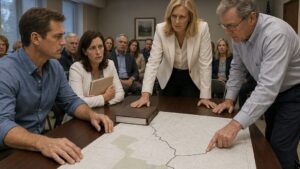
Frank picked up the association map from the packet Stephanie had provided. It showed lot outlines, common areas, streets, and several marked easements.
“Where does HOA jurisdiction end on my frontage?”
Stephanie blinked.
“What?”
“The strip beside the driveway.”
“That has nothing to do with your repair application.”
“It does if the board is going to tell me exactly what I control and how it has to look.”
He carried the map to the window.
Outside, evening traffic moved slowly through the neighborhood.
“When you held the gathering Saturday, two of your guests parked partly on the strip beside my driveway.”
Stephanie’s jaw tightened.
“That area has always been used for overflow parking.”
“Always?”
“For years.”
“By permission?”
“It’s along the street.”
“That wasn’t my question.”
Benjamin stood and came around the table.
“Let me see the map.”
Frank handed it to him.
Benjamin traced the curb line with his finger.
“The lot lines are shown here.”
“Mostly,” Frank said.
Benjamin leaned closer.
The map simplified the corner. Frank’s driveway met the street at an angle, and the broad strip beside it appeared as a blank wedge between several printed lines.
“Is that common area?” Benjamin asked.
Stephanie said, “It’s frontage.”
“That’s not a legal category.”
She looked at him.
Benjamin shrugged.
“I’m just saying the map doesn’t label it.”
Stephanie came around the table.
For nearly a minute, three adults stood over a document none of them had previously considered important.
Frank felt the balance of the conversation change.
Not because he had proved anything.
Because for the first time, Stephanie did not have an immediate answer.
She straightened.
“The county plat would control, not this illustration.”
Frank nodded.
“Good.”
“What does that mean?”
“It means I’ll look at the county plat.”
Stephanie’s irritation surfaced.
“Frank, this is becoming unnecessarily adversarial.”
He looked through the window again.
Across the street, a pickup had one tire resting along the broad edge near his corner.
“No,” he said. “I think it became adversarial when I was told I could be fined every day for concrete I’m not allowed to replace.”
He gathered his papers.
Stephanie returned to her seat.
“We’ll proceed under the enforcement policy unless you submit an acceptable correction.”
Benjamin said quietly, “We may want to hold off until we understand the boundary issue.”
Stephanie stared at him.
“We are not suspending enforcement because Frank has raised an unrelated parking question.”
“It may not be unrelated.”
“That is enough.”
Her tone ended the discussion.
Frank left without another argument.
At home, he parked in the garage and remained behind the wheel for a moment, watching the last light reach across the cracked slab.
He had spent years keeping records.
Invoices. Utility bills. permits. Old tax statements. Every time something came in the mail that looked remotely connected to the house, he put it in a labeled folder.
His father had been worse.
Or better, depending on the day.
Frank went into the garage and pulled down an old storage box from the top shelf.
Inside were papers he had not touched since moving into the house in 2013.
The original closing documents were near the top.
Beneath them was a folded property survey, yellowed at the creases.
Frank opened it across his workbench.
The drawing was denser than the association map.
Bearings.
Measurements.
Easements.
Pins.
A notation ran along the corner frontage.
He moved a shop light closer.
Then he saw something he had never paid attention to before.
The boundary near the driveway did not follow the line he had assumed all these years.
And beside it was a reference number that led somewhere else.
Chapter 3: The Parking Habit Frank Never Stopped Became Evidence Against Him
The county records clerk looked at Frank’s photographs, then at the old survey, then back at Frank.
“Did you ever tell them not to park there?”
Frank had expected questions about parcel numbers.
Not that one.
“No.”
“Ever put up a sign?”
“No.”
“Send a letter?”
“No.”
“Ask the association to stop using it?”
Frank shifted in the chair.
“Not formally.”
The clerk folded her hands.
“So for years people parked there and you let them.”
The statement irritated him because it was true.
“I didn’t think I needed to turn every neighborly thing into paperwork.”
“I’m not saying you did.”
“That’s what it sounds like.”
“I’m saying there’s a difference between what people were legally entitled to do and what they reasonably believed you allowed.”
Frank looked through the glass partition toward the records shelves behind her.
He had arrived expecting to confirm that the HOA was wrong.
Instead, within ten minutes, someone had found a way to make his own silence relevant.
The clerk tapped the survey.
“You’re asking who controlled this strip. That’s a title and record question. But if what you really want to know is why everyone treated it like shared parking, the answer may be much simpler.”
“They got used to it.”
“Probably.”
Frank sat back.
The line reminded him uncomfortably of his father.
Keep the peace.
For years Frank had watched guests pull half onto the frontage during cookouts, holiday parties, contractor visits, and association meetings. Sometimes he noticed. Sometimes he did not.
Once, after a moving van blocked part of the driveway, he had nearly asked the driver to move.
Then he had decided it was only an afternoon.
Another time Benjamin parked there during a neighborhood meeting and waved to Frank while walking past.
Frank had waved back.
He had mistaken silence for generosity.
Now everyone else had mistaken it for permission.
The clerk returned to the computer.
“Let’s deal with the record itself.”
Frank leaned forward.
She entered the parcel number from his tax bill, then compared it with the reference on the older survey.
“That’s odd.”
“What?”
She enlarged an archived index image.
“There’s a separate legal-description reference attached to this frontage.”
Frank felt the old certainty return.
“So it is mine.”
“I didn’t say that.”
“But it’s separate.”
“Yes.”
“From the HOA?”
“I haven’t looked at the association declaration.”
“I brought it.”
He reached for another folder.
She raised a hand.
“Mr. Miller, if you hand me another stack of papers, I’m going to charge you rent.”
Despite himself, he laughed.
It was the first time in a week anything about the dispute had felt remotely funny.
She took the declaration anyway.
They spent another twenty minutes comparing descriptions.
Nothing produced the dramatic answer Frank had imagined.
There was no red stamp declaring the association wrong.
There was only a trail of references suggesting that the strip had been treated differently from the main lot for a long time.
Before leaving, Frank requested copies.
At home he spread them across the kitchen table beside recent photographs of the driveway and frontage.
The image that held his attention was from Saturday.
Stephanie’s guests’ cars sat along the edge while the crack in his driveway cut through the foreground.
The scene looked different now.
Not like theft.
Like habit.
That distinction bothered him more than he expected.
His phone rang.
Benjamin Allen.
Frank considered letting it go to voicemail.
Then he answered.
“I hear you went to records.”
Frank frowned. “News travels fast.”
“Stephanie mentioned it.”
“Of course she did.”
Benjamin was quiet for a moment.
“I wanted to ask you something before this turns into something bigger.”
“It already turned into something bigger.”
“Fair enough.”
Frank leaned against the kitchen counter.
“What do you want?”
“Did you always consider that strip private?”
Frank looked through the front window.
A delivery van rolled slowly around the corner.
“Yes.”
Benjamin exhaled.
“Then I owe you an apology.”
Frank had not expected that.
“For what?”
“I parked there.”
“I know.”
“More than once.”
“I know that too.”
“I honestly thought you allowed it.”
Frank said nothing.
Benjamin continued.
“I think most of us did.”
“Stephanie too?”
“Probably.”
“That’s convenient.”
“I’m not defending what’s happening with the driveway.”
“You voted for the violation.”
“Yes.”
“And the denial?”
A longer pause.
“Yes.”
Frank looked at the violation envelope on the table.
“Then what are you defending?”
“I’m trying to tell you there wasn’t some board meeting where we decided to take advantage of your property.”
“I never said there was.”
“You’ve been talking like we knowingly used something that belonged to you.”
“Did it occur to anyone to check?”
“No.”
“Why?”
“Because you never objected.”
There it was.
Frank gripped the counter edge.
He wanted to tell Benjamin that permission was not something a person should have to revoke when nobody had asked for it.
He wanted to say the board had built an entire system around making homeowners request approval, and yet its own members somehow considered silence sufficient authorization when the convenience ran the other direction.
All of that was true.
But another truth sat beside it.
Frank had watched the practice grow.
He had chosen not to speak.
His father’s old advice had always sounded like restraint. Lately Frank was beginning to wonder how often he had used it to avoid discomfort.
“I should’ve said something years ago,” he said.
Benjamin sounded surprised.
“Probably.”
“That doesn’t make it association property.”
“No.”
“And it doesn’t make threatening me with daily fines any more reasonable.”
“No.”
Frank looked again at the old survey.
“So what happens now?”
“I don’t know.”
“That makes two of us.”
After they hung up, Frank went outside.
He stood at the curb and looked back toward the house.
From there, the disputed strip seemed less impressive than it had on paper. Part grass, part rough paving, part transition between driveway and street. An ordinary piece of ground no one would notice unless someone forced them to.
Frank walked its length slowly.
At the driveway, he stopped where the large crack reached the edge.
He imagined a row of posts along the frontage.
A chain.
A private-property sign.
The thought gave him a brief, satisfying sense of control.
Then he remembered something the clerk had said before he left.
If the area tied into drainage or access, ownership alone might not tell him what he could block.
That afternoon he called the county again.
The clerk pulled up the record while he waited.
“I found the reference you asked about.”
Frank sat down at the kitchen table.
“What is it?”
“It points to an older instrument.”
“What kind?”
“I haven’t pulled the full image yet. Give me a second.”
He heard keyboard clicks.
Then nothing.
Another few seconds passed.
“Huh.”
Frank straightened.
“What?”
“This description isn’t just a continuation of your main parcel.”
“I know.”
“No, I mean it was recorded separately for a reason.”
“What reason?”
“I need to read the instrument.”
“Can you send it?”
“Yes.”
A printer or scanner hummed faintly on her end.
Frank looked at the crack photograph lying beside the survey.
The clerk came back on the line.
“I’m emailing the index page now. The full record may take a little longer.”
His computer chimed.
Frank opened the attachment.
Near the bottom of the scanned page was the separate description reference.
Beside it, in faded type, were several words he had never seen connected to his property before.
Municipal dedication.
Frank stared at them.
The question had changed again.
It was no longer just whether the HOA controlled the strip.
It was why, years ago, someone had expected the city to control it instead.
Chapter 4: The Forgotten Strip Was Never Where the HOA Thought It Was
“The HOA may be right about your driveway and wrong about the land beside it.”
Rachel Harris said it without emphasis, as if she were telling Frank two measurements from the same drawing.
Frank sat across from her desk with the county copies spread between them. He had expected a cleaner answer. Something he could carry home, photograph, and place in front of Stephanie Carter with one finger on the decisive line.
Instead, Rachel had spent the first twenty minutes separating nearly everything he had been treating as one problem.
“The association can have architectural authority over improvements on your lot,” she said, “without owning every piece of land near your driveway. Those are different questions.”
Frank pointed to the narrow frontage on the old survey.
“So they don’t control this.”
“I didn’t say that yet.”
“You just said—”
“I said they may not.”
He leaned back.
Rachel moved the survey beside the association declaration and aligned the corners.
“This description here is your residential lot. The HOA’s declaration incorporates that lot and the common areas shown in the recorded subdivision documents.”
She tapped the frontage reference.
“This strip is described separately.”
Frank felt the same small surge of satisfaction he had felt at the county office.
Rachel immediately interrupted it.
“Separate does not mean unrestricted.”
“I know.”
“No, I don’t think you do.”
He looked at her.
She slid another copy toward him.
“There are drainage references along this corridor. There’s also language about access for public improvements. If you run outside tomorrow and put posts across it because the HOA doesn’t own it, you could create a different problem.”
Frank stared at the paper.
The image he had been carrying around in his head—posts, chain, perhaps one clean PRIVATE PROPERTY sign—lost some of its appeal.
“So what exactly do I own?”
Rachel gave him a patient look.
“That’s the question we’re answering.”
Two hours earlier, the county clerk had pulled the older instrument referenced in the index.
It did not read like anything meant for ordinary people.
Metes and bounds descriptions ran through the page. There were references to iron pins, centerlines, drainage, municipal acceptance, and a proposed dedication that apparently had never been completed.
Frank had understood perhaps half of it.
Rachel understood enough to slow him down.
She traced one boundary with a pencil.
“The residential lot line stops here.”
Frank leaned closer.
The line ran near the edge of his driveway, but not where he had always assumed. The broad strip used for overflow parking lay outside the parcel description the HOA cited in its architectural documents.
“So Stephanie’s map was wrong.”
“Not necessarily wrong. Simplified.”
“It left this out.”
“Yes.”
“And they’ve been treating it like association-controlled frontage.”
“That appears to be an assumption.”
Frank let out a short breath.
For the first time since the violation notice arrived, there was a fact Stephanie could not reduce to architectural standards.
The board’s authority had an edge.
A physical one.
He imagined the next meeting.
He could already see Stephanie’s expression when he unfolded the plat.
Rachel looked up.
“You’re enjoying this.”
Frank’s face tightened.
“I’m enjoying finally having something they can’t reinterpret.”
“That isn’t the same thing.”
“No.”
But it was close.
Rachel returned to the papers.
“The question now is what the separate strip is subject to.”
Frank watched her read.
After several minutes, she stopped.
“What?”
“There’s an attachment missing from this copy.”
“What attachment?”
“A municipal request.”
His chair creaked as he leaned forward.
“The dedication?”
“Yes.”
She turned the county document toward him.
“This notation refers to a proposed dedication for drainage and street-edge improvements.”
Frank remembered the faded words on the index page.
“Why would the city want it?”
“Probably because this corner collects water.”
He glanced toward the window as if he could see his house from her office.
Storm runoff.
The cracked slab.
The shallow channel that overflowed during heavy rain.
For years he had treated those as maintenance problems.
Now they seemed connected to a much older decision.
Rachel called the county records office.
While she waited, Frank looked down at the survey again.
The main crack in his driveway began near the garage, wandered across the slab, then reached the outer edge almost exactly where the older drawing separated the residential lot from the strange frontage strip.
He ran his finger along the printed boundary.
One line was damage.
The other was ownership.
He had spent weeks treating both as evidence that someone else was doing something to him.
The clerk returned Rachel’s call twenty minutes later with the missing pages.
Rachel read silently.
Frank watched her expression change—not dramatically, but enough.
“What?”
“The city asked for dedication of the strip when drainage improvements were proposed along this side of the subdivision.”
“When?”
“Years ago.”
“Why didn’t it happen?”
Rachel scanned the page.
“Looks like the owner at the time never completed the conveyance.”
Frank thought about the documents stored in his garage.
His father had helped him review the property before Frank bought it in 2013. Not as a lawyer, not even as a surveyor, but as a man who believed old papers deserved to be kept because somebody, someday, would ask a question everyone else had forgotten.
Frank had once teased him for saving outdated plats.
Now one sat between him and a land-use attorney.
“What does that mean for me?”
Rachel kept reading.
“It may mean nothing. We need to know whether the city’s interest expired, whether the project changed, whether the dedication language is still usable, and what obligations attach to the strip today.”
Frank’s satisfaction cooled.
“So I still don’t have an answer.”
“You have an important one.”
“Which is?”
“The HOA’s architectural jurisdiction does not appear to extend over this frontage the way they assumed.”
He looked at her.
“That sounds like an answer.”
“It is one answer. Not the last one.”
Rachel gathered several pages and squared them.
“If you want the easy emotional solution, you can send the board this survey tonight and tell them to keep everyone off.”
Frank said nothing.
“If you want the durable solution,” she continued, “we find out what the city wanted, why it wanted it, and what happens if you keep the land private.”
He thought of the posts again.
Simple. Visible. Satisfying.
Then he thought of water backing around them during a storm, or a city crew needing access, or another argument beginning the moment this one ended.
“What happens if I keep it?”
Rachel turned to the drainage notation.
“You may keep control of the parking problem and inherit responsibility for the drainage problem.”
That landed harder than he expected.
He had wanted a boundary.
Instead, he had found a choice.
Rachel flipped to the final page of the old municipal correspondence and stopped.
“Interesting.”
Frank had learned to dislike that word.
“What now?”
“The offer wasn’t closed.”
“What does that mean?”
“The file shows the dedication was requested, not rejected. There’s no recorded withdrawal. No replacement agreement either.”
Frank looked at the faded form.
“So the city might still take it?”
Rachel nodded slowly.
“If the engineering department still wants it.”
Outside her office, someone rolled a cart down the hallway. The sound passed and disappeared.
Frank stared at the narrow strip outlined on the old plan.
For days he had wanted proof that the land was his.
Now he was faced with a stranger possibility.
The cleanest way to establish that the HOA did not control the strip might be to give up controlling it himself.
Chapter 5: One Dollar Would End the Argument but Cost Frank Control
“One dollar.”
Frank thought the city engineering employee had misspoken.
They sat at a conference table with Rachel beside him and the old dedication packet open between them.
“One dollar?” Frank repeated.
“That’s the nominal consideration listed on the original form.”
“You’re telling me the city still wants sixty-some feet of frontage and the number on the paperwork is one dollar?”
The employee smiled slightly.
“The dollar isn’t the point.”
“I figured.”
“The dedication would place the strip under municipal control for drainage and related right-of-way functions. Our records show the corridor was never completed at your corner. We’ve had maintenance problems there more than once.”
Frank looked at the drainage map.
Blue markings followed the edge of the street and narrowed near his property.
“So the runoff that keeps getting under my driveway…”
“Could be related to the incomplete drainage path. I’d want field staff to confirm that before making a technical conclusion.”
Rachel glanced at Frank.
That was her kind of answer: useful and careful enough to frustrate him.
“What happens if I dedicate it?”
The employee pointed to the plan.
“The city controls the strip. Parking may be restricted during work, maintenance, or permanently if engineering determines it interferes with drainage or access.”
“And if I don’t?”
“It remains subject to whatever private ownership and recorded restrictions currently apply. But you’d still need to respect any existing public easement rights.”
Frank leaned back.
For days, ownership had felt like leverage.
Now it felt heavier.
He could keep the land and force the HOA to acknowledge his boundary. He could put the board through months of letters and legal opinions. Every time Stephanie held an event, she would know he was watching the curb.
Part of him liked that picture.
Another part was tired just imagining it.
At home that evening, he carried the proposed dedication documents outside.
The crack was darker after a brief afternoon shower. He stood with one shoe on either side of it.
For years he had stepped over that line without thinking.
Now every line seemed to ask something of him.
His phone buzzed.
An email from Stephanie.
Subject: Proposed Resolution.
He nearly ignored it.
Instead he opened the attachment.
The board offered to suspend the escalating fines while Frank submitted another driveway repair proposal. In return, he would agree that the frontage question was separate from the current enforcement action and refrain from interfering with “established temporary parking practices” while the board reviewed jurisdiction.
Frank read the paragraph twice.
Then once more.
Stephanie knew.
Maybe not everything.
Enough.
A week earlier she had dismissed the frontage as irrelevant. Now she wanted him to promise not to interfere with parking while she investigated whether the HOA had any authority over the ground.
Rachel answered on the third ring.
“You got it too?”
“Yes.”
“What do you think?”
Frank looked toward the street.
A car passed slowly.
“She’s worried.”
“Probably.”
“That feels good.”
Rachel laughed once.
“At least you admit it.”
“She threatened me with a hundred dollars a day.”
“I remember.”
“And now that she realizes her guests may be parking somewhere the HOA doesn’t control, suddenly everyone wants patience.”
“Yes.”
Frank waited for Rachel to tell him what to do.
She did not.
“So?”
“So what?”
“Should I take the deal?”
“That depends on what you want.”
“I want them off my back.”
“The settlement might do that temporarily.”
“And the strip?”
“Stays yours. The parking dispute stays yours too.”
He looked at the dedication form.
“If I sign this instead?”
“The city reviews it, accepts it if the required departments approve, and you no longer control that frontage.”
“Neither does Stephanie.”
“Correct.”
Frank said nothing.
Rachel’s voice softened.
“If your goal is to keep something you can use against the board, don’t dedicate it.”
“That’s not my goal.”
“Are you sure?”
He looked at the white violation envelope still sitting on the workbench inside the garage.
He remembered how carefully Stephanie had handed it to him.
How easily she had said one hundred dollars per day.
He imagined showing up at the next association meeting with the survey and letting her explain herself in front of everyone.
The thought still appealed to him.
That bothered him.
“My father used to tell me to keep the peace with neighbors.”
Rachel waited.
“I thought that meant not making trouble.”
“And now?”
Frank looked down at the crack.
“Maybe sometimes it meant I let other people decide where the line was because I didn’t want to be the one who pointed at it.”
Rachel did not answer immediately.
“That sounds less like a property question.”
“It probably is.”
The next morning, Stephanie came to his house.
No envelope this time.
She stopped near the driveway but did not step onto it.
“I wanted to make sure you saw the proposal.”
“I saw it.”
“We can stop this from becoming unnecessarily expensive.”
Frank folded his arms.
“For who?”
“For everyone.”
“You’re suspending fines?”
“If you agree to the terms.”
“So the driveway suddenly isn’t urgent?”
“That’s not fair.”
He almost smiled.
“No. It isn’t.”
Stephanie looked past him toward the frontage.
“The board has to protect itself too, Frank.”
“From what?”
“From inconsistent enforcement. From residents claiming we make exceptions. From spending association money on legal fights that don’t benefit anyone.”
For the first time, she sounded tired rather than authoritative.
Frank understood her better than he wanted to.
She had built her position around consistency. Backing down publicly would make every past decision vulnerable to challenge.
But understanding pressure was not the same as excusing choice.
“You could have paused the fines when Benjamin raised the contradiction.”
Stephanie’s mouth tightened.
“I believed the issues were separate.”
“And now?”
“Now I believe we need more information.”
Frank looked toward the strip.
“So do I.”
She waited.
“Will you sign the proposal?”
“No.”
Her expression hardened, but he continued before she could speak.
“I’m also not putting up posts.”
That surprised her.
“What are you doing?”
“I’m deciding what I want the boundary to look like after neither of us is arguing about it anymore.”
Stephanie stared at him.
“I don’t know what that means.”
“Neither did I a week ago.”
That afternoon Frank met Rachel at the city office.
The documents were less dramatic than he expected.
Initials.
Legal description.
Acknowledgment.
A line for consideration.
$1.00.
He held the pen above the signature block.
Rachel did not rush him.
“If you sign,” she said, “you don’t get to change your mind the first time the city does something you dislike there.”
“I know.”
“You won’t own the parking question anymore.”
“I know.”
“You may also be giving up leverage in the HOA dispute.”
Frank looked at her.
“That’s the point.”
He signed.
The pen made almost no sound.
For weeks he had imagined victory as finally possessing a fact strong enough to control Stephanie.
Instead, he chose the option that removed the disputed ground from both of them.
When he slid the dedication across the table, the one-dollar line remained visible beneath his signature.
It looked absurdly small beside everything it had just changed.
Chapter 6: The City Trucks Arrived Before the Board Understood His Choice
The first utility flag appeared before Frank finished his coffee.
By the time he stepped outside, there were nine of them.
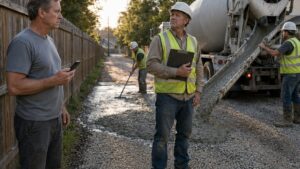
Blue, orange, and yellow markers ran along the frontage beside his driveway. A city pickup idled near the corner while a worker sprayed short lines across the ground.
Frank stood barefoot on the porch for several seconds.
Ten days.
He had known the dedication had been accepted.
He had not expected the physical consequences to arrive so quickly.
The public-works supervisor introduced himself twenty minutes later and unfolded a work sheet against the hood of the truck.
“We’re opening the drainage edge here, checking the existing utility locations, and cleaning up the transition to the inlet farther down.”
Frank pointed toward the temporary signs stacked in the truck bed.
“Parking restrictions?”
“During the work, definitely. Engineering may keep part of it restricted afterward depending on clearance.”
The supervisor looked toward the cracked driveway.
“We’ll try not to interfere with your access.”
Frank almost laughed at the sentence.
For months, everyone had discussed the street edge as if his driveway were the inconvenience.
Now the city was designing work around keeping his access open.
A crew arrived before eight.
Temporary fencing followed.
Then cones.
Then NO PARKING signs.
Neighbors slowed as they drove past.
One stopped long enough to ask Frank what was happening.
“Drainage work.”
“Why here?”
“The city owns the strip now.”
The neighbor stared at him.
“Since when?”
“Recently.”
By nine, Frank’s phone had three missed calls.
The fourth came from Benjamin.
Frank answered.
“What did you do?”
The question sounded alarmed, but not angry.
“I signed the dedication.”
“The old city one?”
“You knew about it?”
“Stephanie found out yesterday from the county.”
Frank watched a worker mark the curb.
“She didn’t call.”
“She was trying to understand whether the board could challenge it.”
“And?”
A pause.
“I don’t think there’s anything to challenge.”
Frank looked toward the fresh flags.
“No.”
Benjamin lowered his voice.
“You realize three board members use that stretch during meetings.”
“I realize a lot of people use it.”
“I’m not accusing you.”
“You sound like you’re trying not to.”
Benjamin sighed.
“I told Stephanie we should have slowed down when you asked about the map.”
Frank remembered the meeting room. Benjamin’s finger tracing the blank wedge.
“She didn’t.”
“No.”
Neither of them spoke for a moment.
Then Benjamin said, “There’s something else.”
Frank heard a truck brake near the corner.
“What?”
“Stephanie’s trailer.”
Frank looked down the street.
The white party trailer sat where it had been parked for several days, beyond Stephanie’s property and partly along the newly posted work zone.
He had noticed it the night before.
He had not connected it to the coming work.
“What about it?”
“It’s inside the restricted section.”
A public-works employee was already walking toward it.
Frank felt a small, sharp satisfaction.
It arrived before he could stop it.
There it was.
The image he had imagined in different forms for weeks: Stephanie discovering that the rules could reach her too.
He hated how good it felt.
The supervisor approached.
“Do you know who owns that trailer?”
“Yes.”
“Can you contact them?”
“I can.”
Frank called Stephanie.
She answered immediately.
“What is going on?”
“City drainage work.”
“I can see that. Why wasn’t the association notified?”
“You’d have to ask the city.”
“Frank.”
He walked toward the curb.
“What?”
“There are no-parking signs all along the frontage.”
“Yes.”
“Benjamin says you transferred the strip.”
“I did.”
Silence.
Then, “For what purpose?”
“The purpose in the dedication.”
“That is not an answer.”
“It’s the only one I have.”
Her voice sharpened.
“You did this because of the driveway.”
Frank looked at the crack behind him.
“No. The driveway made me look at the records.”
“You expect me to believe this is unrelated?”
“I didn’t say it was unrelated.”
A city worker stood beside the trailer, checking a clipboard.
Frank added, “You need to move your trailer.”
“What?”
“It’s inside the work zone.”
“I’m at an appointment.”
“The supervisor asked me to contact you.”
“Tell him I’ll move it this afternoon.”
Frank covered the phone and relayed the message.
The supervisor shook his head.
“We’re excavating there before noon.”
Frank uncovered the phone.
“They need it moved before noon.”
“I cannot get there before noon.”
“Then call someone who can.”
“You created this situation.”
Frank closed his eyes briefly.
“No. I signed over the land. The city created the work schedule.”
“That is wordplay.”
Maybe it was.
He watched the workers unload temporary fence sections.
By ten-thirty, half the frontage had changed shape.
The rough edge everyone had treated as casual parking was now crossed with paint, flags, cones, and equipment.
What had been ambiguous for years had become visually unmistakable in one morning.
A boundary no one had respected as private was now impossible to ignore as public.
Stephanie arrived shortly after eleven.
She parked across the street and crossed quickly.
Several neighbors were outside watching.
Frank wished they were not.
That made what happened next feel less like resolution and more like spectacle.
Stephanie stopped beside the trailer.
“You could have told me.”
“I called you as soon as they asked.”
“I mean before this.”
“The dedication?”
“Yes.”
Frank looked at her.
“You offered to suspend my fines if I agreed not to interfere with parking while you investigated whether you controlled the area.”
“That was a settlement proposal.”
“It was also the first time you treated the boundary as important.”
Her face flushed.
“You engineered this.”
“Frank.”
It was Benjamin.
He had walked over from farther down the street.
Stephanie turned on him.
“Did you know?”
“Not that he signed.”
“You knew this was possible.”
“I knew there was a record question.”
“You’re the treasurer.”
“And you’re the president.”
The words landed harder because Benjamin did not raise his voice.
Stephanie looked back at Frank.
“You wanted this.”
He could have denied it.
Instead he said, “Part of me did.”
She stared at him.
That answer unsettled her more than a defense would have.
Frank continued.
“But not enough to keep the land just so I could fight with you over every car.”
The public-works supervisor approached.
“Ma’am, is this your trailer?”
“Yes.”
“We need it out of the work limits.”
“I’m arranging that.”
“We need it now.”
“I said I’m arranging it.”
The supervisor glanced toward a tow vehicle waiting at the far end of the block.
Stephanie saw it too.
Her face changed.
“You cannot be serious.”
“The signs were posted this morning, and this equipment is obstructing scheduled work.”
She turned toward Frank.
“Call them off.”
He almost answered too quickly.
Then he looked at the strip.
Fresh paint crossed the old edge.
The city’s markings ran directly past the place where the crack in his driveway ended.
For years Frank had believed keeping peace meant absorbing inconvenience until someone else eventually noticed.
Then, for several angry weeks, he had wanted the opposite—to possess enough authority that no one could inconvenience him again.
Now neither choice was available.
The land was no longer his.
He had made sure of that.
“I can’t call them off,” he said.
Stephanie stepped closer.
“You can tell them this is a misunderstanding.”
“It isn’t.”
The tow driver backed into position.
A metal chain rattled against the pavement.
Around them, the watching neighbors grew quiet.
Frank felt no triumph now.
Only the uncomfortable weight of being exactly where he had chosen to stand.
The driver crouched near the trailer tongue and secured the connection.
Stephanie looked at Frank as if there were still one final favor he could grant.
“You caused this,” she said. “You can fix it.”
Frank looked from her to the hooked trailer, then down at the painted line the city had drawn across the ground.
For the first time, the answer was not hidden in a map, a rule, or an old document.
It was his to give.
Chapter 7: When Stephanie Asked Him to Intervene, Frank Finally Drew a Boundary
“You caused this,” Stephanie said. “You can fix it.”
The tow driver had already lifted the trailer tongue.
Frank looked at the steel connection, then at the fresh paint running along the frontage. Behind Stephanie, a public-works crew was waiting for the space to clear.
“I can’t.”
Her eyes narrowed.
“You mean you won’t.”
“No. I mean I can’t.”
“It was your property.”
“It was.”
“You transferred it.”
“Yes.”
“So call the city and tell them to give me an hour.”
Frank glanced toward the supervisor.
The man was standing several yards away, deliberately staying out of the argument.
“This isn’t my decision anymore.”
Stephanie folded her arms.
“That’s very convenient.”
Frank almost answered sharply.
A week earlier, he probably would have.
Instead, he looked at the trailer.
“It was convenient when everybody treated that strip like parking.”
Benjamin stood a short distance away, saying nothing.
Stephanie followed Frank’s eyes.
“That is not the same thing.”
“No. It isn’t.”
The tow driver tightened the connection.
Metal clicked against metal.
Stephanie turned toward him. “Wait.”
The driver pointed toward the supervisor.
“You’ll have to speak with him.”
She did.
Frank could not hear every word, but he saw the answer.
The supervisor shook his head once.
Stephanie came back.
“They’re charging me for the tow.”
Frank said nothing.
“And storage if I don’t pick it up today.”
“I’m sorry.”
She gave him a look.
“Are you?”
The question caught him.
Frank considered lying.
Then he shook his head.
“Not entirely.”
Stephanie stared at him.
He continued before the moment could harden.
“Part of me wanted you to find out what it feels like when somebody else makes the decision and tells you there’s nothing you can do about it.”
Her mouth tightened.
“At least you admit it.”
“I also know that’s not the best reason I had for signing.”
“What was the best reason?”
Frank looked toward the torn edge of the frontage where the crew would begin drainage work.
“I didn’t want to spend the next five years fighting over every car.”
Stephanie said nothing.
The trailer began moving.
Its wheels rolled past the temporary signs and onto the street.
Several neighbors watched from porches and driveways.
Frank could feel them watching him too.
That bothered him more than he expected.
He did not want to become the man everyone pointed to when telling the story later.
The homeowner who got the president’s trailer towed.
The man who finally beat the HOA.
That version would be easier to repeat.
It would also be incomplete.
Stephanie watched the trailer disappear around the corner.
Then she said, “You could have told me what you were planning.”
Frank nodded.
“Yes.”
The answer surprised her.
He continued.
“I could also have told people not to park there years ago.”
Benjamin shifted.
Stephanie looked at him.
Frank pointed toward the frontage.
“I watched that become normal.”
“You never complained.”
“I know.”
“So we were supposed to guess?”
“No.”
He let the word sit there.
“That part is on me.”
For the first time that morning, Stephanie’s expression changed without becoming defensive.
Frank said, “But I asked where the association’s authority ended. After that, you still sent me a settlement asking me not to interfere with parking while you figured out whether you controlled it.”
Stephanie looked away.
“I was trying to keep the dispute contained.”
“You were trying to preserve the board’s position.”
“Yes.”
The honesty came quickly enough that Frank almost missed it.
Stephanie glanced toward the construction crew.
“I thought if we paused everything, every architectural decision we made this year would get challenged.”
Benjamin stepped closer.
“Some of them probably should be reviewed.”
Stephanie turned.
“Benjamin.”
“I’m serious.”
“You supported those decisions.”
“I did.”
His voice stayed level.
“And I supported Frank’s violation.”
Frank looked at him.
Benjamin continued.
“We kept treating consistency like it was the same thing as correctness.”
Stephanie rubbed her forehead.
“This is not the place for a board meeting.”
“No,” Benjamin said. “But we’re going to need one.”
The public-works supervisor called to the crew.
An excavator started.
Conversation became impossible.
Frank stepped back onto his driveway.
The machine’s bucket cut into the frontage where tires had rested only days earlier.
Dark soil appeared beneath the rough surface.
Water stains marked the shallow channel underneath.
For the first time, Frank could see why the city had wanted the strip.
This was not merely a parking problem.
It had never been merely a parking problem.
Three weeks later, Frank returned to the HOA meeting room.
This time he did not bring the old plat.
Benjamin had copies.
The agenda included a proposed amendment to the board’s enforcement procedure requiring staff or board review of actual association jurisdiction before issuing certain exterior-use violations.
Stephanie sat at the same end of the table.
She looked tired.
Not defeated.
Just less certain.
Benjamin read the proposed language.
One of the unnamed board members asked whether it was really necessary.
“Yes,” Benjamin said.
Stephanie looked at Frank.
Then she said, “Yes.”
The room went quiet.
She turned to the architectural-review item.
“Mr. Miller’s driveway application.”
Frank sat straighter.
Stephanie opened the revised staff recommendation.
“The board has received additional contractor information confirming that replacement is the appropriate maintenance method for the failed slabs.”
Frank almost smiled.
That information had been available from the beginning.
Stephanie seemed to know what he was thinking.
She continued.
“The board also reviewed the standard concerning color and visual consistency.”
Benjamin glanced at her.
Stephanie took a breath.
“The current wording does not reasonably distinguish between aesthetic alterations and necessary replacement caused by material failure.”
That was the closest thing to an admission Frank expected.
“The recommendation is to approve the replacement using standard unfinished concrete, subject to ordinary drainage and permit requirements.”
The vote passed.
No applause.
No speeches.
Frank preferred it that way.
After the meeting, Stephanie caught him in the hallway.
“Frank.”
He stopped.
She held his original violation file against her side.
“I should have checked the parcel information when you asked.”
He waited.
“I didn’t.”
“No.”
“I thought you were trying to derail the enforcement issue.”
“At first, I probably was.”
She looked surprised.
Frank continued.
“When I asked about the frontage, I wanted something I could use against you.”
Stephanie’s shoulders loosened slightly.
“And then?”
“Then I found something bigger than the argument.”
They stood in silence for a moment.
Finally she said, “I still think you should have told me before signing the dedication.”
Frank nodded.
“Maybe.”
“That’s not much of an apology.”
“It isn’t one.”
A faint smile appeared at the corner of her mouth.
“No.”
Frank looked toward the meeting room.
“I should’ve spoken up years earlier about the parking.”
Stephanie nodded.
“Yes.”
Neither of them tried to turn the exchange into forgiveness.
That would have been too neat.
A month later, the contractor poured the final replacement slab.
Frank stayed home while the crew worked.
By afternoon, the old cracked section was gone.
The new concrete was lighter than the surrounding driveway, exactly as Stephanie had predicted.
For a while, it would stand out.
Frank found he did not mind.
Near the street, the city had finished the drainage work and established a clean edge along the public frontage.
The old informal parking area no longer looked like nobody’s ground.
It had a purpose.
That evening Frank walked down the driveway.
His shoes crossed smooth concrete where the widest crack used to be.
He stopped at the bottom.
Ahead of him, the newly defined public strip met the edge of his property in a line clear enough that no one needed to argue about it.
For years, Frank had believed peace meant not pointing out where one person’s space ended and another person’s began.
Then he had almost convinced himself that justice meant owning the line strongly enough to punish anyone who crossed it.
Standing there now, he understood something simpler.
A boundary did not have to be a weapon.
Sometimes it was just the place where responsibility changed hands.
Frank stepped to the edge of the new concrete and stopped exactly where his property ended.
The story has ended.