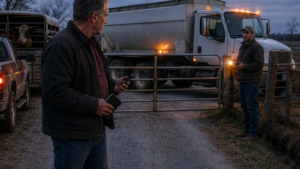
They Used His Farm Lane for Event Parking Until One Old Boundary Post Changed Everything
Chapter 1: The Wedding Cars Filled the Only Farm Lane
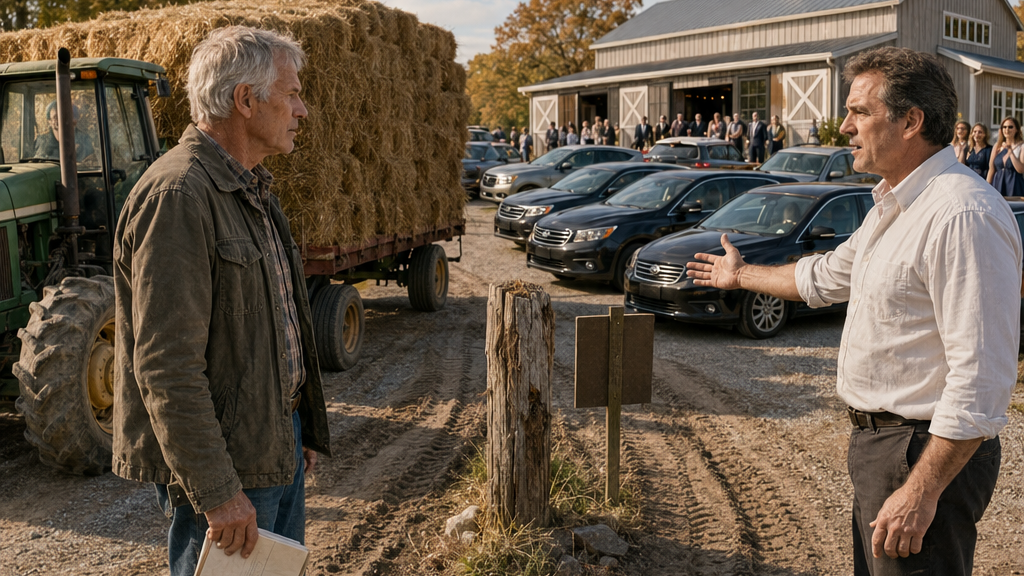
Raymond Hall came around the bend with four tons of hay behind him and found fourteen cars parked where the wagon had to turn.
He took his foot off the accelerator.
The tractor settled into a low diesel thrum, the loaded wagon creaking behind it. Ahead, polished SUVs and sedans stood in two loose rows across the gravel turnaround beside his machine shed. Men in jackets and women carrying small purses were walking toward Edward Baker’s event barn fifty yards away, where music drifted through the open doors.
For a moment Raymond simply stared.
A young parking attendant in a reflective vest stepped into the lane and lifted one hand as if Raymond were another arriving guest.
“Sir, you’ll need to hold up.”
Raymond looked past him at the wagon.
“Need to put that hay under roof.”
The attendant glanced behind the tractor, apparently noticing the load for the first time.
“We’ve got a wedding going on.”
“I can see that.”
The boy shifted his weight. “Cars should start moving later.”
Raymond killed the engine.
Silence fell around the tractor except for the distant music and the ticking of hot metal.
“This is my lane.”
The attendant’s expression changed, but only slightly.
Then another SUV turned off the county road.
Before Raymond could say anything, the attendant stepped aside and waved it forward.
The SUV rolled past Raymond’s front tire, crossed the worn gravel line beside the ditch, and stopped beyond a faded wooden post that had stood there since Raymond was a boy.
Something in him tightened.
He climbed down.
“Don’t put another one over there.”
The attendant gave him the strained look of someone trying to remain polite in front of customers.
“That’s where Mr. Baker told us overflow goes.”
Raymond walked toward the new SUV. Its driver was already locking the doors.
“That needs to move.”
The driver looked from Raymond to the attendant.
“I was told this was parking.”
“It isn’t.”
The woman hesitated. “For the wedding?”
“For anything.”
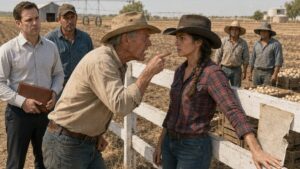
Edward emerged from the barn before the argument could spread. He wore dark slacks, work boots, and a white shirt with the sleeves rolled above his elbows. Sweat darkened his collar despite the cool afternoon.
“Raymond.”
“You’ve got my turnaround full.”
Edward looked at the cars as though seeing them from Raymond’s angle required effort.
“We’re tight today.”
“I’m tighter.”
Raymond pointed toward the hay wagon.
“If I can’t make that turn, I can’t get it into the shed.”
Edward rubbed the side of his jaw. “Give me twenty minutes.”
“I’ve already got hay sitting out.”
“There’s no rain coming.”
“That isn’t the point.”
Guests passing toward the barn had begun looking over. Raymond hated that more than the parked cars. He had spent most of his life avoiding scenes because scenes traveled faster than facts in a rural county.
Edward lowered his voice.
“You don’t have to make this a thing in front of everybody.”
Raymond looked at him.
“I didn’t park fourteen cars here.”
Edward exhaled through his nose.
Then he turned sharply toward the attendant.
“Clear him a lane.”
It took fifteen minutes.
Drivers were found inside the barn. One sedan had to be backed onto the grass. Two SUVs squeezed close enough to the fence that their mirrors nearly touched. Raymond stood beside the tractor without helping.
When there was finally enough room, he climbed back into the cab and eased forward.
The wagon barely made the turn.
Its rear wheel passed within a foot of the weathered boundary post. Raymond saw fresh tire marks running on both sides of it, pressing the grass flat.
Edward stood near the barn entrance.
Raymond stopped the tractor beside him.
“This can’t keep happening.”
Edward gave a tired laugh that held no humor.
“Raymond, people have parked there for years.”
“Not like this.”
“Maybe not fourteen at once.”
“Not every weekend.”
Edward’s face hardened.
“You’ve never had a problem with it before.”
Raymond almost answered immediately.
Instead he looked toward the old post.
There had been cars there before. A few. Sometimes six, maybe eight during the harvest dinners. He remembered telling himself it wasn’t worth fighting about.
That was not the same as permission.
At least that was how he remembered it.
“I’m telling you now,” Raymond said. “Keep them off the lane and the turnaround.”
Edward studied him.
“You sure you want to start drawing lines after all these years?”
“I’m not starting anything.”
Edward glanced toward the post.
“That’s not how I remember it.”
Raymond drove the hay into the shed without answering.
By evening the wedding traffic was gone. Crushed paper cups lay near the ditch, and pale arcs from tires marked the gravel where cars had backed and turned.
Raymond walked the property line carrying a notebook.
He counted impressions. He wrote down what he could remember: fourteen vehicles, approximate arrival time, wagon delayed. The act felt petty, so he nearly stopped.
Then he reached the old boundary post.
A fresh scrape exposed pale wood beneath decades of gray weathering.
One side leaned slightly toward the field.
Raymond crouched and touched the damaged place.
Ten yards farther down, the orange-topped stake he had driven beside the lane the previous spring was gone.
He searched the grass.
Nothing.
Raymond stood and looked toward Edward’s darkening barn.
For the first time that afternoon, the question was no longer whether Edward had let too many cars onto his property.
It was whether Edward truly believed they had every right to be there.
Chapter 2: The County Map Drew a Harder Line
The red line on the county map ran straight through the middle of Edward’s painted parking arrows.
Raymond leaned closer to the counter.
Jennifer Green rotated the large monitor toward him and enlarged the parcel image.
“This is the recorded boundary,” she said. “But I want to be careful about what that means.”
Raymond pointed at the screen.
“My turnaround is here?”
“Yes.”
“And this strip along the lane?”
“Yes.”
“All mine.”
“According to the recorded deed and survey references, yes.”
Raymond sat back.
For two days he had replayed Saturday in his mind, especially Edward’s last sentence.
That’s not how I remember it.
He had come to the county office expecting the land record to remove the uncertainty. Instead, Jennifer’s caution made him uneasy.
“What’s the part you’re being careful about?”
She folded her hands.
“Ownership records answer ownership. They don’t necessarily answer every question about permission, agreements, access, or historical use.”
“There’s no easement.”
“I didn’t say there was.”
“Nothing recorded?”
“Nothing I can see granting event parking.”
That was better.
Jennifer printed the parcel map and retrieved an older survey reference from the file. One notation mentioned an iron pin near the northern corner and a wooden witness post several feet inside the property.
Raymond recognized the location immediately.
“The old post.”
“Could be.”
“It’s been there fifty years.”
“That doesn’t make the wood itself the legal marker. But if the surveyor used it as a witness point, it helps locate the recorded line.”
She stamped certified copies of the relevant pages.
Raymond paid the fee and slid them carefully into a manila folder.
At the door, Jennifer stopped him.
“Mr. Hall?”
He turned.
“If this is becoming a dispute, don’t assume these papers settle every part of it just because they settle the parcel.”
Raymond nodded.
But driving home, he felt lighter than he had since Saturday.
The lane was his.
The turnaround was his.
Whatever Edward remembered, the land itself had not moved.
On Tuesday afternoon Raymond screwed a new sign to a cedar post at the entrance: PRIVATE FARM ACCESS. He placed another near the turnaround, far enough inside his boundary that no one could mistake which side it concerned.
Then he took the certified plat and walked toward the event barn.
Workers were arranging tables under the open-sided pavilion. Edward was helping unload folding chairs.
Raymond waited until he noticed him.
“I checked the county records.”
Edward set down the chairs.
“I figured you would.”
Raymond opened the folder.
“The line runs here.”
He pointed from the road toward the weathered post.
“And across the turnout. All of it.”
Edward wiped his hands on his pants but did not take the papers.
“I never said it wasn’t yours.”
That stopped Raymond.
“Then why are your people parking there?”
“Because we’ve used it.”
“You’ve used it because I didn’t stop you.”
Edward looked toward two employees listening from beside the pavilion.
“No. We used it because you told me we could.”
Raymond felt heat rise along his neck.
“I never gave you my lane.”
“You said we could use the gravel when we needed overflow.”
“When?”
Edward stared at him.
“You seriously don’t remember?”
Raymond held the plat tighter.
“I remember letting a few cars sit there.”
“That’s not what you said.”
A pickup towing a small decorative trailer rolled toward the barn. The driver slowed when the lane narrowed. One tire crossed onto Raymond’s gravel before correcting.
Raymond pointed at it.
“That stops now.”
Edward stepped closer.
“I’ve got two weddings and a harvest dinner booked this weekend.”
“Then park them somewhere else.”
“Where?”
“That’s your business.”
Edward’s jaw worked.
“Some of those events were booked months ago.”
“That doesn’t make my property part of the contract.”
“No, but fifteen years of doing the same thing makes it reasonable to think you aren’t going to wake up one Saturday and change the rules.”
Raymond held out the certified map.
“I’m changing them now.”
Edward finally took the paper.
The two men stood near the weathered post while a breeze lifted one corner of the plat.
Raymond showed him the marked boundary and then handed him a second sheet he had typed that morning.
Effective immediately, any prior informal permission for guest parking on the Hall parcel was withdrawn.
Edward read the sentence twice.
“So that’s what this is?”
“It’s notice.”
“You could’ve talked to me.”
“I did Saturday.”
“No. You told me.”
Raymond said nothing.
Edward looked from the paper to the post.
“You’ve got the deed. Fine. But don’t stand there pretending this came out of nowhere.”
“I’m not pretending.”
“You are if you’re pretending you never opened that ground to us.”
Edward folded the copy once and walked back toward the barn.
Raymond remained by the post.
The county map had answered the question he had come to answer.
Yet somehow the argument felt less settled than it had before.
That evening Carolyn came into the farmhouse carrying a casserole dish and found the certified plat spread across Raymond’s kitchen table.
She read the notice beside it.
“You gave this to Edward?”
“This afternoon.”
Carolyn set the dish down.
“What happened now?”
“He’s been filling the turnaround with cars.”
“I know.”
Raymond looked up sharply.
“You know?”
“I came by during one of those weddings last month.”
“And you didn’t say anything?”
“I thought you knew.”
Raymond tapped the plat.
“Well, it’s done. I checked everything. The lane is ours.”
Carolyn did not look relieved.
Instead she pulled out a chair.
“Raymond.”
He knew that tone.
“What?”
She rested both hands on the table.
“You did tell him he could use it.”
Chapter 3: The Favor Nobody Ever Ended
Carolyn laid an old photograph beside the certified plat.
Eight cars were parked along Raymond’s gravel lane.
The picture had faded around the edges, but the weathered boundary post was unmistakable behind them.
Raymond picked it up.
“When was this?”
“Edward’s first harvest dinner. Maybe fourteen years ago.”
“You kept a picture of parked cars?”
“It was Dad’s birthday. Look at the porch.”
Raymond looked again. Their father stood in the far background beside the farmhouse, partly hidden by shadow. Raymond himself was near the gate, younger, heavier through the shoulders, holding a coffee cup.
Edward was standing beside him.
Raymond remembered the year before he remembered the conversation.
Edward had recently begun converting his old livestock barn into an event space. The first season had gone badly. Rain ruined one outdoor dinner. A caterer canceled another. The county made him redo part of the septic work. He had talked often about selling before winter.
Carolyn watched Raymond’s face.
“You remember now.”
“I remember the dinner.”
“You told him he could use the gravel.”
“For that night.”
“No.”
Raymond put the photograph down.
“You weren’t standing there.”
“I was ten feet away.”
“What exactly did I say?”
Carolyn looked toward the window as if the words might still be outside.
“You said, ‘If you get jammed up on weekends, use the gravel when you have to.’”
Raymond laughed once.
“That is not permission forever.”
“I didn’t say it was.”
“I meant while he got started.”
“Did you tell him that?”
Raymond opened his mouth.
Nothing came.
Carolyn leaned back.
“That’s the problem.”
He pushed the photograph away.
“So now it’s my fault?”
“I didn’t say that either.”
“He’s directing cars there. He painted arrows toward my property.”
“And he shouldn’t be doing that after you told him to stop.”
“Then what are we arguing about?”
Carolyn’s expression sharpened.
“We’re arguing because you’re acting like he invented the whole thing.”
Raymond stood and carried the coffee pot to the sink though it was already empty.
For years he had handled disagreement the same way. If a neighbor left a gate open, he closed it. If somebody cut too close to his ditch, he fixed the rut. If Edward had five cars on the gravel, Raymond drove around them.
He had called that patience.
Carolyn apparently had another word for it.
“You could’ve mentioned this before I went to the county.”
“You needed to go to the county.”
“Before I handed him a notice like he’d been trespassing from day one.”
“That would’ve been useful, yes.”
Raymond turned.
“You knew I was mad about the parking.”
“I knew you complained about it. That’s different from knowing you planned to shut it down on a Friday.”
He hated that she had a point.
The next morning Raymond carried the photograph outside.
He stood at roughly the place where Carolyn must have taken it and held the image up against the real lane.
The post aligned.
So did the curve of the ditch.
But the scale of the parking did not.
In the old photograph, the cars formed a neat single row along the gravel shoulder. The middle of the lane remained open. The turnaround was empty.
Now Edward’s operation used both.
Raymond lowered the picture.
That difference mattered.
He went inside and retrieved his handwritten log.
For years the entries had been irregular: dates when cars interfered with baling, a Saturday when someone blocked the fuel delivery, two nights when headlights swept across the house until midnight. More recently the notes grew frequent.
Six cars.
Nine.
Twelve.
Fourteen.
He had never once written Edward a letter.
That fact mattered too.
By noon he drove to the event barn.
Edward was stacking cases of bottled water in a storage room.
Raymond held up the photograph.
“Carolyn found this.”
Edward looked at it and gave a tired nod.
“So you remember.”
“I remember enough.”
“Good.”
“I told you to use the gravel when you got jammed up.”
“Yes.”
“I did not tell you to build your parking plan around my land.”
Edward set down the case.
“I didn’t do that overnight.”
“That supposed to make it better?”
“No. It means you watched it happen.”
The words landed harder than Raymond expected.
Edward continued before Raymond could answer.
“First year, maybe five cars. Next year, sometimes eight. Then the dinners got bigger. You drove by. You waved at people. You never told me to stop.”
“I complained.”
“You complained about how they parked. Not that they were there.”
Raymond remembered saying, Keep them off the grass. Don’t block the shed. Tell them not to leave bottles by the ditch.
He had treated the use as something to manage, not something to end.
Edward wiped his hands on a rag.
“You think I’m saying I own it? I’m not. I know it’s your ground.”
“Then keep your customers off it.”
“I’m trying to tell you why I thought we had an understanding.”
“You had a favor.”
“Maybe.”
Edward met his eyes.
“But you never said when the favor was over.”
Raymond looked toward the open barn doors.
Rows of tables waited inside. Wooden beams had been cleaned and sealed. New lights hung between them. The place no longer looked like a struggling side business.
“How many events do you have booked?”
“Through November?”
“Yes.”
Edward hesitated.
“Eleven.”
“And how many can you handle without my ground?”
“That depends.”
“On what?”
“Attendance.”
Raymond understood the answer.
“Not eleven.”
Edward said nothing.
There it was: the practical problem beneath the argument.
Raymond left without resolving it.
He spent the afternoon walking the lane, measuring the width between the ditch and fence, marking where a feed truck needed room to swing. The old post remained just inside the grass, pale scrape visible along one side.
He set the old photograph against it once more.
The post had not changed.
Their use of the land had.
By evening, Raymond could admit something he had resisted all week: Edward had not started as a thief. Raymond had opened the door and then refused to say when it should close.
But that did not explain what Edward was doing now.
The new notice had been explicit.
The line had been shown.
Permission had been withdrawn.
At dusk Raymond drove to the mailbox and found a glossy event card tucked among the bills, apparently mailed to nearby residents.
Directions to Edward’s harvest weekend were printed on the back.
He almost tossed it onto the truck seat.
Then one line caught his eye.
Overflow vehicles were instructed to continue past the barn entrance and follow attendants onto the gravel farm lane.
Raymond read it twice.
The cards had been printed after their confrontation.
He looked down the road toward Edward’s barn, then back at the directions in his hand.
Whatever confusion had existed for fourteen years, Edward could no longer claim he did not know where the boundary stood.
Chapter 4: Two Cameras Changed What Everyone Could Deny
Raymond’s phone buzzed at 4:17 Friday afternoon.
The first car crossed the line less than three hours after Edward’s parking crew arrived.
Raymond stood inside the equipment shed with a wrench in one hand and stared at the image on the screen. The camera he had mounted that morning showed the farm entrance clearly: county road, ditch, new sign, weathered boundary post.
A dark sedan had passed the sign and stopped well beyond the post.
Raymond set the wrench down.
He had resisted installing cameras because he disliked what they represented. He had lived beside people he knew his entire life. Cameras belonged over convenience-store registers and equipment yards where strangers came through at night, not on a lane where neighbors once borrowed tools without asking.
But the printed event directions had changed that.
He had mounted one camera facing the entrance and another beneath the machine-shed eave overlooking the turnaround. Both stored dated images. He had tested them twice.
Now his phone buzzed again.
A second vehicle.
Then a third.
Raymond opened his notebook and wrote the time.
At 4:36, the image changed the argument.
An event-barn employee stood beside the entrance. Raymond recognized the reflective vest.
The employee raised one arm and pointed.
A white SUV turned past the barn driveway and continued toward Raymond’s lane.
The next image showed the employee directing another car the same way.
Raymond enlarged it.
No confusion.
No driver mistaking gravel for public parking.
Someone was sending them there.
He walked outside.
Music had not started yet, but guests were beginning to arrive. Raymond could see the barn’s string lights glowing beneath the rafters. He remained on his side of the property and watched another vehicle enter.
The attendant spotted him.
For a second neither man moved.
Then the attendant looked toward the barn.
Edward came out several minutes later.
“You putting cameras on me now?” he asked.
“They’re pointed at my ground.”
Edward glanced at the camera on the shed.
“You trying to make everybody feel like criminals?”
“I’m trying to know who’s using my lane.”
“You know who’s using it.”
“Then why are we still arguing about it?”
Edward shoved his hands into his jacket pockets.
“Because I can’t create thirty parking spaces in a week.”
“You had years.”
“And for those years, I thought I had overflow.”
Raymond took out his phone and showed him the photograph of the attendant directing the SUV.
“I withdrew permission Tuesday.”
Edward barely looked at it.
“These events were already booked.”
“That doesn’t change Tuesday.”
“You expect me to cancel weddings?”
“I expect you not to solve your problem with my property.”
Edward stared at him for a moment.
Then he turned away.
“Do what you think you have to do.”
It was not agreement.
Raymond watched him walk back toward the barn.
By six o’clock, nine cars had crossed the line.
Raymond logged every one.
He did not approach the drivers. He did not leave notes under windshield wipers. He recorded arrival times and took still photographs from the camera feed.
The process felt cold.
It also felt cleaner than another argument.
Saturday brought a different problem.
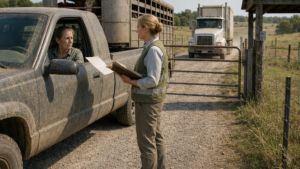
Shortly after noon, a feed delivery truck came down the lane toward Raymond’s livestock lot. The driver needed the turnaround to reverse toward the storage bin.
He stopped before reaching it.
Six guest vehicles occupied the outer curve. Three more sat along the edge of the lane.
Raymond met the driver on foot.
“Can you make it?”
The man looked at the parked cars and shook his head.
“Not without putting the trailer in the ditch.”
Raymond called Edward.
No answer.
He tried again.
Then he walked toward the barn.
A ceremony was underway behind closed doors, and an employee intercepted him near the entrance.
“You can’t go in right now.”
“I don’t want to go in. I need those cars moved.”
The employee glanced toward the lane.
“We’re in the middle of the ceremony.”
“I’ve got a feed truck sitting in the road.”
“Can it come back later?”
Raymond looked at him.
“No.”
The employee’s face tightened.
“Mr. Baker told us not to disturb guests unless it’s an emergency.”
Raymond turned his head toward the waiting truck.
“That trailer is carrying feed I ordered for today. He has another delivery after mine.”
“I understand, but—”
“No. You understand a wedding is happening. I understand this is still a working farm.”
The employee said nothing.
Raymond walked back to the truck.
The driver waited twenty-three minutes before several owners could finally be found.
When the trailer eventually backed into position, its rear wheels passed inches from Raymond’s ditch.
That evening Raymond sat at his kitchen table with the parking log open beside the camera images.
He had spent the week wondering how much blame belonged to fourteen years of ambiguity.
The cameras answered a narrower question.
Whatever had been unclear before Tuesday was clear now.
Edward knew permission had been withdrawn.
His employees knew Raymond objected.
And they were still directing cars over the line.
Carolyn came in through the mudroom and saw the photographs spread across the table.
“You look pleased,” she said.
“I’m not.”
“You look like a man who proved something.”
“That isn’t the same thing.”
She examined one image.
“That his people are sending them in?”
“Yes.”
Carolyn pulled out a chair.
“What are you going to do?”
Raymond closed the notebook.
“I talked to a towing company.”
Her eyes lifted.
“Raymond.”
“They won’t tow unless the signs are posted correctly and I authorize the vehicles.”
“And are they?”
“Yes.”
Carolyn sat back.
“You sure you want to make that jump?”
Raymond thought about the feed truck sitting half in the county road.
“I gave notice.”
“I know.”
“I gave him a chance.”
“I know that too.”
He looked at the old boundary post through the kitchen window.
For years it had meant almost nothing because everybody knew where the farms met.
Now the camera framed every vehicle in relation to it.
A piece of weathered wood had become the fixed point in an argument neither man could talk his way around.
On Monday morning Raymond met the tow operator at the farm entrance.
They walked the property together. Raymond showed him the certified plat, the signs, the lane, and the turnaround.
The operator read the documents twice.
“We only remove what you specifically authorize.”
“That’s what I want.”
“No blanket grabbing cars.”
“No.”
“You call. We verify. We take the vehicle you identify.”
Raymond signed the limited authorization.
The operator handed him a copy.
As Raymond folded it into the same folder as the county plat, he felt no triumph.
Only the weight of a choice that could no longer be mistaken for silence.
The next event was Saturday.
If Edward sent cars across the line again, Raymond would not ask him to move them.
Chapter 5: The First Tow Solved Less Than Raymond Expected
The tow truck arrived while the wedding band was playing.
Raymond heard the music carrying across the field before he saw the truck turn off the county road, amber lights flashing against the dusk.
For almost an hour he had watched cars fill Edward’s main lot.
Then the overflow began.
The first two vehicles stopped short of Raymond’s boundary after attendants redirected them toward a strip near the barn.
The third crossed the post.
Raymond waited.
A fourth followed.
Then a fifth parked partly across the farm turnaround.
He checked the signs. He checked the camera timestamps. He looked once toward Edward’s barn.
Then he made the call.
The tow operator stopped beside Raymond’s shed.
“You want the one blocking the turn?”
“Yes.”
Raymond pointed.
“That gray SUV.”
The operator checked the posted signs and Raymond’s authorization before backing the truck into position.
Guests noticed almost immediately.
A man in a suit came running from the barn as the SUV’s front wheels lifted.
“Hey! That’s my car.”
The operator stopped and spoke to him while Raymond remained several yards away.
The man’s voice rose.
“We were told to park here.”
Raymond heard the sentence clearly.
The driver pointed toward the barn.
“One of their guys told us.”
The tow operator looked at Raymond.
Raymond walked closer.
“This is private farm access.”
“I didn’t know that.”
“The signs are right there.”
The man looked toward the post as though seeing them for the first time.
“Then why did they send us over here?”
Raymond did not answer for Edward.
The man paid the required release fee and moved his SUV himself.
That could have been the end of it.
Instead another car crossed the line thirty minutes later.
Raymond authorized the tow.
This time the owner did not appear before the vehicle left.
By nine o’clock, word had spread through the reception.
People came outside in clusters, pointing toward the gravel. A woman photographed Raymond’s signs. Someone called him ridiculous loudly enough that he heard it from the shed.
Edward came across the lot at a fast walk.
“What are you doing?”
Raymond kept his hands at his sides.
“What I told you I’d do.”
“You towed a guest.”
“I authorized a tow on a vehicle parked past the boundary.”
“They were directed there.”
“By your employee.”
Edward stopped.
“You know exactly what you’re doing to me.”
“I know exactly what happened to my feed delivery last week.”
“This is a wedding.”
“And this is still my farm.”
Edward gestured toward the barn.
“I’ve got a hundred and eighty people in there. You’re making a spectacle.”
Raymond looked at the guests gathered outside.
“I didn’t invite them onto my lane.”
“You could’ve called me.”
“I called you last Saturday. Twice.”
Edward’s face flushed.
“That was during a ceremony.”
“And that’s the problem, Edward. Your schedule keeps becoming the reason my property has to wait.”
For several seconds neither spoke.
Then Edward lowered his voice.
“I have events booked through November.”
“You told me.”
“You know what that means?”
“It means you need parking.”
“It means people paid deposits based on the capacity I told them I could handle.”
Raymond frowned.
“What capacity?”
Edward looked away.
The answer came before the words.
“You counted this ground.”
Edward’s silence confirmed it.
Raymond felt something shift.
“How long?”
“It wasn’t written that way.”
“That wasn’t my question.”
Edward rubbed his forehead.
“When we added the south room, the planners asked about parking.”
“And?”
“I showed them the areas we’d been using.”
“My lane.”
“The overflow area.”
“My lane.”
Edward’s mouth tightened.
“You want me to call it your lane? Fine. Your lane.”
Raymond stared at him.
“You expanded that barn knowing you didn’t own the parking.”
“I expanded it believing the arrangement wasn’t going anywhere.”
“Why?”
“Because it hadn’t gone anywhere for fourteen years.”
Raymond almost answered, but the sentence found its target.
Fourteen years.
For fourteen years Raymond had complained without drawing the line.
Then, in one week, he had drawn it in ink, cameras, signs, and tow paperwork.
That did not make Edward right.
But it explained why the consequences had spread farther than Raymond intended.
Another guest approached them.
“My daughter’s car was towed.”
Edward turned toward her.
Raymond saw the embarrassment cross his face before anger replaced it.
“We’re handling it.”
“She parked where your attendant told her.”
“I know.”
The woman looked at Raymond.
“So you’re the owner?”
“Yes.”
“You couldn’t just warn people?”
“I did.”
“Not us.”
Raymond had no satisfying answer to that.
The warning signs were visible.
The notices had gone to Edward.
The guests themselves had entered expecting the event business to tell them where they could park.
Raymond still believed the vehicles had to stop.
But the clean moral shape he had given the problem in his head began to blur.
By ten, the lane was clear.
The camera showed something new.
Cars approaching the old post slowed and turned away.
Fresh tire tracks ended at the boundary instead of crossing it.
Raymond stood beside the post and looked down at them.
For the first time in years, the turnaround was entirely open.
His tractor could enter.
A feed trailer could back.
An ambulance, if one were ever needed, could reach the house without threading between wedding guests.
The result was exactly what he had wanted.
Yet music continued from the barn, subdued now by the murmuring of angry people outside.
Edward returned near the end of the night.
His anger was gone.
He looked tired.
“You cost me three guest complaints tonight.”
Raymond leaned against the fence.
“I didn’t park their cars.”
“No. My people did.”
That admission surprised him.
Edward looked toward the post.
“I told the attendants to stop using your side.”
“Good.”
“But I can’t fix the rest this weekend.”
“You’ll have to.”
Edward gave a short, bitter laugh.
“You make everything sound simple once you’ve decided.”
Raymond straightened.
“What does that mean?”
“It means you had fourteen years to tell me the arrangement was temporary.”
“I shouldn’t have needed fourteen years to remind you it wasn’t your land.”
“No. You shouldn’t.”
Edward nodded slowly.
“And I should’ve gotten something in writing.”
Raymond watched him.
Edward continued.
“I knew we never had a written agreement.”
The words settled between them.
“You knew?”
“I knew there wasn’t a lease. I knew there wasn’t an easement.”
“Then why keep building around it?”
Edward looked toward the lit barn but did not answer.
A moment later he walked away.
Raymond remained by the now-clear lane, staring after him.
The first tow had settled one question.
Edward knew the land was not his.
What Raymond still did not understand was why a man who knew that would risk his entire business on the hope that a favor would never end.
Chapter 6: What Edward Had Been Afraid to Admit
Edward came to Raymond’s house Tuesday morning carrying a calendar instead of a lawyer’s letter.
Raymond saw him through the kitchen window and almost did not open the door.
Then he noticed Edward was alone.
No folder from an attorney. No county official. No angry guest.
Just a thick appointment book under one arm.
“What is that?”
Edward held it out.
“My problem.”
Raymond let him in.
Edward placed the calendar on the kitchen table and opened it.
Colored marks filled nearly every weekend through November.
“This Saturday is a wedding. Next Friday is a corporate dinner. Two harvest events after that. Then three more weddings.”
Raymond remained standing.
“You told me eleven.”
“I wasn’t exaggerating.”
“I didn’t think you were.”
Edward turned several pages.
“These people booked months ago. Some more than a year.”
“That still doesn’t make the lane yours.”
“I know.”
The answer came so quickly that Raymond sat down.
Edward pulled out the opposite chair.
“I’m asking you to let us use it until the season ends.”
“No.”
Edward’s shoulders dropped.
“You didn’t even think about it.”
“I’ve been thinking about it for two weeks.”
“I’ll pay you.”
“No.”
“A temporary lease.”
“No.”
“Then what exactly do you want me to do?”
“Find parking you control.”
Edward looked down at the calendar.
“You think I haven’t?”
Raymond said nothing.
“There’s a field east of the county road. The owner didn’t want cars on it. The church lot is too far and already used Saturday nights. The school won’t do private-event parking without an agreement that takes months.”
“So reduce attendance.”
“These aren’t new bookings.”
“You sold something you couldn’t guarantee.”
Edward closed the calendar.
“Yes.”
That single word took the heat out of Raymond’s reply.
Edward looked older than he had at the barn. There were gray strands Raymond had never noticed around his temples.
“When did you expand?” Raymond asked.
“Three years ago.”
“The south room?”
“And the kitchen.”
“You borrowed for it.”
Edward gave him a faint look.
“You already know the answer.”
“How much?”
“Enough.”
Raymond waited.
Edward rubbed a thumb along the calendar’s edge.
“The first years were barely keeping the place alive. Then we started doing better. Weddings got bigger. People wanted dates. I had a choice between staying small or borrowing to improve it.”
“And you counted my gravel when you made the numbers work.”
“I counted what we’d been doing for over a decade.”
“You knew it wasn’t yours.”
“Yes.”
“That’s the part I don’t understand.”
Edward looked toward the window.
The old boundary post was visible beyond the yard.
“No,” he said. “You understand it. You just don’t like it.”
“Try me.”
Edward was quiet for several seconds.
“When the bank looked at the expansion, nobody asked whether I owned every place cars had ever sat. They looked at revenue, bookings, capacity. I told myself I’d get a real agreement with you later.”
“You never asked.”
“I know.”
“Why?”
Edward let out a slow breath.
“Because I was afraid you’d say no.”
There it was.
Not confusion.
Not entitlement alone.
Fear.
Raymond sat back.
Edward continued.
“Every year it got harder to ask. First it was five cars, and asking felt silly. Then it was ten. Then twenty on the biggest nights. By the time the expansion happened, asking meant admitting I’d let my business depend on something I didn’t control.”
“So you just kept quiet.”
“Yes.”
Raymond almost laughed at the ugly symmetry of it.
For years he had kept quiet because he did not want conflict.
Edward had kept quiet because he did not want an answer.
Between them, silence had become an agreement neither man had actually made.
“That doesn’t excuse sending cars in after Tuesday,” Raymond said.
Edward looked at him directly.
“No.”
“You did that knowing I withdrew permission.”
“Yes.”
“Why?”
“Because I panicked.”
The admission was plain.
“I had two weddings that weekend. I told the attendants to use the old overflow until I figured something out.”
“You made your panic my problem.”
“I did.”
Raymond looked down at the calendar.
For the first time since the blocked hay wagon, Edward seemed less like a man trying to take land and more like a man who had built himself into a corner.
Raymond did not confuse understanding with forgiveness.
But the difference mattered.
“I’m not reopening the lane.”
Edward’s face tightened.
“Then some of these events are going to go bad.”
“That’s not a reason.”
“I have employees depending on this season.”
“Don’t use them to make me responsible for your decision.”
Edward flinched.
Raymond immediately heard how hard the words were.
Still, he did not take them back.
The front door opened without a knock.
Carolyn stepped inside carrying a grocery sack, stopped at the sight of Edward, then looked at the calendar.
“Well,” she said. “At least you’re finally sitting at the same table.”
Neither man answered.
She put the sack on the counter.
Edward stood.
“I should go.”
Carolyn glanced between them.
“Did you ask him for the lane?”
“Yes.”
“He said no?”
“Yes.”
“Good.”
Edward looked surprised.
Carolyn continued.
“And did either of you talk about another place to put the cars?”
Edward shook his head.
“Then all you did was repeat the argument indoors.”
After he left, Raymond glared at her.
“Good morning to you too.”
Carolyn began putting groceries away.
“You going to keep towing every weekend?”
“If they park there.”
“That wasn’t what I asked.”
“What do you expect me to do?”
“I expect you to decide whether you want your lane back or Edward ruined.”
“Those aren’t the only choices.”
“Then find the third one.”
Raymond leaned against the counter.
“He created this.”
“Yes.”
“He knew.”
“Yes.”
“He sent people over after I told him not to.”
“Yes.”
Carolyn closed the refrigerator.
“And fourteen years ago, you opened the gate.”
Raymond looked away.
“I know.”
“Do you?”
“Yes.”
She lowered her voice.
“Then don’t use being right today to pretend you were clear yesterday.”
That stayed with him.
Not because he liked it.
Because it was true.
That afternoon Raymond drove the county road east of Edward’s property.
Beyond a shallow ditch lay an open field that had been harvested early. Flat ground. Easy road access. Far enough from the barn that guests would not want to walk it in dress shoes, but close enough for a short shuttle.
Raymond knew the owner only in the way rural people often knew each other: by machinery, property lines, and occasional conversations at the feed store.
He stopped at the field entrance and called.
The conversation lasted less than ten minutes.
Yes, temporary parking might be possible.
No, not free.
Yes, only after the ground was inspected.
No guests crossing the county road on foot.
Edward would need a shuttle.
Raymond wrote down the terms.
The price was not small.
But it was far less than canceling eleven events.
He drove to the barn near dusk.
Edward was alone outside, stacking folding signs in a utility trailer.
Raymond held out the paper.
“I found you parking.”
Edward read it.
His expression changed when he reached the price.
“That plus shuttles?”
“Yes.”
“For the rest of the season?”
“If the field owner agrees after inspection.”
Edward stared toward the field across the road.
“I can’t afford this.”
Raymond took the paper back.
“Then you can’t afford the events you sold.”
Edward’s jaw tightened, but the anger faded quickly.
“Would you split any of it?”
“No.”
“Even after all the years—”
“No.”
Raymond folded the paper once.
“I’ll help you work out safe access if you take the deal. I won’t pay for it, and I won’t reopen my land.”
Edward said nothing.
“That’s the choice,” Raymond said.
For once he did not soften the sentence afterward.
He did not add maybe.
He did not say they could see how things went.
He left the boundary exactly where he meant it.
Edward looked again toward the neighboring field.
The solution existed.
But for the first time, keeping his business intact would require him to pay the real cost of parking instead of passing that cost silently onto Raymond.
Chapter 7: The Boundary Stayed, but the War Did Not
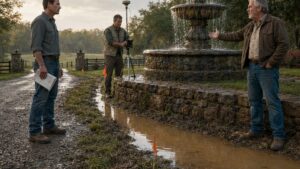
The survey crew drove the new iron marker into the ground three inches from the weathered wooden post.
Raymond heard each strike from the tractor shed.
Steel rang against steel, sharp enough to carry across the field. By the time he walked down to the lane, one surveyor was checking the instrument on its tripod while another brushed loose soil away from the marker.
Edward stood on the opposite side of the gravel.
Neither man had invited the other.
They had simply known the survey was happening.
The old post leaned slightly toward Raymond’s field, its pale scrape still visible from the wedding traffic weeks earlier. Beside it, the new marker looked almost too clean.
The surveyor checked his notes.
“Recorded line falls here.”
He stretched a hand along the lane.
“The old witness post is close, but it was never meant to be the legal monument itself. This marker gives you the surveyed position.”
Raymond nodded.
“How much of the turnaround?”
The surveyor indicated two fresh stakes farther down.
“All of what you’re using for equipment swing is on the Hall parcel.”
Edward looked at the stakes but said nothing.
Raymond had imagined this moment more than once.
In some versions, Edward argued.
In others, Raymond handed him the certified records and watched him finally admit defeat.
Instead there was only the sound of the survey crew packing its equipment.
The facts had become more precise.
That did not make them new.
Edward already knew where the ground belonged.
Raymond had learned that ownership was not the hardest part of the dispute.
When the crew left, Edward remained beside the new marker.
“The field owner called me,” he said.
Raymond waited.
“I took the lease.”
“For the rest of the season?”
Edward nodded.
“And the shuttle?”
“Starts Saturday.”
Raymond felt a small release in his chest.
Not victory.
Something quieter.
“Good.”
Edward looked toward the barn.
“I had to move some money around.”
Raymond almost said that was not his concern.
The words reached his tongue and stopped there.
He had spent weeks learning that there was a difference between holding a boundary and pretending nothing existed beyond it.
“I figured.”
Edward gave him a sideways glance.
“You don’t sound sorry.”
“I’m not paying for it.”
“I know.”
“But I don’t want you ruined either.”
That seemed to surprise Edward more than anger would have.
Raymond crouched and pulled the old wooden post upright as far as the packed soil allowed.
“We need to put this back straight.”
Edward stepped closer.
“It isn’t the legal marker anymore.”
“Never was.”
“Then why keep it?”
Raymond ran a thumb across the weathered grain.
“My father set it.”
Edward’s expression softened.
Raymond had rarely mentioned his father during the dispute. The old man had died years before Edward expanded the barn, but Raymond still remembered one sentence from the last winter they worked together.
Keep the working ground working.
At the time Raymond had thought the promise meant resisting subdivision, selling fields, or letting good soil grow houses.
He understood it differently now.
A farm could lose usefulness a few feet at a time.
So could a relationship.
Edward put one hand against the post while Raymond packed gravel around its base.
They did not speak while they straightened it.
When they finished, the old wood stood beside the new iron marker: one carrying memory, the other precision.
Edward wiped dirt from his palms.
“I still need something from you.”
Raymond stood.
“What?”
“Emergency access.”
“No guest parking.”
“I didn’t say guest parking.”
“No vendor staging.”
“No.”
“No employees.”
Edward frowned.
“You practiced this?”
“Yes.”
For the first time in weeks, Edward almost smiled.
“I mean actual emergencies. Ambulance. Fire equipment. If the front entrance gets blocked.”
Raymond considered it.
The lane was the most direct secondary route to the barn. Refusing emergency access would protect no legitimate farm interest.
But the old Raymond would have said, Sure, if you need it, and walked away.
That was how they had arrived here.
“I’ll agree to emergency vehicles,” Raymond said. “And only emergency vehicles.”
“What if there’s equipment stuck in the main drive?”
“You call me.”
“And if you’re not home?”
“Then we write down what qualifies before either of us signs anything.”
Edward studied him.
“You really are putting everything on paper now.”
“Seems we do better that way.”
Two days later they sat at Carolyn’s kitchen table because she refused to let them finalize anything separately.
She read the proposed agreement twice.
Edward’s leased field would handle all overflow parking. A small shuttle would transport guests along the county road to the event barn. No event traffic, employees, contractors, or vendors would use Raymond’s lane without specific permission.
Emergency vehicles could enter at any time.
If the barn’s main driveway became physically unusable, Edward could contact Raymond for temporary service access, but that permission would apply only to the specific incident.
Carolyn tapped the last page.
“One thing’s missing.”
Edward looked at her.
“What?”
“The old parking.”
Raymond knew immediately what she meant.
“We’re ending it.”
“I know. But this reads like Edward never had permission at all.”
Raymond’s shoulders tightened.
“He doesn’t have permission now.”
“That isn’t what I said.”
Edward remained silent.
Carolyn pushed the paper toward Raymond.
“If you want this agreement to fix the problem, write the truth.”
The old reflex came back quickly.
He owned the lane.
The county map proved it.
Edward had knowingly directed guests there after notice.
Why should Raymond put anything in writing that might weaken his position?
Then he looked through Carolyn’s window.
The old boundary post was visible at the edge of the lane.
For fourteen years he had expected everybody else to understand limits he had never clearly spoken.
A written agreement that erased his own part would be another kind of silence.
Raymond picked up the pen.
He added a sentence acknowledging that limited, informal parking had been permitted in prior years as a neighborly accommodation, without creating permanent parking rights or future entitlement to access.
Edward read it.
“You’re willing to put that in?”
“It happened.”
Edward’s thumb rested on the page.
“I should’ve asked before the expansion.”
“Yes.”
“I should’ve stopped the attendants after your notice.”
“Yes.”
Edward gave him a tired look.
“You could give me one easy answer.”
Raymond almost smiled.
“I could’ve spoken sooner.”
Carolyn looked from one to the other.
“There. Now both of you have something on the page you’d rather not admit.”
Edward signed first.
Raymond signed after him.
There was no handshake.
Carolyn collected the copies before either man could reconsider.
On Saturday afternoon, Raymond watched the first shuttle make its run.
Cars turned into the leased field instead of continuing toward his lane. Guests stepped onto a small bus in dress clothes and jackets, some looking puzzled by the arrangement, most paying little attention.
The shuttle pulled onto the county road.
For an instant Raymond expected it to turn toward his gravel entrance out of habit.
It did not.
It continued to Edward’s main drive.
Raymond’s phone remained silent.
No camera alert.
No plate crossing the post.
No need to open the parking log.
He carried the notebook from the shed to the farmhouse and placed it in a drawer.
He did not throw it away.
It reminded him of something the county plat could not show: how long a person could let a problem grow while telling himself he was keeping the peace.
Several weeks later, the last large event of the season coincided with Raymond hauling a final wagon of hay from the south field.
He came around the familiar bend and saw headlights near Edward’s property.
His hands tightened automatically around the steering wheel.
Then he saw the lane.
Empty.
Not mostly empty.
Not cleared after someone noticed him coming.
Empty.
The weathered boundary post stood upright beside the new iron marker. Beyond it, the gravel turnaround was open from ditch to fence.
Across the county road, rows of guest cars sat neatly in the leased field.
A shuttle waited near them with its hazard lights blinking.
Raymond slowed the tractor as he reached the entrance.
At the same moment, the shuttle pulled onto the road.
For a second the two vehicles moved parallel to each other: the bus carrying wedding guests toward Edward’s barn, Raymond’s tractor pulling hay toward the shed.
Neither had to stop.
Neither had to give up the other’s route.
As Raymond turned onto the farm lane, he saw Edward near the barn entrance.
Edward lifted one hand.
Not an apology.
Not permission.
Just acknowledgment.
Raymond raised his own hand from the steering wheel.
The wagon followed cleanly through the turnaround.
Its rear tire passed the old post with several feet to spare.
Raymond glanced at it once before driving on.
The boundary had not disappeared.
It had become clear enough that neither man had to fight over it anymore.
The story has ended.