They Kept Using His Yard as a Turnaround—Then the HOA Learned Where Its Stormwater Actually Went
Chapter 1: The Eighth Set of Tire Tracks
Michael Harris knew the track was new because the dirt was still wet at the edges.
It cut across the front corner of his lawn in two dark bands, climbed over the patch he had reseeded on Saturday, then curved back toward the paved entrance of the subdivision across the road. One tire had sunk deep enough to fold the grass over like peeled carpet.
He stood beside it with his coffee cooling in one hand.
Eight.
He did not have to count again.
Eight times in six weeks.
The first had been a delivery van. Then a landscaping truck. Then a contractor hauling stone. Twice, vehicles had come across after rain and left mud pressed into the bluegrass. Each time Michael had filled the grooves, scattered seed, tamped the soil flat, and told himself he was not going to become the man who spent retirement arguing about tire marks.
That decision had lasted until the fourth set.
After the sixth, he had called the HOA office.
After the seventh, he had spoken directly to Brian King.
Now there was an eighth.
Michael set the coffee on the hood of his old pickup and crouched beside the deeper rut. He pushed the end of his tape measure into it.
Nearly three inches.
Across the road, the entrance sign for the subdivision stood between two stone pillars, clean enough to look freshly washed. Beyond it were broad driveways, young ornamental trees, and two-story houses set at deliberate angles from the road. The whole development had gone up in stages over the last several years.
Michael’s land had been there much longer.
His house sat back from the county road behind a line of maples, a low brick ranch with a detached metal shop he had built when he was still working full weeks on diesel engines. The property continued behind it into pasture and tree line. He did not need forty acres to make a living anymore, but he liked knowing exactly where they began and ended.
A white SUV slowed at the subdivision entrance.
Michael watched it turn in.
Then he looked back at the rut.
By seven-thirty, he had taken twelve photographs.
Wide shots. Close shots. The tread pattern. The churned grass. A muddy smear on the edge of the gravel shoulder. He placed the tape measure vertically in the deepest section and photographed that too.
He was still doing it when Brian’s car appeared across the road.
Brian King parked near the entrance rather than coming onto Michael’s driveway. He stepped out holding a paper cup and wearing the same kind of pressed golf shirt Michael had seen him in at every HOA meeting he had ever attended as a courtesy.
Brian was in his forties, an attorney by profession and president of the association by choice. He had a way of speaking that made even ordinary sentences sound preapproved.
He glanced down at the tracks.
“Another contractor, I assume.”
“You assume?”
“I didn’t see it happen.”
Michael straightened.
“You told me last week you’d tell them to stop.”
“I told the landscape company to be careful.”
Michael pointed at the rut.
“Does that look careful?”
Brian exhaled through his nose.
“The entrance is tight when trucks are coming out. You know that.”
“I know my yard isn’t part of it.”
“We’re talking about a few feet of grass.”
Michael let the sentence sit between them.
That was the part that bothered him most. Not the repair. Not even the repeated damage.
A few feet of grass.
As if the size of the thing decided whether it belonged to somebody.
Brian took a sip from his cup.
“We can have the landscaper throw some seed down.”
“I don’t need their seed.”
“Then what do you want?”
“I want them to stop driving on my property.”
Brian looked toward the entrance, where a maintenance pickup was waiting for a resident to pass.
“Michael, nobody is trying to take your property.”
“Then staying off it shouldn’t be hard.”
Brian gave him a tired half smile.
“You know this corner has always been used when bigger vehicles need room.”
“No. It’s been used since that subdivision started pretending it had more room than it does.”
Brian’s expression tightened, but his voice stayed even.
“There are practical realities.”
Michael rolled up his tape measure.
“So is a property line.”
For a moment neither man spoke.
Brian finally said, “I’ll remind the contractors again.”
Michael watched him cross the road.
He had heard the word again before.
Back at the rut, he took three more photographs.
Then something caught his eye near the lower edge of the depression.
A round green plastic cap sat almost flush with the soil, half hidden by grass. Michael had mowed around it for years without thinking much about it. He had assumed it belonged to an old utility run or drainage line left from before the development.
This time he crouched beside it.
There were faint raised letters on the lid.
STORM.
Michael brushed dirt off with his thumb.
The cleanout sat only a few feet from where the truck tires had crossed.
He looked toward the subdivision again.
The road sloped almost imperceptibly downward toward his side before rising behind his house. After heavy storms, he had noticed water moving through the ditch in ways it had not twenty years ago. Nothing dramatic. Just faster runoff. More volume.
He had never connected it to the green cap.
Until now.
Michael walked the frontage slowly.
Near the fence line he found another low spot. Then a concrete drainage head farther back, half obscured by weeds. He remembered county crews digging near there when the first phase of the development went in. At the time, someone had told him they were working within an easement.
Michael had never asked much more.
That was his habit.
If something did not interfere with him, he left it alone.
If someone needed temporary room, he usually gave it.
When a neighbor’s tractor once broke down near his gate, Michael had let it sit there for three days. When survey crews needed to cross his field years earlier, he had unlocked the fence without making anyone produce a letter.
He had always thought there was a difference between being easy to deal with and being easy to use.
Now he wondered whether anyone else still saw the difference.
He returned to the deepest rut and took one final picture with the storm cap visible in the background.
At the house, he opened his laptop.
He found the email he had sent the HOA after the sixth incident.
Please instruct contractors and residents not to enter or turn around on my property.
Brian’s reply was two sentences long.
We will remind vendors to exercise care near the entrance. Certain access rights may apply in that area.
Michael read the second sentence twice.
Certain access rights.
He had ignored it at the time because it sounded like lawyer language designed to make a simple thing foggy.
Now he printed the email.
By late afternoon, the damaged grass had begun drying around the tire marks. The edges turned stiff and pale where the mud had been pushed up.
Michael carried a shovel out but stopped before filling them.
Not yet.
For once, he wanted the damage left exactly as it was.
Inside the house, he went to the hall closet and pulled down a battered steel document box that had belonged to his father. It was heavier than he remembered.
Old tax receipts filled the top.
Under them were deeds, insurance papers, surveys, and folded plats with creases so deep the paper had started whitening along them.
Michael set the box on the kitchen table.
He found his property’s deed first.
Then another envelope with the county clerk’s stamp faded almost brown.
Inside was a survey map dated decades before the subdivision existed.
Michael unfolded it carefully.
A narrow strip crossed the front portion of his land.
Next to it, in small type, were two words he had never paid much attention to before.
Drainage easement.
Chapter 2: The Line Brian Could Not Point To
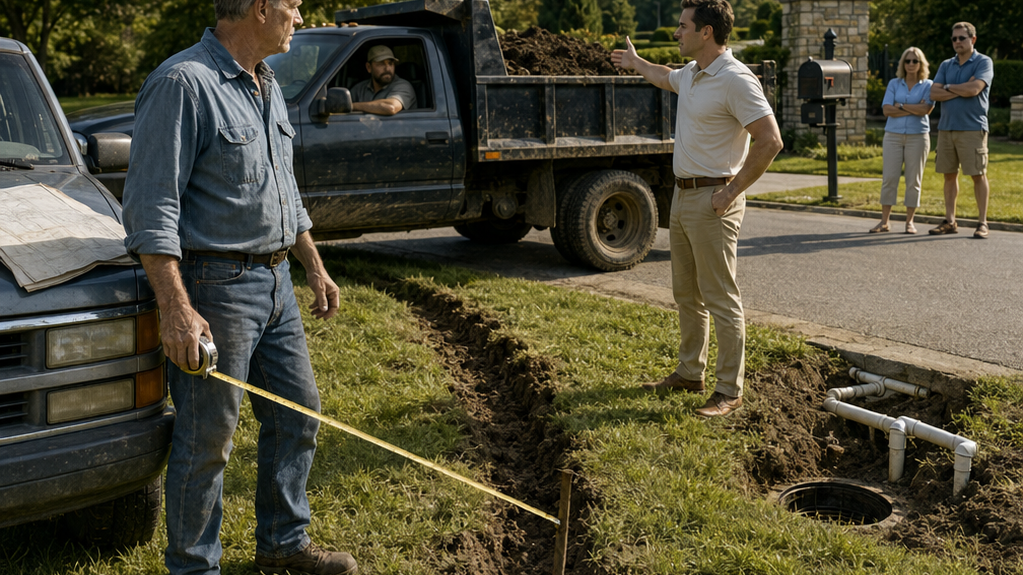
The landscaping truck was already backing toward Michael’s grass when he stepped out of the ditch holding a survey in one hand and a tape measure in the other.
“Hold it there.”
The driver hit the brake.
The truck stopped with its rear tires inches from the edge of Michael’s lawn.
Across the road, Brian King turned sharply.
It had been two days since Michael found the old survey. Two days of tracing faded lines, comparing them to fence posts, and locating an iron boundary pin under twenty years of packed soil.
Now a small orange flag marked the pin.
Michael had driven a second marker farther down the frontage, then stretched his tape between them.
The fresh tire rut from Monday crossed the measured line by several feet.
Brian walked over.
“What are you doing?”
“Finding out where my yard stops.”
Brian glanced at the orange flag.
“We’re trying to get the landscaping done.”
“Then do it without using my property.”
The driver remained in the cab, hands visible on the wheel.
Brian looked toward him.
“You can make the turn. Just keep it tight.”
Michael did not raise his voice.
“No.”
Brian looked back at him.
“No?”
“Not until somebody shows me where you get the right to put that truck over this line.”
A pair of residents walking toward the subdivision mailbox slowed.
Michael noticed them, but he kept his eyes on Brian.
Brian’s jaw tightened.
“We’ve discussed this.”
“We’ve discussed grass. Now I’m asking about the right.”
“The association has an easement.”
Michael unfolded the survey on the hood of his pickup.
“Show me.”
Brian stared at him.
“Show you what?”
“The part that says trucks can use my lawn as a turnaround.”
Brian gave a short laugh without humor.
“Michael, that’s not how an easement works.”
“Good. Then explain how it works.”
Brian stepped closer to the survey.
The paper showed Michael’s parcel as it had existed long before Pemberton Estates had a name. A narrow marked corridor crossed near the front and angled toward a drainage outlet.
Michael tapped it.
“This says drainage.”
“It provides access connected to drainage.”
“Where?”
“The easement language isn’t all printed on the drawing.”
“I know that.”
Michael pulled a photocopy of the deed from beneath the survey.
“I read this too.”
Brian’s expression changed slightly.
Not fear. Not yet.
More like irritation at discovering the conversation would take longer than expected.
Michael continued.
“It gives entry for inspection, maintenance, and repair of the drainage line. I don’t see anything about landscaping trucks turning around because your entrance was built too narrow.”
The driver opened his door.
“Sir, I can just back out and come in another way.”
Brian turned.
“You don’t need to.”
The driver looked from Brian to Michael, then at the tape stretched across the grass.
“I’m not driving across a marked property line if the owner is standing here telling me not to.”
That was the first small shift.
Not victory.
Just a man who had nothing to gain by inheriting somebody else’s argument.
Brian lowered his voice.
“This is getting unnecessary.”
Michael folded his arms.
“Eight times was unnecessary.”
One of the residents near the mailbox lifted a phone, though Michael could not tell whether she was recording or checking a message.
Brian saw it too.
His shoulders squared.
“The easement predates the current development. The association inherited the drainage rights.”
“I’m not arguing that yet.”
“Yet?”
“I’m asking about the trucks.”
Brian looked down at the deed copy again.
“You can’t selectively obstruct access associated with an easement.”
“Then point to the access I’m obstructing.”
Brian did not answer immediately.
Michael could feel his own satisfaction rising, and he disliked how much he enjoyed it.
For two weeks Brian had made him feel like an unreasonable old man protecting a patch of decorative grass.
Now, for the first time, Brian was the one searching for precise words.
Michael placed the end of his tape against the iron pin.
He walked the tape toward the road.
“This is the corner.”
He pointed at the rut.
“That’s four feet inside.”
Then he pointed toward the cleanout.
“And that is about nine feet farther in.”
Brian followed his finger.
“Which is part of the drainage system.”
“Exactly.”
“So you understand there are rights here.”
“I understand there are drainage rights.”
Michael looked at him.
“I don’t understand why you think that means everybody you hire gets a free driveway.”
The landscaping driver closed his door and began backing onto the road.
Brian raised a hand.
The truck kept going.
Michael almost smiled.
He stopped himself.
Brian watched the truck pull away.
Then he said, “You’re making this more adversarial than it needs to be.”
“No. I’m making it specific.”
“And what happens when we need to service that line?”
“You ask.”
“We don’t need your permission every time.”
“Maybe not.”
Michael tapped the deed.
“But according to this, you need a reason.”
Brian’s face had gone still.
That was when Michael noticed something else.
The survey line showed one main drainage route.
But the cleanout near the tire rut was not the only feature Michael had found.
Behind a patch of tall fescue, farther along the easement, three smaller PVC lines entered a junction box at slightly different angles.
He had exposed the tops that morning with a hand shovel.
They looked newer than the main line.
Bright white plastic under the dirt.
The old survey showed nothing branching there.
Michael had assumed the map was simply too old or too general.
Now he was less sure.
He folded the survey.
“I want copies of whatever the HOA has showing changes to this drainage system.”
Brian frowned.
“Why?”
“Because the drawing I have doesn’t match what’s in the ground.”
Brian’s gaze went toward the tall grass.
It was quick.
Too quick.
But Michael saw it.
“What doesn’t match?” Brian asked.
“Three laterals.”
“Those could be service connections.”
“They are service connections.”
“Then what’s the issue?”
“The issue is I don’t know when they got there.”
Brian’s tone sharpened.
“Michael, don’t start digging around infrastructure you don’t understand.”
That hit something in him.
For thirty-seven years, Michael had diagnosed engines that cost more than some of the houses across the road. He had traced hydraulic failures through machines packed tighter than any subdivision drainage box.
But he did not say that.
Instead, he said, “Then give me the drawings.”
Brian looked at the folded survey in Michael’s hand.
“I’ll see what the association has.”
It was not a promise.
But it was different from dismissal.
By evening, Michael had marked the visible pipe positions on a copy of the old survey.
One main route.
Three laterals.
Possibly a fourth, though he could not confirm it without uncovering more.
He measured from the boundary pin and wrote the distances in pencil.
Then he laid the old survey beside a satellite printout from the county property site.
The subdivision’s later phases had added homes uphill from the original drainage corridor.
Michael traced the slopes with his finger.
If the newer laterals served those houses, someone had connected them years after the recorded easement.
Maybe legally.
Maybe not.
The difference mattered.
He sat at the kitchen table until after dark, comparing dates.
The easement was older than Pemberton Estates.
The subdivision’s second phase came decades later.
Michael pulled the deed closer.
For the first time since the argument began, he no longer felt certain that Brian was simply bluffing.
The HOA had real drainage rights.
That part was clear.
What was not clear was whether those rights had quietly grown every time someone added another pipe.
Michael circled the three laterals in pencil.
Then he wrote a single question beside them.
Authorized when?
Chapter 3: The Easement Was Real After All
“That easement is not fake.”
Samuel Thompson said it before Michael had finished unfolding the survey.
Michael stopped.
They were sitting at a scarred laminate table inside the county records office, beneath fluorescent lights that made every old sheet of paper look grayer than it was.
Samuel adjusted his glasses and pulled the document closer.
“You were hoping I’d tell you it expired?”
“I was hoping you’d tell me exactly what it means.”
“That’s different.”
Samuel had worked around county drainage projects for years before retiring from field inspection. Now he helped part-time with old plats, engineering files, and records requests that younger staff did not always know how to interpret.
He ran one finger along the easement corridor.
“This line here is legitimate. Recorded. Runs with the land.”
Michael leaned back.
“So Brian was right.”
“About there being an easement? Yes.”
Michael did not like how the answer landed.
Samuel looked up.
“That’s not the same as saying he’s right about everything.”
He asked for the deed language.
Michael handed it over.
Samuel read slowly.
“Inspection. Maintenance. Repair. Replacement of drainage facilities within the described corridor.”
“Vehicle access?”
“Could be incidental if necessary to perform the work.”
“Turning around landscaping trucks?”
Samuel looked at him over the top of his glasses.
“I wouldn’t want to argue that one with a straight face.”
Michael felt a flicker of satisfaction.
Then Samuel added, “But I also wouldn’t tell you to block their drainage line.”
“I haven’t blocked it.”
Samuel held his gaze for one second longer than Michael liked.
Michael looked down.
Not exactly, he thought.
Three days earlier, while tracing the drainage route, he had placed a removable rubber test plug near an accessible service opening. He had wanted to see which branch carried water after a brief shower.
It was something he had done around shop systems before: isolate one path, observe pressure and flow, remove it.
He had left it longer than intended.
Not enough to seal the main line.
At least, he did not think so.
Samuel gathered several reference numbers.
“Let’s see what was filed after the subdivision expanded.”
They spent nearly an hour moving between paper plats and scanned engineering exhibits.
The first development plan showed the main storm route connecting into the easement on Michael’s property.
That matched his survey.
A later plan showed additional houses uphill.
Then Samuel found a construction sketch from a later phase.
He printed it.
Three thinner lines branched toward the original system.
Michael stared.
“Those are the laterals.”
“Looks like it.”
“Where’s the recorded amendment?”
Samuel did not answer.
He went back to the computer.
Search.
Pause.
Another search.
He asked the clerk for a different index.
Ten minutes later he returned with nothing.
“Could be under a separate instrument,” he said.
“Could be?”
“Michael, old filing systems are not magic. Sometimes things are recorded badly. Sometimes exhibits get attached to agreements nobody indexed correctly.”
“And sometimes they’re never recorded.”
Samuel nodded.
“Sometimes.”
Michael placed his old survey beside the newer engineering sketch.
The main line matched.
The laterals did not exist on the older document.
“Can they just add them?”
“Depends on the scope of the easement, approvals, drainage authority, and what exactly was installed.”
“So no.”
“I didn’t say no.”
“You didn’t say yes.”
Samuel sighed.
“This is why people hire surveyors and attorneys.”
Michael smiled faintly.
“You’re telling me to hire a lawyer?”
“I’m telling you not to make a mechanical decision about a legal system.”
The words stayed with him.
Outside, Michael stood beside his pickup and studied the copies.
For days he had imagined the discovery ending one way: proof the HOA had trespassed, proof Brian had lied, proof Michael could simply shut the whole arrangement down and force everyone across the road to come asking.
Instead the truth had split.
The HOA had rights.
Real ones.
Just not necessarily all the rights Brian had been acting like it possessed.
When Michael got home, the original tire rut had hardened into two brown channels. The mud inside was cracked from the sun. Grass leaned dead along the edges.
He walked past it toward the drainage corridor.
The service opening sat where he had left it.
He crouched and removed the cover.
Water moved below, but more slowly than he expected.
Michael felt something tighten in his stomach.
He reached inside with the hook tool and checked the temporary test plug.
Still there.
He had meant to pull it yesterday.
He had gotten distracted by the records search and Brian’s emails.
Michael removed it immediately.
A stronger rush of water followed.
Not violent. Not dramatic.
But enough to make him stare into the pipe.
He waited until the flow settled.
Then he walked farther downhill and checked the outlet.
The system was moving.
Still, he did not like how long it took.
He pulled out his phone.
The weather alert had updated.
A heavy storm line was expected the following evening, with possible localized flooding.
Michael looked toward the subdivision.
Roofs rose beyond the trees, rows of gutters and driveways feeding water toward lower ground.
Toward the line under his property.
He thought of Samuel’s warning.
Don’t make a mechanical decision about a legal system.
Michael had treated the pipe like a machine because machines had rules he trusted. Pressure went somewhere. Restriction caused a response. Open the path and flow returned.
Property disputes were worse.
Every action carried somebody else’s assumption with it.
He checked the junction again before dark.
One branch still seemed sluggish.
Maybe sediment.
Maybe debris.
Maybe nothing.
He told himself the test plug had been removable, temporary, harmless.
Then he remembered how long it had been in place.
At nine that night, thunderstorm warnings began scrolling across his phone.
Michael stood at the kitchen window watching the first distant flashes over the western tree line.
For the first time since finding the eighth tire track, he was no longer wondering what the HOA had done to his property.
He was wondering what his own stubbornness might have done to theirs.
Chapter 4: When the Water Reached Emily’s Garage
The water in Michael’s tire rut was moving the wrong direction.
He saw it from the porch before the rain became heavy enough to blur the houses across the road. The rut that had begun as two dry brown scars was now a pair of narrow channels, carrying muddy water toward the entrance of Pemberton Estates instead of away from it.
Michael set his coffee down untouched.
Within ten minutes he was outside in a rain jacket, boots sinking into soil that had softened almost instantly.
Water gathered around the storm cleanout.
Not enough to spill yet.
Enough to worry him.
He pulled the cover and listened.
A drain under normal load had a particular sound: water moving with somewhere to go.
This sounded choked.
Michael crouched lower.
The main line was carrying water. He could hear that.
But the lateral feeding from the subdivision was surging and falling, as though pressure were building upstream faster than the junction could accept it.
He swore quietly.
The temporary plug was gone. He had removed it the previous night himself.
But that did not mean the system had returned to normal.
Something might have shifted.
Sediment might have collected while flow was restricted.
Or the whole system might simply have been too close to its limit already.
His phone rang.
Brian.
Michael watched it buzz twice before answering.
“What did you do?”
No greeting.
Michael looked toward the subdivision.
“What happened?”
“We’ve got water standing in the lower driveways.”
“How much?”
“Don’t play games with me.”
“I’m asking because I’m trying to figure out what’s happening.”
“You’ve been inside our drainage line.”
Michael closed his eyes briefly.
“I tested a service point.”
“You did what?”
“It was temporary.”
“You had no authority to touch it.”
“And you had no authority to keep driving trucks across my yard.”
“This isn’t about your grass anymore.”
That much was true.
Michael looked at the water gathering along the road.
“No,” he said. “It isn’t.”
He hung up before Brian could answer.
A vehicle came fast through the subdivision entrance and stopped partly in the road. A woman stepped out without an umbrella.
She was soaked before she crossed halfway.
Michael had seen her before at the mailbox but did not know her name until she said it.
“Emily Miller.”
She was breathing hard.
“My garage is taking water.”
Michael’s attention sharpened.
“Inside?”
“Not yet. It’s at the threshold.”
“Which house?”
She pointed into the subdivision.
“Third street down. Lowest house on the left.”
Michael pictured the engineering sketch from the records office.
One of the three laterals ran directly toward that section.
He started toward his truck.
Emily followed him.
“Did you block it?”
Michael stopped.
The question was not angry.
That made it worse.
She looked frightened.
Not offended. Not indignant.
Frightened.
“I restricted one service opening temporarily,” he said. “It’s open now.”
“Why?”
“I was tracing the branches.”
“In a storm system?”
“There wasn’t a storm when I did it.”
“But you left something in there?”
“For longer than I should have.”
Her face changed.
Michael could have defended himself.
He could have explained the tire damage, Brian’s dismissals, the missing laterals, the survey that did not match what was underground.
Instead he said, “Show me your house.”
The subdivision road was already carrying a shallow sheet of brown water along one curb.
At Emily’s driveway, runoff spread across the concrete in a wide fan.
Her garage sat lower than the street.
Michael understood the problem immediately.
“You got a floor drain?”
“Inside.”
“Keep the door closed.”
“The water’s almost under it.”
Michael walked to the curb inlet.
The grate was clear.
So the restriction was farther down.
He traced the direction toward the drainage corridor on his property.
Brian arrived before Michael reached the road again.
He came through the rain without a jacket, his shirt plastered to his shoulders.
“You need to open that line.”
“It’s open.”
“Then why is this happening?”
“I don’t know yet.”
“You were inside it.”
“I know.”
Brian stepped close.
“If these houses flood because you decided to conduct your own experiment—”
“Then standing here isn’t helping.”
Michael turned to Emily.
“Do you have a wet vacuum?”
She nodded.
“Get it ready. Towels along the bottom of the garage door. Anything stored low, get it up.”
Then he looked at Brian.
“Call whoever services your storm system. Tell them the restriction may be at the junction near my frontage.”
Brian stared at him.
“You are not directing my contractors.”
“No. I’m telling you where I think the problem is.”
Michael went back across the road.
At the service opening, the water level was higher.
He inserted the hook tool, feeling carefully along the inside edge.
Nothing.
Then something soft scraped against it.
He pulled.
A wad of leaves and silt came loose, followed by a rush strong enough to jerk the tool from his hand.
Water roared through the line.
Michael stepped back.
The level dropped visibly.
He did not feel relief yet.
He drove back to Emily’s house.
The water had reached the rubber seal at the garage door but had not crossed it.
Five minutes later, it began receding.
Emily stood beside him under the garage overhang.
“You fixed it?”
“I cleared something.”
“Was it because of what you did?”
Michael watched dirty water retreat down her driveway.
“I don’t know how much.”
It would have been easy to say no.
He could have blamed leaves, undersized pipes, bad grading, or the laterals that might never have belonged there.
All of those things might be true.
But he had put the plug in.
“I shouldn’t have left that test plug where I did,” he said.
Emily folded her arms against the cold.
“I thought you hated all of us.”
Michael looked at her.
“What?”
“That’s what it sounds like when Brian talks about you.”
Michael almost laughed.
Instead he said, “I don’t know enough of you to hate you.”
For the first time, she smiled slightly.
Then it vanished.
“Most of us didn’t know anything about your property.”
“The drainage easement?”
“Any of it.”
Michael looked toward the HOA entrance.
Emily lowered her voice.
“Brian did.”
Michael turned back.
“What do you mean?”
“Months ago there was a board discussion about stormwater.”
“About what?”
“I wasn’t on the board then. My neighbor was.”
Rain struck the aluminum gutter above them.
Emily hesitated.
“Apparently an engineer told them some of the drainage setup needed work. Maybe rerouting. Maybe permits. I don’t know the exact details.”
“How long ago?”
“Late winter.”
Michael said nothing.
“Brian argued against bringing it to the full membership,” Emily continued. “He said they needed more information because it could mean a special assessment.”
“How much?”
“I heard several thousand per house.”
Michael looked at the receding water.
Brian had spoken about the easement as though nothing about it were uncertain.
As though Michael were the only complication.
Emily added, “I’m not defending him.”
“No?”
“I’m telling you he may be scared of thirty homeowners asking why their dues didn’t cover a drainage system they thought was already settled.”
Across the road, Brian stood near the storm opening with a contractor.
Michael’s phone buzzed.
An email.
He opened it.
The subject line read: EMERGENCY ACCESS DEMAND.
The message stated that the HOA required immediate and continuing access to inspect and service drainage facilities affected by Michael’s interference.
Michael read it once.
Then again.
Emily watched his face.
“From Brian?”
“From the association.”
She nodded slowly.
Michael looked back at the tire rut.
Rainwater still ran through it, but now it was draining away.
The same groove that had begun the fight had nearly carried the consequences into somebody else’s garage.
He folded the phone into his palm.
“Emily.”
“Yeah?”
“You said Brian knew there could be an assessment.”
“That’s what I was told.”
“Before he ever told me this was just about a few feet of grass?”
She looked toward the subdivision.
“Months before.”
Chapter 5: The Problem Brian Had Already Priced
Michael’s name was printed in bold on the first page of the HOA meeting packet.
EMERGENCY DRAINAGE INTERFERENCE — MICHAEL HARRIS PROPERTY.
He stood just inside the meeting room door reading it while residents took folding chairs around him.
No one had called him.
Emily had forwarded the meeting notice.
Brian sat at the front table beside the HOA attorney, arranging papers into neat stacks.
When he saw Michael, his expression did not change.
“You received notice?”
“Eventually.”
“This is a homeowners’ meeting.”
“I’m the subject of the first item.”
Brian glanced toward Emily, who was seated three rows back.
“You’re welcome to speak when recognized.”
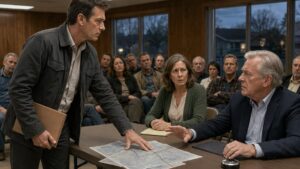
Michael took a seat near the aisle.
He had brought one folder.
Inside were photographs of the tire tracks, the recorded survey, the newer engineering sketch, the emergency access demand, and a color picture of the deepest rut with the tape measure standing upright in it.
He had considered bringing more.
He had considered making the folder thick enough to drop onto the table like evidence in a courtroom drama.
Instead he brought only what mattered.
Brian opened the meeting by describing the storm.
He was careful.
He did not say Michael had intentionally flooded anyone.
He said there had been “unauthorized interference with drainage infrastructure located within an easement area.”
That phrasing drew nervous looks.
Then Brian discussed the obligation to protect common infrastructure.
A resident near the front raised a hand.
“Was Mr. Harris allowed to block it?”
Brian looked toward Michael.
“No.”
Michael spoke before he was recognized.
“That’s not exactly what happened.”
The attorney leaned toward Brian.
Brian paused.
“Mr. Harris will have an opportunity.”
Michael sat back.
That was when he noticed something interesting.
Brian was not enjoying this.
He looked tired.
There were shadows under his eyes, and every time someone mentioned possible repairs, his fingers pressed harder against the edge of the packet.
When Michael was finally invited forward, he did not begin with the drainage line.
He held up the photograph of the rut.
“This is where this started.”
Several residents leaned forward.
“This was the eighth time in six weeks a vehicle connected to work in this subdivision crossed my property.”
Brian said, “That issue is separate.”
Michael looked at him.
“It was separate until every time I objected, I was told the association had access rights.”
He put the old survey on the table.
“This is the easement.”
Then the newer sketch.
“This is what is actually underground.”
The room became quieter.
Michael tapped the three laterals.
“I am not claiming the main drainage line is illegal. It isn’t. I learned that after checking the county records.”
That admission shifted the room more than an accusation would have.
A resident asked, “So what is illegal?”
“I don’t know that anything is illegal.”
Michael looked directly at Brian.
“I know these three laterals aren’t shown on the original recorded exhibit, and I know the county couldn’t immediately find an amendment covering them.”
The attorney spoke.
“Absence from that exhibit does not establish lack of authority.”
“I agree.”
Michael heard a murmur behind him.
Brian’s eyes narrowed slightly.
Michael continued.
“But it also doesn’t establish authority.”
Emily raised her hand.
“Was there already a plan to fix the drainage?”
Brian looked at her.
“What plan?”
“The engineering review from winter.”
The room changed.
Not loudly.
Just enough.
A few heads turned toward Brian.
One board member stopped writing.
Brian said, “That review was preliminary.”
Emily did not sit back.
“Did it recommend rerouting some connections?”
“It identified several options.”
“Did one of those options include building a proper turnaround so contractors wouldn’t need Mr. Harris’s grass?”
Michael had not known that part.
Brian looked down at the table.
The attorney whispered something.
A resident in the front row said, “What engineering review?”
Brian inhaled slowly.
“We commissioned a drainage and entrance-access assessment earlier this year.”
“Why weren’t we told?”
“Because it was not final.”
“How much?”
No one answered.
The question came again from farther back.
“How much was the estimate?”
Brian’s composure finally cracked at the edges.
“The highest preliminary option was significant.”
“How much?”
He looked around the room.
“Depending on scope, potentially several thousand dollars per lot.”
The reaction was immediate.
Not shouting.
A collective movement. Chairs shifted. People looked at spouses. Someone muttered that dues had already increased.
Michael watched Brian absorb it.
For the first time, he understood something he had not wanted to understand.
Brian had not been protecting some abstract HOA empire.
He had been trying to avoid becoming the man who told thirty households they might owe thousands of dollars.
That did not excuse him.
But it explained the pressure.
Brian said, “I delayed presenting an incomplete proposal because I believed further review could reduce the cost.”
Michael asked, “And while you were delaying it, why did you keep telling contractors they could use my frontage?”
Brian’s eyes moved to him.
“Because the entrance still had to function.”
“You knew there was a proposed turnaround.”
“I knew there was an expensive proposed turnaround.”
“And you decided my lawn was cheaper.”
Silence.
Brian could have dodged.
Instead he said, “In practical terms, yes.”
The answer landed harder than denial.
Michael felt anger rise again.
Then he saw Emily.
She was not looking at Brian.
She was looking at the packet in her lap, calculating something.
Several thousand dollars.
Mortgage.
Insurance.
Groceries.
Repairs.
The dispute had grown larger than the two men who started it.
The HOA attorney stood.
“Regardless of later infrastructure questions, the recorded easement appears broad enough to support emergency access where necessary to preserve drainage.”
Michael nodded.
“Emergency access.”
“Correct.”
“Not landscaping trucks?”
The attorney paused.
“That is a separate factual question.”
Brian looked away.
There it was.
Small, but real.
The room had finally separated the issues Brian had kept blending together.
After the meeting, Michael went directly to the county engineering counter with copies of the newer sketch.
A civil engineer reviewed them while Michael waited.
The engineer traced the original trunk line.
“This one is protected by the recorded corridor.”
Then the laterals.
“These appear to have been added later.”
“Can they stay?”
“Not necessarily in their present configuration.”
“Even if the HOA has emergency access?”
The engineer shook his head.
“Access and authorization are different things.”
Michael felt the distinction settle into place.
Exactly the distinction he had been asking Brian to make.
The engineer continued.
“If these laterals fall outside the recorded scope or don’t comply with the approved drainage plan, they’ll need to be documented, modified, or rerouted. Emergency access doesn’t cure that.”
Michael looked through the glass doors toward the parking lot.
He had wanted leverage.
Now he had it.
But leverage was no longer a simple thing.
If he demanded everything at once, Brian could tell residents Michael Harris was the reason for a special assessment.
And he would not be entirely lying.
Michael folded the engineering sketch.
“So they can’t leave it like this forever?”
“No.”
The engineer slid the papers back.
“Whatever temporary access exists, somebody is going to have to correct those laterals.”
Chapter 6: Forty-Eight Hours Before Anyone Crosses
Michael stared at the number he had written at the top of the page.
$12,500.
He crossed it out.
The pen tore slightly through the paper.
For three days he had been drafting terms at his kitchen table.
Damage compensation.
Survey expenses.
Attorney review.
Access fees.
Restoration.
Then, late the previous night, anger had taken over the arithmetic.
He had added a figure large enough to make Brian feel what inconvenience cost.
Now, in daylight, it looked exactly like what it was.
Punishment.
Michael crumpled that page and started over.
The survey lay open beside him.
Once it had represented leverage.
Now it looked more like a set of instructions neither side had bothered to read carefully enough.
At ten, Brian arrived with the HOA attorney and a revised engineering proposal.
They met at Michael’s kitchen table.
No audience.
No meeting packet.
No contractors waiting with engines running.
Brian placed the plan in front of him.
“The engineer believes we can preserve the original trunk line.”
Michael examined it.
The questionable laterals would be redirected to a new collection point inside HOA property. A gravel turnaround would be built just beyond the entrance, wide enough for maintenance and landscaping trucks.
“No more turning on my frontage?”
“No.”
Michael looked up.
Brian added, “Assuming the project is approved.”
There it was.
The cost.
Michael read further.
Routine inspection access would still be required through the old easement corridor.
He slid his draft agreement across the table.
“Forty-eight hours’ written notice for routine entry.”
Brian read the line.
“No.”
Michael leaned back.
“Then we’re done early.”
“Emergency drainage work cannot wait forty-eight hours.”
“I said routine.”
“Your draft says access.”
Michael pulled the paper back.
He read it again.
Brian was right.
Michael hated that.
He crossed out the sentence.
“Emergency access for active flooding, line failure, or imminent property damage,” he said. “No advance notice where it isn’t practical.”
The attorney nodded.
“That’s workable.”
Brian pointed to another section.
“You also require forty-eight hours before inspections.”
“Routine inspections.”
“What if we detect a failure?”
“Then it’s not routine.”
They went back and forth for nearly an hour.
Not arguing about ownership anymore.
Defining words.
Emergency.
Routine.
Repair.
Inspection.
Restoration.
Vehicle access.
Each term closed one hole and exposed another.
Michael realized this was what he should have demanded months earlier.
Specificity.
Not silence followed by anger.
Brian tapped the compensation section.
“We’ll restore documented lawn damage.”
“Eight incidents.”
“Documented incidents.”
“I have photographs of six.”
“We’ll pay six.”
Michael looked at him.
Brian looked back.
Michael almost argued out of principle.
Instead he said, “Six, plus reseeding the full affected strip.”
Brian considered it.
“Agreed.”
The number felt less satisfying than twelve thousand five hundred dollars would have.
It also felt cleaner.
By noon, they had reduced the dispute to four pages.
The original trunk line would remain.
The questionable laterals would be removed or rerouted following county review.
Routine access required notice.
Emergency access did not.
Vehicles performing easement work could enter only as reasonably necessary.
Landscaping, deliveries, and ordinary contractor traffic could not use Michael’s property as a turnaround.
Any damage caused during authorized work had to be restored.
Brian gathered the papers.
“There’s still one problem.”
“The vote.”
Brian nodded.
“The board can’t commit to the construction package without membership approval.”
“How much?”
Brian told him.
Michael whistled softly.
Less than the worst estimate from winter.
Still enough to hurt.
“You knew that number before the storm?”
“Not that number.”
“But you knew it wouldn’t be cheap.”
Brian sat back.
“Yes.”
Michael waited.
Brian rubbed one thumb along the edge of the plan.
“You think I was trying to take your land.”
“I think you were trying to use it because it was easier than telling people the truth.”
Brian did not answer immediately.
Then he said, “Do you know what happens when you tell thirty households they’re getting an assessment because an entrance designed six years ago isn’t adequate?”
“No.”
“They don’t call the engineer.”
Michael almost smiled.
“No. I imagine they call you.”
“They call me. They ask why we didn’t catch it. Why the developer didn’t pay. Why reserves won’t cover it. Why dues went up last year.”
“And your answer?”
“Usually that infrastructure doesn’t care whose fault something was.”
Michael looked at the survey between them.
“Neither does a property line.”
Brian nodded once.
Not agreement exactly.
Recognition.
After they left, Michael took a wheelbarrow to the frontage.
He filled the deepest tire rut with topsoil.
Then the second.
He tamped them down with the flat of his shovel.
When he reached the section nearest the iron pin, he stopped.
He left six feet unrepaired.
Not as a threat.
As a reminder that the dispute was not finished.
That afternoon Brian returned alone.
He carried a revised copy of the access agreement.
Michael read the changed language.
Routine entry: forty-eight hours’ notice where practicable.
Emergency entry: immediate, with notice as soon as reasonably possible.
No unrelated vehicle turnaround.
Restoration required.
Michael signed the draft subject to formal HOA approval.
Brian did not offer his hand.
Michael did not either.
Instead they walked to the frontage.
The old survey was clipped to a board between them.
Michael pointed at the line he had measured during the contractor confrontation.
“The new turnaround stays over there.”
Brian followed the line with his eyes.
“Yes.”
“And these laterals?”
“Removed if the engineer confirms they’re outside the permitted system.”
“Not grandfathered because they’ve been there awhile.”
“No.”
Michael looked toward the houses.
Brian said, “You understand the residents still have to approve the money.”
“I do.”
“And if they don’t?”
“Then we haven’t solved it.”
Brian nodded.
For once, neither man pretended otherwise.
The vote notice went out that evening.
Brian scheduled it for the following Tuesday.
Michael received a copy by email.
No legal threat.
No accusation.
Just a meeting agenda with one binding question: whether Pemberton Estates would fund the drainage correction and construct its own vehicle turnaround.
Michael printed the notice and set it beside the old survey.
Outside, six feet of the original tire rut remained open against the green grass.
For the first time, the choice was no longer whether Brian would respect Michael’s boundary.
It was whether the entire subdivision was willing to pay the actual price of doing so.
Chapter 7: The Turnaround Finally Stayed Across the Road
The utility truck slowed at Michael’s frontage, its right wheels drifting toward the strip of grass where the deepest rut had once been.
Michael stopped with a bag of seed in his hand.
For half a second, the old reaction came back automatically.
His shoulders tightened.
He was already picturing another tread mark cutting across the repair.
Then the driver turned the wheel.
The truck crossed the road and rolled onto the new gravel turnaround inside Pemberton Estates.
Michael stood still until it stopped completely.
Six weeks earlier, that simple maneuver would have seemed too small to matter.
Now it felt like proof.
The new turnaround was not pretty. Fresh limestone covered a broad crescent beside the entrance, pale against the darker pavement. Orange construction flags still marked one edge, and a section of disturbed earth showed where the drainage work had been completed.
But it was entirely on HOA property.
No tires touched Michael’s grass.
He looked down at the remaining six-foot section of the old rut.
He had kept it open through the vote, through the engineering revisions, and through the first week of construction. Rain had softened it twice. Grass had begun creeping in from the edges anyway.
The vote had passed.
Not easily.
Emily had told him afterward that the meeting lasted nearly three hours. Several homeowners had objected to the assessment. One had demanded to know why the developer had not solved the problem years earlier. Another wanted the association to sue Michael instead.
Brian had not supported that.
That had surprised Michael more than the vote itself.
According to Emily, Brian had stood in front of the room and told them the association could argue about blame for another year, but the drainage lines would still be in the wrong place and the entrance would still be too narrow.
He had also admitted that delaying the issue had made it harder.
The residents approved the project by enough votes to make the decision binding.
They also changed the board’s procedures.
Future easement disputes could no longer be handled solely by the president. Any new interpretation of recorded access rights required board review and written notice to affected property owners.
Brian remained president.
Michael had expected him to resign.
Instead he stayed.
Maybe that took more pride than leaving would have.
The utility crew supervisor crossed the road toward Michael.
“We’re ready for the final inspection on the trunk line.”
Michael nodded.
“You have the notice?”
The supervisor smiled slightly and pulled a folded sheet from his vest pocket.
“Forty-eight hours.”
Michael took it.
The date and time were correct.
Purpose of entry: final camera inspection of existing lawful stormwater trunk line.
Equipment: one inspection cart, one service vehicle.
Estimated duration: ninety minutes.
Michael folded the paper once.
“Gate’s open.”
The supervisor started back.
A white car pulled in behind the utility truck.
Brian stepped out.
Michael watched him walk across the road.
He carried another copy of the notice even though the supervisor had already delivered one.
“You’ve got it?” Brian asked.
Michael held up the folded sheet.
“Got it.”
Brian glanced at the grass.
“You going to make me ask too?”
Michael looked at him.
Brian’s expression was difficult to read.
Not joking exactly.
Not confrontational either.
Michael said, “You’re here for the inspection?”
“Yes.”
“Then you’re covered by the notice.”
Brian nodded.
Neither man moved for a moment.
Six weeks had changed the frontage more than Michael expected.
The questionable laterals were gone.
Two had been rerouted entirely inside the subdivision. The third had been replaced with a new connection documented under the revised drainage plan.
The lawful trunk line remained where it had always been.
That part had mattered to Michael.
He had spent so much time imagining the easement as something taken from him that he had nearly forgotten it had been part of the property long before Brian King appeared.
It was not an insult.
It was an obligation attached to the land.
What mattered was keeping that obligation from quietly expanding into whatever somebody found convenient.
Brian looked toward the gravel turnaround.
“The landscaping company likes it.”
“Good.”
“They say they should’ve had it from the beginning.”
Michael gave him a flat look.
Brian almost smiled.
“I know.”
The inspection crew opened the service point and fed a camera into the trunk line.
Michael stayed nearby, not because he distrusted them exactly, but because six weeks was not long enough to erase habit.
On the monitor, the inside of the pipe appeared in gray-white circles.
The supervisor called out distances.
The line was clear.
At the old junction where the unauthorized laterals had once entered, new sealed connections were visible.
Everything matched the revised plan.
Samuel Thompson had reviewed the final drawings before county signoff. He had refused to call the outcome a victory when Michael showed him the recorded agreement.
“Looks more like maintenance,” Samuel had said.
Michael had understood what he meant.
Property ownership was not one dramatic moment when somebody finally recognized a line.
It was the dull work of keeping that line understandable.
Paperwork.
Notice.
Repair.
Permission.
Sometimes saying no early enough that nobody had to hear you shouting later.
The camera reached the outlet.
“Clean all the way through,” the supervisor said.
Michael nodded.
Brian stood several feet away with his hands in his pockets.
“You know,” Brian said, “I still think you shouldn’t have touched that service line.”
Michael looked at him.
“I shouldn’t have.”
Brian seemed prepared for an argument and had nowhere to put it.
Michael continued.
“I was angry.”
“That’s not much of a defense.”
“It wasn’t meant to be.”
Brian looked toward the subdivision.
“My attorney told me not to admit anything to you.”
“Smart attorney.”
“He also said the vehicle issue was harder to defend than I made it sound.”
Michael picked up the seed bag.
“You could’ve told me that sooner.”
Brian nodded.
“So could you.”
Michael stopped.
The answer irritated him because it was partly true.
He could have gone to the records office after the second incident.
He could have sent a formal letter after the third.
He could have marked the boundary before the fourth.
Instead he had tolerated each small violation until the eighth one became proof of every disrespect he thought he had swallowed over the years.
Brian had been wrong to use that patience as permission.
Michael had been wrong to believe silence made him reasonable.
“Probably,” he said.
Brian looked surprised again.
The inspection finished without trouble.
Before leaving, the supervisor replaced the service cover and walked the easement corridor with Michael. The disturbed soil would settle over the next few months. The HOA had agreed to repair any erosion from the work.
At the road, the utility truck turned onto the new gravel pad, backed once, then pulled away without crossing Michael’s frontage.
Michael watched it go.
Brian remained.
“The assessment notices went out,” he said.
“Emily told me.”
“Some people are still angry.”
“At me?”
“At everybody.”
“Fair enough.”
Brian rubbed the back of his neck.
“One homeowner asked why we were paying to repair your grass.”
“What did you tell them?”
“That we damaged it.”
Michael looked at him.
There was no ceremony in the sentence.
That made it better.
Brian added, “For what it’s worth, the board approved the full strip, not just the six photographed incidents.”
Michael nodded.
“Appreciate it.”
The words sounded strange between them.
Brian seemed to think so too.
He stepped toward the road.
Then stopped.
“We’ll have another routine inspection in the spring.”
“Send the notice.”
“I will.”
Michael did not ask for an apology.
Brian did not offer one.
Maybe there were things that sounded cleaner in stories than they did between two men standing beside a repaired drainage line.
Michael no longer needed Brian to say he had been right about everything.
He had not been right about everything.
That was part of the point.
After Brian left, Michael carried the seed bag to the unfinished section of rut.
He filled the shallow groove with the last of the topsoil and worked it level with the back of a rake.
Across the road, a landscaping trailer entered Pemberton Estates.
The driver used the gravel turnaround without hesitation.
Michael scattered seed over the repaired strip.
He pressed it into the soil with the flat of his boot.
Beneath him, several feet down, water moved steadily through the old trunk line.
The sound was too deep to hear.
But he knew it was there.
The line belonged to the easement.
The grass belonged to him.
Neither fact needed to erase the other.
Michael looked once at the iron boundary pin near the road.
He had cleaned the rust from its top during construction, then left it visible instead of covering it again.
Not as a warning.
Just so no one had to guess.
He pressed the last handful of seed into the final trace of the tire rut.
Then he picked up the empty bag and walked back toward the house while the next truck stayed exactly where it was supposed to.
The story has ended.