The HOA Marked His Workshop for Removal—Then Learned Who Actually Owned the Road Beneath Their Trucks
Chapter 1: The Orange Line Across His Gravel
The orange paint appeared six feet from Robert Miller’s workshop door before anyone asked him a question.
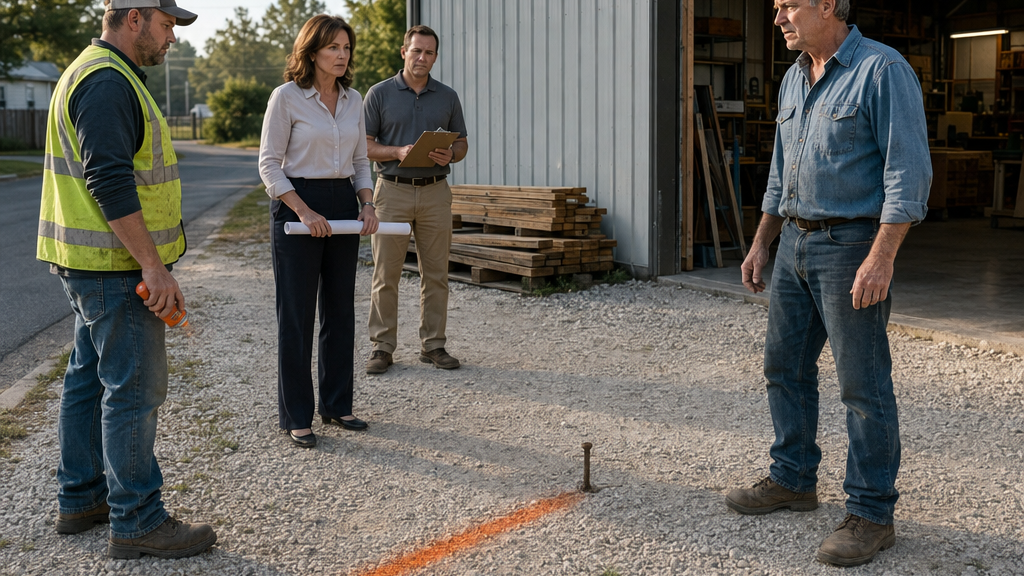
He heard the hiss of the spray can through the open bay, sharp against the steady hum of his dust collector. By the time he stepped outside, a contractor in a fluorescent vest had already drawn a bright line across the pale gravel where Robert backed his truck in every morning.
Robert looked at the line.
Then at the man holding the can.
“Who told you to put that there?”
The contractor lowered his arm and glanced toward the service lane.
Christine Wright was walking toward them with a rolled site plan under one arm. Kevin Carter followed with a clipboard and the careful expression of a man who had come prepared to explain something after it had already been decided.
Christine stopped just short of the orange stripe.
“Morning, Robert.”
He did not return the greeting.
“What is this?”
“The widening limit.”
“For what?”
“The service lane.”
Robert looked past them toward the narrow paved road that ran beside his property before curving behind the last row of houses. Delivery trucks used it. Waste collection used it. Landscapers used it. So did Robert, because his workshop had been there before most of the subdivision.
Christine unrolled the plan against the hood of Kevin’s SUV.
“We sent three notices.”
“You sent three pieces of paper saying the board was reviewing access.”
“The final notice stated the work schedule.”
Robert knew that. He had read the first page, seen the familiar association header, and put it beneath a stack of invoices. He had assumed the matter concerned landscaping or drainage farther down the lane.
He had stopped attending HOA meetings two years earlier.
Too much talking. Too many votes over things that should have been handled with a tape measure and common sense.
Christine placed one finger on the drawing.
“The lane has to meet the access width shown here. The contractor is marking the common-area boundary. Everything inside this line has to be cleared.”
Robert followed her finger.
The shaded strip ran straight through the edge of his gravel apron.
A rack holding maple boards stood inside it. So did the turning space he used for deliveries.
“How much?”
“Approximately eight feet along this section.”
“Eight feet of my property.”
Christine’s face tightened slightly.
“Common property.”
Robert looked at Kevin.
Kevin nodded toward the plan. “That’s how it’s recorded in the association documents.”
Robert had spent thirty-seven years measuring before he cut anything. Cabinet doors exposed mistakes smaller than an eighth of an inch. Walls wandered. Floors sagged. Old houses lied constantly, and drawings lied often enough that he had learned never to trust a line until he knew what had established it.
He crouched beside the orange paint.
The gravel was packed hard from years of trucks. He brushed aside loose stone with the side of his hand.
Christine exhaled.
“Robert, we’re not trying to make this difficult.”
He kept brushing.
A rust-dark circle appeared beneath the dust.
Then a short iron pin.
Robert cleared another inch around it.
The contractor shifted his weight.
Kevin leaned closer.
Robert stood and wiped his palm against his jeans.
“That was there when my father bought this place.”
Christine looked from the pin to the orange line.
They were several feet apart.
“What is it?” Kevin asked.
“Survey pin.”
Christine glanced at the plan again. “It may be an old construction marker.”
“It isn’t.”
“How do you know?”
“Because I watched the surveyor flag it when we put the shop in.”
That was nineteen years ago. Robert could still see his father standing beside him with a thermos in one hand while the concrete crew stretched string across the forms.
The shop had not been assembled by strangers while Robert watched. He had poured the slab with two friends and his father. He had framed the office inside it, wired half the outlets himself before an electrician inspected them, and laid the gravel a truckload at a time.
Christine rolled the plan tighter.
“The board’s map is recorded.”
“With who?”
“The association.”
“That isn’t what I asked.”
A small silence settled between them.
Kevin spoke first. “If you have a competing survey, send it to management and we’ll forward it for review.”
Robert pointed toward the pin.
“You’re standing next to one of the reasons you should have reviewed it before painting my property.”
Christine’s restraint thinned.
“We have an insurance inspection coming up. The lane has been identified as an access concern. This isn’t about taking your workshop.”
“You just painted a line through the place trucks need to reach it.”
“We are widening a shared lane.”
“Across whose land?”
“The site plan identifies it as common area.”
Robert looked at the drawing again.
The workshop was represented by a simple rectangle. His gravel apron was blank. The lane beside it appeared wider on paper than it did beneath their feet.
He had the uncomfortable sensation of looking at a picture of his own property drawn by someone who had never stood there.
The contractor raised the can.
Robert looked at him.
“Don’t.”
The man stopped.
Christine said, “He needs to finish marking.”
“Not past that pin.”
“Robert.”
“You want to prove it belongs to the association, prove it. Until then, nobody moves lumber, cuts gravel, or changes anything on this side.”
Kevin opened his clipboard.
“I need to be clear about the schedule.”
Robert turned toward him.
Kevin removed a printed notice and held it out.
“Property within the marked improvement area must be cleared within ten calendar days. If it isn’t, the association may arrange removal under the governing documents and charge related costs back to the owner.”
Robert took the sheet but did not read it.
Ten days.
Christine looked tired now rather than angry.
“You could make this easier by coming to the meetings before decisions are finalized.”
Robert folded the notice once.
“You could make it easier by checking where my property ends before you tell me to clear it.”
For a moment neither of them said anything.
Then Christine told the contractor to stop marking at the workshop until management reviewed Robert’s objection.
It should have felt like a small victory.
Instead Robert watched them walk back toward the lane and noticed that the orange line already crossed twenty feet of his gravel.
A hard, fluorescent declaration that somebody else believed they knew where his land ended.
He went back inside, but the shop did not feel the same.
The cabinet carcasses waiting on his assembly table seemed suddenly temporary. The stacked lumber by the wall. The rolling tool chest. The old pencil marks still visible on one corner post where his father had checked the height of the first cabinet Robert ever built in the place.
Robert set Kevin’s notice on the bench.
He told himself he would find the deed after work.
He told himself the pin was enough.
At eleven forty-three, his phone rang.
The delivery driver sounded irritated.
“I’m sitting at your back entrance.”
Robert looked through the open bay toward the lane.
“What’s wrong?”
“Contractor’s got a trailer sideways across it. Says I can’t come through.”
Robert stepped outside.
From where he stood, he could see the top of a utility trailer blocking the service lane.
The driver continued, “You want me to take this load back?”
Robert stared at the orange paint across his gravel.
“No,” he said.
But he had no idea yet how he was going to get the truck to his door.
Chapter 2: Three Days Without a Loading Lane
The lumber truck was forty feet from Robert’s workshop and might as well have been across town.
A contractor’s equipment trailer occupied the narrowest part of the service lane, its rear ramp dropped onto the pavement. Stacks of cones stood beside it. A compact loader sat farther back, nose angled toward the shoulder.
Robert walked down the lane until the delivery driver lowered his window.
“They told me they’d be here all morning.”
Robert looked toward the contractor.
“How long do you need to unload?”
“Twenty minutes if I can back to the bay. Two hours if you want me carrying sheet goods from here.”
Robert did not.
The load included walnut plywood, maple stock, and two prefinished panels that would show every ding they received.
He walked to the trailer.
“Who’s in charge?”
A worker pointed toward a man near the loader.
Robert told him he had a scheduled commercial delivery.
The man shook his head. “We’re staged here under HOA authorization.”
“You can move the trailer twenty feet.”
“Not while the loader’s operating.”
“The loader isn’t operating.”
“It will be.”
Robert took out his phone and called Kevin.
Voicemail.
He called Christine.
She answered on the fifth ring.
“The contractor has blocked my loading access.”
“They’re doing preliminary work.”
“My truck is here now.”
“They should be able to accommodate residents.”
“I’m not asking what they should be able to do.”
A pause.
“I’ll call the project supervisor.”
“How long?”
“Robert, I don’t control where every piece of equipment sits minute by minute.”
“No. You just authorized them to sit here.”
He heard her breathe in.
“This is exactly why the board has been trying to address the lane. There isn’t enough space.”
Robert looked at the idle loader and the trailer.
“That argument works better when you’re not the one blocking it.”
He ended the call before she could answer.
The trailer moved seventy minutes later.
By then the driver had another stop to make and left after unloading only part of the order.
The rest came back the following afternoon.
That was the first delay.
The second cost him a client.
By Wednesday, Robert was three days behind on a built-in cabinet installation. He called the homeowner and explained that materials had been delayed because access to his shop was restricted.
The client listened, then said, “I understand, but we have painters scheduled behind you.”
Robert stared at the project calendar hanging above his desk.
“I can still finish by Monday.”
“You said Friday.”
“I know.”
There was a silence long enough that Robert knew where it was going.
“We may need to use someone else for the mudroom portion.”
Robert closed his eyes.
“That’s your call.”
When the conversation ended, he calculated the loss twice.
Then a second customer postponed a custom vanity order because Robert could no longer promise the delivery week.
It was not fourteen thousand dollars yet, but it was enough to make his stomach tighten.
For the first time, the dispute stopped feeling like an insult and started feeling expensive.
That afternoon he found the folder of HOA notices beneath his unpaid-material invoices.
The first letter mentioned “service-lane access remediation.”
The second referred to “minimum clear width.”
The third contained the site plan.
Robert spread it across his assembly table and set a tape measure beside it.
He read the scale.
Then he went outside.
From the pavement edge to the painted orange line, the plan appeared to claim nearly twelve additional feet at the workshop section.
Robert measured the physical lane.
Then the shoulder.
Then the distance to the old survey pin.
He did it again.
The numbers did not agree.
The lane on the association drawing was substantially wider than the road under his boots.
He photographed the tape measure stretched across the pavement and emailed the pictures to Christine and Kevin.
Subject: SITE PLAN DIMENSIONS DO NOT MATCH EXISTING LANE.
Kevin replied forty minutes later.
The recorded association plan remains the controlling reference pending formal review.
Robert read the sentence twice.
Then Christine called.
“I got your pictures.”
“So you see it.”
“I see that the existing lane is narrower than planned.”
“No. The plan shows land you don’t have.”
“That isn’t established.”
“The pin is established.”
“Robert, a pin by itself doesn’t establish ownership.”
He almost laughed.
“And a drawing in an HOA file does?”
“It is the board’s recorded site plan.”
“Recorded where?”
“With the association documents.”
Again, the same careful wording.
Not with the county.
Not on his deed.
Not in a title record.
Robert looked toward the orange line. Contractor tires had scuffed parts of it into pale streaks, but the paint was still visible beneath the dirt.
“What document created the extra width?”
Christine was silent for a moment.
“I don’t know the chain of title.”
“Then why are you telling me it’s common property?”
“Because that is what every plan the board has used for years shows.”
Robert heard something in her voice then. Not deception. Certainty built on repetition.
The board had used the map so long that nobody remembered where it came from.
“That isn’t good enough,” he said.
Christine’s voice cooled.
“Then provide a survey.”
He ended the call and stood beside the workbench for several seconds.
Normally, that would have been the point when he dug in.
He disliked paying professionals to tell him things he believed he already knew. He disliked asking permission from people who worked behind desks. Most of all, he disliked turning a straightforward physical fact into paperwork.
But straightforward physical facts were already costing him work.
The next morning he went to the county records office.
The clerk behind the counter asked for his parcel number.
Robert handed over a copy of his tax bill.
“I need the boundary records.”
“Current deed?”
“And whatever existed before the subdivision.”
The clerk typed for a while.
“You’re in the association off Carter Ridge?”
“Yes.”
She found the current parcel map and turned the monitor slightly.
Robert recognized the shape immediately.
His lot.
The workshop.
The service lane.
But the digital map did not answer his question.
“What’s older than that?”
The clerk clicked through another screen.
“There was a subdivision filing in the nineties.”
“Can I see it?”
“You can request the plat.”
“That’s what I need.”
She studied the parcel number again.
“You may want the pre-HOA subdivision plat, not the association exhibit.”
Robert leaned slightly toward the counter.
“What’s the difference?”
“The association exhibit shows how the development was planned to function. The plat shows how the land was actually divided and recorded.”
The distinction landed harder than he expected.
“How far back?”
She checked.
“The relevant filing looks older than your association.”
Robert thought of Christine saying every plan the board had used for years showed the same width.
Years were not the same thing as origin.
“Can you print it?”
“Yes.”
The clerk turned toward the large-format printer.
A few minutes later, an old black-and-white plat began feeding out.
Robert watched the lines emerge inch by inch.
Before he could study it, the clerk placed one finger near the lower margin.
“If you’re disputing association property,” she said, “don’t stop with this. There may be recorded instruments referenced here.”
Robert looked down.
Tiny numbers crowded the edge of the old drawing.
He had spent three days arguing about a map.
Now he was holding an older one that might explain where the first map had gone wrong.
Chapter 3: The Twelve Feet Nobody Explained
The old plat put Robert’s property line under the pavement.
He saw it before he reached the workshop.
He had unfolded the printout across the passenger seat at a red light, glanced down, and found the heavy parcel boundary running beneath the western edge of the service lane.
He waited until he was parked before looking again.
The line was still there.
Robert carried the plat into the shop and spread it beside the HOA drawing.
For several minutes he said nothing.
The association plan showed the lane as a broad common strip.
The older plat showed something different: the traveled road crossed the edge of his parcel before bending away farther south.
Robert found the scale and measured with a ruler.
Approximately twelve feet.
He went outside with the printout under one arm.
The old survey pin sat where it always had, rust-dark and half buried. Robert stretched his tape from the workshop reference point shown on the plat toward the lane.
The dimensions lined up.
Not perfectly—no paper measurement could replace a survey—but close enough that the disagreement was no longer theoretical.
The orange paint had been sprayed across land the old plat still placed inside his parcel.
Robert stood in the lane and looked down its length.
For three days the HOA had acted as though he was obstructing property that belonged to everyone.
Now the pavement itself appeared to be crossing his.
His first feeling was satisfaction.
His second was anger.
He went inside, photographed the plat, and typed an email to Christine.
YOUR MAP IS WRONG.
He stared at the words before sending.
Then deleted the message.
For once, being right was not enough.
By noon he was sitting across from Laura Ramirez in a small real-estate law office twenty minutes away.
She had the old plat, his current deed, tax records, the HOA site plan, and photographs of the survey pin spread across her conference table.
Robert watched her move between them without reacting.
“Well?” he finally asked.
Laura looked at the old plat again.
“It appears the underlying fee boundary may extend into the lane.”
“Meaning?”
“Meaning you may own the land beneath part of the pavement.”
Robert leaned back.
“That’s what I told them.”
Laura held up one finger.
“May.”
“The line is right there.”
“The line establishes a recorded boundary. I still need the title history and any easements attached to it.”
Robert frowned.
“If I own it, what else is there?”
“A lot.”
“They’re widening a road across my land.”
“That could be a problem for them.”
“Could?”
Laura looked at him over the top of the plat.
“Ownership and right of use are not the same thing.”
Robert said nothing.
She pointed to a notation near the lane.
“There’s an access reference here.”
He leaned forward.
Tiny text sat beside a number he had barely noticed.
“What does that mean?”
“It means somebody recorded—or intended to record—an instrument affecting use of this strip.”
“By the HOA?”
“Not necessarily. The plat predates the current association structure.”
Robert felt the satisfaction drain out of him.
“So I own it, but they can use it.”
“Possibly.”
“Then what’s the point of owning it?”
Laura gave him a patient look that annoyed him immediately.
“The point is that an access right may allow passage without allowing widening, excavation, storage, or permanent alteration.”
Robert looked back at the map.
“So they may have the right to drive across twelve feet.”
“Maybe.”
“But not take eight more.”
“Maybe.”
He exhaled sharply.
“You say maybe a lot.”
“That’s cheaper than saying something definite before I have the documents.”
Robert almost smiled despite himself.
Laura turned to his deed.
“Did you ever sign an easement with the association?”
“No.”
“Did your father?”
“Not that I know of.”
“Did he allow people to use this road?”
“Everybody used it.”
“That isn’t the same question.”
Robert thought.
When his father bought the property, there had been only a handful of houses beyond it. The road had been narrower, partly gravel. Neighbors drove through. Utility trucks drove through. Nobody had asked much because nobody needed to.
“My father never cared if people passed.”
“That may matter.”
“He didn’t give them the land.”
“That also may matter.”
Robert sat back again.
He had arrived expecting Laura to confirm what he already believed and give him a sentence strong enough to throw back at Christine.
Instead she was adding questions.
He disliked questions.
Questions were how boards and managers delayed things.
But Laura was not delaying. She was narrowing.
She tapped the old plat.
“This proves enough for you to challenge the assumption that the entire strip is common property. It does not prove you can block the lane.”
Robert looked toward the window.
“I could put a gate across it tomorrow.”
“You could also create a very expensive problem for yourself tomorrow.”
“They blocked my deliveries.”
“That doesn’t give you the right to block everyone else’s.”
He turned back.
For the first time, he heard how close he had come to treating every person who used the lane as part of the board that had painted his gravel.
Laura closed the current deed.
“Let’s find the instrument referenced on the plat.”
They returned to the county archive that afternoon.
The clerk helped locate an index entry tied to the lane.
The document was not an easement itself.
It was correspondence linked to a proposed transfer.
Date: 1994.
Robert read the first page slowly.
An earlier property owner had apparently discussed conveying the service strip to the development entity that preceded the current HOA.
Laura found the recording reference.
Then stopped.
“What?”
She checked another index.
“There should be a deed following this.”
“Is there?”
“I’m not seeing one.”
The clerk searched by parcel number, grantor, and instrument type.
Nothing.
Laura asked for the associated file.
More pages appeared.
A draft conveyance.
A description of the strip.
A proposed access arrangement.
An acknowledgment letter.
But no final recorded deed transferring ownership.
Robert felt his pulse quicken.
“So they never got it.”
Laura did not answer immediately.
She turned one page over.
“Not so fast.”
There, in the margin of another document, was language reserving access for specific purposes.
Residential passage.
Utilities.
Service access.
Robert leaned closer.
“Does that give them the lane?”
“It may give them use.”
“But not ownership.”
“Correct, if the rest of the chain confirms what we’re seeing.”
He looked again at the proposed transfer.
The document described nearly the same width shown on the HOA’s modern site plan.
Something had been planned in 1994.
Something had not been finished.
And decades later, the association appeared to be behaving as though the unfinished transfer had become fact simply because its map showed the intended result.
Laura checked the recording book again.
Then she pointed to the reference number printed near the bottom.
“This is the strange part.”
Robert waited.
“There’s a notation for a 1994 transfer package.”
“And?”
“I can find the proposal. I can find the access language. I can find the acknowledgment that the documents were prepared.”
She looked at him.
“But I cannot find the deed that was supposed to transfer the strip.”
Robert stared at the twelve-foot section on the plat.
For the first time since the orange paint appeared, he understood that the question was larger than whether Christine’s line was misplaced.
The real question was whether the HOA had spent years treating an intention from 1994 as though somebody had actually completed it.
Chapter 4: The Transfer That Never Finished
“They don’t own it,” Laura Ramirez said. “But that does not mean nobody can use it.”
Robert Miller sat across from her with both hands flat on the conference table.
“That sounds like ownership with extra steps.”
“It isn’t.”
Laura rotated the photocopy toward him. The old plat lay beneath three later documents, each one carrying a slightly different description of the service strip.
“The underlying land appears to remain in your parcel. The proposed 1994 conveyance was prepared, but I still don’t see evidence it was completed and recorded.”
Robert pointed at the roadway.
“Then I can close it.”
Laura looked at him.
“No.”
“You just said they don’t own it.”
“And I said there are access rights.”
Robert leaned back hard enough that the chair creaked.
For two days, he had imagined one clean answer.
His road.
His decision.
After the orange paint, the blocked deliveries, and Christine’s insistence that the association map settled everything, he wanted something equally simple to put back in front of them.
Laura denied him that satisfaction.
She traced one paragraph with a pen.
“This language appears to preserve passage for residential access, utilities, and service vehicles. We still need to confirm exactly who benefits and whether later documents changed it.”
“So they get to use my land forever.”
“For defined purposes, maybe.”
“And widen it?”
“No evidence of that yet.”
“Park equipment on it?”
“Probably not.”
“Cut into my gravel?”
“Not without something stronger than what I’ve seen.”
That slowed him.
Laura continued.
“You may have a very good argument that the association exceeded whatever rights it has. That is different from saying there are no rights at all.”
Robert stared at the photocopy.
On the page, he had drawn the HOA’s orange line in pencil. It crossed his parcel like an accusation.
He reached for an orange marker from Laura’s desk and redrew it more precisely, following the board’s claimed widening limit.
Then he shaded the twelve-foot strip beneath the existing pavement.
The two shapes were not the same.
That difference was becoming the entire case.
“What would happen if I put barriers at my line?”
Laura did not answer immediately.
“Where?”
“Across the part I own.”
“Would residents still be able to pass?”
“Depends where I put them.”
“Then that matters.”
Robert looked away.
Laura closed the folder.
“You are angry at Christine and the board. Fine. You may have good reason. But if you use a title defect to cut off people whose access rights still exist, you become part of the problem.”
He disliked the sentence because it sounded too close to something his father might have said.
His father had hated being pushed.
He had also hated punishing the wrong person.
Robert gathered the copies.
“I’m not promising anybody anything.”
“I’m not asking you to.”
“Sounds like you are.”
“I’m asking you not to make the most aggressive move before we know what your rights actually are.”
Robert left with less certainty than he had carried in.
The lane was quiet when he returned to the workshop.
Contractor equipment had been moved farther down, but tire tracks cut across the scuffed orange paint. The old survey pin remained exposed where he had brushed the gravel away.
A pickup was parked beside the lane.
Jacob Green stood near it.
Robert knew him mostly from passing conversations. Jacob lived three houses beyond the bend and served on the board, though not as loudly as Christine did.
Robert slowed.
“If you’re here to tell me the map controls, save it.”
Jacob folded his arms.
“I’m here because the lane needs to stay open.”
“That’s not the same sentence.”
“No.”
Robert unlocked the workshop.
Jacob followed him to the edge of the gravel but did not step farther.
“My mother gets medical deliveries twice a week,” he said.
Robert stopped.
“She lives with you?”
“For the last year.”
Robert had seen the delivery van before. White, compact, usually midmorning.
Jacob nodded toward the lane.
“They come through here because the other entrance is tight for the van. Waste pickup comes through here too. So does the propane truck for two houses.”
Robert said, “I’m aware people use the road.”
“I heard you found something in the title records.”
“Who told you?”
“Christine said there was a boundary dispute.”
Robert let out a short breath.
“A boundary dispute is one way to put it.”
Jacob looked at the orange line.
“I voted for the widening study.”
There it was.
Robert waited.
Jacob did not look embarrassed.
“I still think the lane is too narrow.”
“So you came to tell me Christine is right.”
“No. I came to tell you why I thought she was.”
That caught Robert off guard.
Jacob continued.
“Last winter an ambulance had to back almost to the curve because a landscaping trailer was parked wrong. Insurance flagged the access after that.”
Robert remembered the ambulance lights, though he had not known why they had stopped.
“I didn’t know that.”
“You don’t come to meetings.”
Robert’s jaw tightened.
Jacob raised one hand.
“I’m not saying that makes the board right about your land. I’m saying there was a reason this started.”
Robert looked toward the lane.
A delivery van could pass now, barely. Two vehicles could not.
Christine’s urgency suddenly had a shape that was harder to dismiss.
Not greed.
Not even control, at least not at the beginning.
Fear of being blamed when something went wrong.
Jacob said, “If you own part of it, I want that sorted out. But if your answer is to put a gate across the whole thing, I’ll fight you on that.”
Robert almost replied immediately.
Then he thought of the medical van.
“I haven’t put up a gate.”
“Yet.”
Robert met his eyes.
“Yet.”
Jacob gave a small nod.
It was not agreement.
But it was honest.
Later that afternoon, Laura called.
“I found more of the 1994 file.”
Robert put down the cabinet hinge he was fitting.
“And?”
“The development company sent a draft deed to the prior owner. The strip was supposed to transfer after several conditions were met.”
“What conditions?”
“Survey correction, consideration, final acceptance.”
“Were they?”
“Not all of them.”
Robert leaned against the workbench.
“So no transfer.”
“That is what it looks like.”
He felt the old satisfaction rise again.
Laura interrupted it.
“The access agreement, however, appears to have been signed separately.”
Robert closed his eyes.
“What exactly does it say?”
“Passage for residential owners, their guests, utility providers, emergency services, and ordinary service vehicles.”
“Construction?”
“Not general construction staging.”
“Widening?”
“No.”
“Permanent common ownership?”
“No.”
Robert opened his eyes.
There it was.
Not total victory.
Something narrower.
Something better because it was real.
Laura said, “The association appears to have inherited access rights, not fee ownership.”
Robert looked at the orange line on the gravel.
“Then they had no right to mark the widening strip as theirs.”
“That is the argument I would make.”
“Finally.”
“Don’t enjoy it yet.”
He frowned.
“What now?”
“I reviewed the emails you forwarded.”
Robert had sent her every HOA notice he could find, including his response after the first contractor visit.
Laura continued.
“You asked for a title review before the work proceeded.”
“I know.”
“You sent that request the afternoon they marked the gravel.”
“Yes.”
“And Christine received it.”
Robert straightened.
“How do you know?”
“She replied internally to Kevin. It was included in the management export.”
Robert was silent.
“What did she say?”
Laura read it.
“Proceed with preliminary work. Boundary objection can be resolved separately.”
Robert looked through the open workshop door toward the lane.
The anger returned, but differently now.
Christine had not simply relied on a map she believed was correct.
She had been warned there was a title question.
And she had chosen to keep going anyway.
Chapter 5: The Meeting Christine Could Not Control
“The project is already approved,” Christine Wright said before Robert had fully taken his seat.
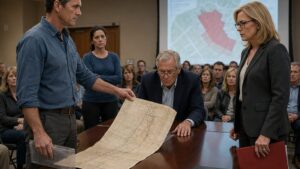
The emergency HOA meeting had drawn more people than the regular monthly meetings ever did.
Folding chairs filled the community room. Several neighbors stood along the back wall. Kevin Carter sat at one end of the board table with a laptop open. HOA counsel occupied the other.
Robert placed a thin folder in front of himself.
He had brought less paper than everyone else.
That was deliberate.
Christine looked down the table.
“The purpose tonight is to address the title concern raised by Robert and determine whether the lane project can continue on schedule.”
Robert heard the phrase title concern.
Not mistake.
Not disputed ownership.
Not contractor entry across private property.
Christine had always been good at choosing words that made a problem sound manageable.
One of the board members asked whether the contractor had stopped work.
Kevin answered.
“Physical widening adjacent to Robert’s workshop is paused pending counsel review. General staging elsewhere is continuing.”
Robert said, “My loading area was blocked again this morning.”
Christine turned toward him.
“For approximately twenty minutes.”
“It was still blocked.”
“We addressed it.”
“After I called.”
The room shifted slightly.
Robert hated rooms like this.
Too many eyes. Too many people waiting for someone to say something wrong.
Normally he would have let Laura speak.
She was not there.
That had been his decision too.
She had told him what the documents meant. The property was his. The access rights were limited. The proposed transfer had never been completed.
Now Robert had to say the rest himself.
Christine spread a copy of the association plan.
“The board has relied on this site plan for decades. Nothing about the current work was undertaken maliciously or secretly.”
“I didn’t say it was.”
“You implied overreach.”
“I said you marked land as common property when it isn’t.”
A neighbor near the wall murmured something.
Christine continued.
“The lane has a documented access deficiency. Our insurer requested corrective action after an emergency vehicle had difficulty passing last winter.”
That produced a different reaction.
Several people turned toward Jacob Green.
He sat two chairs from Christine.
Jacob nodded.
“That happened.”
Robert watched Christine.
For the first time since the dispute began, she looked less like someone defending authority and more like someone defending a decision she had made under pressure.
She slid another document forward.
“Our renewal is approaching. If we fail to address a flagged access issue, we could face higher premiums or coverage limitations.”
Robert said, “Then fix the access problem.”
Christine stared at him.
“That’s exactly what we are trying to do.”
“Not on land you don’t own.”
The room went quiet.
Kevin glanced toward HOA counsel.
Christine said, “The association has used that lane openly for years.”
“Use isn’t ownership.”
“We have recorded access rights.”
“Yes.”
A few faces turned toward Robert.
That answer seemed to surprise them.
Christine’s expression changed too.
“You agree the association has access rights?”
“I agree people have the right to pass.”
“Then I’m not sure why this has become—”
“Because passing over twelve feet of my property is not the same as owning it, widening it, storing equipment on it, or painting another eight feet of my gravel as common area.”
This time nobody murmured.
Robert opened his folder.
He removed two sheets.
One was the old plat.
The other was a printed photograph of the orange line beside the rust-dark survey pin.
He placed both in the middle of the table.
Christine looked at the photo.
Robert said, “That pin lines up with the older recorded boundary. The current association plan does not.”
Kevin adjusted his glasses and leaned closer.
“I’d like counsel to speak to that.”
HOA counsel folded his hands.
“I reviewed the materials this afternoon. At this stage, I do not believe the association should proceed with widening across the disputed strip without written consent or further title resolution.”
Christine’s head turned.
“Are you saying we have to abandon the project?”
“No. I’m saying the association’s access rights do not automatically establish ownership of the underlying land.”
“And the site plan?”
“It is evidence of intended use. It is not, by itself, a deed.”
Robert watched that sentence move through the room.
It was not dramatic.
No one gasped.
But people sat differently afterward.
Christine looked at Kevin.
“Why was this not caught earlier?”
Kevin’s face tightened.
“The management file contained the association exhibits and current plan.”
Jacob spoke.
“What about Robert’s objection?”
Christine looked toward him.
Jacob had a copy of the meeting packet in front of him.
“What objection?”
Robert watched Christine’s eyes narrow slightly.
Jacob continued.
“The packet says Robert refused to cooperate with access remediation. It doesn’t include his email asking for a title review.”
Christine said, “That email was received after the contractor mobilized.”
“Before they kept working?”
Silence.
Kevin moved one hand toward his laptop.
“I can pull the timestamp.”
“You don’t need to,” Robert said.
Christine looked at him.
“I sent it at 2:17 Monday.”
Jacob turned toward Christine.
“Did you see it?”
She did not answer immediately.
Robert felt the room waiting.
Finally she said, “Yes.”
Jacob’s voice remained calm.
“And you told management to proceed?”
“With preliminary work while the boundary issue was reviewed.”
Robert looked at the photograph.
Orange paint across his gravel.
A contractor’s trailer across his loading lane.
Two jobs delayed.
It would have been easy to make Christine smaller in that moment.
He wanted to.
Instead he said, “That is the problem.”
Christine looked at him.
“I had an insurance deadline.”
“And I had a business.”
“I understand that.”
“No. You understand it now.”
The words came out harder than he intended.
For a second he regretted them.
Christine’s face changed.
Not much.
Enough.
She looked tired.
“The board was told we had to show corrective action before renewal review. I believed the property issue could be resolved while preliminary work continued.”
HOA counsel said, “That was not the safer course.”
Christine looked down.
Robert did not feel triumph.
He felt something more uncomfortable.
She had been wrong.
But she had not invented the ambulance problem. She had not invented the insurance deadline. She had made a bad decision because she believed delay was the greater risk.
Jacob said, “Then we stop pretending Robert is just refusing to cooperate.”
No one argued.
Kevin closed one of the documents.
“Management can instruct the contractor to suspend all work inside the disputed area immediately.”
“That needs to happen tonight,” Robert said.
“It can.”
“And the business losses?”
Christine looked back at him.
“We haven’t discussed compensation.”
“We will.”
One board member shifted in his chair.
“Are we talking about association funds?”
Robert turned toward him.
“I’m talking about two jobs affected because your contractor blocked commercial access after I disputed the boundary.”
Christine said, “We will need documentation.”
“I have it.”
Again, he surprised himself.
Six months earlier, Robert would have walked out before saying half of this in front of neighbors.
He would have assumed the documents should speak for him.
Now he understood that documents remained silent until somebody put them on the table.
HOA counsel gathered the plat and photograph.
“For now, widening should not continue across the disputed title area. Existing passage rights remain a separate issue.”
Christine nodded once.
Then she looked directly at Robert.
“If the association does not own that strip, what exactly do you intend to do with it?”
The room became still.
Robert knew what everyone was hearing beneath the question.
The lane.
Medical deliveries.
Waste trucks.
Emergency access.
For days, he had wanted the leverage badly enough to imagine closing the road simply to make the board feel what it had done to him.
Now everyone was waiting to learn whether he actually would.
Christine did not look angry anymore.
She looked worried.
“Robert,” she said, “are you planning to revoke access to the lane?”
Chapter 6: Seven Days to Rewrite the Boundary
The surveyor drove the first wooden stake into the gravel while Christine watched from six feet away.
The hammer struck three times.
Each blow sounded cleaner than the hiss of the orange spray can had a week earlier.
Robert stood beside the workshop with his hands in his jacket pockets.
The survey crew had spent most of the morning locating old monuments, checking bearings, and comparing the recorded plat with Robert’s deed.
Now fluorescent flagging marked the twelve-foot strip with an accuracy the HOA paint had never had.
The old orange line remained visible in faded patches beneath tire dust.
The new stakes did not follow it.
They cut inside it.
Christine stared at the difference.
“How far off?”
The surveyor checked his notes.
“It varies. At the workshop apron, the association’s painted widening line extends several feet beyond the deed boundary.”
Kevin Carter stood beside her with a folder.
“And the lane itself?”
“Part of the existing pavement crosses Mr. Miller’s parcel.”
Christine looked toward Robert.
He said nothing.
The confirmation gave him less pleasure than he had expected.
Maybe because it came too late to feel surprising.
Maybe because he now knew the harder question was what happened next.
The surveyor finished flagging the line before noon.
Robert spent the afternoon documenting everything.
Three delayed deliveries.
The canceled portion of one cabinet job.
The postponed vanity order.
Additional handling charges.
Gravel disturbed by contractor staging.
Time spent clearing equipment from the loading area.
Laura had told him not to exaggerate.
So he did not.
He listed only losses he could show.
By four o’clock, the total sat on his workbench beside a proposed notice.
Robert read the notice again.
The first version had been much shorter.
All association access across Robert Miller’s property terminates seven days from receipt.
Laura had crossed it out.
The replacement was narrower.
Contractor staging, widening activity, excavation, material storage, and other uses beyond established access purposes would terminate after seven days unless the parties reached a written agreement.
Resident passage, emergency access, utilities, and ordinary service use would continue.
Robert had argued with her for twenty minutes.
Now he understood why she had insisted.
He signed it.
Kevin arrived the next morning to receive the copy.
He read the first page standing beside the new survey stake.
“So residents can still use the lane.”
“Yes.”
“Emergency vehicles?”
“Yes.”
“Waste pickup?”
“If it’s ordinary service passage.”
Kevin looked relieved.
“Contractors?”
“Not unless they’re using it for normal service. No staging. No widening. No storing equipment. No treating my gravel like a construction yard.”
Kevin nodded.
“This gives us seven days?”
“It gives you seven days before I enforce what the paperwork already says.”
There was no smile between them.
But there was no argument either.
That afternoon, Christine called.
“I’ve reviewed your compensation demand.”
Robert set down a drawer front he had been sanding.
“It isn’t a demand. It’s documentation.”
“You are asking the association to reimburse all of it.”
“Yes.”
“The board may not agree that every loss was caused by the project.”
“The first client’s delay started the morning your trailer blocked my delivery.”
“I understand the sequence.”
“Then what don’t you agree with?”
“The amount.”
Robert looked at the cabinet parts laid out on his bench.
“Which amount?”
Christine hesitated.
“The lost work.”
“I sent the cancellation email.”
“I saw it.”
“The invoice history?”
“Yes.”
“The delivery surcharge?”
“Yes.”
Another pause.
Robert said, “Then you don’t dislike the evidence. You dislike paying for what happened.”
“That’s not fair.”
“No. None of this has been.”
The line went quiet.
He immediately wished he had phrased it differently.
Not because it was false.
Because it moved them backward.
Christine spoke more carefully.
“The association has limited funds. Any settlement comes from homeowners.”
Robert knew that.
He had known it intellectually.
Hearing it aloud was different.
His reimbursement would not come from Christine personally. It would come from dues paid by Jacob, the people beyond the bend, and Robert himself.
“I’m not asking for a penalty,” he said.
“I know.”
“I’m asking for what I can prove.”
“And repairs.”
“To my gravel.”
Christine exhaled.
“We also have six days before the insurer expects an updated remediation plan.”
There it was again.
The deadline behind her deadline.
Robert looked through the open bay toward the lane.
A white medical-delivery van passed slowly over the section he owned.
Jacob had not exaggerated.
The lane mattered.
“So redesign it,” Robert said.
“Around your parcel?”
“Inside what you actually have.”
“That may not give us the width they asked for.”
“Then explain that the association doesn’t own enough land to create the width without an agreement.”
Christine was silent.
Robert continued.
“If you want more rights than you have, ask for them.”
The sentence felt strange coming from him.
He had spent years treating HOA requests as orders in softer clothing.
Now he was the one telling them negotiation was possible.
Christine said, “And if we ask?”
“Then I decide what I’m willing to give.”
Two days later, the board offered partial reimbursement.
Robert rejected it.
Not angrily.
He sent back three supporting documents and one sentence asking which item they disputed.
The next offer covered nearly all documented losses but excluded restoration of the loading apron.
Robert returned photographs of ruts left by the contractor.
By day six, Kevin called.
“We can include the gravel repair.”
“And the title correction?”
“That’s separate.”
“It isn’t separate.”
Kevin paused.
“I understand.”
“No permanent claim of common ownership. Not in the map. Not in the agreement. Not in management records.”
“We’re working on language.”
Robert looked at the new stakes.
“Work faster.”
On the seventh day, no contractor appeared.
The equipment trailer stayed away.
Residents continued through the lane without interruption.
Robert’s lumber delivery backed cleanly to the workshop for the first time since the dispute began.
He signed the receipt beside the faded orange paint.
That should have been the payoff.
Instead, just after five, Kevin’s SUV turned into the lane.
He carried a thick envelope.
“Board approved revised terms.”
Robert wiped sawdust from his hands.
“Everything?”
“Compensation. Gravel restoration. Temporary suspension of widening. Negotiated access language.”
Robert took the envelope.
“Temporary?”
“Read it.”
He did.
Most of it was better than he expected.
The board acknowledged the disputed deed boundary.
It agreed to reimburse documented business losses.
It agreed to repair the loading area.
It proposed a recorded access arrangement rather than relying solely on the old association plan.
Robert reached the final page.
Then stopped.
One paragraph described the twelve-foot strip as part of the association’s “permanent common roadway area.”
He read it twice.
Kevin watched his face.
“What?”
Robert tapped the clause.
“This.”
Kevin leaned closer.
“That may just be standard language.”
Robert looked at him.
“That is how this started.”
Kevin’s expression changed.
Robert handed the document back open to the page.
“They’re offering to pay me for the damage while asking me to sign the same mistake into a new agreement.”
Neither man spoke.
Fresh survey stakes stood along the lane.
A few inches away, the last traces of orange paint still showed through the dust.
Robert pointed toward them.
“I’m not spending two weeks proving where the line is just to erase it with my own signature.”
Chapter 7: The Line They Finally Put in Writing
Robert crossed out the phrase permanent common roadway area before anyone else had finished taking a seat.
The revised agreement lay open on the folding table in the same community room where Christine had once called the widening project already approved. Robert drew one firm line through the clause, wrote “limited access easement only” in the margin, and slid the document toward Kevin Carter.
Kevin stared at the edit.
“You know counsel drafted this.”
“I know.”
“They’ll want to review any changes.”
“They should have reviewed that one before putting it in.”
Christine Wright sat across from Robert with both hands around a paper cup of coffee. She looked at the crossed-out language, then at the copy of the survey beside it.
The new survey was clean.
No shaded assumptions. No broad common-area stripe.
A measured property boundary ran beneath part of the existing service lane and stopped exactly where the survey crew had staked it weeks earlier.
Christine said, “The intent wasn’t to take ownership from you.”
Robert tapped the deleted phrase.
“Then it shouldn’t say you own it.”
No one answered.
HOA counsel reached for the document and read the paragraph.
After a moment, he nodded.
“Mr. Miller is correct. This wording is broader than necessary.”
Kevin shifted in his chair.
“It came from our standard roadway form.”
Robert almost laughed.
Standard language.
That had become the phrase people used when nobody wanted responsibility for what the words actually did.
HOA counsel continued.
“We can replace it with a limited recorded easement describing specific permitted uses.”
Robert said, “Passage. Emergency access. Utilities. Ordinary service vehicles.”
“And minimum clear width,” Christine added.
Robert looked at her.
She did not look away.
“That part still matters,” she said.
For the first time in the entire dispute, she sounded as though she were asking rather than declaring.
Robert glanced toward Jacob Green.
Jacob sat against the wall near the end of the table. He had attended because the board still needed a vote once the language was settled.
Robert thought of the white medical-delivery van passing through the lane.
“How much clear width?”
HOA counsel read from the proposed engineering notes.
Robert studied the number.
It would require him to keep part of the existing paved area unobstructed, including a corner where he sometimes left a lumber cart during unloading.
He disliked that immediately.
His first instinct was to object.
Then he stopped himself.
“Does it require widening?”
“No,” counsel said. “The redesign stays inside the current traveled surface. The association would add signage farther down and prohibit contractor staging in the narrow section.”
Robert looked at Christine.
“So the original widening isn’t happening.”
“Not across your property.”
“And no equipment gets parked by my loading apron.”
“That restriction is included.”
Robert turned another page.
The compensation provision covered the lost work he had documented, delivery charges, and restoration of the gravel damaged by the contractor.
No penalty.
No inflated nuisance claim.
Just the numbers he could prove.
He had wanted more when the fight began.
Not money.
Something harder to name.
He had wanted the board to feel embarrassed.
He had wanted Christine to stand in front of the neighborhood and admit that Robert Miller had been right from the beginning.
But he had not been right from the beginning.
He had ignored the notices.
He had skipped meetings because he assumed nothing important could happen there.
He had nearly convinced himself that owning the land meant he could close the lane and let everyone else solve the consequences.
The documents had protected him.
They had also corrected him.
Christine cleared her throat.
“There’s something I should say before we vote.”
Robert looked up.
The room quieted.
She kept both hands on the coffee cup.
“When the insurance notice came in, we were told the lane had to be addressed before renewal. I treated that deadline like proof that the board had authority to move faster than we should have.”
Kevin looked toward her.
Christine continued.
“When Robert raised the title question, I believed we could resolve it afterward.”
She paused.
“That was a mistake.”
Nobody clapped.
Robert was glad.
Applause would have made the moment cheaper.
Christine looked at him.
“I should have stopped the work when you asked for the title review.”
Robert nodded once.
Then he surprised himself by saying, “I should have answered the earlier notices.”
Jacob leaned forward slightly.
Robert continued.
“I read the first one and assumed it was another board project that didn’t concern me. By the time I paid attention, you were already painting my gravel.”
Christine’s mouth moved almost into a smile, but did not quite get there.
“That would have been useful information two months ago.”
“So would a deed.”
That did make Jacob laugh quietly.
Even Christine let out a breath.
The tension did not disappear.
It changed shape.
HOA counsel revised the clause while they waited.
The final language was plain enough that Robert could understand it without Laura translating every sentence.
The strip remained part of Robert’s parcel.
The association received a defined easement for residential passage, guests, utilities, emergency vehicles, and ordinary service providers.
No expansion beyond the surveyed limits without Robert’s written consent.
No contractor staging.
No material storage.
No claim of fee ownership.
Robert would maintain the defined clear width and could not obstruct legitimate access.
The board would correct its management maps to distinguish easement from ownership.
Robert read the paragraph three times.
Then he signed.
Christine signed after him.
Jacob and the remaining board members voted to approve the agreement.
Kevin gathered the pages carefully.
When the meeting ended, there was no handshake line.
No one congratulated Robert.
Christine stopped beside him while the others were leaving.
“The insurer accepted the revised access plan,” she said.
Robert nodded.
“Good.”
“They still want us to monitor the lane.”
“You should.”
She looked at him.
“That almost sounded cooperative.”
“Don’t get used to it.”
This time she did smile.
Several weeks later, the gravel contractor came back.
Not to widen anything.
To repair what had been damaged.
Robert stood outside the workshop while fresh stone was spread over the ruts near his loading area. The last fragments of orange paint disappeared beneath the new gravel.
He expected that to satisfy him most.
It didn’t.
What caught his attention was the old survey pin.
The contractor had left a small clear circle around it.
Rust-dark metal remained visible beside the lane.
Not dramatic.
Not decorative.
Just accurate.
A delivery truck turned into the service road a few minutes later.
The driver slowed at the bend, passed the newly posted no-staging area, and backed toward Robert’s workshop without obstruction.
Robert guided him the final few feet with one hand.
“Good there.”
The truck stopped.
The rear doors opened.
Maple boards waited inside.
Beyond the truck, a neighbor’s vehicle passed along the same strip Robert now knew he owned.
He did not resent it.
The road had never needed to become entirely his or entirely theirs.
It had needed the truth put into words precise enough that neither side could pretend the other did not exist.
Robert glanced once more at the survey pin beside the fresh gravel.
For years, it had sat nearly buried while everyone drove over assumptions.
Now the line was visible.
More importantly, it was finally written down.
The story has ended.