My Neighbor Kept Piling Trash Around My Mailbox Until One HOA Hearing Changed Both of Us
Chapter 1: The Bags Were Back Before Sunrise
George Moore knew what was outside before he reached the bottom of his front steps.
The smell reached him first.
Not strong enough to turn his stomach, but sour enough to be unmistakable in the cool air before sunrise. He looked toward the curb and stopped with one hand still on the porch rail.
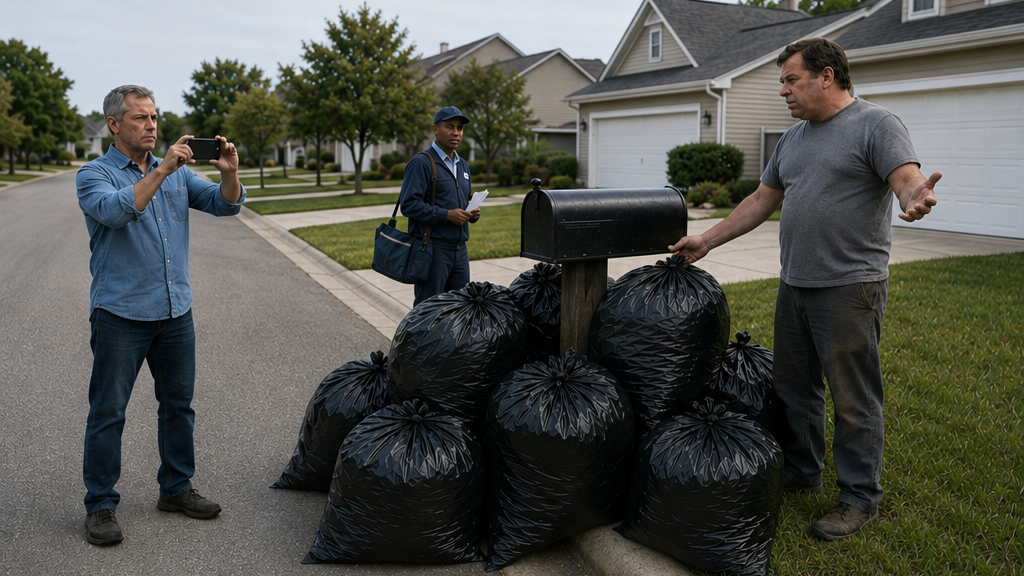
Three black garbage bags had been wedged around his mailbox.
One leaned against the post. Another sat directly beneath the metal box. The third bulged into the narrow strip where George normally stood when he collected his mail.
He closed his eyes for a second.
“Again.”
The word came out quieter than he intended.
Across the property line, Brian King was dragging a fourth bag down his driveway.
Brian was in a gray T-shirt, work pants, and old running shoes. He had one hand wrapped around the plastic knot at the top of the bag. The thing bumped over the edge of his driveway, leaving a faint wet mark on the concrete.
George stepped into the street.
“Brian.”
Brian looked up but kept walking.
“Morning.”
“That doesn’t go there.”
Brian glanced at the mailbox as though seeing the bags for the first time.
“They’re trash.”
“I know what they are.”
“Truck comes today.”
“That’s my mailbox.”
Brian dropped the fourth bag beside the others.
For a moment neither man moved.
The houses along the street were still mostly dark. Porch lights glowed here and there. A sprinkler clicked somewhere behind a wooden fence.
George had lived in the subdivision for twelve years. He knew which houses put their bins out Monday night and which waited until five in the morning. He knew when the mail truck usually came and which neighbors forgot holiday collection changes.
He also knew this was not the first time Brian had used the space around his mailbox.
The first time, two loose bags had appeared there after a holiday weekend. George had assumed the wind or a hurried sanitation crew had shifted them. The second time, he had seen Brian’s son carrying one across the grass.
George had moved it back.
No argument. No note.
Just a quiet correction.
The following week, the bags returned.
Now Brian was standing ten feet away from him, having placed them there deliberately.
George pointed toward Brian’s curb.
“Move them back to your side.”
Brian gave a small laugh through his nose.
“My side is full.”
“Then keep them beside your cans.”
“They won’t take them if they’re behind the cars.”
“Then move the cars.”
Brian looked at him as though George had suggested dismantling the house.
“The truck is going to pick them up in a couple hours.”
“That’s not the point.”
“That’s exactly the point.”
George felt the familiar pressure behind his ribs—the feeling he got when someone treated a reasonable request like an eccentric demand.
He had spent years letting small things go.
A landscaping trailer parked across the edge of his driveway for twenty minutes. Children cutting through the corner of his lawn. Contractors setting lumber against his fence because it was “only temporary.”
None of those things had mattered enough to become the man who complained about everything.
But this was different.
The black bags pressed against his mailbox looked less like an accident each week.
George lowered his voice.
“I’m asking you directly. Don’t put your garbage around my mailbox again.”
Brian folded his arms.
“You own the mailbox?”
“I maintain it.”
“I mean the curb.”
George stared at him.
Brian shrugged.
“It’s curb space, George. The city truck takes trash from the curb.”
“Not from somebody else’s pickup area.”
“It isn’t a pickup area.”
“It’s where my mail gets delivered.”
Brian looked toward the bags.
“The mail comes this afternoon.”
George could almost hear the logic sealing itself inside Brian’s head: if the bags disappeared before the mail arrived, then no harm had occurred.
George had dealt with people like that before. Not bad people. People who defined inconvenience according to whether they personally felt it.
He stepped closer to the bags.
“Move them.”
Brian’s expression changed slightly.
Not anger exactly.
Resistance.
“You want me to drag all that back because you don’t like looking at it?”
“I want you to keep your trash on your property.”
Brian shook his head.
“Your property.”
“Yes.”
“That grass between the sidewalk and the curb belongs to the association.”
George knew enough about the subdivision documents to know that was only partly relevant. The association maintained some common landscaping. That did not make every curbside area a free dumping zone.
But he also knew arguing sections of HOA documents at six in the morning would make both of them ridiculous.
So he kept it simple.
“Brian. Don’t put your bags here again.”
Brian looked at him for another second.
Then he lifted both palms.
“Fine. Whatever.”
But he did not move the bags.
George waited.
Brian turned and walked toward his house.
“Brian.”
Without turning around, Brian said, “Truck will get them.”
The screen door shut behind him.
George stood beside the mailbox.
The black bags looked different now.
Before the conversation they had been irritating.
After it, they were an answer.
He pulled one away from the post so the mailbox door could open. Something inside shifted heavily. George smelled old food and coffee grounds.
He considered dragging all four bags back to Brian’s driveway.
The thought gave him a quick pulse of satisfaction.
Then he stopped.
If he moved them, Brian could say they had never been there.
George disliked the thought that came next because it felt too formal for something so stupid.
He took out his phone.
Not a complaint. Not yet.
Just a photograph.
He stepped backward until the mailbox, all four bags, the curb, and part of Brian’s driveway fit in the frame.
The phone marked the time automatically.
6:17 a.m.
George took one picture.
Then another from the sidewalk.
He put the phone away.
By nine, the sanitation truck had come through. The bags were gone. The mailbox stood alone again, looking harmless and ordinary.
George told himself that would be the end of it.
Brian had heard him.
Whatever point Brian thought he was making, he had made it.
Six days passed.
On the following Tuesday morning, George was standing in his kitchen with a cup of coffee when movement crossed the front window.
He looked up.
Brian was halfway down his driveway.
A black garbage bag hung from his right hand.
And he was walking toward George’s mailbox.
Chapter 2: The Photograph Changed the Argument
George did not go outside immediately.
That surprised him.
A week earlier, he would have opened the door before Brian reached the curb. He would have stopped him, repeated himself, and probably heard the same argument about the garbage truck arriving in a few hours.
Instead, George set his coffee on the counter and picked up his phone.
Through the window, he watched Brian place the first bag beside the mailbox.
Then the second.
Then a third.
Brian stood up and rubbed his hands against his pants.
George opened the front door.
Brian saw the phone before he saw George’s face.
“What are you doing?”
George walked to the curb without answering.
He stopped several feet from the bags and raised the phone.
The mailbox stood behind them, partly blocked from view.
Click.
Brian stared at him.
“You taking pictures of my garbage now?”
George took one from the side.
“Yes.”
“That’s normal?”
“No. This isn’t.”
Brian stepped closer.
George lowered the phone.
“I asked you last week not to put it here.”
“And I told you the truck takes it.”
“That wasn’t an agreement.”
Brian’s jaw tightened.
George noticed that Brian did not say he had forgotten.
That mattered.
“You seriously going to make this a thing?” Brian asked.
“You already made it a thing.”
Brian laughed once.
“Over three trash bags.”
“Over you putting them here after I asked you not to.”
Brian looked toward his own house.
His regular wheeled trash cart was nowhere near the curb. George noticed it, but only in passing.
At that moment all he saw was the repeat.
The choice.
Brian pointed at the mailbox.
“You act like I dumped them on your porch.”
“No. You put them where my mail gets delivered.”
“For two hours.”
“Move them.”
Brian exhaled and walked away.
Again, he left the bags where they were.
George remained on the curb until the front door of Brian’s house closed.
Then he photographed the placement one more time.
6:24 a.m.
He went inside, opened his laptop, and searched the city sanitation page.
He expected vague language.
Instead, the rule was straightforward.
Household refuse had to be placed at the designated collection point associated with the serviced address. Waste could not obstruct mailboxes, driveways, sidewalks, or access routes.
George read it twice.
Then he looked through the window.
One of Brian’s bags leaned against the mailbox post.
He felt something small but definite settle inside him.
Not victory.
Confirmation.
For years George had mistrusted the impulse to object because he disliked the possibility that he was being fussy. The rule removed that uncertainty.
He opened the complaint form.
Address of violation.
Date.
Approximate time.
Nature of complaint.
He typed carefully.
Repeated placement of household garbage belonging to neighboring address around mailbox serving my residence after direct request to stop.
The form allowed photo attachments.
George uploaded two.
He hesitated before clicking submit.
It seemed absurd to involve the city in three bags.
Then he remembered Brian’s expression when George had asked him to move them.
Not confused.
Not apologetic.
Dismissive.
George clicked.
A case number appeared.
He wrote it on a yellow pad beside his computer.
Later that morning, the mail carrier arrived before the sanitation truck.
George happened to be in the garage when he saw the small postal vehicle slow at the curb.
The carrier leaned toward the passenger window, looked at the bags, then stopped.
One bag had slumped outward into the narrow approach to the mailbox.
The carrier pulled forward, parked, and got out.
George walked down the driveway.
“Sorry about that.”
The carrier looked from him to the bags.
“Yours?”
“No.”
The carrier gave him a tired look that suggested this was not the strangest thing encountered that morning.
“I can get to it today.”
The carrier stepped around the pile and opened the box.
George felt embarrassed despite having done nothing.
“Does that count as blocked?”
“It counts as making my job harder.”
That sentence stayed with him.
Until then, Brian’s argument had been annoyingly effective in one narrow sense: the trash disappeared eventually.
No lasting damage.
No broken mailbox.
No ruined lawn.
But standing there while a mail carrier maneuvered around someone else’s garbage made the issue tangible.
George took another picture after the carrier left.
Not of the person.
Only the bags and the access space.
By afternoon, the sanitation truck removed everything.
The city called the next day.
A staff member asked whether the bags had been placed by the neighboring household.
George said yes.
“Did you observe that yourself?”
“Yes.”
“More than once?”
“Yes.”
The staff member explained that an inspector would issue a warning regarding designated collection placement and obstruction.
George wrote down the information.
“Will they know who complained?”
“I can’t tell you what information may appear in the case record,” the staff member said. “But the violation is based on location and observation, not a private property dispute.”
George thanked them.
Two days later, a city vehicle stopped in front of Brian’s house.
George saw it through the blinds.
A code-enforcement officer walked up the driveway carrying a folder.
George should have walked away from the window.
He did not.
Brian came to the door.
The officer spoke for less than five minutes and handed him a sheet of paper.
Brian looked across the lawn before the officer had even returned to the vehicle.
Straight at George’s house.
George stepped away from the blinds.
That evening Brian caught him at the mailbox.
“You called the city?”
George closed the mailbox door.
“I filed a sanitation complaint.”
“You called the city over trash bags.”
“I asked you first.”
Brian held up the paper.
“They came to my house.”
“Then maybe they explained the rule.”
“Oh, they explained it.”
George waited.
Brian stepped closer.
“You could’ve just talked to me.”
“I did.”
“You came outside barking about your property.”
“I asked you to move your trash.”
“You were looking for a reason.”
“A reason for what?”
Brian shook the paper.
“This.”
George felt his temper rise.
He had imagined this moment differently. He had expected Brian to be annoyed, perhaps embarrassed, but ultimately forced to recognize that George’s request had not been arbitrary.
Instead Brian was acting as though the official warning proved George had committed the larger offense.
George kept his voice level.
“The city agreed the bags don’t belong there.”
Brian stared at him.
Then he folded the notice once.
Slowly.
“Doesn’t change where the truck picks them up.”
George looked at him.
Brian tucked the folded paper into his back pocket and walked away.
George stood beside the mailbox long after Brian reached his front door.
The warning had been supposed to end the argument.
Instead, George had the uneasy sense that it had only given Brian something new to resist.
Chapter 3: The Warning Only Made the Pile Higher
There were seven bags.
George counted them twice because seven felt childish.
Not careless.
Not convenient.
Seven glossy black bags were arranged along the curb and around the mailbox post, two stacked against each other high enough to hide nearly half the box.
George stood at the edge of his driveway with his phone in his hand.
Across the street, a garage door rattled open.
He ignored it.
One photograph from the front.
One from the side.
One wide enough to show the location relative to Brian’s house.
He did not photograph Brian.
He did not need to.
The timestamp was 6:11 a.m.
Week three.
George had expected another violation. What unsettled him was how deliberately visible this one seemed.
Three bags could be explained as overflow.
Seven looked like a statement.
He called the city as soon as the office opened.
The staff member pulled up his prior case number.
“Another occurrence?”
“Yes.”
“Same location?”
“Same mailbox.”
“Photographs?”
“Yes.”
George heard keyboard tapping.
“Upload them to the existing case. We can route it for follow-up.”
“Will someone inspect it?”
“If it’s still present when an officer is available.”
George looked through the window.
The pile seemed enormous from inside the house.
“Okay.”
He uploaded the photographs.
Then, after a moment, he opened the HOA website.
George had avoided involving the association.
The board dealt with architectural approvals, landscaping standards, parking complaints, rental restrictions, and all the little frictions that came from living in a neighborhood where everyone technically owned their property but had agreed to a long list of shared rules.
George had never wanted to be one of the residents who quoted sections at people.
He searched the governing documents anyway.
Sanitation.
Waste containers.
Nuisance conditions.
Access.
One paragraph caught his attention.
Repeated placement of refuse in a manner that interfered with neighboring property access or community services could be treated as a compliance matter after documented notice.
George leaned back.
There it was.
Another rule.
Another confirmation.
And, he admitted to himself, another small burst of satisfaction.
He sent a message through the HOA portal and attached the first two weeks of photographs, the city complaint number, and that morning’s images.
By lunchtime Katherine Johnson called him.
George knew Katherine well enough to wave at neighborhood meetings but not well enough to call a friend.
“George, I saw your submission.”
“Okay.”
“I want to be careful here.”
That was not the opening he wanted.
“He’s doing it every week.”
“I can see the pictures.”
“He’s already had a city warning.”
“I saw that too.”
“So what does the association do?”
Katherine paused.
“We establish whether it’s an association violation.”
George looked at the seven bags.
“What else do you need?”
“A pattern tied to notice.”
“I sent three weeks.”
“You sent photographs.”
“With dates.”
“Yes. That helps.”
George heard himself becoming sharper.
“Katherine, the mailbox is almost blocked.”
“I’m not saying nothing happened.”
“Then what are you saying?”
“I’m saying the board isn’t going to issue fines because two neighbors disagree over a curb.”
George stood.
“This is exactly why people stop reporting things.”
“And this is exactly why boards get accused of selective enforcement when they act before the record is complete.”
That stopped him.
Katherine’s tone stayed calm.
“If the city has documented the placement, send the warning notice or the case reference. If there’s another verified occurrence after that notice, then we have something stronger than your word against his.”
George looked at the yellow pad beside his computer.
Case number.
Date.
Officer visit.
His irritation cooled just enough for him to hear what she was actually saying.
She was not refusing.
She was asking for sequence.
“I have the case number.”
“Send it.”
“I have photographs from before and after the warning.”
“Send those too.”
George did.
An hour later Katherine emailed him confirmation that the association would open a compliance review.
He should have felt relieved.
Instead he spent ten minutes arranging the photographs on his computer by date.
Tuesday.
Tuesday.
Tuesday.
Same mailbox.
Same angle.
Increasing piles.
It looked less like trash and more like evidence.
George enlarged the newest photograph.
The mailbox was nearly swallowed by black plastic.
For the first time he noticed how much he liked the clarity of it.
There was no ambiguity in the pictures.
No tone of voice.
No dispute over who had said what.
Just dates and bags.
Facts.
That afternoon an HOA management representative sent Brian a formal notice requiring correction of the condition and warning that repeated violations could result in a hearing.
George knew because Katherine copied him only on the portion confirming action had been taken.
He printed the email anyway.
He placed it with the city case number in a folder.
Then he caught himself.
A folder.
He had made a folder for garbage.
George closed the drawer harder than necessary.
Near dusk, Ruth Green crossed the street while George was pulling weeds near the front walk.
Ruth had lived opposite him almost as long as he had lived there. She was the kind of neighbor who knew which house had a broken sprinkler and which couple was visiting grandchildren without making any of it sound like gossip.
She nodded toward the mailbox.
“Looks clear now.”
“Truck finally came.”
“I saw the pile this morning.”
George straightened.
“Hard to miss.”
Ruth gave him a look.
“I also saw you taking pictures.”
George wiped dirt from his glove.
“He’s had a warning.”
“I heard.”
“From Brian?”
“From the street.”
George disliked the answer.
Ruth looked toward Brian’s house.
“I’m not saying he should put it there.”
“Good.”
“But this is getting bigger.”
“Because he keeps doing it.”
Ruth nodded slowly.
“Probably.”
George waited.
She did not leave.
“What?”
Ruth hesitated.
“You know his own cart hasn’t been collected in three weeks, right?”
George frowned.
“What do you mean?”
“The big city cart. The one everybody uses.”
“I know what cart you mean.”
“It hasn’t been out.”
George glanced toward Brian’s side yard.
From his property he could not see much beyond the fence.
“So?”
“So I thought you knew.”
“Knew what?”
Ruth looked uncomfortable now.
“I don’t know the whole story. I heard there was some problem with the account. Or the cart. Something with city service.”
George said nothing.
Ruth continued.
“That doesn’t make your mailbox his dumping place.”
“No.”
“I’m just saying there may be a reason he has all those bags.”
George looked at the curb where the pile had been.
A faint dark mark remained near the mailbox post.
He had spent three weeks asking why Brian would ignore such a simple rule.
Until that moment, George had assumed the answer was equally simple.
Because Brian did not care.
Now another possibility had appeared.
Not innocence.
Not justification.
A reason.
Ruth tucked her hands into her jacket pockets.
“You really didn’t know?”
George looked across at Brian’s house.
“No.”
Ruth nodded once.
Then she said, “You know his own cart hasn’t been collected in three weeks, right?”
Chapter 4: The Reason Did Not Excuse the Choice
George saw the empty space beside Brian’s house the next morning.
He had not meant to look for it.
He was carrying a bag of lawn clippings toward his own garage when he glanced past the fence line and noticed the concrete pad beside Brian’s side gate.
Every house on the street had roughly the same arrangement: a narrow strip beside the garage where the city-issued trash cart usually sat between collection days.
Brian’s strip was bare.
No large wheeled cart.
No recycling bin.
Nothing except a pale rectangle on the concrete where something had stood for years.
George stopped walking.
Ruth’s words came back to him.
You know his own cart hasn’t been collected in three weeks, right?
He put the lawn bag down.
From where he stood, he could also see two tied black garbage bags tucked against the rear corner of Brian’s garage.
Not at the curb.
Not near George’s mailbox.
Waiting.
The sight changed something without resolving anything.
Brian had a problem.
That much was now obvious.
George went inside and called the HOA office.
Katherine answered on the fourth ring.
“I was going to call you this afternoon,” she said.
“About Brian?”
“About the compliance review.”
George sat at the kitchen table.
“I heard his trash service is messed up.”
There was a pause.
“Who told you that?”
“Does it matter?”
“It matters whether you’re asking me to confirm private account information.”
“I’m asking whether there’s a reason he doesn’t have a cart.”
Katherine sighed.
“What I can tell you is that the city has already noted a service issue connected to his address. The association doesn’t manage municipal collection accounts.”
“So Ruth was right.”
“I don’t know what Ruth told you.”
“She said his cart hasn’t been collected.”
“That part is observable.”
George looked through the window toward the mailbox.
“So he actually doesn’t have anywhere to put the bags?”
“I didn’t say that.”
The firmness in Katherine’s voice made him sit straighter.
“What are you saying?”
“I’m saying the city provided options.”
George said nothing.
Katherine continued.
“Temporary tagged overflow collection. A replacement-cart request. He was given instructions after the first sanitation contact.”
“And?”
“And the file indicates the request wasn’t completed.”
George frowned.
“Why not?”
“I don’t know.”
That answer irritated him more than it should have.
“You’re telling me he had a way to fix this?”
“I’m telling you he had a process available.”
“And instead he keeps using my mailbox.”
“Yes.”
George leaned back.
For three weeks, he had pictured Brian’s behavior as pure entitlement. The new information softened that picture around the edges, but not in the way he expected.
If Brian had no disposal option at all, George might have understood the desperation.
But there had been an option.
Paperwork.
A replacement request.
Temporary overflow tags.
Not pleasant, perhaps. Not convenient.
But available.
“So what happens now?”
“We continue the compliance review.”
“Can you fine him?”
“If the board establishes repeated violation after notice, yes.”
“How much?”
Katherine went quiet again.
“George.”
“What?”
“You asked me what happens.”
“I’m asking what the penalties are.”
“They escalate.”
“To what?”
“That depends on duration, prior notice, and board action.”
George opened the drawer where he had put the folder.
The photographs were inside.
City case number.
HOA acknowledgment.
Three Tuesdays.
He took the folder out.
“I want the board to consider the full schedule.”
Katherine did not answer immediately.
George heard papers moving on her end.
“You mean maximum escalating sanctions.”
“Yes.”
“Why?”
The question annoyed him because he thought the answer was obvious.
“Because he keeps doing it.”
“I understand that.”
“He’s had a city warning. He’s had an HOA notice. He has other options. What else is supposed to happen?”
Katherine spoke carefully.
“The board is not there to help one homeowner punish another.”
“I didn’t say punish.”
“You said maximum sanctions.”
“Because lesser warnings haven’t worked.”
“That may be true.”
George pressed his palm against the folder.
“Then what are we talking about?”
“Proportionality.”
“He’s using my property.”
“The curb frontage.”
“My mailbox.”
“Yes.”
“He’s blocking it.”
“Sometimes.”
George’s temper rose.
“Sometimes?”
“I’ve seen your photographs.”
“Then you know.”
“I know there’s a valid complaint. I also know you sound different today than you did when you first called.”
George went still.
“How?”
“You sounded like you wanted the bags moved.”
“I still do.”
“Now you sound like you want Brian to feel what you’ve been feeling.”
The sentence landed harder than George expected.
He stared at the folder.
“That’s not fair.”
“I’m not making a ruling. I’m asking you to think about what remedy you actually want.”
George closed the folder.
“I want him to stop.”
“Good. Then keep that as the goal.”
After the call, George remained at the table.
He told himself Katherine was simply cautious because HOA boards had to be cautious.
Selective enforcement.
Resident disputes.
Threats of lawsuits.
Every volunteer board president learned to speak as though each sentence might later be printed in an attorney’s letter.
Still, her question followed him.
What remedy do you actually want?
By late afternoon, Brian was outside replacing a section of loose edging near his side yard.
George almost walked over.
The impulse surprised him.
He imagined saying, I heard about the cart.
He imagined offering the city number he had used.
Then he imagined Brian’s face when he realized George knew.
The imagined expression stopped him.
Brian would hear pity.
Or intrusion.
Or victory.
George went to the mailbox instead.
Nothing was blocking it.
He opened the door and removed two envelopes.
When he turned back, Brian was watching him.
Neither spoke.
George glanced toward the empty cart space beside Brian’s garage.
Brian noticed.
His expression changed at once.
“What?”
George shook his head.
“Nothing.”
“You looking for something?”
“No.”
Brian set down the edging tool.
“Then quit looking over here.”
George felt his sympathy harden.
“I was checking my mail.”
“You were looking at my yard.”
“You’re the one who keeps putting your trash in front of mine.”
Brian laughed without humor.
“There it is.”
“What?”
“You just can’t let it go.”
George stared at him.
“I would love to let it go.”
“Sure.”
“All you have to do is stop.”
Brian picked up the tool.
“Truck comes Tuesday.”
George felt the old anger rise again.
Even now.
Even after warnings.
Even after whatever problem Brian had with his service.
The man still spoke as if the issue belonged to George.
George went inside before answering.
That evening he logged into the HOA portal.
The compliance case showed a status update.
Hearing eligibility pending verification of continued violation.
Below it was a section labeled requested remedy.
George clicked the menu.
Informal correction.
Compliance agreement.
Standard fine schedule.
Escalating fine schedule.
Maximum permitted sanctions following hearing determination.
He read the last option twice.
Katherine’s voice stayed in his head.
Keep that as the goal.
George selected maximum permitted sanctions.
His finger hovered over the submit button.
He thought about the empty concrete strip beside Brian’s garage.
He thought about seven bags swallowing his mailbox.
He clicked submit.
The next morning Katherine called.
She did not sound surprised.
“I received your remedy request.”
“Okay.”
“I’ll include it in the file.”
“Good.”
Another pause.
Then Katherine asked, “George, do you want the bags stopped, or do you want Brian punished?”
Chapter 5: The Case File Became Bigger Than the Trash
The code-enforcement vehicle arrived before the garbage truck.
George saw it pull up at 7:38 on Tuesday morning while five new bags were still clustered around the mailbox.
He had already photographed them.
Same angle.
Same curb.
Same black plastic.
Week four.
The code officer stepped out holding a tablet and a small folder.
George went outside.
“Morning.”
The officer nodded.
“You the complainant?”
“Yes.”
The officer looked at the mailbox, then at the bags.
“Same household as prior report?”
“Yes.”
“Still after notice?”
“Yes.”
George almost added, And after an HOA notice.
He stopped himself.
The officer took several photographs, measured the clear space in front of the mailbox with a quick glance and a short folding rule, then typed into the tablet.
Brian’s front door opened.
George expected him to come down the driveway.
Instead Brian stood on the porch.
“What now?”
The officer turned.
“Sir, I need to speak with you about the repeat placement.”
Brian crossed his arms.
“They’re at the curb.”
“They’re at another serviced address’s collection point.”
“It’s six feet away.”
The officer looked at the bags.
“Then moving them six feet should be manageable.”
George nearly smiled.
He caught himself.
Brian noticed anyway.
His eyes moved from the officer to George.
“There. That’s what this is about.”
The officer looked between them.
“What?”
“Him enjoying this.”
George’s face warmed.
“That has nothing to do with where you put the bags.”
Brian came down two steps.
“You stand in your window waiting.”
“I live there.”
“You take pictures every week.”
“Because you do this every week.”
The officer raised one hand.
“I’m not mediating the neighbor dispute.”
Neither man spoke.
The officer pointed toward the bags.
“I’m documenting the placement. You were previously advised of the collection requirement. Continued violations can result in additional charges and removal costs.”
Brian’s expression tightened.
“How much?”
The officer gave him the range.
It was not ruinous.
But it was no longer nothing.
Brian shook his head.
“For five bags.”
“For a repeat violation after notice.”
George heard the distinction clearly.
So did Brian.
The officer finished the inspection and returned to the vehicle.
Brian stayed on the porch.
George expected him to drag the bags back.
He did not.
By late morning, a city sanitation truck came through with a small two-person crew.
This was not the regular collection run.
George knew because the regular truck had already passed the opposite side of the street.
One crew member checked the address against a work order.
The other began lifting Brian’s bags into the truck.
George stood inside his front window.
He watched the first bag disappear.
Then the second.
By the third, he realized he was waiting for Brian to come outside.
The thought made him uncomfortable.
The crew removed all five bags.
One worker photographed the cleared curb and marked something on the work order.
George’s mailbox stood alone.
For four weeks he had wanted exactly that.
A clean curb.
No smell.
No black plastic.
No obstacle.
He should have felt relieved.
Instead, he looked toward Brian’s house.
The blinds were closed.
George felt a sharp, irrational disappointment.
Brian had not watched.
He had not seen the city remove the bags.
He had not stood there while the consequence became physical.
George stepped away from the window.
The realization followed him into the kitchen.
He had wanted an audience.
Not the neighborhood.
Just Brian.
He wanted Brian to see that George had been right.
That the warnings had mattered.
That ignoring him had eventually cost something.
George opened the drawer and removed the folder.
It had grown thick enough to need a rubber band.
He spread the contents across the table.
Photographs.
Week one.
Week two.
Week three.
Week four.
City case confirmation.
Warning reference.
HOA notice.
Inspection notice.
Sanitation removal summary.
He placed the photographs side by side.
The mailbox stayed fixed in every frame.
Only the pile changed.
Three bags.
Three again.
Seven.
Five.
George found himself studying the images as though they belonged to someone else.
The evidence had been necessary.
No question.
Without the photographs, Brian could have argued that the bags blew there or had been set down temporarily.
Without dates, the HOA could have called it one isolated disagreement.
Documentation had protected George from being dismissed.
But now the file felt larger than the thing it documented.
That afternoon, an HOA packet arrived by email.
Formal hearing notice.
Date.
Time.
Opportunity for both residents to present information.
The board could impose the standard fine schedule, escalating fines for continued noncompliance, administrative costs allowed under the governing documents, and a compliance plan.
George printed the packet.
He read the sanction section twice.
Maximum penalties were available.
Katherine had not exaggerated.
George could ask for them.
Brian had repeated the behavior after direct warning, city warning, and HOA notice.
He had been offered options for his own service and had not finished the process.
The case was clean.
George knew what he would have said a week earlier.
Fine him until he stops.
Simple.
Now another sentence competed with it.
You stand in your window waiting.
George hated that Brian had been partly right about anything.
He went outside.
The mailbox door opened easily.
No bags touched the post.
No smell.
Nothing to photograph.
Across the street, Ruth was watering two planters beside her steps.
She saw him looking at the empty curb.
“Got what you wanted.”
George glanced at her.
“For today.”
“You think he’ll do it again?”
“I don’t know.”
Ruth shut off the hose.
“City picked it up separately.”
“Yes.”
“They’re billing him?”
“That’s what the officer said.”
Ruth nodded.
George waited for her to tell him he had gone too far.
She did not.
Instead she said, “He should’ve moved them.”
George looked at her.
Ruth shrugged.
“I can think his situation is messy and still think he shouldn’t make it yours.”
The simplicity of it irritated and relieved him at the same time.
“He had options,” George said.
“I know.”
“Temporary tags. Replacement cart request.”
“I know.”
“He didn’t do any of it.”
Ruth set the hose down.
“Then that part’s on him.”
George looked at the mailbox.
“And the rest?”
“What rest?”
He almost told her about the maximum sanctions.
Instead he said, “Nothing.”
That evening he opened the hearing packet again.
At the bottom of one page was a section for the complaining resident’s requested remedy.
George checked maximum sanctions last week through the portal.
The printed form gave him another opportunity to confirm it.
He picked up a pen.
His hand moved toward the box.
He stopped.
In the quiet kitchen, the decision felt embarrassingly heavy for something that had begun with trash bags.
He thought of Brian ignoring him.
He thought of the city officer.
The sanitation crew.
The closed blinds.
He thought of his own disappointment when Brian had not come outside to watch the bags being taken away.
George lowered the pen.
For the first time, the question was no longer whether he could punish Brian.
The rules had already answered that.
The question was what he would ask for now that he finally had the power to do it.
Chapter 6: At the Hearing, George Changed His Request
Katherine Johnson opened the hearing by asking George one question.
“What remedy are you requesting?”
George had expected introductions.
Procedure.
A recitation of dates.
Instead the room went quiet before he had settled fully into the plastic chair.
The community meeting room was small enough that nothing felt private. A folding table separated the three board members from George and Brian. Printed copies of the evidence lay in two neat stacks.
On top was George’s first photograph.
Black bags around the mailbox.
Brian sat six feet to George’s right.
He did not look at him.
Katherine folded her hands.
“George?”
He had brought the completed request form in a folder.
The maximum-sanctions box was still blank.
“I want the dumping to stop.”
Katherine nodded.
“I understand the desired outcome. What remedy are you requesting from the board?”
George looked down at the papers.
“Can we go through the record first?”
“We can.”
The HOA management representative summarized the case.
Four documented collection days.
Municipal warning.
Subsequent repeat placement.
Association notice.
Another repeat.
City inspection.
Special sanitation removal.
Brian did not dispute the dates.
That surprised George.
When Katherine asked whether he believed the photographs accurately showed the placement, Brian said, “Yes.”
“Did the bags belong to your household?”
“Yes.”
“Were you aware after the first city contact that you were not supposed to place them there?”
Brian hesitated.
“Yes.”
George looked at him.
That one word changed the room.
Until then, part of the conflict had always remained wrapped in Brian’s argument that the curb was harmless space.
Now he had admitted knowledge.
Katherine continued.
“Then why did it keep happening?”
Brian rubbed his palms together.
“My service was messed up.”
“We have that information.”
“My cart disappeared after an account issue. I called. They told me I had to submit something online. Then there was a balance that had to clear. I was working.”
Katherine said, “You were also offered tagged overflow pickup.”
“I know.”
“Did you use it?”
“No.”
“Why not?”
Brian looked toward the wall.
“Because I didn’t.”
Katherine waited.
The silence stretched.
One board member shifted in his chair.
Finally Brian said, “Because by then this whole thing wasn’t about trash.”
George felt his shoulders tighten.
Brian looked at him for the first time.
“He came outside like I was dumping garbage in his living room.”
George answered before Katherine could stop him.
“I asked you to move it.”
“You told me where I could put my own trash.”
“It wasn’t on your property.”
“It was at the curb.”
“We’ve done this already.”
“Yes,” Katherine said. “You have.”
Both men stopped.
She turned to Brian.
“Continue.”
Brian looked down.
“The first time, I thought he was making a big deal out of nothing. Truck came in a couple hours. Bags were gone. Nobody got hurt.”
“The mailbox was obstructed,” Katherine said.
“I know that now.”
“You knew after the warning.”
Brian’s jaw tightened.
“Yeah.”
“Why continue?”
Brian gave a short laugh, but there was no humor in it.
“Because then he called the city.”
George stared at him.
Brian kept going.
“I know how that sounds.”
“It sounds like you retaliated,” one board member said.
Brian shook his head.
“No. I mean—maybe. Not like I was trying to damage anything.”
Katherine said, “Then what?”
Brian looked at George again.
“I wasn’t going to give him the satisfaction.”
The room became very still.
George had imagined dozens of explanations.
Laziness.
Entitlement.
Convenience.
Financial stress.
None landed like that sentence.
Brian leaned back.
“Every week he was out there with his phone. Taking pictures. Standing there like he was building a court case.”
“I was documenting what you were doing.”
“I know.”
“You kept doing it.”
“I know.”
“Then what was I supposed to do?”
Brian shook his head.
“That’s the point. By then it didn’t matter what you were supposed to do. I saw the phone and thought, fine. You want pictures? Take pictures.”
George felt heat creep up his neck.
“You made your own fines worse to prove something to me?”
Brian looked embarrassed now.
“Apparently.”
One board member exhaled through his nose.
Katherine did not smile.
“And your service issue?”
“Real.”
“Your failure to complete the temporary solution?”
Brian looked at the table.
“Also real.”
“Financial issue?”
Brian nodded.
“Some. Not all.”
“So you had a legitimate problem.”
“Yes.”
“And chose an illegitimate solution.”
Brian nodded once.
“Yes.”
George should have felt vindicated.
Instead the admission made the whole conflict look smaller and uglier.
Not the consequences.
The reason.
Weeks of garbage.
City calls.
HOA notices.
Photographs.
A sanitation crew.
Because one man did not want to give the other satisfaction.
George looked at the printed pictures.
The same mailbox repeated four times.
Then Katherine said, “George, your request.”
He opened his folder.
The sanction schedule was inside.
The board had authority to impose escalating association fines because the violations had continued after notice. The management representative had already calculated the maximum amount permitted through the hearing date.
George knew the number.
He had wanted it.
Now Brian sat six feet away admitting he had acted out of pride.
George thought of his own kitchen window.
Waiting for the city crew.
Wanting Brian to come outside and see.
That was not the same thing.
But it was close enough to make him uncomfortable.
George pulled out the remedy form.
“I submitted a request for maximum sanctions through the portal.”
Brian looked at him.
Katherine said, “Yes.”
George placed the form on the table.
“I’m withdrawing that request.”
Brian’s expression changed.
One board member leaned forward.
Katherine asked, “What are you requesting instead?”
George looked at Brian.
For weeks, he had imagined this moment as the place where Brian finally lost the argument.
Now he realized the argument had already been lost.
The city had ruled.
The HOA had documented.
Brian had admitted responsibility.
More money would not make the mailbox clearer.
“I want a compliance agreement.”
Brian frowned.
George continued.
“He pays whatever city charges are already valid. That’s between him and the city.”
Katherine nodded.
“And the association?”
“No additional punitive fines if he complies from here.”
Brian stared at him.
George kept his voice even.
“If he puts another bag at my mailbox after tonight, then the normal escalating schedule starts. No restarting notices. No arguing about the curb.”
Katherine looked toward the other board members.
“That is administratively workable.”
Brian shifted.
“What’s the catch?”
George almost laughed.
“There isn’t one.”
Brian did not believe him.
“You want me to sign something.”
“Yes.”
“There’s the catch.”
“The condition is simple.”
George glanced at the photographs.
“Your household trash stays at your collection point. If you have a service problem, you use the city’s temporary process. You don’t use my mailbox area as overflow.”
Brian looked at Katherine.
“If I sign that, the HOA fines are waived?”
Katherine answered.
“Additional discretionary penalties associated with the current matter could be held in abeyance, provided the board approves the agreement and you comply. Municipal charges are unaffected.”
Brian looked back at George.
“And he’s okay with that?”
George said, “I’m the one asking for it.”
Brian’s face hardened for a moment.
Then softened into something George had not seen before.
Confusion.
“Why?”
George could have given the noble answer.
Because this was always about the boundary.
Because punishment would not solve anything.
Because people deserved a way back from a bad decision.
All of those were partly true.
Instead he said, “Because I noticed I wanted you to see the city take the bags away.”
Brian stared at him.
George continued before he could reconsider.
“I stood at my window waiting for you to come outside. I wanted you to watch.”
No one spoke.
“I didn’t like that.”
Brian looked down.
George tapped one of the photographs with his finger.
“These were necessary. I’m not apologizing for reporting it.”
“I didn’t ask you to.”
“But I’m not interested in spending the next six months trying to make you regret it either.”
Brian rubbed the edge of the table.
Katherine slid a blank compliance form from the packet.
“We can draft the final terms tonight if both parties agree.”
Brian looked at it.
George waited.
For once, there was no phone in his hand.
No officer.
No city truck.
No pile at the curb.
Just a choice neither man could hand to someone else.
Brian picked up the pen.
He did not sign immediately.
He read every line.
Then he looked at George.
“You really won’t push the extra fines if I follow this?”
“No.”
“And if the city messes up my cart again?”
“Call the city.”
Brian gave the faintest shake of his head.
“Right.”
George said, “Not my mailbox.”
That almost became an argument.
George saw it in Brian’s face.
The reflex.
Then Brian looked at the compliance form.
“Not your mailbox.”
He signed.
Katherine took the paper, reviewed the signature, and placed it beside the stack of photographs.
The hearing was not dramatic.
No one apologized.
No one shook hands.
The board did not congratulate George, and Brian did not thank him.
Katherine simply gathered the documents and said the agreement would take effect once the board entered it into the record.
George stood.
Brian remained seated for a moment.
As George reached the door, Brian spoke behind him.
“I could’ve fixed the cart thing sooner.”
George turned.
Brian looked at the table, not at him.
“I know,” George said.
Brian nodded.
Then George added, “I could’ve stopped wanting you punished sooner.”
Brian looked up.
Neither man smiled.
George opened the door and stepped into the hallway.
Behind him, Katherine began explaining the final service-restoration deadline to Brian.
George did not stay to listen.
For the first time in weeks, the question was no longer what the rules could force Brian to do.
It was whether Brian would do it once George stopped giving him someone to fight.
Chapter 7: The Mailbox Became Ordinary Again
The first sound George heard Tuesday morning was the hollow rattle of plastic wheels on concrete.
He was standing at the kitchen counter with coffee in one hand.
The sound came again.
Rattle. Pause. Rattle.
For four weeks, that noise had trained him to look toward the front window.
His body moved before his mind caught up.
He set down the mug, crossed the kitchen, and reached for the curtain.
Then he stopped.
His phone was still charging beside the coffee maker.
For a second he considered going back for it.
The thought irritated him.
He pulled the curtain aside with his empty hand.
Brian was halfway down his driveway.
He had one large city-issued trash cart behind him and another smaller container in front. Both lids were closed.
George watched without moving.
Brian rolled the first cart to his own curb.
Not George’s.
His own.
He positioned it beside the driveway, turned the handle toward the house, then went back for the second container.
George looked automatically toward his mailbox.
Nothing.
No black plastic.
No loose bag.
No wet stain against the post.
The curb beside it was empty.
Brian returned with the second container.
He set it beside the first, adjusted the spacing, and stepped back.
Then he looked down the street.
His eyes passed across George’s mailbox.
For one unpleasant second, George expected him to start walking toward it.
Brian did walk in that direction.
George’s fingers tightened around the curtain.
Brian crossed the strip between the two houses, passed within several feet of the mailbox, and kept going.
He was checking something at the edge of his lawn.
That was all.
He turned around and walked home.
George released the curtain.
The compliance agreement had been in effect for six days.
Six days was not proof of much.
Brian had restored his city service two days after the hearing. George knew because a replacement cart had appeared beside his garage. The HOA management representative had sent a short confirmation that the service-restoration condition had been satisfied.
The municipal charges remained Brian’s responsibility.
The special pickup.
The repeat citation.
Whatever account balance had contributed to the original problem.
The HOA had not erased those.
It had simply held its additional penalties in abeyance as long as Brian complied.
George had read that email three times.
Then printed it.
He had almost put it into the folder with the photographs.
Instead he left the email on his desk.
That morning he opened the front door and stepped outside.
The air smelled faintly of cut grass and diesel from a landscaping truck somewhere farther down the street.
Brian’s bins stood where they were supposed to stand.
George walked toward his mailbox.
Halfway there, the front door across the street opened.
Ruth came out carrying a watering can.
She saw him.
Then she saw Brian’s containers.
“Well,” she said.
George glanced at her.
“Well what?”
Ruth smiled slightly.
“Nothing.”
“That sounded like something.”
“It sounded like two trash cans.”
George looked back at Brian’s curb.
“Three weeks ago, you had more to say.”
“Three weeks ago, you had seven garbage bags around your mailbox.”
George reached the box.
The metal door opened without obstruction.
Inside were two envelopes and a grocery circular.
Nothing important.
He closed it.
Ruth crossed halfway into the street.
“He fix the service?”
“Yes.”
“Good.”
George nodded.
She looked toward Brian’s house.
“Did he apologize?”
“No.”
“You apologize?”
“No.”
Ruth considered that.
“Probably better.”
George almost laughed.
“Why?”
“Because then one of you would’ve said too much.”
He looked at her.
She shrugged.
“You two seem talented that way.”
George could not argue.
The sanitation truck came shortly after eight.
He happened to be outside when it turned onto the street.
The mechanical arm lifted Brian’s large cart, emptied it, and set it back down.
Then the smaller container.
No special stop.
No code officer.
No extra crew.
No one photographed anything.
The truck moved on.
Brian came outside a few minutes later and rolled both containers back toward his house.
George was trimming a dead branch from the shrub beside his porch.
Brian slowed when he reached the point closest to George’s yard.
Neither man had spoken since the hearing.
George expected silence now too.
Instead Brian said, “They finally got the account straight.”
George lowered the pruning shears.
“Good.”
“Replacement cart came Friday.”
“I saw.”
Brian nodded.
A few seconds passed.
George could have left it there.
Probably should have.
But one question had followed him since the hearing.
“Why didn’t you just do the temporary tags?”
Brian stared toward his garage.
“They wanted me to go online, upload the service number, print the tags.”
“That doesn’t sound impossible.”
“It wasn’t.”
George waited.
Brian rubbed his thumb along the handle of the cart.
“My son kept telling me the same thing.”
George said nothing.
Brian looked toward the curb.
“I was behind on the account. Not by much. Enough that I was embarrassed about it.”
George had suspected money.
Hearing Brian say it made the problem feel less mysterious and more ordinary.
Brian continued.
“Then you came out that first morning telling me to move the bags.”
“I asked you.”
“You told me.”
George almost corrected him.
He stopped.
Brian gave a tired half-shrug.
“Doesn’t matter now.”
“It mattered then.”
“Yeah.”
The word held no challenge.
Brian looked at the mailbox.
“I figured the truck was coming anyway. Then you reported me.”
“I warned you first.”
“I know.”
“And then you kept doing it.”
“I know.”
George felt the old argument trying to reconstruct itself between them.
He could have stepped into it easily.
Instead he said, “The agreement works if we both stop having this conversation.”
Brian looked at him.
Then he smiled once—not warmly, exactly, but without hostility.
“Probably the smartest thing you’ve said about it.”
George raised an eyebrow.
Brian rolled his containers toward the side yard.
At the gate, he stopped.
“For what it’s worth, I shouldn’t have kept putting them there.”
It was not an apology.
George noticed that.
He also noticed he did not need to turn it into one.
“No,” he said. “You shouldn’t have.”
Brian nodded and disappeared behind the fence.
Another Tuesday came.
Then another.
The bins remained on Brian’s curb.
The mailbox remained clear.
The HOA sent one final compliance update: no additional violations observed.
George read it once.
He did not print it.
The folder stayed in the kitchen drawer.
For a while, George still checked the curb first thing on collection mornings.
Then one Tuesday he forgot.
He remembered at ten, after the sanitation truck had already come and gone.
That surprised him more than the clean mailbox had.
Weeks earlier, the mailbox had become the center of his morning. A boundary. A piece of evidence. A place where he expected disrespect before he even opened the door.
Now it was becoming what it had been before Brian’s first bag appeared.
A mailbox.
Nothing more.
Near the end of the month, George heard wheels outside again.
He was in the kitchen.
His phone lay on the table within reach.
He picked it up automatically.
Then he caught himself.
The gesture was so familiar that for a second he simply stood there with the phone in his hand.
Photograph first.
Document.
Preserve the time.
Protect yourself from being told it did not happen.
That habit had served him.
It had also begun to own more of him than he liked.
George set the phone back down.
He went to the window.
Brian was rolling two closed containers to his own curb.
He passed George’s mailbox on the way back.
He did not look at it.
Across the street, Ruth was bringing in a package. She glanced toward George’s house and caught him standing at the window.
She lifted one hand.
George lifted his.
No one came outside to discuss the trash.
No board member called.
No city vehicle stopped.
There was nothing to enforce.
Later that afternoon, George went for the mail.
His phone stayed inside.
He walked down the driveway empty-handed.
The mailbox stood alone beside the curb, its post visible from top to bottom.
George opened it and took out the day’s envelopes.
Then he closed the metal door.
For once, he did not look toward Brian’s house to see whether anyone had noticed.
He simply turned around and walked home.
The story has ended.