The Dog Beneath the Table
Part I — The Cup
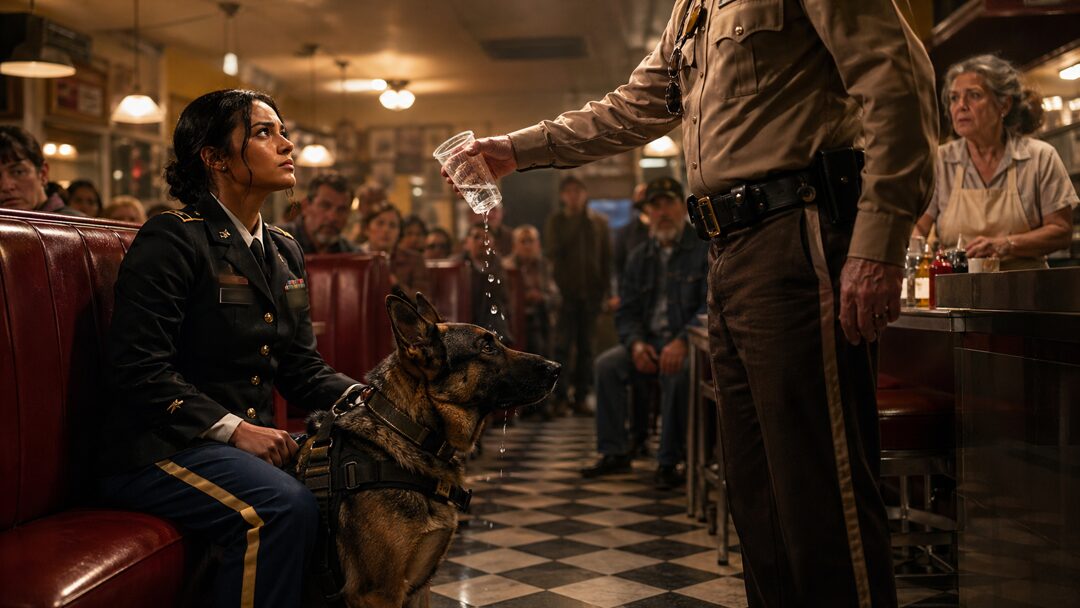
The first drop of water hit the black-and-white tile beside Atlas’s paw, and every fork in the Liberty Bell Diner seemed to stop halfway to someone’s mouth.
Mara Voss did not move.
She sat in the back booth beneath the framed photograph of the county’s first Veterans Day parade, still wearing the dress uniform she had worn to Sergeant Willis’s funeral, her polished shoes dulled by roadside dust, her hair pinned tight enough to hurt. One hand rested beneath the table, wrapped around the leather handle on Atlas’s service harness.
The German Shepherd lay pressed against her boot.
Across from them, Sheriff Cal Rusk stood with a clear plastic cup of ice water tilted in his hand.
Another drop fell.
Atlas’s right ear flicked.
Mara tightened two fingers around the harness and said quietly, “Leave it.”
Atlas left it.
That was the first thing everyone in the diner saw and would later pretend they had not understood.
Sheriff Rusk smiled.
It was the kind of smile that looked friendly from across a room and ugly from up close. His tan uniform was spotless. His badge caught the yellow diner light. His mirrored sunglasses hung from his shirt pocket even though the sun had already gone behind the gas station across the road.
“Well,” he said, loud enough for the booths along the windows to hear, “that’s a pretty big animal to have near people’s food.”
June Bell, who owned the diner and knew every face that had ever cried into coffee at her counter, stood frozen by the register with a receipt book in her hand.
A young waitress named Lina held a coffeepot over a man’s empty mug and forgot to pour.
Mara looked up at Rusk. Not fast. Not sharp. Just enough.
“He’s working.”
Rusk glanced down at Atlas.
The dog wore a black service harness with a worn patch on the side. He was large, dark-backed, amber-eyed, steady as a shadow. He was watching Mara’s knee, not Rusk’s face. He had been trained to read what people missed.
Rusk’s smile widened.
“Working,” he repeated. “In a diner.”
Mara could feel the whole room choosing silence.
The old men at the counter. The couple in the corner booth. The mother with two boys who had been whispering about Mara’s medals before Rusk walked in. All of them were suddenly very interested in coffee rings, napkins, plates, phones, anything but the sheriff holding water over a veteran’s service dog.
Mara knew that kind of silence.
It had weight.
It had rank.
It had always been easier for people to respect a uniform when the person inside it did not ask for anything.
She drew one slow breath. Atlas leaned his shoulder into her shin, a pressure point, warm and exact.
“I’m here to eat,” Mara said. “That’s all.”
Rusk gave a small laugh through his nose.
“Sure. I’m just making sure everyone’s safe.”
The cup tilted again.
This time the water landed close enough to darken the fur above Atlas’s front paw.
The dog did not rise.
Mara did not rise.
But under the table, her hand closed harder around the harness until the stitched leather pressed a line into her palm.
She had sat through mortar alarms without blinking. She had watched men twice her size vomit from fear and then stand back up because the convoy still had to move. She had learned how to keep her voice level when everything inside her was counting exits, threats, distances, hands.
The Liberty Bell Diner had two doors.
Front entrance. Kitchen exit.
Rusk stood between her and the front one.
His right hand was close to his belt.
His left hand held the cup.
The ice shifted.
For half a second, the sound was not ice.
It was brass casings on concrete.
Then Atlas pressed harder against her leg.
Mara came back to the diner.
“Sheriff,” June said carefully, stepping out from behind the counter, “Atlas has been in here before. He never bothers anybody.”
Rusk did not look at her.
“June, I appreciate that. But I’m the one who has to answer when somebody’s kid gets bit.”
No child was near Atlas.
No one said so.
Mara’s thumb found the edge of the service ribbon on her jacket. She touched it without meaning to, then stopped.
Rusk noticed.
His eyes dropped to the ribbon, then lifted to her face.
“Long day?” he asked.
Mara heard what was underneath it.
Nice uniform. Nice medals. Nice performance.
She said nothing.
That made him braver.
Part II — The Room That Watched
Rusk pulled a chair from the neighboring table and turned it backward, but he did not sit. He rested one hand on the chair back, still standing over her, making a show of patience.
“You know the rules,” he said. “Dogs aren’t allowed where food is served unless they’re real service animals.”
Mara kept her eyes on him.
“He is.”
“What does he do?”
“That’s not your business.”
A small sound moved through the room. Not quite a gasp. More like a shared inhale.
Rusk’s smile sharpened.
“That right?”
Mara felt Atlas’s breathing change first. Slow, trained breaths, but attentive. He knew her voice. He knew when it went flat. He knew when the room got too close.
“He’s trained to assist with a medical condition,” Mara said. “That’s all I’m required to say.”
Rusk nodded as if she had confirmed something.
“A medical condition.”
Lina’s coffeepot trembled. A dark line of coffee slid down its glass side and dripped onto her sneaker.
June saw it. Mara saw it. Rusk did not.
“What kind of soldier needs a dog to eat pancakes?” he asked.
The line landed clean.
That was why he used it.
It gave the people who wanted to laugh permission. No one did, but a few mouths twitched before shame caught up.
Mara’s face did not change.
Her father had taught her that.
Never let a man see the hit land, he used to say. Pain is information. Don’t hand it over free.
He had been Sergeant Daniel Voss to half the county and Dad only inside their small kitchen, where he drank coffee standing up and sat with his back to the wall.
When Mara was twelve, she had asked him why he always chose the chair facing the door.
“Habit,” he said.
When she was twenty-nine, she knew habit could be a wound that had learned manners.
Atlas shifted beneath the table, not rising, only changing the angle of his body so his shoulder touched more of her leg. A pressure command. Grounding.
Mara placed her palm flat on his harness.
“I’m asking you to step back,” she said.
Rusk looked around the diner, inviting the room into his disbelief.
“Hear that? She’s asking me to step back.”
No one answered.
That silence did more damage than the joke.
June came closer. Her gray hair had come loose from its bun, and there was flour on one sleeve of her apron. A faded flag pin was clipped near her name tag. She had worn that pin every November for twenty years. Mara remembered seeing it when she was a girl sitting beside her father, eating toast after parade mornings.
“Cal,” June said softly. “Let it be.”
Rusk finally turned his smile on her.
“June, I like your place. Always have. Don’t make me come in here next week with a health inspector because you can’t follow basic rules.”
June’s mouth closed.
There it was.
Not a shout. Not a threat the whole room could object to. Just a hand resting lightly on the throat of her business.
Rusk looked back at Mara.
“See? Nobody wants trouble.”
Mara thought of Sergeant Willis’s folded flag that morning. His wife had held it like it was still warm. Mara had stood in the second row, Atlas at heel, while people said words like sacrifice and honor and country in voices polished smooth from use.
After the service, three people had thanked Mara for her service.
One had asked if Atlas was a police dog.
One had said, “You look great. You must be doing better.”
Mara had smiled because people liked veterans best when the damage stayed invisible.
Now Rusk was pouring water beside that invisibility.
Another drop fell from the cup.
Atlas’s ear flicked again.
Rusk watched it.
Mara watched Rusk watching it.
That was the moment she understood. He was not careless. He was fishing.
He wanted the dog to react.
He wanted proof.
If Atlas barked, Rusk could say dangerous. If Mara raised her voice, he could say unstable. If June defended her, he could say the diner was in violation. If anyone filmed, he could call it interference.
He had already written the story in his head.
He was only waiting for them to step into it.
Mara swallowed once.
The ice in the cup clicked.
The spoon in the mother’s mug tapped the ceramic once, twice, then stopped when she realized everyone could hear it.
Mara’s pulse tried to become a drum.
Checkpoint.
Hot wind.
A boy on a bicycle too still beside the road.
Corporal Haines laughing five minutes before the blast because somebody had packed strawberry gum in a medical pouch.
A dog ahead of them stopping dead, hackles high, handler’s fist rising.
Mara blinked.
Red vinyl booth.
Sheriff’s badge.
Atlas breathing.
She was not there.
She was here.
But here was not safe either.
“Last time,” Mara said, voice low. “Step back from my dog.”
Rusk’s eyes lit at the word my.
“Your dog,” he said. “Thought he was medical equipment.”
The cup tipped.
Part III — The Bark
Water splashed over Atlas’s front paws.
Not a drip this time.
A deliberate spill.
The sound was small, almost ridiculous. A wet slap on fur and tile. A few ice chips bounced and skidded under the booth.
Atlas came up hard.
He did not lunge for Rusk’s throat. He did not snap. He moved exactly as he had been trained to move when Mara’s body crossed a line she could no longer name.
Between.
One bark cracked through the diner.
Sharp. Deep. Commanding.
Rusk flinched backward so fast the chair scraped and fell onto its side. His right hand jumped toward his holster and froze there, fingers splayed over leather. The cup jerked in his left hand. More water spilled down his own sleeve.
For one second, the sheriff looked afraid.
Everyone saw it.
Mara stood.
“Atlas,” she said. “Sit.”
The dog sat.
Immediately.
Water darkened both front paws. His ears remained forward. His body stayed angled between Mara and Rusk, but he obeyed.
The diner did not breathe.
Rusk stared at the dog, then at Mara, then at the room that had witnessed him jump.
His face changed color beneath the tan line at his temples.
Mara stood beside the booth now, no longer trapped under his shadow. She was not tall enough to tower over him. She did not need to be.
Rusk straightened his belt.
“That animal just threatened me.”
“No,” Mara said.
Her voice was quiet enough that people leaned in to hear it.
“He interrupted you.”
Rusk laughed once, but the laugh had no body in it.
“You don’t get to define what happened here.”
Mara looked down at Atlas. The dog’s eyes were on her now. Not Rusk. Her.
He was waiting.
Always waiting for the next true command.
Rusk recovered himself by reaching for the one thing he knew how to wear: authority.
“I can cite you for an aggressive animal,” he said. “And obstruction if you want to keep pushing.”
June inhaled.
Lina set the coffeepot down too hard. Coffee jumped from its spout and spotted the counter.
Mara felt the whole room tilt again.
Rusk had stumbled, but he had not fallen. Men like him rarely did from one mistake. They used the next minute to turn the mistake into policy, the policy into paperwork, the paperwork into punishment.
He pointed at Atlas.
“Outside. Now.”
Mara did not move.
“I said outside.”
Atlas’s paws left wet marks on the tile.
The puddle beneath him reflected the yellow ceiling light and the sheriff’s boots.
June came closer, barely.
“Cal,” she said, “there are cameras above the register.”
Rusk turned his head slowly.
The room felt colder.
“Are there?”
June’s throat moved.
“Yes.”
He smiled.
“Good. Then they’ll show the dog coming at me.”
Mara looked at the camera in the corner above the pie case. Old. Dusty. A red light blinking.
It would show angles, not intentions.
It might show water falling, but not the smirk.
It might show Atlas rising, but not the ten minutes of needling that made him necessary.
Rusk knew that.
So did Mara.
Lina’s voice came from near the counter, thin but clear.
“I have some of it.”
Everyone turned.
The young waitress stood with her phone half-hidden against her apron. Her face had gone pale under her freckles.
Rusk’s gaze landed on the phone.
“What did you say?”
Lina’s hand closed around it.
“I was recording. Not all of it. Some.”
Rusk took one step toward her.
June moved without thinking, placing herself between them.
It was not a dramatic movement. It was not brave in the way movies made brave look. It was a tired woman taking one tired step because the alternative was watching a girl get crushed.
Rusk stopped.
Lina’s eyes filled, but she did not cry.
“My brother has court next month,” she whispered. “For the speeding ticket. The one you wrote.”
Rusk’s expression softened in the worst possible way.
“Well, Lina,” he said, “then you know how important it is not to interfere with an officer.”
The phone lowered a fraction.
Mara saw it.
She also saw the shame on Lina’s face.
That was how power spread. It did not need every person to be cruel. It only needed each person to have something to lose.
Mara looked at the doorway.
She could leave.
Atlas would follow. June would apologize. Lina would delete the video. Rusk would file whatever he wanted. The town would call it unfortunate. People would say Mara had been under stress after the funeral. People would say the dog startled the sheriff. People would say both sides.
Both sides was the place truth went to suffocate politely.
Mara’s hand drifted to the pocket inside her uniform jacket.
A card waited there. State Veterans Advocacy Office. She had taken it from a woman after a support meeting she had not meant to attend and had not returned to.
Call if you need help, the woman had said.
Mara had almost laughed.
Need was a word she kept locked in rooms no one entered.
Rusk pointed to the door again.
“Move.”
Atlas remained seated.
Mara remained standing.
Her father’s voice came back.
Pain is information.
But another voice came with it this time. Haines, coughing dust after the first blast, saying, Voss, breathe. That’s an order. Then laughing because even half-buried under rubble, he thought jokes could hold the world together.
He had died before the medevac.
The dog that warned them had died too.
Mara had lived.
Survival had followed her home like a debt collector.
Atlas had not erased that debt. He had simply taught her where to put her hands when the interest came due.
Part IV — Her Father’s Chair
Rusk’s eyes narrowed.
“Voss,” he said suddenly, like he had found a handle. “You’re Danny Voss’s girl.”
Mara’s body went still in a new way.
June closed her eyes.
Rusk noticed both reactions and stepped into the opening.
“I knew your father. Whole county knew your father.” He shook his head with theatrical disappointment. “Sergeant Voss would be ashamed seeing his daughter make a scene over a dog.”
The sentence struck harder than the water.
Not because it was true.
Because part of Mara still feared it might be.
Her father had not liked weakness. Or what he called weakness. Complaints. Excuses. Public emotion. He had loved her fiercely, but his love arrived in polished boots, folded flags, practical advice, and silence so deep it sometimes felt like a locked door.
When Mara came home after the explosion, he had visited her at the rehab center.
He brought clean socks, crossword books, and a thermos of diner coffee from June’s place.
He had stood at the foot of her bed and said, “You’re alive. Start there.”
She had wanted him to sit beside her.
He had wanted her to stand before she was ready.
They had loved each other across that distance until his heart gave out two winters later, in the chair facing the front door.
Now Rusk had dragged him into the diner and propped him up like a witness for the prosecution.
Mara’s mouth went dry.
Atlas leaned against her leg.
Not between now. Against.
A reminder.
Here. Now. Breathe.
Rusk saw her hesitate and smiled again.
“That’s what I thought,” he said. “Your old man understood discipline.”
June’s voice cut through before Mara could answer.
“Danny Voss sat in that booth after every deployment.”
Rusk looked over.
June’s hands were trembling, but her voice held.
“That one,” she said, pointing to the booth near the window. “Back to the wall. Eyes on the door. Every time.”
Mara turned her head slowly.
She knew the booth. Of course she knew it. Her father had always chosen it. She had thought he liked the light.
June took another step.
“He ordered coffee black and toast dry, and if a truck backfired on Main, he’d stop talking mid-sentence.” Her eyes went to Mara. “He never said why. Nobody asked. We called it discipline because that sounded kinder than admitting we didn’t know what he carried.”
The room shifted.
Not loudly. Not enough to become courage all at once.
But something changed.
The mother in the corner pulled her boys closer, not away from Atlas, but away from the argument. One of the old men at the counter looked down at his own hands. The man whose mug Lina had forgotten to fill pushed it away untouched.
Rusk’s jaw tightened.
“That’s a touching speech, June.”
“No,” June said. “It’s a late one.”
The words hung there.
A late one.
Mara felt them settle somewhere deep, beside all the things no one had said when they might have mattered.
Rusk’s face hardened.
“Enough. I want the dog outside.”
“He has a name,” Mara said.
Rusk turned back to her.
“What?”
“His name is Atlas.”
The sheriff looked almost amused again.
“Fine. Atlas has shown aggression. Atlas goes outside while I write the report.”
The old fear rose in Mara so quickly she nearly reached for the booth.
Not fear of Rusk.
Fear of the report.
The official version.
The clean paper lie.
Aggressive animal. Uncooperative veteran. Escalated situation. Officer safety concern.
It would sound so reasonable.
That was what scared her most. Cruelty often sounded reasonable when typed in complete sentences.
Rusk took another step toward Atlas.
Mara moved first.
Not fast enough to startle the dog. Not close enough to touch the sheriff. Just one step around the booth, out from the red vinyl trap, into open floor.
Atlas stayed seated.
The wet tile shone between them.
Rusk looked down at the water. For the first time, he seemed to remember he had made it.
Mara reached inside her jacket and removed the card.
Her fingers were steady now.
She held it out to Lina, not forcing her to take it.
“There’s a veterans’ advocate on that card,” Mara said. “If you choose to send what you recorded, send it there. If you don’t, I understand.”
Lina looked at the card like it weighed more than a phone.
Rusk said, “Careful.”
Lina flinched.
June did not.
She reached out, took the card from Mara, and placed it on the counter beside Lina’s hand.
Then June looked up at the camera above the register.
“I’ll save the footage,” she said.
Rusk laughed.
“You’ll save the footage.”
“Yes.”
“You sure about that?”
June’s flag pin caught the light as she lifted her chin.
“No,” she said. “But I’m doing it.”
That was the first honest thing anyone had said about courage all day.
Part V — Between
Rusk’s face changed once more.
The friendly mask did not drop. It flattened. Became something official and blank.
“You people are making this harder than it needs to be,” he said.
Mara almost smiled.
How many times had she heard that sentence in different uniforms, different offices, different rooms?
Harder than it needs to be meant: Let me do this quietly.
Harder than it needs to be meant: Stop making me see you.
Atlas’s gaze flicked toward Mara’s hand.
She did not touch him.
He did not need reassurance. He needed command clarity.
Rusk lifted the cup slightly, as if realizing too late that it was still in his hand.
Mara looked at it.
So did half the diner.
The cup had become ridiculous now. Small. Cheap. Transparent. His fingers were wet around it. A thin trail of water ran down his wrist and disappeared under his cuff.
Mara thought of the dog overseas.
Not Atlas.
Ranger.
A lean Belgian Malinois with one torn ear and a handler named Sosa who sang under his breath when he was nervous. Ranger had stopped at the checkpoint. Sosa’s fist went up. The convoy halted. Mara remembered the sudden silence before the first explosion, the way silence could become a doorway.
Ranger had given them seconds.
Seconds were lives.
Haines had used his seconds to shove Mara behind the engine block.
Sosa had used his to reach for Ranger.
The second blast took both of them.
For months afterward, Mara hated dogs.
Then she hated herself for that too.
Atlas came later, after panic made grocery aisles impossible and fireworks put her on the laundry room floor. He did not ask her to explain. He learned her breathing. He learned the tremor before she knew it was in her hands. He learned when to lean, when to block, when to wake her from dreams where every door opened onto dust.
He was not the wound.
He was not the cure.
He was the bridge she crossed on days when her own body became unsafe ground.
And Cal Rusk had tried to turn him into evidence.
Mara looked from the cup to the sheriff’s face.
“You said he was dangerous,” she said.
“He barked at me.”
“You spilled water on his paws after I asked you to step back.”
Rusk pointed toward Atlas. “That dog came between us.”
“Yes.”
The word landed clean.
Mara took one more step, stopping at the edge of the puddle.
“That is what he is trained to do.”
Rusk opened his mouth.
Mara did not let him have the room back.
“He is trained to interrupt escalation. He is trained to create space when my body reads threat before I can speak it.” Her voice remained low. “He did his job.”
Rusk’s eyes flicked toward the counter, toward the camera, toward Lina’s phone.
Mara saw the calculation and felt something inside her settle.
Not heal.
Settle.
There was a difference.
She had spent years fearing the moment people would see the damage.
Now they were seeing the discipline.
She turned slightly, not away from Rusk, but toward the room.
“My father taught me not to make a scene,” she said. “The Army taught me to follow lawful authority. Grief taught me how long a person can stay quiet and still be breaking.”
No one moved.
Mara looked back at Rusk.
“But you are not discipline. You are not authority. You are a man with a badge and a cup of water, trying to scare a dog so you can call a veteran unstable.”
The sheriff’s hand twitched.
Atlas’s ears shifted.
Mara gave the smallest hand signal.
Atlas stayed.
Rusk saw it.
That was important. He saw it.
He saw what control looked like when it did not need volume.
Mara nodded toward the puddle.
“You wanted him to prove I was broken,” she said. “All you proved is that he knows when to stand between me and a threat.”
The line did not echo.
Real rooms did not echo.
They absorbed truth badly at first, like cloth taking on blood.
Then the old man at the counter set down his fork.
The mother in the corner said, barely audible, “My God.”
Lina picked up the card.
Her fingers shook, but she picked it up.
Rusk looked around, and for the first time since he walked into the diner, the room did not give itself back to him.
No one smiled.
No one nodded.
No one rescued him with a joke.
His badge still shone. His belt still held weight. His office still existed outside the diner doors.
But something smaller and more fragile had cracked.
The belief that everyone would help him pretend.
His radio hissed at his shoulder.
No one had called him.
He grabbed it anyway.
“Rusk,” he said into the static, then paused as if listening. “Yeah. Copy.”
The performance was so thin it almost hurt to watch.
He backed toward the door, eyes on Mara, then on Atlas, then on June.
“This isn’t over,” he said.
Mara did not answer.
June did.
“No,” she said. “I don’t think it is.”
The bell above the door rang when Rusk left.
Outside, his cruiser sat crooked across two spaces, engine running, lights off.
Inside, nobody moved until the sound of the engine faded down Main Street.
Then the diner exhaled.
Part VI — The Towel
Lina sent the video with both thumbs.
She did it standing behind the counter, the phone plugged into a charger because her battery was at nine percent and her hands were shaking too hard to trust. June stood beside her, reading the email address from the card once, then twice, then once more.
Mara did not watch over her shoulder.
She sat back down.
Not because her knees were weak, though they were.
Not because anyone told her to.
Because her coffee was still on the table, untouched and cooling, and she had ordered it before Cal Rusk walked in, before the room decided to become a courtroom, before a cup of water tried to rewrite the truth.
She sat because choosing to stay was different from being made to stay.
Atlas lowered himself beside her booth again. His wet paws marked the tile. His breathing had already returned to rhythm.
June disappeared into the kitchen and came back with a stack of clean towels.
For one terrible second, Mara thought she might apologize.
Instead, June crouched with a sound in her knees and placed one towel on the floor in front of Atlas.
“May I?” she asked.
Mara’s throat tightened.
People often reached for Atlas without asking. They saw fur before harness. Comfort before work. Dog before partner.
June waited.
Mara nodded.
“Paws,” Mara said.
Atlas lifted one front paw onto the towel.
June dried it carefully, as if the paw belonged to something sacred and ordinary at the same time.
The diner watched, but it was not the same watching.
Earlier, their eyes had pressed on Mara’s skin.
Now they made room.
The mother in the corner leaned toward her sons and whispered something too soft to hear. One of the boys looked at Atlas, then at Mara’s uniform, and did not point.
Lina came to the booth with the phone held flat in both hands.
“I sent it,” she said.
Mara looked up.
Lina’s face was still pale. Fear had not left her. Courage had simply stood beside it.
“Thank you,” Mara said.
Lina nodded too many times.
“My brother’s going to kill me.”
“Maybe,” Mara said.
Lina blinked, startled.
Mara gave her the smallest smile.
“But maybe he’ll be proud first.”
Lina pressed her lips together. Her eyes shone, but she did not cry.
June finished drying Atlas’s second paw and stood slowly.
“Coffee’s on me,” she said.
Mara reached for her wallet.
June put a hand over the check.
“No.”
“It’s just coffee.”
“No,” June said again, and this time her voice cracked. “It should’ve been just coffee when you walked in.”
Mara looked at her then.
At the flour on her sleeve. The loose gray hair. The old flag pin. The woman who had taken too long but had arrived.
Mara knew late courage did not erase early silence.
She also knew late was not the same as never.
“Thank you,” she said.
June nodded once and turned away before her face could finish changing.
Mara drank her coffee.
It had gone bitter.
She drank it anyway.
The old man at the counter cleared his throat. “Your dad used to sit right there,” he said, pointing to the window booth.
Mara looked over.
“I know.”
“He never talked much.”
“No.”
The old man rubbed the edge of his napkin between his fingers.
“I thought he was proud,” he said. “Quiet like that.”
Mara set the mug down.
“He was proud.”
She looked at Atlas, who had rested his chin near her boot.
“He was also tired.”
The old man nodded as if someone had finally given him permission to understand a memory he had carried badly.
Mara stood a few minutes later.
Atlas stood with her.
The diner did not clap. Mara was grateful for that. Applause would have made her into a symbol, and she was too tired to be useful to anyone’s idea of bravery.
June came from behind the counter and opened the front door herself.
Outside, the evening had cooled. Main Street looked the same as it had when Mara entered: pharmacy sign buzzing, flag at half-staff near the courthouse, Rusk’s cruiser gone from the lot.
Nothing was fixed.
That was the truth.
Rusk still had his badge. Lina still had a brother with court next month. June still had a business in a town where power remembered insult. Mara still had nights when the walls moved wrong and mornings when the uniform in her closet looked like it belonged to a braver woman.
But the video was sent.
The footage was saved.
The water had been wiped from Atlas’s paws, not from the record.
Mara stepped through the doorway.
The bell above her rang.
This time, when the diner looked at her, she did not feel their pity first.
She felt recognition.
Atlas paused on the sidewalk and looked up at her.
Mara touched the harness.
“Forward,” she said.
And together they crossed the parking lot, not healed, not untouched, but no longer carrying the silence alone.